
Get in touch with Shengtu Bufan Company

Pet food processing is the set of four production routes – dry extrusion, freeze-drying, hot-air drying, and retort canning – that turn raw ingredients into a specific finished-product format, and it is the format, not the species on the label, that sets the equipment a buyer actually needs.
Prepared with Shandong Shengtu Bufan Intelligent Technology Co., Ltd.’s published line specifications – Updated August 2026
Quick Specs
| Dry kibble extrusion | 8 process stages, twin-screw extrusion is the defining step, dryer/coater sizing is the primary throughput control point |
| Freeze-dried treats | 4 process stages, vacuum freeze-drying is the defining step, nutrient/pathogen stability is a food-safety-plan responsibility, not a machine spec |
| Wet / canned | 6 process stages, retort sterilization is the defining step, the scheduled thermal process is the primary control point (80–900 kg batch across 4 retort sizes) |
| Jerky / semi-moist | 5 process stages, hot-air drying is the defining step, pre-heat + chamber-uniformity evidence is the primary control point |
Pet food processing isn’t one production method – it’s four distinct routes, and the format of the finished product decides which one applies, not the species or brand behind it. Four machine types define the four routes – a dry kibble line, a vacuum freeze-dryer, a hot-air jerky dryer and a retort canning line – each removing moisture or managing pathogens through a different mechanism, so a buyer sizing equipment against the wrong route’s assumptions will get the wrong numbers before a single quote is requested.
Pet food processing covers four routes – extrusion, freeze-drying, hot-air drying and retort canning – each removing water or managing pathogens differently. Market size is projected to grow from $6.43 billion in 2026 to $10.39 billion by 2034. Which route fits the product is the buyer’s first decision.
In this guide
- Format decides the production route, not the pet species – a dog and cat kibble recipe share a line more easily than kibble and freeze-dried treats for the same species.
- Drying isn’t automatically a validated pathogen-lethality step in three of the four routes; only retort canning is built for thermal lethality by regulatory design, though the extrusion cook step does provide partial protection.
- Freeze-drying and continuous kibble extrusion sit at opposite ends of the batch versus continuous spectrum, the sharpest either/or choice the Four-Route Compatibility Grid below captures.
- Pet food is regulated as animal food under FSMA’s 21 CFR Part 507 – a separate legal track from the Part 117 rules most generic “food processing” guides assume.
- The clearer 2025-2026 signal isn’t the market’s overall growth rate – it’s a shift toward plants that can run more than one format, not just scale up a single route.
6.17%market CAGR, 2026–2034
4distinct production routes
80–900 kgShengtu’s retort batch range
What Pet Food Processing Covers
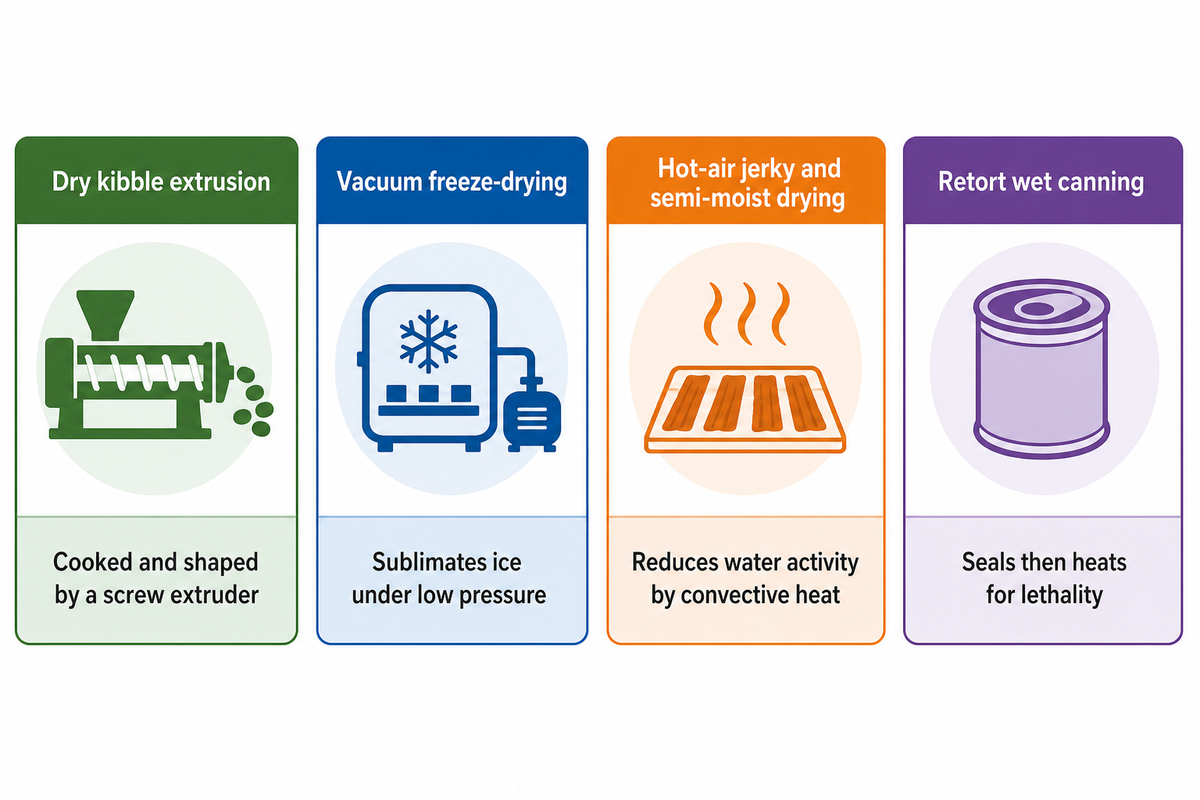
“Pet food processing” is an umbrella term for four production methods that turn raw food ingredients into finished food products. This category is sized at roughly $6.43 billion in 2026, projected to reach $10.39 billion by 2034 at a 6.17% compound annual growth rate, per Fortune Business Insights – but that number blends four routes that don’t compete with each other so much as serve entirely different product formats. Dry pet food accounts for roughly 63% of that category by value, with wet and canned formats making up about 37% – a split that roughly tracks which of the four routes gets specified most often.
Those four routes are: dry kibble extrusion, which cooks and shapes a recipe through a screw extruder into the familiar kibble pellet; vacuum freeze-drying, a batch process that sublimates ice directly out of a product under low pressure to make shelf-stable raw-style treats; hot-air jerky and semi-moist drying, which reduces water activity in strips or chunks through convective heat rather than freezing; and retort wet canning, which seals product in a container first and then applies heat to achieve microbial lethality through a controlled thermal cycle inside the sealed pack. Each is a different answer to the same underlying question – how does this specific product become shelf-stable – and the answer that fits a dry, crunchy kibble is close to irrelevant for a soft, high-moisture treat.
This is why it isn’t species, it’s format that’s the variable that actually controls the path. An extrusion plant that runs both dog food and cat food kibble on the same line needs only to worry about two recipes, whereas a plant trying to run kibble and freeze-dried treats for one species is managing two completely separate businesses in one building: the equipment, batch economics, and food-safety control points don’t overlap. Treating these four routes as variations on one machine, rather than four separate capital decisions, is the assumption most likely to produce a mis-sized quote.
Dry Kibble Extrusion
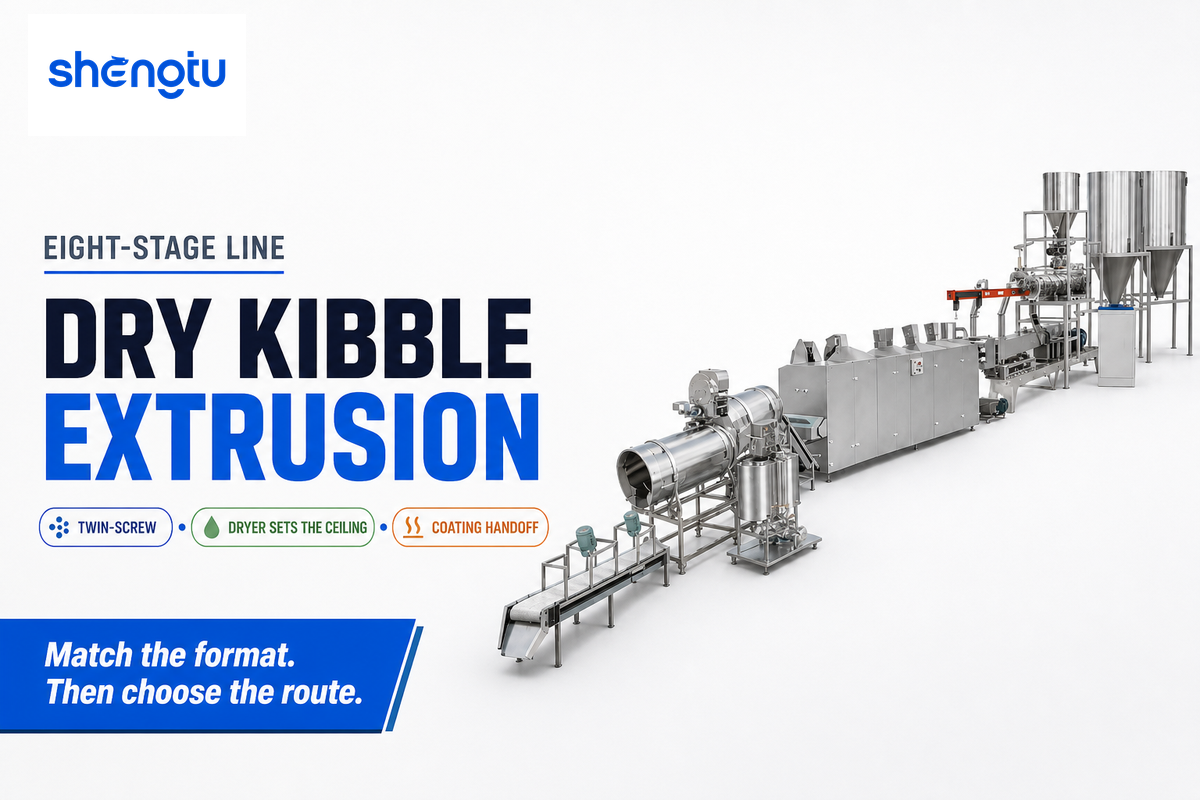
Dry kibble extrusion takes a ground, conditioned formula and turns it into the shelf-stable pellets that make up most dry pet food, typically in a single- or twin-screw extruder, which cooks the product through heat and pressure and shapes it through a die before a knife slices it to length. Twin-screw extruders are commonly specified for higher-fat or more complex recipe formulations because they distribute fat and moisture uniformly across the barrel much more effectively than a single-screw extruder, and this affects the density and coating absorption of the final kibble product very directly during later parts of the line.
Shengtu’s own extrusion-line configuration runs an 8-stage sequence, batching/dosing, grinding, mixing and conditioning, twin-screw extrusion, shaping and cutting, multi-layer drying, coating and seasoning, then conveying and packaging. The stage that most often gets underestimated when a buyer is comparing quotes is the dryer, not the extruder. An extruder’s rated throughput describes what the screw can physically push through the die; it says nothing about how fast the resulting pellet can actually be dried to a stable moisture content, and in practice the dryer and coater set the real ceiling on the line’s output far more often than the extruder does.
💡 Engineering Note
Size the dryer and coater to the extruder’s rated output with headroom, not a 1:1 match. Don’t size the dryer exactly to the extruder’s paper throughput, because it will become the bottleneck for the line at even small moisture variations in the recipe, environmental humidity variations, or pellet-density drift from the design case.
For a more detailed explanation of where actual kibble lines tend to bottleneck in real operation – including what the typical failure modes look like in a newly commissioned line, see Shengtu’s dry kibble extrusion line troubleshooting guide. Once the route itself makes sense, the stage-by-stage configuration, capacity matching, and acceptance criteria behind that buying process are covered on the dry kibble line’s dedicated equipment page.
Freeze-Dried Pet Treats
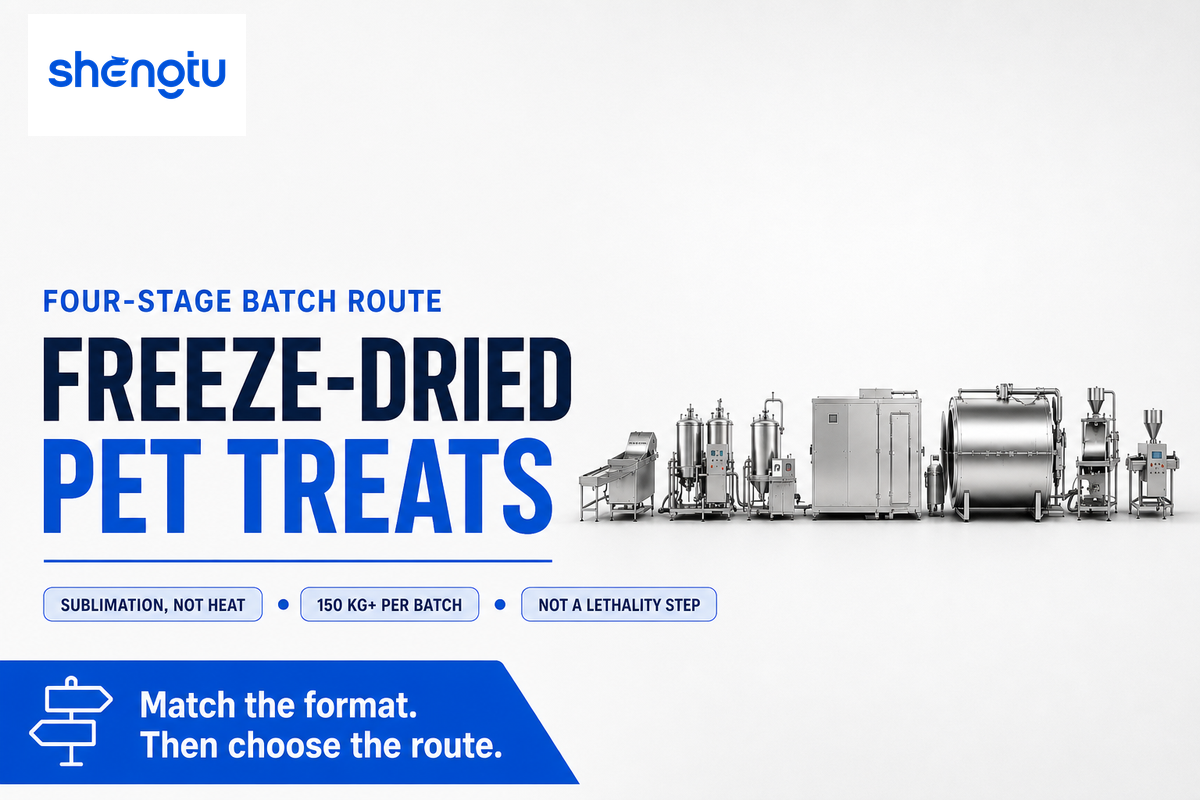
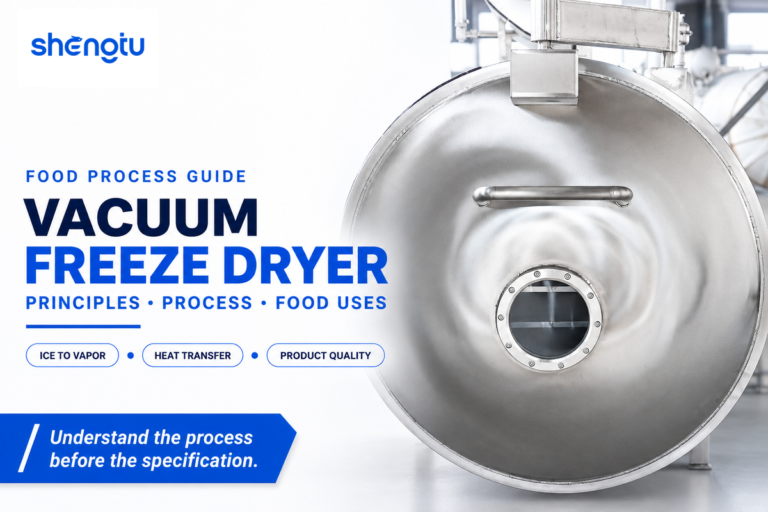
Vacuum freeze-drying, also called lyophilization, keeps a treat shelf-stable by freezing it solid and then extracting the ice directly as vapor by reducing the pressure – sublimation – as opposed to evaporating water that was never frozen in the first place, the way hot-air dryers do. This is also why pet-treat freeze-drying runs as a batch process rather than a continuous one: each load has to be frozen, primary dried, and secondary dried in a sealed chamber. Continuous, conveyor-fed vacuum freeze-drying does exist commercially – instant coffee is the best-known example – but it hasn’t caught on in the pet-treat category the way batch chambers have.
One strange fact to get out of the way early: a higher vacuum doesn’t speed a freeze-drying cycle up. General freeze-drying guidance keeps the chamber pressure well below the vapor pressure above the ice surface in the piece, but not at the deepest vacuum achievable – because past a certain point the residual gas that helps conduct heat into the ice thins out, so the deeper the vacuum is taken the more difficult it is to transfer heat in and the slower the cycle may actually run. Equipment vendors make the same point about drying speed versus product quality: blasting the highest possible heat is not always the best option, since speed and product quality trade off against each other.
Shengtu’s freeze-dried pet treat line proposal baseline runs at 150 kg or more per batch, roughly 20 square meters of effective drying area, a shelf temperature range of -45°C to +80°C, a cold trap holding -60°C or colder, and 300 kg or more of rated ice-capture capacity per drying cycle (an independent condenser-capacity minimum, not a fixed ratio to the 150 kg batch-load minimum above), figures that size the chamber and refrigeration plant around the batch, not around a continuous throughput number the way an extrusion line would be specified. At the top of that range, the freeze-dryer module’s own installed electrical load runs up to roughly 88 kW at 380V/50Hz – a figure worth checking against the plant’s actual electrical service before a chamber size gets locked in, since it doesn’t scale in a simple straight line with batch weight.
A sizing mistake you see often is a producer sizing a freeze-dryer they plan to use for pet-meat and -poultry treats using the water content of plant-derived produce as the sizing metric. High-moisture produce commonly runs 80-95% water as harvested. USDA’s own published figures put raw beef and poultry cuts at roughly 56-73% water depending on cut and fat content instead – fattier cuts running toward the low end, leaner cuts like beef eye of round running toward the high end. Sizing a jerky-adjacent or pet-treat freeze-dryer off the produce band systematically overstates the incoming water load the equipment actually has to remove.
⚠️ Important
Freeze-drying is not automatically a pathogen-lethality step. Removing moisture and water activity lowers the risk of microbial growth, but it doesn’t reliably inactivate pathogens already present in a raw input. That gap isn’t theoretical — nutrient stability and pathogen stability are both real, distinct risk categories in raw and freeze-dried pet food, and both are the kind of failure a food-safety plan has to catch on its own, since nutrient and pathogen stability in a freeze-dried product are a formulation and validated-process responsibility that sits with the food-safety plan, not something the freeze-dryer itself confers by running the cycle.
For the configuration specifics, material preparation, freeze-drying parameters, metal detection, and packaging handoff, see the freeze-dried pet treat production line page. Shengtu’s dedicated vacuum freeze-dryer platform page covers the equipment itself in more depth, independent of the pet food application.
Pet Jerky and Semi-Moist Treat Drying
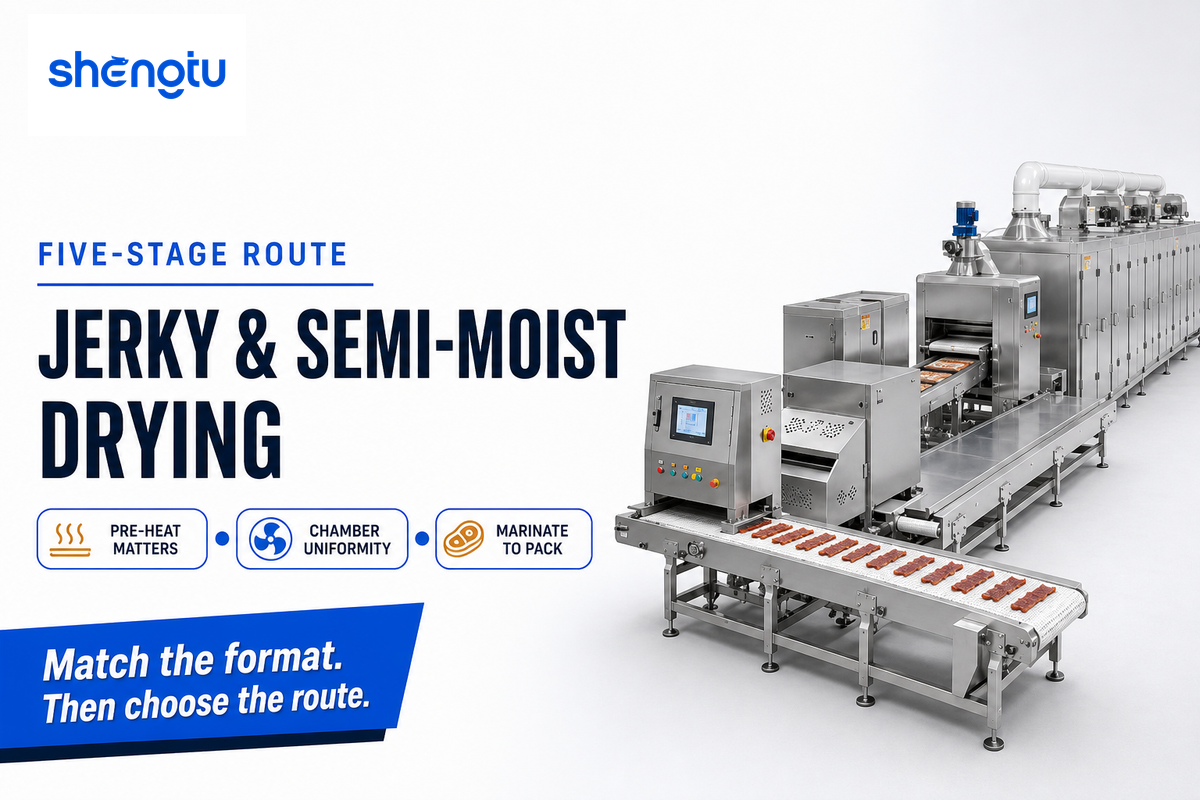
Unlike the freeze-drying route just covered, jerky and semi-moist treat production runs cutting, marinating, hot-air drying, metal detection, and packing in sequence, and the drying stage is where the most misunderstood food-safety question in this whole category lives: drying by itself isn’t a lethality step. Inside a dehydrator or a low-temperature oven, evaporating moisture absorbs most of the applied heat, so the meat itself doesn’t actually start rising in temperature until most of that moisture is already gone, which means any pathogens present have more time to become heat-resistant before the product ever reaches a temperature that would kill them.
This is the physical reason USDA recommends pre-heating meat to 160°F and poultry to 165°F to destroy harmful bacteria before drying begins, then holding 130-140°F through the drying cycle itself. Two scope notes matter for a commercial buyer reading that figure: first, this specific guidance is published by USDA’s Food Safety and Inspection Service for home-dehydrated jerky, under USDA’s jurisdiction over meat and poultry; pet treats fall under FDA’s animal food rules instead, so a commercial pet-treat producer’s own validated process is what governs, not this consumer figure directly. Second, USDA’s own page confirms commercially made jerky safety is established through federally inspected plants running their own monitored process, not through duplicating a home dehydrator’s exact numbers. The physics, that drying alone doesn’t kill pathogens and pre-heating buys a safety margin, is the same on both sides of that jurisdictional line, which is why the number gets referenced across the industry even outside its original scope.
On the equipment side, Shengtu’s KHG batch ovens run 250–500 kg per load, and the continuous option is a 1,000mm mesh-belt dryer at roughly 14.25 kW of total installed power (the line supports electric, steam, gas, or heat-pump heat sources, so how that power splits between drive/control load and heating duty depends on which one is specified), running a 50–95°C, 6–15 hour drying window depending on product thickness and target water activity. At the smaller end of the same line, the strip cutter that feeds it draws only about 1.5 kW – a reminder that on a jerky line, installed power scales with the drying stage, not the cutting stage. Chamber-uniformity matters because a set-point reading at the sensor doesn’t guarantee the same temperature at every strip on the belt, and the gap between the two is what actually drives batch-to-batch consistency. That is the practical reason chamber-uniformity data is worth asking for on its own, not folded into a single drying-time spec.
💡 Pro Tip
Ask a jerky-line supplier for pre-heat step evidence and chamber-uniformity data – not just a drying-time spec. Drying-time alone can’t tell you whether every strip on the belt actually reached the target pre-heat and hold conditions, which is the variable that actually controls the food-safety outcome.
See the pet jerky and semi-moist drying line page for batch and continuous configuration options, or Shengtu’s mesh-belt hot-air dryer platform page for the dryer itself outside the pet food context.
Wet and Canned Pet Food
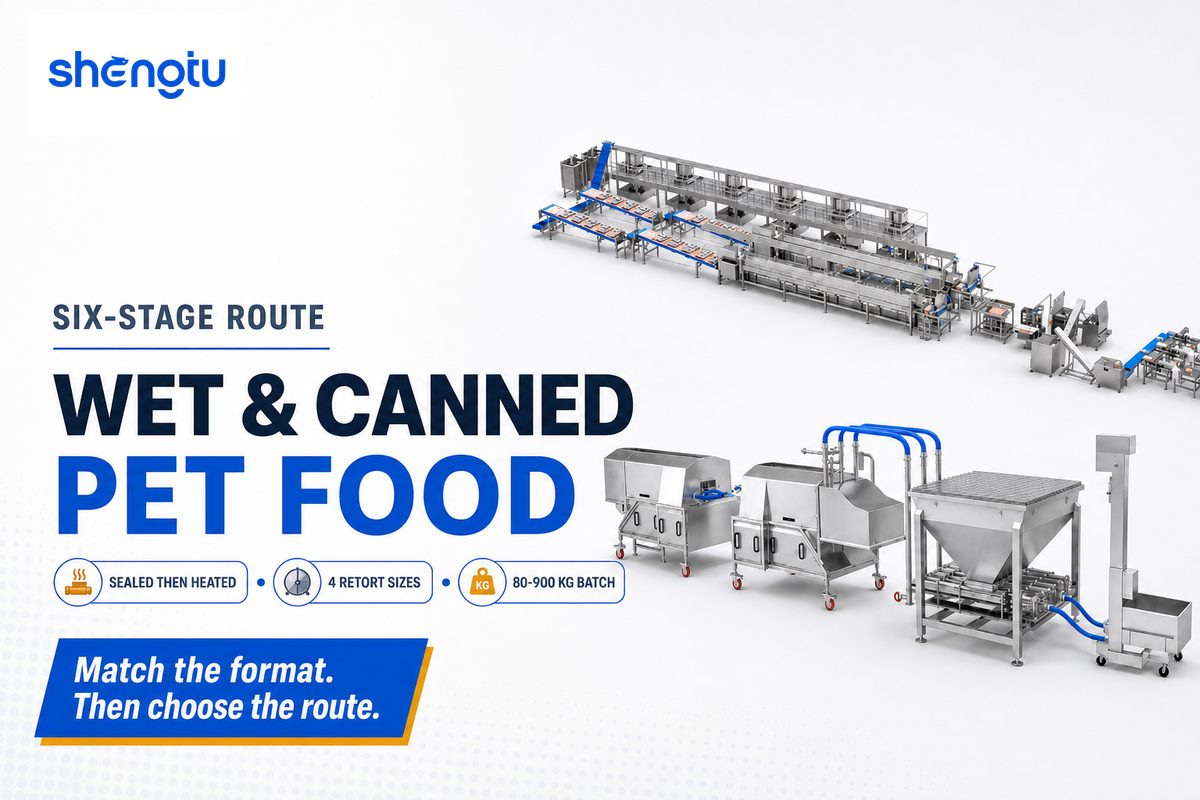
Wet and canned pet food runs dicing, filling, seaming, retort sterilizing, air drying, and labeling – and unlike the other three routes, wet food production is the one where the equipment itself achieves microbial lethality by design, because the product is sealed inside its final container before the heat is ever applied.
Shengtu’s retort equipment spans four vessel sizes from roughly 80 kg (a 700mm chamber) up to roughly 900 kg (a 1,200mm chamber, 2 m³ flagship), built in 304 stainless, with filling throughput up to 2,800 cans per hour at 3% or better accuracy and seaming rates of 15–50 cans per minute across a can-size range of roughly 50–127mm in diameter by 50–200mm in height.
The distinction that matters most for a buyer evaluating any retort supplier is validation versus verification versus monitoring, and who’s actually responsible for each. Validation is the one-time (or periodically repeated) scientific work that establishes a thermal process actually achieves the required lethality for a specific product and container – this has to come from a qualified processing authority, not the equipment vendor. Verification confirms the validated process is being followed correctly during production. Monitoring is the real-time tracking of the process parameters – temperature, time, pressure – during each individual retort cycle. A retort machine can execute a schedule precisely; it can’t establish on its own that the schedule is correct for a given recipe and container size.
💡 Engineering Note
21 CFR 507.5(b) gives low-acid canned animal food a genuinely narrow exemption from certain Part 507 requirements; it applies only to Subpart C and Subpart E, only for microbiological hazards, and only when the facility is already operating under Part 113’s low-acid canned food rules. Outside that narrow exemption, a wet-canning line still carries Part 507’s general animal food obligations alongside Part 113’s thermal-processing requirements, not one instead of the other.
On the equipment side, three Part 113 sections define what a retort supplier and processor each need to have in place: 113.40 covers equipment and procedures – including the temperature-indicating device accuracy Shengtu’s own retort specification references; 113.83 covers establishing the scheduled process itself, which by regulation has to come from a qualified person relying on a competent processing authority’s procedures, not the machine builder; and 113.100 covers the processing and production records that document each batch actually ran the scheduled process. None of the three make the equipment vendor responsible for the food-safety outcome – they define what the processor’s own program has to produce, with equipment that’s built to support it.
See the wet pet food canning line page for the four retort vessel sizes and filling/seaming configuration options.
Choosing the Right Route, The Four-Route Compatibility Grid
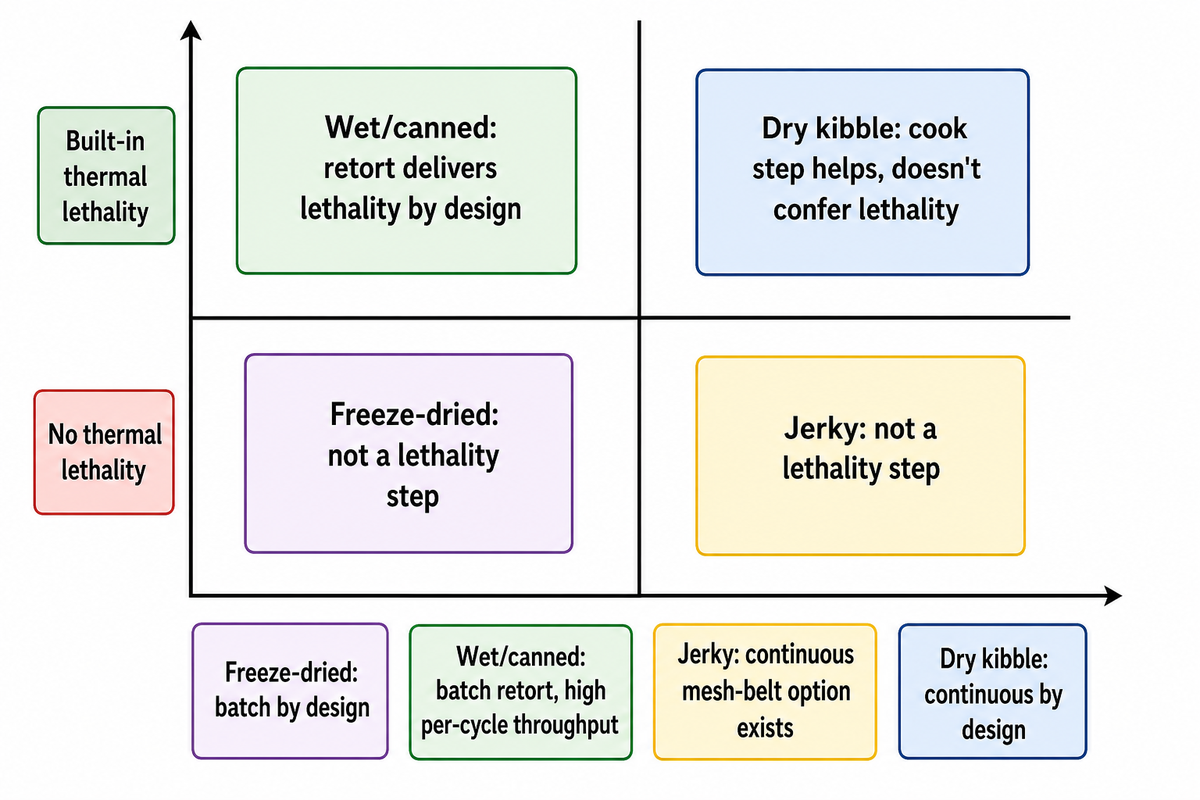
Retort wet canning is the only one of the four routes built for thermal lethality by design – exactly the kind of route-defining difference the Four-Route Compatibility Grid is built to surface. The Grid checks a product’s moisture target, texture goal, and batch-versus-continuous fit against all four routes at once, so any mismatch shows up before a single supplier conversation.
| Product variable by route type | Dry kibble extrusion | Freeze-dried treats | Jerky / semi-moist | Wet / canned |
|---|---|---|---|---|
| Low final moisture target (crunchy, shelf-stable dry) | Fit — this is the route’s defining output | Partial fit — very low moisture, but a different texture profile | No fit — semi-moist by design | No fit — wet product by design |
| Raw or minimally cooked texture/nutrient profile | No fit — extrusion cooks the recipe | Fit — sublimation preserves raw structure | Partial fit — heat-dried, not raw | No fit — thermally processed by design |
| Shelf stability from thermal lethality (not just low water activity) | Partial fit — extrusion cook step helps, drying alone doesn’t confer it | No fit — not a lethality step | No fit — not a lethality step | Fit — retort delivers lethality by design |
| High-volume continuous production fit | Fit — continuous by design | No fit — batch by design | Partial fit — continuous mesh-belt option exists alongside batch ovens | Partial fit — batch retort cycles, but high per-cycle throughput |
| Typical batch or cycle size | No batch ceiling — continuous line output | 150 kg or more per batch (chamber-limited) | 250–500 kg per batch oven, or continuous mesh-belt | 80–900 kg per vessel across 4 retort sizes |
| Capital cost per unit of throughput | Fit — lower cost per unit at continuous scale | No fit — capital-heavy per unit, chamber and cold-trap dominate | Partial fit — moderate, oven/dryer sizing driven | Partial fit — moderate to high, vessel-size driven |
| Who is responsible for validating food safety | Facility’s own hazard-analysis and preventive-controls plan | Facility’s own hazard-analysis and preventive-controls plan | Facility’s pre-heat and chamber-uniformity monitoring process | Qualified processing authority establishing the scheduled process |
| Primary buyer-facing positioning | Cost-efficiency at scale | Premium, raw-style positioning | Simple treat-category format | Shelf-stable without refrigeration |
| Typical finished-product packaging | Bagged bulk kibble | Sealed pouches or treat bags | Strips or chunks in bags or pouches | Sealed cans or retort pouches |
Dry kibble extrusion
- Continuous, high-volume production
- Lower cost per unit at scale
- Cooked texture and moisture target
- Extruder throughput is only the paper ceiling — dryer/coater sizing sets the real one
Vacuum freeze-drying
- Batch production, capital-heavy per unit of throughput
- Premium raw-style texture and nutrient retention
- Not a pathogen-lethality step on its own
- Chamber and cold-trap sizing driven by batch water load, not a continuous rate
Reading the Four-Route Compatibility Grid as a decision path: if the product needs a low-moisture, cooked, crunchy format at continuous high volume, dry kibble extrusion is the starting point. If it needs a raw-style texture and premium positioning and the plant can absorb batch economics, freeze-drying is the route, but plan the food-safety validation separately, since the process itself doesn’t provide lethality. If it’s a semi-moist or jerky-style treat, hot-air drying fits, provided the pre-heat step and chamber uniformity are engineered in, not assumed. If the product needs to be shelf-stable without refrigeration and without relying on low water activity at all, retort wet canning is the only one of the four routes built for that outcome by design. For a guided, interactive version of this same fit check, see Shengtu’s format-to-production-route selector.
Food Safety and Regulatory Compliance: Animal Food, Not Human Food, Rules
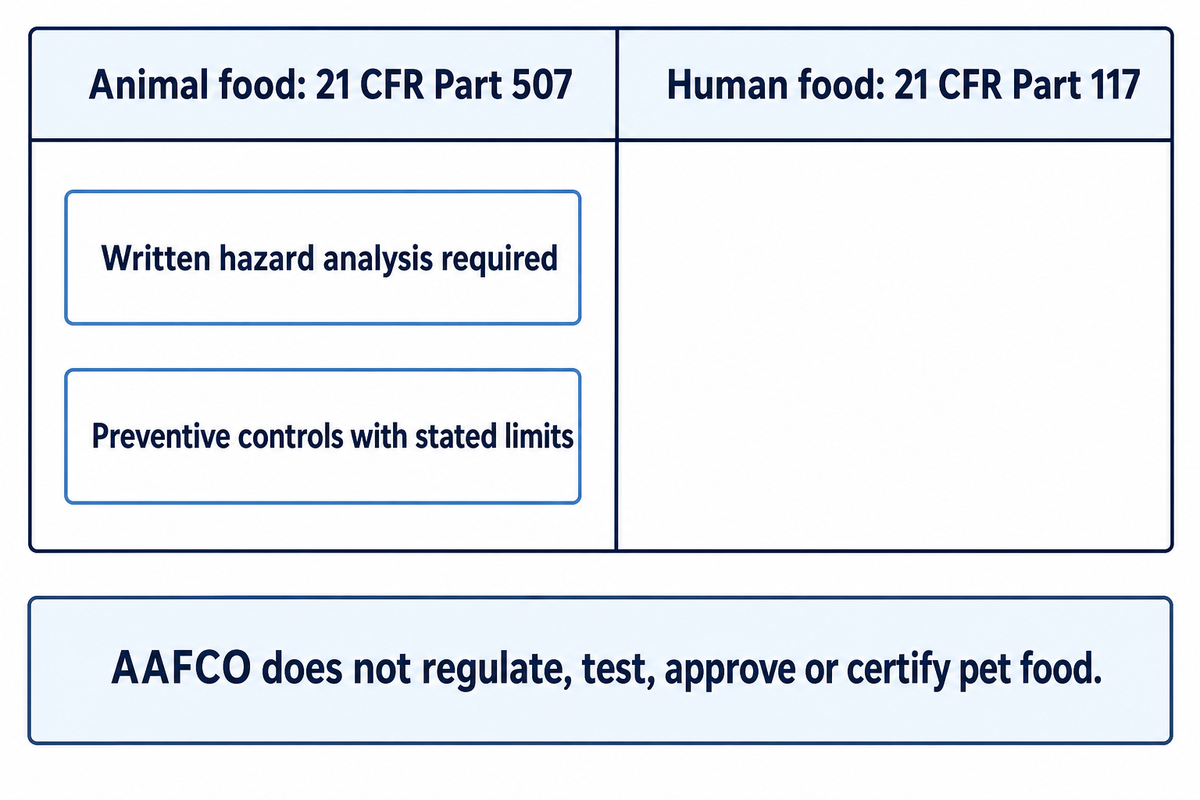
Pet food is legally animal food in the US, and it is governed by its own branch of FSMA – the Preventive Controls for Animal Food rule at 21 CFR Part 507. That is a separate regulatory track from Part 117, the rule most generic “food processing” content assumes applies. A processor building a food-safety plan around Part 117’s human-food requirements is working from the wrong rulebook.
Formally titled the Current Good Manufacturing Practice, Hazard Analysis, and Risk-Based Preventive Controls for Food for Animals rule, Part 507 created two requirements in one: current good manufacturing practice (CGMP) foundation sanitation and manufacturing procedures, and the hazard analysis preventive controls (PC) rules below. Firms who treat their CGMPs as a checklist separate from the hazard analysis already have a myopic understanding of Part 507’s expectations.
Part 507’s core obligations are concrete, not aspirational. 21 CFR 507.33 requires a written hazard analysis for every type of animal food manufactured at a facility, covering biological, chemical, and physical hazards; the hazard analysis has to be written regardless of what it concludes. 21 CFR 507.34 then requires written preventive controls with stated maximum or minimum parameter values wherever a process control applies, plus sanitation controls, supply-chain controls, and a recall plan. These are facility-level, process-level obligations; they describe what the processor’s food-safety program has to contain, not what a piece of equipment does on its own.
One correction worth making explicitly: AAFCO doesn’t certify or endorse pet food. According to AAFCO’s own published position:
“AAFCO does not regulate, test, approve or certify pet food.”
Instead, AAFCO produces model regulations and nutrient profiles – the technical basis manufacturers use to formulate balanced diets and support consistent pet nutrition outcomes – for government adoption into law and develops feed ingredient definitions, but GRAS (Generally Recognized as Safe) status itself is established either through FDA’s voluntary notification process or independently through a company’s own self-affirmed determination backed by qualified experts – neither pathway runs through AAFCO, and AAFCO doesn’t test, approve, or certify individual products. The distinction between standard-setting and product-level certification is a common point of confusion in pet food marketing more broadly.
⚠️ Honest limitation
An equipment set doesn’t intrinsically produce safe food. A validated hazard analysis, written preventive controls, and a functioning recall plan are the job of the facility running the equipment – the buyer’s own food-safety plan – not something a processing line comes with pre-installed. Any supplier who implies otherwise is overselling what a machine can do.
Evaluating Equipment Cost and Total Cost of Ownership
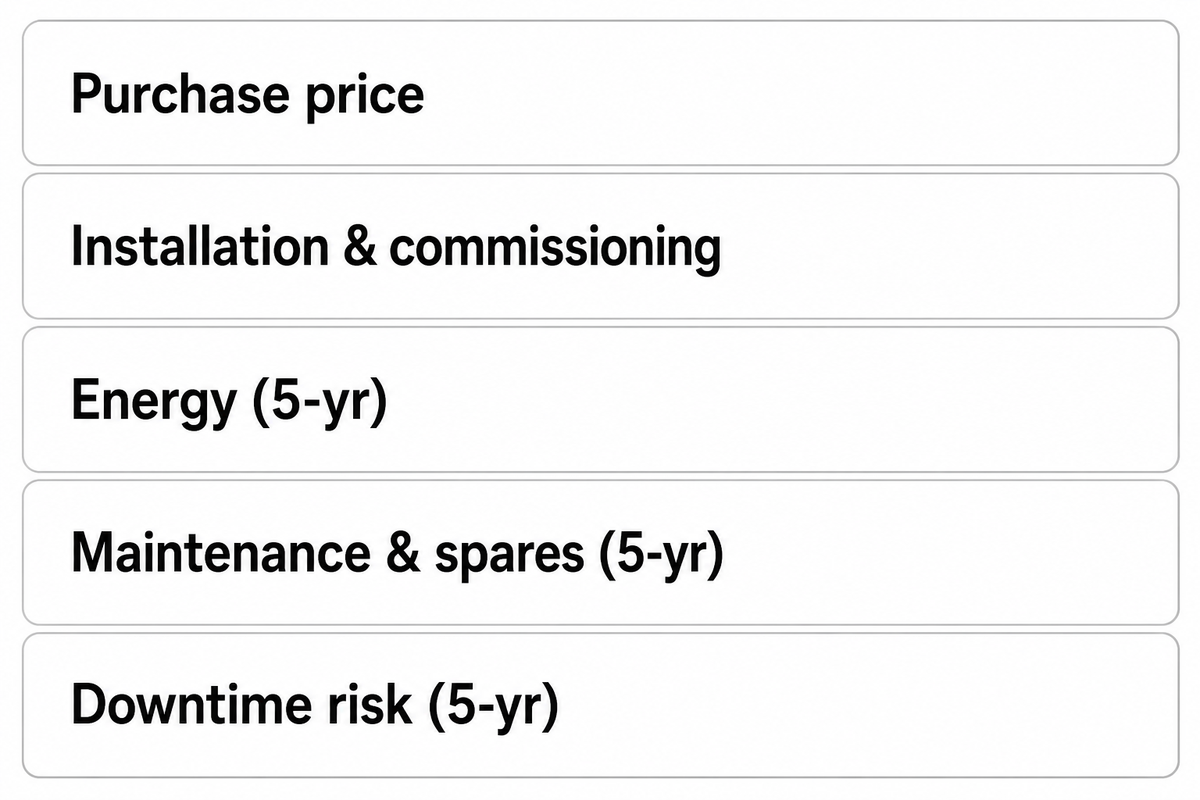
Food-safety compliance is the facility’s responsibility, not the equipment’s, but the equipment purchase itself still has to be evaluated on more than sticker price. Comparing two pet-food processing equipment quotes on the price alone gives you almost nothing for a real-world comparison considering installation, energy, maintenance, spares, and downtime risk over a realistic ownership horizon. Any actual differences separating one bid from another are almost always absent from page one of either document.
For true like-for-like purchasing, a comparison needs five line items priced over the same horizon for every option: purchase price, installation and commissioning, energy cost over the ownership period, maintenance and spares over the same period, and the cost of downtime risk, which depends on how often a component fails and how long it takes to get a replacement part or technician on site.
5-year total cost of ownership — what to price out for any two quotes:
| Cost item | What to ask each supplier |
|---|---|
| Purchase price | Confirm what’s included — controls, spare-parts kit, and commissioning support are frequently quoted as add-ons |
| Installation & commissioning | On-site labor, utility hookups, and factory acceptance testing before handoff |
| Energy (5-yr) | Rated power draw at actual operating load, not nameplate maximum, multiplied by realistic run hours |
| Maintenance & spares (5-yr) | Wear-part replacement schedule and whether critical spares are stocked locally or ship from overseas |
| Downtime risk (5-yr) | Mean time to a technician or replacement part on site — this is where an overseas-only supplier’s real cost usually hides |
Payback figures quoted in this specific part of the industry don’t tend to hold water across different recipes and lines – capital intensity, utility rates, and labor cost vary too much by site for a single number to be honest. What does hold: the relative weight of each cost line shifts by route and site, which is exactly why the five-item table above – rather than a single payback number – protects a buying decision. Shengtu’s six-variable quotation scoring tool walks through the same comparison against a specific quote.
Choosing a Processing Equipment Manufacturer
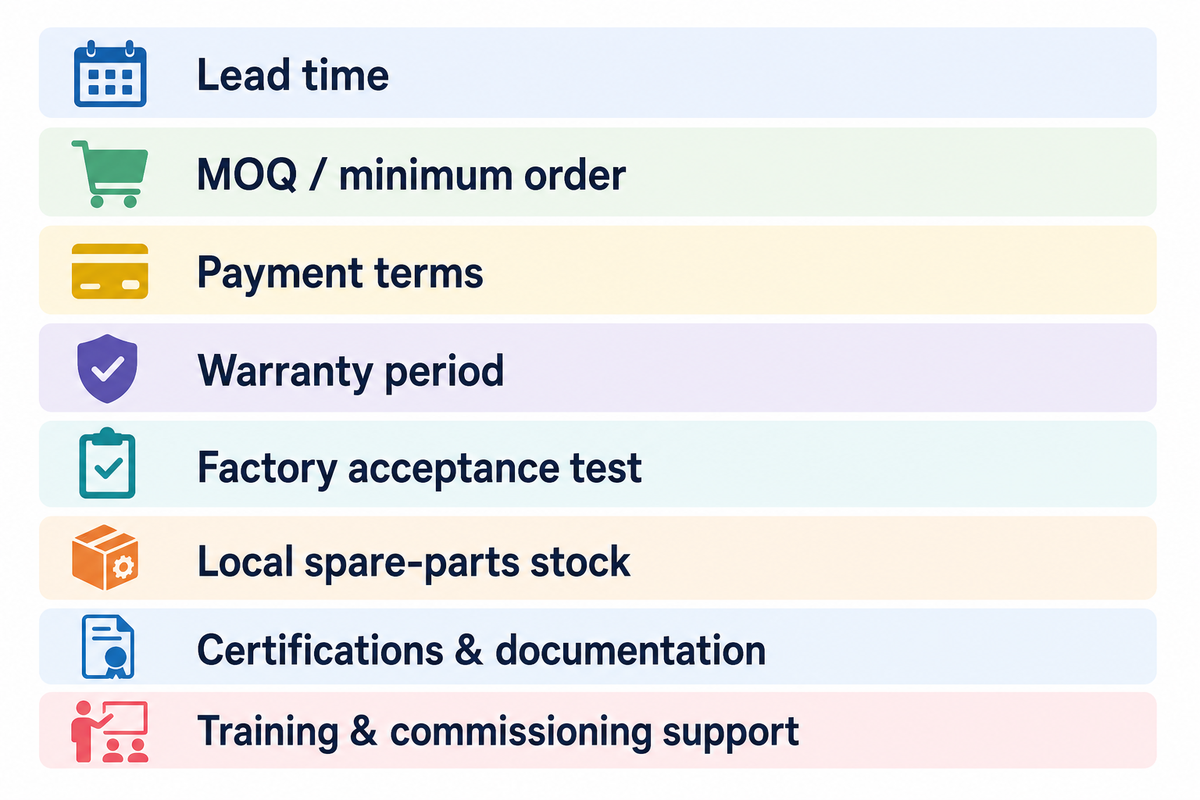
Total cost of ownership only tells half the story — who you buy from matters as much as what the five-item comparison adds up to. Buying and evaluating pet food machinery now involves considering not just the market’s large-scale equipment segment that pet food manufacturers researching this category will run into (Buhler and GEA lead this equipment category by share, alongside specialized regional builders — Buhler Holdings at roughly 19%, GEA Group AG at about 16%, per the same Fortune Business Insights report), but also smaller, more focused equipment producers scattered in regional locales. Scale isn’t the deciding factor by itself; what actually separates a good quote from a risky one is whether the supplier answers the following points before a contract is signed.
RFQ checklist — copy these into your quote request:
| Parameter | Recommended range | Why it matters | How to verify |
|---|---|---|---|
| Lead time | Stated in working days, not calendar days | Peer supplier pages rarely publish this at all — its absence is itself a signal | Ask for a written delivery date tied to deposit date, not a range |
| MOQ / minimum order | One set for most custom-configured lines | Some suppliers quote per-station minimums that inflate the real order size | Get MOQ in writing per line item, not just for the full line |
| Payment terms | Deposit + balance before shipment is standard for custom equipment | Payment structure affects cash flow planning as much as price does | Confirm milestone triggers (design approval, FAT pass, shipment) in the contract |
| Warranty period | Commonly 1–2 years on core mechanical components | Warranty scope (parts only vs. parts + labor) varies more than the headline duration | Get exclusions in writing, especially for wear parts |
| Factory acceptance test | Documented FAT with the buyer’s actual recipe/product, not a generic demo | A line that passes a demo run on a different product can still fail on yours | Request FAT protocol and pass/fail criteria before deposit |
| Local spare-parts stock | Critical wear parts stocked in or near the destination market | Directly drives the downtime-risk line in a total-cost-of-ownership comparison | Ask for the actual parts list and current stock location, not a general claim |
| Certifications & documentation | CE marking (EU) or destination-market equivalent, plus material certificates for product-contact stainless parts | A missing certificate becomes a customs and insurance problem after the equipment ships, not just a paperwork gap | Request certificate copies and the issuing body’s name, not a logo on a spec sheet |
| Training & commissioning support | On-site or remote operator and maintenance training included through handover | Determines how fast a new line reaches its rated output after installation, separate from whether it simply passes FAT | Ask how many training days are included and whether they’re on-site or remote-only |
A pattern that shows up across supplier pages in this space: most publish either real technical specifications or real commercial terms, lead time, MOQ, payment terms, but rarely both together. A supplier willing to put lead time and payment terms in writing alongside their technical specs, before a deposit changes hands, is answering the question most peers leave for a phone call.
Where Pet Food Processing Is Headed
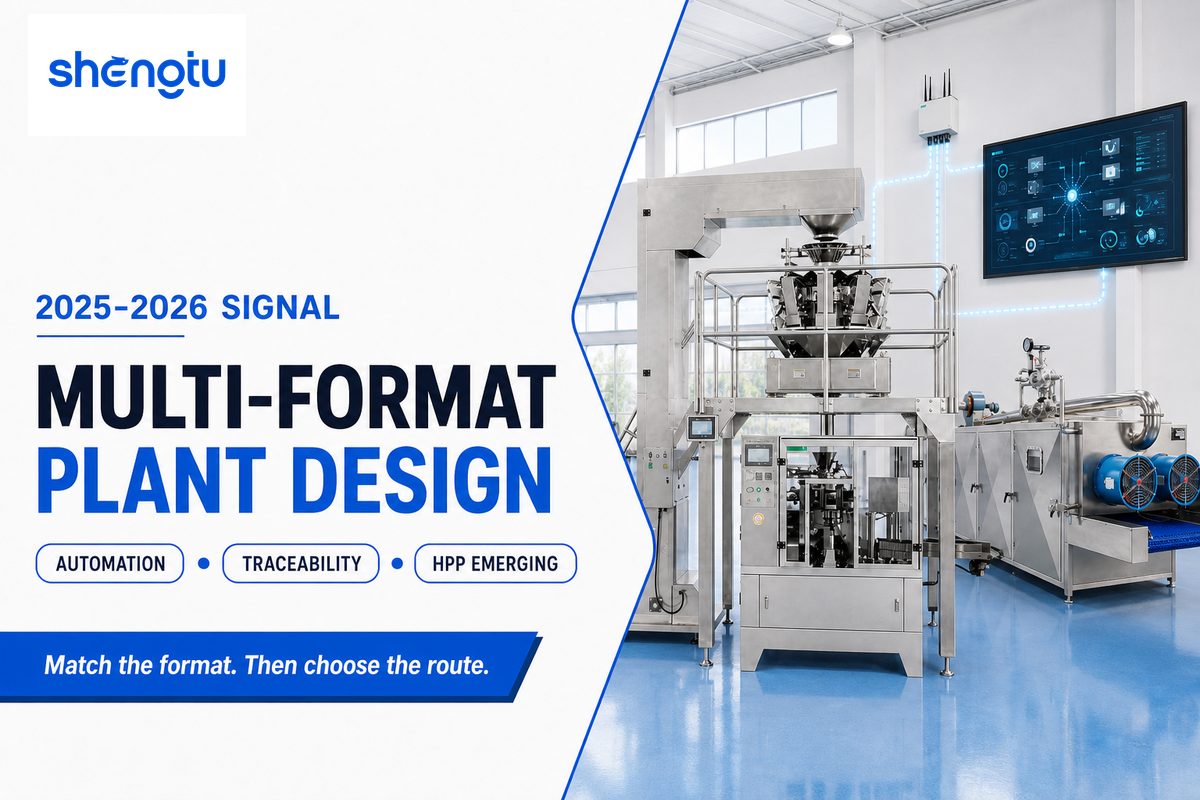
Choosing the right manufacturer today should also account for where the category is going. What jumps out for now, out of the 2025-2026 data, is a clearer movement away from single-route output and toward flexible multi-product design, driven by pet owners wanting freshly made, freeze-dried, or wet formats alongside standard extruded kibble. That shift comes down to plant design, not just extruder size.
Behind that change: the market is still forecast to expand from roughly $6.43 billion in 2026 to $10.39 billion by 2034 at a 6.17% CAGR; automation and traceability adoption is proceeding rapidly across food manufacturing generally, while non-thermal processing technologies are emerging for raw and fresh formats specifically. One notable example is high-pressure processing (HPP): independent peer-reviewed studies record pathogen inactivation from approximately 250-750 MPa depending on the desired organism, with approximately 586 MPa for three to four minutes producing 5-log reductions of Salmonella and Shiga-toxin-producing Escherichia coli in pet food formulations. HPP adoption in pet food remains very new compared to thermal- and dry-based routes, but it’s a real option for raw and fresh formats specifically, worth knowing about even for a buyer whose current product doesn’t need it yet. One area to keep an eye on: plasma treatment and other non-thermal methods are attracting active research interest, even though adoption in commercial pet food production is still limited – a reminder that research activity and commercial rollout don’t necessarily move on the same timeline.
Key takeaway
A plant specified only for its current single-route volume is being specified for 2024, not 2026 — the safer design brief now asks whether the layout and controls can absorb a second format later without a rebuild.
Frequently Asked Questions
Q: What’s the difference between pet food processing and general food processing?
Pet food processing is legally and operationally distinct from human food processing because pet food is classified as animal food under FSMA, even though many of the actual production steps look similar on the plant floor.
The two overlap on core process types like extrusion, drying, and thermal processing, but pet food falls under 21 CFR Part 507 (animal food) instead of Part 117 (human food): a distinction that affects the hazard-analysis and preventive-controls scheme a facility must operate, even if the equipment itself appears similar to a human-food line.
Q: What equipment do I need to start a pet food processing line?
Equipment needs depend entirely on which of the four routes the product format requires; there is no single standard pet food line that fits kibble, treats, jerky, and canned formats equally well.
A dry kibble line requires batching, grinding, conditioning, twin-screw extrusion, drying, and coating stations; a freeze-dried treat line calls for prep, a vacuum freeze-dryer, metal detection, and packaging; a jerky line necessitates cutting, marinating, and a hot-air dryer; a wet canning line needs dicing, filling, seaming, and retort sterilizing machinery. Confirming the target format first is what determines the actual equipment list.
Q: What determines pet food processing line capacity?
Capacity is usually set by the slowest stage in the sequence, not by the fastest or most expensive machine on the line, so sizing the bottleneck stage correctly matters more than any single spec sheet number.
On an extrusion line that’s often the dryer or coater instead of the extruder itself; on a freeze-dried line it’s the chamber and cold-trap capacity in relation to batch water load; on a retort line it’s the vessel capacity and cycle time together. Comparing each stage’s actual throughput against the others, not just against the rated throughput of the equipment listed, is what determines the actual line capacity.
Q: Is pet food processing regulated differently from human food processing?
Yes, pet food sits under 21 CFR Part 507 as animal food, a separate FSMA rule from the Part 117 human food regulations, with its own hazard-analysis and preventive-controls requirements.
Low-acid canned pet food has a supplemental, limited pathway: Part 113’s thermal-processing rules work in conjunction with Part 507, with a limited exemption under 507.5(b) that applies only to Subparts C and E, only microbiological hazards, and only when the facility already adheres to Part 113. It is an extra requirement, not a substitute for Part 507’s general requirements.
Q: What’s the difference between dry kibble extrusion and freeze-dried treat production?
Extrusion is continuous, cooks the recipe, and targets a low-moisture crunchy format; freeze-drying is batch, preserves a raw-style structure, and is not a pathogen-lethality step.
They also differ sharply in capital profile: extrusion lines are built for continuous high-volume output at a lower cost per unit, while freeze-drying is capital-heavy per unit of throughput because every batch requires its own full freeze/primary-drying/secondary-drying cycle inside a sealed chamber. In practice, a product needing crunchy, shelf-stable kibble at volume and a product needing premium raw-style treats in smaller batches are two different businesses running under one brand. A freeze-dryer’s chamber and refrigeration plant are also sized around the batch itself – Shengtu’s own line spec, for example, runs shelf temperatures spanning roughly -45°C to +80°C with a cold trap holding -60°C or colder – rather than around a continuous throughput figure the way an extrusion line is specified, which is one more reason the two routes rarely share equipment or plant layout.
With the Four-Route Compatibility Grid, the trends shaping the category, and the buying questions above in hand, ready to move from route selection to a specific line configuration? Review all four pet food processing lines →
About This Analysis
This is based on Shengtu’s own process specifications from its extrusion line, freeze-dryer, hot-air dryer, and retort canning line, as well as independently re-verified U.S. regulatory text (21 CFR Parts 507 and 113), and it references peer-reviewed research literature in thermal processing and high-pressure processing. Where a data point could not be independently confirmed, including one historical food-safety incident referenced on Shengtu’s own pages, it was left out rather than repeated on the strength of a single unverified source.
References & Sources
- Pet Food Processing Market Size, Share & Growth Report — Fortune Business Insights
- Food Safety Modernization Act and Animal Food — U.S. Food and Drug Administration
- 21 CFR 507.33, Hazard Analysis — Electronic Code of Federal Regulations
- 21 CFR 507.34, Preventive Controls — Electronic Code of Federal Regulations
- 21 CFR Part 113, Thermally Processed Low-Acid Foods — Electronic Code of Federal Regulations
- Understanding Pet Food — Association of American Feed Control Officials
- Pet Food and Specialty Pet Food Labeling Model — Association of American Feed Control Officials
- Jerky and Food Safety — USDA Food Safety and Inspection Service
- Salmonella Presence and Risk Mitigation in Pet Foods — PubMed Central
- Water Content in Meat and Poultry — USDA Food Safety and Inspection Service
- Retort Processing and Heat Distribution/Penetration Review — PubMed Central
- High-Pressure Processing for Pet Food Review — PubMed Central
- Practical Advice on Scientific Design of Freeze-Drying Process — PubMed Central
- The Role of Preconditioning in Food and Feed Extrusion — NC State Extension
Related pet food processing pages


![How Is Freeze Dried Coffee Made? [Process Guide]](https://shengtumachinery.com/wp-content/uploads/2026/08/fd-coffee-tea-beverage-line-guide-featured-150x150.png)


