Get in touch with Shengtu Bufan Company

ISO Standard Manufacturing
Sterilization Equipment
Food Sterilization Equipment, Retort, UHT and Plate Pasteurizer Systems
Which of the three you need is decided by your food product, not by our catalogue. This page walks the two decisions that settle it, then publishes the specification of every model we make. Send us the product, the pack format and the throughput you’re planning for, and an engineer, not a configurator, comes back with a machine proposal, a layout sketch and a quotation.
- Engineer-reviewed quotation within 24 hours
- Retort chambers from 700 mm to 1,200 mm
- Water bath, spray and steam modes on every retort
- 304 stainless steel on all product-contact surfaces
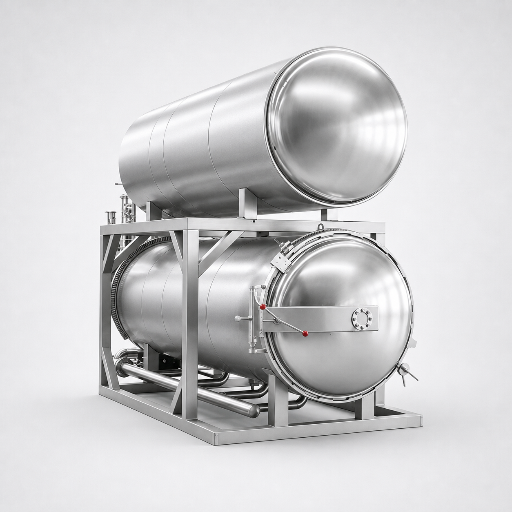
Our products autoclaves: for already finished packaged product
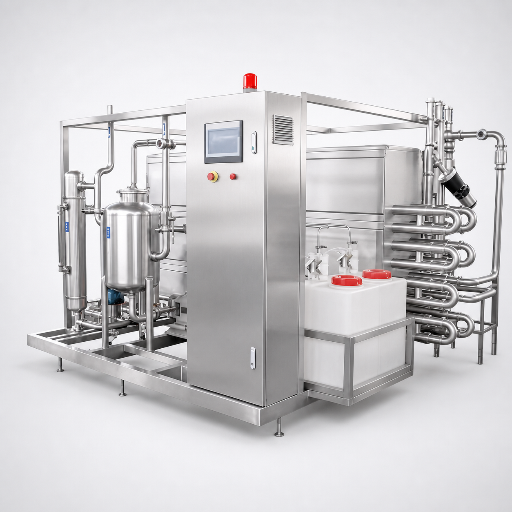
UHT sterilizers: for liquid product pasteurisation continuous, followed by pack
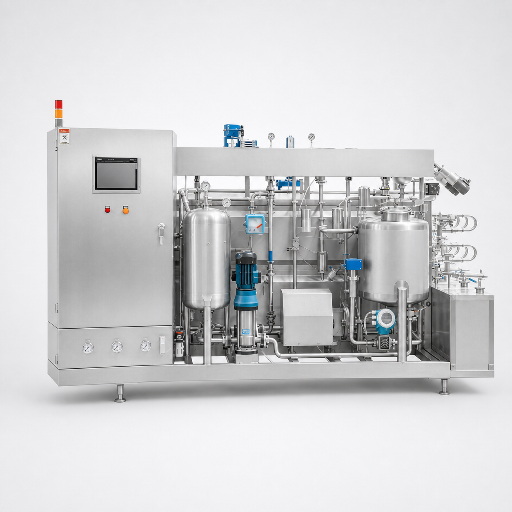
Plate pasteurisers: for liquid product at a less stringent thermal level
Get a Quote
Your product data, recipes and pack drawings are treated as confidential and are used only to size your machine.
Quotation Turnaround
Full package back within 24 hours: machine proposal, layout advice, utility figures, quotation and video
Fault Response
Response times, remote support, on-site service and spare-parts arrangements are confirmed in the quotation and contract
Warranty
Warranty duration, coverage and exclusions are confirmed in the quotation and contract
Spare Parts
Spare-parts availability and dispatch arrangements confirmed per order
Retort Capacity Range
Approximately 80 kg to 900 kg per batch across four chamber sizes
Configurable Per Order
Capacity, chamber size, heat source, automation level and control integration
Retort, UHT and Plate Pasteurizer, Two Forks Decide Your Route
All three families do heat sterilization or heat pasteurization, and all three exist to extend shelf life without preservatives. Most equipment pages then ask you to pick a machine, which is the wrong order. Two questions about your product settle the machine choice before any supplier is involved, and getting them the wrong way round is how plants end up over-specified.
Fork one: does your product legally need commercial sterility?
United States regulation splits food by acidity, and the split is sharp.
- Low-acid finished equilibrium pH above 4.6 and water activity above 0.85 [1]. Carries Clostridium botulinum risk in a sealed container and must reach commercial sterility under a filed scheduled process.
- Acidified finished equilibrium pH at or below 4.6 [2]. Falls under a far lighter regime with a much less severe heat treatment.
Practically, that split is blunt. A pH 3.8 juice or a properly acidified sauce doesn’t need a retort at all, pasteurization is sufficient and a retort would over-process it. A pH 6.2 meat pouch or wet pet food does need one, and no amount of pasteurizing will substitute.
Fork two: is the product already sealed, or still flowing?
Once you know which thermal severity your product needs, the container state decides the machine architecture and therefore the sterilization method. This is the fork that separates our three families.
| Decision axis | Retort / autoclave | UHT sterilizer | Plate pasteurizer |
|---|---|---|---|
| Container state at treatment | Sealed in its final container | Flowing in the pipe, filled afterwards | Flowing in the pipe, filled afterwards |
| Product form | Solids, semi-solids, viscous fills, liquids in packs | Low-viscosity liquid | Low-viscosity liquid |
| Acidity fit | Low-acid, pH above 4.6 | Low-acid liquid intended for ambient distribution | Acidified, high-acid or chilled-chain product |
| Heat transfer | Through the pack wall, in-container | Coil or tubular heat exchange in continuous flow | Plate heat exchange in continuous flow |
| Batch or continuous | Batch, by basket load | Continuous, by flow rate | Continuous, by flow rate |
| Downstream requirement | Cooling and drying, then labelling | Aseptic or clean filling line | Filling line or chilled storage |
| Shengtu model family | STSJ series, four chamber sizes | 500 L/h coil-heated unit | 0.5 t/h plate unit |
Work the two forks in order and the routing is unambiguous in almost every case. Where it isn’t, a viscous low-acid sauce that could plausibly go either way, a product family that spans both sides of pH 4.6, it’s a process design question, and we would rather look at your recipe than sell you the wrong vessel.
The three machine families we build
Eq-01 / Ret
01
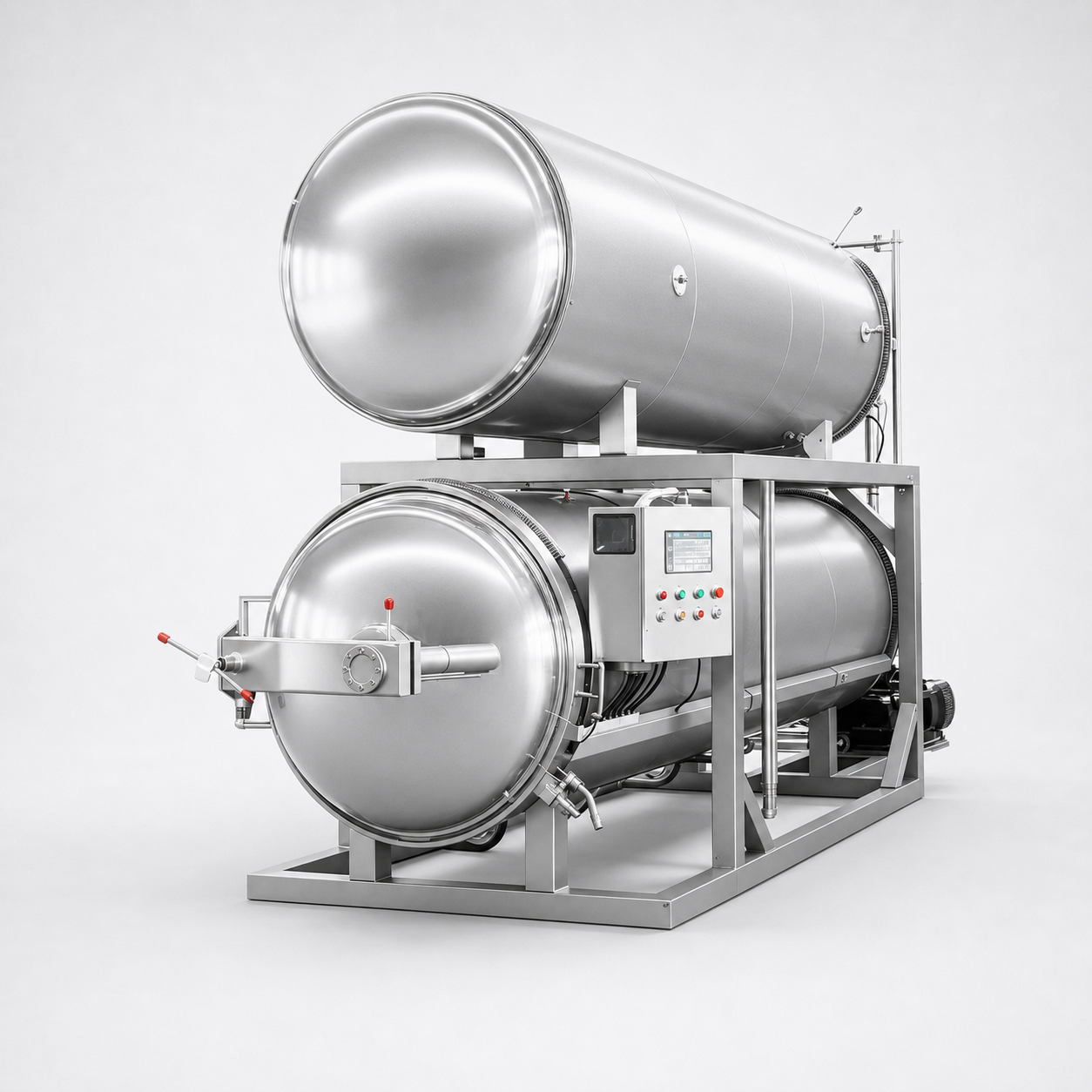
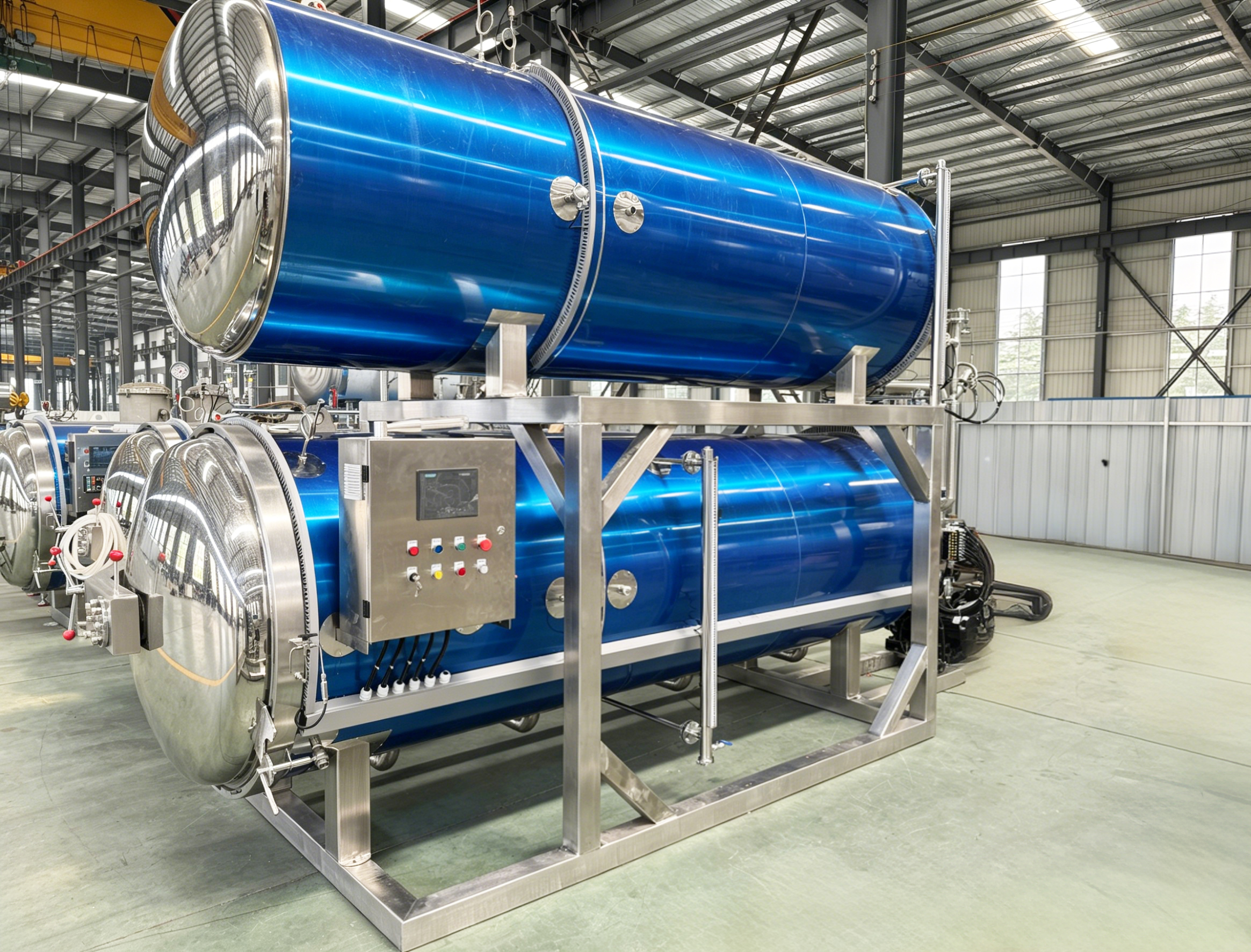
Food Retort / Autoclave Sterilizer
Batch pressure vessel for product sealed in cans, pouches, trays, jars and bottles.
- Four chamber sizes, 700 mm to 1,200 mm
- Approximately 80 kg to 900 kg per load
- Water bath, spray and steam modes on every frame
- Semi-automatic or fully automatic
- PLC control with programme storage, data logging and fault alarm
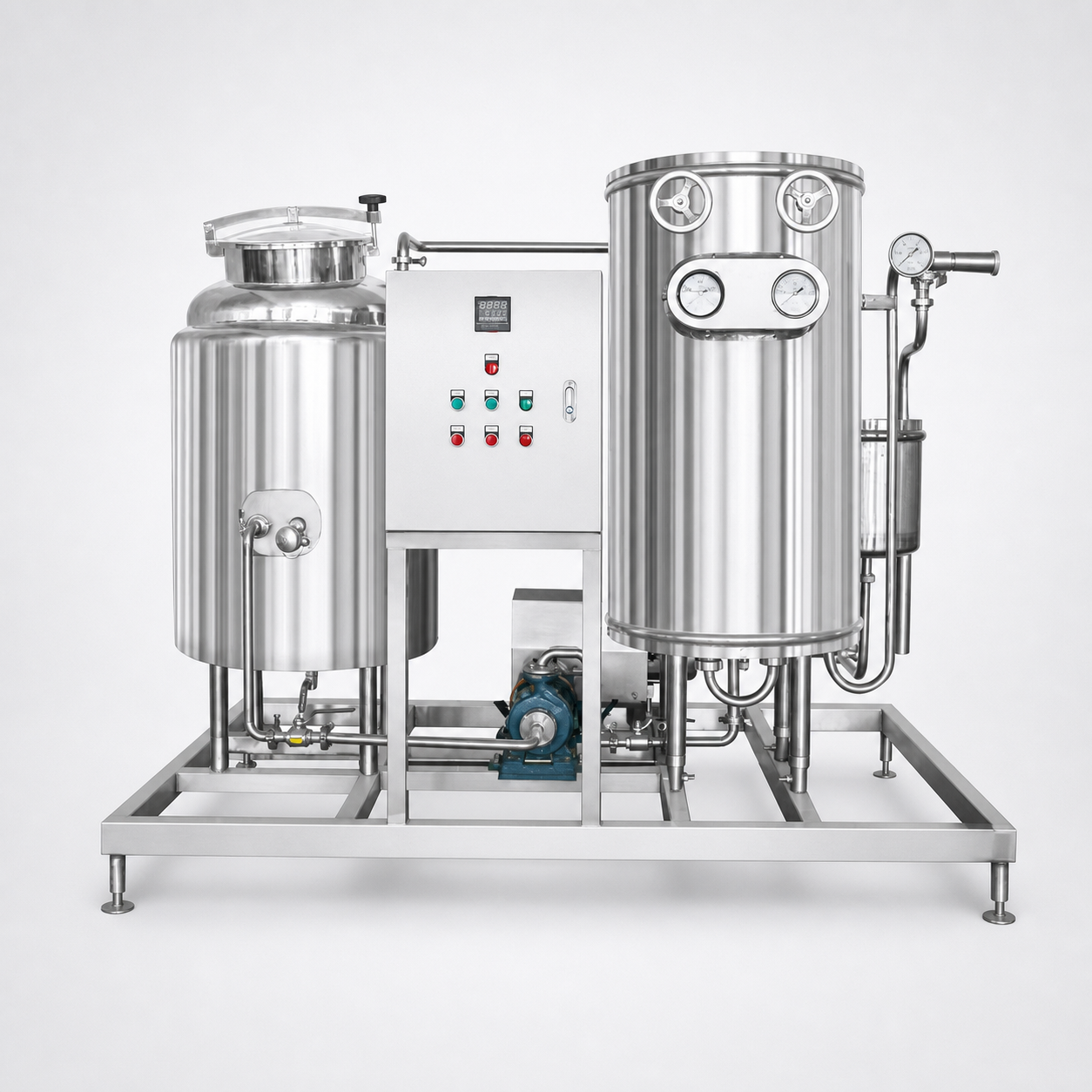
Eq-02 / Uht
02
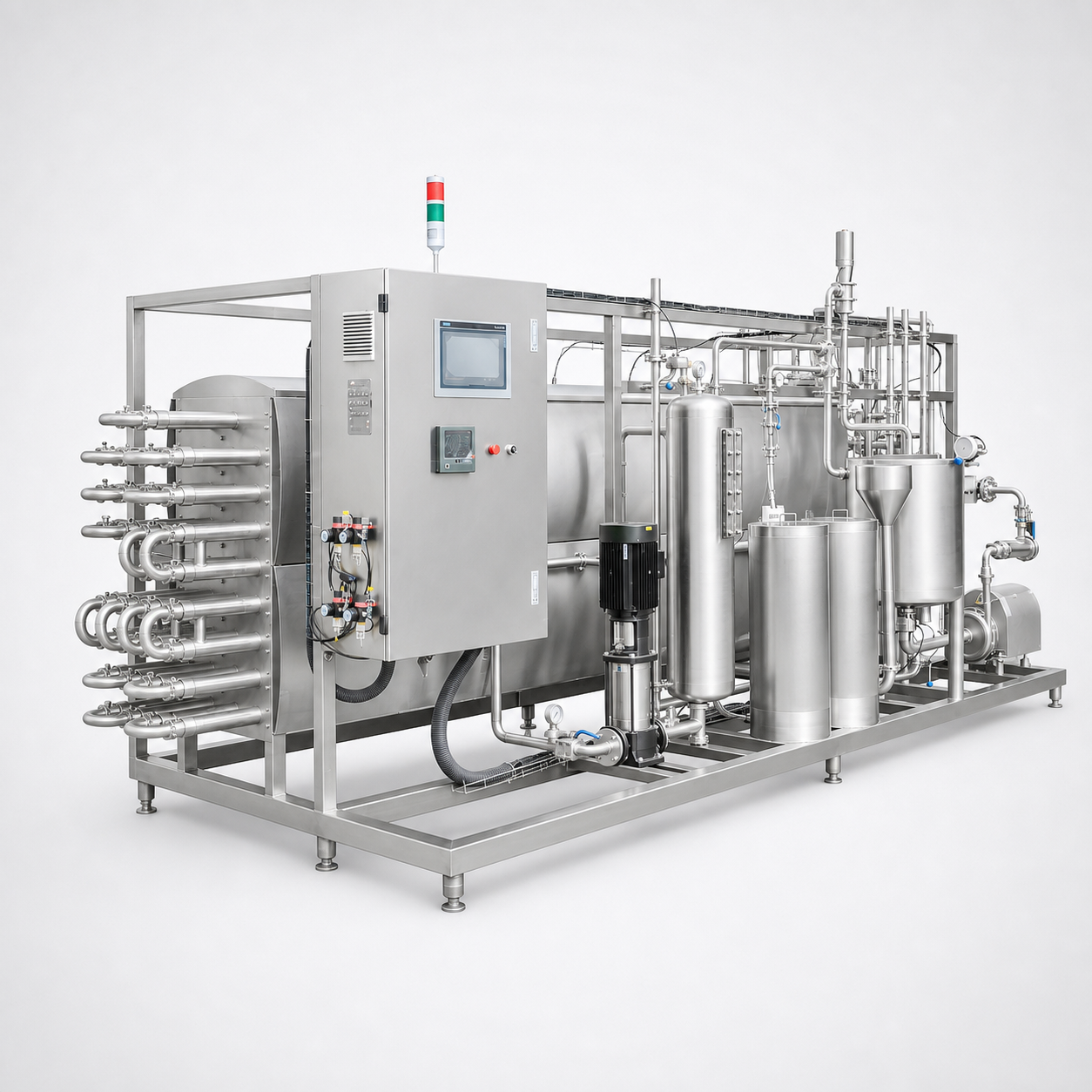
UHT Sterilizer
Continuous-flow unit for liquid product treated before filling.
- 500 L/h with coil-type steam heating
- 4–6 second hold, discharge below 65 °C
- Touchscreen control with automatic temperature regulation
- Automatic reflux when the setpoint isn’t met
- 304 stainless steel on all product-contact parts
Eq-03 / Plt
03
Plate Pasteurizer
Plate heat exchanger for processes involving the less intense heat treatment necessary for liquid items such as milk, flavoured drinks, juice, tea, beer, or eggs and other liquid flavourings.
- 0.5 t/h at 47.6 kW on 380 V three-phase
- Corrugated stainless plate pack
- Heat recovery between incoming and outgoing streams
- Automatic holding section
- Clean-in-place cycles
Package Formats and Product Types Each Route Handles
Your pack decides more of the thermal process than most buyers expect, and packaging materials are part of the specification rather than a downstream detail. Codex Alimentarius is explicit that container size and type, and package thickness in particular, are inputs to the scheduled process, not afterthoughts [3]. A change of pack is a change of process, and the same inputs govern the hermetically sealed container definition in 21 CFR 113.3.
Pack formats our retorts are built around
- Metal cans — the classic saturated-steam duty; rigid walls, predictable heat transfer.
- Aluminium foil pouches — thin profile heats fast but the seal needs air overpressure through both heating and cooling.
- Vacuum soft packs — same overpressure requirement, plus float control in water modes.
- Plastic trays and bowls — semi-rigid, deform if pressure is not balanced against the internal vapour pressure.
- Glass jars and bottles — thermal shock limits the cooling ramp; water modes are usually the right choice.
- Pet wet-food packaging — cans, pouches and cups, all conduction-heated because of the fill viscosity.
Product families we size equipment for
Sealed-pack products → retort route
Wet pet food, canned meat and fish, ready-to-eat meals, sauces and pastes, prepared dishes, canned vegetables and pulses, soups and congee, flexible-pack staples.
Flowing liquids → UHT or plate route
Milk and dairy drinks, yoghurt beverages, plant-protein drinks, fruit juice and pulp, tea drinks, beer, egg liquid, liquid seasonings and sauces thin enough to pump, liquid pet food and nutritional liquids.
Retort Modes and Continuous-Flow Sterilization, Water Bath, Spray, Steam
All of our Shengtu retorts feature our water bath, spray and steam modes. It’s not a Marketing bundle — they move heat different ways so that they appeal to different kinds of pack.
The Three In-Container Modes
Two complaints recur about cheaper machines in this category.
However, studies don’t all show the same comparisons for the modes as the results differ because they depend upon the product/pack/fill [4]. As a result there’s no “best mode”, simply one suitable for your batch.
Possible Fixed Futen cycles that won’t follow product thermal profiles – programme storage of per product and per pack 9.
Uneven spray coverage on the load – nozzles laying out and circulating, the solution.
What the Mode Change Actually Changes
Overpressure is the reason the modes are not interchangeable
Water mode gets you overpressure. For as any sealed pouch or plastic tray heats up, vapour pressure will builds within the structure and if equal back-pressurization, or counter-pressurization isn’t imposed at an equal level on the outside, the sealing material or the structure will rupture. This pressure can’t be provided by thesaturated steam therefore a canline can’t replace a pouchline even if you keep thetemperature and thehold- time perfectly equivalent and matched.
Agitation Is the Other Lever
Oscillations move product, agitate fill, reducing process time: A study looking at oscillating process of a two-basket water-spray retort demonstrated process times as much as 10-27% reduced as compared to static conditions under similar thermal conditions [4]. If this applies to your product will involve product headspace and fill viscosity which is product-process design; not a hardware argument.
Continuous Flow: Heat Exchange Instead of a Pressure Vessel
The UHT and the plate units do the same work by different physics. Product is pumped through a heat exchanger, raised to temperature, held for a given time, then cooled and sent to filling.
No basket, no pack and no batch; flow rate, not a load
Heat is recovered between the incoming cold stream and the outgoing hot one, which is where most of the reduction in energy consumption on a continuous line comes from
Both liquid machines carry clean-in-place circuits, so acid and caustic cycles run without stripping the plate pack or the tube nest
Cooling and Clean-Down
Automatic cooling on the retorts brings the load under controlled pressure once the hold is complete, which limits pack deformation and protects colour and texture.
Clean-in-place on the liquid machines runs automatic acid and alkali cycles without disassembly.
Automatic basket loading and rail conveying is available on the retorts when the retort room is the bottleneck rather than the vessel itself.
Specification Tables for All Six Model Configurations
Four retort frames and two continuous-flow units. These are the published figures; anything not listed here’s set per project.
| Specification | STSJ-0.7-1.2 | STSJ-0.9-1.8 | STSJ-1-2.4 | STSJ-1.2-3.6 |
|---|---|---|---|---|
| Chamber Diameter (mm) | 700 | 900 | 1,000 | 1,200 |
| Chamber Diameter (in) | 27.6 | 35.4 | 39.4 | 47.2 |
| Batch Capacity (kg) | approx. 80 | approx. 300 | approx. 500 | approx. 900 |
| Batch Capacity (lb) | approx. 176 | approx. 661 | approx. 1,102 | approx. 1,984 |
| Installed Power (kW) | 2.2 | 2.2 | 4 | 7.5 |
| Heat Source | Electric or steam | Electric or steam | Steam | Steam |
| Sterilization Modes | Water bath / spray / steam | Water bath / spray / steam | Water bath / spray / steam | Water bath / spray / steam |
| Automation | Semi-automatic or fully automatic | Semi-automatic or fully automatic | Semi-automatic or fully automatic | Semi-automatic or fully automatic |
| Material | 304 stainless steel | 304 stainless steel | 304 stainless steel | 304 stainless steel |
| Specification | UHT Sterilizer | Plate Pasteurizer |
|---|---|---|
| Throughput | 500 L/h (132 US gal/h) | 0.5 t/h (1,102 lb/h) |
| Heating Method | Coil-type steam heating | Plate heat exchange with heat recovery |
| Process Temperature | 92–95 °C (198–203 °F) | Set per product and scheduled process |
| Hold Time | 4–6 s, adjustable per order | Automatic holding section, time set per product |
| Discharge Temperature | below 65 °C (149 °F) | To filling or chilled storage |
| Installed Power | 2.2 kW pump | 47.6 kW |
| Power Supply | 220 V single phase, adjustable per order | 380 V / 50 Hz three phase |
| Machine Dimensions | Set per configuration | 1,600 × 1,200 × 2,000 mm (63 × 47 × 79 in) |
| Steam Supply | Coil heating, sized per project | 0.3–0.5 MPa at 100–150 kg/h |
| Cooling Water | Sized per project | 1–1.5 t/h |
| Compressed Air | Sized per project | 0.4 MPa |
| Product-Contact Material | 304 stainless steel | SUS304 |
Reading The UHT Figures Correctly
The terminology in this category is loose, and it matters to your shelf-life plan.
Codex Alimentarius defines UHT treatment as heat applied to a continuously flowing product severe enough to render it commercially sterile, and puts the range at 135-150C [5].
The 500 L/h configuration published above runs 92-95C, which is a high-temperature short-time duty suited to extended chilled shelf life rather than a commercial-sterility duty for ambient distribution.
If your product plan needs ambient shelf stability from a liquid line, tell us at enquiry so the configuration is sized against that target rather than against this one, and check where your product sits under the FDA acidified and low-acid canned food rules.
Factory Acceptance Testing and Compliance
There’s a difference here that determines if your machine passes an audit, and it’s worth being specific: Commercial Sterility is a feature of a validated scheduled process; it isn’t a feature of any vessel.
“Scheduled processes for low-acid canned foods must be established only by competent persons having expert knowledge of thermal processing and having adequate facilities for making such determinations.” — Codex Alimentarius CAC/RCP 23-1979, section 7.5.1.2 [3]
Establishing what that procedure (sterilization process is your process authority’s work) should be is your process authority’s job. Delivering a vessel that will be capable of holding it, proving it holds, before the machine leaves our door is ours. Where those two sets of responsibility meet is the cold spot: under-processing risk lives there, and that’s why an auditor might value seeing a distribution test a lot higher than a list of numbers on the control page does.
Company records: Request the current holder, scope and validity details.
Equipment conformity: Confirm the documents for the model, configuration and destination country.
Order documents: Agree inspection records, manuals, drawings and shipment paperwork in the contract.
×
Every machine passes five tests before it ships
- Pressure safety test – vessel integrity, safety devices under operating pressure
- No load run test – circulation, valves, controls, interlocks with chamber empty
- Heat distribution test – temperature uniformity across the chamber which provides the data you’ll need to demonstrate there’s no cold spot
- Simulated load test – one full run with conditions representative of normal operation (e.g. chamber filled with containers)
- Full-machine interlock test – the complete machine automatic cycle, from ramp up through the hold, cool and discharge phases.
Heat distribution testing in particular, provides more value for your subsequent validation work than heat penetration because it’s the machine-part of the puzzle. Where heat distribution shows how effectively your retort heats the volume surrounding the containers, heat penetration shows how effectively heat is transferred into the centres of the containers themselves [4]. Heat Penetration analysis is the responsibility of your process authority; heat distribution analysis is ours.
The tolerance your auditor will look for
The guidance issued by FDA describes precisely this responsibility as: ‘all thermocouples within the retort should read within IF of the target temperature (the target temperature when the Come-Up Period is initiated or started […]. Within each load (either still retort) ‘every reading must be equal to or above the setpoint with a difference between minimum and maximum readings of not more than 2F.
Certificates and Documents by Project
Applicable certificates and documents are confirmed for the equipment model, configuration and destination country. Company management-system records are reviewed separately from product conformity documents. Confirm any RoHS requirement and supporting records for the proposed configuration in the order scope.
Where Thermal Sterilization Is the Wrong Tool
Four circumstances under which we’d advise against buying this gear, or at least not to buy it quite yet.
Your product is already acidified
At pH 4.6 or below with water activity above 0.85, you’re in the acidified-foods regime and the required heat treatment is much less severe than for a low-acid food [3]. A retort will work, but it’s over-processing that costs you twice, once in capital and again in quality loss. A plate pasteurizer is the right tool.
You want ambient shelf life from a pasteurizing cycle
The retort equipment can be operated at pasteurization temperatures and the outcome is a chilled-chain product with minimal shelf life – a shelf-stable product. Vessel purchase doesn’t buy the shelf life; process order does.
Thicker product, hotter cycle
That just raising the retort temperature takes care of a thicker pack isn’t necessarily true in most cases. For conduction heat processing, increase retort temperature makes larger difference between surface and cool spot, over heats outside layer without proportional assistance of central cool zone. Otherwise pack shape, agitation, are good alternatives.
You need a non-thermal or a medical-device method
Shengtu makes only thermal equipment, so if your process requires irradiation, ethylene oxide or dry heat sterilization of instruments rather than food, we are not your supplier. Those routes serve different products under different regulatory regimes, and nothing on this page transfers to them. Tell us what you are trying to achieve and we will point you where to look instead.
You do not have a scheduled process yet
If it was to be of a low acid canned food or acid food being imported into US the site has to be registered with FDA and a scheduled process has to be filed [7] with a process authority and this needs to be done as soon as possible as one shouldn’t be putting in plant without having already started this work.
Sterilization Equipment Engineering Tools
Sterilization Route Fork
Two questions decide the route. The first is about your product’s acidity, which sets whether commercial sterility is required at all. The second is about container state, which sets the machine architecture.
Explore Tool ➔Retort Batch Capacity Match
The four STSJ frames differ by chamber diameter and load. Enter what one batch weighs and how many batches a shift has to carry, and the tool returns the smallest frame that covers it.
Explore Tool ➔Package Format Compatibility Check
Different packs need different modes. Tick everything your line runs, including the formats you plan to add, and the tool returns the mode that covers the set and flags the ones that need overpressure.
Explore Tool ➔Utility Readiness Checklist
Utility readiness is the item that most often surprises a first-time sterilizer buyer. Work through the list against the machine you are considering, then send the gaps with your enquiry.
Explore Tool ➔FAQ: Sterilization Equipment Buying Questions
What is the difference between a retort and an autoclave?
In the combination pestajejs wij used for the same Machene. An autoclave is any pressure vessel that sterilizes with saturated steam or heated water; a retort is an autoclave designed for food production, with the overpressure control, cooling ramp and container handling that packed food requires. Laboratory and medical autoclaves are designed for different activity and aren’t interchangeable with a production retort.
What is retort sterilization?
Products were packaged into their final containers, loaded into vessel and then they’re subjected to certain temperatures and pressures for a period, the product was chilled under reduced pressures and finally discharged. The final product is expected to achieve commercial sterility, which implies product would free from viable organisms, microorganisms could grow and multiplied under standard non-refrigeration storage and distribution, such as ambient storage, transported to local and further retail network [3].
Is UHT sterilization the same as pasteurization?
No. The heat for UHT kills spoilage and pathogenic organisms, and it normally leaves a product which still has a cold chain. UHT is defined by its end point: heat applied to a continuously flowing product severe enough to make it commercially sterile in the target package, typical in the 135150 C range [5]. They’re different targets, not different levels of one target.
What is the difference between HTST and UHT pasteurization?
HTST is a high-temperature short-time UHT: hot enough to kill pathogens and spoilage organisms while extending refrigerated shelf life on shelf life, not hot enough to make the product UHT for ambient distribution. UHT gets even hotter and sterilizes for aseptic pack storage at room temperature. Equipment design is similar; temperature, hold time and downstream filling needs aren’t.
What temperature and hold time does plate pasteurization use?
It depends on your product, and your planned process, not on the machine. The plate unit provides the heat exchanger, an automatic holding section that controls how long the product spends in the hold tube, and the temperature control and record to prove it ran. Your process authority produces the specific time and temperature combination.
What are the disadvantages of a retort?
Four real ones, and you need to know them before you buy.
It’s a batch process so throughput occurs in steps instead of continuously, and the retort room often ends up as the bottleneck on the line.
It applies intense heat, which takes quality away on sensitive products.
It’s a pressure vessel, and the safety and maintenance requirements follow from that.
It uses steam and cooling water, and utilities readiness is something you want to include in the budgeting discussion.
Which package formats can a retort handle?
Metal cans, aluminium foil packs, vacuum soft packs, plastic trays and bowls, glass bottles and jars, PET wet food packs. Mode and overpressure profile will be different, whether the machine can run them or not doesn’t matter.
Can one retort run several package formats and product types?
Yes, and this is why most specify water spray or immersion, rather than single-stream steam. Each format has its own cycle programme, and load configuration needs to match pack types. Please provide your full pack list when enquiring rather than the largest.
What are the disadvantages of plate heat exchangers?
Plate packs work well for low-viscosity liquids, and aren’t great with suspended solids or very high-viscosity products that tend to block the channels. Gaskets are a wear item. In exchange you get high heat-recovery efficiency and a small footprint, which is why plate is still the default in milk and juice applications.
How often do we have to revalidate the retort?
Operators constantly ask this, and the sad truth is that a retort validation schedule is determined by your process authority and food safety plan, not by the equipment supplier. We can advise on what changes would require a new validation study.
A new product or a reformulation
A change to a new pack format or a change in pack size
A change in fill weight or initial product temperature
Any modification to the vessel or its control system
Our part is the equipment-side record: the heat distribution record from factory acceptance testing is the basis your subsequent validation studies can be compared against, and it ships with the machine.
Where do we find the internationally recommended Fo value for our product?
There’s no single, published figure because F0 is both product-dependent and container-dependent. F0 equates the lethal effect to number of minutes at 121.1 C, and the target value is established from your planned process by your process authority [3].
Inputs to that determination include microbial load, pH, water activity, formulation, container size and type, and expected storage temperature
Anyone quoting a universal F0 target for ready-to-eat meals is guessing
Equipment must hold and record the process you were given, which is why the control system and the acceptance tests exist
Do we need an FDA recognized LACF process authority before we buy?
If you are selling low-acid canned food or acidified food into the United States, yes, and it is worth starting early. Your plant must be registered with FDA and the scheduled process filed, and that filing comes from a process authority rather than from an equipment supplier [7]. Buying the machine first and finding the process authority later is the common sequence and the one that causes delay, so we are happy to size equipment while that work runs in parallel.
Can you supply a retort haccp study template with the machine?
We supply the equipment-side records: the factory acceptance test results, the heat distribution record, and the control system documentation that shows what the machine logs. Your hazard analysis has to be written around your product and your plant, so a generic template wouldn’t survive an audit anyway. We can make sure the machine produces the records your plan will need to cite.
We only want to trial the process. Is there a small entry option?
Pilot retorts are large and expensive relative to what a trial actually needs, which is a fair complaint. Our smallest published frame is the 700 mm chamber at approximately 80 kg per batch and 2.2 kW, and it accepts electric heating, so it can run without a plant boiler. If your trial volume is smaller than that, say so and we’ll tell you whether the frame still makes sense rather than selling you one that doesn’t.
How much does a retort machine cost?
It depends on chamber size and basket count, heat source, automation level, pack flexibility and control integration, the five drivers listed above. We would rather size it against your actual batch and pack list than quote a number that turns out to describe a different machine. Send the five inputs and the quotation comes back within 24 hours.
What do you need from us before you can quote?
Your product, target throughput, pack format and size, available heat source, and plant floor dimensions. If you’ve a drawing of the plant area, send that too, layout constrains chamber length more often than buyers expect.
What happens if the machine develops a fault after installation?
Response times, remote support, on-site service and spare-parts arrangements are confirmed in the quotation and contract.
Spare-parts availability and dispatch arrangements are confirmed per order
Warranty duration, coverage and exclusions are confirmed in the quotation and contract. Maintenance after the warranty period is agreed separately
![F&V Freeze-Drying Line Process Guide [2026]](https://shengtumachinery.com/wp-content/uploads/2026/09/fv-freeze-drying-line-guide-featured-150x150.png)