Get in touch with Shengtu Bufan Company

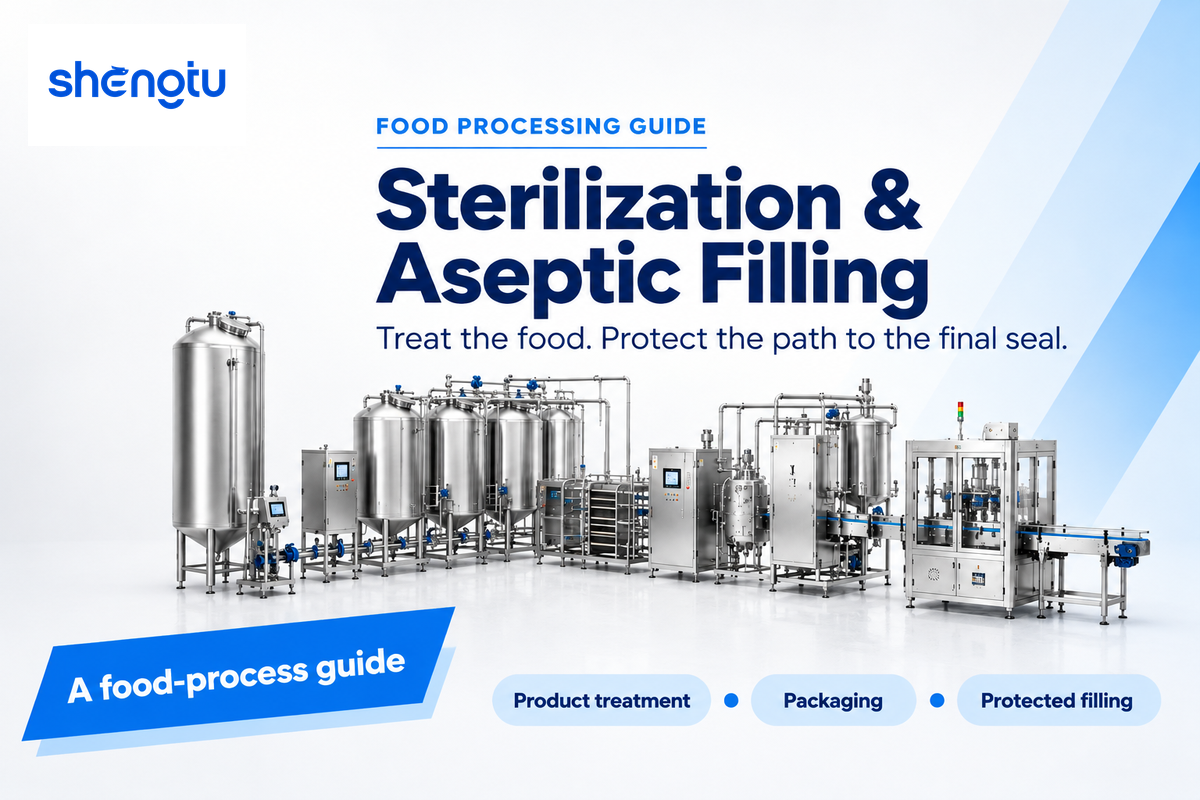
Sterilization & Aseptic Filling perform two jobs within the food production process: first, treating the product to achieve commercial sterility; and second, protecting the product from recontamination during packaging. Cooled treated food is placed in a presterilized container and receives a presterilized closure under controlled conditions. Achieving the result of a shelf stable product is dependent on several factors such as the type of product, equipment, package, and seal.
Food aseptic manufacturing can process milk, juice and a thick soup; but there can be a significant difference in the heating systems and the packaging of the different products. Understanding the differences enables a production team to compare routes and decide on the type of sterilizer or filler to use. SHENGTU describes the equipment and its integration scope on its Sterilization & Aseptic Filling solutions page.
Quick process overview
- Product treatment: establishes the required microbial control for the food.
- Aseptic transfer and filling: maintains the treated product’s condition through packaging.
- Packaging: includes the container, closure and a hermetic seal.
- Storage: follows the unopened product’s label; opening changes the storage conditions.
Key takeaways
- Commercial sterility is a food-processing endpoint with defined storage conditions.
- Retort and aseptic routes apply the microbial treatment at different points relative to sealing.
- Viscosity and particles change heat transfer and residence time.
- Productive hours and accepted packages reveal more about unit cost than rated filler speed alone.
Sterilization and Aseptic Processing: What Changes?
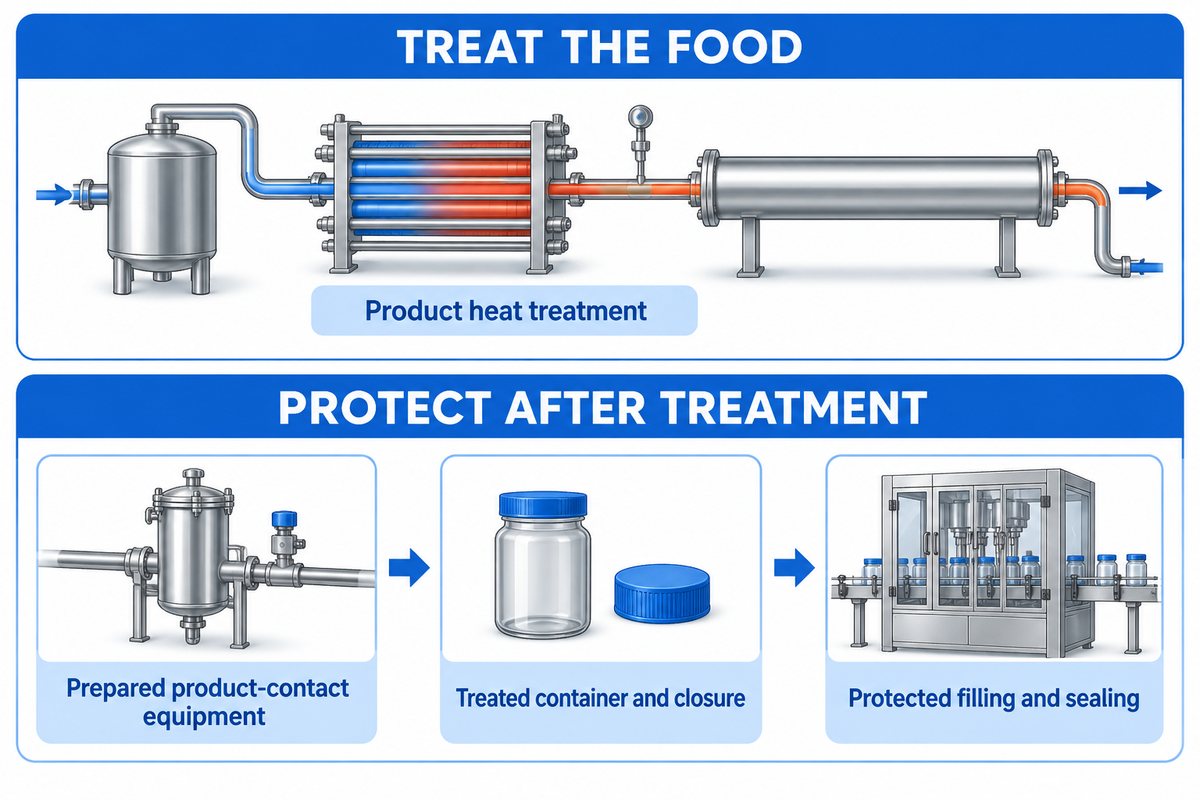
Sterilization treats the food, while aseptic processing defines what happens around and after that treatment. In the case of food, product and packaging can be treated and brought together without recontamination. This is the reason a sterilizer and an aseptic filler perform different functions in the same manufacturing process.
Do sterile and aseptic mean the same thing?
Sterile describes a microbiological condition. Aseptic describes the conditions and practices that prevent contamination and recontamination. For food processing, the more specific term used is commercial sterility. The difference between sterile and aseptic matters because a treated product can lose its protected state if it comes in contact with untreated equipment, air and/or packaging.
A closed pipe is useful only when its product-contact surfaces and connections belong to the controlled path. A valve replacement, an untreated connection or an ineffective barrier can create an entry point for microbial contamination downstream of heating. The FDA food aseptic-processing inspection guide discusses these downstream entry points separately from product heating.
What are aseptic filling operations?
Aseptic filling operations involve treating and preparing product-contact equipment, presenting a treated container and closure, dispensing commercially sterile product, and sealing the package in a protected environment. The filling process must maintain aseptic conditions through normal running and permitted interventions. The requirements for filling accuracy and microbial control are separate requirements.
In food manufacturing facilities, aseptic techniques protect treated food during transfer and packaging. Personnel interventions are part of the line’s strict aseptic procedures, along with controls of the equipment and air systems. An operator’s gown or glove can contaminate if it comes in contact with an exposed surface. Controlled handling helps reduce the risk of contamination through that route.
Pharmaceutical manufacturing uses sterile manufacturing and sterile processing terms for sterile pharmaceutical products, including a drug product such as a vaccine or biologic. Food and pharmaceutical products have different regulatory contexts for practices such as sterile filtration. Stringent pharmaceutical cleanroom grades and sterile filtration practices shouldn’t be copied to a food specification merely because the two industries discuss sterility assurance.
What Commercial Sterility Means for Food
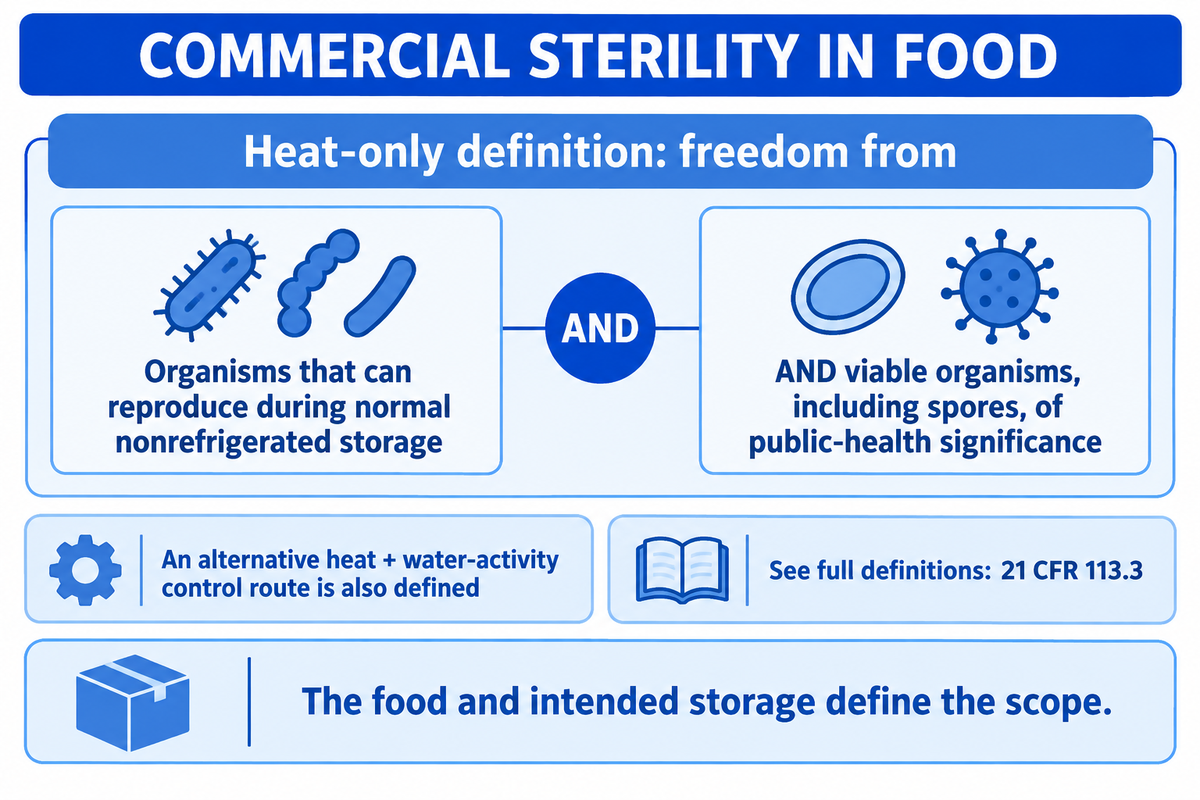
Commercial sterility states which organisms are relevant to the food and its intended storage. Under the US heat-treatment definition, it means freedom from organisms that can reproduce during normal nonrefrigerated storage and viable organisms, including spores, of public-health significance. The regulation also provides a heat and control of water activity combination route.
The full wording is in 21 CFR 113.3. It doesn’t reduce food processing to an absolute claim that every living microorganism has been removed under every possible condition. Equally, a growth-only shorthand leaves out part of the heat-only definition.
US low-acid food scope generally means a finished equilibrium pH above 4.6 and water activity above 0.85 , excluding alcoholic beverages; tomatoes and tomato products below a finished equilibrium pH of 4.7 have a specific exception. NC State Extension’s low-acid food explanation describes the boundary for acidity and water activity. These definitions state the regulatory scope and aren’t instructions for heat processing.
For juice, regulatory requirements include product-specific controls. 21 CFR 120.24 provides a conditional exemption from paragraph (a)’s 5-log pathogen-reduction control requirement for a sufficient single thermal shelf-stability process, while requiring a copy of the thermal process in the written hazard analysis and processing and final packaging within a single facility operating under current good manufacturing practices.
A refrigerated extended-shelf life product is on a different route than an unopened stable product. The terms UHT or Ultra-Pasteurized alone don’t determine storage of a package. Enzymatic changes, separation, oxidation and flavor loss occur even after microbial control has been established and affect shelf life.
4-Path Aseptic Process Map: Product to Sealed Pack
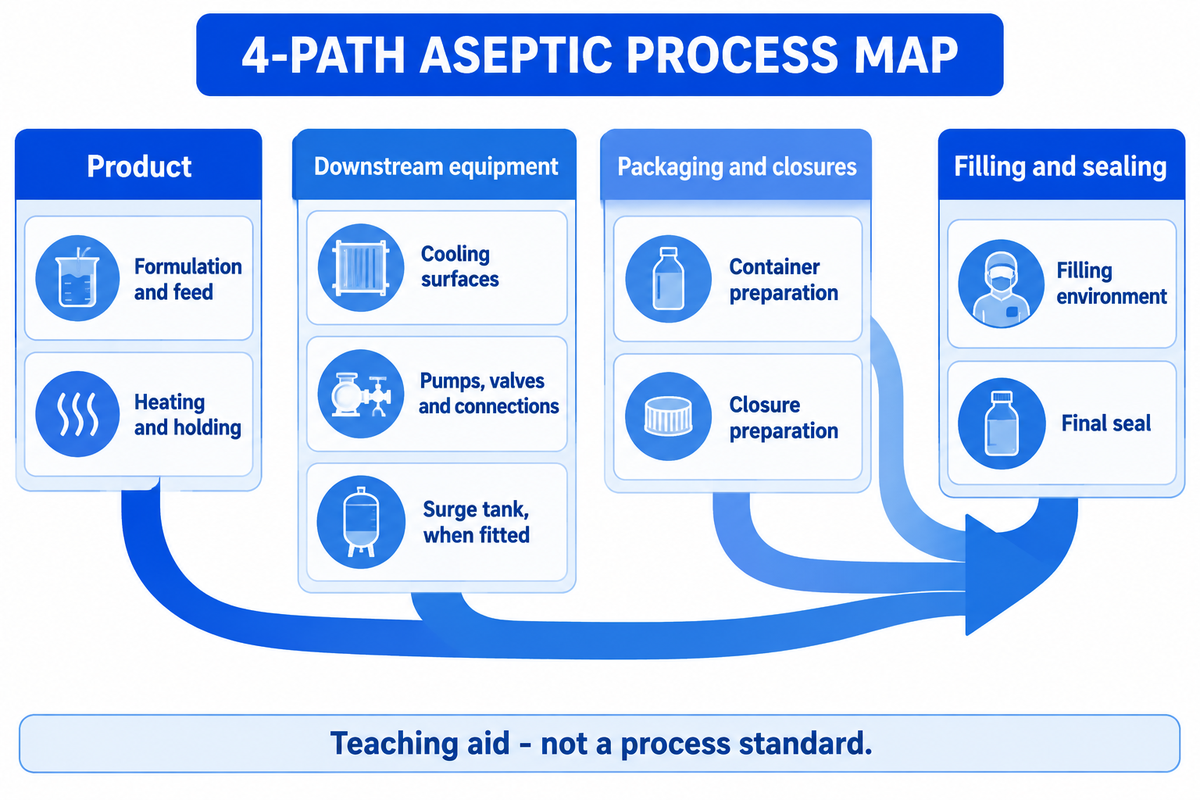
The 4-Path Aseptic Process Map covers product treatment, downstream contact equipment, packaging and closure preparation, and protected filling and sealing. It’s a teaching aid to trace an installed line. Its value is in showing where separately prepared streams merge, and where a failure can affect product that has already been heated.
The FDA guide’s introduction identifies the product, equipment downstream of the holding tube, packaging equipment and packaging material as distinct control duties. The map below combines those duties for a plant walk-thru, and the path numbers are not a new certification or process standard.
| Path | Checkpoint | What it controls | How the path can be interrupted |
|---|---|---|---|
| Product | Formulation and feed | The food entering the established process | A recipe or particle change alters the processing duty |
| Product | Heating and holding | Treatment temperature and residence time | Insufficient treatment or excessive product flow |
| Downstream equipment | Cooling surfaces | Protected cooling after treatment | An ineffective separation barrier permits contamination |
| Downstream equipment | Pumps, valves and connections | Sterile transfer through product-contact equipment | A shaft seal or valve barrier fails |
| Downstream equipment | Surge tank, when fitted | Protected temporary product storage | Sterile gas supply or tank protection is lost |
| Packaging and closures | Container preparation | Treatment of the food-contact package surfaces | Treatment does not reach the required surfaces |
| Packaging and closures | Closure preparation | The cap, lid or fitment entering the protected zone | An untreated closure crosses the boundary |
| Filling and sealing | Filling environment | Protection during exposure and filling | An intervention or air-system fault disrupts protection |
| Filling and sealing | Final seal | Resistance to microbial entry after closure | A defective seal leaves a route into the package |
The product path typically includes the heating, holding, and cooling, and the protected transfer steps. The packaging path may begin with a roll of material, a premade bottle or a sterilized bag. Those two paths merge at the filler. The closure must reach that point in the proper condition as well.
Successful aseptic production processes food once equipment has been prepared. Preparation checks include sterile air supply and the applicable equipment barriers. The task of startup interlocks is to ensure product cannot enter an unprepared pathway. A functional test checks the stop or diversion response. While running, the sterile boundary must be preserved. After an intervention or deviation, the restart sequence follows the established process.
Treating these operating states separately supports understanding as to why a machine can be mechanically prepared while food contact components are still being prepared.
Aseptic Filling, Hot Filling and Retort Compared
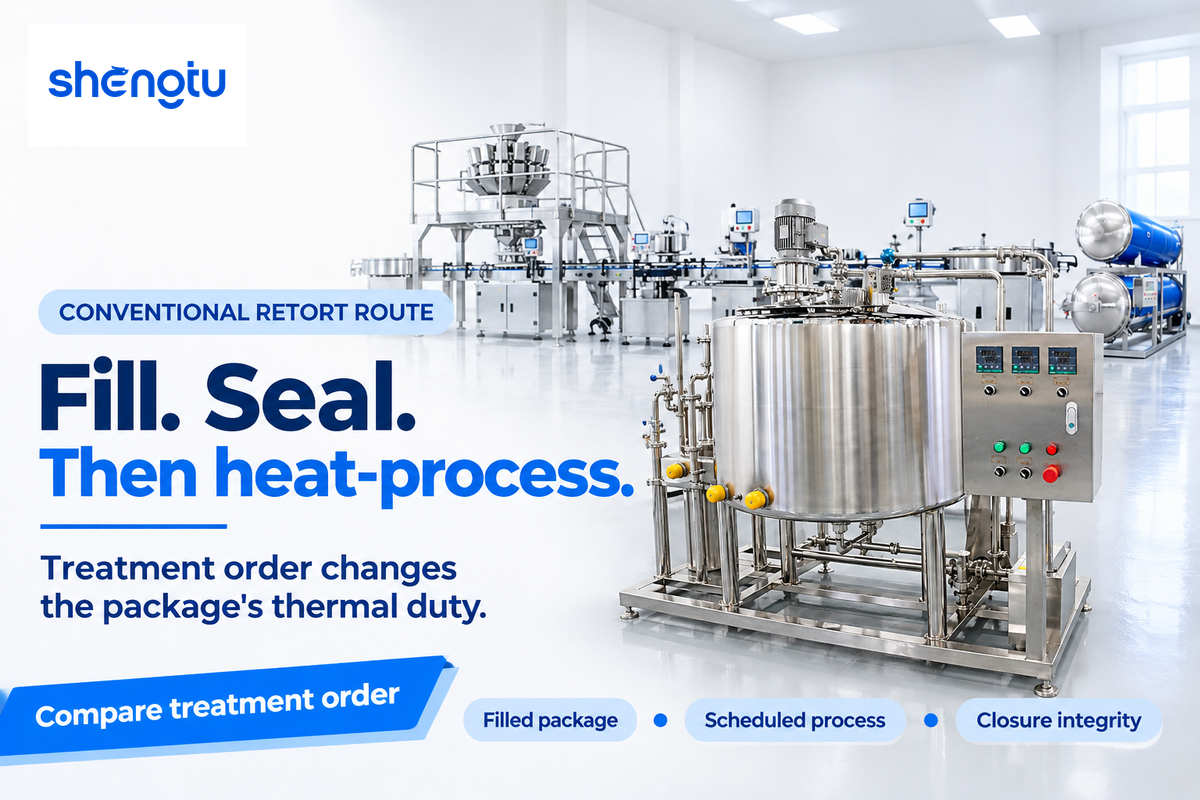
Aseptic processing treats food and package separately, before the protected filling. Conventional retort processing applies the heat process to the food after it has been sealed in its container. Hot filling employs the process of filling a container with a hot product within a defined filling and holding time. All these change the heat exposure of the package, the sequence of treatment and production planning.
The USDA shelf-stable food guide focuses on the difference between aseptic and retort processes. Aseptic packaging isn’t treated with the same process as a retort product. Rather, aseptic packaging is processed separately.
| Dimension | Aseptic route | Hot-fill route | Conventional retort route |
|---|---|---|---|
| Treatment order | Treat product and package separately, then fill and seal | Fill hot product within an established thermal sequence | Fill, seal, then heat-process the package |
| Product temperature at filling | Cooled after the product treatment | Hot, at the specified filling condition | Initial fill condition is part of the process design |
| Package thermal duty | Withstands its own preparation and filling conditions | Withstands hot product and subsequent cooling | Withstands the filled-package thermal process |
| Container preparation | A distinct sterilization duty | Defined as part of the complete hot-fill process | Package and contents receive the scheduled process together |
| Typical examples | Milk, beverages, purees and pumpable foods | Suitable acidic beverages and sauces | Foods in suitable cans, pouches or other retortable packs |
| Heat-transfer concern | Continuous flow and treatment of the actual formulation | The complete product/container time-temperature history | Heat penetration into the filled package |
| After-treatment protection | Sterile transfer, protected filling and hermetic sealing | Closure integrity and the established cooling/handling sequence | Closure integrity during cooling and handling |
| Storage outcome | Ambient when the complete product/package system establishes shelf stability | Follows the established product process and label | Ambient when commercially sterile and properly sealed |
| Cost comparison boundary | Treatment, sterile services, packaging and accepted output | Hot-fill package, heating, cooling and accepted output | Retort loading, thermal cycle, cooling and accepted output |
Plain hot filling shouldn’t be treated as an interchangeable low acid commercial sterilization process. A scientifically based scheduled process applies to food and packaging for low-acid product. Differing product characteristics can lead to different equipment discussions for the same ambient distribution.
Although aseptic processing reduces the need for prolonged exposure to heat, the product’s quality is still impacted by the full temperature history. Retort equipment also varies, and it isn’t always correct to treat a retort configuration as a batch machine. The food retort and autoclave guide provides a deeper analysis of equipment in this family.
How the Product Changes the Heat-Treatment Route
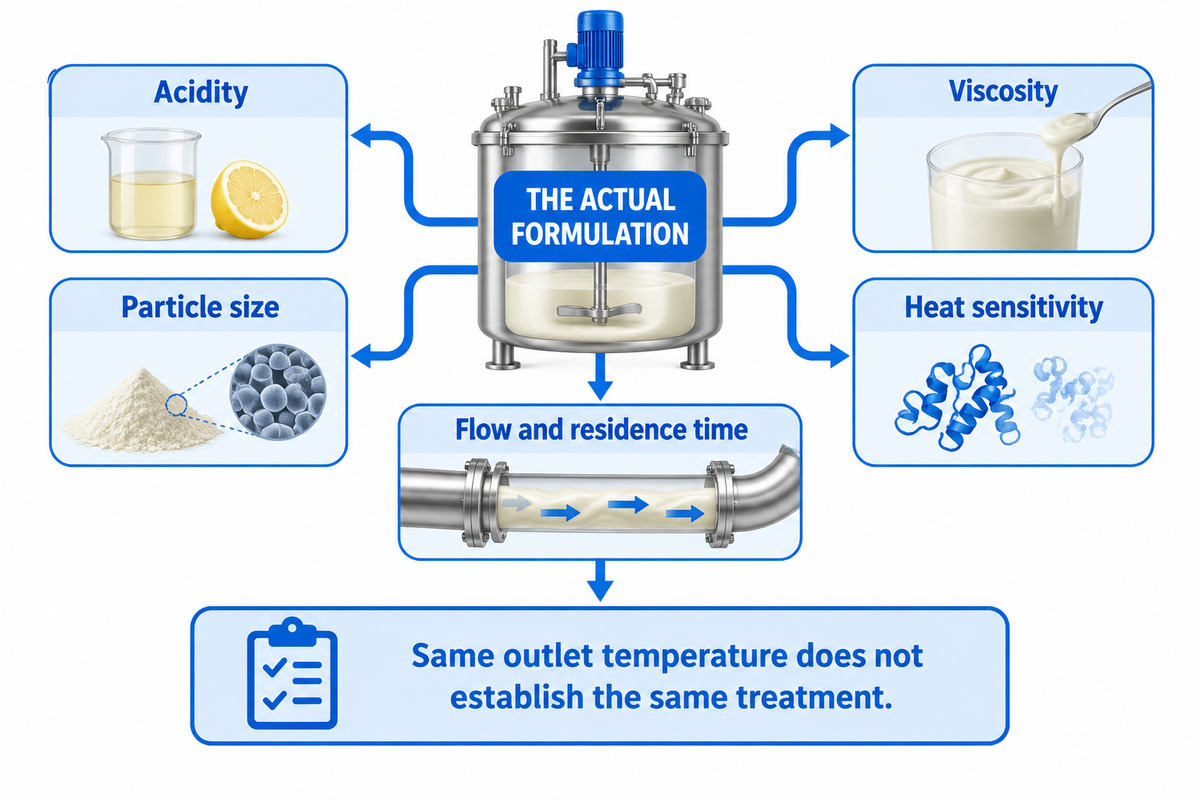
The behavior of a food product when treated is impacted by many factors such as acidity, viscosity, particle size and the sensitivity of the food. For heat-sensitive products, the full thermal history is important. A continuous system must treat the actual formulation at the flow conditions at which it was established. A smooth liquid, and a thick particulate food, can differ in heating, pumping and residence-time distribution, even if they have the same outlet temperature.
Food scientist Richard Stier’s IFT explanation of aseptic food processing describes high-temperature treatment examples around 135–140 °C for a few seconds. Those are descriptive examples, not settings for a new recipe. Treatment development also considers the relevant organisms and the product’s chemical stability.
“Any product destined for an aseptic package must be biologically and chemically stable.”
Richard Stier, consulting food scientist, Food Technology, May 2025
Hypothetical Dairy Scenario.
The processor moves from a plain milk drink to a thicker product formulation in development and manufacturing. The previous flow trial used the thinner product. Keeping the same pump setting and outlet temperature display doesn’t establish the same residence time and heating behavior. Flow distribution and fouling on the heat transfer surface may change with the different formulation. The process will need to associate the change in formulation with the change in heating and holding conditions, while the quality section assesses the effect on the product. Purchasing a larger filler wouldn’t address the issues because the restriction is upstream. Changes in product formulation of this nature should be evaluated as part of a process assessment to determine if the product is acceptable to producers to be routinely manufactured.
Heat sterilization can use direct heating, which brings steam into contact with the food through injection or infusion, or indirect heating across a surface. The FDA guide describes plate, tubular and scraped-surface systems for a range of products, including viscous puddings and certain particulate soups. The controlling particle size belongs to the established process; a universal particle size ceiling would conceal these differences.
Microbial treatments leave other hazards to control. For instance, FDA’s juice hazards guidance states that patulin from unsuitable apples can remain in pasteurized apple juice. Therefore, in the case of thermal treatment, the selection of the raw material has a different role. For the dairy industry, see the pasteurized and UHT milk line guide.
Packaging Sterilization and the Filling Environment
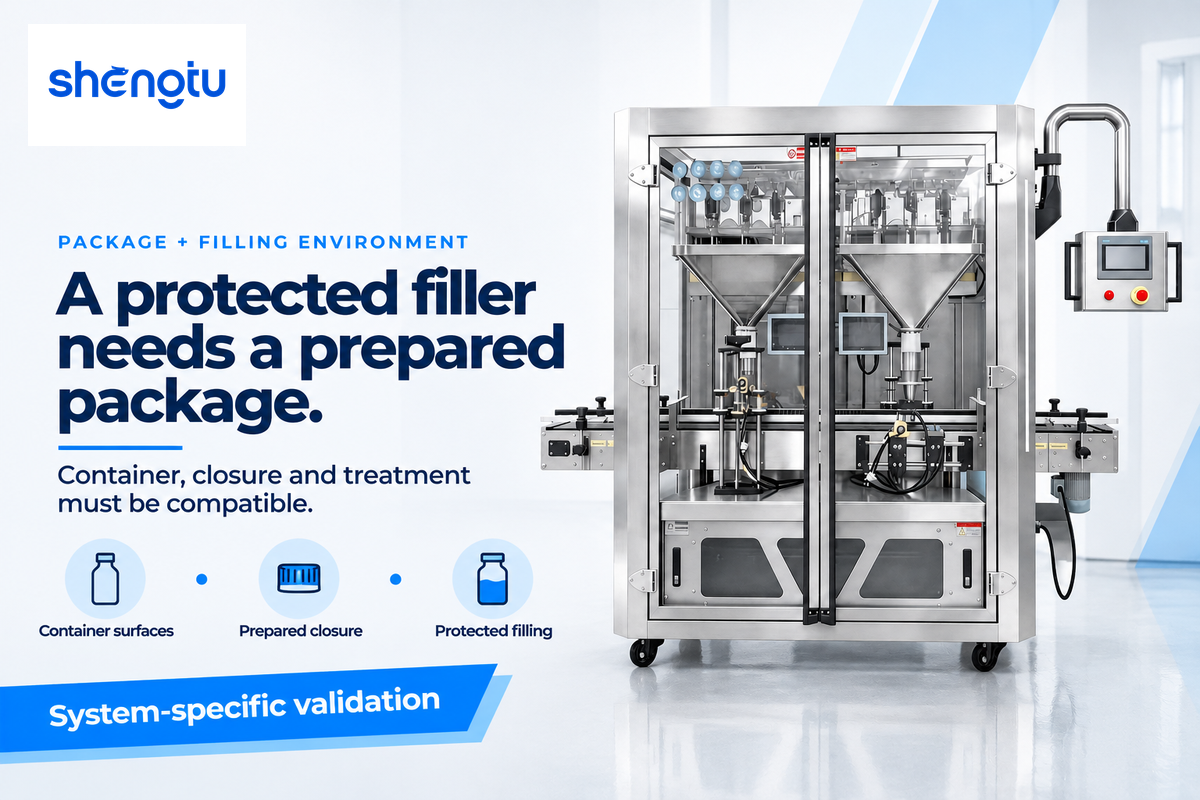
Packaging (sterilization) treats food contact surfaces, and the filling environment protects the product and surfaces as they come in contact with each other. The container material, shape, closure, and treatment must be compatible. Maintaining a sterile environment around the filler won’t correct an inadequately prepared bottle, cap or fitment.
The Canadian Food Inspection Agency’s dairy guidance separates packaging material, sterilant suitability, residues and packaging controls. The IFT mentions heat, chemical, and radiation treatment. These aspects of aseptic packaging systems need system-specific validation, and sterilization techniques aren’t interchangeable treatment choices.
Hypothetical packaging scenario. A juice producer wants to change cartons to lightweight bottles. The new bottle and cap must enter the filling zone without losing their prepared condition. Other questions are specific to the bottle. How will the new bottle surfaces respond to the established treatment? Will the new material tolerate the treatment? Previous cartons can’t answer these questions. The juice producer’s production manager and the quality team are evaluating a new package format. A new treatment and seal assessment are part of the project comparison. This assessment includes the handling of the bottle and closures, and the product sterilizer.
Validation of aseptic packaging specifies treatment conditions and residue control for the H2O2 and PAA systems. Electron beam systems raise other exposure and material questions. A 2025 Royal Society of Chemistry review covers food applications, product quality and the limits of electron beam irradiation. It supports defining the scope of application and doesn’t set a universal package dose.
Within the filler’s manufacturing environment, minimizing the risk of contamination involves sterile-air filtration, pressure control, equipment preparation and controlled interventions. HEPA filters are components of a designed air system. An isolator or clean room by itself doesn’t say much about whether every product contact surface and closure is protected during filling and sealing.
Cleaning, Sanitizing and Sterilizing Are Different Jobs
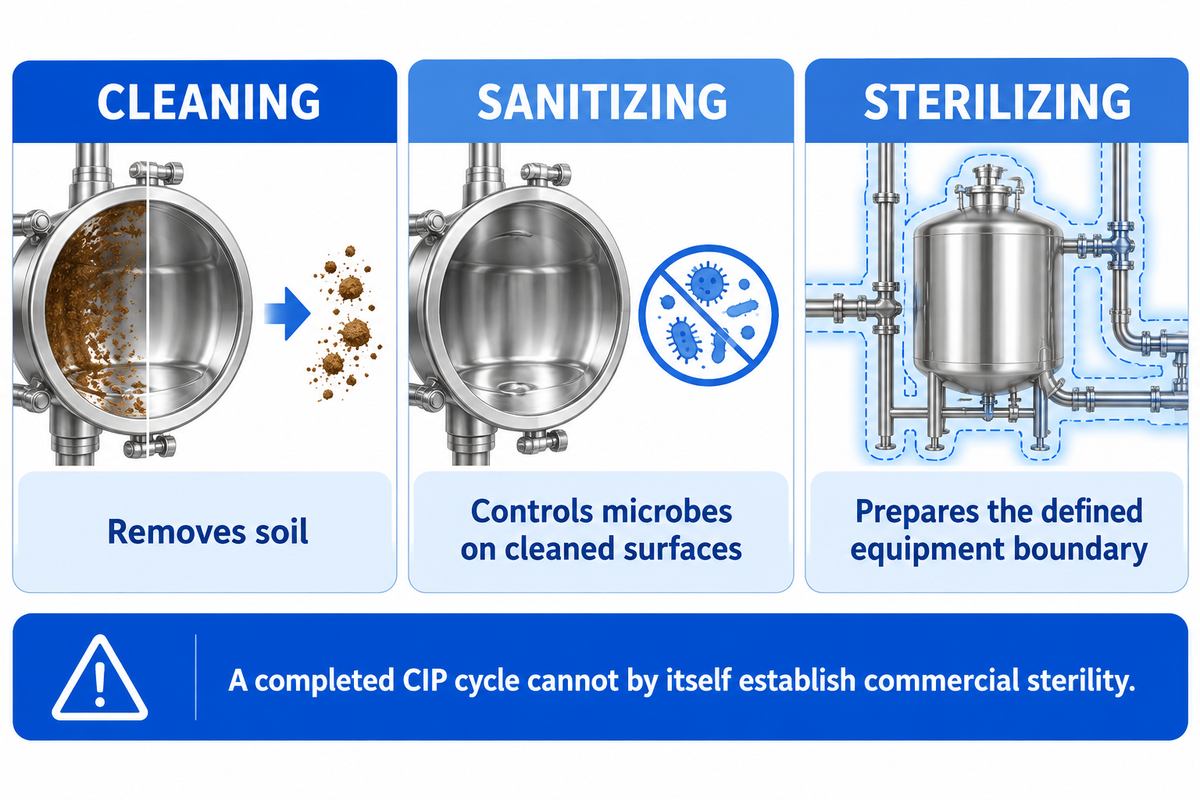
Cleaning removes soil. Sanitizing aims to control microbes on cleaned surfaces. An aseptic line’s sterilization process prepares its defined equipment boundary for production. There are differing procedures and evidence for accomplishing these objectives. A completed clean-in-place (CIP) cycle may be used to support preparation of a line for further processing, but it cannot by itself establish that the processing line has achieved commercial sterility.
T. Bowser at Oklahoma State University describes clean-in-place methods as rinsing away loose materials, washing away soils, and sanitizing. The equipment geometry and product residue determine where the cleaning solution must reach. Easy-to-clean construction helps the cleaning process; however, it doesn’t eliminate the need to validate the process.
In-place sterilization (SIP) follows its own defined boundary and conditions. Steam sterilization is a possible approach for suitable equipment. The FDA food guide separately discusses cleaning up and re-sterilizing an aseptic system after a process deviation. Good manufacturing practices (GMP) also require attention to hygienic operation throughout the manufacturing process.
Manufacturing operations with shared equipment introduce another boundary. The FDA’s juice questions and answers identifies milk-protein carryover when equipment used to process dairy is used for juice processing. Microbial control and removal of allergenic residues are assessed differently. A sterile result does not indicate allergenic residue control. The CIP cleaning system guide provides details on controls and cycle operation of CIP cleaning systems.
Why Shelf-Stable Products Can Still Lose Sterility
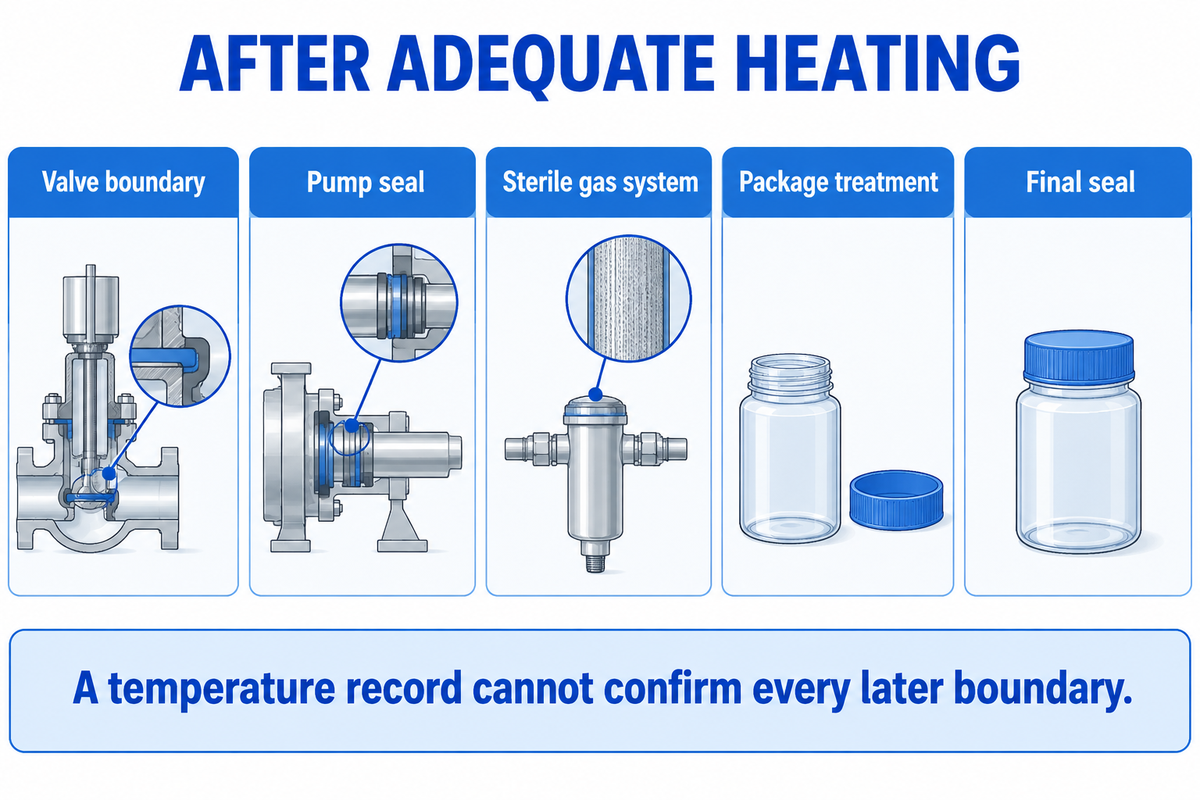
Contamination risks remain after adequate heating if a downstream barrier, package treatment or seal fails. The suspected entry point may be a valve, pump seal, sterile gas system or closure. A temperature record shows part of the process; it can’t confirm that all later boundaries were intact.
The FDA’s downstream-equipment discussion names coolers, surge tanks, diversion valves, homogenizers and pumps as potential points of contamination introduction. Monitoring their protective barriers has a different purpose from recording holding-tube temperature.
Here’s a hypothetical soup scenario. A factory changes a valve in the protected product path between production runs. The filler can run once the valve is in place, but equipment preparation to complete the process hasn’t been carried out. If that later boundary is disregarded, food that has been heat treated may be exposed to an unprepared surface. Adjusting the heating setting to a higher level wouldn’t be of any help for the untreated downstream connection. An investigation following the equipment boundary, restart records and affected production window is useful to address the remaining questions. In this scenario, the mechanical readiness of equipment and ability to produce aseptically are disconnected.
CFIA’s critical factor guidance states that the absence of spoilage in incubated samples, by itself, isn’t evidence of commercial sterility. When a critical factor deviates, the affected product is held for the appropriate investigation and disposition. Testing sample(s) contributes to the assessment and doesn’t eliminate the deviation.
The UHT sterilizer validation and troubleshooting guide discusses equipment checks in more detail. Maintain the whole-line investigation at the point of protection loss.
Compare Cost per Accepted Pack, Not Filler Speed
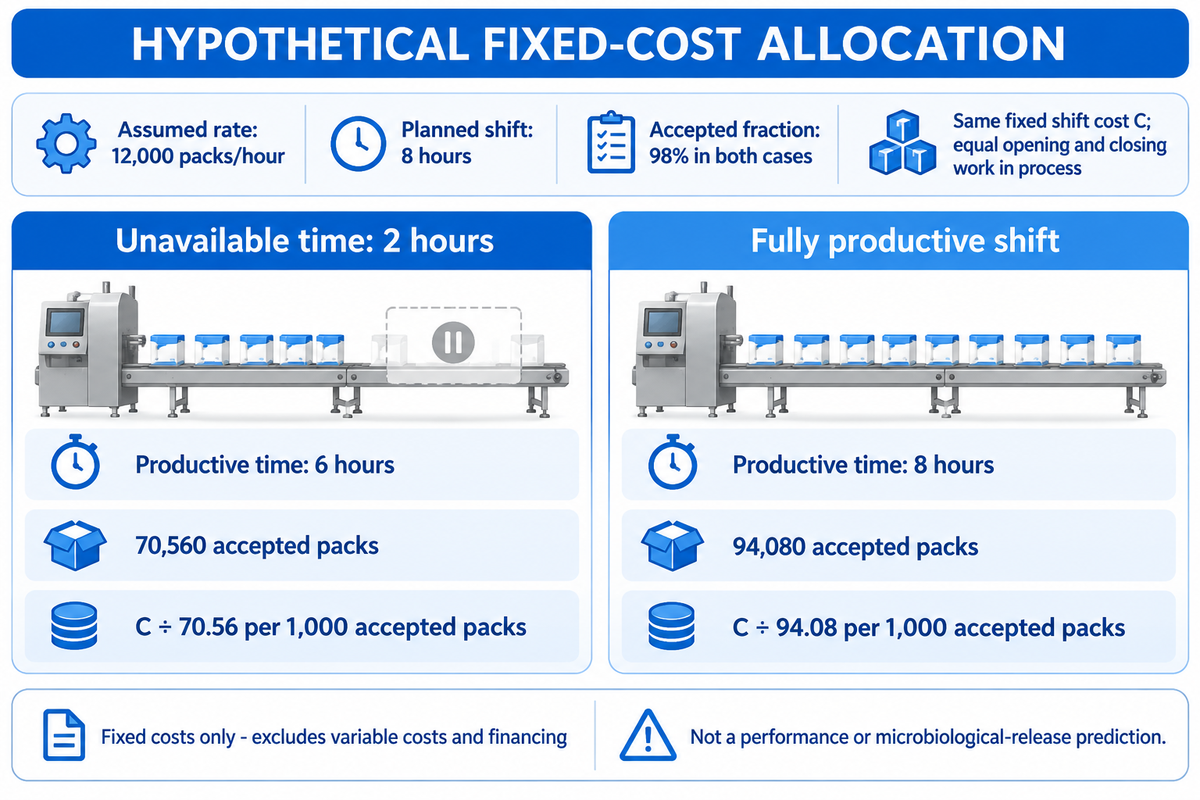
Cost per accepted pack is determined by the usable output delivered over a defined period. Productive running time, actual rate and the accepted fraction determine output. Rated filler speed determines only one input. A higher speed machine can still spread fixed costs over fewer packs with interruptions and product holds, resulting in a lower output.
CFIA’s packaging-record guidance covers start and stop times, reasons for downtime, and the volume of product produced. These records provide inputs for operation. The calculation below is a hypothetical example for accounting purposes based on the types of inputs shown above, and is in no way intended to reflect performance claims that are made in the guidance.
Assumed inputs: a constant rate of 12,000 packs/hour; an 8-hour planned shift; 2 hours unavailable in the first case; a 98% accepted fraction in both cases; and the same fixed shift cost, represented by C, in both cases. Opening and closing work in process are equal. In the second case, the full shift is productive, with the same product and acceptance criteria.
| Result | Shift with unavailable time | Fully productive shift |
|---|---|---|
| Productive time | 6 hours | 8 hours |
| Accepted packs: rate × time × accepted fraction | 70,560 packs | 94,080 packs |
| Fixed cost per 1,000 accepted packs | C ÷ 70.56 | C ÷ 94.08 |
Given the assumptions for the first case, the fixed cost per thousand accepted packs is C / 70,560 × 1,000, and under these assumptions, it’s one-third higher than the fully productive case. Packaging, ingredients, variable utilities, additional labor and financing remain outside the calculation. The example assumes acceptable output; it doesn’t predict micro-biological release, or demonstrate that the proposed line would be able to achieve either case.
Before comparing a speed upgrade, identify the constraint that consumes productive time.
From Process Knowledge to an Integrated Food Line
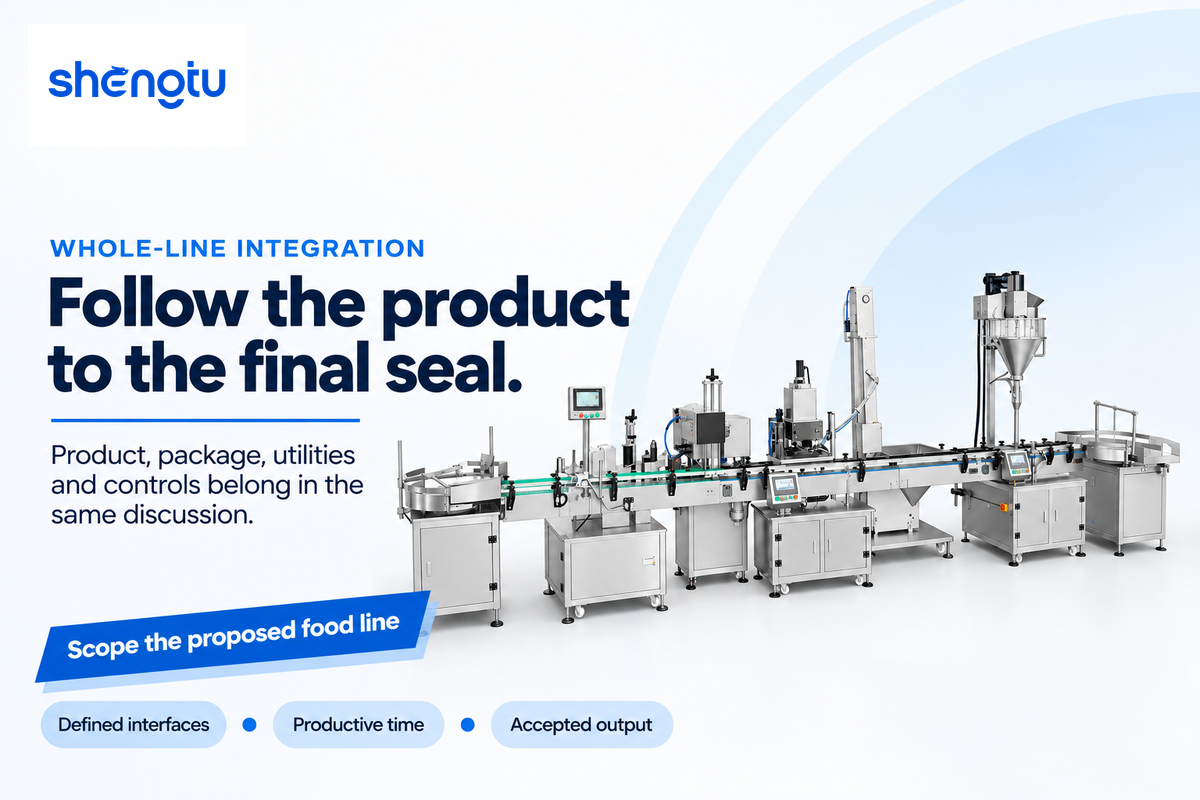
Food aseptic processing requires compatible product treatment, sterile transfer, package preparation and filling. The starting point is established by the product family and the intended route of storage. Utilities and controls have to support that process through preparation, production and recovery. A collection of specified machines is only a part of this process.
For companies manufacturing aseptic food, the FDA guide recommends following the complete processing and packaging flow, rather than evaluating only the product sterilizer. That same whole-line view helps purchasing teams understand supplier scope. A process-equipment specialist may supply the heat-treatment section; a packaging specialist may provide the filler and package system; an integrator coordinates the installed interfaces.
For plant management, the consequence is productive time and a workable changeover sequence. For quality staff, it is a defined product/package process with controlled interventions and usable records. Finance needs the output denominator and included cost boundary. Understanding these tasks together clarifies and reveals differences between the proposals.
SHENGTU’s company overview describes food process equipment and project services. An analysis of Product, Package, and Storage and Distribution summarizes the above discussion.
Key takeaway
Follow the food through treatment and every protected interface to the final seal. Then compare line output using the same product, package, productive-time boundary and acceptance definition.
Planning a food-processing project? Share the product family, package format, intended storage route and required output with SHENGTU. The process discussion can then connect the product-treatment section with packaging, utilities and controls, and identify the scope of equipment and integration support for your proposed line.
Frequently Asked Questions
What is terminal sterilization?
A terminal sterilization process applies the treatment after the product has been filled and sealed in its final container.
Conventional food retorting follows this treatment order. The thermal process must account for the filled package, food formulation, initial conditions and heat penetration. Aseptic processing follows a different sequence: product and packaging receive their treatments separately before protected filling. The choice between them follows the product and package requirements, including quality effects and the intended storage conditions, rather than the terminology alone.
What is the value of a sterility test?
A sterility test provides information about the samples and conditions tested within the product’s quality-control program.
A finding can support investigation of contamination, while a negative result needs interpretation alongside processing records and package-integrity evidence. Testing a sample doesn’t inspect every package or recreate the full production history. If a critical process factor deviates, the affected food still needs the appropriate hold, evaluation and disposition. Successful sample incubation alone can’t demonstrate that an out-of-control process achieved commercial sterility.
What is the difference between sanitization and aseptic processing?
Sanitization controls microbes on cleaned equipment; aseptic processing combines commercially sterile food, prepared packaging and protected filling and sealing.
A sanitizing step can be part of a broader hygiene program, but its completion doesn’t establish that an entire food line is ready for aseptic production. The equipment boundary, container, closure and filling environment each have their own treatment and control requirements. Cleaning, sanitizing and sterilizing therefore need clearly defined purposes in the preparation sequence, with the applicable conditions and records for each activity.
Does an aseptic package need refrigeration?
An unopened shelf-stable product can be stored as its label directs.
Opening removes the sealed-package protection. Refrigerate and use the opened food according to its product-specific instructions; an aseptic-looking container alone doesn’t establish ambient storage suitability.
Can food containing particles be processed aseptically?
Yes, suitable systems can process particulate foods as well as smooth liquids.
The FDA food guide includes certain soups among scraped-surface heat-exchanger applications. The actual formulation and particles matter: their size, behaviour in flow and heating characteristics must fit the established process. A filler capable of passing a particle does not establish that the particle received the required treatment upstream. The process therefore connects product preparation, pumping, heating, holding and protected filling. A single particle-size number taken from another machine or recipe does not describe all aseptic food systems.
Does aseptic filling require preservatives?
A properly established aseptic food process can produce shelf-stable products without added preservatives.
The complete formulation, treatment, packaging and storage conditions still determine the product’s requirements.
How long does aseptic food last after opening?
The opened-food storage period follows the specific product’s instructions, rather than a universal aseptic-package duration.
Once the seal is opened, handling and the surrounding environment can introduce microorganisms. The product’s composition and subsequent storage conditions also matter. Milk, juice, broth and sauce don’t share a single opened-life rule simply because they were all aseptically packaged. Keep the package instructions available, refrigerate where directed and use the food within the stated period. The original unopened shelf-life date describes the intact package under its specified storage conditions; it isn’t a fresh countdown that begins when the container is opened.
Related Articles
- Sterilization equipment for food processing
- Plate pasteurizer operation and selection
- Cleaning and CIP equipment guide
References & Sources
- Electronic Code of Federal Regulations: 21 CFR Part 113, including definitions, equipment, scheduled processes and deviations.
- FDA: Aseptic Processing and Packaging for the Food Industry, food inspection reference material.
- NC State Extension: Low-Acid Canned Foods.
- Electronic Code of Federal Regulations: Juice Process Controls, 21 CFR 120.24.
- USDA Food Safety and Inspection Service: Shelf-Stable Food Safety.
- Canadian Food Inspection Agency: Dairy Aseptic Processing and Packaging Systems.
- Richard Stier: Understanding Aseptic Processing of Foods, IFT Food Technology, May 2025.
- Li and colleagues: Electron beam irradiation in food processing, Sustainable Food Technology, 2025.
- Timothy J. Bowser: What Is Clean in Place?, Oklahoma State University Extension.
- FDA: Juice Hazards and Controls Guidance, patulin and allergen cross-contact sections.
- FDA: Questions and Answers on the Juice Regulation, shared dairy-equipment question.