Get in touch with Shengtu Bufan Company

A wet pet food canning line is the equipment and process line that seals high-moisture pet food into cans and sterilizes it in a retort so it stays shelf-stable without refrigeration. Anyone researching one soon encounters two types of pages: equipment spec sheets, and marketing copy about the health benefits of canned food. Neither provides the answers a brand owner, co-packer evaluator, or plant engineer needs before an order. This article addresses three questions equipment pages often neglect: which US rules apply to canned pet food, when in-house production can beat co-packing, and what to verify with a supplier before signing.
Who This Guide Is For
This guide is for a brand owner considering a first canning line, a private-label buyer comparing co-packing with internal production, or a plant engineer preparing an equipment specification.
What this guide doesn’t cover: full machine specifications, retort model tables, and station-by-station line configuration. That depth already exists on our wet pet food canning line solutions page. This guide picks up where that page leaves off.
What Counts as “Wet” or “Canned” Pet Food
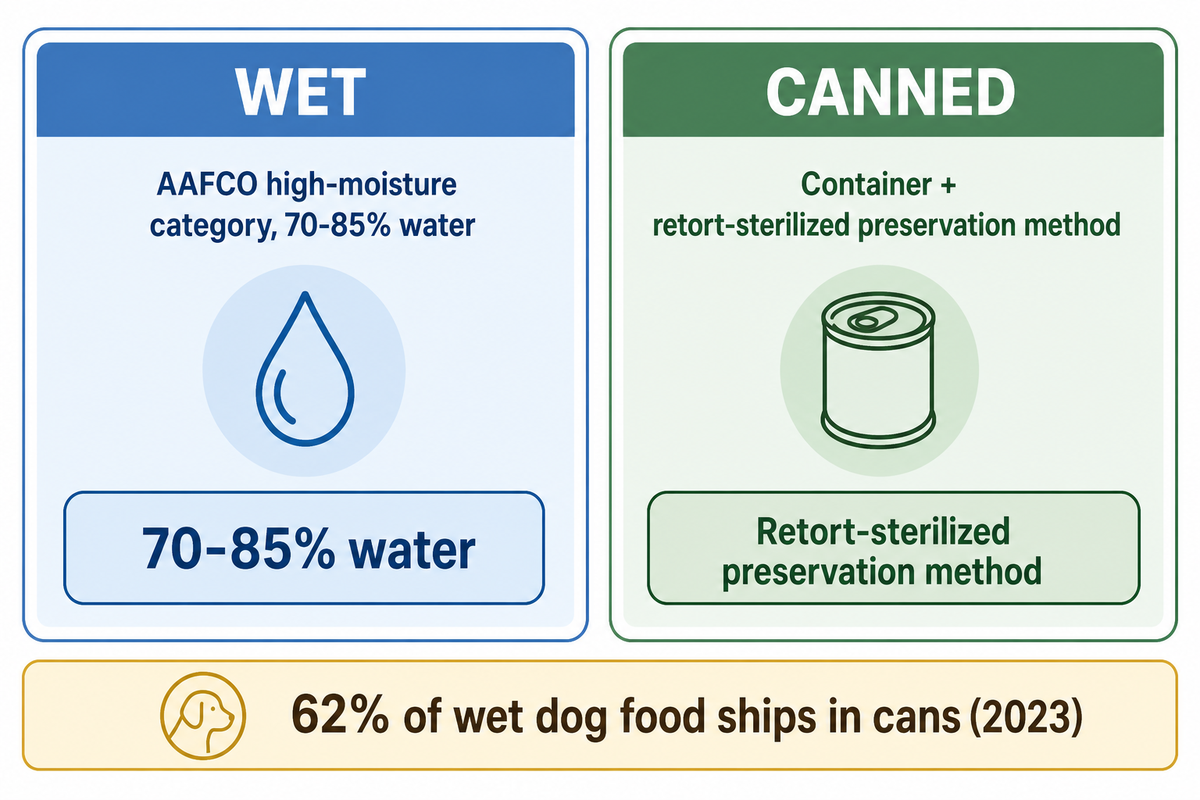
A wet pet food canning line processes food that stays well above the moisture threshold separating it from dry or semi-moist formats. AAFCO’s framework treats “wet” as the high-moisture category, typically 70-85% water, versus roughly 6-10% for dry kibble, per FDA’s own pet food guidance. “Canned” narrows that further to one preservation method: food sealed into a hermetically closed container and processed in a retort, rather than freeze-dried, dehydrated, or extruded.
Not all wet pet food is canned; pouches and trays are wet too. Cans nevertheless remained the dominant format in one US consumer dataset: 62% of wet dog food purchasing in 2023 went to cans, against 19% for plastic cups and tubs and 17% for pouches, per MRI-Simmons data reported by Pet Food Processing. If your product is a pâté, stew, or chunk-in-gravy formulation destined for a sealed metal or composite container, you’re in canning-line territory; if it’s a pumpable liquid meant for cold filling, you’re looking at aseptic processing instead, which this guide addresses briefly in the format-comparison section below. Buyers who assume “wet” and “canned” mean the same thing often hit a mismatch when comparing supplier quotes, because a pouch-format quote and a canning-line quote solve different procurement problems even though both ship wet pet food under the same AAFCO and FDA framework. That confusion appears early in RFQ conversations. Specifying only “wet food” does not tell a canning-line supplier enough to quote the correct container-handling and preservation system, because equipment selection depends on container type as well as moisture content.
The Regulatory Framework Built for Canned Pet Food
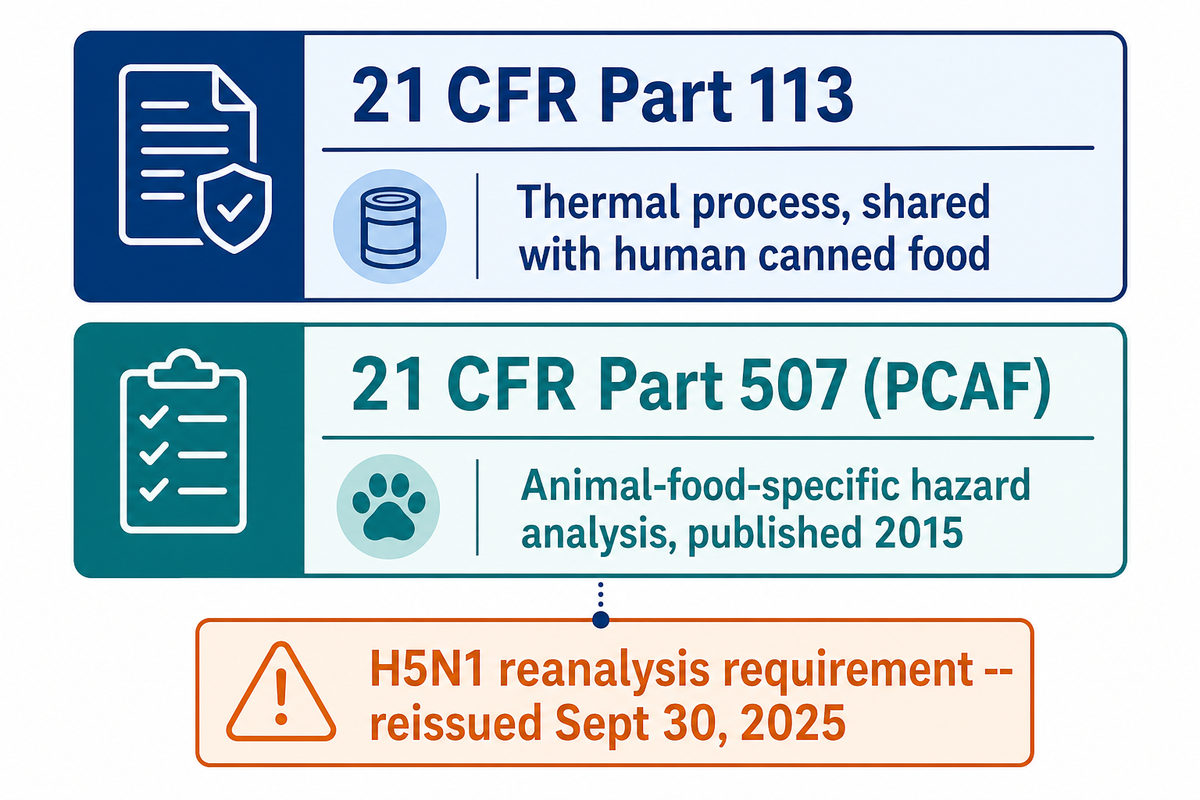
Canned pet food sits under two US regulations at once, not one: 21 CFR Part 113 governs the thermal process itself and is shared with human canned food, while 21 CFR Part 507 (the Preventive Controls for Animal Food rule, PCAF) adds an animal-food-specific layer of hazard analysis and preventive controls on top. Neither replaces the other. FDA’s own pet food guidance states this plainly:
“Canned pet foods must be processed in conformance with the low acid canned food regulations… see Title 21 Code of Federal Regulations, Part 113” — the identical rule that governs a can of human soup.
PCAF, published as a final rule in September 2015, sits alongside it as the animal-food track: it requires a written food safety plan, hazard analysis, and preventive controls specific to facilities manufacturing food for pets.
A canning-line supplier’s job
- Deliver a vessel with documented temperature-distribution behavior
- Build to a chamber size, basket pattern and material spec you approve
- Hand over the record of how the equipment was configured and tested
What stays your job (or your processing authority’s)
- Establishing the scheduled process for your specific product and container
- Writing and maintaining the PCAF food safety plan
- Filing the food-canning-establishment registration and scheduled-process paperwork per product with FDA
That last point is easy to miss when a supplier’s pitch focuses entirely on throughput and chamber size: equipment capability isn’t the regulatory unit of validation. The scheduled process, the specific time-and-temperature combination that makes your product commercially sterile, is filed per product and per container, with a competent processing authority standing behind it. Even a vessel that behaves exactly as documented does not establish compliance if the scheduled-process filing for a new pack size has not been completed.
Label requirements sit on a separate, slower-moving track. AAFCO’s Pet Food Label Modernization (PFLM) project, underway since 2015, is not a single nationwide law that took effect on one date — it is model regulation that each state adopts and enforces on its own timeline. Washington is a useful example: the state adopted the 2025 AAFCO model regulations into its own administrative code on June 6, 2025, but its Department of Agriculture is deliberately not enforcing the new label requirements until July 1, 2030, to give manufacturers time to redo laboratory analysis, packaging artwork, and information systems. AAFCO itself recommends a 6-year transition window. If a supplier or consultant tells you PFLM compliance is a fixed 2025 deadline everywhere, ask which state’s rulemaking they mean — the honest answer is “it depends where you sell.”
One more regulatory thread is current as of this writing and specific to canned pet food’s advantage over raw formats: FDA determined, and reissued the guidance again on September 30, 2025 for the fall migratory season, that manufacturers using uncooked or unpasteurized poultry- or cattle-derived ingredients must reanalyze their food safety plans to include H5N1 (highly pathogenic avian influenza) as a hazard. FDA names “pasteurizing, cooking, or canning” explicitly as processing steps capable of inactivating the virus. If your formulation uses raw poultry or beef inputs, a retort cycle that achieves commercial sterility is also doing double duty as a virus-inactivation step FDA has explicitly recognized, worth knowing if you’re weighing canning against a raw or lightly-processed format for the same product line.
In-House Canning vs. Co-Packing: The Real Cost Comparison
Whether an in-house line beats a co-packer on cost depends on your volume and how fully you can run the line, not on a fixed threshold anyone can quote. Despite how often buyers ask for one, no single published breakeven number exists for wet pet food specifically. Industry practitioners describe the trade-off correctly: owning your own factory can cost less when the plant runs efficiently at high utilization; when volume is low or unpredictable, a co-packer can win because it converts fixed capital risk into a variable cost paid only when you produce. The right answer comes from your own numbers, not someone else’s rule of thumb.
5-year total cost of ownership: in-house line vs. co-packer
| Cost item | In-house line (your inputs) | Co-packer (your inputs) |
|---|---|---|
| Purchase price | [line quote, one-time] | $0 |
| Installation & commissioning | [one-time] | $0 |
| Utilities (5-yr) | [steam/power rate x hours] | included in per-unit fee |
| Labor & changeover (5-yr) | [headcount x wage x 5] | included in per-unit fee |
| Co-pack unit fee equivalent (5-yr) | n/a | [per-unit fee x annual volume x 5] |
| Maintenance & spare parts (5-yr) | [typically 2-4% of purchase price per year] | included in per-unit fee |
| Facility / floor space (5-yr) | [rent or opportunity cost x years] | $0 (uses co-packer’s facility) |
| Operator training (one-time) | [hours x wage rate] | $0 (co-packer’s own crew) |
| Financing / interest (5-yr) | [loan amount x rate x years, if financed] | n/a |
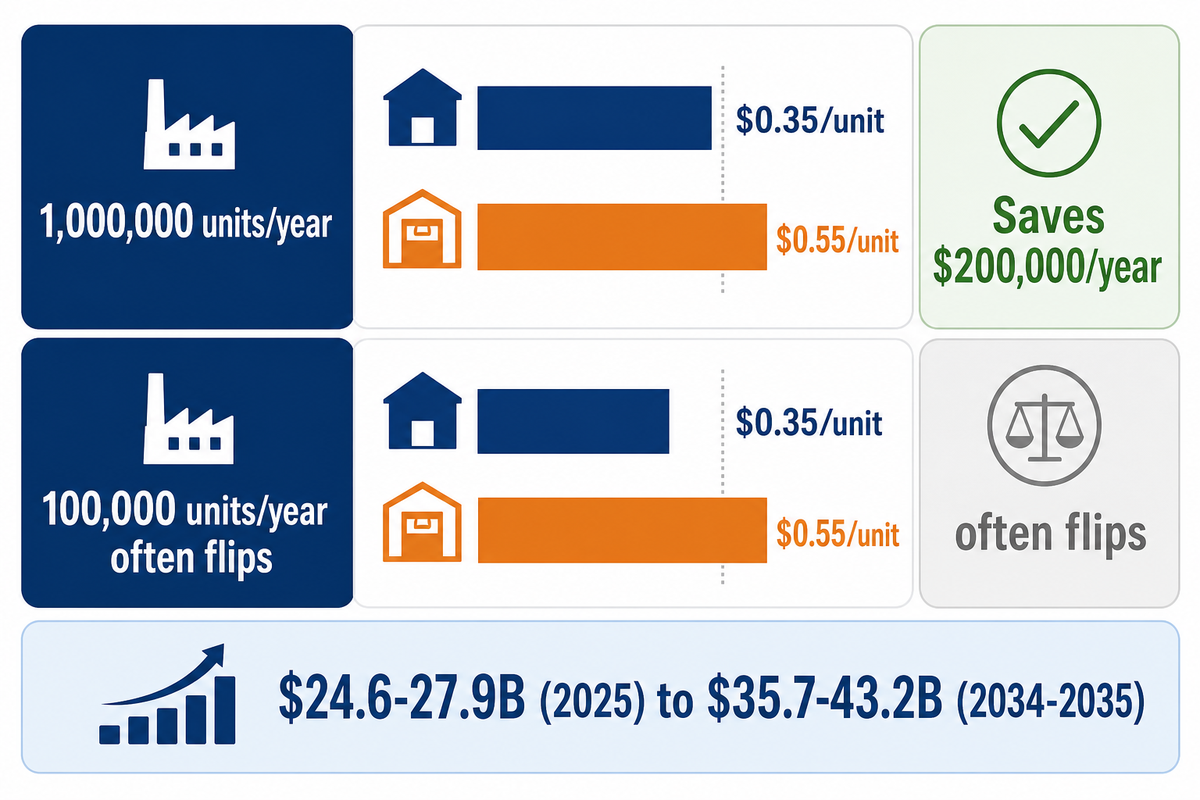
Payback example: a plant running 1 million units/year at an in-house all-in cost of $0.35/unit against a co-packer quoting $0.55/unit saves $0.20/unit — $200,000/year, or $1,000,000 over 5 years, against a line that typically costs a fraction of that to purchase and install. Run that same math at 100,000 units/year, though, and it often flips: fixed capital and utility costs spread over a tenth of the volume, and the per-unit in-house cost can climb above what a co-packer charges. For a sensitivity check, recalculate at 50%, 75%, 90%, and 100% utilization, then move utility rates by −10% and +10%. Run this table with your own supplier quote and expected volume before deciding either way.
Two structural facts favor building capacity right now, if the volume math clears that bar. First, wet pet food isn’t a shrinking category in absolute terms: independent market-research estimates put the global market at roughly $24.6 to $27.9 billion in 2025, growing toward $35.7 to $43.2 billion by 2034-2035, a compound annual growth rate in the 4.3%-4.5% range across separate firms. That figure describes the segment’s dollar growth, not necessarily its share of the total pet food market relative to dry kibble, a distinction worth holding onto if you see wet-vs-dry share claims elsewhere that don’t match. Second, cat ownership and cat-specific wet formats are a disproportionate share of what’s driving new product activity: cat wet food was the second-largest new-product-launch category industry-wide from 2016 to 2025, behind only dog snacks and treats, at 19.8% of all launches tracked. Tracking cat wet food specifically, rather than “pet food” as one undifferentiated category, is the sharper way to read this demand signal.
Choosing a Format: Wet/Canned vs. Dry Kibble vs. Freeze-Dried vs. Jerky
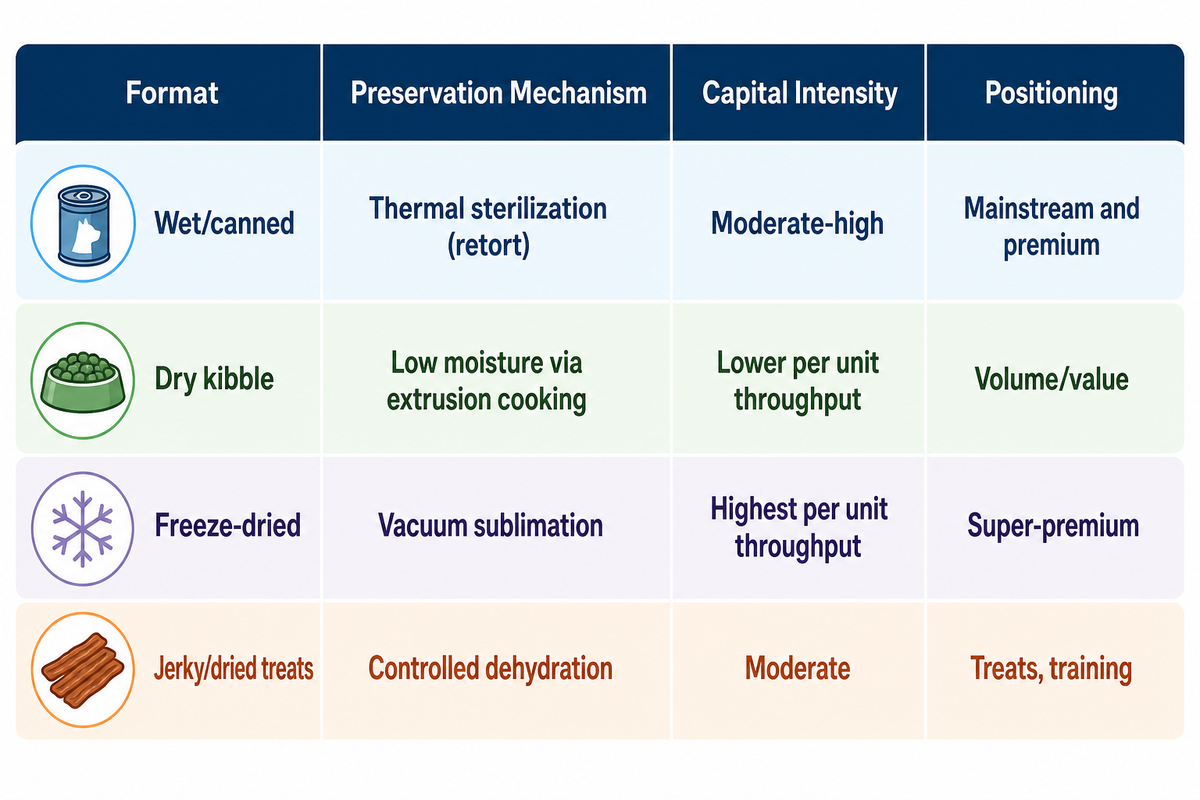
The four common pet food formats trade off differently on capital intensity, shelf-life mechanism, and brand positioning, and picking the wrong one for your product concept costs more to fix later than it does to compare up front. Wet canning uses thermal sterilization for shelf stability without refrigeration; dry kibble extrusion uses low moisture and cooking for stability with a much lower per-unit capital and utility footprint; freeze-drying removes water under vacuum to preserve structure and nutrients at the cost of the highest capital intensity per unit of throughput; and jerky-style drying sits in between, using controlled dehydration for a shelf-stable treat format.
| Format | Preservation mechanism | Relative capital intensity | Typical positioning |
|---|---|---|---|
| Wet / canned | Thermal sterilization (retort) | Moderate-high | Mainstream and premium, high palatability |
| Dry kibble | Low moisture via extrusion cooking | Lower per unit throughput | Volume/value, everyday feeding |
| Freeze-dried | Vacuum sublimation | Highest per unit throughput | Super-premium, raw-adjacent |
| Jerky / dried treats | Controlled dehydration | Moderate | Treats, training, shelf-stable snacking |
If your product concept is specifically a moisture-rich, gravy-or-jelly formulation meant to sit on a shelf without refrigeration, canning is very likely the right route and the rest of this guide applies directly. Still comparing formats? The deeper mechanics of each sit in dedicated guides: our dry kibble extrusion line guide covers the process-control side of kibble, our freeze-dried pet treat line guide covers why freeze-drying’s cost structure runs opposite to canning’s (operating cost dominates, not capital), and our pet food processing overview compares all four routes side by side.
Inside the Line: The Stations and Materials a Buyer Should Recognize
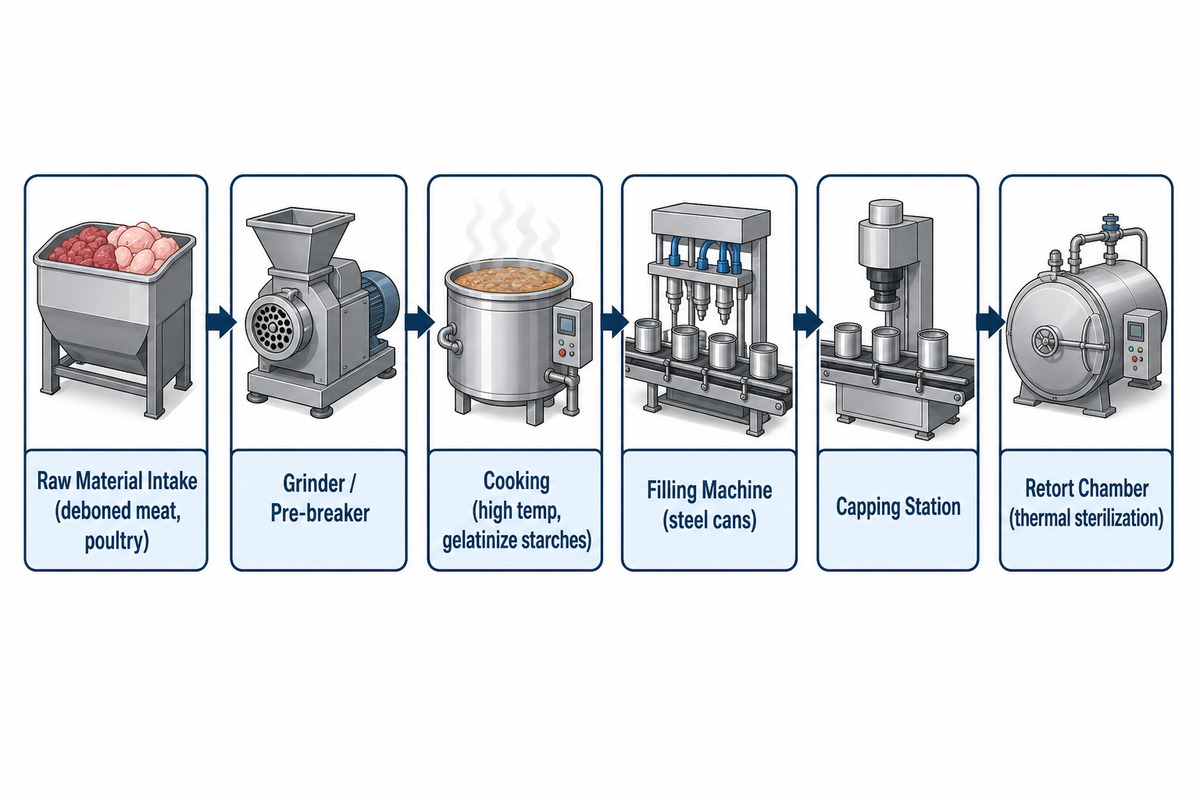
A wet pet food processing plant is not one machine; its canned pet food production line links preparation, filling, retorting, and pet food packaging. On the prep side, raw material intake typically starts with deboned meat or poultry, sometimes supplemented with animal by-product or plant-based protein depending on the formulation. Dry ingredients such as vitamin and mineral premixes, binders, and thickeners join the mix after a grinder or pre-breaker reduces the raw material to a workable particle size. Whether the meat arrives fresh or frozen changes upstream handling but not the downstream equipment selection.
The cooking process runs at high temperature to gelatinize starches and set the gravy or pâté structure. Finished-mix viscosity matters as much as the temperature curve: product that is too thin can underfill, while product that is too thick can jam a filling machine. On the filling line, the filler deposits product into steel cans or another specified primary package. If the can supplier specifies a two-piece format, the capping or seaming tooling must match it. Pouches or trays need separate filling equipment, while carton handling normally belongs to secondary packaging.
Sealed containers then move to the retort chamber for thermal sterilization. Shelf stability depends on a hygienic, airtight seam; extra cook time cannot compensate for a defective closure. At the end of line, a case packer, decorative labeling, robotics-assisted palletizing, and quality control prepare the product for shipment. These wet pet food packaging stations are part of the production system, not cosmetic add-ons. Stainless-steel product-contact surfaces support hygienic design, but high-performance machinery and material choice alone do not prove that a plant will pass a sanitation audit. None of this replaces the chamber-size and automation-tier selection guidance on our canning line solutions page.
The buyers behind these purchase orders vary as much as the stations on the line. Some food manufacturing companies extend an existing human-food plant into pet nutrition; others move from a dry pet food line into canned cat food for the first time. Every pet food line still needs a formulation that meets the applicable complete and balanced nutrition requirements for the target species. Pet owners see the finished package, but a processor must also budget conveyor and material-handling capacity between stations because a bottleneck can cap the output of the whole pet food production line. Supplier-defined “automation tiers” may differ from one manufacturer to the next, and that gap often surfaces during factory acceptance testing. Ask the supplier to define station interfaces, test scope, and process-control records in writing before signing. Shengtu lists ISO 9001-documented management-system controls among its certifications, but the buyer should still verify how those controls apply to the quoted machinery.
5-Point Hidden Bottleneck Map for Line Sizing
This map turns five easy-to-miss interfaces into factory-acceptance questions. It does not predict output from a catalog speed; it shows which upstream or downstream constraint can prevent the quoted line rate from becoming saleable packed product.
| Hidden bottleneck | What it constrains | Evidence to request | Buyer action |
|---|---|---|---|
| Recipe viscosity → filler | Fill accuracy, deposit consistency, and stoppage risk | Trial data using your actual pâté, stew, or chunk-in-gravy recipe | Put the recipe and target package into the factory acceptance test |
| Container → retort mode | Whether saturated steam is suitable or overpressure is required | Heating-mode rationale tied to each can, pouch, or tray | Reject a mode recommendation that is not package-specific |
| Closure integrity → scheduled process | Whether the container stays hermetically sealed through heating and cooling | Seam or seal measurements plus reject criteria | Run the acceptance test with production containers, not generic samples |
| Transfer and buffer capacity | Whether grinding, mixing, filling, retort loading, and unloading stay rate-matched | Station-by-station rate sheet and buffer assumptions | Size the slowest interface, not only the fastest machine |
| Labeling, case packing, and palletizing | Whether finished containers clear the end of line without backing up retort unloading | A sustained 30 min run at 100% of the quoted packed-product rate | Include end-of-line equipment in the line-rate guarantee |
How Retort Sterilization Actually Works, And Why the Heating Mode Matters
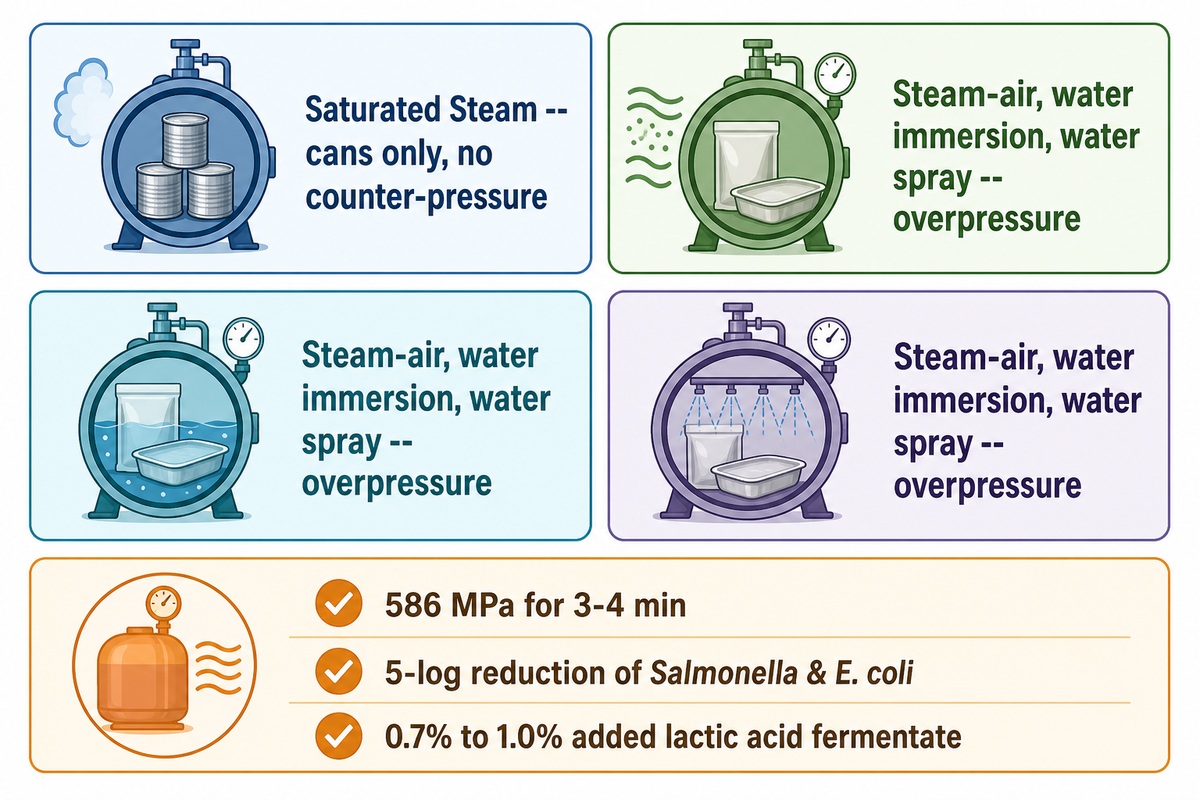
Retort sterilization works by heating sealed containers above the boiling point of water inside a pressure vessel, long enough to reach commercial sterility. Which of four common heating modes the vessel uses changes what container formats it can safely run: saturated steam, steam-air mixtures, water immersion, and water spray. The right mode depends on whether your format is a rigid can or a flexible pouch or tray.
Saturated steam condensing directly on the container wall is the simplest mode, but it provides no counter-pressure. That can suit a rigid metal can, which carries its own structural pressure resistance, but it can distort or split a pouch or tray during heating. Steam-air mixtures and water immersion or water-spray systems add counter-pressure, called overpressure, which is why flexible and semi-rigid packages need one of those modes rather than plain steam. USDA guidance on overpressure retorts puts the working steam-to-air ratio between roughly 75% steam/25% air and 95%/5%, adjusted for the package being run. If you’re set on cans only, saturated steam can be a valid starting point; once pouches or trays enter the format mix, overpressure capability becomes an equipment and validation decision. Shengtu’s published retort range spans roughly 700mm to 1200mm inner diameter and 80 kg to 900 kg batch load across four heating modes, but the final selection must follow the container and scheduled process.
High-pressure processing (HPP) is a non-thermal alternative worth knowing about, though it serves a different product category. HPP has demonstrated 5-log reductions of Salmonella and Shiga-toxin-producing E. coli in raw pet food formulations at roughly 586 MPa for 3-4 min, while published studies use pressures from roughly 250 MPa to 750 MPa across target organisms. Listeria monocytogenes can be more pressure-resistant. The 2024 Journal of Food Protection study found that HPP alone fell short of a full 5-log Listeria reduction and required 0.7% to 1.0% added lactic acid fermentate to close the gap and hold it through frozen storage at −10°C to −16°C for up to 21 days. HPP targets the raw and lightly processed pet food segment; it does not replace retort sterilization for a shelf-stable canned product, because HPP-treated raw food still requires refrigeration. If your product must sit on a shelf without refrigeration, retort remains the applicable technology. For the full breakdown of chamber sizes, basket configurations, and heating modes, see our canning line solutions page and retort equipment page.
The 2-of-14 Procurement Disclosure Gap: What to Ask a Canning Line Supplier Before You Sign
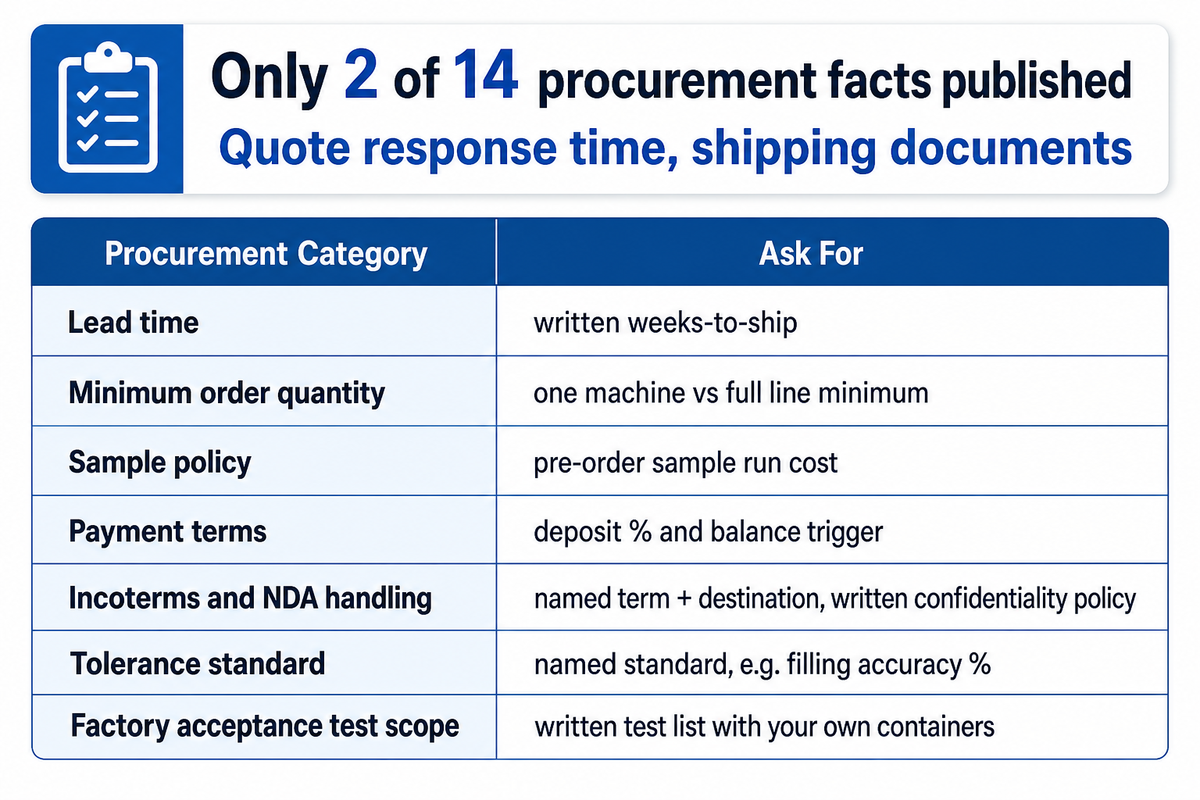
Most canning-line supplier pages read like brochures, and that’s not an accident: our own review of seven supplier-owned pages in the industrial food sterilization equipment category, spanning Chinese manufacturers at comparable scale and Western specialists, not independently audited by a third party, found that only two of fourteen procurement facts buyers actually need were published anywhere: quote response time and shipping documents. Call it the 2-of-14 Procurement Disclosure Gap: the other twelve, lead time, minimum order quantity, sample policy, payment terms, Incoterms, NDA handling, tolerance standard, and factory acceptance test scope among them, simply weren’t there to find. That’s not a claim about any one supplier’s honesty; it’s a description of what an entire peer set leaves out of its own marketing pages, which means the burden falls on you to ask directly. It matters beyond price, too: the equipment a supplier ships still has to support the food-canning-establishment registration and scheduled-process paperwork FDA requires per product, so a quote silent on procurement basics is often silent on compliance documentation as well.
RFQ checklist — copy these procurement-category rows into your quote request:
| Procurement category | Ask for | Why it matters | How to verify |
|---|---|---|---|
| Lead time | Written weeks-to-ship, by line stage | Determines your launch date and cash-flow plan | Get it in the written quote, not a verbal estimate |
| Minimum order quantity | One machine vs. full line minimum | Sets your minimum viable purchase | Confirm in writing whether partial-line orders are accepted |
| Sample policy | Whether pre-order sample runs on your own product are offered, and at what cost | Lets you validate fill accuracy and seam quality before committing capital | Ask whether sample runs use your actual formulation or a generic test product |
| Payment terms | Deposit % and balance trigger (e.g. before shipment vs. after acceptance) | Affects your working capital exposure | Compare deposit percentage across at least two quotes |
| Incoterms | Named term (e.g. FOB, CIF, DDP) with the specific port or destination | Determines who owns shipping risk and cost at each leg | Confirm the exact Incoterms version cited (e.g. Incoterms 2020) in writing |
| NDA handling | Written policy on formulation and drawing confidentiality | Protects proprietary recipe and container-spec details shared during quoting | Request a signed NDA before sharing full formulation data |
| Tolerance standard | Named standard (e.g. filling accuracy %, seam dimensions) | Determines whether the line meets your product spec | Ask for the acceptance-test report format before ordering |
| Factory acceptance test scope | Written list of what gets tested with your own containers | This is where design errors surface before shipment, not after | Request the FAT checklist in advance, not on the day |
None of these questions requires a large order or unusual negotiating power. Canning-line buyers of any size can ask for straight answers on procurement terms, and a supplier’s willingness to put these eight items in writing tells you more about the relationship than a capacity claim on a product page. The same disclosure gap appeared in the saved AI-citation baseline for this topic: buyer-intent questions about the “best” line, selection, and price produced no citation to an individual equipment maker’s own site. The results were marketplace listings and a small set of brand mentions, so AI search did not supply the procurement detail that a direct RFQ can obtain.
Common Quality and Safety Failures in Wet Pet Food Production
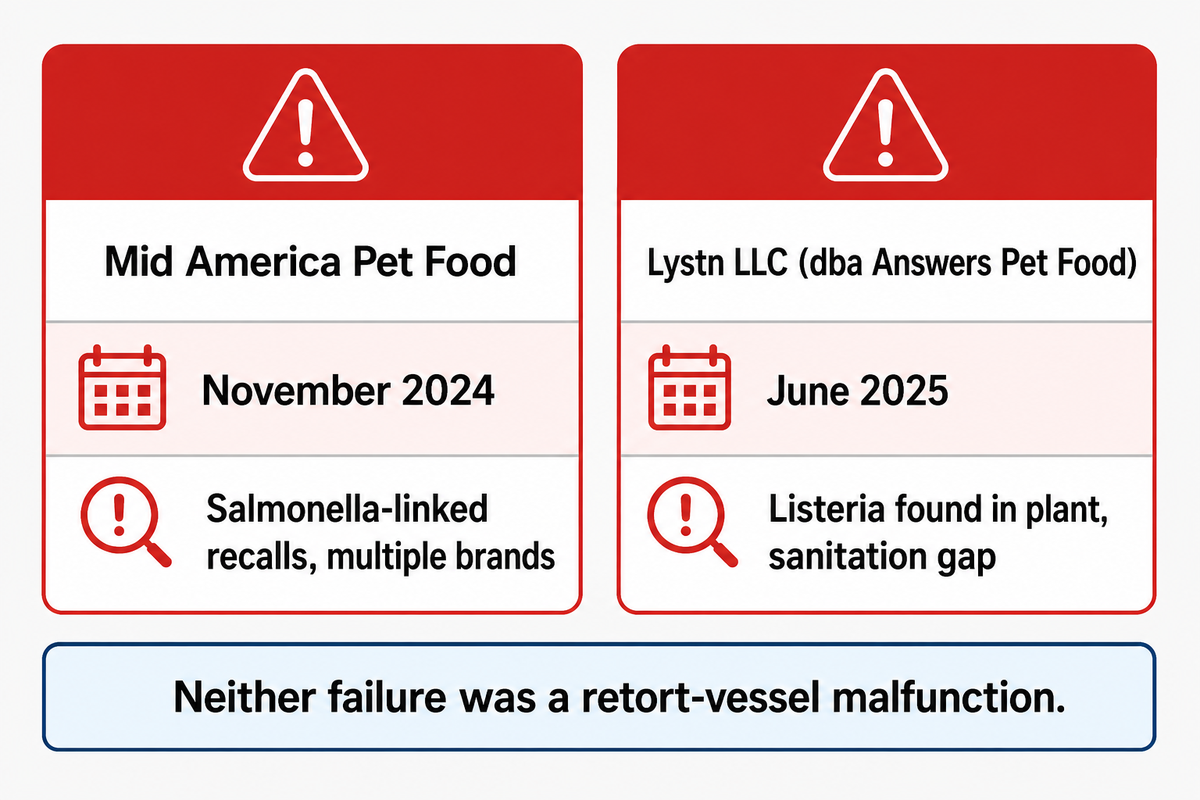
The failure modes that actually show up in FDA enforcement records are less about exotic equipment faults and more about gaps between what a rapid test shows and what’s really in the product. Real, recent cases make the pattern concrete: FDA issued a warning letter to Mid America Pet Food in November 2024 over Salmonella-linked recalls spanning multiple brands, and to Lystn LLC (dba Answers Pet Food) in June 2025 after inspectors observed water splash from non-food-contact surfaces onto in-process product and found Listeria inside the plant. Neither failure was a retort-vessel malfunction; both were sanitation and cross-contamination control gaps in facilities and workflows around the processing equipment.
Understanding what your lab tests can and can’t tell you is a subtler failure mode worth walking through. The 0.85 water-activity threshold is a US regulatory boundary that removes a product from the scope of the low-acid canned food rules; it is not, on its own, proof that a product is pathogen-free. Separately, and more specific to canning, a 2026 study out of Ludwig Maximilian University of Munich found that canning can lower water-soluble phosphorus readings in a common rapid lab screening method even when the identical amount of inorganic phosphate was added before processing. In that study’s experimental loaf-style wet cat diet, canned samples showed markedly lower 1-minute water-soluble phosphorus values than the same formulation tested raw, despite carrying the same added phosphate load. Canning isn’t uniquely risky here: a fast solubility screen is not the same thing as a total-phosphorus measurement. If phosphorus management matters for your formulation, that is a case for total-phosphorus testing on the finished canned product, not just the pre-cook mix. Retort sterilization still serves its core job of eliminating harmful microorganisms and preventing spoilage in products that would otherwise need refrigeration. Both 2024-2025 warning letters concerned sanitation and cross-contamination gaps around processing equipment, not a failure of retort science.
Industry Outlook: Why Canning Capacity Investment Is Accelerating
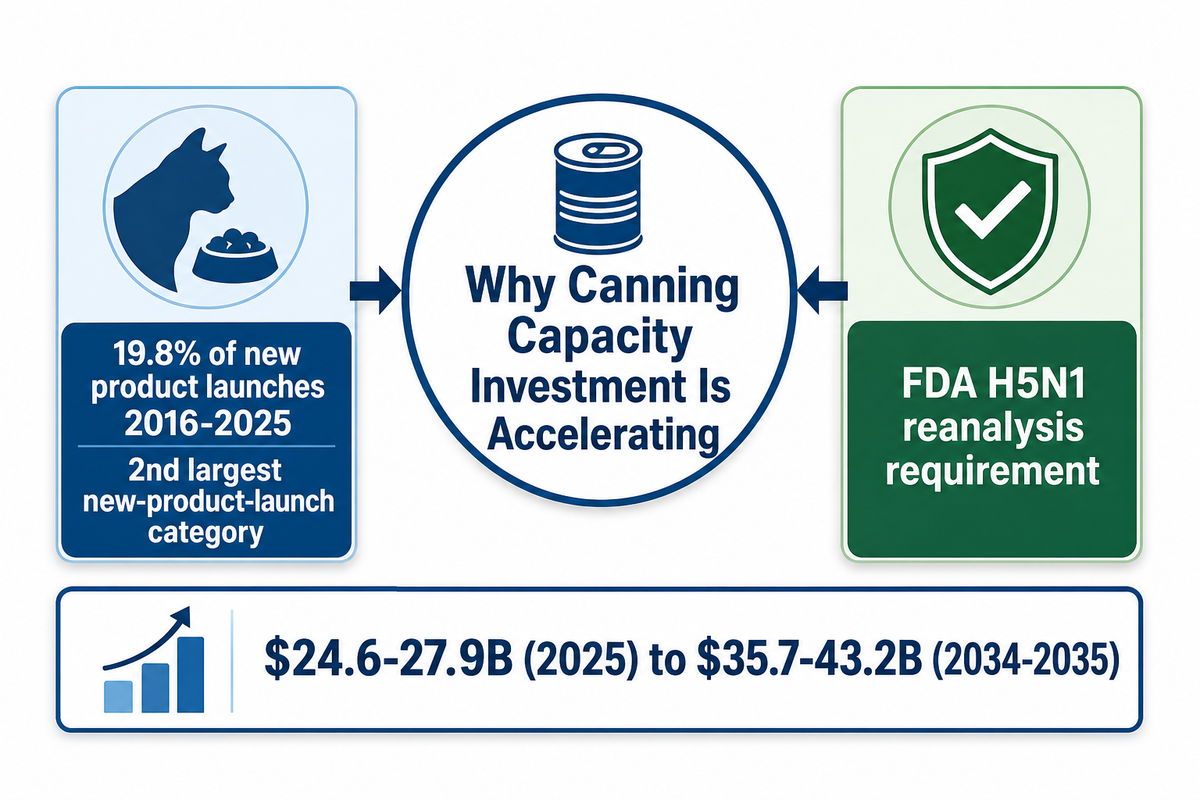
The clearest demand signal for wet capacity is cat-specific product activity, not a generic “pet food is booming” claim. Cat wet food ranked as the second-largest new-product-launch category industry-wide from 2016 to 2025, at 19.8% of launches in the cited dataset. Manufacturers using raw poultry or cattle ingredients face a separate regulatory driver: FDA’s H5N1 reanalysis requirement, reissued for the 2025-2026 fall migratory season, names canning as a virus-inactivating step. Market-size estimates of $24.6-27.9 billion in 2025, rising toward $35.7-43.2 billion by 2034-2035, provide directional context rather than a plant-level forecast. If you’re timing a capacity decision, test those demand and regulatory signals against your own SKU plan and expected utilization. One 2025 trade-press report also describes pet-food processors adding automation around labeling, case packing, and palletizing, so capacity planning should include the end of the line rather than the retort alone.
Frequently Asked Questions
Q: What’s the difference between wet pet food and canned pet food?
Wet is a moisture category defined by AAFCO’s framework; canned is a container and preservation method involving retort sterilization. The two overlap heavily but aren’t synonyms, since pouches and trays are wet too.
“Wet” refers to moisture — typically 70-85% water under AAFCO’s framework. “Canned” refers to the container and process: a hermetically sealed metal can, retort-sterilized. Pouches and trays are wet too, so the two terms aren’t interchangeable, even though most canned product is wet. Quoting “wet” alone does not identify the container or preservation method.
Q: How much does it cost to start a wet pet food canning line?
Budget in three buckets: line purchase and installation, retort vessel count and size, and recurring utilities. Actual prices depend on the container mix, throughput, automation scope, local utility rates, and acceptance-test requirements.
Build a credible budget around purchase and installation, retort vessel count and size, and recurring utilities such as steam or electric heating, compressed air, and cooling water. Co-packing shifts much of that burden into a per-unit fee instead of financing a production line yourself. Use written supplier quotes and the cost comparison above to test where that trade-off flips for your expected annual volume.
Q: Is co-packing cheaper than building an in-house canning line?
Volume and utilization decide this; no fixed crossover number applies to every product. Compare a written co-packer quote with your expected annual output, capital cost, labor, utilities, maintenance, and downtime risk.
Co-packing avoids upfront capital and lets a brand test formats before committing to a plant, but per-unit fees accumulate as volume grows and production must fit the co-packer’s schedule. In-house canning can win at larger, predictable volumes because fixed capital and utility costs spread across more units. Run your own numbers through the TCO comparison above instead of borrowing a generic crossover point.
Q: What regulations apply to canned pet food in the US?
Two federal regulations apply, not one: 21 CFR Part 113 (shared with human canned food) plus 21 CFR Part 507 (animal-specific preventive controls), on top of AAFCO’s state-by-state label requirements.
Two federal rules and one state-variable label track apply. 21 CFR Part 113 covers the thermal process and is shared with human canned food. 21 CFR Part 507 (PCAF) adds animal-food-specific hazard analysis and preventive controls on top; both rules matter. Labeling follows AAFCO’s Pet Food Label Modernization project, which each state adopts on its own schedule rather than through one national deadline. Washington, for example, will not enforce the new label requirements until July 2030 even though it adopted the 2025 model regulations in June 2025. Manufacturers sourcing raw poultry or cattle ingredients also need to review FDA’s H5N1 food-safety-plan guidance for the 2025-2026 season.
Q: How do I know if a canning line supplier is being straight with me about lead times and MOQ?
Ask for lead time, minimum order quantity, payment terms, tolerance standard, and factory acceptance test scope in writing before signing. The seven-supplier baseline found that most of these facts were not published.
Request lead time, minimum order quantity, sample policy, payment terms, Incoterms, NDA handling, tolerance standard, and factory acceptance test scope in writing as part of your RFQ. Across seven industrial sterilization equipment suppliers, the peer baseline found that only two of fourteen procurement facts appeared on any supplier-owned page. That pattern is not unique to one company; ask these eight questions directly rather than assuming the answers will appear in a quote.
Why We Write This
Our solutions page for wet pet food canning lines is an equipment and RFQ-engineering resource: it answers “what will you build me,” not “should I build this, and what should I verify.” The peer-baseline procurement-disclosure survey above came from a review of supplier-owned pages in the retort and sterilization equipment category. The Part 113/Part 507 explanation and the state-by-state status of AAFCO’s label modernization were tightened after an adversarial review found that an earlier draft had oversimplified both.
References & Sources
- FDA, Pet Food regulation overview, 21 CFR Part 113 U.S. Food and Drug Administration
- FDA CVM Update, Cat and Dog Food Manufacturers Required to Consider H5N1 in Food Safety Plans U.S. Food and Drug Administration, reissued September 30, 2025
- AAFCO, Pet Food Label Modernization (PFLM) Association of American Feed Control Officials
- Washington State Department of Agriculture, PFLM Enforcement Discretion Policy Statement WSDA, June 6, 2025
- Wet packaging evolves alongside consumer demand for convenience, sustainability Pet Food Processing
- New Pet Food Product Launches 2016-2025 (Mintel GNPD data review) Animals (MDPI), 16(11):1753
- Canning wet pet food complicates phosphorus labeling Pet Food Industry, summarizing a Journal of Animal Physiology and Animal Nutrition study
- FDA and CDC Investigate Cases of Salmonella Linked to Pet Food Made by Mid America Pet Food U.S. Food and Drug Administration
- Warning Letter, Lystn LLC dba Answers Pet Food U.S. Food and Drug Administration, June 18, 2025
- Understanding retort processing: A review PubMed Central
- Module 11, Retorts Using Overpressure USDA Food Safety and Inspection Service
- Wet Pet Food Market Size, Share & Industry Analysis Fortune Business Insights
- Wet Pet Food Market Size and Trends Precedence Research
- The Combined Use of High Pressure Processing and Lactic Acid Containing Fermentate on Inactivation of Salmonella, Shiga Toxin-producing E. coli, and Listeria monocytogenes in Raw Pet Foods Journal of Food Protection, December 2024