Get in touch with Shengtu Bufan Company

Cleaning and CIP Equipment for Food Processing Lines
Cleaning and CIP equipment covers two separate purchases that are often confused, because they share one hygiene objective. One route is the produce line, where an industrial vegetable washer, brush or bubble stages and peeling equipment are sized to the crop you handle. The other route is process equipment cleaning, where a food-grade clean-in-place skid circulates cleaning solution through tanks, pipework and heat exchangers without disassembly.
- Produce washing and peeling equipment, plus food-grade clean-in-place systems
- Configured by product, soil load, circuit and cycle objective
- Selection referenced to published hygiene standards, EN 1672-2 and EN ISO 14159
- Digital control through the STUnit platform
Four inputs move a configuration fastest: the product and its process state, the hourly target, the existing line interfaces, and the utilities and effluent limits at the site.
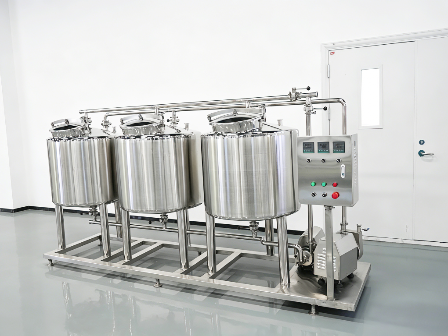
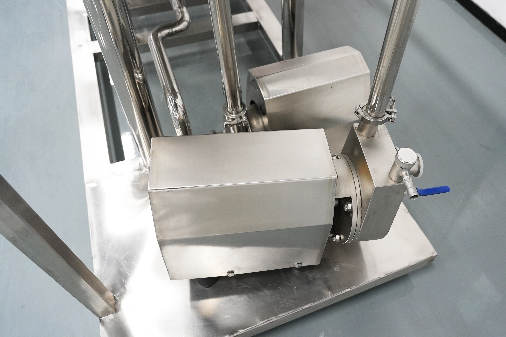
Who builds it
Shandong Shengtu Bufan Intelligent Technology Co., Ltd., a high-tech enterprise in Weifang
Scope of work
Food machinery research and development, manufacturing, and whole-plant digital solutions
Engineering record
100+ research and development projects and 7 patents
Software record
100+ software copyrights
Control platform
The STUnit platform, with standalone OTA upgrades
Plant-level scope
Line integration and smart factory planning, from a single washer to a full processing hall
Cleaning Challenges Mapped to the Right Equipment
Begin with what each machine is actually for, because the two routes answer different questions. Washing vegetables removes soil, field debris and surface contaminants, and it limits cross-contamination between units of product moving through shared water. It is not a lethality step: on lightly contaminated rocket leaves, six washing methods produced no significant reduction in Salmonella,2 and plain water on lettuce reduces counts by no more than about 1 log cfu/g.5
Explore Cleaning Technologies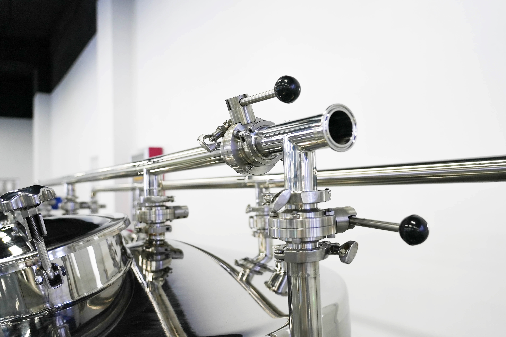
| Cleaning route | What it acts on | What it does not do | Where it sits |
|---|---|---|---|
| Produce washing and peeling | Field soil, sand, leaf debris and loose skin on fruits and vegetables | Replace a validated lethality step | Between intake and cutting, weighing or packing |
| Clean-in-place | Product residue and biofilm inside tanks, pipework, pumps and heat exchangers | Reach clamps, hoses, fittings, crates or scale buckets | Between production runs, without disassembly |
| Clean-out-of-place | Parts removed from the line and washed in a dedicated crate or tray washer | Run while the line is producing | After operators disassemble the wetted parts |
| Manual cleaning | Open surfaces, frames, floors and drains | Give repeatable, recorded cycle times | Daily sanitation window |
Deciding the boundary between CIP and COP early changes the equipment list more than any brochure comparison. Buying a larger skid does nothing for the clamps, hoses and crates sitting outside the circuit. A plant that maps every wetted part into one of these two columns rarely buys the wrong washer, and it stops paying for capacity that was never going to touch the parts causing its swab failures.
Equipment Configuration InquiryVegetable Washing and Peeling Equipment by Product and Soil Load
Colder wash water is not safer water. When water sits below the core temperature of the product, the pressure differential draws water inward through stem scars and wounds, and tomatoes, melons, mangoes and apples are the classic infiltration risks.6 Deep tanks raise the hydrostatic pressure and raise that risk with it, which is a design input, not an operating habit.
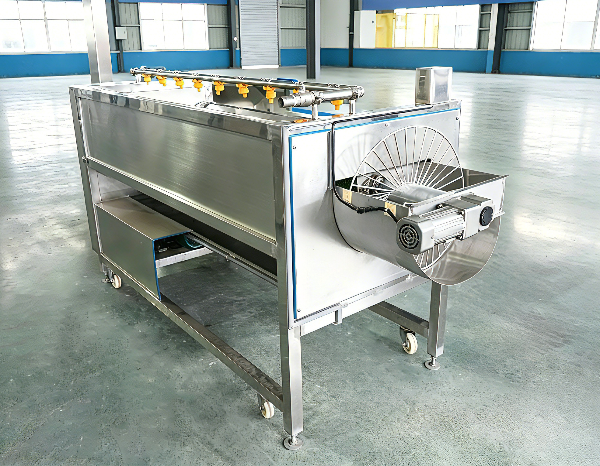
Vegetable Washing & Peeling Machine
Produce washing routes are selected around crop fragility, soil load and the required line output.
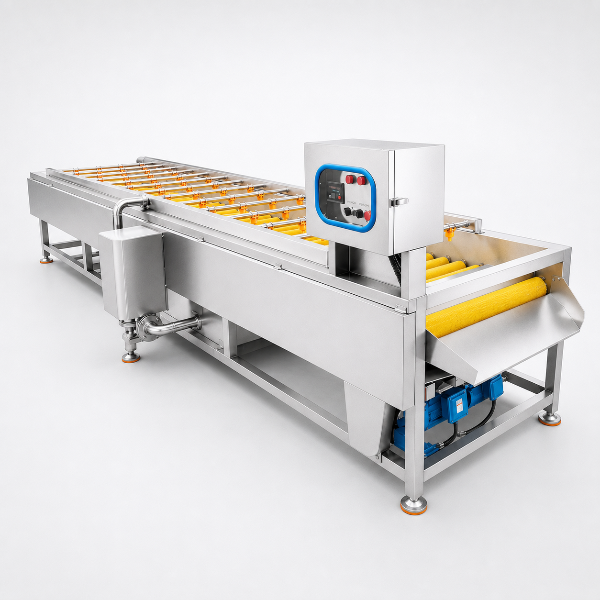
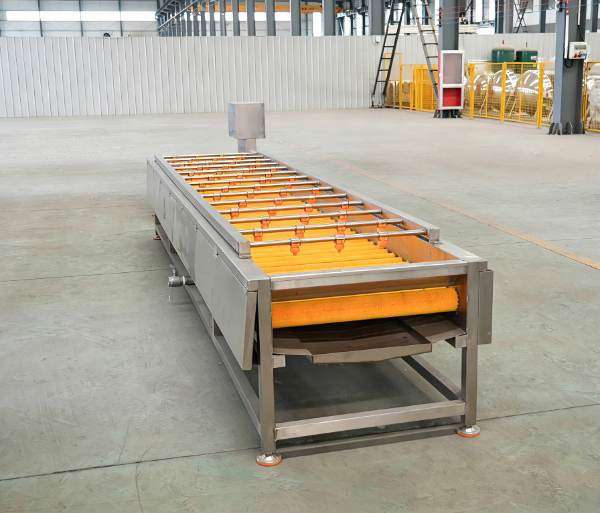
For field-soiled fruits and vegetables, with bubble washing, brush cleaning, spray rinsing or abrasive peeling selected to match the product.
- Best fit: leafy, root and mixed produce, using different cleaning actions
- Plan around: soil load, damage limit, hourly target and water strategy
- Line links: intake and sorting through cutting, dewatering or weighing
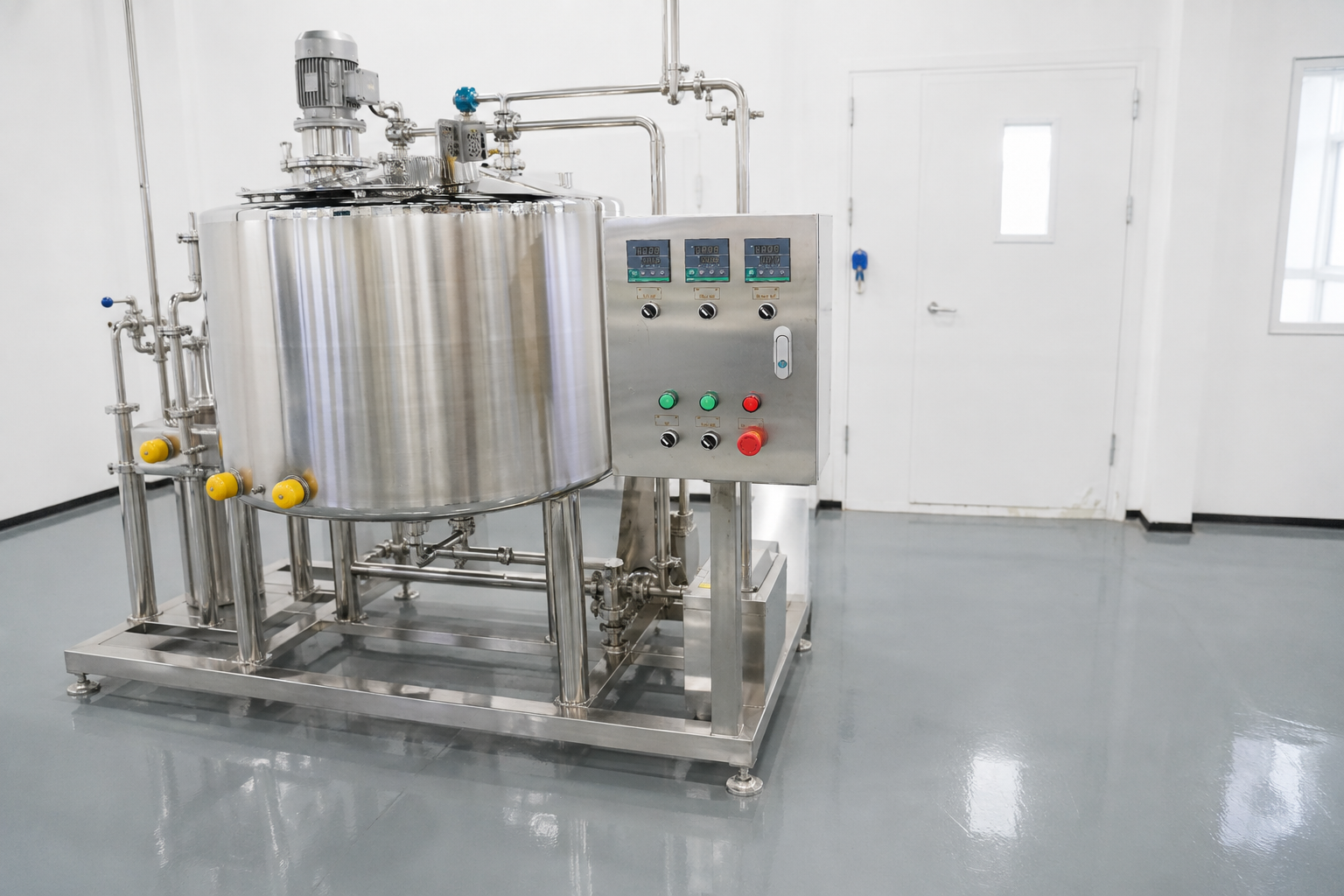
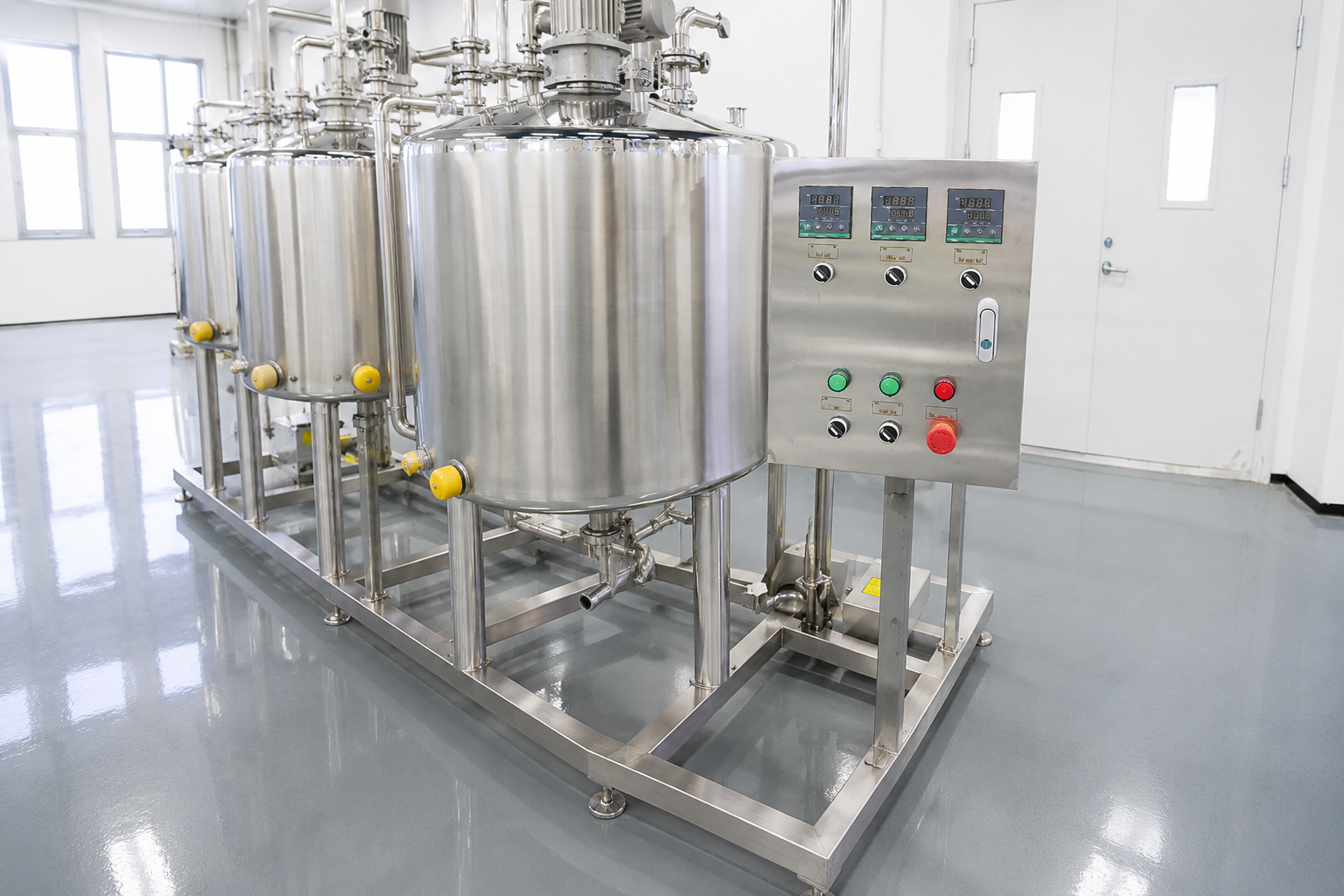
CIP Cleaning System
CIP scope is defined by the closed circuit, cycle objective, return route and available sanitation window.
For tanks, pipework, pumps and heat exchangers that need a repeatable cleaning cycle without dismantling the production circuit.
- Available scope: single-, two- or three-tank skids with single-use or reuse routing
- Plan around: circuit volume, soil chemistry, cycle time and recording needs
- Confirm first: line sizes, spray coverage, heating and return capacity
| Washing mechanism | Suited to | Mechanical action | Damage risk |
|---|---|---|---|
| Air bubble agitation | Leafy greens, herbs, berries and other delicate items | Turbulence lifts soil without direct contact | Low, but weak on heavy adhered soil |
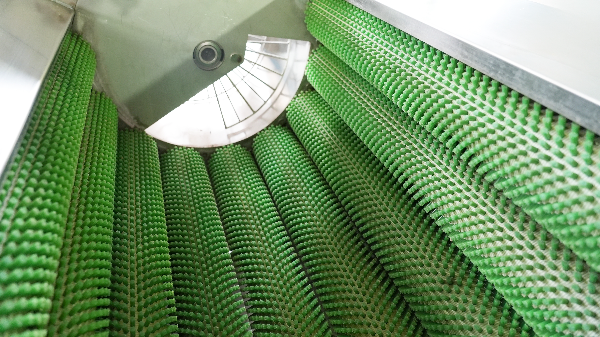
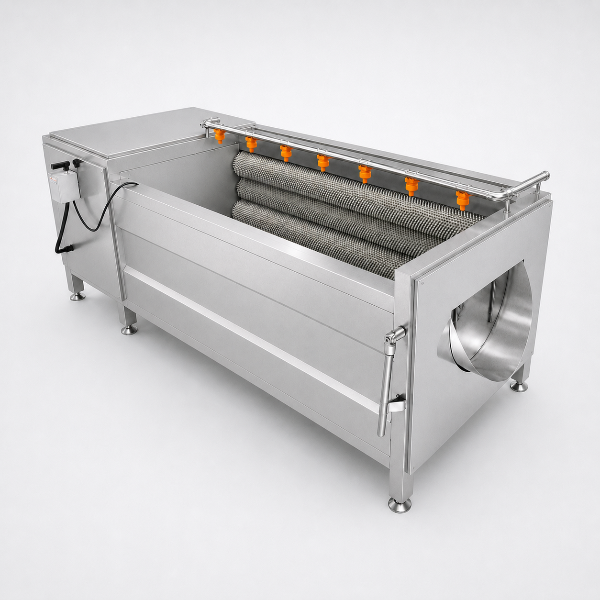
| Brush roller | Root vegetable crops such as carrot, potato, beetroot and ginger | Rotating brushes scrub the skin under a spray bar | Abrasion on thin-skinned produce |
| Spray and rinse bar | Irregular surfaces and post-cut rinse duty | Nozzle pressure and coverage do the work | Low, and highly dependent on nozzle layout |
| Vortex or turbulence flow | Mixed loads where some items float and some sink | Directed water flow separates and carries product | Moderate, rises with water velocity |
| Abrasive roller peeler | Root vegetable skin removal before cutting | Abrasive rollers remove skin with continuous rinse | Yield loss if dwell time is set too long |
| Drum or trommel | Bulk items arriving with a high soil load | Tumbling plus immersion loosens caked soil | Bruising on soft fruit, which is why it stays on hard crops |
Context
Search & Terminology Guide
Machine names travel badly between suppliers, so match the mechanism to the vegetables and fruits in front of you rather than to the label. A fruit and vegetable washing machine is a category, not a specification. One commercial vegetable washing machine sold as a single product family may contain three of the mechanisms above, and the choice between them decides both water use and product damage.
Search for a small scale vegetable washing machine and for a high-capacity line, and the same mechanism name comes back for two very different machines.
Anything sold as a leafy vegetable washing machine is a bubble or vortex design, because brushes tear the leaf.
An automatic vegetable washer describes the control system, not the washing action.
Listings for an industrial vegetable washer for sale rarely state the mechanism at all, which is what makes them hard to compare.
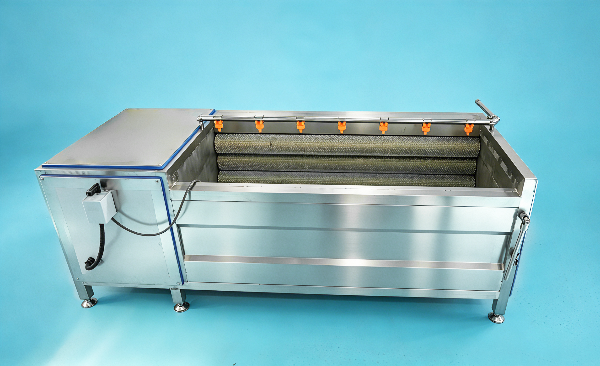
Product card: vegetable washing and peeling machine
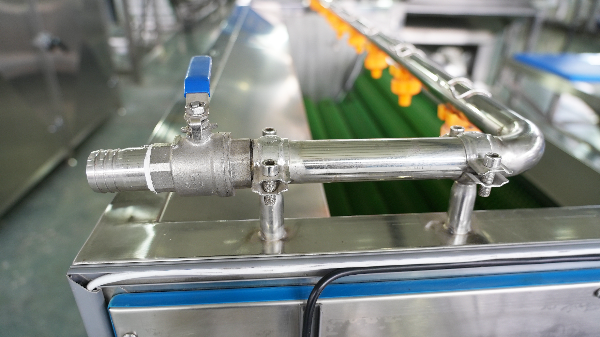
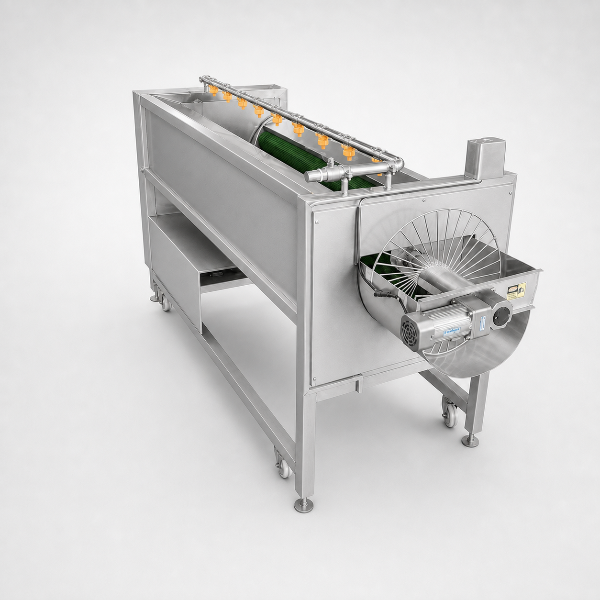
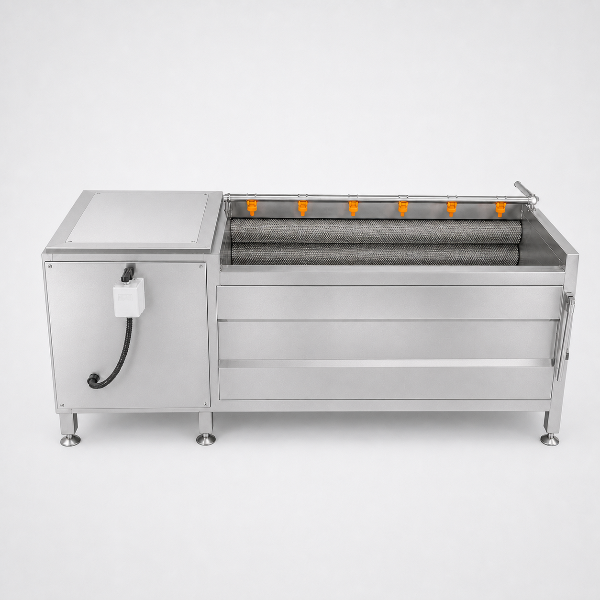
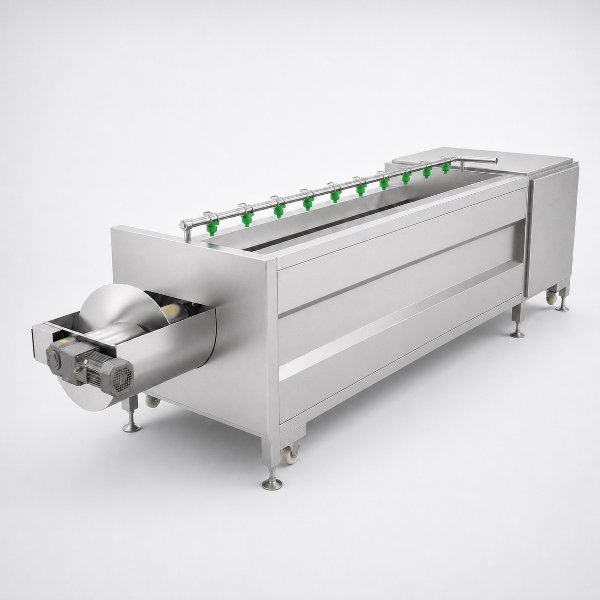
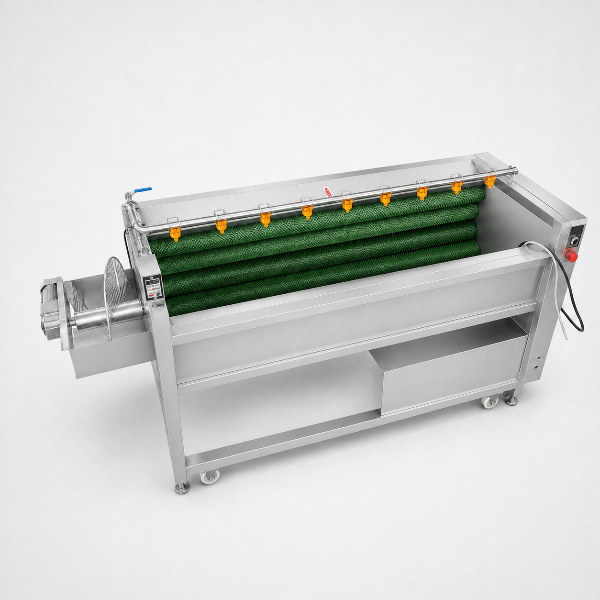
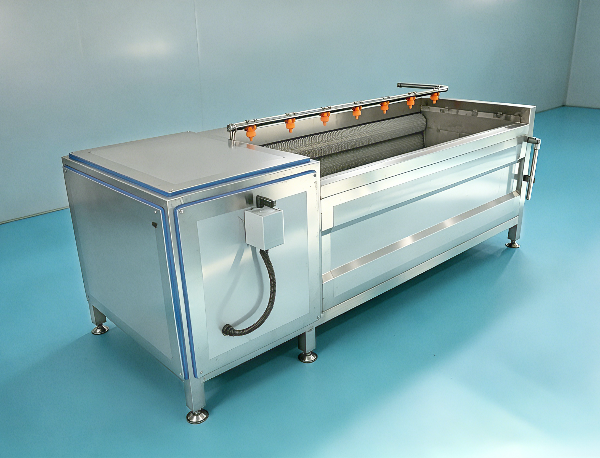
Brush roller washer with overhead spray bar and discharge chute, built for root vegetable crops.
- Equipment family: brush roller washers, bubble washers, spray washers and abrasive roller peelers
- Decision fields: crop and process state, soil load, fragility, hourly target, water reuse strategy
- Line position: after intake and sorting, before cutting, dewatering and weighing
- Adjustable at commissioning: roller and brush speed, dwell time, spray pressure and conveyor speed
- Interfaces to confirm: infeed conveyor height, discharge height, drain size, water supply and effluent route
Water rules that sit above machine choice
Water is a regulated input rather than a utility you can leave to the plumber. Two rules set the boundary for washing vegetables and for any fruit washing operation feeding a fresh-cut process.
- Harvest and postharvest agricultural water must have no detectable generic E. coli in 100 mL under 21 CFR 112.44(a), and untreated surface water is excluded.3
- Water recirculated for processing has to meet potable water quality under Regulation (EC) No 852/2004, Annex II, Chapter VII, unless the competent authority accepts that it cannot affect the finished product.4
- Wash water temperature is held at or above product core temperature to avoid infiltration, which conflicts with the instinct to run the tank as cold as possible.6
- Where a disinfectant is dosed into shared water, its first purpose is preventing cross-contamination in the tank rather than cleaning the produce itself.5
Food-Industry CIP Systems by Circuit and Cycle Objective
An alkaline cycle on its own is not a guarantee, and surface condition decides how far it gets. On pilot-scale food processing equipment, a caustic wash at 0.2 percent potassium hydroxide removed roughly 2.4 log of Pseudomonas fluorescens biofilm from smooth surfaces but only about 1.4 log from rough ones, and the authors concluded that without a sanitization step, clean-in-place may not eliminate all biofilm cells.1 Ozone-assisted circulation at the higher dose took counts below the detection limit on both surface conditions.1
“Without a sanitization step, cleaning-in-place may not eliminate all biofilm cells, particularly from rough surfaces.”1
| Cycle step | Objective | Control variable | Measured result in the cited trial |
|---|---|---|---|
| Pre-rinse | Carry away loose residue before chemistry is added | Volume and flow rate | Not measured separately |
| Caustic wash | Break down protein, fat and carbohydrate soils | 0.2% potassium hydroxide, 50 °C, 2 min | 2.4 log on smooth, 1.4 log on rough |
| Intermediate rinse | Clear detergent before the next chemistry | Conductivity return to baseline | Not measured separately |
| Acid wash | Remove mineral scale left by alkaline cycles | Concentration and contact time | Not measured separately |
| Sanitize | Act on the cells the wash step leaves behind | Ozonated water 5 ppm, 5 min | 2.1 log on smooth, close to none on rough |
| Sanitize, higher dose | Same objective, longer contact | Ozonated water 10 ppm, 10 min | Below detection limit on both surfaces |
| Final rinse | Leave the circuit ready for product | Water quality and drainability | Not measured separately |
CIP Process Control Variables
Water Reuse & Auditable Routing
The CIP process steps above run in a fixed order and clean and sanitize in turn, and two design numbers govern whether the cleaning agent gets to work at all. Cleaning solution needs at least 1.5 m/s in pipework to produce the turbulent flow that scrubs the wall, which corresponds to a Reynolds number of about 10,000 or higher. Surface roughness above Ra 0.8 µm gives soil somewhere to hide, so effective cleaning depends on the finish specification and the CIP recipe being one decision rather than two.
Reuse is a routing problem before it is a storage problem. A published CIP design keeps return streams separate and sends each one to a different recovery tank according to an online turbidity or conductivity threshold, so lightly soiled final rinse water becomes the next pre-rinse instead of being blended away.8 That structure is what makes reuse auditable rather than a claim on a brochure.
Product card: CIP cleaning system
- Equipment family Single-tank, two-tank and three-tank CIP skids, with single-use or reuse routing
- Decision fields Circuit volume, soil chemistry, sanitation window, reuse target, recording requirement
- Line position Serving tanks, pipework, pumps and heat exchangers between production runs
- Interfaces to confirm Supply and return line sizes, spray device coverage, steam or electric heating, drain capacity
Equipment Selection and Line Integration
Handling damage is created by the line, not by the harvest. Impact measurements taken with an instrumented sphere found that existing apple packing lines caused more bruising than any other postharvest operation, and that the damage concentrates at transfer points where product is lifted and dropped.7 Raising conveyor speed to lift throughput raises impact energy with it, so capacity and quality are traded against each other at every transition.
| Reference point | Value used in design and acceptance |
|---|---|
| Food-contact surface roughness | Ra 0.8 µm (32 µin) as the maximum under 3-A Sanitary Standards and EHEDG hygienic design guidance |
| CIP pipework velocity | At least 1.5 m/s, giving turbulent flow at a Reynolds number of roughly 10,000 or above |
| Agricultural water quality | No detectable generic E. coli in 100 mL under 21 CFR 112.44(a) |
| Recirculated process water | Potable standard under Regulation (EC) No 852/2004, Annex II, Chapter VII |
| Product drop height at transfers | Below 30 cm (12 in) onto a smooth surface, with height differences between machines removed |
| Machinery hygiene design | EN 1672-2 and EN ISO 14159, applied under Directive 2006/42/EC |
| Wash water temperature | At or above product core temperature, with tank depth treated as a risk factor, per Ohioline AEX-262 |
| Hygienic conveying between machines | EHEDG Guideline 43 on the hygienic design of belt and chain conveyors |
| Coverage verification | Riboflavin coverage test plus ATP swabs, with conductivity and total organic carbon on the return line |
Four of those rows are interface decisions rather than machine decisions, and they are the ones that get settled last and cost the most to change. Fixing them in the layout drawing is cheaper than fixing them during commissioning.
Specifications
Resources ➔
// OPTIMIZATION 01
Keep drop height below 30 cm and remove height differences between adjacent machines.
// OPTIMIZATION 02
Use an active or passive device to control product speed at each transfer, other than gravity.
// OPTIMIZATION 03
Line impact zones with cushioning material and cover exposed sharp edges.
// OPTIMIZATION 04
Separate the product zone from the technical zone so drives, bearings and cabling never sit above open product, as EN 1672-2 requires.
// OPTIMIZATION 05
Grade decides durability in a chloride-heavy wash environment, where pitting corrosion is the failure mode, so fix stainless steel grade, weld finish and surface roughness in the specification instead of assuming them from photographs.
// OPTIMIZATION 06
Confirm conveyor heights, drain positions and utility points against the building, not against the machine drawing alone.
// OPTIMIZATION 07
Hygienic conveying between machines has its own published guidance in EHEDG Guideline 43 on hygienic conveyors and belts, so the space between two machines is not an unowned gap. On high-capacity lines this is where soil, water carry-over and product damage accumulate.
Project Inputs, Pricing Logic and Delivery Confirmation
There is no price list for configured cleaning equipment, because the same machine name covers very different builds. Price follows product mix, soil load, water strategy, material and finish specification, degree of automation and the interfaces the equipment has to meet. The written configuration comes first, and the figure follows it.
Cost driver
Product mix and changeovers
Effect on cost
Every additional product adds validation work and often adds a cleaning cycle
How to reduce it
Group products by soil chemistry so one cycle recipe covers a family
Cost driver
Soil load and water turnover
Effect on cost
Heavy field soil forces higher water exchange and larger filtration
How to reduce it
Add pre-cleaning or dry removal upstream so the wash stage sees less soil
Cost driver
Sanitation window length
Effect on cost
A short window forces larger pumps, tanks and heating capacity
How to reduce it
Re-examine the production plan before oversizing the skid
Cost driver
Material and finish specification
Effect on cost
Tighter surface roughness and weld finish raise fabrication hours
How to reduce it
Apply the tight specification to product-contact surfaces only
Cost driver
Automation and recording depth
Effect on cost
Instrumented cycles with data capture cost more than manual sequencing
How to reduce it
Instrument the circuits that carry audit risk first
Cost driver
Utilities and effluent limits
Effect on cost
Local discharge limits can add screening, balancing or dosing equipment
How to reduce it
Screen effluent parameters at the brief stage rather than at commissioning
Every one of those drivers is a trade-off rather than a defect. A shorter sanitation window costs you pump, tank and heating capacity, while instrumenting every circuit buys you audit evidence you may not need on all of them.
What has to exist before a number exists
How the schedule gets confirmed
- Product list with process state, and whether a later lethality step exists downstream
- Hourly target and the shift pattern behind it
- Circuit inventory for CIP: tank volumes, line sizes, spray devices and heat exchangers
- Available water quality and volume, plus the effluent parameters the site is held to
- Layout drawing with heights, drains and utility points marked
- Acceptance criteria you intend to test at the factory and again on site
Delivery dates are set against three fixed events rather than against a calendar guess. Drawing approval starts manufacture, factory acceptance testing closes the build, and site acceptance closes the project. Each of those events has written criteria agreed in the contract, and the timing of the failure consequences belongs in the same document.
Use the project brief template to assemble those inputs in one file before you approach any supplier, including this one.
Hygienic Design Verification and Acceptance Inspection
Conductivity returning to baseline proves the circuit is free of chemical residue. It does not prove the equipment is clean, and a sight glass only confirms that visible soil is absent while biofilm and chemical residue stay invisible. Complete verification combines coverage, residue, organic-carbon and swab evidence, and an uncalibrated conductivity sensor is a recognised cause of CIP validation failure.
Verification method
What it demonstrates
What it cannot demonstrate
Riboflavin coverage test
Spray devices wet every internal surface
That soil was removed from those surfaces
ATP swab
Total organic residue at a defined sampling point
A specific allergen protein or a single pathogen
Conductivity on the return line
Detergent has been rinsed out of the circuit
Cleanliness of the equipment itself
Total organic carbon
Organic residue in the return stream
Coverage of surfaces the flow never reached
Visual and borescope inspection
Absence of visible soil and standing water
Biofilm or chemical film below visible scale
Microbiological swab
Recovery from defined worst-case locations
Conditions at unsampled locations
Acceptance sequence for a cleaning system
STEP 01
Agree acceptance criteria in writing before manufacture, including which methods will be used and what result closes each one.
STEP 02
Run a factory acceptance test on the assembled equipment, with function, safety and cleaning cycles exercised.
STEP 03
Verify coverage with riboflavin on the installed circuit, since spray behaviour changes with real pipe runs.
STEP 04
Run the cleaning process with production soil, not with a clean circuit, and record every cycle parameter.
STEP 05
Swab worst-case locations and compare results against the criteria agreed in step one.
STEP 06
Close site acceptance against the same document, and record the deviations that remain open.
Confirm before shipment which compliance documents travel with the equipment, because certification bodies and document formats differ between jurisdictions. Buyers who leave this to arrival discover the gap after the equipment has already cleared customs.
How We Work on a Cleaning Equipment Project
STAGE 01Line and product brief
you send the product list, hourly target, layout and utility limits, and we mark the gaps that would otherwise surface at commissioning.
STAGE 02Route and mechanism selection
we match washing mechanism or CIP circuit design to the products rather than to a machine catalogue.
STAGE 03Layout and interface review
heights, transfer points, drains and control interfaces are checked against the building before anything is built.
STAGE 04Written configuration and quotation
scope, materials, surface finish, instrumentation and acceptance criteria are listed in one document, then priced.
STAGE 05Manufacture and factory acceptance test
the equipment is assembled and exercised against the agreed criteria, and we own the deviations found there.
STAGE 06Installation, commissioning and site acceptance
cycles are run with production soil, results are recorded, and the project closes against the same written criteria.
What each stage needs from you
Brief stage product list, throughput target, drawings, water and effluent data
Selection stage confirmation of process state and whether a lethality step exists downstream
Build stage approval of the layout drawing, which is the event that starts manufacture
Acceptance stage site availability, production soil for the trial, and named people to sign off
Smart Controls and Upgrade Path
Cleaning is now a measurable process rather than a fixed timer. A published system captures temperature, humidity, water and chemical flow, concentration, pressure and visual checks during a cleaning session, compares step durations and utility consumption against historical averages, and flags the inefficient step. Fixed-duration cycles have to be set for the worst product the line runs, so every lighter product is over-cleaned by design.
Platform capability
What it means on a cleaning line
Included in your project
The STUnit platform
Equipment is built to be controlled and monitored rather than retrofitted later
Only when written into the project scope
Standalone OTA upgrades
Control software is updated without replacing the panel
Only when written into the project scope
Low-code control boxes and multi-protocol gateways
Existing machines from several suppliers are brought onto one data path
Only when written into the project scope
YOLO vision and edge algorithms
Image-based checks run at the machine instead of in a central server
Only when written into the project scope
Self-produced hardware for deep integration
Control hardware and machine are engineered together rather than bolted together
Standard on equipment we build
- Data Layer Integration
- Control Architecture Statement
Standards already exist for the data layer, so integration does not have to be invented for each project. Three of them decide whether a washer or a CIP skid can report its state to a plant system without a custom driver.
Naming a standard is not the same as holding a certificate against it, and this page makes no certification claim. What the list above describes is the control architecture we can build to, with the inclusion decision made in the project scope rather than assumed from the platform.
Product Evidence and Application Gallery
Industries these machines are built for
Application 01
Fresh-cut vegetable processing
Leafy vegetables and mixed salads where wash water is shared and cross-contamination control drives the design.
Application 02
Fruit washing and packing
Fruit washing before grading, where infiltration risk and bruising at transfers set the limits.
Application 03
Food and beverage liquid plants
Dairy, beverage and liquid food circuits with tanks, pipework and heat exchangers cleaned between runs on a fixed sanitation window.
Application 04
Central kitchens and ready meals
Mixed produce arriving daily, with short cleaning windows and heavy crate and container traffic.
Buyers evaluating an unfamiliar supplier tend to test three things before price: whether the equipment fits the line, whether commissioning and acceptance close properly, and whether spare parts and support can be reached. The material on this page is arranged around those three questions, and the equipment images are our own machines rather than stock photography.
Get a Cleaning Line Layout Review
Send a layout drawing or a photograph of the existing line. We mark the transfer points, drain positions and interface heights that would otherwise surface at commissioning.
Get a Layout ReviewApplicable certificates and documents are confirmed for the equipment model, configuration and destination country. Company management-system records are reviewed separately from product conformity documents.
Where This Equipment Is Not the Right Answer
Four situations come up often enough that they belong on the page rather than in a sales call. In each one the cleaning method that looks obvious is the mistake, not the fix. Each one has a route out.
| Situation | Why it works against you | What to do instead |
|---|---|---|
| Ready-to-eat product with no later lethality step | A washer reduces and redistributes surface contamination and is not a substitute for a validated kill step2 | Place the control point elsewhere in the process and treat washing as cross-contamination control |
| Single product, low volume, generous cleaning window | Automation adds validation and maintenance work that the labour saving does not repay | Keep manual cleaning under recorded procedures, with one small washer for the heaviest soil |
| Most wetted parts are crates, hoses and clamps | A CIP skid cannot reach them, so swab failures continue after the investment | Buy clean-out-of-place capacity and a crate washer before enlarging the CIP system |
| Water supply cannot meet potable quality and reuse is not authorised | Water quality becomes the binding constraint on the whole line4 | Resolve treatment and effluent routing first, then size the washing equipment |
Process Note
In all four rows the trade-off is the same: capital spent on the visible machine does not buy the control an audit is actually asking for. Unlike a capacity problem, none of these is solved by a bigger skid. Most of them are process decisions, and the equipment follows.
Cleaning & CIP Equipment Engineering Tools
CIP Configuration Checklist
Standardize cleaning parameters and ensure compliance for industrial sanitation cycles.
Project Brief Template
Outline system requirements efficiently to streamline communication for custom CIP integrations.
Washer Selection Worksheet
Calculate capacity and specify technical needs to identify the optimal industrial washer.
Cleaning and CIP Equipment FAQs
What is the difference between clean-in-place and clean-out-of-place?
Clean in place circulates cleaning solution through assembled equipment, so tanks, pipework, pumps and heat exchangers are cleaned without disassembly; clean-out-of-place means operators disassemble the parts and wash them in a dedicated machine, which is the only route for clamps, hoses, crates and scale buckets. Most plants need both, and the split between them decides the equipment list: the boundary is physical rather than commercial, since a part that circulating solution cannot reach at the required velocity will not come clean at any skid size and belongs in a clean-out-of-place washer or a manual station instead. That split usually surfaces at budget time, when the crate washer and the parts washer turn out never to have been in the CIP scope at all.
Does an industrial vegetable washer sanitize the produce?
No. Washing removes soil and lowers the contaminant load on the surface, and published trials found no significant reduction of Salmonella on lightly contaminated leaves across six washing methods. Sanitizer in the tank is there mainly to stop cross-contamination between units of product sharing the same water, which makes the washer a food safety control rather than a kill step.
What flow rate does a CIP circuit need?
Design practice puts the minimum at 1.5 m/s in product pipework, which produces turbulent flow at a Reynolds number of about 10,000 or higher. Below that, chemistry substitutes for scrubbing and cycles run longer. Surface finish is the other half of the same decision, because roughness above Ra 0.8 µm under 3-A Sanitary Standards gives soil somewhere to hide.
Why does wash water temperature matter more than people expect?
Water colder than the product core pulls itself inward through stem scars and wounds. Tomatoes, melons, mangoes and apples carry the highest risk. Hold wash water at or above core temperature.
How is a vegetable washing machine sized for a specific crop?
Sizing starts from the crop, its soil load and its fragility, then the mechanism is chosen, and only then is the hourly target used to set dimensions. A brush roller suits carrot and other root vegetable crops, while bubble agitation suits leafy greens that a brush would tear. Getting that order wrong produces a machine with the right rating and the wrong result.
What does an automated CIP system cost to run?
Running cost is driven by water volume, chemical concentration, heating energy, labour and the length of the sanitation window, and those are the levers to model for your own line. Published industry cases commonly report annual savings in the tens of thousands of dollars where a single-use system is converted to reuse, but those are other plants’ figures and not a projection for yours. The reliable way to answer this is to price your own water, energy and labour against the cycle recipe.
Can existing machines be retrofitted with sensors and automation?
Often yes, through gateways that bring older equipment onto one data path without replacing the machine. Suppliers of turbidity-based cycle control typically report water reductions of up to about a fifth on the circuits they instrument, though results depend heavily on how variable the soil load is. Whether any of it applies to a specific line is a scope question answered during the layout review, not a platform guarantee.
Which documents should transfer with imported equipment?
Agree the document set before shipment rather than after arrival, because certification bodies and accepted formats differ between jurisdictions. The set usually includes the declaration of conformity, material certificates for product-contact parts, the electrical schematic, the operating and maintenance manual, and the signed factory acceptance test record. Missing documents are cheap to fix before dispatch and expensive afterwards.
How does acceptance work after installation?
Acceptance runs against criteria written before manufacture, exercised once at the factory and again on site. On a cleaning system that means a riboflavin coverage test on the installed circuit, cycles run with production soil, and swabs at worst-case locations. The project closes against the same document that opened it, with any open deviations listed.
Which spare parts should be ordered with the machine?
Order wear parts with the equipment, not after the first failure. On washers that means brush rollers, spray nozzles, seals and drive belts; on CIP skids it means pump seals, gaskets, valve seats and the sensors on the return line. Proprietary parts sourced across a border after a breakdown arrive long after the production loss has been counted.

![F&V Freeze-Drying Line Process Guide [2026]](https://shengtumachinery.com/wp-content/uploads/2026/09/fv-freeze-drying-line-guide-featured-150x150.png)