Get in touch with Shengtu Bufan Company

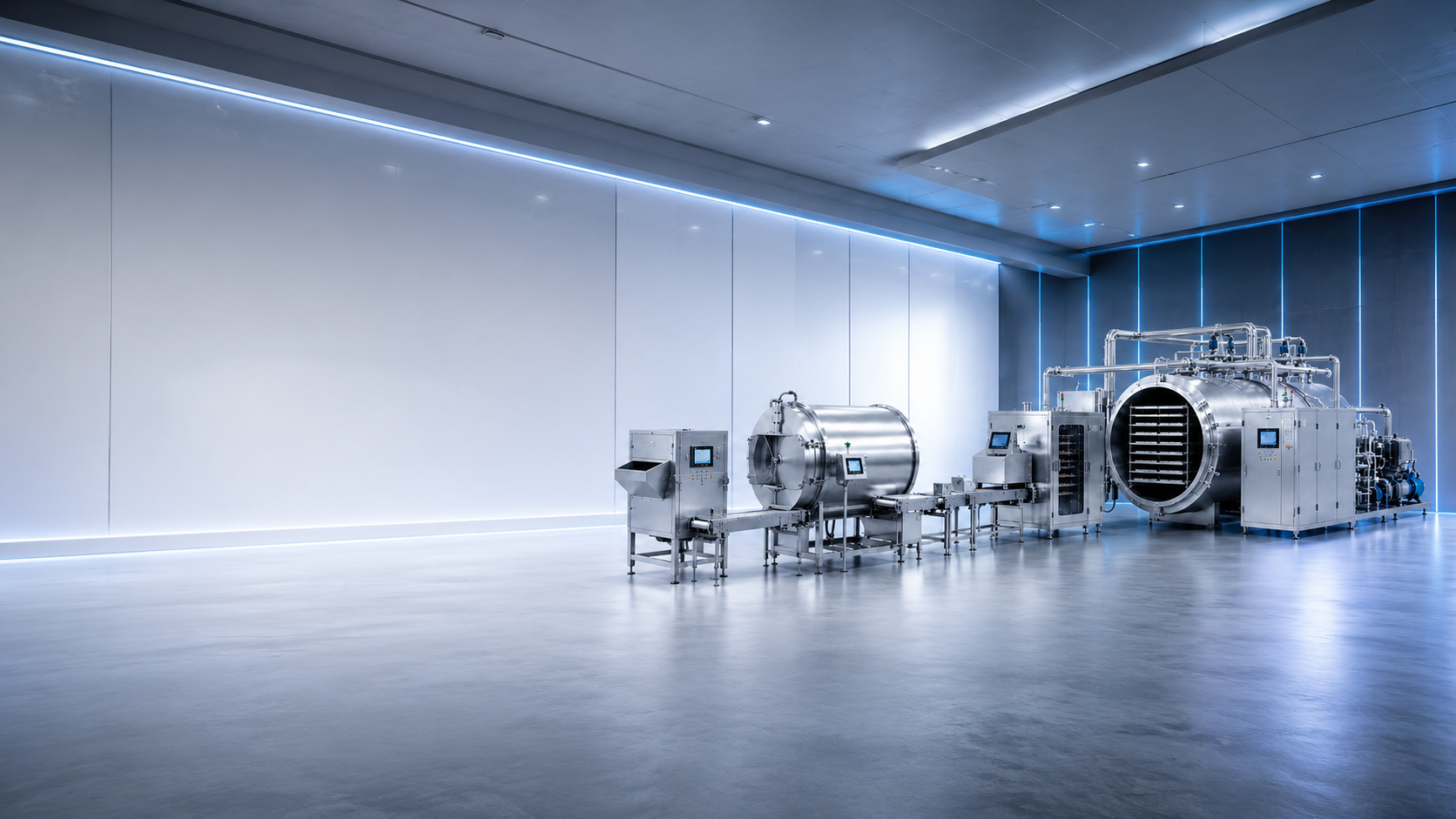
Freeze-Dried Meat and Seafood Production Line
Four stations in one flow: strip cutting, vacuum freeze drying, vacuum packing and metal detection. An industrial freeze dryer sits at the centre, sized to your product and your target output, from a 50 kg raw charge per batch up to 300 kg (110–661 lbs).
Get a Line Proposal
Send us your product and daily tonnage needs.
An engineer produces a station-by-station layout — not a price list.
- 50–300 kg raw charge per batch
- 74–463 kg ice capture per batch
- 380 V / 50 Hz three-phase
- Warranty terms confirmed in the quotation and contract with maintenance scope confirmed in the contract
- Quote returned in 24 business hours
Four Stations of the Freeze-Dried Meat and Seafood Line
Freeze drying is the drying of an already frozen product under a vacuum below the triple point of water. The vacuum lets the ice sublime — it converts straight from solid to vapour with no intermediate liquid stage, which is why the cell structure of the original piece survives the process.
Station 1
Strip cutter
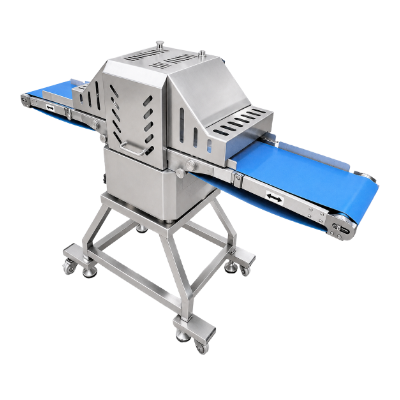
Station 1 — Strip cutter
The cutter hands the freeze dryer an even thickness, which is the single upstream decision that most affects batch behaviour. A thick block and a thin strip on the same tray finish at different times, and the batch is only done when the slowest piece is done.
Cutter specification
- Belt width240 mm
- Motor power1.5 kW
- Dimensions1200×680×860mm
- Weight150 kg
- Power380V / 50Hz
What it does
Cutting to a uniform strip reduces the length of the vapour path from surface to centre. It also allows a tray to be fed smoothly and evenly, so heat conduction is consistent across all pieces.
Station 2
Vacuum freeze dryer
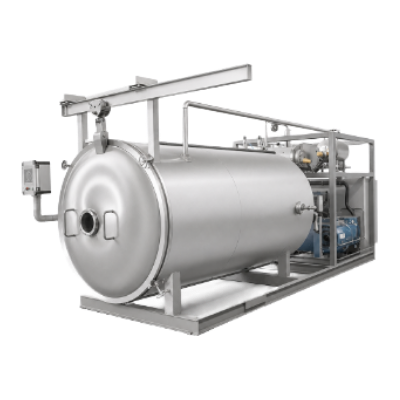
Station 2 — Vacuum freeze dryer
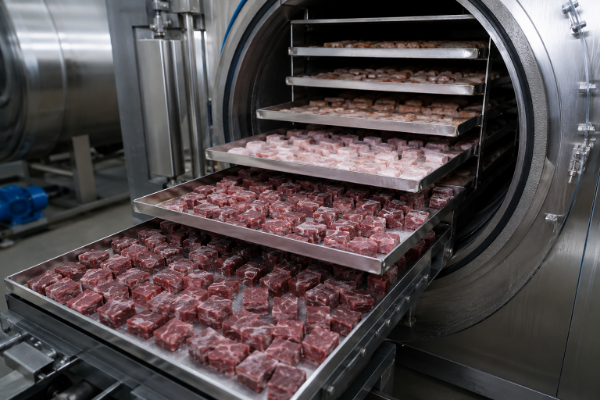
The freeze dryer machine is the station everything else is sized around. It runs three phases in one sealed chamber: pre-freezing to lock the product structure, primary drying where the bulk of the ice sublimes, and secondary desorption that pulls the last bound moisture out.
Trays measure 610 × 710 × 35 mm, 14 to 72 per set depending on model, loaded on trolleys from FDG-10 upward.
Electric shelf heating supplies the sublimation energy, 8 to 30 kW arranged in 7+1 to 12+1 element groups.
Vacuum is drawn by a rotary vane pump on the two smaller models, or by a Roots booster ahead of a vane or water-ring pump on FDG-20 and FDG-30.
Refrigeration runs 8 to 42 kW behind a piston or screw compressor, freezing released vapour out onto the condenser.
Control is PLC based, with programmable recipes, stored cycle data and a freeze-drying profile that we adapt to your product during commissioning.
What actually caps a batch is ice capture, not tray area. Every kilogram of water the product releases has to be frozen out by the condenser, so the ice capture figure and the electric heating rate always have to be read together.
Station 3
Vacuum packer
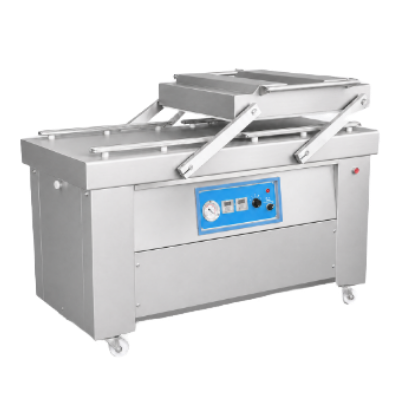
Station 3 — Vacuum packer
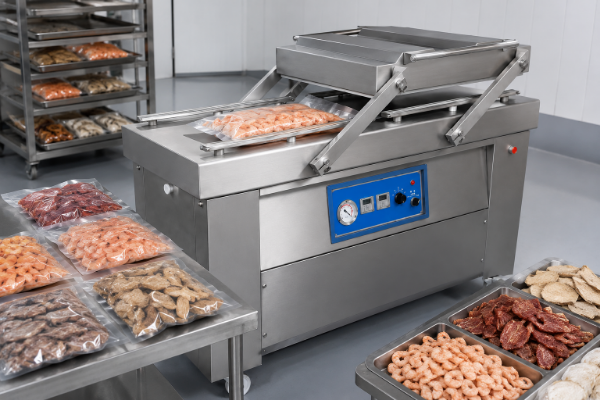
Freeze-dried product is hygroscopic the moment it leaves the chamber, so the packing station belongs on the same floor and in the same shift. A chamber-type vacuum sealer pulls the air down and seals in one cycle.
Vacuum packer spec
- Dimensions1440×720×910mm
- Work table1440×620mm
- Chamber720×600×130mm
- Seal bar620×10×2mm
- Power3.8kW
In the flow
Trays come out of the chamber, product is weighed into barrier bags, and the bags are evacuated and sealed before ambient humidity can re-enter the structure.
Station 4
Metal detection
Station 4 — Metal detection
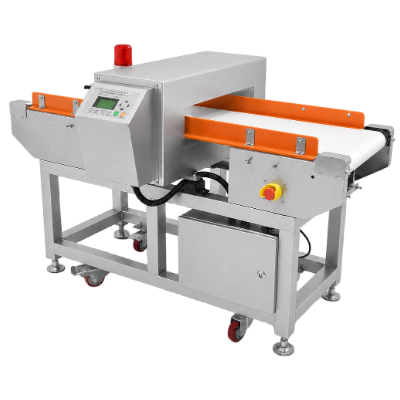
This last station is what the auditor sent by your buyer will want to discuss first of all. A conveyorised metal detector is situated after the final seal so any particles picked up from the cutter, from the trays, or from any trolleys can be intercepted before the case is closed.
Metal detector
- Aperture400W × 120H mm
- Length1400 mm
- Dimensions1400×820×920mm
- FerrousFe Ø0.8 mm
- Non-ferrousCu Ø1.5 mm
- StainlessSUS Ø2.0 mm
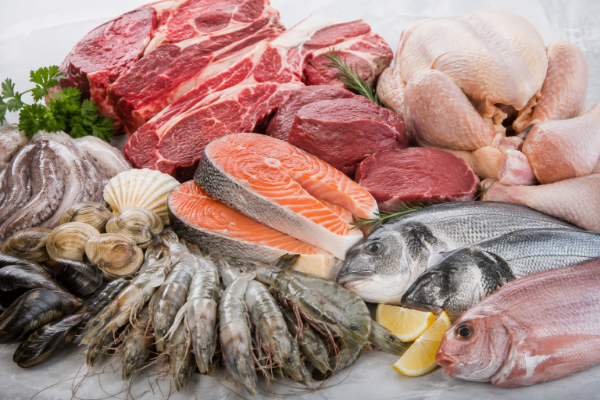
Meat, Poultry and Seafood This Line Runs
Every category below runs on the same four stations. What changes is the cut you present to the tray and the pre-treatment upstream, so this is the part of the specification we work through with your sample rather than from a catalogue.
Something else entirely
If your product is not on this list — including pet food formats built on raw meat and organ material — send a sample. We freeze dry it, look at what comes out, and specify the cut and the tray loading from the result rather than from an assumption.
Material Category
Recommended Cut
Why That Cut
On-Machine Note
01Beef and red meat
Trimmed strips or dice, uniform thickness, grain across the strip
Muscle fibre runs long; cutting across it shortens the vapour path and stops strips curling on the tray
Fat trim matters — fat does not sublime and softens the finished piece
02Pork
Lean cuts, diced or stripped, fat capped off before cutting
Lean tissue holds an open structure after freeze drying; marbled cuts stay pliable
Load one thickness per tray so the batch does not wait on its slowest piece
03Poultry breast and thigh
Breast in strips or shreds; thigh diced after deboning
Breast and thigh have different fat and moisture profiles and dry at different rates
Run them as separate batches, or accept the slower of the two as the batch length
04Whole shrimp and prawn
Peeled or shell-on, laid flat and not stacked
The shell is a vapour barrier; stacking creates a second barrier on top of it
Single-layer tray loading is worth the tray count it costs
05Fish fillet
Skinned portions or strips, even thickness across the fillet taper
A natural fillet is thick at the shoulder and thin at the tail, so it dries unevenly if left whole
Portioning at the cutter is faster than sorting half-dry trays later
06Shellfish meat
Scallop, mussel and clam meat shucked, drained, laid in a single layer
Surface brine holds water that the condenser has to capture along with the product moisture
Draining before loading buys back condenser headroom
07Cooked meat and ready meals
Portioned after cooking, sauce reduced, pieces separated on the tray
A reduced sauce carries less free water and holds its coating through sublimation
The cook step and its kill step stay in your own food-safety plan, upstream of this line
08Offal and organ material
Sliced or diced, membrane removed, drained before loading
Organ tissue is dense and wet; slicing is what makes the interior reachable
Raw organ product is the usual route for treat manufacture
Click to Stabilize
Packaging Formats and Post-Drying Handling
Finished product leaves the chamber at a low residual moisture and immediately starts pulling moisture back out of the room. Everything in this section exists to shorten the window between chamber and barrier.
Formats the line supports
- Chamber vacuum bags for bulk and food-service packs
- Barrier pouches with an oxygen absorber for shelf-stable retail
- Laminate structures (including aluminium or mylar) requiring complete exclusion of both light and oxygen
- Bulk lined cases for onward processing or blending
- Rotary pouch packer — sister-line option
Handling between the chamber and the seal
Trays are unloaded to a covered staging area rather than an open bench, and the shelf life you quote downstream depends on how disciplined that step is. Product that sits open for an hour has already given back part of what the cycle just removed.
- Move trolleys straight from the chamber to the packing bench, staged under cover rather than routed across the general production floor.
- Weigh and fill promptly — the vacuum sealer is sized so a full tray set can be packed within the same shift it comes out.
- Control the room: a dehumidified packing room is the cheapest single upgrade to finished-product shelf stability, and a barrier pouch is not a substitute for one.
- Don’t rely on the seal bar setting alone — verify seal integrity by inspecting the pack itself.
Stations
8-station rotary
Bag types
Stand-up, zipper, four-side-seal, three-side-seal, paper composite
Bag size
Width 180–300 mm, length 180–450 mm
Pack weight
100–1000 g
Power
3 kW, 380 V / 50 or 60 Hz
Compressed air
0.9 m³/min, supplied by the customer’s plant air system
Industrial Freeze Dryer Specifications by Batch Size
Four industrial freeze dryers cover the range. Read the table by starting from the raw charge you need per batch, then check that the ice capture ceiling on that row is comfortably above the water your product actually carries.
The FDG-30 installed power figure depends on which vacuum and refrigeration package is selected, so we confirm it against your configuration rather than printing a number that is not yours.
| Specification | FDG-5 | FDG-10 | FDG-20 | FDG-30 |
|---|---|---|---|---|
| Drying area (m²) | 5 | 10 | 20 | 30 |
| Raw material charge (kg) | 50 (110 lbs) | 100 (220 lbs) | 200 (441 lbs) | 300 (661 lbs) |
| Ice capture capacity (kg) | 74 (163 lbs) | 147 (324 lbs) | 315 (694 lbs) | 463 (1021 lbs) |
| Number of trays | 14 per set | 24 per set | 48 per set | 72 per set |
| Tray dimensions (mm) | 610 × 710 × 35 | 610 × 710 × 35 | 610 × 710 × 35 | 610 × 710 × 35 |
| Electric heating (kW) | 8 | 12 | 24 | 30 |
| Heating elements | 7+1 | 12+1 | 8+1 | 12+1 |
| Refrigeration (kW) | 8 | 15 | 28 | 42 |
| Compressor | 8P piston | 18P piston | 30P screw | 40P screw |
| Vacuum pump set | Rotary vane | Rotary vane | Roots + vane / ring | Roots + vane / ring |
| Circulation pump (kW) | 1.1 | 1.5 | 2.2 | 3 |
| Tray cooling method | Natural cooling | Water-cooled | Water-cooled | Water-cooled |
| Cooling water tank | No | Yes | Yes | Yes |
| Chamber form | Cubic | Cubic | Cylindrical Ø1700 | Cylindrical Ø1800 |
| Main dimensions (mm) | 3800×1100×1600 | 4000×1655×2100 | 4500×1955×2515 | 4500×2155×2605 |
| Trolleys supplied | None | 2 | 2 | 4 |
| Trolley dimensions | — | 1500×800×1800 | 2100×1350×1420 | 1470×1300×1700 |
| Total installed power | 22.5 kW | 34 kW | 73 kW | On request |
How to read this table without getting caught out
The biggest mistake is choosing only by price or tray area. Ask about kg of water captured per batch, then check that figure against your own product before you put two quotations side by side.
— what our commissioning engineers say to every buyer who sends us two quotations to compare
Ice capture is the ceiling
A 200 kg charge of high-moisture seafood carries more water than the same weight of trimmed lean beef. Tray area tells you what fits; the ice capture column tells you what the condenser can actually take out.
Heating power is a rate
Electric heating supplies the energy for sublimation, so it governs how fast the ice can leave — not how much of it there is in total. A bigger heater is not always a faster batch, because the condenser still has to keep up with it.
The trade-off runs in both directions. An under-sized chamber forces extra runs and caps your throughput, whereas an over-sized one idles and ties up capital that could have bought a second station.
Quotation Basis, Lead Time and Trade Terms
We do not publish a price for this line, because a quotation that means anything depends on which of the four stations you need, which freeze dryer model suits your product, and what your utilities can already provide.
What moves the number
01
Model and drying area
the step from 5 m² to 30 m² changes the compressor, the vacuum package and the structural build, not just the size.
02
Vacuum package
a Roots booster ahead of the backing pump buys you a faster pull-down and costs you capital; on smaller charges a single rotary vane pump is the right call.
03
Station count
plants that already operate a cutter or a metal detector buy the modules they lack.
04
Cooling package
natural cooling on the smallest model, water cooling and a tank from FDG-10 upward.
05
Automation level
recipe management, data logging and line integration are specified against your requirement rather than included by default.
Commercial terms
Quotation turnaround
Quotes are returned within 24 business hours on business days, reviewed by an engineer.
Minimum order
1 set (bulk pricing from 3 units) — single pieces are accepted.
Lead time
Production runs are scheduled at 20–40 days after deposit for customised machines (stock models 10–20 days), confirmed with your quotation.
Payment
L/C, T/T, D/P, PayPal or Western Union by wire transfer.
Incoterms
We ship FOB, CIF, CFR or EXW, normally out of Qingdao Port; other Incoterms on request.
Expediting
Expedited production is available; the cost is agreed case by case. Feasibility is confirmed at drawing review.
Shipping details, the packing list and the commercial invoice are provided against the agreed conditions detailed in your contract, and crating is defined for the shipping mode you select. Please request the shipping weight and crate dimensions at quotation stage should your freight forwarder require them early.
The two numbers we stand behind on energy
Total installed power and ice capture per batch are the two figures we will document, because both are features of the machine we deliver. We do not publish a specific kilowatt-hours-per-kilogram figure: published values for this process are cited against different denominators — water removed in some sources, raw material in others — and are not directly comparable.
What that means for your business case
Estimate your operational cost from the installed power on your chosen model, your local tariff, and the number of cycles you will actually be running per week. That calculation is easy to verify against the nameplate; a borrowed energy ratio is not.
Factory Acceptance Testing, Food Safety Documents and Certifications
Applicable certificates and documents are confirmed for the equipment model, configuration and destination country. Company management-system records are reviewed separately from product conformity documents.
All our lines are tested in our own factory prior to crating. These are the five trial procedures that must be passed, in the sequence they are undertaken.
SEQUENTIAL PROTOCOL
-
01
No-load operational test — refrigeration, vacuum, heating, control and circulation equipment are all operated and validated one by one.
-
02
Ultimate vacuum and pressure-hold trial — the chamber is pumped down to its ultimate vacuum and then maintained with the pumps isolated, which is what actually confirms seal integrity, not pump size.
-
03
Loaded simulation run — a real charge is taken through pre-freezing, sublimation, and desorption so the entire cycle is observed under load.
-
04
Shelf temperature uniformity and refrigeration pull-down — the temperature spread across the shelf stack is measured as well as pull-down time and stability.
-
05
Interlocked whole-machine process run — the stations are run interlocked as they will run on your floor.
Why the pressure-hold test decides more than the pump curve
Broken seals and slow leaks are the hardest problem to find on a running vacuum system, because a leaking machine still pumps down — it just never holds. Isolating the pumps and watching the pressure rise is the only test that separates a sealing fault from a pumping fault, so we run it before crating instead of leaving you to discover it on your own floor. Vacuum pump oil, seals, and condenser cleaning recur on a schedule for the life of the machine, and the wear-parts list ships with the line.
FACTORY INSPECTION GALLERY
01 / 04
Company records: Request the current holder, scope and validity details.
Equipment conformity: Confirm the documents for the model, configuration and destination country.
Order documents: Agree inspection records, manuals, drawings and shipment paperwork in the contract.
Use arrows to browse factory trial assemblies.
Materials and components
Product-contact construction
Contact surfaces are food-grade 304 and 316 stainless steel, welded and finished to a smooth, crevice-free surface. That is the criterion that the 3-A and EHEDG hygienic design rules are built around, and why we don’t leave lap joints or unfinished welds in the product zone.
Electrical components
We build the control cabinet with brand-name components — Schneider and CHINT switchgear, Lijiu motors — so that a replacement part can be sourced locally by your own maintenance team instead of only from us.
How We Run an Order, from Enquiry to Commissioning
Seven steps, the first three of which are undertaken before you pay us any money. Nothing on this list is optional, and nothing on it is priced separately.
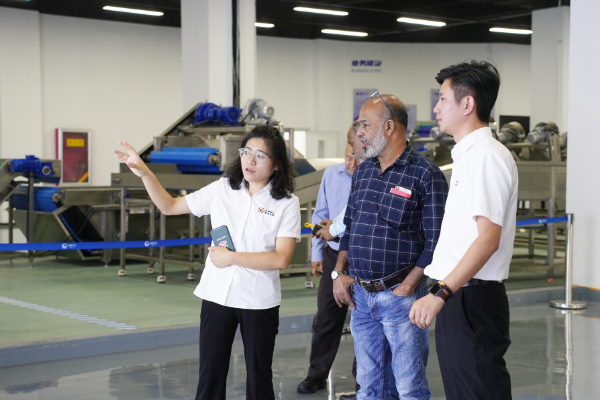
-
PROCESS 01
Send us the product, your target daily output, your available floor area and your power supply. A floor plan helps, and every requirement you give us here shortens the next step.
-
PROCESS 02
We build from your own product sample or from your drawings. Running the sample tells us the cut, the tray loading and the realistic cycle behaviour.
-
PROCESS 03
An engineer returns a station-by-station layout with the model selected, the installed load and the utility connections marked.
-
PROCESS 04
General arrangement and electrical schemes are reviewed with you, and feasibility of any expedited schedule is confirmed at this point rather than after payment.
-
PROCESS 05
Production begins based on the signed drawings, followed by the five acceptance tests described above, which are completed before crating.
-
PROCESS 06
Installation covers layout guidance, mechanical and electrical work, interlocked commissioning, freeze-drying curve optimisation on your product, and operator training.
-
PROCESS 07
After handover you have remote diagnosis, vacuum and refrigeration analysis, remote re-commissioning, and engineer escalation when a problem needs hands on the machine.
Where Freeze Drying Is Not the Right Route
Freeze drying preserves structure and rehydration behaviour better than any other drying route, and it is slower and more energy-hungry than all of them. Here is where we will tell you to buy something else.
Sizing errors cost the same in both directions. A 73 kW machine running one batch a week costs the same to install as one running five, and we would rather have that conversation before the quotation than after the installation.
SCENARIO 01
Bulk fruit and vegetable work sold on cost per tonne belongs on hot air rather than here. Our fruit and vegetable dehydration line is built for exactly that, and it is where to look instead.
SCENARIO 02
Sticky purees, high-sugar, or fatty foods challenge loading and drying uniformity, foul trays and waste cycle time. They can be freeze dried, but a meat and seafood line is the wrong answer for them.
SCENARIO 03
Slurries that will not hold a tray shape need a different loading system than this line provides, so the risk of a failed batch sits with the product rather than with the machine.
SCENARIO 04
Below roughly one batch a week the capital simply sits idle. You have to use it a lot to make it worth it, and under that threshold a toll processor beats owning your own chamber.
Engineering Calculation Tools
Technical resources for production line evaluation, capacity estimation, and facility integration.
Getting a Line Proposal for Your Factory
Tell us the product, the output you need per day, and the floor and power you have.
An engineer returns a station-by-station layout and a quotation within 24 business hours
— warranty and maintenance arrangements are confirmed in the quotation and contract.
Both run on this line, and the choice is yours to make on food-safety and product grounds rather than machine grounds. Raw muscle and raw organ material rehydrate closer to fresh texture, which is the usual route for treat manufacture. Cooked meat, stews and sauced ready meals freeze dry just as well, but the cook step and its validated kill step stay upstream in your own plan.
Yes, and thickness matters more than shape. Sublimation moves a vapour front from the surface inward, so a 6 mm strip finishes well before a 25 mm block of the same material. Our strip cutter takes a 240 mm belt width and hands the freeze dryer an even thickness, which is what keeps one tray from finishing while its neighbour is still wet.
Well, because the structure survives the process. Water leaves as vapour directly from ice instead of migrating to the surface as liquid, so the cell and matrix structure of the original piece stays largely intact and water can find its way back in. Actual rehydration behaviour still depends on your species, your cut and your pre-treatment, which is why we run your sample before committing to a curve.
Hot-air dehydration evaporates liquid water above ambient temperature, while freeze drying sublimes ice under vacuum so the product never passes through a liquid stage. That is why freeze-dried meat holds shape, colour and rehydration behaviour that hot air cannot match, and also why it costs more per kilogram to run. Published energy figures for freeze drying vary by two orders of magnitude across the industry depending on whether the denominator is water removed or raw material, so treat any single kilowatt-hour-per-kilogram number with caution.
High-sugar purees, fatty pastes and slurries that will not hold a tray shape are poor fits, because they load unevenly and foul trays. Bulk fruit and vegetable work sold on cost per tonne is better served by hot-air dehydration on a different line. We will say so rather than sell you a chamber that will disappoint you.
Vapour capture sets it, not tray area — the condenser has to freeze out every kilogram of water the product releases, so the ice capture figure in the specification table is the real ceiling on a batch. Peer-reviewed lyophilisation studies typically report that primary drying dominates the cycle, and that the product temperature at the sublimation front sits well below the shelf temperature shown on the panel. That is why we optimise the curve on your own product during commissioning instead of quoting a fixed number of hours: a cycle time published by another factory describes their product, their loading and their chamber, and tells you very little about yours.
FDG-5 takes 50 kg (110 lbs) of raw material per batch, FDG-10 takes 100 kg (220 lbs), FDG-20 takes 200 kg (441 lbs) and FDG-30 takes 300 kg (661 lbs). These are raw charge weights before drying, carried on 610 × 710 × 35 mm trays, 14 to 72 trays per set. The matching ice capture ceilings are 74, 147, 315 and 463 kg of water per batch.
Three-phase 380 V / 50 Hz across all four stations. Total installed power for the freeze dryer is 22.5 kW on FDG-5, 34 kW on FDG-10 and 73 kW on FDG-20; the FDG-30 figure is confirmed on request because it depends on the vacuum and refrigeration package selected. The strip cutter adds 1.5 kW, the vacuum packer 3.8 kW, and cooling water is required from FDG-10 upward.
Yes, and that is the normal case rather than the exception. We build from your own product sample or from your drawings, and the four modules — refrigeration, vacuum, drying chamber and electrical control — are specified separately so the line fits your floor and your utilities. Send the product, the target daily output and a floor plan, and an engineer returns a station-by-station layout.
1 set — single pieces are accepted, and bulk pricing starts from 3 units. You can also buy one station, a commercial freeze dryer on its own for example.
Production runs are scheduled at 20–40 days after deposit for customised machines, confirmed with your quotation; stock models ship in 10–20 days. Expedited production is available and the cost is agreed case by case. Feasibility is confirmed at drawing review, not after you have paid.
L/C, T/T, D/P, PayPal or Western Union by wire transfer. We ship FOB, CIF, CFR or EXW, normally out of Qingdao Port; other Incoterms on request.
Response times, remote support, on-site service and spare-parts arrangements are confirmed in the quotation and contract. Share the equipment identification, fault description and location so the support scope can be agreed.
Yes. We build from your own product sample or from your drawings, and you are welcome to visit the factory and watch the equipment run before you buy.
![F&V Freeze-Drying Line Process Guide [2026]](https://shengtumachinery.com/wp-content/uploads/2026/09/fv-freeze-drying-line-guide-featured-150x150.png)