Get in touch with Shengtu Bufan Company

Pet food processing solution
Dry Kibble Extrusion Line Built Around Your Product
We engineer your pet food extrusion route around the formula, kibble target, plant layout, and packaging specification. Ingredient preparation, twin-screw extrusion, drying, coating, conveying, and packaging are integrated into a complete project rather than sourced as separate machines.
- Recipe-led configuration
- Integrated process route
- Plant-specific layout
- Written acceptance plan
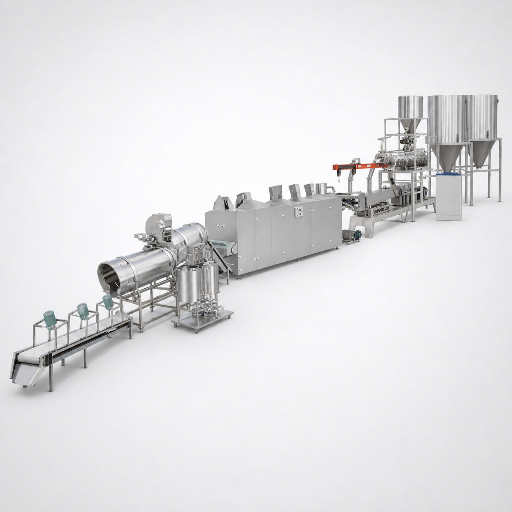
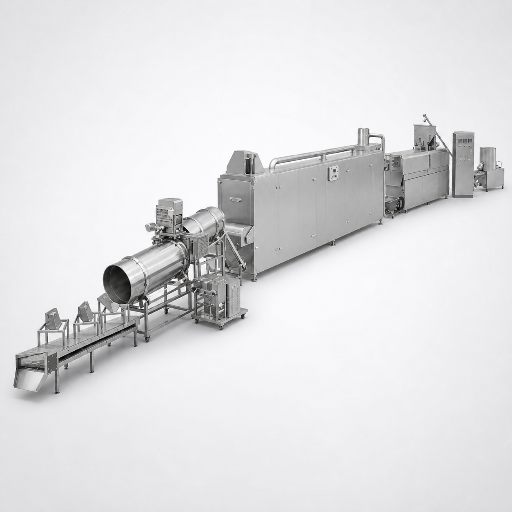
Dry Kibble Production Routes by Product Goal
A dry kibble extrusion line depends on the product you plan to sell. Formula attributes, pellet geometry, bulk density, final moisture content, and packaging format establish the required food industry operating range.
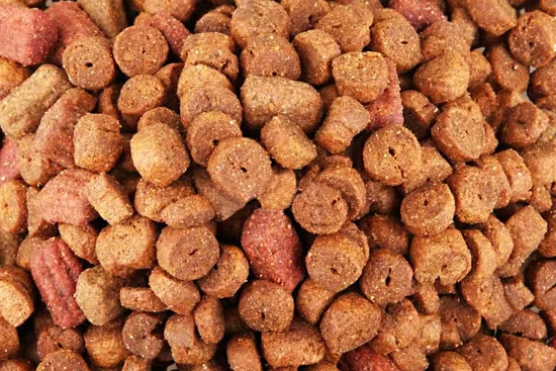
Dog Kibble
Configure die geometry, cutter setup, expansion, texture, and coating around the intended dog food range. Separate recipe families when shape, density, fat addition, or changeover demands are materially different.
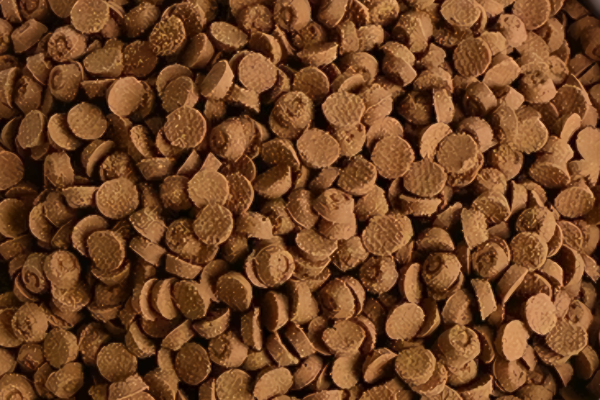
Cat Food
Build the route around the smaller kibble profile, formulation, moisture control, surface treatment, and package requirement. Product trials should use the actual raw material and target specification.
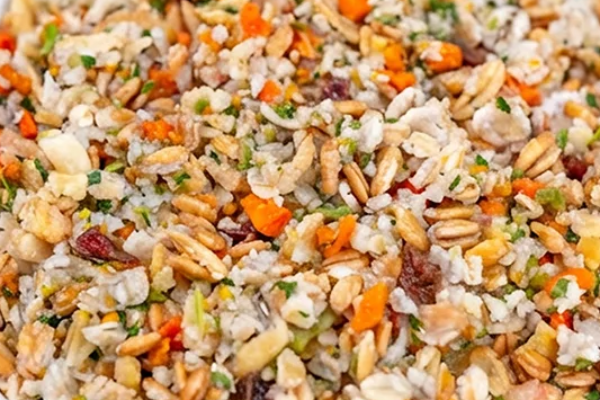
Specialty Dry Pet Food
Functional ingredients, higher-fat recipes, sensitive inclusions, or multiple color and shape families can change mixing, extrusion, drying, coating, and cleaning requirements. These products need an explicit trial and changeover plan.
For related planning details, see the dry kibble extrusion process guide.
One line or modular product families
Changeover complexity is the trade-off: a wider product range may share core equipment, but dies, dosing, coating, cleaning, and operating windows still need to be defined by family.
Recipe-led selection
Extrusion is the center of the cooking process, but it does not work alone. Upstream feed condition and the drying, coating, and handling stages after the die all influence the finished food product.
Recipe and Raw-Material Inputs
Formulation characteristics are critical for selection of reliable processing equipment. We examine ingredient characteristics such as the starch and protein system, fat and liquid ratios, particle size distribution, inherent moisture content, and production sequence before completing line design.
Start with a representative formula
A formula that extrudes in a laboratory may not transfer directly to production-scale equipment. Use the intended production raw material for trials and approve the commercial recipe against its own product targets.
Ingredient preparation
- Raw material form, storage, and feeding method
- Batching accuracy and dosing sequence
- Grinding target and particle-size distribution
- Mixer order for powders, liquids, water, and steam
Extrusion response
- Recipe formulation and pre-conditioning requirement
- Moisture control before and during extrusion
- Required cooking, expansion, and texture response
- Die plate, cutter, and product geometry
Finished kibble
- Shape, dimensions, surface, and bulk density
- Final moisture and handling condition
- Oil, palatant, or seasoning application
- Any digestibility target and its test owner
- Fines limit, pack size, and seal requirement
Production pattern
- Recipe families and planned changeovers
- Operating hours and cleaning windows
- Measurement point for required throughput
- Startup, reject, and rework treatment
PROCESS SPECIFICATIONS
Drying, Coating, and Pack-Handoff Requirements
Extrusion-cooked kibble must reach packaging in the agreed condition. Configure the dryer, coating apparatus, conveying equipment, cooling process, and packaging systems together.
Required outcome
Configuration inputs
Project decision
Controlled final moisture
Feed condition, dryer loading, air conditions, residence time, and product geometry
Define the test method, sampling point, and acceptable range
Stable shape and texture
Formula, pre-conditioning, extrusion process, die, cutting, and drying profile
Approve a representative sample and measurement method
Consistent coating
Kibble surface, oil or palatant condition, dosing, drum action, and transfer
Define addition rate, uniformity check, and changeover method
Packaging-ready product
Temperature, moisture, fines, conveyor handling, pack material, and seal process
Name the handoff condition and responsibility owner
Cooling boundary
Add cooling where the approved product and packaging handoff require it. State whether the cooler or cooling conveyor sits in Shengtu scope or plant scope, together with the required inlet and outlet condition.
Product-quality checks
- Moisture content and water-activity method where applicable
- Dimensions, bulk density, texture, and surface
- Coating addition and palatability-related product requirements
- Fines, breakage, and pack condition
Hygiene and changeover checks
- Access to mixer, extruder, dryer, drum, and transfers
- Wet or dry sanitation method by area
- Hygienic design, drainage, dust collection, and zoning interfaces
- Recipe segregation and line-clearance records
SYSTEM ARCHITECTURE
Dry Kibble Line Configuration
This processing-route summary will serve as the basis for a Shengtu dry pet food production line project. Individual component models, connections, and alternatives will be chosen in conjunction with the customer’s accepted product characteristics and plant data.
Stage
Line function
Information used for configuration
01
Batching and dosing
Ingredient list, batch size, storage method, dosing sequence, and accuracy requirement
02
Grinding
Incoming raw material, target particle size, screen strategy, and dust interface
03
Mixing and conditioning
Formula order, mixer and pre-conditioner requirements, liquid addition, water and steam, and residence needs
04
Twin-screw extrusion
Formulation, feed condition, cooking window, screw setup, specific mechanical energy, extruder barrel needs, and control points
05
Shaping and cutting
Die plate, kibble dimensions, cut length, expansion, texture, and product family
06
Multi-layer drying
Inlet moisture, finished moisture, product depth, drying temperature, residence behavior, and discharge condition
07
Coating or seasoning
Oil or palatant form, addition method, coating load, mixing action, and product temperature
08
Conveying and packaging
Cooling boundary, fines control, pack format, weighing, sealing, coding, and warehouse handoff
[ INTEGRATION NODE ]
Line layout inputs
Send the usable footprint, clear height, column positions, access routes, utility connection points, raw-material entry, and finished-pack exit. Allow practical space for operation, cleaning, and maintenance.
[ CONTROL PROTOCOL ]
Recipe-to-Kibble Control Chain
Map each product target to the upstream input, machine setting, downstream response, and check point used during trials or acceptance.
Open the Recipe-to-Kibble Control Chain
PROJECT SPECIFICATIONS
Quote Inputs and Investment Drivers
A meaningful equipment proposal needs more than a capacity request and product description. It should show how the formulation, scope, plant conditions, control criteria, testing, and delivery boundary shape the selected pet food processing equipment.
Commercial driver
Why it changes the project
What to send
Product range
More formulas, shapes, and coating systems can change dies, dosing, cleaning, and changeover design
Product matrix and representative recipes
Output basis
Throughput depends on the named formula, product state, operating window, and measurement point
Required rate with product and test conditions
Equipment scope
Upstream storage, cooling, conveyors, packing, dust, and sanitation may sit in different scopes
Required module list and responsibility boundary
Plant conditions
Utilities, layout, access, elevation, and any energy efficiency target determine integration effort
Site plan, utility data, measurement boundary, and destination
Automation
Recipes, alarms, data, gateways, vision, and remote functions require defined interfaces and lifecycle ownership
Control philosophy and plant-system requirements
Acceptance
Trials, materials, runtime, sampling, documents, and witness roles determine the verification package
Product targets and acceptance expectations
Compare quotations on the same boundary
A machine list can look complete while critical handoffs remain outside the quoted scope. Unlike model-first quoting, a project quotation should identify included modules, exclusions, utilities, plant work, controls, testing, packing, and logistics, whereas a bare equipment total hides those differences.
VALIDATION & ACCEPTANCE
Product Trial and Line Acceptance
Risk is increased when a formulated product has no defined test method, sampling protocol, or assigned owner. Because the end result depends on the complete process rather than a single machine, Shengtu engineers acceptance across 8 stages and documents the agreed criteria.
[01]
Before the run
- Freeze the test formula and ingredient condition
- Identify calibrated instruments and test methods
- Record the line state, startup treatment, and sampling plan
- Agree how interruptions, deviations, and retests are handled
[02]
During the run
- Record batching, mixing, pre-conditioning, and extrusion conditions
- Track dryer operation, moisture control, coating, and product transfer
- Take samples at the agreed points and frequency
- Preserve recipe versions, alarms, adjustments, and operator actions
[03]
Finished-product checks
- Kibble shape, dimensions, expansion, and bulk density
- Moisture, texture, surface condition, and fines
- Coating addition and package handoff condition
- Any agreed quality control or food safety tests owned by the plant
[04]
Closeout records
- Results against each agreed limit
- Open actions, owner, and due point
- Approved settings and recipe identification
- Signed acceptance or a documented retest plan
Dry-Kibble Interface Closure Board
A machine list is not a substitute for an interface plan. Assign every mechanical, utility, control, product, and document interface to an owner before the project boundary is frozen.
Open the Interface and Acceptance MatrixDry-Kibble Scope Readiness Score
A project is ready for equipment selection when the product basis, required route, plant inputs, responsibility split, and acceptance plan are all defined. Missing inputs should be exposed before they become late changes.
PROCESS METHODOLOGY
Engineering and Delivery Process
We control the process for transitioning product requirements to an accepted process scope through a sequenced series of controlled steps. Each stage closes a decision with the customer before the information contained in the following phase is considered.
01
Review the agreed product brief to verify product type and family, raw-material characteristics and status, kibble formulation, coating process, package size and type, required output basis, and intended product changeovers.
02
Create a process route to reflect the product requirements: from batching/ingredient prep through extrusion to drying, cooling decision, coating, conveying, and final packing.
03
Develop a process-line diagram based on: material flow pattern, adequate height and access for installation and maintenance, ease of sanitation and equipment removal, available utilities connections, warehouse staging requirements and layout.
04
Establish an interface chart demonstrating mechanical and utility connections including power and water services, air, steam, ventilation, drainage, dust handling, automation controls, data transmission interfaces and associated plant work.
05
Confirm the overall project scope to align the equipment list with options, inclusions, omissions, documentation requirements, performance test procedures, packaging operation definition, logistics and delivery responsibilities.
06
Execute the agreed acceptance procedure: confirm equipment functioning in accordance with specification, monitor intermachine interfaces, review all production data logs, and verify final product quality against the written criteria.
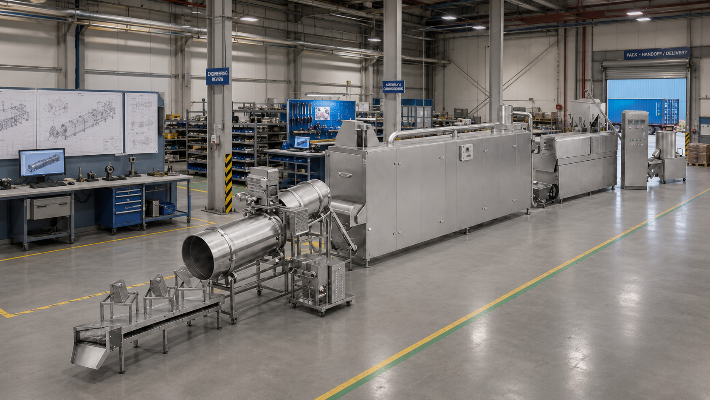
Smart manufacturing of food equipment, empowering industrial upgrades.
Project-selectable controls
The STUnit platform, standalone OTA upgrades, low-code control boxes, multi-protocol gateways, YOLO vision, and edge algorithms are selected only where the project requires them. A gateway and an access control are not interchangeable; the control system functions, interfaces, user roles, update path, backup, recovery, and support ownership belong in the proposal.
Documents to align
Applicable certificates and documents are confirmed for the equipment model, configuration and destination country. Company management-system records are reviewed separately from product conformity documents.
Use one approved equipment list, flow diagram, layout, utility schedule, interface list, control description, acceptance plan, and open-action register. Contract-specific service, training, site work, and delivery commitments should appear in the quotation rather than be assumed from a general web page.
EQUIPMENT & PROCESS
Equipment Across the Dry Kibble Line
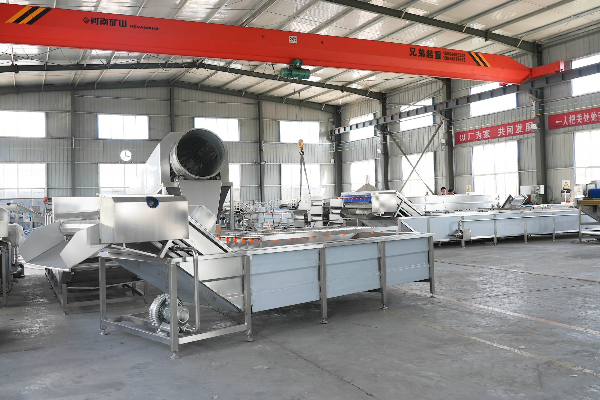
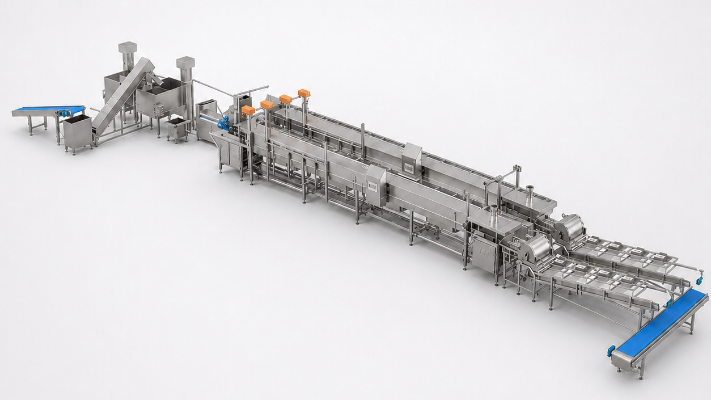
These pictured Shengtu equipment modules represent major components used in ingredient preparation, extrusion, drying, coating, and packing. Shengtu adapts equipment selection and configuration to the approved product and plant, and each Shengtu proposal identifies the included equipment.
01
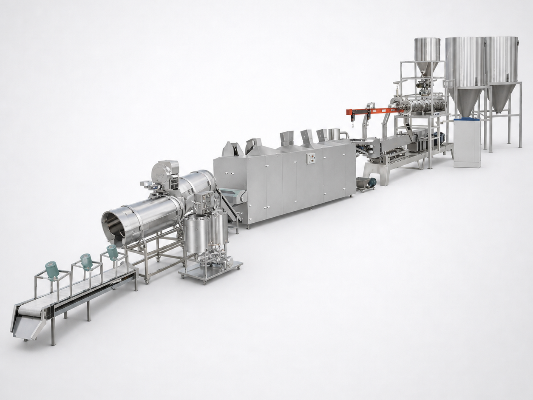
Integrated dry-kibble production route from preparation to downstream handling.
02
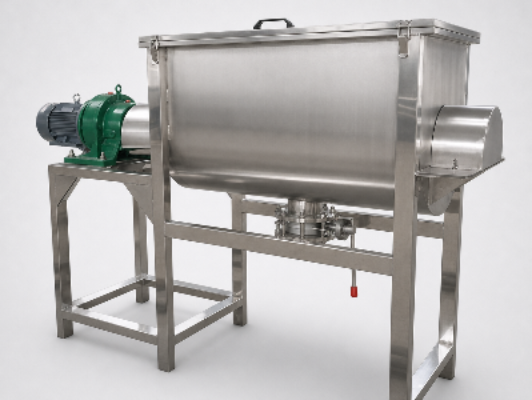
Ingredient mixer for controlled recipe preparation before extrusion.
03
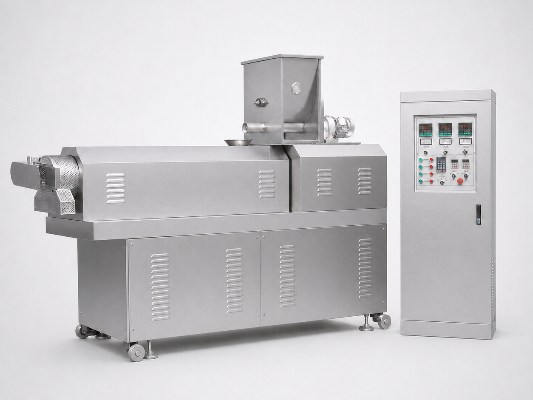
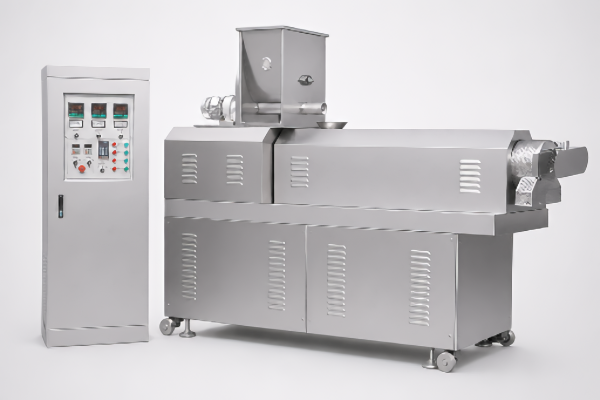
Twin-screw pet food extruder for cooking, shaping, and forming.
04
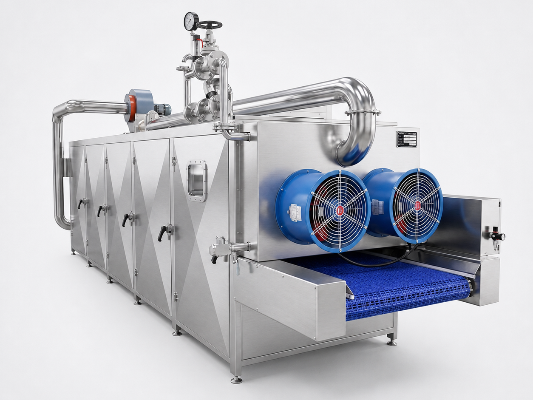
Multi-layer dryer for controlled post-extrusion moisture removal.
05
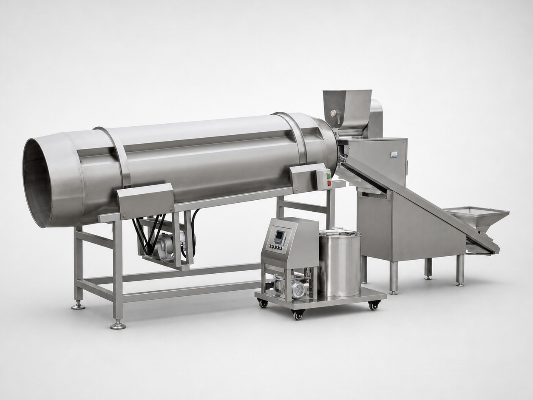
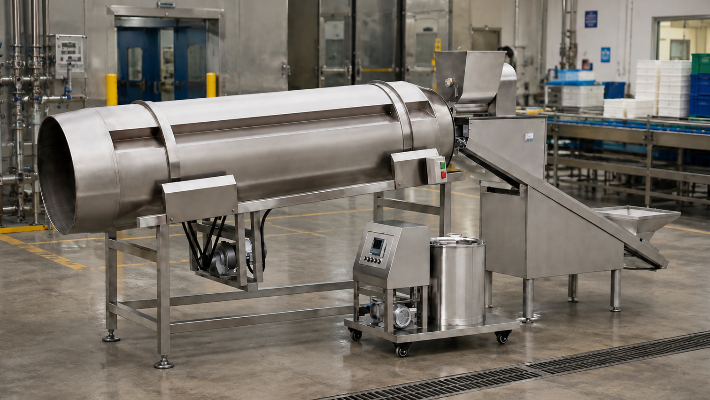
Coating drum for oil, palatant, or seasoning application.
06
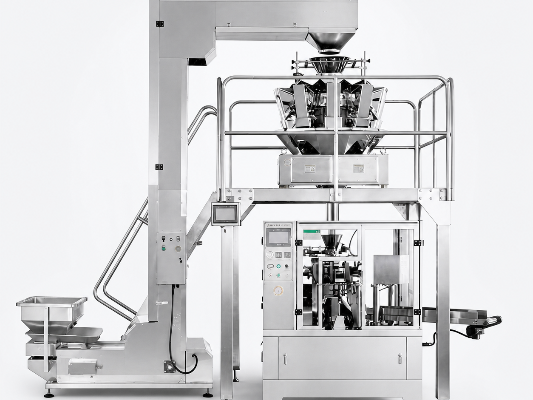
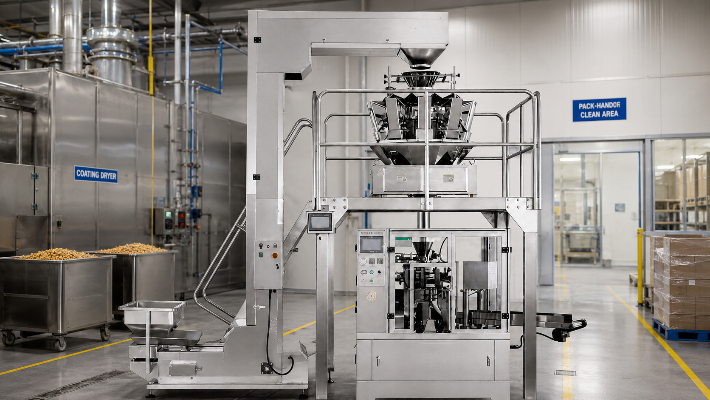
Premade-pouch packaging equipment for the finished-product handoff.
Dry Kibble Line in Operation
LIVE FEED
PROCESS SPECIFICATIONS
Alternative Pet Food Processing Routes
Dry kibble extrusion is used for cooked, shaped, and dried pet food. Wet foods, meat jerky, freeze-dried products, and extruded human snacks need separate processing routes because their moisture, forming, preservation, or market requirements differ.
Product direction
Why a separate route is needed
Recommended action
Wet pet food
Retort, container handling, thermal process, and high-moisture hygiene requirements differ from dry extrusion
Define the wet-product and packaging process separately
Meat jerky or formed treats
Meat preparation, forming, dehydration, texture, and preservation targets require another equipment chain
Start with the treat formula and forming method
Freeze-dried products
Freezing, vacuum drying, cycle time, and packaging barrier are outside the dry-kibble route
Develop a dedicated freeze-drying scope
Extruded human snacks
Although extrusion may be shared, recipes, seasoning, handling, compliance, and commercial presentation differ
Review the extruded puffed snack line
Formula development before line sizing
If the recipe or finished kibble is still undefined, begin with product targets and representative trials. Fixing a production line before the product basis is stable can create unnecessary rework.
PROJECT RESOURCES
Engineering Evaluation Tools
[ SYSTEM INTEGRATION NODE ]
Configure Your Dry Kibble Extrusion Line
Submit your food formulation, kibble target specifications, production operating capacity goals, package format, desired plant layout and available services so that we may engineer the product-appropriate processing route, machine list, plant interfaces, and acceptance specifications for your next project.
FAQ: Dry Kibble Extrusion Line
Both dog food and cat food requirements can be reviewed. Final equipment selection depends on the actual formulation, kibble geometry, moisture target, coating, changeovers, packaging, and plant conditions.
Shengtu’s documented route uses twin-screw extrusion for the cooking and forming stage. Screw configuration, feed condition, water and steam addition, temperature, die, and cutter still need to be matched to the intended extruded pet food.
No automatic assumption should be made. Project scope should state whether cooling is required, the target product condition at packaging, the cooling method, and whether that equipment belongs to Shengtu or the plant.
A throughput statement is not a useful acceptance term unless it names the recipe, product state, operating window, runtime, measurement point, and treatment of startup, rejects, downtime, and changeovers. The accepted value then belongs in the project quotation and test plan.
Recipe formulation, raw-material particle size, mixing, pre-conditioning, moisture control, extrusion settings, die and cutter setup, drying, coating, cooling, and conveying all influence the product. Use the Recipe-to-Kibble Control Chain to connect each target to a controlled input and check.
Multiple product formats can be planned through die, cutter, recipe, dryer, coating, and changeover decisions. Send the complete product matrix so the proposal can identify shared equipment, change parts, and cleaning steps.
Send usable dimensions, clear height, columns, floor conditions, access doors, operator and maintenance routes, ingredient entry, warehouse handoff, and utility locations. Include electrical supply, water, steam, compressed air, ventilation, drainage, and dust-control information.
They are project-selectable Shengtu capabilities, not an automatic standard package. Confirm the required function, interfaces, user roles, update and rollback path, backup, recovery, versioning, acceptance method, and lifecycle owner.
Compare the same product basis, output definition, included modules, exclusions, utilities, plant work, controls, documentation, trials, acceptance, packing, logistics, and delivery boundary. Use the interface matrix to make each responsibility visible.
Send the product and recipe brief, required output basis, pack formats, plant layout, utilities, desired automation, destination, module boundary, and acceptance expectations. Photos or drawings of the planned installation area also help the engineering review.
![F&V Freeze-Drying Line Process Guide [2026]](https://shengtumachinery.com/wp-content/uploads/2026/09/fv-freeze-drying-line-guide-featured-150x150.png)