Get in touch with Shengtu Bufan Company

Tunnel IQF Freezer
IQF Tunnel Freezer — ST-SDS Inline Freezing Solution for Food Processing
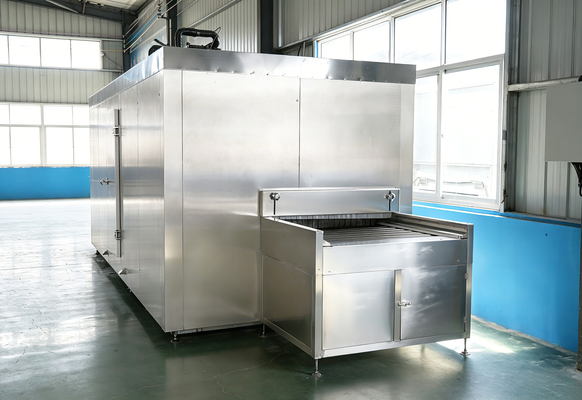
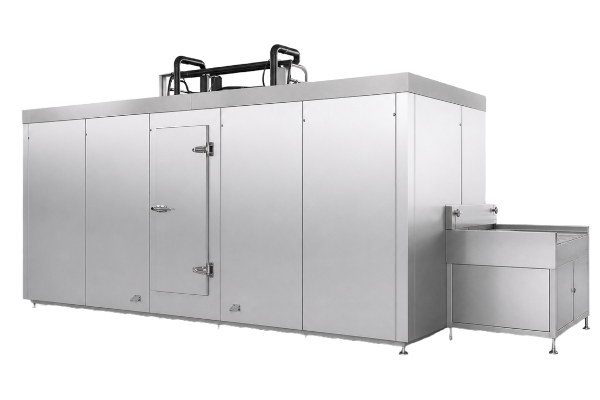
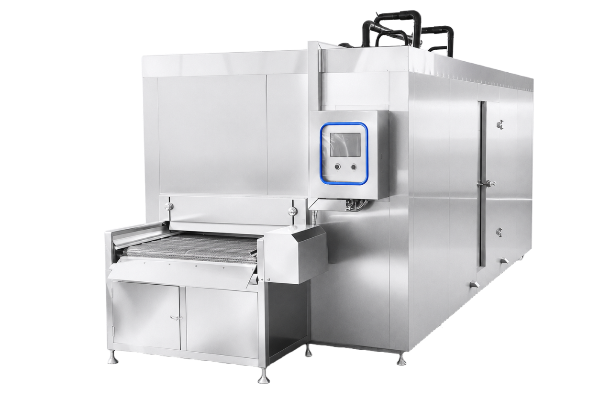
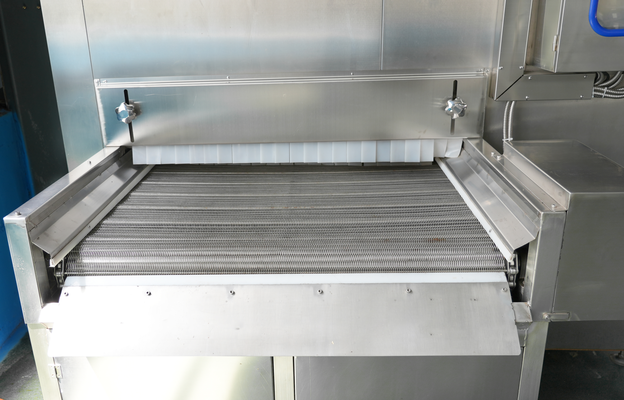
The ST-SDS is a mechanical-refrigeration IQF tunnel freezer running inline between your process line and packing station. Cold air is driven across a wire mesh belt, so every piece leaves separated rather than bonded into a block. Where the freezer is one stage of a new line rather than a retrofit into an existing one, the IQF frozen food production line covers the stations either side of it.
An engineer reviews your capacity before any figure is sent.
QUOTE within 1 business day
100–1000 kg/h, four models
2.2–2.4 m machine height
Build time 100–120 working days
ST-SDS IQF Tunnel Freezer at a Glance
- Capacity range 100, 300, 500 and 1000 kg/h — four Shengtu models, each with its own published footprint
- Build time 100–120 working days from the signed order, confirmed with your quotation
- Before dispatch Every machine is run as a complete system before dispatch, and the test record ships with it
- Warranty Warranty duration, coverage and exclusions are confirmed in the quotation and contract
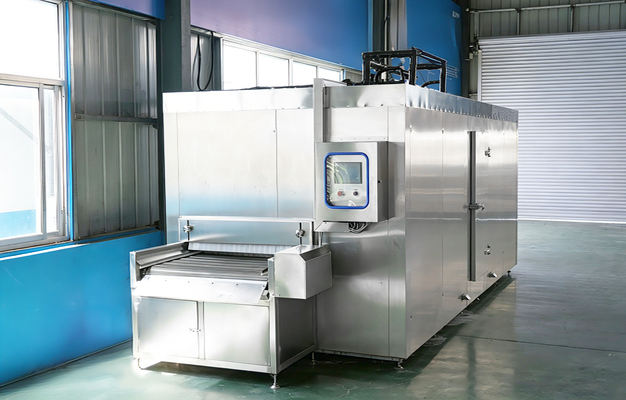
- Ceiling height 2.2–2.4 m machine height, which fits low-bay rooms that cannot take a spiral
- Company scale Our equipment runs in 52 countries, with 2,000+ machines delivered
- Payment terms 30% deposit, the 70% balance before shipment, or an L/C at sight
- What ships with it The user manual, electrical drawings, factory inspection record and full export paperwork
The IQF Freezing Cycle: Freeze Process and Airflow Path
-
01
Individual quick freeze means each piece freezes on its own rather than bonded into a solid mass. Cold air crosses the wire mesh belt the ST-SDS is built around, so the freeze process reaches every piece top and underside at once. Product leaves free-flowing, ready to portion by weight.
-
02
Product enters over an infeed section of 900–1200 mm (35.4–47.2 in), where pieces spread out into a single layer on the conveyor so nothing clumps together.
-
03
Cold air circulates across the belt inside a welded enclosure. Surface heat leaves first, which sets the crust that stops pieces sticking.
-
04
An outfeed section of 600–1000 mm (23.6–39.4 in) carries frozen pieces on to downstream equipment, so the tunnel runs inline instead of as a batch step.
Airflow geometry is not settled across this equipment class. A published third-party patent application describes a different arrangement, a perforated belt with upward high-velocity cold air lifting product clear of the belt surface, rather than the crosswise flow above.
Why Crystal Size Decides Product Quality
A peer-reviewed review of ice morphology in foods reports ice crystals between 50 to 100 μm in muscle cells of frozen specimens, and large crystals puncture cell membranes so intracellular fluid is lost on thawing. Equivalent crystal diameters run close to 12.6 μm, 3.6 μm and 1.2 μm at −20 °C, −80 °C and −196 °C, spanning mechanical and cryogenic ranges alike. Colder air, smaller crystals — the argument for quick freeze equipment of any kind, and the reason a slow freeze shows up downstream as drip loss and inconsistent texture.
“Quick Frozen” as the Law Defines It
Under Council Directive 89/108/EEC, quick-frozen food is product taken through the zone of maximum crystallisation as rapidly as possible and then held at −18 °C or lower at all points once thermal stabilisation is complete. No numeric freezing-rate threshold appears anywhere in its text; the international code of practice covering the same subject is Codex Alimentarius CXC 8-1976.
ST-SDS IQF Freezing Machine Models and Full Specifications
Four ST-SDS models cover 100 to 1000 kg/h. Every figure below comes from our own specification tables, in the units our drawings use, with imperial added.
| Specification | ST-SDS-100 | ST-SDS-300 | ST-SDS-500 | ST-SDS-1000 |
|---|---|---|---|---|
| Capacity | 100 kg/h | 300 kg/h | 500 kg/h | 1000 kg/h |
| Dimensions L × W × H (mm) | 6600 × 2300 × 2200 | 11500 × 2500 × 2200 | 15800 × 2600 × 2300 | 19200 × 3700 × 2400 |
| Dimensions L × W × H (in) | 259.8 × 90.6 × 86.6 | 452.8 × 98.4 × 86.6 | 622.0 × 102.4 × 90.6 | 755.9 × 145.7 × 94.5 |
| Belt width | 1200 mm (47.2 in) | 1400 mm (55.1 in) | 1500 mm (59.1 in) | 2600 mm (102.4 in) |
| Infeed section length | 900 mm (35.4 in) | 900 mm (35.4 in) | 1000 mm (39.4 in) | 1200 mm (47.2 in) |
| Outfeed section length | 600 mm (23.6 in) | 600 mm (23.6 in) | 800 mm (31.5 in) | 1000 mm (39.4 in) |
| Cooling load | 22 kW | 58 kW | 90 kW | 170 kW |
| Installed power | 4 kW | 10 kW | 14 kW | 28 kW |
// SYS.REQ
Two figures we set against your process, not in a brochure
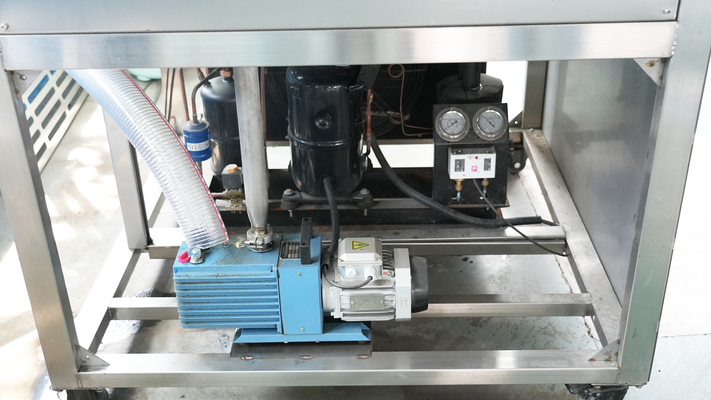
Discharge core temperature and evaporating temperature get fixed at quotation, against your product, its piece weight and your process requirements. Cooling load in the table is the refrigeration duty the machine is built around — the figure your refrigeration contractor asks for.
Sizing by Capacity, Belt Width and Floor Space
Pick the model from your hourly throughput first, then check the room. This table reduces the specification to the three numbers deciding whether a machine fits.
| Throughput | Model | Floor area | Cooling load | Installed power | Machine height |
|---|---|---|---|---|---|
| Up to 100 kg/h | ST-SDS-100 | 15.2 m² (163 ft²) | 22 kW | 4 kW | 2.2 m |
| Up to 300 kg/h | ST-SDS-300 | 28.8 m² (310 ft²) | 58 kW | 10 kW | 2.2 m |
| Up to 500 kg/h | ST-SDS-500 | 41.1 m² (442 ft²) | 90 kW | 14 kW | 2.3 m |
| Up to 1000 kg/h | ST-SDS-1000 | 71.0 m² (765 ft²) | 170 kW | 28 kW | 2.4 m |
[DATA: ALT_CHK_REQ]
Ceiling Height Is the Constraint Nobody Publishes
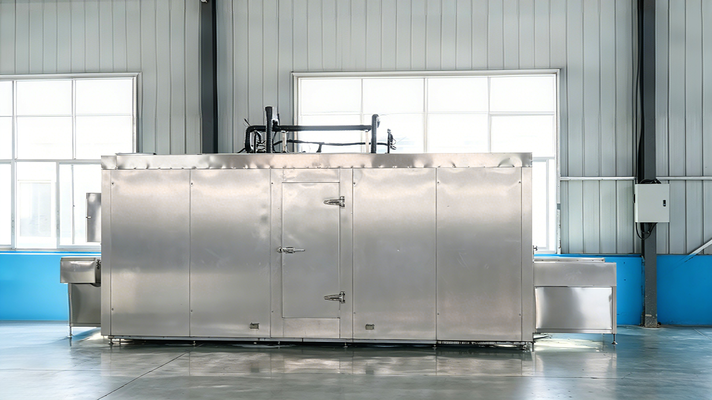
Our ST-SDS range stands 2.2–2.4 m (7.2–7.9 ft) tall. That is machine height, not installation clearance — add room above the enclosure for refrigeration connections and maintenance access. Ask every supplier for both figures separately: one “height” number never says which you are reading.
Three Sizing Checks to Run Before You Enquire
-
Refrigeration duty does not scale with the belt.
Ten times the throughput brings roughly eight times the cooling load and seven times the installed power, which is why energy per kilogram improves as the machine grows.
-
Belt width is a product decision, not a capacity decision.
Stepping from 1500 mm to 2600 mm carries extra load at the same air path, so wide flat pieces may need a larger frame than throughput alone suggests.
-
Length, not width, usually blocks an installation.
Our 1000 kg/h model is 19.2 m long, and a room can have ample floor area yet still fail on one straight run. Belt choice moves that number too: practitioners note solid belts take up longitudinal space where a mesh belt would not.
Tunnel and Spiral Freezer Footprint at Equal Capacity
Spiral freezers get called the space-saving choice almost by reflex. Measured against our own published dimensions that is not always true: it holds at the top of the range and reverses below it.
| Capacity / Metric | Tunnel (ST-SDS) | Spiral (ST-LXS) | Which is smaller |
|---|---|---|---|
| 300 kg/h floor area | 11500 × 2500 mm = 28.75 m² (309 ft²) | 7500 × 4500 mm = 33.75 m² (363 ft²) | Tunnel, by 14.8% |
| 500 kg/h floor area | 15800 × 2600 mm = 41.08 m² (442 ft²) | 8600 × 5200 mm = 44.72 m² (481 ft²) | Tunnel, by 8.1% |
| 1000 kg/h floor area | 19200 × 3700 mm = 71.04 m² (765 ft²) | 9200 × 5800 mm = 53.36 m² (574 ft²) | Spiral, by 24.9% |
| 500 kg/h cooling load | 90 kW | 85 kW | Within 6% of each other |
| 1000 kg/h cooling load | 170 kW | 170 kW | Identical |
| 500 kg/h installed power | 14 kW | 18 kW | Tunnel, no helix drive |
| 1000 kg/h installed power | 28 kW | 25 kW | Spiral, the order reverses |
| Machine height | 2.2–2.4 m (7.2–7.9 ft) | 2.5–4.0 m (8.2–13.1 ft) | Tunnel, in every model pair |
How to Read the Crossover
The crossover sits between 500 and 1000 kg/h. Below it a tunnel takes less floor area than the spiral freezer of the same rating, and above it the spiral pulls ahead by a quarter.
Refrigeration duty is not the differentiator. At 1000 kg/h both routes carry the same 170 kW load, so this is a building question, not an energy one.
Shape differs more than area. A tunnel is narrow and long where a spiral is short and tall, so two rooms of equal area can accept opposite answers.
Belt type consumes length. In a food safety forum thread on freezing tunnel cleaning, a practitioner notes that solid belts are available but take up longitudinal space, so product that cannot run on mesh pushes the layout longer.
Those are published dimensions of our ST-SDS and ST-LXS ranges. Other builders arrange machines differently, so the crossover on your shortlist may differ.
DATA-LINK
Run the comparison on your capacity
Enter a throughput to see both footprints, both cooling loads and the gap between them.
Mechanical Refrigeration and Cryogenic IQF Freezer Routes
Shengtu builds mechanical refrigeration machines. Six routes make up the shortlist a food processor actually works through, so the whole comparison sits here whether or not it favours us.
Mechanical air-blast tunnel (what we build)
Heat Removal
Where It Fits
Mechanical spiral
Heat Removal
Where It Fits
Liquid nitrogen tunnel
Heat Removal
Where It Fits
Liquid carbon dioxide tunnel
Heat Removal
Where It Fits
Impingement tunnel freezer
Heat Removal
Where It Fits
Batch block freezing
Heat Removal
Where It Fits
The Split Between Capital Cost and Running Cost
Teaching material from a university industrial refrigeration research consortium states that operating cost is the dominant criteria when choosing between mechanical and cryogenic freezing, and lists what favours a mechanical machine: space in the production area, one product run at one location day after day. Theoretical refrigerating effect of liquid nitrogen runs 152 BTU/lb against 65 to 115 BTU/lb actually transferred into food, and liquid CO2 117 BTU/lb against 85 to 110 BTU/lb.
- Cryogenic routes buy in the cold. Refrigerating effect leaves with the vented gas, making the cold a recurring purchase for every kilogram frozen.
- Mechanical routes build the cold. Refrigeration plant is capital that stays on site, and ammonia inventories above 10,000 lb bring US process safety and risk management obligations with them.
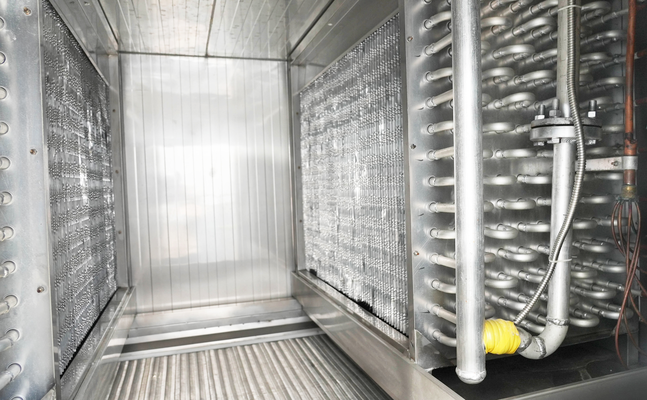
Frost is the mechanical route’s honest weak point, and that same source notes these machines can lose capacity when their coils load up with frost,which turns defrost into a purchasing question.
Products the ST-SDS Tunnel Freezer Is Built For
An IQF tunnel suits pieces that arrive separated and leave the same way. How fast the freeze runs decides product quality, since slower freezing grows larger crystals inside the piece. What follows are the checks that decide whether a product family runs well — not a promise about your recipe.
Shrimp and prawns
Graded to one size band, drained upstream
Mixed sizes freeze unevenly — grade before the belt
Berries and diced fruit
Firm, free-flowing, single layer
High-moisture surfaces need a crust before handling
Green beans, peas, sweetcorn
Blanched, cooled and drained upstream
Carry-over water freezes into a mat between pieces
Diced & shredded vegetables
Uniform cut, low surface moisture
Fine shreds move in the airflow — set belt loading for them
Poultry portions & meat pieces
Separated portions, not nested stacks
Thickest piece sets the cycle, not the average
Meatballs and formed pieces
Set firm enough to hold shape on mesh
Soft product may need surface setting first
Coated and battered pieces
Fried or set upstream, coating fixed
Wet coatings transfer to the belt as cleaning load
Pasta, rice and cooked grains
Loose, oiled or separated after cooking
Starch fines are among the hardest residues to wash out
Two Product Limits This Tunnel Will Not Cross
High-moisture product may need conditioning first. A granted US patent on continuous freezing describes an inlet conditioner treating high-moisture material before the freezing bed, the mechanical form of the crust-first rule. Without conditioning, belt speed alone will not deliver an IQF result.
Ice cream and edible ices sit outside the definition. Council Directive 89/108/EEC excludes them from quick-frozen foodstuffs, so a specification drafted against that directive will not cover them.
Piece size limits, dwell time and belt loading get set per product family against your sample rather than fixed in advance. Where a food product sits right at a band edge, running it is what gives the honest answer. Every check in the third column above is also settled upstream of the freezer rather than inside it: Grading, blanching, cooling and draining belong to the line ahead — our leafy fresh-cut processing line and root vegetable washing and peeling line cover that side, and the tunnel inherits whatever they hand over.
Product and Volume Limits That Rule Out an IQF Tunnel Freezer
Five situations where this equipment is the wrong tool. Each one carries a better route with it, because naming a limitation without naming the alternative helps nobody.
Product is sold as a solid block
Where it bites
You pay for separation you undo at packing, and for the airflow that delivers it
Better route
Plate freezers or a batch blast room, sized to your block format
Volumes are small or highly seasonal
Where it bites
A continuous line only earns its capital when it runs
Better route
Batch equipment, or a cryogenic tunnel rented for campaign weeks
Pieces are large, thick or nested
Where it bites
Thickest piece sets cycle time and the whole belt slows to it
Better route
Portion or grade upstream, or accept lower throughput on a larger frame
Product is fragile, sticky or unconditioned
Where it bites
Pieces bond on the belt, so product quality suffers where separation was the point
Better route
Add a crusting step upstream[4], or use a route that sets the surface faster
Your room cannot take an 11.5 to 19.2 m straight run
Where it bites
Floor area alone does not decide it — a tunnel needs its length in one line
Better route
A spiral of equal capacity, trading floor length for headroom
For related planning details, see the spiral belt freezer selection guide.
[SYS.CONCLUSION]
Quotation, Lead Time and What Ships With the Machine
The number moves with the capacity band, the belt width your product needs, the cooling load that comes with it, and whether the refrigeration plant sits in our scope or yours. Every quotation is built against a machine, not read off a price list.
“Every machine is run as a complete system before dispatch, and we publish the 80% split on purpose. A supplier claiming every machine on a turnkey line comes out of one factory is describing an ambition, not a supply chain.”
Shengtu Engineering Team
Why Published Prices Span Two Orders of Magnitude
- Machine against line: some figures cover a freezer on its own, others a whole processing line with washing, blanching, dewatering and packing.
- With or without the refrigeration plant: a tunnel quoted with compressor rack, condensers and pipework is a different purchase from that same purchase from that same tunnel quoted bare.
- New against used: resale platforms list second-hand tunnels beside new equipment, and rarely label either clearly enough to compare.
So the useful question is not what an IQF tunnel freezer costs, but which package any given number is describing.
From Your Capacity Figure to a Written Quotation
- Send your product, target capacity, factory layout drawing and process requirements.
- Engineering review checks capacity against belt width, cooling load and your available space, then comes back with questions if those do not close.
- You get a written quotation covering model, scope, exclusions and build time, so the inclusions are legible before you commit.
- On order we work on a 30% deposit, the balance before shipment, or an L/C at sight, by wire transfer.
- Every machine is run as a complete system before dispatch, and the test record ships with it.
- Packing, containerisation, export paperwork and shipment coordination are all handled on your behalf.
Build Time and What Arrives With the Machine
Standard build time is 100–120 working days from the signed order. We quote it honestly rather than shorten it to win an enquiry — your season is planned around that schedule.
- Shipped with the machine: the user manual, electrical drawings, factory inspection record and export paperwork.
- Warranty duration, coverage and exclusions are confirmed in the quotation and contract.
- After-sales covers operation guidance, spare parts and technical support, with the scope confirmed in the quotation.
We build around 80% of our main equipment categories in four owned and self-built manufacturing bases, and roughly a fifth of specialised machines come from long-term partner factories.
Cleaning Access, Defrost and Planned Downtime
Cleaning and defrost decide how many hours a year the machine actually produces, because frosted coils and an overrunning wash-down both come straight out of production time. Listed first is what is mechanically verifiable on the Shengtu enclosure, then the questions worth putting to every supplier.
Built Into the Machine
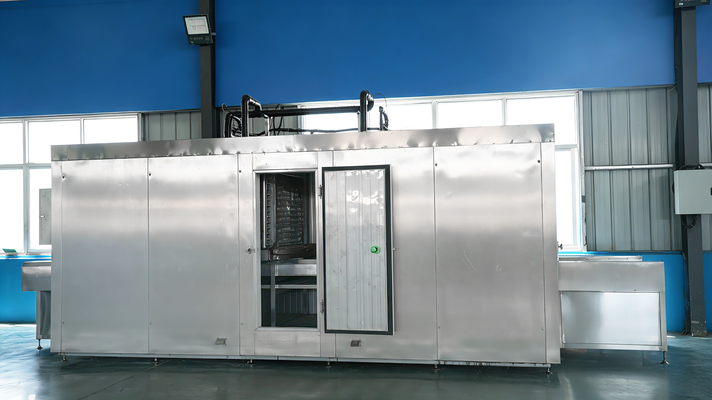
- A welded enclosure with access doors and openable side panels, which keeps the belt path reachable for washing.
- Infeed and outfeed sections of 900–1200 mm and 600–1000 mm, where product residue collects first.
- Continuous operation, which puts cleaning and defrost in scheduled gaps rather than alongside the line.
- Every machine is run as a complete system before dispatch, so belt drive and refrigeration circuit are verified together, not at your site.
The Standards Your Auditor Will Be Working From
Hygienic design of food machinery is covered by EN 1672-2:2020, which EHEDG guidance references when assessing cleanability in place. A North American Meat Institute task force publication treats sanitation as part of equipment design itself. Those are what a cleanability review runs against.
Four Questions to Put to Any Supplier
These come from practitioners rather than brochures. A long-running thread on freezing tunnel cleaning in a food safety network is candid about what goes wrong.
01
Which defrost method, and how long
An Indian National Horticulture Board specification for IQF plant gives the defrosting arrangement as water, hot gas or air. Ask which one, how often it runs, and what production time each cycle costs you.
02
Which cleaning chemistry the coils tolerate
In that thread a food safety practitioner warns that IQF freezers usually hold aluminium coils, and the wrong cleaner can pit or damage the coils leading to microbial harborage or refrigerant leaks at welds, and he recommends staying away from chlorinated and high-causticity cleaners.
03
How long a full wash-down takes
Whoever opened that thread found wet flour adhered to surfaces after defrost, and reported that cleaning takes like 8 hours. Ask for the realistic duration on your residue, not on a clean-running product.
04
How the enclosure is entered safely
The practitioner quoted above on coil chemistry puts worker safety ahead of everything else: these are enclosed areas where a person can become incapacitated unnoticed. Confined-space procedure and lock-out belong in the purchase discussion.
Tunnel IQF Freezer Engineering Tools
Calculate specifications, compare footprints, and verify installation parameters for your production line.
footprint comparison
Compare the required floor space of different Tunnel IQF configurations. Evaluate dimensional footprint against your facility’s layout.
Access
model selector
Input your required freezing capacity and product types to find the optimal IQF freezer model. Ensure precise matching for your processing needs.
Access
room fit check
Verify spatial clearances and installation feasibility. Validate that the selected IQF unit integrates safely into your existing processing room.
Access
Frequently Asked Questions
Get a Quote
What are the disadvantages of an IQF tunnel freezer?
Four trade-offs belong to the process itself, not to one brand. A continuous line only pays when it runs, which is why seasonal volumes suit batch equipment better, and sticky or unconditioned product bonds on the belt whatever the speed. A tunnel also needs its length in one straight run, and coils accumulate frost, so wash-down takes scheduled hours out of every week.
What is the difference between an IQF tunnel freezer and a blast freezer?
An IQF tunnel freezes individual pieces continuously on a moving conveyor, so product leaves free-flowing. Blast freezers work in batches instead, freezing whatever is loaded as a single mass.
What causes uneven freezing and dehydration in a tunnel freezer?
Three causes, in the order they bite: product fed above the rated load of the belt, airflow set to control residue rather than to freeze, and coils carrying frost. A practitioner in a food safety forum thread on freezing tunnel cleaning argues that fan speed has to be tuned so it stops scattering debris through the tunnel while the freezing temperature stays where it belongs.[6] All three surface the same way, as weight loss, clumping and an inconsistent core temperature.
What determines the cost of an IQF tunnel freezer?
Four variables move the figure: capacity band, belt width, the cooling load that follows from it, and whether the refrigeration plant sits in our scope or yours. Published prices describe different packages — a bare machine, a whole line, or second-hand equipment.
Which ST-SDS model fits my capacity and floor space?
Start from hourly throughput, where 100, 300, 500 or 1000 kg/h maps to one model each. Then check your room against the footprint — 15.2, 28.8, 41.1 and 71.0 m² — and against the 19.2 m straight run.
Do I need mechanical refrigeration or a cryogenic tunnel?
We build mechanical refrigeration machines, so read this as reasoning rather than a recommendation. Cryogenic freezing with liquid nitrogen or liquid carbon dioxide costs less to install and more to run, because the refrigerating effect leaves with the vented gas.
Can the freezer be adjusted to my product, capacity and factory layout?
Yes. Send your product, target capacity, factory layout drawing and process requirements; where capacity, belt width and space do not close, we say so.
How much ceiling height and installed power does each model need?
Machine height is 2.2 m at 100 and 300 kg/h, 2.3 m at 500 kg/h and 2.4 m at 1000 kg/h. Installation clearance is higher. Installed power is 4, 10, 14 and 28 kW.
Can the line keep running while the belt is cleaned?
Not on a single belt. In that same thread a member suggests keeping a second set so one runs while the other is washed, and cautions that belts are not cheap.[6] Price a spare set alongside the machine.
Can I see the actual ST-SDS machine before ordering?
We hold 15 photographs and 3 videos of the ST-SDS tunnel freezer and send them on request, without asking you to commit first. No named installations or customer references appear on this page.
Which inputs do you need to prepare a quotation?
Your product, target capacity, factory layout drawing and process requirements. Send the first two if that is all you have.
How long is the lead time, and what are the payment terms?
Standard build time is 100–120 working days from the signed order, confirmed in your quotation. We work on a 30% deposit, the balance before shipment, or an L/C at sight.
Which documents ship with the machine, and what does the warranty cover?
Applicable certificates and documents are confirmed for the equipment model, configuration and destination country. Company management-system records are reviewed separately from product conformity documents.
Every machine is run as a complete system before dispatch, and the test record ships with it, alongside the user manual, electrical drawings, factory inspection record and export paperwork. Warranty duration, coverage and exclusions are confirmed in the quotation and contract.
![F&V Freeze-Drying Line Process Guide [2026]](https://shengtumachinery.com/wp-content/uploads/2026/09/fv-freeze-drying-line-guide-featured-150x150.png)