Get in touch with Shengtu Bufan Company

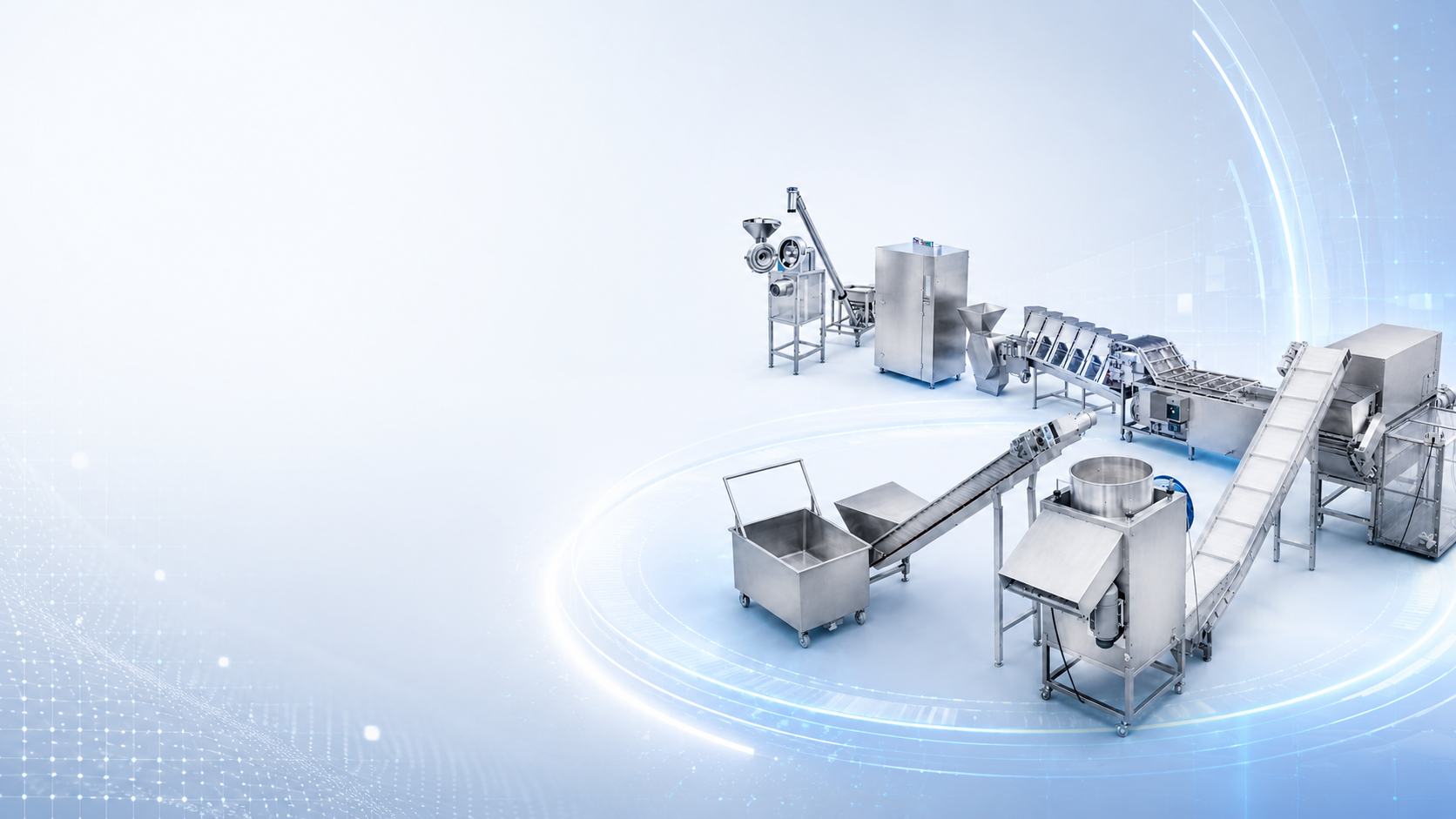
FD Instant Soup & Porridge Line — Freeze Dried Instant Soup and Porridge Production Line
A freeze dried instant soup and porridge production line is a five-station food processing system that cooks, freezes, sublimes, fills and inspects the product in one controlled sequence. Five stations run pre-cooking, quick freezing, vacuum freeze drying, premade-pouch filling and sealing, and metal detection. Finished blocks reach 3–5 % residual moisture and rebuild into soup when hot water is added.
Get a Line Proposal- Freeze drying area
- 5, 10, 20 and 30 m² (54, 108, 215 and 323 ft²)
- Wet product per batch
- 50, 100, 200 and 300 kg (110, 220, 441 and 661 lb)
- Quick freezing capacity
- 100–1000 kg/h, tunnel or spiral
- Finished moisture
- 3–5 %
- Quotation turnaround
- 5 business days single machine,
10 business days full line - Lead time
- 90–120 working days from confirmed down payment
Freeze Dried Instant Soup and Porridge Production Line — Station Sequence
We supply this production line as five linked stations, each with its own control loop and its own acceptance criteria. The sequence below is the configuration we build; individual stations can be supplied on their own where you already operate part of the route.
01 / 05
STATION [ 01 ]_
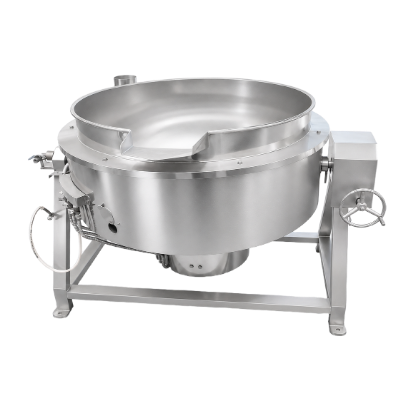
Pre-cooking
The kettle brings the recipe to its finished eating state before any freeze drying happens, because the freeze dryer preserves structure rather than creating it. Starch gelatinisation in porridge and protein set in meat and vegetable pieces are fixed here.
CONTROLLED HERE
batch temperature profile, hold time, solids content at discharge.
STATION [ 02 ]_
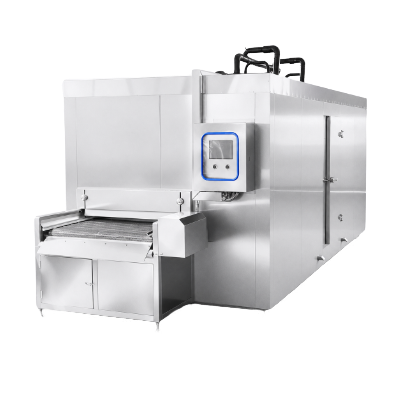
Quick freezing
Freezing rate sets the size of the ice crystals, and ice crystal size sets both the sublimation path and the texture your customer eats. Fast freezing gives small crystals and a finer pore structure; slow freezing gives larger ice crystals and faster drying but coarser texture.
CONTROLLED HERE
air temperature, belt speed, product core temperature at exit.
STATION [ 03 ]_
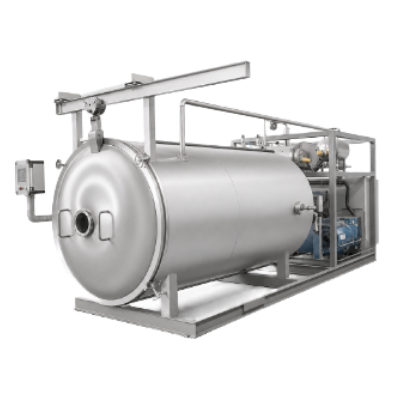
Vacuum freeze drying
Under vacuum the frozen water leaves as vapor without passing through a liquid stage, which is what keeps the block’s shape and its rehydration behaviour. Shelf heating supplies the heat of sublimation while the condenser captures the water vapor as ice.
CONTROLLED HERE
shelf temperature, chamber pressure, endpoint moisture definition.
STATION [ 04 ]_
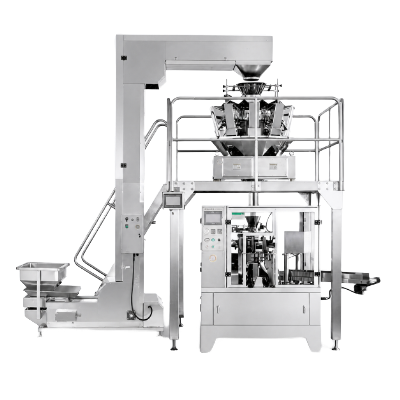
Premade-pouch filling and sealing
Freeze-dried blocks are fragile and hygroscopic, so the filler is chosen for gentle handling and for a seal that holds a moisture barrier. Pouch, pillow-pack and canister formats are all served from this station.
CONTROLLED HERE
fill weight, seal integrity, headspace and barrier choice.
STATION [ 05 ]_
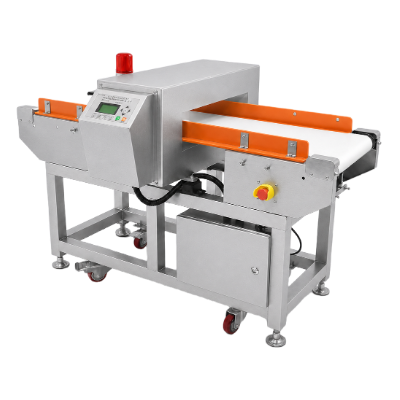
Metal detection
Every sealed pack passes a metal detector before it leaves the line, and rejects are diverted rather than returned to the flow. This is the last station because it must see the pack as your customer receives it.
CONTROLLED HERE
detection sensitivity per pack format, reject confirmation, log retention.
Tunnel or Spiral: Choosing the Quick Freezer
SPECIFICATION
ST-SDS tunnel freezer
ST-LXS spiral freezer
Capacity band
100–1000 kg/h
300–1000 kg/h
Footprint (1000 kg/h)
19200 × 3700 × 2400 mm
(63.0 × 12.1 × 7.9 ft)
(63.0 × 12.1 × 7.9 ft)
9200 × 5800 × 4000 mm
(30.2 × 19.0 × 13.1 ft)
(30.2 × 19.0 × 13.1 ft)
Belt width range
1200–2600 mm
(47.2–102.4 in)
(47.2–102.4 in)
610–710 mm
(24.0–28.0 in)
(24.0–28.0 in)
Cooling load (1000 kg/h)
170 kW
170 kW
Installed power (1000 kg/h)
28 kW
25 kW
Suits
Flat, single-layer pieces and long straight halls
Deeper products and floor plans with height but no length
Parts of the Line We Are Asked About Most
Pre-cooking kettle with recorded temperature profile
Tunnel and spiral quick freezers, 100–1000 kg/h
FDG vacuum freeze dryer, 5–30 m² shelf area
Tray sets, trolleys and loading systems
Premade-pouch filling and sealing machines
Metal detection and reject handling
Product Formats and Process Fit for This Line
Two lists follow, and the difference between them matters. The first is what this line is built around; the second is what the same process route handles once the variables in the last column are confirmed with you.
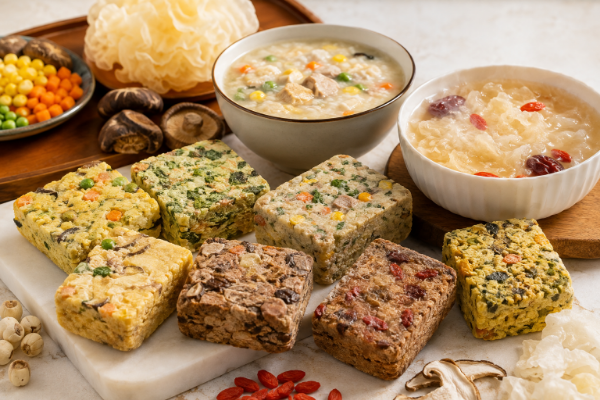
Products This Line Is Built Around
-
Freeze-dried instant soup blocks — pre-cooked, frozen and dried as a single compressed portion
-
Instant porridge blocks — gelatinised starch base with inclusions
-
Tremella and thickened broth soups — high-viscosity recipes carried through the same route
Formats the Same Process Route Covers
| Format | Process note | Station configuration | To confirm with us |
|---|---|---|---|
| Instant porridge sachets | Loose granules instead of a block | All 5 stations | Bulk density, sachet fill weight |
| Ready-meal side components | Dried separately, blended after | Stations 2–5 | Piece size uniformity |
| Diced freeze-dried vegetable | Blanch before freezing | Stations 1–5 | Cut size, blanch time |
| Diced meat pieces | Fat content limits shelf life | All 5 stations | Fat percentage, endpoint moisture |
| Mushroom and fungus pieces | High water content, long primary drying | Stations 1–5 | Slice thickness |
| Fruit pieces | Sugar lowers the collapse temperature | Stations 2–5 | Soluble solids, shelf temperature ceiling |
| Seasoning and flavour blocks | Oil content affects sealing | Stations 1–5 | Oil percentage, barrier film |
| Egg-drop and dairy components | Protein sensitive to shelf temperature | All 5 stations | Maximum product temperature |
| Seafood pieces | Odour carry-over between recipes | Stations 1–5 | Changeover and cleaning plan |
| Soy and bean curd pieces | Porous structure dries quickly | Stations 1–5 | Piece geometry |
| Cooked grain and cereal | Gelatinised then dried, as for porridge | All 5 stations | Solids at discharge |
| Freeze-dried pet food pieces | Same route, different hygiene zoning | All 5 stations | Separation from human-food runs |
| Another format | Send the recipe and we will confirm the route | Confirmed at selection | Recipe and target output |
Send Your Recipe for a Process-Fit Review
Send the recipe or process sheet and we will tell you which stations your product needs and which variables we have to fix before a cycle time can be quoted. No purchasing information is required at this stage.
Packaging Formats and Finished Product Output
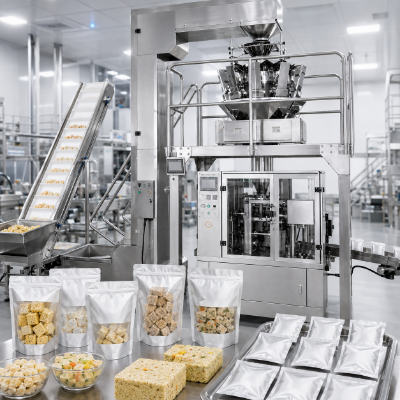
Freeze-dried products are dry, light and hygroscopic, so the pack has to do the work that refrigeration does for a wet product. Packing is selected around the block shape and the barrier your shelf life target needs.
| Format | Suits | What the station does | In-house or bought in |
|---|---|---|---|
| Premade pouch (doypack) | Retail soup and porridge blocks | Pouch opening, gentle drop fill, seal | Built and integrated by us |
| Pillow pack | Sachets and multipack inners | Form, fill and seal from film | Built and integrated by us |
| Canister and jar | Bulk and food service | Volumetric fill and closure | Built and integrated by us |
| Metal detection | Every format | Inspection after sealing, reject diverted | Built and integrated by us |
What We Make and What We Buy
Frames, chambers and assembly are done in our own works, and the bought-in packages are named rather than hidden inside a line item.
- Made by us — frames, chambers, tray and trolley systems, station integration and the control cabinet build
- Bought in and identified by part number on the quotation — vacuum pumps, refrigeration compressors and control hardware
SYSTEM / COMPLIANCE & ANNEX
Parts of the line that touch the product ship as-built with the cleaning arrangement described in the technical annex to your quotation. Buyers in regulated food industries usually settle that annex before the contract, and we work in that order.
FDG Freeze Dryer Range and ST Quick Freezer Specifications
The table below is the selection table we quote from. Shelf area and wet product per batch are the two figures that fix everything downstream, so they are given first.
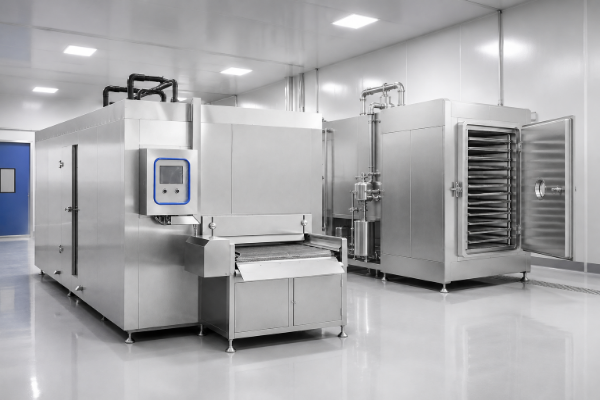
| Model | Shelf area | Wet product per batch | Tray size | Trays per set | Target moisture |
|---|---|---|---|---|---|
| FDG-5 | 0 m² (0 ft²) | 0 kg (0 lb) | 610×710×35 mm | 0 | 3–5 % |
| FDG-10 | 0 m² (0 ft²) | 0 kg (0 lb) | 610×710×35 mm | 0 | 3–5 % |
| FDG-20 | 0 m² (0 ft²) | 0 kg (0 lb) | 610×710×35 mm | 0 | 3–5 % |
| FDG-30 | 0 m² (0 ft²) | 0 kg (0 lb) | 610×710×35 mm | 0 | 3–5 % |
| ST-SDS | — | 0–0 kg/h | Belt 1200–2600 mm | — | — |
| ST-LXS | — | 0–0 kg/h | Belt 610–710 mm | — | — |
Loading Density and Cycle Time: One Input Among Several
The FDG range is rated at 10 kg of wet product per square metre of shelf, which is where the 50/100/200/300 kg figures come from. Good Freeze Dryer publishes a 2017 Chinese soup project run at 30 kg/m² with a 20-hour cycle, 1.94 % final moisture and 2.3 kWh per kilogram of raw material. Both are real operating points, and neither number on its own tells you what your cycle will be.
What actually sets your cycle time
- Solids content of the recipe at discharge from pre-cooking
- Depth of product in the tray
- Tray geometry and how the load sits on the shelf
- Shelf temperature profile through primary and secondary drying
- Chamber pressure setpoint
- How the endpoint moisture is defined and measured
Loading deeper buys you batch size and costs you cycle hours, and the two move together.
We quote a cycle time once those six variables are fixed, not before. A cycle time quoted without them is a guess dressed as a commitment.
Request a QuotationOur sizing rule, applied to every freeze dryer we quote
Reading a capacity figure before you compare two quotations
Freeze dryer capacity is published on more than one basis, and the bases are not interchangeable. Average dehydration divides all the water removed by the whole cycle, including pre-freezing and secondary drying. Peak sublimation rate is what the machine sheds at its fastest moment of primary drying.
| Published basis | What it measures | Why it misleads a comparison |
|---|---|---|
| Average dehydration | Whole cycle, all phases included | Looks low next to a peak figure from another supplier |
| Peak sublimation rate | Fastest moment of primary drying only | Cannot be held for a whole cycle, so it oversizes your plan |
| Rated sublimation | Machine rating, divided by tray area to normalise | Depends on the tray area quoted alongside it |
| Wet product per batch | What you load, not what is removed | Says nothing until loading density and cycle time are known |
Ask every supplier which of these four their number is, and the comparison becomes possible. Our own figures in the table above are wet product per batch at a 10 kg/m² rating. Published work on large food freeze dryers reports peak sublimation above 3 kg per m² per hour as an alternative operating point to running at low vacuum, not as a continuous throughput (Assegehegn 2020).
Site and Utility Requirements
These are the nine categories your site has to answer before the line is ordered. Where we have a figure it is below; where the figure depends on your configuration it is fixed in the technical annex to your quotation.
| Category | What we can state now |
|---|---|
| Electrical load | FDG-5 22.5 kW, FDG-10 34 kW, FDG-20 73 kW; FDG-30 confirmed |
| Refrigeration | FDG-5 8 kW, FDG-10 15 kW, FDG-20 28 kW, FDG-30 42 kW |
| Cooling water | Water tank required from FDG-10 upward |
| Compressed air | Confirmed in the technical annex |
| Footprint | FDG-5 3800×1100×1600 mm; FDG-30 4500×2155×2605 mm |
| Clear height | Confirmed in the technical annex |
SCOPE BOUNDARY: We supply equipment, layout and pipe-routing guidance and commissioning; building services up to our terminal points are yours.
Pricing Mechanism, Quotation Turnaround and Lead Time
Price on this line follows the freeze drying area you select, the quick freezing method, the packaging format and how much of the sequence is automated. There is no price list for a configured line, and your figure comes back in a written quotation.
What Moves Your Price
Driver
Effect on cost
How to reduce it
Freeze drying area
The largest single item in the line
Size on cycle time with real solids content, not on peak figures
Quick freezing method
Spiral costs more per kg/h than tunnel
Use tunnel where the product is flat and the hall is long
Packaging format
Premade pouch costs more than pillow pack
Match the format to the retail decision, not to both
Automation depth
Loading, unloading and traceability add cost
Automate the stations where your labour cost actually sits
Lead Time and Commercial Terms
Stage
Our term
What it covers
Quotation
5 business days single machine, 10 business days full line
Process route, selection, scope and price
Manufacture
90–120 working days from confirmed down payment
Build, assembly and factory testing
Payment
30 % deposit, 70 % before shipment, or letter of credit at sight
Confirmed in the contract
Trade terms
FOB Chinese port as standard; EXW, FCA, CFR and CIF on request
Quoted on request, FCA where the load moves by container
Lead time runs from the confirmed down payment and excludes sea freight and customs clearance at your end. Installation and commissioning are scheduled after arrival, against dates we agree at contract stage.
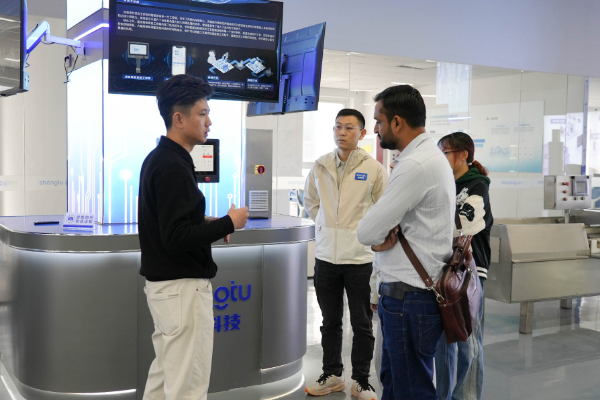
How Your Quotation Is Produced
Send the recipe, the target output and the pack format, and an engineer returns a quotation within 5 business days for a single machine or 10 business days for a full line. The quotation identifies bought-in vacuum pumps, refrigeration compressors and control hardware by part number.
Three Numbers You Can Work Out Yourself
- Output per batch = shelf area × loading density (this line is rated at 10 kg/m²)
- Daily output = output per batch ÷ (cycle time + load and unload time) × 24
- Energy shape = sublimation about 45 %, vacuum about 26 %, condensation about 25 %, freezing about 4 %, as reported from Ratti’s 2001 energy cost breakdown for the freeze drying process
[ CLOSE ]
CLICK TO ZOOM IN | MOVE MOUSE TO PAN DETAILS
Factory Testing, Certification and Documents Shipped with the Line
Applicable certificates and documents are confirmed for the equipment model, configuration and destination country. Company management-system records are reviewed separately from product conformity documents.
Acceptance on capital equipment is a document trail, not an impression.
Five Tests Every Freeze Dryer Passes Before Shipment
| Test | What is exercised | What is recorded |
|---|---|---|
| No-load run | Machine runs empty | Mechanical and electrical functions, logged |
| Ultimate vacuum and pressure hold | Chamber is pumped down and held | Pressure reached and hold duration |
| Loaded simulation | A simulated load through pre-freezing, sublimation and secondary drying | Stage times and shelf conditions |
| Shelf temperature uniformity and refrigeration pull-down | Shelf and refrigeration performance under load | Measuring point positions with their readings |
| Full interlocked run | Every interlock exercised as a checklist | Each action signed off |
Where the Pass Criteria Come From
Those five tests state what gets measured; the numbers they are judged against belong in your contract. Acceptance criteria are written into the technical annex and confirmed by both sides before production starts, so nobody is arguing about the standard after the fact. Commissioning delays have a structural cause rather than a mechanical one, because a line proved station by station has still not been proved as one interlocked system.
- Factory testing uses a simulated load; site acceptance during commissioning uses your recipe
- We take responsibility for tuning the freeze drying curve to the agreed result at commissioning
- You are welcome to witness the factory test in person, or to receive the video record
- The factory-test record ships with the line and shows the measured fields, not a summary
Certification
Company records: Request the current holder, scope and validity details.
Equipment conformity: Confirm the documents for the model, configuration and destination country.
Order documents: Agree inspection records, manuals, drawings and shipment paperwork in the contract.
- ISO 9001 quality management system
- ISO 27001 information security management system
- CE marking
- Request applicable third-party test reports
Documents That Ship with the Line
-
Factory-test record
[ VERIFIED ]
-
Installation and wiring documentation
[ VERIFIED ]
-
Operating manual
[ VERIFIED ]
Hygienic Design and Cleaning
Machinery placed on the European market for use with foodstuffs carries a legal design duty under the Machinery Directive Annex I §2.1. It requires product-contact surfaces to be smooth and free of ridges and crevices, internal surfaces to have curves with a radius sufficient for thorough cleaning, and all cleaning fluids to discharge completely.
The Directive sets the duty without setting a number, and hygienic-design guidance supplies the working values used in the food industry. Contact-surface material grades, surface finish and the cleaning method for this line are confirmed in the technical annex against your recipe, your allergen plan and your local rules.
- Contact materials must be cleanable before each use, or disposable
- Product-contact surfaces must be smooth, with no ridges or crevices that can harbour organic material
- Internal surfaces must have curves with a radius sufficient for thorough cleaning
- Cleaning and rinsing fluids must discharge completely, and the instructions must cover areas that cannot be reached
How We Work: From Recipe Brief to Commissioned Line
SYSTEM PROCESS
| Stage | What happens | What you receive |
|---|---|---|
| Recipe and requirement brief | You send the recipe, target output and pack format | Confirmation of the process route |
| Process design and selection | Station configuration, freeze drying area and freezing method are fixed together | A configuration you can check against your own arithmetic |
| Quotation and contract | Scope and bought-in components are itemised | Part numbers, acceptance criteria and commercial terms |
| Manufacture and factory testing | Build, assembly and the five-test programme | Factory-test record, witnessed in person or on video |
| Shipment and documents | Packing and export documentation | Clearance paperwork for your side |
| Installation, commissioning and training | We tune the freeze drying curve to the agreed result | Trained operators and a signed site acceptance |
Selection Rules and Why They Save Money
| Decision | Rule we apply | Why it saves money |
|---|---|---|
| Freeze drying area | Size from measured cycle time at your solids content | Avoids buying area that idles through secondary drying |
| Tunnel or spiral freezer | Tunnel for flat single-layer product, spiral where floor length is short | Spiral capacity you cannot use is the most expensive metre on the line |
| Tray depth | Set depth from the drying result, not from the tray | An over-deep load lengthens every cycle for the life of the plant |
| Endpoint moisture | Define measurement method before the number | Two definitions of 3 % can differ by hours of drying |
| Automation | Automate loading and unloading first | That is where the labour hours and the breakage sit |
Spare parts follow the same logic as the quotation. Vacuum-pump wear parts, seals, sensors and electrical control components are listed as a package so you can stock them before the line runs.
When Freeze Drying Is Not the Right Process
Freeze drying earns its cost on products that have to hold shape, colour and rehydration behaviour. Where those do not matter, another route is cheaper and we will say so. That trade-off is always the same one, and the mistake is always the same one: paying for structure the product does not need.
One spray dryer can replace six lyophilizers at the same production capacity, on about 25 % of the floor space.
CITATION / SOURCE DATA
, technology manager at spray-dryer builder SPX Flow Technology Systems, writing in Powder & Bulk Solids. His employer builds the competing machine, and the comparison is drawn from pharmaceutical and biotechnology practice rather than from soup.
| Situation | Why it works against you | What to do instead |
|---|---|---|
The product is sold as a powder |
Freeze drying preserves a structure a powder does not need, and charges you floor space and cycle hours for it |
Spray dry it; keep freeze drying for pieces that must rebuild their shape |
Cycles are measured in hours, not minutes |
A freeze drying cycle occupies the chamber for the whole run, so throughput scales with installed area rather than with speed |
Use hot air drying for bulk low-value material where texture is not the product |
Loading density and cycle time pull against each other |
Loading more per square metre raises batch size and lengthens the cycle at the same time |
Work the trade-off in the calculator before fixing the freeze drying area |
You expected the pack to get simpler |
Dried product picks moisture back up, so barrier and seal integrity still carry the shelf life |
Budget the barrier film and seal validation as part of the line, not after it |
Engineering & Production Tools
Freeze drying removes water from the frozen state as vapor without a liquid stage, so the structure left behind is the structure the product had when frozen. Hot air drying evaporates liquid water, and surface tension pulls the structure inward as it goes. That is why a freeze-dried block rebuilds in hot water and an air-dried one usually does not.
Fast freezing produces small ice crystals and a fine pore network; slow freezing produces larger ice crystals and coarser pores. Coarse pores let vapor escape faster, so drying is quicker, but the texture is softer and the piece is more fragile. The quick freezing station is where you choose which side of that trade you want.
This line targets 3–5 % residual moisture. Drier is not automatically better: pushing below the optimum costs secondary drying hours and can harm rehydration and texture. That number matters less than agreeing how it will be measured, because two definitions of the same percentage can differ by hours of drying.
Shelf life comes from the residual moisture and the pack together, not from the freeze dryer alone. A block at 3–5 % moisture in a barrier pouch is shelf-stable at room temperature; the same block in a poor seal picks moisture back up. We size the drying and specify the packing station against the shelf life you need.
Yes. The FDG range is supplied on its own where you already run pre-cooking, freezing or packing. Quotation turnaround for a single machine is 5 business days against 10 business days for a full line.
It is wet product loaded, at the line’s rated loading density of 10 kg per square metre across 20 m² of shelf. It is not dried output and it is not water removed per hour. When you compare it with another supplier’s number, check which basis theirs uses.
Because the basis differs, not necessarily the machine. Average dehydration spreads the water removed across the whole cycle, while peak sublimation rate is the fastest moment of primary drying; published work on large food freeze dryers gives peak rates above 3 kg per m² per hour as an alternative operating point rather than a continuous one. Ask which basis the number is on before you compare.
Yes. Your technical annex is that document: station configuration, specifications, utility requirements, acceptance criteria and the scope boundary in a single file you can send to your facilities engineer and your finance team.
There is no single best instant soup processing equipment for every recipe, because the right configuration is set by your solids content, your pack format and your target output. Send those three and we will tell you which stations you need and which you do not. Buyers who already freeze dry foods on a laboratory unit should also send the cycle time they measured there, which is the most useful single input we can start from.
The freeze dryer itself runs from 3800 × 1100 × 1600 mm at FDG-5 to 4500 × 2155 × 2605 mm at FDG-30. A 1000 kg/h tunnel freezer needs 19.2 m of straight run, while the spiral equivalent needs 9.2 m of length but 4 m of height. Clear height, floor loading and service routes are confirmed in the technical annex with your quotation.
Start from the installed figures: FDG-20 draws 73 kW installed with 28 kW of refrigeration, and a 1000 kg/h tunnel freezer adds 170 kW of cooling load. For the shape of the demand, published work on the freeze drying process puts sublimation at about 45 % of energy cost, vacuum at 26 %, condensation at 25 % and freezing at 4 %. Your actual bill follows your cycle time and your local tariff.
The chamber, refrigeration and vacuum packages are built to your configuration rather than picked from stock. Our five-test factory programme runs after assembly and before shipment. Lead time starts at the confirmed down payment and excludes sea freight and clearance.
Send the recipe or process sheet and we will confirm the process route and the variables we need before quoting a cycle time. Site acceptance during commissioning is run on your recipe rather than on a simulated load. Tuning the freeze drying curve to the agreed result at that stage is our responsibility.
Layout and pipe-routing guidance, mechanical and electrical installation support, interlocked process commissioning, freeze drying curve optimisation and operator training. Spare parts are quoted as a package covering vacuum-pump wear parts, seals, sensors and electrical control components. Building services up to our terminal points stay in your scope.
Freeze-dried food for pets runs the same process route on the same equipment. What changes is zoning, changeover cleaning and record keeping, which we set out in the technical annex. Confirm at selection whether the line will be shared, because the cleaning plan differs.
![F&V Freeze-Drying Line Process Guide [2026]](https://shengtumachinery.com/wp-content/uploads/2026/09/fv-freeze-drying-line-guide-featured-150x150.png)