
Get in touch with Shengtu Bufan Company

Industrial dairy process guide · Updated September 2026
Map the shared milk front end, three product branches, material destinations, cleaning conflicts, and acceptance evidence before equipment selection is made.
An industrial Yogurt / Cheese / Butter Line is a plant architecture that shares milk reception and preparation before separating into cultured-product, curd-and-whey, and cream-and-buttermilk routes. It isn’t one straight conveyor that turns the same milk into three products. The relevant design question isn’t whether the plant can produce all three. It’s what can be shared without creating a material, hygiene, cleaning, or scheduling conflict.
This article addresses that question. The Shengtu page for the yogurt, cheese and butter Line has a different job: equipment configuration, capacity discussion, project scope, delivery, and inquiry. Maintaining a solution page in a commercial format, and keeping the guide educational, provide each URL a clear search intent.
Direct answer: One dairy plant can produce yogurt, cheese and butter, provided that it integrates centralized milk preparation with product-specific branches. Size reception, separation, pasteurization, buffers, utilities, and CIP against separate operating cases, not one headline milk-flow number.
Key takeaway
Shared equipment saves space only when product states, availability windows, cleaning circuits and utility peaks fit the same schedule. That shared asset becomes a bottleneck when it cannot be cleaned or released in time.
Shared front end
Reception, storage, clarification, separation and selected heat-treatment duties
Reception, storage, clarification, separation and selected heat-treatment duties
Three branches
Cultured milk, curd and whey, or cream and buttermilk
Cultured milk, curd and whey, or cream and buttermilk
Hidden constraint
CIP availability, utilities, buffers and hygienic separation
CIP availability, utilities, buffers and hygienic separation
Proof
Product-specific trials, samples, records and release rules
Product-specific trials, samples, records and release rules
1. Can One Dairy Line Really Make All Three Products?
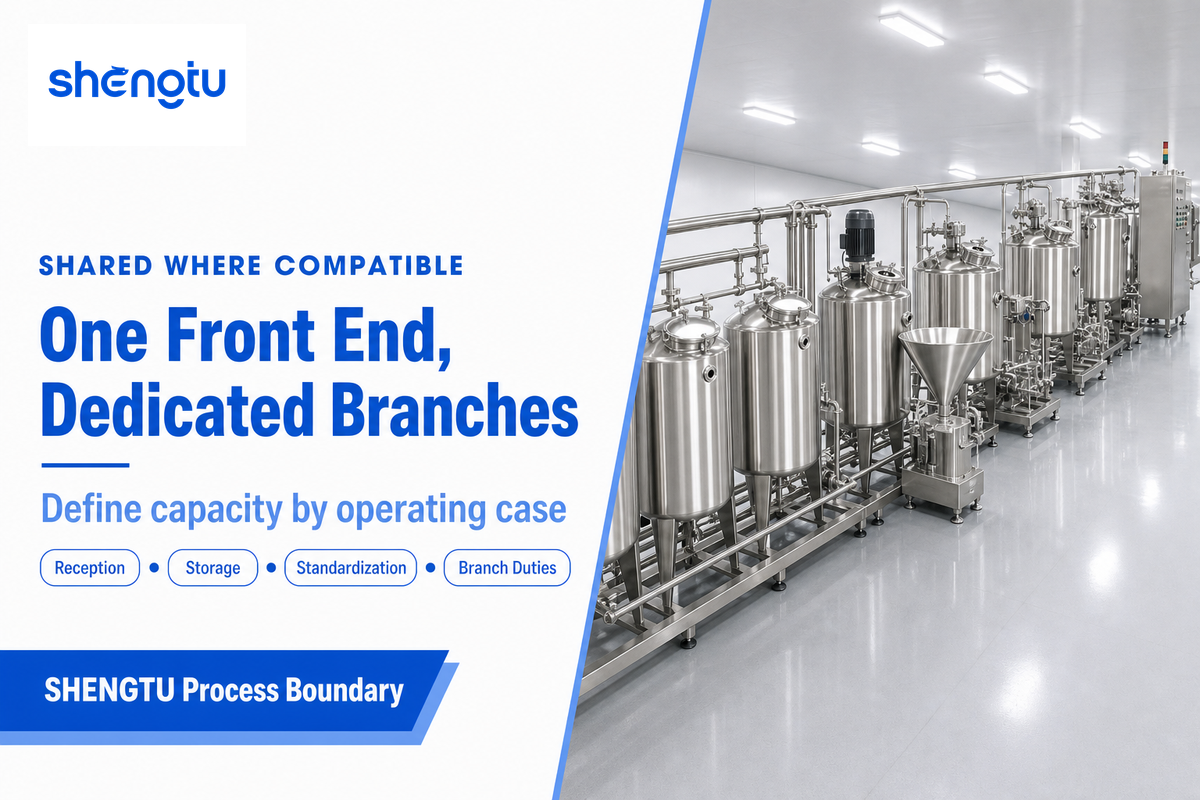
Yes, if “one line” means an integrated plant with centralized milk handling and dedicated downstream branches. Yogurt is based on controlled culturing and cooling. Cheese is based on coagulation and handling of curd and removal of whey. Butter is based on the separated cream and churning or working. These steps can’t be simplified to a single tank time.
On the production side, a plant can conduct reception tests, cooling, storage, clarification, and transfer of the same raw milk. Fat and skim components can be separated and standardized according to the production plan. Some heating duties may share the same platform when the recipes, flow ranges, and validated process conditions are compatible. The branch decision starts when the product state and the destination begin to differ.
The practical consequence is that capacity must be stated by operating case. This becomes a scheduling risk because an unavailable shared buffer or CIP window can stop otherwise-ready production. Reception can have one milk-intake rate, while yogurt cups, cheese mass, and butter packs have different batch durations, material destinations, and packing rates. The plant that can receive a stated volume of milk per hour hasn’t yet proven that each branch can sustain that rate or can operate simultaneously.
For the common milk front end, the Pasteurized and UHT milk Line Guide illustrates how the product, thermal, packing, cleaning, utility and record interfaces form one system. This guide starts where the milk platform splits into three different physical transformations.
2. The 3-Branch Dairy Map
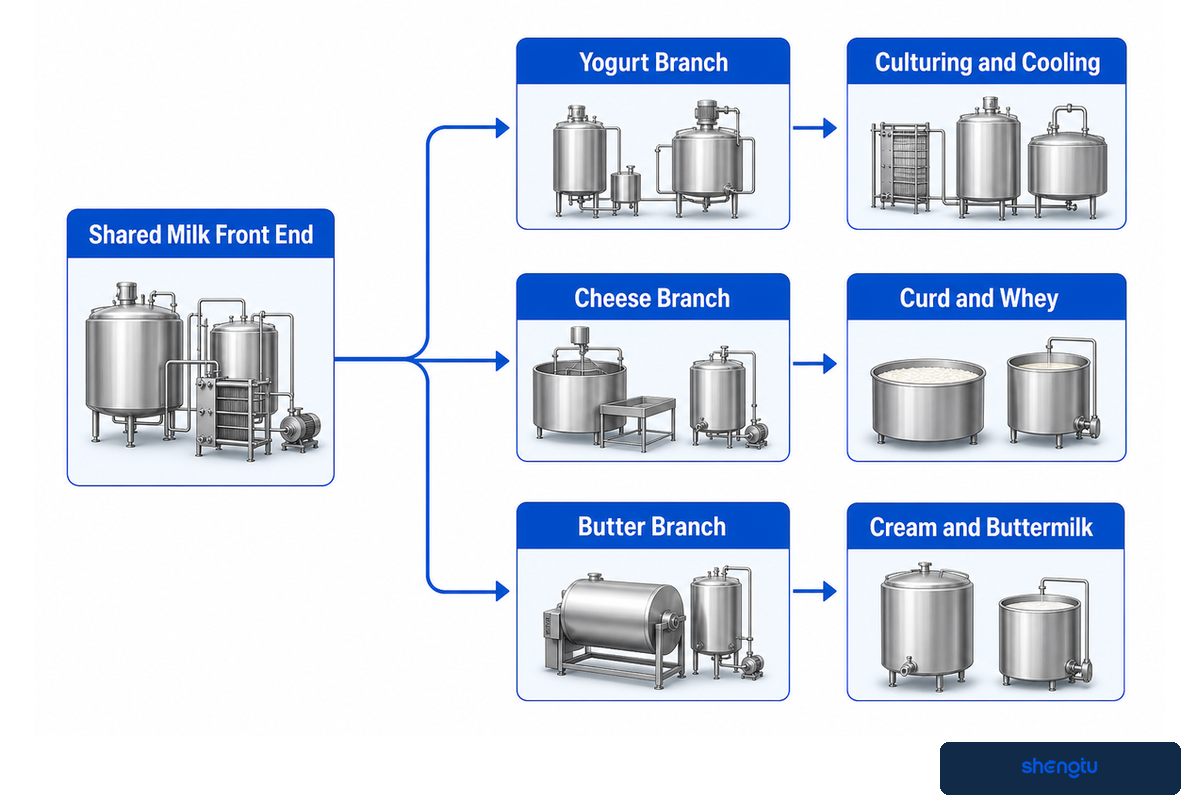
3-Branch Dairy Map is a planning model that follows milk by its product state. The cultured branch maintains most of the prepared milk matrix, the cheese branch separates curd from whey, and the butter branch concentrates milk fat from cream while producing buttermilk. Each branch therefore needs its own equipment, buffers, cleaning, and material-destination logic.
| Planning point | Yogurt branch | Cheese branch | Butter branch |
|---|---|---|---|
| Feed state | Standardized milk or formulated dairy base | Cheese milk prepared for coagulation | Separated cream at the defined fat basis |
| Main change | Culture-driven acidification and gel formation | Coagulation, curd formation and whey separation | Fat concentration and phase inversion during churning or working |
| Dedicated duty | Culture addition, incubation, cooling and texture handling | Curd cutting, drainage, moulding or pressing | Cream ripening where used, churning, working and moisture control |
| Secondary stream | Depends on concentrated or separated product design | Whey and fines | Buttermilk and possible wash water |
| Scheduling anchor | Incubation and cooling availability | Vat cycle plus downstream curd capacity | Cream accumulation and churn or continuous-butter capacity |
Use the map and then draw a machine list. Start with the finished product and work your way back through the product state, side streams, holding, and packaging. This will tell you if a shared separator, pasteurizer, or buffer system is truly common or if it’s just shown on the simplified flow diagram once.
Product Names Are Process Inputs, Not Recipe Instructions
Most search results show factory planning intermingled with cookery guidance. For example, a query such as “make cheese at home” may recommend lemon juice to curdle milk. The plant brief instead identifies the product standard, culture or starter, rennet where used, approved additive list, batch method, and release specification.
Different family names for products describe different duties to be performed. Cream cheese, cottage cheese, ricotta cheese, fresh cheese, goat cheese, cheddar, mozzarella, and Parmesan can require different coagulation, drainage, salting, forming, or maturation steps. The request to “add salt” is incomplete until it states the method, timing, and product target. Texture descriptions such as thicker or like cream cheese also need measurable acceptance criteria.
The cultured dairy list can include regular yogurt, probiotic yogurt, sour cream, labneh or crème fraîche. Descriptors such as “tangy” or “like sour cream” provide a sensory direction, not a process control setpoint. The brief should identify how beneficial bacteria ferment the selected base, how lactic acid development is monitored, and when cooling or another validated step stops further change.
Raw material information needs the same discipline in order to be useful. Variations on whole milk, goat milk, full fat or even full fat specifications shouldn’t be viewed as equivalent. We need to capture the fat content, protein, total solids, lactose range and seasonal variations. These factors affect separation, standardization, heat treatment, yield and the evidence required for the finished product.
3. What Happens in the Yogurt Branch?
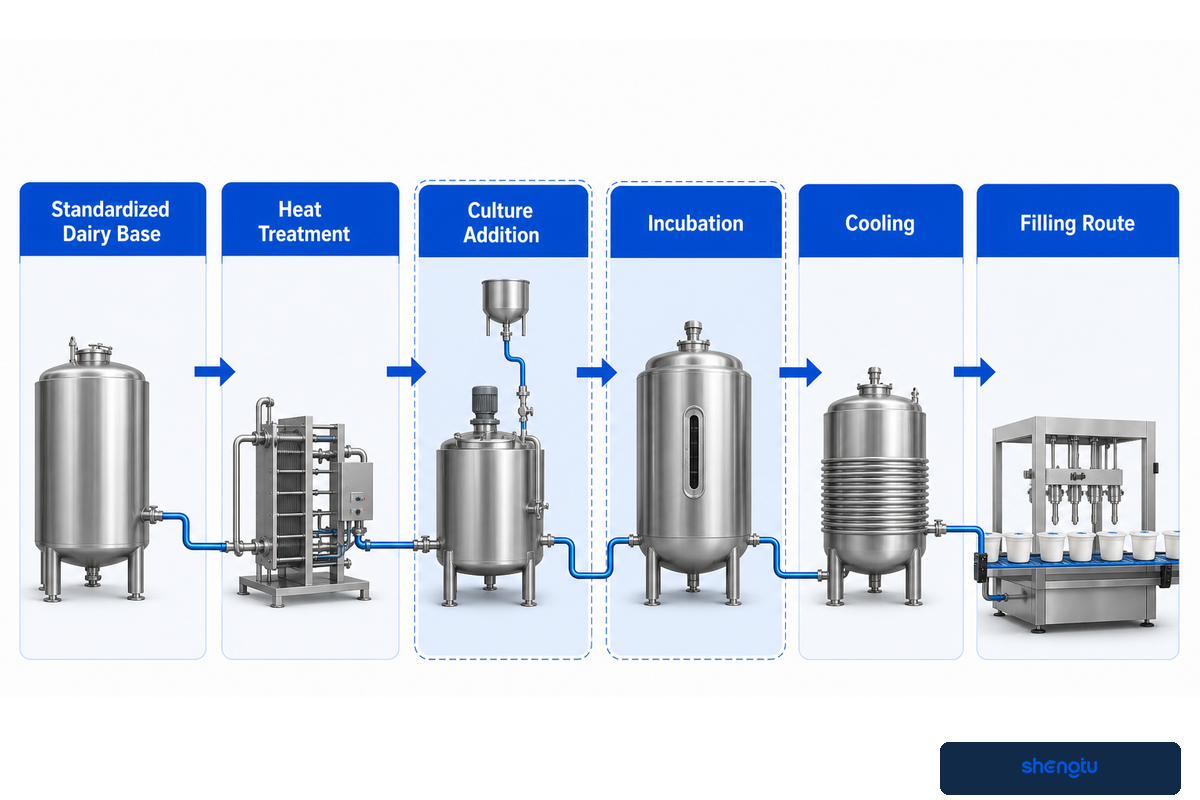
The yogurt branch prepares a standardized dairy base, applies product-specific heat treatment and homogenization where required, adds the selected culture, controls incubation, stops acid development by cooling, and transfers the product to a filling route that protects the target texture. Set, stirred, drinking and concentrated yogurt don’t follow the same downstream process.
The route should be defined from the package backward. Set yogurt is commonly inoculated and filled before incubation in the retail container. Stirred yogurt develops in a process vessel before cooling, texture adjustment and filling. Drinking yogurt may require stronger shear or dilution. Concentrated styles may require an additional separation step and a new secondary-stream destination. These are product families and not a reason to copy one temperature, time or agitator setting.
Terminology also changes by market: yoghurt is the common spelling in many standards and regions. Plain yogurt, fruit yogurt and Greek yogurt, or other concentrated styles, target different acidity, creamy texture and flavour profiles. Those labels are useful for defining trials, but the actual formula and finished-product specification must control the process brief.
Heat treatment relates to formulation and texture as well as microbiological control. Protein, fat, sugar, stabilizer, fruit preparation and shear history can influence fouling, heat transfer and viscosity. The plate pasteurizer guide is good during a preliminary study of a heat exchanger, but the selected unit must actually fit the dairy base, flow window and cleaning cycle.
Another boundary is culture. If yogurt and cheese share employees, air routes, utensils, or sanitation systems, the project team must assess cross-traffic and culture-interference risks instead of assuming that a clean-looking room solves them. The control plan is for the products, cultures and the facility; this guide doesn’t suggest a generic culture program.
4. Why the Cheese Branch Needs Curd and Whey Logic
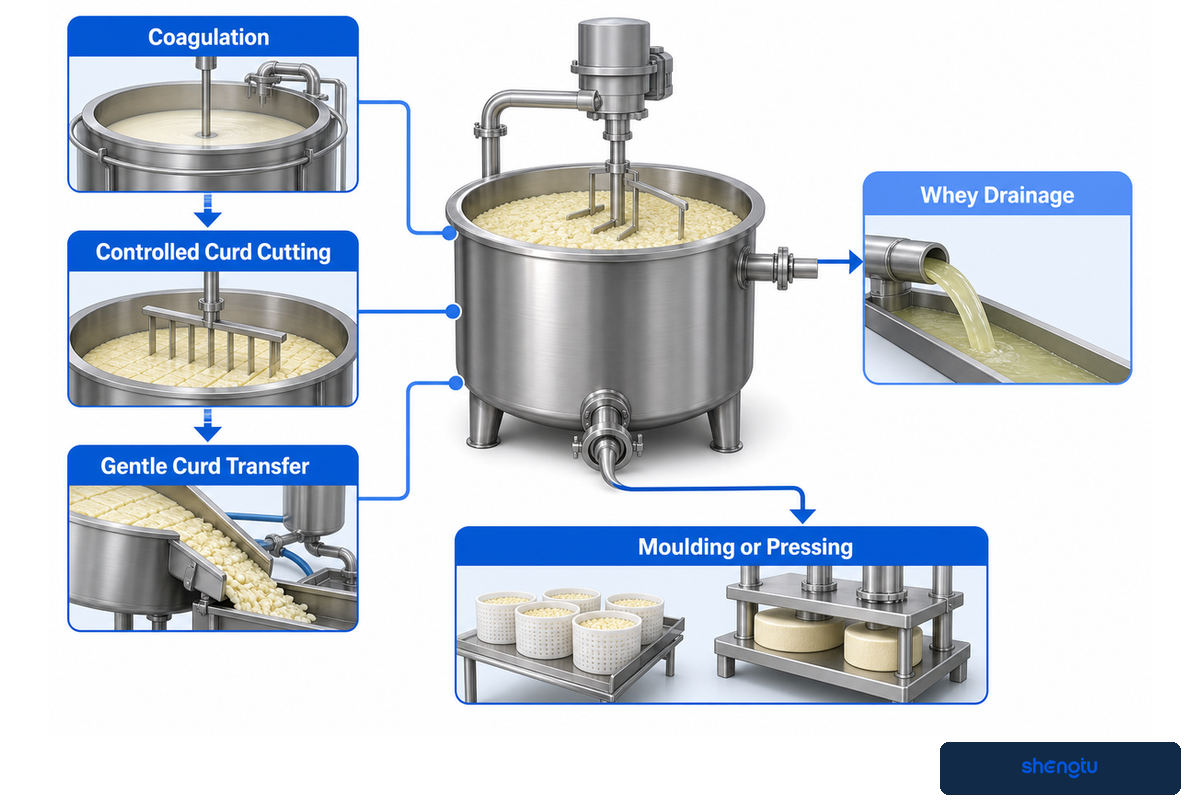
The curd-and-whey branch requires systems for coagulation, controlled curd cutting, whey drainage, and gentle curd transfer. Depending on the cheese, additional systems may be required for curd cooking or washing, moulding, pressing, salting, and maturation. A general fermentation tank doesn’t fulfill those mechanical or drainage functions.
The geometry of the vat, cutting pattern, agitation, outlet configuration, and downstream drainage all have an effect on how curd is treated. The line must move fragile particles without turning product into fines that leave with the whey. The exact design depends on cheese type, batch size, moisture target, and the accepted product method. Thus, when comparing two cheese designs, volume of the vessel alone isn’t an adequate comparison.
Whey isn’t an invisible remainder. It requires a defined course of action: immediate use, cooling and storage, further processing, sale, allowed use in animal feed, or management as a process effluent. Every course of action adds product transfer, a holding tank, temperature control, cleaning, and scheduling requirements. A cheese vat is at risk of being blocked when its cycle is complete if the designated holding tank isn’t available.
Open curd handling changes the hygiene picture. Drainers, tables, mould fillers, and presses can bring product-contact surfaces and/or the product in contact with a room, people, and condensate. Therefore, a site plan must be joined with an equipment plan, allowing for sufficient empty space for cleaning, inspections, maintenance, and product handling.
5. How the Butter Branch Follows the Fat Stream
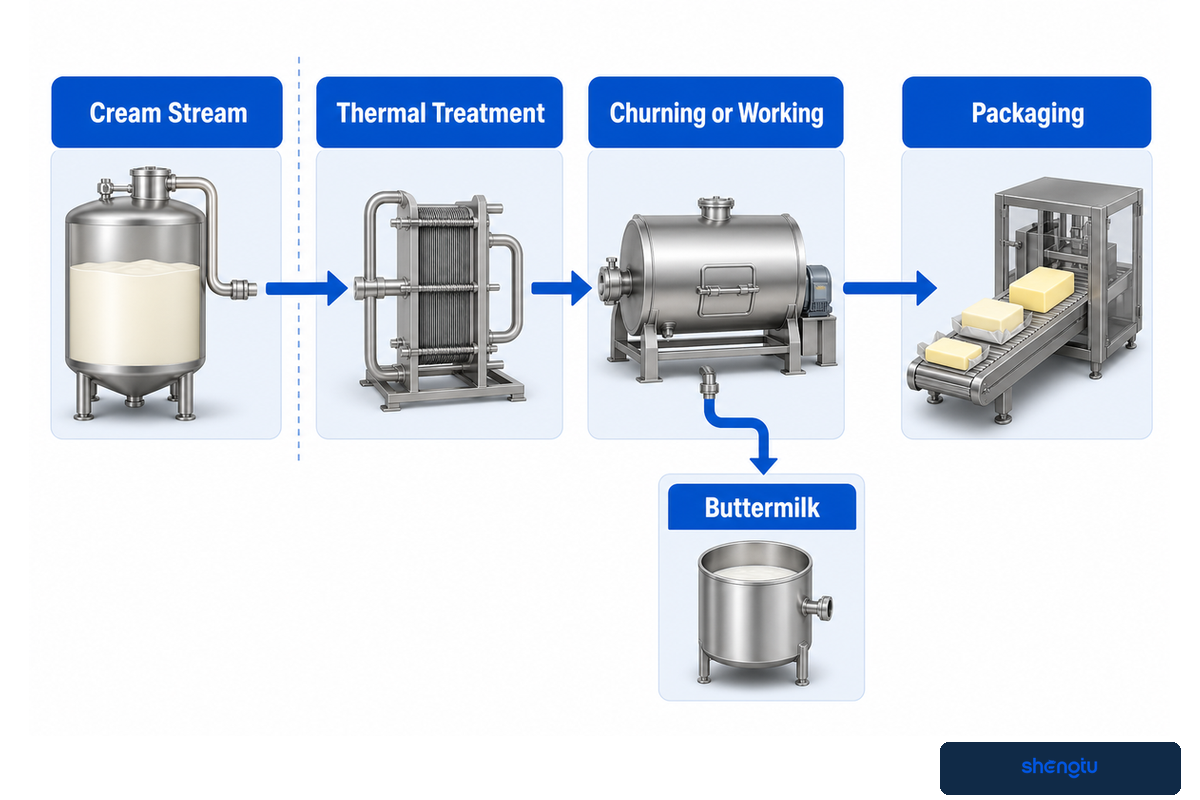
Butter production uses the cream stream instead of the full milk intake. Cream is then standardized and receives the appropriate thermal treatment and cooling. The cream can then be held or allowed to ripen before batch churning or continuous butter making. The line also requires streams for buttermilk, wash water, working, moisture control, and packaging.
The performance of the separator and the scheduling of cream are therefore critical. Milk allocated to yogurt or cheese can be standardized by removing or adding fat. The accumulated cream is then butter feed. The relevant question isn’t how many liters of milk the churn can “process”. Rather, it’s how much suitable cream reaches it, at what concentration, in what time frame, and where the corresponding skim phase is allocated. That mismatch creates a scheduling risk because separator output and cream accumulation, not raw-milk intake alone, govern churn availability.
Batch and continuous butter systems differ in their ways of operation. In a batch churning system, cycles of fill, churn, drain, washing (if necessary), working and discharge are performed. A continuous system combines cream feeding, phase inversion, buttermilk removal, working and discharge. Packaging capacity and a clear response to the stoppage of the packer are required for either system.
Butter and some cheese products also have different ready-to-eat hazard and growth conditions relative to many yogurt or hard cheese products. Don’t copy one environmental monitoring, hold or release rule across all three branches. Evidence is dependent on product composition, pH, water activity, post-process exposure, applicable law and the plant’s hazard analysis.
6. Build a Milk-Solids Destination Ledger Before Comparing Capacity
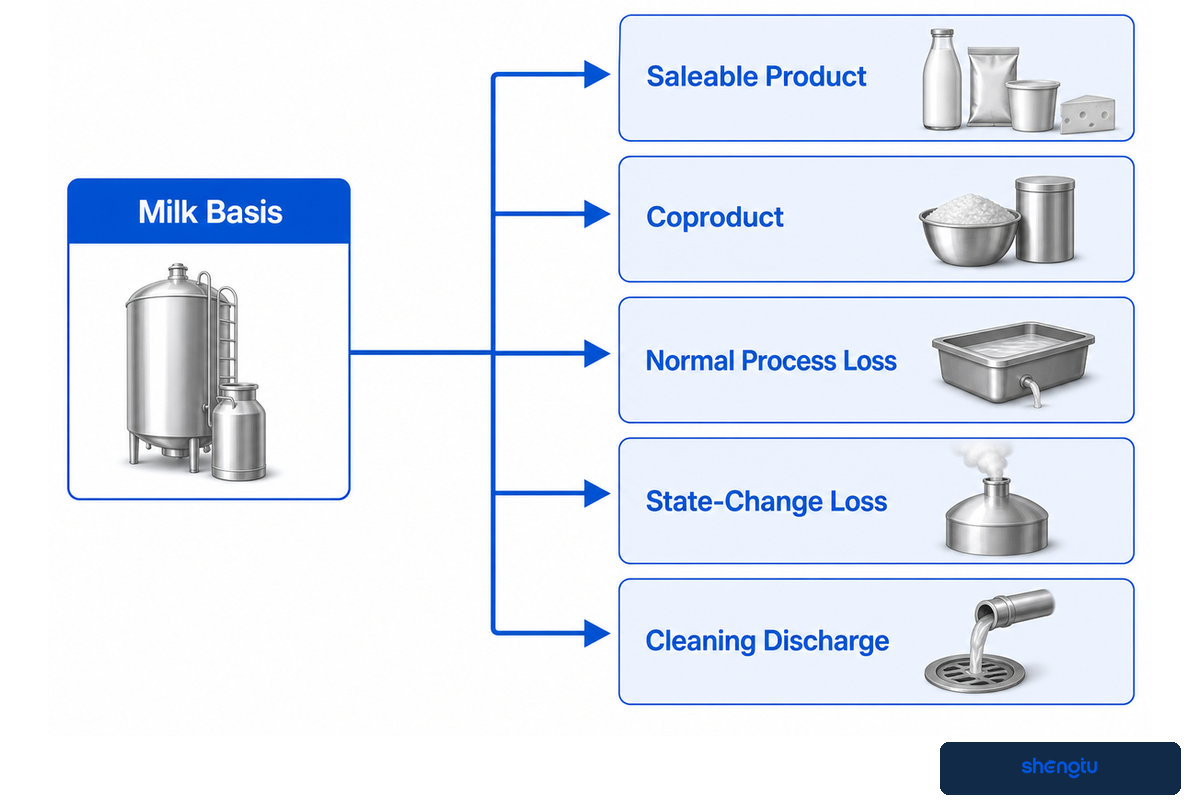
A Milk-Solids Destination Ledger describes the final location for water, fat, proteins and other solids. It includes whey or buttermilk, saleable product, recovered streams, startup and shutdown losses, changeover residue, cleaning discharge, spills, and spoilage. These destinations are required to interpret the milk input and describe real output and effluent load without false precision.
| Destination class | Question | Why it changes equipment |
|---|---|---|
| Milk basis | What are the fat, protein, total solids and seasonal ranges? | Sets the starting material balance and standardization duty |
| Saleable product | What composition, pack and acceptable quantity leave the line? | Connects process output to filling and storage |
| Coproduct | Where do whey, buttermilk, skim or recovered cream go? | Adds transfer, cooling, tanks and cleaning |
| Normal process loss | What remains in pipes, vessels, filters or separators? | Affects yield evidence and effluent loading |
| State-change loss | What is displaced at startup, shutdown and product changeover? | Defines recovery, drain routing and production planning |
| Cleaning destination | How are first rinse, chemicals and product residues segregated? | Sizes tanks, drains, treatment and recovery options |
| Off-spec or spoilage | What hold, rework or disposal route applies? | Prevents an unplanned stream from stopping the plant |
| Ingredient addition | Which solids or liquids enter, and at what process state? | Adds dosing, mixing, filtration and traceability duties |
| Sampling and hold | What volume is sampled, retained or held pending release? | Connects batch accounting to tanks and release timing |
The ledger doesn’t calculate yield. A defensible mass balance needs actual milk composition, formula, target moisture or fat, recovery assumptions, process method, and measurement basis. It should state whether output means gross transfer, filled packs, released product, or product after expected losses. This avoids false precision while giving suppliers the data needed to size each branch.
Evidence capsule: the U.S. EPA lists product remnants from cleaning, spills, startup, shutdown, changeover, and spoiled product among principal dairy-processing waste streams. Although this doesn’t direct us to design global treatment systems for this waste, it does confirm that these waste systems are part of the balance of the plant.
7. Test Shared Equipment with a Shared-CIP Conflict Matrix
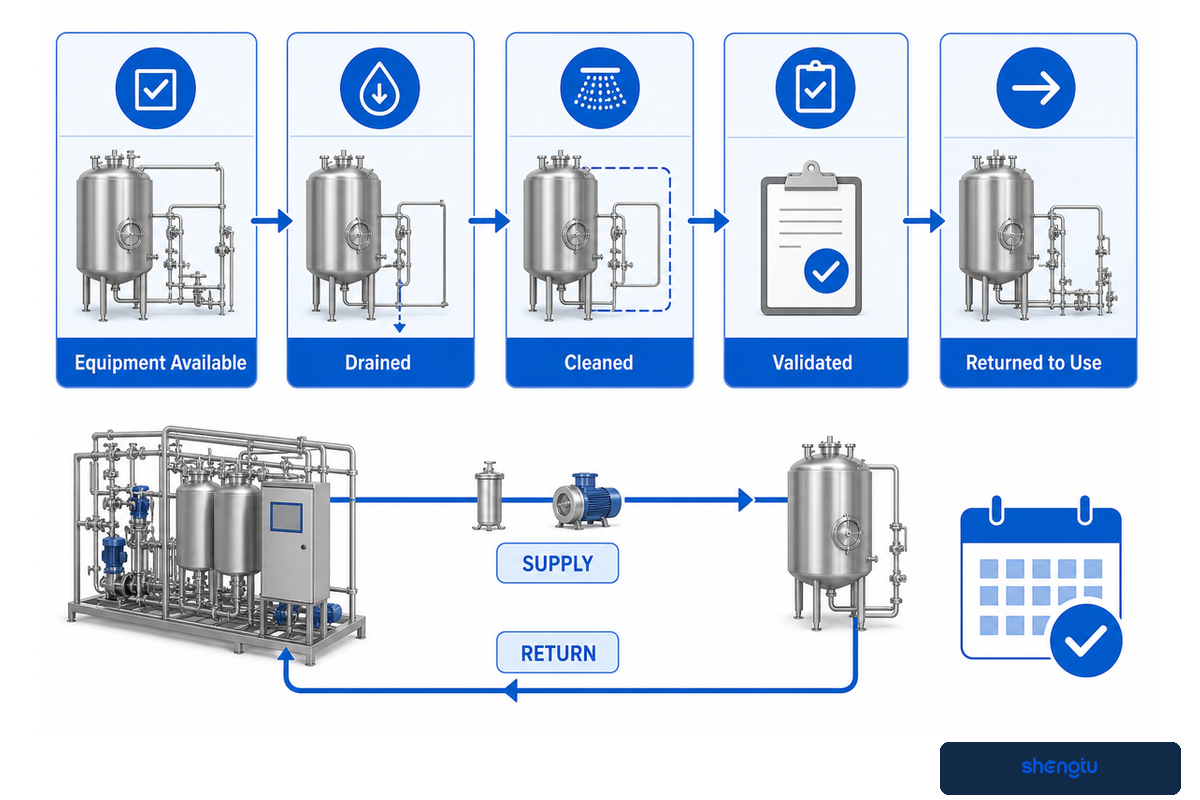
A “Shared-CIP Conflict Matrix” evaluates whether equipment for multiple products can be available, drained, cleaned, validated, and returned to use within the production schedule. This matrix analyzes residues, circuit grouping, cleaning program, tank and chemical demand, heating and return capacity, production overlap, and the consequence of a delayed release.
“Design CIP systems in advance; add-ons are expensive and rarely work properly.”
| Conflict test | Evidence to request | Failure if ignored |
|---|---|---|
| Residue compatibility | Product family, soil type and approved cleaning program | A shared recipe leaves one branch unverified |
| Simultaneous availability | Production and CIP Gantt chart | One branch waits for a circuit or tank |
| Hydraulic fit | Circuit volume, flow, pressure and return condition | The farthest or largest circuit misses its cleaning basis |
| Thermal and chemical peak | Heating duty, tank sequence and concentration control | Average demand hides the real peak |
| Drain and segregation | Drainability review and valve-state matrix | Residue, cross-connection or mixed effluent |
| Release evidence | Recorded variables, inspection or analytical criteria | Clean status exists only as an operator assumption |
| Production handoff | Equipment isolation, drain confirmation and last-product status | Cleaning starts before the circuit is safely released |
| Return to service | Rinse acceptance, valve alignment and release record | The next batch starts with an unresolved residue or route |
The CIP cleaning system becomes a commercial equipment handoff when the circuit list and cleaning basis are defined. Prior to the request for configuration, it’s necessary to prepare a circuit and equipment listing, the most challenging product sequence, the available time for cleaning, utility conditions and the drain, the recovery route or the confirming cleaning methodology.
8. Draw Hygienic Boundaries in Pipes and Rooms
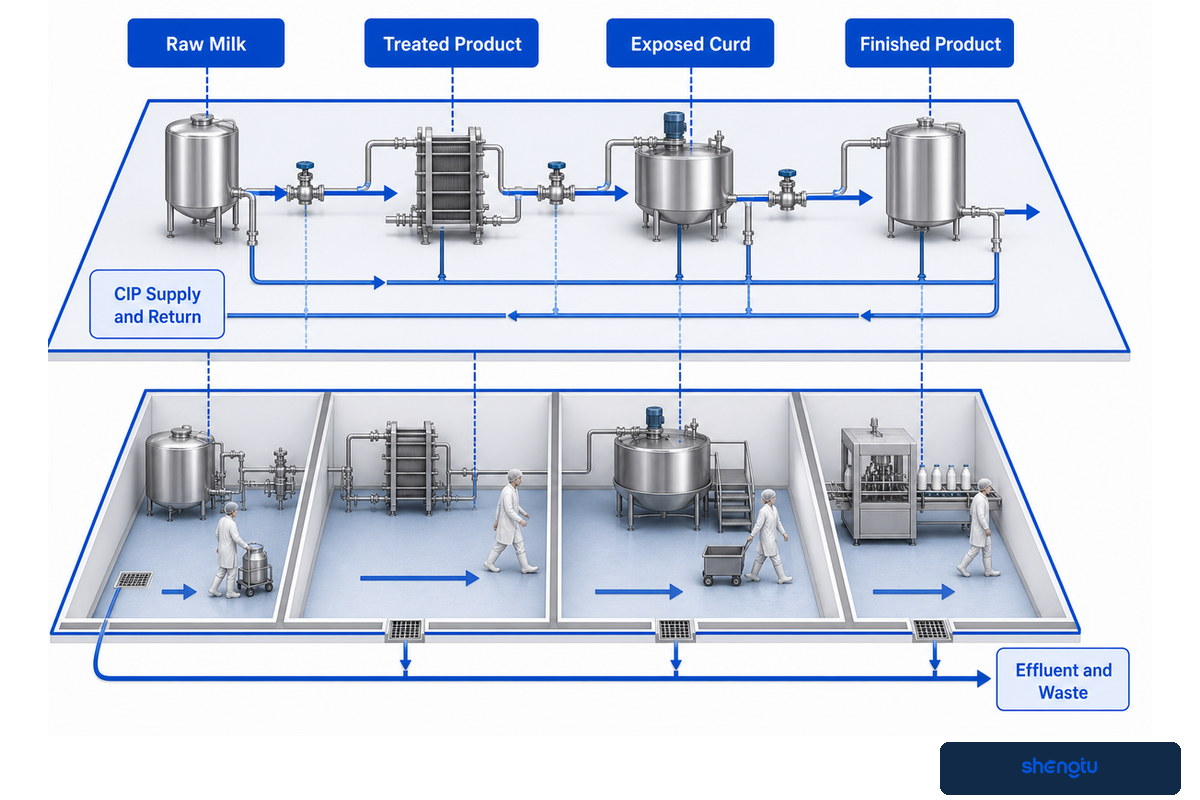
Hygienic zoning doesn’t start only where product is exposed. A dairy design must prevent raw product from reaching pasteurized product and prevent CIP fluid from connecting with product. It must also control room-side exposure around curd handling, cultured product cooling and filling, butter working, drains, condensate, people and mobile tools.
A useful review starts with product states on the process diagram. Mark raw milk, treated product, inoculated product, exposed curd, finished product, CIP supply and return, recovery, effluent and waste. Then test every valve cluster, hose, bypass, balance tank, sample point and return path for the wrong connection. The FDA inspection guide is U.S.-specific and non-binding, but its raw/pasteurized and CIP/product cross-connection checks illustrate why closed piping still contains critical boundaries.
Continue these states to the building. Separate traffic where footwear, tools, air movement, drains, or condensate could transfer contamination toward post-process product. Design the area to allow cleaning and maintenance access without forcing technicians to cross exposed-product zones. The level of construction boundary and zone separation is product and packaging point specific, and is derived from applicable regulatory codes and hazard evaluation of the facility.
Don’t assume you’re done because one room is labelled ‘high hygiene.’ A designated boundary requires an owner, an allowed flow direction, a defined cleaning state, an inspection method, and a response when a valve, drain, door, or pressure condition fails.
9. Use a Product-Specific Saleable-Batch Acceptance Ladder
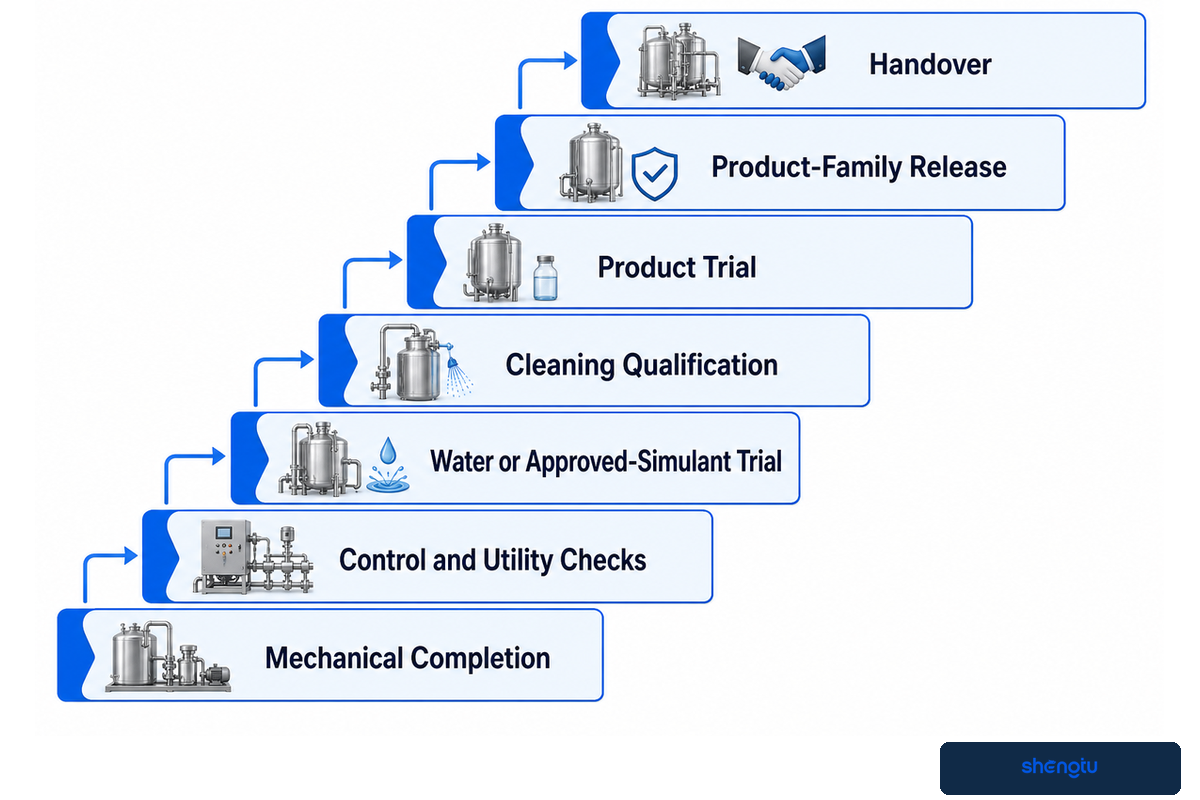
Saleable-Batch Acceptance Ladder separates mechanical completion, control checks, water trials, cleaning evidence, product trials and commercial release. The order for the stages can be the same throughout the facility; however, the final evidence can’t be product neutral. Yogurt, cheese and butter have differing specifications, hazards, sampling needs, maturation or storage, and jurisdictional requirements.
- Mechanical completion: confirm installed equipment, materials, guards, access, piping, slopes, drains, and documents against the approved scope.
- Control and utility checks: test instruments, valve feedback, interlocks, alarms, recipes, steam, cooling, water, air, and power under agreed states.
- Water or approved-simulant trial: confirm circulation; sequence timing; hydraulic response; recovery; operation of stops and restarts; provide evidence of operation, but don’t affirm that a saleable product was achieved.
- Cleaning qualification: perform cleaning in the defined circuits; collect operating parameters; and apply the agreed inspection or analytical criteria.
- Product trial: use agreed milk and formula; collect process state data; sample at the prescribed positions; and verify material balance.
- Product-family release: apply the product’s composition, microbiological, sensory, package, hold, maturation, and destination-market rules.
- Handover: close the deviations; train operator and maintenance staff; freeze the approved recipes; and determine who controls future process changes.
A water trial can’t show performance of culture, yogurt or curd, or separation of whey or butter or distribution of moisture in the package. Those things will require the real product or an explicitly approved trial basis with a set of acceptance criteria articulated prior to the commencement of the testing.
The same caution applies to microbiological release. FDA guidance shows that ready-to-eat dairy products can differ in their ability to support Listeria growth. The correct response is not to copy a U.S. rule into every project. It is to bind each finished product to its own hazard analysis, applicable law, specification, sampling plan, hold decision and responsible release authority.
10. Turn the Guide into an Equipment Brief
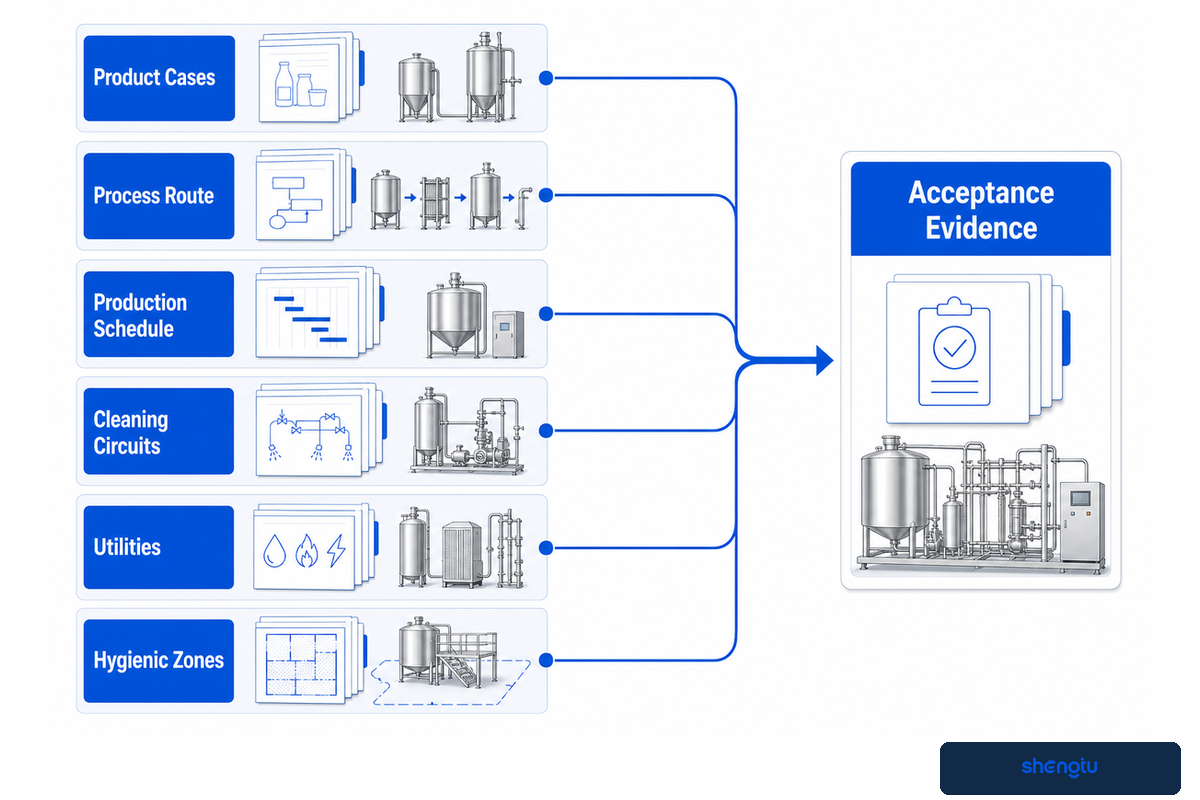
An equipment brief should include one operating case for each product, the milk (ingredient basis), the process route, the batch or hourly schedule, and packaging. It should also include the materials’ final destination, the cleaning circuits, the status of the utilities, hygienic zones, and the evidence of acceptance. It should also include which products can run in parallel and which shared assets must be available between the batches.
Minimum RFQ data pack
- Finished product families and pack sizes
- Milk composition and seasonal range
- Ingredients and addition points
- Product-specific process flow
- Daily and weekly production schedule
- Required simultaneous operations
- Saleable output definition
- Whey, buttermilk and skim destinations
- Startup, changeover and cleaning losses
- CIP circuit and turnaround requirements
- Available steam, cooling, water, air and power
- Room, drain and access constraints
- Destination-market standards
- FAT, site trial and product-release criteria
Send the data pack with a marked process flow rather than asking for “one 5,000 L/h yogurt, cheese and butter line.” The milk reception figure can be shared; the branch basis can’t. For each case, specify flow in L/h, batch and buffer volume in m³, product and utility temperatures in °C, pressure in bar, concentration in %, cooling duty in kW, and turnaround in minutes or hours. These aren’t default values. The supplier should be asked to provide a material balance, equipment duty list, buffer logic, the production and CIP schedules, a peak table for the utilities, an interface matrix, and an acceptance plan.
Formatting example only: a completed sheet might contain entries such as 5000 L/h, 10 m³, 20°C, 4 bar, 2%, 100 kW, 50 mm, 500 kg, 400 V, 50 Hz, 30 min and 8 hr. Replace every example with measured site conditions and the approved product case; none is a design recommendation.
Unit-entry illustration: fields may be recorded as 15°C, 3 bar, 1%, 50 kW, 25 mm, 250 kg, 380 V, 60 Hz, 15 min, 6 hr, 2 days, 12 A, 500 W, 0.5 MPa, 300 rpm or 25 m². These figures only show a consistent data-sheet format; they don’t describe a dairy process.
Shengtu Machinery states its services include custom fabrication of integrated food production equipment and lines. Please refer to the background of Shengtu’s technical team and company for that first-party context. For equipment selection, layout, pricing, delivery, and a project-specific proposal, proceed from this planning guide to the dedicated solution page, or send your process brief to the engineering team.
Frequently Asked Questions
Can one dairy line make yogurt, cheese and butter?
Yes, a dairy plant can share milk reception, storage, and standardization, and some parts of heat treatment. However, these three systems become three separate lines once their respective processes begin to differentiate. Yogurt requires controlled culturing, cheese requires curd formation and whey removal, and butter follows the cream-fat stream through churning. Thus, a viable solution will incorporate a shared, integrated front end with dedicated back end equipment and processes.
Which equipment can really be shared among the three products?
Some of the tasks related to reception tanks, transfer of milk, filtration, separation, standardization, as well as some pasteurization, can be shared under certain product formulations, hygiene zoning, and operating schedules. Dedicated tasks usually occur during culture incubation, cutting of curd, and drainage or churning of the cream and performing the related activities. Sharing should be done considering peak utility demands, cleaning circuits, changeover time, and the risk of holding one branch while the other is running.
Why can’t a fermentation tank replace a cheese vat?
A fermentation tank controls a cultured liquid or gel through temperature and mixing. A cheese vat must also support coagulation, curd cutting, whey separation and gentle curd handling. Those mechanical and drainage duties require different geometry, outlets and downstream equipment.
How should capacity be stated for three dairy products?
Use one case per product: milk basis, schedule, saleable output, coproducts and losses. Require the mass-balance assumptions behind every capacity. For each case, record batch duration, simultaneous duties, buffer assumptions, packaging rate, and the point at which the product becomes saleable.
What should be checked during commissioning?
Check mechanical completion, controls, safety interlocks, utility stability, water trials, cleaning evidence, product trials, and records in that order. State recipe or product family, test duration, sampling method, pass conditions, and release authority. While a water run may show flow and controls, saleable yogurt, cheese, and butter still need product-specific evidence and applicable release rules.
Start with the three operating cases
Product, material, schedule, CIP, utility and acceptance inputs are to be prepared first. Then compare a line proposal against the same evidence.
References & Sources
- Milk Processing and Marketing, Food and Agriculture Organization
- Code of Hygienic Practice for Milk and Milk Products, Codex Alimentarius
- What Is Clean in Place?, Oklahoma State University Extension
- Guide to Inspections of Dairy Product Manufacturers, U.S. Food and Drug Administration
- CPG Sec. 555.320 Listeria monocytogenes, U.S. Food and Drug Administration
- Dairy Products Processing Effluent Guidelines, U.S. Environmental Protection Agency
- BEST-Dairy Energy and Water Benchmarking Manual, U.S. Department of Energy archive
- Dairy Processing Handbook, 2025 edition, Tetra Pak
Technical examples are used within their stated source scope. No universal yield, process setting, shelf-life promise or supplier-performance figure is inferred. Final design, hygiene controls and release criteria remain product-, plant- and jurisdiction-specific.
![F&V Freeze-Drying Line Process Guide [2026]](https://shengtumachinery.com/wp-content/uploads/2026/09/fv-freeze-drying-line-guide-featured-768x512.png)
![Beef/Lamb/Poultry Cutting Line Acceptance Guide [2026]](https://shengtumachinery.com/wp-content/uploads/2026/09/beef-lamb-poultry-cutting-line-guide-featured-768x512.png)

![F&V Freeze-Drying Line Process Guide [2026]](https://shengtumachinery.com/wp-content/uploads/2026/09/fv-freeze-drying-line-guide-featured-150x150.png)