Get in touch with Shengtu Bufan Company

Pet Jerky Drying Line | Shengtu
- Quotation returned within 1 business day
- Production scheduled at 35–45 working days
- One set minimum order
- Warranty duration, coverage and exclusions are confirmed in the quotation and contract
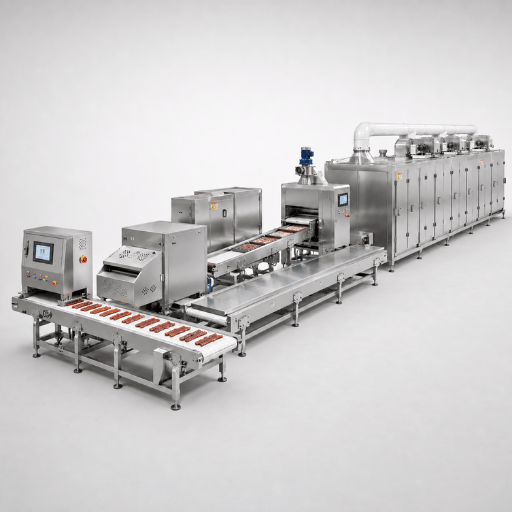
We produce the whole pet jerky drying line — cutting, marinating, tray loading, hot-air drying, cooling, grading, packing and metal detection — not as a stack of separate machines but as one commissioned system. Which dryer sits at the centre of it depends on your recipe, your target moisture and the floor space you have.
SYSTEM SCOPE
Pet Jerky Drying Line Scope and Station Capabilities
Hot-air drying, not freeze-drying and not expansion, is what this whole-muscle and formed pet treat production line is built around. Because we spec it station by station, you can order the full pet food production line or just the drying section your existing plant is missing.
01
Raw material handling and thawing
02
Strip cutting to your slice thickness and length
03
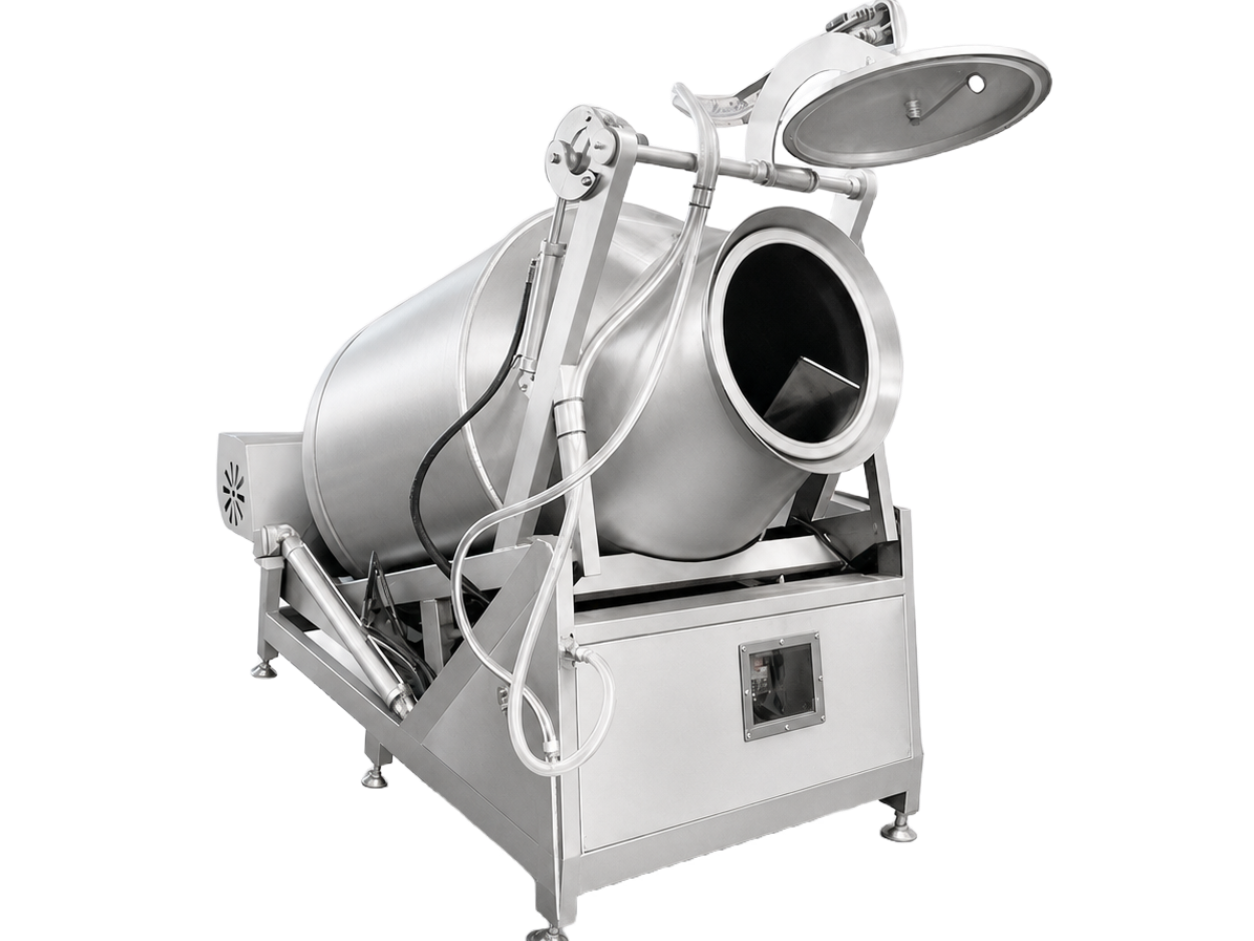
Marinating/seasoning in vacuum tumbler as necessary for the recipe
04
Loading and tray or belt spreading
05
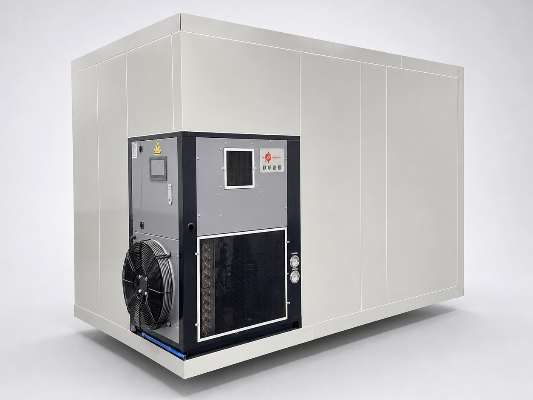
Hot air drying machine stage, batch or continuous
06
Cooling to ambient before the product is handled again
07
Grading and screening of undersize and broken pieces
08
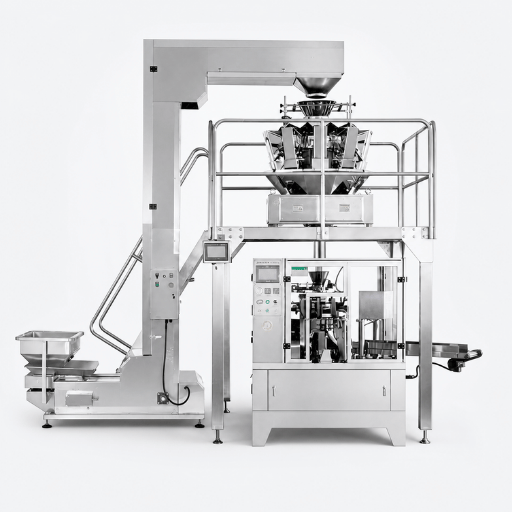
Automatic weighing, bagging and metal detection
On a dog treat production line of this type, five stations carry the engineering weight. Each is specified against your product; none of it is sold as a fixed package.
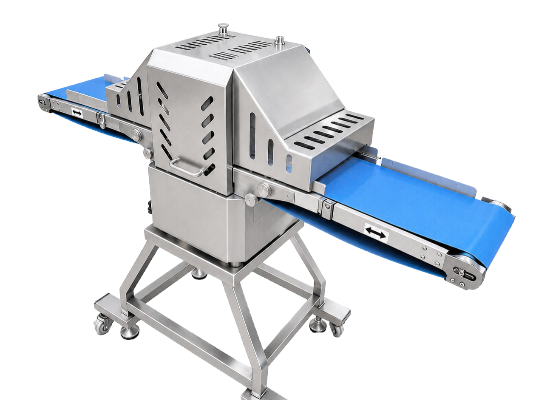
Strip cutter
chilled or partly thawed muscle goes in and comes out at your slice geometry; the machine is SUS304, draws 1.5 kW and occupies 1680 × 860 × 1160 mm.
Marinator
a 1,583 L vessel tumbles 600 kg of effective load per drum, so the seasoning step keeps pace with a full dryer load; it is the only mixer-type station on the line.
Dryer
recirculating hot air held anywhere across 50–95 °C, with the airflow path set so the corners of the chamber see the same air the centre does.
Pouch packer
eight stations running stand-up, zipper, four-side-seal, three-side-seal and paper-composite bags from 100 to 1,000 g.
Metal detector
a 400 mm wide × 120 mm high aperture detector ships as the last station before your carton.
What each station is responsible for
- Cutting logic: Whatever cutting decides, you live with for the life of the food production line: thickness governs how long moisture needs to travel to the surface, and therefore how long you dry.
- Marinating phase: Marinating sets flavour and water-binding.
- Drying parameter: Drying sets safety margin and shelf stability.
- Final output: Packing and metal detection are the two stations your customer’s goods-in inspection ever actually sees.
MATERIAL COMPATIBILITY
Raw Materials and Contact-Surface Construction
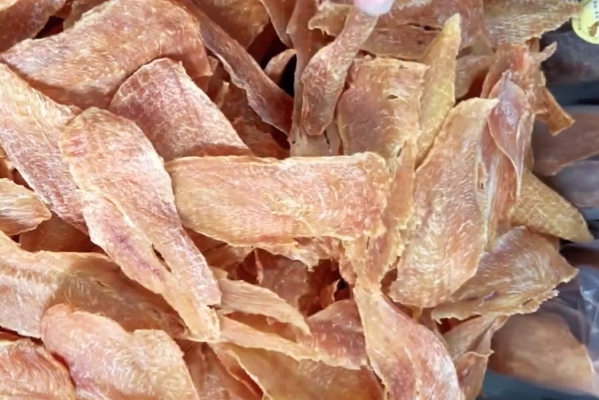
Whole-muscle meat, formed billets and starch-bound blends all run on this line. Slice thickness, drying time and the cleaning regime all shift with your raw material — far more than the machines do. Get the contact metal wrong, though, and the bill is the chamber, not the batch.
The FDA animal food rule, 21 CFR part 507, requires plant equipment to be adequately cleanable and adequately maintained, and it requires wet-cleaned contact surfaces to be dried before reuse. That obligation sits with you as the pet food processor, so Shengtu builds the contact side of the line to make it achievable in practice.
- 01Chicken breast and chicken fillet
- 02Duck breast
- 03Beef and beef strips
- 04Fish fillet and fish skin
- 05Organ meat such as liver and gizzard
- 06Formed and composite billets pressed from minced meat and starch
- 07Root-vegetable strips used as a carrier or as a wrap core
- 08Rawhide and collagen blanks for wrapped products
SUS304 and SUS316 stop being interchangeable the moment chlorides enter the picture: high-salt marinades and chloride-heavy wash-down water pit 304 over time, because the passive film that protects it breaks down locally wherever chloride concentrates. Pitted metal becomes a cleaning problem before it becomes a corrosion problem.
Contact-Surface Options & Applications
Contact-surface option
Where we use it
What it changes for you
SUS304 stainless steel
Standard on cutter, marinator, dryer chamber and belts
Covers meat, poultry and starch-bound products with routine caustic and hot-water cleaning
SUS316 stainless steel
Optional upgrade on request
Chosen for high-salt marinades, fish lines and chloride-heavy wash-down water
Polyurethane belt
Alternative to the stainless mesh belt on the continuous dryer
Gentler on soft formed products that mark against wire mesh
PRODUCTION FORMATS
Finished-Product Formats
One set of jerky processing equipment turns out very different retail formats, and it is the format that decides your cutter, your tray density and your bag. Seven come up most often.
- 01 Straight meat strips and sticks
- 02 Thin meat slices and chips
- 03 Wrapped and twisted chews with a rawhide or collagen core
- 04 Dental chews and shaped chew sticks
- 05 Semi-moist treats held at a higher finished moisture
- 06 Biscuit-style pressed pieces dried rather than baked
- 07 Cubes and dices for topper and training use
Format-driven configuration changes
Those seven behave, in practice, as two drying problems. Thin slices dry from both faces and load densely, which rewards a continuous belt; thick wrapped chews dry from the outside in and want a longer, gentler hold, which usually points to a batch chamber at a lower set point. Your cutter and your tray density get built around that split, and calling it wrong costs you in one of two ways.
-
Drive a thick chew like a thin slice and case hardening follows: the surface dries off too fast, seals itself, and locks water into the core — then the pack fails on mould weeks after it left your line.
-
Run a thin slice on a chew cycle and you are paying for hours of chamber time, and the energy behind it, that the product never needed.
Machine Specifications and Drying Parameters
Every figure below comes off machines we actually build. Size your electrical supply and your floor plan against them before you send us anything. They will size the dryer — but the lethality set point, the one that makes the product safe, is validated separately against FSIS Appendix A.
| Specification | What we build |
|---|---|
| Batch oven models and load per batch | KHG-3 at roughly 250 kg, KHG-5 at roughly 350 kg, KHG-7 at roughly 500 kg |
| Batch chamber dimensions | 3000 × 1650 × 2100 mm, 3500 × 1880 × 2100 mm and 3800 × 2150 × 2100 mm |
| Batch heating power | 2.8 kW, 4.6 kW and 6.0 kW, each with three 0.55 kW circulation fans |
| Continuous mesh belt dryer | 1,000 mm belt width, 6000 × 1500 × 3200 mm, 14.25 kW total power |
| Drying temperature | 50–95 °C, adjustable across the whole range |
| Drying time | 6–15 h, set by your initial and target moisture content |
| Power supply | 380 V / 50 Hz three-phase on every station |
| Contact material | SUS304 as standard, SUS316 on request; belt in stainless steel or polyurethane |
| Strip cutter | 1680 × 860 × 1160 mm, 1.5 kW, SUS304 |
| Marinator and mixer station | 2250 × 1100 × 1650 mm, 3 kW, 1,583 L drum, 600 kg effective load |
| Pouch packing machine | Eight stations, bags 180–300 mm wide × 180–450 mm long, 100–1,000 g, 3 kW |
| Compressed air required | 0.9 m³/min at the packing station, supplied on your side |
The Batch-or-Continuous Crossover Point
Chambers or belt comes down to three numbers, and price is not one of them.
| Variable | Points to batch chambers | Points to a continuous belt |
|---|---|---|
| Daily target output | Volume a chamber can clear inside one cycle at 6–15 h | Volume that needs the dryer producing while it is still being loaded |
| Shifts you can staff | One shift, where a 12-hour cycle leaves room for a single full load per shift | Two or three shifts, where idle chamber hours become the constraint |
| Usable building length | Short bays; each chamber needs 3.0–3.8 m of run and stacks by count | A clear 6 m run for the dryer body plus infeed and discharge |
Batches-per-day figures are worked out from load size and cycle length, which makes them engineering estimates rather than guaranteed output. A committed capacity figure goes in writing only against your product and your shift pattern.
Batch-or-Continuous Crossover Point calculator: Feed it daily target output, staffed shifts and usable building length; back comes the dryer family your numbers point to, with the reasoning.
The Heat-Source Swap Test
Heat pump vs electric is the question most treat buyers arrive with — and the wrong one to answer first. Because heat source moves running cost far more than capital cost, your site settles it: we supply four, and three get ruled out by what your plant already has.
| Heat source | What your site must already have | What it changes | When not to choose it |
|---|---|---|---|
| Electric heating | Adequate three-phase capacity at 380 V / 50 Hz | Simplest installation; the KHG chambers are built this way as standard at 2.8–6.0 kW | Where industrial electricity tariffs are high and run hours are long |
| Steam | An existing boiler with spare capacity and a condensate return | Moves heating cost onto your existing fuel contract; the continuous dryer is configured for it | Where no boiler exists, since a new boiler dwarfs the dryer cost |
| Natural gas | A piped supply and local approval for a fired appliance in a food room | Lowest energy cost per kilogram of water removed in most gas markets | Where gas is bottled or the permit route is slow |
| Heat pump | Space for the unit and a stable ambient temperature band | A peer-reviewed review of heat-pump drying reports 1.0–4.0 kg of water removed per kWh against 0.1–1.3 kg for hot air, at moderate rather than low capital cost | Short run hours, because the review notes the payback depends on long hours of operation |
Heat-Source Swap Test worksheet: Answer four questions about your site and the worksheet strikes out every heat source your plant cannot support — before you start comparing quotations.
Lead Time, Minimum Order and Commercial Terms
Price follows line length, dryer family, heat source, contact material, automation level and packing format. A customised line has no price list — your figure comes back in a written quotation.
Minimum order
One set. We quote a single dryer as readily as a full line.
Lead time
Production runs are scheduled at 35–45 working days, confirmed with your quotation.
Quotation turnaround
Quotes are returned within 1 business day on business days, reviewed by an engineer.
Trade terms
We ship FOB; other Incoterms on request.
Payment
An advance payment releases production, and the balance is settled after your line has passed in-house inspection and testing, before packing and shipment.
Documents
A document pack matched to your machine model, configuration and destination market ships with your order, and the exact certificate list is confirmed in writing at quotation.
What we need to quote
An enquiry becomes a real quotation on five inputs. Gather them internally before you talk to any supplier, ourselves included.
- Product name and the format you are aiming at
- Target capacity in kg/h of finished product
- Initial moisture content and target moisture content
- Heat-source conditions available at your site
- Factory space dimensions, including usable ceiling height
Pre-quotation input checklist
Same five inputs, as a printable checklist, each with the unit and the tolerance we need.
Open the input checklistLead time starts on approval of the drawing package and configuration, and ocean transit sits outside it. Customisation is normal on this line, priced into the quotation rather than added afterwards.
Compliance & Assurance
Quality Control, Food-Safety Design and Warranty
Drying a meat treat is not the same thing as making it safe. US regulators treat the lethality step and the drying step as separate operations — lethality performance sits with FSIS Appendix A, not with the dryer — and a 2003 Salmonella outbreak in jerky was traced to slow drying under very low humidity, which let organisms dehydrate and turn heat tolerant before they were killed.
“The temperature-control stability check in our pre-shipment run exists for one reason: the corners of a loaded chamber have to see the same air as the centre. Drying is not a substitute for your lethality step, and we will not claim it is. What we hand over is a chamber whose spread is small enough for your validated set point to survive a full load.”
That is why chamber uniformity is a number on this line rather than an adjective. Published extension guidance sets a dehydrator’s temperature set point at the mean plus a multiple of the standard deviation measured across at least twelve points in the chamber: at three sigma, 33,400 units per million miss the lethality temperature; at six sigma, 1.7 do. Our airflow design and our temperature-control stability check exist to keep that spread small enough for you to work with.
Hover for Data
The Pre-Shipment Five-Test Run
No line ships without being run first, and you can watch that run on site or over remote video.
- No-load run of every drive, fan and heater
- Loaded production simulation with representative product
- Temperature-control stability check across the chamber
- Core-component inspection of motors, bearings, heaters and controls
- Whole-line interlock test from infeed to metal detection
Warranty and response
- Warranty duration, coverage and exclusions are confirmed in the quotation and contract.
- Response times, remote support, on-site service and spare-parts arrangements are confirmed in the quotation and contract.
- Troubleshooting support after the warranty period is scoped in the service agreement.
Lethality set-point calculator
Enter your observed mean and standard deviation, and the tool will output the calculated three, four, five, and six sigma set points, along with the number of expected under-processed units at each sigma level.
Open the set-point calculator| Metal detection sensitivity | Detected from |
|---|---|
| Ferrous | 0.8 mm sphere |
| Non-ferrous, copper | 1.5 mm sphere |
| Stainless steel | 2.0 mm sphere |
How We Scope, Build and Commission Your Line
A food processing enquiry reaches a running line in five steps — and every engineering decision lands in the first two.
-
DATA INPUT
You send the five quotation inputs; back comes the dryer family, the layout envelope and the utilities your site will need.
-
ENGINEERING QUOTE
An engineer returns a written quotation within 1 business day, including the automation level and the packing format.
-
PRODUCTION RELEASE
An advance payment releases production against the agreed configuration.
-
INSPECTION RUN
The five-test run happens before the balance falls due, and you are welcome to attend it.
-
ON-SITE DEPLOYMENT
We install, commission and train on your floor.
After the machine lands
Buyers who have imported equipment before tell us the same thing: the part that usually gets missed is parts support after the machine lands, and what they were sold was usually just a warranty on parts. A duration on its own buys you nothing when a fan motor fails on day 400, because what you need at that moment is somebody who answers. Agree response timing, spare-parts availability and support after the warranty period in the quotation and contract.
Installation, commissioning and operator training
On-site installation and commissioning plus one-to-one operator training in your language, so the first fault on your floor is diagnosed by your own people rather than by email. Choosing us as your supplier does not end at the packing crate.
Process Limitations
When This Line Is Not the Right Fit
For several pet products hot-air drying is simply the wrong process, and buying it anyway is expensive. Four cases point you somewhere else.
Biscuit-type treats sit between the two: a pressed piece we can dry, but anything that has to brown or expand needs baking equipment, and anything that has to extrude needs extrusion instead.
Dry kibble.
Extrusion, not muscle drying, is what makes expanded dog food; you need an extruder and a dryer sized to it.
See our extruded kibble line for dry pet food
01
Dry kibble.
Hover to analyzeFreeze-dried raw treats.
Sell on raw nutrition and a rehydrating texture and sublimation under vacuum is your only route.
See our freeze-dried treat line for raw formats
02
Freeze-dried raw treats.
Hover to analyzeWet food in cans or pouches.
Shelf stability there is bought with thermal sterilization inside a sealed container, not by taking water out.
See our canning and retort line for wet formats
03
Wet food in cans or pouches.
Hover to analyzeA validated lethality process.
Chamber, controls and stability evidence are ours to supply; the validated process itself stays with your process authority and your regulator.
No link required
04
A validated lethality process on paper.
Hover to analyze
SYSTEM RESOURCES
Engineering Planning & Evaluation Tools
TOOL_01
Batch-or-Continuous Crossover Point
Feed it daily target output, staffed shifts and usable building length; back comes the dryer family your numbers point to, with the reasoning.
Launch Calculator
TOOL_02
Heat-Source Swap Test
Answer four questions about your site and the worksheet strikes out every heat source your plant cannot support.
Start Evaluation
TOOL_03
Lethality Set-Point Calculator
Enter your observed mean and standard deviation, and the tool will output the calculated sigma set points.
Launch Calculator
TOOL_04
Pre-Quotation Input Checklist
Same five inputs, as a printable checklist, each with the unit and the tolerance we need.
Open Checklist
Technical Support
Frequently Asked Questions
Two families do the work. A KHG batch chamber holds one tray load at a set temperature for the whole cycle; a continuous mesh belt dryer walks product through heated zones on a 1,000 mm belt. Both run 50–95 °C and 6–15 h.
The batch models hold roughly 250, 350 and 500 kg per load for KHG-3, KHG-5 and KHG-7. The continuous dryer is sized by belt width and layer count rather than by load, starting from a 1,000 mm belt. A finished kg/h figure goes in writing only against your product and your moisture targets.
Between 6 and 15 hours. That span is not padding — initial moisture, target moisture and slice thickness set it between them, which is why we ask for all three before quoting.
50–95 °C, adjustable across the whole range. Thin slices and semi-moist products sit low in that band; wrapped chews and thick sticks sit higher, and longer.
Chicken and duck breast, beef, fish fillet and skin, organ meat, formed billets of minced meat and starch, root-vegetable strips, and rawhide or collagen blanks. Two cases pull us towards the SUS316 upgrade: salt-heavy marinades, and fish.
Strips, slices, wrapped and twisted chews, dental chews, semi-moist pieces, pressed biscuit-style pieces, and cubes for toppers. Moving between them usually costs a cutter change and a drying curve — not a new line.
Electric, steam, natural gas or heat pump — your plant decides. Electric where three-phase capacity is spare, steam where a boiler already runs, gas where a piped supply and permit exist, heat pump where run hours are long enough to repay the higher capital cost.
Yes, and customisation is the normal case rather than an extra. Send the five quotation inputs — product, target capacity in kg/h, initial and target moisture, heat-source conditions and factory space dimensions — and the layout comes back with the quotation within 1 business day.
Company management-system documents are requested and checked for their holder, scope and current validity. The line itself is built for HACCP and ISO 22000 style production requirements: SUS304 or SUS316 contact surfaces, a cleanable layout, and controls accurate enough to hold the temperature you validate against. Which certificates apply depends on model, configuration and destination market, and the applicable list is confirmed in writing at quotation.
One set, and 35–45 working days of production. The balance of payment is not due until the line has passed in-house inspection and testing, which is the part of the schedule you can actually hold us to.
Most pet treats need no pre-market approval in the United States, but the facility and the equipment still fall under 21 CFR part 507, which requires equipment to be adequately cleanable and instruments controlling temperature or water activity to be accurate, precise and adequate in number. Your process authority and your regulator decide what your validated process looks like; we do not give legal advice on your behalf.



![F&V Freeze-Drying Line Process Guide [2026]](https://shengtumachinery.com/wp-content/uploads/2026/09/fv-freeze-drying-line-guide-featured-150x150.png)