Get in touch with Shengtu Bufan Company

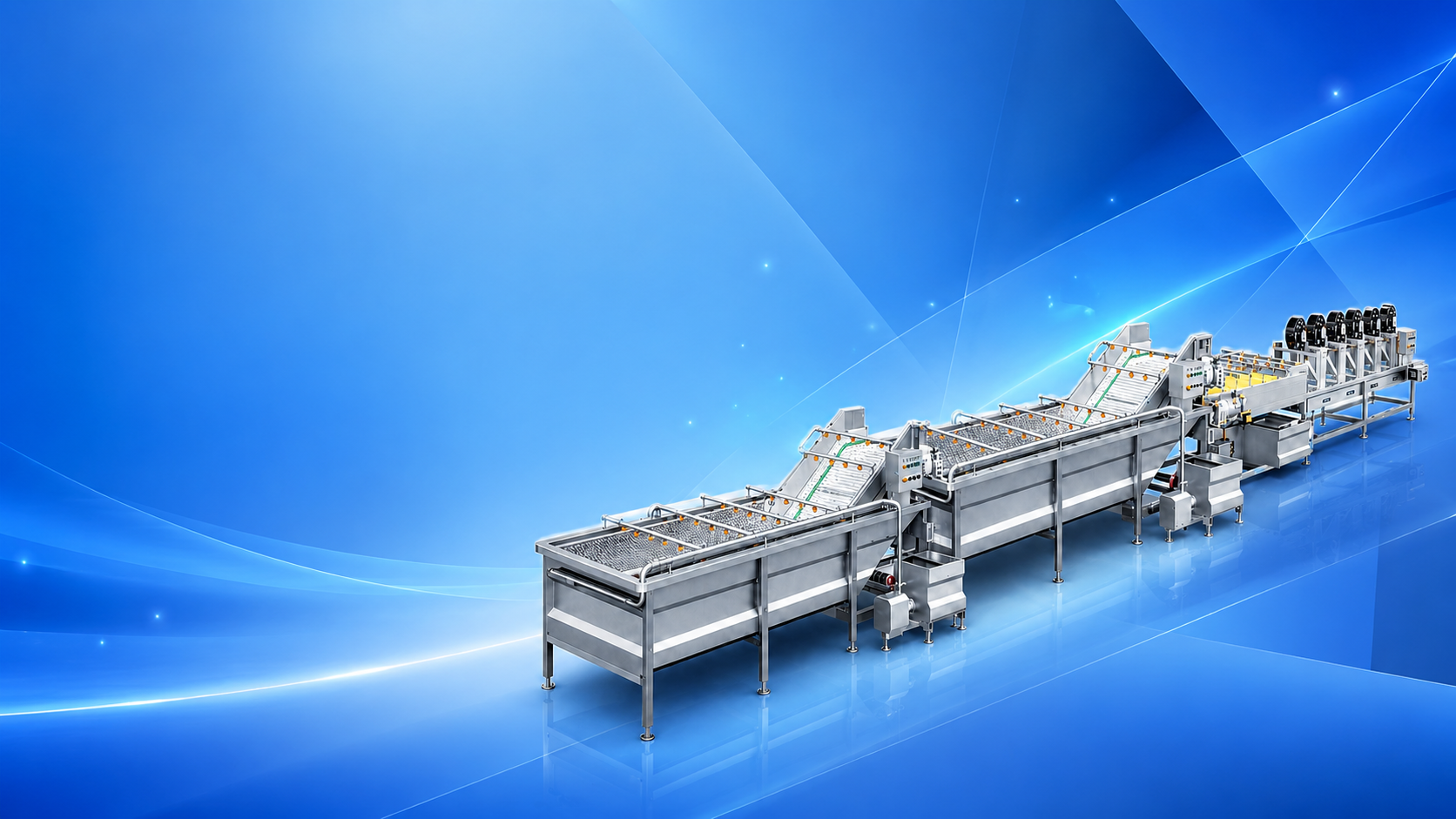
Leafy Fresh-Cut Line: A Complete Fresh Cut Vegetable Processing Line for Leafy Greens
A leafy fresh cut vegetable processing line is an eight-station system that washes, cuts, washes again, dewaters, air dries and packs lettuce, spinach, cabbage and similar crops as ready-to-eat product. SHENGTU builds it in three capacity tiers with three separate wash stages, and integrates the control platform, the packing end and the plant network as one delivery.
Where Leafy Fresh-Cut Lines Actually Fail
Most leafy processing lines are not sold badly. They are sold without the three numbers that decide whether the plant works: what the line draws, what it occupies, and what the product looks like on day 12.
Failure happens downstream of the purchase
- Cutting is the moment risk is created: Cutting damages the waxy cuticle of the leaf, according to the US Food and Drug Administration, exposing interior tissue and releasing nutrient-rich fluids that support microbial invasion and growth.
- Cut leafy greens are a time-and-temperature controlled food, and once cut they must be held at or below 41 °F (5 °C).
- Shelf life is finite and known. Anticipated shelf life for many bagged fresh-cut leafy greens runs to approximately 12 to 16 days.
- A line that cuts well but dewaters inconsistently does not fail on the factory acceptance test. It fails in the retailer’s cold room, three weeks after the engineers have flown home.
What this page does differently
Every process number below is either sourced to a government or university publication, marked as a figure to be confirmed against your crop and configuration, or written as a range rather than a guarantee. No payback period is quoted, because no honest one exists without your labour rate and your throughput.
Where this gets decided
In practice the trade-off between belt speed and leaf damage is fixed on day one of production planning, and a 60 min changeover penalty is expensive to discover afterwards. Our engineers set that balance with you at 5 °C hall conditions before quotation, drawing on 10+ years of leafy line builds at SHENGTU.
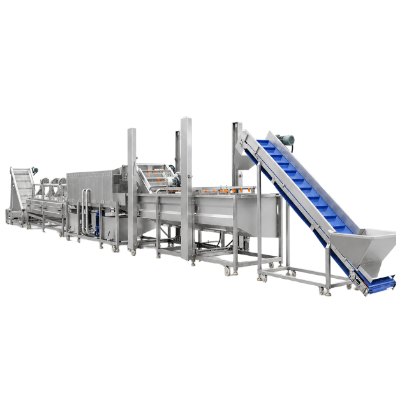
The 3-Wash Leafy Line Blueprint: Eight Stations, Station by Station
The defining feature of leafy vegetable processing — as opposed to a general fruit and vegetable line, often marketed as a fruit-vegetable line — is the washing-cutting-washing order: washing happens three times, and cutting sits between the first and second wash. Washing and drying together account for five of the eight stations. Below is the blueprint we build to.
Why three washes and not one
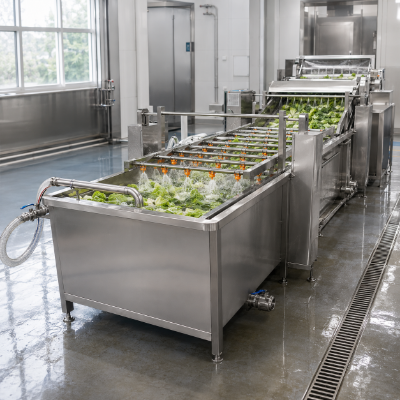
Continuous drying and surface-water removal for leaf vegetables are long-established engineering problems, described in patent families such as US20080032010A1 and US4251895A. Vegetable cleaning is not one operation on this line, and thorough cleaning takes all three stages of the multi-stage wash. The three-wash arrangement exists because each wash removes a different contaminant class: field soil, cut-cell exudate, and microbial load in the water itself.
How we size it
Every station has a failure mode and the error is discovering that during a 90 minute changeover rather than at the design review, and every wash removes a different kind of contaminant. Station fabrication and sizing are confirmed against your specific crop list and equipment scope. Review the station-by-station specification sheet.
Hover to reveal full line
| Step | Station | What it does | Why it exists | What fails without it |
|---|---|---|---|---|
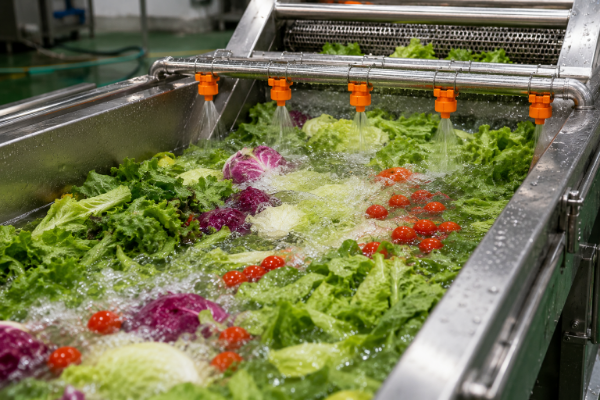
| 01 | Pre-wash / soak tank | A bubble washing machine agitates the tank so field soil, sand, surface residue and loose outer leaves lift away before any blade touches the crop | Soil removed before cutting is soil that never enters the cut surface | Grit is driven into cut edges; blade life collapses; wash water fouls within one shift |
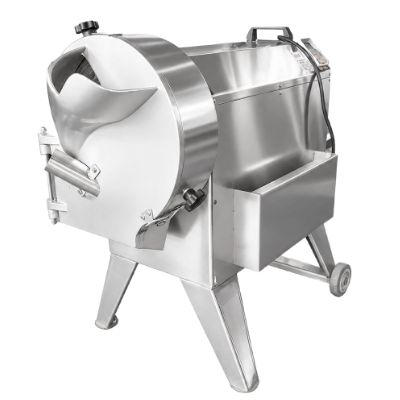
| 02 | Vegetable cutting machine | Adjustable blade set cuts to shred, strip or leaf-cut geometry; cutting sizes and shapes, julienne included, are a blade change rather than a machine change | Cut geometry is the product specification the buyer actually pays for | Ragged edges brown faster and are visible through the bag |
| 03 | Second wash (turbulence) | Removes cell exudate and fines released by cutting | Cut fluids are the nutrient source for spoilage organisms | Wash water turns cloudy, bag liquid appears, shelf life shortens |
| 04 | Third wash (sanitiser contact) | Antimicrobial contact stage with controlled concentration and dwell time | Prevents water-mediated cross-contamination across the batch | One contaminated intake crate can be distributed across the whole production run |
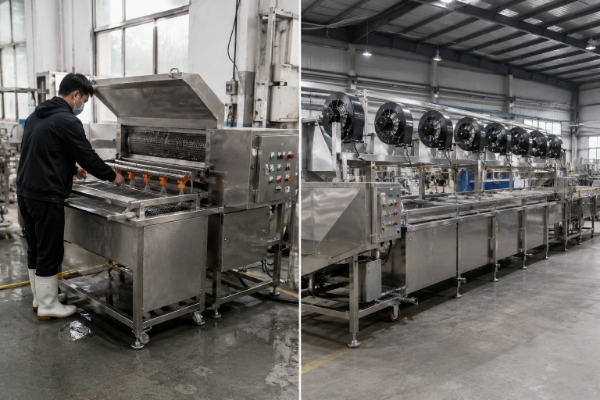
| 05 | Vibrating dewatering | A vibrating draining machine sheds bulk free water without mechanical stress — the gentlest product handling on the line | Gentle washing and gentle water removal have to come before any high-force step | The dryer is asked to remove water it was never sized for |
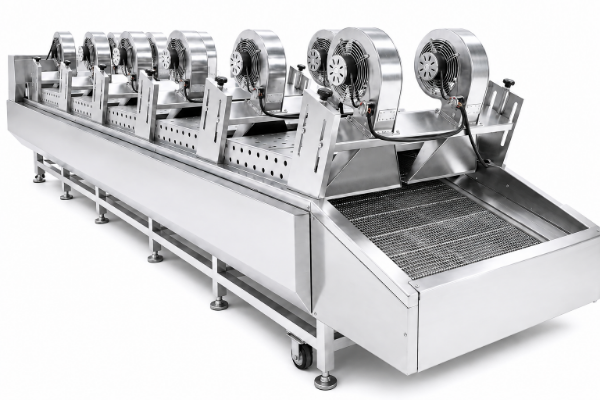
| 06 | Air drying tunnel (+ optional centrifugal dryer) | High-volume air removes remaining surface moisture to the target moisture content band | Residual surface moisture governs bag condensation, product quality and spoilage rate | Wet product in the bag; visible condensation; rejected deliveries |
07 |
Inspection conveyor |
A belt conveyor system allows manual sort and foreign-body check before packing |
The last human checkpoint before the product is sealed |
Defects and foreign material are discovered by the customer |
08 |
Weighing and packing machine |
Weighing and packaging: portioning and bagging, with modified atmosphere packing as an option |
Pack format determines both give-away and shelf life |
Overfill loss on every bag, compounding across the year |
Which Leafy Crops This Line Handles
The honest crop list is not ours to invent. The FDA Food Code defines “leafy greens” explicitly, and that definition is the practical boundary for the types of leafy vegetables this line handles.
| Crop group | Examples | Line fit | Configuration note |
|---|---|---|---|
| Head lettuce | Iceberg lettuce, romaine, butter and leaf lettuce | Core application | Lettuce processing starts at the trim table upstream of station 1, where the core is removed |
| Baby leaf and mixes | Baby leaf lettuce, spring mix, arugula, escarole, endive | Core application | The cutting machine is often bypassed — the leaf is already at size |
| Firm leaf | Spinach, chard, kale, cabbage | Core application | Cabbage requires a shredding blade set and a slower belt speed |
| Stem vegetables | Celery, leek, spring onion | Handled with caveats | Higher water load; longer dewatering dwell |
| Soft herbs | Cilantro, parsley, basil | Handled with caveats | Explicitly outside the FDA leafy-greens definition; bruise easily, need reduced air velocity |
SOURCE NOTE
The 2009 “leafy greens” list by the FDA includes iceberg, romaine, leaf and butter lettuce, baby leaf lettuce, escarole, endive, spinach, spring mix, cabbage, kale, arugula and chard, and it specifically excludes herbs such as parsley and cilantro. SHENGTU processes herbs, but we do not claim they behave the same way as leafy greens.
Bagged salad, mixed salad and ready-to-eat packs
Most of this equipment ends up producing bagged salad rather than loose cut leaf. A fresh-cut salad production line is the same eight stations; what differs is the recipe and the pack format.
- Single-crop packs — shredded iceberg lettuce or cabbage, the highest-volume salad products in most plants
- Mixed salad — two or more crops blended after drying, which needs buffer capacity between station 6 and station 8
- Ready-to-eat salad with a dressing sachet — sachet insertion is a packing-machine function, so it belongs in the station 8 specification
The constraint on a vegetable salad processing line is not the cutter. It is whether the drying stage holds a consistent residual moisture, because freshness in the pack is decided there rather than at the cold store.
Who this line is specified for
- Salad producers running a salad processing line into retail or club-store packs
- Food service and central-kitchen operators cutting to a daily order rather than to stock
- Fresh produce packers adding a washed, ready-to-eat range beside whole-head vegetable production
- Vegetable distribution businesses moving up the chain from crate handling into a fresh-cut vegetable programme
The common factor is not scale. It is a fresh vegetable order profile that changes week to week, which is why configuration decides more than headline rate does. Most of these buyers are also adding a line inside an existing vegetable processing plant rather than building greenfield, so the tie-in points matter as much as the machine.
Crop fit is a design input, not a filter: Getting it wrong is the expensive mistake in this category, because blade geometry and air velocity are set per crop rather than per line, and a 20 mm cut behaves nothing like a whole baby leaf in production. Crop lists are confirmed against the documented production process settings before build.
Capacity Selection: 500, 1,000 and 2,000 kg/h
Capacity on a fresh cut vegetable processing line should be chosen from your cold-chain window backwards, not from a brochure’s maximum figure. Because the FDA requires cut leafy greens to reach 41 °F (5 °C) and stay there, the line’s rate must match how fast your chilling and packing end can absorb it, which means production capacity is set downstream of the cutter.
Tier
Nominal throughput
Typical fit
Honest limit
Entry
500 kg/h
Central kitchens, regional caterers, first-time fresh-cut entrants
Changeover between crops consumes a meaningful share of the shift
Standard
1,000 kg/h
Established processors supplying regional retail
Requires a dedicated packing crew to avoid a bottleneck at station 8
High
2,000 kg/h
National supply, multi-shift operation
Water and effluent handling become a plant-level design problem, not a line option
External reference points
- European line builders publish comparable tiering — roughly 1,000 kg/h for small-to-medium operations and 2,000–3,000 kg/h for high-speed installations.
- Published industry capability for this equipment class reaches about 3,000 kg/h.
- Almost without exception, baby leaf is the crop that determines the throughput of mixed lines; it doesn’t survive the belt speed of cabbage.
Three questions, no call. Tell us crop mix, daily volume and available floor area.
Get a detailed capacity estimateCostly Tier Selection Error
Oversizing costs you footprint and wasted kW on every shift; under-sizing creates bottlenecks you cannot fix later. Your optimal tier depends on your packing capacity and your production volume rather than any headline number, and SHENGTU measures throughput in a clean 60 min production window inside your own hall.
Wash Water, Sanitiser and Residual Moisture
This is the section most equipment pages avoid, and it is the one your retailer’s auditor will ask about. Two things are commonly claimed about leafy washing, and both run contrary to the published evidence.
Claim 1: vegetable washing eliminates pathogens
A common assumption is that the washing machine sterilises the product. It does not, and the distinction is not academic — it changes where you spend your food-safety budget.
“The use of antimicrobials in the wash water is a critical step in preventing such water-mediated cross-contamination.”
Gombas, D. et al. (2017), Journal of Food Protection 80(2):312–330, DOI 10.4315/0362-028X.JFP-16-258
What that means on your line
The antimicrobial in the wash tank is a preventive control against cross-contamination – it stops one contaminated intake crate from spreading through the whole batch. It is not a kill step, and no wash stage on any leafy processing line should be sold as one.
Why the distinction matters commercially: If you buy a line believing the wash sterilises the product, then you will under-invest in the two controls that really govern your risk: incoming raw-material quality, and cold-chain discipline below 41 °F (5 °C) from cutting to dispatch.
Sanitiser concentrations and contact times
The figures below are published by Clemson University Cooperative Extension (HGIC 3644, Northcutt, 2021). They are the reference band against which we design the station-4 contact section.
Claim 2: drier is better
Drier is not always better: Some line-builders advertise drying down to “zero percent residual moisture”, which for leafy greens is not a goal but a defect. Over-drying wilts the leaf, reduces saleable weight and shortens the pack’s visual life.
- Residual moisture is a band, not a floor, and the band differs by crop – baby-leaf tolerates much less air energy than cabbage.
- Residual moisture must be measured, not assumed. We state the measured value per crop for your configuration, with the test method attached.
- A single flat percent figure across all crops is a marketing number, not an engineering one.
Semi-Automatic Versus Fully Automatic
For a first fresh-cut line, semi-automatic is often the correct answer, and we will say so during specification rather than after commissioning.
Dimension
Semi-automatic
Fully automatic
Labour at the line
Higher; manual feed, trim and pack
Lower; operators supervise rather than handle
Crop changeover
Faster — people adapt quicker than recipes
Slower unless recipes are pre-built in the control system
Consistency across a shift
Varies with crew and fatigue
Repeatable within machine tolerance
Capital exposure
Lower entry cost; modules added later
Higher upfront; lower marginal cost per kilogram at volume
Best suited to
Mixed crop, variable daily volume, new market entry
Narrow crop range, stable contracted volume, multi-shift
More automation is not always the right call. The cheapest line is rarely the best value across five years, but neither is the most automated one if your crop mix changes weekly.
Where automation is already proven
Automation of the inspection step is a particularly mature field, with machine-vision stem and calyx removal appearing in patent families such as WO2014144268A1. Such is the maturity that the inspection conveyor is the module most customers upgrade first.
Choosing between them: The trap is buying automation for a crop mix that changes weekly, because recipe changeover then costs more than the labour it replaced — on a 30 min cycle that gap compounds fast. SHENGTU quotes both configurations side by side against your production plan, drawing on years of mixed-crop installations.
What Actually Drives the Cost of a Leafy Fresh-Cut Line
We do not publish a price for a fresh cut vegetable processing line, because a price without a configuration is noise. We do publish the five variables that move it, and the direction each one moves it in.
| Cost driver | Direction | Why it moves the number |
|---|---|---|
| Throughput tier | ▲ strongly | Tank volumes, motor sizes and dryer air volume all scale with rate |
| Number of crops in the mix | ▲ moderately | Each crop adds blade sets, recipes and validation work |
| Water recirculation and effluent treatment | ▲ strongly | Filtration, dosing control and effluent handling are plant systems, not line accessories |
| Packing format (bulk vs modified atmosphere) | ▲ strongly | Gas flushing, film handling and seal integrity checking belong to separate packaging machines; vacuum packing is not a leaf format, because the pack collapses the product |
| Documentation and validation depth | ▲ moderately | Retailer and regulatory audit packs take engineering hours to assemble properly |
The last item above – preventive-control validation and record keeping – is a formal requirement under the FSMA framework, and assembling that documentation against a specific line configuration is engineering work.
On the subject of Payback/ROI claims, you will see leafy processing line pages trumpeting a return on investment “within 14 months”, assembled with no labour rate, no utility cost and no throughput assumption behind it.
No payback figure is printed on this page.
Instead you get connected load, water demand and throughput, so your finance team can calculate a return that stands up to scrutiny.
Specification words that carry no information
Search for vegetable processing equipment and the same phrases — high-quality build, high efficiency, total flexibility — appear on almost every listing. None of them can be checked until a test condition is attached, so here is what to ask for instead.
| Phrase on the listing | Ask for this instead |
|---|---|
| “High efficiency” | Throughput in kg/h at a stated crop, cut size and infeed moisture, measured across the washing-drying sequence |
| “Long service life” | Material grade, bearing specification, and the wear-part list with lead times |
| “Fully customizable” | Which modules stay configurable after the frame is welded, and which do not |
| “Turnkey line” | Written scope: who supplies chiller, drains, compressed air and the drying and packaging end |
| “Hygienic design” | The named hygiene standard, the weld finish, and the drain-down time of the wash tanks |
| “Handles a wide variety of vegetables” | The crop list the vegetable processing machines were actually validated against |
We hold ourselves to the same test. A production line that can process a wide range — baby leaf through to shredded cabbage — is worth claiming only when the industrial food processing validation records sit behind it.
What a minimum viable configuration contains
- One pre-wash tank, one vegetable cutting machine, two additional wash steps
- Vibrating dewatering plus an air drying tunnel
- One inspection conveyor and one semi-automatic weighing and packing station
- Control cabinet, cabling and the documentation set described further down this page
Turning drivers into a number: Budget approval fails when the cost structure is opaque, because finance cannot defend a figure it cannot decompose, and a 24 month depreciation case needs inputs rather than a slogan. SHENGTU issues a line-item configuration built in-house, with project-specific documentation, so the estimate survives review.
Utilities, Footprint and Site Preparation
These are the numbers no competitor publishes, and the ones your civil contractor needs before any processing equipment is ordered. We provide them per configuration rather than as a single headline figure, because they change materially between tiers.
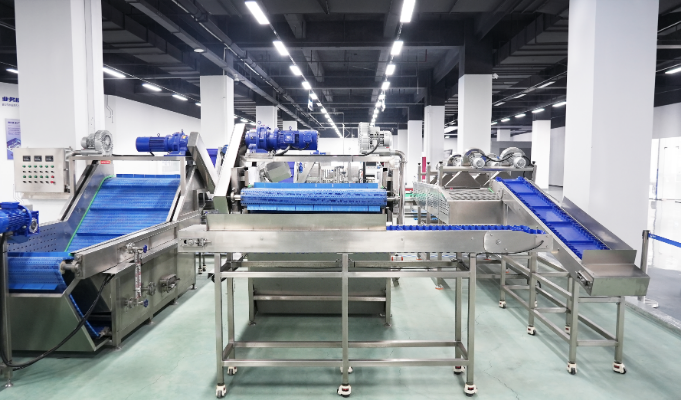
Water is the utility that most often surprises first-time processors. Recirculation with filtration and dosing control is the established lever for reducing it, an approach documented in patent families such as EP2005846A1 covering water-saving washing and disinfecting.
| Requirement | What we specify | Status |
|---|---|---|
| Total connected load | kW per capacity tier, split by station | Stated per quotation |
| Water demand | m³/h at steady state, plus recirculation ratio | Stated per quotation |
| Compressed air | m³/min and working pressure in bar | Stated per quotation |
| Line footprint | Length × width, plus service clearance on both sides | Stated per quotation |
| Ceiling height | Minimum clear height above the drying tunnel | Stated per quotation |
| Drainage and effluent | Floor gradient, trench positions, expected effluent load | Stated per quotation |
Before civil work starts: Site surprises are the most expensive delay in this category, because drainage and connected kW are hard to retrofit once the floor is poured, and a 400 mm gradient error can strand a whole wash section. Layout drawings and utility schedules are issued in-house by SHENGTU before any production order.
Line Intelligence: STUnit, OTA Updates and Remote Diagnostics
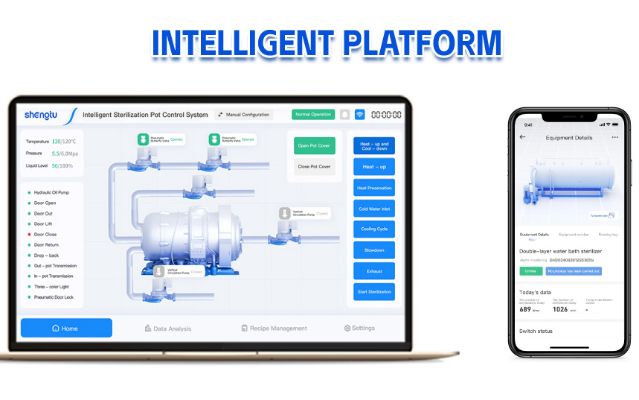
Every SHENGTU line is built on the STUnit platform, so the equipment is instrumented from the day it ships rather than retrofitted later. That matters most when something goes wrong at 2 a.m. on the other side of the world.
Built in from day one
-
01
Low-code control boxes and multi-protocol gateways, so every processing machine talks to whatever supervisory system your plant already runs
-
02
Over-the-air update capability for control logic, delivered as a standalone upgrade path rather than a service visit
-
03
Machine vision and edge analytics run on-board at the inspection point, so nothing is sent to the cloud or outside the plant
-
04
Remote fault diagnostics, so a fault is identified before an engineer is dispatched instead of after
Security is an equipment property here
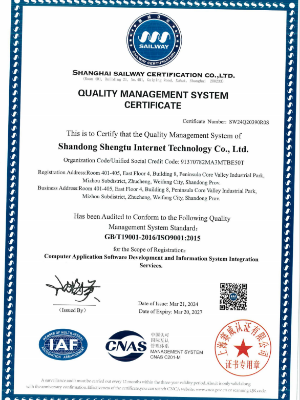
Because the platform touches plant networks, information security is treated as an equipment property rather than an IT afterthought. Information-security responsibilities and relevant company records are reviewed for the project.
ISO/IEC 27001
ISO 9001
“We instrument the line so that the first diagnostic conversation is about a specific station and a specific parameter, not about whether the customer has tried restarting it. That is the difference between a two-hour fix and a two-week fix.”
What This Line Does Not Do — and Which Line Does
A leafy fresh-cut line is a specialist machine. Buying it for the wrong crop is the most expensive mistake in this category, so here is the boundary in plain terms.
Process
On this line?
Where it belongs
Peel root crops (carrot, potato, beet)
No
Root vegetable washing and peeling line — a washing peeling combination built on a brush-roller peeling machine, with different wash geometry
Dice or cube firm vegetables
No
Firm-vegetable cutting line built around a vegetable dicing machine; a dicing machine indexes the product against the blade, which a leafy cutter does not do
Blanch before freezing
No
Blanching and individual quick freezing line — a vegetable blanching machine using steam or water, then bubble cooling
Produce frozen vegetable product
No
Freezing line downstream; this line ends at a chilled ready-to-eat end product
Optical sorting by colour or defect
Not standard
Available as a separate module; optical sorting machines sit ahead of packing, whereas the standard station 7 here is a manual inspection conveyor
Cut cucumber, pepper and other fruiting vegetables
No
A multifunctional vegetable cutting machine with a chopping machine head; leafy blades shear the leaf rather than chop it, so the two cutters are not interchangeable
Dry to flake or powder
No
Vegetable drying and powder processing line — a hot-air drying machine and a mill, not the centrifugal dryer used here
Wash whole fruit alongside leaf
No
Fruit and vegetable cleaning line — a general fruit and vegetable processing layout runs a different sanitiser regime
Handle fresh cut fruit
No
Fruit processing line — different sanitiser chemistry and far higher sugar load in the wash water
One practical warning before you compare quotations: the same equipment is listed under a dozen names. A vegetable cleaning processing line, a vegetable washing processing line and a clean vegetable processing system are usually the same washing equipment with no cutting station at all, and a drying processing line is normally a dehydration line rather than a fresh-cut dryer. Read the station list, never the product title.
Adjacent technologies
Adjacent technologies are genuinely different machines, not settings. Ultrasonic vegetable washing, for example, is its own patented field – see WO2004004934A1. If your crop needs it, you need that machine, not a longer dwell time on this one.
Scope is a specification
Scope is a specification, not a disclaimer: Buying the wrong line is the costliest mistake here, because a peeling machine and a leafy washing machine differ in geometry rather than settings, and a 12 mm brush roller will bruise baby leaf in production. We will tell you when the answer is a different line, and SHENGTU has done so for years.
Certifications and What We Can Document
Certificates matter to your auditor, not to us. What follows is what actually ships with a SHENGTU vegetable processing line, so you can check it against your own audit checklist before you order.
Item
Scope
Provided
ISO 9001 quality management
Company-level manufacturing and servicing processes
Certificate copy
ISO/IEC 27001 information security
Relevant to STUnit connectivity and plant network integration
Certificate copy
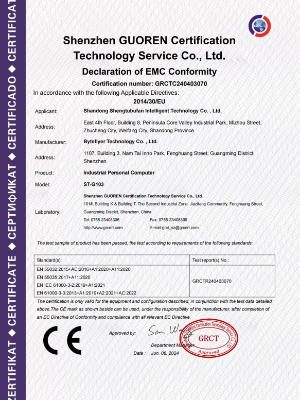
CE marking
Food machinery supplied into applicable markets
Declaration of conformity
Food-contact material declaration
304 stainless steel product-contact surfaces
Material certificate
Electrical and control documentation
Wiring schematics, PLC and touchscreen operation manual
Full set with the machinery
Company technical standing
Over 100 R&D projects, over 100 software copyrights, 7 patents; DCMM Level 2; SRDI SME
Company documentation
Request the Certification Pack
Request the applicable company records, conformity declaration and material documents for your model, configuration and destination.
What an auditor actually opens: Certificates fail an audit when they cannot be tied to the machine on your floor, because the gap is traceability rather than paperwork volume. Our document set is issued against the serial number of your line.
Request the detailed certification pack
Company records: Request the current holder, scope and validity details.
Equipment conformity: Confirm the documents for the model, configuration and destination country.
Order documents: Agree inspection records, manuals, drawings and shipment paperwork in the contract.
Delivery, Installation, Training and After-Sales
The most common objection we hear about imported food processing machinery is not price. It is what happens on the day the line stops and the supplier is eight time zones away.
Our commitments
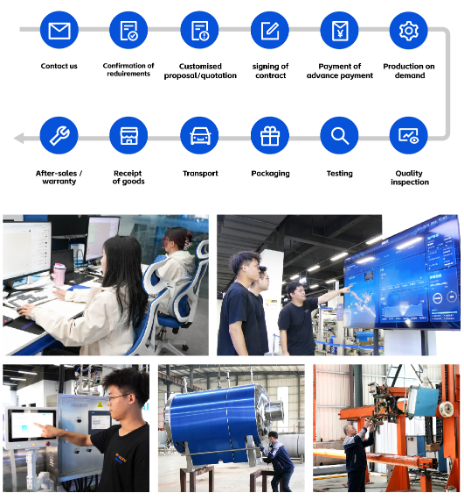
- 01 First reply, preliminary diagnosis and engineer dispatch are scoped in the service terms, with timing confirmed in the quotation and contract.
- 02 Remote diagnosis before dispatch, so the engineer arrives knowing which station failed.
- 03 On-site installation and commissioning, followed by operator and maintenance training delivered on your line, not in a classroom.
- 04 Spare parts logic – because the same washing system runs at stations 1, 3 and 4, your critical spares list is shorter than the station count suggests.
- 05 Documented lead time per tier, stated in weeks at quotation.
- 06 Servicing obligations are part of what an ISO 9001 quality management system is audited against, which is why our after-sales process is documented rather than discretionary.
Leafy Fresh-Cut Line Tools
What equipment is included in a leafy fresh-cut line?
A complete processing line runs eight stations: a pre-wash tank, a vegetable cutting machine, two further washing stages, vibrating dewatering, an air drying tunnel with an optional centrifugal dryer, an inspection conveyor, and a weighing and packing machine. Control cabinet, wiring and documentation are part of the delivery, not an extra.
Which crops can it process?
The core application is the FDA leafy-greens group: iceberg, romaine, leaf and butter lettuce, baby leaf, spring mix, spinach, cabbage, kale, arugula, chard, escarole and endive. Celery, leek and soft herbs are processed with configuration changes and reduced air velocity.
Is the capacity customisable?
Yes. Three standard tiers at 500, 1,000 and 2,000 kg/h, and the tier is chosen from your cold-chain and packing capacity rather than from the maximum figure alone. Modules can be added later if you start semi-automatic.
How much floor space does the vegetable processing line need?
Footprint, service clearance and minimum ceiling height are stated per tier in the quotation, together with drainage positions and floor gradient. We issue a layout drawing before anything is ordered so your civil contractor can work from it.
Does the vegetable washing stage eliminate microorganisms such as E. coli and Listeria?
No — and any supplier who says otherwise is selling you a risk you have not priced. Peer-reviewed guidance (Gombas et al., 2017) describes wash-water antimicrobials as a critical control for preventing water-mediated cross-contamination across the batch, not as a kill step. Your actual pathogen controls are incoming raw material quality and cold chain discipline at or below 41 °F (5 °C).
How is residual moisture measured, and what is the right target?
There is no single correct percentage across all crops. Target moisture is a band that differs between baby leaf and cabbage, and it should be stated for your crop with the measurement method attached. Drying to zero costs saleable weight and wilts the leaf.
Should I choose full automation or semi-automatic?
Semi-automatic suits a mixed crop range, variable daily volume and market entry. Full automation suits a narrow crop range with contracted, stable, multi-shift volume. Starting semi-automatic and adding modules is a legitimate strategy, not a compromise.
How much time does crop changeover cost?
Changeover consumes a meaningful share of the shift at the entry tier and less at higher tiers where recipes are pre-built into the control system. The realistic figure depends on your crop sequence, and we state it against your specific mix rather than as a generic number.
Can I expand this into a complete line later?
Yes. Modified atmosphere packing, optical sorting and additional dewatering capacity are module additions rather than a different processing machine. Because the line is built on the STUnit platform, added modules join the existing control and diagnostics environment rather than sitting outside it.
Does the line meet international food safety standards?
Applicable certificates and documents are confirmed for the equipment model, configuration and destination country. Company management-system records are reviewed separately from product conformity documents. Agree any required conformity declaration and food-contact material records in the order scope. Food safety outcomes, however, are a function of your process controls as well as the equipment — which is why we supply the process documentation your auditor will ask for.

![F&V Freeze-Drying Line Process Guide [2026]](https://shengtumachinery.com/wp-content/uploads/2026/09/fv-freeze-drying-line-guide-featured-150x150.png)