Get in touch with Shengtu Bufan Company

Mesh-Belt Hot-Air Dryer
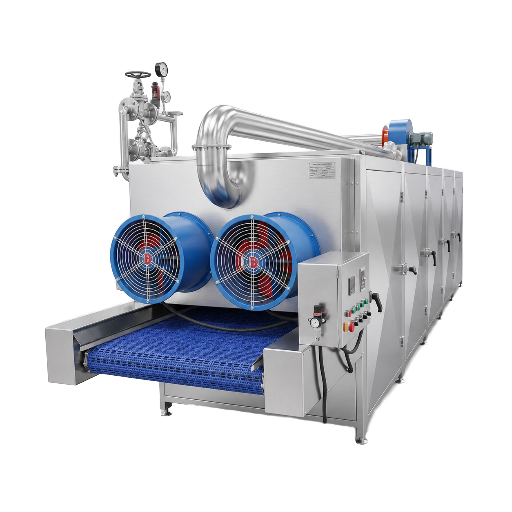
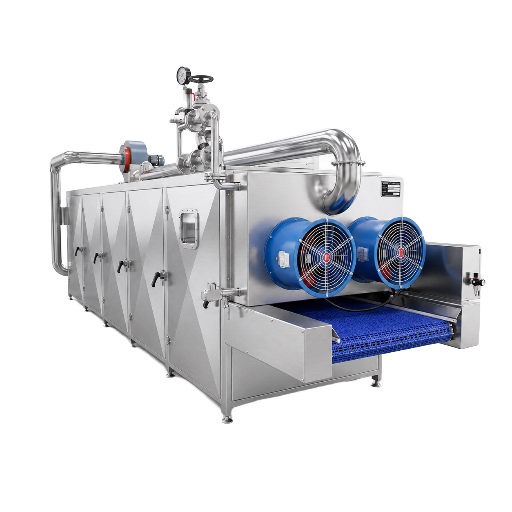
Mesh Belt Dryer for Continuous Food Drying
Engineered proposal and quotation back within 24 hours | One machine ships in 30–40 working days | 50–95 °C controlled hot air (122–203 °F) | Minimum order is one machine
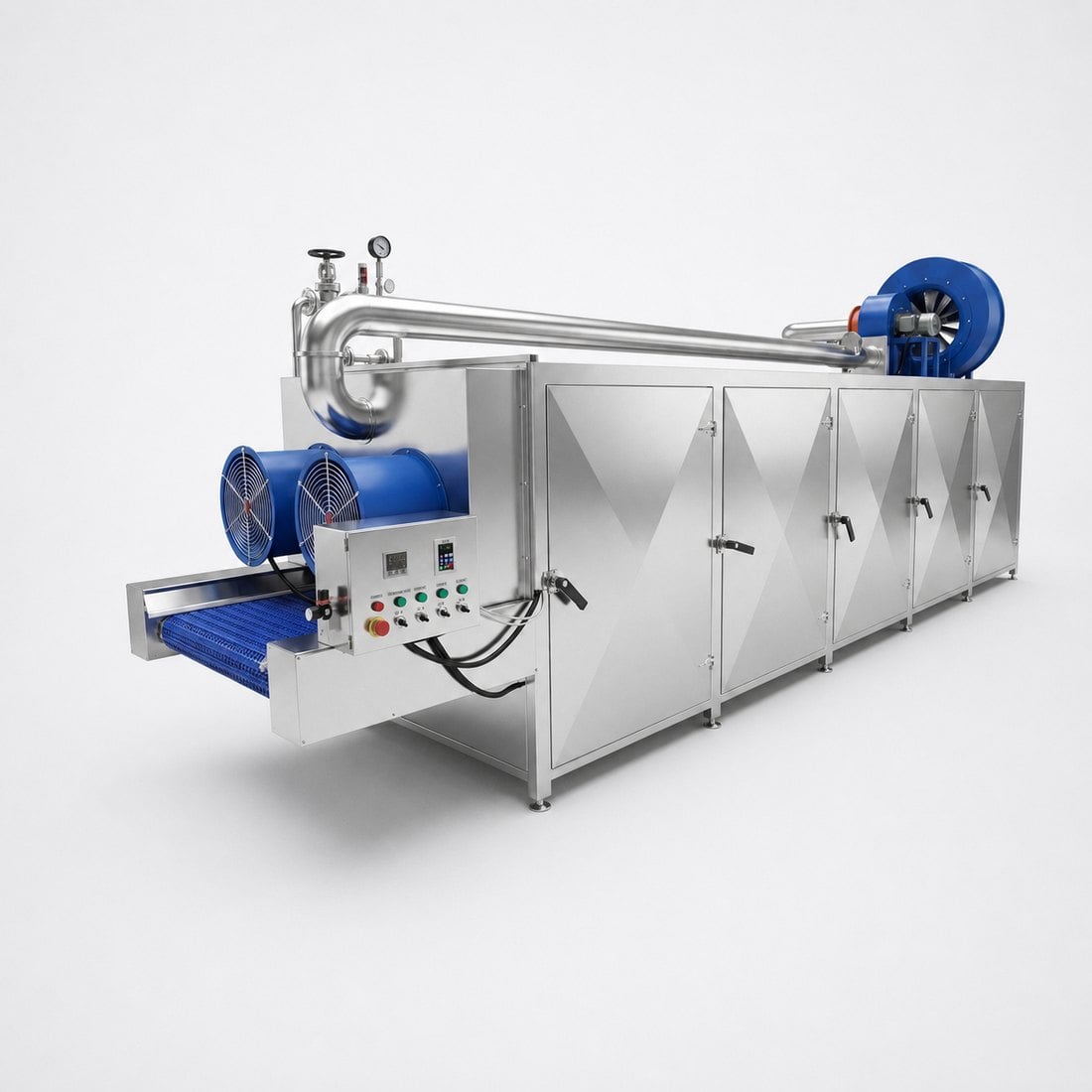
Wet product travels through an enclosed tunnel on a perforated stainless belt while heated air is forced through the bed. Shengtu builds these as continuous food processing machines: fruit and vegetable slices, meat and pet treats, seafood, herbs, tea and agricultural produce. Send the product, the throughput and the moisture numbers, and the Belt-Dryer Envelope below tells you whether it belongs on a belt at all — after which you get a configuration rather than a catalogue page.
Get a Quote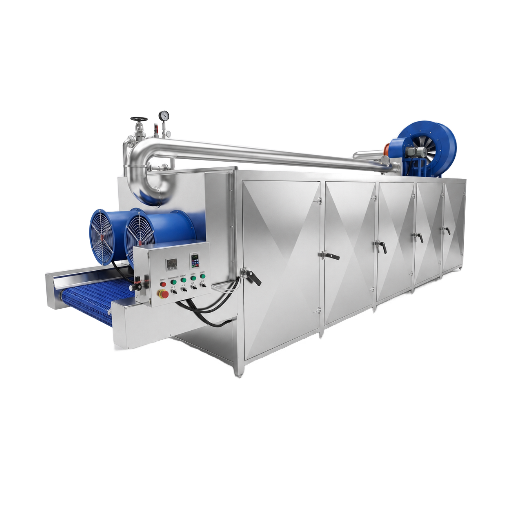
The Belt-Dryer Envelope
Most drying enquiries fail on fit, not on size. The Belt-Dryer Envelope is the four boundaries that decide whether a mesh belt dryer is the right machine for your product at all, before anyone talks about layers or throughput.
Product Form
Inside the envelope
Pieces that hold their own shape on a perforated belt — slices, dices, strips, shreds, granules, small whole items.
Outside it
Slurries, pastes, purees and anything that flows through or blinds the mesh.
Where it goes instead
Drum, spray or vacuum belt drying.
Bed Depth & Air
Inside the envelope
An even layer thin enough for heated air to pass through the whole bed.
Outside it
Deep or matted beds where the top dries while the bottom stays wet.
Where it goes instead
Split the load across more belt layers, or reduce the layer depth.
Temperature Ceiling
Inside the envelope
Product that tolerates continuous hot air between 50–95 °C (122–203 °F).
Outside it
Heat-labile actives, volatile aromatics and structures that collapse above the low band.
Where it goes instead
Freeze-drying route or a longer run at the bottom of the band.
Moisture Endpoint
Inside the envelope
Conventional dehydration to a storage-stable water content.
Outside it
Very low residual moisture, or a porous structure that must rehydrate to its original shape.
Where it goes instead
Freeze-dried and quick-frozen routes.
Rows are independent. A product can sit comfortably inside three boundaries of the envelope and still be pushed out by the fourth, which is why the answer arrives as a configuration and not as a model number. Only once a product is inside all four does its target moisture content become a sizing question.
How the Machine Works
01
Product is spread evenly onto the mesh belt at the infeed, either by hand or from an upstream conveyor.
02
The belt carries it through an enclosed tunnel divided into independently controlled heating zones.
03
Hot air is forced through the product bed rather than across it, so moisture leaves from inside the piece outward.
04
Humid air is exhausted, and the dried product discharges continuously at the far end.
05
Three levers hold the moisture endpoint in production, and an operator works all three together: belt speed, zone temperature and air volume.
System Capabilities & Applications
Check your product against the Belt-Dryer Envelope
An interactive fit test that walks the four boundaries with your own product in mind and tells you which route it belongs on.
Products a Mesh Belt Dryer Runs
No single drying machine suits every food, and each product family behaves differently in a belt tunnel. Select a product family below to compare its processing route.
One Counter-Intuitive Fact Worth Knowing Before You Dry Meat
The common assumption is that hours of hot air must also make the product microbiologically safe. The physics says otherwise, and the reason is evaporative cooling.
“Within a dehydrator or low-temperature oven, evaporating moisture absorbs most of the heat. Thus, the meat itself does not begin to rise in temperature until most of the moisture has evaporated.” — USDA Food Safety and Inspection Service, Jerky and Food Safety
FSIS recommends heating meat to 160 °F and poultry to 165 °F before the drying process, because that is where the lethality happens.
Its guidance then asks for a constant 130–140 °F during drying, so the load dries before it spoils.
Work published in the Journal of Food Protection in 2004 found E. coli surviving drying times of up to 10 hours at temperatures up to 145 °F.
Drying and lethality are not interchangeable, which is why the acceptance criteria for that step belong to your destination-market food-safety owner and not to the machine builder.
Another product
Send the product name with your inlet and outlet moisture targets and your throughput, and we will confirm in the quotation whether it belongs in a belt tunnel and which configuration fits.
Heat Sources, Air Handling & Hygienic Construction
The reference configuration is steam-heated. Electric, natural gas and heat-pump heating are selectable alternatives, and the choice changes both the installed load and the running cost.
Heat source is therefore one of the few specification decisions that keeps costing money every day the machine runs, which is why it is fixed against your utilities rather than against a default.
10%
of total energy consumption in the food sector is driven by drying.
— 2025 Assessment of US Industry
Equipment Options
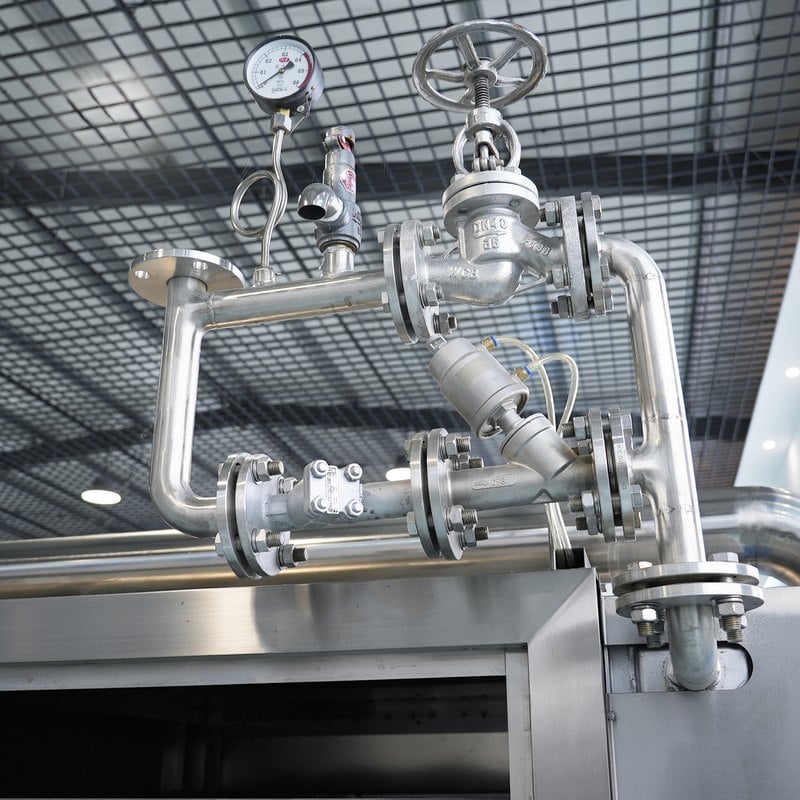
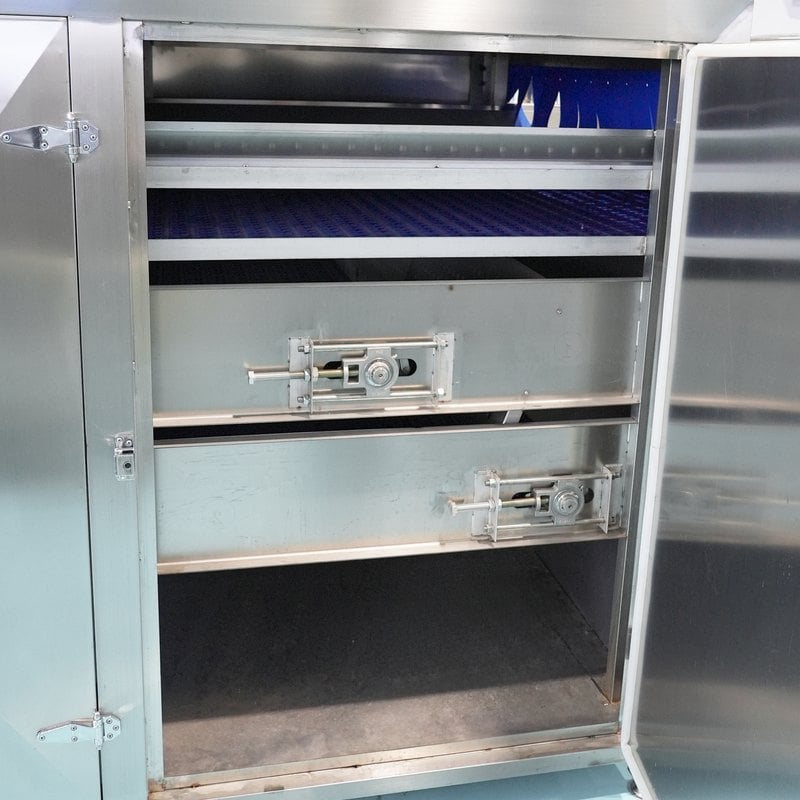
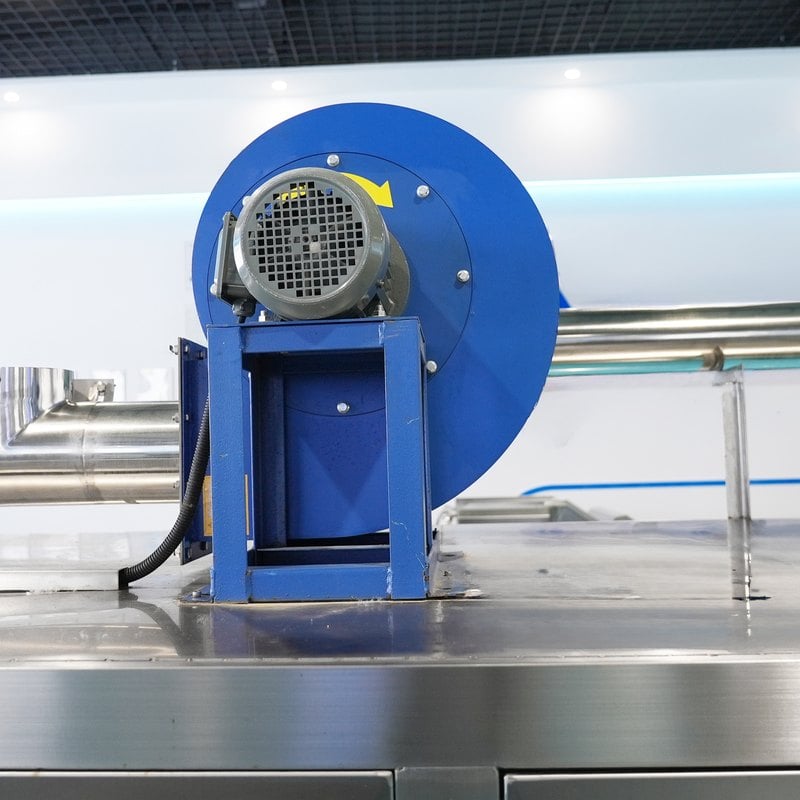
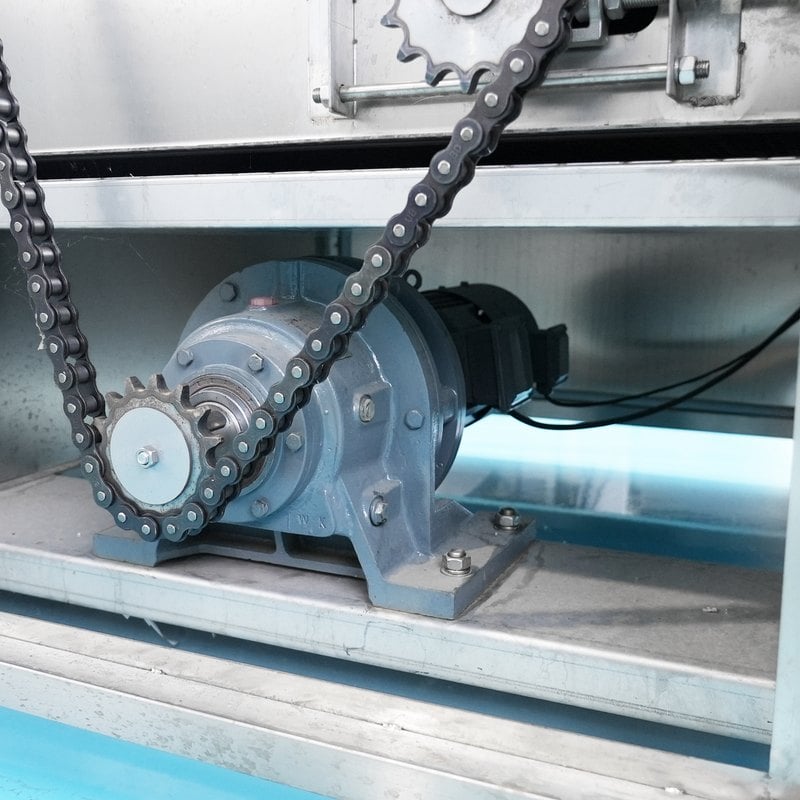
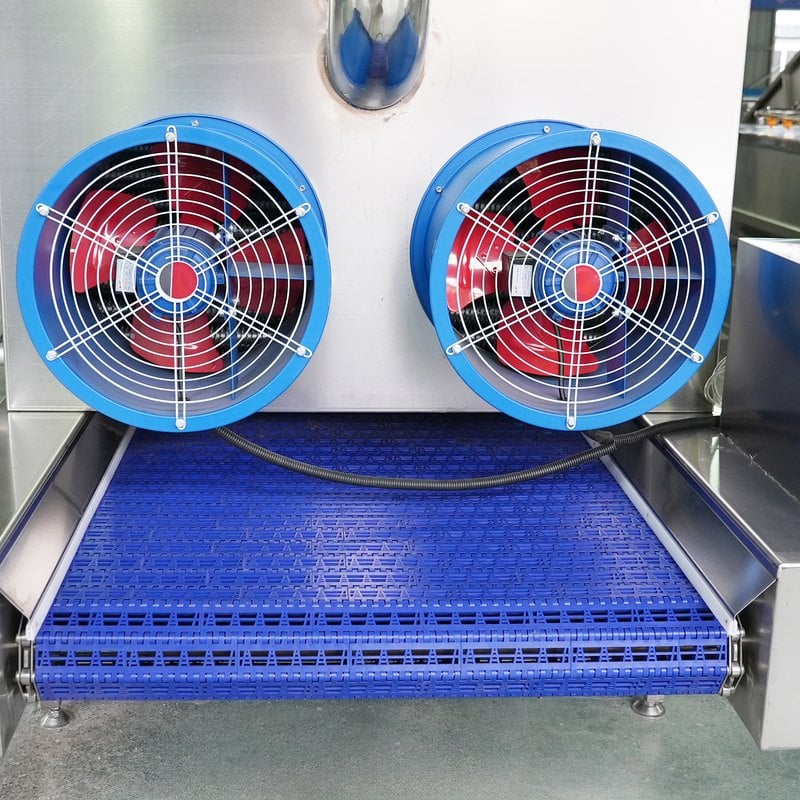
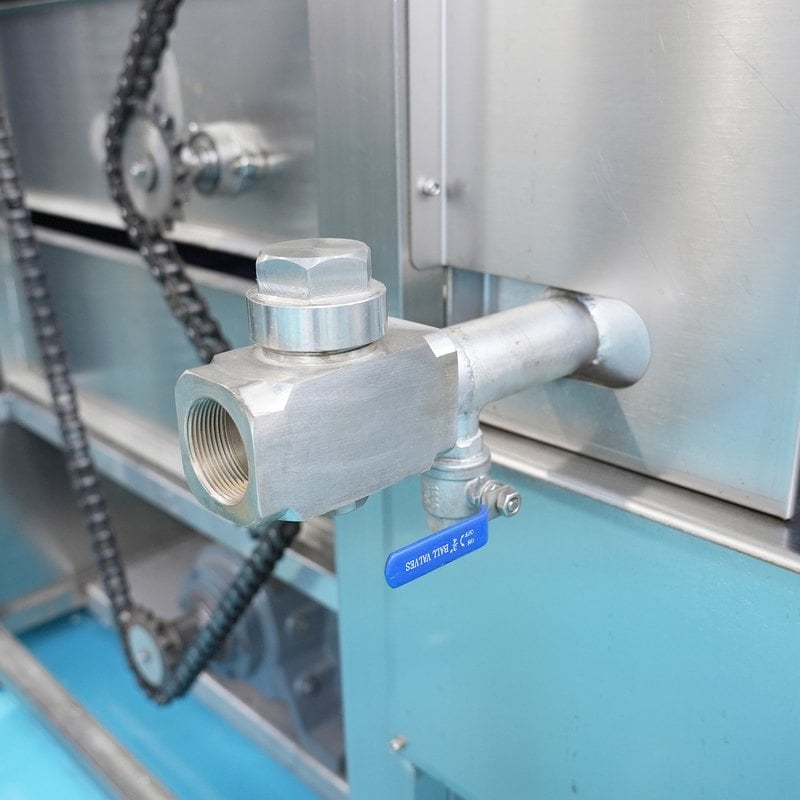
Hygienic Construction
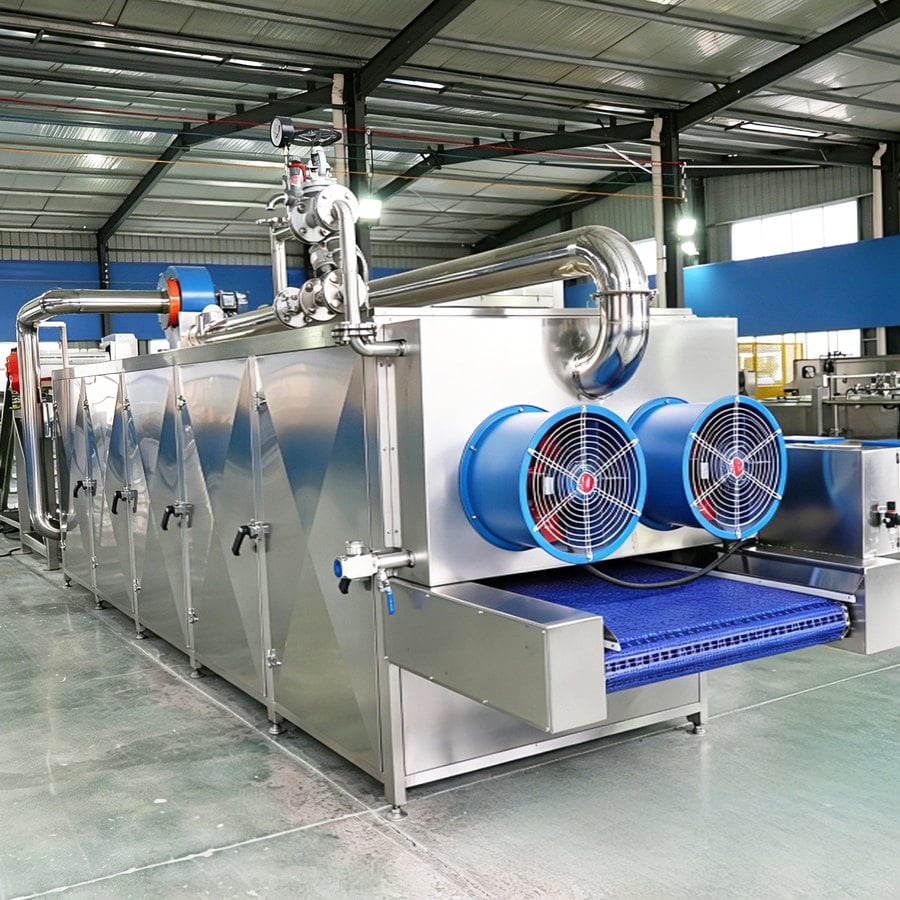
SUS 304 stainless steel is the standard build for the frame, panels and contact surfaces.
SUS 316 is available where salt, acid or aggressive cleaning chemistry is part of the daily routine.
Belt material is stainless mesh or polyurethane, chosen by product contact and cleaning method.
Panels open for inspection so the belt run, the plenum and the fans can be reached without dismantling the tunnel.
The dryer can be tied into an existing CIP cleaning system where the wider line already runs one.
United States food regulation states the principle this construction answers to: equipment must be adequately cleanable, installed so that cleaning and maintenance are practical, and made of corrosion-resistant, non-toxic materials suited to the intended use, with conveying and automated systems held to the same requirement.
Mesh Belt Dryer Specifications
The figures below describe the reference steam-heated configuration. Belt width, length, layer count and heating are all set against your throughput and moisture numbers at drawing stage.
| Specification | Reference configuration |
|---|---|
| Drying method | Continuous through-circulation hot air on a mesh belt |
| Mesh belt width | 1,000 mm (39.4 in) |
| Number of belt layers | Set against throughput and available floor space |
| Drying air temperature | 50–95 °C (122–203 °F) |
| Drying time | 6–15 hours; the position inside that band is set by the product and the moisture target |
| Heat source | Steam on the reference build; steam, electric, natural gas or heat pump selectable |
| Total installed power | 14.25 kW electrical, excluding the steam plant |
| Supply voltage | 380 V / 50 Hz |
| Overall dimensions | 6,000 × 1,500 × 3,200 mm (236 × 59 × 126 in) |
| Conveyor belt material | Stainless steel mesh or polyurethane |
| Machine material | SUS 304 as standard, SUS 316 on request |
| Air circulation | Self-circulating hot air with zone-level air volume adjustment |
| Control | Electrical control with independent zone temperature set points |
| Standard lead time | 30–40 working days for one machine from drawing approval |
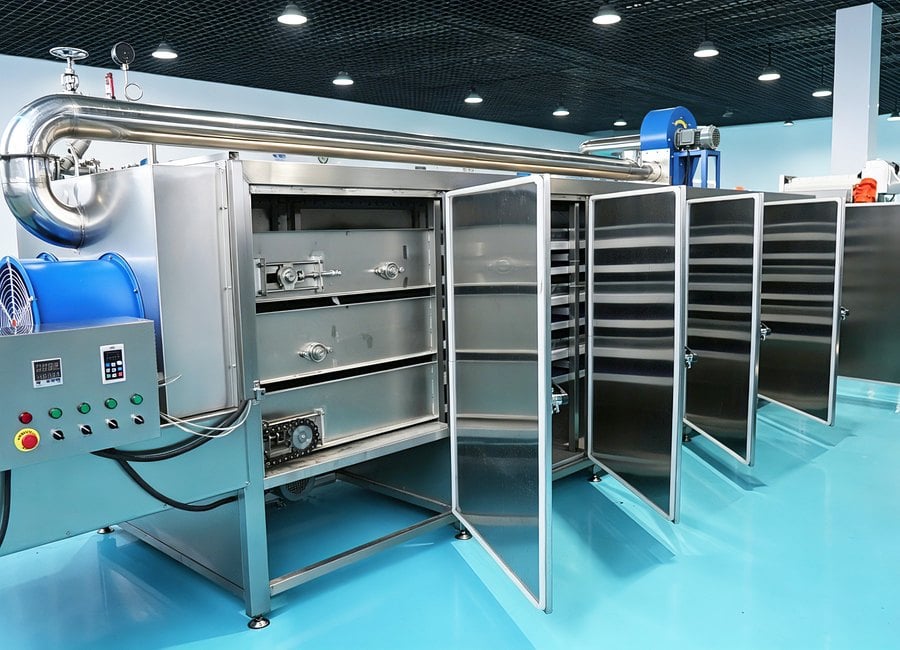
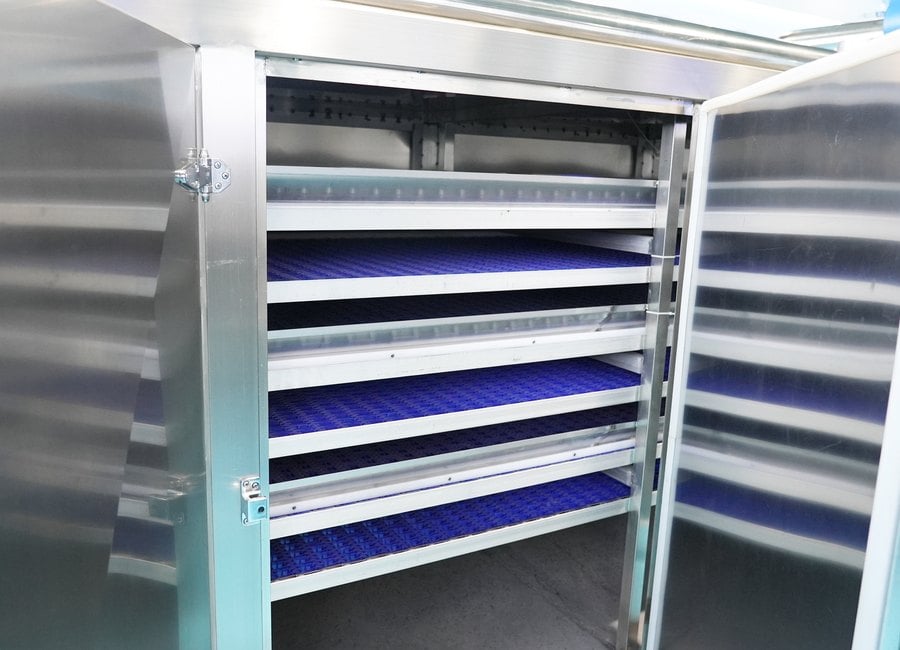
Click to Swap
Size the water load
Throughput alone does not size a dryer. This estimator converts your production rate and your two moisture figures into an hourly evaporation duty, which is the number a configuration is actually built around.
Get a QuotePricing and Lead Times
There is no mesh belt dryer price list, because the machine is built to a product rather than to a catalogue. Your figure comes back in a written quotation, and these are the levers that move it.
A used mesh belt dryer is the obvious alternative, and sometimes it is the right one.
The trade-off is that a second-hand tunnel was sized for someone else’s water load, and re-sizing the belt area of an existing machine costs more than the discount saves.
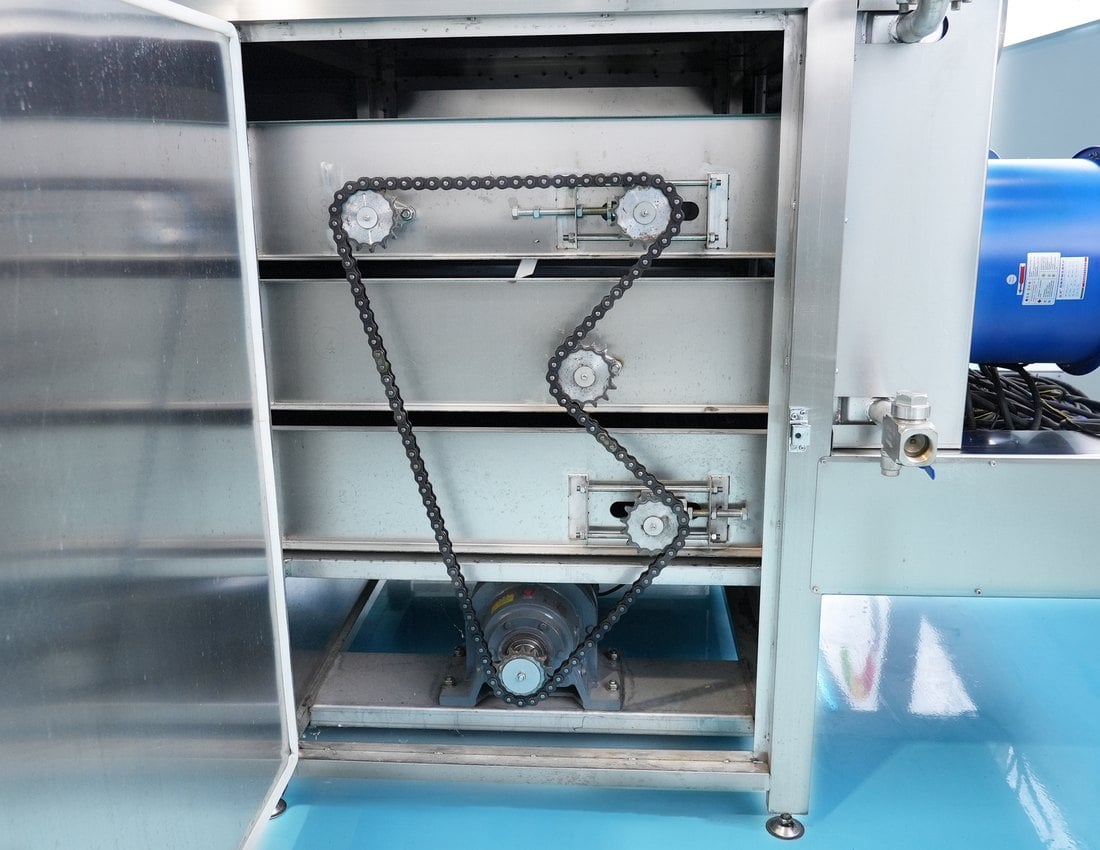
Levers That Move Your Price
| Driver | Effect on cost | How to bring it down |
|---|---|---|
| Hourly water load | The real size driver. Throughput multiplied by the gap between inlet and outlet moisture sets how much water has to leave per hour, and that sets drying area. | Remove free water upstream with a dewatering or centrifugal step before the dryer sees it. |
| Drying area and layer count | Area is belt width times length times layers. More area means more steel, more fans and more floor. | Stack layers instead of extending length when floor space is the tighter constraint. |
| Heat source | Capital and running cost pull in opposite directions. Electric is cheapest to install and usually dearest to run; a heat pump reverses that. | Choose against your local energy price and against the steam capacity you already have. |
| Material grade | SUS 316 contact surfaces cost more than SUS 304 and are worth it only where the chemistry demands it. | Specify 316 for the contact side only, rather than the whole machine. |
| Automation and integration | Automatic feeding, discharge handling, recipe control and interfacing to neighbouring stations each add scope. | Fix the mechanical boundary first and add control scope in a second phase. |
How Your Quotation Is Produced
Send us the five inputs below and an engineer returns a quotation within 24 hours, together with an equipment proposal, a factory layout suggestion and an energy consumption estimate. There is no automatic quoting engine behind this page, and that is deliberate: a drying configuration that has not been read by an engineer is a guess.
Your product
Target throughput in kg/h
Inlet and outlet moisture targets
Heat source available on site
Floor space you have for the machine
Quality Control and Inspection
Any dryer that has never been run before it leaves the factory is one you will commission twice. Every Shengtu machine is tested loaded and unloaded before packing.
Why Instrument Accuracy Is a Regulatory Question, Not a Feature
Zone temperature is the control that decides whether the product reaches its moisture endpoint, and a drifting sensor is a silent failure: the display reads correctly while the load underneath it does not dry. United States food regulation treats that risk as a compliance matter rather than a preference.
“Instruments and controls used for measuring, regulating, or recording temperatures, pH, acidity, water activity, or other conditions that control or prevent the growth of undesirable microorganisms in food must be accurate and precise and adequately maintained, and adequate in number for their designated uses.”
21 CFR 117.40(f), U.S. Food and Drug Administration
The reason this lands on a dryer rather than on a laboratory is that the dryer is where the condition is created. Shengtu therefore verifies each zone against its set point during the factory heating test, and the same instruments are re-checked during on-site commissioning before the first production run.
How Every Machine Is Checked
- Fabrication check against the approved general arrangement, covering belt tracking, frame squareness and panel sealing.
- No-load run of the belt drive, fans, heating circuit and control system, watching for vibration, leakage and abnormal noise.
- Heating and temperature uniformity test across zones, confirming each set point holds and that neighbouring zones do not fight each other.
- Loaded trial run under simulated production conditions, verifying belt speed control and discharge behaviour.
- Full-machine interlock and safety test, then packing with the fasteners and spares needed for site assembly.
Certifications
Applicable certificates and documents are confirmed for the equipment model, configuration and destination country. Company management-system records are reviewed separately from product conformity documents.
CE
ISO 9001 quality management
ISO 27001 information security
SGS
DCMM Level-2
Acceptance is written before the machine is built, not argued afterwards. If a checked item falls outside the approved drawing, we rework or remake it against the same written criteria used at the fabrication check.
Company records: Request the current holder, scope and validity details.
Equipment conformity: Confirm the documents for the model, configuration and destination country.
Order documents: Agree inspection records, manuals, drawings and shipment paperwork in the contract.
×
How We Work
01
Send your drying brief
— product, throughput, inlet and outlet moisture, heat source and floor space.
02
Engineering review
— we convert the brief into an evaporation duty and a drying area, and tell you if the product sits outside the envelope.
03
Written quotation within 24 hours
— equipment proposal, layout suggestion, energy estimate, price and delivery.
04
Drawing approval
— you sign off the general arrangement, and the lead time clock starts here.
05
Manufacture and factory testing
— the five checks above, with the loaded trial run recorded on video for you before packing.
06
Installation, commissioning and operator training
— on-site installation supervision and operator training, with the process curve tuned on your own product.
After the Machine Is Running
| What you need | Our commitment | Why it is written down |
|---|---|---|
Someone answers |
Initial response timing confirmed in the service terms | A silent supplier is the single most expensive failure mode in imported equipment |
A path forward |
Diagnostic review and remedy timing confirmed in the service terms | Most stoppages are settings, wiring or airflow, and can be resolved without a flight |
Someone on site |
On-site engineering support scoped to the fault, location and agreed service terms | Dispatch is the promise that matters once remote support has been exhausted |
Parts, not promises |
Spare-parts availability and dispatch arrangements confirmed per order | Wear items are the mesh sections, the bearings and the heating elements, and distance is the enemy |
Cover |
Warranty duration, coverage and exclusions are confirmed in the quotation and contract | Review the written duration, coverage, exclusions and claim procedure before ordering |
Build your drying brief
A short guided form that turns the five inputs into a complete enquiry you can send to us or to anyone else. It is the same brief our engineers work from.
Mesh-Belt Hot-Air Dryer Engineering Tools
Evaluate, estimate, and build precision briefs for your production requirements.
Belt-Dryer Envelope Check
Four boundaries decide whether a mesh belt dryer is the right machine for your product. Answer them and the check tells you which route your product belongs on, before anyone talks about model numbers.
Run Check
Water-Load Estimator
Throughput on its own does not size a dryer. What sizes it is how much water has to leave every hour. This estimator converts your production rate and your two moisture figures into that number, using the mass balance and nothing else.
Calculate Load
Drying Brief Builder
Five answers are enough for an engineer to size a mesh belt dryer. This builder turns them into a complete written brief you can paste into an email — to us, or to anyone else you are comparing. It is the same brief our engineers work from.
Build Brief
FAQs About Mesh Belt Dryers
Product is spread on a perforated belt that carries it through an enclosed tunnel split into heated zones. Heated air is forced through the bed rather than across it, and humid air is exhausted while dried product discharges continuously at the far end.
Cabinets dry a fixed load and then stop so they can be emptied and refilled. A belt dryer runs without stopping, so the same daily output is achieved with less handling labour and a steadier product, at the cost of a machine that only earns its keep when it runs.
50–95 °C (122–203 °F) on the reference configuration, with each drying zone holding its own set point. Most food runs sit well below the top of that band; the ceiling matters mainly for wet, heat-tolerant feedstock.
6–15 hours on the reference configuration. Where a given product lands inside that band is set by the piece size, the starting water content and the moisture endpoint you need.
Steam, electric, natural gas or a heat pump. Steam is the reference build; the others are selected against the utilities you already have and your local energy prices.
Three things account for most of it: an uneven bed depth at the infeed, air short-circuiting through a thin patch instead of passing through the whole load, and a zone set point fighting its neighbour. All three are set-up problems rather than machine defects, which is why the loaded trial run and the on-site commissioning both exist.
Case hardening is a dry crust forming on the outside of a piece early in the run, sealing water inside. A zoned temperature profile that starts gentler and finishes cooler is the standard answer, together with a shallower bed so air reaches the whole piece.
Panels open so the belt run, plenum and fans can be reached without dismantling the tunnel, and the contact surfaces are SUS 304 as standard. Where the wider line already runs one, the dryer can be tied into your CIP cleaning system.
No. Drying is a dehydration and stabilisation step, not a lethality step. For products such as jerky the lethality treatment sits before the dryer in your process, and both the process definition and the acceptance criteria belong to your destination-market food-safety owner.
Five things: your product, your target throughput in kg/h, your inlet and outlet moisture targets, the heat source available on site, and the floor space you have. With those an engineer returns a quotation within 24 hours along with a layout suggestion and an energy estimate.
30–40 working days for one standard-configuration machine and 30–60 working days for a customised or line-integrated dryer, both counted from drawing approval. The minimum order is one machine.
30 % deposit with the balance before shipment, by bank transfer, confirmed in the quotation.
Response times, remote support, on-site service and spare-parts arrangements are confirmed in the quotation and contract. Warranty duration, coverage and exclusions are confirmed in the quotation and contract.
Four of them. Ask for the hourly evaporation duty the machine is sized to, not just a kilogram-per-hour figure; ask which zones hold which temperatures; ask what the lead time is counted from; and ask who performs the acceptance check and against what written criteria. A supplier who answers all four in writing is quoting a machine, and one who answers none is quoting a picture.
Not quite. Industrial food dryer is the category, and it covers batch cabinets, drying rooms, rotary dryers and freeze dryers as well; a continuous belt dryer is one machine inside that category, defined by the fact that product enters and leaves without the machine ever stopping. Whether yours should be one is what the Belt-Dryer Envelope answers.
Yes. Working height, discharge direction, the control interface and the mechanical boundary with the stations either side are all fixed at drawing stage, which is the point at which changes cost nothing.

![F&V Freeze-Drying Line Process Guide [2026]](https://shengtumachinery.com/wp-content/uploads/2026/09/fv-freeze-drying-line-guide-featured-150x150.png)