
Get in touch with Shengtu Bufan Company

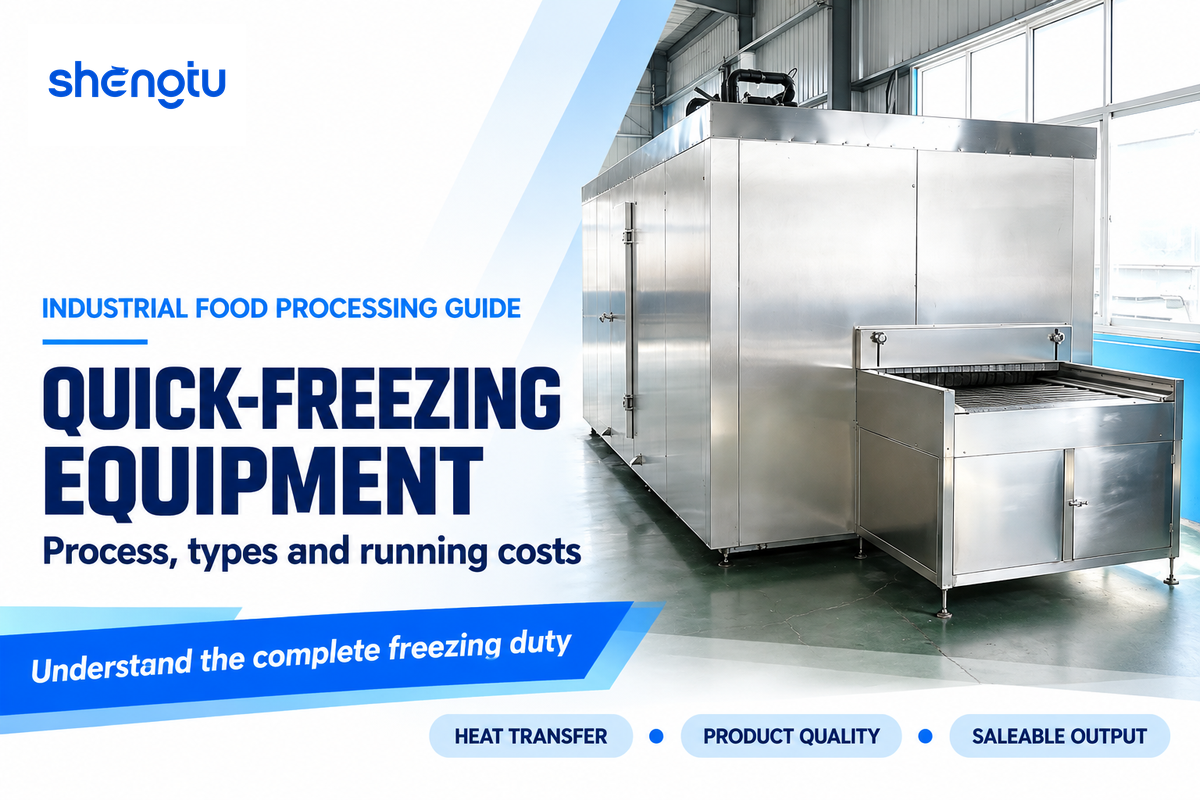
Quick-freezing Equipment removes heat from food rapidly enough to reach a defined frozen state of the product, and minimizes unacceptable changes in texture and handling. The freezer is part of this process. Product preparation, loading, packaging and the cold chain determine whether the frozen output remains useful after it leaves the machine.
By Cherry, SHENGTU · Updated October 2026
Quick-Freezing Equipment rapidly removes product heat through moving cold air, refrigerated contact surfaces or cryogenic media. Judge the result by food temperature, separation, quality and completed output, rather than the freezer’s air-temperature display alone.
Quick guide: industrial food freezing
- Process endpoint: a specified product condition at the thermal centre.
- Equipment families: air-blast, contact and cryogenic systems, with overlapping layouts.
- IQF outcome: individual pieces remain separated.
- Operating comparison: completed, released net food output over the same elapsed period.
Key points
- Freezing duty and frozen-storage duty require different questions.
- Nine useful freezer formats don’t form nine mutually exclusive technologies.
- Residence time, productive running hours and elapsed shift time are different clocks.
- Cost per saleable kilogram needs a consistent weighing point, release condition and energy boundary.
A production manager may see a high hourly rating, a quality manager may see damaged berries, and an engineer may see a coil that needs defrosting. All of these observations may be correct in context to the freezing process. This guide connects the physical freezing process to the output that the factory can actually pack and release.
What Quick-Freezing Equipment Does
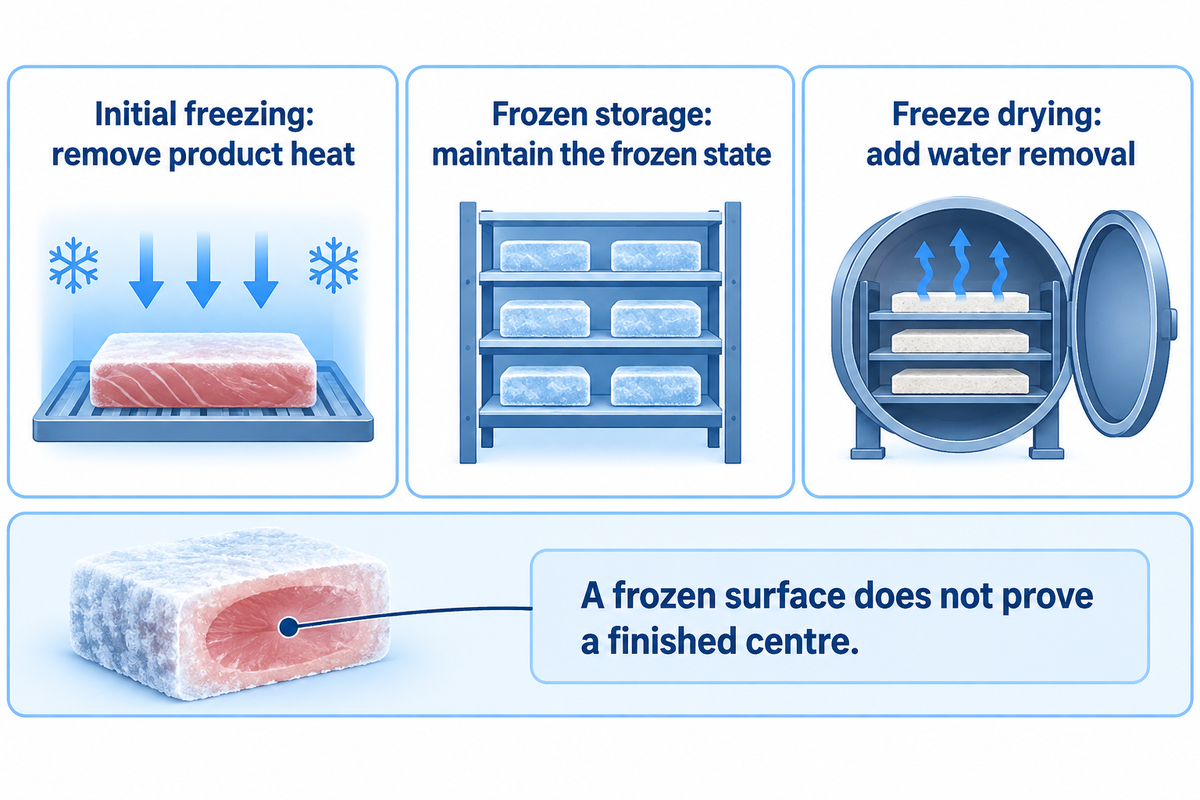
Industrial quick freezers remove sensible heat and the latent heat of fusion to transform the food to a specified frozen state. Frozen storage maintains this state. A freezer designed to preserve food already frozen may not have the heat removal capacity and/or airflow to rapidly freeze a fresh production load.
Calling a machine a fast freezer or flash freezer doesn’t describe its function. These machines are used in the food processing industry to freeze food under a specified function. State what enters, how much heat must leave, and what the finished food must accomplish. Machines that freeze products such as packaged meals, peas, fish blocks and other food products face different surface areas and dimensions and require different ways of handling even when their intended storage temperatures match.
The inspected Codex code for quick-frozen foods, revised in 2008, describes completion at −18°C or colder at the thermal centre after temperature stabilization. Its definition of thermal centre is the warmest point at the end of the process. Air sensor, surface and geometric center are all different measurement questions.
A blast chiller serves a chilling duty; a freezer serves a freezing duty. A machine sold for both would require evidence of each operating mode. Also freeze drying removes water by further drying. Reaching a frozen state doesn’t make a food product shelf-stable.
- Before freezing, identify food condition, preparation and incoming temperature.
- During freezing, follow product temperature and the heat-transfer path.
- After freezing, protect the product during packing, storage and dispatch.
After the process boundary is defined, the solutions section of SHENGTU’s quick-freezing equipment solutions page is useful for defining the equipment scope for the particular line.
How Food Freezes: Heat Transfer and Ice Crystals
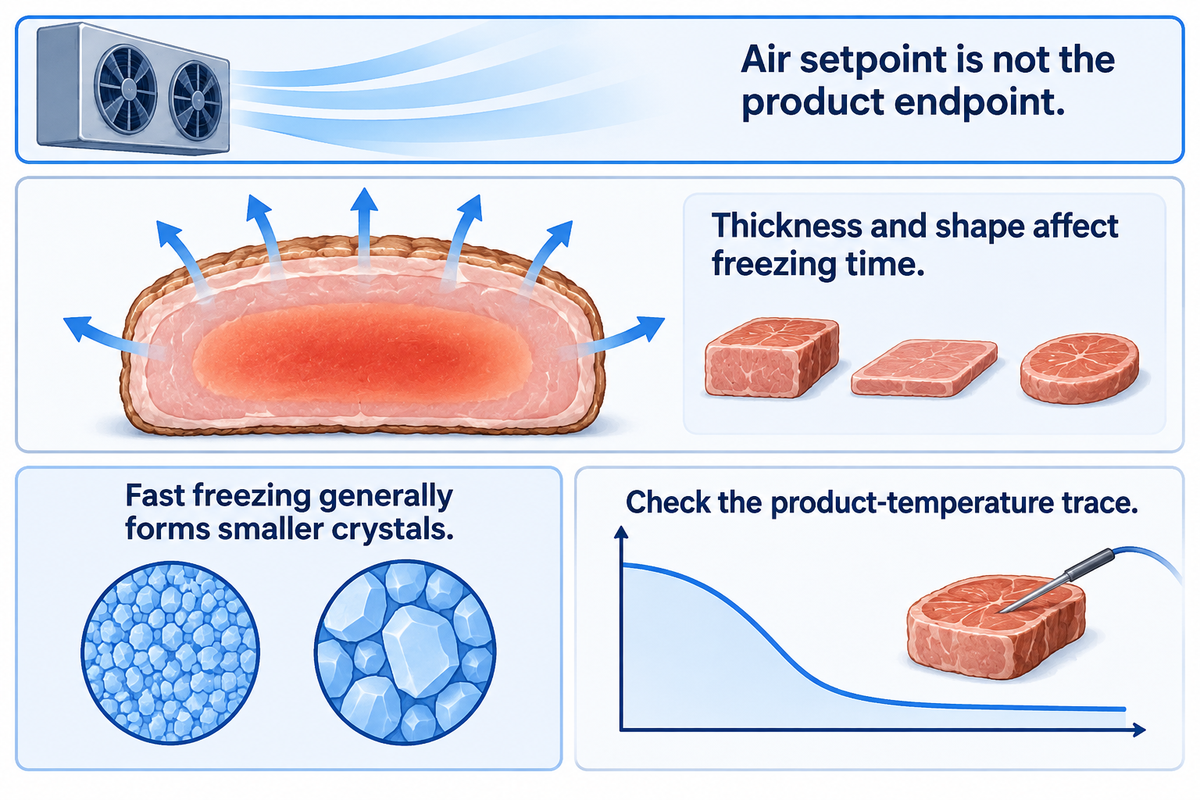
In freezing of food, the state and composition of constituents influence the path of freezing. Food can’t be modeled as a pure medium. Therefore, the temperature range where ice crystals form isn’t the same for all foods. Also a low air set point doesn’t show how quickly heat leaves the product’s slowest cooling region.
The FAO manual on freezing fruits and vegetables mentions that the initial and final temperatures, as well as the shape and thickness of food are factors affecting the time required for freezing. Freezing of food isn’t as simple as flat phase-change freezing of pure water.
The initial freezing point and temperature range of maximum ice crystal formation are impacted by water content and dissolved solids. Fast freezing generally results in smaller crystals than slow freezing. The formation of large ice crystals can damage cell structure of the food and may account for some of the changes observed after thawing. While this explanation is useful, it doesn’t establish a universal crystal size, freezing time or a guaranteed freshness for any product.
In Cheng and colleagues’ 2023 chestnut-kernel experiment, nitrogen and still air each at −40°C ambient temperature produced different passage times through the main ice-formation stage. As reported in Table 1, time required to complete this stage in still air and with nitrogen was 1,429 seconds and 1,063 seconds, respectively. The result concerns those samples and treatments; it is not a factory-capacity or energy-saving percentage.
Engineering note: measure the product with the appropriate instrument
The inspected Codex code’s Annex, section 3.1.1, recommends product-temperature system accuracy of ±0.5°C over −20°C to +30°C and display resolution of 0.1°C. Those are measurement-system recommendations, not permission for a process deviation. Sensor placement, calibration and stabilization still matter; an air-reading specification doesn’t establish product-probe performance.
For a thicker patty or a packaged prepared food, the outside can become firm while the thermal centre remains warmer. Check dimensions, loading and the temperature trace before shortening residence time. Similar issues that occur during the forming and cooking stages along a meatball, fishball or patty processing line will also impact what’s available to the freezer.
Freezing technology manages heat transfer; quality assessment must follow the food. A faster surface freeze can be useful without proving that the full product has reached its endpoint or will retain the same texture throughout storage.
9 Freezer Formats and the Products They Suit
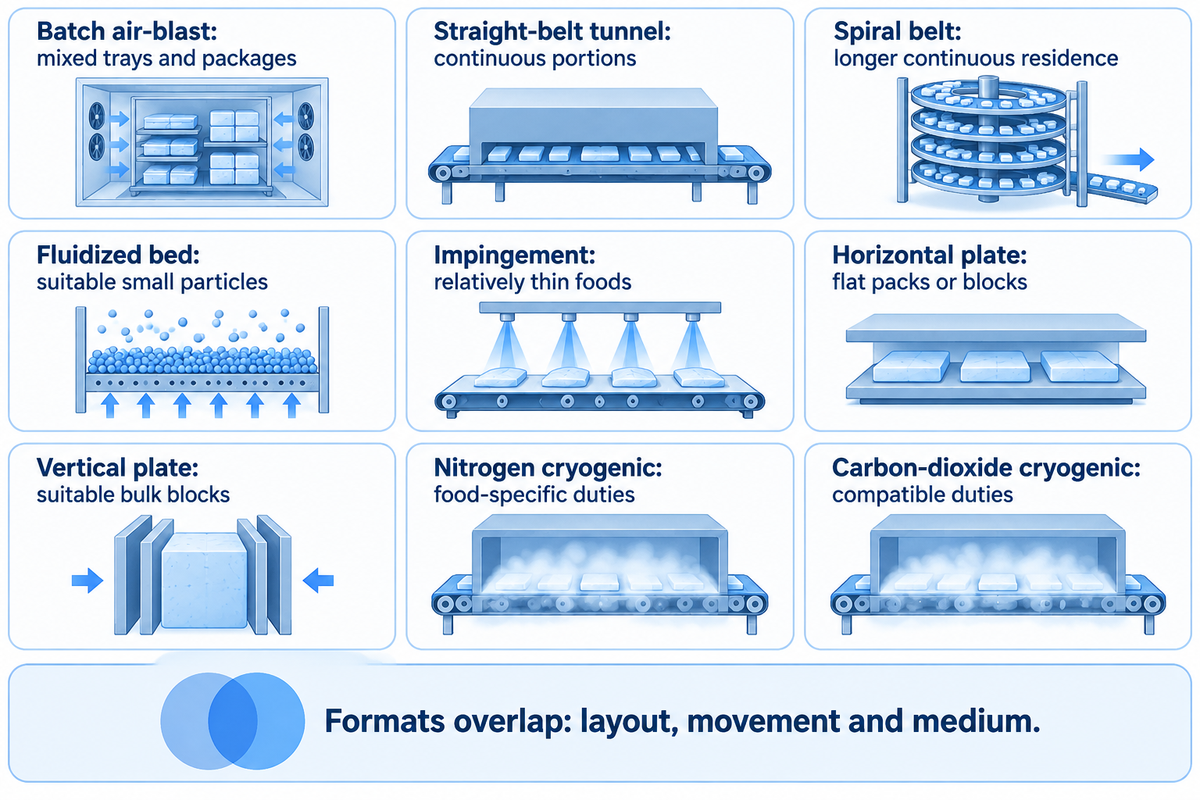
Freezing machines can be grouped by heat-transfer route, product movement, and physical layout. These classifications overlap. A spiral can use different cooling systems, and a tunnel can produce either separated pieces or other product forms. The nine formats below are practical examples of operational technology, and not exhaustive of all available technologies.
Freezing manuals published by the FAO distinguish air, contact, and cryogenic methods. An IQF freezer adds a product outcome to that description: the food is frozen individually and remains separable. This outcome is dependent on the way the product is loaded and handled, not only the shape of the freezing cabinet.
| Format | Heat-transfer approach | Typical task to investigate | Handling question |
|---|---|---|---|
| Batch air-blast | Forced cold air around a stationary load | Mixed trays, packages or irregular foods | Can air reach each loading position? |
| Straight-belt tunnel | Air passes over food on a moving conveyor belt | Continuous portions with a compatible dwell time | Is loading even across the belt? |
| Spiral belt | A long conveyor path arranged vertically | Products needing a longer continuous residence | Are belt support and transfers gentle enough? |
| Fluidized bed | Upward air supports or agitates small pieces | Suitable peas, diced vegetables and similar particles | Can pieces separate without breakage or carryover? |
| Impingement | Directed high-speed jets disrupt the surface air layer | Relatively thin foods with accessible surfaces | Does thickness limit the benefit of surface transfer? |
| Horizontal plate | Refrigerated plates contact regular packages or blocks | Flat packs or controlled block dimensions | Does the package make consistent plate contact? |
| Vertical plate | Product fills spaces between upright plates | Bulk blocks, including suitable fish applications | How are blocks loaded, released and handled? |
| Nitrogen cryogenic | Cold nitrogen gas, spray or immersion | Food-specific crusting or complete freezing duties | Are gas supply, exposure and product stress controlled? |
| Carbon-dioxide cryogenic | Cold gas and solid CO₂ provide cooling | Compatible continuous or batch applications | Are gas supply and ventilation suitable? |
A spiral freezer describes the conveyor arrangement. Fluidized describes product movement in an air stream. Cryogenic describes the cooling medium. Separating those terms simplifies the common types of IQF systems, without assuming that every spiral or tunnel freezer is suitable for processing every food.
Food Engineering’s 2022 technical roundup describes impingement jets directed above and below products such as thin patties and fillets. Better surface heat transfer helps only while the surface resistance is a meaningful constraint; thicker products still need time for internal heat to move outward.
What are the downsides of cryogenic freezing?
Cryogenic freezing depletes the cooling medium, making the economics of delivered gas storage and utilization a key consideration. Very rapid cooling can also create product-handling issues and cracking. Nitrogen and carbon dioxide present exposure concerns, and a proper plant design, monitoring, and training with regard to emergency situations is a must.
The International Institute of Refrigeration’s nitrogen reference covers cracking and supply constraints. Liquid nitrogen’s atmospheric boiling point is about −196°C; that is a property of the medium, not a required food exit temperature. A coauthor of this reference is from the gas industry. Therefore, the examples of application shouldn’t be construed as general operating ratios.
A historical OSHA investigation released in July 2021 described a poultry-plant freezer malfunction in which nitrogen displaced room oxygen. That accident illustrates why cryogenic IQF evaluation includes people and the room, not just product quality. It doesn’t establish a present-day incident rate or supply an entry or rescue procedure.
IQF Separation and Product Quality
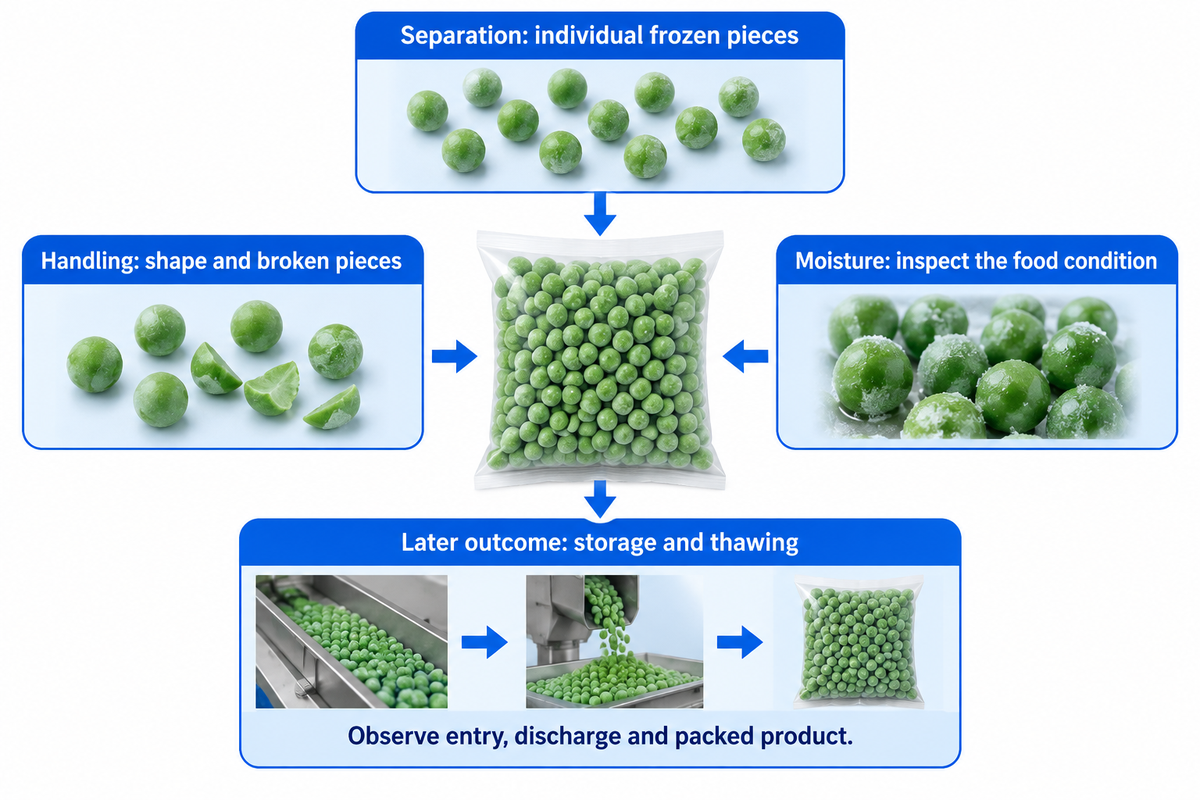
IQF means individual quick freezing: the intended result is separate frozen pieces that can be handled and portioned. Quality of IQF freezing includes separation, shape, breakage, moisture loss and the result of thawing. A product can stay loose in the bag yet still not meet the quality requirement for its intended use.
Which freezer is best for frozen food?
The best freezer for a frozen food is the one that achieves its specified temperature and handling outcome at the required completed output. There are different transfer and handling requirements for foods such as small loose pieces, fragile berries, flat packaged products and bulk fish blocks. The best practice is to first take food duty into consideration, and compare equipment for that particular duty.
When talking about cooling and freezing equipment, for an individual quick freeze it’s important to understand if pieces at first contact are bridged by surface water and if movement damages pieces before their surfaces firm up. An IQF fluidized bed uses airflow to assist separation of suitable particles. FAO’s manual on fruits and vegetables describes a system for tray packing (or similar) of well drained products, and fluidized systems for sticking particles. The preparation step remains part of the result.
Let’s use an example of a pea line that produces clumps, even though the discharge temperature is okay. The operator sees wet peas arrive in occasional heaps rather than a uniform layer. Increasing rapid freezing speed doesn’t, by itself, explain where the bridges are forming. Start with the drainage, feeding and separation around the inlet, then compare the frozen pieces after packing. If the product leaves in a separated state, but is found to be clumped later, we look into the cold-chain and packing. This is an observation sequence, not a customer case or a prescribed machine setting. The advantage of IQF happens only when the output is separated for the entire journey.
- Record clumps or free-flowing pieces at a defined point.
- Inspect broken pieces, fines and belt marks.
- Assess the food after the intended storage and preparation route.
The FDA’s freezer guidance discusses the differences between preservation and continued quality retention. Freezing does not restore raw material to an acceptable state or make packing irrelevant. An IQF label should lead to a verifiable product state, as opposed to serving as a proxy.
Read Capacity Through a 3-Clock Freezing Ledger
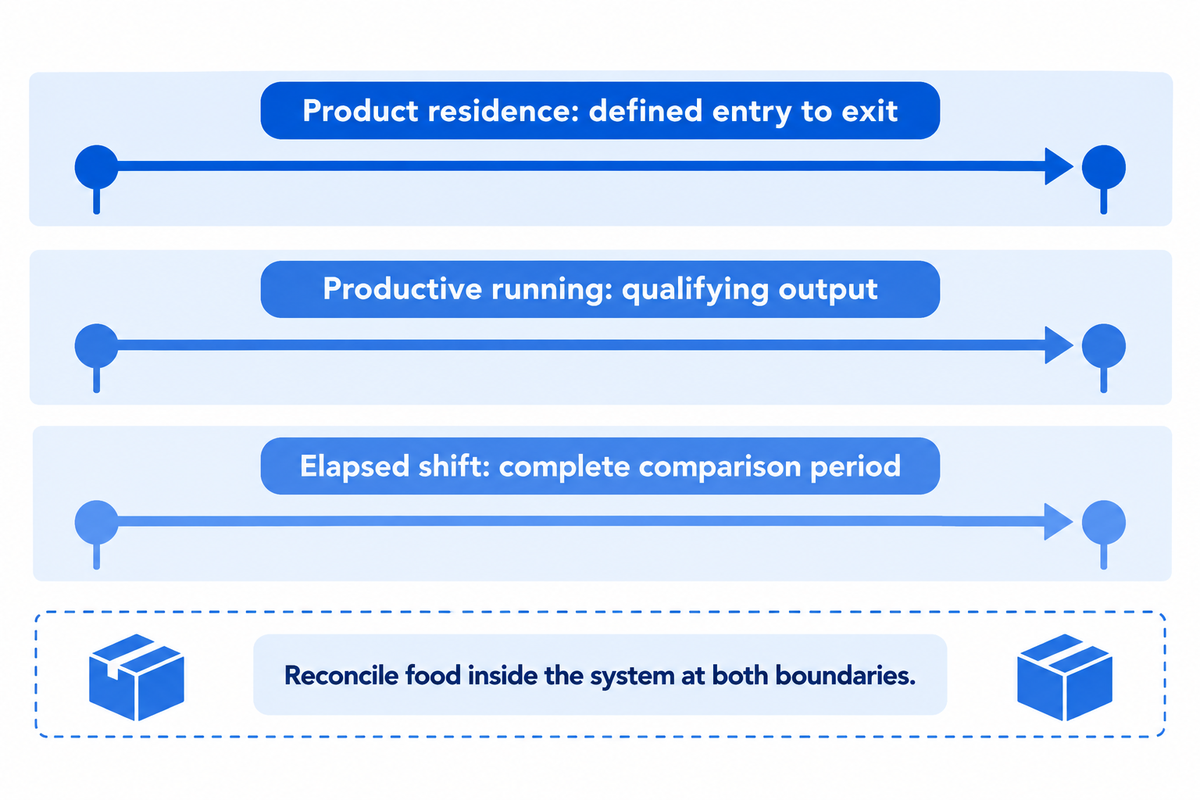
The 3-Clock Freezing Ledger separates product residence time, productive running hours, and the elapsed shift time. Residence helps define the food end point; running hours describe when useful product is being made; and the shift time includes all the breaks and interruptions around the working hours. Keep these clocks separate before converting an hourly rating into completed, released output.
| Clock | Record | What the number can explain |
|---|---|---|
| Product residence | Time from defined entry to defined exit | Whether the product receives the required freezing treatment |
| Productive running | Hours delivering product at the stated discharge condition | How the measured production rate relates to gross frozen output |
| Elapsed shift | The complete comparison period | Output and cost after startup, stops, changeover and recovery |
In FAO’s fisheries freezer-load example, a 50 mm tray has a freezing time of 1.75 hours, and a complete cycle of 2 hours after loading, unloading, and defrost allowances. The extra quarter hour is part of the production cycle. These values describe that example; they aren’t recommendations for freezing times for other food products.
50 mmfish-tray thickness in FAO’s example
1.75 hoursfreezing time in that example
2 hourscomplete cycle in that example
For a continuous freezer, use weighed completed output rather than an estimated incoming feed. Record where kg/h is measured. If the freezer contains more food at shift end than at the start, input during the shift is not the same as finished output during it. Quality-held lots are to be kept separate from released saleable production.
| Record | Boundary to define | Question it resolves |
|---|---|---|
| Product duty | Food, dimensions, package and inlet/exit condition | Are the compared freezing capacities describing the same task? |
| Rate location | Feed, frozen discharge or released product | Has an input rate been mistaken for finished output? |
| Residence | Defined entry and exit events | Did product receive the needed treatment? |
| Startup and pull-down | Elapsed time before qualifying output | Does the shift include initial recovery? |
| Defrost | Stop plus recovery before qualifying production | Was only the active defrost interval counted? |
| Cleaning and changeover | Separate or overlapping events | Has the same unavailable interval been subtracted twice? |
| Feed interruptions | Upstream starvation versus freezer stoppage | Which process actually limits the line? |
| Work in process | Food inside the system at both period boundaries | Does the period contain an inventory change? |
| Quality and net mass | Rejects, held lots, packaging and protective glaze | What food weight is actually released for sale? |
Cooling load is different from electrical input
SHENGTU’s published tunnel IQF freezer specification table offers a good reading exercise. These are supplier-defined fields, as opposed to performance measurements.
| Model | Listed capacity | Listed cooling load | Listed installed power |
|---|---|---|---|
| ST-SDS-100 | 100 kg/h | 22 kW | 4 kW |
| ST-SDS-1000 | 1,000 kg/h | 170 kW | 28 kW |
It’s possible for both a thermal cooling load and an electrical power field to be defined by kW; however, the table doesn’t define the full metering boundary; therefore, don’t divide its columns to indicate a whole-plant efficiency or multiply installed kW by hours to represent actual consumption.
Diagnose Clumping, Drip Loss and Uneven Freezing
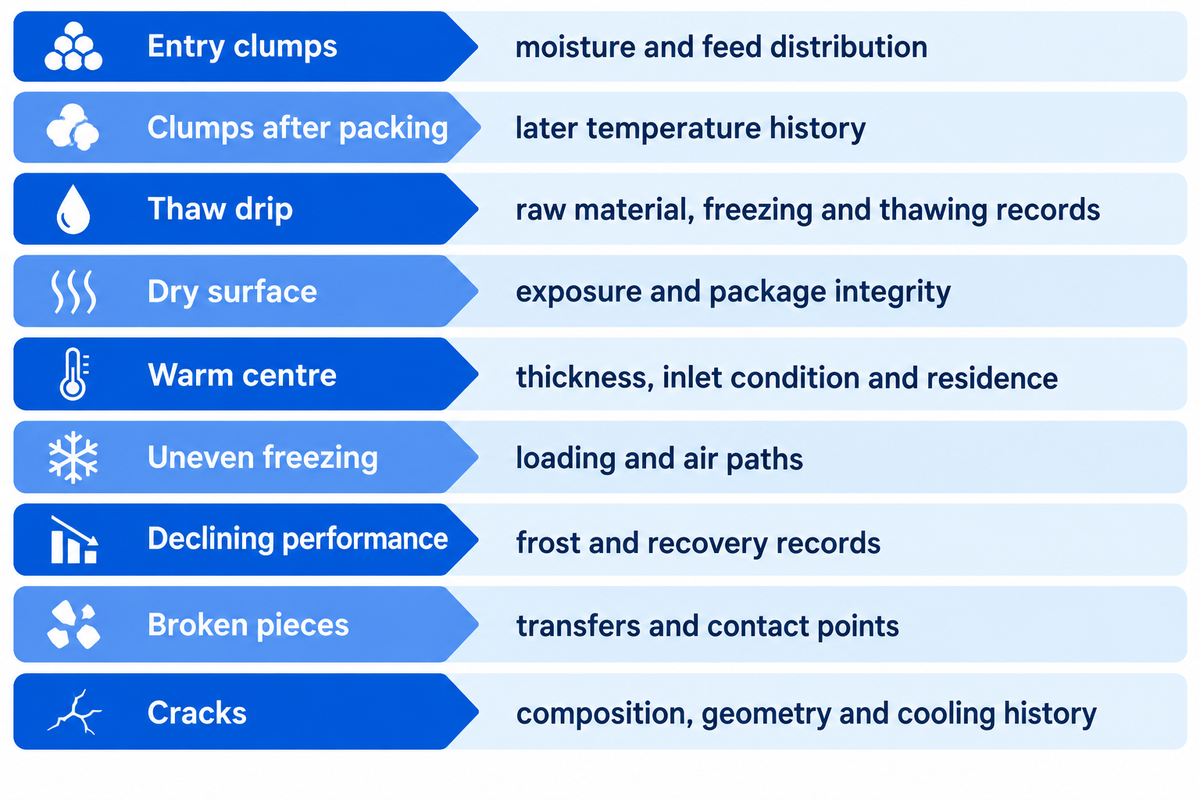
Freezing defects occur along different paths and require different observations. For instance, surface drying, tissue damage, sticking and a warm thermal center occur along different paths. Generally, starting with the symptom and working back is a good strategy. Compare product, loading, temperature and handling records before adjusting the freezer or attributing the defect to a single cause.
| Observed symptom | Record to compare | Next question |
|---|---|---|
| Clumps at freezer entry | Surface moisture, feed surges and layer distribution | Are pieces already touching or bridged before surface hardening? |
| Clumps appearing after packing | Discharge condition and later temperature history | Was separated product exposed to warming or compression? |
| Excess thaw drip | Raw material, freezing trace, storage and thawing method | Which stage changed the tissue or released water? |
| Dry surface or freezer burn | Exposure time and package integrity | Was moisture lost during freezing or subsequent storage? |
| Warm product centres | Thickness, inlet condition, residence and loading | Does the product match the duty used for the rate? |
| Uneven freezing across the load | Loading pattern, air paths and position-specific temperatures | Can air bypass the product? |
| Performance deteriorating through the run | Coil frost, temperatures and recovery after defrost | Has heat transfer or airflow changed? |
| Broken pieces or belt marks | Transfer points, belt contact and product firmness | Is handling damaging a product that freezes adequately? |
| Cracks after very rapid cooling | Product composition, geometry and cooling history | Does thermal stress require a food-specific trial? |
The FAO air blast discussion shows frost bridging between coil fins can reduce the effectiveness of heat transfer and increase resistance to airflow. Examples of pallet loading demonstrate that cold air can avoid the load. Setting a temperature at a lower level than normal doesn’t correct an air channel that misses the food.
Imagine a case where fragile berries come off the freezing zone at an acceptable temperature but arrive at the packing area with more fragments. A colder recipe might leave breakage unchanged. Observe berries just before loading, as they’re coming out of the freezer, and after each transfer. Compare product distribution and contact points while preserving the intended temperature treatment. Observing the stage where defects first occur should accompany examining if product is sufficiently cold. It explains why food quality needs observations at several positions rather than a single final temperature check.
Storage can add another mechanism. Ullah, Takhar and Sablani’s 2014 potato study observed larger ice-related pores and microstructural damage during progressively wider temperature-fluctuation stages. The experiment combined changing excursions with cumulative storage time, so it doesn’t supply a universal threshold. It does support checking cold-chain records before blaming only the original freezing process.
The first changed observation can be used to track the change in the quality of the food. A phenomenon that occurs upon storage will need a different line of investigation from one observed at discharge. Comparison of the two will provide a problem statement to a maintenance or process team, and in the process, provide a useful starting point for improvement.
Calculate Running Cost per Saleable Kilogram
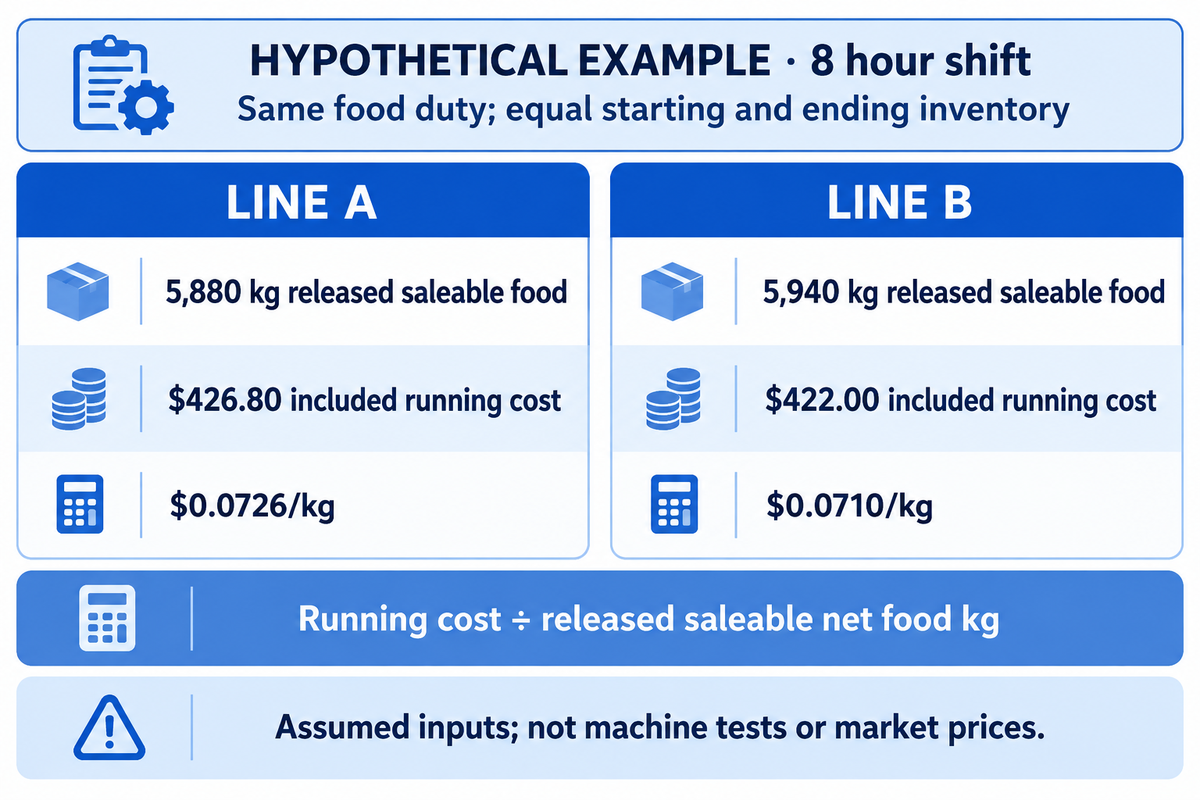
The running cost per saleable kilogram is determined by dividing the operating cost incurred during the period by the released, net saleable food produced during the same period. Define the boundaries clearly. Labor, electricity and other operating costs comprise the numerator. Electricity, cryogen, labour and other included operating charges belong in the numerator; packaging weight, protective glaze and unreleased production do not belong in the food-output denominator.
FAO’s chapter on freezing cost analysis focuses on the cost per unit weight, local conditions and plant utilization. The accounting method remains useful even though its historical example prices are unsuitable as current industrial quotations. A worked example used to illustrate the method is provided.
Formula: Running cost per saleable kg = attributable operating cost during the period ÷ released saleable net food kg completed during that period.
Assume two lines process the same food duty during an 8 hour shift, with equal beginning and ending work-in-process. Their rates describe gross frozen-food discharge before quality rejects, and the accepted output is released within the period. Line A delivers 1,000 kg/h for 6 productive hours at 98% saleable yield: 1,000 × 6 × 0.98 = 5,880 kg. Line B delivers 800 kg/h for 7.5 productive hours at 99% yield: 800 × 7.5 × 0.99 = 5,940 kg. The lower hourly rate delivers slightly more saleable food in this assumed shift. For real production, weigh the completed output and reconcile inventory and held lots rather than treating this forecast as a measurement.
| Input or result | Line A | Line B |
|---|---|---|
| Elapsed shift | 8 hours | 8 hours |
| Gross frozen-food discharge rate | 1,000 kg/h | 800 kg/h |
| Productive running time | 6 hours | 7.5 hours |
| Saleable yield from that discharge | 98% | 99% |
| Released saleable net food | 5,880 kg | 5,940 kg |
| Assumed metered electricity, same scope | 640 kWh | 600 kWh |
| Electricity at assumed $0.12/kWh | $76.80 | $72.00 |
| Labour plus other included running charges | $320 + $30 | $320 + $30 |
| Total conversion running cost | $426.80 | $422.00 |
| Running cost per saleable net kg | $0.0726/kg | $0.0710/kg |
The labour assumption is two operators × 8 hours × $20/h = $320 per line. Electricity is measured over the same complete shift and scope of the equipment, including the relevant stops and recoveries. Divide $426.80 by 5,880 kg and $422.00 by 5,940 kg to obtain the rounded unit costs above. A cryogenic comparison would include the delivered gas consumed within the defined boundary.
Don’t subtract overlapping defrost and cleaning twice. Don’t apply a yield factor, if the conversion rate measures saleable product. This example of a conversion cost doesn’t include the raw materials, capital recovery and lost sales margin. Adding these would extend the discussion to a broadened product cost or investment and require a different consistent model.
For glazed seafood, FDA guidance on glaze and net weight states that net weight excludes protective ice. Use the same clear weighing boundary in the operating comparison. Reducing food loss can improve the denominator; however, adding water weight does not increase food output.
Keep Defrost, Cleaning and Cold Storage Connected
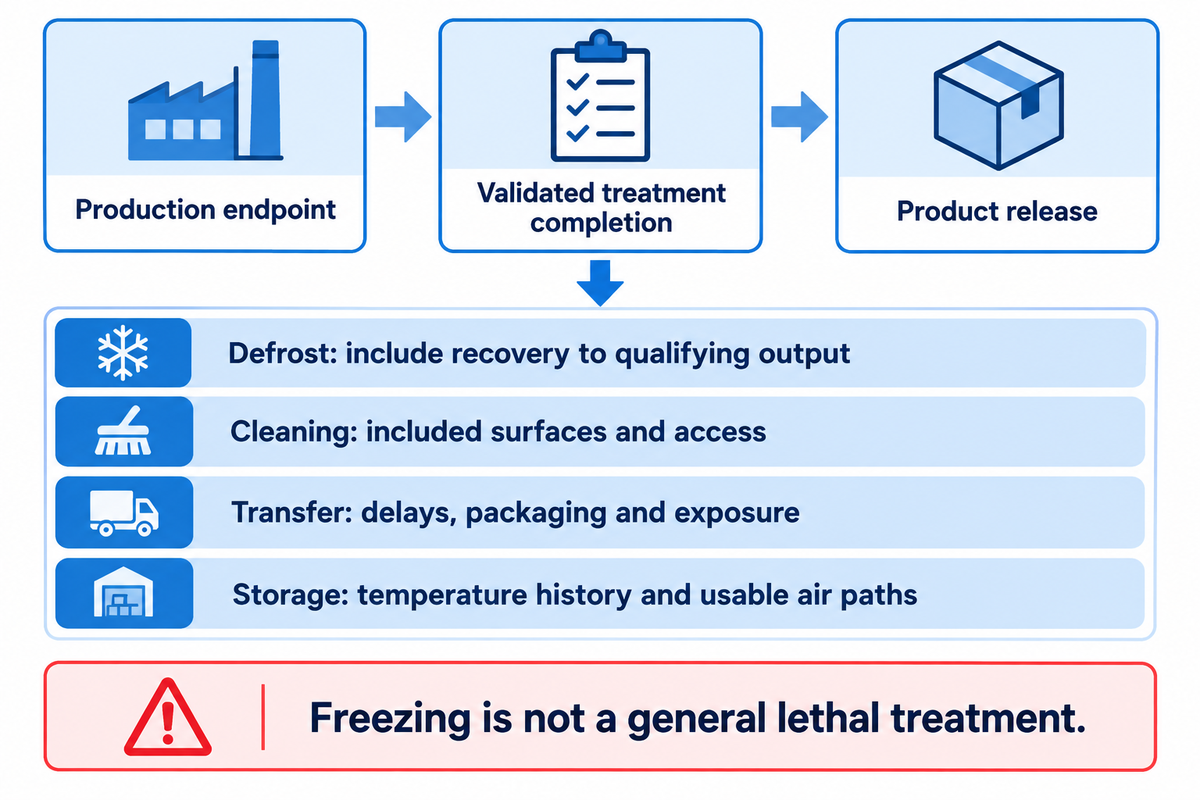
Freezing performance continues beyond the active freezing interval. Defrost, cleaning, drying where required, recovery and transfer to storage must fit the food route and the equipment design. A completed freezing cycle is separate from completion of a validated hazard control hold or the quality team’s decision to release the product.
The inspected Codex code connects the freezing apparatus to cold storage and asks for controlled transfer with appropriate records. Hygiene measures are in the food safety system. Quick freezing of poultry, seafood or another raw product does not replace the controls required for its intended use.
“Freezing should not be considered as a lethal treatment for microbiological contamination in foods.”
The same section recognizes that appropriate validated freezing conditions may control certain parasites. This is a commodity- and hazard-specific treatment and a holding condition, not evidence that every rapid freezing process achieves it. Keep production endpoint, treatment completion and product release as separate recorded states.
- Record when qualifying production can resume after defrost, not just when heating stops.
- Follow the included cleaning surfaces, access method and product-change requirements.
- Check delays, packaging condition and exposure between freezing and storage.
- Retain temperature history and keep airflow paths usable in storage.
Equipment labeled as easy to clean and maintain doesn’t always mean there’s an actual access and cleaning method. A freezer may combine accessible manual cleaning, removable parts and an included automated route; the label alone does not establish coverage. The Cleaning and CIP Equipment guide explains the rationale for matching surfaces and methods.
For an integrated IQF quick-frozen food processing line, upstream preparation and downstream packing can set the useful output. While the freezer has available capacity, feed starvation can constrain output. Food processing facilities need the whole route to agree on what counts as finished product.
USDA FSIS’s freezing guidance also states that freezing slows enzyme activity, and that product-specific pre-treatment, including appropriate blanching for certain vegetables, remains a separate process decision.
What Is Changing in Food Freezing
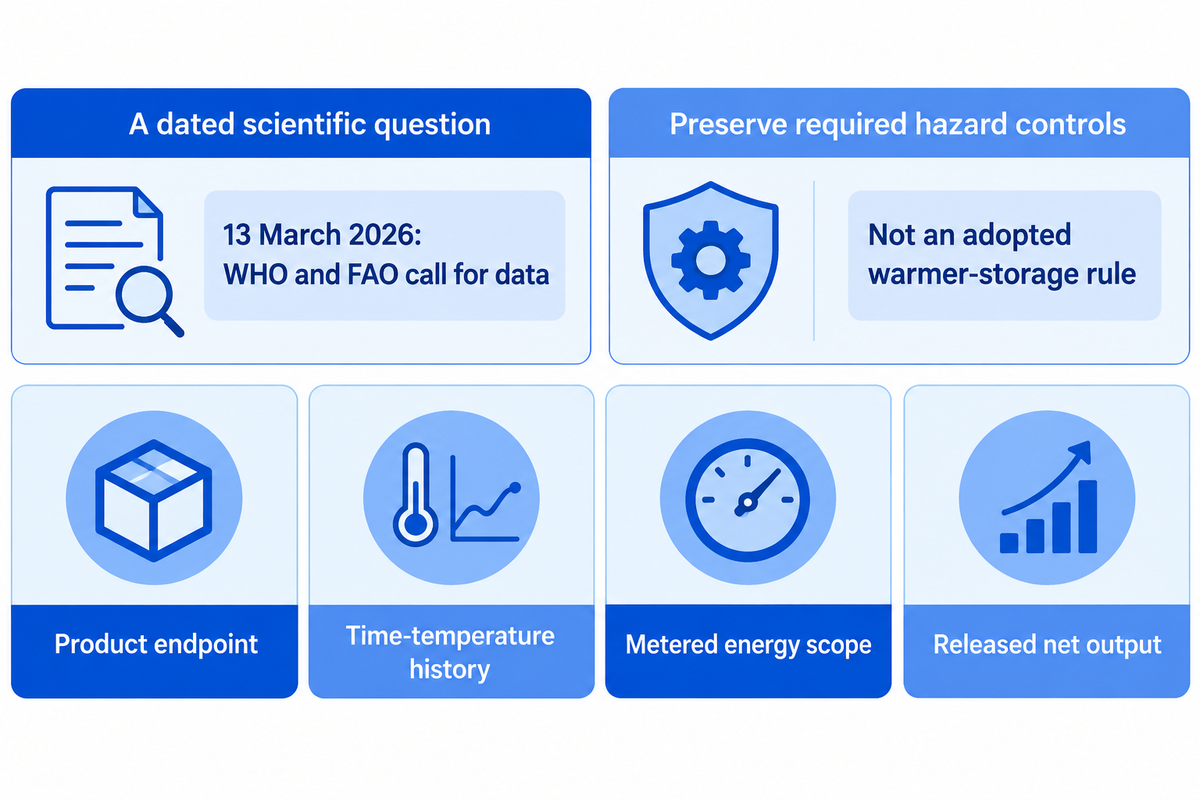
There are questions concerning the scientific validity of frozen-storage temperature, but a research proposal doesn’t authorize a plant to change its validated operating conditions. The practical question for food processors is how to preserve product quality and required hazard controls while evaluating energy use across a defined freezing, storage and distribution boundary.
The 2026 frozen-storage temperature review
On 13 March 2026, WHO and FAO released a call for frozen storage data to assist in possible updating of CXC 8-1976. It defined −18°C as the reference temperature and requested data on alternative temperatures and behavior of bacteria and parasites. Its submission deadline was 15 April 2026.
The notice is evidence of a dated scientific question, not an adopted warmer-storage rule. Nor does the inspected 2008 Codex copy establish the final outcome of all subsequent Codex discussions. A project to evaluate a different storage condition should define applicable requirements, customer specification, and validated product controls prior to changing the process.
When a new installation is undertaken, useful measurements should be retained, e.g. product endpoint, time-temperature history, metered energy scope and released net output. These records should be kept available to assess the potential for increasing process efficiency. A change that results in a decrease in storage energy but increases rejected product, weakens a required treatment or shifts the burden elsewhere needs the broader comparison.
Supply resilience should also be covered by the analysis. The 2022 Food Engineering interviews mentioned disruption to some cryogenic gas users; that historical account doesn’t establish today’s local supply. Ask about the actual utility and consumable supply situations that are available to the plant, and don’t automatically assume that a refrigerated system is the answer to every operating restriction.
The food industry has several ways to efficiently freeze suitable food products. A useful improvement is demonstrated by product and operating condition trials. A high freezing capacity label, an ultra-low temperature or a broad market forecast cannot establish that improvement on its own.
Quick-Freezing Equipment FAQ
What is the price of an individual quick freezing machine?
An individual quick freezing machine’s price requires a defined food duty and equipment scope.
Capacity alone can’t establish a comparable price. A quotation may include the freezing enclosure and conveyor while treating refrigeration plant, installation, utilities or gas storage separately. Give the freezer manufacturer the food dimensions, incoming condition, required output and product endpoint. Compare the included scope before comparing totals; an unsupported generic price range would hide those differences rather than help a real project.
Is there a way to instantly freeze something?
A very fast surface freeze does not mean the entire food freezes instantly.
Heat still has to leave the piece of food, including its slowest-cooling region. Thickness, composition, packaging and the cooling medium affect that time. A process described as flash freeze or crust freezing may primarily harden the outside before another stage completes the duty. Check the product-temperature trace and the defined endpoint instead of interpreting a visibly frozen surface as proof that the centre is finished.
Is IQF safe?
IQF is a preservation process; finished-food safety depends on ingredients, hygiene, validated controls and intended use.
Freezing isn’t a general lethal treatment for microbiological contamination. Some hazards need a separately validated treatment, and frozen raw products may still need appropriate cooking or other preparation. Product temperature, a loose appearance and the IQF label answer different questions. Follow the product’s handling instructions and the food plant’s validated control and release requirements; don’t infer that freezing raw food makes it ready to eat.
Is quick freezing the same as freeze drying?
Quick freezing retains frozen water; freeze drying adds a water-removal stage.
A vacuum freeze dryer uses a different process and finished-product endpoint. A freezing machine alone doesn’t establish the moisture content, packaging requirements or shelf stability of a freeze-dried food.
Can I use a regular freezer for IQF production?
Small tray-separated batches are possible, but a regular freezer’s suitability for industrial IQF production must be demonstrated.
FAO describes tray packing in which well-drained pieces freeze in a single layer before packaging. That doesn’t establish the freezing capacity, repeatability or hygiene of an industrial line. A regular storage freezer uses its available refrigeration to handle the load placed inside, and adding warm product changes the duty. Check whether the required food endpoint and separation survive the actual loading pattern, batch sequence and packing route. For food processing plants, the relevant comparison is completed acceptable output over the production period, including handling and recovery. Traditional block freezing can be appropriate when the intended product is a block; it’s simply a different outcome from free-flowing IQF products. Choose between those outcomes before deciding whether the existing freezer can perform the required work.
How do I compare used quick-freezing equipment?
Used equipment needs a condition and duty assessment, not just comparison of its original nameplate capacity.
Establish the product previously used for the rating, the included refrigeration and controls, service records, cleanability and available parts. Inspect the installed condition and confirm which work is needed to meet the new food duty. Traditional freezing methods and modern IQF technologies can both be suitable when their actual process fits. A low purchase price leaves the important questions unanswered if the unit can’t meet the required endpoint, handling outcome or completed production schedule.
Key takeaway
Compare freezing solutions by the food they complete and release over the same period. The three clocks, consistent net-food weighing and an explicit operating-cost boundary make the difference between a nominal rating and a useful production comparison.
Define the duty for your food
Bring the product dimensions, incoming temperature, required endpoint and production schedule to a project discussion. SHENGTU’s team can review the equipment scope against those inputs.
For company background and sourcing scope, see About SHENGTU. Equipment specifications cited in this Guide are attributed to the suppliers; the comparative analysis is illustrative and doesn’t contain any fictitious customer test data.
Related Processing Guides and Equipment
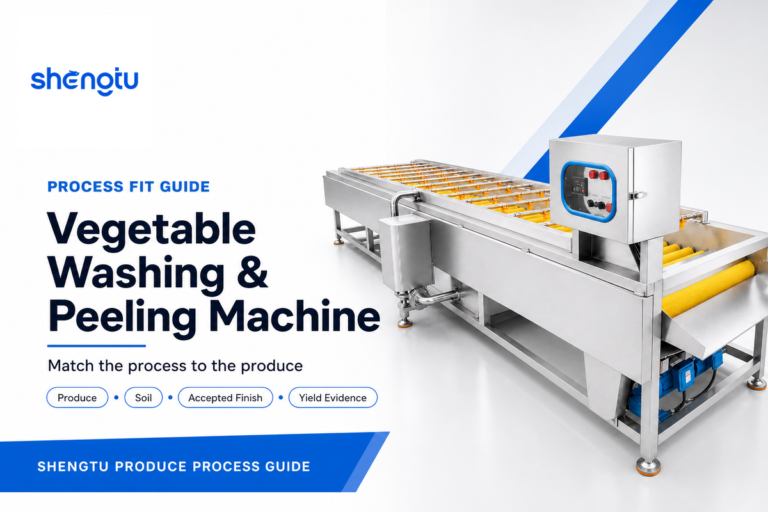
- Root vegetable washing and peeling line upstream preparation in fruit and vegetable processing.
- Vegetable washing and peeling equipment product cleaning before further processing.
- CIP cleaning system cleaning routes for equipment designed for the included method.
- Freezing duty input canvas organize application information for a project discussion.
References & Sources
- Codex: Processing and Handling of Quick Frozen Foods, inspected 2008 revision, definitions, sections 4.3–4.8 and Annex 3.1.1.
- FAO: Introduction to freezing fruits and vegetables, process, capacity and equipment sections.
- FAO: Freezing and refrigerated storage in fisheries — Freezers, airflow, cycle and load calculations.
- FAO: Cost analysis and product price, accounting framework; historical prices not reused.
- Cheng et al. (2023): Heat-transfer medium and rate in chestnut-kernel freezing.
- Ullah, Takhar and Sablani (2014): Temperature fluctuations and ice-crystal growth in potatoes.
- IIR: Cryogenic nitrogen in the food and beverage industry, configuration and limitations.
- Wayne Labs (2022), Food Engineering: Freezing and Cooling, technical interviews.
- FDA: Are You Storing Food Safely?, Freezer Facts.
- FDA: Guidance on glaze and frozen-seafood net weight.
- USDA FSIS: Freezing and Food Safety, updated August 2024.
- OSHA: July 2021 poultry-plant nitrogen incident release, archived historical investigation.
- WHO/FAO: March 2026 call for frozen-storage temperature data, research context rather than adopted permission.
![Meat / Poultry / Prepared: Plant Planning Guide [2026]](https://shengtumachinery.com/wp-content/uploads/2026/10/meat-poultry-prepared-processing-guide-featured-768x512.png)

![Meat / Poultry / Prepared: Plant Planning Guide [2026]](https://shengtumachinery.com/wp-content/uploads/2026/10/meat-poultry-prepared-processing-guide-featured-150x150.png)


