Get in touch with Shengtu Bufan Company

Orange Fruit: Anatomy, Varieties & Processing Routes

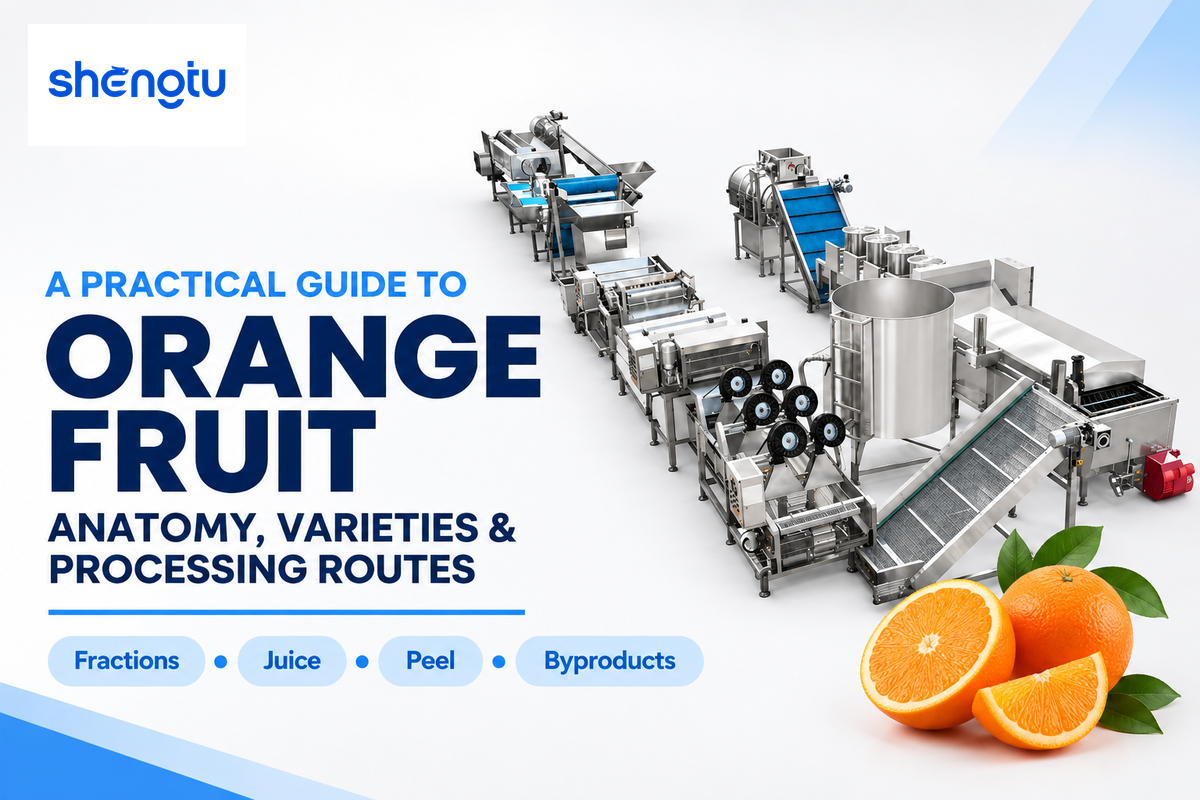
Orange fruit isn’t one uniform raw material. A processor may send whole fruit to a fresh pack line, separate juice and pulp, recover peel oil, or direct peel and seeds to a qualified byproduct route. Decisions for a route are based on fraction, variety, maturity target, soluble solids and acidity checks, throughput, sanitation plan, and the buyer’s product spec. This guide identifies those decisions at overview level to support a discussion on equipment at route level as opposed to a vague request for an “orange machine.”
Quick answer: what is an orange fruit used for?
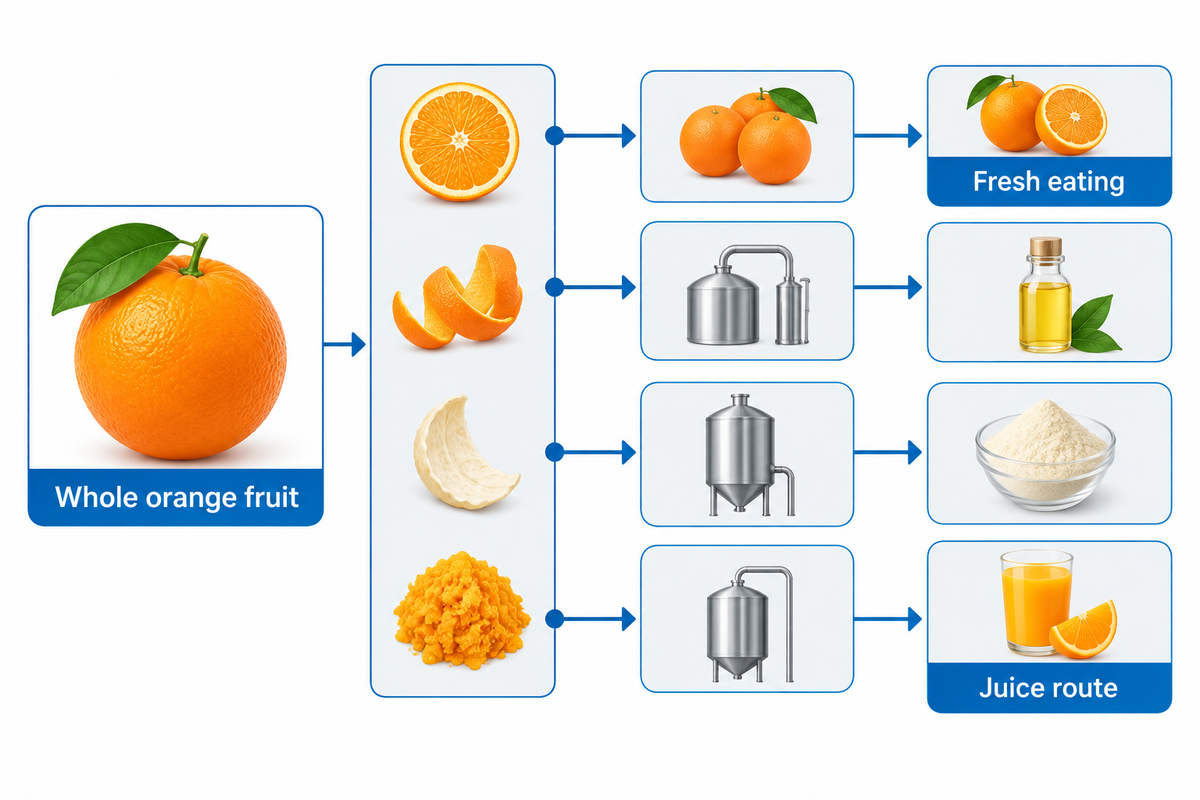
Orange fruit is citrus fruit used for fresh eating, orange juice and beverage ingredients, marmalade, peel oil, essences, pectin-oriented processing, and other qualified food or feed routes. The useful question isn’t “what can an orange make?” The useful question is “what fraction must be protected, separated, concentrated, dried, or packed for the intended destination?” A navel orange selected for table fruit has a different handling priority from a Valencia lot selected for the juice line. Peel, albedo, segments, juice vesicles, membranes, pulp, and seeds also create different cleaning and material-handling requirements. For a plant enquiry, the input variety, the fraction of interest, hourly capacity, quality tests, and the final product must be defined before discussing machine configuration. The Orange Book processing overview gives additional product-route context.
Orange anatomy and fraction map
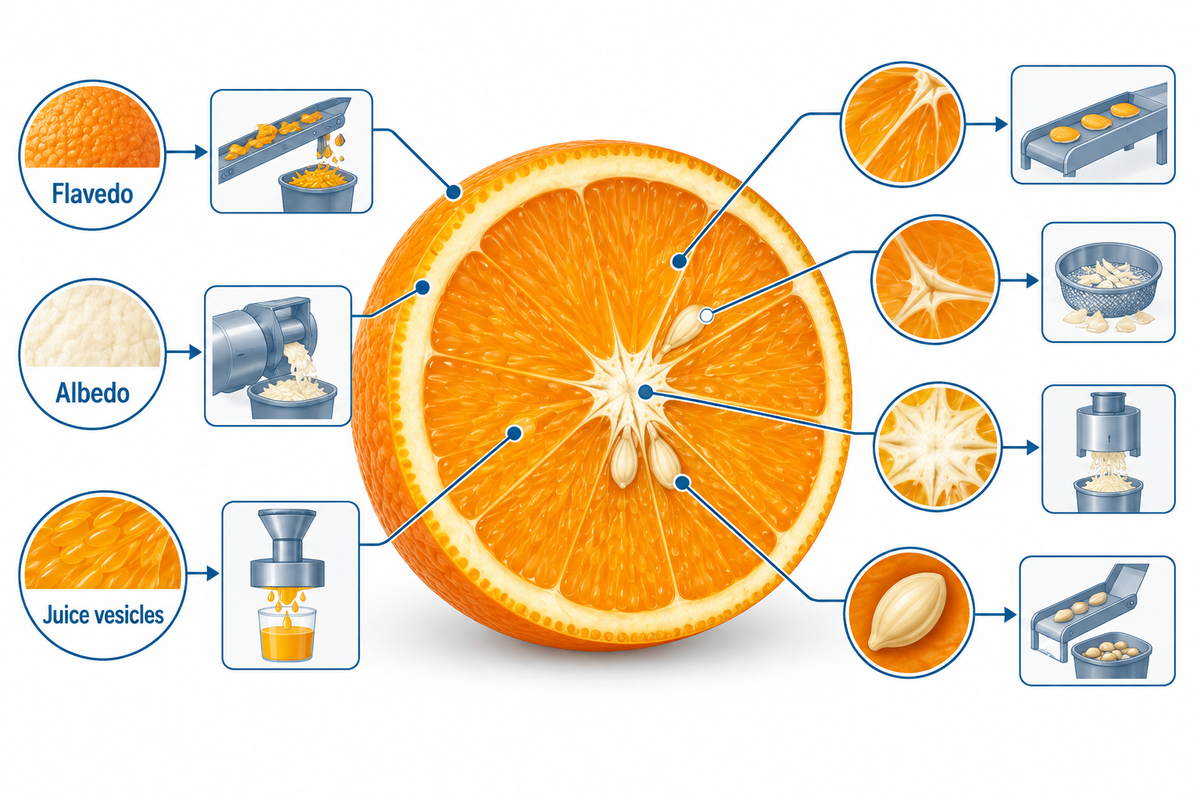
Understanding Orange anatomy is essential when determining the appropriate method of processing. The outer colored layer is the flavedo. Under the flavedo is the albedo. The albedo is broken into segments and dispersed throughout the fruit, and is surrounded by membranes. Inside are segments, juice vesicles, membranes, a central core, and seeds where present. Treating the components as a single stream can lead to product loss or additional work to clean up and dispose of excess product. In marketing descriptions, skins or rinds may be referred to as zest; these words all describe the outer layer, and thus for the purposes of this route description can be used interchangeably.
| Route category | Fraction | What it means for a processor | Typical route question |
|---|---|---|---|
| Peel route | Flavedo | Colored outer peel; can be protected for peel or oil-oriented handling. | Is peel integrity needed, or will the peel be milled or extracted? |
| Peel route | Albedo | White inner peel layer. Citrus anatomy references describe it as a pectin- and cellulose-containing layer. | Will it be separated, softened, dried, or sent with the peel stream? |
| Juice route | Segments and membranes | Edible structure that affects texture, screening, and pulp recovery. | Does the product require clarified juice, cloudy juice, or retained pulp? |
| Juice route | Juice vesicles | Small juice-bearing sacs that influence pressing and solids separation. | What solids level and particle size can the destination accept? |
| Secondary route | Core and seeds | Non-target fractions that must be removed, conveyed, or qualified for a secondary route. | Will they be screened out before extraction, drying, or packing? |
| Fresh route | Whole fruit | Whole fruit handling protects appearance and reduces unnecessary fraction damage. | Can the line grade size and defects without bruising? |
| Fresh route | Segments | Segment integrity affects retail appearance and eating texture. | Does the pack require intact segments or cut pieces? |
| Byproduct route | Mixed peel and pulp | A mixed stream may need dewatering, drying, or a defined disposal path. | What moisture and storage limit applies to the outlet? |
| Quality route | Wash and trim stream | Wash water and trim need sanitation, drainage, and record controls. | How will the site isolate and document this stream? |
For more background on the anatomy of orange, refer to the citrus Fraction reference and orange overview from Britannica. These references provide a general overview of the orange fruit structure. They don’t validate claims made by a supplier’s equipment. An equipment brief is still needed which includes sample based testing.
Orange varieties and the route each one supports
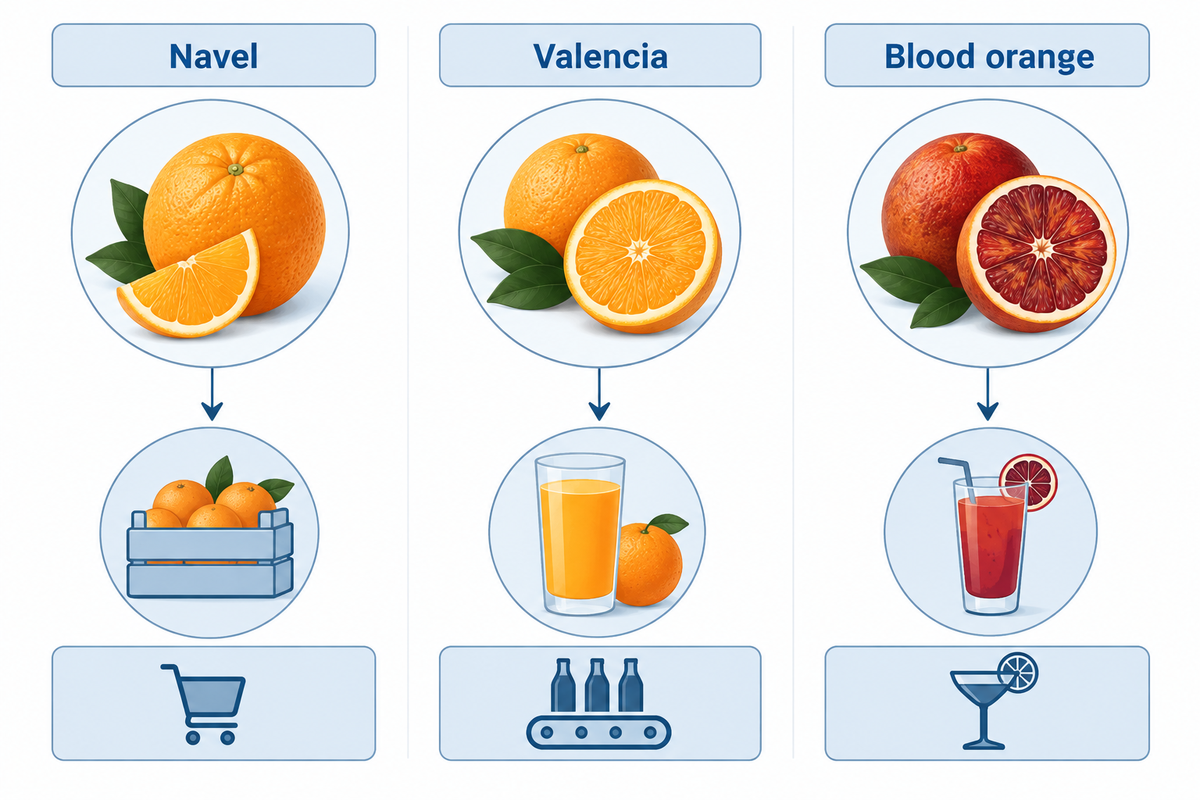
Variety in this route isn’t purely a decorative label. The Navel oranges, because of seedlessness and eating quality, are typically directed to the fresh market. Valencia oranges are widely used in juice discussions because a processor may value juice yield and seasonal availability. Blood oranges have a distinct color compound, and can be directed to the fresh market or specialty beverages, if the buyer is willing to accept the identity of the lot and the requested color orange outcome. The Bitter or Seville oranges are typically associated with marmalade and peel-led applications. A sweet orange from a orange tree can be compared with a mandarin orange or tangerine when a buyer checks incoming lots; grapefruit and pomelo belong in a different raw-material brief. These are route tendencies and not universal specifications. Cultivar, growing region, harvest stage and customer requirements can impact the outcome. Britannica’s orange overview provides general variety context.
Consumer descriptions such as juicy, easy to peel, seedless, dessert or salad, don’t point to a line specification. Skin, rind, zest, aroma, and fragrant are useful words for a fraction or sensory brief, while cultivation, subtropical, and ripen belong to agricultural context.
| Variety example | Route tendency | What to confirm before equipment selection |
|---|---|---|
| Navel | Fresh segments, retail packs, and selected juice routes. | Fruit size range, damage tolerance, seed expectation, and pack presentation. |
| Valencia | Juice and ingredient routes, with fresh use also possible. | Juice yield target, solids handling, wash load, and seasonal supply profile. |
| Blood orange | Specialty fresh or beverage applications where color is part of the offer. | Color consistency, oxidation control, and whether the customer wants pulp retained. |
| Bitter or Seville | Marmalade and peel-oriented products. | Peel thickness, bitterness management, cut size, and cooking or extraction step. |
Variety names can be used to initiate a test matrix, not to skip testing. A line quote should be specific and say which varieties and size grades are covered in the proposal.
Maturity, soluble solids and acidity as route checks
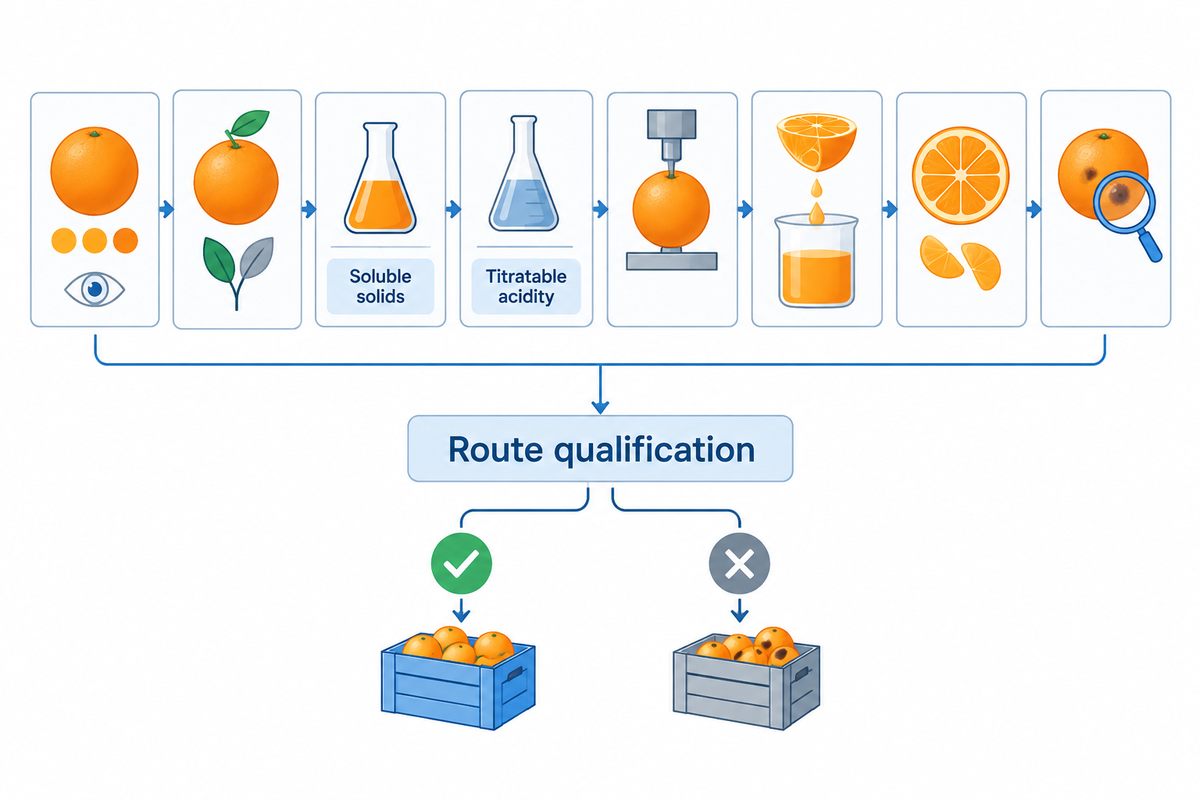
Color of peel is an observation that can be very helpful; however, it doesn’t constitute a full maturity specification. Citrus color doesn’t always mean maturity. Define measurable acceptance criteria for the route in question. A juice or ingredient buyer may check for soluble solids and titratable acidity. A fresh-pack buyer may focus on firmness, appearance, and defect limits. The numbers must be tied to the product and method. A value reported for one formulation is not a universal orange standard.
There’s for example, a study reviewed herein, which reports soluble solids and titratable acidity for juice formulations based on orange. On the other hand, a study on Valencia reports solids accumulation and yield. Prior to a line being sized, it’s necessary to agree on:
- the sampling plan and number of fruit or lots;
- the test method and instrument;
- the acceptable soluble-solids and acidity window for the product;
- the levels of pulp, seed, peel and temperature at the outlet; and
- what happens when a lot falls outside the window.
Useful background sources include the citrus maturity discussion, the Valencia study, and the orange formulation study.
For a plant level discussion, the same quality window should be sent with the inquiry through the fruit processing route.
Raw-material briefs can include terms like Citrus sinensis and descriptions like orange flesh and bright orange color without transforming them into machine-performance claims.
Product routes: fresh eating, juice, peel oil, pectin and marmalade
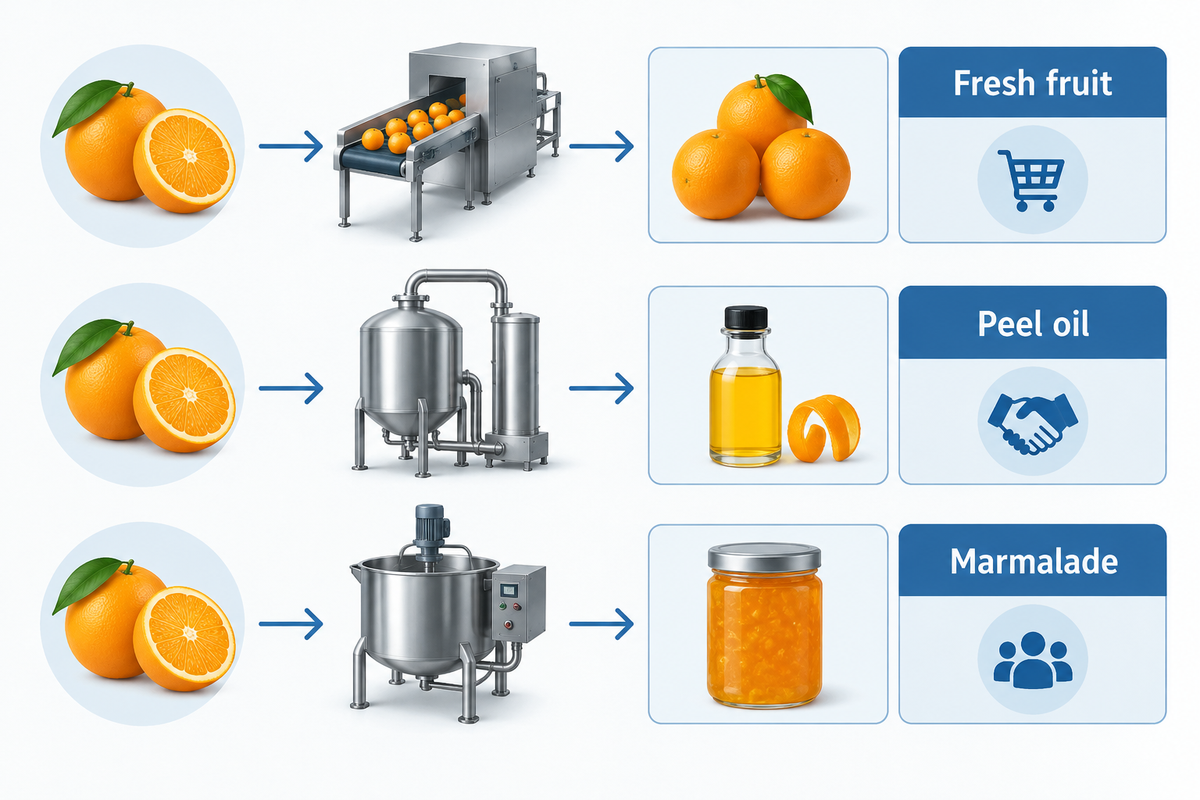
The Orange Fraction-to-Route Matrix, shown below, is a planning matrix. Established commercial destinations are separated from conditional or research-based destinations. A route is determined to be an equipment requirement once the buyer confirms the product specification, local rules, and sample trial.
| Input fraction | Possible destination | Route fit question | Evidence boundary |
|---|---|---|---|
| Whole fruit | Fresh packs or whole-fruit handling | Can the line protect appearance and control size or defects? | Commercial route; pack specification still controls. |
| Segments and juice | Juice, beverage base, or ingredient | Is the target clarified, cloudy, pulpy, or concentrated? | Commercial route; validate yield and solids separation. |
| Flavedo | Peel oil or essence-oriented route | How will oil-bearing peel be protected and separated? | Commercially established in some plants; recovery depends on variety and process. |
| Albedo and peel | Pectin-oriented processing or marmalade | What bitterness, cut size, cooking, or extraction controls apply? | Some uses are product-specific; do not assume a generic peel line makes food-grade pectin. |
| Pulp residue | Feed, drying, or a qualified secondary product | What moisture, contamination, and storage limits apply? | Conditional; qualification and local compliance are required. |
| Seeds and mixed residue | Separated waste, feed, or research-led recovery | Is separation economically and hygienically justified? | Do not turn a research paper into a finished-product claim. |
The Tetra Pak Orange Book is a useful route reference for juice, pulp, peel oil, essences, and feed-related by-products. Reviews on citrus residue discuss disposal burden and valorization. For a quote, use the fruit and vegetable processing page as the internal handoff and include a sample trial request. The same brief can be attached at the route-brief checkpoint.
Market summaries may use orange production, fruit production, fruit yield, orange groves, orange orchards, and fruit trees as agricultural terms. Separate references may report production of orange and million tonnes of oranges, or describe cultivation of oranges in tropical and subtropical regions with a documented wide range of soil conditions. It addresses juice products, the juice industry, fruit selection, and equipment fit for the route.
Processing overview for a buyer
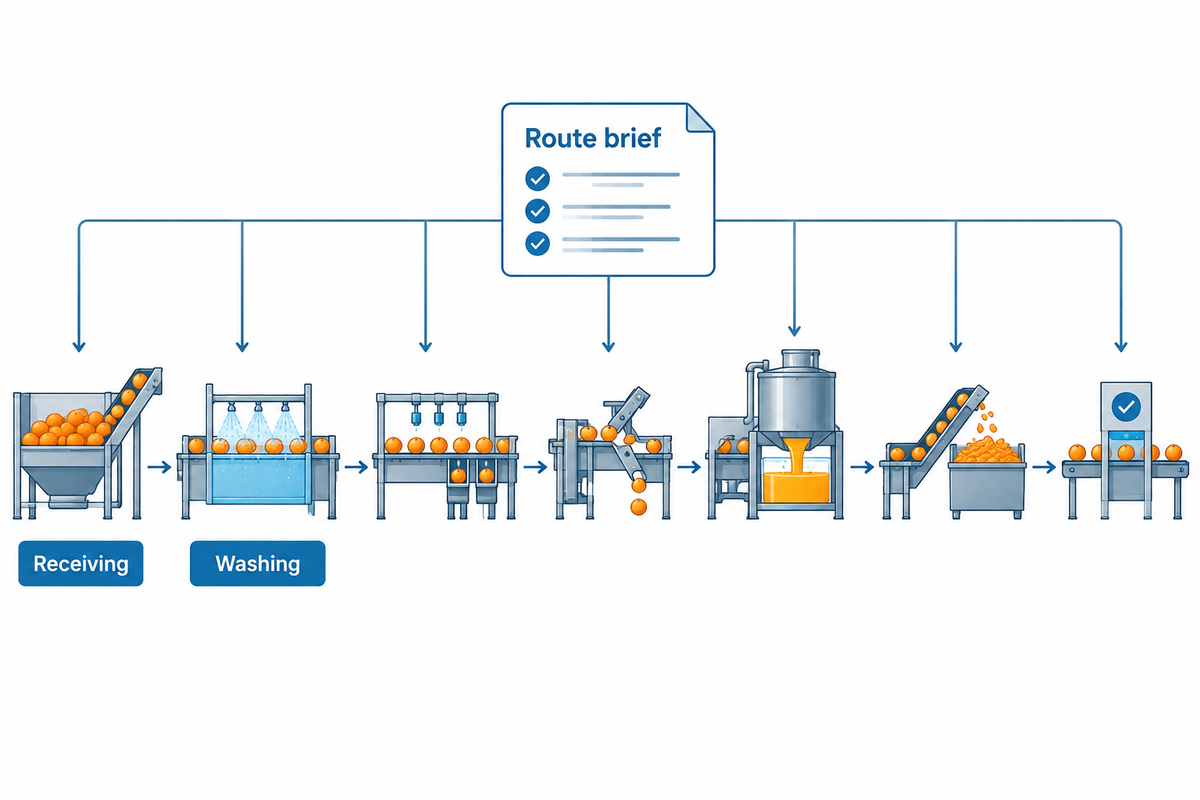
A typical orange-line starts with lot identification and inspection and continues with washing, sorting, and making a first separation decision. The line may also include peeling and cutting. The decision to extract juice may also be made on the line. It may then include peeling, cutting, juice extraction, solids screening, peel-stream recovery, drying or cooking, packaging, cold storage, and sanitation. Depending on the product chosen, other steps may be needed. Describe the route prior to asking for a machine name.
- Receive and inspect: Record variety, size, maturity, defects, and temperature of incoming product.
- Wash and sort: remove field soil and reject fruits that are outside the agreed condition.
- Separate the target fraction: protect segments, juice, peel, or whole-fruit appearance according to the route.
- Condition and screen: control particle size, seed carryover, pulp level, and temperature.
- (Finish: cook, concentrate, dry, chill, or pack to the customer specification.)
- Handle secondary streams: Convey and store peel, pulp, seeds and wash water with a defined disposition.
Food safety requires a control plan of its own. The FDA juice HACCP guidance describes hazard analysis and critical-control-point controls for juice processors. Citing that guidance does not mean the machine supplier is endorsing or certifying the buyer’s process. The buyer, process owner, and relevant authority must define the applicable controls.
Byproducts and qualification limits
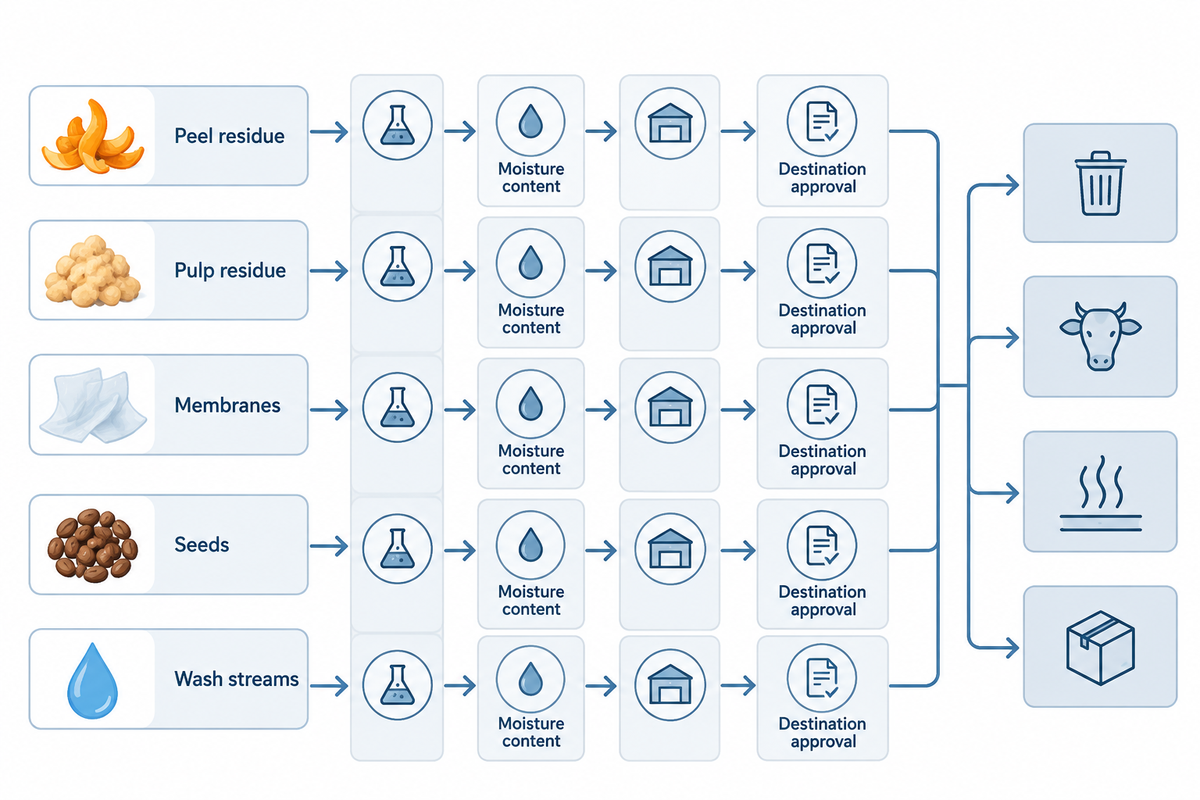
In the first enquiry, the mass balance discussed Peel, pulp residue, membranes, seeds, and wash streams. A residue stream can be a disposal cost, a feed input, a drying feedstock, or a qualified ingredient route depending on the moisture content, contamination, storage, and customer acceptance. Anticipating it reduces the risk that a main juice or fresh-fruit line is technically successful, but operationally difficult to clean or discharge. The reviewed citrus-residue study describes the scale and handling implications of processing residue.
Research articles and patents describe possible pectin, flour, oil, and other recovery methods. Keep the claim narrow. State that this fraction may be evaluated for a qualified route, and define the test and approval needed to proceed. Nutrition terms such as vitamin C, potassium, beta-carotene, and “rich in vitamin C” aren’t performance claims and are outside the scope of this equipment brief.
How to choose an orange route before requesting a line quote
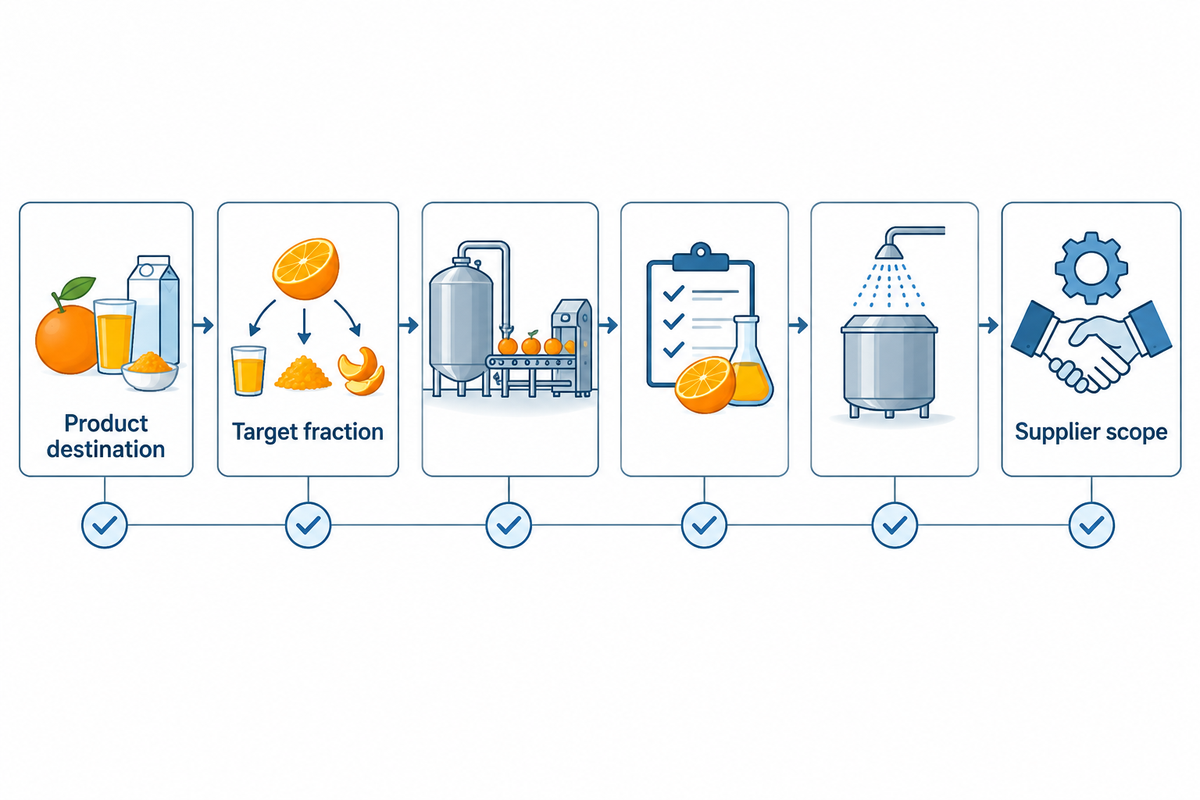
Use the Route Fit Ladder: fraction → variety → quality target → product destination → line discussion. A quote is often easier to evaluate if all the vendors are given the same facts.
- Input: Number of SKUs or types of goods sold.
- Target: whol fruits, segments, juice, pulp, peel, oil, pectin-oriented material, or other defined output.
- Capacity: tonnes per hour, operating hours, batch or continuous mode, and peak-season demand.
- Quality: soluble solids, acidity, pulp percentage, seed tolerance, moisture, temperature, and pack format.
- Hygiene: wash-water plan, cleanability, food-contact materials, drainage, and changeover frequency.
- Evidence: sample-trial protocol, expected yield definition, excluded conditions, drawings, utilities, and documentation.
Ask each supplier to state what is included in the quoted line, what is an optional module, and which performance values require a trial. This prevents a general process diagram from being read as a guaranteed production result.
Keep the route brief attached to the SHENGTU site enquiry so the input and output assumptions remain visible during review.
In broad consumer searches, terms like eaten fresh or eating fruit may occur. Terms like Fruit varieties, orange producer, and main orange are market terms and not machine terms. Florida orange juice and round fruits define other search contexts. Orange rind and yellow fruits may describe a raw-material observation. Vitamin C and antioxidants are terms describing nutrition. All of these terms won’t form part of this industrial route decision, unless the buyer includes them in the product specification.
Internal handoff: choosing a fruit and vegetable processing route
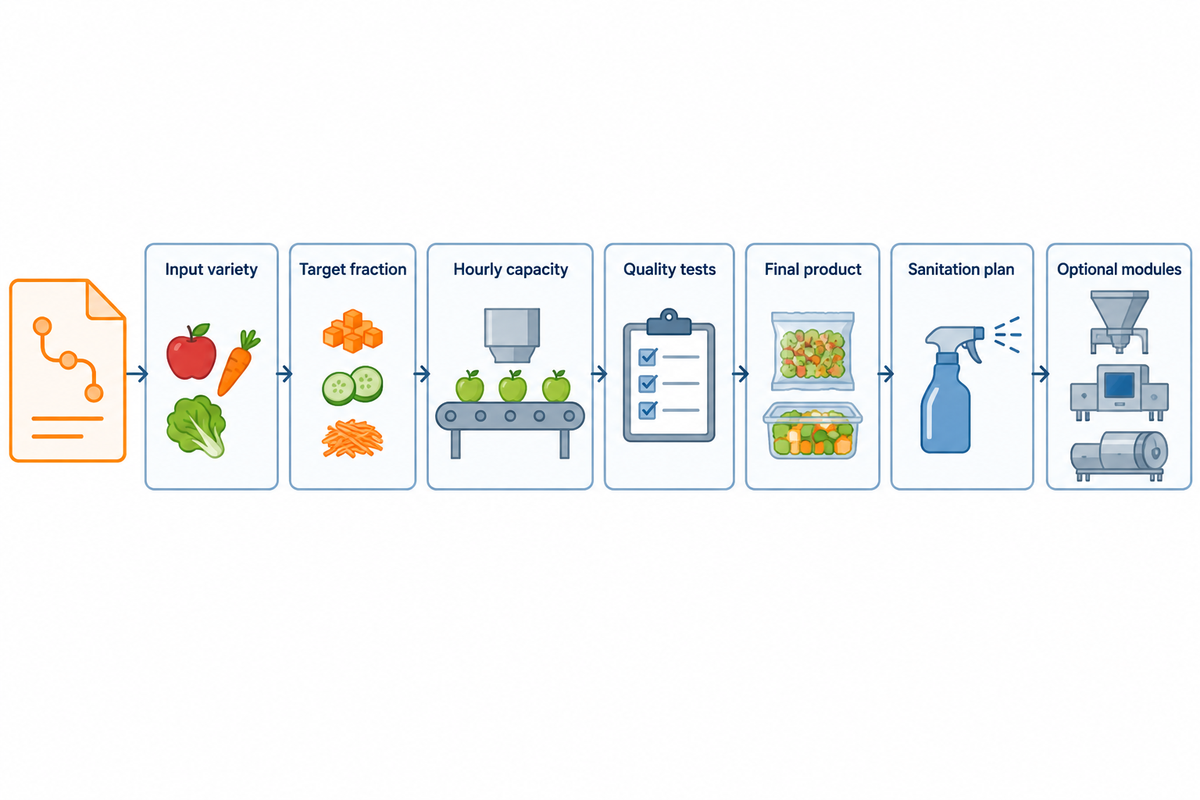
Once the fraction and destination are defined, the next conversation can move from orange fruit to a fruit and vegetable processing route. See SHENGTU’s fruit and vegetable processing routes page, the SHENGTU homepage, or the route overview, then send the input variety, target product, throughput, quality window, layout constraints, utilities, and desired documentation. That covers the basics, and gives the team an opportunity to design, test and implement a process. It helps avoid the messy mixing of fresh-fruit, juice, and byproduct requirements.
FAQ
What parts of an orange are normally separated?
Depending on the route, a line may separate peel, albedo, segments, juice, pulp, membranes, core, and seeds. The required separation depends on whether the output is fresh fruit, juice, peel oil, marmalade, a pectin-oriented stream, or a qualified byproduct.
Which orange is best for juice?
Valencia oranges are normally used in juice routes, although this can be flexible. Navel, blood, and bitter oranges can be used with other products or specialty programs. Verify yield, flavor, color, season, solids, acidity, and customer specification by checking a representative sample, and then select the equipment.
Can orange peel become a product instead of waste?
Yes, many methods may use peel for oil, essence, marmalade, pectin-oriented, drying, feed, and other routes. The right option will depend on peel condition, separation quality, moisture content, contamination level, storage, and destination approval. A research possibility isn’t always a saleable food product.
What should a processor specify before choosing equipment?
Identify variety and size range, condition, target fraction, throughput, mode, quality tests, accepted pulp and seed levels, temperature, sanitation, utilities, packaging, and secondary-stream disposition. Describe sample-trial method and define “yield.” This enables suppliers to be evaluated in the same way.
Does orange color prove the fruit is ready for processing?
No. Color is a subjective assessment, not an objective maturity-release criterion. Use a defined sampling plan and the measurements that matter for the route, such as soluble solids, titratable acidity, firmness, juice yield, pulp level, or defect limits. The acceptance window should be determined with the product owner, and should be applied consistently to incoming lots.
References & Sources
- Citrus anatomy and fraction reference.
- Encyclopaedia Britannica: orange fruit overview.
- Florida State Horticultural Society: citrus maturity and color.
- Journal of the American Society for Horticultural Science: Valencia observations
- PubMed Central: orange formulation quality measurements.
- PubMed Central: citrus residue and valorization review.
- U.S. Food and Drug Administration: Juice HACCP guidance.
- Tetra Pak Orange Book: orange products and byproducts.
ENGINEERING CONTENT DISCLOSURE
Why Shengtu Publishes Technical Guides
These guides turn common production-line questions into a clearer decision path for food manufacturers, project engineers and procurement teams.
We focus on the inputs that change equipment selection: product characteristics, package format, target capacity, process stages, utilities, plant constraints and destination requirements.
01Define the applicationStart with the product, pack and operating target.
02Map the process routeConnect stages, interfaces and utility needs.
03Surface trade-offsExplain the choices that affect line scope.
04Prepare better questionsTurn reading into a reviewable project brief.
MANUFACTURER PROFILE
SHENGTU
- Focus
- Food processing equipment and turnkey line solutions
- Base
- Zhucheng, Shandong, China
- Project path
- Requirement → layout → equipment scope → delivery coordination
SOLUTION COVERAGE
VALIDATION BOUNDARY Final equipment configuration should be confirmed against your product, package, throughput, utilities, plant constraints and destination requirements.