Get in touch with Shengtu Bufan Company

Freeze-Drying & Drying Equipment: Compare Yield, Time and Cost


Updated October 2026
Comparing freeze-drying & Drying Equipment should be based on the type of food produced, the time taken to produce it, and the cost per kilogram of the saleable product. A wet-feed rating answers only part of that question. Freeze drying technology removes moisture from food through a process whose loading and endpoint must match the product. Product structure, the way water is removed, and the losses and the package can impact which process would be more economical.
A chewy snack has a different job from frosting with fruit inclusions. Start with the job, and then compare representative trials. This manual connects a trial sheet to a material balance, a production schedule, and a completed cost calculation.
Three numbers to keep separate
Wet kilograms loaded, kilograms of water removed and saleable dry kilograms measure different things. Record all three before comparing output or energy. The worked example below keeps the dry solids constant, then accounts for product losses separately.
What Freeze-Drying & Drying Equipment Actually Does
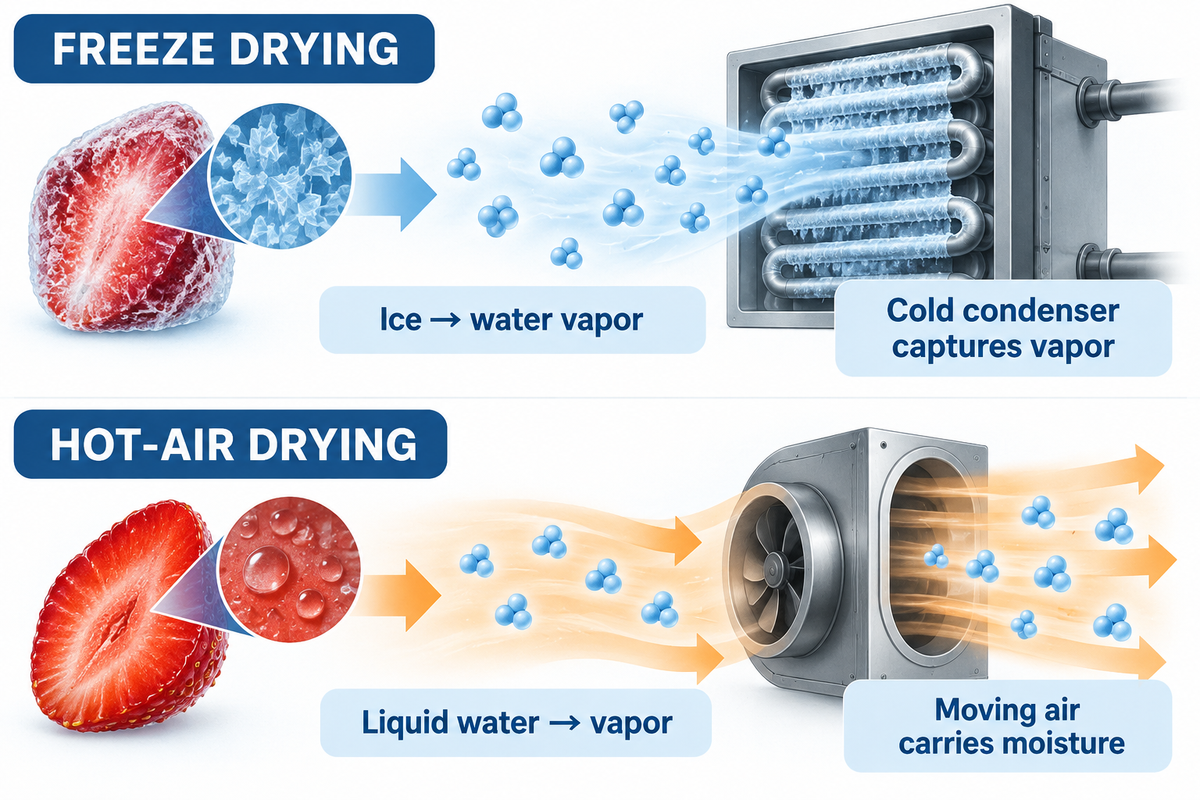
Freeze drying removes frozen water through sublimation under reduced pressure, but hot-air drying uses a different method for the transfer of water. Both preserve food, but Freeze drying uses a lower pressure, and therefore, a different method for the transfer of water, thus giving rise to different demands on the process.
How does a freeze dryer work?
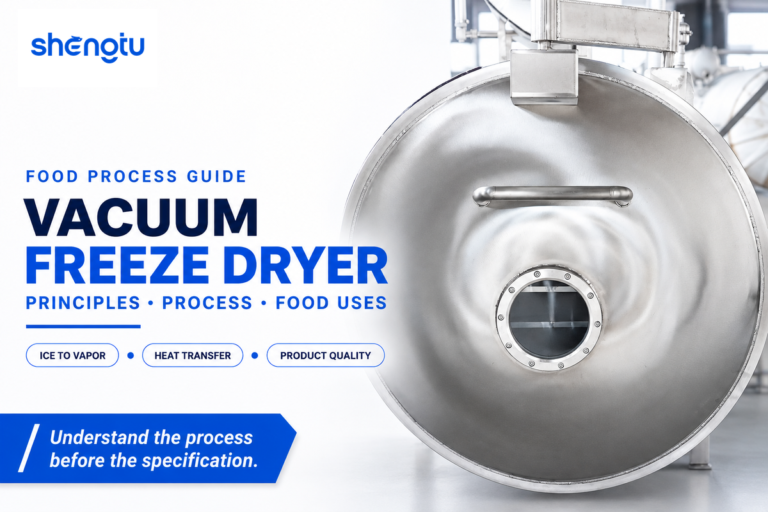
A freeze dryer removes moisture through controlled freezing, heat input and vapor capture. Freezing the product prepares its water to sublimate directly into vapor, without passing through a liquid phase. This process is called sublimation. A refrigerated condenser captures this water vapor, and the vacuum pump helps reduce the pressure and remove noncondensable gases. Primary drying removes ice, secondary drying removes more tightly held moisture. Shelf temperature and product temperature are different readings. The food-process review by Nowak and Jakubczyk explains why heat supply and vapor transport must be considered together.
A hot-air dehydrator evaporates liquid water. There are many factors that affect the rate of evaporation, such as air temperature, humidity, air velocity, and contact with the food. A dry surface can conceal a wetter center, and this can be especially true if the product is thick or the surface of the product hardens early. A mesh-belt hot-air dryer and a tray-loaded vacuum freeze dryer therefore need different loading records.
The drying chamber operates as a vacuum chamber during primary drying; a separate freezing chamber may prepare the load. The heat source supplies energy while the frozen product remains within its developed cycle limits. Low temperatures during freezing don’t mean that every shelf or every drying stage uses the same temperature. A food dehydrator instead uses fans to circulate air around the load. Reduced pressure changes the boiling point of water, but ice sublimation is a distinct phase change. Low pressure alone doesn’t identify the process. Vacuum drying can evaporate liquid water; freeze-dry operation requires a frozen product during primary sublimation. If a quotation says only “vacuum dryer,” establish which physical route and product state it describes.
Freeze Drying vs Hot-Air Drying: Compare the Product You Can Sell
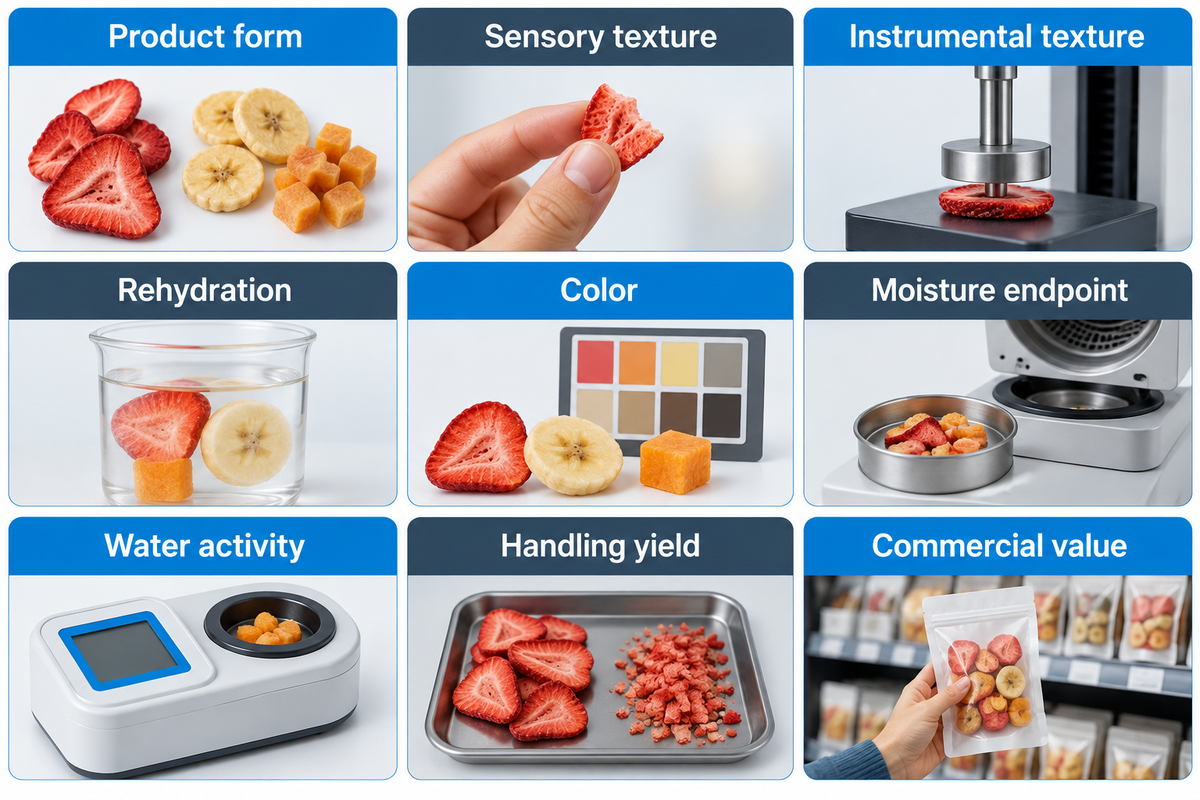
The best route yields a texture and appearance the customer finds acceptable at an economical cost. There are other important properties like hardness and rehydration. Porosity and crispness are separate properties. A food product can be easily rehydrated, but may be deficient in a certain quality parameter or parameters. How well freeze-dried food retains its original shape or original texture must be judged based on the purpose for which it’s intended. Nutritional value, flavor and nutrition should be judged based on appropriate parameters instead of a general retention limit.
In Xiao and colleagues’ apple-chip experiment, freeze-dried samples had greater rehydration and lower instrumental crispness than some air-dried treatments. Crispness was assessed by peaks in the texture-test curve. The final moisture level also varied among the treatments. Those results provide evidence against the statement, “freeze dried means crispier,” and therefore don’t prove which apple product is best.
| Decision measure | Freeze-drying trial | Hot-air trial |
|---|---|---|
| Product form | Check porous piece, powder or inclusion | Check desired slice, strip or granule |
| Sensory texture | Taste fracture and mouthfeel | Taste chewiness and surface hardness |
| Instrumental texture | State probe and test method | Use the same measurement method |
| Rehydration | Measure uptake and shape after soaking | Measure under the same preparation conditions |
| Color | Compare against an agreed reference | Separate acceptable browning from defects |
| Moisture endpoint | Record basis and sampling positions | Record basis and sampling positions |
| Water activity | Measure separately from moisture | Use the same instrument conditions |
| Handling yield | Weigh fines and broken pieces | Weigh rejects and off-size material |
| Commercial value | Confirm a buyer pays for the result | Confirm the accepted specification and price |
Let’s say our illustrative bakery buys raspberry ingredients. Their frosting needs inclusions that disperse rather than remain chewy. The bakery creates two small recipes with the same addition of fruit solids, and compares how each one behaves when added to a mix, and how each one affects color and mouthfeel. Let’s say a freeze-dried powder fits that application, but the cost of that ingredient is greater than others. The bakery’s granola team may prefer a piece that survives mixing and gives a good bite; those are different acceptance tests. Raspberry substitution discussion illustrates the practical issue; however, proving the same thing through a plant trial would require adding a measured yield and repeatability. Set the application test before buying a larger dryer. Dehydrated food may suit the desired chew; a different food preservation method may suit a powderable inclusion. A gentle drying description alone says little about either result.
Convert Wet Feed into Water Load and Dry Product
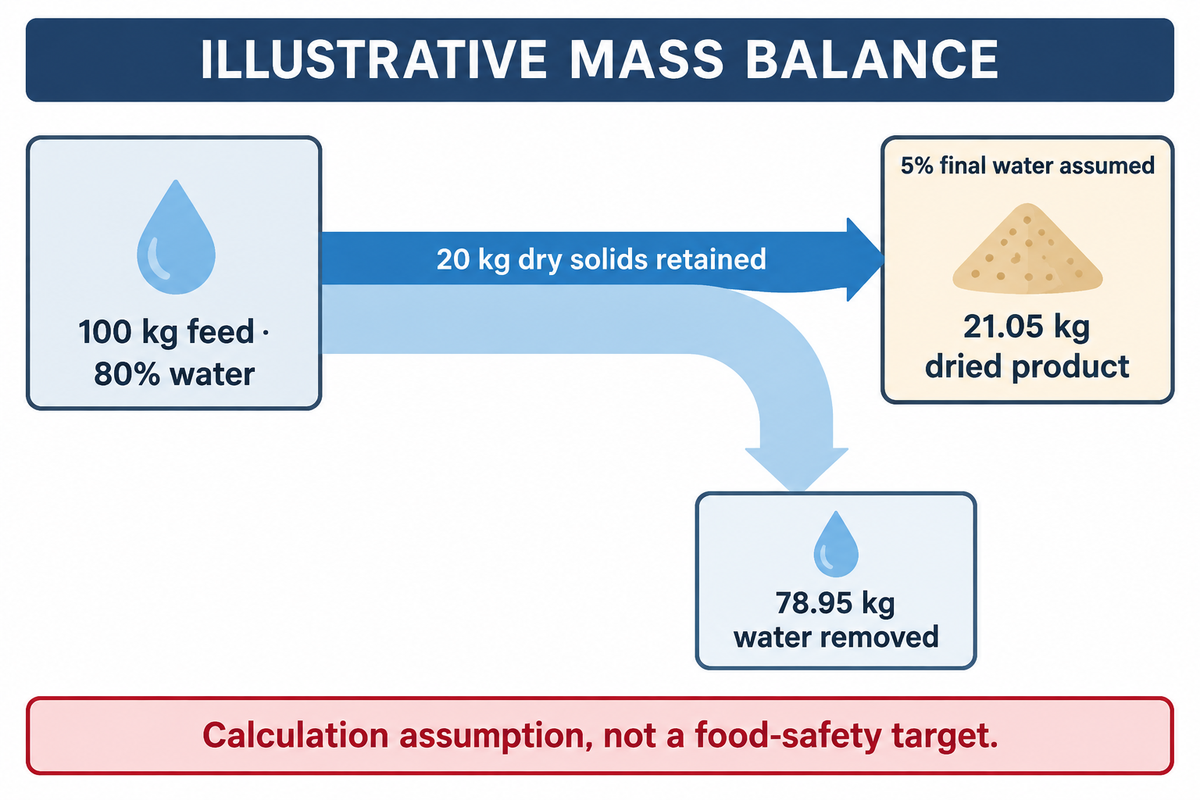
In an illustrative 100 kg batch containing 80% water on a wet basis, 20 kg is dry solids. If those solids are retained and the final product contains 5% water, the calculated dried mass is 21.05 kg. Water removal is 78.95 kg. The chosen endpoint is a calculation assumption, not a food-safety target.
Dry Solids Stay, Water Leaves
This phrase refers to the mass-conservation assumption in the example. FAO’s drying chapter defines wet-basis moisture as water mass divided by total mass. In contrast, dry-basis moisture divides by dry-solids mass. Convert the basis before entering a value into a balance. Report both initial water content and final moisture content on the same basis. Removing moisture concentrates the remaining solids, so a change in composition per kilogram does not automatically mean that more nutrient mass has been retained.
Dry solids = 100 × (1 − 0.80) = 20 kg
Dried product = 20 ÷ (1 − 0.05) = 21.0526 kg
Removed water = 100 − 21.0526 = 78.9474 kg
Can a 100 kg batch produce 100 kg of dried food?
No: the batch loses water, so its dried output is lower unless other material is added. In this example, a “100 kg batch” refers to wet input. A condenser rating in kilograms of ice describes water-handling capacity under its stated conditions. It doesn’t describe 100 kg of dried food or a universal wet loading limit.
Juice drainage, trim loss and solids lost with the juice change the starting balance. Record them before drying. After drying, weigh broken product and fines separately; they may contain valuable solids but fail the intended saleable grade. For a different feed moisture, the existing water-removal load comparison may support the same accounting process.
Read Capacity Across the Whole Production Calendar
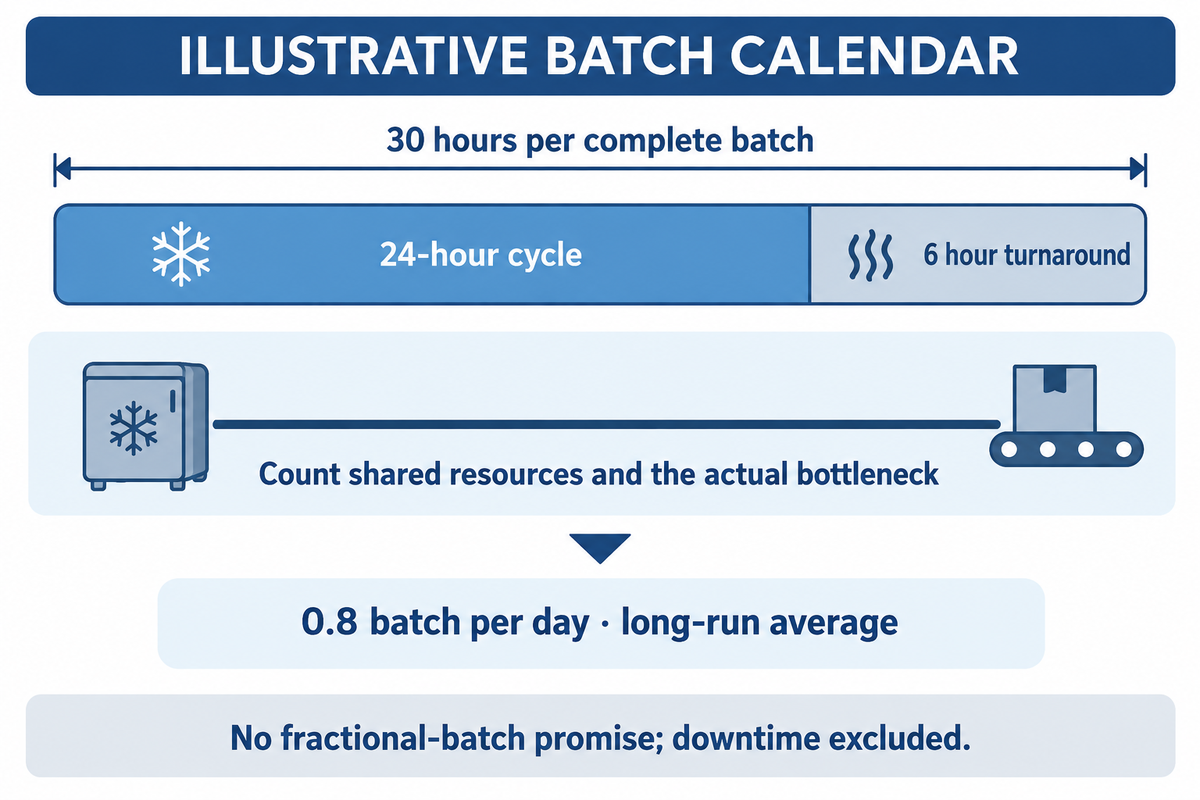
A 24-hour cycle with a 6 hour non-overlapping turnaround time would yield a batch processing time of 30 hours. The long-run average for this process is 0.8 batch per calendar day. This average is based on repeated, expected runs. That average describes repeated production; it does not promise a completed fraction of a batch on any particular day or include unplanned downtime.
The example’s calculated dry output would average 16.84 kg/day before rejects. Loading, unloading, condenser defrost, cleaning and preparation occupy time even when no saleable food leaves the dryer. Some of these activities can be done in parallel. If a separate freezer prepares the next load while the chamber operates, count the shared resources and actual bottleneck instead of adding every task duration.
Batch production
- Track occupied chamber time
- Include turnaround before the next load
- Plan shared freezer and packing resources
Continuous production
- Track steady output at the accepted endpoint
- Include startup and shutdown losses
- Plan shared feeding and packing resources
Industrial freeze drying includes batch and continuous designs. Food Engineering’s RAY Plus report describes a batch configuration with loading and condenser arrangements; those are that supplier’s designs. Don’t apply a single batch-clock formula to every continuous system. When daily output is tight, compare the scheduled sequence of complete loads with the shipping calendar.
What an Energy Number Includes and Leaves Out
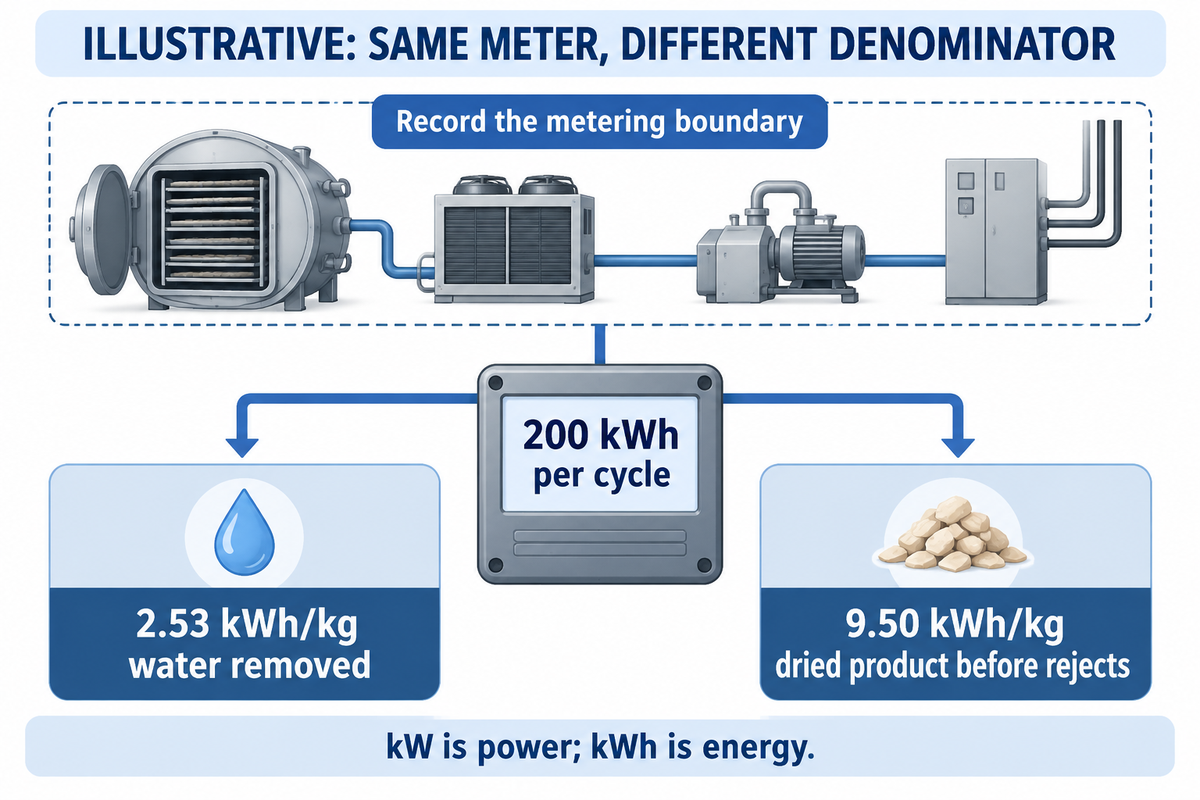
In the illustrative balance, a measured 200 kWh cycle would equal 2.53 kWh per kilogram of water removed or 9.50 kWh per kilogram of dried product before rejects. Both results are using the same energy reading. The denominator determines the answer, and the power (in kW) is describing something else entirely.
For the meter data record, separate the chamber heater, refrigeration, condenser, vacuum system and external utilities. Prefreezing, cooling water, compressed air and defrost may sit outside a supplier’s quoted boundary. Record energy consumption, the product loading and end point, next to each energy value, to adjust for a shorter cycle that may leave more water behind.
Liu, Tian and He’s 2024 industrial study reported 1,937 vs 1,471 kWh for a full-process cold-trap comparison for shiitake, showing a 24% reduction. Other configurations and a continuous system comparison are reported as well. These results belong to the studied equipment; two authors were employed by Zhejiang Tongking FD Technology. They illustrate why defrost and condenser organization are in the boundary, rather than establishing a Shengtu savings claim.
The tariff also affects the cost of electricity. The U.S. Department of Energy’s rate explanation explains energy charges, demand charges and fixed charges and time-varying rates. Parallel equipment can change the site’s peak demand. A lower energy reading can still align with a higher demand charge. Compare time stamped consumption with the rate schedule to assess the energy cost for a low energy trial.
Calculate Cost per Saleable Kilogram: A Worked Example
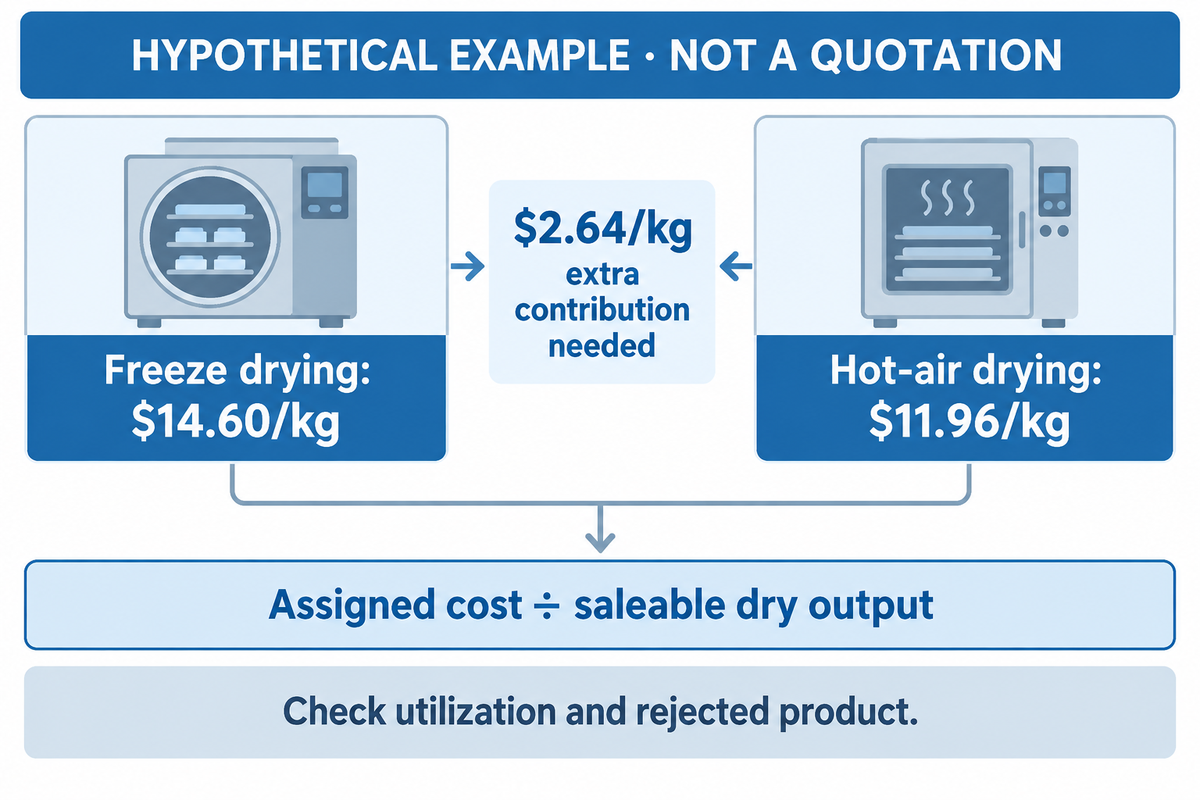
Under the hypothetical assumptions below, freeze drying costs $14.60 per saleable kilogram and hot-air drying $11.96. The $2.64/kg difference is the extra contribution the freeze dried product would need before other unallocated business costs. These are teaching case calculations, not equipment costs, market prices or quotations.
Both routes start with the same 100 kg feed and a final wet-basis moisture of 5% (assumed). Each product needs to meet its own specification. A flat electricity price of $0.12/kWh is assumed; fixed allocations include the assigned share of equipment, maintenance and demand/fixed utility costs. Avoid adding those costs again elsewhere.
| Cost or yield item | Freeze-drying example | Hot-air example |
|---|---|---|
| Wet feed | 100 kg | 100 kg |
| Theoretical dry output | 21.0526 kg | 21.0526 kg |
| Rejected fraction of dry output | 5% | 10% |
| Saleable dry output | 20.0000 kg | 18.9474 kg |
| Feed cost | $120.00 | $120.00 |
| Energy and energy charge | 200 kWh; $24.00 | 80 kWh; $9.60 |
| Assigned labor | $48.00 | $32.00 |
| Assigned packaging | $40.00 | $40.00 |
| Fixed allocation | $60.00 | $25.00 |
| Total assigned cost | $292.00 | $226.60 |
| Cost per saleable kilogram | $14.60/kg | $11.96/kg |
Imagine an ingredient producer using this comparison for a premium fruit inclusion. Its calculation is $292 ÷ 20 = $14.60/kg for the freeze-dried route, against $226.60 ÷ 18.9474 = $11.96/kg for hot air. A buyer willing to pay only $1/kg extra would leave a $1.64/kg gap under these assumptions. Improving texture would still need to be commercially justifiable. The producer could change the product, improve yield, raise the selling price or retain the lower-cost route. A photograph of an attractive sample does not change that math. The decision depends on an accepted product and a realizable selling price, rather than a claim that one machine is inherently economical.
Test sensitivity before treating results as an investment case. If utilization halves while annual fixed costs stay unchanged, the fixed allocation doubles: the two unit costs become $17.60/kg and $13.28/kg. If freeze-dried rejects instead rise to 15% at the original cost, saleable output falls to 17.89 kg and unit cost rises to $16.32/kg. Each change is calculated separately. Transport, finance, taxes and selling costs remain outside this example.
Read Product Trials Before Scaling to a Larger Dryer
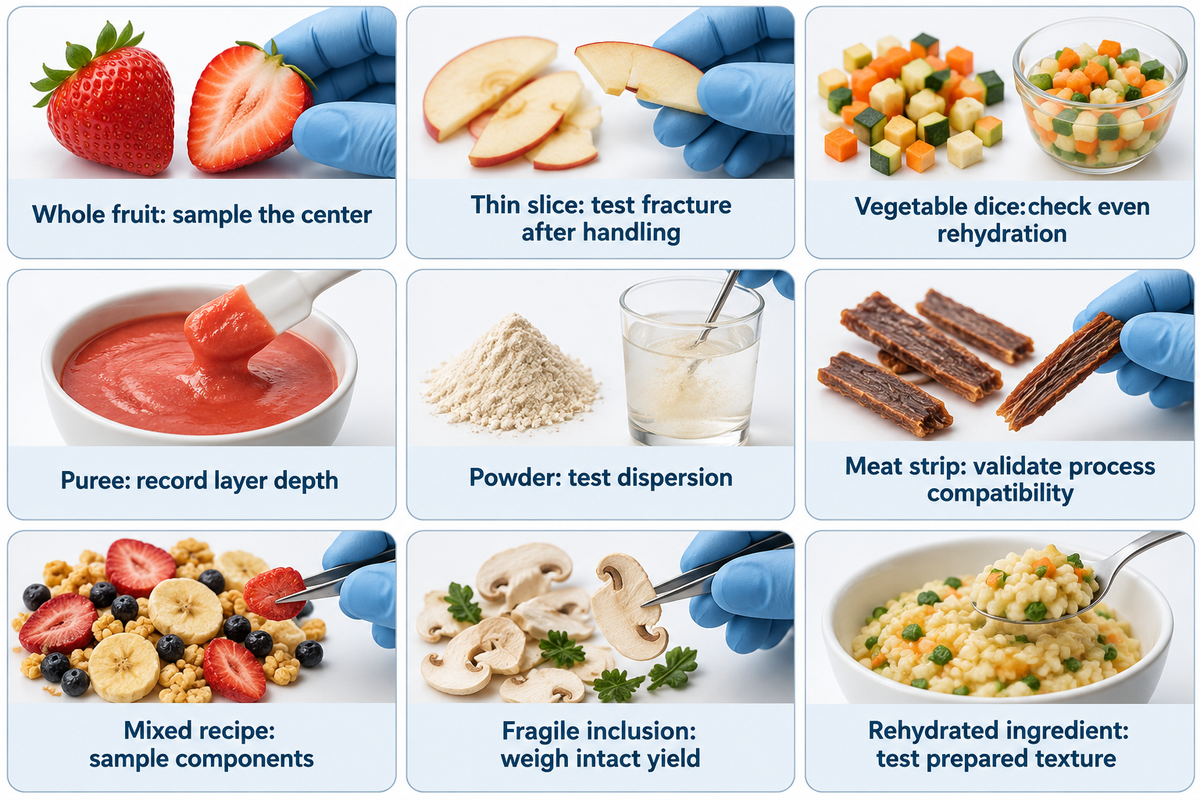
A representative trial preserves the product formulation, piece geometry, loading pattern and agreed endpoint while assessing what changes with scale. Chamber volume alone doesn’t establish heat delivery or vapor-removal performance. Record the least favorable sampled positions, as well as the average result, before committing to production capacity.
Antal’s Idared apple experiment compared freeze drying with hot-air-assisted and infrared-assisted freeze drying. Its freeze-drying run took 22 hours; the hybrid conditions took 12–16 hours, with different final moisture values. These experimental details are useful, but don’t provide a universal ratio for hot air alone versus freeze-dried food.
| Trial type or product form | Principal question | Record before scaling |
|---|---|---|
| Whole fruit piece | Does the center reach the endpoint? | Piece size and center samples |
| Thin fruit slice | Does the desired fracture survive handling? | Thickness and broken-piece mass |
| Vegetable dice | Does the prepared product rehydrate evenly? | Dice distribution and preparation method |
| Fruit puree | Does loading depth change the dry structure? | Solids content and layer depth |
| Powder ingredient | Does powder disperse as intended? | Particle distribution and mixing result |
| Meat strip | Are pretreatment and drying controls compatible? | Formulation and validated process requirements |
| Mixed formulation | Do components dry at different rates? | Recipe and component-specific sampling |
| Fragile inclusion | How much survives transfer and packing? | Intact yield after the actual transfer route |
| Rehydrated ingredient | Does the prepared food meet its specification? | Water temperature, time and final texture |
Preparation can dominate the comparison. In a root vegetable washing and peeling process, what arrives for slicing and drying changes. Match trimming, draining and size distribution between trials. Different types of foods need different acceptance records. If a product is sold as probiotic, measure the required viable cell result separately from dryness and appearance. Improving saleable recovery can reduce food waste, but the recovered grade and its destination must be documented. For process related questions for various crops, use the fruit and vegetable freeze-drying guide in addition to the measured batch record.
Protect the Result Between the Dryer and the Package
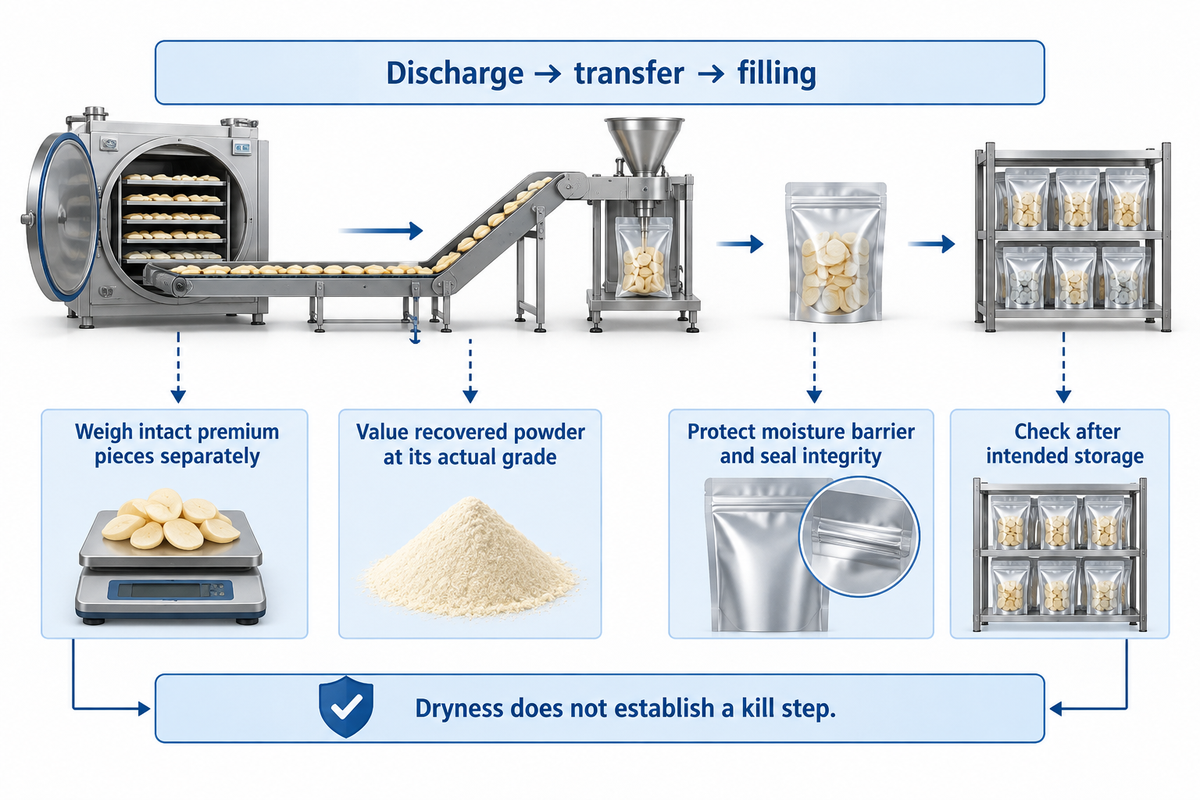
Saleable freeze-dried food depends on moisture protection, handling strength and product-specific control after drying. Moisture content and water activity provide answers to different questions. Finished product testing and intact packaging provide data, but none of them fully describes the food safety and/or shelf life system.
“The process of freeze-drying does not kill illness-causing microorganisms but rather preserves them until they are exposed to water”
The FDA water-activity guide explains water activity through equilibrium vapor pressure, rather than total water percentage. Product release needs its own validated requirements before a food is sold as shelf-stable. For food storage, specify the package moisture and oxygen barrier, seal integrity and storage conditions. Mylar bags are one packaging format; the laminate construction and sealed-package performance determine their suitability, not the name alone. A perishable feed becoming dry does not establish a storage-life claim. 21 CFR 117.40(f) addresses accuracy of instruments used for conditions controlling undesirable microbial growth; that duty is not a dryer certification.
Consider a hypothetical snack producer whose trial samples arrive intact but whose production pieces break during transfer. Their packing team weighs product upon discharge, after conveyance and after filling. Intact premium pieces are set aside. Powder that sells in another grade is assigned a recovery value, as opposed to a full value, and the account is based on the actual value of the product. A gentler transfer and shorter open exposure may be more valuable than a larger chamber. The next trial should include the real hopper, conveyor and package. Check the sealed product after storage under the intended conditions, and preserve the lot link between the drying record and the packing record.
For low-moisture ready-to-eat human foods within its scope, FDA’s January 2025 draft sanitation guidance discusses environmental monitoring and the limits of relying solely on product testing after contamination. Plan prevention of product contamination and related validated controls with the food safety team. It remains nonbinding draft guidance. Do not consider dehydration as an automatic kill step.
Which Equipment Supplier Fits Your Production Route?
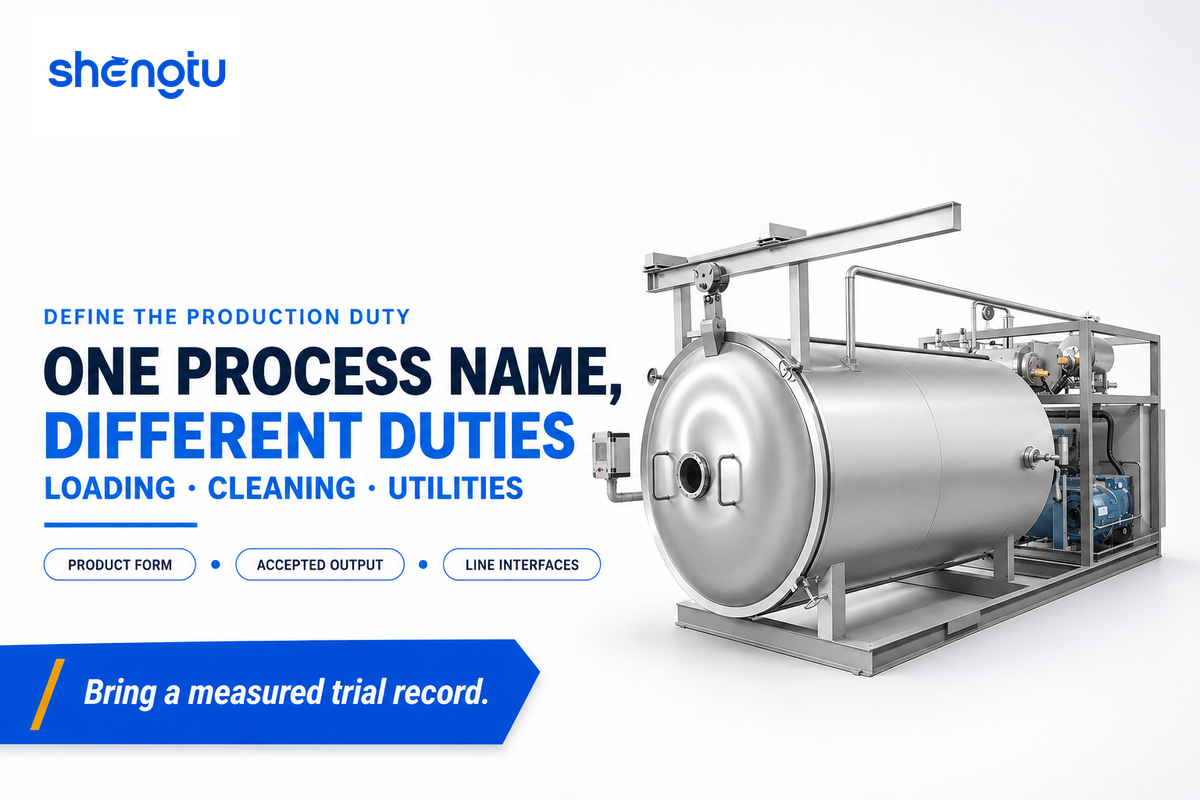
Food producers should talk to suppliers about having an agreed product outcome with a realistic production duty. Types of freeze dryers include systems built for food, laboratory work and pharmaceuticals. A laboratory lyophilizer, pharmaceutical system and industrial food dryer can share a process name while having different loading, cleaning, automation and documentation needs. Start with the food application and required output rather than the chamber label.
A home freeze dryer can help an operator understand an ingredient, but its appliance cycle is a different order of task. Production should cover issues related to tray or belt loading, utilities, and product transfer and line controls. Smaller units can support development, while home units are designed around appliance-scale tasks. Home and commercial equipment should be compared at the required duty rather than by tray count alone. A freeze drying machine for pet food also should include process controls related to its intended use. The mechanical boundary of a food vacuum freeze dryer should fit the preparation and packing operations around it.
Check out Shengtu’s food freeze-drying and hot-air drying systems page for more details on its equipment. To support the discussion, bring the feed specification, accepted product form, trial results and your daily schedule. The focus should be on the production task at hand.
When to Stop: Results That Need Another Trial

When the material balance doesn’t close, and/or endpoints are different without a product reason, energy boundaries are changing or saleable losses are missing, run another controlled trial. Before increasing the size of the equipment, resolve the specific uncertainty. A second controlled trial should answer a defined question rather than repeat a favorable sample demonstration.
Do
- Reweigh the feed, drained material and dry output
- Match endpoint, piece size and sampling method
- Measure the complete scheduled process boundary
- Include transfer, packing and accepted grade
Don’t
- Convert condenser ice capacity directly into product output
- Reward a faster run for a wetter endpoint
- Substitute connected power for measured cycle energy
- Assume all recovered dry material earns the premium price
If the product meets the quality target but the premium does not cover the cost difference, revisit the product positioning or retain the less expensive route. If the production calendar is the constraint, determine the bottleneck of occupied time and shared resources before assuming a new chamber will resolve it.
Frequently Asked Questions
What are the disadvantages of freeze drying?
Its equipment complexity, production time and handling demands can raise the cost of the accepted product.
Refrigeration, vacuum equipment, loading, condenser defrost and product transfer all consume resources. A porous product may also break during packing. The commercial question is whether customers value the achieved texture, appearance or rehydration enough to cover those costs. Compare full-cycle output and saleable yield at the intended specification rather than using a general claim that one drying route is always better.
What food should not be freeze-dried?
Foods with little removable water or an unwanted final texture are poor candidates for an assumed standard cycle.
Composition, freezing behavior and intended use matter more than a universal prohibited-food list. A formulation rich in fat or sugar may need a different product design or a carefully developed cycle. Establish the actual product form and acceptance criteria, then test the recipe on suitable equipment. Food-safety controls remain product specific; a visually dry sample alone doesn’t establish a validated production process.
How long do freeze-dried foods last?
Shelf life belongs to the particular food, package and storage conditions.
Residual moisture, oxygen exposure, fat oxidation and packaging performance can change the result. Establish commercial shelf life through product data for the intended package and distribution conditions. A generic promise of decades of storage doesn’t establish the life of a newly developed ingredient. Include handling before sealing and the prepared product’s intended use when defining the storage study.
What is another name for freeze-drying?
Freeze-drying is also called lyophilization.
A lyophilizer is a freeze dryer. Food, laboratory and pharmaceutical systems can have different loading, operating and documentation requirements despite sharing that name.
Can you freeze dry at home without a machine?
A household freezer does not reproduce a controlled commercial freeze-drying process.
A freezer freezes food; it doesn’t provide the controlled vacuum, vapor capture and endpoint measurement used by a commercial freeze dryer. For a manufacturer considering an investment, a representative pilot or contract-drying trial gives more useful production information. Record formulation, loading, initial moisture, final specification and handling yield together. Domestic experiments aren’t a substitute for developing and validating a factory process. Home use and commercial use involve different throughput, handling and documentation needs.
References & Sources
- The Freeze-Drying of Foods, The Characteristic of the Process Course and the Effect of Its Parameters on the Physical Properties of Food Materials Nowak and Jakubczyk, Foods, 2020.
- Modification of Cell Wall Polysaccharides during Drying Process Affects Texture Properties of Apple Chips Xiao et al., Journal of Food Quality, 2018.
- Agricultural engineering in development: Drying Food and Agriculture Organization of the United Nations.
- GEA Debuts RAY Plus Freeze Dryers Food Engineering, November 2024; supplier-reported configuration.
- Industrial freeze-drying energy and cold-trap experiments Liu, Tian and He, Energies 17(4), 884, 2024.
- Evaluating Your Utility Rate Options U.S. Department of Energy.
- Comparative study of three drying methods: freeze, hot air-assisted freeze and infrared-assisted freeze modes T. Antal; original apple experiment.
- Freeze drying Amy Johnston, University of Minnesota Extension.
- Water Activity (aw) in Foods U.S. Food and Drug Administration, 1984.
- 21 CFR 117.40: Equipment and utensils Electronic Code of Federal Regulations, current text.
- Draft guidance: Establishing Sanitation Programs for Low-Moisture Ready-to-Eat Human Foods and Taking Corrective Actions Following a Pathogen Contamination Event U.S. Food and Drug Administration, January 2025; nonbinding draft.
Discuss a product-led drying trial
Tell Shengtu what the finished ingredient must do, how much accepted product you need and which preparation and packing operations surround the dryer. Share your current trial record or arrange a representative comparison. The useful starting point is a defined product and production duty.
ENGINEERING CONTENT DISCLOSURE
Why Shengtu Publishes Technical Guides
These guides turn common production-line questions into a clearer decision path for food manufacturers, project engineers and procurement teams.
We focus on the inputs that change equipment selection: product characteristics, package format, target capacity, process stages, utilities, plant constraints and destination requirements.
01Define the applicationStart with the product, pack and operating target.
02Map the process routeConnect stages, interfaces and utility needs.
03Surface trade-offsExplain the choices that affect line scope.
04Prepare better questionsTurn reading into a reviewable project brief.
MANUFACTURER PROFILE
SHENGTU
- Focus
- Food processing equipment and turnkey line solutions
- Base
- Zhucheng, Shandong, China
- Project path
- Requirement → layout → equipment scope → delivery coordination
SOLUTION COVERAGE
VALIDATION BOUNDARY Final equipment configuration should be confirmed against your product, package, throughput, utilities, plant constraints and destination requirements.