Get in touch with Shengtu Bufan Company

Retort Canned & Pouch Line
Retort Sterilizer Line for Canned and Pouch Foods
Shengtu builds retort sterilizer lines that dice, fill, sterilize, air-dry and label canned and pouch foods on one layout. Send your product, container format and target output; we return a line configuration, an equipment list and a written quotation.
Quotation
Engineer-reviewed quote within one business day
Lead Time
Complete line built in 45–70 working days
Accuracy Specification
Filling accuracy within 3% and labelling accuracy to ±1 mm on the standard line configuration
Process Inputs
- We start from product photos, plant layout drawings and written process requirements
Confidentiality, data access and handling requirements for your drawings and product details are agreed as part of the project scope.
Retort Sterilization Line at a Glance
A retort sterilization line is a five-station food processing line that fills packaged food into cans, jars, trays or pouches and then runs thermal processing inside a pressurised retort machine until the sealed contents reach commercial sterility. The output is shelf-stable products whose shelf life holds at ambient temperature, without refrigeration — the practical result of commercial sterilization.
Too little heat leaves a spoilage risk; too much heat costs you texture and colour
Send your product and container spec and we set the cycle against those, not against the machine
Get a Line Proposal→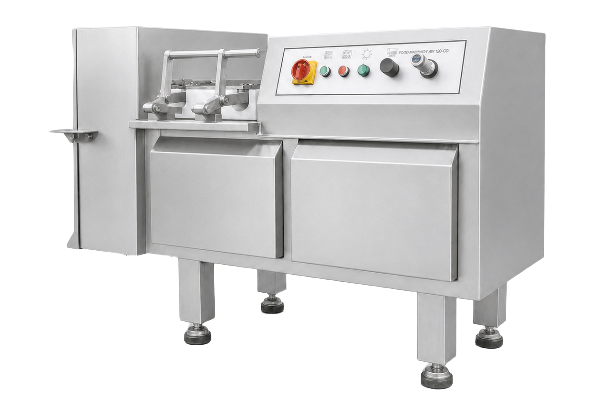
-
01
Quote turnaround
Within one business day, reviewed by a process engineer
-
02
Complete line build
45–70 working days after the layout is approved
-
03
Single machine build
20–30 working days standard configuration; 40–55 working days custom configuration
-
04
Minimum order
One machine or one complete line — there is no minimum order quantity
-
05
Line accuracy
Filling within 3% and labelling to ±1 mm on the standard configuration
-
06
Before crating
Factory acceptance test on your own product and containers
Line Capabilities: Dicing, Filling, Sterilizing, Drying And Labelling
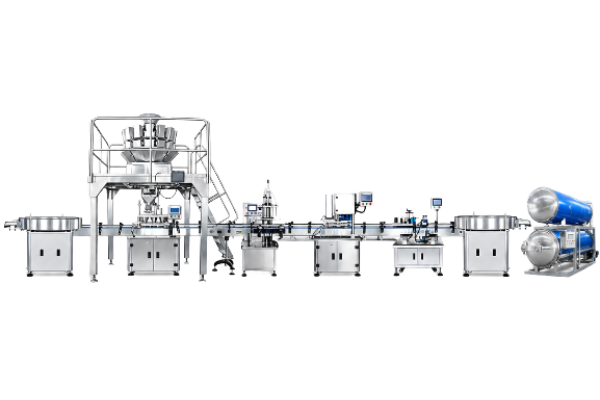
A canned food production line performs only as well as its weakest handover. We build all five stations of the retort canning line to one container spec, so basket patterns, fill weights and conveyor pitches match end to end. Filling, processing and sterilization all run to that one definition — the point in food manufacturing where safety and quality either hold together or come apart.
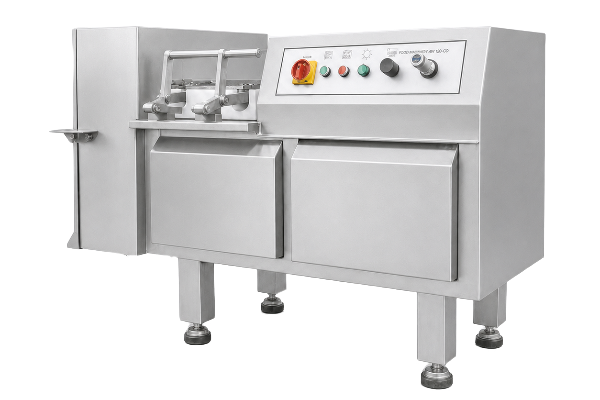
Station 1 — Dicing and Product Preparation
The dicer cuts fruits and vegetables, meat blocks and firm solids to a uniform dice, and feeds the filler directly. Particle size is what makes heat transfer through the container predictable later in the cycle.
- Cutting belt width 240 mm; drive power 1.5 kW; 380 V/50 Hz supply
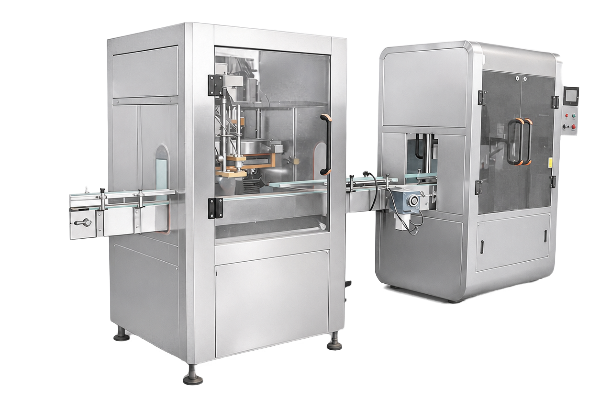
Station 2 — Filling and Sealing Handover
The filler doses product into cans, jars, bottles or pouches at a controlled fill weight and hands sealed containers to the loading area. Fill weight and headspace are process inputs, not cosmetic settings, because both change how fast the pack reaches process temperature.
- Output 2,800 bottles per hour with filling accuracy within 3%
- Capping and seaming gear is matched to the container format you supply
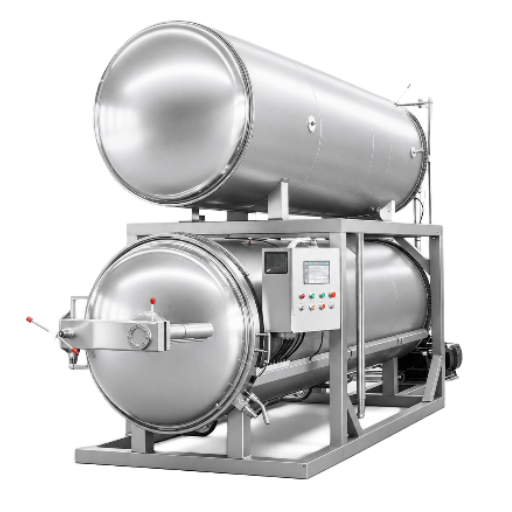
Station 3 — Retort Sterilization
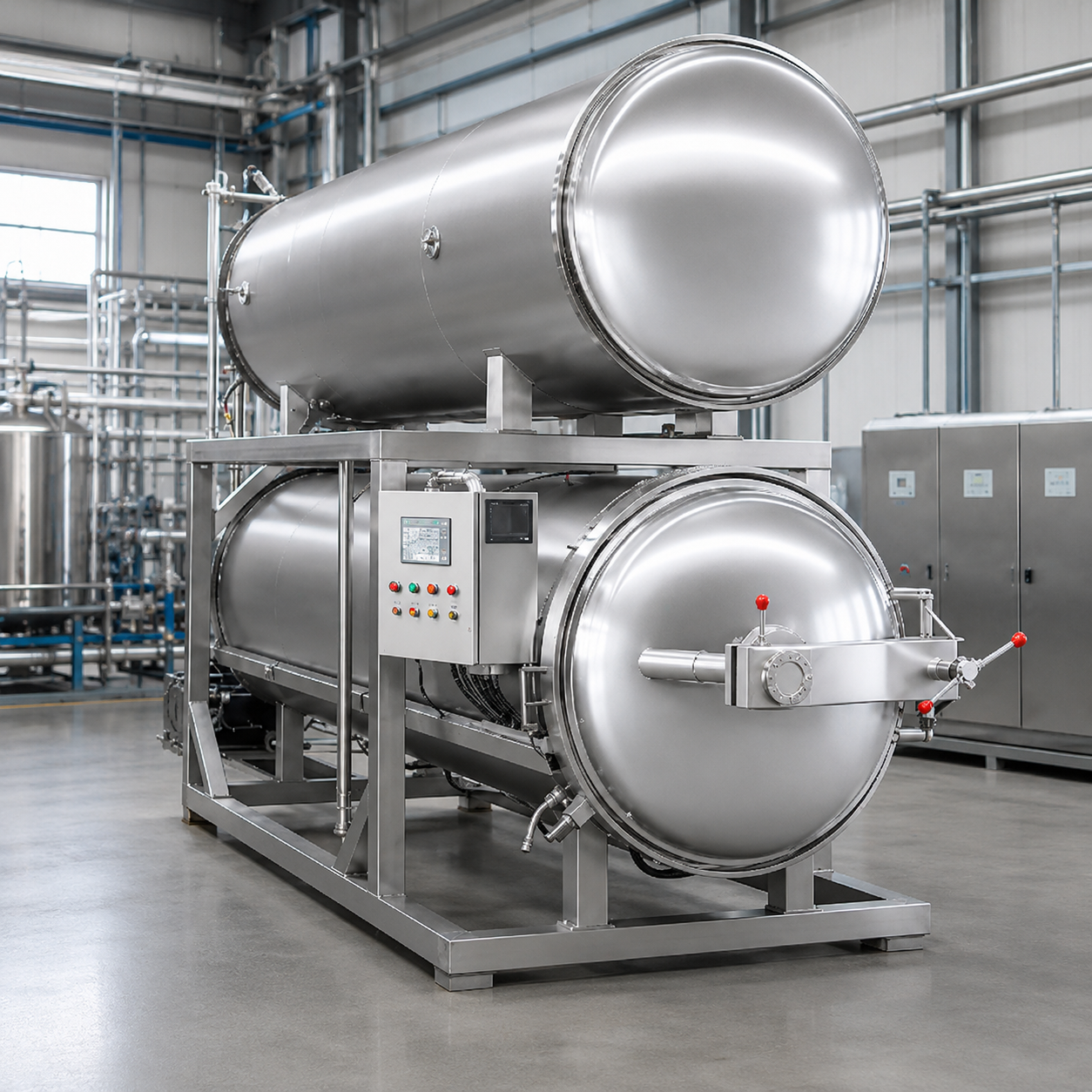
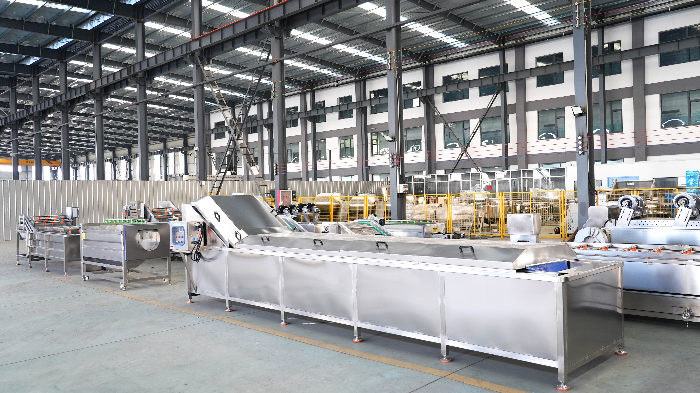
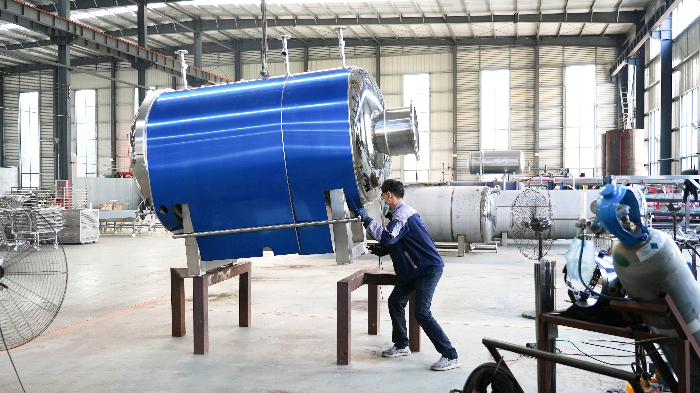
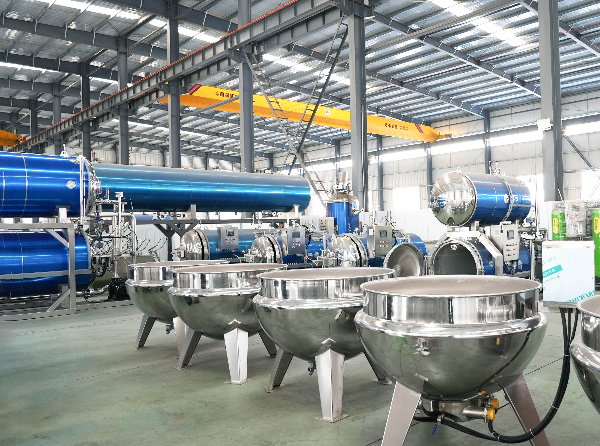
This is the station that will sterilize food inside its own sealed pack: baskets are loaded, the chamber is vented, brought to temperature and pressure, held, then cooled under controlled overpressure. The vessel is built at one of our four owned and self-built manufacturing bases, and the build source of every machine on your equipment list is named in the quotation.
- Chamber 1,200 mm inner diameter × 3,600 mm shell, 24 baskets, 2 m³ loading volume
- Steam, hot water circulation, water spray and water bath modes on one vessel
- Make-up pump 7.5 kW and circulation pump 5.5 kW, running alternately
- PLC control with a touchscreen stores sterilization cycles as named recipes, with data recording and alarm handling
- Built on our own control system and the STUnit platform, so we automate the points where operator variation would change the process
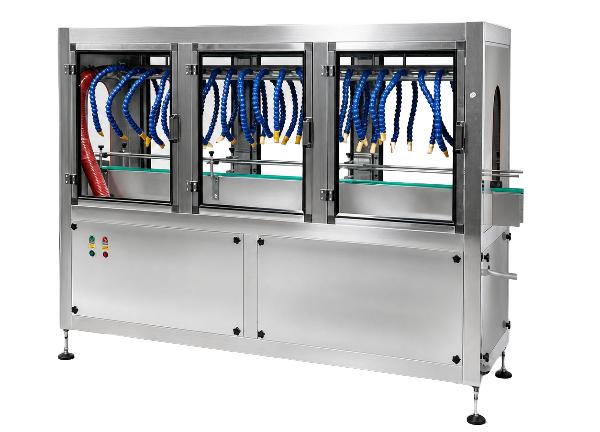
Station 4 — Air Drying
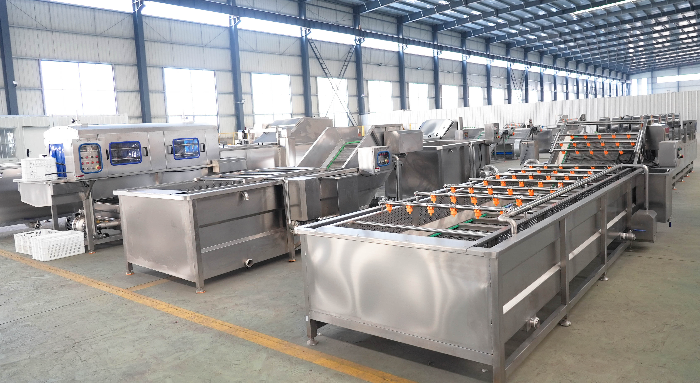
Wet cans and pouches will not take a label and will corrode in the carton. Twin-sided air knives strip surface water before the pack reaches the labeller — the step that most often caps throughput on a retorted pouch line.
- Compressed air 0.8 MPa, about 2.5 kW, AC 220 V/50 Hz
- Drying time is set against the slowest container in your range
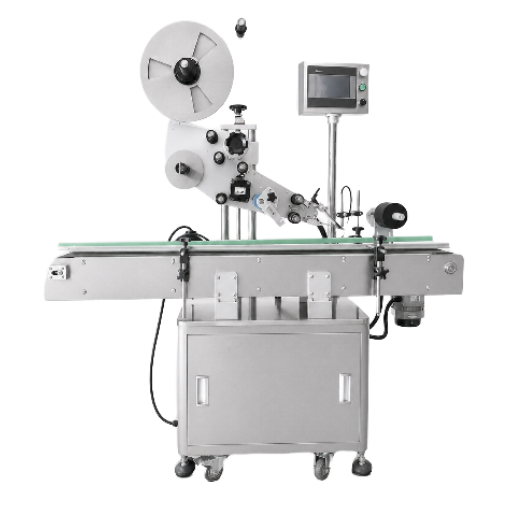
Station 5 — Labelling and End of Line
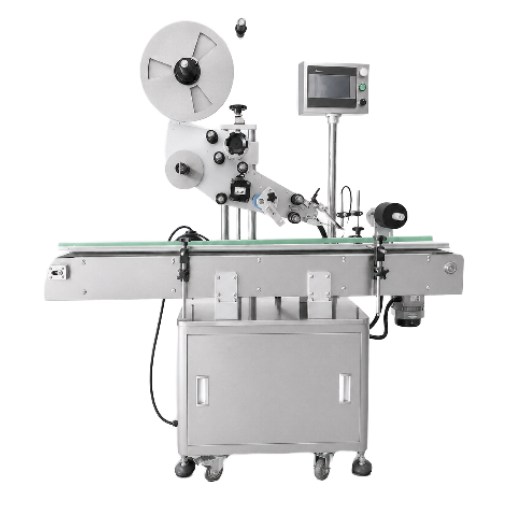
The labeller applies your own brand label to the dried container and closes the line. Stepper and servo drives are both available; the choice follows the speed your pack needs.
- Label length 6–250 mm, label width 6–130 mm, roll outer diameter 280 mm
- 40–150 pcs/min on stepper drive, 50–200 pcs/min on servo drive
- Low-code control boxes and multi-protocol gateways connect the finished line to your plant systems
Containers and Packaging Formats We Sterilize
The container decides what happens downstream: which heating mode the autoclave runs, whether overpressure is required, how the load is stacked and how fast the pack dries. Retort packaging is not ordinary food packaging: every format below has to survive the full cycle intact.
Metal Cans
- Runs canned food, canned fruits, sauces and pet food in cans
- Stacked in baskets with separator plates
- Saturated steam needs no overpressure — the rigid wall carries it
Aluminium Foil Pouches
- Ready-to-eat meals, meat products and sauces
- Laid flat in slotted trays at a constant pack thickness
- Overpressure runs through heating and cooling, not just the cook
Vacuum Flexible Pouches
- Flexible packaged food and vacuum packing formats
- Single layer, so no stacking load sits on the seal
- Overpressure is not optional — the pack carries no counter-pressure of its own
Plastic Trays and Bowls
- Prepared meals, rice and noodle packs, pet portions
- Profile trays hold the pack so the lidding film cannot lift
- Overpressure protects that film, which is the weakest point of the pack
Glass Jars and Bottles
- Sauces, canned fruits and drink products
- Cushioned separators keep glass off glass
- Slow ramps plus overpressure, or the jar takes the thermal shock
Pet Wet-Food Packs
- Pet wet food in pouches, trays and cans
- Mixed-format baskets carry several pack sizes in one load
- Every flexible and semi-rigid pack needs overpressure
Another Container Format
Send the container drawing or a sample photo; we confirm the heating mode, basket pattern and back-pressure profile in the quotation.
Packaging Format × Heating Mode Fit Matrix
This is how we size a retort before anyone talks about price. A mode marked as needing overpressure still works — it requires the air compressor and pressure control loop in the specification from day one.
| Packaging format | Saturated steam | Steam-air | Water immersion | Water spray |
|---|---|---|---|---|
| Metal cans | Suited — rigid wall carries the pressure | Suited | Suited | Suited |
| Aluminium foil pouches | Not recommended — seal distorts | Needs overpressure | Needs overpressure | Needs overpressure |
| Vacuum flexible pouches | Not recommended — pack expands | Needs overpressure | Needs overpressure | Needs overpressure |
| Plastic trays and bowls | Not recommended — lidding film lifts | Needs overpressure | Needs overpressure | Needs overpressure |
| Glass jars and bottles | Not recommended — thermal shock | Needs overpressure | Preferred, even ramping | Controlled ramp only |
| Pet wet-food packs | Cans only | Needs overpressure | Needs overpressure | Needs overpressure |
Retort Autoclave Heating Modes and Process Options
Food plants say retort, laboratories say autoclave, and an industrial retort is a food autoclave designed for one duty — the same pressure vessel applied to sealed packages of food. Between installations, the variable is the heating medium and how it reaches the pack.
| Heating mode | Heat transfer | Medium temperature | Containers it suits | Build source |
|---|---|---|---|---|
| Saturated steam | Condensing steam on the wall | 115°C to 121°C (240–250°F) at 15–20 psi | Metal cans | Own base |
| Steam-air mixture | Forced steam and air blend | Same band, plus air | Pouches, trays, jars, cans | Own base |
| Water immersion | Circulating hot water | Same band, water column | Glass jars, pouches, trays | Own base |
| Water spray | Water sprayed over the baskets | Same band, low volume | Pouches, trays, cans | Own base |
Build source above is the standard configuration. Four owned and self-built manufacturing bases cover about 80% of our main equipment categories and the balance is produced with long-term partner factories, so the source of each machine on your equipment list is named in writing with the quotation.
Saturated Steam and Steam-Air Retorting
Steam sterilization in a steam retort is the simplest mode: saturated steam under pressure condenses on the container and gives up its latent heat, carrying the load to the high temperatures listed above. Steam alone gives no counter-pressure, so a pure steam environment — steam with no air added — belongs to rigid cans; adding air turns the same autoclave into a mode that holds pouches and trays.
Water Immersion and Water Spray Modes
Water immersion retorts hold the load under a heated water column. That gives even ramping for glass and delicate packs, and it is the mode we pick when thermal shock is the failure to avoid. A water spray retort machine uses far less water, suits mixed pouch and tray loads, and cools faster at the end of the cycle.
Overpressure Control for Pouches and Trays
Inside a sealed pouch the headspace expands as the contents heat, and without external counter-pressure that load lands on the seal. Overpressure control applies and releases chamber pressure on its own curve, independent of temperature, so the pack holds its integrity during processing.
Agitation as a Process Lever
Hotter and longer is not always safer, and it is where product quality goes. A published review of retort processing reports that excessive safety margins are a leading cause of nutrient loss, and that shortening a process can improve the result.
Line Specifications, Capacity and Standard Lead Times
Build figures for the standard five-station configuration of this canned food processing equipment package. Chamber size, basket count and pump duty set both your throughput and your utility load, so these are the retort equipment figures to check against your own plant.
| Station | Specification | What we build | Standard lead time |
|---|---|---|---|
| Dicer | Cutting belt width | 240 mm (9.4 in) | 20–30 working days |
| Dicer | Power and footprint | 1.5 kW; 1,200 × 680 × 860 mm (47.2 × 26.8 × 33.9 in) | 20–30 working days |
| Filler | Output and accuracy | 2,800 bottles per hour; within 3% | 20–30 working days |
| Filler | Power and footprint | 6.5 kW; 2,000 × 1,500 × 2,000 mm (78.7 × 59.1 × 78.7 in) | 20–30 working days |
| Retort | Chamber size | 1,200 mm inner diameter × 3,600 mm shell (47.2 × 141.7 in) | 40–55 working days |
| Retort | Basket loading | 24 baskets at 900 × 800 × 130 mm; 2 m³ (70.6 ft³) loading volume | 40–55 working days |
| Retort | Temperature and pressure | Maximum working temperature 143 °C (289 °F); design pressure 0.35 MPa (50.8 psi); maximum working pressure 0.3 MPa (43.5 psi) | 40–55 working days |
| Retort | Hydrostatic test | 0.44 MPa (63.8 psi) | 40–55 working days |
| Retort | Pump set | Make-up pump 7.5 kW and circulation pump 5.5 kW | 40–55 working days |
| Retort | Wetted material | 304 stainless steel shell, baskets and internals | 40–55 working days |
| Air dryer | Air supply and power | 0.8 MPa (116 psi) air; about 2.5 kW; AC 220 V/50 Hz | 20–30 working days |
| Labeller | Label size range | Length 6–250 mm (0.24–9.84 in); width 6–130 mm (0.24–5.12 in) | 20–30 working days |
| Labeller | Speed and accuracy | 40–150 pcs/min stepper or 50–200 pcs/min servo; to ±1 mm | 20–30 working days |
| Complete line | Integrated build and wiring | All five stations matched to one range of cans, jars, trays or pouches | 45–70 working days |
[ PROC-REQ-02 ]
Procurement Quick-Read
- Footprint driver — the 3,600 mm shell plus basket clearance at both ends
- Utility driver — steam supply, 0.8 MPa compressed air, and the 7.5 kW plus 5.5 kW pump set
- To fix the layout we need — plant layout drawings with ceiling height, door and lift openings, and floor loading
Pricing Factors, Payment Terms and Incoterms
There is no price list for a retort line, because price follows the container format, the retort capacity, the automation level, the utility configuration and the destination requirements. Before a quotation exists, we can still give you the structure of the cost.
Four Things That Move Your Price
Container range and changeover
One container format — all cans, or all pouches — is the cheapest line to build. Every extra pack size adds basket tooling, conveyor adjustment and a separate validated recipe.
Retort capacity and cycle time
Chamber volume and cycle length set how many batches a shift produces. Across the range of retort configurations, one larger vessel and two smaller vessels give very different shift profiles at similar cost.
Utility supply and steam load
Steam demand peaks during venting in the first minutes of every cycle, and that peak is what your boiler has to cover. Where several vessels share one boiler, staggered start times keep it down.
Automation depth and destination
Automatic basket loading, line integration and plant-system connectivity are priced as scope, not as options bolted on afterwards. Destination voltage, frequency, steam pressure and pressure-vessel documentation are confirmed one by one against the regulatory requirements of the destination country.
Payment Terms and Trade Terms
- Payment 30% T/T deposit to start production, 70% balance before shipment; an irrevocable letter of credit at sight is accepted for larger orders
- Acceptance The factory acceptance test is a contract event, run before the balance falls due
- Trade terms FOB or CIF as standard; EXW, CFR and DDP on request
- Lead-time scope The build clock starts when the layout drawing and equipment list are approved, and excludes shipping and site utility work
Quality Control, Factory Testing and Compliance Boundaries
You achieve commercial sterility with a process, not with a machine on its own. We deliver a vessel whose behaviour is measured and documented; your processing authority then sets the cycle your product and load need.
Pre-Shipment Tests and Documented Temperature Distribution
- Pressure safety test the vessel is verified under pressure before anything else proceeds
- No-load running test control system, circulation system and valve train are run and observed
- Heat distribution test chamber temperature uniformity and heat penetration are recorded
- Simulated load test a real sterilizing duty is run to see how the vessel behaves loaded
- Whole-line interlock test all five stations run together to verify sequencing
Commercial Sterility: Who Establishes the Scheduled Process
Under 21 CFR Part 113 the scheduled process for low-acid canned food has to be established by qualified persons with expert knowledge of thermal processing. That obligation sits with the food manufacturer and its processing authority, and no equipment supplier can discharge it for you.
- Come-up time is not hold time, and the batch record separates the two, so the hold you can show an auditor is time at the process temperature
- Temperature distribution has to be established and documented for the retort actually in use
- Headspace, product consistency, fill weight and water activity all change the outcome, so a new pack size invalidates the previous scheduled process
- Pressure and temperature are logged per batch, so microbial process records can be reconstructed for an audit
- Spore-forming bacteria are the target organisms in low-acid packs, and they include both pathogens and heat-resistant spoilage formers, so microbial safety is decided at the slowest-heating point, which is the controlling measurement
Certificates and Documents Shipped with the Line
Applicable certificates and documents are confirmed for the equipment model, configuration and destination country. Company management-system records are reviewed separately from product conformity documents.
- With every line an operation manual, electrical drawings, a factory test (FAT) report and a certificate of conformity, plus the export document set for your destination
- Company records to request ISO9001, ISO27001, DCMM Level 2, SRDI small and medium enterprise status, and Gazelle Enterprise status
- Confirmed per order equipment-level certificates and destination-country pressure vessel documentation are checked model by model and destination by destination before the quotation is issued
QA // VALIDATION
How We Work: From Layout Drawing to Commissioning
01
Send your brief
Product photos, plant layout drawings and written process requirements are enough to open a file.
02
Line configuration
An engineer reviews raw material, capacity, process and destination, then proposes a station-by-station build.
03
Written quotation
Every machine is listed with its build source, so you know what comes from our own bases and what from a partner factory.
04
Contract and production
The 30% deposit releases the build slot and the drawing package is frozen with it.
05
Factory acceptance test
We run your own product and containers on the line, and you sign off the factory acceptance test by recorded video or a live video inspection before the machines are crated.
06
Shipping and commissioning
Documents ship with the line and commissioning starts against the layout you approved.
What we need from you
Why we need it
What happens without it
Plant layout drawings: ceiling height, door and lift openings, floor loading
Sets vessel orientation, basket handling side and access route
The vessel is sized right but cannot reach its position
Container format (cans, jars, trays, pouches), size range and fill weight
Sets basket pattern, heating mode and back-pressure profile
Basket tooling has to be re-made after delivery
Product viscosity, particulate size and initial temperature
Governs heat transfer through the pack and therefore cycle length
Cycle estimates drift and capacity planning is wrong
Target output per hour and shift pattern
Decides chamber volume, vessel count and loading automation
The line is bought at the wrong capacity
Destination voltage, frequency, steam pressure, water quality
Determines electrical build, pump selection and documentation
Rework on site before the line can be energised
Commissioning is scope, not goodwill: the boundary of each activity is written into the quotation.
- Plant layout planning and equipment positioning
- Steam and water connection guidance, and electrical installation support
- Sterilization process parameter optimisation and heat distribution commissioning
- Operator training and maintenance guidance
- Technical response through remote video, photographs and online diagnosis
- Engineer support for heat penetration problems on specific products
- Long-term supply of valves, seals, sensors, control components and other accessories
Manufacturing Base and R&D Platform
Shandong Shengtu Bufan Intelligent Technology Co., Ltd. is a high-technology enterprise in Weifang, China, working in food processing machinery research, manufacture and whole-plant digital solutions.
Book a Video MeetingWhere the machines are built
Four owned and self-built manufacturing bases cover about 80% of our main equipment categories; specialised or supplementary machines are produced with long-term partner factories. Self-produced hardware is what lets us integrate control and mechanics on one line.
Behind the control system
Shengtu holds more than 100 research and development projects, more than 100 software copyrights and 7 patents. Our own industrial control system and the STUnit industrial internet platform form the software-and-hardware base under that: control boxes that take low-code configuration and remote control, gateways that carry several protocols, and machine vision and edge algorithms brought in alongside them on food industry lines.
When a Batch Retort Line Is Not the Right Choice
A batch retort is the right answer for sealed packs of low-acid food, and the wrong answer for several neighbouring problems. Each case below has a better route, and aseptic UHT lines and freeze-drying lines are ones we build ourselves.
Heating a filled bottle of juice or dairy in a batch autoclave costs colour and flavour for no safety gain. Ultra-high-temperature treatment with aseptic processing and cold filling is the route for pumpable liquids.
Acidic products do not need a pressure cycle to reach shelf stability, and running one costs energy and quality.
The threshold that pulls a product into low-acid thermal processing is pH above 4.6 with water activity above 0.85.Pasteurization at atmospheric pressure is cheaper, and for pre-fill liquid products we build plate pasteurizers.
Whole berries, delicate seafood and premium pet treats lose structure under a full thermal process. Freeze-drying preserves shape and colour where a retort cannot.
Batch cycles cap throughput because loading and unloading are dead time. Batch production retorts are not a substitute for a continuous or rotary agitating system in a plant running one product around the clock.
Retort Canned & Pouch Line Tools
Select a specialized engineering tool below to configure sterilization parameters, estimate ROI, and ensure process compliance for your packaging line.
-
Engineering Tool
Line Capacity Planner
Evaluate throughput requirements for your retort and packaging lines. Calculate batch cycle times to optimize overall plant capacity.
-
Comparison Tool
Heating Mode Selector
Compare steam, water cascade, and water immersion heating modes to determine the most energy-efficient method for your specific product matrix.
-
ROI Calculator
Agitation Payback Estimator
Quantify potential energy savings and heat penetration efficiency gains when upgrading to rotary or reciprocating agitation technology.
-
Compliance Check
Process Documentation Readiness
Assess your current thermal process records against FDA/USDA standards to ensure commercial sterility documentation is audit-ready.
01
What is the difference between an autoclave and a retort?
Both are pressure vessels that sterilize sealed containers with heat, on the same principle as a pressure cooker but at industrial scale and under a documented cycle. A food plant calls it a retort machine; a laboratory calls the same principle an autoclave. A food retort autoclave runs cycles built around your product, container and load rather than a fixed program.
02
What is the difference between canning and retort processing?
Food canning is the whole commercial canning route: filling, sealing and the heat treatment that turns the pack into shelf-stable food. Retort processing is that heat treatment, under pressure, after the container is sealed. Every canning line contains a retort; a retort alone is not a canning line.
03
What products can be sterilized in a retort?
Pet wet food, canned food, meat products, ready-to-eat meals, sauces, flexible packaged food, prepared meals, drink products, and canned fruits and vegetables on a different basket pattern. The limit is the container and the heat transfer through the product, not the vessel.
04
Why is overpressure important for pouches and trays?
Headspace inside a sealed pouch expands as the contents heat, and without counter-pressure the seal carries that load. Overpressure holds external pressure against the pack so the seal keeps its shape. Steam-air, water immersion and water spray support it; saturated steam does not.
05
What is the difference between batch retorting, continuous retorting and aseptic processing?
Batch retorting loads sealed containers, runs one cycle and unloads. Continuous systems move containers through without stopping and suit very high single-product output. Aseptic processing sterilizes product and package separately and fills cold, which suits pumpable liquids.
06
Can one line handle different products and container sizes?
Yes, within the range we design for. The validation is what changes, because a new pack size makes the previous scheduled process invalid.
07
How much does a retort sterilization line cost?
There is no fixed figure, because price follows container format, retort capacity, automation level, utility configuration and destination requirements. We do not publish a range that would be wrong for most configurations. Send your product, container and target output; a written quotation comes back within one business day.
08
What are the lead times and payment terms?
A standard-configuration single machine ships in 20–30 working days and a custom-configuration machine in 40–55 working days; a complete line takes 45–70 working days after the layout is approved. Payment is 30% T/T deposit to start production and the 70% balance before shipment, with an irrevocable letter of credit at sight accepted for larger orders. There is no minimum order quantity, and we quote FOB or CIF as standard.
09
Who is responsible for establishing the scheduled process?
Under 21 CFR Part 113 the scheduled process for low-acid canned food is established by qualified persons with expert knowledge of thermal processing, and that sits with the food manufacturer. We deliver the retort, its instrumentation and the documented temperature distribution for your vessel.
10
What do you need from us to prepare a line proposal?
Product photos, plant layout drawings and written process requirements are enough to start. Container format and size range, target output per hour, shift pattern and destination utilities get the configuration closer on the first pass. An engineer replies within one business day.
Prepare a Line Proposal
![F&V Freeze-Drying Line Process Guide [2026]](https://shengtumachinery.com/wp-content/uploads/2026/09/fv-freeze-drying-line-guide-featured-150x150.png)