Get in touch with Shengtu Bufan Company

How to Validate a Root Vegetable Washing & Peeling Line Before You Buy

Buyer evidence guide · Root vegetable processing
A Root Vegetable Washing & Peeling Line trial is useful only when it turns an incoming crop, a set of losses and a set of handoffs into records that another supplier—or the same supplier on another day—can understand. This guide gives procurement, operations and quality teams a five-record trial pack for that purpose. It does not select a machine, quote capacity or decide what rules apply at a particular facility.
Root crops do not arrive as a uniform laboratory input. Published postharvest guidance treats crop handling, wash arrangements, sorting and drainage as crop-dependent matters. That is why a buyer should begin with evidence about the trial sample and the interfaces around it, rather than with a single kilograms-per-hour headline.
A trial result becomes decision-ready only when its crop, loss and handoff records can be retrieved and challenged.
1. The 5-Record Trial Pack: Start With the Evidence Boundary
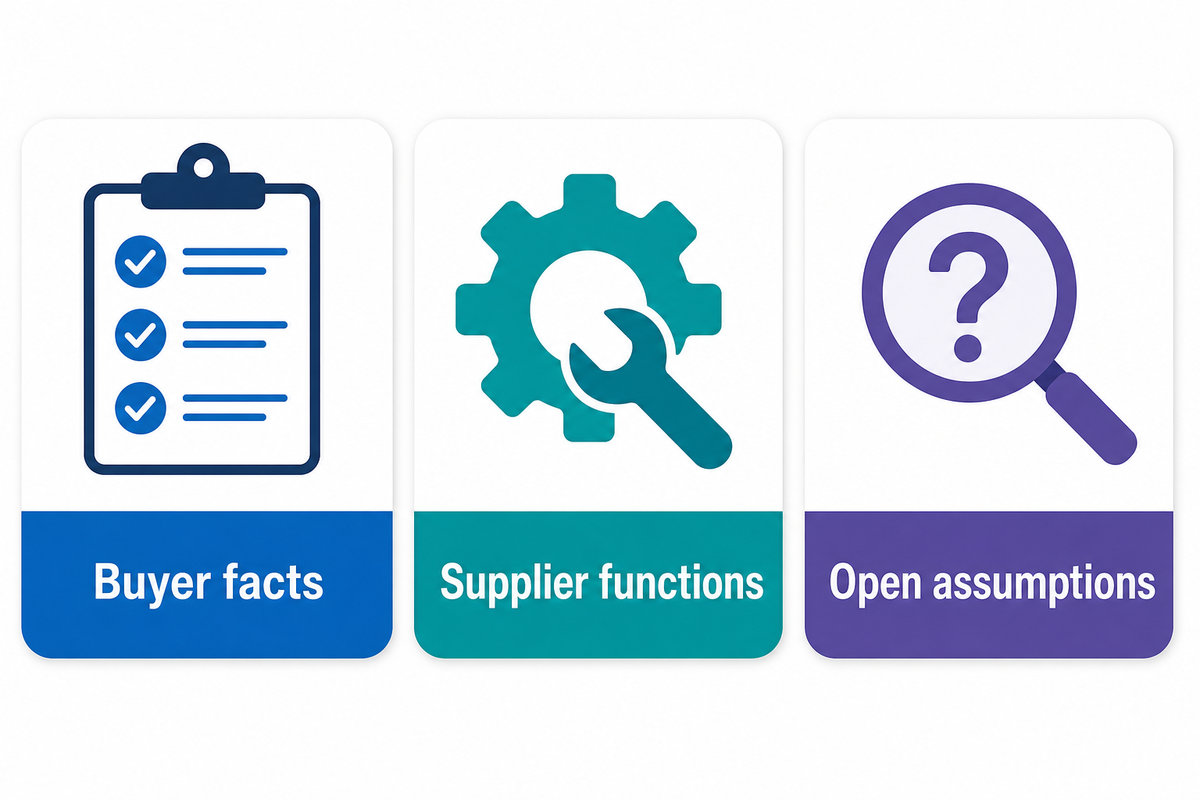
Before anyone debates brushes, peelers or conveyors, make three columns on the trial brief: facts supplied by the buyer, functions to be demonstrated by the supplier, and assumptions that remain open. For example, a buyer-supplied fact might be a labelled crop lot and its received mass. Likewise, a supplier demonstration might be the agreed observation of access, transfer or separation. An open assumption is not a hidden promise: it is a question with an owner and a next action.
This boundary keeps the article in its proper place. Broader fruit and vegetable processing context can help readers orient themselves, but it cannot substitute for a lot-specific trial record. Nor can a quote settle who owns water controls, cleaning-release authority or site discharge review.
Supplier comparisons built on an unlabelled crop lot create a risk because a later reviewer cannot tell whether the same input was tested. Keep that limitation in the record rather than treating it as a factory result.
| Category / question to name | Named owner on the buyer side | Evidence to bring to the trial | What this guide does not conclude |
|---|---|---|---|
| Facility and activity scope | Operations or compliance lead | Site, intended activity and the question that needs review | Whether a particular rule applies |
| Commodity and representative-lot basis | Quality or production lead | Crop, variety, lot identifier, condition and sampling plan | That one trial represents every crop or season |
| Water-system responsibility | Site utilities or quality lead | Water-system contact and the agreed observation boundary | Water-control adequacy or programme acceptance |
| Cleaning, adjustment and jam-clearing authority | Site safety and operations lead | Who may authorize each activity and which site process governs it | A safety procedure or energy-control method |
| Drainage and discharge review | Facilities or environmental lead | Drainage route, receiving point and reviewer contact | A permit, effluent limit or discharge conclusion |
| Trial-clock definition | Operations trial lead | Start event, stop event and interruption log | That a short observation establishes production output |
| Measurement traceability | Data keeper | Scale or log reference and record location | Measurement accuracy beyond the retained evidence |
| Escalation path for open items | Procurement lead | Re-test decision owner and due-date reference | That an unresolved item is commercially settled |
A named owner does not slow a project down. It prevents the team from treating an equipment observation as proof of a site decision. Put the five names and contacts in the trial brief before the sample arrives.
Record this boundary in the trial brief.
2. Build an Incoming-Crop Condition Record
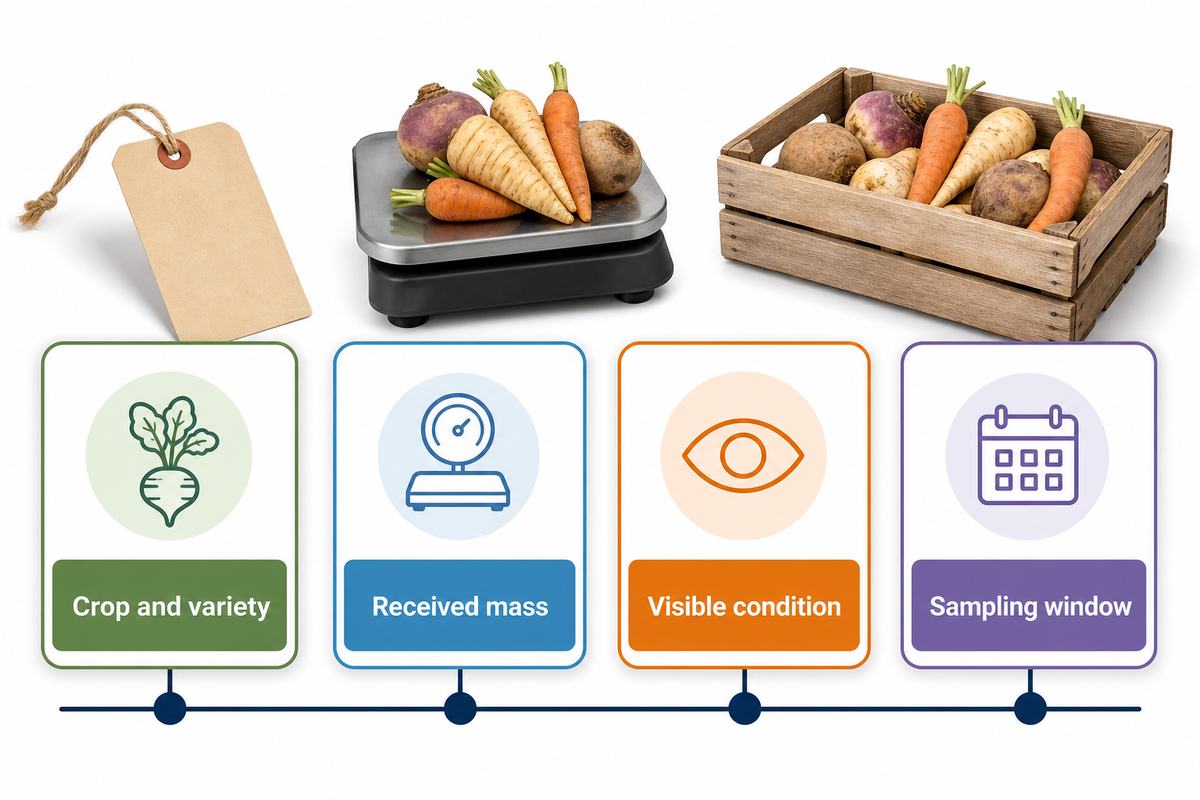
Begin with a record that makes a trial repeatable. Give the sample a simple identifier, then record crop and variety, received mass, date and time, visible soil or stone condition, size spread, defects, target output definition and the exact sampling window. If a trial spans more than one lot, mark the handoff rather than averaging the lots together. Preserve the conditions that could explain a different result later instead of making the crop look better.
Research on cassava processing has linked usable output to root shape, rot, soil and peeling or cut-off loss. For a buyer’s record, the same practical lesson applies: an incoming-mass figure without a condition description cannot explain why output changed. University extension guidance also distinguishes crop-specific washing and handling arrangements, so “root vegetable” should not be used as if it were a single unchanging material class.
At procurement review, the risk is comparing two trials whose lot boundaries differ, because their mass and elapsed-time records do not describe the same input. Keep each lot in its own record.
Keep the record descriptive. “Mixed size spread, wet adhering soil, visibly damaged pieces isolated before trial” is more useful than “good quality.” A photo reference can be helpful if the buyer controls it and the lot label remains visible. Do not turn the record into a food-safety release form or a universal crop specification.
Decide the sample boundary before weighing. State whether the received mass is measured before or after a buyer-owned preliminary sort, whether loose soil is included at receipt, and which pieces are outside the intended trial sample. None of those choices is universally right; the important point is that every comparison uses the same written choice. When the lot changes, open a new record instead of carrying the old description forward.
Assign the crop record to a quality lead, while an operations representative confirms the trial clock and an observer confirms the scale or log reference. Those roles can be held by one person in a small test, but the record should still say who did what. A second supplier can only reproduce a comparison when the input definition, the elapsed window and the retained evidence are discoverable.
Those records can make a factory review more comparable by distinguishing input variation from an observed result; they do not convert a trial into a factory acceptance claim.
For the commercial discussion, teams can use a separate crop-throughput input grid to organize the questions they intend to bring. That planning aid should remain distinct from the observed trial record: one is a request structure; the other is trial evidence.
Search labels are not trial proof
Inbound briefs use many overlapping labels. In this guide, each label is a prompt to request evidence, never a supplier-specific performance, material, safety or capacity claim.
| Category | Labels that may appear in a brief | Evidence question instead of an assumption |
|---|---|---|
| Crop and raw material | carrot; sweet potato; radish; beet; root crops; clean root; raw material; commercial vegetable; commercial root vegetable; automatic root vegetable; oval-shaped fruits and vegetables | Which labelled lot and condition are actually being observed? |
| General line language | root vegetable washing and peeling; root vegetable washing peeling; root vegetable washing peeling line; root vegetable peeling washing; root vegetable processing line; root vegetable line; vegetable washing and peeling; vegetable and fruit processing; vegetable processing line; processing line; production line; peeling line; complete processing; integrated root vegetable | Which boundaries, handoffs and outcomes are in the trial? |
| Washing and peeling labels | washing machine; washer; root vegetable washer; washing peeling machine; vegetable washing and peeling machine; fruit and vegetable washing machine; cleaning machine; bubble washer; potato washing; carrot washing; fruit washing; washing and cleaning; cleaning and peeling; vegetable peeling; brush peeling; roller peeling; brush roller peeling; brush roller washing; brush rollers for washing; peeling root vegetables; peel root | What function and observation point have the parties agreed to record? |
| Configuration words that require evidence | peeling machine; peeler; brush roller; nylon brush; nylon; soft brush; brush and abrasive; knife peeling; steam peeling; high-pressure; soft or hard; adjust the speed; vegetable cutting machine; cutting equipment; peeling and cutting; washing cutting; cleaning equipment; food processing equipment; industrial vegetable; industrial use; processing plants; food processing plants; processing companies; commercial kitchens; processing needs; automated processing; easy cleaning; hygiene; SUS304 stainless steel; 304 stainless steel | Is the statement supported by an agreed trial record, drawing or owner-side review—and who owns the open question? |
3. Measure Peel Loss as a Station-by-Station Mass Balance
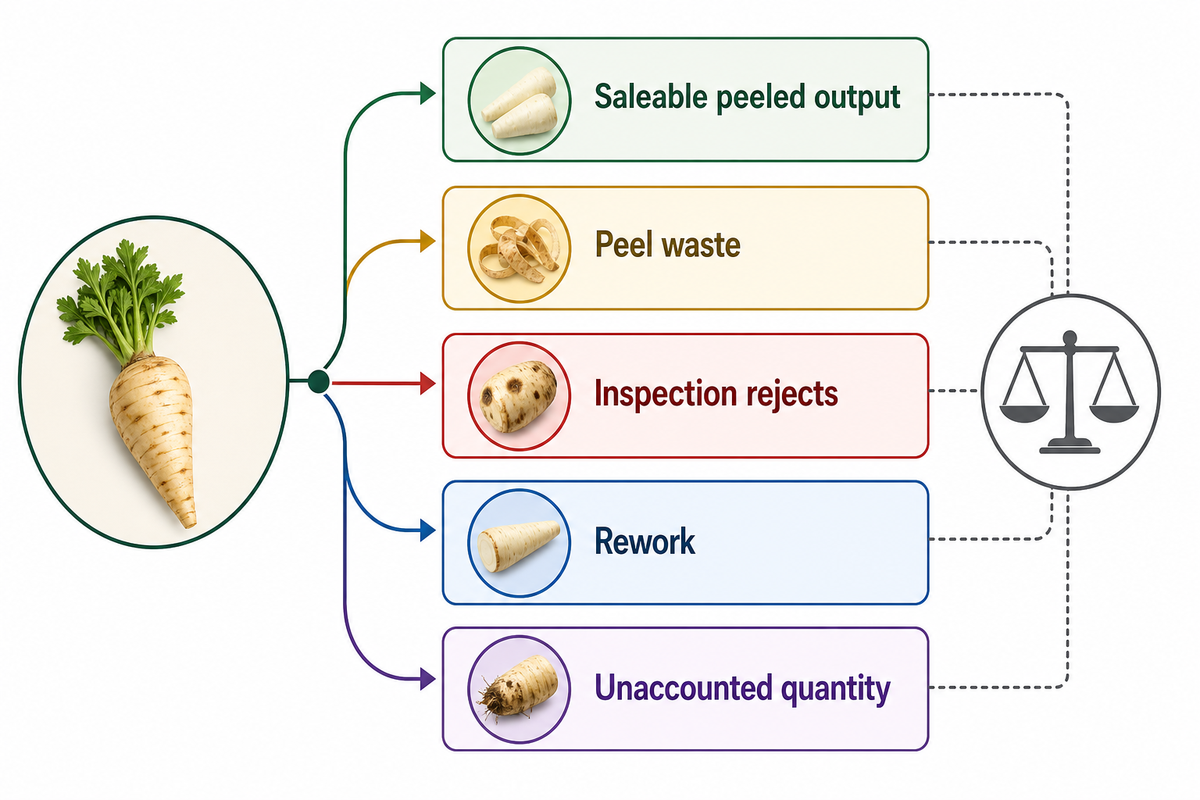
Use the second record as a mass balance, not a supplier yield promise. Start with the labelled incoming mass. Then weigh saleable peeled output, peel waste, inspection rejects, rework and any remaining unaccounted quantity separately. Note elapsed time and the definition of each category. If the categories do not reconcile within a tolerance agreed before the test, write “re-test” rather than smoothing the difference away. Treat each query label as an evidence request, and use the labelled crop lot and sampling boundary established in the incoming-crop record as the basis for that mass balance.
Do not import a percentage into a proposal. Buyers need to see which mass left as peel, which as inspection reject and which is still unexplained under the conditions of the particular trial. A mass balance makes those categories visible without claiming that one lot predicts another.
Choose the weighing points with the team before the material moves. For example, define whether a peel container is weighed at the end of a run or exchanged and weighed during the run; define whether rework is retained as a separate category; and define who records a scale reading. These are record-design decisions, not claims about a line. They reduce the familiar problem of trying to rebuild a loss number from mixed containers after the sample has gone.
Hypothetical worked example — not a supplier performance claim
Suppose a labelled sample begins at 1,000 kg. Its trial log records 760 kg saleable peeled product, 150 kg peel waste, 50 kg inspection rejects, 25 kg rework and 15 kg unaccounted loss. The categories sum to 1,000 kg. The record is complete enough to discuss where loss occurred, but it does not predict a future production yield, capacity or cost.
How is peeling loss controlled?
Control starts with definition and visibility, not an assumed percentage. Before the run, agree the sample label, time window, loss categories, weighing point and the person who records each category. Those definitions give the buyer a traceable basis for comparing where material left the observed process.
Weigh each category at the point where it leaves the observed process; do not merge rejects with peel waste unless the brief says they are the same category. Compare the reconciliation result with the incoming-crop record, then repeat the test if the crop condition, category definitions or material handoff changed. This protocol makes a loss conversation auditable. It does not establish that one peeler is better than another or that the result will hold for every root crop.
4. Find the Hidden Constraint Behind the Hourly Claim
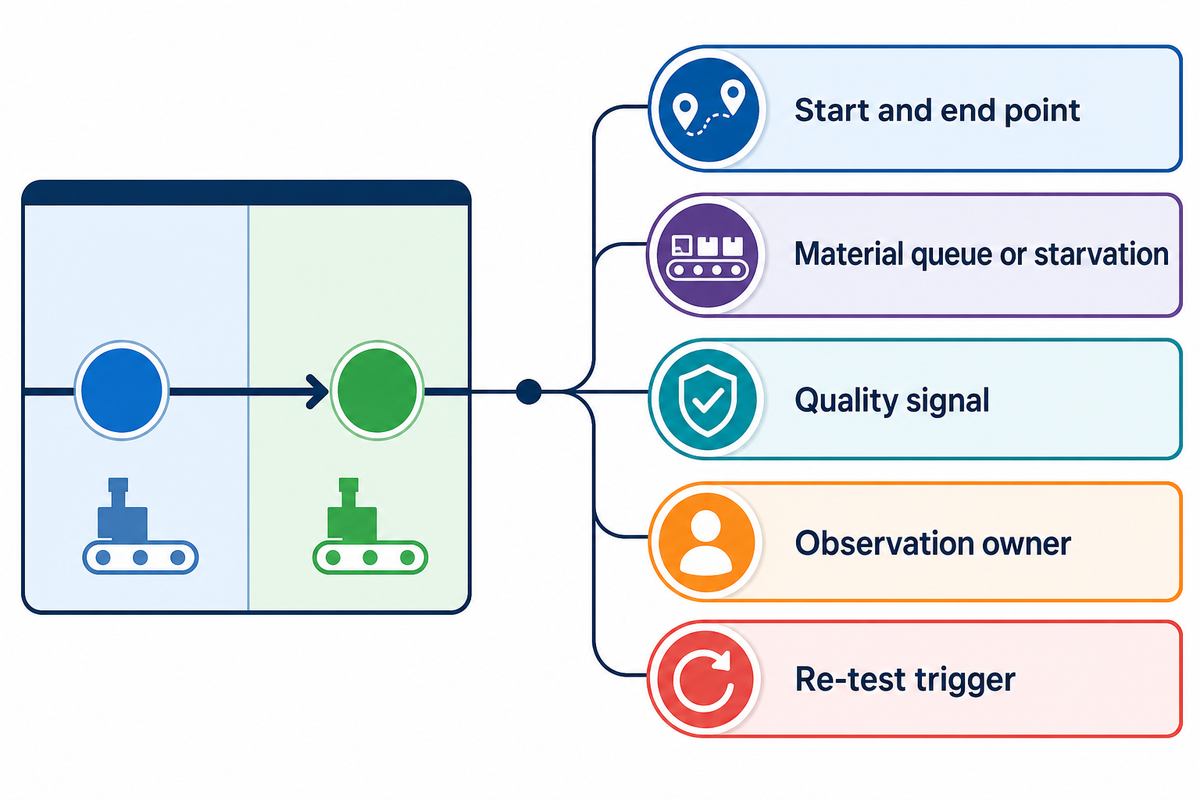
Even a measured station rate can be real and still be unusable for the line around it. In a trial, record the handoffs rather than relying on the fastest moment at one station. That result then shows where the material actually paused, accumulated or required another observation.
At procurement review, a queue is a risk because it can prevent an observed station rate from representing the whole interface. Treat the evidence pack as a bounded trial record, not a factory performance rating. Next, the buyer and supplier should resolve the question by naming the handoff that needs another observation.
Create the third record as a Constraint-Proof Map. For every handoff observed, capture the start and end point, trial duration, material queue or starvation, the quality signal affected, the person who owns the observation and the condition that would trigger a re-test. Handoffs may include receiving to washing, washing to inspection, inspection to peeling, peeling to dewatering or transfer to packing. This map is not an equipment-flow diagram and it does not recommend a capacity.
| Observed interface | What to record | Decision use |
|---|---|---|
| Material handoff | Start/end point, time window and lot identifier | Shows whether two observations belong to the same sample |
| Queue or starvation | Where it appeared, duration and photo/log reference if used | Identifies the next interface to test |
| Quality signal | Agreed visual or mass-balance signal | Keeps speed from hiding a quality trade-off |
| Data owner | Named person and record location | Makes the evidence retrievable at proposal review |
| Re-test condition | What must change before rerunning | Prevents an unresolved observation becoming an assumption |
This record is valuable to finance as well as operations. It tells the team whether a missing result calls for another test, a different sample or a site-interface answer—not an invented savings estimate. Any broader budget conversation should use explicitly stated inputs, such as those collected in a planning-cost input tool, rather than converting an incomplete trial into a cost claim.
Ask observers to separate a momentary queue from a recurring constraint. A queue that appears once while a container is moved may simply be a logged interruption; a queue that persists through the defined test window is a question for re-test or integration review. Such a map should preserve both the observation and the condition under which it occurred. It should not turn a single interruption into a design conclusion, and it should not conceal a recurring interface issue behind an average rate.
Where possible, agree one neutral observation point at each interface. That person does not need to judge product acceptability or approve a site process. Their role is to state what was observed, when it was observed and where the supporting record is stored. This keeps the trial data from becoming a collection of unlinked impressions.
5. Make Changeover and Sanitation Evidence Testable
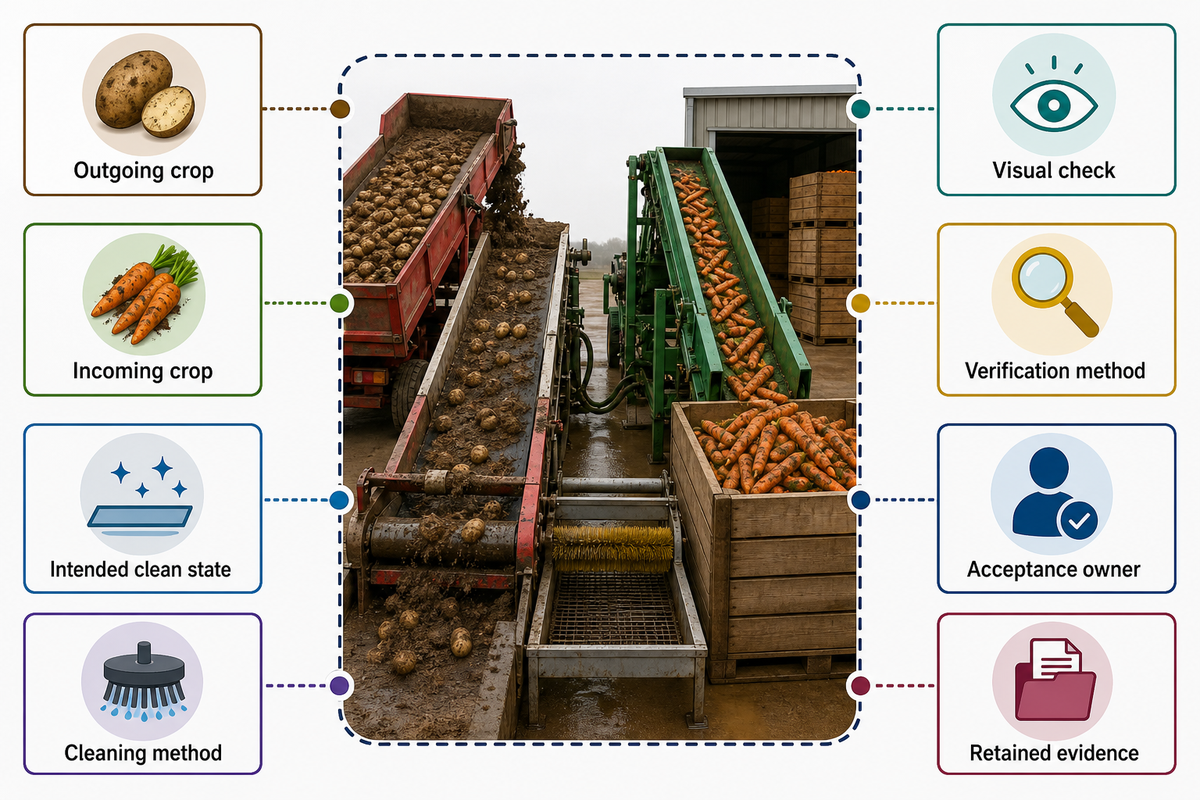
For the fourth record, document what the group agreed to observe during a changeover rather than declare a product or site acceptable. Before the run, name the outgoing crop, incoming crop, intended clean state, cleaning method being observed, visual check, verification method, acceptance owner and retained evidence. This record documents the trial boundary; a generic equipment demonstration is not a buyer’s food-safety plan.
Confusing an observed access point with a site procedure creates a changeover risk because the retained acceptance record belongs to an owner-side process. Factory demonstration can support a question, but it cannot close that owner-side review.
For equipment questions, a separate cleaning-system scope can help frame what access or function a supplier may discuss. Product-specific sanitation acceptance and site procedures remain with the buyer. If cleaning, adjustment or jam clearing is contemplated, the buyer’s named safety and operations leads must decide how it is authorized under the site’s applicable process. No energy-control instruction is provided here.
Capture the record as an observation sheet, not a pass certificate. Useful fields include the defined start point, the defined end point, each person present, the visual check used, the retained photo or note reference, and any condition that made the observation incomplete. If a buyer’s internal programme requires a further review, the document register should point to the owner and status rather than attempting to summarize or replace that programme.
How long do peeling brushes last?
There is no responsible universal brush-life number for a buyer guide. Record the brush condition at trial start, the inspection point, the agreed sign that would prompt replacement and who retains the observation. A trial can demonstrate an agreed inspection opportunity; it cannot turn one crop, one cleaning regime and one test window into a lifetime guarantee.
6. Turn the Trial Into a Handover Document Register
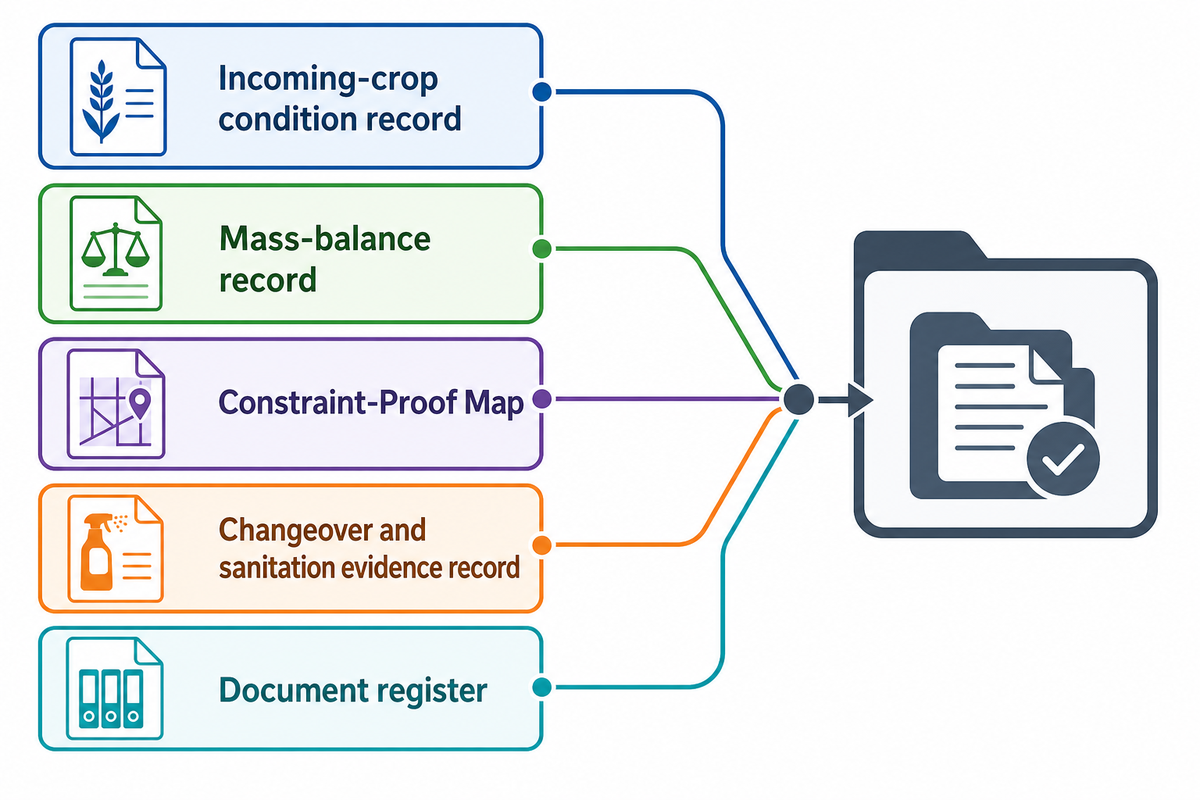
A promising demonstration becomes procurement evidence only when someone can find it again. The fifth record is a document register that points to the incoming-crop record, mass balance, Constraint-Proof Map, changeover record and acceptance note. Add the trial date, version, owner, unresolved assumption and re-test decision for each item. Include drawings, scope splits and spare-identification requests only when they are actually received; do not mark a document complete because it was discussed.
- Incoming-crop condition record: identifies the sample and its visible condition.
- Mass-balance record: accounts for saleable output, peel, rejects, rework and unexplained quantity.
- Constraint-Proof Map: records measured handoffs, queues and re-test triggers.
- Changeover and sanitation evidence record: preserves the agreed observation boundary and acceptance owner.
- Document register: links each record to its version, data owner and decision status.
Sequence matters. A drawing cannot repair a missing sample ID, and a meeting note cannot repair a mass balance that never reconciled. Keeping the five records together also prevents a later quotation review from silently filling gaps with recollection.
Use plain version discipline. Give every record a date, a file name or number, an owner and a status. If a value changes after the trial, retain the earlier version and write why it changed. If a photo, drawing or spreadsheet is unavailable, record that absence as Incomplete. A document register earns trust by showing uncertainty honestly, not by making every field look finished.
At procurement review, a missing record is a risk because a quotation can no longer be compared against a retrievable observation. The document register is not a factory acceptance certificate; it is the map back to the evidence and its open items.
7. Pass the Evidence-to-Configuration Gate Before Requesting a Proposal
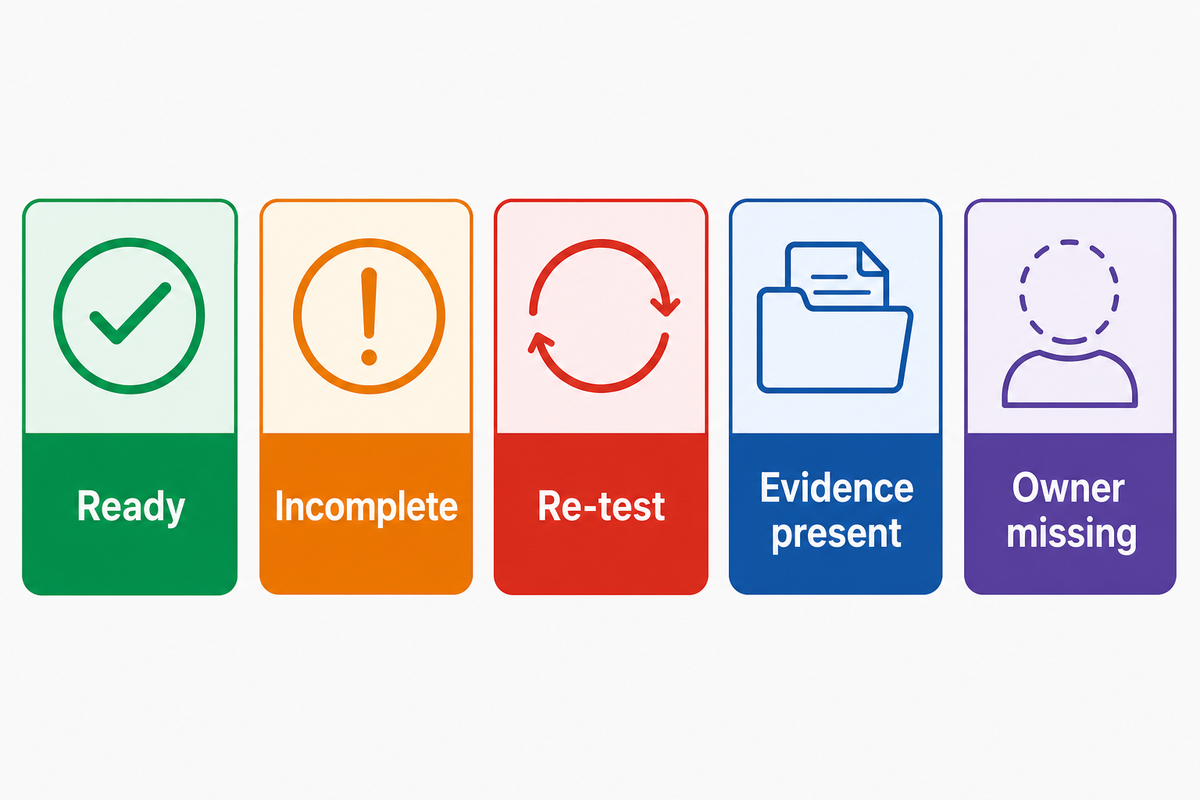
Use three states for each of the five records: Ready when the evidence is present and owned; Incomplete when a required field or owner is missing; and Re-test when the evidence was observed but the conditions changed or the balance did not reconcile. The gate does not approve a facility. It only tells the team whether it has a defensible briefing pack for a project-specific conversation.
Evidence-led request
“Here is the labelled sample record, category definitions, mass balance, observed interface map, changeover boundary and the site contacts for unresolved questions. Please identify what you need to configure and what must be re-tested.”
Untestable request
“Please quote a complete line for root vegetables at a high hourly rate and minimal loss.”
| Record | Ready | Incomplete | Re-test |
|---|---|---|---|
| Incoming crop | Lot, condition and window are identifiable | A material fact or owner is missing | A new lot or changed condition invalidates comparison |
| Mass balance | Categories reconcile on the stated basis | A category or scale reference is absent | The balance does not reconcile or definitions changed |
| Constraint map | Interfaces and observations are attributable | Observation or data owner cannot be found | A changed handoff needs a new observation |
| Changeover record | Agreed observation and owner are recorded | Boundary or retained evidence is missing | Crop, observation method or condition changed |
| Document register | Versions and open items are traceable | A required record is unavailable | A correction changes a decision-relevant record |
Only when the pack is Ready—or when the remaining items are plainly labelled Incomplete or Re-test—should the team request a project-specific root vegetable line configuration. That is the commercial bridge. It should not be used to replace the buyer’s missing evidence.
A risk arises when an Incomplete pack is treated as a finished brief because a configuration conversation has begun. A buyer may send the scoped evidence pack to Shengtu Bufan, but unresolved owner-side questions remain open until the named reviewer closes them.
8. Bring Measured Interfaces to the Integration Review
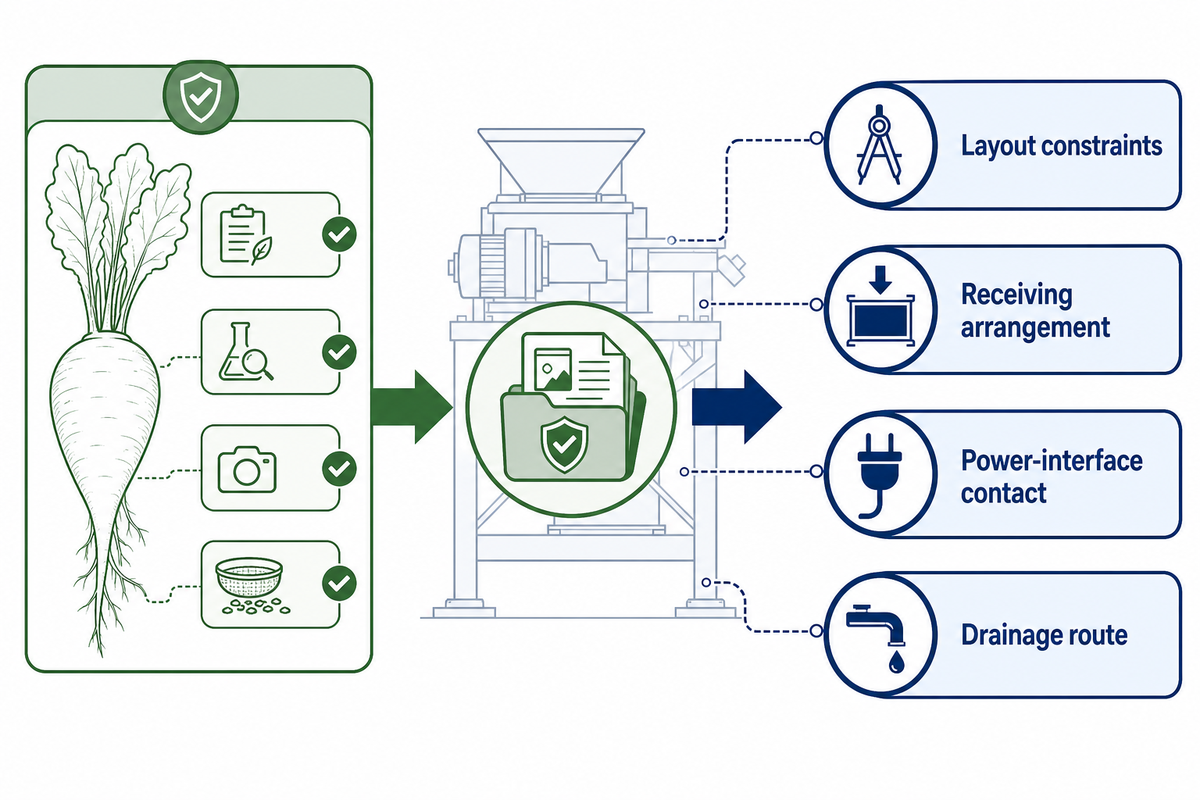
At integration review, bring the five records with the site facts that surround them: layout constraints, receiving arrangement, intended packing handoff, water-system contact, power-interface contact and drainage route. These are interfaces to confirm, not numbers to assume. If drainage or discharge is relevant, carry the name of the buyer’s review owner and the route description; this guide does not interpret permits, limits or jurisdiction. If the Evidence-to-Configuration Gate labels the pack Ready, Incomplete or Re-test, carry that state into integration review with the same named owner.
It helps to separate “known at the trial” from “to be confirmed at site review.” The trial may show a material handoff; it may not show the final receiving arrangement, local layout, power connection or drainage route. Keep those items in the register as owned follow-ups. A configuration discussion becomes more useful when it can see both the measured trial evidence and the interface facts that have not yet been confirmed.
Another risk is assuming that an observed handoff settles every site interface, because drainage, receiving and packing facts may still be unconfirmed. Keep the owner and next review visible rather than converting that gap into a specification.
An interface record is not a factory acceptance test or a layout approval. It is a controlled way for the buyer to carry observed trial evidence into the next review without turning an open site fact into a claim.
Frequently asked questions
What makes a root vegetable trial result comparable across suppliers?
Use the same crop condition, incoming-mass definition, saleable-output definition and trial window. Record every loss category separately. If one result folds inspection rejects into yield loss and another omits them, the percentages are not comparable. The five records make the difference visible rather than pretending it does not exist. For a supplier comparison, retain the lot label, scale reference and time window with the records. Without those retrieval points, a buyer can compare descriptions but not a controlled observation.
How do I calculate peeled yield without hiding losses?
Weigh the labelled incoming sample. Separately weigh saleable peeled product, peel waste, inspection rejects, rework and any remaining unaccounted amount. Reconcile the categories against the incoming mass within a pre-agreed tolerance. This is an audit method for a trial, not a prediction of production yield. Keep the category names with the scale reference and trial window.
What should be agreed before a multi-crop changeover trial?
Name the outgoing and incoming crops, intended clean state, observation method, verification method, acceptance owner and retained record before the trial. The supplier may demonstrate agreed functions. The buyer retains product-specific sanitation acceptance and the site’s operating decisions. Keep any incomplete observation visibly assigned to its owner rather than calling it a release.
Does the trial pack prove regulatory, safety or wastewater compliance?
No. It records evidence for a configuration request. Before relying on it, the buyer must name owners for facility and commodity scope, water-system controls, authorization of cleaning or adjustment activities, and drainage or discharge review. Those questions depend on the operation and jurisdiction and sit outside this equipment-trial method.
When is a kilograms-per-hour claim not enough?
It is not enough when receiving, inspection, dewatering, packing or a manual handoff cannot sustain the observed rate. Record the interface and the trial window so the team can decide whether to re-test or bring a specific question to configuration review.
Which facts should stay out of a supplier comparison?
Exclude unqualified yield percentages, generic downtime costs, universal brush life and rate claims without a shared trial basis. Keep the comparison to observed evidence, named assumptions and the questions each party still owns.
Sources and evidence boundaries
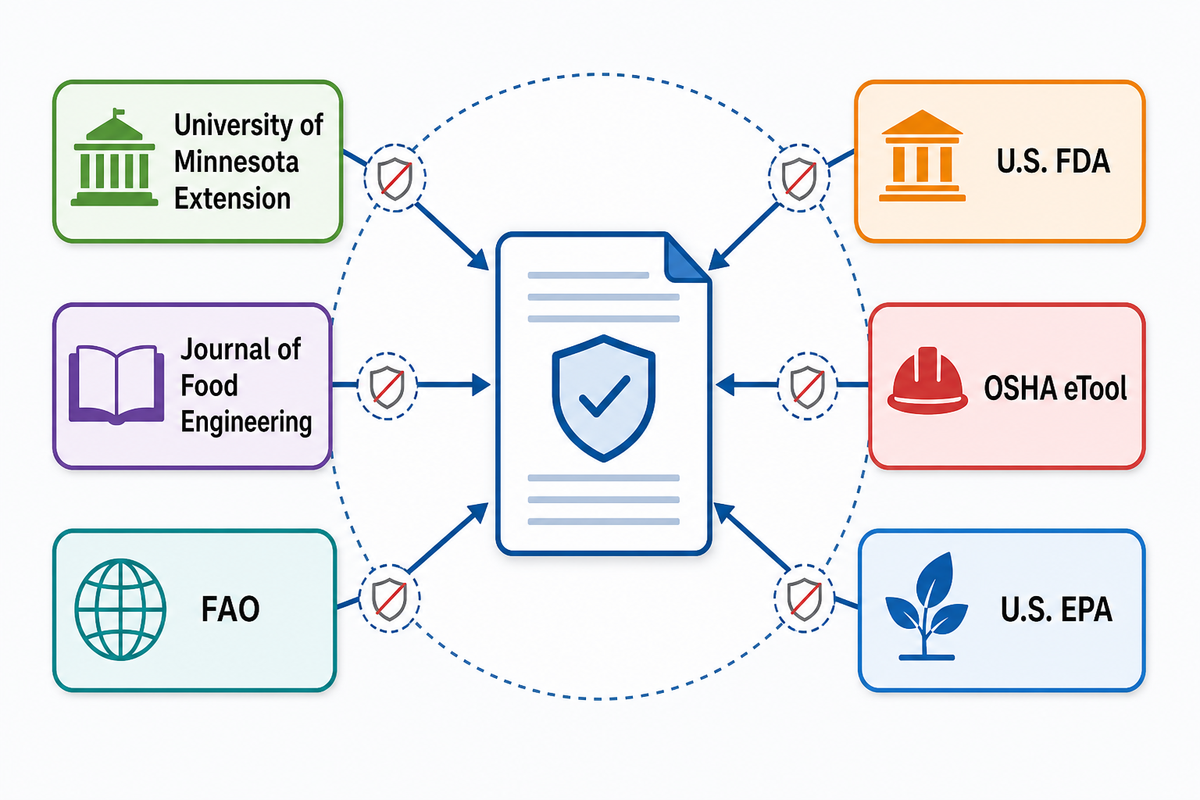
Sources support the method boundaries stated above. They do not support a supplier-specific capacity, yield, compliance, brush-life, water or wastewater claim.
References & Sources
- University of Minnesota Extension: Postharvest handling of fruit and vegetable crops — crop-dependent washing, sorting, drainage and handling context.
- Journal of Food Engineering: review of root-vegetable peel loss and valorisation — background only; no yield range or benchmark adopted.
- FAO: postharvest handling guidance — inspection and grading-error context.
- U.S. FDA: Current Good Manufacturing Practices and FSMA FAQs — scope boundary only.
- OSHA eTool: hazardous-energy context — owner-side review boundary only.
- U.S. EPA: canned and preserved fruits and vegetables effluent guidelines — drainage/discharge review boundary only.
ENGINEERING CONTENT DISCLOSURE
Why Shengtu Publishes Technical Guides
These guides turn common production-line questions into a clearer decision path for food manufacturers, project engineers and procurement teams.
We focus on the inputs that change equipment selection: product characteristics, package format, target capacity, process stages, utilities, plant constraints and destination requirements.
01Define the applicationStart with the product, pack and operating target.
02Map the process routeConnect stages, interfaces and utility needs.
03Surface trade-offsExplain the choices that affect line scope.
04Prepare better questionsTurn reading into a reviewable project brief.
MANUFACTURER PROFILE
SHENGTU
- Focus
- Food processing equipment and turnkey line solutions
- Base
- Zhucheng, Shandong, China
- Project path
- Requirement → layout → equipment scope → delivery coordination
SOLUTION COVERAGE
VALIDATION BOUNDARY Final equipment configuration should be confirmed against your product, package, throughput, utilities, plant constraints and destination requirements.