Get in touch with Shengtu Bufan Company

![How Is Freeze Dried Coffee Made? [Process Guide]](https://shengtumachinery.com/wp-content/uploads/2026/08/fd-coffee-tea-beverage-line-guide-featured.png)
Updated August 2026
An FD Coffee / Tea / Beverage Line is an industrial process chain that moves brewed or prepared extract through clarification, concentration, aroma handling, controlled freezing, granulation, primary and secondary drying, powder handling, and protective packaging. Freeze dried coffee is brewed coffee extract that has been concentrated, frozen, dried under vacuum, and prepared for moisture-safe packing. Each handoff changes what the next machine must receive and what the plant must measure.
This process guide explains those handoffs. Equipment configuration, quotation inputs, supplier scope, lead time, and project execution remain on Shengtu’s extract-to-pack project scoping page, so the two pages answer different buyer tasks.
Quick Process Evidence
| Commercial product input | Brewed coffee extract, tea extract, or a separately defined beverage concentrate |
|---|---|
| Freeze-drying stages | Freezing, primary drying by sublimation, and secondary drying by desorption |
| Coffee study example | 30% w/w extract in one university freezing experiment, not a universal production specification |
| Humidity study example | Fresh powder at 3.58 ± 0.02% moisture reached 5.41 ± 0.13% after eight days at 32% ERH |
| Regulatory scope | 21 CFR 117.40 covers equipment and utensils; it does not supply a coffee or tea cycle recipe |
Direct answer
Freeze-dried coffee is brewed coffee that is concentrated, frozen into a controlled structure, dried under vacuum while the ice remains solid, and protected from moisture before packing. Tea and formulated beverages may share equipment, but they need separate product duties and evidence.
TL;DR
- Incoming water load matters, but it cannot size a dryer by itself.
- Aroma can be lost during concentration before the freeze dryer receives the extract.
- Freezing history and load thickness create the pore structure that controls vapor escape.
- Black tea, green or jasmine tea, coffee, and formulated beverages need different duty briefs.
- Packaging risk is conditional on humidity, exposure, handling, residual moisture, and barrier performance.
How Freeze-Dried Coffee Moves from Bean to Granule
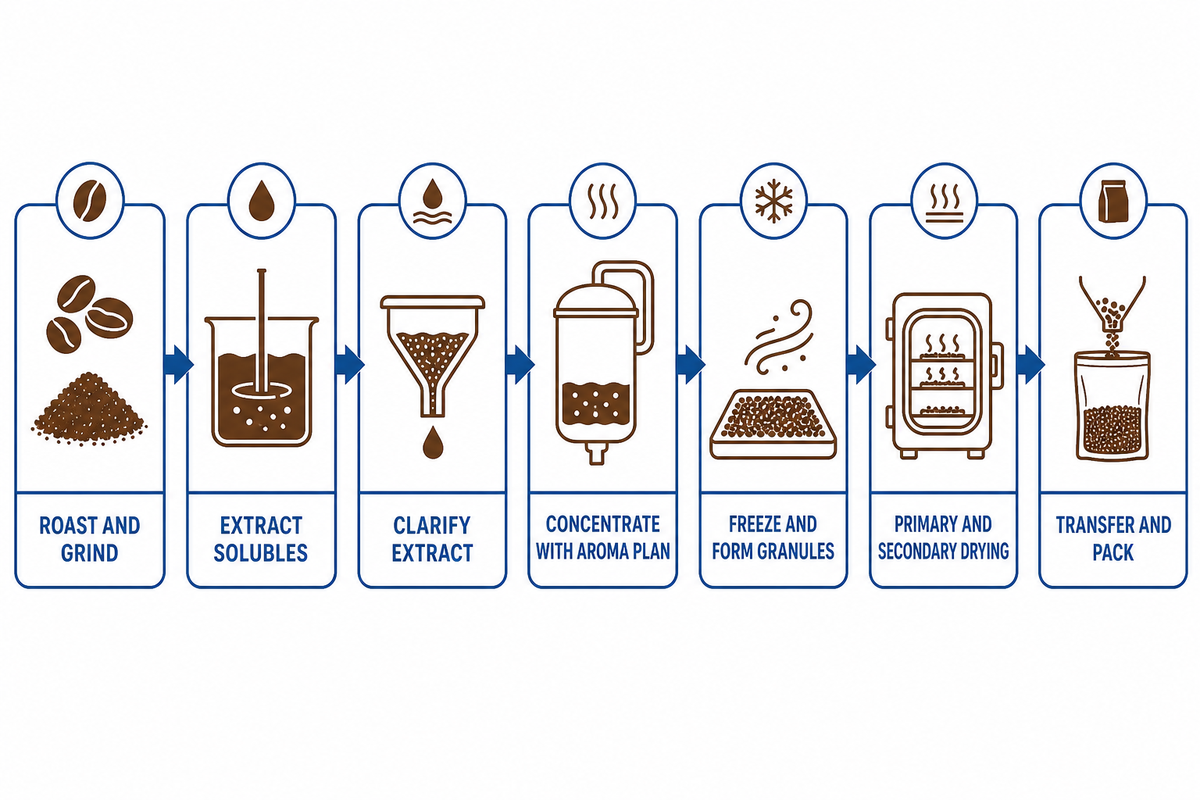
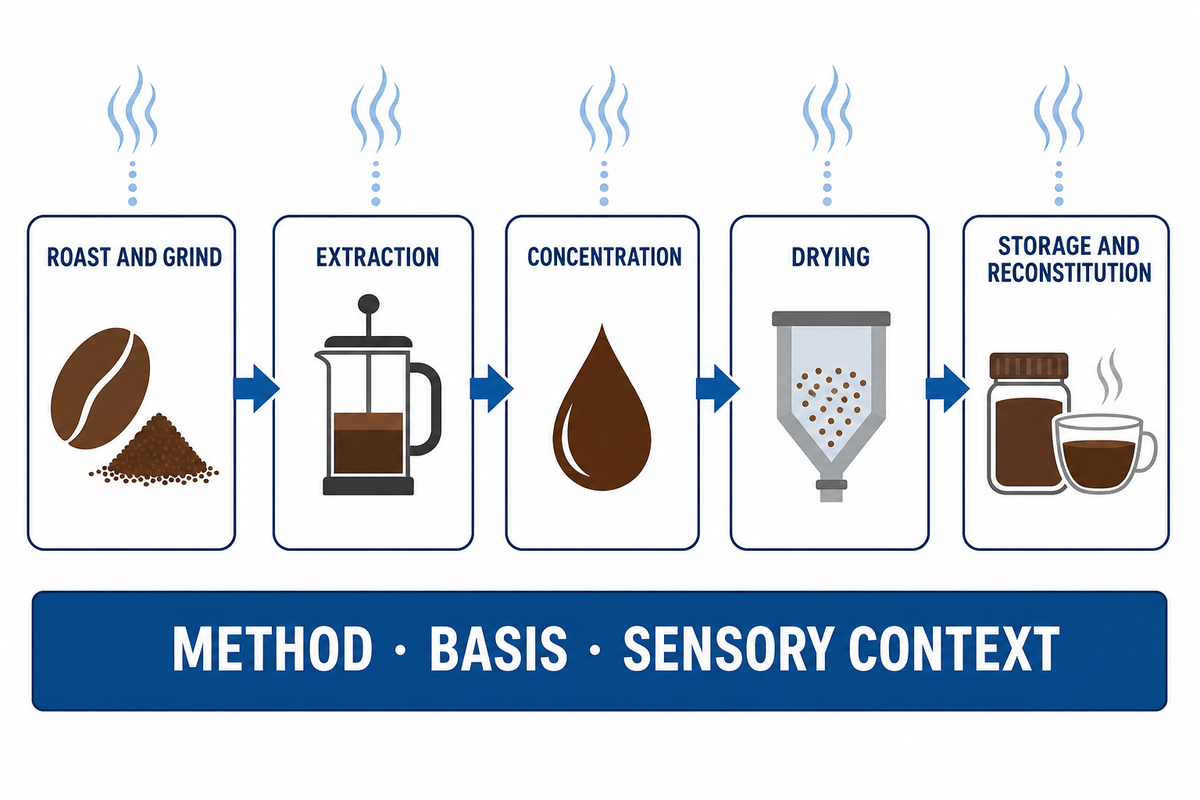
Freeze-dried instant coffee begins as real brewed coffee, not as dried beans placed in a vacuum chamber. Roasting develops each coffee bean before grinding prepares it for extraction; the liquid is then clarified, concentrated, frozen into a defined form, subdivided when required, dried in two water-removal stages, and transferred into a protective package. That packaging and moisture boundary makes the upstream sequence matter.
Sequence matters because every station changes the feed delivered downstream. Clarification changes suspended solids. Concentration changes water load, viscosity, and the volatile pool. Freezing fixes the ice and pore network. Granulation fixes piece size and loading behaviour. Drying removes ice and bound water, while packaging controls what happens after the chamber returns to atmospheric pressure.
- Roast and grind — create the raw material for extraction, with roast and grind treated as upstream quality inputs.
- Extract the soluble fraction — separate soluble coffee compounds from insoluble plant matter with a defined brewing route.
- Clarify the extract — remove particles that interfere with downstream separation, concentration, and finished-cup clarity.
- Concentrate with an aroma plan — remove part of the water while tracking what happens to volatile compounds.
- Freeze and form granules — establish ice morphology, cake thickness, and particle geometry before sublimation.
- Run primary and secondary drying — sublime frozen water, then desorb part of the remaining bound water without crossing the product limit.
- Transfer and pack — control exposure, breakage, caking risk, oxygen, moisture, seal integrity, and finished-pack evidence.
How Does Brewed Coffee Become Instant?
Brewed coffee becomes instant coffee when the insoluble grounds are separated, the soluble extract is concentrated, and most of its water is removed to leave a powder or granule that can dissolve again. Freeze-drying removes ice by sublimation; spray drying atomizes liquid into hot air. Both routes start with an extract, but they create different particle structures.
This is how freeze-dried coffee is made: extraction creates the liquid feed, concentration reduces its water load, freezing creates structure, and vacuum drying turns that structure into soluble coffee powder. Coffee made by this route remains an extract product rather than a dried whole bean.
Search and procurement vocabulary can blur that boundary. “Freeze-dried soluble coffee” names both a route and a format; “instant soluble coffee” is broader; “soluble coffee manufacturers” describes a supplier category. Even a query such as “how to make coffee powder in factory” must be translated into a defined feed, process, output, and evidence brief.
Nowak and Jakubczyk’s food freeze-drying review separates the process into freezing, primary drying, and secondary drying. Drying therefore begins after extract preparation and concentration, while the chamber-level drying stage remains one part of the total production path.
📐 Boundary note
A seven-stage map describes responsibility and material state. It is not a universal machine list: a plant may receive ready-made extract, use existing concentration equipment, or send dried granules to an existing packaging room.
Translate Consumer Search Language into an Engineering Brief
Consumer and historical wording often enters an industrial request without defining the material state or line boundary. The translation below keeps those phrases visible for search relevance while converting each group into a project input; none of the phrases is treated as a Shengtu specification.
| Search-language group | Translate into project data | Why the phrase alone is insufficient |
|---|---|---|
| “instant coffee powder,” “powdered coffee,” “fine powder,” “soluble powder,” “free-flowing instant coffee powder” | Finished format, granule distribution, fines limit, flow and dissolution method | Powder and granule formats load, transfer and pack differently. |
| “instant coffee made,” “instant coffee is made,” “making instant coffee,” “instant coffee production,” “instant coffee production process” | Line boundary from extraction through sealed pack | A process question does not identify existing equipment or ownership. |
| “mass production of instant coffee,” “production process,” “drying towers,” “coffee industry” | Batch and annual output basis, route choice, operating calendar and interfaces | Scale language cannot select spray or freeze drying by itself. |
| “coffee grounds,” “ground coffee beans,” “coffee is ground,” “raw coffee beans” | Roast, grind, extraction and clarification responsibility | The freeze dryer receives extract, not loose beans or grounds. |
| “freshly brewed coffee,” “freshly brewed,” “coffee brewed,” “fresh coffee,” “liquid coffee” | Incoming temperature, mass, soluble-solids basis and suspended solids | “Fresh” does not define a measurable feed condition. |
| “coffee concentrate,” “concentrated coffee,” “coffee extract is frozen,” “freezing the coffee,” “frozen coffee” | Concentration basis, viscosity, volatile plan, freezing history and frozen form | The same water mass can form different pore structures; do not copy the 30% w/w university example as a universal feed. |
| “soluble instant coffee,” “regular instant coffee,” “regular coffee,” “type of coffee,” “soluble coffee solids” | Product family, formulation, solids method and target reconstitution | Retail labels do not define product thermal behaviour. |
| “instant coffee dissolves,” “skipping the liquid phase,” “evaporate,” “instant cup,” “cup of instant coffee” | Dissolution method, water-removal route and serving basis | Reconstitution language can hide the preceding liquid process. |
| “coffee beverage,” “iced coffee,” “coffee machine,” “caffeine content” | Beverage formulation, serving temperature, adjacent equipment and assay ownership | These may describe a drink or appliance rather than dryer duty. |
| “original flavor,” “original flavor and aroma,” “flavorful coffee,” “Colombian coffee,” “Turkish coffee” | Sensory attributes, origin/style claim, analytical basis and comparison point | Origin and preference terms are not measurable retention guarantees. |
Six Variables That Set Dryer Duty
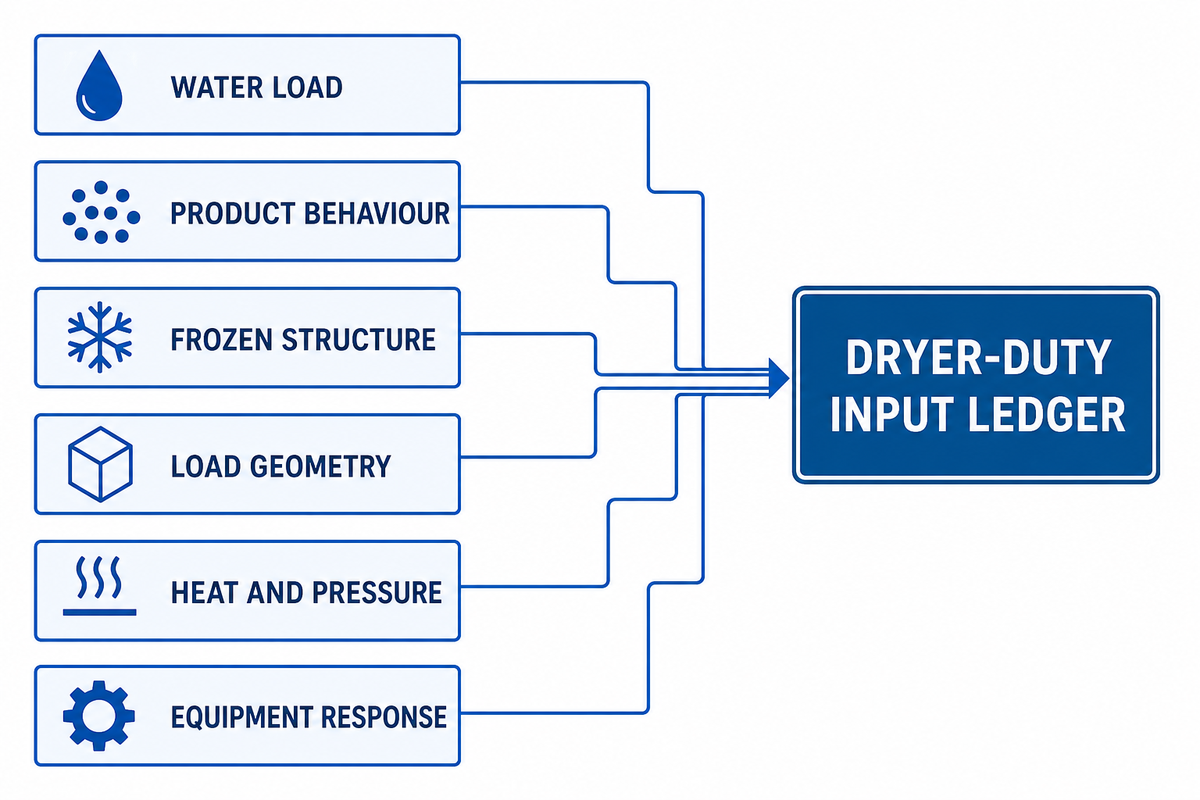
Dryer duty starts with the mass of water that must leave, yet water load alone can’t predict a practical cycle. Product composition and collapse behaviour, freezing-created pore structure, layer thickness, shelf heat input, chamber pressure, and dry-layer resistance determine whether heat reaches the sublimation front and vapor escapes without damaging the granule. That seven-stage material-state map now becomes the input boundary for duty.
In 2024, a Food Engineering article written by a Flottweg application manager reported thin coffee extract around 5–10% soluble solids and concentration to about 50%. Those figures describe one vendor’s coffee-process example. They do not describe tea, and they belong in an attributed worksheet rather than in a universal chamber-sizing rule.
A coffee-specific university-repository experiment exposes the limitation. Researchers used 30% w/w coffee extract and found that cooling temperature, scraper speed, 2–8 temperature cycles, hardening rate from 2 °C/min to 10 °C/min, and cake thickness changed ice-crystal and pore structure. Larger crystals accelerated primary drying under that tested setup, so identical water mass didn’t create identical drying behaviour.
| Input type to record | Why it changes duty | Evidence to request | Limitations / Not suitable for |
|---|---|---|---|
| Incoming mass and water load | Sets the ice mass that must be captured. | Batch mass, incoming solids method, concentrate basis. | Not a cycle-time prediction by itself. |
| Composition and collapse behaviour | Defines the product-temperature boundary. | Product-state study, formulation record, observed structure. | Coffee evidence cannot be copied to tea or mixed beverages. |
| Freezing method and rate | Creates crystal size and connected pores. | Cooling profile, supercooling behaviour, hardening record. | One experiment does not establish a universal optimum. |
| Granule size and frozen structure | Changes exposed area and vapor path. | Size distribution, images, fines and breakage record. | Visual size alone does not describe pore connectivity. |
| Layer thickness and loading | Alters heat path and dry-layer resistance. | Loaded depth, tray map, edge/centre temperature evidence. | Shelf area cannot be converted to output without loading basis. |
| Shelf heat input | Too little slows sublimation; too much can raise product temperature beyond its limit. | Shelf and product temperatures, control response, endpoint basis. | A shelf setpoint is not the same as product temperature. |
| Chamber pressure | Changes vapor transport and gas-mediated heat transfer. | Pressure history, condenser load, product-temperature response. | A deeper vacuum does not guarantee a faster cycle. |
| Dry-layer resistance | The dried layer becomes the vapor path as the front moves. | Pressure/temperature response and endpoint comparison. | Cannot be inferred from chamber nameplate data. |
| Equipment and position effects | Heat transfer and sustainable pressure depend on the actual dryer and load position. | Mapping across shelves, condenser margin, sensor locations. | No article can certify a specific installation without trials. |
Procurement teams can use the table as a missing-input screen. Finance teams can use the water load as one mass-balance input. Plant teams still need product and equipment evidence for the other variables. The water-removal load comparator belongs after, not before, those scope questions.
Aroma Recovery Is a Process Stream, Not a Marketing Claim
Aroma retention cannot be reduced to “freeze-dried tastes better.” Volatile compounds can leave during roasting, grinding, extraction, concentration, drying, storage, and reconstitution. Defensible process briefs name the loss point, capture method, storage condition, return point, analytical basis, and sensory question instead of promising one retention percentage. Those product variables and their evidence must also cover aroma losses upstream.
Product teams may document “flavor and aroma” or use the British-English spelling “flavour and aroma.” Either phrase is incomplete unless the record also states the compounds or sensory attributes, the sampling point, and the comparison basis.
One 2024 Siam University abstract reports an industrial and laboratory Robusta comparison. After concentration, the concentrated brew retained 43.94% of the total volatile aroma compounds measured in the starting brew. Industrial freeze drying then retained 73.39% of the concentrated extract’s measured volatiles, while industrial spray drying retained 45.13%.
Those percentages use different denominators. The concentration figure compares concentrate with brew; the drying figures compare dried coffee with concentrate. They cannot be multiplied into a marketing claim without reproducing the study’s method. Total volatile mass also does not equal perceived aroma: compound identity, odor activity, interactions, and release from the reconstituted matrix all matter.
“Portable, yes, but also most likely horrible.”
Haszard’s remark matters because portability and process success are not the same thing. One named Starbucks plant case described extraction, freeze and thermal concentration, drying, and direct packaging as separate streams. Its report says powder at that plant was packed within 12 hours, but that is one facility practice, not an industry deadline or a Shengtu performance claim.
| Stage | Question | Evidence | What cannot be inferred |
|---|---|---|---|
| Extraction | Which volatiles leave with steam or insoluble material? | Mass balance and compound profile | That a stronger extract tastes better |
| Concentration | What volatile pool enters and leaves? | Same-method before/after analysis | That less water always means higher quality |
| Aroma capture | Where is the stream captured and stored? | Flow description and storage record | A universal recovery percentage |
| Drying | Which compounds remain after the route? | Compound-level analysis with denominator | Perceived cup aroma from total mass alone |
| Reconstitution | How are compounds released above the cup? | Sensory plus analytical method | That retained compounds are all odor-active |
Freezing Creates the Granule Structure the Dryer Inherits
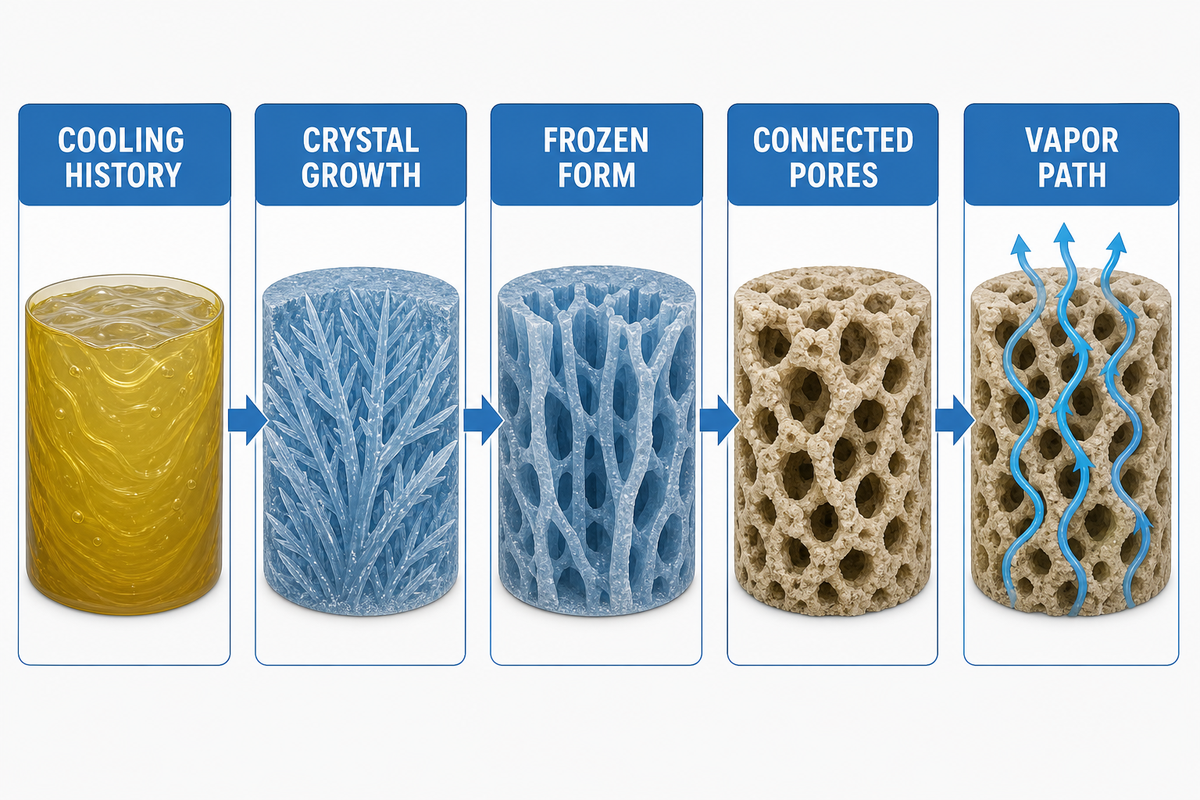
Freezing isn’t a waiting room before sublimation. Cooling history, supercooling, crystal growth, repeated temperature cycles, hardening rate, granule geometry, and cake thickness create the connected pores through which vapor later moves. A change made before loading can therefore alter primary-drying resistance without changing the chamber nameplate.
TU Hamburg’s repository abstract describes a coffee-specific experiment. A 30% w/w coffee extract entered a scraped-surface heat exchanger, then underwent further hardening. Cooling temperature, scraper rotation, 2–8 temperature cycles, hardening rates from 2 °C/min to 10 °C/min, and cake thickness all affected internal structure and drying kinetics.
Larger crystals accelerated primary drying in that experimental setup because they left larger pores. That doesn’t make “slow freezing is best” a general rule. Primary and secondary drying can prefer different pore characteristics, and product collapse, granule strength, fines, appearance, dissolution, and loading behaviour remain part of the decision.
One public patent record also distinguishes drying frozen slabs before grinding from subdividing frozen extract before drying. This record helps explain why granulation order belongs in the process brief. It doesn’t prove Shengtu owns, uses, or guarantees that historical method.
📐 Engineering note
Record frozen form, granule-size distribution, cake or layer thickness, loading pattern, fines, edge/centre temperatures, and post-dry breakage. A chamber-volume comparison without those fields compares containers, not duties.
What the Dryer Must Protect in Coffee and Tea Extracts
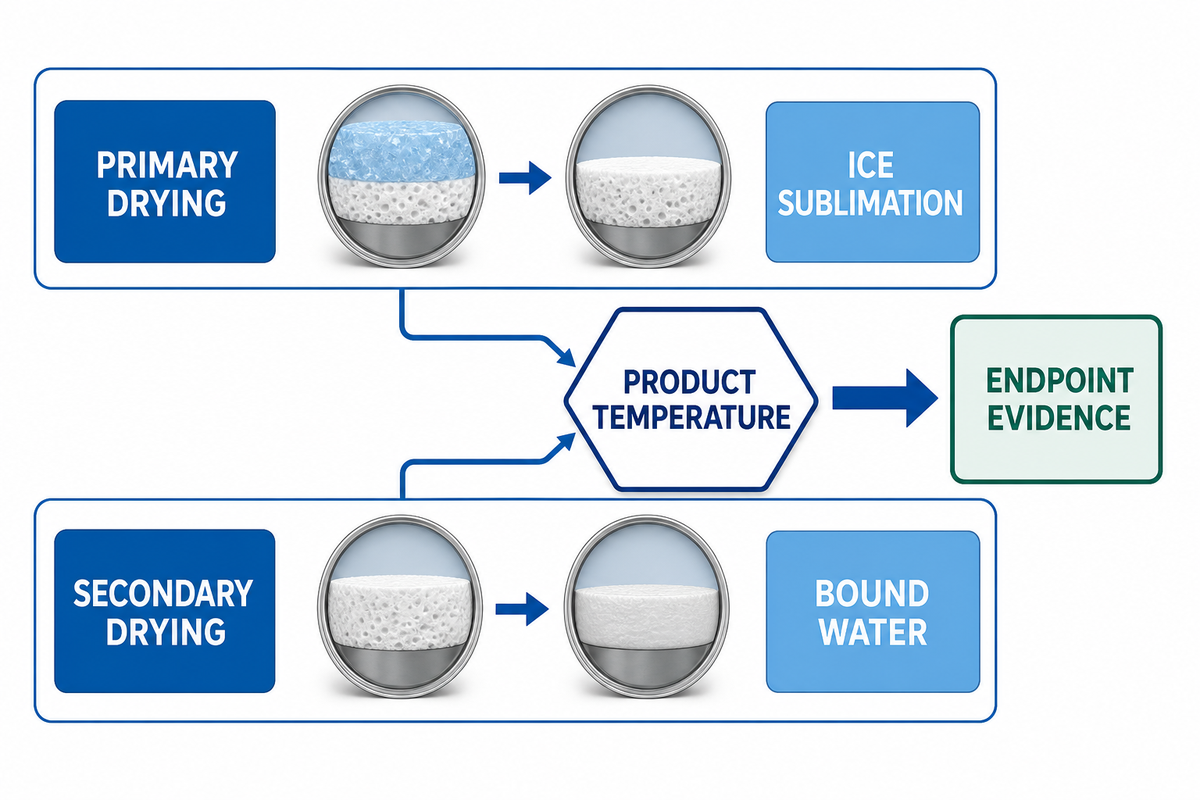
Primary drying must move ice vapor through a growing dry layer while product temperature remains below the material limit; secondary drying must remove part of the remaining bound water without undoing structure or aroma goals. Pressure and shelf temperature are manipulated variables, but product temperature and endpoint evidence decide whether the settings are acceptable.
In the food freeze-drying review, too little heat slows sublimation, while too much heat can raise product temperature until melting, collapse, shrinkage, or other damage occurs. Chamber pressure also affects vapor transport and gas-mediated heat transfer, so “pull the deepest vacuum” and “raise the shelf temperature” are both incomplete instructions.
Generic ranges from pharmaceutical vials or a food freeze-drying physics and safety guide can teach mechanisms. They can’t become a coffee or tea recipe without extract-specific thermal behaviour, load geometry, product temperature, condenser capacity, endpoint method, and finished-powder evidence.
Do
- Track product temperature separately from shelf temperature.
- Define an endpoint method before calling a cycle complete.
- Compare edge, centre, top, and lower load positions.
- Keep pressure history beside condenser and product response.
Don’t
- Copy a vial pressure band into a coffee specification.
- Treat deeper vacuum as automatic cycle reduction.
- Convert shelf area into annual output without load depth and cycle basis.
- Call drying a product-validation or hazard-control step by itself.
Coffee and Tea Products Need Separate Duty Briefs
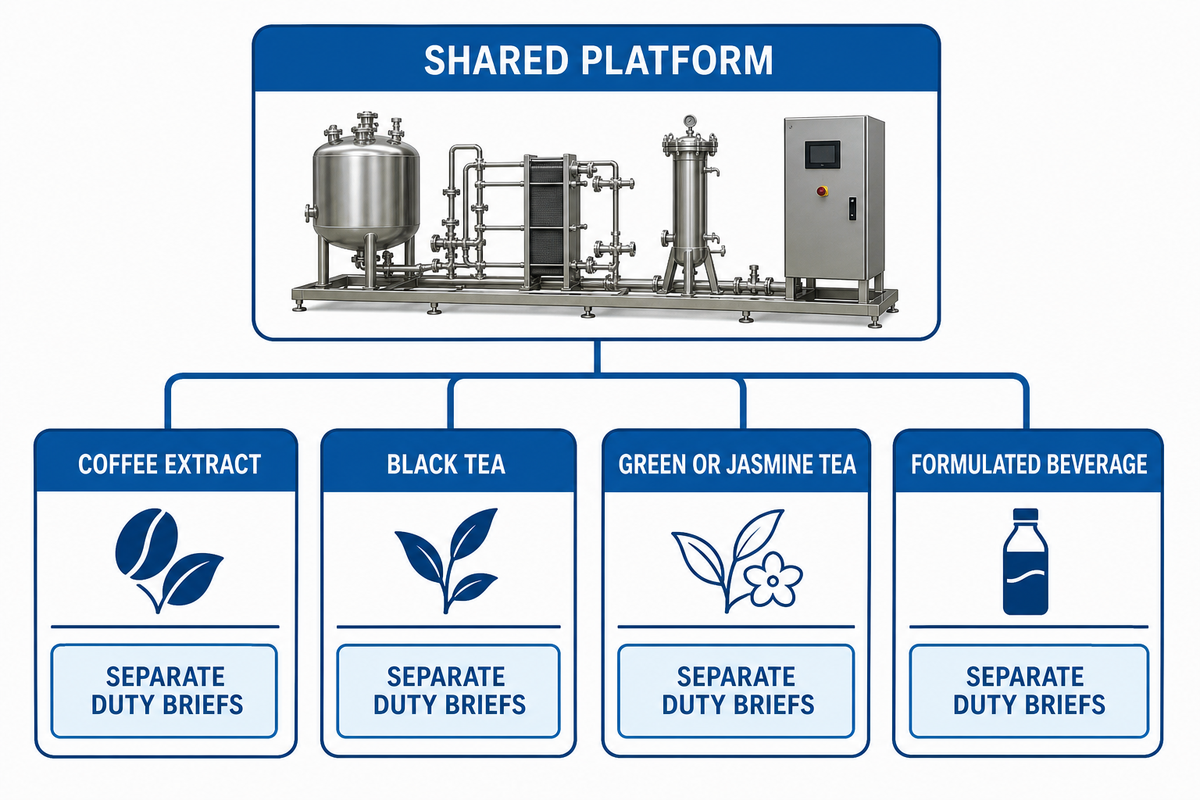
Coffee, black tea, green or jasmine tea, and formulated beverages may share part of a vacuum-drying platform, but they don’t share one process matrix. Raw-material composition, extraction, clarification, aroma chemistry, formulation aids, freezing behaviour, analytical priorities, cleaning risk, and finished-powder response have to be specified product by product. That product-validation boundary is why one shared chamber still needs separate briefs.
In 2023, an instant-tea metabolomics study found marked differences among black, green, and jasmine teas. Researchers compared 177 detected volatiles and showed different dominant compound classes across the three materials. That evidence doesn’t supply a dryer recipe; it proves that an undifferentiated “tea” brief is too broad.
One 2013 green-tea abstract reports tests at 20–25% extract, 10 mm layer thickness, −17 °C freezing, 8.5 hours drying, and 0.1–0.3 mmHg. Those values describe that single experiment. They’re useful as evidence that concentration, thickness, temperature, pressure, and time form a product-specific curve, not as recommended settings for another tea or plant.
| Decision | Coffee extract | Black tea | Green / jasmine tea | Formulated beverage | Limitations / Not suitable for |
|---|---|---|---|---|---|
| Raw material | Roasted ground coffee | Oxidized tea material | Tea with distinct catechin and aroma profile | Defined ingredient system | Category name alone is insufficient |
| Extraction | Brew route and soluble yield | Tea-specific extraction | Raw-material and temperature-sensitive extraction | May arrive as prepared concentrate | No shared time/temperature recipe |
| Clarification | Insoluble particle removal and recoverable solids | Product-specific haze and solids basis | Compound-retention and clarity basis | Ingredient-dependent separation | Visual clarity is not a universal release test |
| Concentration | Water load plus aroma loss | Product-specific solids and aroma | Catechin and volatile sensitivity | Viscosity and carrier effects | Coffee solids cannot be copied across |
| Aroma | Roast, extraction, concentration, and drying streams | Tea-specific volatile profile | Green/jasmine profiles need separate evidence | Added flavour may change release | Total volatile mass is not perceived aroma |
| Formulation | Coffee solids and optional microgrounds or aroma systems | Tea extract composition | Raw-material-specific composition | Sugars, carriers, acids, botanicals, or dairy alternatives | Additives change collapse and hygroscopicity |
| Freezing | Slab or granule route with coffee evidence | Needs its own curve | Needs separate raw-material evidence | Formulation-specific phase behaviour | One green-tea study is not a platform spec |
| Acceptance | Solids, volatile basis, moisture, dissolution, sensory | Tea-specific analytical and sensory targets | Product-specific compounds and aroma | Declared formulation targets | No article supplies pass/fail limits |
| Cleaning | Coffee oil, fines, extract deposits | Tea soil and changeover evidence | Product-specific colour/aroma carryover | Allergen and ingredient review when applicable | Equipment supply does not discharge facility duties |
| Packaging | Moisture, oxygen, aroma, granule integrity | Tea aroma and moisture evidence | Light/aroma/formulation basis | Ingredient and format-specific barrier | No universal shelf-life statement |
Shared projects should therefore carry separate product briefs. Shengtu’s freeze-dried soup and porridge line is another reminder that concentrated liquids can share a preservation route while demanding a different front end and release basis.
The 5-Checkpoint Solids-Aroma Measurement Brief
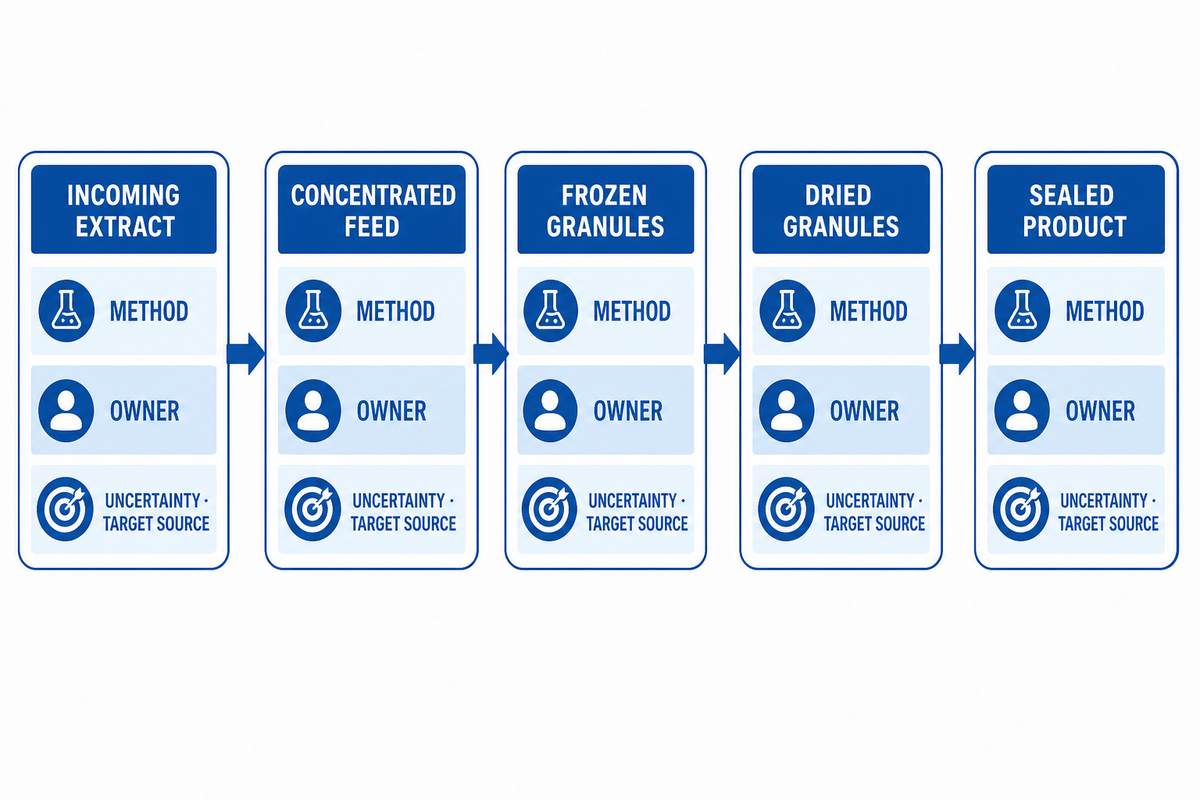
The five-checkpoint brief is not a universal acceptance protocol. It is a handoff record that asks what was measured, which method and normalization basis were used, who owns the result, what uncertainty applies, and where the product-specific target comes from. That prevents a supplier table from silently becoming a plant validation plan.
This article explains the measurement logic. Use the separate execution checklist for product validation when translating that logic into a test plan.
21 CFR 117.40 requires equipment that can be adequately cleaned, corrosion-resistant and nontoxic food-contact surfaces, suitable installation, and maintained measuring instruments. The rule supports explicit equipment and measurement responsibilities. It does not give a coffee cycle, hazard analysis, acceptance threshold, or Shengtu certification.
| Checkpoint | Measure to define | Method / basis | Owner | Uncertainty / target source |
|---|---|---|---|---|
| Incoming extract | Mass, soluble-solids basis, suspended solids, temperature | Named sampling and analytical method | Product/process owner | Batch variation; target from approved product brief |
| Concentrated feed | Mass, solids, viscosity/flow, volatile basis | Same-basis before/after comparison | Concentration and quality teams | Method recovery and aroma denominator |
| Frozen granules | Granule distribution, thickness, frozen structure, loading | Sampling map plus image or sieve basis | Freezing and loading owner | Edge/centre and batch variation |
| Dried granules | Moisture, aw when relevant, dissolution, fines, volatile/sensory basis | Declared method with sample conditioning | Quality and dryer owner | Product-specific target; no article threshold |
| Sealed product | Seal, barrier basis, residual oxygen when specified, storage study | Package test and time/temperature/RH condition | Packaging and release owner | Shelf-life conclusion requires actual study |
Used this way, the brief gives procurement a comparable input set, QA a record structure, plant operations an ownership map, and finance a way to separate water-load arithmetic from unproven cycle or shelf-life promises. Copy the fields into the project brief, but let the product owner and applicable process authority set the targets.
Do
- Name the analytical method and sample basis.
- Assign one owner to each product-state handoff.
- Record uncertainty and product-specific target source.
- Use the same denominator before comparing two stages.
Don’t
- Turn trade-source numbers into Shengtu specifications.
- Call equipment compliance a validated process.
- Use total volatiles as a sensory guarantee.
- Reuse one coffee or tea curve for another product.
Packaging Risk Depends on the Open-Chamber Handoff
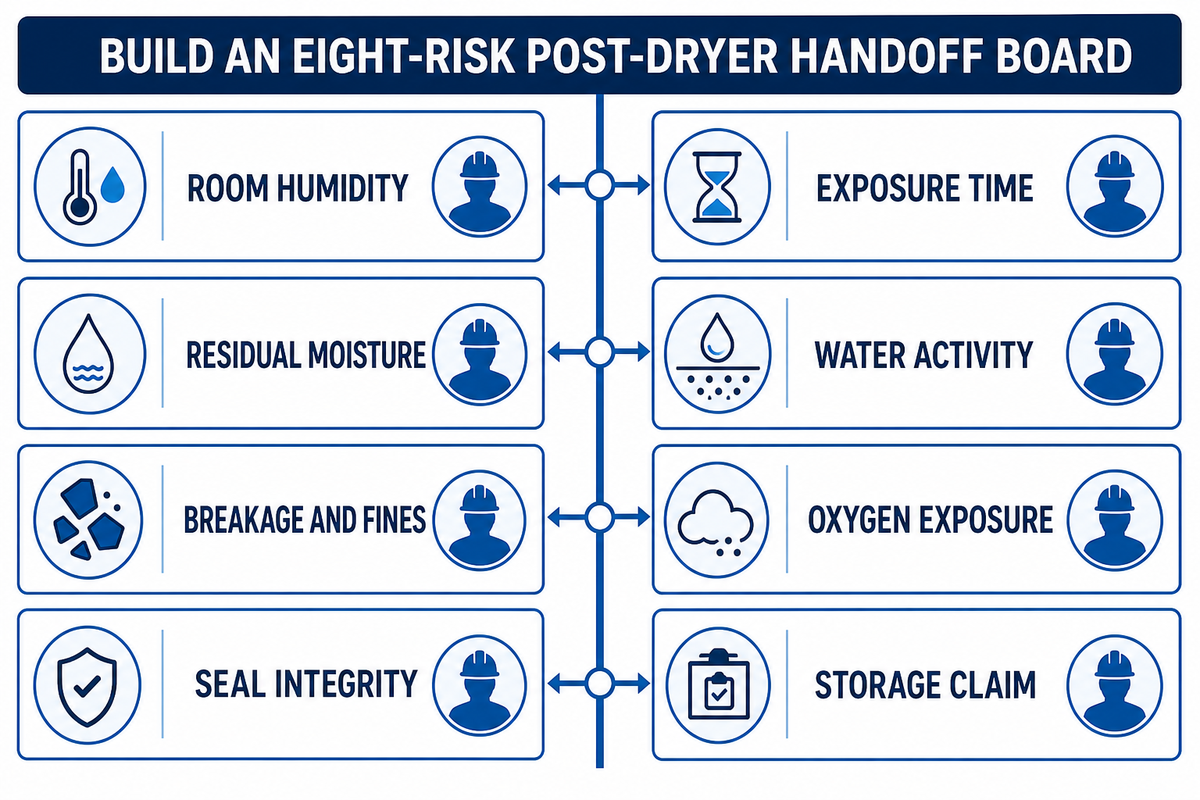
Open-chamber transfer is a conditional risk, not an automatic failure. Porous instant-coffee granules may remain stable under low humidity yet absorb water, cake, lose free flow, and dissolve poorly as environmental humidity and exposure rise. Residual moisture, air condition, time, handling, oxygen, barrier, seal, and storage temperature belong in one handoff. That product-specific curve must continue into the sealed-pack handoff.
A 2025 instant-coffee humidity study provides a worked scenario. Fresh instant coffee measured 3.58 ± 0.02% moisture with aw 0.13 ± 0.05. At 32% ERH and 20 °C, the sample reached 5.41 ± 0.13% moisture within eight days. At 65% ERH, the study observed faster and larger moisture uptake. Those conditions don’t define a shelf life; they show why room and exposure data matter.
That study distinguishes moisture content from water activity and links moisture uptake to caking, impaired solubilization, and brew-quality decline. Packaging decisions should therefore join the dryer’s endpoint evidence to room conditions, transfer duration, package material, sealing, storage, and product study instead of asking only for a final-moisture number.
| Risk | Evidence to retain | Owner | Limitations / Not suitable for |
|---|---|---|---|
| Room humidity | Logged RH and temperature during transfer | Packaging-room operations | A single daily reading |
| Exposure time | Unload-to-seal time by batch | Line coordinator | Copying another plant’s 12-hour practice |
| Residual moisture | Declared method, sampling point, uncertainty | Quality | Using moisture alone as shelf-life proof |
| Water activity | Product-specific method when relevant | Quality / product authority | Treating aw and moisture as interchangeable |
| Breakage and fines | Granule distribution before and after transfer | Material-handling owner | Visual inspection without sampling basis |
| Oxygen exposure | Package and headspace basis when specified | Packaging development | Assuming moisture barrier equals oxygen barrier |
| Seal integrity | Defined seal test and sampling plan | Packaging quality | Checking only package appearance |
| Storage claim | Actual time, temperature, RH, package and product study | Product owner | A universal shelf-life number |
How Long Does Freeze-Dried Coffee Last?
Freeze-dried coffee has no honest universal shelf-life number. Product composition, residual moisture, water activity where relevant, oxygen exposure, packaging barrier, seal integrity, storage temperature, humidity, and repeated opening all affect the result. A supplier can describe the package and process; the finished-product owner needs an actual stability study for the declared market life.
Practically, the next step is to connect the five-checkpoint brief to the proposed line boundary. If the process has separate coffee and tea tracks, each track should end with its own finished-pack study and release basis.
Key takeaway
An FD coffee, tea and beverage project becomes comparable only when product-state measurements, their basis, their owner, and their scope travel with the material from extract to sealed pack.
Frequently Asked Questions
What is FD coffee?
FD coffee is brewed coffee extract that is concentrated, frozen, dried under vacuum by sublimation, and converted into porous granules that dissolve again in water.
FD coffee means freeze-dried coffee in an industrial processing context. Brewed coffee extract is concentrated, frozen, and dried under vacuum so ice leaves by sublimation. The abbreviation is not a reference to Fire Department Coffee, although search results often make that mistake. The finished porous granules dissolve in water, while the exact process conditions remain product- and equipment-specific.
Is freeze-dried coffee the same as instant coffee?
Freeze-dried coffee is one type of instant or soluble coffee; spray-dried coffee is another, and the two routes create different particle structures and aroma exposures.
Freeze-dried coffee is one type of instant or soluble coffee, but instant coffee may also be spray dried. Both begin with brewed coffee extract. The drying routes create different particles and expose volatile compounds to different conditions. A production brief should therefore specify the intended finished format instead of treating “instant coffee” as a complete process specification.
Can one line handle both coffee and tea extracts?
A shared platform can serve coffee and tea only when each product has a separate duty brief, cleaning basis, process curve, acceptance evidence, and finished-pack study.
A shared platform can serve coffee and tea only with separate product-duty briefs. Coffee, black tea, green or jasmine tea, and formulated beverages differ in extraction, clarification, soluble solids, aroma chemistry, formulation, freezing behaviour, cleaning, and finished-powder evidence. Shared hardware does not justify a shared recipe, acceptance limit, or shelf-life claim.
Why concentrate coffee before freeze-drying?
Concentration removes water before freeze-drying and reduces the ice load, but the solids target remains product-specific; one trade example written by a Flottweg application manager reports 5–10% extract and about 50% concentrate.
Concentration removes water before freeze-drying, reducing the ice load. Higher solids can change viscosity, aroma, freezing structure, and heat or mass transfer. One trade example written by a Flottweg application manager reports about 5–10% extract and 50% concentrate; these are attributed coffee figures, not universal settings.
Does freeze-drying preserve all coffee aroma?
No. A 2024 Siam University abstract reports 73.39% volatile retention after freeze drying and 45.13% after spray drying relative to concentrate, but total volatiles do not equal sensory aroma.
No. Volatiles can disappear during roasting, grinding, extraction, concentration, drying, and storage. Even measured total volatiles do not equal perceived aroma. Defensible comparisons identify the compounds, denominator, method, sampling point, and sensory context. Without that basis, one retention percentage says little about cup quality or whether the dryer caused the difference.
What information is needed before requesting a line layout?
Start with product identity, current feed condition, output basis, freezing and loading plan, package format, utilities, existing interfaces, cleaning duties, control ownership, and acceptance evidence.
Provide the product identity, feed condition, output basis, package, utilities, interfaces, cleaning duties, and evidence targets.
Move from process questions to a scoped solution
Bring separate coffee and tea product briefs, the dryer-duty input ledger, and the 5-checkpoint measurement brief. Shengtu can then review the line boundary without turning article examples into project guarantees.
Process Guide Method
This analysis separates Shengtu’s commercial FD coffee, tea and beverage line page from an informational process task. It uses coffee-specific freezing research, instant-coffee humidity experiments, industrial aroma measurements, current equipment rules, and clearly labelled plant or patent examples; unsupported About-page claims and universal cycle promises were excluded.
Related Articles and Tools
- pet food processing route comparison: broad preservation-route choices for pet-food formats.
- a solid-food line boundary for meat and seafood: a separate freezing and water-load duty.
- preservation route selector: an early screen when freeze-drying may not be the right route.
- the separate pet-treat production scope: a different product family with non-transferable acceptance criteria.
References & Sources
- The Freeze-Drying of Foods: Foods / PubMed Central.
- Influence of Freezing Parameters on Coffee Granule Structure: Hamburg University of Technology.
- Volatile Aroma Compounds in Freeze-Dried and Spray-Dried Instant Coffee: Burapha Science Journal.
- Impact of Environmental Humidity on Instant Coffee Stability: Foods / PubMed Central.
- Raw Materials, Drying Methods and Instant Tea Quality: Frontiers in Nutrition / PubMed Central.
- Research of the Freeze-Drying Curve of Instant Tea: Science and Technology of Food Industry.
- 21 CFR 117.40, Equipment and Utensils: Electronic Code of Federal Regulations.
- Instant Coffee Clarification and Separation: Food Engineering.
- Starbucks Soluble Coffee Plant Case: Food Engineering.
- A Brief History of Instant Coffee: Works in Progress.
- US3443961A: Method of Freeze-Drying Coffee: Google Patents public record.