Get in touch with Shengtu Bufan Company
Product family
Buyer provides
Recipe, ingredients, allergens and intended use

Shengtu designs freeze-dried and quick-frozen food production lines to match the product state you require to sell: a shelf-stable dry food or a separated frozen product. Begin with the closest application card, then specify product load, quality endpoint, utilities, hygiene, packaging, controls and acceptance before a line rating is set.
Route first, equipment second. Freeze drying and individual quick freezing solve different preservation jobs; a product trial must confirm the route, cycle and final condition.
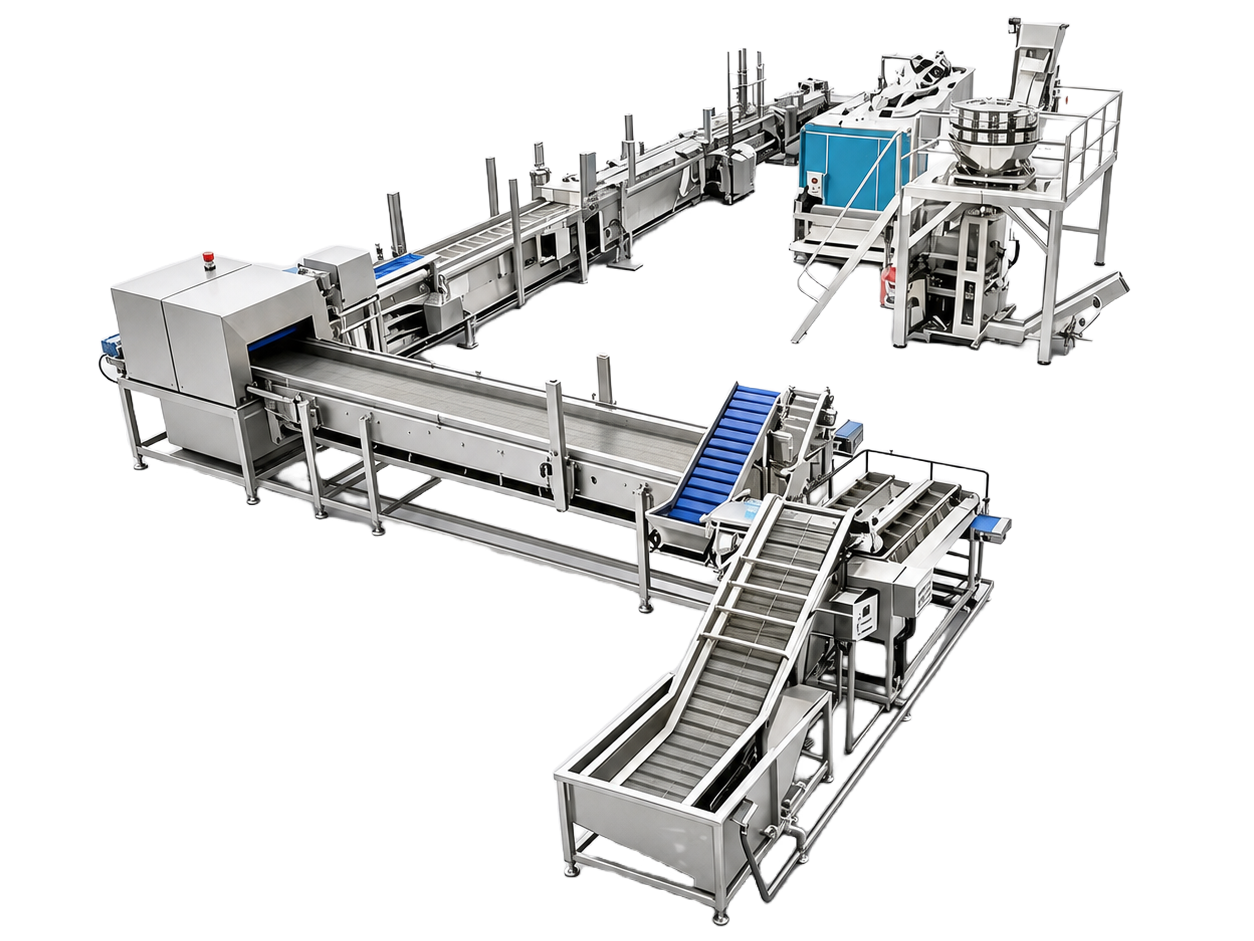
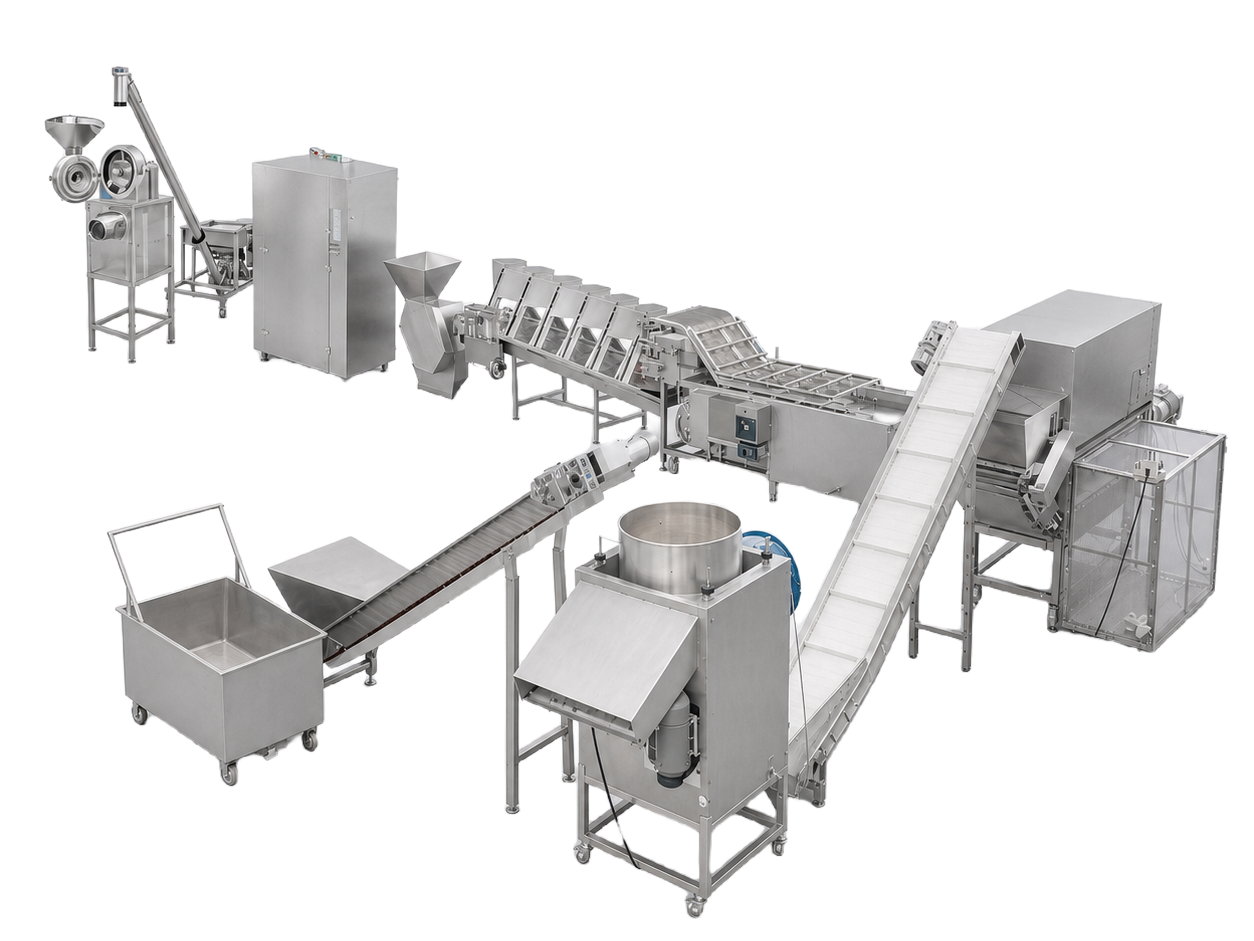
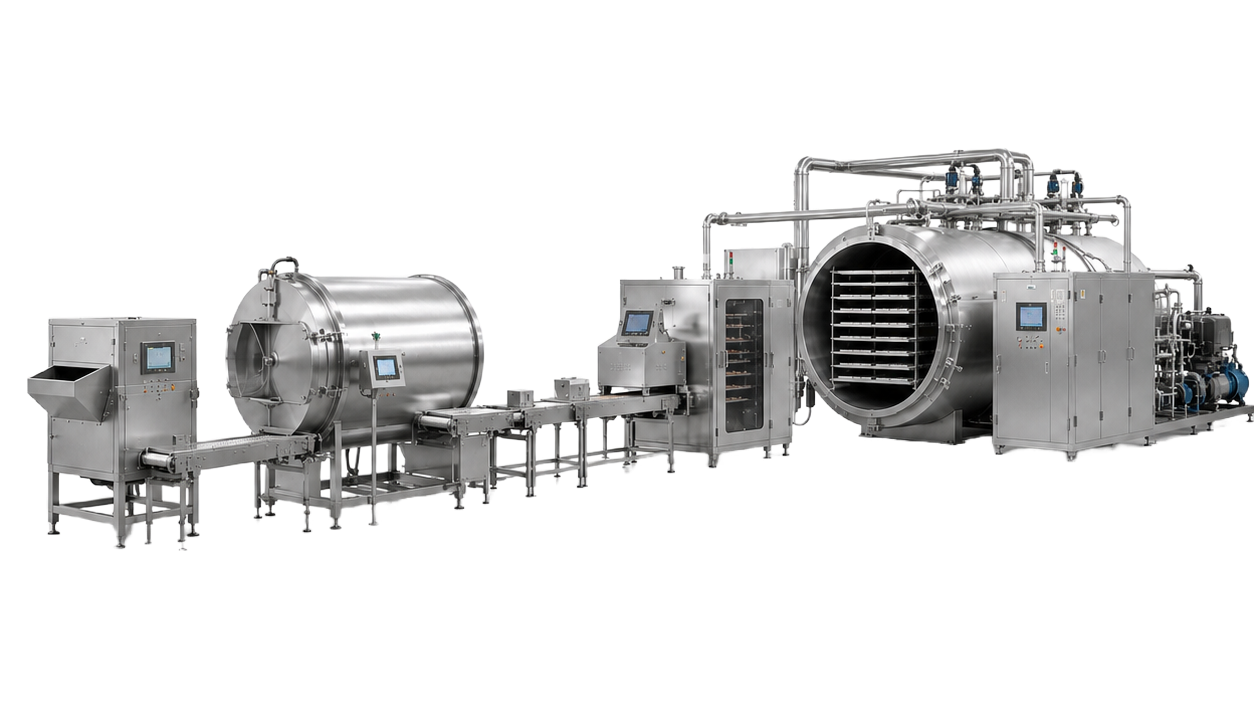
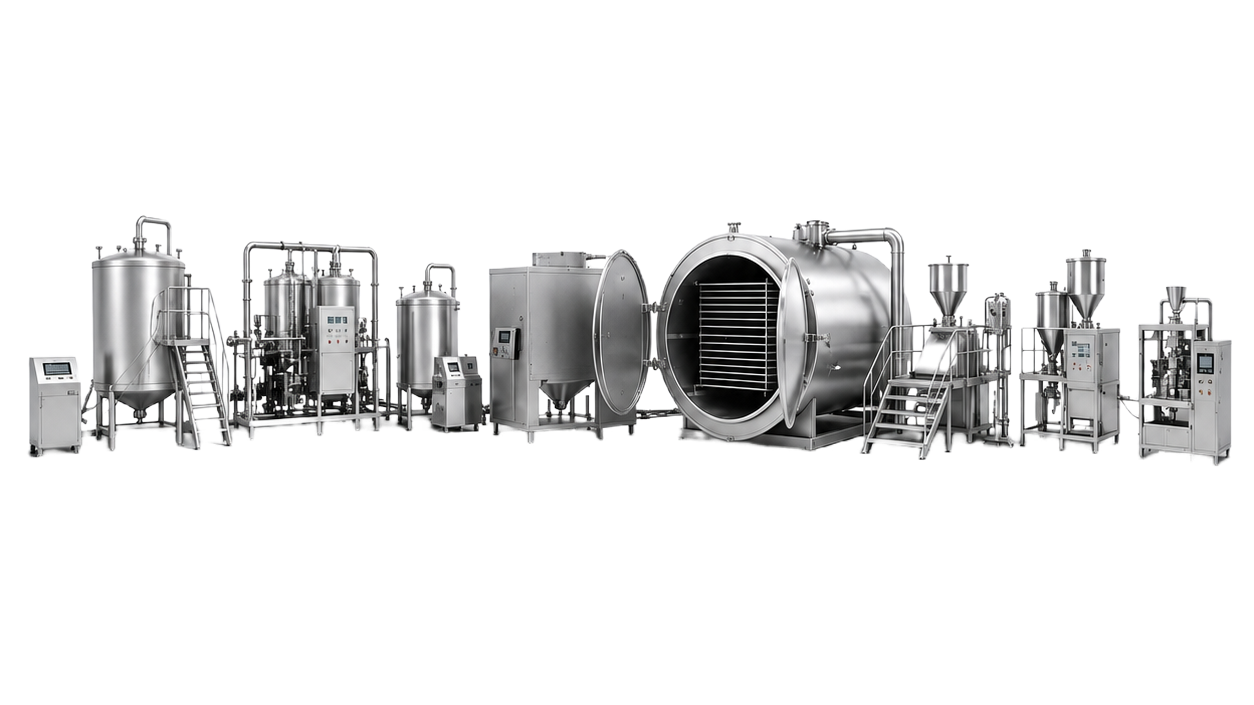
This route comparison uses FDA water-activity guidance for the dry-product endpoint and Virginia Tech IQF guidance for product preparation questions. Neither source selects the final commercial route.
We map preparation, freezing or pre-freezing, drying or frozen handling, inspection and packaging interfaces. We define control, data and remote-access options by project scope.
Preparation, freezing, freeze drying, conveying, inspection and packaging modules are reviewed as one product path. Maintenance access and cleaning boundaries remain visible at each handoff.
Recipes, setpoints, interlocks, alarms and operator roles are defined for the approved configuration. A named signal list prevents late assumptions between modules.
Gateway, event, traceability and remote-service needs are scoped against the plant network. Access control, update approval, backup, recovery and logging need named owners.
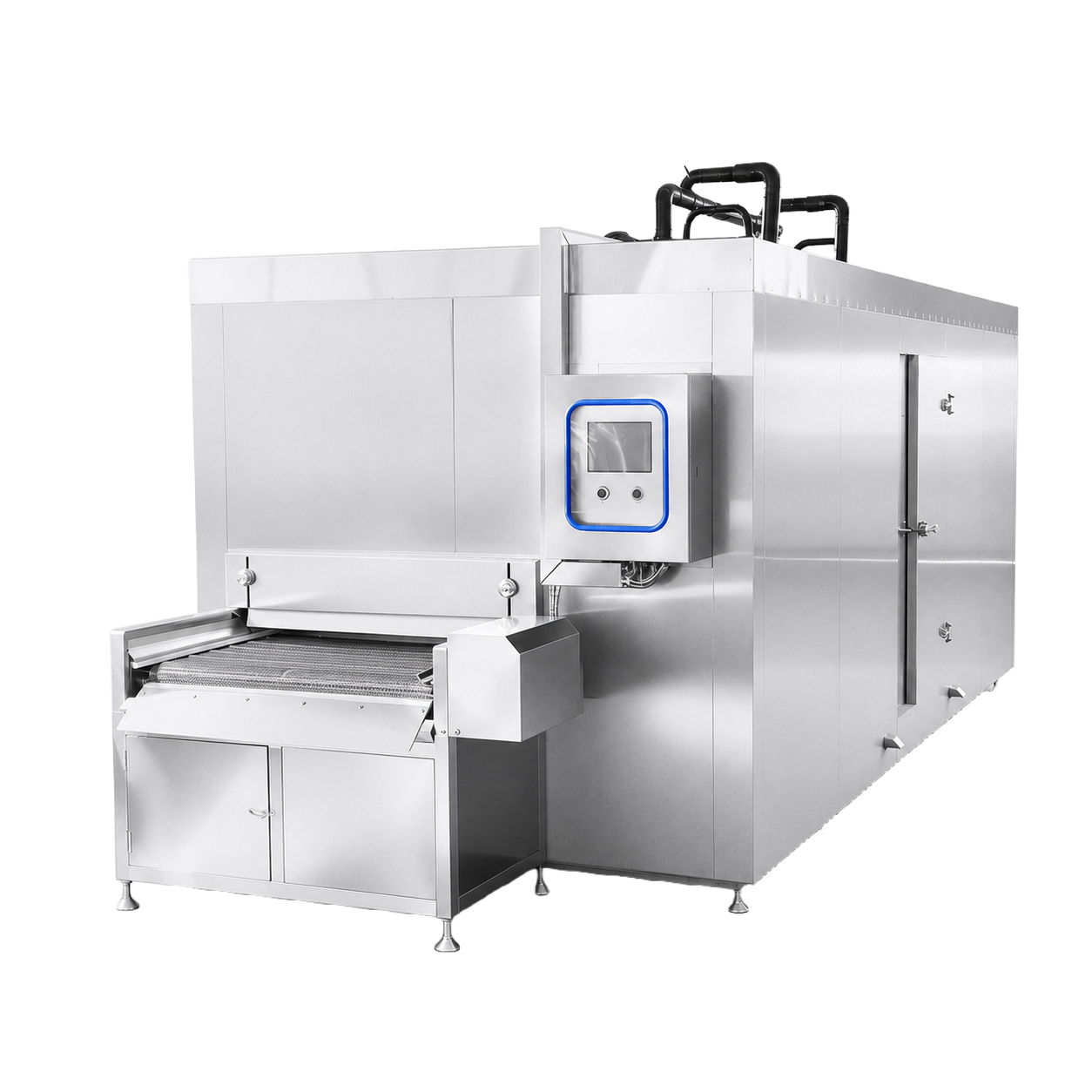
NIST SP 800-82 Rev. 3 treats operational-technology security together with performance, reliability and safety constraints. ISA-95 supplies useful integration layers, but neither source proves that a specific option is included until it appears in Shengtu’s approved project scope.
We scope four line families: instant soup and porridge, meat and seafood, IQF quick-frozen food, and coffee, tea or beverage ingredients. Each card is a non-exclusive entry point; product testing may move the final configuration across card boundaries.
For cooked mixtures, soups, porridges and instant meal components that need pre-cooking, controlled freezing, freeze drying and sealed packaging. Recipe viscosity, fill depth, inclusions, drying endpoint and rehydration target drive the trial.
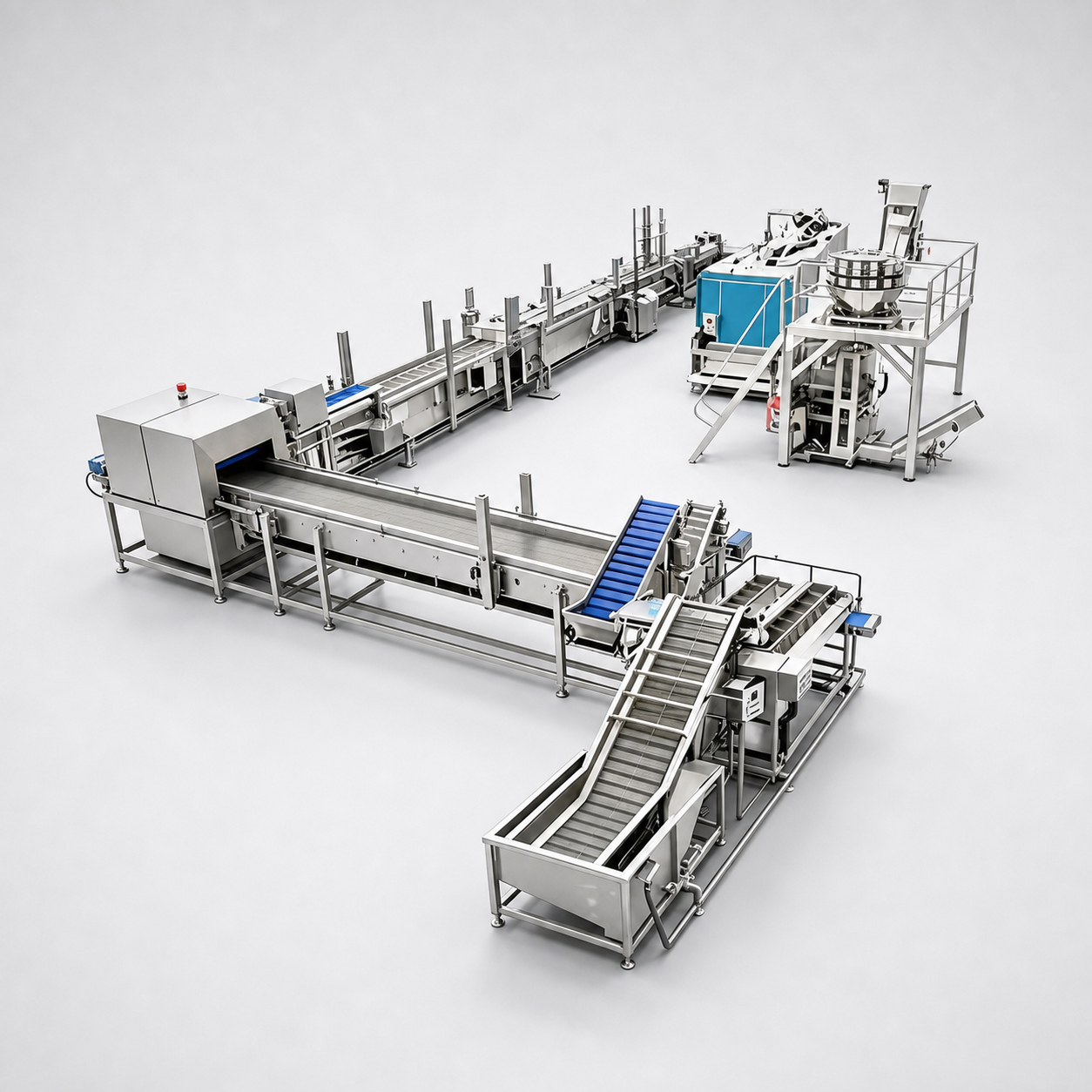
For strips, pieces or prepared portions whose geometry and composition can be held through freezing, primary drying and secondary drying. Piece thickness, fat, load pattern, water activity, package barrier and rehydration use require validation.
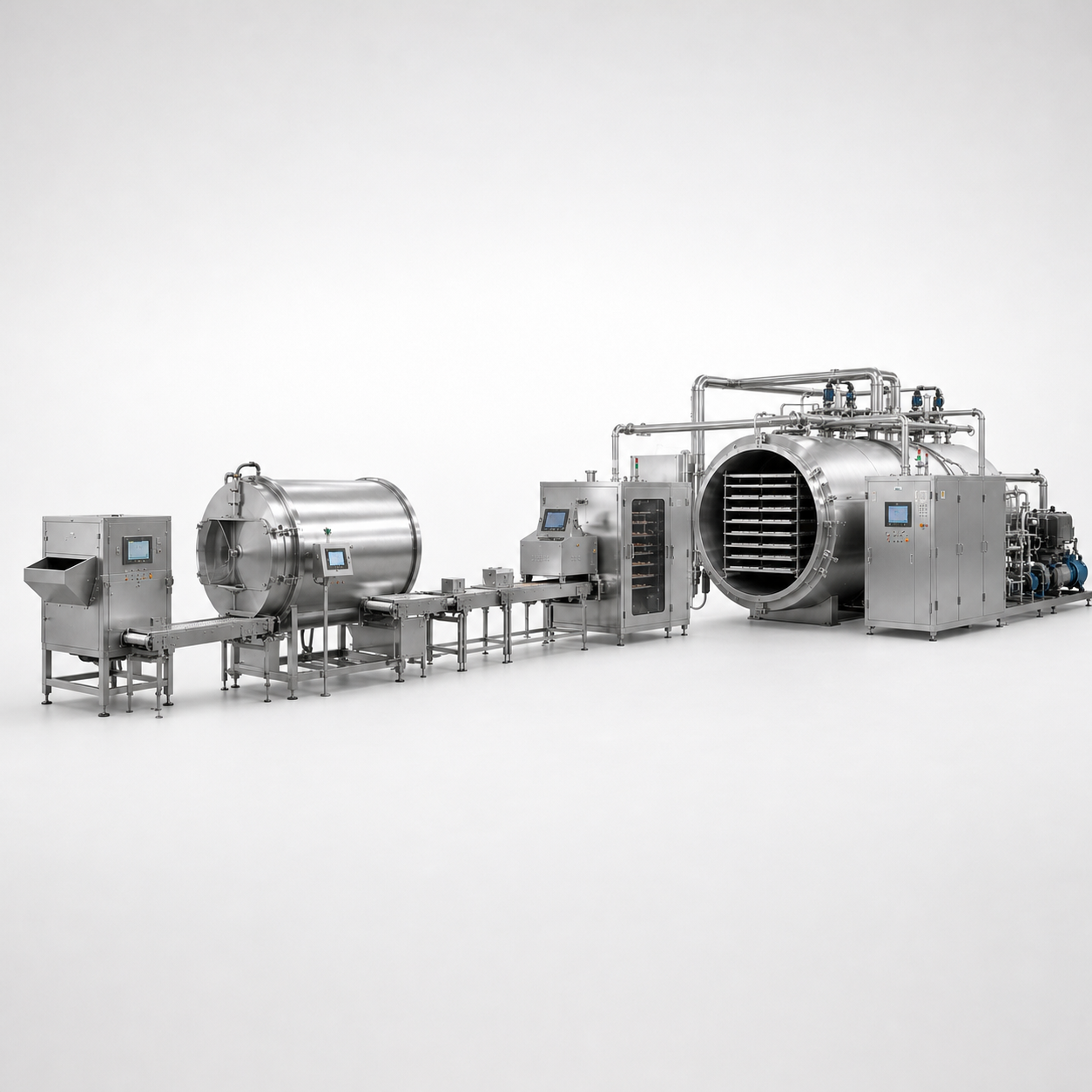
For prepared pieces that stay frozen through packing, storage and distribution. Product geometry, surface water, pre-cooling, even infeed, early separation and cold-chain handoff matter alongside freezing temperature.
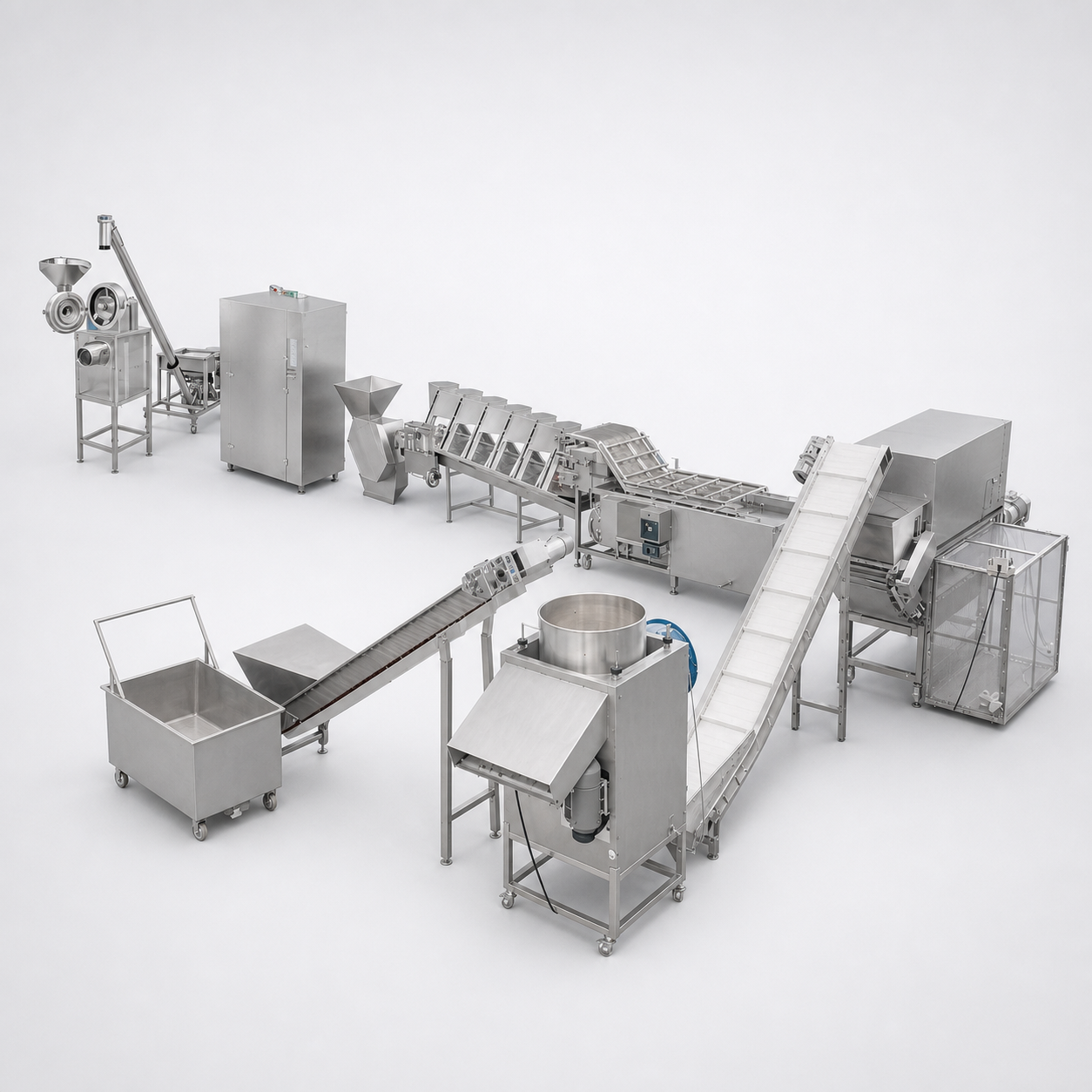
For extracts or beverage ingredients that move through grinding or extraction, concentration, freezing, freeze drying and powder handling. Solids level, aroma target, freezing behavior, drying endpoint and final pack format shape the route.
Freeze drying begins with a product capable of being frozen into a repeatable load and then proceeds through primary drying and secondary drying. The usable cycle depends on heat transfer, vapor flow, chamber pressure, condenser duty, product thickness and the endpoint required by the package and market.
recipe, cut, cook or concentrate
fill depth, tray pattern, batch mass
product structure and temperature
sublimation and vapor load
bound-moisture removal
endpoint and foreign material
barrier, seal and storage
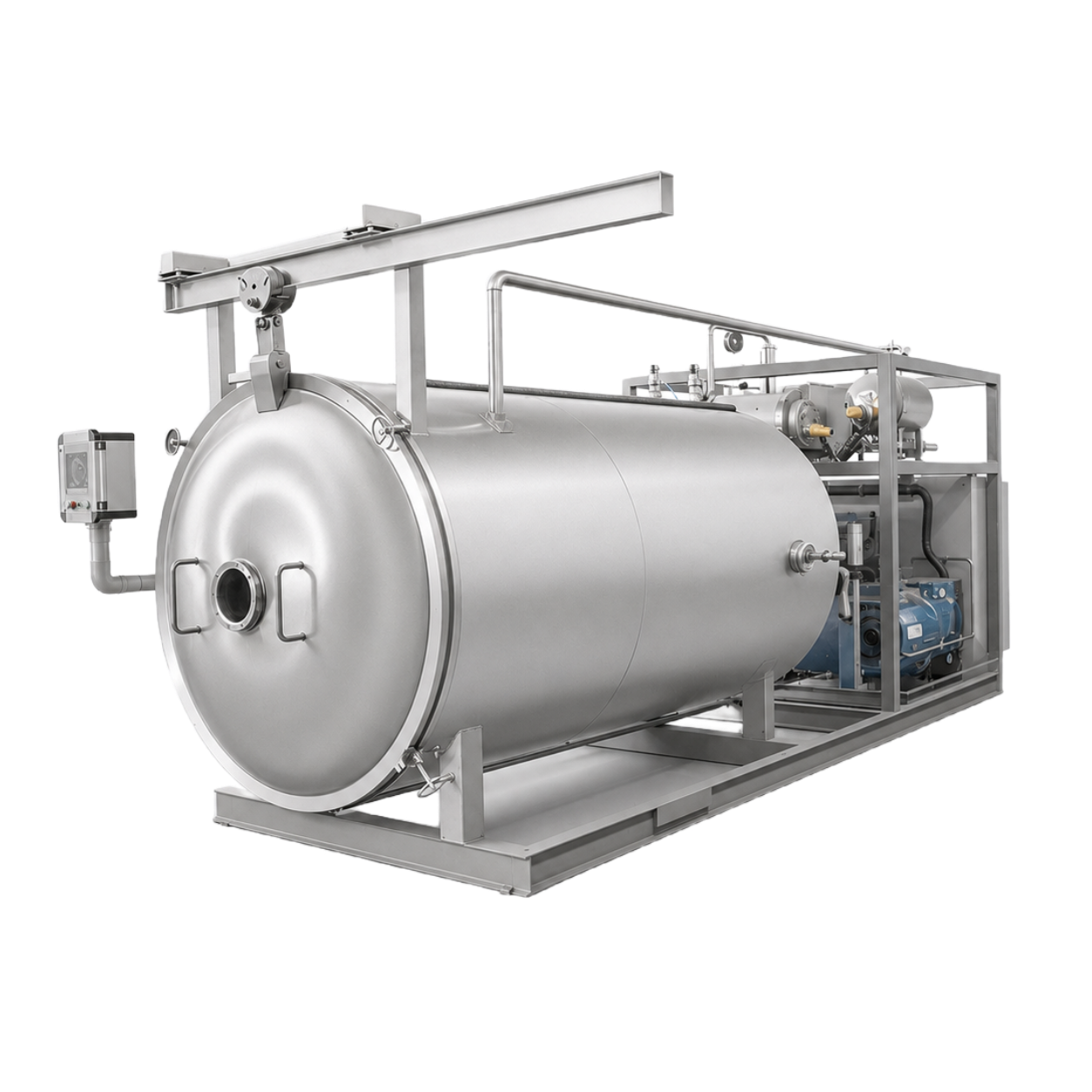
A product load generates water vapor that an empty chamber does not. Condenser, vacuum and heat-input limits should be evaluated with the intended load and recipe.
The lowest pressure or coldest condenser is not automatically the fastest safe cycle. Product temperature, structure and quality limits remain part of the trial.
FDA explains that water activity affects food stability and must reach a suitable level after drying and remain acceptable in storage. The project therefore needs a product-specific endpoint and package plan, not a universal Shengtu setpoint.
An IQF freezer is only a step within a handling chain. A cold product can still clump, dehydrate or lose its specified condition if surface water, sticky cut faces, uneven distribution, residence time or downstream temperature history is uncontrolled.
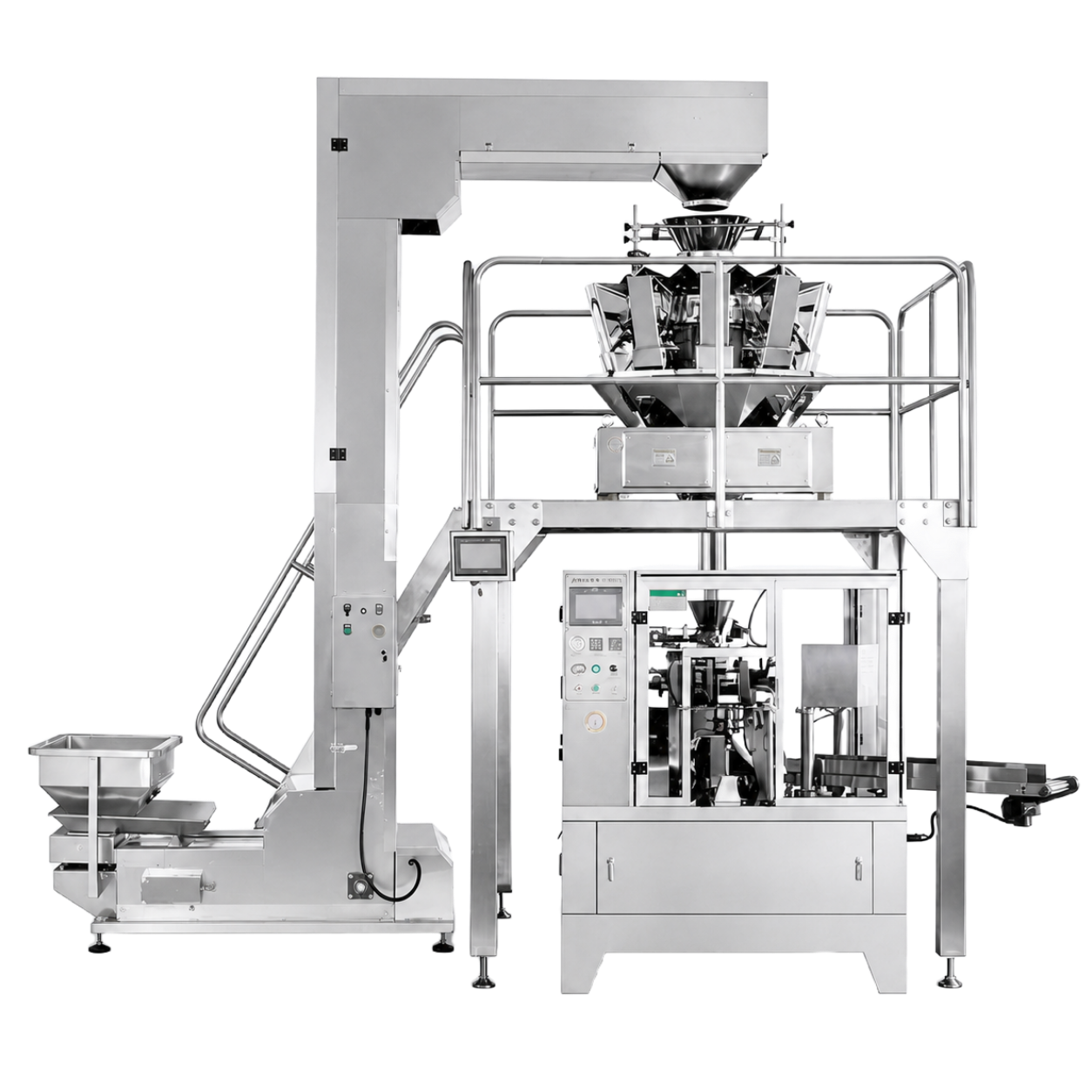
Clumping risk remains because product preparation and air-side freezing duty interact. FAO identifies geometry, initial and final product temperatures, refrigeration-medium temperature, heat transfer and product properties as separate freezing-time inputs; Virginia Tech also links even scattering, surface drying, pre-cooling and thickness to IQF edamame processing. Shengtu uses those findings as trial questions, not universal settings.
We review the product brief before fixing the preservation route. We identify the utility and refrigeration boundary before the equipment scope is approved.
Recipe, ingredients, allergens and intended use
Route, material contact and cleaning review
kg/h or kg/batch, shifts and SKU mix
Load model, line balance and buffer scope
mm, piece mass, fill depth or solids level
Freezing and drying trial inputs
Water activity, rehydration, separation or exit condition
Acceptance criteria and package handoff
V / Hz, available kW and plant standard
Electrical design and utility boundary
Water, steam, air, drainage and refrigeration conditions
Connection list and site responsibility
Available m², heights, access and maintenance clearances
Layout and installation path
Pack size, film or tray, seal, coding and inspection
Transfer rate and downstream interface
Protocols, users, data tags, IP needs and remote-access policy
Control architecture and responsibility register
Test product, duration, sampling and document language
FAT, commissioning and handover plan
Low-moisture food and frozen food need different hazard controls, yet both lines must remain cleanable and maintainable. We review cleaning access, allergen changeover and food-contact boundaries for the proposed configuration.
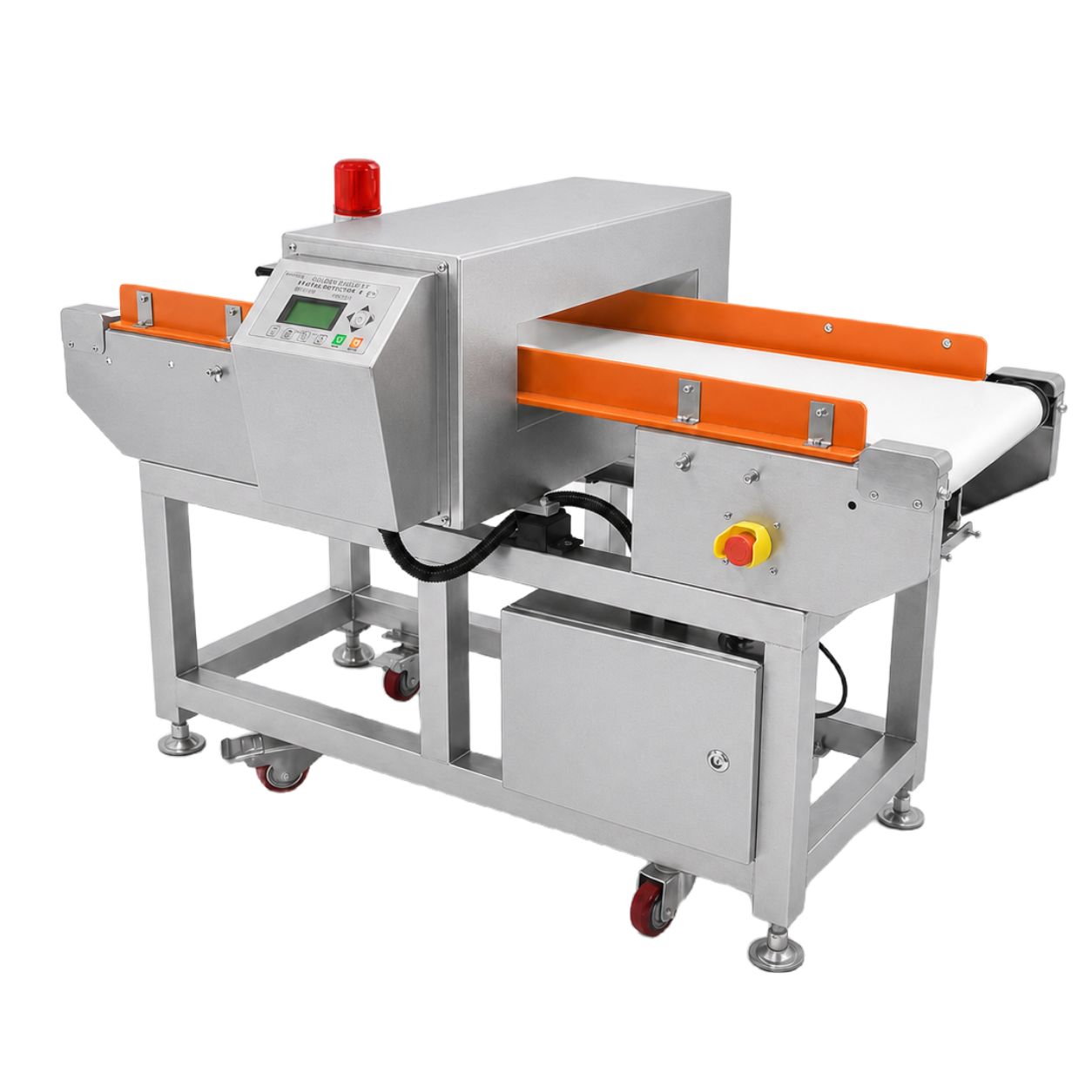
Can product-contact surfaces be accessed, cleaned and inspected?
Do materials resist the product, cleaning chemistry and environment?
Can water, residues or product collect in hidden areas?
Are instruments located and maintained for the process they control?
Where does raw, cooked, low-moisture or exposed product move?
How are environmental monitoring and root-cause actions assigned?
What releases a cleaned line after allergen changeover?
Which lot, traceability and inspection events cross the packaging interface?
We record the product-trial inputs and acceptance method before performance is evaluated. We state included modules, exclusions and open decisions in the proposal.
Hidden Interface Risk: For a production buyer, hidden interface risk can delay installation because the machine builder, refrigeration contractor, site team and packaging supplier may assume different boundaries. The written interface register gives each party a checkable input and acceptance owner.
Define the food, intended state, recipe, geometry, load and package.
Select FD, IQF or a comparative test and agree the measured endpoints.
Map preparation, preservation, inspection, packaging, access and accumulation.
Assign refrigeration, utilities, controls, data, building work and third-party machines.
Record assumptions, exclusions, documentation, FAT and site-test conditions.
Align site readiness, commissioning inputs, training topics, punch-list closure and records.
We align commissioning inputs, training topics and handover documents with the approved scope. A passed factory test does not replace a site test with the real utilities, product, packaging and connected equipment.
Line price and schedule follow the validated route, usable load, module count, refrigeration or vacuum duty, hygienic design, packaging, controls, documentation and site-service boundary. Without those inputs, two equipment lists may not describe comparable projects.
No Shengtu payback, energy-saving percentage or customer return is published. Compare the purchase scope with utilities, changeovers, yield loss, cleaning time, packaging stops, maintenance access, spares, commissioning and unresolved interface risk.
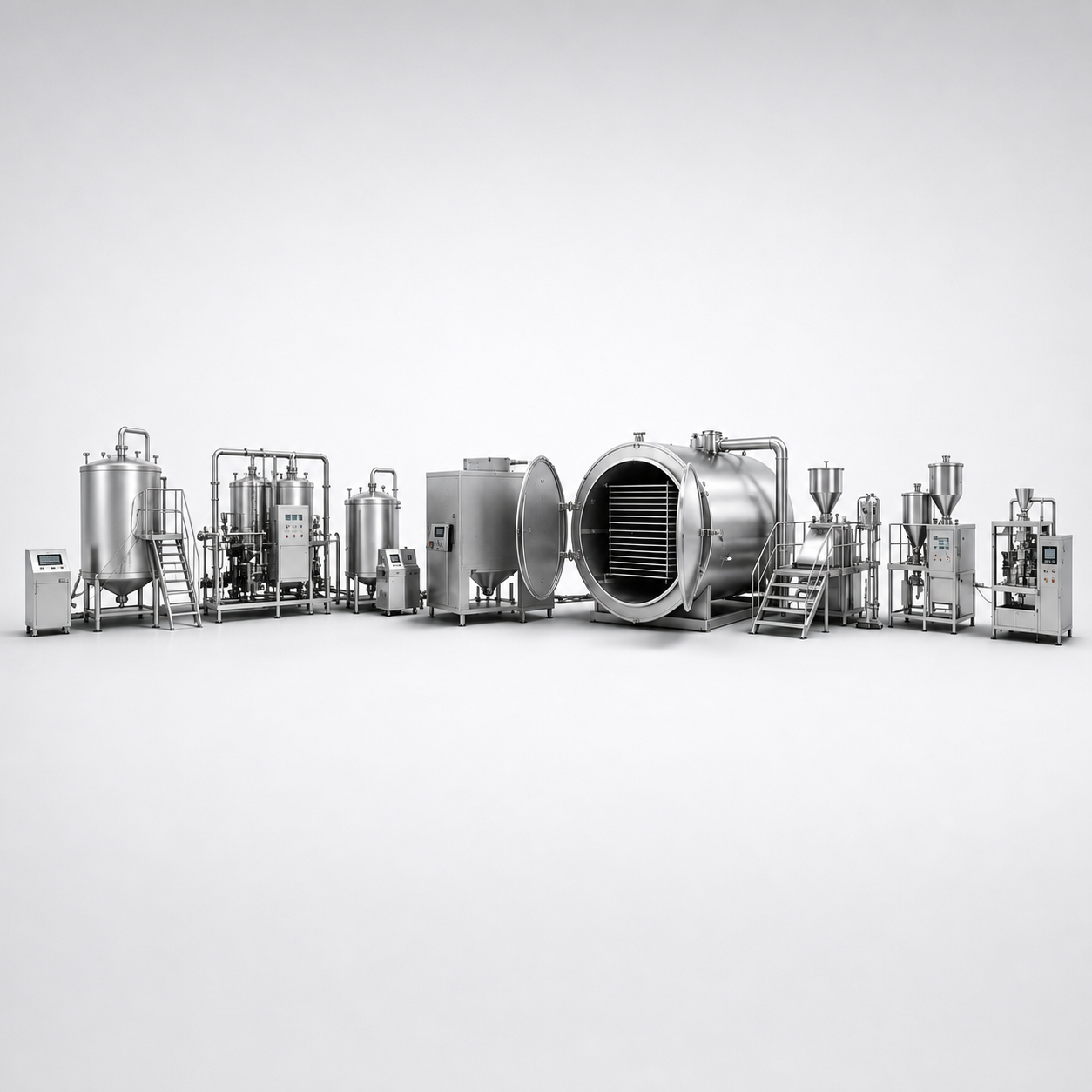
Shengtu combines food machinery research, manufacturing and whole-plant digital solution planning in Weifang. The supplied line-family images document solution scope; customer results, installed-base figures and fixed performance remain absent without attributable records.
Client material contains complete-line illustrations and module media for FD soup and porridge, FD meat and seafood, IQF prepared food, and FD beverage ingredients.
Machinery, controls, utilities, packaging and site interfaces are brought into one proposal boundary. The approved configuration remains the source of what Shengtu will supply.
Product tests and acceptance records belong to the product and configuration that generated them. No competitor number, patent or certification is transferred into Shengtu performance.
A line becomes quotable when product behavior, process duty, interfaces and acceptance are visible together.
Public technical references remain separate from company proof: NIST informs connected-control responsibilities, and 21 CFR 117.40 informs equipment-design review. The supplied Shengtu media establishes only the documented line-family scope.
Freeze drying is not an automatic upgrade over IQF, and IQF is not a substitute for a shelf-stable dry product. The better route is the one that meets the product, package, distribution and business requirement after trial evidence is considered.
Use it when dry stability, low shipping mass, rapid preparation or rehydration justifies the vacuum-drying route. Validate cycle duty and package protection.
Use it when a cold chain is accepted and piece separation, frozen handling or rapid pack-out defines the product. Validate surface condition and downstream temperature control.
Some portfolios need both outcomes or a different preservation method. Pilot work can prevent one capital project from carrying incompatible product assumptions.
Deeper vacuum and colder refrigeration do not guarantee a faster safe freeze-drying cycle.
An empty-system vacuum test does not establish performance under a wet product load.
Freezer air temperature alone does not guarantee lasting separation after storage and distribution.
A machine rating does not establish whole-line good output when packaging or cleaning controls the schedule.
Evaluate product characteristics and processing requirements to determine the optimal freeze-drying or quick-freezing preservation route.
Define the physical interfaces, third-party limits, utility connections, and integration boundaries for your production line project.
Compile your required throughput, utility availability, and facility constraints to initiate an accurate engineering and quotation review.
Start with the market state: a shelf-stable dry product points toward FD, while a separated frozen product points toward IQF. Compare both through product trials when quality, rehydration, cold-chain or cost trade-offs are still open.
Provide the product, recipe, dimensions, target good output, quality endpoint, utilities, footprint, package, controls and acceptance method. The 10-input table keeps unknown values visible until engineering confirms them.
No universal cycle is promised. Fill depth, solids, fat, geometry, freezing behavior, vapor load, heat transfer and target endpoint change the product trial and equipment duty.
No. Geometry, surface water, pre-cooling, distribution, early separation, packaging and storage history all affect the result, so the acceptance test must define the product and handling window.
Yes, after speeds, heights, product transfers, utility loads, signals, cleaning access, safety functions and ownership are reviewed. Retained equipment stays outside Shengtu's performance promise unless the written scope says otherwise.
Recipes, interlocks, alarms, data events, gateways and remote support can be evaluated by project scope. Protocols, accounts, access approval, segmentation, logging, backup and recovery must be defined with the plant owner.
The design review covers food-contact materials, cleanability, drainage, maintenance access, allergen changeover, environmental monitoring boundaries and packaging exposure. Hazard analysis and regulatory acceptance remain the food manufacturer's responsibility unless the contract assigns specific work.
They are fixed in the written quotation after the route, modules, utilities, bought-out items, tests, documents and site services are known. This page does not publish a price band, universal lead time or fixed warranty term.
FDA's June 2026 page states that Congress directed FDA not to enforce the rule before July 20, 2028. Confirm the current status and the foods covered when the project reaches detailed traceability design.
Use agreed product, load, run duration, quality endpoint, sample plan, alarms, inspection checks, utility conditions and document list. Factory and site acceptance should clearly separate equipment function from product or utility variables controlled by others.
Applicable certificates and documents are confirmed for the equipment model, configuration and destination country. Company management-system records are reviewed separately from product conformity documents.
![F&V Freeze-Drying Line Process Guide [2026]](https://shengtumachinery.com/wp-content/uploads/2026/09/fv-freeze-drying-line-guide-featured-150x150.png)