Get in touch with Shengtu Bufan Company

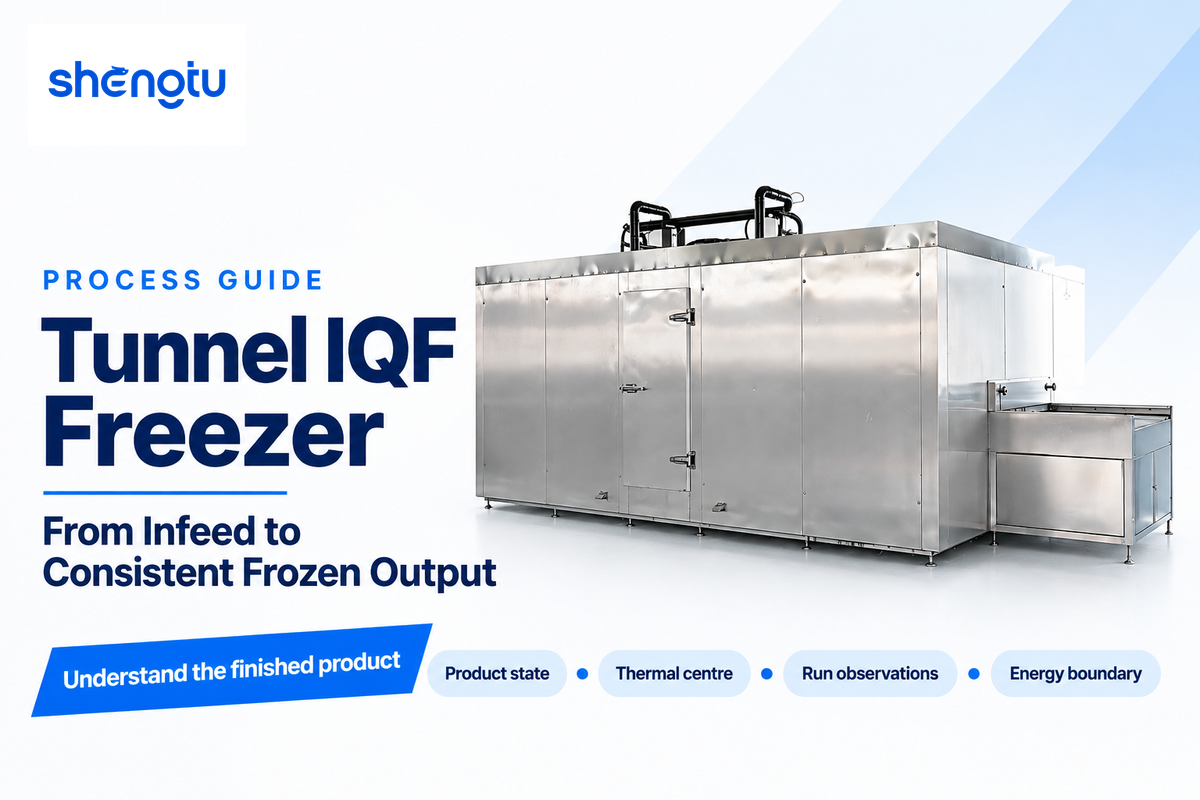
A Tunnel IQF Freezer freezes individual food pieces as they pass through a zone that removes heat from the pieces. Consistent output requires more than cold air: the incoming product, belt loading and heat-transfer conditions must work together. A firm surface can conceal a warm centre, while a cold piece can still be damaged or stuck to its neighbour.
Updated October 2026
A Tunnel IQF Freezer combines continuous product transport with rapid freezing of separate pieces. Evaluate product temperature, separation and damage across the belt and through the run. Air temperature alone can’t describe the finished food.
Quick process guide
- Scope: continuous conveyor tunnels for individual food pieces.
- Product endpoint: a defined temperature at the thermal centre, plus the required physical quality.
- Output check: belt position crossed with production stage.
- Energy comparison: metered electricity for the same equipment boundary and run.
Key points
- IQF describes individual-piece freezing; fluidization describes an airflow mechanism.
- A tunnel rating changes with product dimensions, inlet temperature and loading.
- Repeated observations help separate a persistent pattern from a one-piece exception.
- Cooling duty in kW and electrical consumption in kWh answer different questions.
Different teams in a company have competing goals. For example, the production manager is interested in throughput, the quality team is interested in intact pieces, and the finance team wants an energy use number for a benchmark. Any of these goals can serve as a starting point, as long as the conditions of the process being evaluated are clearly defined.
What Is a Tunnel IQF Freezer?
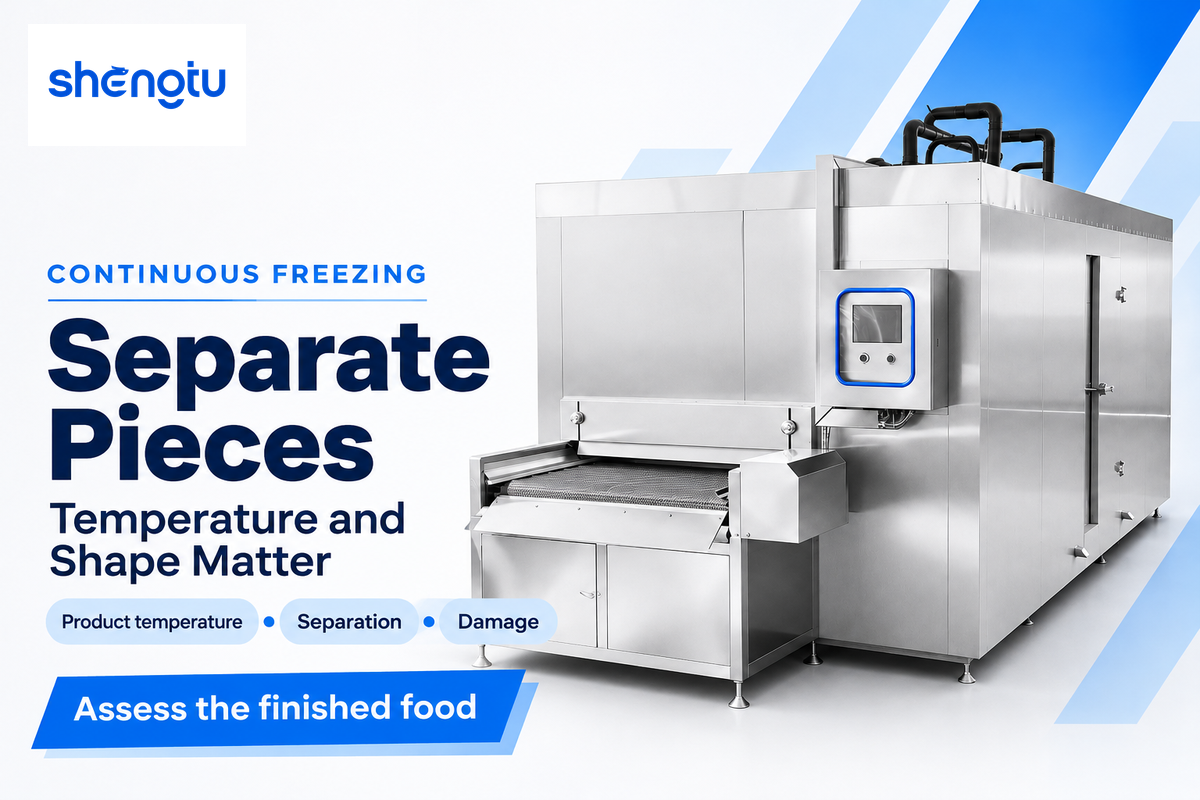
A Tunnel IQF freezer freezes individual pieces of food in a continuous process that uses an insulated enclosure. IQF means individually quick frozen. Pieces can be damaged or stuck to other pieces during the freezing process. Ideally, the product is frozen evenly to the center.
How does a tunnel IQF freezer work?
A conveyor belt moves pieces of food through a zone where heat is removed from each piece. In a mechanical system, product heat is transferred to an evaporator, which is connected to refrigeration equipment. Belt speed sets exposure time, while airflow and the spacing of the pieces on the belt affect how evenly that exposure works. FAO’s freezing manual describes continuous freezer transport on conveyors and the factors that affect freezing time.
Freezing results in a change of state for water, which then leaves behind a fraction that remains unfrozen, which is more concentrated. Rapid freezing can limit the growth of large ice crystals; however, handling before freezing and the temperature history of the product (i.e. the temperature and time it has been held at that temperature post freezing) will affect the texture of the product. Therefore, food preservation starts with good raw material, and doesn’t rely on the quick freezer to repair poor incoming quality.
Consider a bag-filling line for frozen shrimp. Smooth feeding of separate pieces by the weigher can result in consistent portioning. However, fragmented or fused pieces can significantly affect the consistency of portioning. Define the physical output beside the temperature endpoint: the proportion of joined pieces, visible damage and usable appearance. IQF isn’t descriptive of the expectations of the product.
A product at −18°C and a product that pours freely describe different attributes; therefore, keep both observations in the run record, using the temperature criterion relevant to the product and its destination.
Follow the Heat from Surface to Thermal Centre
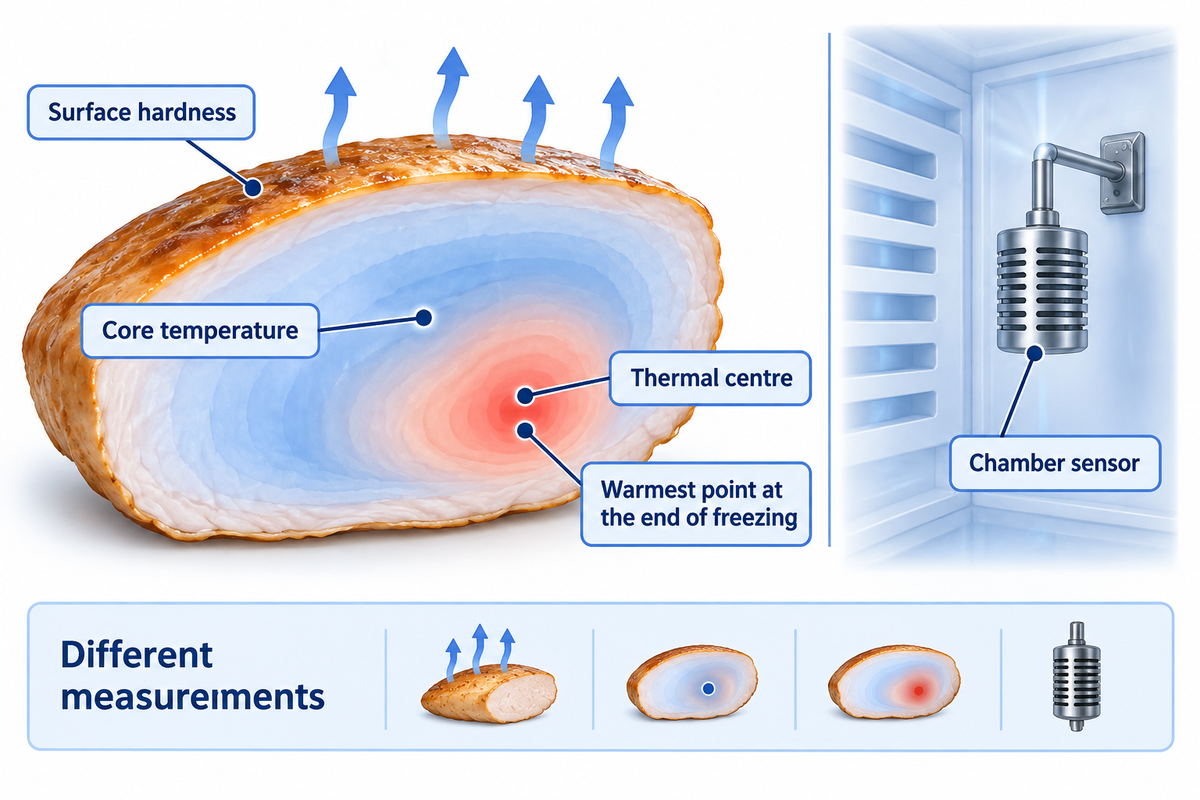
Heat leaves a food piece through its surface before the center finishes cooling. The thermal center is the warmest point at the end of freezing, and need not be the same as the geometric center. For the food piece, surface hardness and core temperature describe different aspects of the freezing process.
The Codex quick-frozen food code, sections 2 and 4.3, describes the thermal-center concept and completion at -18°C or lower upon temperature equilibrium. Codex is international guidance; the applicable product specification and destination requirements belong in the operating brief.
“The point within a piece of food which has the highest temperature at the end of a quick freezing process.”
Food size matters because heat has to pass through the product as well as cross the product’s surface. Composition modifies the amount of heat withdrawn and the temperature range over which water freezes. The FAO freezing manual, section 1.2.2, lists the factors and simplifying assumptions underlying Plank’s equation. Doubling thickness doesn’t universally extend total freezing time by a factor of four.
Example: a processor changes a diced product from 10 mm to 20 mm pieces while retaining the same belt speed. Larger pieces may have a longer internal heat transfer path, but calculating the consequences is not as simple as comparing the two dimensions. Temperature, composition and surface heat transfer all come into play. Measuring only the exterior may miss a warm region. The quality team should compare time–temperature histories for the larger pieces before accepting the original production setting. If the pieces also become wetter during the change, keep that preparation difference visible rather than assigning the entire change to size.
A 2021 review by Fadiji and colleagues discusses the influences of food geometry and boundary conditions on freezing models. Modelling aids the explanation of temperature patterns. Measuring product verifies if the selected process achieves its endpoint.
Measurement takeaway: −18°C at a chamber sensor and −18°C at the thermal centre are different readings. Use a method with known uncertainty and measure at a particular piece location. Indicate the elapsed time between discharge and measurement.
Tunnel, Fluidized Bed and Spiral Describe Different Things
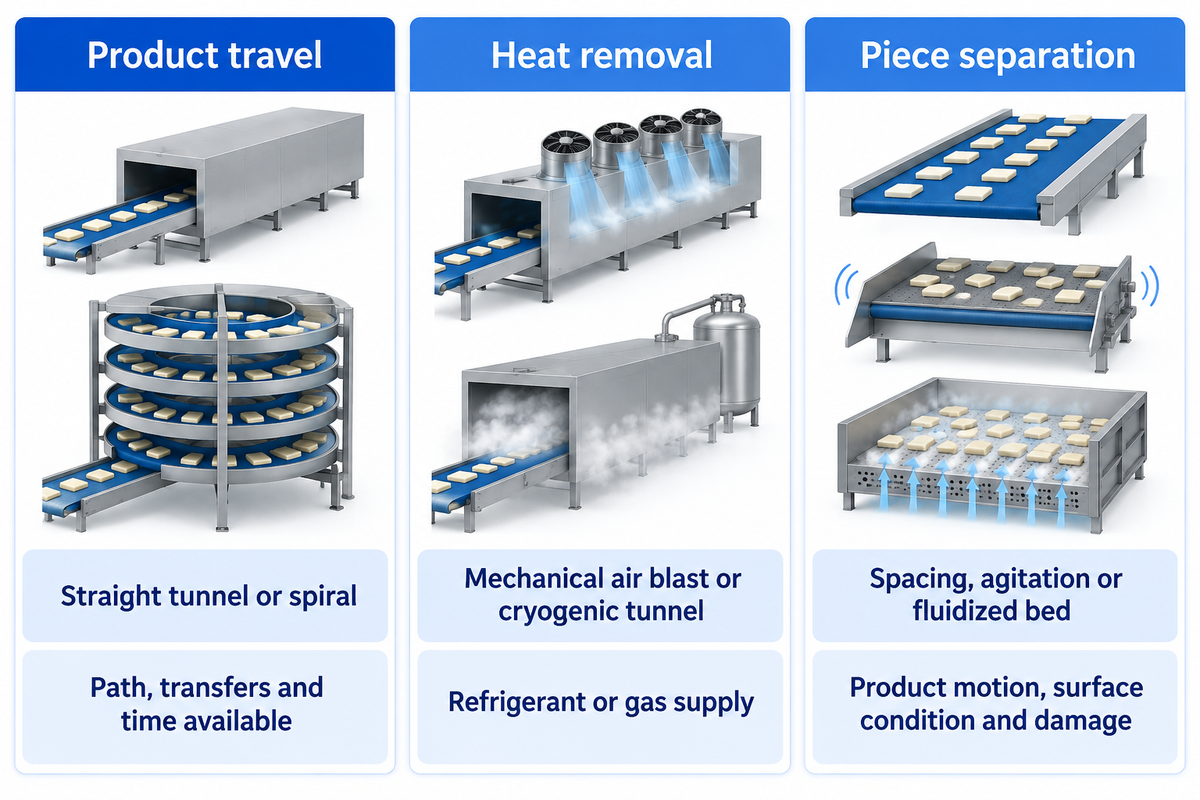
Tunnel and spiral describe product travel arrangements, while fluidization describes the interaction of air with the food bed. IQF describes individual and separated freezing. Those labels overlap. A straight tunnel can use mechanical refrigeration or cryogenic freezing, and a spiral freezer can also produce individually frozen items if they’re mechanically handled and spaced correctly.
The distinction avoids a common mistake in equipment families. A carton freezer can freeze packaged food in a tunnel without producing loose IQF pieces. Historical tunnel designs may have trays on trolleys. The continuous belt systems discussed here are a more restricted case.
| Question | Example label | What still needs definition |
|---|---|---|
| How does food travel? | Straight tunnel or spiral | Path, transfers and time available |
| How does heat leave? | Mechanical air blast or cryogenic tunnel | Refrigerant or gas supply and heat-transfer arrangement |
| How do pieces separate? | Spacing, agitation or fluidized bed | Product motion, surface condition and damage |
Liquid nitrogen is one of the cryogenic routes. Ammonia and the other refrigerants described can work with mechanical systems. “Freon” is an imprecise trade label for a project brief. Precise descriptions of the refrigerant and operating conditions can be requested.
For a more complete selection of families, use the quick-freezing equipment guide. The spiral belt freezer selection guide addresses layouts where a long belt path and floor area constrain the decision.
Comparison boundary: Saying one product can treat 500 kg/h says little about another product without its inlet temperature and finished state. Compare process requirements before concluding that an IQF spiral freezer and a straight tunnel are interchangeable.
Match Product Condition to the Freezing Process
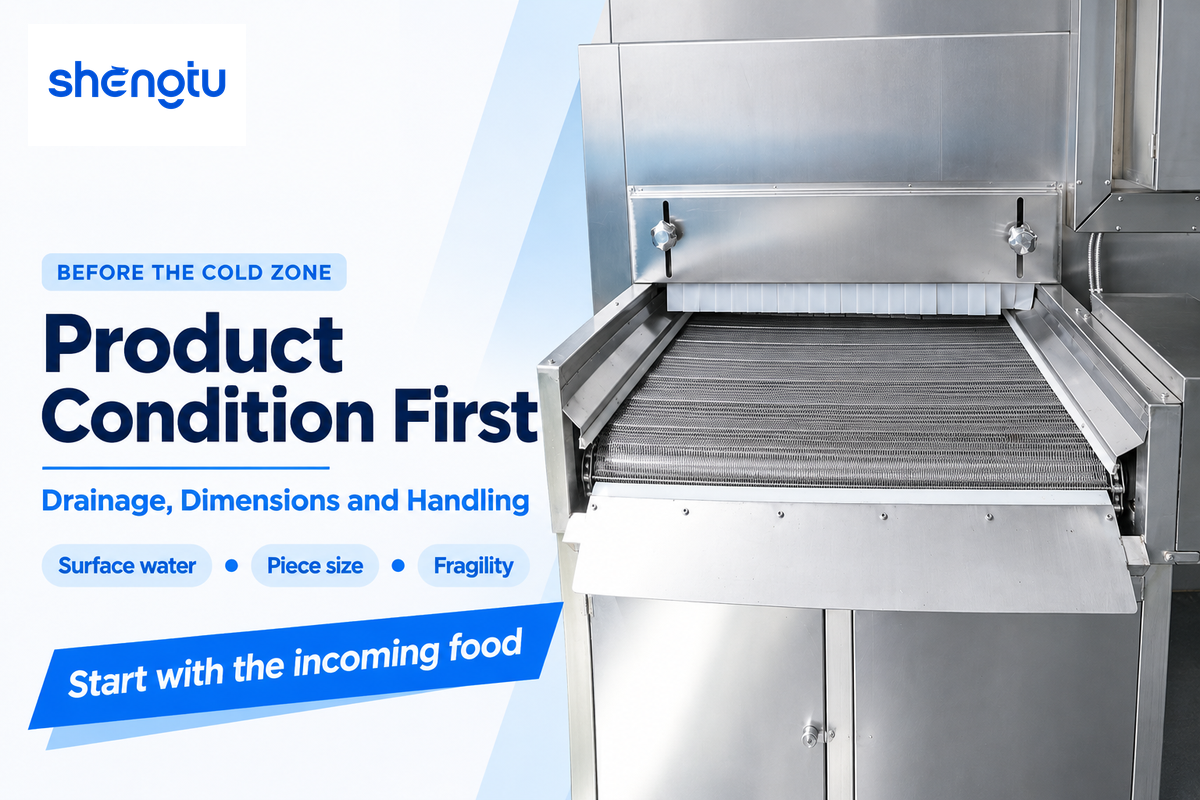
The condition of the product determines the separation problem prior to the first piece entering the cold zone. Free water can form bridges; fragile materials can break during transportation and mixed dimensions can leave different internal temperatures. First determine the constraints of the incoming product and choose the observation that’s likely to show that the product isn’t prepared or handled properly.
In Svetlana Plotean’s technical column on fluidization, the business coordinator of OctoFrost identifies airflow and product characteristics. The principle is control of product motion, and more lifting doesn’t always mean gentler product treatment for all food products.
| Incoming condition | Hidden constraint | Useful observation and owner |
|---|---|---|
| Wet vegetable dices | Residual wash water joins neighbouring pieces | Compare drainage and fused-piece pattern; preparation team |
| Soft strawberry pieces | Product movement can damage tissue | Record intact and broken pieces together; quality team |
| Mixed-size peas | Different dimensions change freezing behaviour | Record size distribution with endpoint readings; quality team |
| Skinless fish fillets | Belt adhesion can damage the contact face | Inspect removal and surface marking; production team |
| Shrimp or other aquatic products | Surface water and later glazing complicate mass comparisons | Keep weighing stage fixed; production and finance |
| Poultry portions | Variable thickness obscures the slowest-cooling region | Match dimensions and temperature location; quality team |
| Potato French fries | Clusters entering together reduce exposed surfaces | Observe feed spreading before changing the cold zone; line operator |
| Flour-coated bakery or pasta pieces | Loose flour becomes a cleaning-access problem | Inspect residue locations and access; hygiene and maintenance |
| Cooked, ready-to-eat pieces | Post-cook contact surfaces can reintroduce contamination | Map contact points after the validated control step; food safety team |
In the fish freezer discussion by FAO, they describe mesh belt marking and sticking of skinless fish in seafood processing; a separate example of airflow control is described in GEA Refrigeration Canada Inc.’s US 9644883B2. A third-party example of airflow control appears in GEA Refrigeration Canada Inc.’s US9644883B2 , granted in 2017 with a 2012 priority date; its adjustable-vane arrangement addresses airflow distribution and fluidized-bed blowouts. The patent is related to the disclosed architecture and not a SHENGTU test.
There’s a discussion post by a filled-pasta operator on IFSQN describing wet flour on a multi-belt tunnel. Some of the posts state that easy access to individual belts and reducing the amount of loose flour before freezing would help. Some of the observations relate the decision to the condition of the product and maintenance: stainless steel construction doesn’t make inaccessible soil easy to remove.
Preparation takeaway: if a trial changes a 10 mm dice to a 20 mm dice and increases surface water at the same time, the comparison contains two changes. Separate them in the run record so the next adjustment addresses the relevant constraint.
Read Freezing Capacity Through Product Conditions
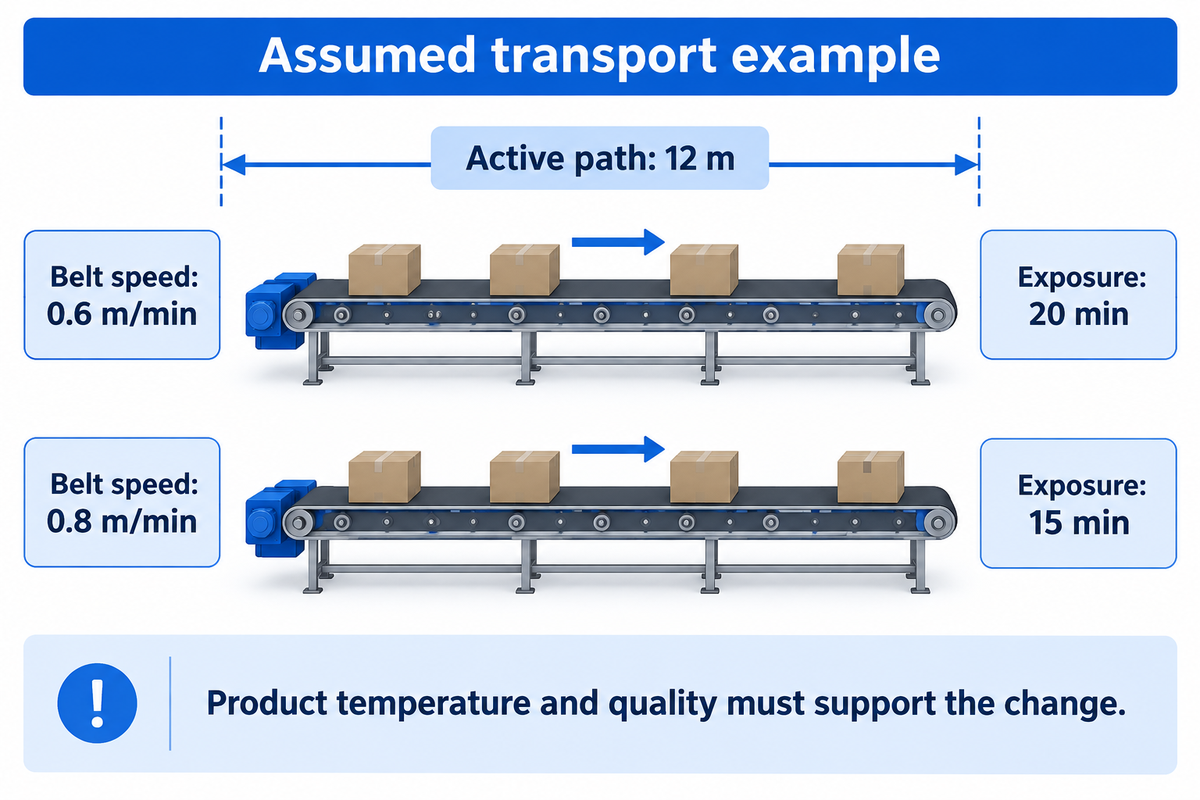
Freezing capacity is a product state conditioned rate rather than a permanent condition of the enclosure. A usable rating connects the mass inflow with dimensions, temperature, loading and the end-state to be frozen. The refrigeration system must remove the heat, and the conveyor must provide enough exposure without creating an unsuitable product layer.
The FAO fish-freezer manual section 4.1.1, states a continuous-belt freezer’s capacity is dependent on the product and the freezing time. A tunnel freezer for food processing can’t be rated meaningfully by its motor power or belt width alone.
Example: Assume the active freezing path is 12 m, and the belt speed is 0.6 m/min. Residence time is 12/0.6 = 20 min. Speeding up to 0.8 m/min reduces exposure to 15 min. With the load per meter unchanged, the conveyor transports more mass per hour. It’s unclear whether the product has finished freezing. A warmer inlet or a thicker piece may consume the time margin. Gains in productivity only count when the finished product is discharged and remains usable. Recirculating unfinished pieces may also disrupt feed balance.
For a fluidized bed, bed depth interacts with particle size and airflow. Minimum kWh/kg and maximum kg/h are different objectives. Neither of these supports a recommendation to deepen or thin a product bed.
Capacity takeaway: changing a 12 m path from 0.6 to 0.8 m/min removes 5 min of exposure in this example. A faster belt is a capacity proposal until the matched product-temperature and physical-quality results support the change.
Use a 3 × 3 Tunnel Run Map
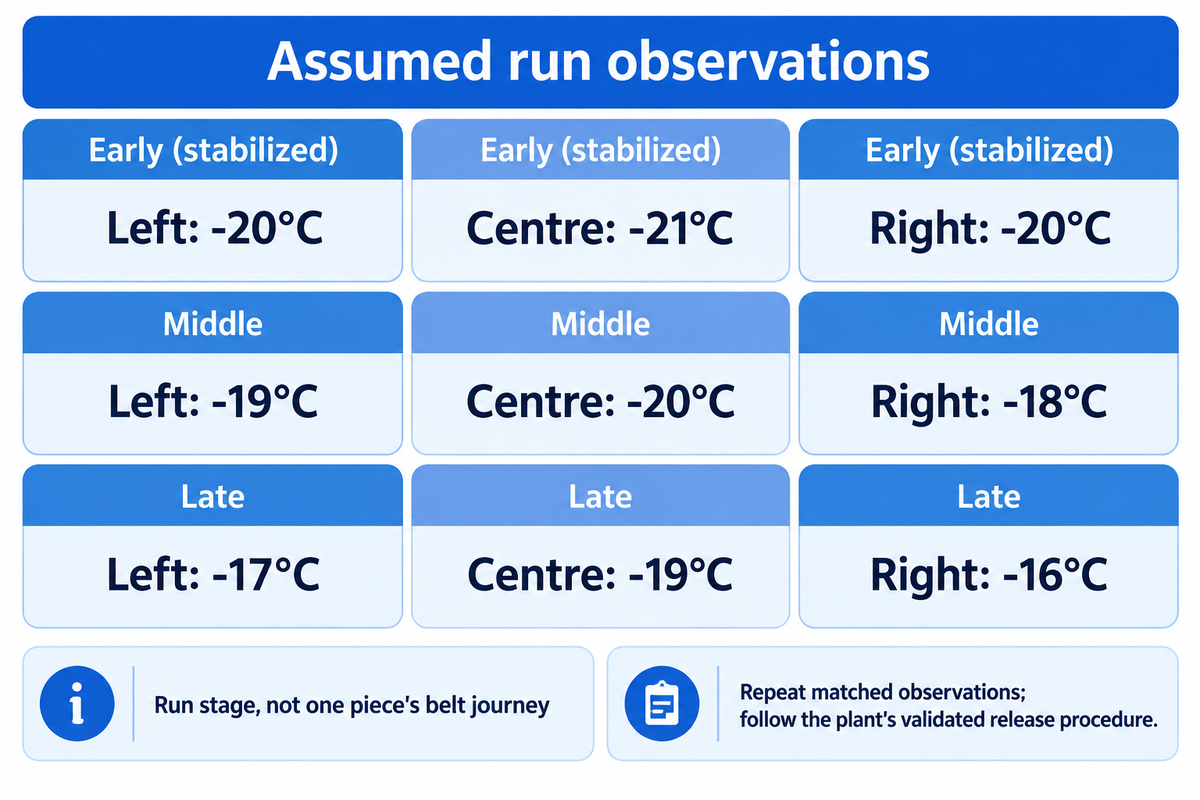
A 3 × 3 Tunnel Run Map records product observations over a belt width and consecutive steps in a production run. The nine cells organize subsequent comparisons. Matching incoming pieces and repeating measurements helps reveal persistent differences; a temperature pattern alone cannot identify whether equipment, feed changes or measurement drift caused them.
Use left, center and right positions at discharge, crossed with stabilized early, middle and late production stages. Define left and right as you face the direction of travel. These stages describe the production run, not the journey of a single part along the belt. Log elapsed production time and time since defrost next to each set.
NIST’s process-modelling principles explain why replication and measurement order matter. A left-to-right sequential check can mix belt position with changes occurring during measurement. Record the order, use matched product groups, and include repeated observations. Organize collection to minimize handling delay and to not systematically assign it to one lane.
| Run stage | Belt position | Recorded product temperature | Separation / damage observation |
|---|---|---|---|
| Early, stabilized | Left | −20°C | Separate; no visible breakage |
| Early, stabilized | Centre | −21°C | Separate; no visible breakage |
| Early, stabilized | Right | −20°C | Separate; no visible breakage |
| Middle | Left | −19°C | Separate; no visible breakage |
| Middle | Centre | −20°C | Separate; no visible breakage |
| Middle | Right | −18°C | Joined pairs observed |
| Late | Left | −17°C | Joined pieces observed |
| Late | Centre | −19°C | Separate; no visible breakage |
| Late | Right | −16°C | Joined pieces observed |
In this instance, repeated comparison of the right lane is justified and the late stage change warrants further examination. The table doesn’t indicate an obstructed air path or confirm frost as the causal agent. First, examine matched dimensions of the pieces being measured, the inlet temperature, feed distribution and the method of measurement. Retain individual repeat readings and their variation, rather than substitute the readings with an average value.
A controlled follow-up modifies only one defined variable and repeats the comparison. If the pattern remains with matched food and confirmed measurement, observations of equipment become more useful. If the pattern disappears when incoming size is matched, a freezer adjustment may have solved the wrong problem. Release of product is done in accordance with the validated sampling and acceptance procedure of the plant. Coverage is based on the hazards and variability of the product.
- Define the product group: record size, preparation and inlet state with the run identifier.
- Collect comparable observations: log position, stage, measurement sequence and handling delay.
- Repeat the suspected difference: retain individual results and check measurement repeatability.
- Test a specific explanation: change one agreed factor and repeat the matched comparison.
Observation takeaway: Repeated observations or monitoring should be done between observation windows when the process changes quickly, rather than relying on a single value of −16°C. Nine single readings don’t quantify a batch’s variability.
Trace Clumping and Uneven Freezing to Their Causes
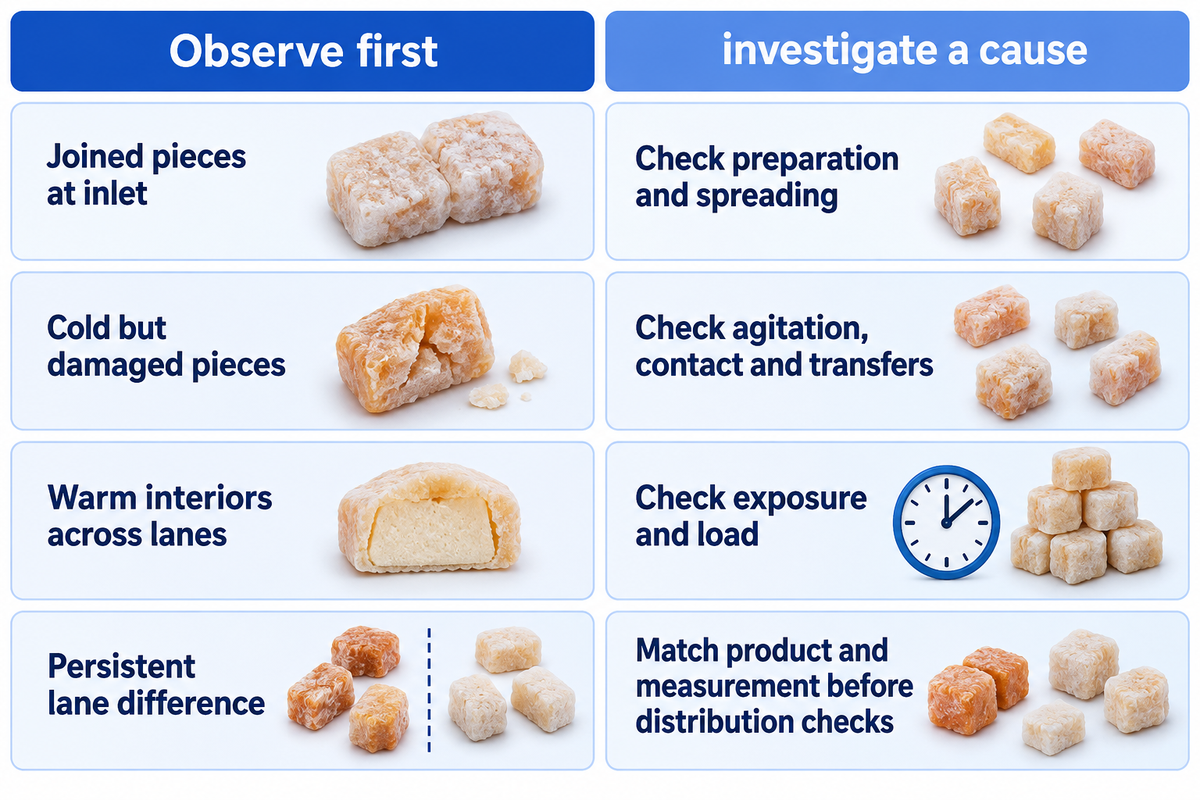
Observations for clumping and uneven freezing are different because adhesion, internal heat removal and mechanical injury can happen independently. Start with the incoming food and identify where the defect first appears. Compare product conditions with the run record before changing belt speed, refrigeration settings or air circulation together.
Why is my tunnel IQF freezer not working as expected?
An issue with tunnel IQF freezer can occur when the feed, exposure time, or heat transfer conditions don’t match the product. Check for joined pieces, a warm thermal center, damage or declining output. These issues can lead to other possible comparisons; cooling the air does not resolve every cause.
Joined pieces already visible at the inlet point toward preparation or spreading. Although cold and damaged, pieces draw focus toward agitation, belt contact, and transfers. Warm interiors across all lanes suggest a broader exposure or load question. A consistent difference across lanes warrants checking the distribution after accounting for differences in the product and measurements.
The DOE/ORNL frost-formation report describes the relation between frost, pressure drop and reduced heat transfer. Its commercial-refrigerator energy percentages are not industrial tunnel benchmarks. The reason for looking into late-run behaviors is justified, as supplying a universal defrost timer wouldn’t be a solution.
In Carmen Popescu’s article on snow formation, the OctoFrost marketing coordinator discusses comparing product moisture before and after freezing. Coil snow includes other moisture sources, so its mass can’t automatically be charged entirely to product loss.
If a fry line is showing feed clusters, it should take care of those before it addresses fan speed. If there are some pieces that have a warm center, those need to be addressed as well. It’s important to identify which pieces are which so an adjustment that fixes separation doesn’t cover up pieces that aren’t fully frozen.
Diagnostic takeaway: A 2°C difference between lanes is an opportunity to repeat, not an absolute defect limit. Using consistent measurement methods helps ensure a useful comparison of uniform freezing. Judge the difference against the product criterion, measurement uncertainty and within-group variation before assigning a cause.
Separate Cooling Duty from Electrical Energy
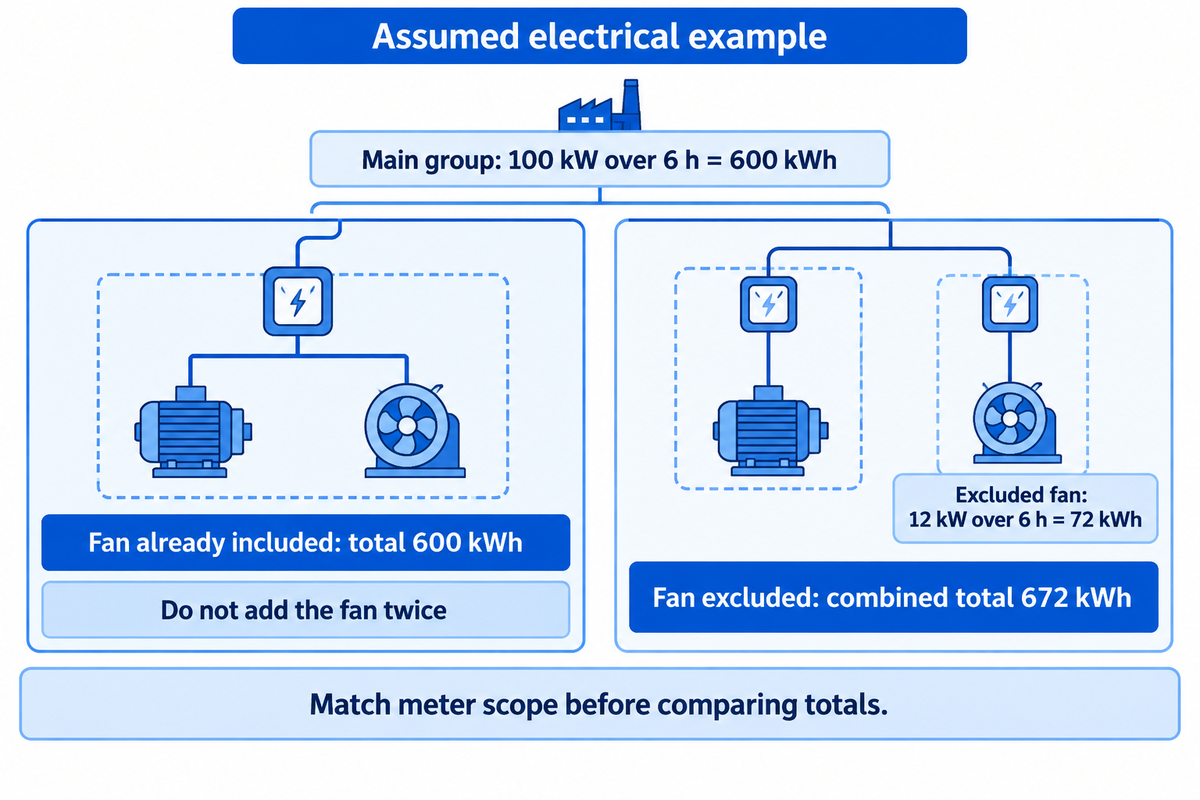
Cooling duty is a measure of the rate of heat removal. Electrical Power is a measure of input. Energy consumption accumulates that input over time. Comparing these requires identical operating conditions and boundaries. Misleading claims may result from dividing refrigeration-duty by unrelated installed power.
SHENGTU lists 170 kW for cooling loads and 28 kW for installed power for ST-SDS-1000. These are shown as separate fields. Whole-system electricity includes the relevant refrigeration plants and auxiliaries in scope; a machine electrical rating and a compressor-system measurement are distinct quantities.
Tunnel Energy Boundary Sheet
The Tunnel Energy Boundary Sheet attributes each electrical load to a meter and comparison period before any totals are combined.
| Load or period | Record | Comparison risk |
|---|---|---|
| Compressor plant | Dedicated or shared meter; allocation method | Shared plant energy charged inconsistently |
| Evaporator fans | Inclusion in main meter total | Fans counted twice |
| Circulating pumps | Included feeder or separate meter | Auxiliary electricity omitted |
| Conveyor drives | Machine feeder coverage | Nameplate mistaken for measured average |
| Infeed preparation | Separate upstream scope | Dewatering included in only one offer |
| Discharge and packing | Separate downstream scope | Line energy compared with freezer-only energy |
| Defrost | Energy and time included | Recovery excluded from comparison |
| Idle and restart | Same start and end conditions | Unmatched run boundaries |
| Output reference | Net product, weighing point and completion status | Glaze or unfinished food alters denominator |
Example: a complete measured equipment group averages 100 kW for 6 h, so its energy is 600 kWh. If the fan feeder averages 12 kW and is already included in that 100 kW, adding another 72 kWh double-counts it. If a different meter excludes those fans, the combined total is 672 kWh. Finance could otherwise compare 600 with 672 and infer a difference that comes entirely from meter scope. Keep the production result, starting condition and period identical before judging lower energy consumption.
Energy efficiency also differs from maximum throughput. An optimal freezing setting for intact product may differ from the setting that sends the most kilos down the belt. Determine the most important objective between output, quality and electricity per completed mass before ranking the alternatives.
Energy takeaway: 100 kW averaged over 6 h equals 600 kWh. Adding a 12 kW fan load is valid only when that feeder sits outside the first measurement; arithmetic can’t repair an undefined boundary.
Plan Defrost, Hygiene and the Discharge Handoff
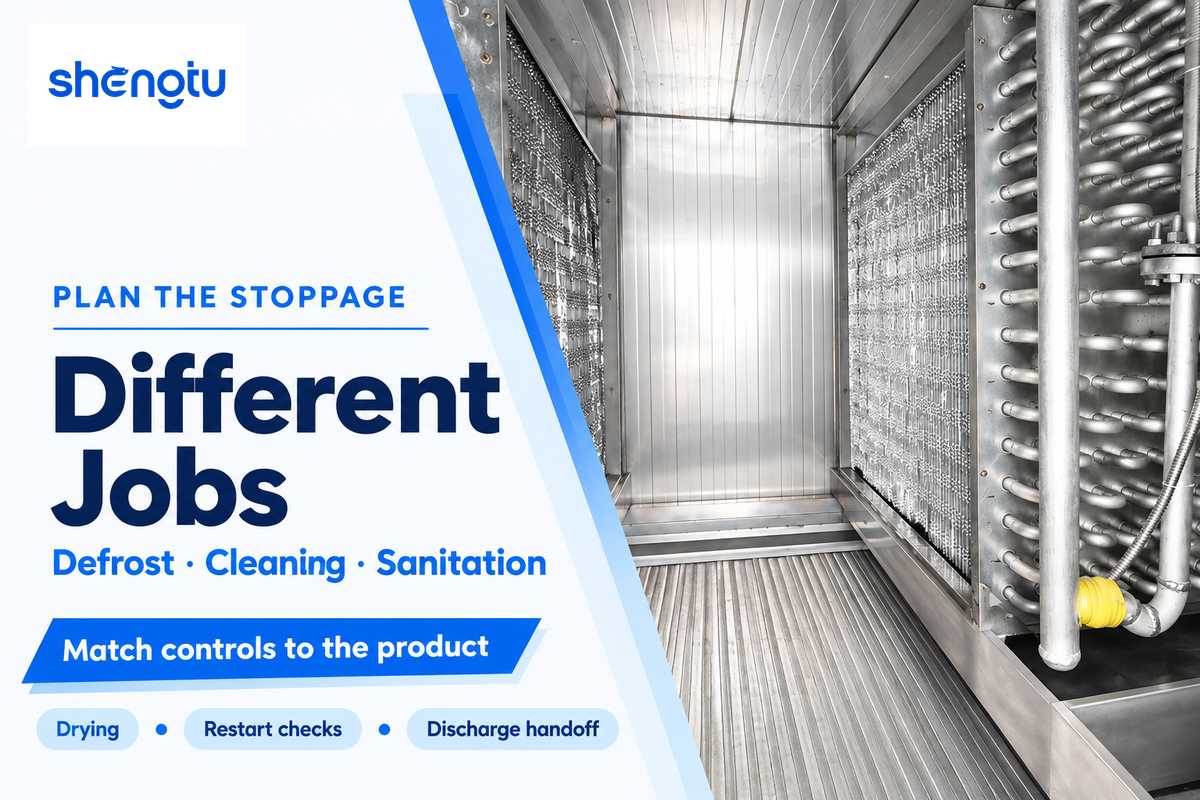
Defrost removes accumulated ice. Cleaning removes food soil. Sanitation controls address food contamination. All serve different functions and must be customized to the equipment and the product. The discharge handoff then maintains the condition of finished food while in transit to glazing, packing and storage. A defrost system alone isn’t able to perform all the three functions.
The thread about filled pasta shows how flour soil and access can dominate downtime. The recommendations to the post focus on coordinating the machine supplier, cleaning specialist and plant departments. Take this more as an access and preparation lesson, rather than adopting the chemicals or cleaning intervals in the thread. Preparing to start up the plant and drying also need to be included in the stoppage plan.
There must be a clear distinction between ready-to-eat food and food that will receive a later validated cooking step. The FDA’s Listeria guidance states that freezing does not eliminate Listeria. Their sampling explanation illustrates food-contact surfaces after a kill-step, or where later contamination is not controlled. A frozen temperature does not replace control of the site hazard.
A short discharge conveyor can still disrupt production if pack-out can’t accept the flow. In the discussion of a quick-frozen food line consider the contact surfaces and route to cold storage. Modular equipment packages need a defined responsibility at each connection.
Integration and utility questions before a quotation
When discussing the product-state record and run observations with IQF tunnel freezer manufacturers, direct the supplier and the refrigeration contractor to define the boundaries of their packages, utilities and measurement points. Assign upstream drainage and spreading to a named team, then determine who owns downstream accumulation of discharge and who’s responsible for interruptions to packing and restart actions.
These responsibilities impact reliability more directly than a promise to freeze various food products. Compare freezer suppliers on the same brief and scope. The SHENGTU tunnel IQF freezer solution provides the commercial model and project information for the next discussion.
The data request by FAO and WHO on 13 March 2026 requested information that could inform potential updates to frozen storage recommendations. A request for scientific advice doesn’t mandate the use of a warmer storage requirement. Therefore, don’t alter operating criteria to be consistent with the notice.
Key takeaway
A 3 × 3 run map organizes nine observation cells. Combine matched product conditions and repeated measurements before testing a cause, then compare energy within one defined boundary. Connect the purchasing brief to the product the plant needs to pack.
Frequently Asked Questions
Is IQF the same as frozen?
IQF adds individual-piece freezing and separation to the frozen state.
Frozen food can form a solid block or remain as separate pieces. IQF is intended to keep individual portions separable after quick freezing. That helps portioning and packaging, but separation alone says nothing about the temperature inside a piece. Assess physical quality and the required frozen endpoint together when comparing product results.
Which tunnel IQF freezer is best for my product?
Match the separation and handling method to the incoming product.
Small loose particles that tolerate movement are candidates for fluidized-bed handling. Fragile, sticky or larger pieces require closer attention to agitation, contact surfaces and transfers. Choose a system around the intended product condition and usable output. A successful run on peas can’t establish the same result for soft berries or thick poultry portions.
Are tunnel IQF freezers safe for food?
A suitable freezer supports a controlled process; freezing is not a general pathogen-kill step.
Food safety requires suitable raw materials, hygienic equipment and controls matched to the food’s intended use. Ready-to-eat products need particular attention to contact surfaces after a validated lethal step. Correct temperature and clean-looking equipment can’t replace those controls. Refrigeration, moving parts and cleaning access also require the equipment’s specified operating and maintenance procedures.
Is a tunnel freezer the same as a blast freezer?
The labels overlap because a tunnel can use air-blast heat transfer.
“Tunnel” describes an enclosure and product route. “Blast” describes forced cold-air heat transfer. A continuous conveyor tunnel may therefore be an air-blast freezer, while other blast systems use batch loading. Describe both the travel arrangement and the heat-transfer method when comparing equipment.
What should I send to a supplier before requesting a price?
Send a product brief, completed-output requirement and equipment boundary.
Include dimensions and their variation, inlet temperature, preparation, surface moisture and intended use. Add the temperature endpoint, acceptable separation and damage, run duration, feed arrangement and discharge route. State whether refrigeration plant, pre-cooling, glazing, packing interfaces and utilities belong in the offer. This makes the price discussion specific and reduces differences hidden behind similar hourly ratings.
Does freezing preserve all nutritional value?
No. Nutritional retention also reflects preparation and storage history.
Freezing can preserve food quality, but trimming, blanching and other preparation steps can change nutrient content before freezing starts. Storage temperature, duration and later handling also matter. Avoid treating fast freezing as a promise that every nutrient or sensory property remains identical to fresh food.
Can a tunnel freezer remove water like a freeze dryer?
No. A freezing tunnel and a freeze dryer perform different jobs.
An IQF tunnel removes heat to freeze food while retaining a frozen product. Freeze drying combines freezing with a subsequent drying process that removes ice by sublimation under reduced pressure. Moisture lost during ordinary freezing is a quality and mass-balance issue, rather than the intended drying operation. Specify the required final product before choosing between quick freezing and freeze drying.
Turn the product record into a defined project
Bring the product family, required completed output and the condition that limits the current run. SHENGTU can discuss the tunnel and its connections to the food-processing line.
Editorial perspective: Cherry writes for SHENGTU. The run map and boundary sheet organize public technical guidance for project discussions; example readings and calculations are assumed inputs. Company information is available in SHENGTU’s company introduction. Equipment-specific settings and the plant’s validated release procedure remain part of the defined project.
References & Sources
- FAO: Freezing of fruits and vegetables, freezing principles
- FAO: Freezing and refrigerated storage in fisheries, chapter 4
- Codex: Processing and handling of quick-frozen foods, CXC 8-1976
- Fadiji et al., 2021: Finite Element Method for Freezing and Thawing Industrial Food Processes
- GEA Refrigeration Canada Inc.: US9644883B2, fluidized bed conveyor belt freezer system
- Plotean, 2018: Fluidization in IQF freezing
- Popescu, 2017: How to minimize snow formation in IQF tunnel freezers
- NIST: General design principles for process modelling
- DOE/ORNL, 2023: Frost formation and novel defrost techniques
- FDA: Listeria and freezing
- FDA: Environmental sampling in food facilities
- FAO/WHO, March 2026: Call for frozen-storage safety data