Get in touch with Shengtu Bufan Company

How an F&V Freeze-Drying Line Turns Prepared Produce Into Stable Food

![F&V Freeze-Drying Line Process Guide [2026]](https://shengtumachinery.com/wp-content/uploads/2026/09/fv-freeze-drying-line-guide-featured.png)
Updated September 2026
An F&V Freeze-Drying Line is a controlled production route that goes beyond a vacuum chamber. It provides a controlled path for prepared fruit or vegetables to go through selection, washing, cutting, freezing, drying, release checks and protected packaging. For an operations team, the right question isn’t, “What capacity is the dryer?” It should be, “What state must the product be in to leave the line and what shows that it has?” This separation prevents a process guide from becoming a second supplier or quote page.
This guide addresses product suitability, the freeze drying process, water-load logic, drying control, hygiene and acceptance evidence. It deliberately does not set a universal pressure, shelf temperature, cycle time, shelf life or equipment rating. These are design parameters that depend on the product, geometry, loading and the particular plant. No private Shengtu production logs, customer trials or confidential acceptance data were made available for this article.
What an F&V Freeze-Drying Line Does, and What It Does Not
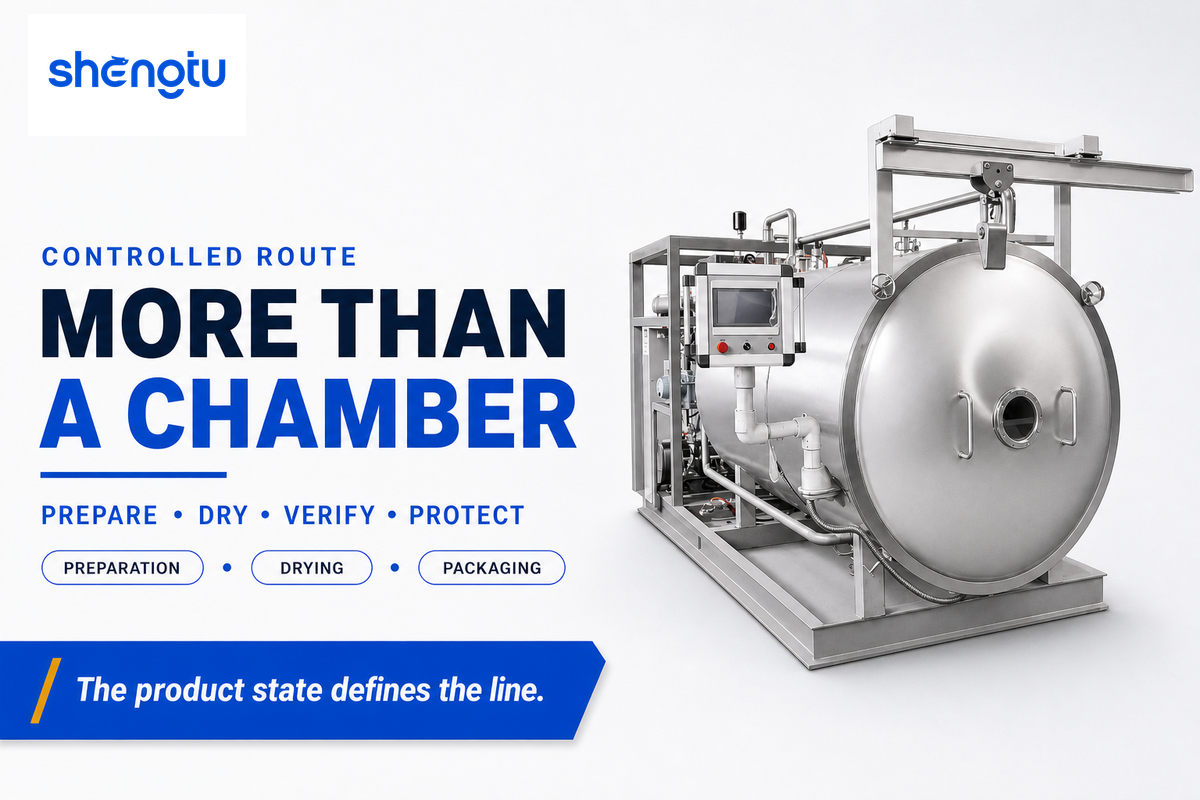
Food freeze-drying freezes water in a product and then removes ice as vapor under reduced pressure. In primary drying, heat is supplied carefully enough to support sublimation without driving the product beyond its own structural limit. In secondary drying, more strongly bound water is removed. The still porous, dry product needs inspection and a protective package.
Vacuum freeze drying, or lyophilization, is a preservation technique for heat-sensitive food ingredients used by food manufacturers. This process can produce freeze-dried products that are lightweight and designed for long shelf life. It can produce lightweight, shelf-stable freeze-dried products for room temperature distribution, but a long shelf life still requires product-and-package evidence. Throughout the food industry, freeze-dried foods include freeze-dried fruit, aromatic garnishes, instant coffee, and even prepared soup and emergency food supplies. These foods don’t share a single cycle, and none guarantees retention of the food’s original form.
Freeze-dried foods use a freeze-drying process in which a food product is loaded into a chamber where the temperature is gradually lowered. The chamber is then pumped to achieve a vacuum. Water within the product sublimates (conversion directly from a solid to a gas without a liquid phase). When the process is complete, the product is removed from the drying chamber and transferred to a packaging material. It’s also important to note that food products are susceptible to damage and contamination if they aren’t properly handled during the unloading process.
For a wider view on the upstream processes, see fruit and vegetable processing routes. This article also doesn’t consider Shengtu models, lead times, or supplier choices. It focuses on the evidence needed by product teams for the commercial questions to become meaningful.
- Define the finished food — state the target snack or ingredient format, texture, use and storage condition.
- Control preparation — lock the raw-material condition, cut geometry and pretreatment variables for the trial.
- Observe the batch — record loading, product temperature, pressure trend and condenser behavior without copying another crop’s recipe.
- Release with evidence — connect sampling, moisture, water activity, sensory and package checks to the validated product.
- Hand off a defined brief — use the evidence package for configuration discussions and a representative acceptance trial.
Which Fruits and Vegetables Are Suitable for Freeze-Drying?
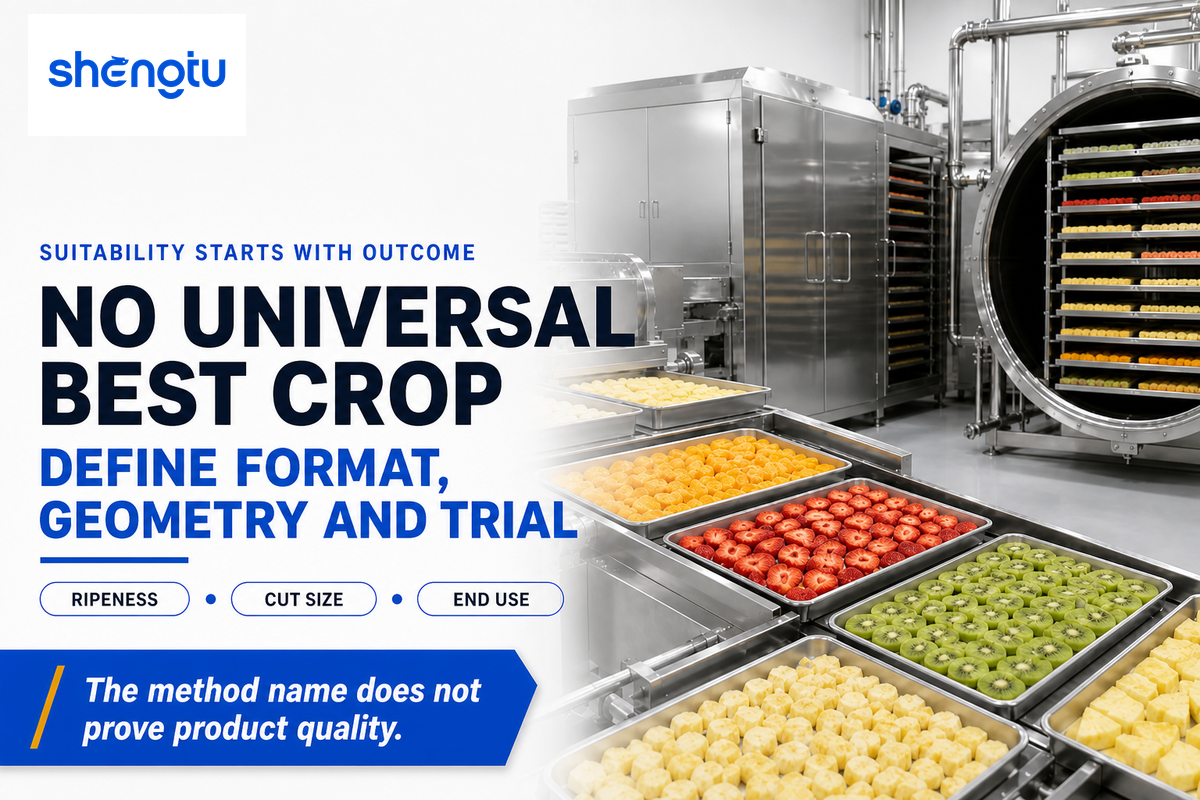
There isn’t a best fruit or vegetable for freeze drying that meets all needs; however, a short list starts with the desired outcome. For example, is the desired end product a crisp snack, an intact inclusion, a powder, a rehydratable component of the meal, or an ingredient to be mixed with another food? Water content, sugar, and acid content, peel or cuticle, cell structure, maturity, and the cut geometry can change the freezing behavior and the resistance to vapor flow.
Studies on plant foods show why broad quality statements can’t stand. Lost vitamin C in tropical fruit products studied ranged from 3% to 70%. This is a direct contradiction to the claim that freeze-drying automatically conserves all nutrients. A brief on the product should also include the cultivar, the state of ripeness, the pretreatment, and the method of analysis, and not just the category fruit.
One must not infer the nutritional value of the food from the name of the drying method. The same analyte, the same basis of comparison, the same product and the same storage condition must be the case for both. The color or the crispness, by themselves, can’t be a substitute for a nutrient assessment.
| Product family | Preparation question | Drying or quality risk | Evidence to collect |
|---|---|---|---|
| Berries | Will whole fruit, halved fruit or a controlled puncture give the intended appearance? | Skin resistance and fragile structure | Cut/skin treatment, color and breakage observations |
| Pome-fruit slices | Which thickness and anti-browning method fit the target color? | Uneven center-to-edge drying | Slice distribution, browning score and endpoint samples |
| Tropical pieces | How do sugar level and ripeness affect stickiness? | Collapse, adhesion and variable nutrient response | Solids, ripeness, tray release and sensory data |
| Leafy vegetables | Is blanching needed to control enzymes or color? | High exposed area and physical damage | Blanching record, color and fragile-piece yield |
| Root vegetables | Which cut geometry produces a repeatable diffusion path? | Dense tissue and wide thickness variation | Cut measurement, core samples and rehydration |
| Peas or corn | Does skin condition require a product-specific preparation step? | Surface resistance and nonuniform loading | Lot condition, loading map and moisture distribution |
| Herbs | How will handling protect aroma and leaf integrity? | Losses during transfer and dry-side breakage | Mass balance, aroma panel and packaging observation |
| Purees or formulated pieces | What tray depth and carrier declaration are acceptable? | Sticky matrix, shrinkage and label implications | Formula, thickness, label review and endpoint test |
| High-sugar sticky pieces | Can shape and pretreatment be stabilized before loading? | Collapse and package clumping | Solids, appearance, water activity and package study |
The table is a starting point; it isn’t a ranking. Berries, for example, can be an excellent choice for a premium crisp snack; however, they may not be a good selection for a line of snacks designed around dense cubes. Some root vegetables can sustain a different preparation route and still deserve more study from the slowest-drying core. Freeze drying fruits and vegetables therefore starts with a product definition and a representative pilot, not a catalog list. At factory scale, this risk persists because cultivar and geometry change mass transfer; treat the independently verified 3%–70% vitamin C range as study evidence, not as a universal promise. Compare pieces of a different size to determine whether the original structure and target texture survive the selected preparation and cycle.
Pretreatment Is Part of the Cycle: Washing, Cutting, Blanching and Browning Control
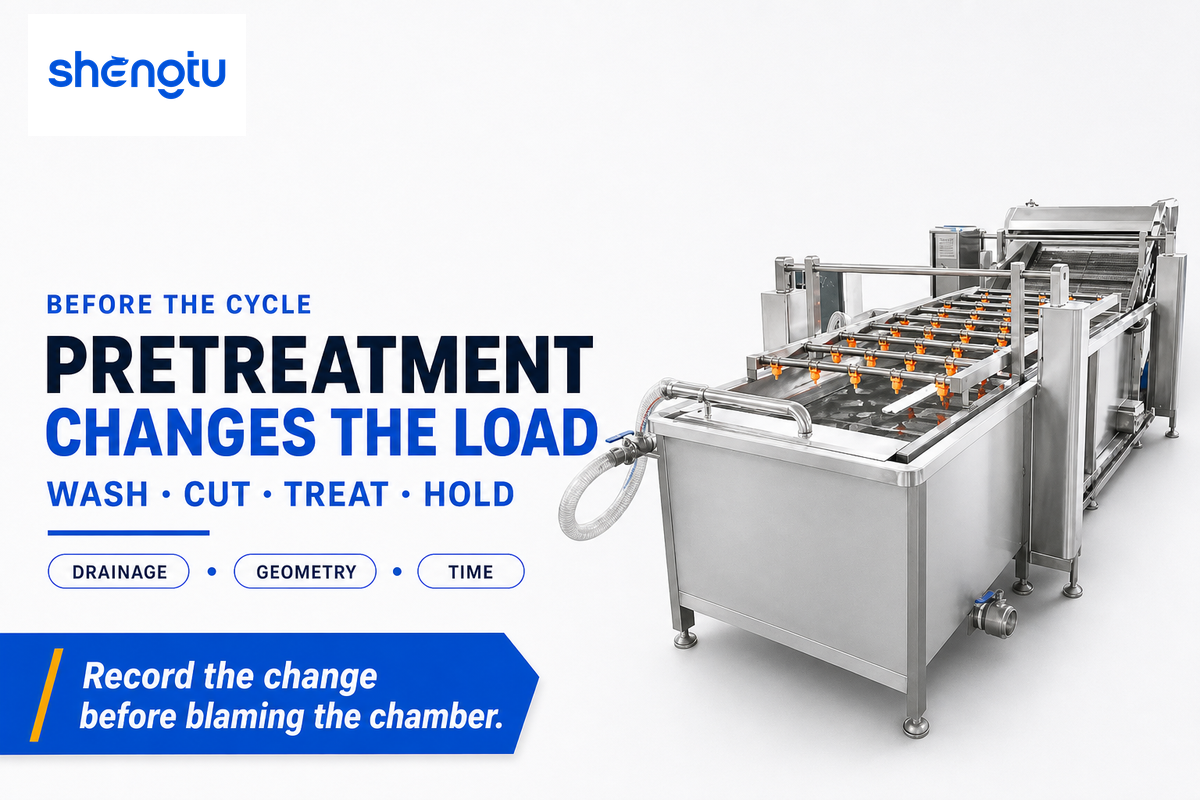
Pretreatment Is Part of the Cycle describes key processes of a dependable cycle. Washing, draining, cutting, blanching, anti-browning treatment, and the time taken before freezing aren’t separate steps. They change the starting temperature, expose different surfaces of the fruit, change the ice structure, modify the pathway for diffusion, and influence the final texture. Therefore, repetition of a blanching or slicing rule in the next cycle is likely to give the impression that the cycle is inconsistent when in fact the change occurred earlier.
The rate of freezing and the structure of the ice crystals, together with the geometry, determine the pathways left after sublimation. Browning control may be the central constraint for sliced apples, blanching and gentle handling for leafy vegetables, and cut-surface distribution for root vegetables, sometimes more than the machine settings themselves. Record the variables that really changed, such as the temperature of the raw material, the method of cutting, and the time and position of the tray. In factory production, an operator should treat 8 mm versus 12 mm cuts and 5 min versus 15 min holds as trial variables, not settings to copy; the risk is that upstream variation moves the slowest-drying location.
For the case of vegetable washing and peeling equipment, washing performance can’t be used as proof of product quality. In the trial protocol, the condition of the produce after washing and draining should be stated, and the person who checks it before loading should be identified.
On a processing line, washers and other commercial vegetable washing machines can alter surface water, product temperature, and the holding time prior to freezing. Spinach, carrot pieces, and fruit slices may come from the preparation stage with different water levels and geometries, even with the same nominal wash setting. When a carrier, antioxidant, or preservative is used, the ingredient, concentration, contact time, drainage, and labeling should be included in the batch record.
There are food-safety and labeling boundaries to pre-treatment. Shared-line ingredients, carriers or coatings can create allergen cross-contact questions even when the fruit or vegetable itself is not a major allergen. The hazard analysis should address whether the pre-treatment affects allergen segregation, validation of cleaning and changeover, and review of labeling. This is a plant-specific control question, not legal advice and not proof that a drying cycle controls the hazard.
Trial forms that are useful should be for one product family at a time. They should include the raw-material state allowed, a measured geometry band, treatment ingredients, the maximum hold time to investigate, the tray pattern, and quality observations to determine if processing should continue. Root-cause analysis is easier when the vacuum chamber isn’t blamed for changes caused by upstream processing choices.
How Freeze-Drying Works: Freezing, Primary Drying and Secondary Drying
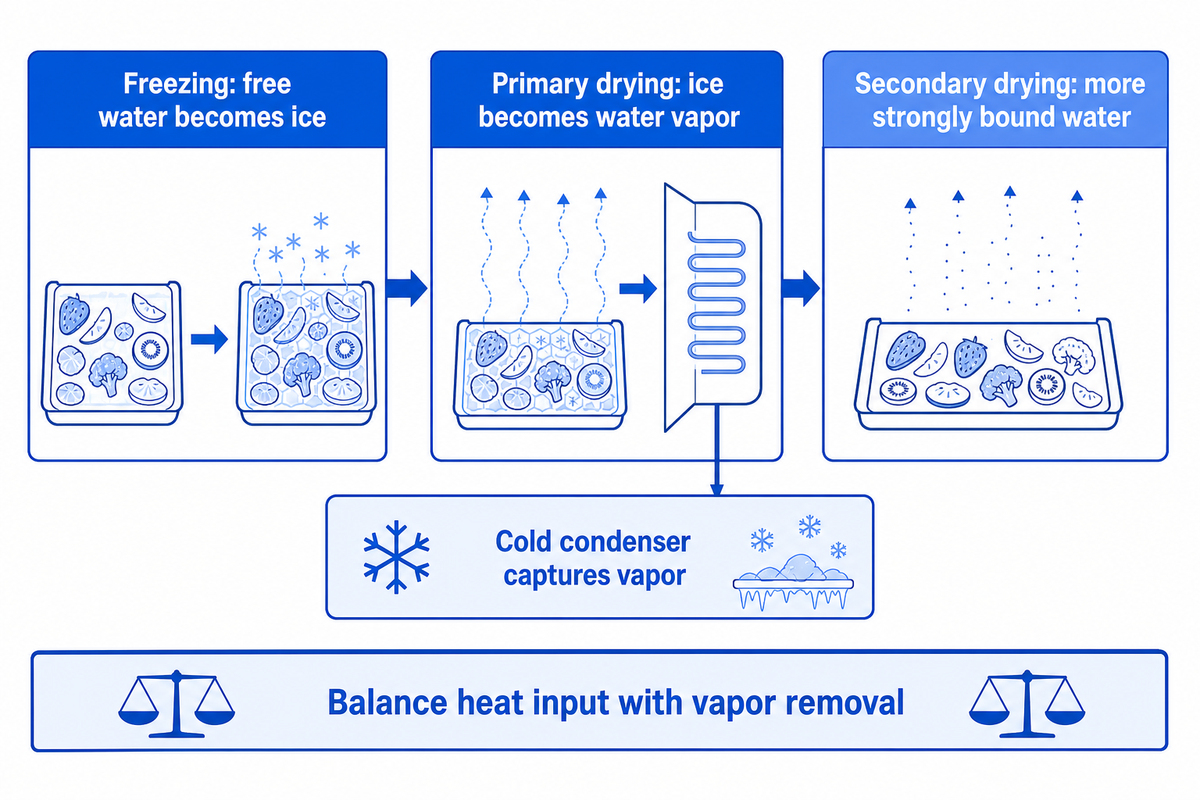
Commercial freeze drying has three consecutive stages. First, the prepared raw material is frozen so its free water becomes ice. Second, controlled heat supports sublimation of that ice into water vapor, which a cold condenser captures. Third, secondary drying removes some more strongly bound water within the product’s acceptable temperature range. The process balances heat input with vapor removal rather than pushing either setting to an extreme.
During primary drying, a product can look frozen and still be vulnerable to collapse if its temperature rises beyond a product-specific limit. During secondary drying, the product may feel dry and firm on the surface, but may still be wet on the inside and may require further drying. The condenser and vacuum system form a controlled vapor path, while the shelving or other heating surfaces make up a controlled energy path.
According to published reviews, primary drying removes the major part of the ice and the secondary drying removes more tightly bound water. The fraction removed in either stage and the acceptable endpoint remain product- and study-specific; they are not a Shengtu specification, a universal release target or a recipe to copy.
Read vacuum conditions, shelf heating, and product-temperature response together. A low temperature can protect one heat-sensitive food while extending drying time or leaving another product outside its release limit. Because of freeze-drying technology, controlled heat and mass transfer become a product-specific control problem. It doesn’t mean that the lowest pressure or the coldest setting is always the best.
For equipment-level terminology and a separate configuration discussion, see industrial vacuum freeze-dryer specifications and sizing. The first consideration should be, what does the product need protection from, and then the design should address that.
Start With Water Removed, Not Wet Feed Alone
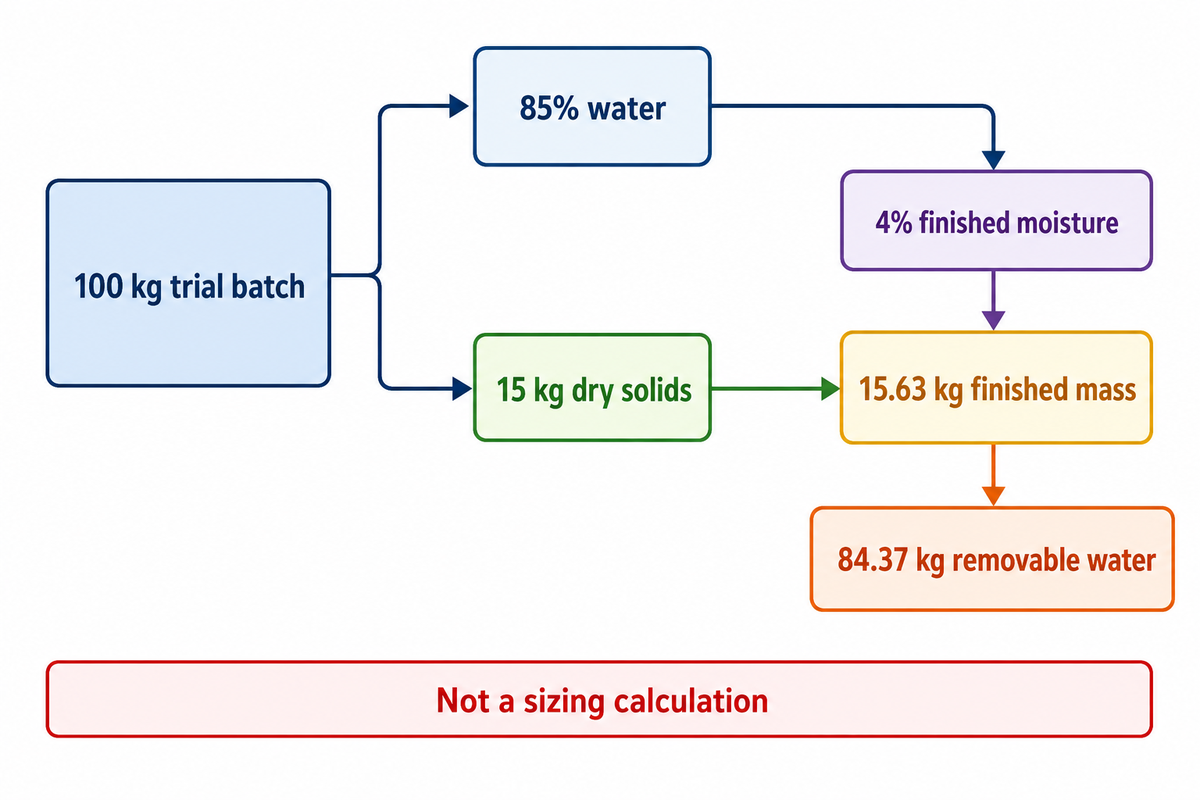
Wet-feed kilograms conceal the question that drives the material balance: how much water is actually removed. Consider a transparent worksheet example, not a sizing calculation. If a 100 kg trial batch begins at 85% water and the defined finished condition is 4% water on a wet basis, the initial water is 85 kg. The dry solids are 15 kg. At 4% finished moisture, total finished mass would be 15 ÷ 0.96 = 15.63 kg, containing 0.63 kg water. The removable-water estimate is therefore 84.37 kg.
Change the same 100 kg wet feed to 75% initial water, while retaining the worksheet’s 4% finished-moisture assumption, and removable water becomes 59.37 kg. The two batches weigh the same at loading but don’t present the same vapor burden. This calculation is helpful in posing better questions about upcoming trials concerning refrigeration and condensate handling. It isn’t a line-capacity result.
A material balance is unable to size an F&V freeze-drying Line because actual drying is coupled to product resistance, geometry, shelf-to-product heat transfer, chamber pressure, shelf temperature, loading arrangement, condenser limits and the accepted cycle. Very low pressure isn’t automatically faster; lower residual gas can help vapor transport while reducing a heat-transfer contribution, so an operating optimum can be product-specific. Don’t state a removable-water number as a guaranteed cycle time, tray area, or equipment rating.
Rather, use the calculation to provide the starting solids, endpoint, proposed load arrangement, and the details of the planned measurements. Then compare the material balance to actual observations for each batch. Discrepancies may provide insights into loss due to raw material changes, drainage, sampling, or loss during handling. The wrong solids basis or inconsistent drainage can make a neat calculation misleading, so reconcile the worksheet with the measured batch.
The 5-Checkpoint Trial Record
The 5-checkpoint trial record links the material balance to geometry, cycle, release, and packaging. The examples shown aren’t Shengtu ratings, cycle settings or acceptance limits.
The 5-Checkpoint Trial Record ties the material balance to geometry, cycle observations, release and the packaging handoff. The examples shown are hypothetical based on the recording of units. They aren’t Shengtu ratings, cycle settings or acceptance limits.
| Checkpoint | Example entries | Question the record must answer |
|---|---|---|
| 1. Feed basis | 100 kg wet feed; 85% initial water; 15 kg dry solids | Which measured lot and mass basis does the calculation describe? |
| 2. Geometry and load | 8 mm, 10 mm and 12 mm pieces; 4 kg, 5 kg and 6 kg tray loads | How much spatial and loading variation entered the trial? |
| 3. Cycle observations | −35 °C, −30 °C and −28 °C product readings; 0.001 bar, 0.002 bar and 0.003 bar snapshots; 2 hr, 6 hr and 12 hr elapsed checks | Where and when were temperature and pressure observations made? |
| 4. Release balance | 4% worksheet endpoint; 15.63 kg finished mass; 0.63 kg retained water; 84.37 kg removable water | Do measured mass and endpoint results agree with the stated assumptions? |
| 5. Handoff and study | 5 min, 10 min and 15 min exposure checks; 30 days, 90 days and 180 days storage checks | Can the package preserve the released condition under the intended study plan? |
Verify the Hardest-to-Dry Locations Before Batch Release
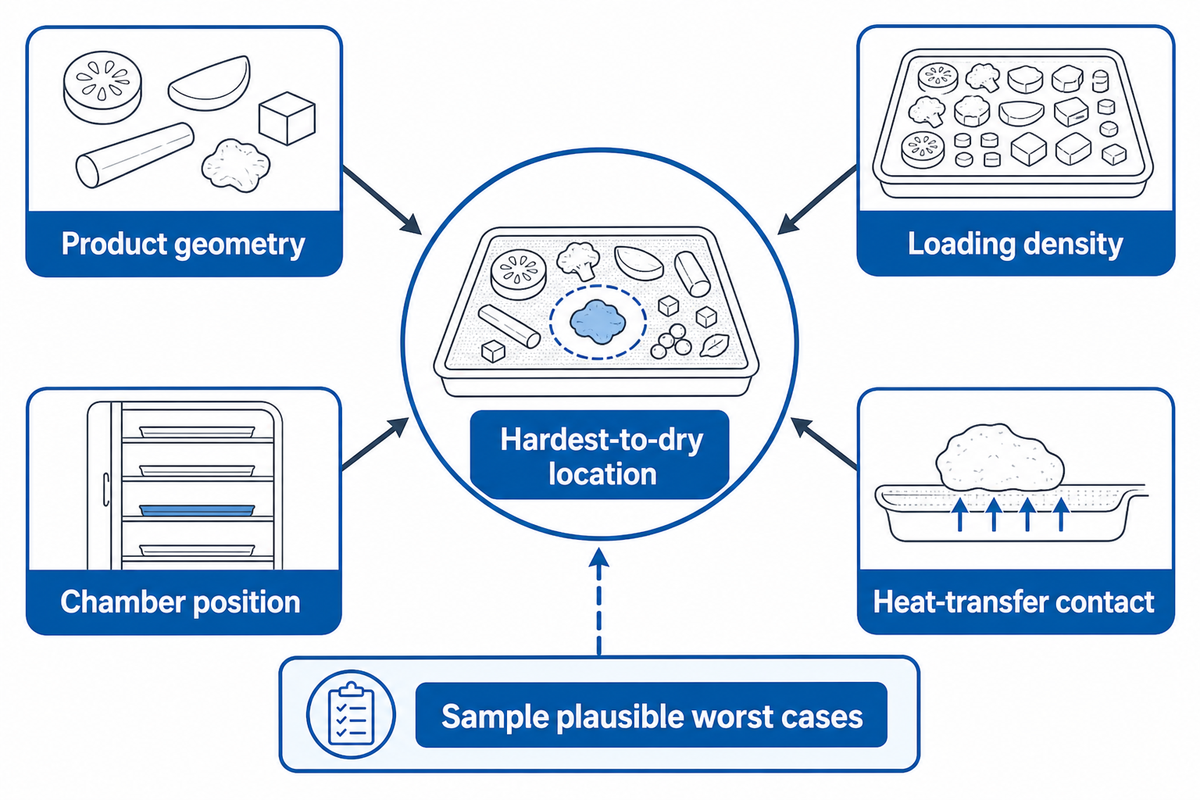
One tray, one probe or a visual check can be a convenient observation without being convincing release evidence. Product geometry, loading density, chamber position and heat-transfer contact can lead to locations which dry more slowly than exposed outer positions. The release plan should aim to find and justify the location expected to be the most difficult to dry.
| Phase | Control variable | Observation | Failure signal | Decision |
|---|---|---|---|---|
| Receiving | Raw-material condition | Lot, maturity and visible defects | Mixed starting condition | Segregate or redefine trial lot |
| Washing | Rinse and drainage | Surface water and handling damage | Unexpected free water | Correct preparation record |
| Cutting | Geometry distribution | Measured sample of pieces | Wide thickness spread | Sort or revise cut method |
| Pretreatment | Formula and hold condition | Time-stamped batch record | Uncontrolled delay or ingredient change | Investigate before loading |
| Freezing | Product state | Representative product temperature | Incomplete or uneven freezing evidence | Hold for review |
| Primary drying | Pressure and heat trend | Trend against the validated trial profile | Unexpected deviation or product damage | Use defined stop condition |
| Secondary drying | Hardest-location sample | Product and endpoint evidence | Center or dense area remains out of limit | Continue, adjust or reject per procedure |
| Unloading | Exposure control | Time, traffic and container condition | Dry product waits in ambient air | Protect or assess disposition |
| Packaging | Seal and barrier verification | Package integrity sample | Leaker, wrong material or poor seal | Hold lot and investigate |
The matrix eliminates a fake universal sampling count. A product owner should define locations based on the tray map and geometry and ensure the selected locations include plausible worst-cases. A change in sample thickness, solids content, treatment or loading pattern can affect the “hardest” case location. For that reason, the engineering and quality functions must work together to determine the most appropriate extent of monitoring.
Release the Batch With Moisture, Water Activity, Rehydration and Package Evidence
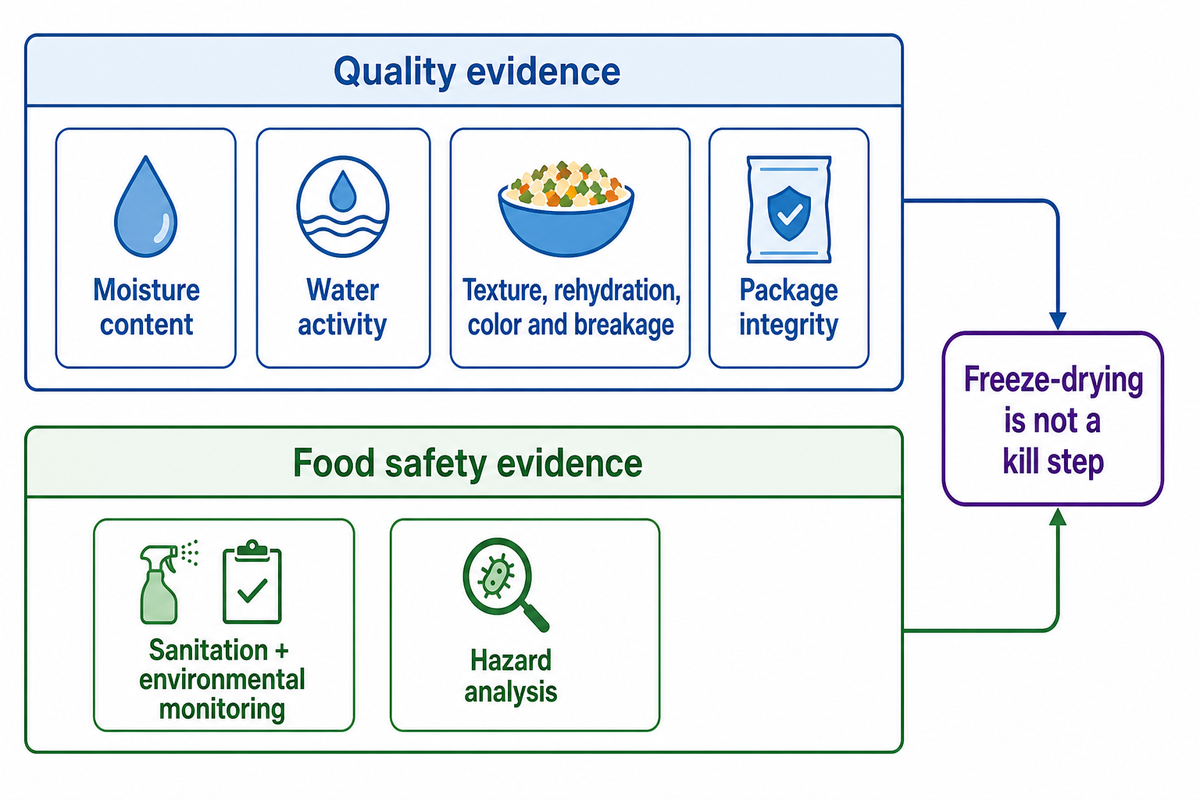
Moisture content and water activity provide different information. Moisture content refers to the amount of water in a sample, using a particular method. Water activity describes the equilibrium vapor-pressure relationship of water in the food and reflects how available that water is for microbial growth and reactions. Even if two products have the same moisture content, their behavior during storage might be different.
Moisture content can provide mass-balance and consistency checks. Water activity can help with a product specific stability assessment. The textural, rehydration, color and breakage properties determine whether the product’s eating or ingredient functionality was maintained. Package integrity, the water-vapor and oxygen barriers, where applicable, headspace and storage studies determine whether the released condition can be sustained. None of these studies can be a universal claim for shelf-life.
Package evidence must be specific to the product. Considering a powder example, a package study might demonstrate how barrier properties affect moisture gain, water activity, or caking. Those values wouldn’t apply to apple slices or vegetable pieces. Address package material, seal condition, storage environment, and the geometry of the product in your validation records. In production, an operator can compare 30-day and 90-day storage checks with an accredited lab report; the risk matters because moisture alone cannot establish package stability.
Why do you state moisture and water activity separately? Moisture is a measure of water quantity. Water activity is a measure of water availability. Both are best measured under clearly defined test conditions. Consider the package in the context of the product and texture. Similar values of moisture don’t guarantee similar values of water activity, commercial sterility, or shelf life.
Passing moisture, water activity, rehydration, or package tests does not guarantee pathogen control. Freeze-drying is not a kill step. Microorganisms can survive. Sanitation, environmental monitoring, hazard analysis, validated preventative controls, and the disposition of the product are all food safety concerns. The FDA’s draft guidance on low moisture ready-to-eat foods is strictly a draft. As such, it does not support a legal or enforceable standard. It may be used as a frame of reference regarding environmental monitoring and corrective actions, however.
Therefore, the release criteria should include two distinct but related streams of evidence. Food safety and quality evidence are interrelated, but should be treated as two separate streams of evidence. Evidence of low water activity and a clean environment may be present, but a quality standard may not be met.
Freeze-Drying vs Dehydration vs IQF: Match the Route to the Product Goal
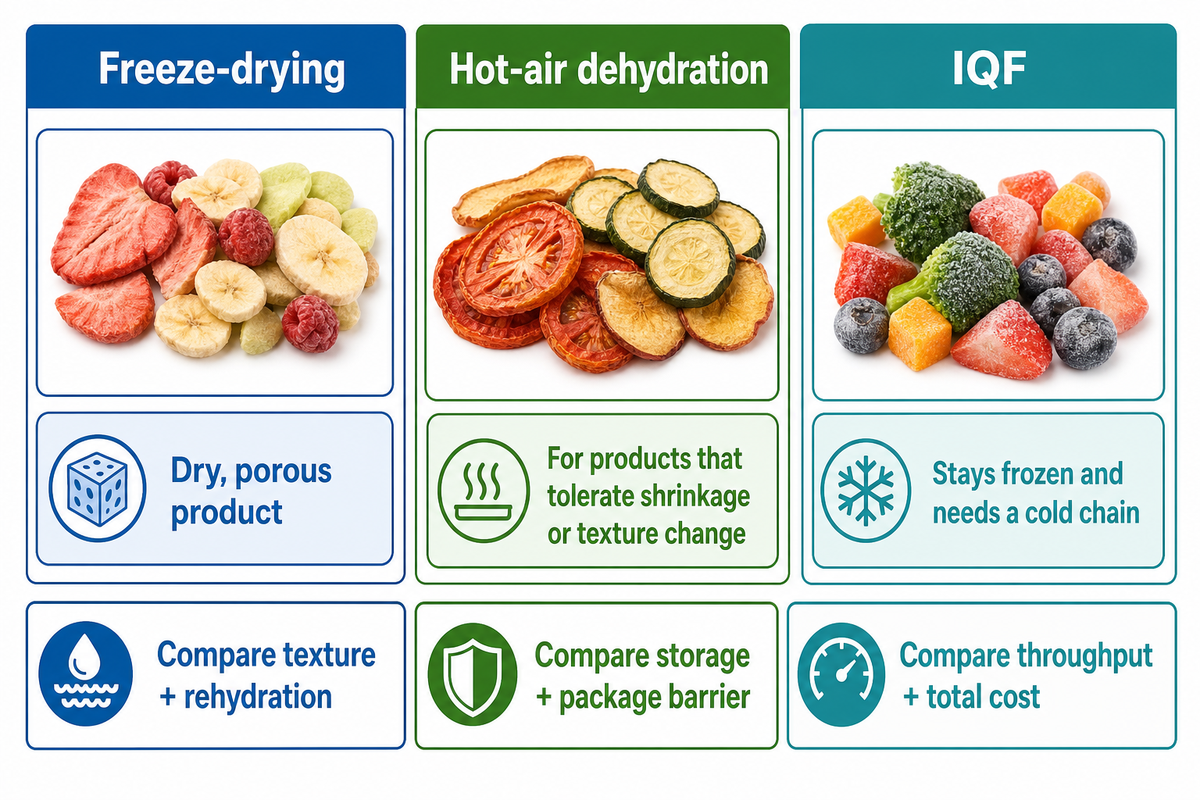
The freeze dryer vs dehydrator question is often a product-goal question in disguise. Freeze-drying creates a dry, porous product through freezing and sublimation. Hot-air dehydration is helpful for removing water by means of hot air and may be applicable to products that can tolerate shrinking or changes in texture. Foods that are individually quick frozen (IQF) stay frozen and remain dependent on the cold chain. Each route has different product structure, energy interfaces, packaging needs and storage obligations.
| Product goal or case | Freeze-drying question | Hot-air dehydration question | IQF question |
|---|---|---|---|
| Crisp berry snack | Can appearance and fragility be protected? | Is shrinkage acceptable to the buyer? | Would frozen use better fit the market? |
| Apple inclusion | Is rapid rehydration or porosity valuable? | Can a denser chew meet the application? | Is frozen distribution viable? |
| Tropical-fruit piece | Can sugar and stickiness be controlled? | Does heat change the desired flavor too far? | Will cold-chain cost outweigh dry storage? |
| Leafy-vegetable ingredient | Can color and fragile structure survive handling? | Is a flake or powder format acceptable? | Does the end user cook from frozen? |
| Root-vegetable cube | Is porous rehydration worth the process burden? | Can a denser dried cube perform in the recipe? | Is frozen texture preferred? |
| Pea or corn component | Does ambient storage support the product model? | Can heat-driven drying meet sensory needs? | Can the customer sustain a cold chain? |
| Herb garnish | Is aroma and visual form the priority? | Is conventional dried form sufficient? | Is frozen storage practical for the use case? |
| Instant-meal inclusion | Is fast rehydration a purchasing requirement? | Can slower rehydration still work? | Is frozen meal preparation the target? |
| Bulk ingredient powder | Does the premium structure create value? | Can another dry route achieve the functionality? | Is a frozen ingredient actually required? |
A comparison of routes shouldn’t select a universal nutrient winner. The range of 3-70% vitamin C loss reported in various studies of tropical fruits demonstrates that product, treatment and method have an effect. Compare the required texture, the extent of rehydration, shrinkage, the storage system, the required barrier of the package, the dependence on the cold chain, the annual throughput and the total cost for the product in question.
In the context of the route, look at an F&V dehydration line and an IQF quick frozen food line as alternatives. The correct choice is the route that corresponds to the validated product in the end, rather than the route with the most appealing general statements.
Utilities, Hygiene and the Dry-Side Packaging Handoff
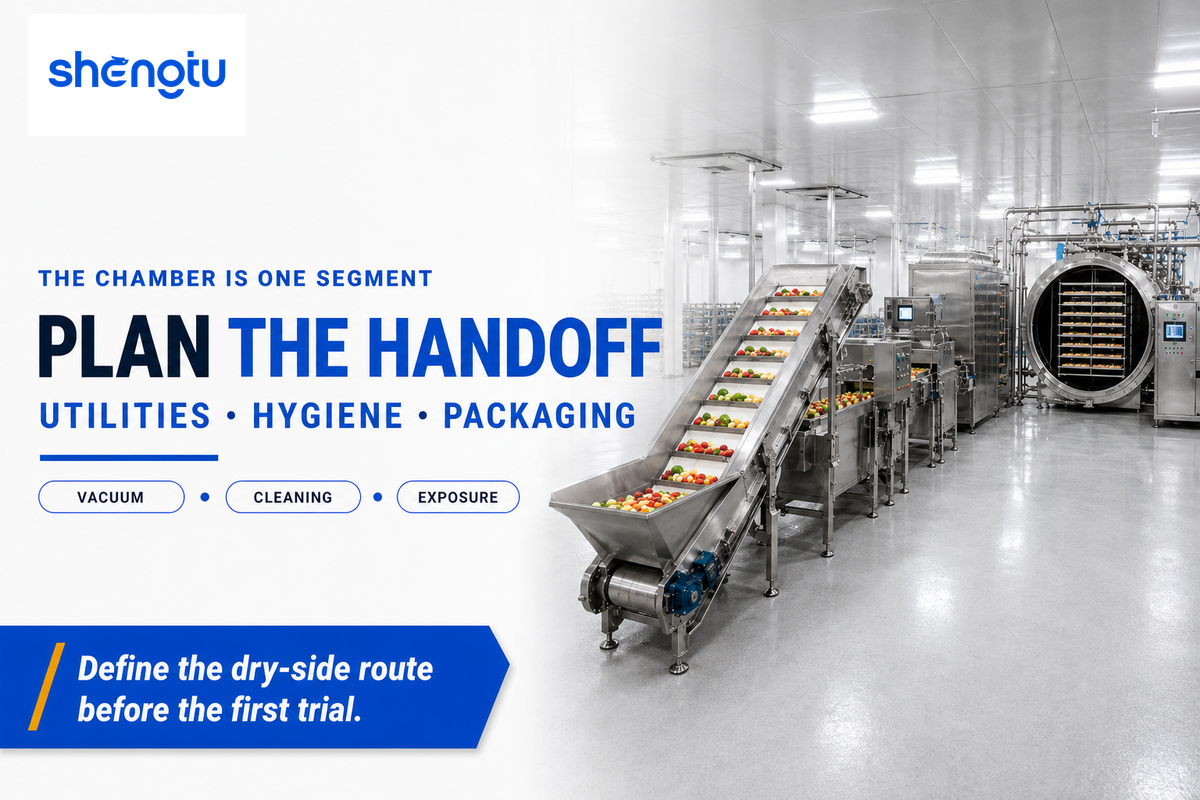
The chamber is one segment of a food line and not an isolated machine. Refrigeration, vacuum generation, shelf heat, condenser defrost, the power supply, drainage, cleaning access, and the traffic flow and dry-side packaging define the difference between a sound cycle and a usable product. A utility estimate requires site tariffs, ambient conditions, refrigeration and vacuum curves, cycle data and the specifications of the package; a utility estimate can’t be reasonably performed with just wet-feed mass.
Plan the dry-side handoff before the first commercial trial. Define how product leaves the chamber, the container that receives it, the permitted exposure, the path to packaging and the response if a seal or material check fails. Link those controls to a documented CIP cleaning system or the relevant cleaning method, while remembering that cleanability claims must be substantiated with testing in the actual production and product environment.
An automatic control package or fully automatic label doesn’t automatically close these interfaces. The production line still needs a defined unload route, permitted exposure time, packaging machine handoff and response to a failed seal. The requirements for the storage and transportation of the product and any claim regarding long-term storage should also be included in the same product-specific evidence package.
For food manufacturing in the U.S., an example of a current good manufacturing practice and hazard analysis and risk-based preventive controls is 21 CFR Part 117. Determine the applicable local jurisdiction and customer requirements rather than considering this to be a compliance determination for this guide.
The FDA Food Code has a different scope: FDA describes it as a model for retail and food-service regulation. The 2026 Food Code update can illustrate current attention to dehydration and freeze-drying critical limits for food establishments, but it is not primary industrial plant governance and adoption varies by jurisdiction. This Food Code must be read in the context of a model code and not as a controlling regulation in food manufacturing.
Low-moisture foods can still require rigorous sanitation and environmental-monitoring attention. The linked FDA guidance remains draft status. Use it to frame questions about hygienic zones, investigation and corrective action, then confirm the final requirements that apply to the plant. Do not use low water activity as a substitute for sanitation or a reason to omit hazard analysis.
Do
- Map dry-side traffic and product exposure.
- Define package and seal verification.
- Record shared-line ingredients and changeovers.
- Connect sanitation records to hazard analysis.
Don’t
- Treat the chamber as the whole line.
- Infer pathogen control from dryness.
- Copy model-code scope into plant governance.
- Assume packaging preserves an untested product.
What Is Changing in Food Freeze-Drying Control?
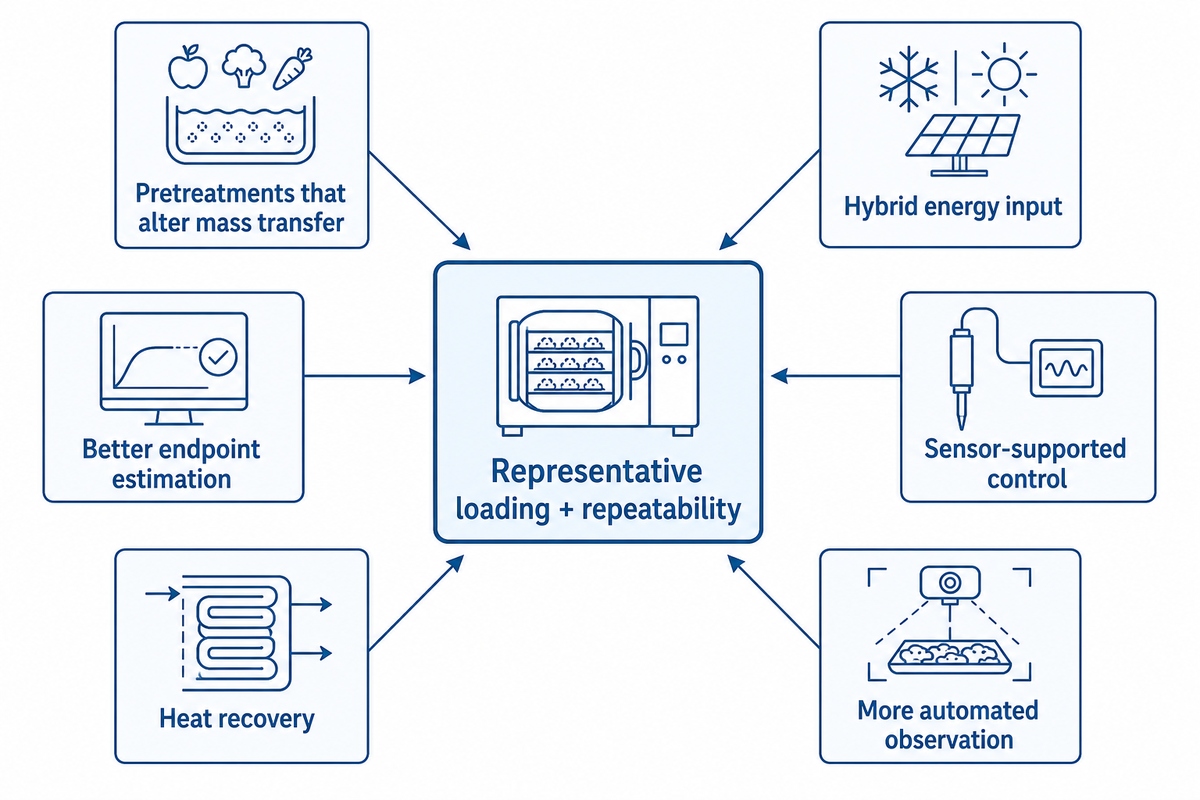
Recent food freeze-drying research is examining pretreatments that alter mass transfer, hybrid energy input, better endpoint estimation, sensor-supported control, heat recovery and more automated observation. The useful direction is not “faster at any cost.” It is whether a change can reduce costs, time or energy while preserving product structure, release evidence and package stability.
The literature review for 2026 also recognizes the areas of scale-up and techno-economics where there’s insufficient evidence. For an operator, the scale-up risk is a control gap because a sensor trend or pilot result can fail when geometry and loading change; the 2026 review treats repeatability and techno-economic evidence as unresolved, not as a certified production recipe. A given treatment in laboratory or pilot experiments may depend on a particular formulation, sample volume, size, geometry, or the arrangement of the instruments. Before a method is deemed production-ready, a representative loading trial, a defined quality comparison, confirmation of safety-system compatibility, an assessment of utility impact, and repeatability across realistic raw-material variation must be demonstrated.
Data collection is often the near-term improvement with the least hype: retain preparation data, lot condition, load map, product-temperature evidence, pressure and heat trends, condenser observations, endpoint samples and package checks in one reviewable record. That doesn’t automate judgment, but it makes a change in cycle outcome traceable enough to investigate.
Build the Evidence Package Before Requesting a Line Proposal
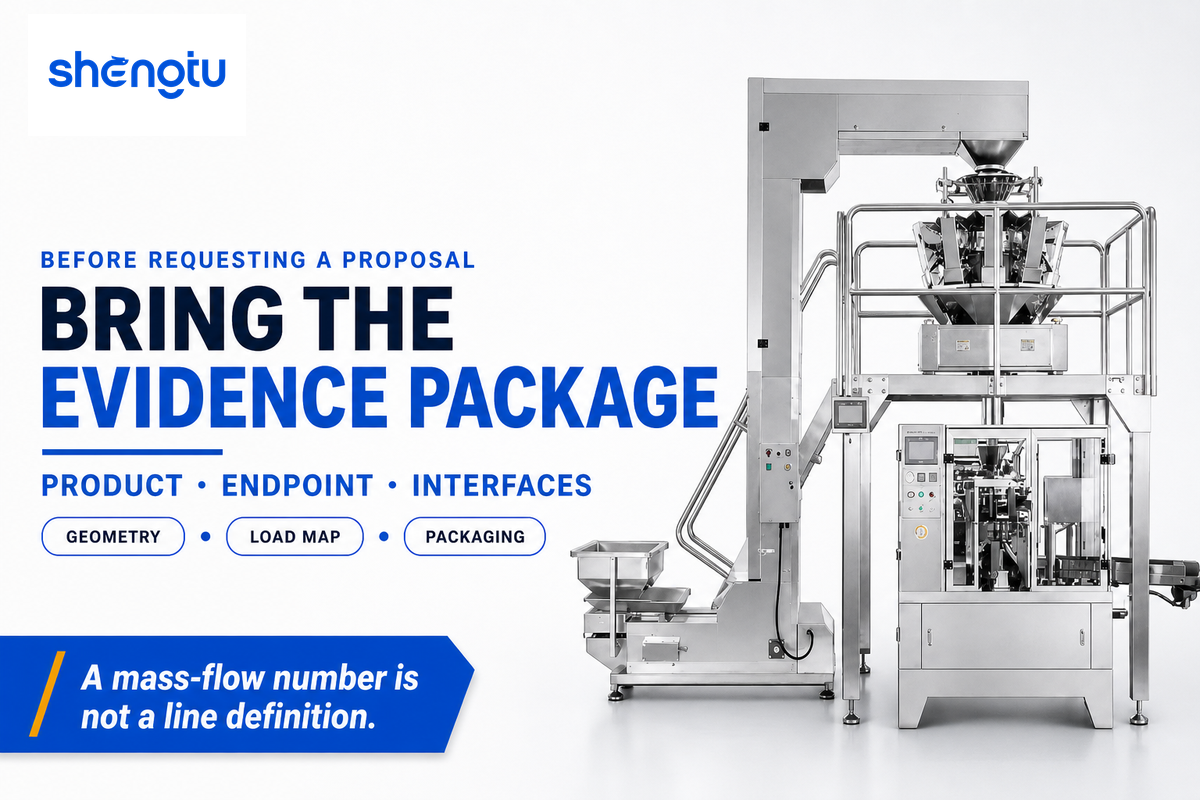
A line proposal starts with evidence rather than an unqualified mass flow rate. Define the product format, raw-material range, pretreatment ingredients, measured geometry, target loading pattern, trial observations, endpoint methods, package concept, plant interfaces and acceptance conditions. These provided inputs are likely to initiate an interaction with a supplier of equipment to evaluate whether shared process and equipment boundaries fit a product which is validated, rather than treating ‘fruit and vegetables’ as a single recipe.
The following checklist can be added to a trial brief. The focus of the brief is to help bring clarity to commercial discussions. This brief doesn’t propose a model or replace a site-specific hazard analysis. The “product outcome to trial evidence to route handoff” framework keeps the sequence explicit: define the food, preserve the trial record, and only then move into route and equipment selection.
A machine manufacturer can use the brief to customize a vacuum freeze drying machine or its production-line interfaces, but commercial pages, not this brief, are the place to address model selection, scope, price, delivery, and installation. The preservation of this brief’s informational role is achieved by the explicit definition of the boundary of the evidence and the product.
Evidence-package checklist — copy these into a trial or proposal brief:
| Parameter | Recommended range | Why it matters | How to verify |
|---|---|---|---|
| Product identity | Each intended crop, cultivar and maturity state | Starting condition changes behavior | Lot record and retained specification |
| Cut geometry | Measured mm distribution for each product | Geometry changes the diffusion path | Sample measurement and tray map |
| Pretreatment | Named ingredients, concentration and hold condition | Quality and allergen controls can change | Batch record, label and changeover review |
| Trial load | Defined kg and tray-loading pattern | Wet feed alone is not a sizing input | Material balance and representative run |
| Release evidence | Product-specific moisture, water activity and sensory limits | Quality has multiple dimensions | Defined method and hardest-location sample |
| Packaging | Named material, seal method and storage condition | Dry product can regain moisture | Integrity test and product-specific study |
| Food-safety controls | Applicable hazard-analysis and sanitation requirements | Freeze-drying is not a kill step | Plant food-safety review |
Once the brief is ready, discuss a configured F&V freeze-drying Line in the present solution-page context. This page is the proper location for the configuration, model, supplier, price, quotation, lead time and installation discussions. This brief ends its role when the product and evidence boundary is defined for the discussions to be viable.
Frequently Asked Questions
What is the downside of freeze-drying?
Freeze-drying can protect a porous, rehydratable format, but it usually adds refrigeration, vacuum, condenser and packaging demands. Product-specific validation and controlled dry-side handling are still required.
The downside is process burden rather than one universal defect. A food team may need a longer batch cycle, careful loading, controlled heat input, dry-side handling and moisture-resistant packaging. Product composition and piece thickness also make a published cycle unsafe to copy. Compare the target texture, ambient-storage value and rehydration requirement with the added utility, validation and packaging work.
How does a commercial freeze-drying machine work?
A commercial freeze dryer freezes prepared food, sublimes ice under controlled vacuum and removes more bound water during secondary drying. Protected unloading and packaging must follow.
Shelves or another controlled heat path supply energy during primary drying while a cold condenser captures vapor. Secondary drying continues within the product’s acceptable temperature range. The chamber is only one section of the line: washing, cutting, pretreatment, loading, unloading, inspection and protected packaging determine whether that drying result becomes a stable food product.
Can one line process both fruits and vegetables?
One line can serve multiple products only when each validated product fits the shared preparation, loading, control, cleaning and packaging boundaries. Each product family still needs its own validation.
Strawberries, apple slices, peas and leafy vegetables are not interchangeable because their geometry, pretreatment, vapor resistance and endpoint evidence differ. Define a separate product brief and changeover rule for each family. Shared ingredients, carriers or coatings also require allergen cross-contact, cleaning and label checks. Confirm shared hardware with representative trials rather than a category label.
Which fruits are best for freeze-drying?
No fruit is universally best because sugar, acidity, cell structure, ripeness and cut thickness change quality and drying behavior. The intended finished-food format also matters.
Define the intended format, then confirm performance with a representative pilot batch.
Why are moisture content and water activity listed separately?
Moisture reports water amount, while water activity reports how available that water is for microbial growth and chemical reactions. Read the values under the defined test conditions used.
Two foods can have similar moisture percentages but different water activity because composition and water binding differ. Define both methods, sampling locations and limits, then connect the results to texture, rehydration and package-barrier evidence. Neither number alone proves commercial sterility, pathogen control or a universal shelf life.
What are common mistakes in freeze-drying?
Common mistakes include uneven geometry, copied cycles, wet-feed-only planning, easy-location release samples and uncontrolled dry-side exposure. These errors span preparation, drying, release sampling, dry-side handling and packaging.
Pair each risk with an observation and a stop condition. Measure geometry, document the starting product, use removable-water arithmetic only as a material balance, sample plausible slow locations and verify package integrity. A product that looks dry at the surface may still need more evidence before release.
What is the difference between a freeze dryer and a dehydrator?
A dehydrator mainly uses heated air, while a freeze dryer removes ice by sublimation under vacuum after freezing the product. That difference changes structure and rehydration behavior.
The routes produce different structure, rehydration behavior, cycle burden and packaging needs. Freeze-drying may fit a product requiring a porous, quickly rehydrated format; hot-air dehydration may fit a product that tolerates shrinkage and heat. IQF is different again because it preserves food in a frozen state and requires a cold chain. Choose against the required product outcome, verified total cost and storage model.
Conclusion: Use Trials to Turn a Product Idea Into a Controlled Process
An F&V freeze-drying line has value in that it provides a repeatable and protected food state for a defined prepared product. Start with suitability and pretreatment. Make the removable-water calculation visible and examine the most challenging locations. Separate quality release from food safety controls while validating the packaging handoff. With this evidence, configure to bring clarity to the discussion.
Key takeaway
A freeze-drying trial is credible only when its preparation, load, hardest-location endpoint, food-safety controls and package evidence are defined together; a wet-feed figure or dry appearance cannot replace that record.
Discuss your product evidence package
References & Sources
- Freeze-drying of foods: process and quality review PubMed Central.
- Plant-food freeze-drying review PubMed Central.
- Packaging and storage evidence review PubMed Central.
- Food freeze-drying review (2026) PubMed Central.
- Water Activity (aw) in Foods U.S. Food and Drug Administration.
- Draft low-moisture ready-to-eat food sanitation guidance U.S. Food and Drug Administration; draft status disclosed.
- FDA Food Code U.S. Food and Drug Administration; retail and food-service model-code scope.
- Food Code 2026 U.S. Food and Drug Administration.
- FDA releases 2026 Food Code U.S. Food and Drug Administration.
- 21 CFR Part 117 Electronic Code of Federal Regulations.
- Can I Freeze Dry That? Utah State University Extension.
- Freeze-Drying Fundamentals Institute of Food Technologists.
- Getting a Fix on Freeze-Drying Institute of Food Technologists.
Our Perspective on This Process Guide
Shandong Shengtu Bufan Intelligent Technology Co., Ltd. manufactures food-processing equipment, but this F&V Freeze-Drying Line guide doesn’t make a performance promise for Shengtu equipment. It’s written to help teams document pretreatment, removable-water logic, endpoint evidence and dry-side packaging questions before a product-specific trial and commercial discussion.
ENGINEERING CONTENT DISCLOSURE
Why Shengtu Publishes Technical Guides
These guides turn common production-line questions into a clearer decision path for food manufacturers, project engineers and procurement teams.
We focus on the inputs that change equipment selection: product characteristics, package format, target capacity, process stages, utilities, plant constraints and destination requirements.
01Define the applicationStart with the product, pack and operating target.
02Map the process routeConnect stages, interfaces and utility needs.
03Surface trade-offsExplain the choices that affect line scope.
04Prepare better questionsTurn reading into a reviewable project brief.
MANUFACTURER PROFILE
SHENGTU
- Focus
- Food processing equipment and turnkey line solutions
- Base
- Zhucheng, Shandong, China
- Project path
- Requirement → layout → equipment scope → delivery coordination
SOLUTION COVERAGE
VALIDATION BOUNDARY Final equipment configuration should be confirmed against your product, package, throughput, utilities, plant constraints and destination requirements.
![Beef/Lamb/Poultry Cutting Line Acceptance Guide [2026]](https://shengtumachinery.com/wp-content/uploads/2026/09/beef-lamb-poultry-cutting-line-guide-featured-768x512.png)
![F&V Freeze-Drying Line Process Guide [2026]](https://shengtumachinery.com/wp-content/uploads/2026/09/fv-freeze-drying-line-guide-featured-150x150.png)