
Get in touch with Shengtu Bufan Company

Updated August 2026
Extrusion Equipment is a connected food-production system, not only an extruder barrel and drive. Every working line has to meter a repeatable recipe, create the intended transformation, shape the product, remove heat or moisture, move it without damage, and hand acceptable output to packaging. Buying the machine before defining that chain is how a promising trial becomes a difficult factory installation.
The short answer
Food extrusion equipment should be selected from the finished product backwards: define the recipe, target structure, stable process window, saleable line output and acceptance evidence first. Then choose the screw architecture and auxiliary equipment that can reproduce that result.
Key points
- The slowest upstream or downstream station can set the real production limit.
- Single-screw and twin-screw extruders are different process tools, not a simple good-versus-better ranking.
- Copied temperature and screw-speed settings are weak evidence because formulation, feed rate and machine design change the process state.
- Supplier trials should leave a record of stable trends and acceptable product, not only a peak kilograms-per-hour claim.
Guide map
What Food Extrusion Equipment Includes
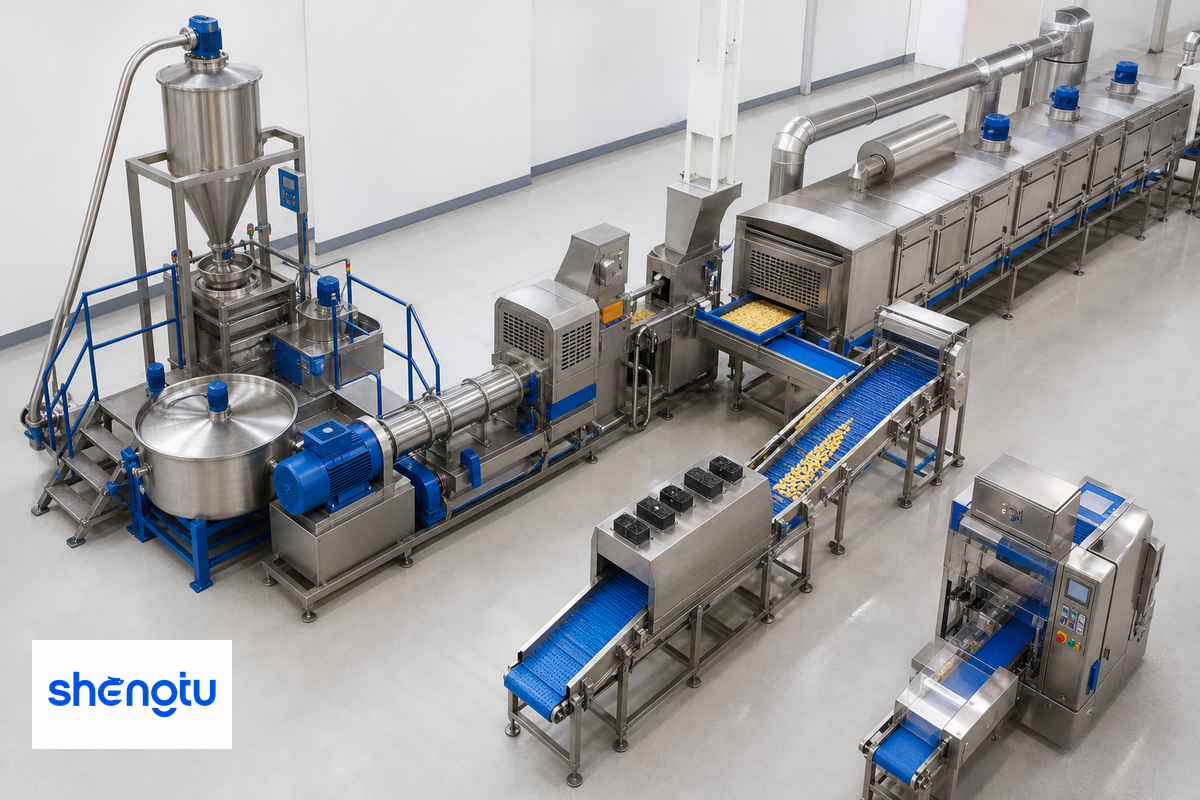
Food extrusion equipment is a connected production line in which material handling, recipe preparation, extrusion, cutting, drying or cooling, conveying, coating and packing must operate at compatible rates. The extruder performs the central transformation, but it cannot compensate for an unstable feeder or an undersized dryer.
Inside the machine, raw material moves through a screw-and-barrel system where conveying, mixing, heat, pressure and shear change its physical state before it passes through a die. That description is useful, but a buyer needs a wider boundary. Upstream equipment establishes what enters the extruder; downstream equipment determines whether the shaped extrudate becomes saleable product.
Line boundaries also include food-contact and cleaning responsibilities. In the United States, 21 CFR 117.40 requires equipment and utensils to be adequately cleanable, properly maintained, and used in ways that protect against contamination and allergen cross-contact. That regulation sets a processor responsibility; it does not certify an undocumented machine design.
| Station | Job | Evidence to request | Limitation / not suitable for |
|---|---|---|---|
| 1. Raw-material handling | Keep ingredients identified and available | Material flow and segregation review | Poor-flowing or segregating blends need tests |
| 2. Dosing and mixing | Build the intended recipe | Batch or loss-in-weight records | Averages can hide short feed disturbances |
| 3. Preconditioning | Add moisture or thermal preparation | Feed condition at the extruder inlet | Not every recipe needs the same treatment |
| 4. Extrusion | Convey, mix, cook, texturize and shape | Stable operating trends and samples | A stable machine can still make the wrong product |
| 5. Cutting | Create repeatable piece geometry | Length or shape distribution | Sticky or fragile extrudate may need another route |
| 6. Drying | Remove moisture to the agreed endpoint | Residence distribution and product checks | Often becomes the line bottleneck |
| 7. Cooling | Stabilize product before handling | Outlet product condition | Packing warm product can create later problems |
| 8. Coating and conveying | Add surface ingredients and move gently | Application uniformity and breakage rate | Fragile pieces may not tolerate every conveyor |
| 9. Packing | Receive product at a compatible rate | Sustained handoff and reject records | Stops upstream output when accumulation is limited |
Use Shengtu’s extrusion line station checklist to mark which stations are included, which are supplied by others, and where product ownership changes.
Why do extrusion equipment searches mix food, plastic and metal machines?
Extrusion equipment search results mix industries because extrusion is a family of forming processes. A food line changes recipe structure and moisture; a plastic extrusion line forms molten polymer into a continuous cross-section; metal extrusion presses force a heated billet through a die. Their auxiliary equipment and acceptance evidence are not interchangeable.
| Industry route | What enters and changes | Typical downstream equipment | Why it cannot size a food line |
|---|---|---|---|
| Food extrusion | A formulated raw material is mixed, cooked, texturized or shaped | Cutter, dryer or cooler, coater, conveyor and packer | Requires recipe, food-contact, cleaning and finished-product evidence |
| Plastic extrusion | Plastic pellets or another polymer feed become molten plastic and pass through a die | Puller, vacuum sizing, cooling tank and cutting for tubing, sheet extrusion or blown film | Continuous cross-sectional sizing does not prove food cooking, drying or sanitation performance |
| Aluminum extrusion | A heated alloy billet undergoes deformation as a press forces it through tooling | Runout, cooling, stretching, cutting and handling for the final shape | Press force and profile tolerances are not food-process acceptance criteria; see the Aluminum Extruders Council equipment overview |
All three routes extrude material, but a puller for tubing and a dryer for cereal solve different problems. On the shop floor, these manufacturing processes also use different controls and test methods. Filter generic search results by material, product form and acceptance method before comparing an extruder machine or line configuration.
Map the Recipe to a Process Window Before Selecting Hardware
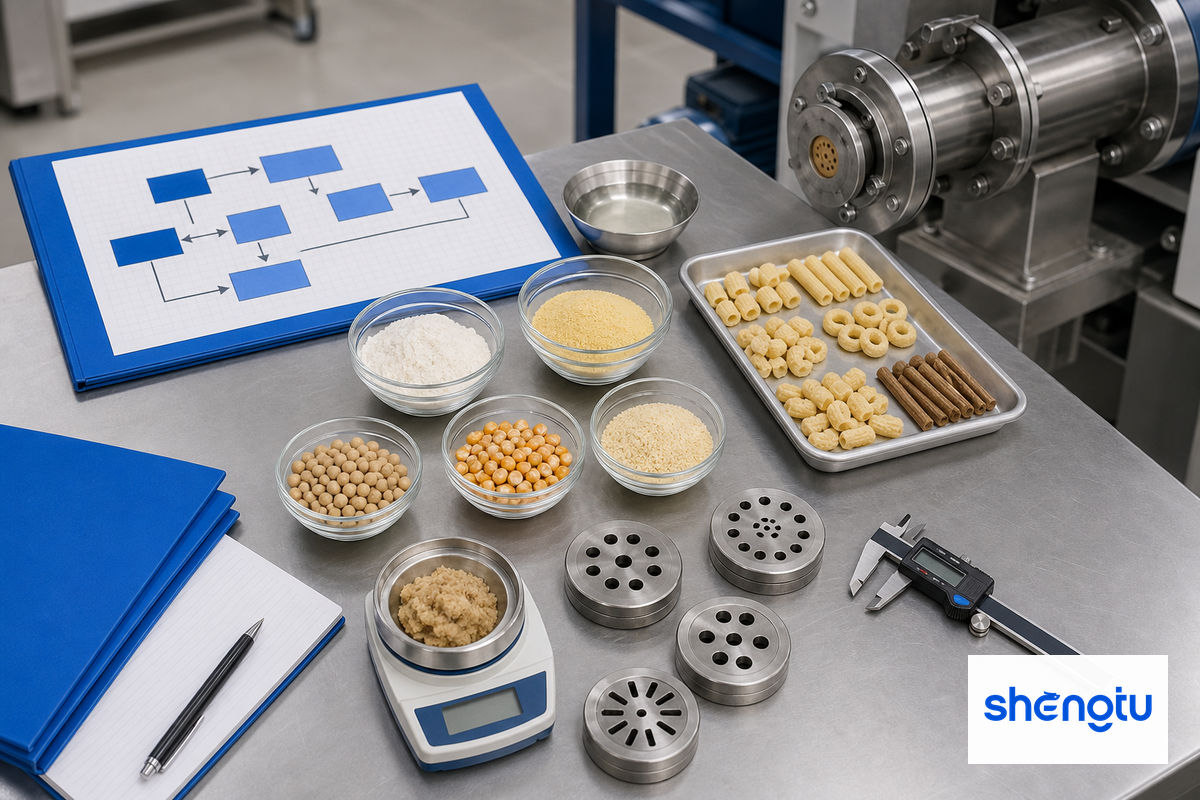
Start an extrusion-equipment specification with a product-and-process target, not a model number. Recipe, particle behavior, moisture, inclusions, intended structural change, die design and geometry, and downstream finish define the process window that the machine and auxiliary equipment must reproduce.
Peer-reviewed food-extrusion research describes a coupled system rather than a collection of independent knobs. Reviews of food extrusion connect feed moisture, screw speed, barrel temperature, feed rate, die pressure, torque and raw-material properties to final density, expansion, texture and other product responses. The review of pulse-product extrusion also explains specific mechanical energy, or SME, as a useful system parameter for relating mechanical work to the material.
This is why a copied recipe card is weak procurement evidence. One study can show how a formulation responded to a defined experiment, but those exact settings do not become a starting guarantee for another recipe or extruder. The formulation-specific extrusion study cited here found changes associated with screw speed and die temperature; its value is the interaction lesson, not the transfer of its set points.
| Decision | Information to supply | Equipment consequence | Limitation / not suitable for |
|---|---|---|---|
| 1. Product target | Shape, density, texture and tolerance method | Defines die, cutting and transformation duty | A marketing sample is not a specification |
| 2. Ingredient identity | Formula, suppliers, substitutions and allergens | Sets dosing, segregation and cleaning needs | Do not test a convenient substitute only |
| 3. Feed behavior | Particle size, bulk behavior, fat and stickiness | Influences feeder and screw architecture | Bench flow may not predict production feeding |
| 4. Moisture route | Initial condition, water or steam addition, final target | Sets preconditioning, injection and drying scope | One moisture number cannot describe the whole route |
| 5. Transformation duty | Mixing, cooking, texturizing, forming or densifying | Drives screw elements and process length | Do not assume every duty needs high shear |
| 6. Inclusions and liquids | Addition point, form and permitted damage | Affects ports, mixing and residence history | Some inclusions cannot survive the required duty |
| 7. Downstream finish | Drying, cooling, coating and packing acceptance | Sets residence time and handoff rate | The dryer may limit the whole line |
| 8. Changeover evidence | Recipe sequence, cleanout standard and inspection | Influences access and cleaning design | A fast run with a slow changeover may miss the business target |
One shared map gives process engineers, QA and procurement a common starting document. It also creates a clean boundary between this educational guide and the model-level work on the Extrusion Equipment solution page.
Single-Screw vs Twin-Screw: Choose by Process Duty
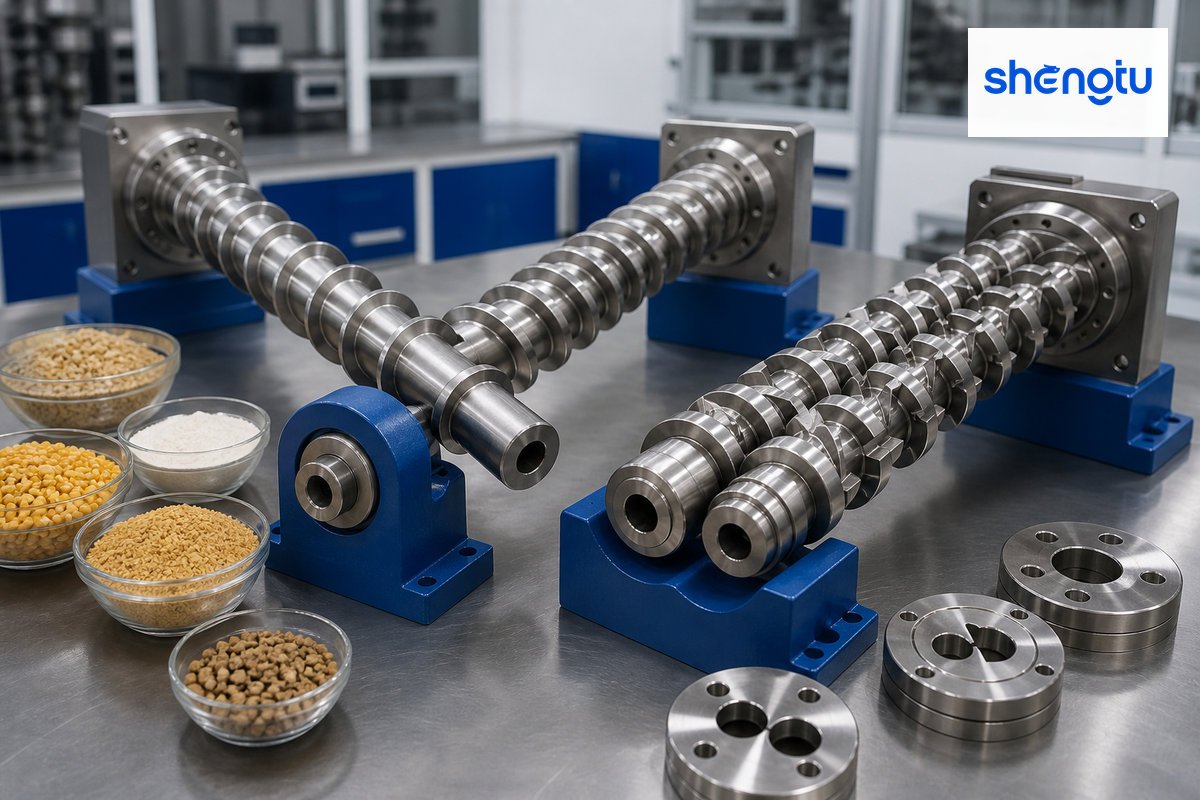
Single-screw extruders suit stable feeds and comparatively simple conveying, cooking or forming duties, while twin-screw extruders give more positive conveying and mixing control for recipes with wider variation or harder transformation tasks. The right choice depends on the material and acceptance target, not the label alone.
Cited peer-reviewed research on extrusion and starch structure describes single-screw transport as more dependent on friction between the material, screw and barrel, while intermeshing twin screws convey more positively and provide stronger mixing options. DLG’s expert report on food extrusion likewise frames screw design, water content and process variables as connected choices.
Single-screw route
- Favors a stable, free-flowing feed
- Fits simpler conveying and forming duties
- Can offer a simpler mechanical architecture
- Needs proof when the recipe tends to slip, bridge or vary
Twin-screw route
- Provides more positive conveying for difficult feeds
- Allows stronger distributive and dispersive mixing choices
- Supports more configurable process sections
- Still needs a representative material trial and acceptance window
What are the types of extrusion machines?
Food plants mainly discuss single screw extruders and twin screw extruders, although piston, roller and multi-screw equipment also exist for narrower duties. Within twin screw extrusion, co-rotating and counter-rotating arrangements behave differently. Useful specifications name the process task and material behavior before the architecture.
For the site’s available architecture and application route, see the twin-screw food extruder page. Treat its specifications as a commercial shortlist, then test the actual recipe against the constraint map above.
Size the Whole Line, Not Only the Extruder
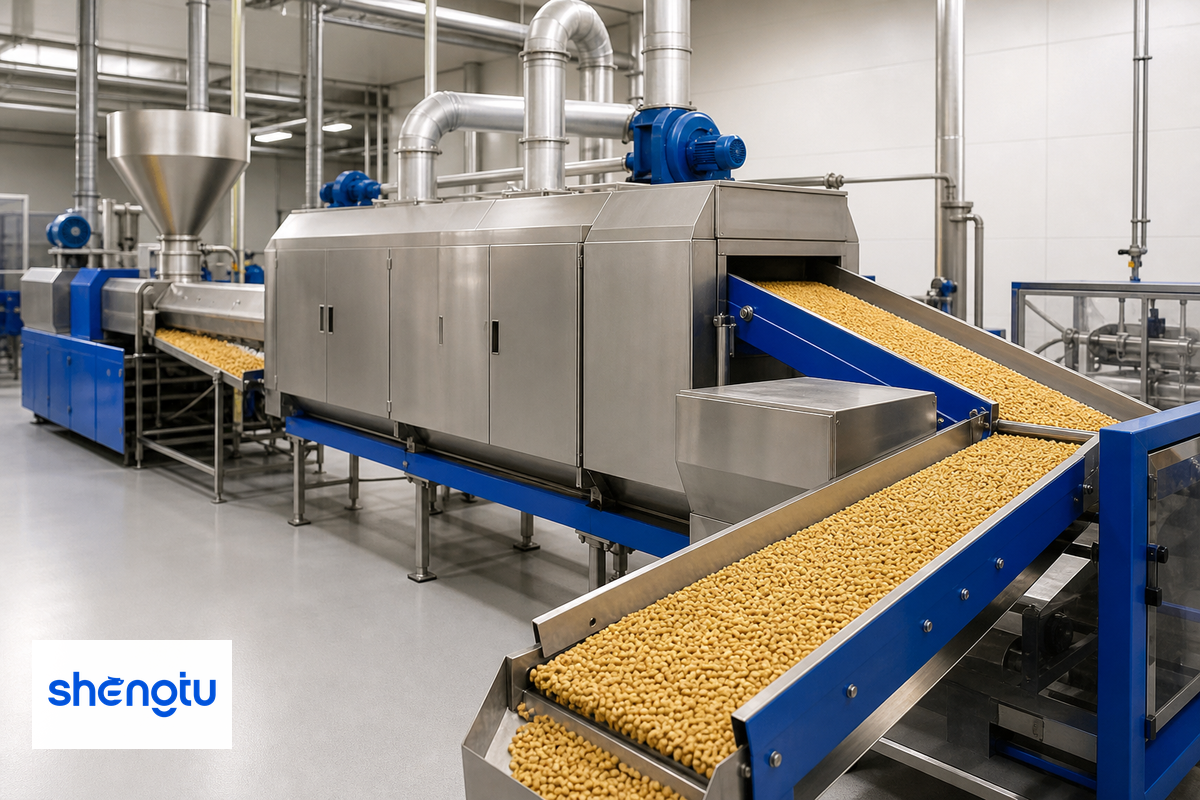
Saleable extrusion-line capacity is the stable line rate discounted for scheduled time, availability and first-pass yield. Higher extruder ratings do not raise throughput when the feeder, dryer, cooling system, coater, conveyor or packer is already the limiting station.
Procurement documents often compare nominal kilograms per hour because it is easy to quote. Plant managers live with a different number: acceptable product shipped during the scheduled window. That gap includes warm-up, recipe transitions, cleaning, faults, downstream stops and product that misses the agreed specification.
Good-Output Capacity Worksheet
Good output = stable line rate × scheduled hours × availability × first-pass yield
Illustrative example only: 300 kg/h × 8 h × 0.85 availability × 0.92 first-pass yield = 1,876.8 kg of good product for the scheduled shift. This is a calculation example, not a Shengtu performance statement or a recommended target.
Using this worksheet changes the supplier conversation. Instead of asking whether an extruder can touch 300 kg/h, ask whether the complete line can hold the agreed product window, how stops are recorded, what happens to material during a downstream interruption, and which station determines the demonstrated rate.
Use the extrusion-line supply boundary matrix to assign each station, interface and utility to a party. Missing interfaces are not small paperwork issues; they can decide whether a line reaches the worked capacity at all.
Control the Process as a Coupled System
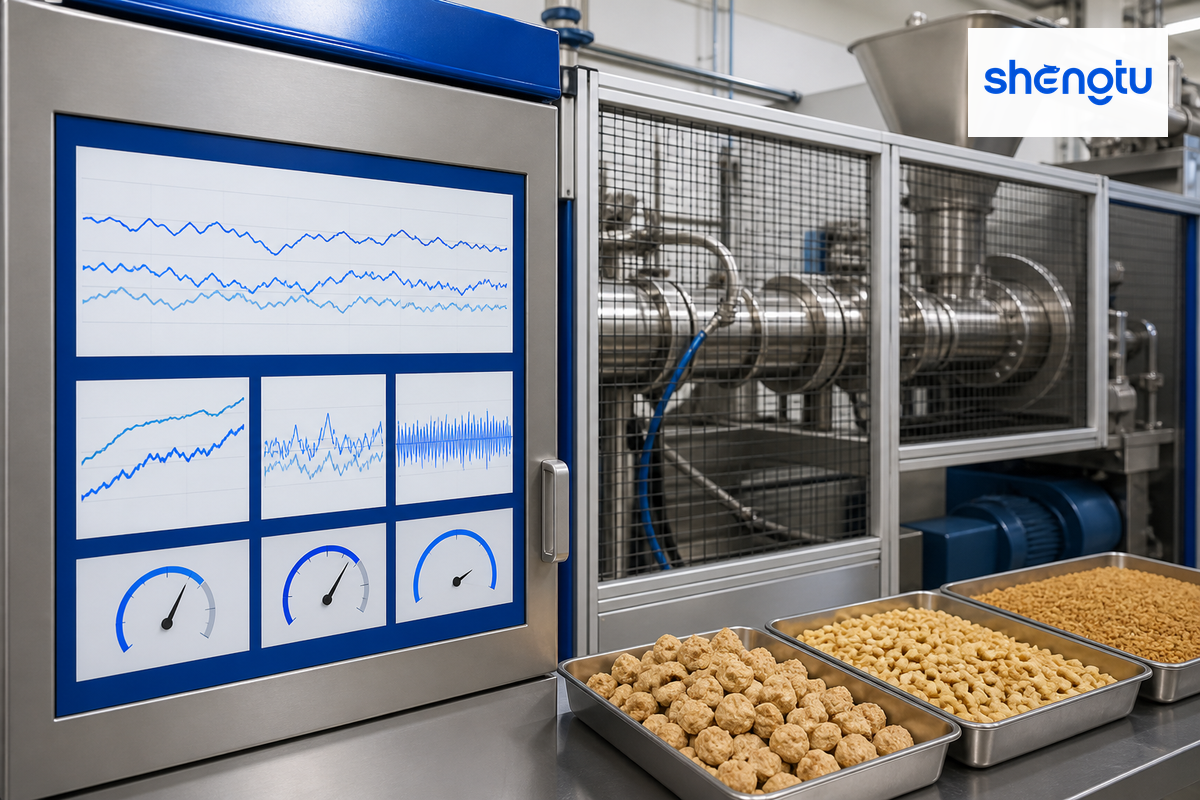
Food-extrusion process control should connect input variables, internal state variables and finished-product responses in one trend. Feed moisture, feed rate, screw speed and temperature control matter, but motor load, specific mechanical energy, pressure control, die pressure and product temperature often explain why identical set points do not create identical extrusion performance.
Recent scoping research notes that identical temperature and screw-speed set points can produce different mechanical energy inputs across extruder designs and feed rates. That finding makes set-point copying a poor scale-up method. More useful is asking whether the new system reproduces the process state and accepted product response within a defined material and test method. See the review of processing severity descriptors for that distinction.
| Layer | Examples | Question answered |
|---|---|---|
| Inputs | Recipe, feed moisture, feed rate, screw speed, barrel settings | What did the operator ask the system to do? |
| Process state | Motor load, SME where available, die pressure, product temperature | What did the material experience? |
| Product response | Density, expansion, dimensions, texture, moisture, breakage | Did the result meet the agreed method and tolerance? |
How does an extrusion machine work?
Inside the extruder, a screw draws prepared raw material into a barrel, conveys and mixes it, and applies mechanical and thermal energy. Material develops pressure before it passes through a die; cutting and downstream equipment then set piece length, moisture, temperature and final handling condition. Each step changes what the next station receives.
For dry pet food, the site’s dry kibble extrusion process-control guide covers that narrow application. This article stays at the cross-application equipment and acceptance level so the two pages answer different queries.
Turn a Sample Run into an Acceptance Plan
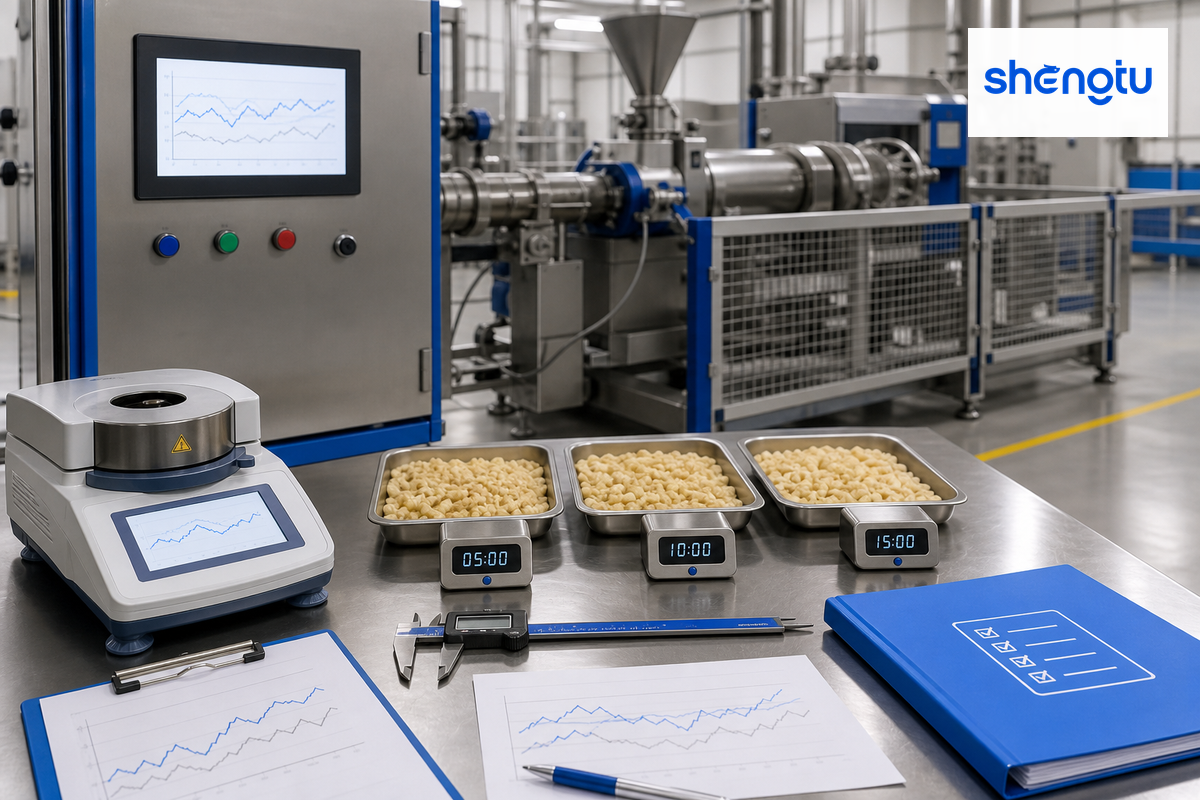
Supplier sample runs should prove that a defined material can reach a stable process window and repeatedly produce acceptable output. Record material identity, in-line and finished-product measurements, trend stability, restart behavior, scrap handling, cleaning observations and the people who approve the result.
Even good-looking samples do not reveal when they were collected, whether the line was stable, or how much off-spec material appeared before and after collection. Define the sample method before the trial begins. Lab methods, tolerances and any food-safety decision stay with the processor’s qualified team.
- Freeze the trial identity — record the recipe revision, raw-material lots, preparation route and agreed product method.
- Reach a declared stable window — agree which trends must settle and who calls the start of the evidence block.
- Capture the process state — retain feed, load, pressure, temperature and other available trends rather than one screenshot.
- Collect timed product samples — link every sample to the corresponding process record and lab method.
- Observe the boundaries — note start-up scrap, a planned interruption or restart, changeover access and material disposition.
- Close the trial — list passes, deviations, open actions, owners and the evidence needed before acceptance.
| Planning point | Illustrative record | Decision | Limitation / not suitable for |
|---|---|---|---|
| Minute 0 | Declare stable-window start | All required trends present? | Do not start by the clock alone |
| Minute 5 | Trend snapshot 1 | Any drift or feed disturbance? | A snapshot is not a trend |
| Minute 10 | Product sample A | Meets agreed test method? | One sample cannot prove repeatability |
| Minute 15 | Trend snapshot 2 | State remains within the declared window? | Use continuous data when available |
| Minute 20 | Product sample B | Consistent with sample A? | Adapt intervals to the process residence history |
| Minute 25 | Trend snapshot 3 | Any downstream accumulation or constraint? | The extruder cannot be reviewed in isolation |
| Minute 30 | Product sample C and close | Pass, conditional pass, repeat or reject? | Longer or product-specific studies may be required |
Use the 30-minute card as a meeting structure. Your product, risk analysis, residence history and validation plan determine the real duration and sampling frequency.
When Extrusion Equipment Is the Wrong Purchase
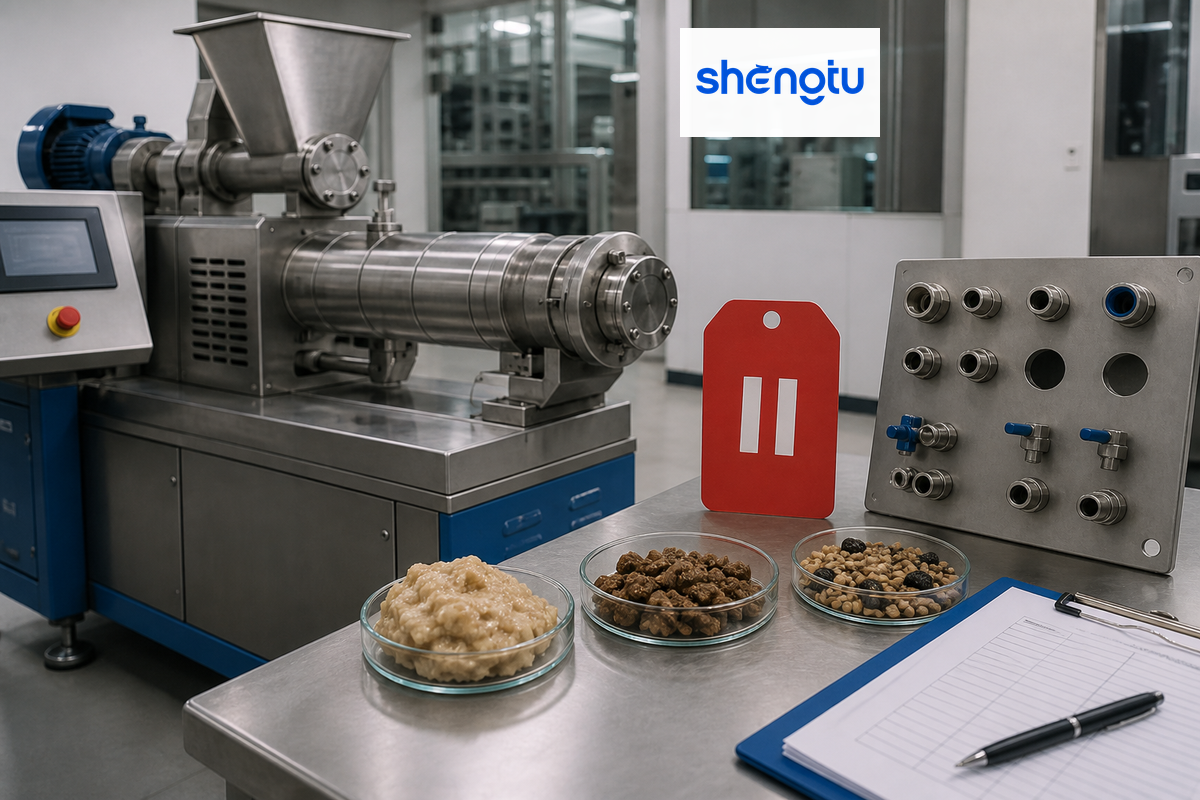
Do not buy an extrusion line when the team cannot define the required product transformation, feed behavior, downstream route, utility boundary or acceptance method. An equipment demonstration is not enough when it uses substitute material, hides unstable periods or leaves cleaning and servicing responsibilities undefined.
Technical mismatch is the first stop signal. If the target product cannot tolerate the required shear or thermal history, or if inclusions are destroyed before the die, another forming or cooking route may be better. Evidence mismatch is the second: a vendor may produce an attractive sample but be unable to show repeatable trends, a stable material feed or a downstream path that preserves the result.
Responsibility mismatch is the third stop. Cleanability must be reviewed against the actual food, allergens, sequence and sanitation program. Maintenance must also have an energy-control boundary. OSHA’s control of hazardous energy standard, 29 CFR 1910.147, covers servicing and maintenance where unexpected energization, startup or release of stored energy could cause injury. The employer’s program and site procedures cannot be replaced by a sales brochure.
Proceed when
- Test material represents production reality
- Product methods and tolerances are agreed
- The whole line boundary is assigned
- Stable trends and samples can be retained
Pause when
- A model is chosen before the recipe duty
- Only peak output is demonstrated
- Downstream stations are treated as an afterthought
- Cleaning or servicing ownership is unclear
How should used extrusion equipment be evaluated?
Used extrusion equipment needs the same product-and-process proof as a new line, plus documented condition evidence. Review service history, screw-and-barrel wear, die inventory, heating elements, controls, food-contact surfaces, cleaning access, spare-parts support and the downstream system. Qualified staff should assess electrical condition and structural integrity before a representative recipe trial.
Treat phrases such as “high-performance,” “energy efficient” and “increase productivity” as unverified marketing language until the supplier converts them into a test method. Useful measures include good output per scheduled hour, energy per accepted kilogram, changeover time, defect disposition and repeatable product tolerance. A used extrusion listing cannot supply that evidence by itself.
Build an RFQ Without Guessing a Model
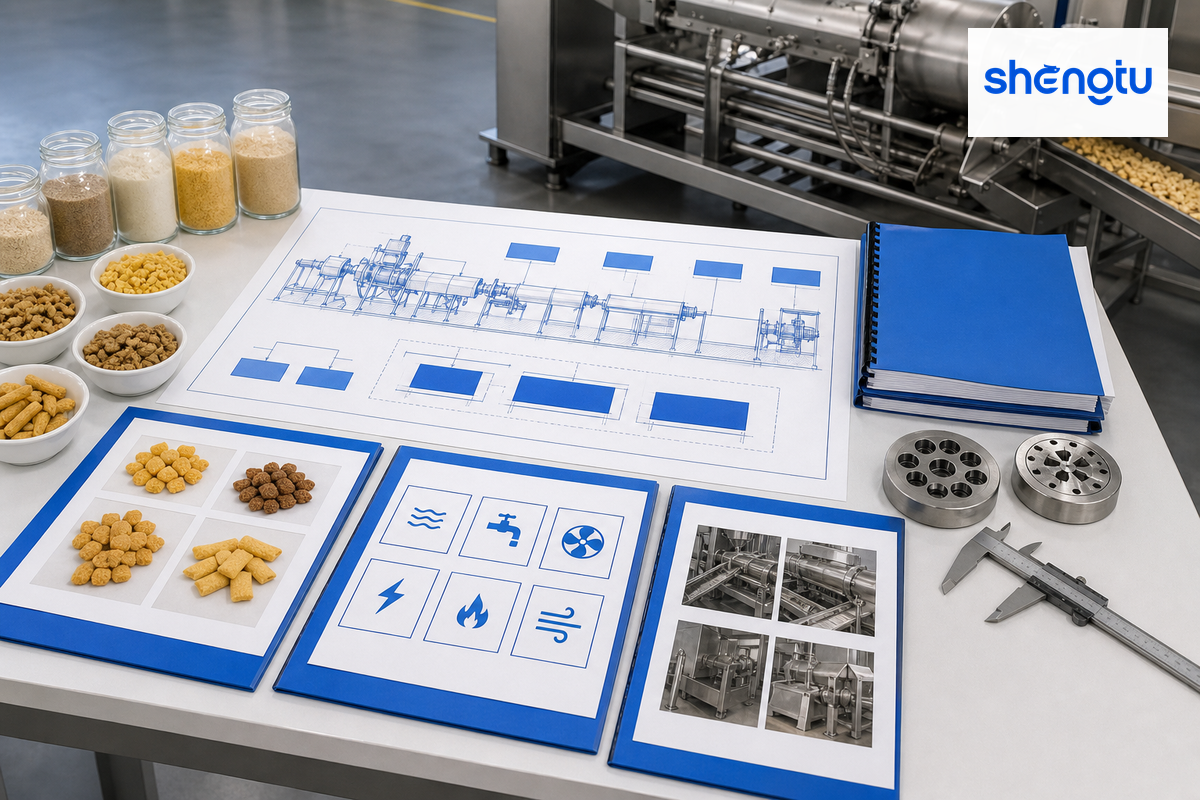
Build a useful extrusion-equipment RFQ by describing the product, recipe, feed behavior, process duty, utilities, downstream interfaces and acceptance evidence before requesting a model. This lets an OEM or supplier respond to one common boundary and makes differences in scope visible.
Copy the following table into your request. “Project-specific” is deliberate: a false precision band is worse than an explicit test requirement. Attach a representative material sample, the product method and a line layout if they are available.
RFQ checklist — copy these into your quote request:
| Parameter | Required definition | Why it matters | How to verify |
|---|---|---|---|
| Finished product | Project-specific method and tolerance | Defines the process target | Agreed sample and lab method |
| Recipe and feed | Current formula, lots and physical behavior | Drives feeding and screw duty | Representative trial material |
| Good output | Required saleable product per scheduled period | Prevents nameplate-only sizing | Sustained line trial and yield record |
| Utilities | Available electrical, water, steam, air and exhaust conditions | Defines installation feasibility | Utility schedule and interface drawing |
| Downstream scope | Cutting, drying, cooling, coating, conveying and packing | Finds the limiting station | Supply-boundary matrix |
| Controls and records | Required trends, exports, alarms and recipe ownership | Makes acceptance evidence retrievable | Demonstration with saved files |
| Cleaning and changeover | Product sequence and inspection endpoint | Affects access and uptime | Observed changeover and inspection |
| Acceptance and ownership | Pass criteria, responsible party and open-action closure | Separates delivery from proven result | Signed protocol and evidence index |
How much does extrusion equipment cost?
No defensible universal price exists for a food extrusion line because scope changes with material handling, screw duty, dryer size, utilities, controls, dies, commissioning and acceptance work. Ask suppliers to price one common boundary and separate included equipment, optional stations, site work, spare parts and trial obligations.
For Shengtu configurations and quotation, continue to the commercial Extrusion Equipment page. For company background and service context, review About Shengtu Machinery.
Key takeaway
Buy the evidence chain, not only the machine: recipe identity, stable process state, good-output rate, accepted product and assigned responsibility should all point to one trial record.
Discuss your extrusion line boundary
Bring your recipe, product target, good-output requirement and downstream scope. Shengtu can then discuss a configuration without turning this guide into a duplicate product page.
Frequently Asked Questions
What products can food extrusion equipment make?
Food extrusion equipment can make shaped or textured products such as snacks, cereals, feed and pet-food formats when the recipe and process route suit extrusion.
Product family alone is not enough to choose a line. Density, texture, moisture, die geometry, coating, drying and packing conditions determine whether extrusion is practical and which stations are needed. Low-density snacks, dense feed pellets and textured proteins can all involve extrusion, yet each asks the feeder, screws, die and downstream equipment to do different work. Supply the actual recipe and acceptance method before comparing configurations.
What are the main types of extrusion machines?
Single-screw and twin-screw extruders are the main screw-based choices in food production, with other architectures serving narrower forming duties and material behaviors across different products.
Single screws often suit stable feeds and simpler duties. Twin screws provide more positive conveying and mixing options for harder recipes. Co-rotating and counter-rotating twin-screw arrangements also behave differently in practice. Piston, roller and multi-screw machines serve narrower duties, so the material trial and target product decide which distinction matters.
Is a twin-screw extruder always better than a single-screw extruder?
A twin-screw extruder is not always better; it is more suitable when the feed and transformation duty need its conveying and mixing flexibility in a verified process window.
Stable recipes with simpler duties may not need the extra configuration. Compare both routes with representative material, an identical product method and a common downstream boundary. Review feeding stability, mixing duty, die behavior, finished-product tolerance, cleaning access and the auxiliary line before deciding. The stronger machine label is not a substitute for repeatable trial evidence.
How should extrusion line capacity be specified?
Specify saleable good output for a scheduled period, then state the product method, availability assumptions, first-pass yield, material disposition and limiting line station under stable conditions.
Nominal extruder rate is only one input. Drying, cooling, coating, conveying and packing must sustain that accepted-product rate. Record planned stops, warm-up and off-spec material with a material-disposition rule rather than hiding them inside a peak figure. Capacity comparisons become useful only when every supplier uses the agreed recipe, product method, operating window and supply boundary.
How much does extrusion equipment cost?
Extrusion-equipment cost depends on the full line boundary, process duty, utilities, controls, dies, service, commissioning and acceptance work rather than one machine label or nominal rate.
Give every supplier one product, recipe, good-output target and supply-boundary document. Separate base equipment, auxiliary stations, site work, spares, commissioning and trial obligations before comparing totals.
What should be included in a supplier sample run?
A sample run should include representative material, a declared stable window, saved trends, timed product samples, agreed test methods, restart observations and a signed action list.
Observe start-up, a controlled interruption or restart, downstream handoff, cleaning access and off-spec material. Link timed samples to saved process trends so reviewers can see what the material experienced before it reached the lab. Record deviations and open actions instead of treating an attractive sample as acceptance. The processor’s qualified team should define product-safety and legal requirements.
Method and source boundary
This guide separates educational process and acceptance guidance from Shengtu’s commercial extrusion page. It uses current public regulations, peer-reviewed food-extrusion research and live site information; research settings are not presented as universal operating values or machine guarantees.
References & Sources
- 21 CFR 117.40 — Equipment and utensils — Electronic Code of Federal Regulations
- 29 CFR 1910.147 — Control of hazardous energy — Occupational Safety and Health Administration
- Low-moisture food-extrusion formulation study — PubMed Central
- Review of coupled food-extrusion variables — PubMed Central
- Extrusion Process as an Alternative to Improve Pulses Products Consumption — PubMed Central
- Effects of Extrusion on Starch Structure and Digestibility — PubMed Central
- Scoping review of processing severity in extruded snacks — PubMed Central
- DLG Expert Report 02/2022: Extrusion — DLG