
Get in touch with Shengtu Bufan Company

Updated September 2026
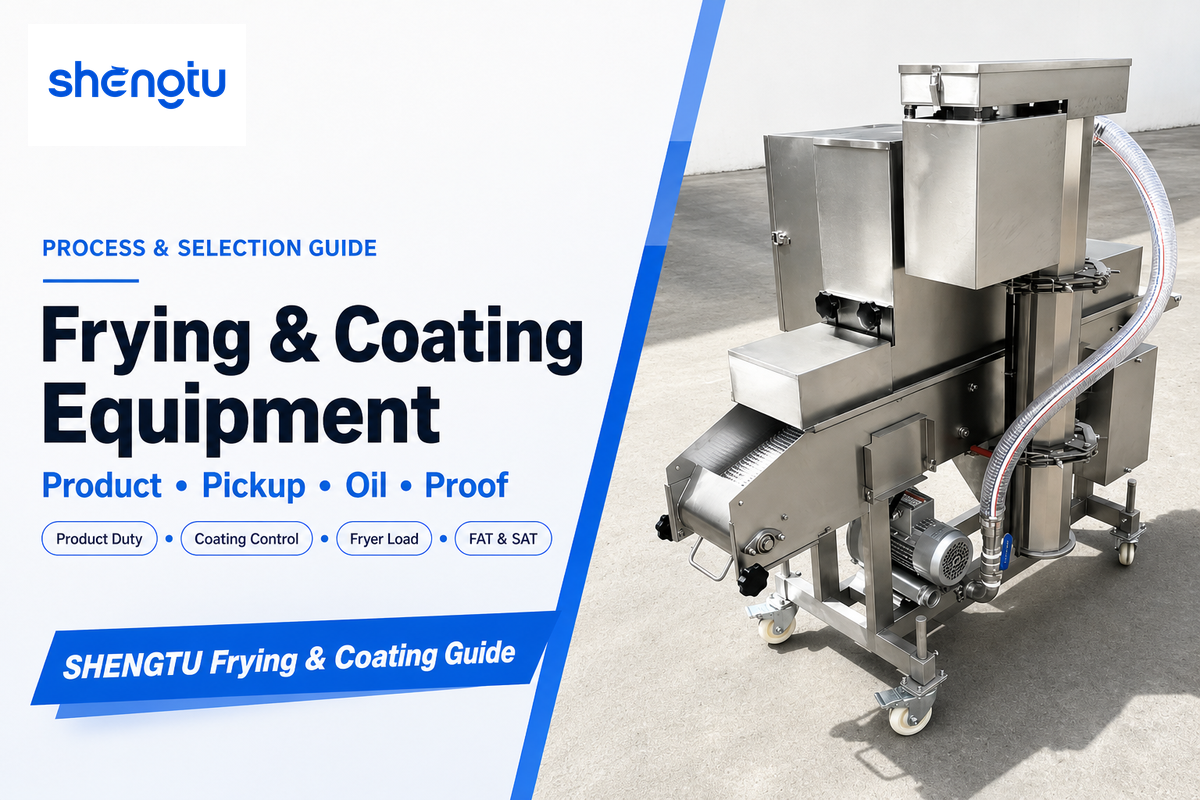
Frying & Coating Equipment is an integrated process system that coordinates product condition, coating pickup, transfer, fryer heat load and downstream handling. Coating loss can still occur at the fryer even if a preduster runs evenly. Fryer setpoints can remain stable while saleable output decreases due to spacing, cooling or changeover instability.
This document is intended for R&D, production, quality assurance, food safety, and maintenance teams, as well as project and procurement leads, when planning to build an industrial line. It describes what should be defined, measured, and assessed prior to considering equipment. This document won’t provide a culinary recipe, food safety setpoint, or a given capacity.
Configuration of machines, special engineering specifications, price, lead time and quotations will be found on Shengtu’s Frying and coating Solution Page. This document will remain on the information side of the boundary and therefore won’t compete with the solution page when serving the same need.
Key takeaway
Specify a frying and coating line from the finished product backward. Freeze the product state, coating system, good-output target, hazards, sanitation method and acceptance evidence before selecting individual machines.
What an Integrated Frying and Coating System Includes
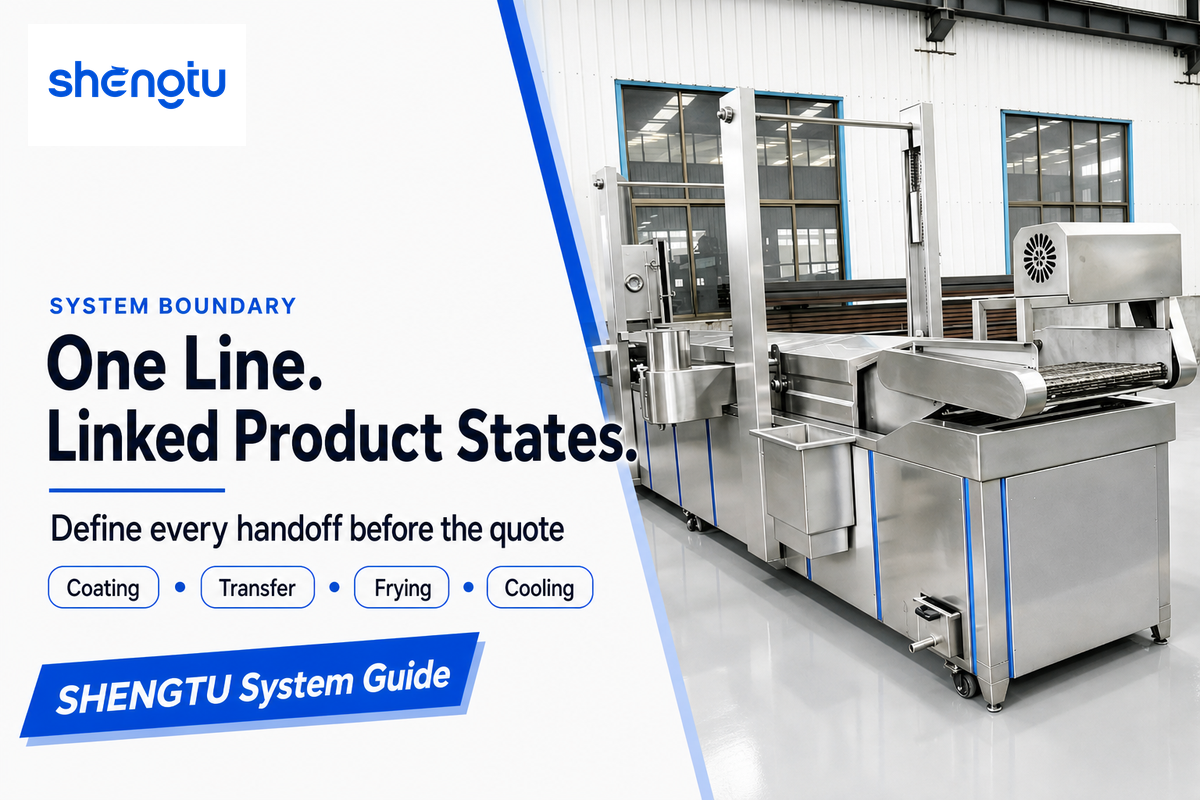
An integrated system can include the preparation of the product, optional predusting, batter application, breading, controlled transfer, frying, oil filtration, de-oiling, cooling, seasoning and packaging. The exact route through each of these steps will vary depending on the product, however the heat load and the final acceptable product will be impacted by variable coverage, spacing, breakage, and stability during transfer.
An integrated system should be drawn as an operating state rather than a catalog copy. Frozen formed products may need predust surface conditioning. Natural-muscle products may differ in shape and moisture content. The transfer duty of pressure-applied crumb and batter is different than that of Tempura batter. Post-fry cooling can affect the coating and oil circulation.
Use the following map in the first supplier meeting: Name each incoming state. Also, name the variable that can change, the evidence of control, and the next state affected. If a state doesn’t belong in the recipe, place “not used” rather than leaving the function vacant.
| Stage | State to define | Evidence to collect | Next-stage risk |
|---|---|---|---|
| 1. Product arrival | Geometry, mass, temperature, frozen/fresh state | Sample distribution, not one average | Uneven coating and residence time |
| 2. Surface conditioning | Free water, frost, tack and roughness | Timed surface check at line entry | Poor predust adhesion or clumps |
| 3. Predust | Coverage, recirculation and excess removal | Pickup sample plus uncovered-area check | Batter release and loose fines |
| 4. Batter | Recipe, temperature, viscosity method and makeup | Timed viscosity/temperature record | Tails, bridging and uneven crumb |
| 5. Breading | Crumb size, condition, pressure and recycle | Pickup and crumb-degradation trend | Bare spots or excessive loose breading |
| 6. Transfer and set | Drop height, vibration, spacing and delay | Slow-motion observation and belt count | Coating loss before fryer entry |
| 7. Fryer entry | Entry disturbance, submergence and loading pattern | Entry video and temperature recovery trace | Blow-off, contact marks and float behavior |
| 8. Fryer mid-zone | Residence time, heat load, oil flow and fines | Time distribution, zone temperatures, oil checks | Color drift and uneven cook |
| 9. Discharge/de-oiling | Drain time, vibration/air action and handling | Surface-oil and breakage samples | Apparent excess oil or fragile crust |
| 10. Cooling/hold | Time, airflow, bed depth and condensation | Product temperature and defect trend | Softening, oil redistribution and damage |
| 11. Packaging handoff | Drop, accumulation, seasoning and pack state | Finished-pack defect and mass balance | Loss blamed on the wrong machine |
Role handoff: R&D defines the product and coating state; production owns operating windows; QA defines release evidence; engineering confirms utilities, access and guarding; procurement keeps the quoted scope aligned with that shared basis.
Scope note: similar search terms can describe a different process
Food coating is broader than coating and frying and may incorporate flavors or seasonings after cooking. For snack food applications, post-fry food seasoning may use a tumble drum or electrostatic coating technology; that is outside this guide’s pre-fry coating process. Cereal and snack lines for chips, pellets, popcorn or pretzels may apply a dry powder blend, starch, spice, vitamin premix or other flavoring after the cook step. A drum, vibratory feeder or liquid spray can distribute these materials. This wider seasoning and coating category also covers other types of food, including some pet food, and may atomize liquid over extruded pieces. Post-cook seasoning equipment performs a different function from batter or breading equipment placed before a fryer.
Fried meat or vegetable products require a uniform coating that develops a crisp, appetizing finish and remains consistent through the process. These specifications define product quality, but they do not determine which coating machine or process should be used. Evidence from coating trials should include loss, pickup, coverage and finished-product results for the relevant food types.
Likewise, the term “all-in-one setup” conceals the interfaces that matter. A mixer, screw conveyor, material handling device, touchscreen, automation package or washdown feature may be part of an integrated line, but equipment and coating behavior must be checked each time the line is handed off. Buildup, reliability and cleaning access may vary among different products and processing lines.
Use the term high-quality, uniform, and upgrade only after defining a measurable result. Food processors should link the supplied coating system to their product and the obligations of the food industry and pertinent industry standards; they shouldn’t assume that any coated food application shares the same configuration.
Evidence note: Ingredion provides predust, batter and breading as a coordinated system, while a peer-reviewed review outlines how frying and cooling affect oil movement. Together, they explain following the product along the whole chain, rather than evaluating one machine in isolation. Ingredion; Peer-reviewed review.
Define the Product and Good-Output Target First
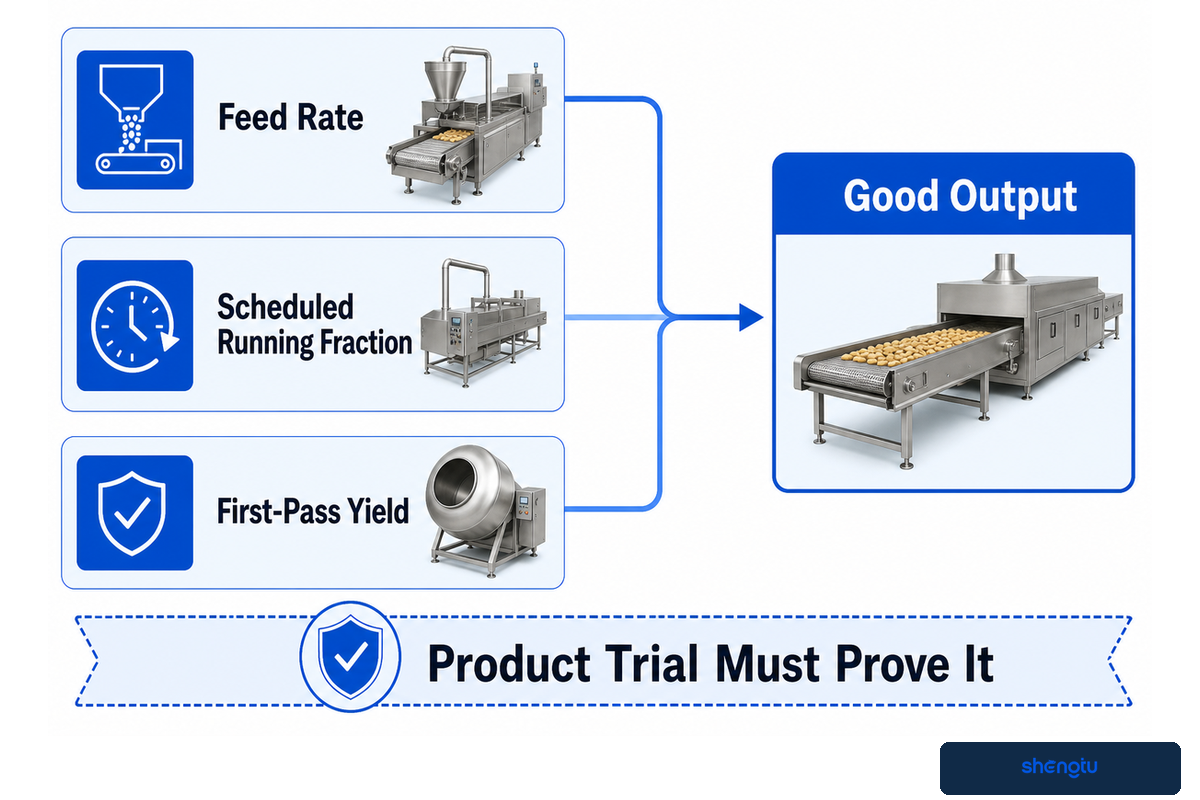
Start with the product, the desired final state and the saleable good. Note the geometry and the mass distribution. Indicate the input and output temperatures. Record the surface condition, the style of coating, the final texture, the SKU mix, the definition of rejects and the operating schedule. Then assess the applicable hazards and regulations. Relying on a given nominal feed rate doesn’t describe the duty or the accepted output.
A useful planning equation is good output = feed rate × scheduled running fraction × first-pass yield. It should not be considered a vendor performance guarantee. If a line is fed at 1,000 kg/h for an 8-hour shift, runs product for 85% of scheduled time and releases 94% at first pass, the planning result is 6,392 kg per shift. The calculation exposes assumptions; a product trial must prove them.
Don’t borrow the 85% or 94% values. Establish them based on planned startup, recipe change, sanitation, inspection, unplanned stop and reject data. Oklahoma State University Extension reports practical industrial fryer utilization in the 80–90% range because startup, shutdown, changeover and failures consume time. This range provides a context for planning utilization, but should not be interpreted as capacity.
Illustrative brief, not a recommendation: a team might describe an 80 g frozen portion measuring 120 × 40 × 15 mm, entering at -18 °C, with a 12 mm maximum crumb, a 1,000 kg/h good-output target, an 8 hour production window and a 45 min allergen changeover. The same brief can reserve 60 min for startup, allow a 15 min setup check, require three 20 min trial runs, record a 5 kg coating mass balance, hold a 2 kg reference sample and compare product after 10 min and 30 min of cooling. These values make the supplier’s interpretation visible; the real project must replace every one.
Before equipment selection, the food-safety owner should determine which rules will apply to the product and plant. For covered U.S. facilities, 21 CFR 117.130 requires a written hazard analysis and specifies factors like equipment design, process, packaging/storage, intended use, and sanitation. Other products and other jurisdictions can impose different requirements.
Five questions that must be answered before a quote
- What product distribution enters the line, including the worst credible pieces?
- What coating and finished-quality measures define an acceptable unit?
- What hourly and shift-level good output is required?
- Which hazards, allergens, sanitation duties and local rules apply?
- Which product trial and records will prove acceptance?
Evidence note: OSU differentiates production rate, fry time, loading and practical utilization in industrial fryer planning. U.S. hazard analysis rules separately require covered facilities to consider equipment and process factors before selecting controls. That makes the product basis and safety basis parallel inputs rather than sequential elements or afterthoughts. OSU Extension; eCFR.
Select the Coating Sequence by Function
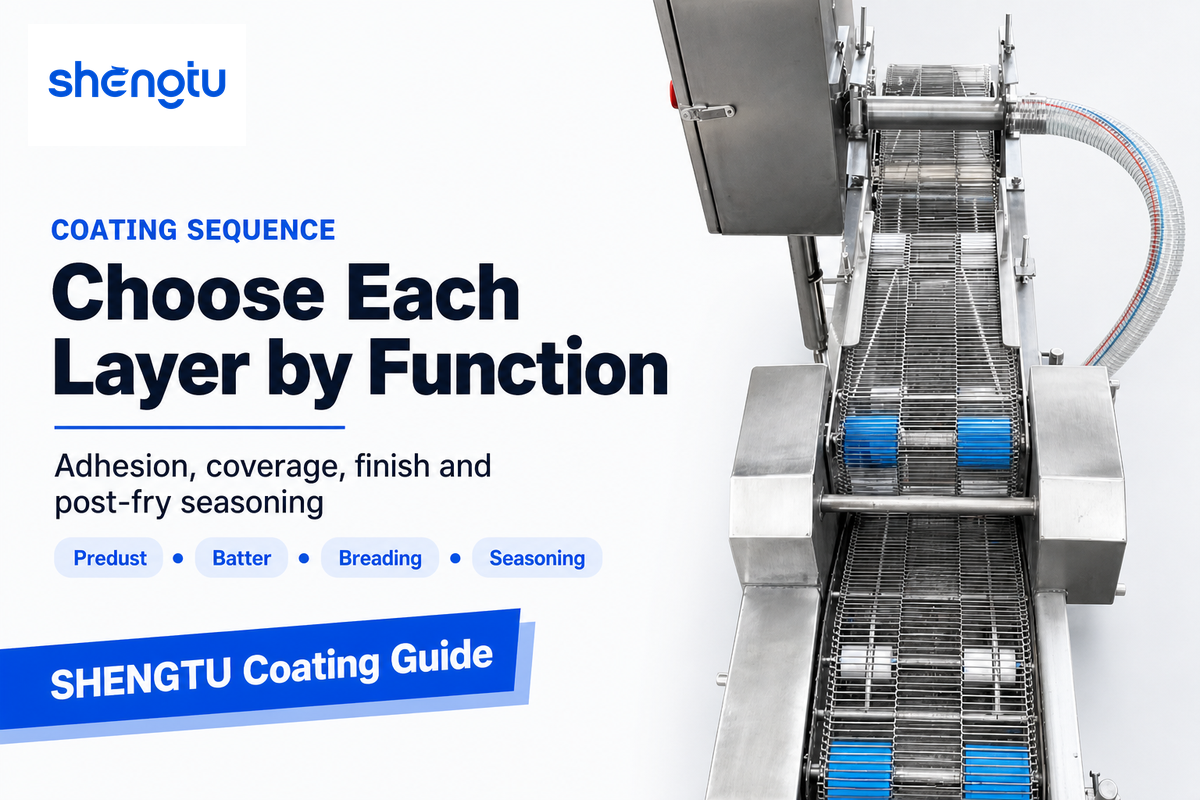
Select predust, batter, breading and seasoning based on each layer’s job function. Predust can improve adhesion and surface condition. Batter carries solids and creates the next adhesion plane. Breading creates the outer layer. Seasoning after frying is a separate responsibility. It isn’t another term for breading.
A product may use all of the stages, some of the stages or multiple passes. Start with the finished bite and appearance, then define the role of each layer. If “more coating” is the only objective, teams can add mass while worsening tails, clumps, loose crumb, oil contamination or breakdown.
Control batter using a named recipe, mixing method, temperature, viscosity method, makeup rule and age limit. A viscosity number without context for spindle, cup, temperature, or time isn’t transferable. Control breading by particle distribution, policy on fresh and recirculated material, pressure, top-bed setting, and condition when fines are removed.
Predust also requires its own check. Predust may improve batter adhesion, but excessive loose material may become an issue in subsequent processing stages. Heat and Control’s process guidance links coating results to product-surface dryness and roughness, batter homogeneity, viscosity, temperature, filtration and belt choice. These are vendors’ observations, so consider these as variables among several other factors that may affect process rather than rules.
For a greater level of detail on the component level, refer to the Shengtu separate article on the battering and breading machines. This article will remain at the system level and focus on the performance handoffs in the system.
Evidence note: Both Ingredient and equipment suppliers define coating as a series of steps that are product dependent, and thus result dependent. Their material supports the process map, but a supplier’s preferred formulation or machine placement still requires a product trial under the buyer’s actual conditions. Ingredion; Heat and Control.
Control Coating Pickup Across the Fryer Handoff
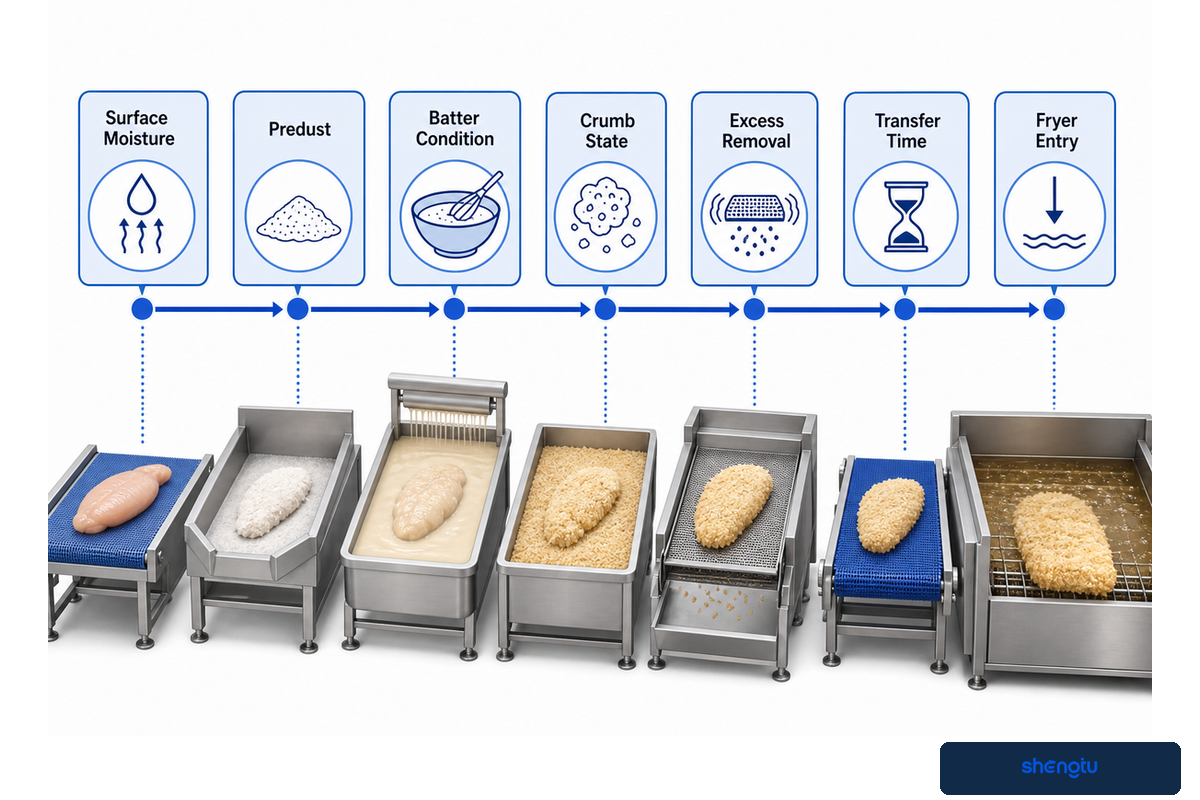
Pick up is controlled across the entire hand off, not one dial. Surface moisture, predust, batter condition, crumb state, excess removal, transfer time, drop height, belt vibration, spacing and fryer entry all interact. A stable average of pickup can mask bare spots, tails or a wide distribution that fails after frying.
Define a sampling method and analyze distribution. Classify total mass gain from useful retained coating. A sample that gains weight from clumps is not equivalent to one with even coverage. Follow the product before, after each chosen coating stage, after frying, and after cooling to identify the loss.
Formulation results don’t transfer automatically. In one fish-cube study, a tested formulation increased batter viscosity by 74.9%, pickup by 26.1% and frying yield by 8.1% versus its control. Those values belong to that study’s ingredients, product and methods. In a separate fish-strip study, three reported pickup values were 9.16%, 8.53% and 7.68%, yet the best fat-reduction result didn’t simply follow maximum pickup.
This isn’t about copying those percentages. This is about treating viscosity, pickup, yield, and oil absorption as separate reactions. More pickup can be desirable, neutral or harmful depending on coverage, adhesion, texture, frying load and the quantity that remains on the final product.
| Observed signal | Material loss | Time loss | Quality/energy link | First evidence |
|---|---|---|---|---|
| Bare spots before fryer | Unused coating plus rejects | Rework and adjustment | Surface condition or coverage | Entry samples by belt position |
| Breading on transfer belt | Retained coating falls | Cleaning stops rise | Drop/vibration damage | Mass balance across transfer |
| Clumps in recirculation | Batter/crumb discard | Screen and refill delay | Moisture and recycle condition | Timed screen-retained mass |
| Fryer-entry blow-off | Coating becomes fines | Filtration burden | Entry flow and coating set | Entry video plus fines trend |
| Temperature recovery lag | More rejects/rework | Rate reduction | Moisture and heat load | Load-aligned temperature trace |
| Dark particles in oil | Oil and product loss | Filter/cleaning stops | Fines creation and residence | Particle load by operating hour |
| Color drift across shift | Off-spec product | Sorting and holds | Oil/product/thermal drift | Color plus oil checks over time |
| Excess surface oil | Oil leaves with product | Longer drain/cool time | Crust, cooling and de-oiling | Hot versus cooled sample |
| Breakage after cooling | Finished-product loss | Repack and clean-up | Crust strength and handling | Defects at discharge and pack |
| Long allergen changeover | Flush and held material | Lost production window | Access and verification duty | Timed clean plus verification record |
Evidence note: Two peer-reviewed articles provide some evidence that batter formulation can change viscosity, pickup, yield and fat behavior, but their numbers are product specific. They support measuring linked responses during trials, not publishing a universal pickup band. Fish-cube study ; fish-strip study .
Choose Batch or Continuous Frying by Operating Case

Batch and continuous fryers solve different operating cases; compare them by sustained good output, SKU pattern, residence-time control, upstream continuity, oil volume, labor, floor space, cleaning and changeover. Neither is always superior. The useful question is which one can reproduce the approved product within the real production schedule.
| Decision field | Batch case to test | Continuous case to test | Evidence |
|---|---|---|---|
| Production pattern | Discrete lots and pauses | Steady upstream feed | Shift schedule by SKU |
| Residence time | Lot timer and operator action | Measured conveyor/time distribution | Product transit study |
| Heat load | Recovery after each charge | Response to sustained load | Temperature trace with product |
| SKU frequency | Flexible small-lot changes | Campaign production | Annual change matrix |
| Coating continuity | Accumulation between lots | Matched belt loading | Upstream rate variation |
| Labor | Charge/discharge work | Monitoring and intervention | Task observation by shift |
| Oil inventory | Lot-based working volume | System and circulation volume | Oil mass balance |
| Cleaning | Open-vessel access | Conveyor, return and filter access | Timed cleaning trial |
| Floor/layout | Work area around batches | Long line and service zones | Scaled layout with access |
| Acceptance | Repeatable lots | Stable run plus transitions | Agreed product protocol |
Conveyor speed is not proof of residence time. Product can float, overlap, enter unevenly or follow different traversals. Measure actual product transit and distribution at the planned load. Likewise, batch time is useful only when charge mass, product state, oil response and discharge timing are controlled.
Evidence note: OSU determines fryer cook surface from the production rate, fry time and product loading. That calculation shows why capacity is a linked operating case. Its practical-utilization discussion also supports comparing scheduled good output rather than assuming every shift hour is productive. OSU Extension.
Manage Heat Load, Oil Turnover, Filtration and Fines
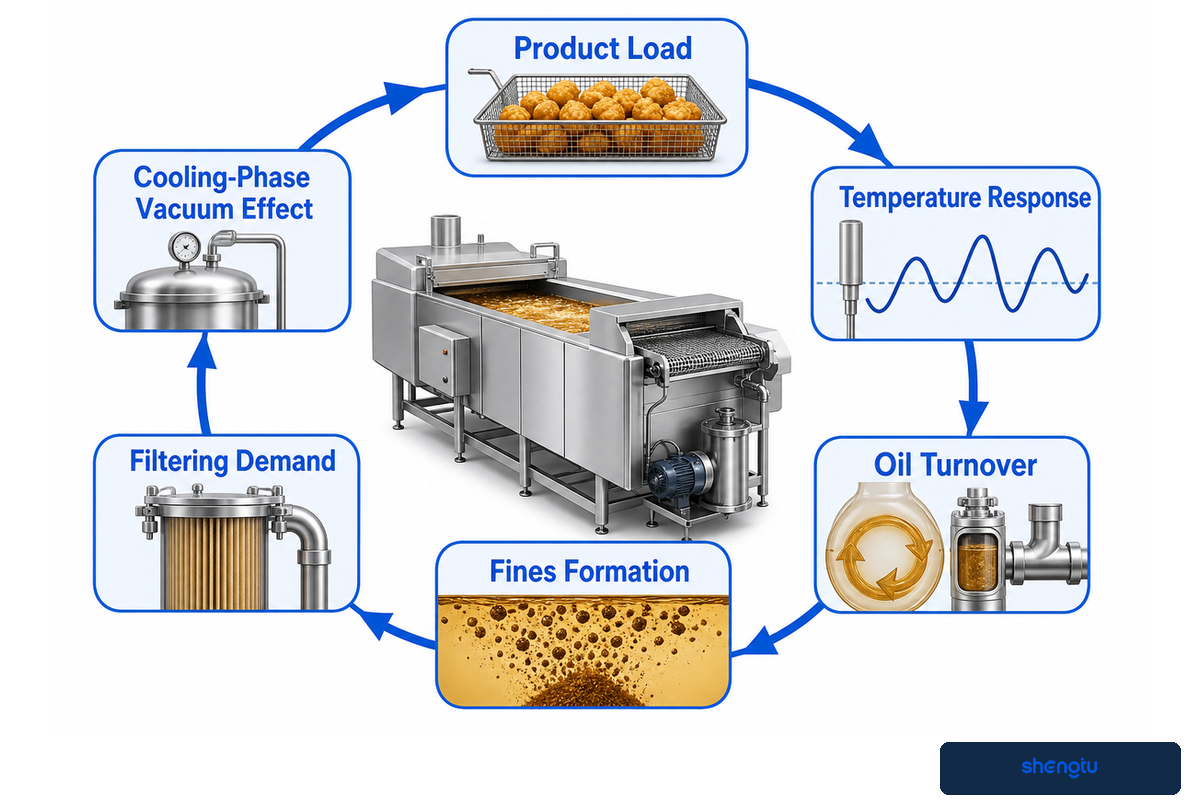
Oil management begins with product insertion and moisture removal. Study the temperature response profile, oil levels, turnovers, food/oil ratio, fines formation, filtering demand, and operating schedule. A fixed fryer temperature/time setting or calendar replacement policy won’t show whether oil and product have remained in the validated range of the plant process and quality limits.
OSU gives a typical industrial oil-turnover context of 5–10 hours and notes that actual fryer startup and shutdown can damage oil and product more than steady operation. The same source discusses longitudinal temperature differences of 12–18°F in common operation. These references aren’t rigid limits for fryer, recipe or safety plan use.
The guide also gives equipment-specific fluctuation examples of 10–15°F for direct-heated gas, 7–10°F for thermal-fluid heating and about ±2°F for indirect heating. Those figures describe the source’s comparison, not an acceptance band. Ask the supplier what heating system, product load, sensor position, and control response was used to generate the trace.
Filtration must be based on the actual size, quantity, hardness, density, and buoyancy of the particles generated. A filter that captures large caked/crumbly particles may not control smaller burnt particles. A continuous side stream can improve control without processing the full oil volume at once; OSU describes systems that filter roughly 5% of the oil inline. Determine the actual circulation and removal capacity of the filter provided.
Register records for oil additions, removals, product mass, filtration, operating hours, temperature excursions, and a defined oil-quality measure. Connect each record to product color, flavor, odor, surface oil, and fines. The goal isn’t to achieve a single “oil life” number. It’s to identify drift early enough to better protect the product and the process.
A peer-reviewed publication also describes a cooling-phase vacuum effect: as steam condenses after frying, oil can be drawn into pores. That’s why hot discharge appearance, de-oiling and cooled-product results should be compared before attributing all oil uptake to the fryer temperature.
Evidence note: OSU provides industrial turnover, temperature and filtration context; the peer-reviewed publication explains the product mechanisms that affect oil absorption, including cooling. The combined evidence argues for a product-and-oil trend, not a copied replacement interval. OSU Extension; review article.
Balance the Whole Line with the 4-Loss Map
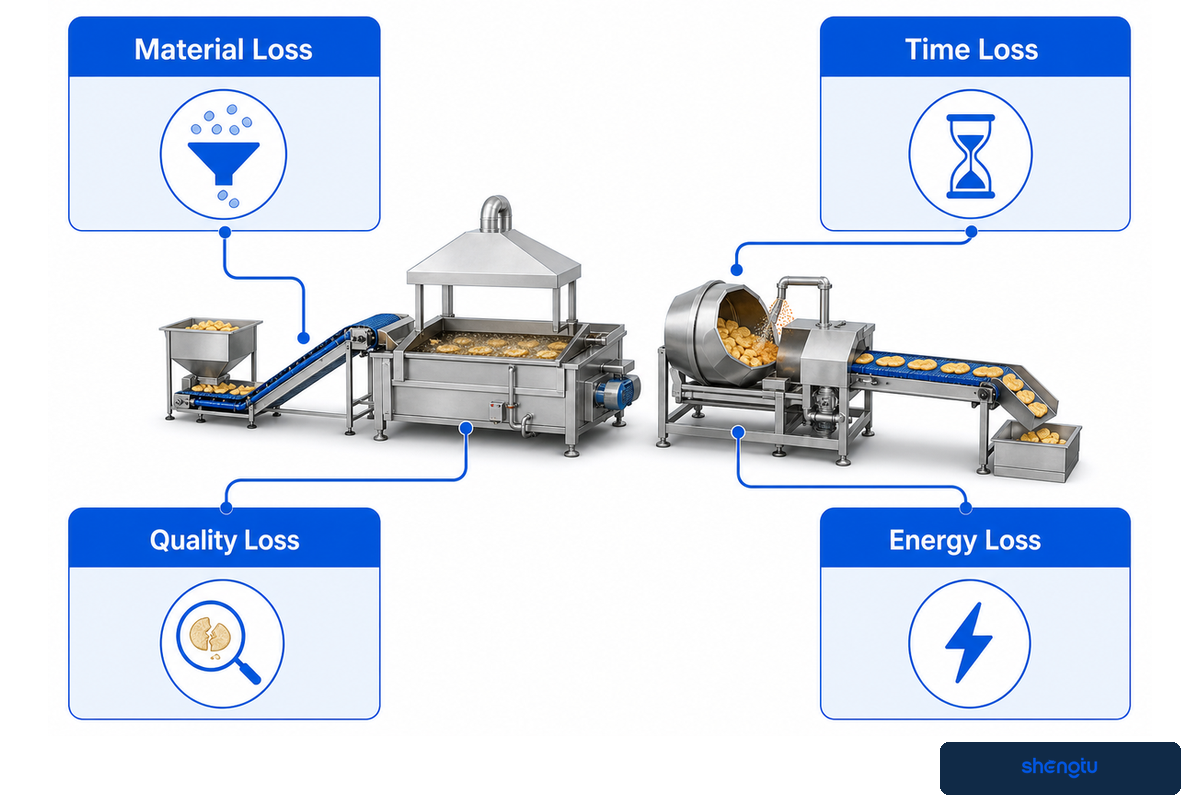
Line balance means every stage can sustain the same accepted product flow through normal variation, changeover and cleaning. The bottleneck may sit in batter makeup, crumb conditioning, transfer spacing, fryer recovery, filtration, de-oiling, cooling or packaging. The speed of the fastest conveyor set at nameplate speed doesn’t constitute saleable hourly output.
Use four loss buckets: material, time, quality, and energy. Each loss bucket contains different production activities. Loss of material may occur from coating on the belts or as fines in oil, or product discarded due to changeover. Loss of time may occur from holds or stops, or due to cleaning or machine warm-up. Loss of quality may occur from bare spots, color drift, undercooking, overcooking, or product breakage. Loss of energy occurs when the idle equipment is left unattended, when there is poor recovery or when schedules are mismatched, causing an extended running time.
Production should document the rate at which each line segment operates and the reason for each stop. QA should record the reason for each hold or reject at the location where it first occurs. Maintenance should record each failure and each intervention. Finance or project management will then be able to quantify the physical losses as costs, rather than obscure them behind an overall efficiency percentage.
Example: a coating section supplies 1,200 kg/h, but the fryer sustains only 1,000 kg/h under the actual moisture load. Accumulation forces spacing changes, batter warms during pauses, crumb condition drifts and the packaging side later sees mixed color. Increasing coater speed makes the system less stable. The objective is to obtain the best repeatable good output of the entire chain.
For another example of a product and process route that may be converted to measurable project inputs, the Sauce Line Planning Guide produced by Shengtu, uses the same principle of “finished product backward” in a different food-processing context.
Troubleshoot Defects Across Equipment Boundaries
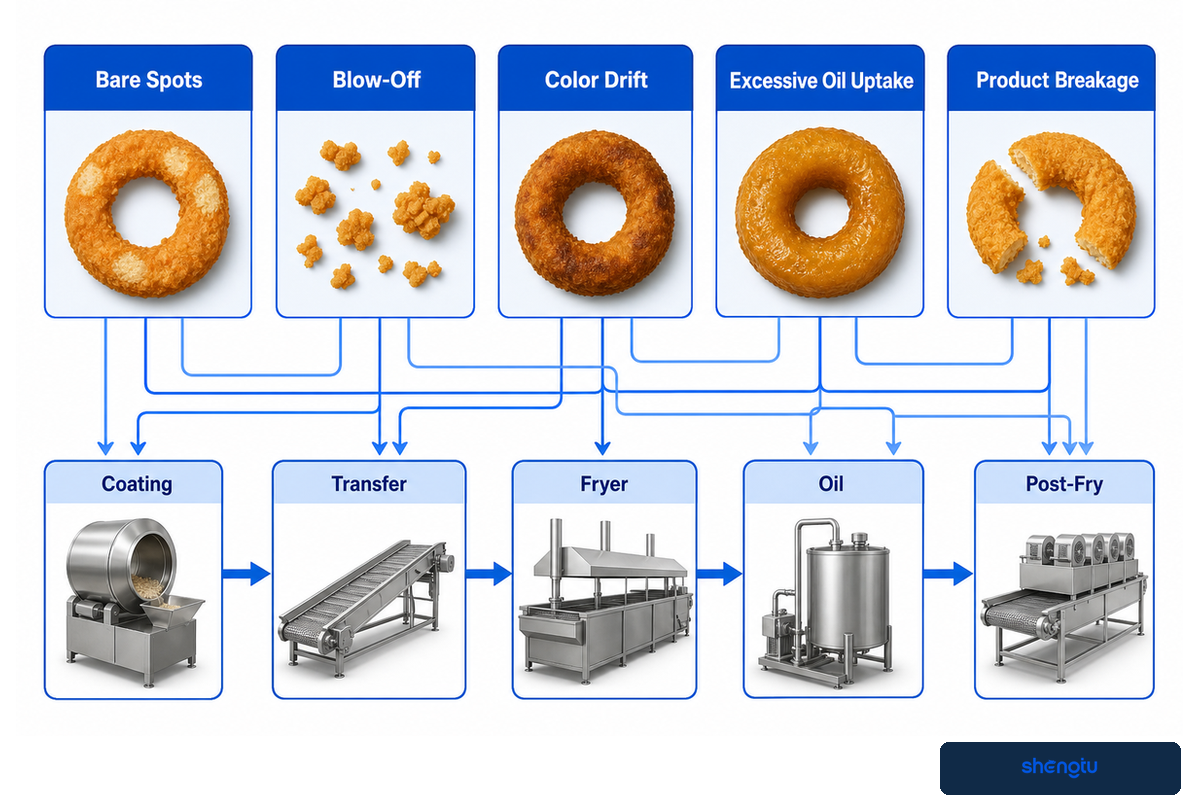
Start diagnosis where the defect first becomes measurable, then work upstream and downstream one boundary at a time. Keep product coating, transfer, fryer, oil, and the post-fry stage as separate evidence groups. Defects can disappear with multiple setpoint changes, which prevents identification of the cause and makes repeatability impossible to confirm.
For bare spots, evaluate the product at the stages of predust, batter, breading and just prior to the fryer. For blow-off, assess all aspects of the transfer (e.g. severity, time, flow) and the initial crust set. For color drift, consider the product load, residency, zone response, condition of the oil and the presence of fines, and then the sampling time.
Over-simplifying excessive oil uptake can lead to a system that’s difficult to manage. Moisture, cooling, crust microstructure, geometry, fry time, temperature and oil quality are major contributing factors. A team that changes frying temperature may also significantly impact color and degree of doneness while leaving the predominant route unchanged.
A food technologist and the site’s process-safety owner must approve recipe or safety-critical changes. A one-variable-at-a-time method is justified only when the system has reached a steady state. Maintain the product lot, coating recipe, sampling point, and method of measurement constant. Change only one bounded factor, observe the response, and repeat. This method is diagnostic and not validation.
Five-step defect trace
1) Define defect and sample point. 2) Find the last point where product was acceptable. 3) Hold constant unrelated variables. 4) Test one reasonable mechanism with one limited change. 5) Perform the test in conditions of normal load and indicate the person releasing the result.
Evidence note: The oil-absorption review identifies multiple interacting mechanisms rather than one universal cause. Supplier instructions place adhesion variables before and during coating. The diagnostic sequence above is an editorial method for organizing evidence; it is not a substitute for a validated process or hazard-control decision. Peer-reviewed review.
Design for Sanitation, Allergen Control and Changeover

Sanitary design helps a plant carry out its cleaning program, but equipment features do not replace that program. Review access, drainability, product traps, belt removals, crumb recovery, oil handling, dry-clean and wet-clean boundaries, chemical compatibility, inspection points, allergen changeover, and verification within the site’s product and legal scope.
Not all frying and coating lines are clean-in-place systems. Open conveyors, crumb beds, batter circuits, fryer internals and filtration equipment may need other approaches. Ask the supplier for safe access and the procedure for disassembly, soil removal, cleaning, rinsing if used, reassembly, and pre-operation inspection.
“The Sanitation SOP’s shall specify the frequency.”
This rule also refers to accountable employees and records. It’s an effective warning to not accept “easy to clean” as the only sanitation claim. A project brief shouldn’t only include the cleaning employee, but also the time allotted for the cleaning, the allergen or soil most difficult to clean, the components opened, and how the cleaning is verified.
For covered U.S. facilities, 21 CFR 117.135 recognizes process, food-allergen and sanitation controls as possible preventative controls. The site’s hazard analysis will determine what controls are required. Visual cleanliness on its own may not demonstrate an allergen changeover.
Dry predust or crumb handling also requires a conditional dust screen. OSHA notes that finely divided combustible material, when suspended in air under the right conditions, can create a flash-fire or explosion hazard. This doesn’t mean every coating line has that hazard. It means the actual powder, dust generation, collection, ignition sources and building conditions require a competent assessment.
EHEDG and 3-A SSI publish hygienic-design resources, but a catalogue entry or design claim doesn’t confirm that a specific line satisfies all site or jurisdictional requirements. Ask which standard, edition, component and scope a supplier’s statement refers to. Shengtu’s sterilization equipment guide addresses why equipment and the validated food-safety process must remain distinct.
Evidence note: USDA FSIS describes sanitation performance requirements. It also recognizes different establishment environments. The eCFR adds written sanitation and hazard-control duties for covered U.S. operations. OSHA adds a conditional dust-hazard boundary for relevant dry materials. FSIS guide; OSHA.
Prove Performance with FAT, SAT and Product Trials
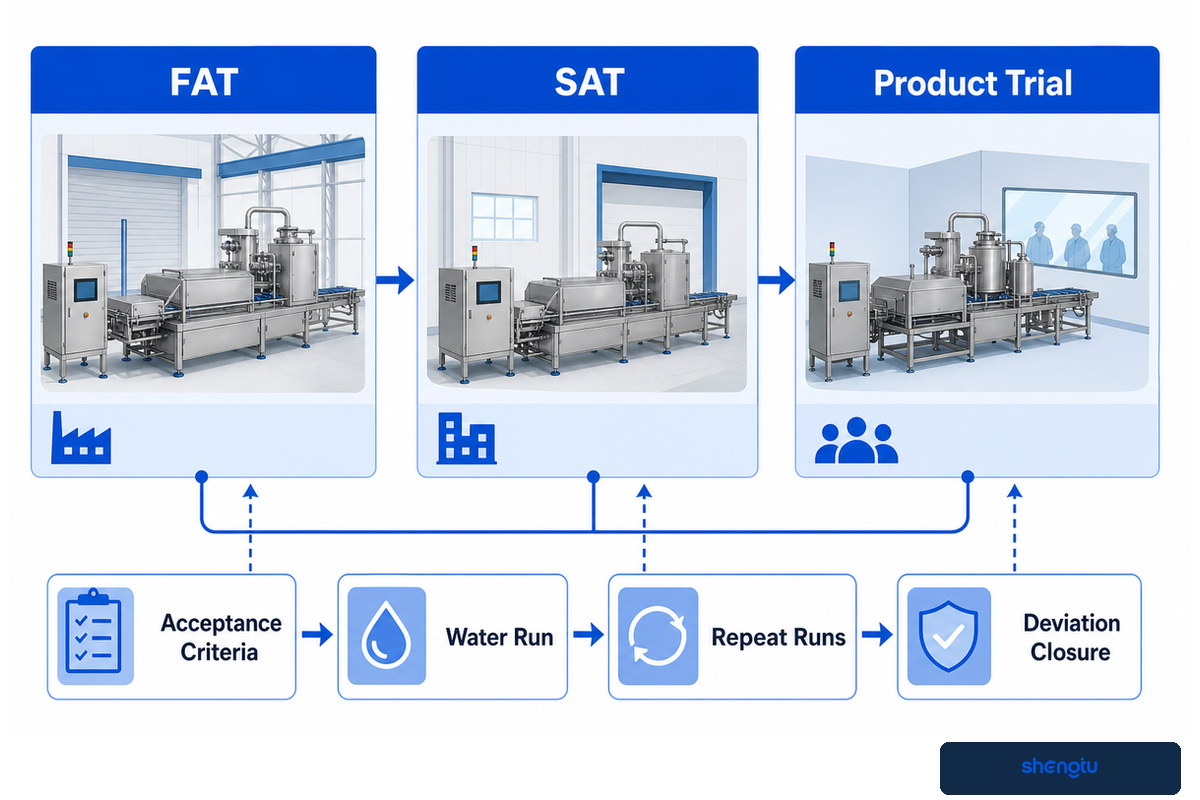
Factory acceptance testing checks the agreed scope at the manufacturer’s site; site acceptance testing checks the installed system under owner-site conditions. Both shouldn’t be reduced to “the motor ran.” Prior to starting a test, specific products under test, their corresponding utilities, operating cases, measuring methods, acceptance criteria, permitted deviations, repeat runs, and owners must be defined.
A no-load or water run can confirm rotation, controls, leaks, alarms and parts of the utility interface, but it cannot prove coating pickup, fryer heat response, product residence time, loss, color, texture or good output. These can’t be confirmed without the intended product and a sufficiently long test to verify steady state conditions and allow for incremental changes.
| Test item | FAT evidence | SAT/site evidence | Decision owner |
|---|---|---|---|
| Scope and interfaces | Tagged equipment and documents | Installed boundary walkdown | Project manager |
| Safety functions | Guard/interlock test protocol | Site risk-control confirmation | Safety owner |
| Utilities | Specified simulated/available supply | Real voltage, fuel, air, water, exhaust | Engineering |
| Good output | Agreed product and timed mass balance | Installed-line shift case | Production + QA |
| Coating pickup | Method, samples and distribution | Routine ingredients and operators | R&D/QA |
| Residence/thermal response | Product transit and temperature trace | Full utilities and site load | Process owner |
| Loss and defects | Coating, fines, reject mass and photos | Normal handling through packaging | QA + production |
| Changeover | Defined recipe transition | Plant schedule and material release | Production |
| Cleaning access | Demonstrated open/remove/drain steps | Site method, time and verification | Sanitation/QA |
| Repeatability | Agreed repeat runs and deviations | Repeat under installed conditions | Joint sign-off team |
The distinction between FAT and SAT is derived from commissioning practices, and it shouldn’t be assumed that FAT and SAT represent a threshold for food processing acceptance. Limits must be determined on an individual project basis for the approved product, hazard controls, and the business duty. If an appropriate representative product isn’t available for FAT, the lack of evidence must be documented and assigned to SAT or a site product trial.
Evidence note: PQE Group’s specialist explanation separates FAT at the manufacturer from SAT at the owner’s site. This guide uses only that site boundary. The evidence-pack fields are a checklist for a food project and don’t incorporate pharmaceutical acceptance limits. FAT/SAT explainer.
Build a Technical Brief a Supplier Can Use
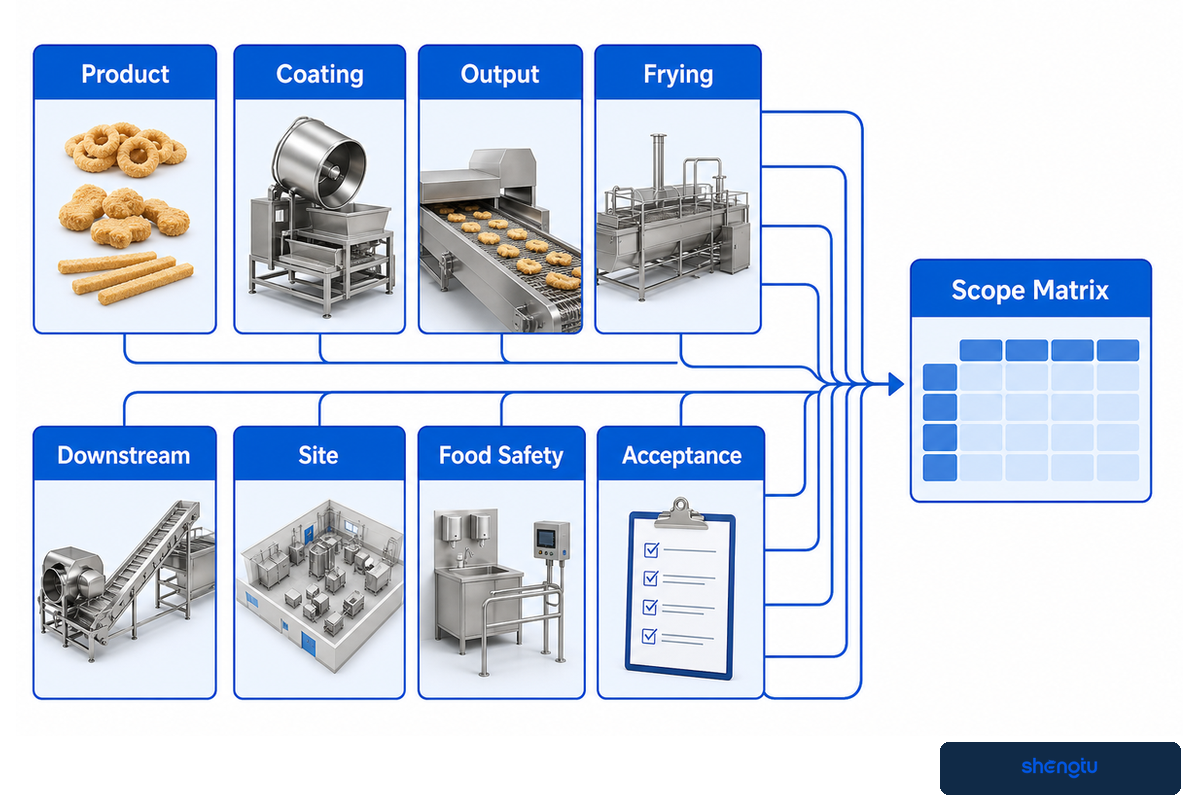
A supplier brief must specify the product duty, system boundary and proof of acceptance in measurable terms. It must allow two suppliers to quote the same problem. It must provide samples and drawings where possible, and must state the unknowns, and must separate the requirements from preferences so the gaps are evident before equipment is ordered.
- Product: name, composition, allergens, geometry, mass range, incoming temperature and frozen/fresh state.
- Coating: predust/batter/breading route, ingredient form, pickup method, recycle rules and acceptable appearance.
- Output: hourly and shift good output, reject definition, operating hours, SKU campaign and changeover target.
- Frying: approved product condition, residence-time evidence, thermal response, oil policy, filtration and de-oiling duty.
- Downstream: cooling, hold, seasoning, conveying and packaging handoff conditions.
- Site: utilities, exhaust, drainage, floor plan, access, lifting and service space.
- Food safety: applicable jurisdiction, hazard-analysis inputs, sanitation method, allergen changeover and verification owner.
- Acceptance: FAT/SAT scope, representative material, methods, limits, repeat runs, records and deviation closure.
Procurement may ask for a scope matrix: supplied/owner-supplied/excluded/optional/trial. Engineering should add utility points and layout interfaces. QA should take ownership of product and verification. Production should take ownership of staffing and scheduling cases. This will help avoid a “complete line” label that obscures the work between machines.
When you’re ready to evaluate alternatives, consider Shengtu’s frying and coating equipment options. You may also want to check out the Shengtu coating equipment company background prior to presenting a project overview.
Discuss Your Frying and Coating Project
Send the state of the product, good output target, coating route, utilities, cleaning/allergen specifications, and proposed acceptance criteria. This will help us prepare the first detailed technical discussion.
Frequently Asked Questions
These succinct responses cover the first common questions most project teams ask. These responses give planning suggestions, but won’t be a substitute for product trials, a food-safety plan or a site-specific engineering review. These will help in identifying what must be final before a supplier can test and select a line.
What equipment is needed for industrial frying?
An industrial line normally needs more than a fryer. Depending on the product, it may include preparation and portioning, predusting, batter application, breading or crumb coating, controlled transfer, frying, oil filtration, de-oiling, cooling, and downstream seasoning or packaging. The exact sequence depends on product geometry, surface moisture, coating style, target throughput, sanitation plan, and final quality. Define those inputs before selecting individual machines.
How do I choose between a batch fryer and a continuous fryer?
Choose by operating case rather than headline capacity. Batch frying can suit lower volumes, frequent recipe changes, or products needing flexible residence time. Continuous frying is usually considered when upstream flow is steady and sustained output and residence-time consistency matter. Compare good output, SKU mix, cleaning and changeover time, oil volume, labor, utilities, and whether coating and downstream equipment can keep pace.
Why does breading fall off during frying?
Breading loss can start before the fryer. Contributors include wet or uneven product surfaces, insufficient predust, unstable batter viscosity, poor excess removal, damaged crumb, rough transfer, crowded belts, and fryer entry that disturbs coating before it sets. Oil-temperature recovery and residence time can amplify the defect. Diagnose the handoff in order; changing only the fryer setpoint may hide the upstream cause.
How much does frying and coating equipment cost?
There’s no reliable single price. Product, capacity, coating stages, fryer type, filtration, controls, utilities, hygienic design and validation scope all change the quote.
What should I send to an equipment supplier?
Send representative products and recipes, incoming state and temperature, dimensions and mass distribution, hourly good output, coating type and pickup method, final quality, SKU/changeover plan, utilities, floor constraints, sanitation and allergen requirements, operating hours, applicable rules and measurable acceptance criteria. Add photos, samples and a process-flow drawing. State what’s mandatory, what’s preferred and what remains unknown so the supplier can flag tests instead of silently making assumptions.
References and Sources
These sources provide technical and regulatory boundaries of this guide. Commercial sources used in other places are identified in the text. This reference list includes government, academic and standards sources only.
- Oklahoma State University Extension, Industrial Deep Fat Frying
- Peer-reviewed review, Oil absorption during deep-fat frying
- Peer-reviewed study, Batter viscosity, pickup and frying yield
- Peer-reviewed study, Hydrocolloid coatings and fried fish-strip properties
- 21 CFR 117.130, Hazard analysis
- 21 CFR 117.135, Preventive controls
- 9 CFR 416.12, Sanitation SOP development
- USDA FSIS, Sanitation Performance Standards Compliance Guide
- OSHA, Combustible Dust
- EHEDG, Hygienic-design guideline catalogue
- 3-A SSI, Standards catalogue
Prepared as an industrial project-planning guide using the cited public sources. Product trials, qualified food-safety review and applicable local requirements govern final settings and acceptance.
![F&V Freeze-Drying Line Process Guide [2026]](https://shengtumachinery.com/wp-content/uploads/2026/09/fv-freeze-drying-line-guide-featured-768x512.png)
![Beef/Lamb/Poultry Cutting Line Acceptance Guide [2026]](https://shengtumachinery.com/wp-content/uploads/2026/09/beef-lamb-poultry-cutting-line-guide-featured-768x512.png)

![F&V Freeze-Drying Line Process Guide [2026]](https://shengtumachinery.com/wp-content/uploads/2026/09/fv-freeze-drying-line-guide-featured-150x150.png)