
Get in touch with Shengtu Bufan Company

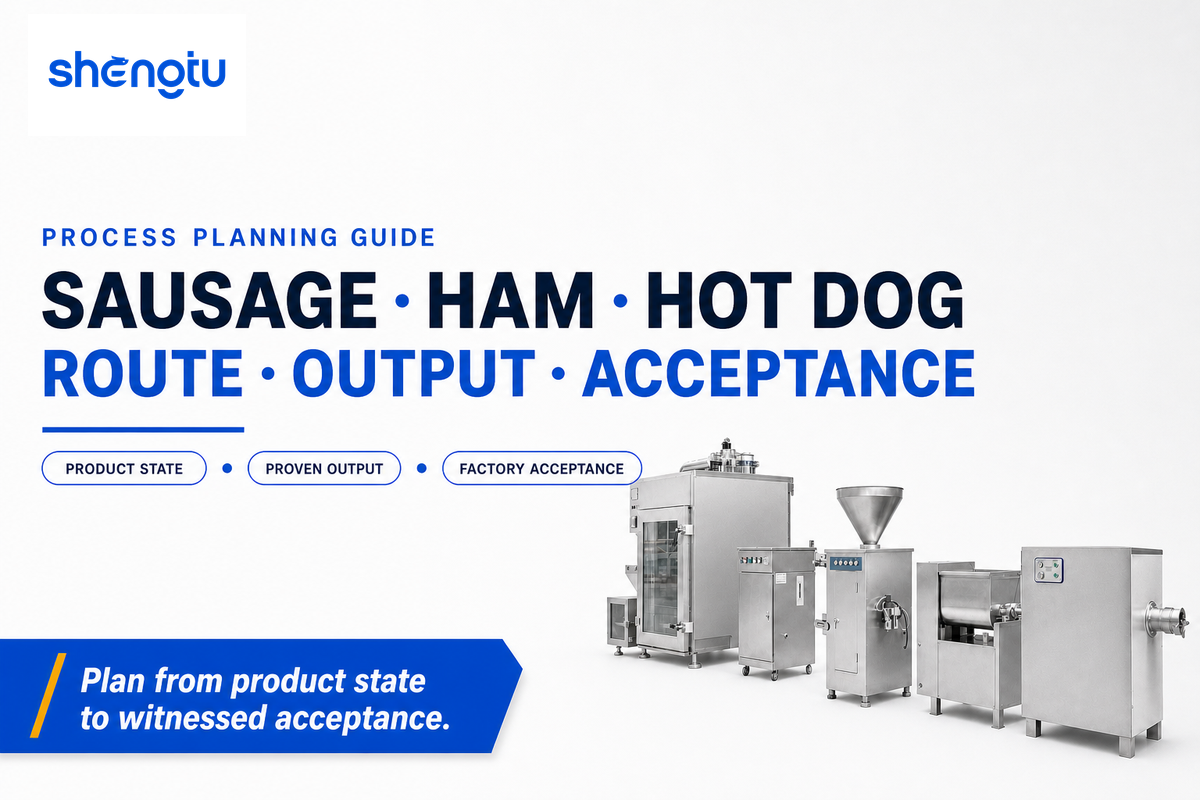
Updated October 2026
A Sausage / Ham / Hot Dog Line is a product-specific sequence that converts defined meat and ingredients into accepted packed output. Some plants can share grinding, mixing, thermal processing, chilling, inspection, and packaging resources. Still, fresh sausage, emulsified frankfurters, skinless hot dogs, and whole muscle ham don’t take the same route.
This guide helps you define that route, create a line architecture, compare casing and product families, and control critical handoffs. It provides guidance for normalizing capacity evidence, closing interfaces, and writing a Factory Acceptance Test (FAT). It is deliberately different from a commercial equipment page: model selection, final configuration, delivery and quotation remain with the existing Shengtu solution.
Commercial listings generally use unstructured terminology. One may define the line as an ‘automatic sausage line’. Another listing may define the line as a ‘sausage machine’ or ‘sausage making machine’ line. Sometimes the unstructured terminology may be as simple as the label ‘making machine’. A fairly detailed meat processing brief addresses these issues and answers the route and acceptance questions.
Define these five boundaries before asking for a machine list
- Product family, physical structure and intended label identity
- Casing, forming, thermal, cooling and finishing route
- Accepted packed output over a stated time window
- Hygiene, post-lethality exposure and food-safety ownership
- Mechanical, utility, control, data and acceptance interfaces
Map the Product Route Before You Select Equipment
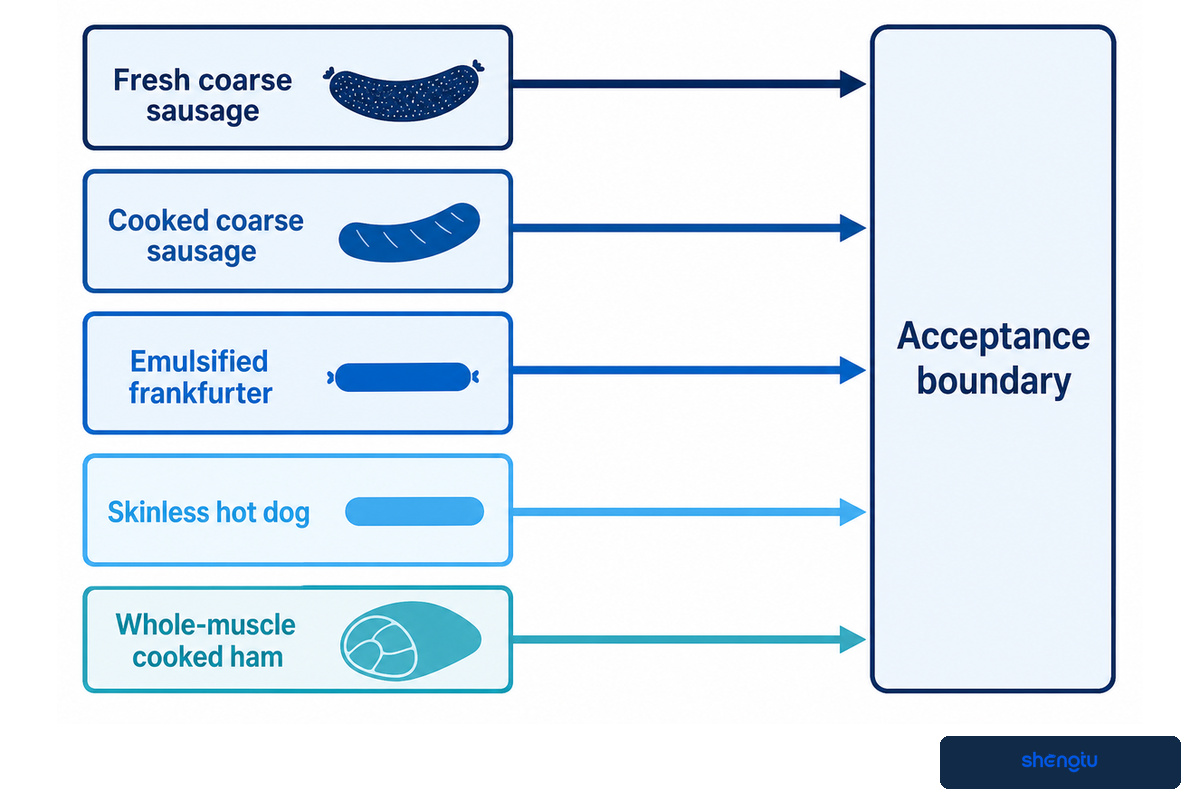
Initially, classify the physical state of the product, the forming method, casing or mold, the thermal condition and the final finish of the product. This boundary will show which sections of the line can be shared and which sections need to be unique. It also keeps the label ‘sausage line’ from masking fundamentally different products and validation needs within the factory.
What changes between fresh sausage and cooked hot dogs?
Fresh sausage is normally shipped without a line-owned lethality step, leaving cooking to a later on-site process; linking itself is a forming step, not lethality. A hot dog, on the other hand, follows a controlled comminution or emulsification route, then stuffing or forming, thermal processing, cooling and, when cellulose casing is used, peeling. Utilities, maintenance, sanitation, inspection, exposure control, and the definition of acceptable output are impacted by these changes.
The language used to describe filling also varies. A sausage stuffer may be described as a pneumatic sausage filler or filling machine. A sausage tying machine may be sold as an automatic sausage tying machine or twisting machine; other listings may use hot dog tie linker or link maker. The name doesn’t always provide product information.
FAO guidance illustrates how sensitive the emulsion route can be: it recommends a cutter mixture temperature no higher than 12–14°C and warns that continued cutting beyond 18°C can contribute to poor stability. Those figures are technical examples, not universal plant critical limits. Product trials and the buyer’s validated process remain controlling.
Product-State-First Boundary Rule
| Product state | Structure and forming | Casing / support | Thermal and finish route | Acceptance boundary |
|---|---|---|---|---|
| Fresh coarse sausage | Ground or chopped mix; filled and linked | Natural or edible collagen | No line-owned cook unless separately specified | Fill, weight, link, temperature and pack condition |
| Cooked coarse sausage | Visible particle structure; filled and linked | Natural, collagen or other approved casing | Cook/smoke, cool, inspect and pack | Validated process plus texture, color and package criteria |
| Emulsified frankfurter | Fine batter; portioned by filler/linker | Edible or peelable route | Cook/smoke, cool and finish | Batter stability, unit uniformity and accepted packed product |
| Skinless hot dog | Fine batter; linked or portioned | Typically peelable cellulose process | Cook, cool, peel, inspect, orient and pack | Surface integrity, peel loss, count and seal acceptance |
| Edible-casing hot dog | Fine batter; filled to a controlled diameter | Natural or edible collagen | Cook/smoke, cool and pack without peeling | Bite, casing condition, diameter and pack count |
| Large-diameter cooked sausage | Coarse or fine matrix; large-format filling | Fibrous, plastic or another specified casing | Longer thermal/cooling path; whole or sliced pack | Center process evidence, diameter and slice performance |
| Whole-muscle cooked ham | Intact muscles; injected/tumbled only as specified | Net, bag, mold or combination | Form, cook, cool, demold and pack | Product identity, bind, shape, yield boundary and pack state |
| Formed / restructured ham | Defined pieces or comminuted fraction; formed mass | Mold, film, net or specified support | Form, cook, cool and possibly slice | Identity, piece definition, slice integrity and labeling |
| Post-lethality sliced product | Cooked product exposed for slicing or repacking | Removed, opened or bypassed before pack | Expose, slice, inspect and repackage | Separate exposure-control and environmental boundary |
| Separate specialist routes | Fermented, semi-dry, dry or country-cured products | Product-specific | Fermentation, drying and/or curing basis | Dedicated hazard, formulation, climate and validation plan |
Products fermented or dried aren’t minor variations of the cooked route. There’s published, peer-reviewed evidence documenting products derived from processes of curing, fermentation and drying. Keep them outside the three core planning families until the plant has the right microbiological, humidity, time and validation control.
For bratwurst and other fresh products, sausage stuffing and sausage filling may end with a twist, clip or knot. The phrases hot dog sausage and commercial hot dog can blur product identity; replace each with a defined sausage making route, casing and final state. A marketplace label such as “ham knot” isn’t a route.
Define upstream and downstream ownership as well. Shengtu’s broader meat and poultry processing lines represent the broader family, while an upstream meat cutting and deboning line may own the raw-material preparation. The project brief must state exactly where this line receives product.
Evidence capsule: According to FAO, the normal minimum lean-meat chopping period in one emulsion is 6-8 minutes, while the specialist literature identifies fermentation and drying as routes. These dimensions explain why one equipment list cannot be applied unchanged across every sausage, ham and hot dog product.
Build a Line Basis That a Supplier Can Actually Size
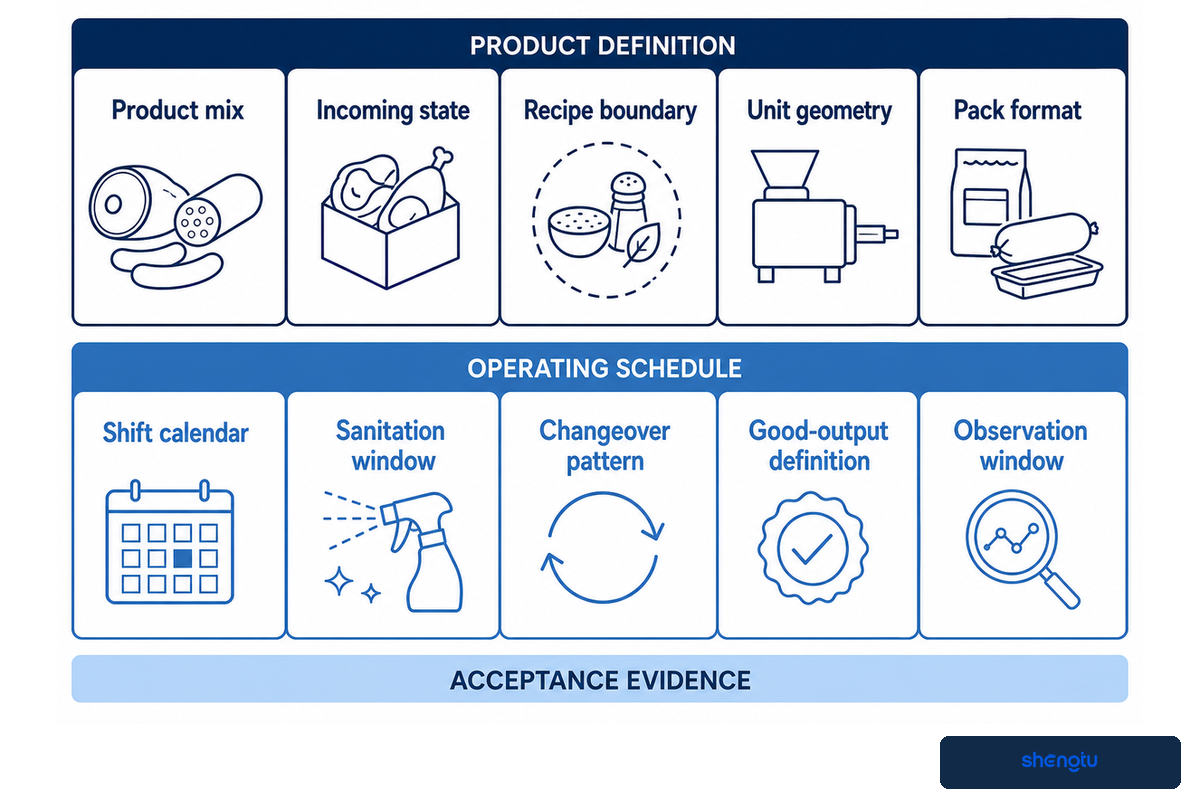
A supplier-sizeable basis defines product mix, incoming condition, recipe boundary, package format, operating calendar, sanitation, changeovers, accepted output and the test window. Kilograms per hour alone hides the very conditions that determine equipment duty, batch synchronization, buffer size, pack availability and whether two proposed lines are genuinely comparable. FAO’s equipment-selection guidance notes that selecting a cutter with the right capacity and efficiency is not always easy; the broader planning lesson is to define the operating and acceptance conditions behind any capacity figure.
What equipment is included in a sausage production line?
The correct answer must be expressed by function, not by model list example. Some examples of functions are frozen-block reduction, grinding, bowl cutting or emulsifying, mixing, vacuum filling, linking or clipping, hanging or loading, smoking/cooking, chilling, peeling, inspection, weighing, orientation, primary packing, coding and secondary handling. Each function must be provided with an inlet and outlet state and acceptance tests.
| Basis field | What to declare | What it sizes | Hidden failure if omitted |
|---|---|---|---|
| Product mix | Share of shift by SKU, route and sequence | Weighted duty and changeovers | Peak SKU replaced by an annual average |
| Incoming state | Cut, particle size, frozen/chilled condition and container | First handling and preparation stage | A grinder inherits an undefined feed problem |
| Recipe boundary | Ingredient additions, water/ice, allergen and hold rules | Batch mass, mixing, dosing and segregation | Nominal batch cannot be repeated safely |
| Unit geometry | Diameter, length, mass and permitted distribution | Filling, linking, hanging, peeling and count | A kg/h claim hides unit-count load |
| Pack format | Units/pack, pack mass, film/tray, atmosphere and case pattern | Orientation, accumulation and packaging cycle | Packaging becomes the real bottleneck |
| Shift calendar | Clock hours, breaks, planned stops and days/week | Required accepted average | 480 clock minutes treated as 480 run minutes |
| Sanitation window | Disassembly, wash, inspection, release and reassembly scope | Access and daily availability | Production rate cannot recover lost cleaning time |
| Changeover pattern | From/to SKU, frequency, clean level and first-off checks | Tools, recipes, buffers and schedule | One fast test SKU masks mixed-day losses |
| Good-output definition | Identity, process, quality, package and release criteria | Accepted output and reject route | Gross filler discharge counted as saleable product |
| Observation window | Trial duration, start/stop rule and included events | Evidence confidence | A short burst is presented as sustained performance |
Consider a realistic plan example, not a performance promise. During an 8-hour shift, there are 480 clock minutes. Based on the above example, allowing for 45 minutes for sanitation and release, 30 minutes for a meal, 20 minutes for breaks and 30 minutes for two changes of mixed product, a total of 355 minutes would be available. A target of 1,800 kg accepted packed output therefore needs about 5.07 kg/min of saleable flow.
That 5.07 kg/min isn’t a machine specification. At 96% conforming product, roughly 75 kg still needs a disposition; at 92% pack availability, upstream equipment needs a controlled buffer, stop or lower synchronized rate. A faster filler merely moves the queue.
The basis should also say whether automated production is intended for continuous commercial use or whether small batches dominate the schedule. A packing machine and conveyor must be verified with the real pack timing. Equipment is easy to clean only if access, drainage, disassembly and verification are defined.
Quality control requires a named defect, a measurement method, a reject route and a record. A high-quality claim becomes testable only after limits and sampling are stated. Full customization likewise requires a defined scope and witnessed acceptance.
The hidden bottleneck map should test at least five constraints: batch preparation, filler/linker rate, smokehouse slot timing, cooling release and primary packing. Batch and continuous phases of a single line must reconcile within the same 355 minute window. Procurement owns comparability, Production owns the schedule, Quality owns acceptance and the project engineer owns the physical balance.
A dimensioned trial basis might state 22 mm diameter, 120 mm length, 50 g unit mass, a 500 kg batch, 6 kg/min saleable flow, 60 packs/min, 8 hours of shift time, 45 min sanitation, 30 min changeover, 2–4°C incoming product, 400 V at 50 Hz, 6 bar air, 30 L/min water, an 80 kW connected load and 24 hours of log retention. Replace every value with the real project basis.
Evidence capsule: An 8-hour published nameplate statement can’t address a 355-minute production basis. The useful dimensions are accepted kilograms per minute, units per minute, batch kilograms, smokehouse cycles per shift, pack availability percentage, and controlled accumulation minutes, all referenced to the same product mix and acceptance criteria.
Choose the Casing Route and Its Downstream Consequences
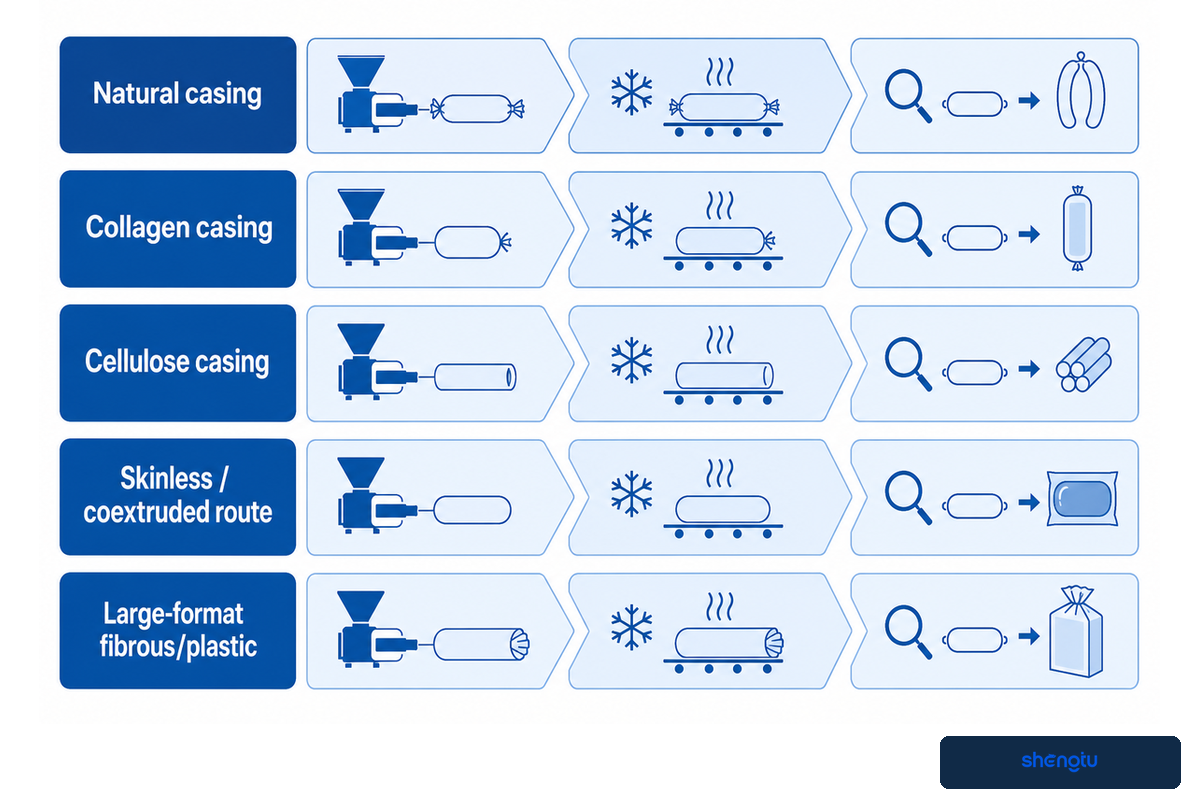
Casing is a route decision because it alters stuffing behavior, linking, and support during thermal processing and the movement of smoke and moisture, cooling, peeling and final presentation. Correct the intended casing and finish before comparing downstream machinery; otherwise the same line drawing may conceal a peeler, an exposure step, or incompatible handling conditions.
A peer-reviewed article treats casings as functional materials. FAO guidance links casing selection with product size, stuffing, smokehouse handling and peeling. Performance still requires trials with the actual formulation, casing, diameter and process.
| Route | Filling / linking | Thermal / cooling consequence | Finish and inspection | Changeover evidence |
|---|---|---|---|---|
| Natural casing | Preparation, diameter variation and linking response | Product-specific permeability and support | Edible finish; visual and breakage checks | Soak/preparation, horn/tool and first-off sample |
| Collagen casing | Specified caliber, strand condition and linking | Support and process compatibility by product | Edible or non-edible grade must be explicit | Grade, diameter, tension and break criteria |
| Cellulose casing | High-uniformity stuffing with controlled tension | Surface formation and cooling affect peelability | Peel, detect residue, inspect surface and orient | Peeler settings, loss, residue and exposed-product controls |
| Skinless / coextruded route | Forming chemistry and equipment are part of the route | Set, cook and chill sequence must be demonstrated | Surface integrity and transfer control | Recipe, diameter, set condition and cleaning |
| Large-format fibrous/plastic | Clip, net or mold interface and fill pressure | Longer center heating and cooling path | Whole-piece release or controlled slicing | Diameter, clip, mold, demold and slice trial |
The chain is casing → fill behavior → link or clip → load support → heat/smoke transfer → cooling → peel or retained finish → inspection → pack orientation. Acceptable conditions should be placed at each of the above arrows. For a 22 mm hot dog and a 28 mm sausage, “same casing family” does not prove the same filler, cook, cooling or pack result.
Industrial food-processing machinery should be compared using route evidence, not by whether a listing calls one device an automatic sausage system or a stand-alone component.
For operations that peel, slice, or repackage ready-to-eat products after lethality, determine if it creates post-lethality exposure in the applicable jurisdiction. In the United States, 9 CFR 430.1 defines that boundary, and 9 CFR 430.4 sets control alternatives for the covered product. Not every casing route has the same classification; the plant’s qualified food safety team must determine applicability.
Evidence capsule: FAO notes that an emulsifying mill may add about 2.5–4.5°C and advises an inlet below 10°C in that described process. It is for that reason that casing and the downstream finish cannot be disconnected from the upstream batter condition and thermal load and the product trial used for acceptance.
Separate the Ham Route from the Frankfurter Route
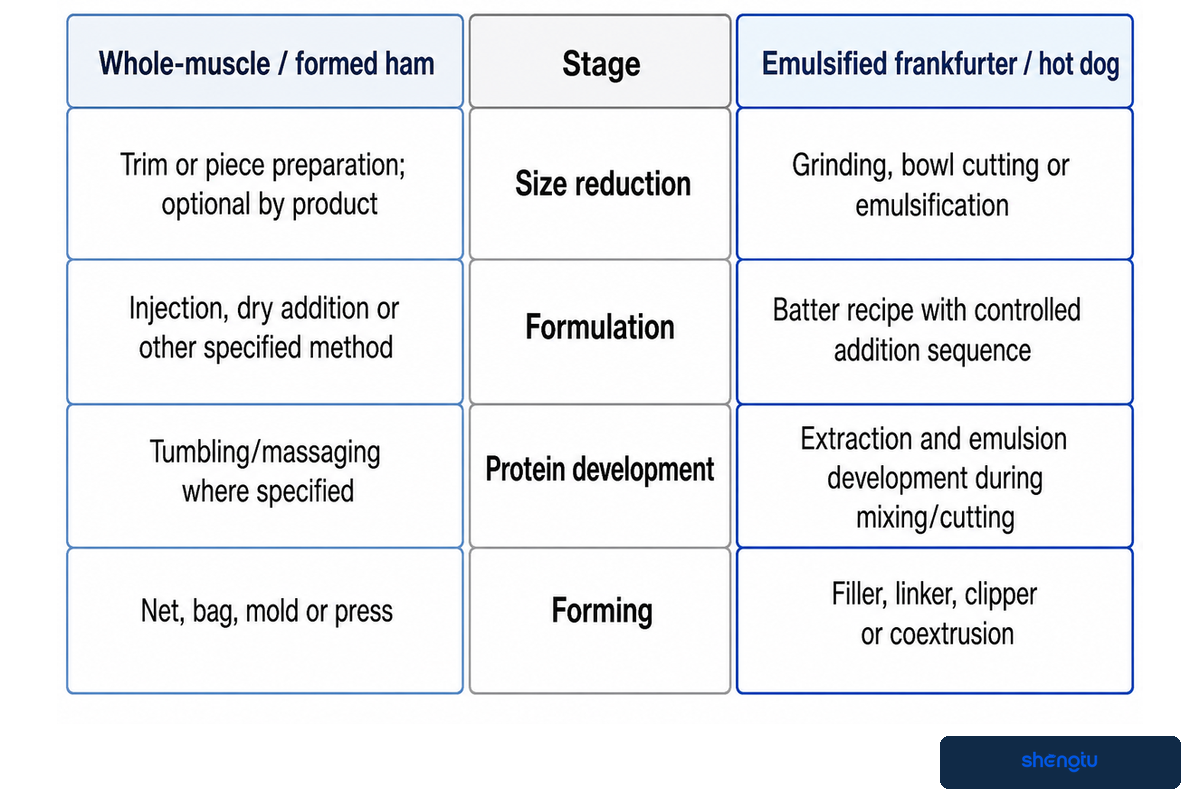
Ham and frankfurter routes can share selected utilities, thermal assets or packing equipment only after their different structures and preparation stages are defined. Whole-muscle or formed ham needs a muscle-preparation and shape basis; frankfurters need a comminution or emulsion, filling and casing basis. A software recipe can’t fill the gap of missing mechanical steps and batch times.
Can one line make sausage, hot dogs and ham?
One project can support all three families when it uses validated shared modules plus deliberate bypasses, change parts, dedicated preparation equipment and controlled changeovers. It is not one fixed route. The supplier should mark every stage as shared, conditional or dedicated and demonstrate the most demanding planned product on representative material.
| Stage | Whole-muscle / formed ham | Emulsified frankfurter / hot dog | Ownership label |
|---|---|---|---|
| Receiving | Defined muscles or pieces | Defined lean/fat raw materials | Shared only if segregation and condition fit |
| Size reduction | Trim or piece preparation; optional by product | Grinding, bowl cutting or emulsification | Dedicated/conditional |
| Formulation | Injection, dry addition or other specified method | Batter recipe with controlled addition sequence | Dedicated process function |
| Protein development | Tumbling/massaging where specified | Extraction and emulsion development during mixing/cutting | Dedicated |
| Forming | Net, bag, mold or press | Filler, linker, clipper or coextrusion | Dedicated |
| Thermal step | Load geometry and center response drive the cycle | Diameter, load and casing route drive the cycle | Potentially shared after validation |
| Cooling | Large product geometry and mold/support matter | Linked units, shower/chill and peel condition matter | Potentially shared only by proven load |
| Finish | Demold, denet, slice or whole-piece pack | Peel or retain casing; inspect and orient | Dedicated/conditional |
| Packing | Whole piece, slice stack or food-service pack | Counted units, bulk or retail pack | Shared only when format and timing match |
The intended product identity is included in accepted outputs. In the United States, 9 CFR 319.104 distinguishes cooked-ham identities using protein-fat-free and added-water conditions. This is a scoped example, not a worldwide formulation rule. It shows why the route brief should name the intended product and label category before the injection, formulation, forming and acceptance steps are finalized.
A formed meat product line provides a useful contrast: sharing mixers or packers doesn’t make a patty-forming route equivalent to ham molding or hot-dog linking. Function and product state decide the boundary.
Evidence capsule: A 150 mm ham mold and a 22 mm frankfurter can enter the same building yet impose very different center-heating, cooling, handling and pack timings. The critical comparison isn’t “one smokehouse”; it’s the validated load, cycle, recovery, identity and accepted output for each product family.
Validate Hygiene, Thermal Processing, Cooling, and Packaging
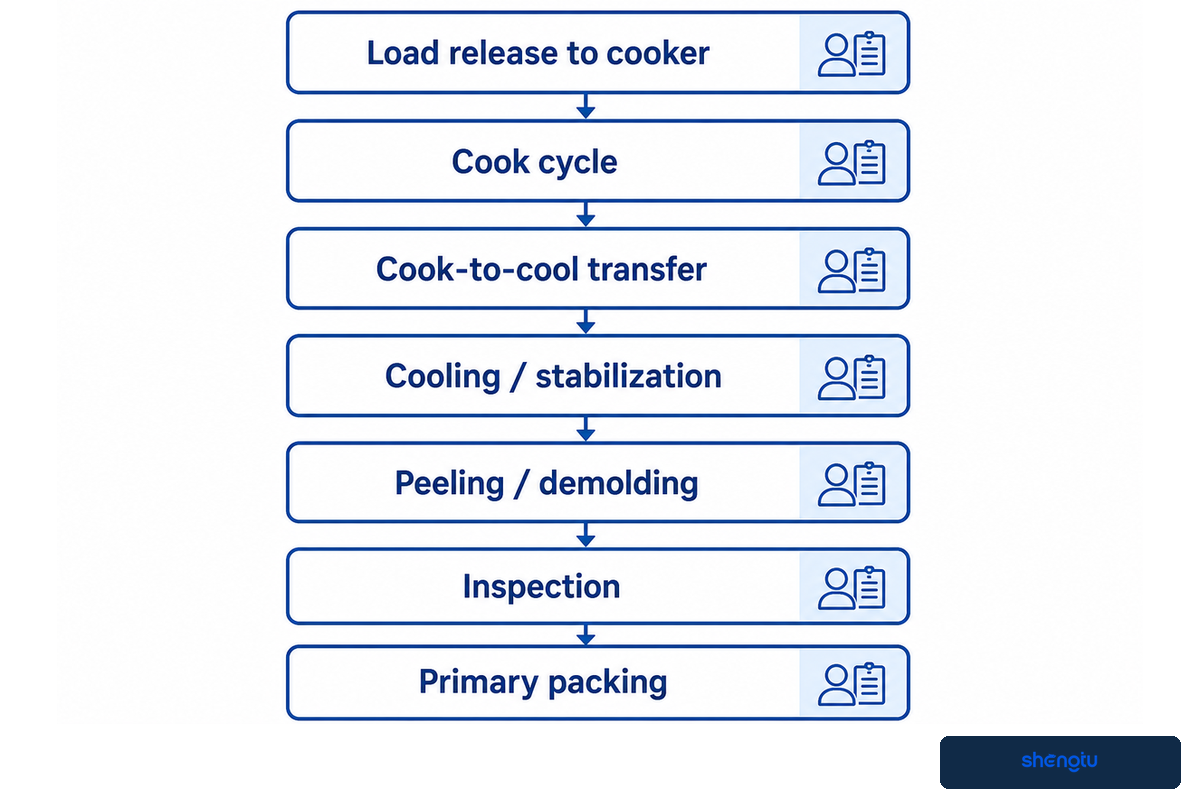
Equipment capability doesn’t validate a food process. The buyer must combine cooking, cooling, peeling and packing with product-specific scientific support, monitoring and corrective actions, and protected handling. A smokehouse rating or stainless-steel frame can support that system, but neither proves lethality, stabilization, hygienic release or post-lethality control.
How should a smokehouse be specified?
Identify the characteristic product (size, shape, load), rack or trolley configuration, batch weight, airflow and humidity strategies, heating and smoking methods, utility limits, probe and record control, access for cleaning, alarm settings and required trial evidence. The validated schedule for the plant, not a blog or an equipment recipe, describes the operating conditions.
| Handoff | Evidence to define | Typical owner | What equipment alone cannot prove |
|---|---|---|---|
| Load release to cooker | Product, load map, start condition and lot | Production + quality | That the load matches scientific support |
| Cook cycle | Validated parameters, sensor locations and record | Food-safety team | Lethality for every product/load variant |
| Cook-to-cool transfer | Maximum transition time and disposition on delay | Production + quality | That movement stays inside the supported process |
| Cooling / stabilization | Product response, environment, time and record | Food-safety team | A universal cooling curve |
| Peeling / demolding | Exposure classification, surface and foreign-material checks | Quality + sanitation | Post-lethality control adequacy |
| Inspection | Defects, challenge method, reject and reconciliation | Quality | Coverage of unknown hazards or defects |
| Primary packing | Product condition, seal, atmosphere/vacuum and coding | Packaging + quality | Shelf life or seal integrity for every format |
| Held / rejected product | Identity, physical control, evaluation and disposition | Quality | That a reject device prevents commingling |
| Sanitation release | Disassembly, cleaning, verification and pre-op record | Sanitation + quality | That clean-looking surfaces are hygienically ready |
Current FSIS guidance is useful because it tells a specific establishment to set supported limits and parameters rather than copy a universal recipe. It shouldn’t be adopted as a universal recipe. A 2021 notice removes the recommendation to cool product from 120°F to 80°F within 2 hours. Including this outdated recommendation in purchasing specifications would be inappropriate.
Hygienic design is more than “stainless steel.” There can be surfaces that are rough, cracked, or dead spaces that aren’t drainable, and inaccessible zones that are hard to clean. Ask for material compatibility, surface treatment, self-draining geometry, 360-degree access where required, tool-free or controlled disassembly, cleanable framework and an agreed sanitation-recovery trial.
In U.S. ready-to-eat operations, 9 CFR 430 makes post-lethality exposure a separate control question. Cleanability supports that system; applicable law, hazard analysis, environmental controls and validation remain with qualified plant personnel.
Evidence capsule: The withdrawn 120→80°F / 2-hour shortcut is a concrete warning against stale specifications. Acceptance criteria should describe the product, load geometry, operating parameters supported, sensor accuracy, cooling record, deviation response, and post-lethality route rather than dealing with a historic temperature pair as if it were universal.
Compare Proposals on a Proven-Output Basis
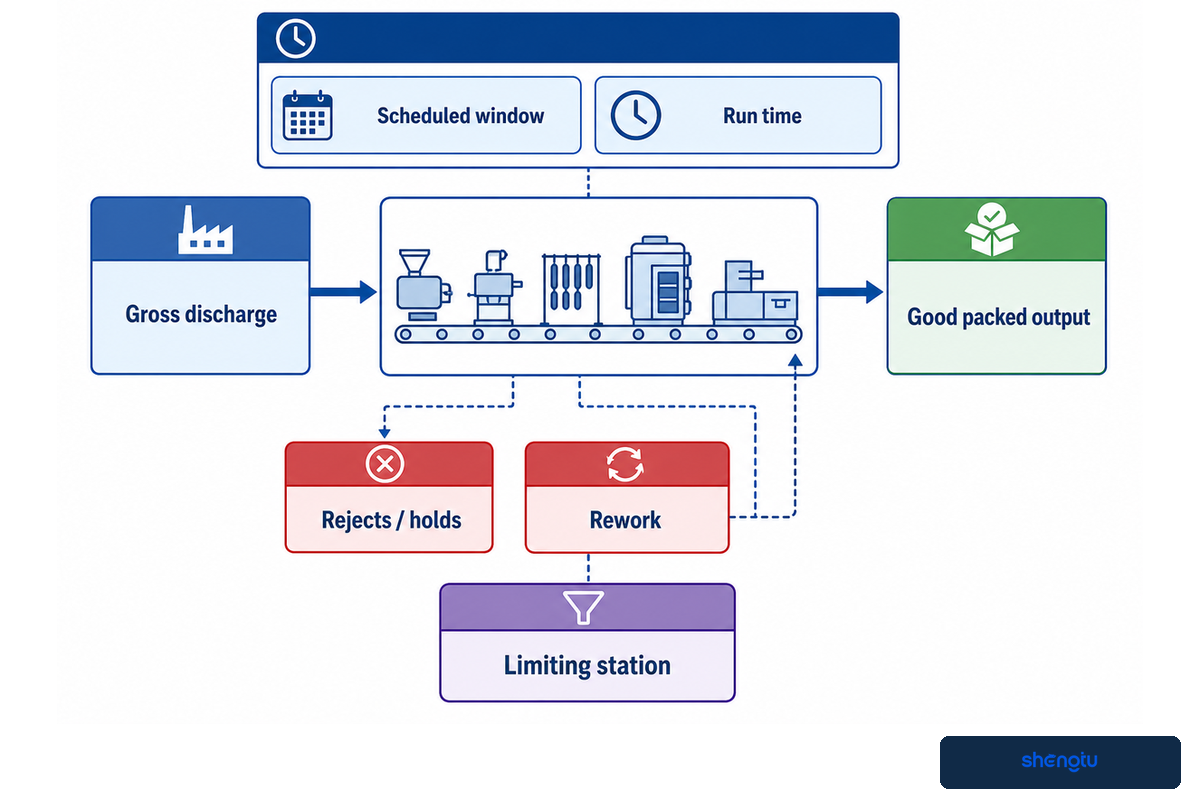
Normalize all proposals to the accepted packed product over the same declared observation window. Document product mix, recipe and incoming state, quality and identity, rejects, reworks, changeovers, sanitation, packaging constraints, and the limiting station. A nameplate rating, a short demonstrated rate, and accepted packaged product after agreed quality, identity, loss, and time rules are three different evidence classes.
Nominal-to-Saleable Throughput Test
| Ledger field | Required unit / statement | Factory-test evidence | Comparison risk |
|---|---|---|---|
| Product identity | Named SKU/category and formulation boundary | Approved trial material and specification | Different products compared as one |
| Incoming condition | Temperature, particle/piece state and container | Receiving checks and batch record | Easy feed substituted for real feed |
| Product mix | % by SKU and run sequence | Witnessed mix or bounded single-SKU result | Fastest SKU becomes the headline |
| Scheduled window | Clock minutes and start/stop rule | Timestamped test log | Burst rate extrapolated to 8 hours |
| Run time | Minutes inside the agreed operating state | State/alarm history | Stopped time silently removed |
| Gross discharge | kg/h and units/min at a named boundary | Calibrated mass/count record | Filler output called line output |
| Good packed output | Accepted kg and packs over the window | Signed quality and pack reconciliation | Uninspected work-in-process counted as saleable |
| Rejects / holds | kg, units, reason and disposition | Reject log and physical reconciliation | Loss disappears from the rate |
| Rework | kg, route, repeat passes and status | Lot-linked rework record | Same mass counted twice |
| Changeover | From/to SKU, minutes and first-good rule | Timed change with first-off approval | Mixed-day demand priced as a long campaign |
| Sanitation recovery | Minutes from stop through pre-op release | Witnessed access and release sequence | Daily availability overstated |
| Limiting station | Named constraint and observed queue/stop signal | Synchronized station log | Largest motor or fastest machine mistaken for capacity |
Use three evidence levels: nameplate capacity is a component rating; demonstrated rate belongs to a named product and window; saleable output is accepted packaged product after agreed quality, identity, loss and time rules. Each level needs additional records.
ISO 22400-2’s public summary reinforces metric discipline by describing manufacturing indicators through their formula, elements, time behavior, unit or dimension and applicable production method. This article’s ledger is not an ISO formula. It applies the simpler lesson that a percentage or kg/h figure is unusable until its numerator, denominator, clock and production boundary are declared.
A 2022 university case reported an initial overall equipment effectiveness of 60.479% for three sausage fillers. The work used 4 weeks of primary data and 4 years of history. That is valuable as a method example, but it is not a target, not a complete-line result and not transferable to another product, pack system or factory.
Evidence capsule: The 60.479% figure belongs to 3 fillers, 4 weeks of primary observation and 4 years of historical context. Preserving all four dimensions is precisely why the result cannot become a universal sausage-line benchmark. Each bidder should be required to submit its own formula, unit, time window and process boundary.
Verify Every Mechanical, Process, and Control Interface
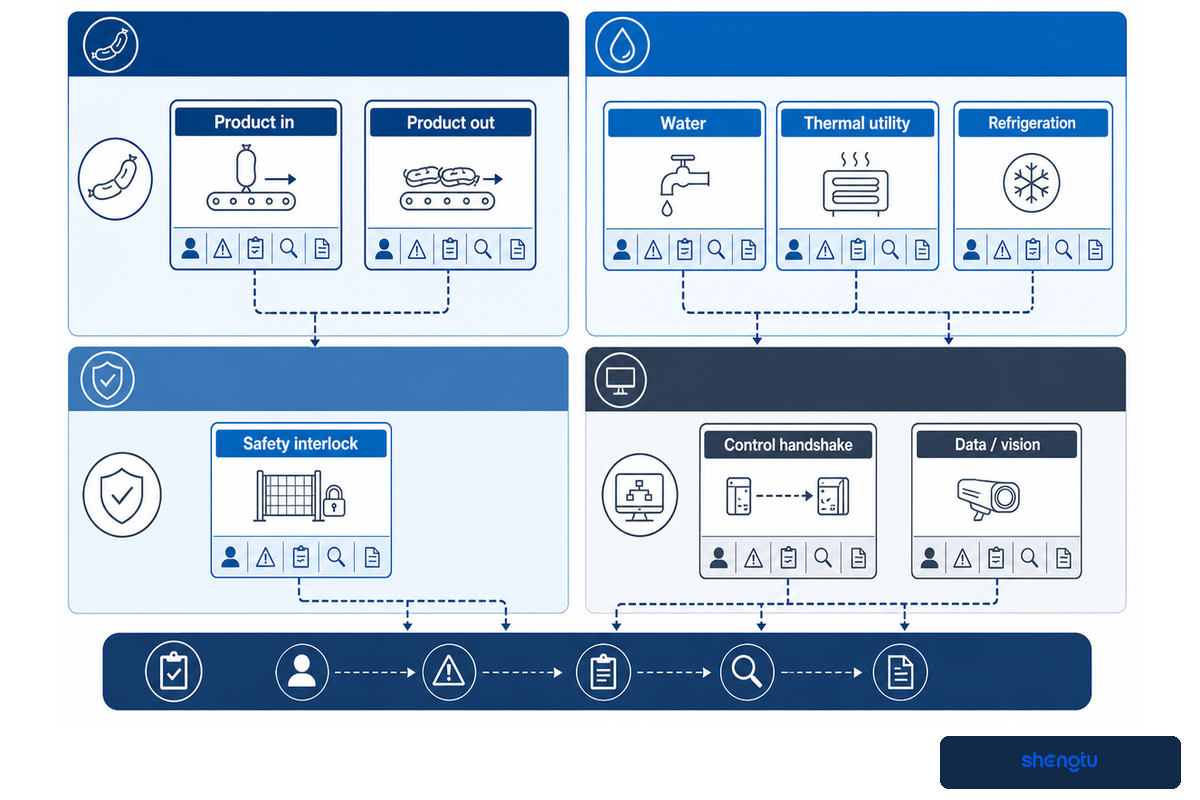
An interface is closed only when its value, connection point, owner, failure behavior, test method and acceptance record are named. Utilities, product handoffs, safety circuits, recipes, protocols, data rights, alarms, vision and update responsibility need to be designed concurrently. Leaving them for commissioning changes scope ambiguity to site delay.
Interface Closure Acceptance Check
| Interface | Value / boundary to declare | Failure behavior | Acceptance evidence |
|---|---|---|---|
| Product in | State, temperature, container, rate and lot signal | Hold, reject or controlled stop | Representative-feed trial |
| Product out | Accepted state, rate, orientation and buffer | Accumulate, divert or stop upstream | Blocked-downstream test |
| Water | Quality, pressure, flow, temperature and point | Alarm and safe process disposition | Measured demand at 1 agreed operating case |
| Drainage | Peak flow, solids, temperature, air gap and connection | No uncontrolled overflow or backflow | Cleaning-discharge observation |
| Thermal utility | Steam/hot water/electric duty and quality | Controlled cycle abort/hold | Worst planned load test |
| Refrigeration | Medium, supply/return condition and heat load | Alarm, hold and product disposition | Defined cooling-load run |
| Compressed air | Quality, pressure, flow and contact classification | Safe stop; no uncontrolled actuator state | Low-pressure recovery test |
| Electrical | Voltage, frequency, load, panel and isolation | Defined restart after power loss | Load and restoration test |
| Safety interlock | Device, protected hazard and reset owner | Safe state without surprise restart | Cause-and-effect challenge |
| Control handshake | Ready/run/block/fault states and protocol | Coordinated hold and restart | Normal plus 3 abnormal-state tests |
| Data / vision | Record, image, label, retention, owner and export | Local fallback and auditable gap | Challenge set and data-recovery test |
| Remote update / OTA | Authorization, version, backup, rollback and network boundary | Continue safely or stop in a defined state | Authorized update and rollback rehearsal |
Shandong Shengtu Bufan Intelligent Technology Co., Ltd. states that its scope covers research, manufacturing and whole-plant digital integration for food machinery. The company brief provided states self-manufactured machinery, the STUnit platform, low-code control boxes, multi-protocol gateways, YOLO vision, edge algorithms, standalone OTA updates, line integration and IT/OT digital integration. These are first-party statements of capability. Evidence of a particular line’s rate, accuracy, savings or compliance is missing.
The same brief lists 100+ R&D projects, 100+ software copyrights, 7 patents, ISO9001, ISO27001, DCMM Level-2, SRDI SME and Gazelle Enterprise status. Procurement should confirm current certificates, scope, issuing body and proposal relevance. Learn more about Shengtu food-machinery and digital-integration capabilities.
A 2025 review places mature near-term meat industry technologies at about TRLs 7-9 and incorporates Internet-of-Things traceability and AI-enabled visual inspections. This provides the basis for a more serious discussion on technology interfaces rather than a forecast that every plant must implement every element. Each digital function still requires a use case, security boundary, data owner and failure test.
Evidence Capsule: A 12-row register provides more information than the term “smart line” because each row represents a physical or digital boundary, owner, and a test. For controls, challenge at least ready, run, block and fault states and for the update path, demonstrate backup and rollback.
Turn the Basis into a Factory Acceptance Plan
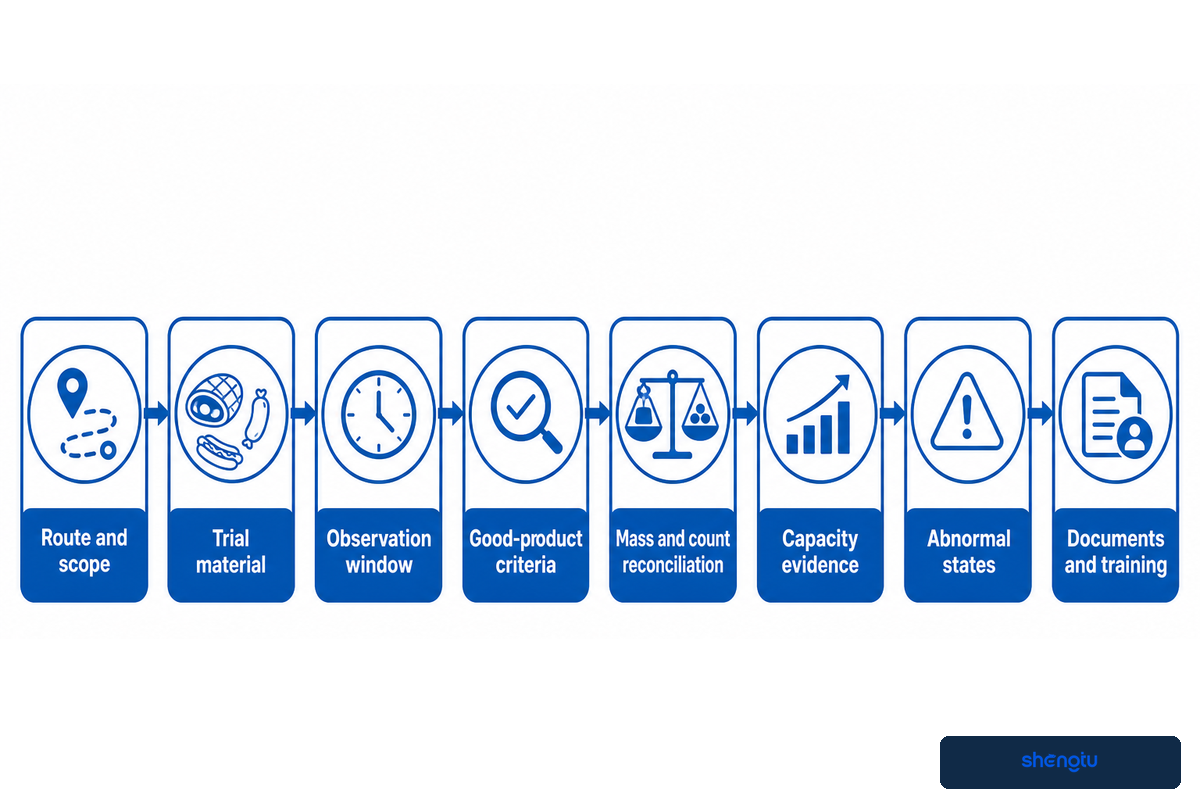
A factory acceptance plan should transform route, line basis, quality rules, hygiene controls, output ledger and interface register into witnessed tests with pass/fail criteria. It should define trial material, duration, measurement, records, deviations, retest rules and open-item ownership before the equipment is built, not after a no-load demonstration.
IEC 62381:2024 provides common terminology for factory, integration, site acceptance and site integration testing of automation process industry systems. That scope supports control system evidence. It does not prove complete-line packaged output, meat-process validation, sanitation recovery or local regulatory compliance.
Factory acceptance checklist for a sausage, ham or hot dog project
- Route and scope: Determine the test SKU, product identity, casing/finish route, included stations, bypasses, and exclusions.
- Trial material: state quantity, condition on receipt, formulation control, casing, packaging material, and the supplier for each item.
- Observation window: includes definition of warm-up, start, stop, planned pauses, and duration such as 120 minutes. This example does not imply that a 120-minute duration fits every project.
- Good-product criteria: describe physical, identity, thermal, sensory/quality, package, label, and release requirements.
- Mass and count reconciliation: Record receipts, work in process, accepted output, holds, rejects, rework and remaining material.
- Capacity evidence: Record kg/h and units/min at limiting station, and at accepted pack-out over the same clock.
- Changeover: witness at least 1 agreed from/to product change, first-good rule, tools, time, purge/cleaning and retained settings.
- Sanitation access: demonstrate disassembly, drainage, cleaning reach, reassembly and pre-op release against the contracted scope.
- Abnormal states: Challenge blocked discharge, low utility, sensor fault, reject-full, emergency stop, power/network recovery.
- Traceability and data: link recipe/version, lot, alarms, inspections, rejects and package records to prove export, retention and ownership.
- Use handshakes to test mechanical fit, product transfer, utility duty, safety circuits and control signals with adjacent systems or simulators.
- Documents and training: reconcile drawings, utility schedules, risk records, parts, backups, manuals and role-based training.
- Punch list: assign an owner to every open item, add a due date, closure evidence, shipping impact and a retest decision to each.
- Site acceptance boundary: include only what can be verified by real-world utilities, room conditions, upstream/downstream equipment and plant personnel.
For U.S. establishments, 9 CFR 417.4 illustrates the separate buyer obligation: the establishment validates and verifies its HACCP plan and reassesses when changes such as formulation, processing systems, production volume or packaging could affect the hazard analysis or plan. A successful automation FAT can’t sign that obligation away.
With the evidence pack complete, use the Sausage / Ham / Hot Dog Line solution for configuration, utility schedules, scope, delivery and quotation. Teams can also submit a product-route and acceptance brief to ensure responses align to the same boundary.
Evidence Capsule: A 120-minute product trial, 1 witnessed changeover and 6 abnormal-state challenges can’t be considered evidence until the product, pass/fail limits, clock treatment, measurement devices, sign-off authority, and retest rules are defined and agreed to by all parties. Test counts create evidence; they do not replace a validated product process or site acceptance.
Frequently Asked Questions
What is the sausage in a hot dog made of?
A hot dog is generally a finely comminuted or emulsified meat product made to a defined formulation and market-specific product identity.
Permitted meat components, ingredients and label terms depend on the recipe and jurisdiction. For line planning, physical structure matters: the process commonly includes controlled size reduction, mixing or emulsification, stuffing or forming, thermal processing, cooling and packing. In the United States, 9 CFR 319.180 provides relevant identity requirements. It should be read for the actual product; this guide does not substitute a formulation or label review.
Does a sausage line support customization?
Yes, when “custom” is translated into product, process, interface and acceptance boundaries.
Define product families, casing route, diameter range, target pack, sanitation method, utilities, controls protocol, inspection points, changeover rules and accepted-output measurement before a supplier proposes equipment. A custom drawing alone does not close the process. The commercial Page owns final configuration and quotation; this guide explains what evidence a buyer should prepare first.
What packing formats are used after sausage or hot dog production?
The format follows the product state, shelf-life system, casing or skinless finish, sales unit and cold-chain plan.
Routes can include bulk bags, tray packs, vacuum packs, thermoformed packs or another validated system. The production-line decision is not simply the packaging machine. Accumulation, orientation, portion count, surface condition, foreign-material or vision checks, seal verification, coding, secondary packing and refrigeration handoffs must all match the accepted final product and release record.
Does casing choice change downstream equipment?
Yes, casing can change cooking support, cooling, peeling, inspection and pack presentation.
Confirm the material, caliber, edible or peelable status, process compatibility and changeover method with representative trials.
How should two suppliers’ capacity claims be compared?
Normalize both offers to the same accepted product, package and clock.
Use the same incoming condition, diameter or unit mass, product mix, packaging format, scheduled time, changeover and sanitation assumptions. Ask what was demonstrated, for how long, where the limiting station was, how rejects and rework were counted, and whether downstream packing was available. If those assumptions differ, the headline numbers are not yet comparable.
What information should a buyer prepare before requesting a proposal?
Prepare the product route, operating basis, site interfaces and acceptance criteria.
Include recipes or physical product definitions, pack formats, target output window, utilities, layout, hygiene zoning, control expectations, trial material, known exclusions and the responsible sign-off roles.
Why We Wrote This
Equipment offers dominate search results for this topic. Meanwhile, buyers must find ways to separate product routes, define saleable output and redefine interfaces as acceptance criteria. Comparisons remain unreliable until buyers define a common planning basis. This article fills that planning gap without replacing the existing solution Page.
Company facts in this guide were supplied by Shandong Shengtu Bufan Intelligent Technology Co., Ltd.
Research and Scope Note
Regulatory text, guidance, and other documents are synthesized in this guide. Standards are summarized. Technical literature is incorporated. Bounded industry examples are included. Shengtu supplied its company profile and capability statements, clearly marked as first-party data. No customer results, installed-line output, savings, yield, or compliance claims are made. Project values require representative trials, local legal review, and the buyer’s validated food-safety system.
References & Sources
- 9 CFR 319.180: Frankfurter, Frank, Furter, Hotdog, Wiener and Bologna Identity
- FAO: Operations in Emulsion-Type Sausage Production
- Peer-Reviewed Review of Sausage Casing Materials
- Peer-Reviewed Evidence on Fermented and Dried Sausage Routes
- 9 CFR 319.104: Cooked Ham Product Identities
- 9 CFR 430.1: Post-Lethality Definitions
- 9 CFR 430.4: Control Requirements for Covered RTE Products
- USDA FSIS: Cooking Guideline for Meat and Poultry Products
- Federal Register: 2021 Cooking and Stabilization Guideline Revision
- Meat Institute: Equipment Sanitation and Hygienic Design Guidance
- ISO 22400-2: Manufacturing KPI Definitions and Descriptions
- University of Lima: Bounded Sausage-Filler OEE Case
- IEC 62381:2024: Factory and Site Acceptance Testing of Automation Systems
- 9 CFR 417.4: HACCP Validation, Verification and Reassessment



![Meat / Poultry / Prepared: Plant Planning Guide [2026]](https://shengtumachinery.com/wp-content/uploads/2026/10/meat-poultry-prepared-processing-guide-featured-768x512.png)

![F&V Freeze-Drying Line Process Guide [2026]](https://shengtumachinery.com/wp-content/uploads/2026/09/fv-freeze-drying-line-guide-featured-150x150.png)