Get in touch with Shengtu Bufan Company

![Meat / Poultry / Prepared: Plant Planning Guide [2026]](https://shengtumachinery.com/wp-content/uploads/2026/10/meat-poultry-prepared-processing-guide-featured.png)
Updated October 2026
Meat / Poultry / Prepared is a planning scope, not a single production-line model. It can mean raw cutting, further processing, cooking, chilled meal assembly, ready-to-eat handling, packaging, or several of those routes under one roof. A useful plant brief begins with the definition of product state, hygiene boundaries, and release criteria, and responsible interfaces. It isn’t useful to begin with a list of machines in the plant.
This guide helps plant owners, engineering teams, quality leaders, and procurement teams define that brief. It covers scope, zoning, line sharing, saleable capacity, utilities, controls, packaging, supplier comparison, and acceptance evidence. Equipment configuration, quotation, and delivery are covered by the existing meat and poultry processing solution.
Meat and poultry processors may ask one site to handle a fresh meat product, several raw meat products, and prepared items. That does not make every route compatible; it makes the boundaries more important for poultry processors and mixed-product teams.
Five decisions should exist before layout work starts
- Which incoming, intermediate, and final product states are in scope
- Where raw, cooked, exposed ready-to-eat, allergen, and packaged states change
- Which rooms, product-contact sections, utilities, and control recipes may be shared
- Which rate represents released saleable output rather than machine cycles
- What evidence will close factory, site, sanitation, and digital-interface acceptance
What Belongs in a Meat, Poultry, and Prepared-Food Plant?
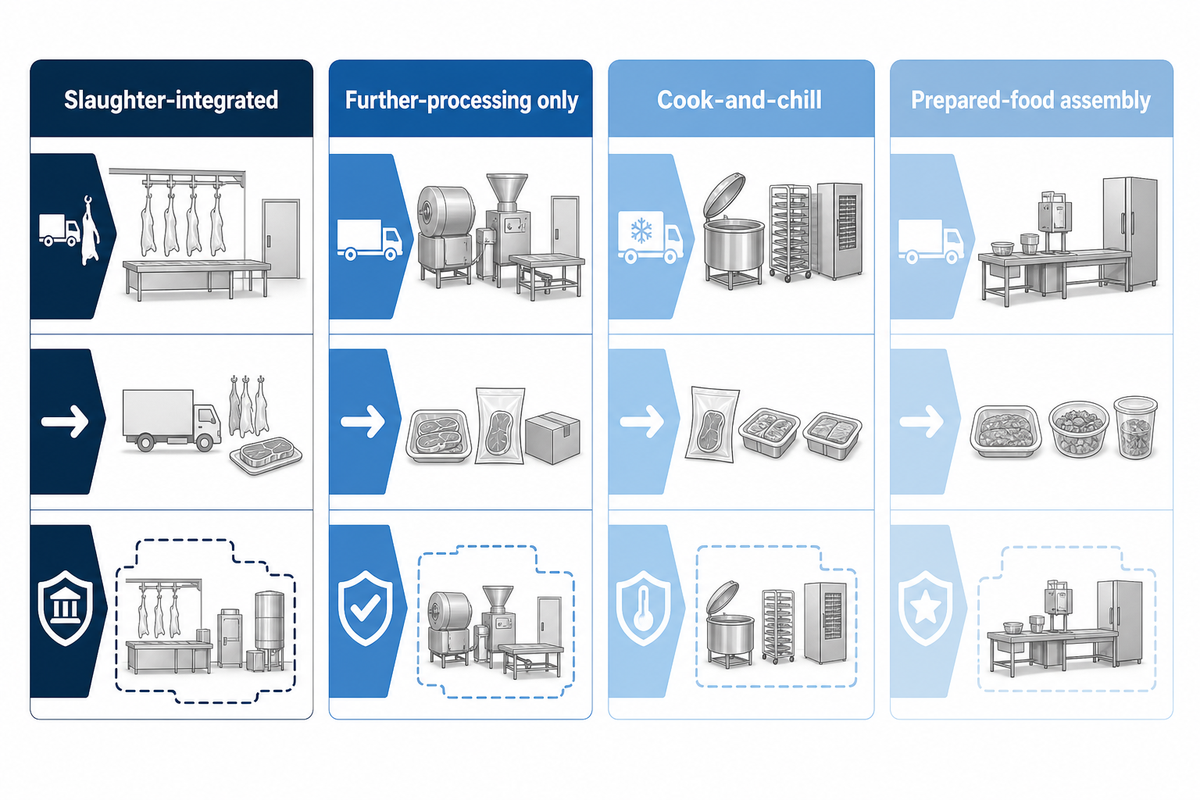
A project boundary should name every included transformation and handoff. “Meat processing plant” may refer to slaughter and dressing, primary cutting, grinding and forming, cooking, cooling, prepared-food assembly, final packaging, cold storage, or dispatch. Those scopes use different hygiene barriers, utilities, regulatory owners, skills, and acceptance tests. Lumping them as one undifferentiated package creates gaps, and equipment quotations bring these to light.
What are the four types of meat processing?
Curing, smoking, cooking, and other similar processes are textbook groupings. These don’t define a project’s capital limits. For plant planning, group each flow based on the state of the product and package. A chicken breast may be received as a boneless item, but the project brief still needs to name its incoming state and package exposure. Example states would be raw, ready-to-cook, fully cooked, exposed ready-to-eat, packaged ready-to-eat, or shelf-stable. Next, identify whether the process includes slaughter, cutting, formulation, thermal processing, cooling, packaging, storage, and dispatch.
FAO guidance separates cutting and further processing from upstream slaughter work and ties clean-area operation to product movement, sanitation, personnel, and contamination control. This explicitly defines a process boundary. It doesn’t specify equipment or impact the rules which apply at the project location.
Regulatory ownership also belongs in the scope map. In the United States, the FDA-FSIS memorandum covers dual-jurisdiction establishments and recognizes that some operations fall exclusively under FSIS. A mixed plant should therefore assign an authority and rule set to each product and operation. A mixed plant handling veal or a broiler should still assign the applicable authority and operating rule to that specific product and operation. Blending FDA preventive-control language and FSIS requirements into one generic “U.S. standard” can create the wrong validation or record obligation.
| Planning archetype | Typical entry state | Typical exit state | Boundary that must be named |
|---|---|---|---|
| Slaughter-integrated | Live animal or bird | Chilled carcass, bird, part, or packed product | Official inspection, humane handling, inedible routes |
| Further-processing only | Inspected meat or poultry input | Formed, marinated, coated, or ready-to-cook product | Supplier handoff, raw zoning, rework ownership |
| Cook-and-chill | Raw or formulated product | Cooled cooked product | Lethality, cooling, post-lethality exposure |
| Prepared-food assembly | Several raw, cooked, and packaged components | Finished meal, tray, pouch, or case | Ingredient authority, allergen status, final release |
Place each handoff on a single page to document the incoming and outgoing state of the product and package exposure, and the zone and control objective. The owner and release conditions should also be noted when a condiment is part of the prepared-food route. Cold storage and dispatch can occur outside of the equipment package, but they still can control the plant schedule.
How Should Raw, Cooked, Ready-to-Eat, and Allergen Zones Be Separated?
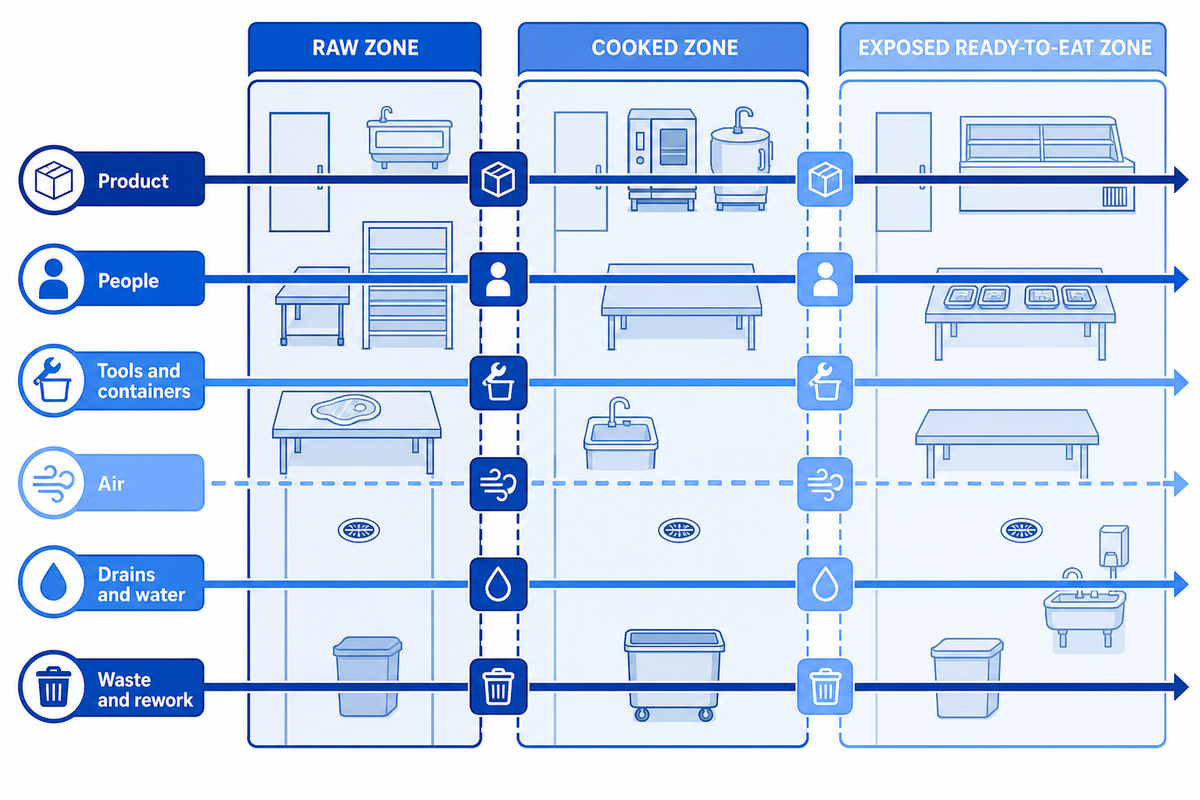
Room names alone do not stop an operator, hose, cart, drain, air path, tool, or waste stream from crossing a boundary. Physical separation may be strongest for one crossing, while time separation, dedicated tools, controlled transfer, or a documented cleaning sequence may be defensible for another. The plant’s hazard analysis and local rules determine the best defense in combination.
How should meat and poultry be stored?
Storage is determined by state of the product, temperature control plan of the plant, exposure of the package, status of allergens, hold or release, and path of traffic. The storage plan should record a chicken product and a chicken and beef recipe separately when their exposure, allergen, hold, or release status differs. Raw materials, cooked and exposed product, packaged RTE products, rework, allergens, retained lots, and released stock may require different storage and controls. Consumer refrigerator advice doesn’t determine factory set point, dwell limits, or segregation.
The Georgia Department of Agriculture states that product should move “from highest to lowest potential exposure to contamination.” Its facility guidance also moves people and air from cleaner toward less-clean areas and calls for physical separation around exposed cooked operations. The useful lesson is directional control across several flows, not a claim that one pressure pattern fits every building.
Product state changes after lethality. Post-lethality-exposed ready-to-eat products fall under the FSIS rule, where the applicable control alternative determines the required testing, hold, rework, documentation, and release procedures. The rule is not universal outside its scope, but it demonstrates why “cooked” and “released for sale” are not the same status.
Equally important are considerations regarding allergen controls. The current 21 CFR 117.160(c)(1) states food allergen controls under § 117.135(c)(2) are exempt from validation. That exemption does not decide a facility’s product sequence, cleaning method, monitoring, verification, or label controls. Measures pertaining to these are to be obtained from the appropriate rules and the facility’s Food Safety Plan. Facilities may, however, perform extra studies if their risk assessment justifies it.
The plant may use a dedicated or shared cleaning and CIP route, but the selected method still needs access, chemistry, flow, residue, verification and release criteria for that product-contact system.
Microbial hazards such as Salmonella and physical hazards such as foreign material require plant-specific assessment and controls. Calling a product “safe to eat” is a release conclusion based on the applicable plan and records, not a layout label.
| Flow | Boundary question | Possible control | Evidence and owner |
|---|---|---|---|
| Product | Is product raw, cooked, exposed, packaged, held, or released? | Wall, pass-through, covered transfer, schedule | Flow drawing; food-safety lead |
| People | Where do boots, hands, clothing, and visitors cross? | Access control, change point, one-way route | Traffic observation; operations owner |
| Tools and containers | Are knives, racks, trays, and bins dedicated or returned? | Color coding, washer, controlled return | Inventory and cleaning record; sanitation |
| Air | What opens together and where can condensate form? | Pressure strategy, capture, door logic | Air study; facilities engineer |
| Drains and water | Can flow, splash, or hoses cross toward exposed product? | Drain zoning, slope, curbs, hose discipline | Wet-clean trial; engineering and sanitation |
| Waste and rework | Where do rejects, inedible material, and rework travel? | Closed route, identity, time limit, disposition | Route challenge; quality and production |
The Shared-Line Proof Test: What Can Share a Section?
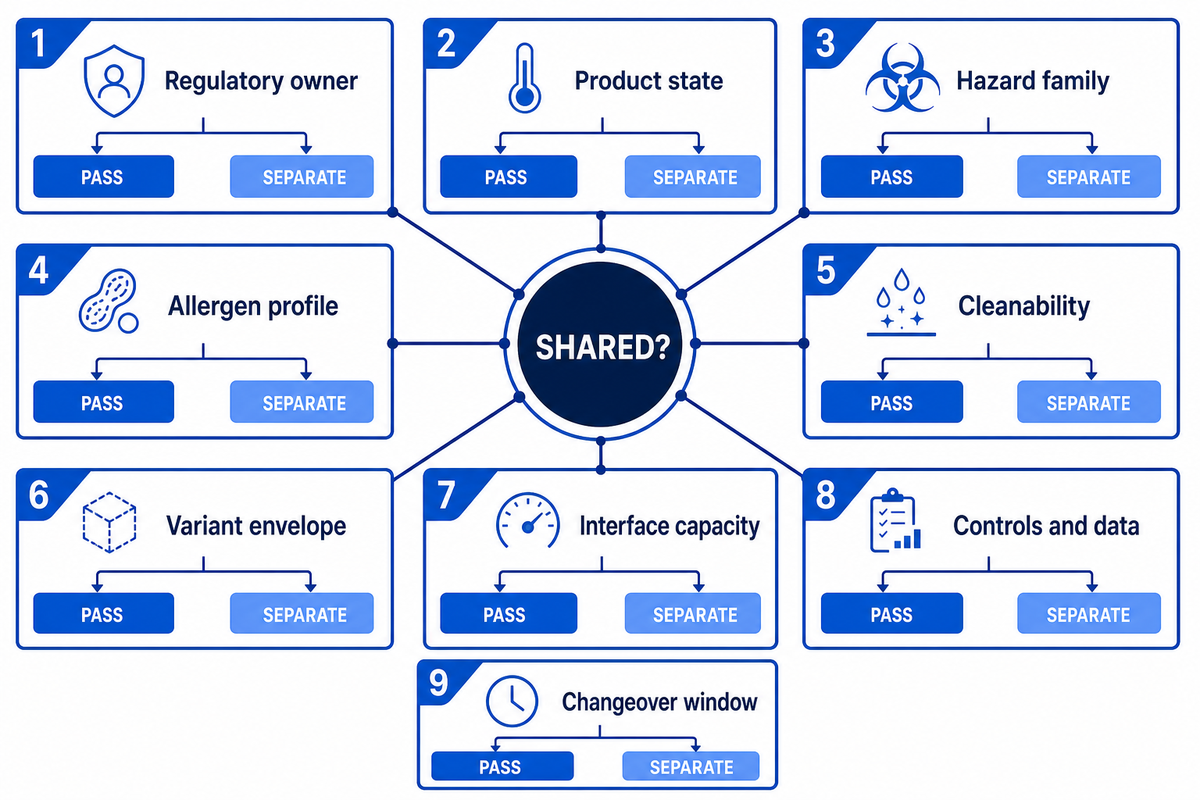
The Shared-Line Proof Test is a branch test for rooms, contact equipment, tools, utilities, control recipes, packaging sections, and data systems. Sharing is approved only for the item actually tested. Marinated chicken and sausage should each pass the Shared-Line Proof Test before rooms, product-contact sections, or control recipes are treated as common. A common steam header may be acceptable while a shared open-product conveyor is not. Similar frame geometry may prove mechanical fit; however, it says nothing about hazards, residues, allergens, exposure, and release. The Georgia Department of Agriculture facility-layout guide gives a useful flow check: product should move toward lower contamination exposure, while air and people move from cleaner to less-clean areas.
| Decision category | Evidence question | Pass evidence | If failed or unknown |
|---|---|---|---|
| 1. Regulatory owner | Do the routes have compatible jurisdiction and operating conditions? | Mapped authority and approved scope | Separate review before design |
| 2. Product state | Are raw, post-lethality, exposed, and packaged states compatible? | Defined transition and barrier | Dedicated route or barrier redesign |
| 3. Hazard family | Can the same controls manage the identified hazards? | Plant hazard-analysis rationale | Dedicated control or new validation |
| 4. Allergen profile | Is the worst-case sequence and label route controlled? | Sequence, cleaning, verification, label proof | Dedicated use or documented trial |
| 5. Cleanability | Can every relevant surface be accessed, cleaned, checked, and restored? | Method, time, verification, release rule | Redesign access or dedicate equipment |
| 6. Variant envelope | Do size, viscosity, coating, temperature, and package variants fit? | Worst-case sample trial | New tooling or separate module |
| 7. Interface capacity | Can upstream, buffer, thermal, cooling, and pack-out sections sustain the mix? | Normalized rate and accumulation test | Resize, reschedule, or split campaigns |
| 8. Controls and data | Are recipe, alarm, lot, reject, and access rules isolated? | Versioned recipe and traceability test | New controls boundary and ownership |
| 9. Changeover window | Does the planned campaign leave enough verified change time? | Observed changeover within schedule | More campaign time or dedicated asset |
Quality owns neither utility capacity nor code access by default; engineering does not own product release simply because it installed the line. An unknown result isn’t a pass. Route it to a trial, a redesign, or dedicated use, and record who closes it.
Smoked chicken, chicken wings, sous-vide products, and pre-cooked components can place different demands on exposure, residue, cooling, and packaging. Their presence on the same sales plan doesn’t allow a shared product-contact section to bypass the nine branches.
What Actually Sets Saleable Line Capacity?
Brochure capacity becomes comparable only after all bidders use the same product, unit, time basis, yield boundary, changeover window, package, and release definition. Until converted to the same released-saleable basis, comparisons between a cart cooker, a depositor, and a fryer aren’t valid.
How do throughput, yield, changeover time, thermal dwell, and packaging rate determine real line capacity?
The speed of the slowest normalized station limits output. Campaign changeover, thermal residence, batch cycles, packaging, rejects, holds and releases all factor in as well, along with available time. The fastest machine is of no consequence if it blocks on downstream interfaces or is starved for input. Start with a first order rate screen and test finite buffers. Then move to scheduling, accumulation and release.
Saleable-capacity screening equation
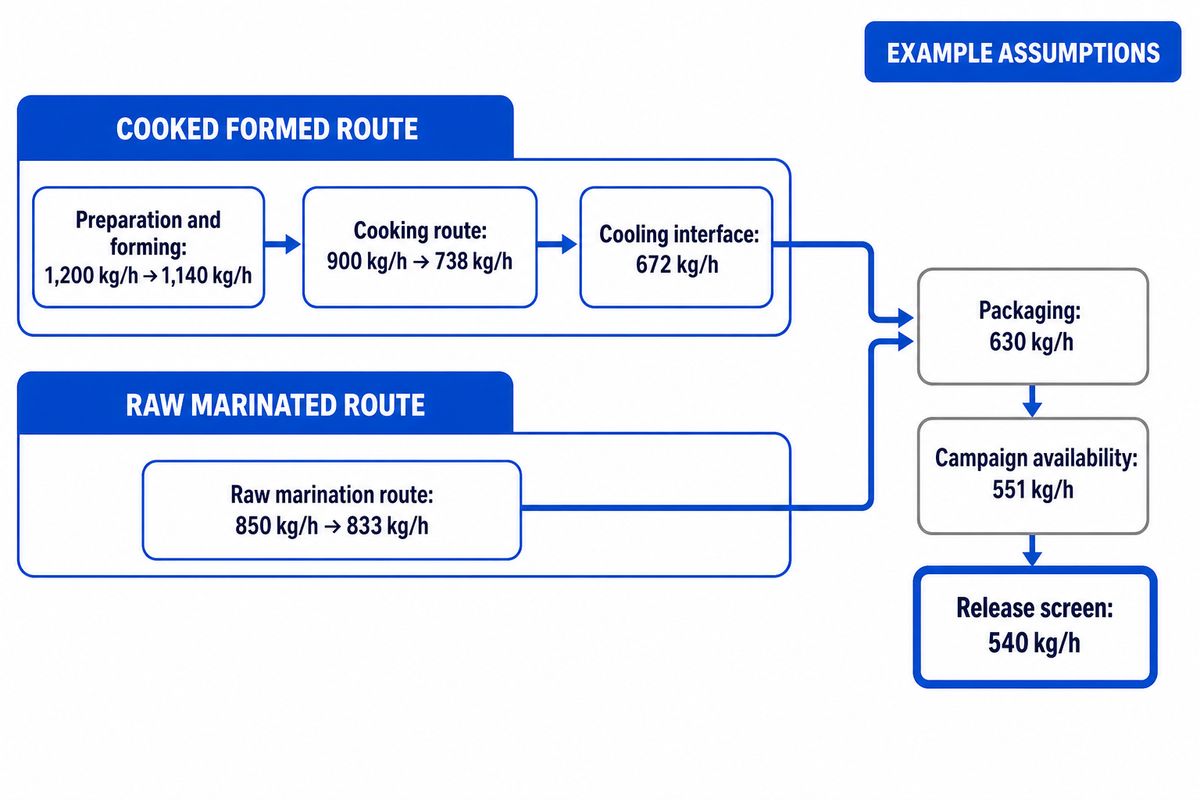
Released saleable rate = min(normalized station rates) × availability × mass yield × release factor
Use this only as a first screen. Then model campaign sequence, finite buffers, starvation, blocking, thermal batches, cooling, holds, rework, and package changeovers.
NIST’s abstract on multi-product production lines models machine reliability, dedicated finite buffers, and priority, cyclic, or work-in-process scheduling. It suggests a helpful adjustment to a systems analysis: The lowest isolated station rate isn’t, by itself, the final system production rate. No food-related factor from that model is used in this example.
A filled mixed-product example
Assume a planned 8-hour shift with 420 available production minutes after breaks and scheduled sanitation. The example mix consists of 60% cooked formed product and 40% raw marinated product. The values shown are example assumptions and not Shengtu (or supplier) performance data.
| Interface | Assumed gross basis | Adjustment | Screened saleable basis |
|---|---|---|---|
| Preparation and forming | 1,200 kg/h | 95% mass yield | 1,140 kg/h |
| Cooking route | 900 kg/h gross | 82% assumed cooked yield | 738 kg/h on cooked route |
| Raw marination route | 850 kg/h | 98% assumed yield | 833 kg/h on raw route |
| Cooling interface | 14 racks × 48 kg | 1.0 accepted cycle/h assumed | 672 kg/h cooked route |
| Packaging | 42 packs/min × 0.25 kg | 60 min/h | 630 kg/h |
| Campaign availability | 420 of 480 min | 87.5% | 551 kg/h equivalent at packaging |
| Release screen | 551 kg/h produced good | 98% illustrative release factor | 540 kg/h released saleable |
Packaging is currently the rate-limiting step; however, the answer isn’t yet a plant promise. A 10-minute buffer can’t absorb a 35-minute cooker or packer downtime. The campaign needs a schedule that respects the zoning of raw and cooked product and changeover. Release holds can also allow produced good output to exceed released good output. Replace all assumptions with plant data and test worst-case SKUs before quoting capacity.
How Do Utilities, Controls, and Packaging Interfaces Change the Layout?
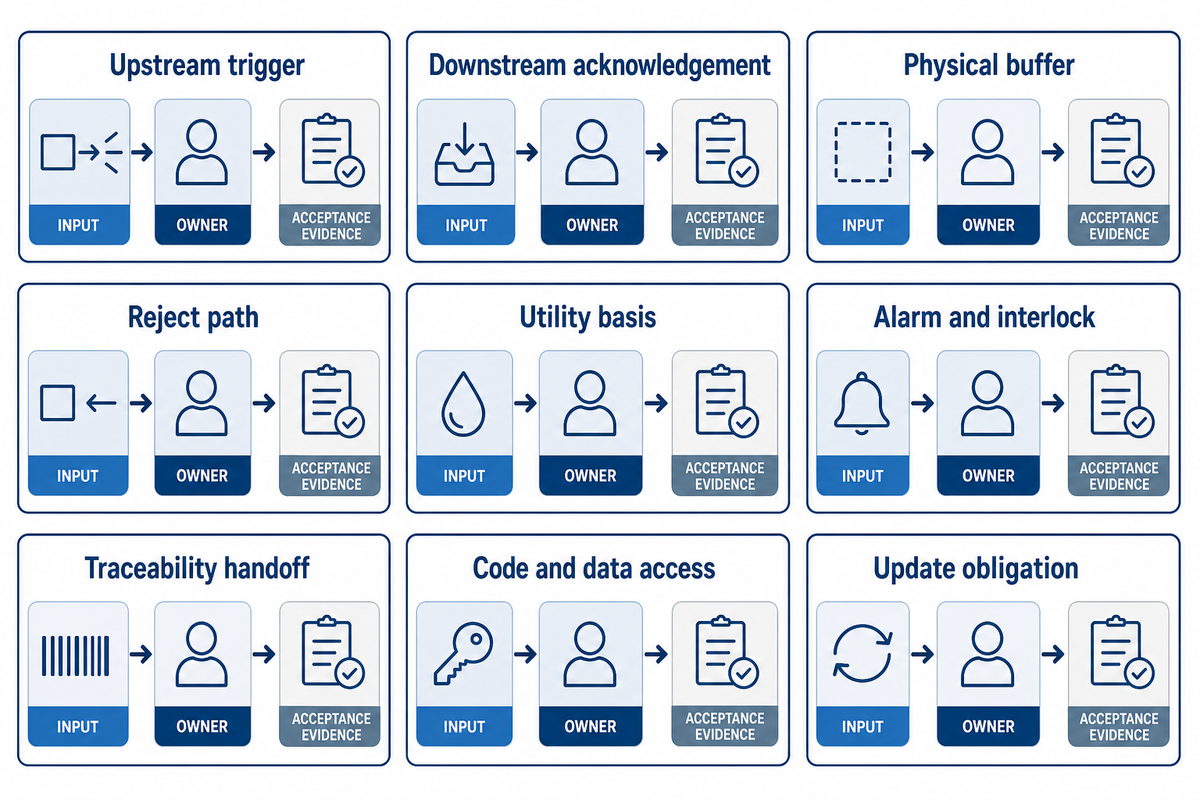
Process flow may look correct while the supporting systems make it unbuildable. Simultaneous steam demand, refrigeration recovery, washdown drainage, compressed-air quality, electrical harmonics, label data, film changes, reject paths, and control ownership all consume space or constrain sequence. Vendor boundaries should be drawn at signals and physical handoffs, not at invoice lines.
Oklahoma State University’s FAPC-104 planning guide asks for product, process, packaging, utilities, controls, flows, sanitation, and future-expansion inputs. It also notes that listed elements may not apply, and other elements may need to be added. That limitation is valuable: a field list is a controlled starting point, not a universal design standard.
Shandong Shengtu Bufan Intelligent Technology describes STUnit, standalone over-the-air updates, multi-protocol gateways, YOLO-based vision, edge algorithms, and low-code control boxes among its capabilities; these are first-party capability statements supplied for this project, not guaranteed outcomes for a particular line. A proposal still needs to identify the exact model, data owner, code access, network boundary, update obligation, cyber controls, acceptance method, and failure response.
The site’s automation and IoT scope can be reviewed as an integration option only after those ownership fields are fixed.
| Interface field | Record before layout freeze | Acceptance evidence |
|---|---|---|
| Upstream trigger | Ready, lot, recipe, and product-state signals | Normal and missing-signal test |
| Downstream acknowledgement | Accept, block, hold, and fault response | Blocked-line simulation |
| Physical buffer | Units, kilograms, time limit, and identity | Timed accumulation trial |
| Reject path | Containment, lock, rework, and disposition | Challenge piece and reconciliation |
| Utility basis | Quality, pressure, flow, peak, return, and owner | Loaded measurement at site |
| Alarm and interlock | Cause, action, reset, and affected product | Fault-injection record |
| Traceability handoff | Lot, time, recipe, quantity, and disposition | Forward/backward trace exercise |
| Code and data access | Credentials, backup, export, retention, and audit trail | Restore and authorized-access test |
| Update obligation | Approval, rollback, support period, and compatibility | Controlled update/rollback demonstration |
What Data Belongs in the Pre-Engineering Brief?
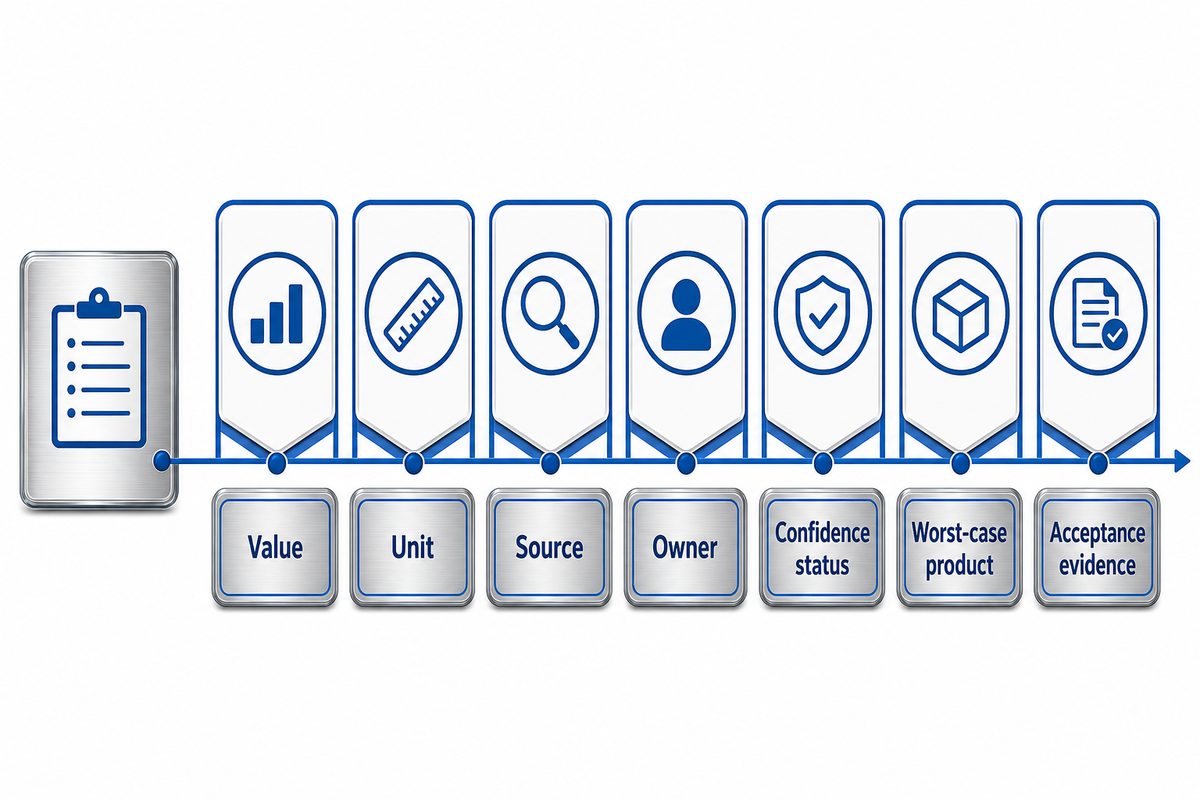
Comparable proposals require controlled inputs. Each field should have a value, unit, source, owner, confidence status, worst-case product, and acceptance evidence. Unknown is an acceptable status; an unstated assumption is not. The brief should also differentiate a planning target from a legal limit, a validated process value, a supplier rating and a site measurement.
14-Field Pre-Engineering Brief Framework
The following framework is a handoff form, not a substitute for engineering. It depicts the scope of decisions made with respect to quality, operations, utilities, automation, packaging and procurement when working in parallel.
What should a buyer prepare before requesting a line proposal?
Prepare product states and recipes, saleable capacity by SKU, campaign sequence, site dimensions, utility quality and peaks, sanitation method, packaging formats, digital interfaces, regulatory owner and acceptance evidence. Give each input a source and confidence level. For a beef and pork recipe or a chicken and pork recipe, the brief should record product state, allergen status, package exposure, and release ownership rather than treating the recipe name as the engineering scope. Mark unknown data as an engineering task or open trial to avoid bidders making incompatible assumptions about similar looking prices.
A meal kit or school meal route may combine ingredients made under different conditions. Record the meal preparation sequence and package exposure instead of treating assembly as an administrative step. Where a sausage recipe includes pork fat, formulation and allergen ownership should appear beside the worst-case SKU.
| Input | Example evidence | Owner / confidence | Acceptance link |
|---|---|---|---|
| Product state | Raw, cooked, exposed RTE, packaged RTE | Quality / approved | Route and barrier challenge |
| Worst-case SKU | Largest, smallest, stickiest, or highest-allergen variant | Product development / provisional | Product trial |
| Saleable demand | kg/h, packs/min, cases/shift by SKU | Planning / approved | Loaded run |
| Campaign sequence | SKU order, duration, change frequency | Operations / draft | Schedule simulation |
| Yield boundary | Input and released-good measurement points | Finance + quality / approved | Mass reconciliation |
| Thermal basis | Plant-validated process and load pattern | Process authority / pending | Validation by responsible authority |
| Hygiene zones | Six-flow drawing and exposure states | Food safety / approved | Movement observation |
| Allergen plan | Matrix, sequence, labels, cleaning method | Quality / pending trial | Plant-defined verification |
| Packaging range | Film, tray, pouch, mass, seal, label, case | Packaging / approved samples | Worst-case format run |
| Electricity | Voltage, frequency, fault level, peak kW | Site engineering / measured | Loaded site reading |
| Thermal and water utilities | Steam or medium, water quality, flow, return | Utilities / measured | Simultaneous peak test |
| Refrigeration | Load profile, defrost, recovery, ambient basis | Refrigeration engineer / calculated | Peak recovery test |
| Controls and data | Protocols, recipes, lots, retention, access | Automation + IT / approved | Interface and restore test |
| Acceptance package | Method, sample, duration, pass rule, deviation owner | Project director / approved | Factory and site protocols |
Once those fields are controlled, the project team can discuss a meat and poultry processing solution without requiring each bidder to specify a different plant. Retain cut-level specifications and narrow cutting-station documents in the separate beef, lamb, and poultry cutting-line guide; this article doesn’t duplicate those cut-level specifications or documents.
Low-friction next step: Copy the 14 field names into your project document. Complete only what the team can provide. Mark the rest “unknown, trial required,” assign an owner, and set a due date before you send the request for quotation.
A utility line might be specified as 400 V, 50 Hz, 6 bar compressed air, 2 m³/h water, 75 kW simultaneous peak, 10 min recovery, a 5 min observation window, a 15 min peak, 30 s sample, and a 24 h record window. Those specs aren’t design values. Replace them with measured site conditions and calculated loads.
How Should Buyers Compare Line Suppliers?
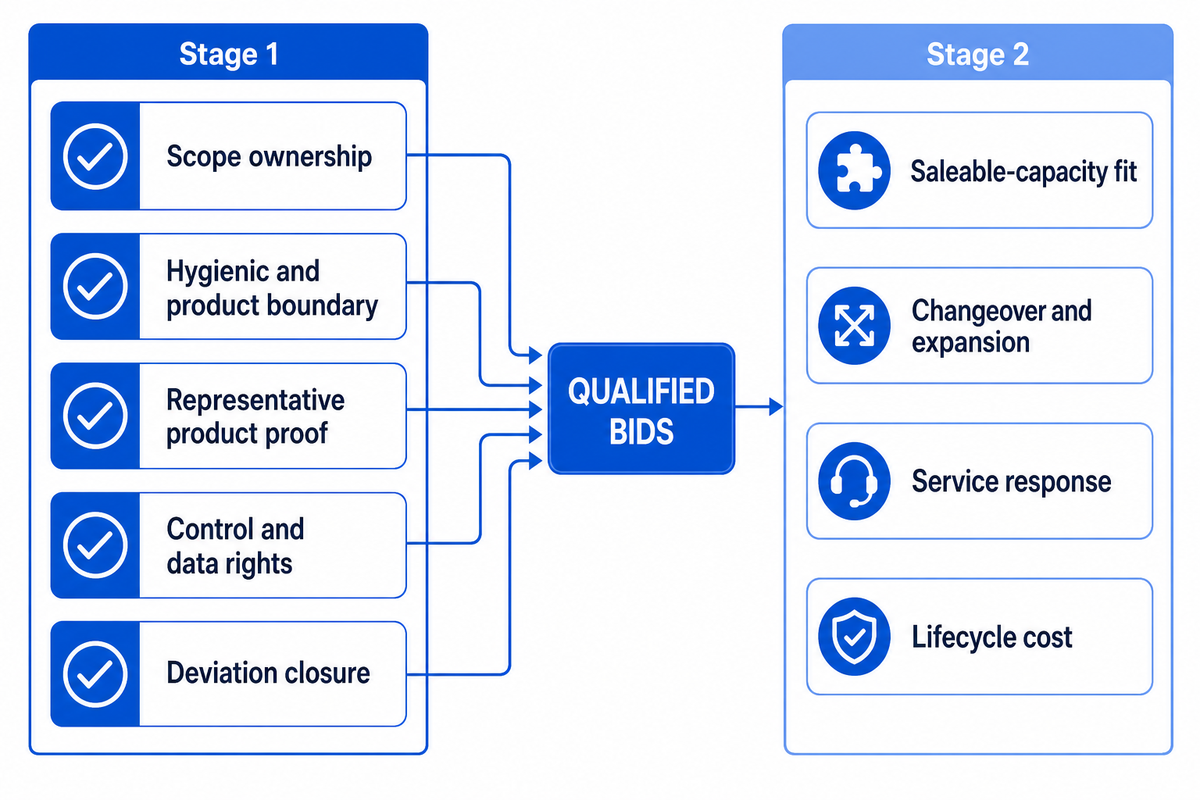
Two stages. Stage 1 is a pass/fail gate for food-safety boundary, supply scope, data integrity, product evidence, and deviation handling. Bids that fail the assessment will be removed. Recovery won’t be permitted by offering a lower price or lead time. Stage 2 scores execution choices among the qualified bids.
What makes a meat-processing equipment supplier suitable for a mixed-product project?
Suitability is case-by-case. It requires clear boundary ownership, proof on representative products, comparable capacity assumptions, documented factory and site tests, controls access, service coverage, and a method for closing deviations. Certifications and project counts can assist with due diligence, but no supplier is universally “best” and a company-level credential doesn’t mean a model-level result is also achieved.
Shengtu reports 100+ research and development projects, 100+ software copyrights, 7 patents, and certifications or designations including ISO 9001, ISO 27001, DCMM Level 2, SRDI SME status, and Gazelle Enterprise status. Treat these as company-supplied facts until the procurement team checks current certificates, issuing bodies, scope, dates, and model-specific records. They do not replace a product trial or acceptance protocol.
For projects spanning multiple packages, the company’s turnkey solution scope still needs the same supplier-boundary and deviation-closure checks.
| Stage | Criterion | Evidence requested | Decision rule |
|---|---|---|---|
| 1 — Gate | Scope ownership | Included/excluded equipment, building work, utilities, software | No unowned interface |
| 1 — Gate | Hygienic and product boundary | Materials, access, drainage, zone and cleaning rationale | Plant team accepts the basis |
| 1 — Gate | Representative product proof | Test product, condition, duration, result, limitations | Worst-case gap has a closure plan |
| 1 — Gate | Control and data rights | Code, backup, export, users, updates, retention | Ownership and access are explicit |
| 1 — Gate | Deviation closure | Owner, due date, retest, commercial hold point | Open deviations cannot become silent exceptions |
| 2 — Score | Saleable-capacity fit | Same product, time, yield, package, release basis | Weighted after gate pass |
| 2 — Score | Changeover and expansion | Observed time, space, utility, controls headroom | Score verified flexibility |
| 2 — Score | Service response | Parts list, location, hours, response and escalation | Score the written commitment |
| 2 — Score | Lifecycle cost | Energy, labor boundary, consumables, maintenance, software | Use common horizon and assumptions |
What Should FAT, SAT, and Validation Prove?
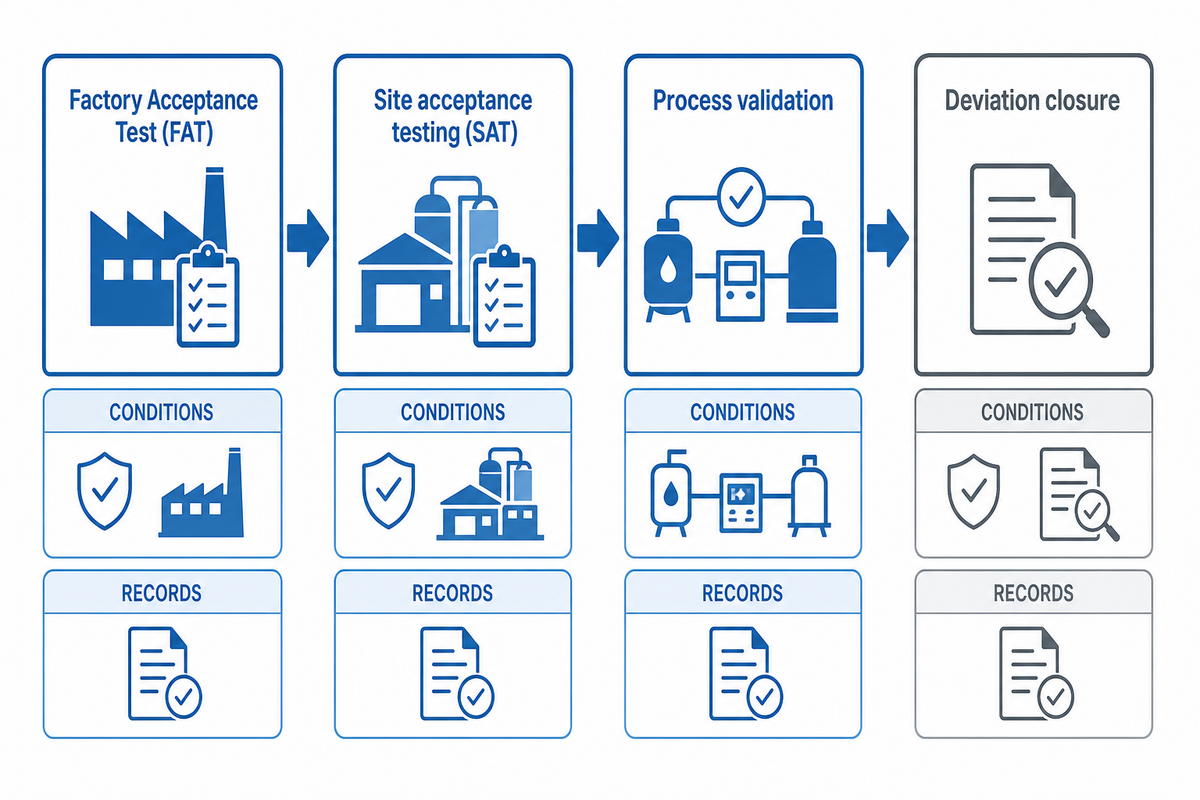
Factory Acceptance Test (FAT) demonstrates what can be shown prior to shipping. Site acceptance testing (SAT) checks the installed system with site utilities, connected equipment, operators, and data systems. Process validation, sanitation or cleaning verification, and regulatory obligations belong to their qualified owners; one empty machine cycle cannot stand in for all four.
Guidance on commissioning emphasizes early planning, ownership of interfaces, documentation, and staged testing. Translate that lesson into traceability: every important proposal statement should point backward to a controlled input and forward to a test method, pass rule, record, and deviation owner.
| Evidence item | FAT can show | SAT/site work must show |
|---|---|---|
| Mechanical sequence | Motion, guarding, dry/wet cycle | Installed alignment and connected handoffs |
| Representative product | Agreed sample under recorded conditions | Site product mix and upstream variation |
| Capacity | Supplier boundary and test window | Whole-line schedule, buffers, packaging, release |
| Changeover | Tooling and recipe procedure | Plant sanitation and release sequence |
| Utilities | Design connection and simulated load | Quality, pressure, flow, peak and recovery |
| Alarms/interlocks | Fault logic and reset behavior | Connected-line action and product disposition |
| Traceability | Data creation and export | End-to-end lot and disposition exercise |
| Cleanability | Access, disassembly, drain behavior | Plant method, time, inspection, verification |
| Deviation closure | Open-item record and retest plan | Closed evidence before final acceptance |
Average results without their distributions, durations, sample counts, and reject treatment are inadequate. Keep trial product identity, utility conditions, software version, operator, timestamp, alarms, output, holds, and deviations together. The records should be such that a later dispute can be reproduced without a sales pitch.
What Is Changing in Meat and Poultry Plant Planning in 2026?
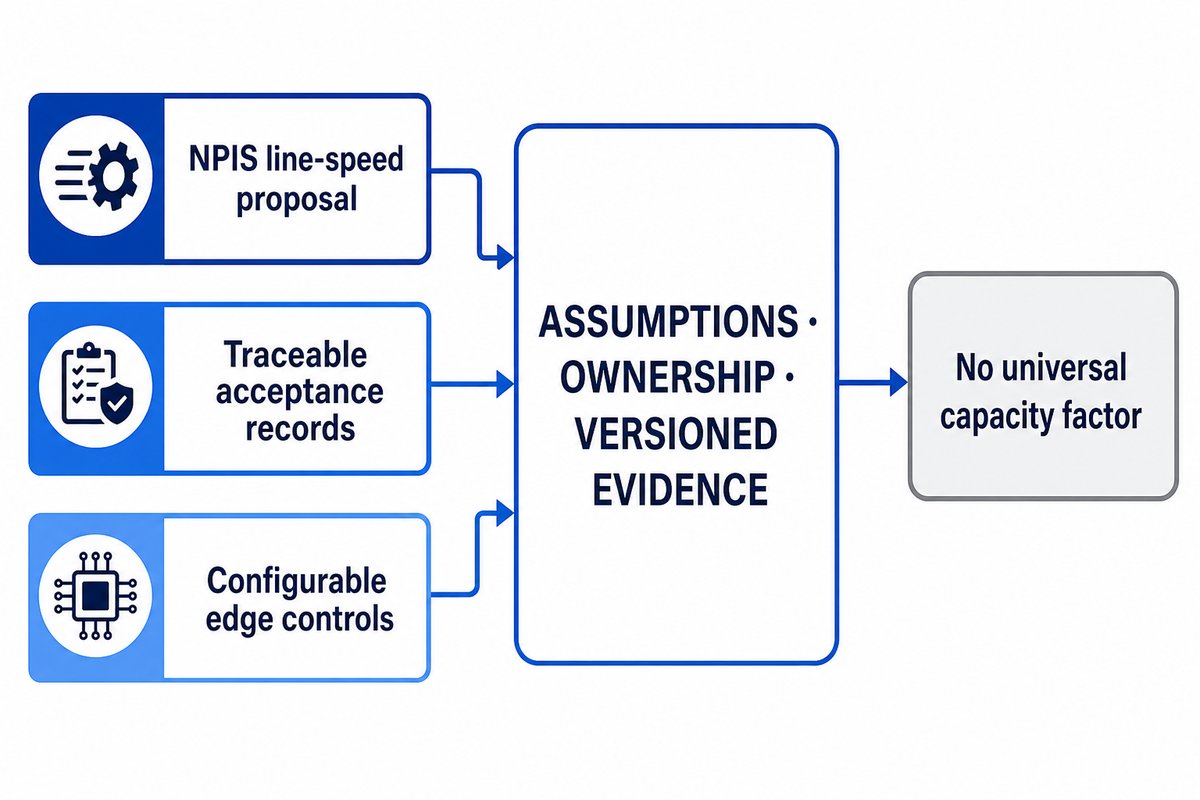
Three current planning priorities are active poultry policy work, traceable acceptance records, and configurable edge controls. None creates a universal capacity factor; they make assumptions, ownership, and versioned evidence more visible in the specification.
A February 2026 U.S. proposal lists maximum line-speed rates of 175 young chickens per minute and 60 turkeys per minute for establishments operating under the New Poultry Inspection System. These speeds pertain only to eligible establishments operating under the New Poultry Inspection System. They don’t pertain to further-processing, cooking, or packaging. Therefore they don’t pertain to the capacity equation above.
Updated factory-acceptance guidance from PMMI’s OpX Leadership Network reinforces the industry focus on structured acceptance planning. The useful response is to define representative products, interfaces, pass rules, data, and deviation closure earlier, not to rename a demonstration as validation.
Configurable recipes, remote update paths, gateways, vision, and edge analytics change the handover. Buyers now need a software bill of scope: version, backup, access roles, data retention, network boundary, update approval, rollback, support period, and replacement responsibility. Hardware may be born smart, but projects aren’t maintainable until obligations have owners.
Across the food industry, poultry production and prepared-food automation increase the number of data handoffs. The project brief should state which records are operating evidence, which support quality release, and which are only maintenance telemetry.
Future growth requires its own space. Space, drains, electrical capacity, steam, refrigeration, network addresses, buffer logic, package formats, and recipe architecture should be reviewed together. A spare floor rectangle without utility or hygiene capacity is not expansion readiness.
Frequently Asked Questions
Can raw and ready-to-eat products use the same building?
Co-location is possible only when the real movements and plant-specific controls support it.
The plant’s hazard analysis must address product, people, tools, air, drains, waste, rework, and package exposure across the proposed boundary. Controls may combine physical separation, time separation, dedicated tools, closed transfers, cleaning, environmental measures, verification, and documented release. The burden becomes greater after lethality and before final package closure, so a generic yes or no can’t settle the design.
When is time separation acceptable instead of physical separation?
A schedule becomes a control only after the sequence, cleanup, checks, and release rule are defined.
Time separation needs a defensible sequence, segregation while the other route is inactive, a plant-approved cleaning method, allergen and environmental controls where applicable, verification, documented release, and enough changeover time. Use the worst-case product and residue in the trial. Show what happens to product made before an unacceptable check. Without that evidence, scheduling is merely a space-saving assumption.
What is the difference between rated capacity and saleable output?
A machine rate counts cycles or gross flow; saleable output counts released good product.
Rated capacity describes a machine or test under stated product, time, and operating conditions. Saleable output applies available minutes, mass yield, product changes, thermal or cooling limits, packaging, rejects, holds, release, and the constrained interface. It also exposes whether a buffer can absorb a stop. Two quotations showing the same kilograms per hour may therefore support very different shipped output.
Which utilities must be confirmed before a request for quotation?
Confirm both utility quality and simultaneous peak demand.
List electricity, thermal medium, water, compressed air, refrigeration, drainage, ventilation, and data. Record quality, peak, connection point, confidence, and owner.
What evidence should factory and site acceptance testing include?
Each test needs a controlled input, pass rule, record, and deviation owner.
Use agreed worst-case products, recipes, packages, planned rates, changeover conditions, sanitation state, alarm and interlock challenges, traceability handoffs, utility loads, data records, and deviation closure. Record product identity, software version, operator, utility condition, sample size, duration, rejects, holds, and open items. Separate what can be proved before shipment from what requires installed utilities, connected machines, plant operators, sanitation procedures, and real site conditions. Keep the exact test basis beside the result, and require a retest where a deviation can affect acceptance.
Where does HACCP planning affect equipment layout?
HACCP decisions affect access, boundaries, product disposition, and records.
They influence monitoring access, raw-to-cooked boundaries, cleanability, traffic, hold points, reject routes, and records. Equipment supports the plan; its supplier doesn’t own the processor’s hazard analysis.
Can a plant add more product families later without redesigning the line?
Expansion is possible only where the reserved physical, utility, hygiene, and control envelope fits the new route.
Reserved space alone is insufficient. Review simultaneous utility peaks, recipe control, packaging range, cleanability, allergen and hygiene-zone compatibility, buffer and cooling capacity, data architecture, maintenance access, release logic, and staff movement. Check whether the proposed SKU changes product exposure or regulatory ownership. A new family needs a fresh hazard and jurisdiction review plus a worst-case product trial. Modular hardware or software doesn’t remove the need to reassess product contact, thermal processing, cooling, sanitation, labels, traceability, packaging, training, spare capacity, and acceptance assumptions. Record which former tests remain valid and which must be repeated.
Turn the idea into a controlled project brief
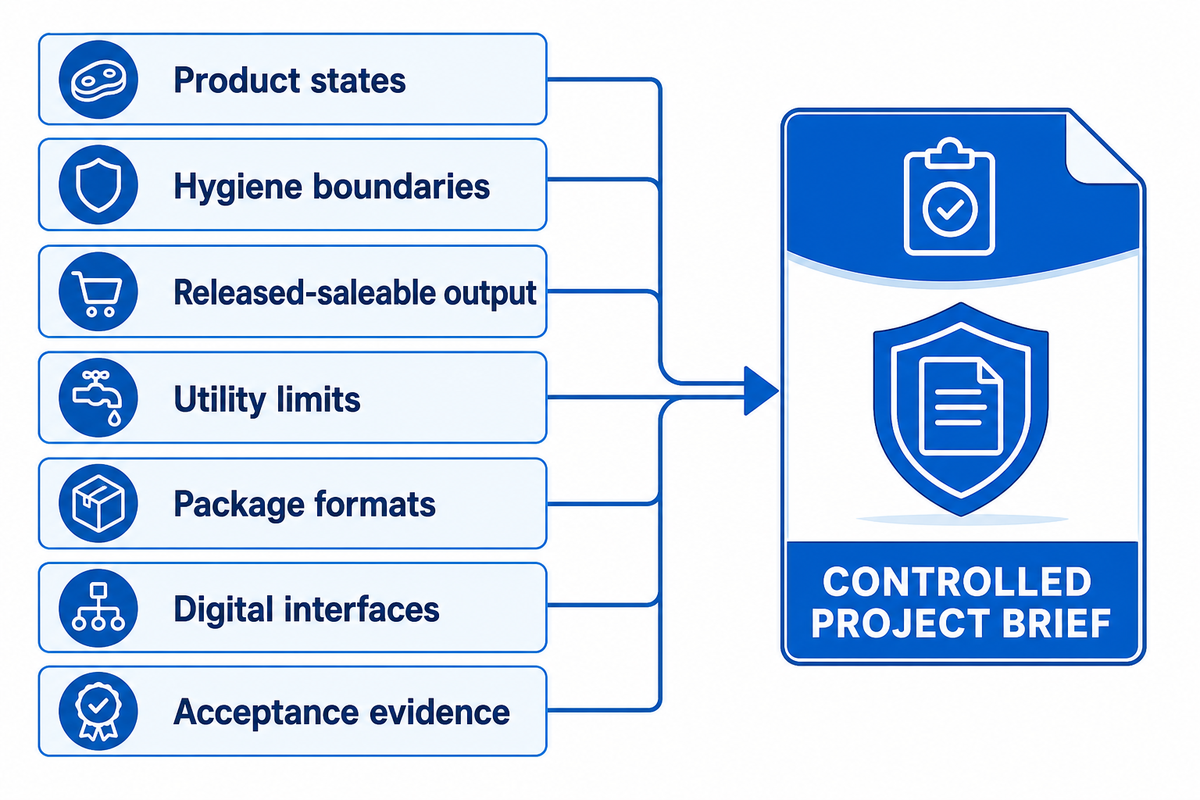
Define product states, hygiene boundaries, released-saleable output, utility limits, package formats, digital interfaces, and acceptance evidence before opening a line-planning discussion. For the validation file, include the FSIS HACCP validation guideline and map any other authority that applies to the planned products. Shandong Shengtu Bufan Intelligent Technology can review that scope against equipment, integration, and whole-plant digital requirements.
References & Sources
- FAO — Guidelines for slaughtering, meat cutting and further processing. Accessed October 8, 2026.
- FDA–FSIS Memorandum of Understanding 225-20-019. Accessed October 8, 2026.
- Georgia Department of Agriculture – Meat Processing Facility Guide: Layout. Accessed October 8, 2026.
- eCFR — 21 CFR 117.160, Validation. Current text reviewed October 8, 2026.
- eCFR – 9 CFR 430.4, Control of Listeria monocytogenes in post-lethality exposed ready-to-eat products. Current text reviewed October 8, 2026.
- NIST – Performance analysis of multi-product lines with dedicated finite buffers. Accessed October 8, 2026.
- Oklahoma State University Extension – Planning the Engineering Design of a Food Processing Facility. Accessed October 8, 2026.
- Federal Register – Proposed maximum line-speed rates under NPIS. Published February 19, 2026; accessed October 8, 2026.
- PMMI OpX Leadership Network – Updated Factory Acceptance Testing Guidance. Accessed October 8, 2026.
- Meat Institute – Principles of meat and poultry Sanitation. Accessed October 8, 2026.