Get in touch with Shengtu Bufan Company

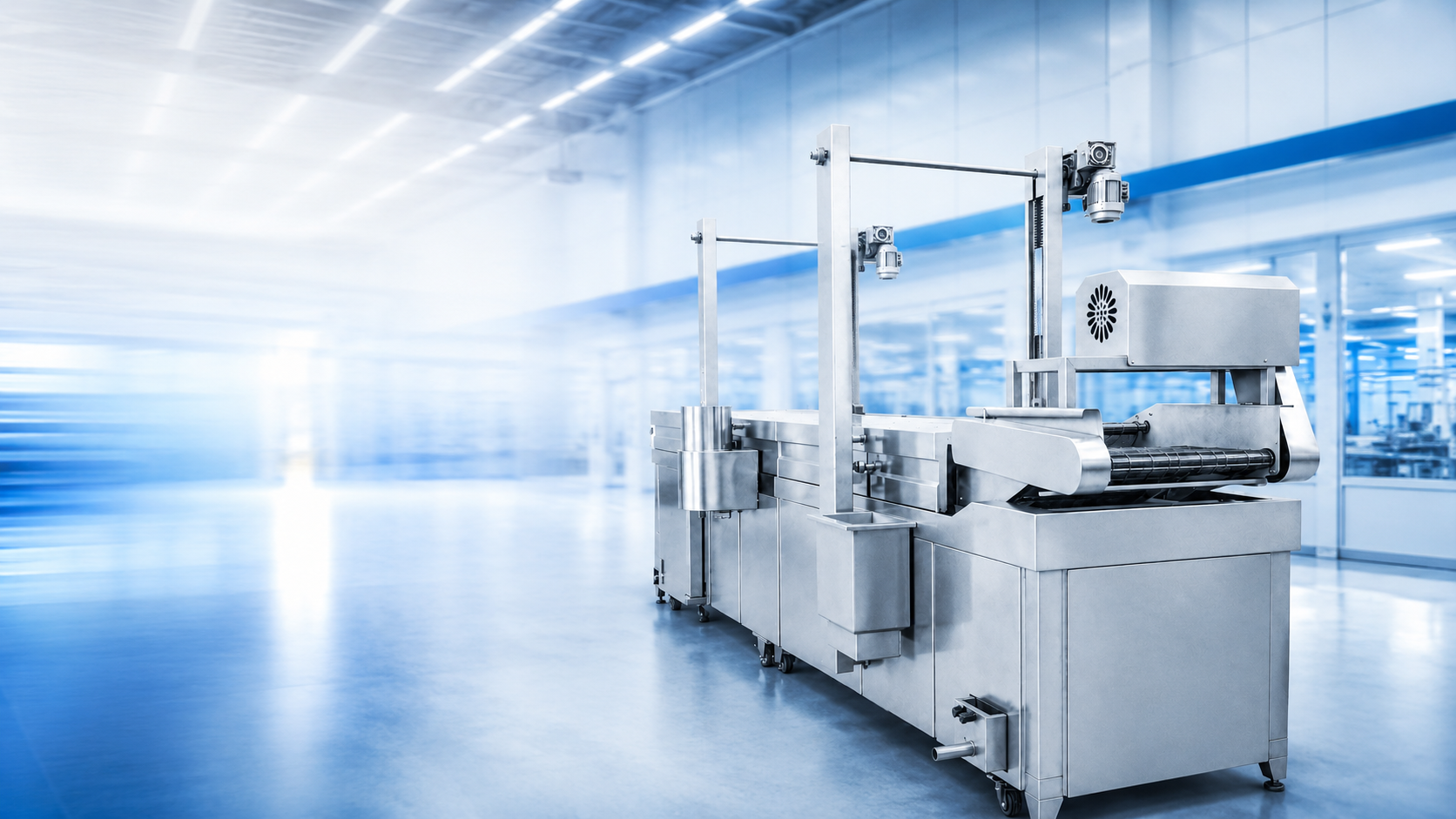
Continuous Fryer Systems for Industrial Food Production Lines
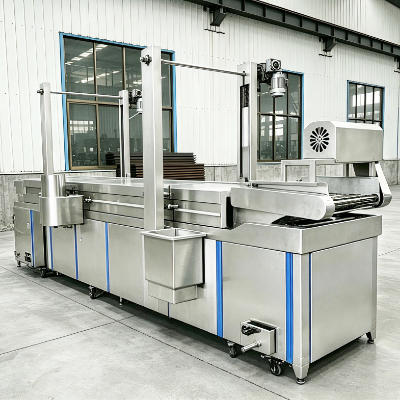
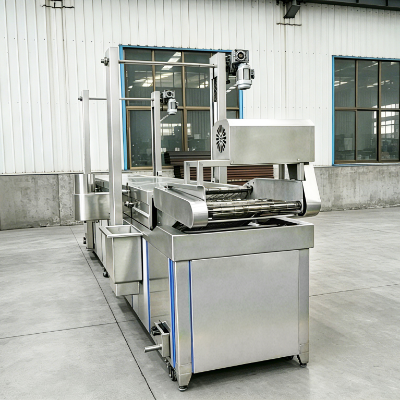
A continuous frying machine moves product through a heated oil bath on a mesh belt at a set speed, so the frying time is fixed by belt speed rather than by an operator. We build four models of continuous fryer for snack, meat, seafood and pet food lines, with electric, gas or thermal-oil heating. The same continuous fryer machine is built as an automatic continuous fryer with recipe control, or as a semi-automatic unit where an operator sets belt speed by product. Belt width is 800 mm on every model, so output is scaled by length, not by rebuilding the conveyor.
- Lead time 25–35 working days after deposit and drawing/layout confirmation
- Payment terms 30% T/T deposit with the balance before shipment; L/C at sight and D/P also accepted
- Conveyor belt width 800 mm (31.5 in) on all four models
- Heating power range 120 kW to 180 kW by model
- Product contact material 304 stainless steel sheet metal on all four models
- Manufacturing scope Conveying, heating, oil-circulation filtration and control cabinets are produced in-house
Continuous Frying Machine Capabilities and Conveyor Configuration
Every continuous fryer we build is a conveyor fryer: a 304 stainless oil tank, a driven mesh conveyor belt, a heating circuit and an oil circulation loop with a side-mounted sludge scraper. Frying time is set by belt speed and oil temperature, and both are held by the PLC through the whole run.
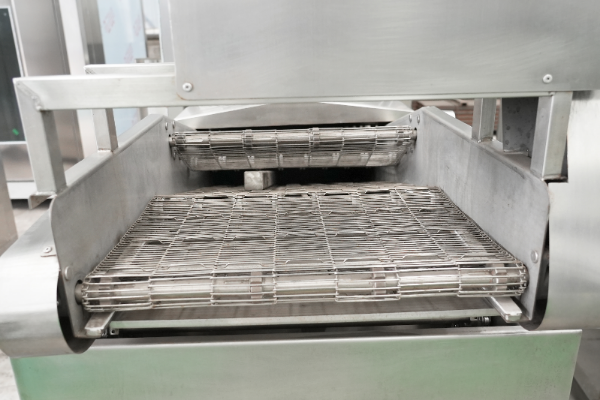
Conveyor Layout: Single-Layer or Double-Layer Mesh Belt
Product that floats needs to be held under the oil, and product that sinks needs to be carried off the tank floor. Buoyancy therefore decides the conveyor system before capacity does: buoyant product calls for a hold-down or submerging conveyor, sinking product calls for a bottom conveyor, and product whose buoyancy changes during frying calls for a multi-stage arrangement1.
We supply a single-layer belt for products that stay submerged and a double-layer belt where a press belt is needed to keep floating product under the oil for the full dwell.
Temperature Control Across the Frying Process
Oil temperature drops the moment product enters the bath and recovers as the product heats. The recovery band is what separates one heating method from another, and it is measurable: indirect-heated systems hold to about ±2 °F, thermal-fluid systems swing 7–10 °F, and direct gas-fired systems swing 10–15 °F1.
Oil chemistry sets a ceiling on the other side. Standard palm oil should not be pushed past 363 °F (184 °C), the point at which the oil begins to crack, and the ceiling differs by oil3. We set and hold your working band inside those limits rather than quoting a single headline temperature.
The four models cover the same duty an electric continuous frying machine, a gas-fired belt fryer or a potato chip frying machine is bought for; what changes is the heat source and the conveyor, not the frying principle.
Products Run on This Continuous Frying Equipment
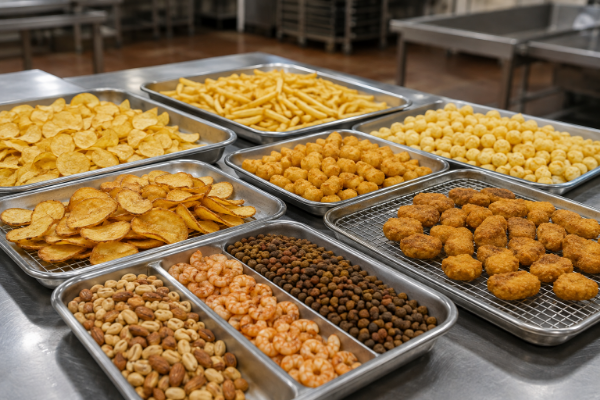
- Potato chips and sliced potato products
- French fries and formed potato products
- Extruded pellet snacks and puffed snack foods
- Nuts, peanuts and seeds
- Chicken nuggets, meatballs and coated meat products
- Seafood and battered fish products
- Pet food kibble and treats
- Prepared and frozen convenience foods
Food Products Processed on This Continuous Fryer
Each product family sets three things at once: the conveyor setup, the heat source that suits it, and the station that sits immediately downstream. Ordering a fryer without the downstream station is how a line ends up slower than the machine it just bought.
The de-oiling method matters as much as the machine that precedes it. Blowing air over fried product to strip surface oil accelerates oxidation and shortens shelf life, so dry steam in an oxygen-free chamber or centrifugation is the accepted route1. That is why every card below names the station that has to follow the fryer.
Potato Chips and Sliced Potato Products
Conveyor setupDouble-layer mesh belt — slices float and need holding under the oil
Heat source fitElectric or thermal oil for a tight recovery band
Downstream stationDe-oiling, then cooling, then seasoning
Line noteSlice thickness upstream governs frying time more than belt length does
French Fries and Formed Potato Products
Conveyor setupSingle-layer mesh belt — product sinks and runs on the bottom conveyor
Heat source fitGas or thermal oil where a fast recovery band matters
Downstream stationDe-oiling, then freezing
Line noteBlanching and dewatering upstream decide colour more than fryer settings do
Extruded Pellet and Puffed Snack Foods
Conveyor setupDouble-layer mesh belt — pellets expand and float on contact
Heat source fitElectric heating for short, tightly held dwell
Downstream stationDe-oiling, then drum seasoning
Line noteDwell is short, so belt speed and oil volume matter more than tank length
Chicken Nuggets and Coated Meat Products
Conveyor setupSingle or double layer depending on coating weight and buoyancy
Heat source fitGas or thermal oil for sustained heat load
Downstream stationDe-oiling, then spiral freezer or oven
Line noteBatter and breading upstream govern coating adhesion and the fines load in the oil
Nuts, Seafood and Pet Food
Conveyor setupSingle-layer belt for nuts and kibble; double layer for light seafood pieces
Heat source fitElectric heating, gas or thermal oil
Downstream stationDe-oiling, then cooling and packing
Line noteThese families carry the highest fines load, so filtration cycle matters most here
Another Fried Product
Send the product, the target hourly output and the station that follows the fryer. We will confirm the conveyor setup, the heat source and the model in the quotation.
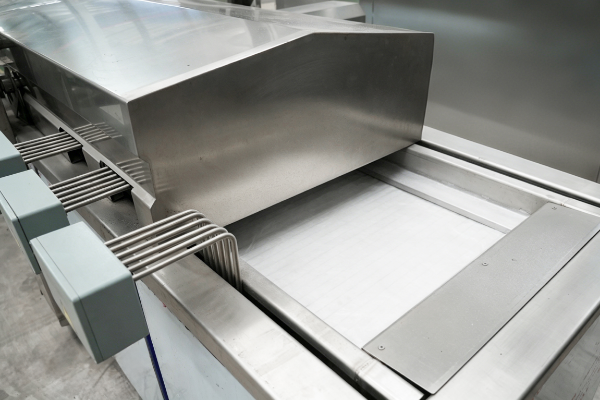
Heating, Oil Circulation and Filtration Subsystems
Oil is the largest running cost on a frying line, and it degrades on a schedule you can influence. One of the biggest mistakes on a frying line is buying cheaper oil to protect the bottom line, because oil quality carries into taste, appearance and shelf life.
Oil turnover rate — the hours of production before make-up oil has replaced the working oil volume — runs between 5 and 10 on industrial fryers, and degradation rises as that figure climbs. Every subsystem below exists to keep that figure where you want it.
| Subsystem | Configuration | What it changes |
|---|---|---|
| Electric heating | Immersed heating elements, 120–180 kW by model, 380 V / 50 Hz | Tightest recovery band; no combustion air or flue required |
| Gas heating | Burner circuit sized to the model heat load | Faster temperature recovery after loading; lower energy cost where gas is cheap |
| Thermal-oil heating | External heat exchanger circuit, large pipe surface area | Eliminates hot spots on the tank wall while holding temperature accurately |
| Oil circulation | Circulation pump, 1.5–2.2 kW by model | Keeps the bath at one temperature end to end instead of stratifying |
| Sludge removal | Side-mounted sludge scraper, all four models | Lifts settled fines out before they carbonise and accelerate oil degradation |
| External oil filtration | External oil filter, optional at additional cost | Removes finer particles from the circulating oil between the tank and the heater |
Why Fines Removal Is an Oil-Life Mechanism, Not an Accessory
Crumb screens sit ahead of the circulation pump so that larger particles never reach the heat exchanger tubes. Fines that are left in the bath burn, carbonise and speed up the degradation reactions in the oil. Settled particles come out through a sludge conveyor or scraper, while floating fines need a weir or skimmer.
How often you filter follows your shift pattern rather than a fixed rule. Batch filtering suits plants running 8 to 16 hours a day with breaks in production, and continuous filtering is the practical choice for 24-hour operation.
Two Operating Rules That Protect the Oil
- Do not run below 80% of nominal capacity. Running a fryer under-loaded stretches oil turnover time and reduces oil quality. This is the single most common way a correctly specified machine still produces poor oil economics.
- Drain after 30 minutes of stoppage. If a changeover or a fault halts production for more than half an hour, drain the fryer and cool the oil before it goes back to the tank. Circulating oil at frying temperature with no product means no steam is generated, air reaches the oil under the hood, and the oil deteriorates.
Where the Discard Line Actually Sits
European oil-discarding legislation is built on polar content. Most countries set a maximum of 25%, and the cut-points across the group run from 20% to 27%. Maximum oligomer content is set at 10% in most of those countries and at 16% in others.
That threshold moves with the oil. A polar content of 25% corresponds to 10% oligomers in palm olein but 15% in sunflower oil — above the stricter of the two oligomer limits — so a single number is not a complete operating rule for a plant running more than one oil. Filtration and circulation do not change where the line sits; they change how long you run before you reach it.
“We size the oil circulation and the scraper to the fines load of your product, not to the tank volume. A nut line and a battered-meat line with the same hourly output do not put the same load on the oil, and specifying them the same way is how a fryer ends up with good paperwork and short oil life.”
Model Specifications: ST-YZJ-3000 to ST-YZJ-6000
All four models share one 800 mm mesh belt width, one voltage and one construction material. Overall length and installed power are what change across the range, and they set frying dwell at a given belt speed.
Get a Quote| Specification | ST-YZJ-3000 | ST-YZJ-4000 | ST-YZJ-5000 | ST-YZJ-6000 |
|---|---|---|---|---|
| Overall dimensions | 0 × 0 × 0 mm (0 × 0 × 0 in) | 0 × 0 × 0 mm (0 × 0 × 0 in) | 0 × 0 × 0 mm (0 × 0 × 0 in) | 0 × 0 × 0 mm (0 × 0 × 0 in) |
| Conveyor belt width | 0 mm (0 in) | 0 mm (0 in) | 0 mm (0 in) | 0 mm (0 in) |
| Heating power | 0 kW | 0 kW | 0 kW | 0 kW |
| Drive power | 0 kW | 0 kW | 0 kW | 0 kW |
| Oil circulation power | 0 kW | 0 kW | 0 kW | 0 kW |
| Slag removal | Side-mounted sludge scraper | Side-mounted sludge scraper | Side-mounted sludge scraper | Side-mounted sludge scraper |
| Sheet metal | 0 stainless steel | 0 stainless steel | 0 stainless steel | 0 stainless steel |
| Oil filtration | External oil filter, optional | External oil filter, optional | External oil filter, optional | External oil filter, optional |
| Voltage | 0 V / 0 Hz | 0 V / 0 Hz | 0 V / 0 Hz | 0 V / 0 Hz |
The Continuous Fryer Sizing Path
Most buyers pick a fryer by asking which model is big enough. Bigger is not always better here, and the mistake is expensive in a way that does not show up until the oil does. That question produces the wrong machine often enough that it is worth replacing with a four-step path.
Click to swap
Step 1 — Start from the product, not the output figure.
Product type sets frying time and buoyancy, and those two set the conveyor and the dwell you need. Oil consumption is driven by the product itself; one fryer type does not inherently use less oil than another3.
Step 2 — Convert output into belt area, then into length.
The cook area a fryer needs equals production rate multiplied by frying time, divided by product loading per unit area; fryer length is that cook area divided by belt width1. Because our belt width is fixed at 800 mm, length is the only variable left — which is exactly why the range steps 3,000 / 4,000 / 5,000 / 6,000 mm rather than widening the conveyor.
Step 3 — Size to run loaded, not to leave headroom.
This is where the instinct to buy big goes wrong. Running below 80% of nominal capacity stretches oil turnover time and degrades oil quality,3 and operating below design capacity also raises oxidative stress and shortens finished-product shelf life1.
There is a production-engineering argument pointing the same way. Processes that cannot easily be stopped, and processes carrying high capital cost, are the ones a plant should deliberately load to the limit rather than balance against everything else4. A continuous fryer is both.
Step 4 — Check the stations on either side before you sign.
Nominal machine capacity is not line output. Real fryer utilisation lands at 80–90% once start-up, shut-down, changeover and mechanical interruptions are counted,1 and the upstream battering and breading station plus the downstream de-oiling station will cap the line before the fryer does. Extra belt length buys you nothing when the constraint sits upstream, and it does nothing for a line that is already waiting on de-oiling.
Pricing Basis and Lead Times
Price follows model length, heat source, conveyor configuration, control specification and the optional external oil filter. There is no fixed price list for a continuous frying machine, because two orders with the same nominal output can carry different conveyor and heating scopes.
What Moves Your Price
Model length
Effect on cost
Drives frame, tank volume, belt length and installed heating power together
How to reduce it
Size from frying time and product loading rather than from a headline output figure
Heat source
Effect on cost
Thermal-oil circuits add an external heat exchanger and pump; gas adds a burner circuit
How to reduce it
Choose on the recovery band your product needs, not on maximum flexibility
Conveyor configuration
Effect on cost
A double-layer belt adds a second drive path and press belt
How to reduce it
Confirm product buoyancy first; only floating product needs the second layer
Filtration scope
Effect on cost
The external oil filter is an optional addition to the standard circulation loop
How to reduce it
Match filtration to the fines load of your product family
Control specification
Effect on cost
Line interlock with upstream and downstream equipment extends the control scope
How to reduce it
Send the layout of adjacent stations with your enquiry so the scope is fixed once
[ QUOTATION PROCESS ]
How Your Quotation Is Produced
Send the product, the target hourly output, the heat source available in your plant and a layout of the stations either side of the fryer. An engineer reviews the fit and returns a written quotation with the model, the conveyor configuration and the scope of supply set out line by line.
[ DELIVERY & TERMS ]
Delivery and Payment
Production runs are scheduled at 25–35 working days after deposit and drawing/layout confirmation. That clock starts at confirmation, not at first enquiry, because the layout drives the conveyor and interlock scope.
30% T/T deposit with the balance before shipment; L/C at sight and D/P also accepted. Shipping terms are set out in the quotation together with packing scope.
Factory Testing, Materials and Certification
Applicable certificates and documents are confirmed for the equipment model, configuration and destination country. Company management-system records are reviewed separately from product conformity documents.
Buyers sourcing food processing equipment overseas check three things before they pay: material grade, witnessed factory testing, and whether the supplier holds critical spares. All three are set out below.
Choosing a continuous fryer manufacturer is not the same problem as choosing an industrial frying machine on specification alone. Relying on a supplier’s word without independent testing is the risk the five-test sequence below is built to close, and every test is run against written acceptance criteria before the machine is packed.
Material Grade and Why It Is Specified That Way
Sheet metal in contact with oil and food is 304 stainless steel across all four models. Construction material for oil and food contact surfaces should be T-304 stainless or better, and brass and copper are avoided because they catalyse oil oxidation1. That grade serves food safety and oil life together.
Five Tests Before the Machine Leaves the Floor
-
No-load run — conveyor belt tracking, drive and control response checked without oil
-
Load simulation — belt loaded to working weight to confirm drive torque and tracking under load
-
Temperature-control stability — heating circuit held at setpoint and the recovery band recorded
-
Circulating filtration — pump, scraper and filter circuit run and checked for flow and leaks
-
Full-line interlock — control interlock exercised against the upstream and downstream stations in the scope
Management System and Compliance
ISO 9001 quality management system
ISO 27001 information security management system
DCMM Level 2 data management capability maturity assessment
CE and RoHS compliance declared for the equipment
7 invention patents and more than 100 registered software copyrights
Certificates are available on request and are named in the quotation, so you can check them before you place an order rather than after.
Core hardware — conveying, heating, oil-circulation filtration and control cabinets — is produced in-house, and the STUnit control platform is developed in-house. That is what lets us change a conveyor configuration or a control interlock at the drawing stage instead of renegotiating with a sub-supplier.
Company records: Request the current holder, scope and validity details.
Equipment conformity: Confirm the documents for the model, configuration and destination country.
Order documents: Agree inspection records, manuals, drawings and shipment paperwork in the contract.
How We Work: Order, Installation and Commissioning
01
Send your requirement
product, target hourly output, available heat source, and the layout of the stations either side of the fryer.
02
Fit review and model selection
we run the Sizing Path against your figures and confirm model, conveyor configuration and heat source in writing.
03
Written quotation and drawing
scope of supply, general arrangement drawing and layout confirmation.
04
Manufacture
25–35 working days after deposit and drawing/layout confirmation.
05
Five-test acceptance before shipment
the tests above are run and recorded before the machine is packed, so the acceptance criteria are fixed before it leaves us rather than argued after it lands.
06
Installation, commissioning and spares
field support for installation and start-up, with conveyor mesh belt, heaters, circulation pumps and control components held as long-term spare categories.
Information That Shortens the Quotation Cycle
| What to send | What to specify | Why it saves time and cost |
|---|---|---|
| Product sample or spec | Product family, piece size, coating, and whether it floats | Fixes conveyor layout and dwell in one pass |
| Target hourly output | Finished kilograms per hour and the shift pattern | Lets us check the 80% loading floor before the model is fixed |
| Plant energy and adjacent stations | Electric supply, gas availability or an existing thermal-oil circuit; upstream battering or breading and downstream de-oiling | Removes a round of heat-source revision and fixes the interlock scope so the control cabinet is quoted once |
Spare parts availability directly impacts equipment uptime, which is why conveyor mesh belt, heaters, circulation pumps and control components are held as long-term categories rather than ordered against a failure. Confirm the supplier’s real timeline before you book the installation window; ours is stated above and repeated in the quotation.
Where a Batch Fryer Beats a Continuous Fryer
Continuous frying is the wrong answer for some products and some plants. Unlike a headline capacity figure, the three situations below cannot be fixed by buying a bigger machine, and each has a route through it.
Not sure which side of the line your output sits on? Send your product and target output for a written engineering estimate and we will say plainly if a batch fryer is the better call.
Kettle-style texture is the product
WHY IT WORKS AGAINST YOU
Kettle chips are made by controlling the frying curve — a sharp temperature drop as product enters the oil, a stable plateau, then a gradual rise. Batch fryers are built around that curve; continuous fryers are built to hold one temperature6.
WHAT TO DO INSTEAD
Use a batch fryer for the kettle line and a continuous fryer for standard chips if you run both
Output sits well under the loading floor
WHY IT WORKS AGAINST YOU
Below 80% of nominal capacity the oil turnover time stretches and oil quality falls,3 so an under-loaded continuous fryer costs you in oil what it saved you in labour. The highest-capacity batch fryers reach about 650 lb (295 kg) per hour,6 which is the practical crossover region.
WHAT TO DO INSTEAD
Stay with batch until sustained demand puts the smallest continuous model above its loading floor
Frequent short runs of many different products
WHY IT WORKS AGAINST YOU
Start-up and shut-down damage oil and product quality more than continuous running does,1 so a continuous fryer stopped several times a shift loses the advantage it was bought for
WHAT TO DO INSTEAD
Group products into longer runs, or keep a batch fryer for the specialty tail and run the continuous line on the volume products
Engineering Calculation Tools
Select a system below to access specialized engineering calculators for continuous fryer sizing paths, oil turnover rates, and heat source selection.
Continuous Fryer FAQs
A continuous fryer feeds product in at one end of the oil tank and takes it out at the other on a conveyor belt, so frying time is set by belt speed. A batch fryer holds a fixed load, and oil temperature drops sharply on loading and then recovers. That temperature curve is a disadvantage for uniform product and an advantage for kettle-style texture, which is why both machines still exist.
Work it as cook area, not as a model number. Cook area equals your production rate multiplied by frying time, divided by product loading per unit area, and fryer length is that area divided by belt width. With our 800 mm belt fixed across the range, the calculation lands directly on one of the four lengths. Check the result against the 80% loading floor before you fix the model.
Potato chips, french fries, extruded pellet snacks, nuts, chicken nuggets and coated meat products, seafood, pet food and prepared frozen foods all run on this frying system. The conveyor layout, heat source and downstream station change between them, as set out in the product cards above.
Electric heating, gas and thermal oil. Electric holds the tightest recovery band, gas recovers temperature faster after loading, and thermal oil runs through a heat exchanger whose large pipe surface area removes hot spots while holding temperature accurately. Installed heating power runs 120 kW to 180 kW depending on model.
Yes, and on temperature stability they are the strongest of the three. Indirect-heated systems hold to about ±2 °F against 10–15 °F for direct gas-fired systems. The trade-off is energy cost and installed electrical supply, which is why we ask about plant energy before recommending a heat source.
Circulation keeps the bath at one temperature, the side-mounted sludge scraper lifts settled fines out before they carbonise, and the optional external oil filter takes finer particles out of the circulating oil. Filtering frequency follows your shift pattern: batch filtering for 8–16 hour days, continuous filtering for 24-hour operation. Oil is discarded against polar content, where most European limits sit at 25%.
Yes. The control cabinet can be interlocked with the upstream battering and breading station and the downstream de-oiling, cooling and seasoning stations. Send the layout of the adjacent equipment with your enquiry and the interlock scope is fixed in the quotation rather than at commissioning.
Buoyancy decides it. Product that floats needs a hold-down or submerging conveyor to keep it under the oil for the full dwell, product that sinks needs a bottom conveyor, and product whose buoyancy changes during frying needs a multi-stage arrangement. Potato slices and puffed pellets typically float; fries, nuts and kibble sink.
The oil is drained and the tank is accessed through the inspection openings for manual cleaning, with the scraper and circulation circuit cleared at the same time. If production stops for more than 30 minutes, drain and cool the oil rather than circulating it hot with no product, because air reaching the oil under the hood degrades it.
Frying conditions are one of the recognised levers. Asparagine is the acrylamide precursor in thermally processed potato products, and methods for reducing it have been patented at industrial scale. Temperature control on the fryer is part of that picture, though raw-material selection and upstream treatment carry most of the effect. Confirm your own limits with your food-safety team, since the United States has no specific regulation for frying-oil quality and fried foods fall under general food law with HACCP and GMP programmes.
30% T/T deposit with the balance before shipment; L/C at sight and D/P also accepted. Production runs are scheduled at 25–35 working days after deposit and drawing/layout confirmation.
Trending now