
Get in touch with Shengtu Bufan Company

![Beef/Lamb/Poultry Cutting Line Acceptance Guide [2026]](https://shengtumachinery.com/wp-content/uploads/2026/09/beef-lamb-poultry-cutting-line-guide-featured.png)
Updated September 2026
A Beef/Lamb/Poultry Cutting Line consists of multiple production units that take a defined carcass or bird state and return specified cuts, trim, by-products and pack-out. When developing this line, product and process need to be considered before equipment, and not the other way around. The same conveyor speed can produce very different outputs based on cut mix, staffing, inspection, rework and pack-out.
This guide sets out the evidence a plant team should assemble before requesting industrial meat processing equipment. It covers specifications for the cutting line, product specifications, differences in species, hand-off points, capacity, ergonomics, hygienic layout, inspection and acceptance criteria. It does not discuss a target value for throughput, yield, food-safety or any equipment package.
Define these five items before discussing equipment
- Incoming product state and temperature condition
- Saleable cut schedule, trim rules and pack formats
- Shift demand and available production minutes
- Plant-controlled checks and applicable official-inspection interfaces
- Utilities, hygiene zones, people flow and acceptance evidence
What a Meat Cutting Line Covers in the Meat Processing Workflow
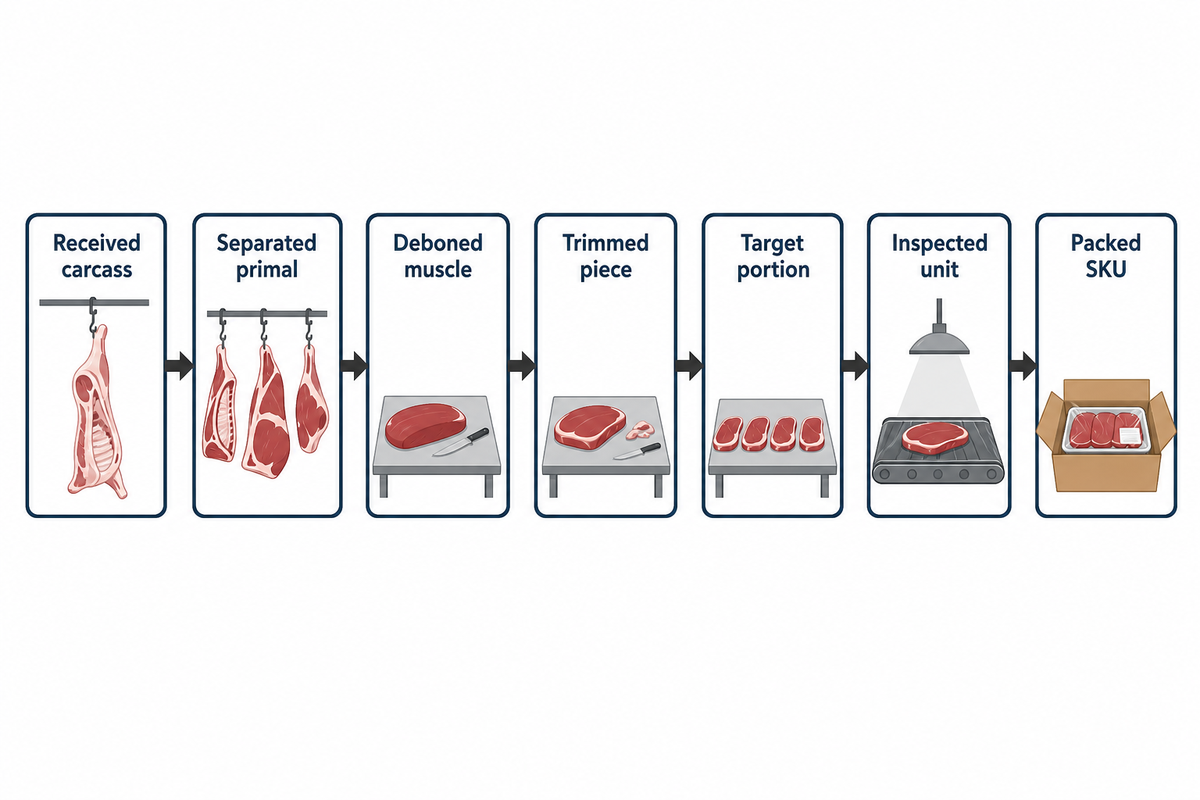
A cutting line starts after a hand-off upstream. For beef or lamb, that might be a dressed side, quarter, or chilled carcass. For poultry, it might be an inspected whole bird or a prepared part stream. The downstream boundary may be primal cuts, deboned meat, portions, trim, offal, or by-products, followed by weighing, inspection, and packing. Identifying both ends of the cutting line prevents costs for slaughter, chilling, fabrication and other processing from being lumped as a single ambiguous scope.
FAO meat-processing guidelines treat cutting and other processing as controlled operations in a clean area. It considers product movement, cleaning, and hygiene of personnel, and prevention of contamination. It defines a stage boundary, but doesn’t select equipment or a legal requirement for a particular country. The plant process description and local rules remain controlling.
Good scope maps identify each state of the product throughout every change. Example: received carcass, separated primal, deboned muscle, trimmed piece, target portion, inspected unit and packed SKU. This scope map also describes the trim, bone, edible and inedible by-products and rework. If a proposed station can’t be connected to one of these states, then its purpose and acceptance method aren’t clear.
The boundary also separates the cutting room from slaughterhouse work, refrigeration, cold storage and shelf life management. Product state and schedule are impacted, but each requires its own design basis. The cutting guide doesn’t include a slaughter line, humane-handling program, shackling system or feather removal.
Boundary check: An 8-hour shift contains 480 clock minutes, but it doesn’t contain 480 production minutes. Breaks, sanitation, product changes, tool service, official-inspection holds and pack-out stops belong in the flow model before a kilograms-per-hour target is transformed into line capacity.
Cut Specifications That Protect Product Quality and Yield

Species and daily tonnage don’t determine the work. That upstream boundary still needs a cut specification before any station rate can be compared. For example, a plant selling bone-in primals and retail-ready portions and doing the trimming has a different station setup from a plant processing the same carcass weight into mostly boneless bulk packs. The cut schedule must indicate what’s saleable, what’s trim, what defects result in rework and where weight or appearance is assessed.
Use observable terms for your specs. The USDA Agricultural Marketing Service’s Institutional Meat Purchase Specifications illustrate this discipline by separating purchaser-specified data, portion weight, thickness, shape, fat limits, workmanship and packaging requirements. Instead of “clean trim,” identify the permitted tissue, bone, membrane or fat condition and the inspection method. Instead of “uniform portions,” define the controlled weight or geometry, sampling point and disposition for out-of-spec pieces. For your project, use the buyer’s product requirements, validated process and applicable customer or regulatory rules, not a generic blog. Fast conveyors do not rescue a station that cannot repeat the approved cut specification.
For fresh meat products, terms such as strip cutting, uniform slices and accurate cutting still need a product sample and measurable acceptance rule. Marketing language won’t tell meat processors if the outcome is retail portion, further processing input or recoverable trim.
| Planning input | Evidence to provide | Decision supported | Limitation / not suitable for |
|---|---|---|---|
| Input state | Whole carcass, side, quarter, bird or part; chilled/frozen state | Handling, carrier and first cut | A species name alone is insufficient |
| Cut schedule | SKU list, anatomy reference and sample photographs | Station sequence and labor content | Pictures do not replace measurable limits |
| Bone condition | Bone-in, boneless, bone-fragment and recovery rules | Tools, inspection and rework | One detector cannot cover every fragment type |
| Trim definition | Permitted fat, membrane, tissue and defect condition | Knife work, recovery and yield accounting | “Clean” is not a test method |
| Portion target | Buyer-approved mass, geometry and sampling plan | Cutting, weighing and giveaway control | A mean value can hide a wide distribution |
| Product mix | Percent of shift by SKU and change sequence | Weighted workload and changeovers | Peak mix cannot be replaced by an annual average |
| Pack format | Bulk, tray, vacuum or bag; pack mass and label data | Accumulation, inspection and pack-out | Cutting rate does not prove packaging rate |
| Temperature state | Validated receiving and handling conditions | Tool, handling and time controls | No universal setpoint is implied |
| Defect list | Representative good, reject and rework samples | Inspection coverage and reject route | A defect with no disposition remains unresolved |
| Acceptance record | Method, frequency, owner, result and lot link | Commissioning and release evidence | Cycle completion is not product acceptance |
Start With Product, Process and Intended Use, Then Account for Species
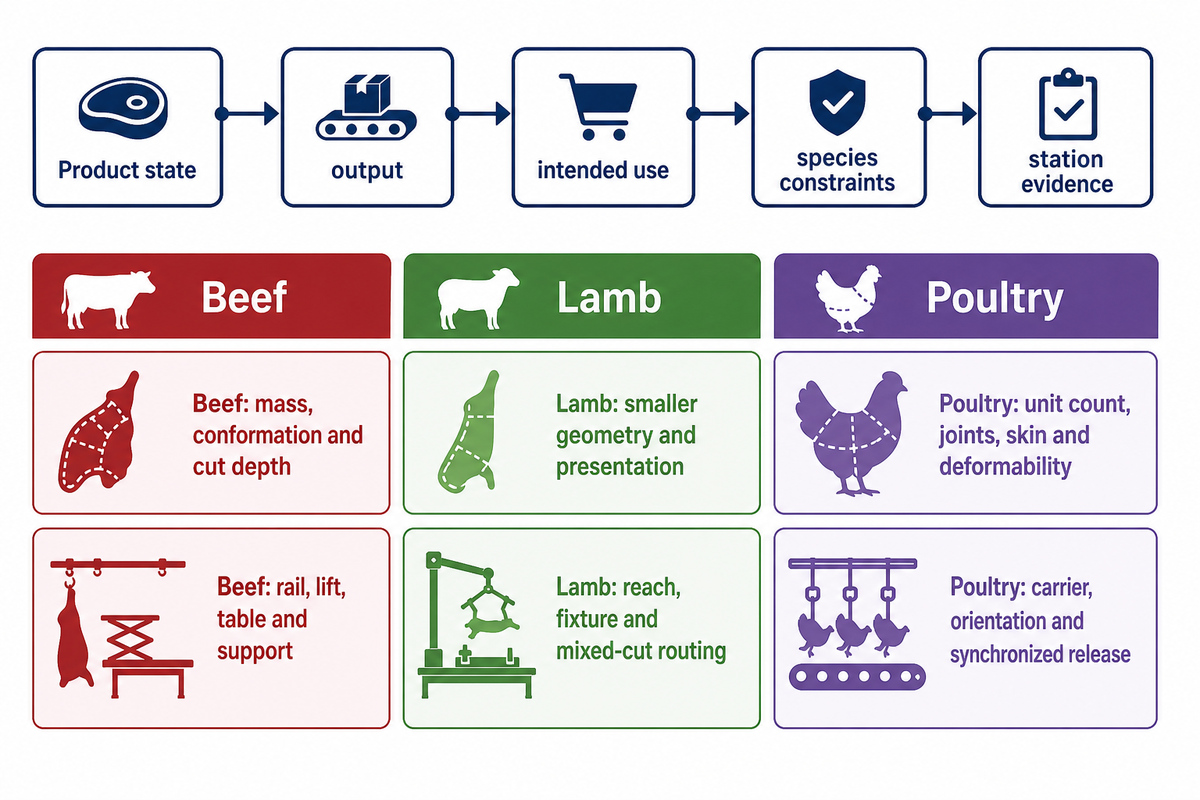
First, product and process. In the United States, 9 CFR 417.2 requires a hazard analysis to include a flow chart and identify the intended use or consumers of the finished product. It allows one plan to cover multiple products in the same processing category when their hazards, control points, critical limits and procedures are substantially alike; product-specific features still must be delineated. Other jurisdictions use their own legal framework, but the planning lesson travels: “beef,” “lamb” or “poultry” is not a complete process definition.
After defining the product state and intended use, species modifies the physical work. For beef cutting, sides and quarters bring larger masses and longer cuts. Lamb presents smaller geometry but does not simply scale every reach, fixture or bone path in proportion. Poultry introduces bird carriers, joint-based cut-up, skin and soft-tissue handling, and higher unit counts. Product variation also affects sensing: deformable materials and changing anatomy can move the constraint from blade speed to presentation, alignment or rejection.
Pork appears only where swine evidence informs worker-safety reasoning; it isn’t a promised configuration.
| Planning layer | Beef | Lamb | Poultry |
|---|---|---|---|
| Incoming unit | Side, quarter, primal or part | Carcass, side or primal | Whole bird or prepared part |
| Primary variation | Mass, conformation and cut depth | Smaller geometry and presentation | Unit count, joints, skin and deformability |
| Handling question | Rail, lift, table and support | Reach, fixture and mixed-cut routing | Carrier, orientation and synchronized release |
| Automation boundary | Anatomy localization and heavy-product control | Stable presentation across smaller units | High-rate sensing, joint location and misfeed handling |
The table isn’t a vendor specification. Boneless beef slicing may resemble boneless poultry portioning more closely than carcass breakdown. Follow product state → output → intended use → species constraints → station evidence.
Transfer limit: A published automation example at 500 units/h or any other documented rate applies only to its product, presentation, sensing, acceptance and operating conditions. It cannot be converted into a beef, lamb or poultry capacity pledge by changing the species name.
Carcass-to-Pack Workflow: Map Every Handoff
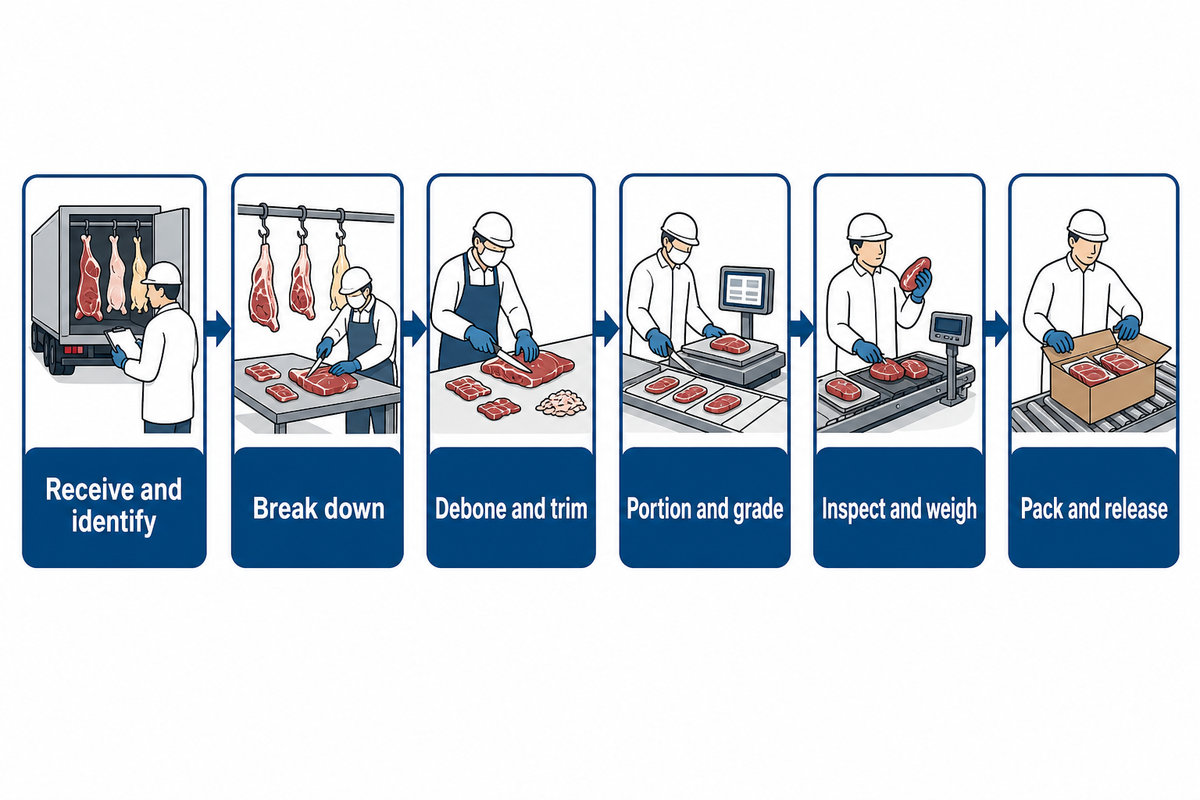
A machine list hides the moments when control changes hands. Product may leave a rail, enter a table, turn for a cut, wait in a tote, move to deboning, split into trim grades, pass an inspection and join a pack lot. Each transfer changes orientation, custody, exposure, information or traceability. Queues often begin there rather than inside the fastest machine.
- Receive and identify — confirm product state, lot and route.
- Break down — separate the unit into planned primals or parts.
- Debone and trim — remove bone and nonconforming tissue to the approved specification.
- Portion and grade — create the required geometry or mass and route by condition.
- Inspect and weigh — apply the defined official or plant-controlled checks.
- Pack and release — associate accepted product with packaging, label, lot and disposition.
For each handoff, record five facts: incoming state, outgoing state, expected rate, maximum controlled accumulation and the owner of rejected or held product. Without a product-time rule, a buffer can hide stoppages. Without identity control, a rework loop can mix lots or repeat the same defect. Without a defined sampling and reject action, a scale only creates numbers.
Mark conveyor systems, manual transfer points, and processing areas on one flow drawing. That reveals where containers, people or product cross and where a sanitation or traceability boundary may fail.
Government facility guidance indicates that poor planning causes unsanitary conditions and congestion, and asks planners to consider room layout, equipment, material and people flow together. Straight-line flow is not always the best layout; procurement should test it against hygiene zones, inspection access and pack-out routes.
Handoff test: If a station is expected to run at 20 units/min while the next accepted handoff maintains 16 units/min, the missing 4 units/min will build up, divert, or stop the upstream process. Over 60 minutes, that gap creates a 240-unit exposure unless the control logic and physical buffer say otherwise. Hidden queue growth turns a small handoff problem into rework and mixed lots.
Balance Before Speed: Find the Slowest Repeatable Accepted Handoff
Balance Before Speed is a planning principle: whole-line output is constrained by the slowest repeatable accepted handoff under the planned product mix, staffing, breaks, sanitation, changeovers, inspection and pack-out conditions. It is not a physical law, a supplier rating or an excuse to push work faster. Even a balanced line needs a separate ergonomic assessment.
Planning rule: The honest version is that modular equipment can relocate a bottleneck; it does not erase the trade-off between accepted output, cleanability, labor, inspection and pack-out. This guide will not claim a universal rate because product and operating evidence still control the result.
5-Station Balance Before Speed Map
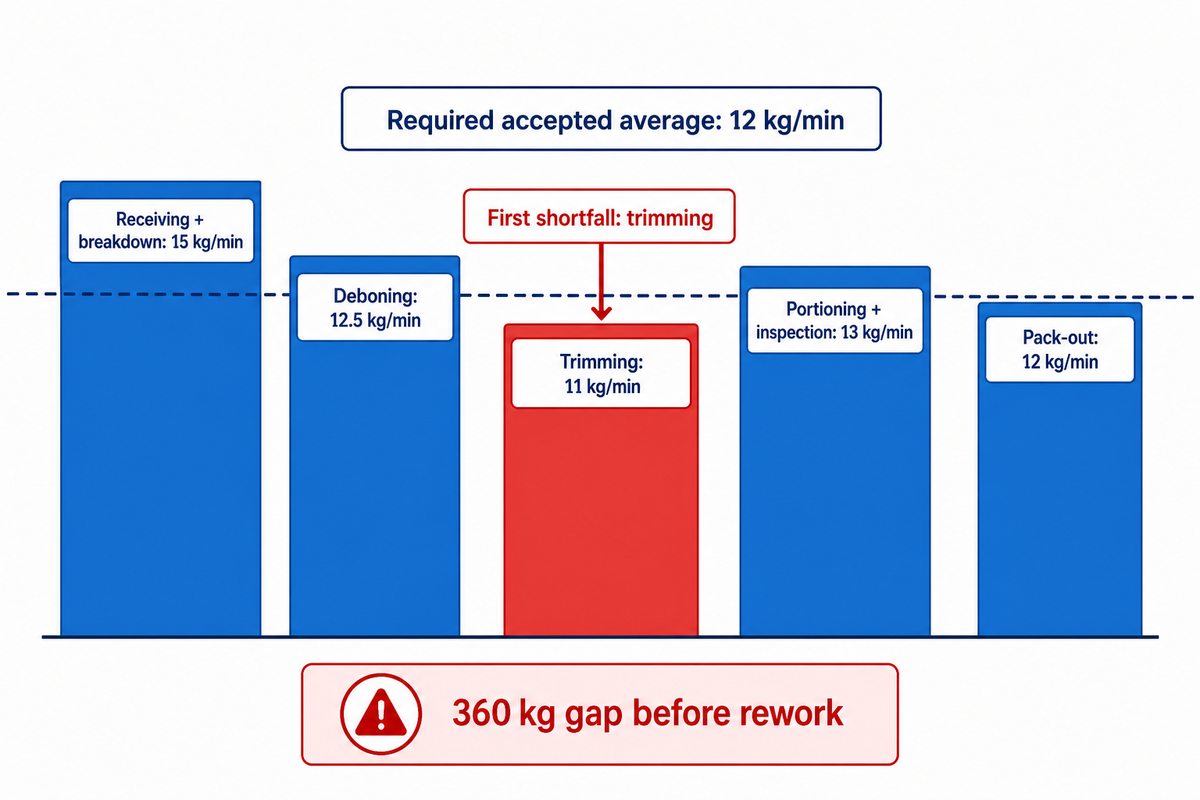
Suppose we’ve a fictitious 8-hour shift. Subtract a 30-minute meal break, two 10-minute breaks, 40 minutes of sanitation and blade/tool service, and two 15-minute product changes. Available production time is 360 minutes, or 6 hours. If the saleable demand is 4,320 kg, the required accepted average is 12 kg/min.
Now test the same product basis across stations. Assume receiving and breakdown can sustain 15 kg/min; deboning, 12.5 kg/min; trimming, 11 kg/min; portioning and inspection, 13 kg/min; and pack-out, 12 kg/min. The first shortfall is trimming. Increasing a saw from 15 to 18 kg/min doesn’t close the 1 kg/min trim gap. Over 360 production minutes, that gap represents 360 kg of queue, diversion or missed plan before rework is counted.
Check whether the 11 kg/min result reflects the planned mix, sharp tools, stable presentation, relief labor, accepted trim quality and normal pack-out. Even 12.2 kg/min leaves little reserve against a 12 kg/min requirement.
Run sensitivity cases before treating the average as capacity. If unplanned loss adds 20 min, available time falls to 340 min and the required rate becomes 12.7 kg/min. If 5% of gross flow requires controlled rework, the station must handle about 13.4 kg/min to protect 12.7 kg/min of accepted flow. Another 10 min stop leaves 330 min and lifts the accepted requirement to 13.1 kg/min.
Productivity and equipment utilization are meaningful only if the denominator is clear. Reducing labor at one station does not necessarily reduce total labor if inspection, rework or queue handling increases elsewhere. Working conditions remain an independent acceptance limit.
Work and line speeds, labor exposure, musculoskeletal-disorder risk and upper-extremity pain should be examined independently. A 2025 FSIS study of swine-processing workers found 46% of evaluated workers at high musculoskeletal-disorder risk and more than 42% reporting moderate-to-severe upper-extremity pain; line-speed effects varied by establishment. That study concerns swine evisceration and cannot be relabelled as cutting-line capacity evidence. This study shows why a single speed number cannot describe workload.
A study of meat cutters in Jabalpur, India, reported REBA scores of 10/10 for deboning and mincing tasks, and recommended redesign of tools, workstations and processes. The scores for the tasks don’t establish a prevalence or a capacity for another plant. Use a qualified ergonomist or the applicable occupational-safety method to assess force, posture, reach, repetition, cold, tool condition and recovery.
Use the calculation to
- Expose the first rate gap
- Test product-mix and downtime assumptions
- Size controlled accumulation and relief
- Define a trial and acceptance question
Do not use it to
- Promise a universal kg/h rate
- Convert a single-machine speed into shift output
- Ignore ergonomics or food-safety signals
- Hide rework inside good production
Design the Cutting Room Around Movement, Access and Hygiene
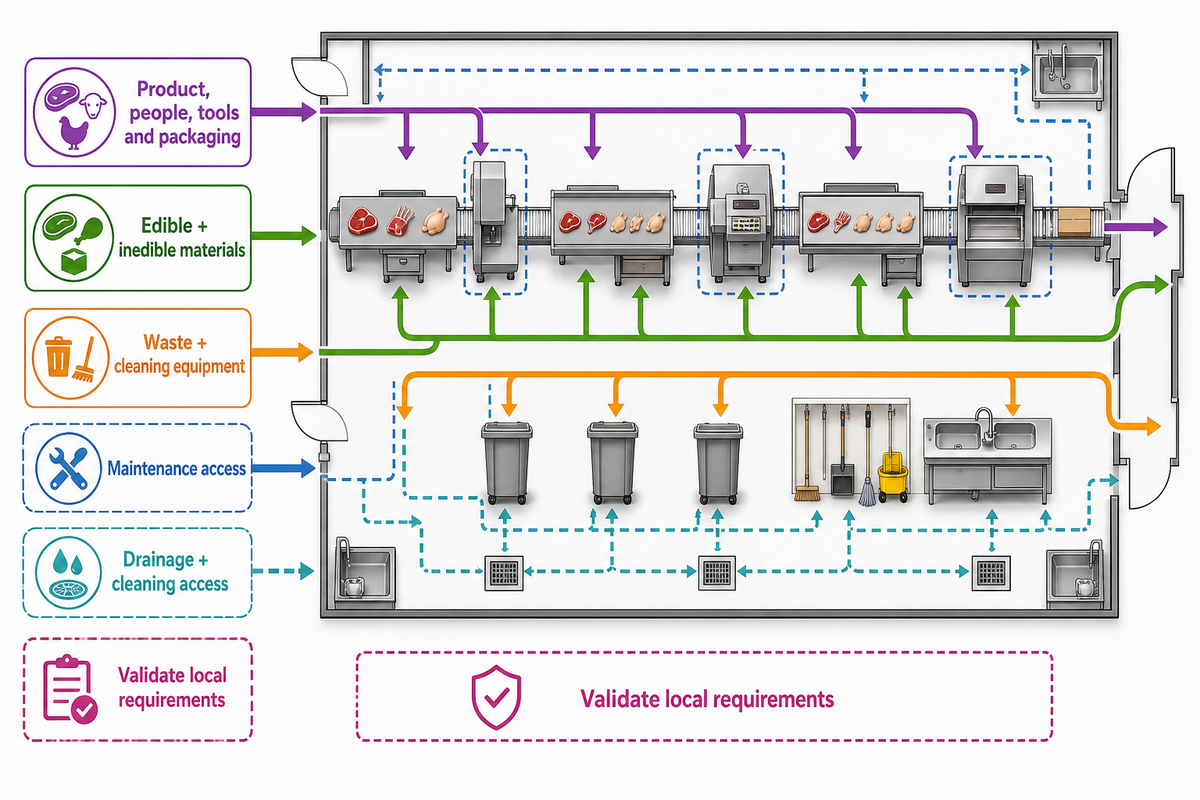
Think in terms of flows as opposed to structures. The handoff and queue limits from the previous section become physical routes here. Define pathways for product, people, tools, packaging, edible and inedible materials, waste, cleaning equipment, and maintenance staff. The height, design, and organization of the work affect the reach and appropriate control of the knife. Drainage and access for cleaning affect the restoration of the room to an acceptable condition. Access for maintenance affects the degree to which a repair can be isolated from the exposed product.
Building services are an integral part of hygienic design. In the USA, 9 CFR 416.2 describes the construction of separations, ventilation, condensation, plumbing and backflow, floor drainage, sewage and potable water. It also calls for the prevention of adulteration of the product. The examples included are only some of the many considerations within a jurisdiction. The project team will have to validate the local building, occupational, environmental, and food legislation.
Test cleanability, water collection, overhead condensation, hose and drain risks, edible/inedible crossings, and maintenance access directly on the layout. Cleaning access disappears quickly when a layout is drawn around machine footprints. Technicians should not need to carry tools through exposed-product zones to reach a drive or sensor.
The placement of critical elements and space utilization shouldn’t result in a loss of required sanitary clearances. Confirm food-grade contact requirements, the stainless steel construction detail, each steel material certificate and the cleaning method separately. A crate washing machine or tool washer may be useful, but it cannot correct inaccessible conveyor frames, poor drainage or uncontrolled clean-to-dirty traffic.
Ergonomic controls require additional rationale. Product supports, inclined surfaces, neutral wrists, sharp tools, and adjustable fixtures may help; however, the task and worker population will determine how much they help. One percentile drawing does not prove safe access across a crew.
Layout challenge: Mark a 1 m service zone, a 750 mm operator reach envelope and a 150 mm floor-drain fall only when the project engineer has approved those values. The numbers make collisions visible; however, anything other than actual local code, equipment drawings, and a site survey is of limited value.
Food Safety in the Cutting Room: Control Contamination at Handoffs
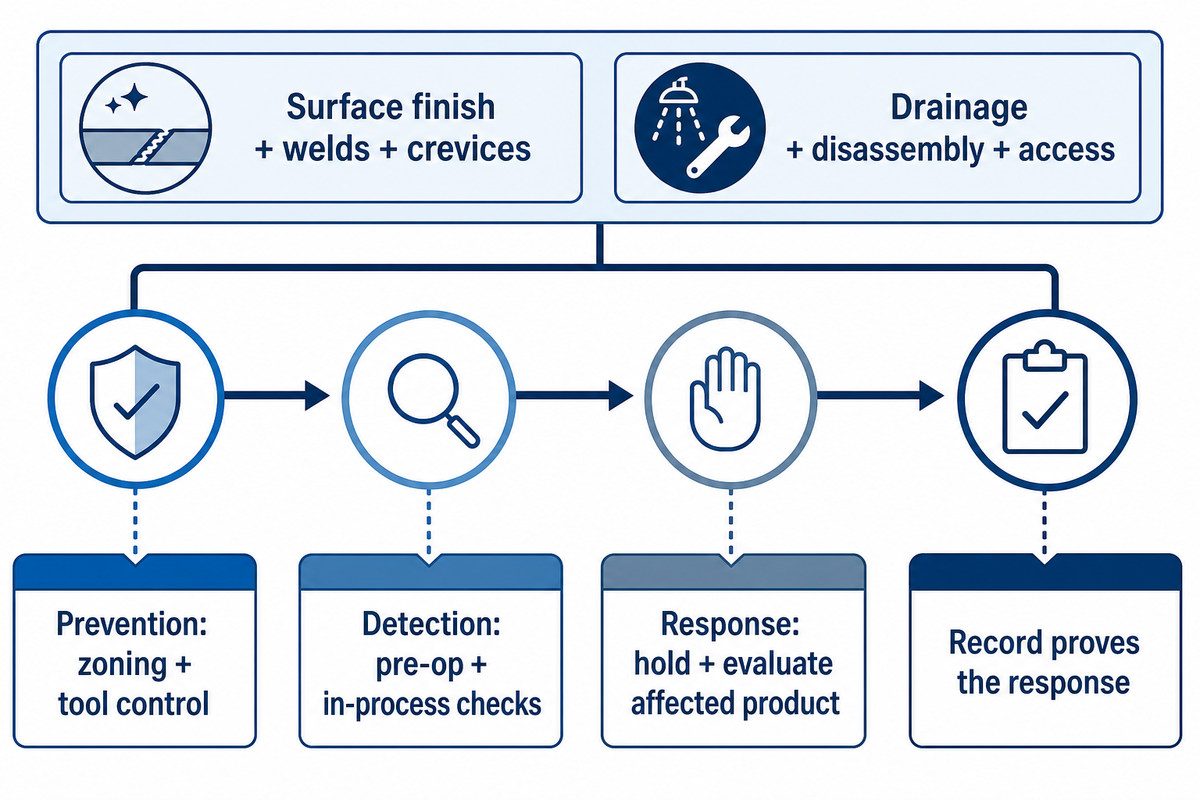
Stainless steel doesn’t make a line hygienic by itself. The access and drainage choices in the previous layout section decide whether those controls can be cleaned and verified. Surface finish, welds, crevices, hollow sections, drainage, disassembly, access and cleaning verification determine if soil can be removed and if the conditions can be checked. The same applies to tools, belts, bins and fixtures; material declaration is only one component of controls.
Food safety plans must be unique to each plant. FSIS guidance connects hazard analysis, monitoring, corrective action, verification and records and doesn’t suggest one universal cutting line set point. Associate each control to a named handoff, surface, tool, movement or product state. Then state what is monitored, who acts, what happens to affected product and what record proves the response.
Hygiene standards safeguard food safety, public health and public safety only when the plant transforms these standards into verifiable controls. Compliance is not the result of simply replicating a grade or equipment claim.
Separate prevention from detection. Zoning and tool control minimize some exposures; pre-operation and in-process checks reveal others. Finished product inspection may identify certain defects, but it can’t make an inaccessible, poorly drained or uncontrolled process hygienic.
Time and temperature require a defined rationale. Limits are dependent on the product, process, jurisdiction and hazard analysis and validated procedures of the plant. Equipment must support the plant’s values and records; it can’t substitute for them.
Control record: A check every 30 minutes isn’t necessarily better than a check every 60 minutes. Frequency is defensible only when it can detect loss of control soon enough to identify, hold and evaluate the affected product under the plant’s validated plan.
Separate Official Inspection From Plant-Controlled Quality Checks

“Inspection” can refer to different authorities and purposes. Inspections by the government are performed based on laws and a particular inspection system. A plant may separately conduct incoming-condition checks, HACCP monitoring, sanitation verification, cut-quality sorting, weight control, tool-integrity checks, foreign-material detection, package checks and label verification. Those activities cannot be exchanged merely because they all observe product.
For U.S. poultry establishments, 9 CFR 381.36 prescribes facilities and locations for official online and offline inspection under applicable systems. The regulation, in the context of the New Poultry Inspection System, includes offline verification stations placed before and after the chiller. These are official inspection interfaces and a plant can’t displace them based on the general ‘inspect before value is added’ principle.
As for livestock, 9 CFR 307.2 defines the specified locations and the facilities for final inspection and retained product, and includes provisions for the separation, sanitation, and drainage. In this regard, the official arrangement is dictated by local regulations and the inspection authority assigned. The logic of this guide is applicable to checks carried out by establishments.
The poultry requirement does not define livestock final inspection, and the livestock facility rule does not replace the applicable poultry inspection system. Keep official interfaces of each species and inspection program clearly defined and separate.
Place a plant-controlled check where its finding can still impact the outcome. A cut-quality check belongs before pieces from many units are mixed if traceability or rework would be lost after mixing. A blade-integrity check needs a defined response for product made since the last acceptable check. A weight check should be placed at a position to segregate underweight or overweight packs, without returning rejected product to a lane that is uncontrolled.
Role test: Write the owner beside every check, official inspector, food-safety team, quality team, production operator or maintenance. If 5 checks share one label but have 5 different authorities and dispositions, they are not one interchangeable inspection point.
Diagnose Species-to-Process Mismatch Before Buying More Automation
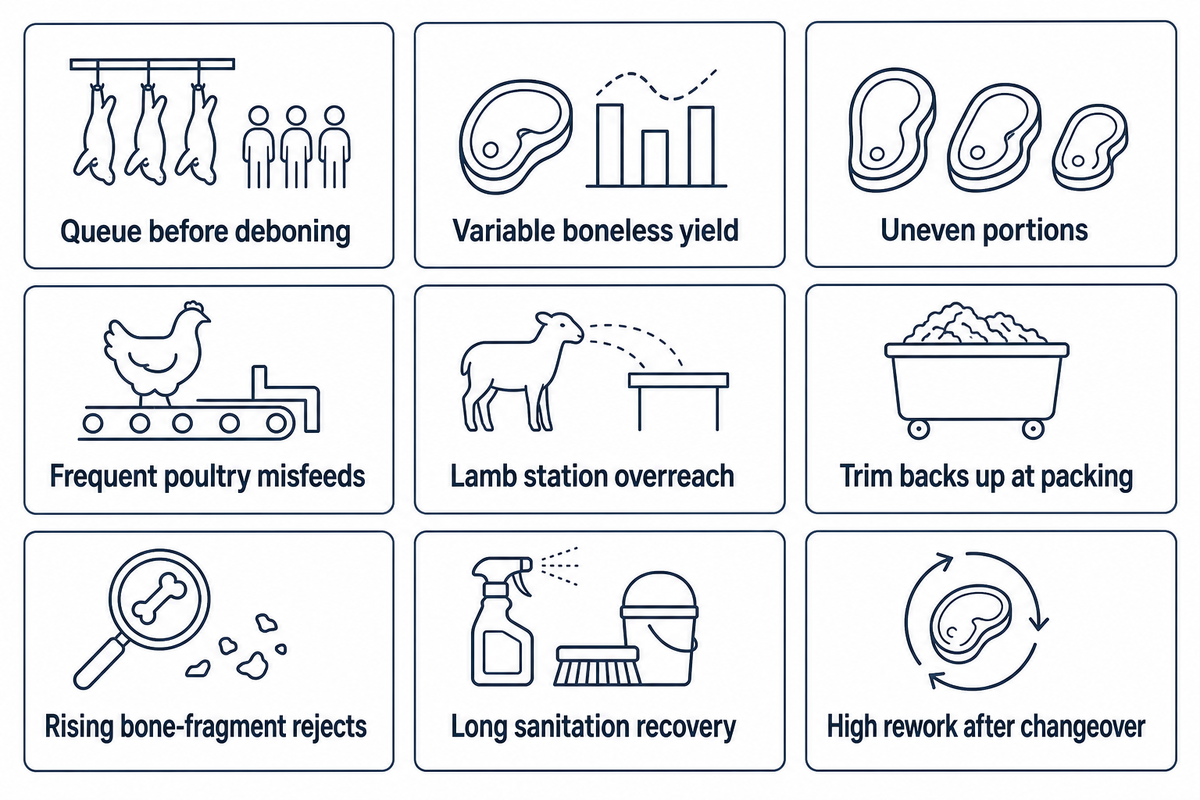
A queue, inconsistent cut, or yield complaint is a symptom of a larger issue. The inspection owners from the previous section help separate a product defect from a handoff or equipment fault. The first question that needs to be asked is “what evidence differentiates input, specification, work, hygiene, inspection and pack-out?” Automation of a well-defined task can help stabilize a process. It can also expose product variation, create a faster queue or reject more pieces when presentation and acceptance remain undefined.
Peer-reviewed work on meat-processing automation cautions that benefits are not always obvious and require plant-specific justification. A 2025 review likewise describes size variation and deformable product as persistent constraints for sensing and adaptive cutting. Again, these findings provide a cautionary diagnostic warning, rather than an indication that automation is preferable to manual systems.
Modern meat processing may combine manual cutting techniques, additional equipment, modular design, and vision-based segmentation. None of those choices automatically minimizes losses. A “high-efficiency” classification does not provide evidence unless the supplier sets the product mixture, output, labor, and utilities and defines the test method.
| Mismatch category / observed symptom | Corroborating evidence | Boundary to verify | Change to avoid |
|---|---|---|---|
| Queue before deboning | Arrival pattern, product orientation, labor cycle | Presentation versus true station rate | Faster upstream cutting |
| Variable boneless yield | Carcass class, cut spec, trim recovery, rework | Input mix and measurement basis | Assuming a machine guarantees yield |
| Uneven portions | Input geometry, weight distribution, blade/tool state | Product conditioning and acceptance method | Tightening a limit without process capability |
| Frequent poultry misfeeds | Carrier loading, bird size, orientation, sensor images | Presentation and variant envelope | Increasing conveyor speed |
| Lamb station overreach | Work height, reach path, fixture and task video | Human factors and product support | Copying a beef workstation at smaller scale |
| Trim backs up at packing | SKU sequence, tote changes, scale and pack cycle | Pack-out, not cutter capacity | Adding another trim station |
| Rising bone-fragment rejects | Cut path, blade condition, anatomy, detector challenge test | Creation versus detection | Relying on detection alone |
| Long sanitation recovery | Drainage map, access log, disassembly time, pre-op findings | Hygienic design and building services | Adding production speed before cleanability |
| High rework after changeover | Recipe, tooling, first-off checks and retained samples | Change verification and variant control | Automating an uncontrolled setup |
Integration and Acceptance Evidence Before You Request a Line Proposal

Proposing similar alternatives starts with the same evidentiary pack to all prospective bidders. Proposed designs must include product representations or anatomy, such as approved samples, cut plans, and assumptions for shifts and mixes, along with utility and hygiene zone boundaries, official inspections, plant checks, available packaging, process data and controls, and a plan for changeover along with the proposed acceptance method. Ask suppliers to mark exclusions rather than letting them disappear inside a total price.
To customize a meat production line, the routes for the product and the evidence must be kept together. The evidence package requested must show which functions alter the product and which functions check it.
Acceptance requires evidence for the product (cut, mass, defect, package, and lot) and process (rate, queue, alarm, reject, and changeover). State whether a check releases one unit, a lot or only an investigation.
A poultry-parts patent published in 2025 and shown as pending when checked in September 2026 describes holders, conveying and cutting stations, a scraper, sensors for jam or misfeed conditions, guards and stop controls. This is one of many potential areas of investigation. It doesn’t represent a standard. It isn’t a case of proven commercial implementation or a Shengtu part. The critical question for procurement is whether the offered concept can detect and manage the abnormal cases that can arise from the proposed project.
The capability statement of Shandong Shengtu Bufan Intelligent Technology Co., Ltd. describes its scope as food-machinery research, manufacturing and whole-plant digital integration, including line integration, OTA upgrade support, low-code control boxes, multi-protocol gateways, vision and edge algorithms. These are user-supplied capability statements. Confirm which functions, interfaces, software records and acceptance tests are being offered.
Search-intent boundary: Searches for “beef lamb poultry cutting line for sale” or “beef lamb poultry cutting line cost” collapse different commercial scopes. This guide explains the evidence; the solution page owns configuration and quotation.
When the evidence package is prepared, use Shengtu’s meat cutting and deboning line for configuration, material, layout, delivery and quotation discussions. This guide expects that the decision about the commercial aspects of the offering will rest with that page; use the contact route for project-specific questions.
Proposal check: A 6-hour witnessed trial with 3 product variants and 2 changeovers can be meaningful only when the sample population, good/reject definitions, rework rule, downtime treatment, measurement method and sign-off authority are agreed before the trial.
Discuss Your Cutting-Line Evidence Pack
Frequently Asked Questions
What is a meat processing line?
A meat processing line is a connected workflow that moves product through defined states rather than one machine, with controlled handoffs, plant checks and acceptance records.
The full process may include slaughter, dressing, chilling, cutting, deboning, further processing, inspection and packaging. Here, a defined carcass, bird or part state enters; specified cuts, trim and by-products leave; and every station follows the same product mix, hygiene plan and pack-out rhythm. A useful project boundary also names who owns refrigeration, official-inspection interfaces, rework and packaging so those responsibilities don’t disappear between suppliers.
What is a meat cutting section called?
Plants may call it a cutting room, boning room, deboning room, fabrication area or poultry cut-up area, depending on species, incoming product state and project scope.
The name depends on species, incoming state and scope. Define inputs and saleable outputs; two “boning rooms” may need different carriers, workstations, hygiene boundaries, inspection roles and pack-out routes. Naming the room is therefore less useful than naming the product states, controlled transfers, people and material routes, utilities, checks and acceptance records inside it.
What do faster line speeds mean for workers and food safety?
A faster upstream rate increases arrivals, but it does not prove the cutting room can sustain accepted output safely under planned staffing, hygiene, inspection and pack-out conditions.
Review station work content, staffing, force, posture, reach, tool condition, breaks, sanitation, inspection, rework, queues and pack-out together. Watch accepted product and control signals rather than conveyor speed alone. In the 2025 FSIS PULSE study, 46% of evaluated swine-processing workers were at high musculoskeletal-disorder risk and more than 42% reported moderate-to-severe upper-extremity pain; effects still varied by establishment. Those figures don’t set a cutting-line speed. They show why the plant must evaluate the people, task and controls around its own rate. Slaughter-line animal-welfare decisions remain upstream, though their rhythm can affect the handoff.
What changes between beef, lamb and poultry cutting?
Define product state, process category and intended use first; then account for species anatomy and handling before selecting shared or species-specific equipment, stations and controls.
Beef, lamb and poultry differ in input size, geometry, bone structure, carrier method, work height, portion mix and upstream preparation. Even a shared conveyor doesn’t erase those constraints. Document both layers so a supplier can distinguish genuinely shared stations from species-specific fixtures, tools, sensors and checks.
How should cutting-line capacity be estimated?
Estimate capacity from saleable demand, available production minutes and the slowest repeatable accepted handoff under the planned mix, staffing, sanitation, inspection, rework and pack-out conditions.
Use one product basis across all required stations. Include breaks, cleaning, tool changes, product changes, inspection, accumulation, rework and packaging stops. Treat the result as a planning range until representative product trials, staffing, layout and acceptance conditions are agreed. The fastest machine’s nameplate can’t establish whole-shift output.
How much does a meat cutting machine cost?
There is no defensible single price for a complete cutting line without a defined project scope covering equipment, controls, installation, documentation and acceptance testing for the project.
Cost changes with species, input state, station count, automation, contact materials, controls, inspection, packaging, documentation, installation, destination and acceptance. Standalone cutter pricing doesn’t represent a room-scale project. Prepare the evidence pack first, then request a configuration and quotation against the same boundary.
How This Guide Was Built
The planning guide cross-checks public FAO, government, regulatory and peer-reviewed evidence against the cutting-room decisions a buyer must document. Shengtu supplied its company profile and capability statements, but no private plant trial, customer result, yield study or throughput benchmark was used. Project values still require product trials, local compliance review and an agreed acceptance plan.
References & Sources
- FAO: Meat Cutting and Further Processing Guidance
- 9 CFR 417.2: Hazard Analysis and HACCP Plan
- 9 CFR 416.2: Establishment Grounds and Facilities
- 9 CFR 381.36: Poultry Inspection Stations
- 9 CFR 307.2: Livestock Inspection Facilities
- USDA FSIS: HACCP Guidance
- USDA FSIS: 2025 PULSE Swine Study
- Peer-Reviewed Meat-Processing Ergonomics Study
- 2025 Review of Robotics in Meat Processing
- North Carolina Department of Agriculture: Meat and Poultry Facility Guidelines
- Animal Frontiers: Lessons in Automation of Meat Processing
- EP4507500A1: Poultry-Parts Processing Patent Publication
![F&V Freeze-Drying Line Process Guide [2026]](https://shengtumachinery.com/wp-content/uploads/2026/09/fv-freeze-drying-line-guide-featured-768x512.png)





![F&V Freeze-Drying Line Process Guide [2026]](https://shengtumachinery.com/wp-content/uploads/2026/09/fv-freeze-drying-line-guide-featured-150x150.png)