Get in touch with Shengtu Bufan Company

Quick Specs
| Stage | Typical Equipment | What It Achieves |
| Washing, sorting, peeling | Washing tanks, brush rollers, peelers | Removes soil, foreign matter, damaged product |
| Cutting, sizing | Dicers, slicers, graders | Uniform pieces for downstream processing or fresh-cut retail |
| Preservation | Dryers, freeze-dryers, IQF tunnels, retorts, aseptic/UHT lines | Extends shelf life via one of eight methods — see The Preservation Compass below |
| Packaging | Fillers, sealers, labelers | Protects product, enables distribution |
What Is Fruit and Vegetable Processing?
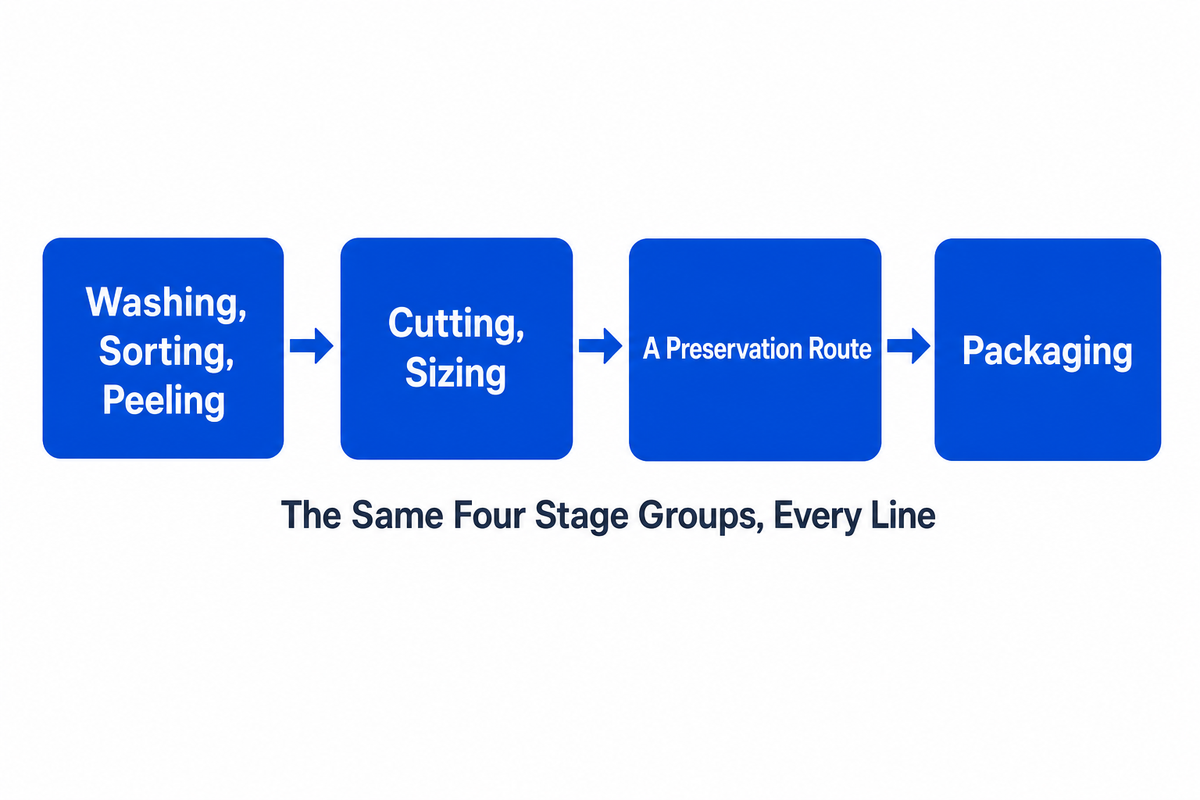
Fruit & Vegetable Processing is the sequence of washing, cutting, and preserving steps that turns fresh, perishable produce into a safe, stable, longer-shelf-life food product. According to the Food and Agriculture Organization, the goal is to supply wholesome, safe, nutritious food to consumers year-round despite the perishable, seasonal nature of the raw crop.
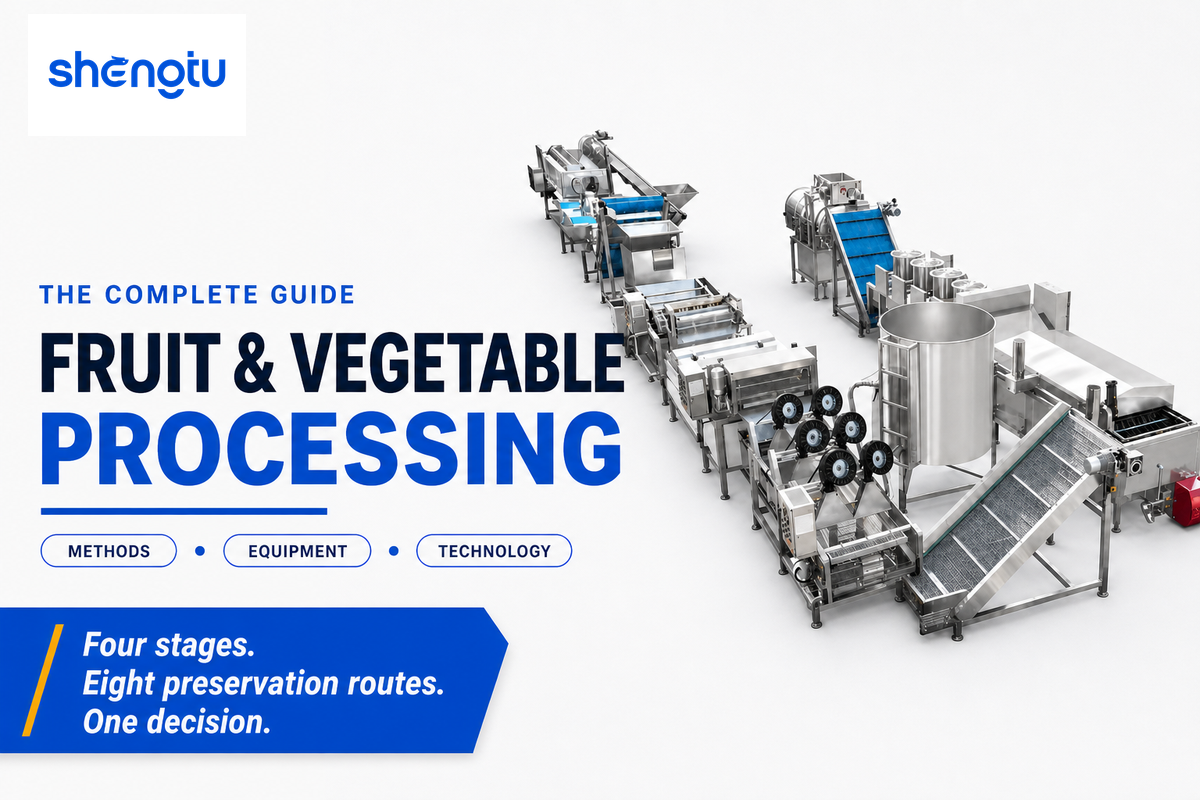
Every processing line, regardless of crop or scale, moves through the same four stage groups: washing/sorting/peeling, cutting/sizing, a preservation route, and packaging. The preservation stage is where processors make their most consequential decision — which preservation method (drying, freeze-drying, individual quick freezing, canning, aseptic filling, pasteurization, high-pressure processing, or fermentation) actually fits the product, and that choice is the subject of most of this guide.
The fruit and vegetable processing industry spans everything from single-machine operations processing fruit for a local market to fully automated processing systems built by major fruit processing equipment manufacturers and food processing companies — names such as JBT Marel (the combined company formed when JBT completed its acquisition of Marel in January 2025) and Alfa Laval design processing solutions for large-scale fruit and vegetable production. What connects small-scale and industrial-scale processing of fruits and vegetables alike is the same underlying goal: highly perishable fresh produce becomes a fruit and vegetable product with consistent quality and a defined shelf life. Food science research into fruit and vegetable processing continues to refine exactly how that transformation happens, and modern fruit and vegetable processing looks meaningfully different from the processing fruit and vegetables saw even a decade ago — largely because of the preservation-route and automation developments covered later in this guide.
Every fruit and vegetable processing equipment purchase ultimately serves one of these two paths. The processing methods covered in this guide all do one of two things to process raw produce: they transform raw produce into a shelf-stable or extended-shelf-life product, or they leave it fresh but minimal-processing techniques (light washing, trimming, light packaging) protect it for a shorter window. Maintaining product quality through either path — and through the production of fresh fruit and vegetable products more broadly — depends on getting the sequence of stages below right, not on any single “best” piece of equipment. Demand for ready-to-eat, minimally processed products is one of the two demand drivers this guide covers in the trends section further down.
Stage One: Washing, Sorting and Peeling

Washing, sorting and peeling remove soil, foreign matter and damaged product before anything else happens to the crop, and the equipment used for this stage is governed by hygienic-design rules, not just throughput specifications. The current international benchmark is BS EN 1672-2:2020, which superseded the 2005+A1:2009 edition and specifies common hygiene and cleanability requirements for machinery and machine components used in preparing and processing food. In practice this means self-drainable surfaces, crevice-free construction, and product-contact materials inert to both the product and cleaning chemicals — design choices that determine how fast a line can be sanitized between shifts, not just how fast it washes produce.
In the United States, this stage also intersects two separate USDA/FDA frameworks. USDA’s Good Agricultural Practices (GAPs) and Good Handling Practices (GHPs) audits are a voluntary certification program — verifying that produce is produced, packed, handled and stored in the safest manner possible — that many buyers and retailers require by contract even though the federal audit itself is not mandatory. Separately, FDA’s Produce Safety Rule under the Food Safety Modernization Act sets mandatory, legally enforceable requirements for covered growers and packers. EN 1672-2 is an equipment-design standard used internationally by machinery manufacturers and exporters; it is distinct from both of these — a washing/peeling line built to EN 1672-2’s hygienic-design principles is easier to operate inside either a GAPs/GHPs audit or an FSMA-compliant food-safety plan than one that was not.
💡 Pro Tip
When evaluating a washing/peeling line, ask the manufacturer which edition of EN 1672-2 the machinery was designed against — the 2020 edition superseded 2005+A1:2009, and older equipment specification sheets sometimes still cite the retired edition.
Washing/peeling lines built to this class of standard are designed for continuous multi-shift duty with cleaning cycles measured in minutes rather than hours between batches — a direct, practical payoff of self-drainable, crevice-free construction. Shengtu’s vegetable washing and peeling machine and full root vegetable washing and peeling line pages cover the machine-selection side of this stage in detail.
Stage Two: Cutting, Sizing and Fresh-Cut Preparation
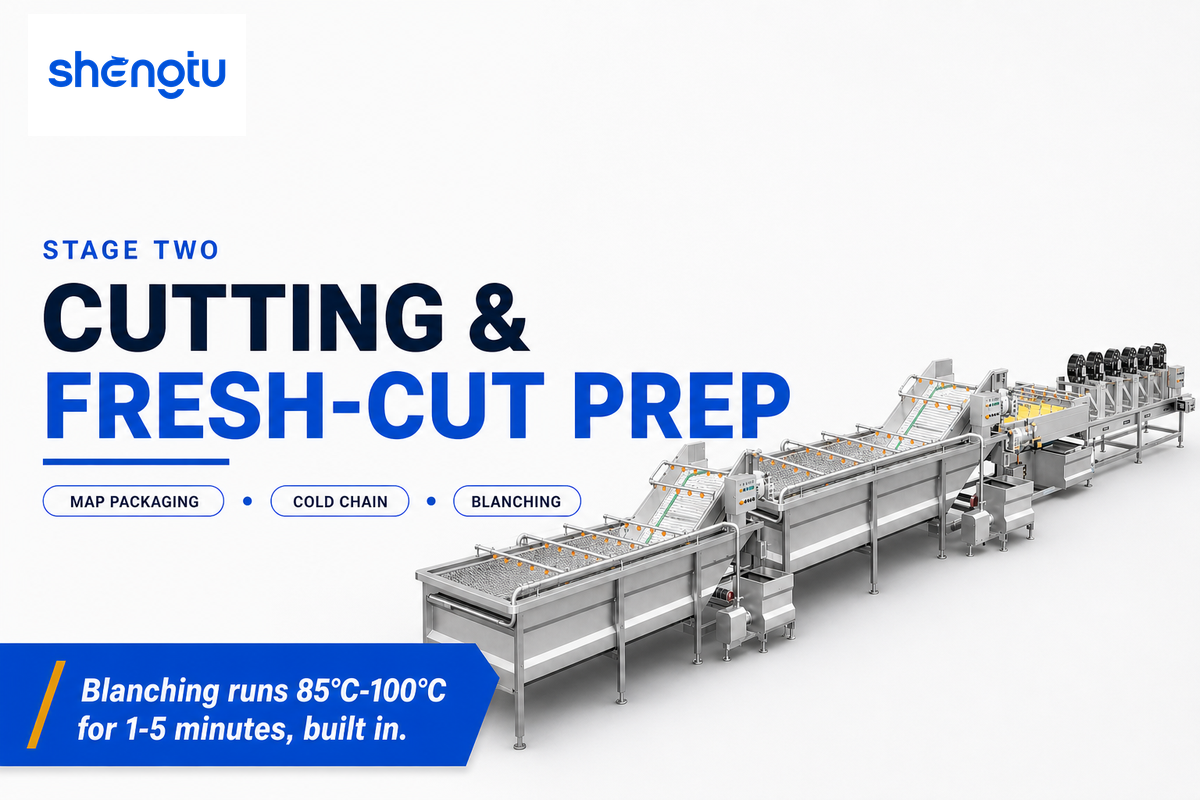
Cutting and sizing prepare produce for either further processing or direct fresh-cut retail sale, and this is the stage where a food-safety risk actually increases rather than decreases. Per USDA’s National Agricultural Library, minimally processed fruits and vegetables pose a greater risk of foodborne illness than their whole-produce equivalents precisely because the protective skin has been cut, exposing flesh and moisture that can serve as a growth medium for pathogens.
This is why fresh-cut lines pair cutting/sizing equipment with modified-atmosphere packaging (MAP) and tighter cold-chain control than whole-produce lines require — the cut surface, not the crop itself, is the new risk the process introduces. Cutting also exposes plant tissue to oxygen, which triggers enzymatic browning in many fresh fruits and vegetables; this is a separate, purely cosmetic problem from pathogen risk, but it’s the reason blanching — typically a brief hot-water or steam treatment in the 85°C to 100°C range for 1 to 5 min, depending on the vegetable and piece size — or an acid dip is often built into a fresh-cut or freezing line immediately after this post-harvest cutting stage rather than left to happen downstream. Shengtu’s leafy fresh-cut line is built around this exact constraint.
The 8-Route Preservation Compass: Comparing Drying, Freezing, Canning, Aseptic and Fermentation Methods
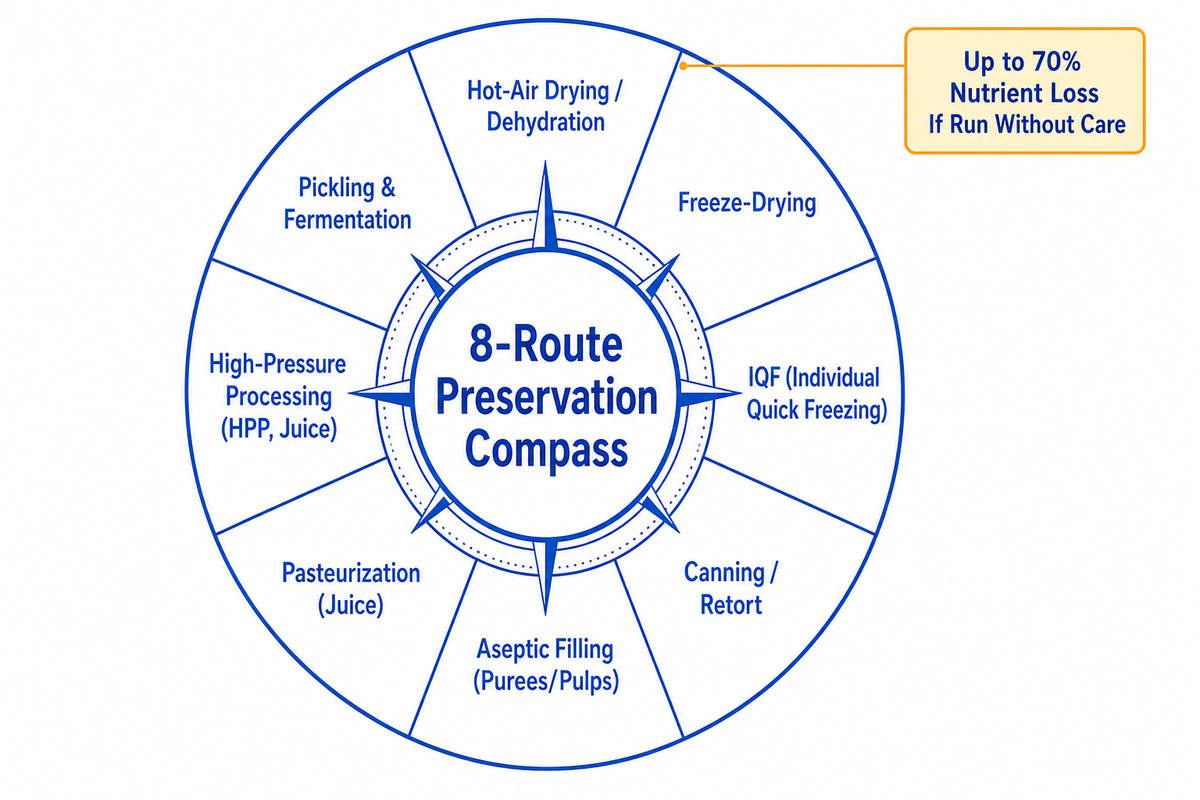
Choosing a food preservation route is a product-fit decision, not a universal ranking — the preservation technique that best protects one crop’s nutrients and sensory qualities (texture, color, flavor) is frequently the wrong choice for another crop, and few publicly available guides on this topic bring all eight of these methods into one side-by-side comparison. The table below is built to be that comparison. (Food irradiation also exists as a preservation technique, but is used narrowly for spice and select produce disinfestation rather than general fruit and vegetable preservation, so it is not included as a primary route here.)
| Process Type | Mechanism | Nutrient/Quality Note | Limitations / Not Suitable For |
|---|---|---|---|
| Hot-air drying / dehydration | Heated air removes moisture at atmospheric pressure | Can reduce vitamin C, carotenoid and phenolic content by up to 70%, depending on process parameters (Onwude et al. 2022) | Heat-sensitive nutrients at aggressive temperature/time settings; not universally worse than freeze-drying — in mangoes, hot-air drying has been shown to retain more carotenoids than freeze-drying, the reverse of the usual pattern |
| Freeze-drying | Frozen product sublimated under vacuum | Peer-reviewed comparisons consistently rate it more protective of heat-sensitive vitamin C than hot-air drying, driven by lower process temperatures; not quantified here as an exact percentage — see note below | Highest capital and energy cost per kg of water removed of the drying routes; product-dependent, not universally superior for every nutrient in every crop |
| IQF (individual quick freezing) | Rapid freezing of individual pieces, typically air-blast or cryogenic | Rapid freezing shortly after harvest can preserve more vitamin C than “fresh” produce that has spent days to weeks in transport and storage losing nutrients to light and oxygen exposure | Requires continuous cold-chain distribution; not a shelf-stable route |
| Canning / retort | Thermal processing to commercial sterility in a hermetically sealed container | Shelf-stable at room temperature with no refrigeration; low-acid products (pH above 4.6) are governed in the US by 21 CFR Part 113, while acidic fruit products instead fall under Part 114 or lighter “acid food” rules (see next section) | Highest heat exposure of the eight types; not suitable for products where texture/flavor loss from full thermal sterilization is unacceptable |
| Aseptic filling (purees/pulps) | Commercially sterilized product filled into pre-sterilized containers in a microorganism-free atmosphere | Shelf-stable without the extended thermal soak of full retort canning; low-acid purees fall under 21 CFR Part 113, acidic fruit purees under Part 114 or lighter “acid food” rules (see next section) | Requires FDA establishment registration and process filing before production; operators need Better Process Control School training |
| Pasteurization (juice) | Thermal treatment, commonly around 90°C for roughly 15 seconds in HTST systems | Well-established process; heat exposure at these temperatures does reduce some heat-sensitive compounds relative to non-thermal alternatives | Governed by 21 CFR Part 120 (5-log pathogen reduction requirement); not suitable when flavor/nutrient loss from heat is unacceptable |
| High-pressure processing (HPP, juice) | Non-thermal pressure treatment, roughly 600 MPa for 0.9 min to 1.5 min | No heat exposure; retains fresh flavor and heat-sensitive nutrients better than thermal pasteurization | Higher equipment capital cost than pasteurization; validation is product-specific, governed by 21 CFR Part 120 |
| Pickling & fermentation | Acid (vinegar) or biological (lactic-acid bacteria) preservation | Live-culture fermented products retain probiotic organisms — a preservation goal, not a food-safety kill step | Narrow product fit (cucumbers, cabbage, select vegetables); not applicable to most fruit |
IQF tunnels typically run between -30°C and -40°C to freeze individual pieces within minutes, then hand off to -18°C storage for distribution. IQF-processed frozen vegetables and frozen fruits depend entirely on unbroken cold storage at that -18°C benchmark from the moment they leave the tunnel to the moment a consumer opens the package — unlike a whole fruit sitting at room temperature, a single cold-chain gap of even a few hours can compromise quality that no downstream step recovers. This is the direct tradeoff for IQF’s nutrient-retention advantage.
Drying, as a category, is not a minor line item in a plant’s energy budget: it accounts for roughly 10% of total energy consumption in the US food sector. That figure is why heat-source selection for a drying or dehydration line is a recurring operating-cost decision, not a one-time equipment spec. Freeze-drying sits at the energy-intensive end of that spectrum specifically: independent industry sources converge on roughly 5 kWh to 10 kWh per kilogram of water removed for conventional food-scale freeze-drying systems, with newer, more efficient equipment reaching closer to 2 kWh to 3 kWh/kg — well above the energy demand of spray drying or hot-air drying. (One peer-reviewed source we checked reported a per-kilogram figure roughly two orders of magnitude above that industry-convergent range; we are treating that single outlier figure as a likely units error rather than repeating it.) Batch-driven operating cost, not the freeze-dryer’s purchase price, typically dominates its lifetime economics in food-scale applications — the reverse of the capital-dominated economics reported for pharmaceutical vial freeze-drying, a different process scale that this guide is not scoped to.
⚠️ Important
A widely repeated marketing claim states freeze-drying retains “90-98% of vitamin C.” We checked this against the peer-reviewed source it is commonly attributed to and could not find that specific figure stated anywhere in the article — the paper supports freeze-drying’s nutrient advantage qualitatively, not with that number. We are not repeating an unverifiable statistic here; treat any precise freeze-drying retention percentage you encounter elsewhere with the same scrutiny.
Explore the drying and freeze-drying routes in depth on Shengtu’s freeze-drying and drying equipment hub, including the vacuum freeze dryer and mesh-belt hot-air dryer pages, or the fruit-and-vegetable-specific dehydration line and freeze-drying line. For IQF, see the IQF quick-frozen food line.
Aseptic, UHT and High-Pressure Processing for Purees, Pulps and Juices
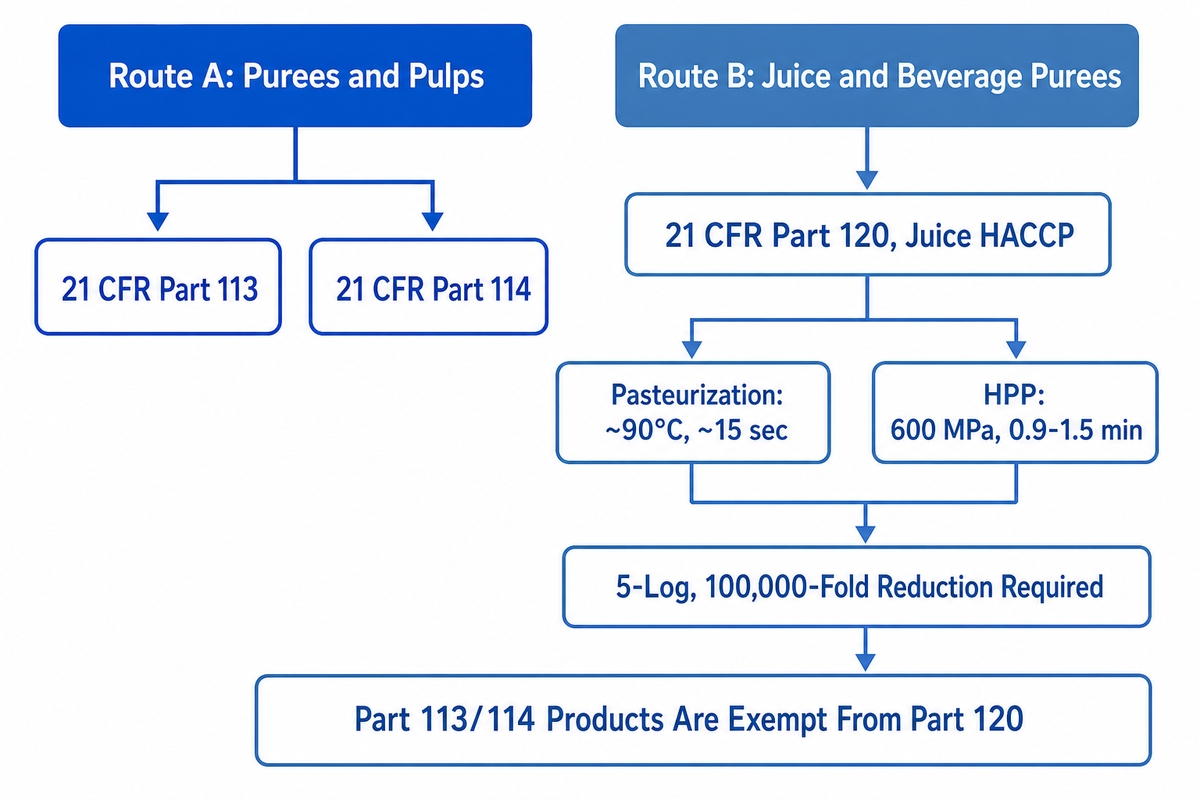
Shelf-stable purees, pulps and juices reach the market through two distinct US regulatory routes that depend on what the product is and how it will be packaged and sold, not on a single unified “aseptic processing” rulebook. Getting this distinction right matters because the compliance obligations, and the equipment required to meet them, are different for each route.
Route A — thermally processed, hermetically sealed products (purees and pulps packed shelf-stable). Which specific regulation applies here depends on the product’s natural acidity, not just its packaging format. Low-acid purees and pulps — pH above 4.6, water activity above 0.85, the zone in which Clostridium botulinum can grow (think pumpkin or some vegetable purees) — fall under 21 CFR Part 113, which governs thermally processed low-acid foods packaged in hermetically sealed containers. Most fruit purees and pulps, by contrast, are naturally acidic (pH 4.6 or below); if acid or an acid ingredient is added to help control that pH, they instead fall under 21 CFR Part 114 (Acidified Foods) rather than Part 113. A naturally acidic fruit puree with no added acid can fall outside both formal categories as a simpler “acid food,” though it still has to meet general FDA safety and labeling requirements. Route A covers two distinct equipment approaches to that same regulatory endpoint: traditional full-retort canning, where the sealed container itself is thermally processed to commercial sterility (see Shengtu’s retort and canned-pouch line for that equipment), and aseptic filling, where the product is sterilized separately, then filled cold into pre-sterilized containers, then sealed with a pre-sterilized closure, in an atmosphere free of microorganisms. Commercial processors operating under either Part 113 or Part 114 must register their establishment and file their process with the FDA before production begins, and operators must complete an FDA-recognized Better Process Control School.
Route B — juice and beverage-use purees sold as juice. These fall under 21 CFR Part 120, the Juice HACCP regulation, which requires a HACCP plan for all 100% fruit or vegetable juice sold wholesale in the US and mandates a minimum 5-log (100,000-fold) reduction of the most resistant public-health-significant pathogen likely to occur in that juice, sustained for the product’s shelf life. Thermal pasteurization is the traditional route to that 5-log reduction. High-pressure processing (HPP) is the non-thermal alternative. A peer-reviewed study in the International Journal of Food Microbiology (2021) puts 600 MPa for roughly 0.9 to 1.5 minutes as sufficient for a 5-log reduction of E. coli O157:H7, Salmonella enterica and Listeria monocytogenes — but that figure is specific to acid and acidified juices below pH 4.5 (tested in pH-adjusted apple juice at 5°C) under a Weibull statistical model; the same study’s more conservative log-linear model estimates 1.8 to 3.2 minutes for the same reduction, and processors still have to validate the hold time for their own juice’s pH and composition rather than treating either number as universal. Either way, HPP delivers that reduction without the heat exposure that changes flavor and destroys heat-sensitive nutrients. Products already achieving commercial sterility under Part 113 or Part 114 are exempt from the separate Part 120 5-log requirement.
✔ Thermal Pasteurization
- Lower equipment capital cost
- Long, well-established regulatory track record
- Heat exposure changes flavor and destroys some heat-sensitive nutrients
⚠ High-Pressure Processing (HPP)
- No heat exposure; retains fresh flavor and heat-sensitive nutrients
- Validated 5-log pathogen reduction at 600 MPa
- Higher equipment capital cost than thermal pasteurization; validation is product-specific, not a blanket approval
One clarification worth making explicit: EN 1672-2, covered in the washing and peeling section above, is a European hygienic-design standard for machinery — it governs how the equipment is built. Parts 113, 114 and 120 are US food-safety regulations — they govern how the process is run and what a facility must file with FDA. A machine can be built to EN 1672-2 and sold globally; the process it runs still has to satisfy whichever national food-safety law applies in the country of use.
Aseptically processed purees are the base ingredient behind two large processed-food categories: shelf-stable baby food pouches, where extended shelf life without refrigeration is a hard commercial requirement, and industrial fruit fillings used by bakery and dairy manufacturers as processed products further down their own supply chain. Both markets choose Route A specifically because it delivers extended room-temperature shelf life for a well-sealed commercially sterile puree — shelf life that Route B’s fresher, shorter-shelf-life juice profile is not designed to match.
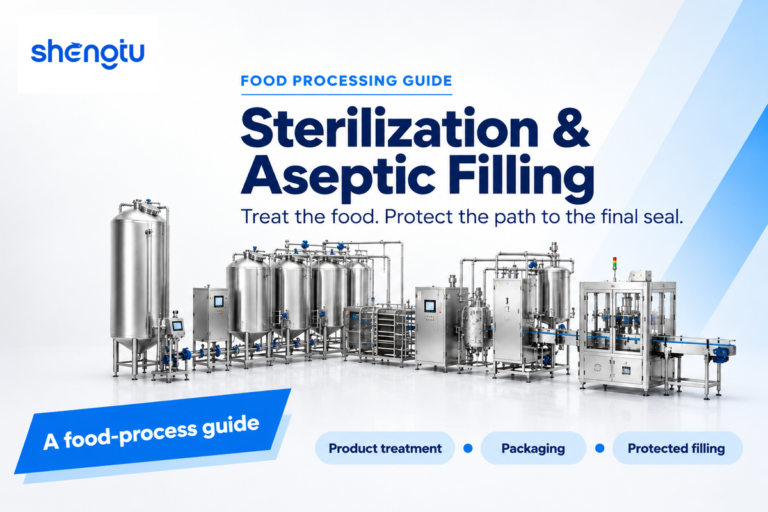
See Shengtu’s UHT and aseptic filling line page for the equipment side of Route A.
Industry Trends: Automation, AI Vision and Sustainable Processing
With the preservation-route and regulatory picture from the sections above in hand, the next layer worth understanding is how the equipment itself is evolving. Two concrete, dated developments are worth a near-term equipment decision-maker’s attention more than the industry’s headline market-size figures. (Updated August 2026.)
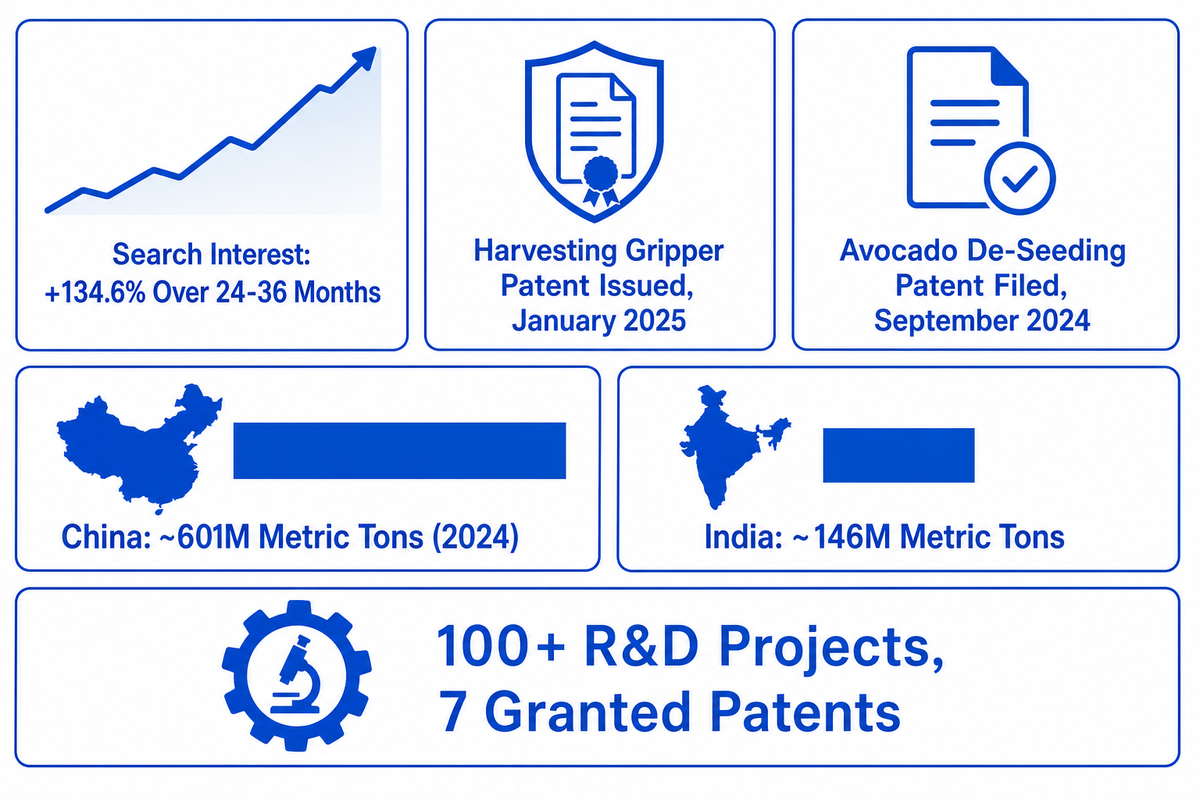
First, harvesting and processing automation continues to draw R&D investment: a flexible-rigid integrated gripper for fruit/vegetable harvesting robots was issued a US patent in January 2025 (assigned to a Chinese agricultural-research institute, not an equipment vendor), and an automated avocado de-seeding and pulp-extraction system was filed as a US patent application in September 2024. These are individual inventive records, not proof of industry-wide deployment on their own — patent filings track invention, not adoption — but they are concrete, dated evidence that automation R&D in this space is active right now, not a vague future promise.
Second, a wave of non-thermal preservation technologies has moved from lab to trade-press coverage: pulsed electric field, pulsed light, ultrasound, high-pressure processing and microwave drying are now named together in current industry reporting as methods that increase product stability while preserving thermolabile (heat-sensitive) nutrients, flavor and texture. HPP, covered above, is the furthest along in regulatory clarity for juice; the others are worth asking a supplier about even if HPP remains the most production-ready option today.
Both developments track a demand-side driver confirmed independently by two different data sources: DataForSEO search-trend data shows search interest in fruit and vegetable processing up 134.6% over the past 24-36 months, and industry reporting attributes rising demand for minimally processed, ready-to-eat products to changing dietary habits and busier lifestyles. Health-conscious consumer demand for food that is both convenient and closer to fresh — rather than heavily reformulated — is the throughline connecting both the automation-and-robotics investment and the non-thermal preservation wave: buyers increasingly expect processed food to taste noticeably fresher (tastier, in plain terms) than older thermal-processing defaults delivered, without giving up shelf life. For context only: market-research firms currently estimate the global processed fruit and vegetable market at roughly USD 328-458 billion depending on the report, a figure that varies by scope definition and should not be treated as more precise than that range implies.
Sustainable food positioning is following the same demand curve across the broader food industry, not just this market segment: processors that can document waste reduction and lower energy use per unit of throughput are increasingly using that data in procurement conversations, which is one more reason the drying-energy figure earlier in this guide belongs in a sourcing decision, not just an engineering one. Market trends in this space move slower than headline market-size figures suggest — supply-chain and equipment-replacement cycles in fruit and vegetable processing typically run in years, not quarters. China and India are consistently reported as the world’s two largest producers of fruit and vegetables by volume — China alone accounted for roughly 601 million metric tons of vegetable production in 2024, with India a distant second at roughly 146 million metric tons — which is part of why so much processing equipment — for both domestic use and export — is engineered and built there.
The practical risk for a buyer evaluating this automation-and-vision trend is treating marketing language as equivalent to deployed capability — a lab demo is not the same as equipment already running a customer’s line, and closing that gap is exactly why an equipment vendor’s own engineering base matters. Shengtu engineers its own control layer for this reason — processing buyers increasingly ask for proof of in-house capability rather than a reseller relationship: low-code control boxes, multi-protocol gateways, YOLO-based machine vision, and edge algorithms developed under an ISO 9001-certified quality system, backed by more than 100 R&D projects and 7 granted patents. That in-house engineering base is what lets an automation or AI-vision claim actually get tested on a real production line rather than taken on faith.
When NOT to Add More Machinery: The Limits of Automation
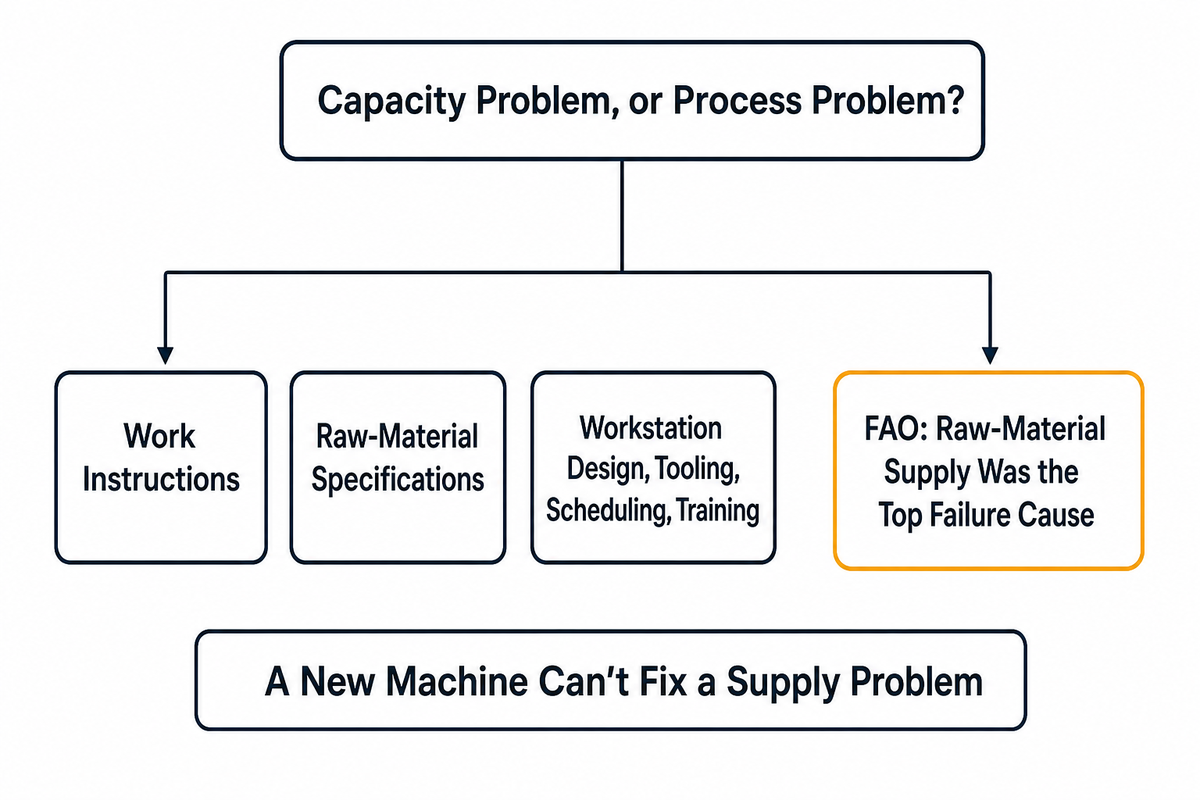
Before commissioning capital equipment to fix a processing bottleneck, it’s worth asking a cheaper diagnostic question first: is the bottleneck actually a capacity problem, or a process problem that machinery can’t fix. Industry practitioners report that the right response to a manual processing bottleneck isn’t always machinery — better work instructions, raw-material specifications, workstation design, tooling, scheduling and employee training can improve performance at lower risk and lower capital cost than a new line.
This lines up with a broader pattern documented in real-world processing-plant failures: FAO’s own historical review of the industry found that the single most common reason processing operations failed wasn’t insufficient machinery — it was an inadequate quantity and regularity of raw-material supply to the factory, often compounded by high labour cost and shifting government policy. A production-planning error compounds this further when planners over-estimate available working days without accounting for power outages or staff absence.
“The most important reason for failure was lack of adequate quantity and regularity of raw material supply to factories.”
— FAO Agricultural Services Bulletin 76, Horticultural Marketing: A Resource and Training Manual for Extension Officers, Chapter 6
A processor evaluating a new line should treat that finding as a checklist item, not a historical footnote: before signing off on capital equipment, confirm the raw-material supply plan is solid first, since new machinery can’t compensate for an upstream supply gap. The honest takeaway: a new machine can’t fix a raw-material supply problem, and it’s worth ruling that out, along with the cheaper process-design fixes above, before capital equipment becomes the default answer to a throughput bottleneck.
Choosing Your Processing Route: From This Guide to a Configured Line
Once you know which preservation route fits your product — drying, freeze-drying, IQF, canning, or the aseptic/UHT/HPP route for purees and juice — the next question becomes a machine-selection question, not a process-education question, and that’s a deliberately different job than this guide is trying to do.
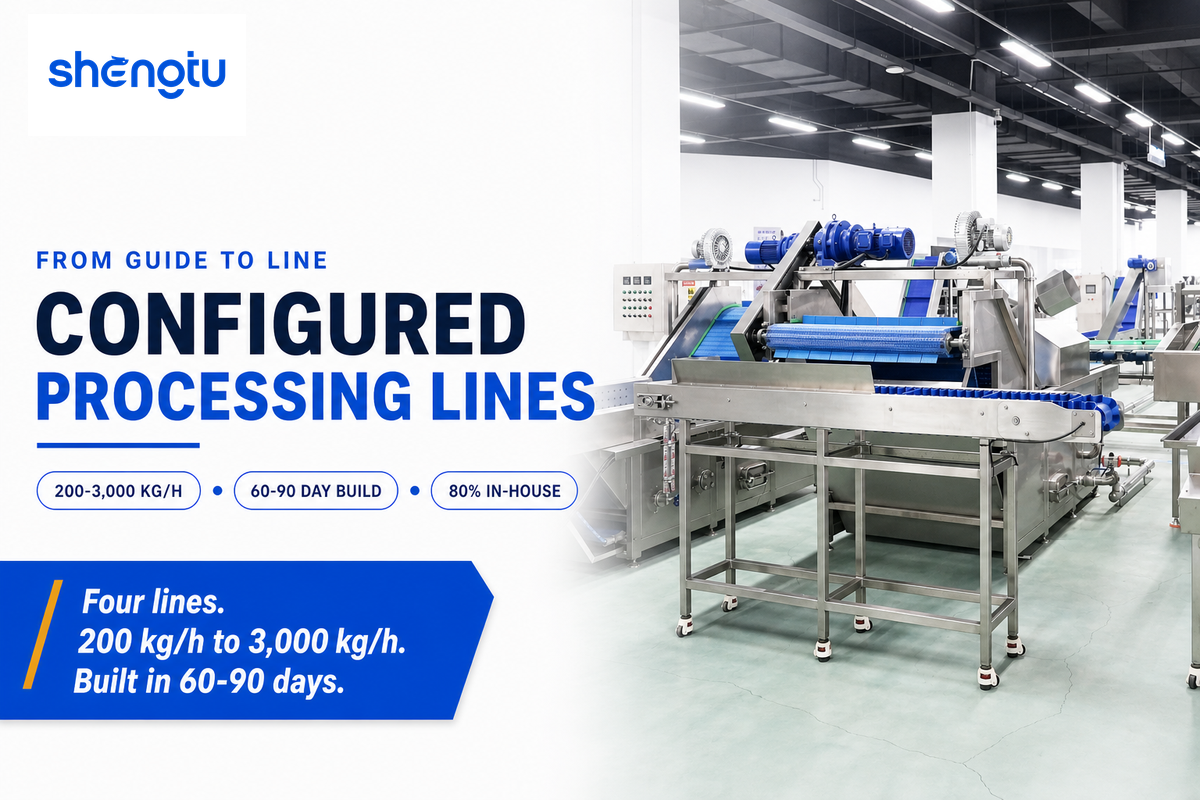
Shengtu’s own fruit and vegetable processing lines page picks up from here: four production lines spanning 200 kg/h to 3,000 kg/h depending on crop and product form, built in 60 days to 90 days after configuration and layout approval, with roughly 80% of core equipment built in-house. That page’s own selection tools handle throughput matching and format selection — the machine-selection layer this guide has deliberately not duplicated.
A configured Route A retort commonly reaches commercial sterility holds in the range of 121°C (250°F), with counter-pressure applied to keep containers intact at that temperature, versus HPP’s 600 MPa non-thermal route covered above — two very different paths, at two very different pressure and temperature profiles, to the same shelf-stability outcome. Maintaining the quality of processed produce from route selection through to a configured, running line is the actual goal behind every decision this guide has walked through — leading fruit and vegetable processing operations treat the preservation-route choice and the machine-selection choice as sequential, not simultaneous, decisions, and that sequencing is worth protecting even when a supplier’s sales process would rather collapse the two into one conversation.
Key takeaway: The preservation route decision (this guide) and the machine-selection decision (the line-configuration tools) are two different questions answered by two different pages — conflating them is how buyers end up specifying equipment before they have actually confirmed which process route their product needs.
Frequently Asked Questions
Q: What is fruit and vegetable processing?
Fruit and vegetable processing is the sequence of washing, cutting, and preserving steps that turns fresh, perishable produce into a safe, shelf-stable food product, using one of several available preservation technologies depending on the crop and the target shelf life.
It covers four stage groups in sequence: washing/sorting/peeling, cutting/sizing, a preservation route (drying, freeze-drying, IQF, canning, or aseptic/UHT/HPP), and packaging. The goal, per the Food and Agriculture Organization, is to supply wholesome, safe, nutritious food to consumers year-round despite the perishable and seasonal nature of raw crops. Every processor — from a single-line operation to a multi-plant exporter — moves through the same four stages; what differs is which specific preservation route fits the product being run.
Q: What fruit and vegetables can be processed?
Nearly any fresh fruit or vegetable can be processed, though the right preservation route depends heavily on the specific crop’s structure, moisture content, and intended end use, not on a generic rule that applies equally to every crop.
Leafy vegetables typically go through fresh-cut lines with MAP packaging; root vegetables through washing/peeling and often drying or canning; soft fruit through freeze-drying, IQF, or puree/juice routes. The 8-Route Preservation Compass table above is designed to help narrow that choice by product characteristic rather than by a one-size-fits-all recommendation, since the research summarized in this guide shows method performance is genuinely product-dependent rather than universal.
Q: What are the key trends in fruit and vegetable processing?
Two concrete trends stand out for equipment buyers right now: continued automation R&D investment in harvesting and processing robotics, and a wave of non-thermal preservation technologies steadily moving from the lab into commercial production use.
Dated 2024-2025 patent filings show active investment in harvesting and de-seeding automation. Separately, pulsed electric field, pulsed light, ultrasound, high-pressure processing and microwave drying are now covered together in current trade press as methods that preserve heat-sensitive nutrients better than conventional thermal processing. Both align with independently confirmed rising demand for minimally processed, ready-to-eat products.
Q: What is the difference between pasteurization and aseptic processing?
Pasteurization is a heat-treatment step; aseptic processing is a complete sterile-fill system, and in the US the two sit under different FDA regulations depending on the product.
Pasteurization (or its non-thermal HPP alternative) satisfies 21 CFR Part 120’s 5-log pathogen-reduction requirement for juice sold wholesale. Aseptic processing under 21 CFR Part 113 (low-acid products) or Part 114 (acidified products) is a full commercially-sterile fill-and-seal system in hermetically sealed containers — a different regulatory route entirely, used for shelf-stable purees and pulps rather than juice.
Q: When should a processor consider freeze-drying instead of hot-air drying?
Freeze-drying is generally the more nutrient-protective choice for heat-sensitive vitamin content, but hot-air drying is not universally the inferior option — product-specific testing beats a blanket rule.
Peer-reviewed comparisons consistently favor freeze-drying for vitamin C retention because of its lower process temperature: convective hot-air drying can reduce vitamin C, carotenoid and phenolic content by up to 70% depending on process parameters, while freeze-drying’s lower-temperature sublimation mechanism is repeatedly rated more protective in the literature. But the pattern is not universal, and this is worth taking seriously rather than treating as a footnote: in mangoes specifically, hot-air drying has been shown to retain more carotenoids than freeze-drying, the exact reverse of the usual result seen in most other crops. Freeze-drying also carries meaningfully higher capital and energy cost per kilogram of water removed than the other drying routes — conventional food-scale systems commonly run 5 kWh to 10 kWh per kilogram of water removed, well above spray drying or hot-air drying, though newer equipment can reach closer to 2 kWh to 3 kWh/kg — so the decision is rarely just “which preserves more nutrients” in isolation; it is nutrient retention weighed against operating cost, equipment lead time, and your specific crop’s documented behavior under each method. Request a test run on your specific crop and product form before committing to either route as your production default, rather than assuming the commonly repeated freeze-drying-is-always-better claim applies to your product without checking it first.
Why We Write This
Shengtu wrote this guide to answer “how does fruit and vegetable processing actually work” separately from “which machine should I buy” — our own fruit and vegetable processing lines page already answers the second question, and duplicating it here would not help a reader trying to understand the underlying preservation-route decision first. The comparison data above draws on peer-reviewed drying research and current FDA/EN regulatory text, cross-checked where a single source was not enough. Reviewed by the Shengtu technical team.
References & Sources
- Fruit and Vegetable Processing — Contents — Food and Agriculture Organization of the United Nations
- BS EN 1672-2:2020, Food Processing Machinery — Basic Concepts — BSI Group
- Food Safety Practices to Expect from Your Fresh-Cut Produce Processor — USDA Food and Nutrition Administration
- Minimizing Microbial Food Safety Hazards of Fresh and Fresh-Cut Fruits and Vegetables — USDA National Agricultural Library
- 21 CFR Part 113 — Thermally Processed Low-Acid Foods — eCFR / US Food and Drug Administration
- 21 CFR Part 114 — Acidified Foods — eCFR / US Food and Drug Administration
- 21 CFR Part 120 — Hazard Analysis and Critical Control Point (Juice HACCP) Systems — eCFR / US Food and Drug Administration
- Evaluation of High Pressure Processing (HPP) Inactivation of E. coli O157:H7, Salmonella enterica and Listeria monocytogenes in Acid and Acidified Juices and Beverages — International Journal of Food Microbiology, 2021
- Convective drying nutrient loss in fruits and vegetables — Onwude et al. 2022, Food and Bioproducts Processing
- Drying energy consumption in the US food sector — ScienceDirect, 2025
- Non-thermal preservation technology coverage — Food Engineering
- US12369526B1 — Flexible-rigid integrated gripper for harvesting fruits and vegetables — USPTO / Google Patents (issued January 2025)
- US20260076400A1 — Automated avocado de-seeding and pulp extraction machine — USPTO / Google Patents (filed September 2024)
- Food drying’s hidden carbon footprint (freeze-drying energy use per kg of water removed) — EnWave Corporation
- Fresh-cut processing bottleneck diagnosis, industry practitioner coverage — Teemyeah
- Causes of failure in fruit and vegetable processing operations — Food and Agriculture Organization of the United Nations
- JBT Corporation completes acquisition of Marel, forms JBT Marel Corporation — PotatoPro, January 2025