Get in touch with Shengtu Bufan Company

Battering & Breading Machine Buyer Guide: Route, Recipe, Balance And Quote Inputs

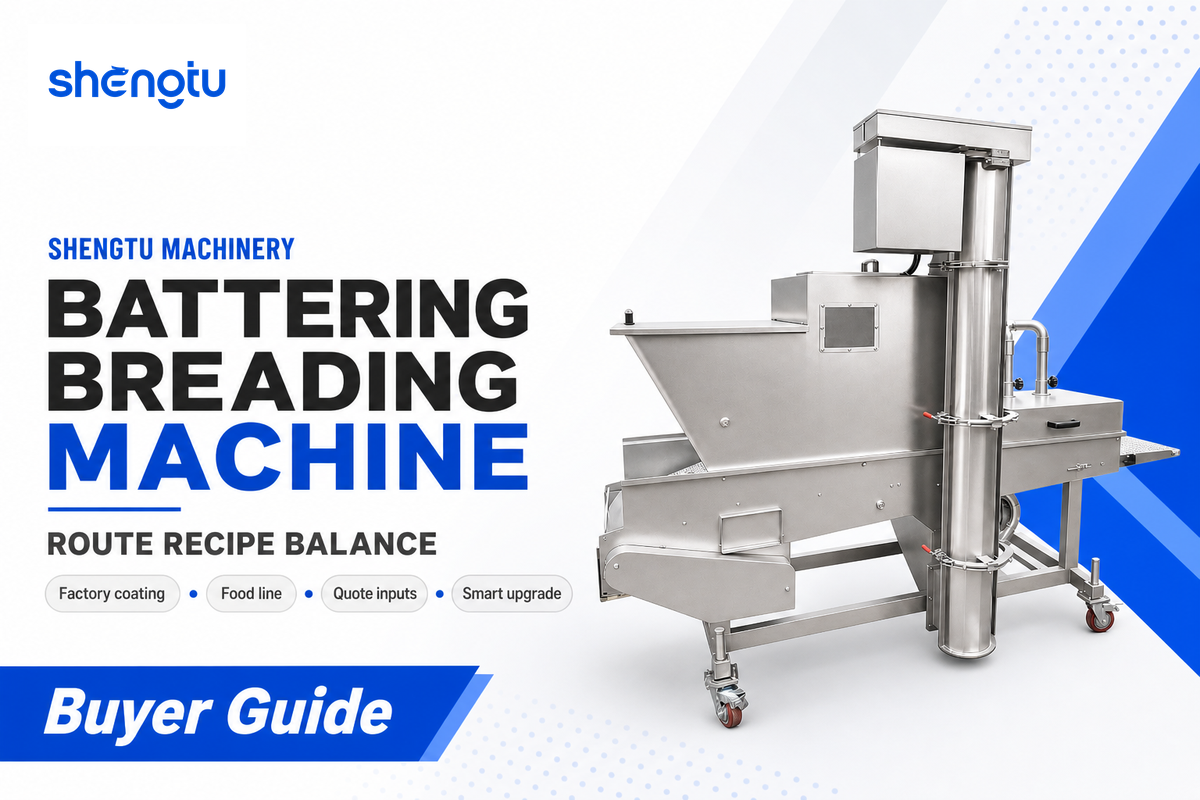
A Battering & Breading Machine is factory coating equipment that applies wet batter and dry crumb to food products before frying, freezing or further food processing. The hard part is not naming equipment. It is proving which route, recipe window and line balance will hold steady once real poultry, seafood, vegetables, cheese, plant-based nuggets or breaded product enter the conveyor belt.
Plant managers, product developers, quality teams and procurement staff can use this guide when comparing an automated wet-coating line, a small-format breader, a breading machine for fillets, or a larger coating-frying project. It uses Shengtu’s module list and buyer tools, plus public regulatory, technical and competitor evidence, to show what to send before asking for a price.
Terminology note: Batter (cooking) here means the wet adhesion layer; a home bread machine is outside this industrial processing industry scope. The article uses breading technology, breading solutions, automated breading, adjustable coating thickness, precision and operational efficiency only where they describe measurable coating behavior.
What A Battering & Breading Machine Does In A Factory Line
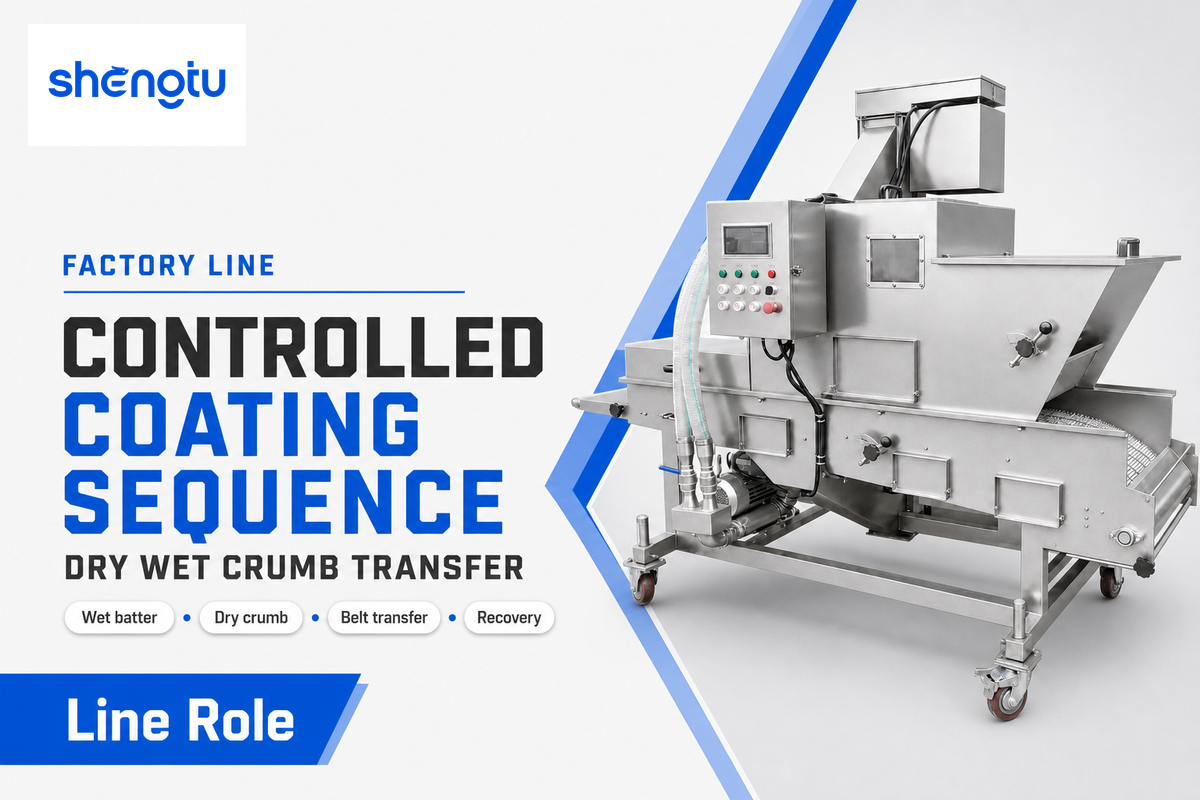
Factory battering and breading equipment turns coating from a manual station into a controlled sequence of dry adhesion, wet pickup, crumb loading and excess removal. In a factory line, that sequence must fit the product, the fryer or freezer, the cleaning window, and the operator access points instead of standing alone as one item of food machinery.
Shengtu’s product page presents the industrial route as five modules: predust applicator, submerging batter applicator, waterfall batter applicator, crumb applicator and drum breader. That matches the broader food production logic described by major equipment makers: pre-dust is a dry step, adhesion batter is wet coating, and breading is dry particulate coating.
The same batter breading machine label may refer to several plant realities. One small automatic breading unit may serve chicken breading trials, while an automatic batter breading line may need synchronized belts, crumb recovery, tank circulation, product spacing and discharge height that matches a fryer. Search results also mix restaurant-scale equipment, BRALYX-style small shop units, and large-scale factory systems; buyers should separate those intents early.
The 5-Step Coating Route Fit Ladder
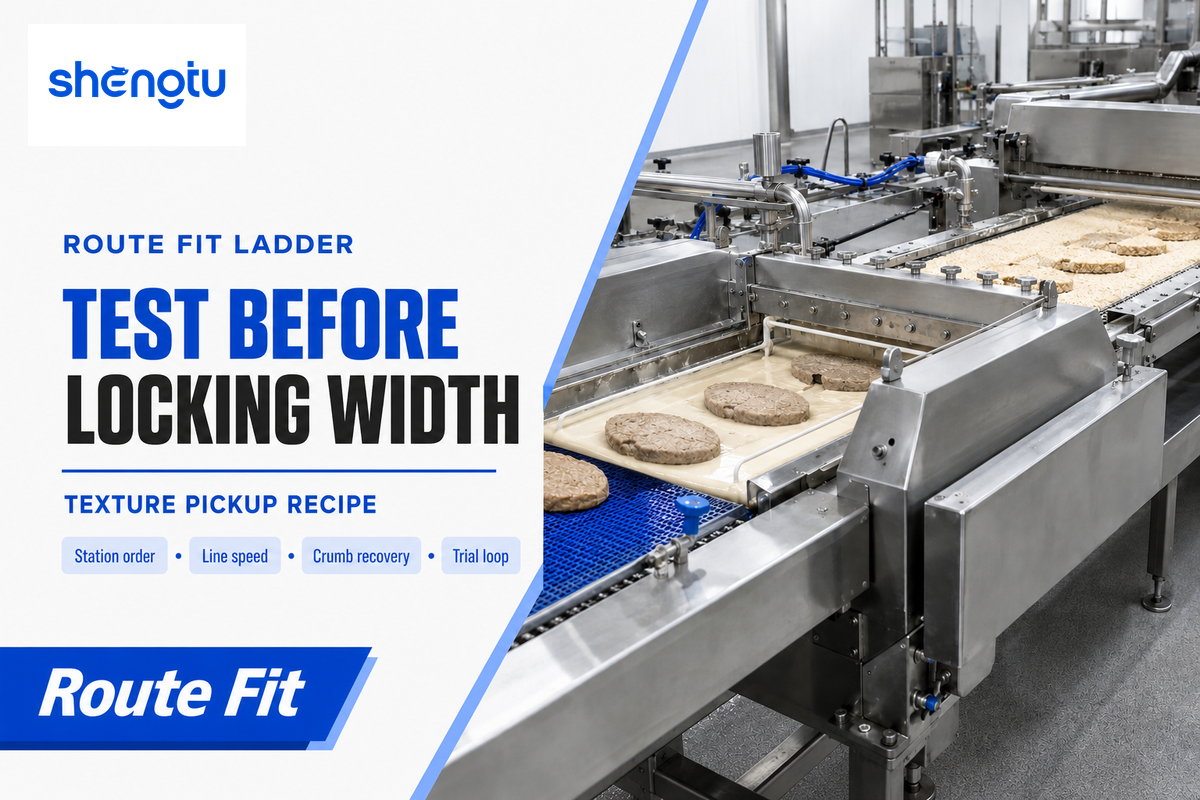
The Coating Route Fit Ladder is an iterative 5-step route check, not a universal order that every product must follow. Start with finished texture and target coating pickup, test recipe behavior, then loop back through station sequence, line speed and crumb recovery until the route matches the product in motion.
1. Finished bite
Define crispness, surface coverage, color and bite after fry or bake. Fried chicken, tempura seafood and a vegetable nugget rarely want the same surface.
2. Recipe window
Record batter viscosity, temperature, solids, pickup target and breadcrumb size before any belt width or speed talk.
3. Station route
Choose predust, submerging batter, waterfall batter, crumb applicator or drum breader only after the recipe and product geometry are known.
4. Motion proof
Check belt speed, transfer drop, turning, edge coverage and whether excess coating returns without clumps or uneven beds.
5. Quote proof
Send kg/h, pieces/h, widest dimension, finished weight, plant utilities and adjacent equipment data so the supplier can size scope.
Loop back
If a trial changes coating pickup, line speed or batter setting, return to step 2. The route is a testable working order.
The common assumption is that the buyer should pick a nominal capacity first. That isn’t always the strongest order. The recipe may thicken during production, breadcrumbs may break down, a product may float through a submerging step, or the fryer infeed may force more spacing than the breader rating assumed. For that reason, route, recipe and balance should be checked together.
Predust, Submerging Batter, Waterfall Batter, Crumb Applicator And Drum Breader
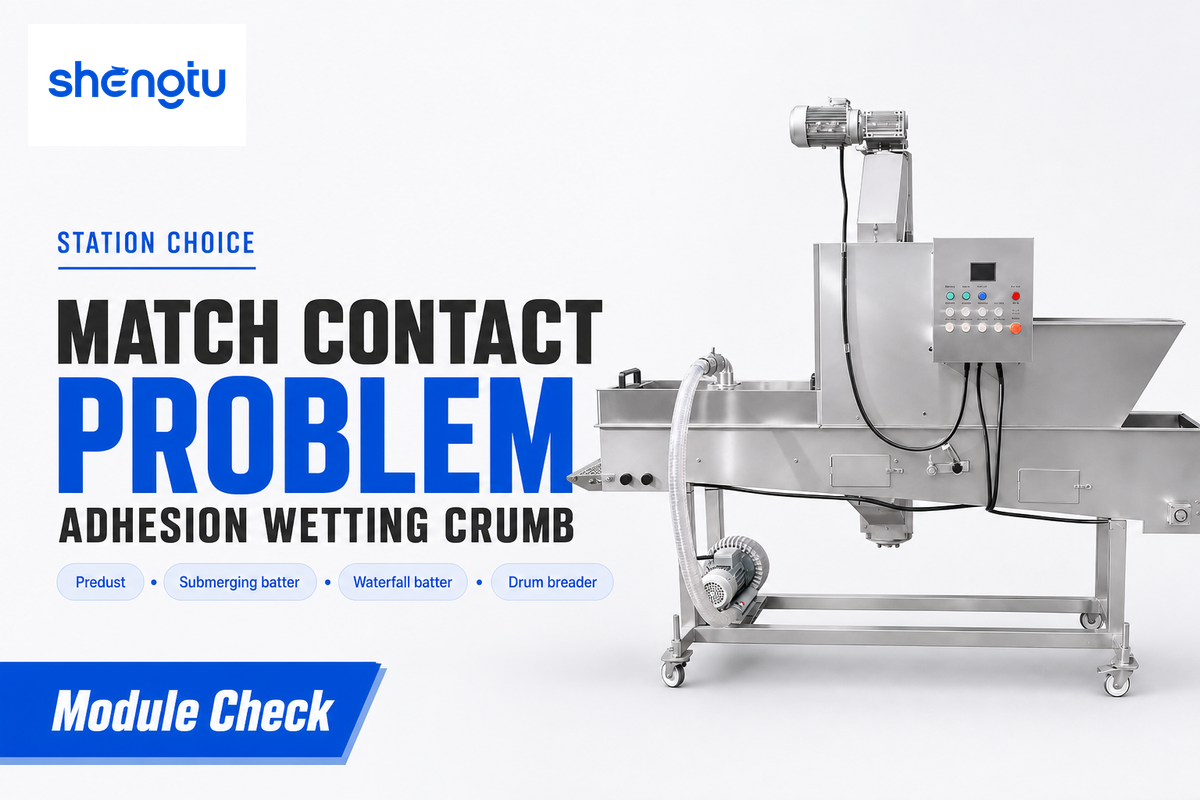
Each coating station solves a different contact problem: adhesion, full wet coverage, top-side wetting, dry crumb loading or gentle tumbling. The right comparison looks at product shape, coating thickness, moisture, fragility and recovery needs, not only at whether the catalog calls the equipment a breader or battering machine.
| Station type | Factory use case | Variables to test | Proof to send before quotation |
|---|---|---|---|
| Predust applicator | Dry flour or fine powder adhesion before wet coating. | Powder bed depth, top coverage, bottom contact, dust control, recovery route. | Product moisture, powder type, target pickup percent, allergen status. |
| Submerging batter applicator | Full wet coating of nuggets, fillets, formed products or seafood shapes. | Batter viscosity, belt hold-down, tank temperature, drip-off time, pump shear. | Recipe solids, temperature window, product buoyancy and required coating of batter. |
| Waterfall batter applicator | Top-side curtain coverage for products that need lower immersion force. | Curtain location, liquid amount, belt velocity, product height and base treatment. | Top/bottom coverage target, maximum product height in mm and target kg/h. |
| Crumb applicator | Breadcrumb, panko, flake or fine crumb loading after wet adhesion. | Breading bed density, top shower, compression, sieve return and crumb breakage. | Breadcrumb type, crumb size, target surface look and rejected crumb policy. |
| Drum breader | Gentle tumbling for shapes that need all-around crumb contact. | Drum angle, dwell time, product fragility, carryover and product clustering. | Piece strength, pieces/h, length-width-height and acceptable breakage. |
| Compact breading machine | Low-volume trials, pilot runs or limited footprint production. | Working width, cleaning access, operator reach and manual feed stability. | Trial batch size, available footprint and target hourly output. |
| Automatic batter breading line | Factory automation for repeatable coated and breaded product output. | Line speed, belt transfer, station spacing, reject handling and controls. | Neighboring equipment, discharge height, utility limits and factory acceptance plan. |
| Chicken breading line | Poultry products such as strips, fillets, nuggets and fried chicken portions. | Sanitation zone, drip control, crumb loading, rework policy and cold-chain handling. | Raw or cooked status, piece weight after coating and sanitation schedule. |
| Seafood and fish route | Fillets, fish nuggets, shrimp or tempura-style seafood where shape and moisture vary. | Product fragility, wet-coating cling, edge coverage and transfer damage. | Photo, piece dimensions, recipe formula and target even coating standard. |
| Plant-based and vegetable route | Formed plant proteins, vegetables, cheese and dairy snacks. | Surface moisture, starch behavior, thaw state and sticking risk. | Ingredient list, allergen separation, coated weight and frying or freezing step. |
Patent pages can be useful for learning design ideas such as excess coating removal, filtering, recirculation and uniform distribution. They shouldn’t be used as proof that a current supplier has achieved a field result. USPTO guidance on prophetic examples is a reminder to separate disclosed concepts from achieved test data.
Product Inputs That Change The Machine Choice
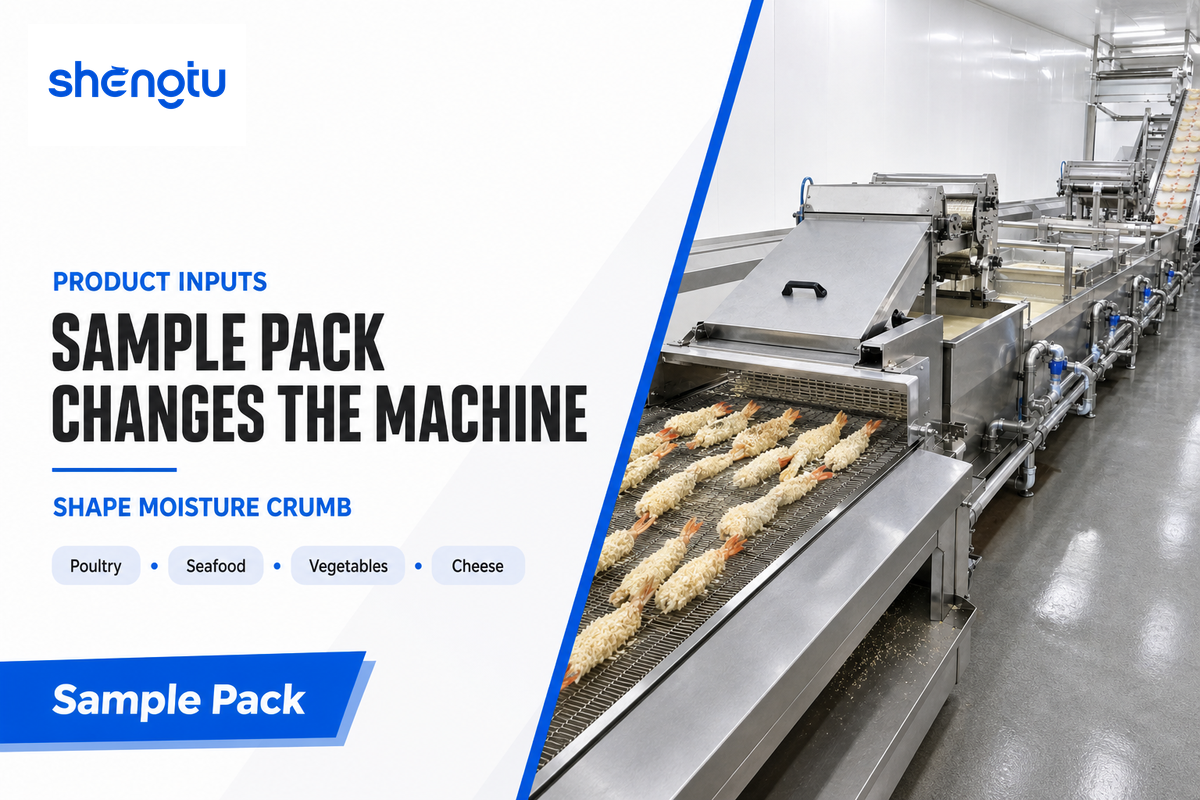
Product data can overturn an equipment choice that looked right on a catalog page. After the station roles are clear, piece size, moisture, crumb type, wet-mix behavior, coating pickup and post-coating handling decide whether automated wet coverage, waterfall coverage, a crumb bed or a drum breader will produce consistent quality at the planned throughput.
Good test notes start with the product’s physical behavior. Thin fish fillets may tear at a transfer. High-moisture vegetables may shed predust. Cheese bites may need controlled coating thickness to avoid leakage. Formed chicken nuggets may run fast, while irregular seafood pieces may need more spacing. Those differences change food processing speed before a supplier changes the model.
Recipe behavior matters because the wet mix is not only a liquid carrier. Peer-reviewed fish nugget research found that protein additions changed viscosity, coating pickup, thermal stability and fat absorption. That study does not compare equipment routes, and it does not dictate a poultry or vegetable recipe. Use it only as evidence that formulation variables deserve a test slot before the buyer freezes the coating route.
Recipe and sample pack for test runs
- Product name, product photo and target market.
- Piece weight before and after coating.
- Widest dimension, thickness and expected shape variation.
- Target kg/h and pieces/h, stated separately.
- Batter formula, viscosity method, temperature and hold time.
- Breadcrumbs, panko, flakes, powder or mixed crumb type.
- Target coating pickup percent and accepted tolerance.
- Fry, oven, freezer or packaging step after coating.
- Allergen and clean-down limits.
- Food safety or customer audit requirements that affect access and records.
Line Balance Before Nominal Capacity
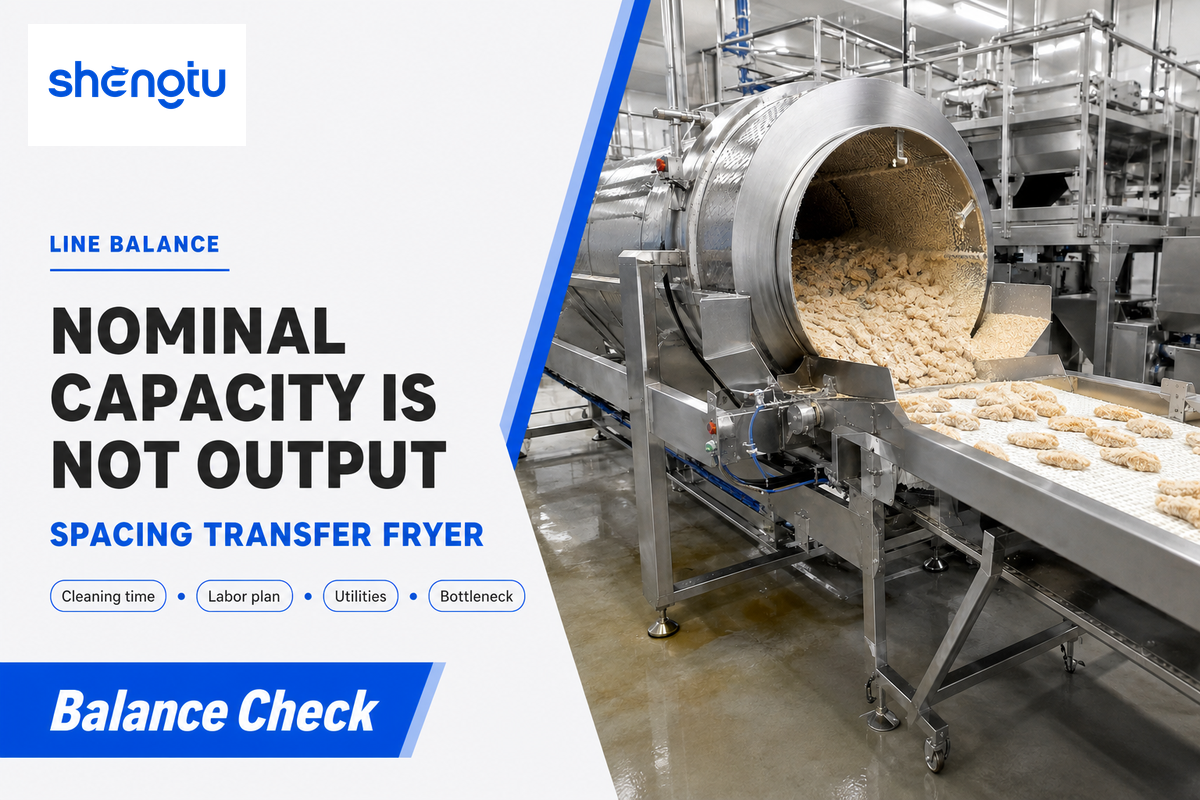
Nominal capacity is not always real line output because the slowest constraint may sit outside the coating zone. Once those product inputs are defined, product spacing, batter setting, transfer height, fryer infeed, utilities, cleaning time and labor plan can all reduce what the factory can actually run per hour.
Use the line-balance map below to bring hidden issues into the first engineering call: spacing, batter setting, transfer height, utilities, cleaning window and upstream/downstream constraints. Treat these as supplier-side project scoping prompts plus general plant engineering logic, not as an independent standard. This is where a number such as 280 kg/h, 350 mm working width or 2,000 pieces/h becomes context rather than a purchase promise.
| Bottleneck type | What to check | Why it can cap real output |
|---|---|---|
| Product spacing | Center-to-center gap on the conveyor belt. | Closer spacing may smear wet coating, overload crumb bed or block fryer loading. |
| Batter setting | Viscosity, temperature, pump shear and drip-off time. | Thick or unstable slurry can force slower speed than the motor allows. |
| Transfer height | Drop between coating station, fryer, freezer or intermediate belt. | Fragile food products can fold, lose crumb or rotate at the drop. |
| Crumb recovery | Sieve, return path, fines removal and bed depth. | Clumped crumb or broken breadcrumb can create uneven coating. |
| Utilities | Voltage, phase, frequency, air, water and drainage. | Electrical or water limits can block the chosen station set. |
| Cleaning window | Access, tool-free removal, tank drainage and dry-zone cleanup. | More uptime on paper can vanish if sanitation takes too long. |
| Operator plan | Feed position, inspection station, reject handling and safe reach. | Reducing labor is a goal, but the operator still needs safe, visible control. |
| Fryer or freezer infeed | Belt width, pitch, oil or freezing load and discharge height. | The next unit may accept fewer pieces than the coating station can prepare. |
| Quality hold | Coating consistency checks, sample pull points and rework limits. | Stopping to sort defects lowers productivity even when speed settings look high. |
| Factory footprint | Floor space, service aisle, drain position and material flow. | That line may fit on drawing paper yet fail once cleaning and maintenance space are added. |
Line Balance Hidden Bottleneck Map: ask the supplier to mark each cap as upstream, coating-zone, downstream, utility, cleaning or operator-related. This turns the sales discussion away from a single capacity number and toward what must be changed to hold target output.
Hygiene And Cleaning Design Checks For Wet Coating Equipment
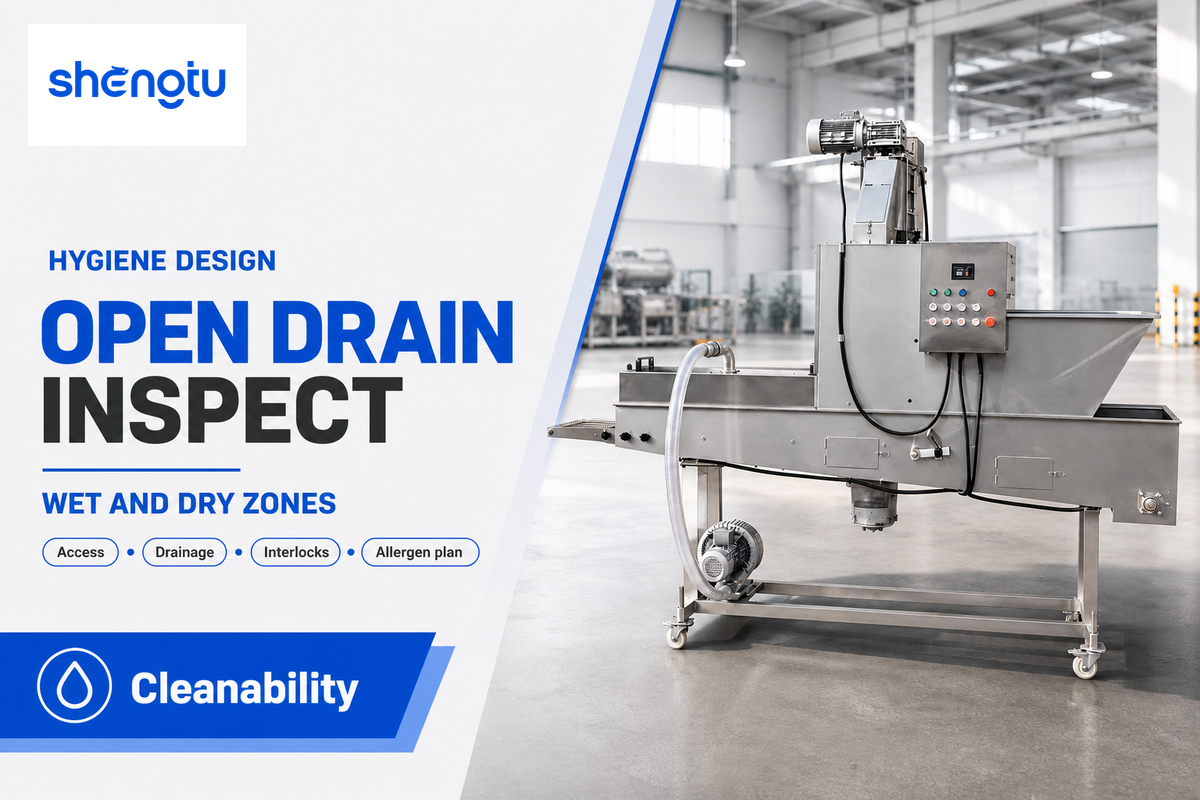
Wet mix, dry flour and crumb residues make hygiene a design question, not a cleaning note at the end of the project. Those same balance constraints affect cleaning access, so buyers should review cleanable surfaces, food-contact materials, allergen changeover, dry dust handling and machine guarding before they approve a layout.
For United States meat, poultry and general food facilities, public eCFR sources point buyers toward equipment that can be cleaned, maintained and sanitized as needed for safe food. FSIS guidance adds poultry sanitation context, while trade-press sanitation reporting keeps the topic visible as a plant program. None of those sources replace the buyer’s own legal, customer-audit or plant safety review.
21 CFR 117.40 gives buyers a cleanability test phrase: equipment “must be so designed and of such material and workmanship as to be adequately cleanable.”
That risk matters in a factory line because one hidden residue point can turn a 24-hour allergen changeover into a failed customer audit, even when coating coverage looks acceptable.
Dry coating also has a safety side. OSHA combustible-dust material identifies flour and starch among dusts that can be explosible. Predust applicators, flour feeds, crumb transfers and cleanup steps may need dust control, housekeeping and ignition-source review. OSHA machine-guarding rules support checks around point-of-operation hazards, ingoing nip points, rotating parts and guards. Interlocks, emergency stops and safe maintenance access remain supplier and plant-safety checklist items; do not present them as if OSHA 1910.212 alone proves them.
- Ask how food-contact surfaces are drained, opened and visually inspected.
- Separate wet batter circulation from dry crumb and predust handling in the cleaning plan.
- Review guard panels, interlocks, emergency stops and lockout access for belts, drums and pumps.
- For fine flour, starch or powder, ask for a dust and housekeeping review tied to the plant’s own safety program.
- For allergen changeover, define whether a quick rinse, full washdown or validated clean break is required.
Price Drivers Without Guessing A Price
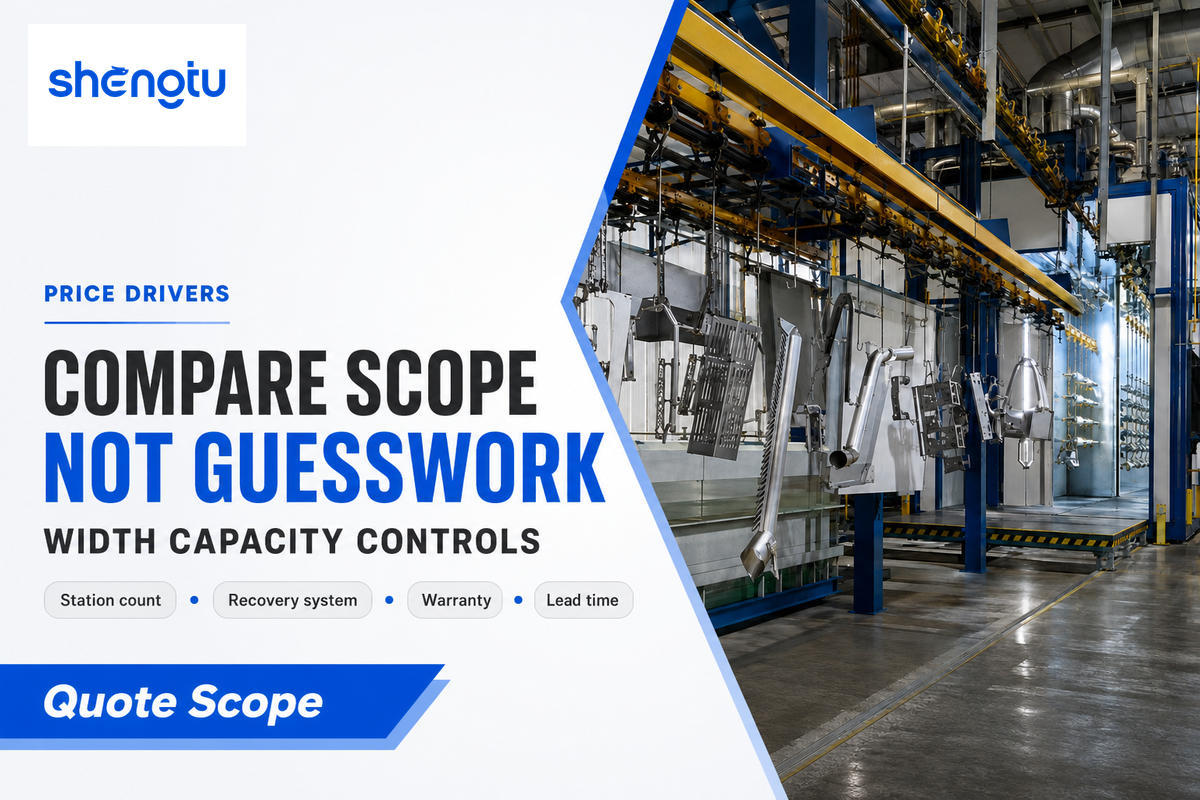
Public price for a batter and breading machine is weak without scope, because the cost is shaped by station count, belt width, capacity band, recipe handling, recovery system, controls, stainless design and installation work. Buyers can still compare quotes by asking each supplier to expose the same price drivers.
Competitor pages show why price guessing is unsafe. ANKO publishes a 280 kg/h capacity figure for one context. GASER lists small and larger units, including a 350 mm useful working width on a larger model. Mainca lists BR models with 2,000 pieces/h at the small end and 5,000-12,000 pieces/h at the higher-output end, plus different belt widths. These figures help benchmark scope, not final cost.
18-Point Scope Measurement Strip
Use measurement fields to compare scope, not as Shengtu acceptance limits. Public competitor and technical pages show the kind of entries buyers should normalize: 280 kg/h capacity context, 350 mm useful width, 600 mm and 1000 mm belt-width examples, 8 mm and 70 mm product-height examples, 2 m/min and 20 m/min belt-speed examples, 1 day quotation timing, 30 days lead-time timing, 12 months warranty timing, 15% pickup trial, 25% pickup trial, 120 mm product width, 25 mm product thickness, 75 mm transfer drop, 5 kg sample lot, 3 kg crumb sample, 2 hours cleaning window, 4 hours changeover window, 24 hours recipe hold, 45 min inspection slot, 50 Hz or 60 Hz power, 380 V supply and 3 phase service. The final quote should replace each sample value with the buyer’s actual plant data.
| Cost driver | Question to ask | Quote risk if omitted |
|---|---|---|
| Belt width | What is the usable working width in mm or inches? | The quoted machine may not handle the widest product or spacing. |
| Station count | Which modules are included: predust, wet tank, crumb, drum or recovery? | Two suppliers may quote different physical lines under the same name. |
| Capacity band | Is output stated as kg/h, pieces/h or both? | Heavy and light pieces make the same kg/h number mean different labor and fryer load. |
| Recipe handling | How are viscosity, temperature and recirculation controlled? | Manual adjustment may create coating drift during a long run. |
| Recovery system | How are excess liquid, flour and crumb returned or rejected? | Waste, clumping and uneven finish can become hidden operating costs. |
| Controls and data | What control box, gateway, recipe storage or remote support is included? | Later automation upgrades may cost more if the first quote is a bare machine. |
| Material and hygiene | Which stainless grade, drain design and access method are quoted? | Low price can move cost into cleaning labor or audit changes. |
| Safety package | Which guards, interlocks and emergency stops are included? | Plant acceptance can stall if safety scope is unclear. |
| Installation scope | Who covers layout, utilities, commissioning, training and factory acceptance testing? | Machine quote may exclude the work needed to run it. |
Confirm minimum order quantity, quotation timing, delivery schedule, warranty and service terms in the current project quotation and contract. Scope, country, line length and the acceptance plan can change the final order conditions.
Supplier Comparison Checklist
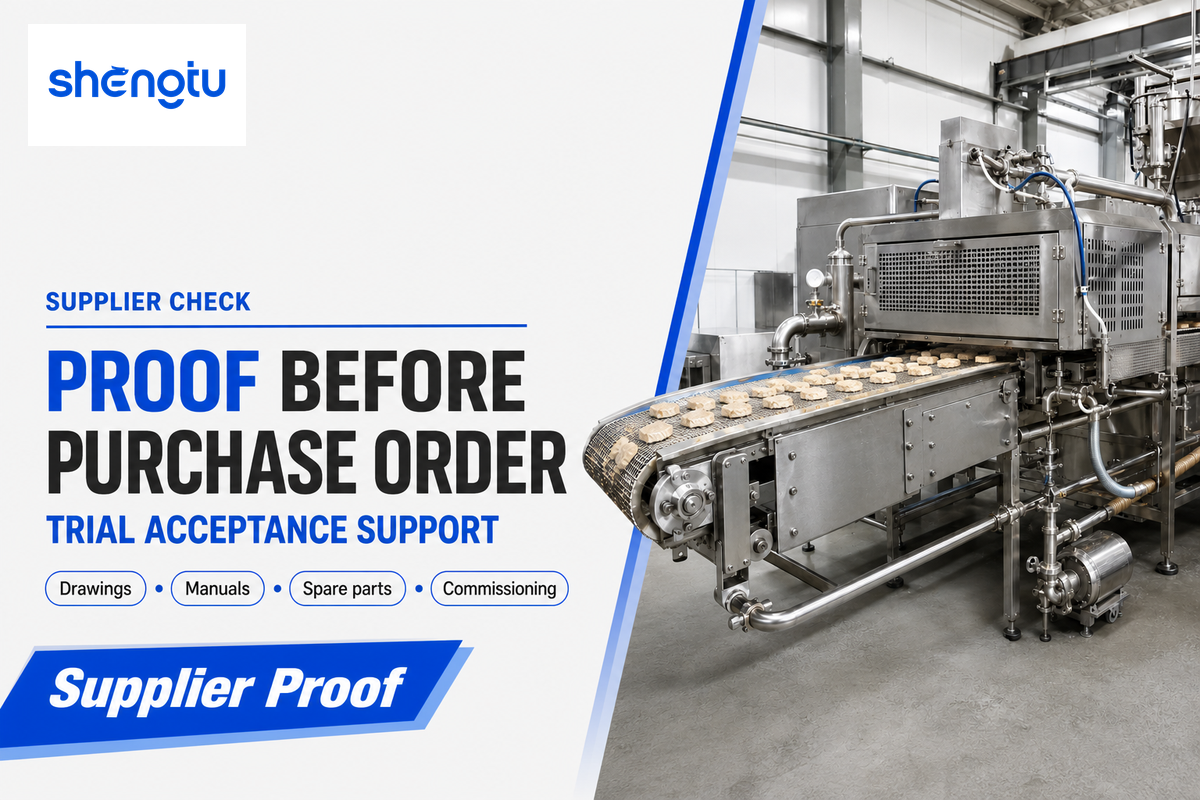
Supplier comparison should test evidence quality: route reasoning, sample trial plan, sanitation access, safety scope, line balance, digital controls and quotation transparency. This protects procurement from comparing one full coating system against another supplier’s smaller standalone breader.
| Comparison type | Acceptable proof | Red flag |
|---|---|---|
| Route fit | Supplier explains why predust, submerging dip, waterfall coverage, crumb or drum applies to the sample. | Only repeats that the machine can coat food. |
| Recipe proof | Trial plan records viscosity, pickup, temperature and finished surface. | No test method for liquid or crumb behavior. |
| Capacity proof | Output is tied to kg/h, pieces/h, spacing and product size. | Single hourly output number with no product assumptions. |
| Hygiene access | Drawings or photos show removable parts, drain paths and inspection zones. | Cleaning is described only as easy to clean with no access detail. |
| Safety | Guarding, interlocks, emergency stops and service access are named in scope. | Safety is pushed to the buyer after shipment. |
| Line integration | Supplier checks belt pitch, discharge height, fryer/freezer infeed and utilities. | Quote covers only the coating station even though neighboring equipment is fixed. |
| Automation | Control box, recipe settings, gateway and remote support path are clear. | No plan to automate data, alarms or future line changes. |
| Evidence limits | Patents, brochures and case notes are framed by what they prove and what they do not prove. | Patent language is treated as field-tested performance. |
| Acceptance plan | Factory acceptance, commissioning, spare parts and training are priced or excluded in writing. | Final responsibility is unclear until after deposit. |
Quotation Proof Pack: send one folder with product photo, piece weight after coating, kg/h and pcs/h, widest dimension, crumb type, target coating pickup, neighboring equipment, belt pitch, discharge height, floor dimensions, voltage/phase/frequency, electrical load, air/water availability, drawings, foundation notes, manuals, spare parts, commissioning, training and factory acceptance needs.
When A Standalone Machine Should Become A Coating-Frying Line Project
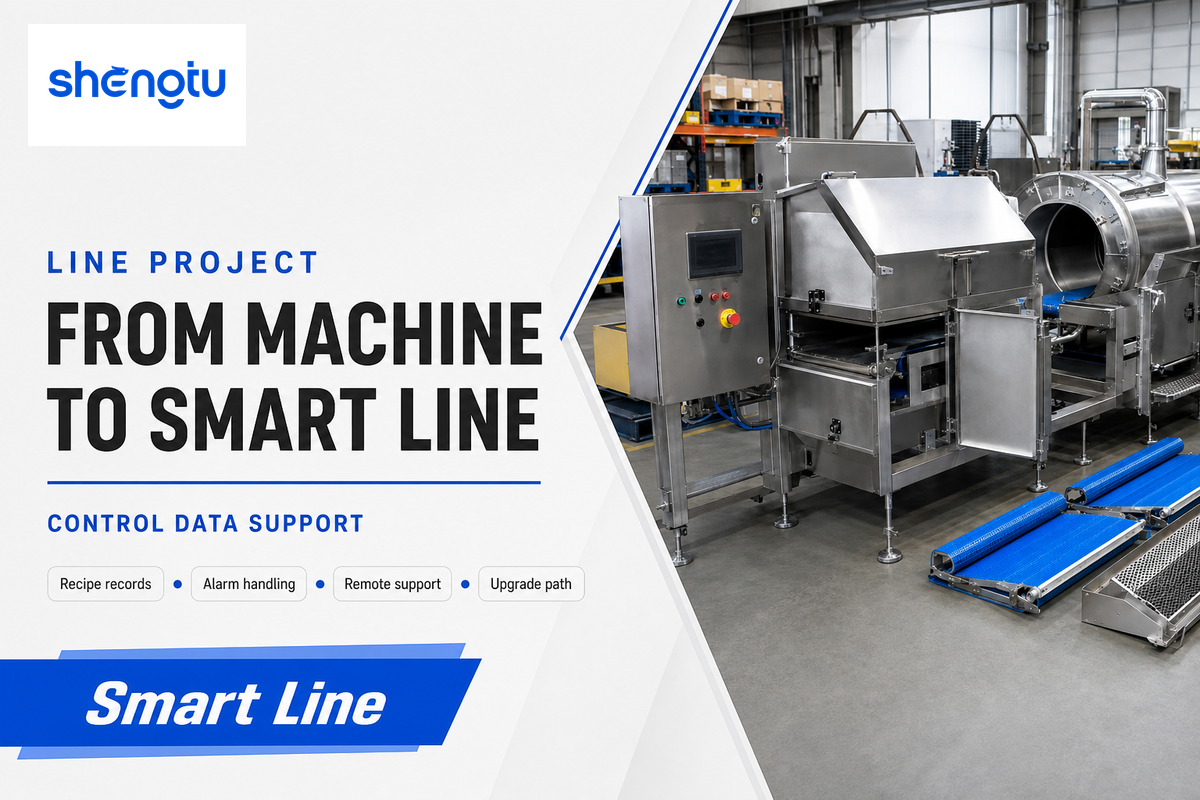
A standalone breading machine is not necessarily the right purchase when the constraint is route control, fryer balance, cleaning time, data capture or future automation. In those cases, a coating-frying line project may lower risk because the supplier sizes product flow, controls and plant interfaces together.
Shengtu’s broader company profile matters here. The company positions itself around food equipment research and development, manufacturing and whole-plant digital solutions. Its STUnit platform, low-code control boxes, multi-protocol gateways, YOLO vision and edge algorithms are relevant when a buyer wants more than metal hardware. They should still be tied to the project need: recipe control, alarm handling, traceable settings, remote support or smart factory planning.
Escalate from a standalone unit to a line project when any of these apply:
- The coating station must match an existing fryer, freezer or packaging unit with fixed height and speed.
- The buyer needs automated systems, recipe records or data links for plant control.
- Labor costs are driving the project, but reject sorting and manual cleanup remain large.
- Food safety, hygiene or allergen plans require layout-level access decisions.
- The plant needs one manufacturer to manage factory acceptance testing, commissioning and training.
At that point, the buyer can ask Shengtu for a line-balance review instead of a single equipment quote. Focused review can define what should be bought now, what can be prepared for later, and which upgrade costs can be avoided by making the first machine “born smart” enough for future integration.
Frequently Asked Questions
How do I choose the right battering and breading machine?
Choose by testing the product route, not by picking the largest capacity first. Define the finished texture, target coating pickup, wet-mix viscosity, crumb type, product size, kg/h, pieces/h and next process step. Then compare whether predust, submerging dip, waterfall coverage, crumb applicator or drum breader gives the required even coating without damaging the product or overloading the fryer. If the recipe changes during a trial, loop back before locking width or output.
What affects the price of a batter and breading machine?
Price depends on working width, station count, capacity band, wet circulation, crumb recovery, stainless design, controls, safety package, installation and acceptance scope. Small-format breader trials and automated coating equipment tied to a fryer are different purchases, so send product and factory data before asking for a defensible, site-specific firm number.
What information should I send for a quote?
Send a product photo, product name, piece weight after coating, kg/h and pieces/h targets, widest dimension, recipe formula, crumb type, target coating pickup, fry or freeze step, neighboring equipment, belt height, floor space, voltage/phase/frequency, electrical load, air and water availability, drawings, foundation limits, commissioning needs, spare parts needs, training scope and factory acceptance test rules. The quote becomes much clearer when each field is tied to a real product sample, not a generic equipment label.
Can one machine handle chicken, seafood and vegetables?
One equipment family can often serve poultry, seafood, vegetables, cheese or plant-based foods, but the station set and settings may change. Trial data should confirm the route before the buyer treats versatility as proven.
Is patent evidence enough to prove machine performance?
No. Patent evidence can explain design ideas such as recirculation, filtering, conveyor handling or coating distribution, but it does not prove that a current supplier’s equipment achieved a plant result. Use patents as background, then ask for test data, drawings, samples, acceptance criteria and supplier-specific evidence from the quoted unit.
References & Sources
- Shengtu battering and breading machine product page
- Shengtu line-balance checklist
- Shengtu quotation-readiness checklist
- eCFR, 21 CFR 117.40, equipment and utensils
- eCFR, 9 CFR 416.4, sanitary operations
- FSIS poultry Salmonella and Campylobacter guideline
- OSHA combustible dust topic page
- OSHA 29 CFR 1910.212 machine guarding
- GEA coaters technical page
- GEA OptiCoater page
- University of Kentucky record on batter characteristics
- Food Engineering breader article
- Food Engineering sanitation article
- Google Patents, breading machine methods and improvements
- USPTO MPEP 2004, prophetic examples guidance
- ANKO batter and crumb page
- Mainca batter and breading page
- GASER batter-breading machines page
Market-report figures captured during research were downgraded to background coverage and aren’t used here as load-bearing price, market-size or return-on-investment claims.
ENGINEERING CONTENT DISCLOSURE
Why Shengtu Publishes Technical Guides
These guides turn common production-line questions into a clearer decision path for food manufacturers, project engineers and procurement teams.
We focus on the inputs that change equipment selection: product characteristics, package format, target capacity, process stages, utilities, plant constraints and destination requirements.
01Define the applicationStart with the product, pack and operating target.
02Map the process routeConnect stages, interfaces and utility needs.
03Surface trade-offsExplain the choices that affect line scope.
04Prepare better questionsTurn reading into a reviewable project brief.
MANUFACTURER PROFILE
SHENGTU
- Focus
- Food processing equipment and turnkey line solutions
- Base
- Zhucheng, Shandong, China
- Project path
- Requirement → layout → equipment scope → delivery coordination
SOLUTION COVERAGE
VALIDATION BOUNDARY Final equipment configuration should be confirmed against your product, package, throughput, utilities, plant constraints and destination requirements.
![How Is Freeze Dried Coffee Made? [Process Guide]](https://shengtumachinery.com/wp-content/uploads/2026/08/fd-coffee-tea-beverage-line-guide-featured-150x150.png)


