
Get in touch with Shengtu Bufan Company


Updated August 2026
A freeze-dried pet treat line is a sequence of linked stations built around a batch vacuum chamber, and the chamber is the part that decides everything else. This guide covers what the process physically does, what it costs at food scale rather than pharmaceutical scale, where the regulatory boundary sits, and when the honest answer is to buy nothing yet. Two ideas run through it: Pharma’s Cost Curve Is Not Yours, which is why the cost figure you’ll meet everywhere is the wrong one, and The In-House Stop/Go Matrix, which is how to decide whether to buy a line at all.
Quick Specs
| Process type | Batch, not continuous |
| Primary drying chamber pressure | 50–200 mTorr; 100–150 mTorr typical |
| Energy per kg water removed | 600–1,000 kWh |
| Operating cost share, food scale | 50–70% of total production expense |
| Water activity for shelf stability | 0.85 or below is the regulatory reference point |
| Is drying a pathogen kill step? | No |
What a Freeze-Dried Pet Treat Line Is, and What It Is Not

A freeze-dried pet treat line is a set of linked stations around a batch vacuum chamber: preparation and portioning, freezing, the freeze dryer itself, inspection, and packaging. That dryer is one machine in the sequence, not the line. Quotes that look wildly different in price usually differ because one covers the chamber and another covers the stations around it.
Three stages make up the process. Product is frozen solid, ice is removed by sublimation under vacuum during primary drying, and secondary drying removes moisture that’s still chemically bound, a step properly called desorption. No stage relies on heat to preserve the product, which is exactly why freeze-dried pet food holds shape, colour and heat-sensitive nutrient content that hot processes degrade. It’s also why these pet foods carry no added preservative: the water is gone, so there’s nothing for spoilage organisms to grow in. Products that are shelf stable without the need for preservatives are the commercial reason the process exists, and brands describing a biologically appropriate diet lean on exactly that property.
Output is a shelf-stable product that will rehydrate in water, which is the property the freeze-dried raw and minimally processed positioning rests on. What the line isn’t is a scaled-up tabletop appliance. A commercial unit adds recipe-profile programming and is built to run continuously, and one operator who ran thirty tabletop units simultaneously reported that at any given moment about a third of them weren’t running properly.
How are freeze-dried dog treats made?
Commercial production runs five steps in fixed order: freeze the raw material, portion it to a controlled piece geometry, load trays onto carts and into the chamber, sublime the ice away under vacuum, then inspect and seal into a barrier pack. Batch size and cycle length change between plants; that order doesn’t.
Raw material arrives frozen or is frozen on site, then it’s portioned, loaded onto trays, and stacked into the chamber on carts. One US plant profiled by Pet Food Processing loads ten carts of forty-two trays into each dryer on a twelve to eighteen hour cycle. Chamber pressure then pulls down to vacuum, shelves supply the heat of sublimation, and ice leaves the product as vapour to be captured on a cold condenser. After unloading, the product is inspected for foreign material and sealed into a moisture-barrier pack. That order never changes; what differs between plants is how much of the sequence is automated and who owns each interface.
Sublimation, Not Evaporation: The Physics That Sets Cycle Time
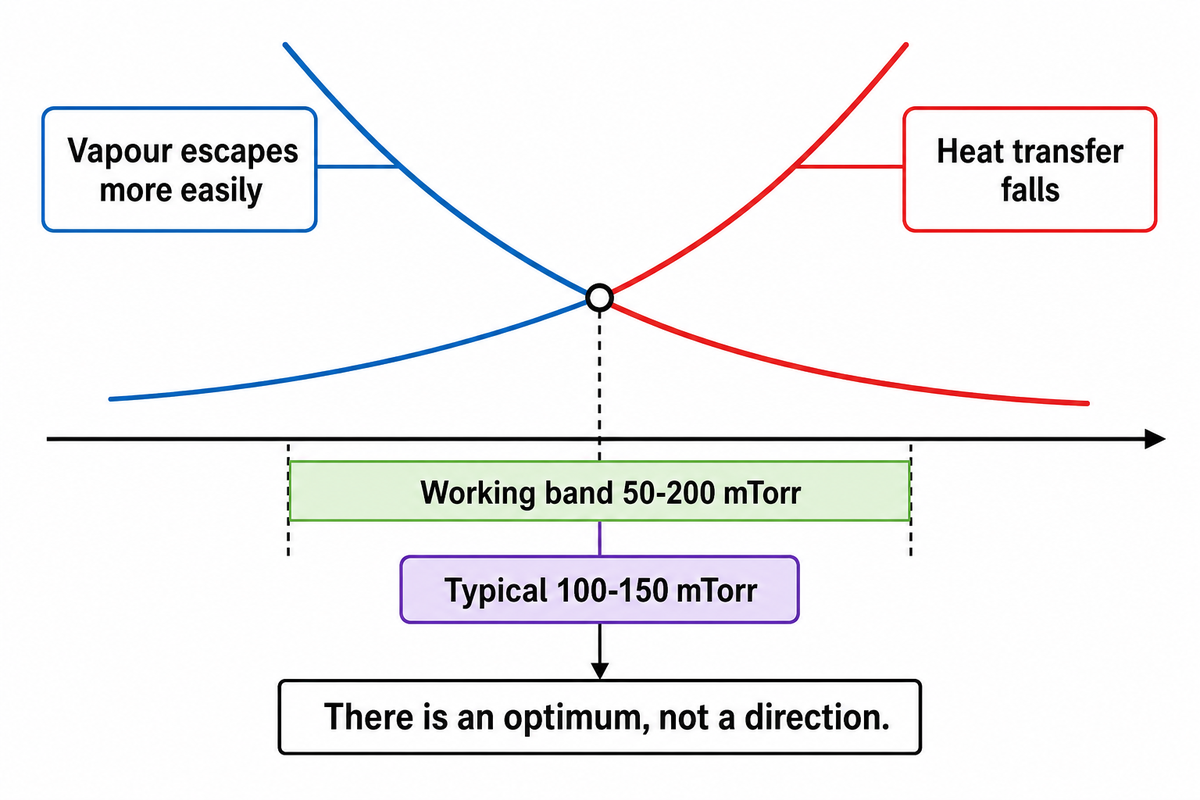
Sublimation moves ice straight to vapour without a liquid phase, and it needs two things at once: enough heat delivered into the frozen piece, and a low enough pressure for the vapour to leave. Those two requirements pull against each other, which is why cycle time isn’t a setting you can simply turn up.
⚠️ A deeper vacuum does not dry faster
This is the most common misreading of the process. Research on primary drying finds the sublimation rate decreases as chamber pressure rises and increases with shelf temperature , but pilot-scale heat-flux work shows the opposite effect on the heat side: raising chamber pressure improves heat transfer into the product, because the thermal conductivity of water vapour is strongly pressure dependent . Pull the pressure too low and the vapour leaves easily but you can no longer get heat in. There is an optimum, not a direction.
That optimum is narrow and well established. A 2023 review of freeze-drying process design reports that chamber pressure during primary drying is almost universally maintained between 50 and 200 mTorr, with 100 to 150 mTorr representing a typical range. If a supplier proposes something far outside that band, ask what product behaviour justifies it.
Where this stops being true: these figures come from vial lyophilization, where the load is a few millilitres of solution in glass. A tray of diced meat has a different geometry, a much larger water load and a different heat path. A pressure band transfers between scales; specific cycle durations don’t.
Freeze-Drying vs Hot-Air Drying vs HPP: Choosing the Route
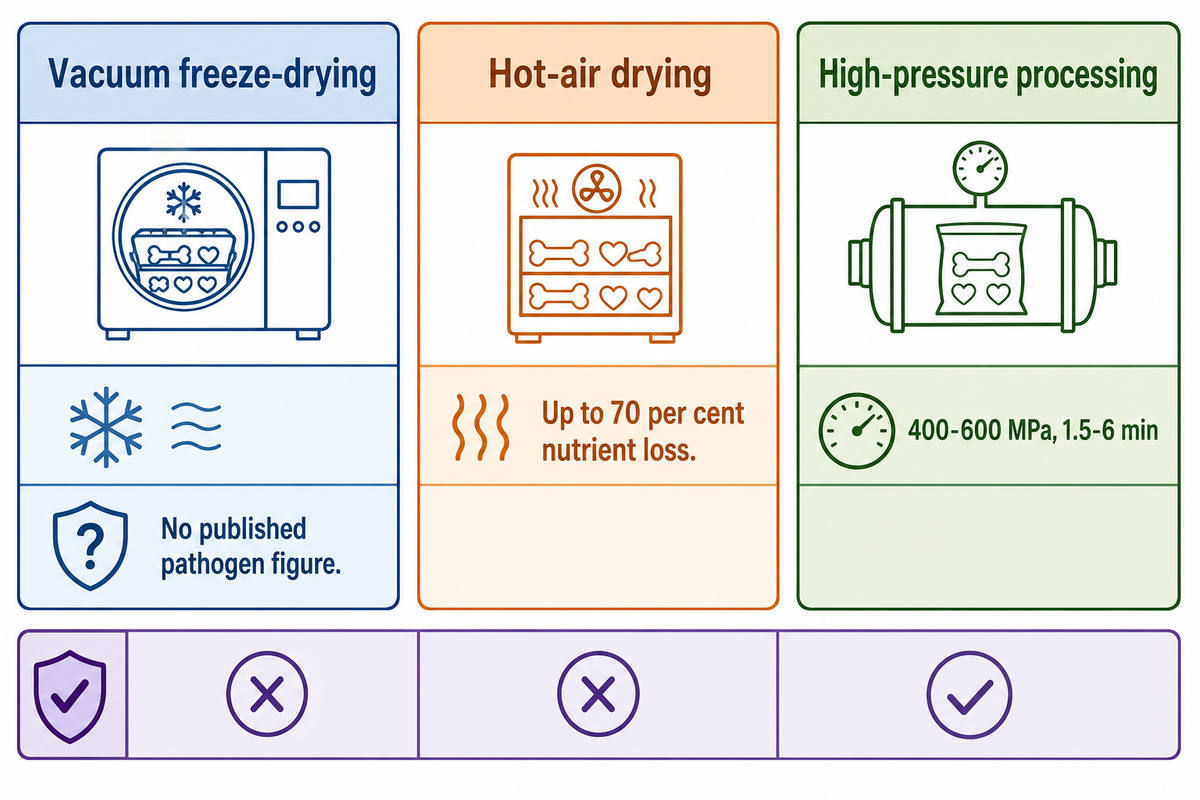
Three routes compete for the same raw material, and they aren’t interchangeable because they solve different problems. Choosing to freeze-dry preserves structure and heat-sensitive nutrients. Hot-air drying is cheaper per kilogram of water removed but takes a quality penalty. High-pressure processing isn’t a drying method at all, it’s a pathogen-reduction step that can sit upstream of either. The decision to freeze-dry rather than air-dry should be made on the product, not on the category the finished pet foods will be merchandised in.
Quality differences between the routes are measurable. Convective drying has been reported to reduce vitamin C, carotenoid and phenolic content of dried produce by up to 70 per cent depending on process parameters , and a review of meat drying notes that freeze-drying doesn’t promote protein denaturation or vitamin loss . Hot air also creates case hardening: a dried skin that traps moisture inside, which higher temperature and higher air velocity make worse rather than better. Palatability is the other axis buyers weigh: raw meat dried without heat stays closer to its original aroma and texture, which is generally read as more palatable, and essential nutrients that are heat-labile survive the milder route. Neither effect is a nutritional adequacy claim. Retained nutritional content isn’t the same as proven nutritional value in the finished diet, and raw nutritional positioning is a formulation question rather than a drying one. High-quality ingredients that enter the chamber degraded will leave it degraded.
| Route | What it does | Published parameters | Not suitable for |
|---|---|---|---|
| Vacuum freeze-drying | Removes water by sublimation, keeps structure | 50–200 mTorr primary drying; no published pathogen log reduction | Any plan that needs drying itself to be the microbial control |
| Hot-air drying | Removes water by evaporation | Up to 70% loss of vitamin C, carotenoids and phenolics reported in produce | Thick pieces where case hardening traps a wet core |
| High-pressure processing | Inactivates vegetative pathogens in the sealed pack | 400–600 MPa, 1.5–6 min industrially; 8-log Salmonella reduction modelled at 600 MPa / 5 min | Spores, which non-thermal HPP does not inactivate |
| HPP then freeze-drying | Reduction first, then water removal | One pet-food study reports 9.08 log Salmonella reduction at 750 MPa | Plans that assume the upstream reduction covers everything after the pack is opened |
Pressure and hold-time figures from the 2022 EFSA scientific opinion on high-pressure processing, whose modelled combinations were derived for raw milk and colostrum rather than for pet food. The 9.08 log figure is from a Food Control study on raw pet food, read at abstract level only.
That last row is where buyers get caught. HPP delivers a real, specified reduction at the moment of treatment, inside a sealed pack. It doesn’t follow the product into your building. Sean Jones, now director of sales at Glacial Freeze Dry, put the handoff plainly in an industry discussion of scaling freeze-dried production:
“They put the materials through HPP, put it in a plastic bag, and it’s delivered to us. What is the first thing we do when it gets here? We cut open that plastic bag and expose it to whatever is in our facility.”
Sean Jones, Director of Sales, Glacial Freeze Dry
The reduction achieved before the bag was sealed isn’t undone. What changes is that everything after you open it is a new exposure the original validation never covered, and it belongs to your plan, not your supplier’s.
Which Treat Formats the Line Has to Handle

Product mix is a machine decision, not a marketing one, because piece geometry sets tray load and tray load sets cycle time. A line specified around thin liver slices will run badly on dense whole hearts, and neither will suit a formed patty. Before specifying anything, it’s worth knowing which formats actually carry retail demand and what each one does inside the chamber.
We measured US search volume across the freeze-dried treat category in August 2026. Cat treats and dog treats each average around 5,400 searches a month, freeze-dried liver dog treats around 3,600, freeze-dried raw cat food around 2,900, and freeze-dried chicken dog treats around 1,600. That ranking says something useful about the line: whole-organ pieces such as liver and hearts, and small whole proteins, dominate the treat end of this category, not formulated patties, which belong to the complete-diet end.
Those two product families behave differently in the chamber, and the reason is water rather than protein: cycle energy scales with the moisture that has to leave, which the 2026 food-industry review of freeze-drying quantifies at 600 to 1,000 kWh per kilogram removed. A whole chicken heart is dense with a low surface-to-volume ratio and dries slowly from the centre. A thin liver slice dries quickly but is fragile and generates fines during handling. A formed patty sits between the two and adds a forming step upstream. A line specified around one of them will run badly on another, which is why “we make freeze-dried treats” isn’t a specification.
| Product cluster | Typical piece geometry | Tray-load and cycle consequence | US demand signal, monthly | Not suitable for |
|---|---|---|---|---|
| Whole organ, dense (heart, kidney) | 15–30 mm, low surface-to-volume | Longest cycle in the mix; dries from the centre last | Included in the 5,400 dog-treat cluster | Lines sized on a thin-slice cycle time |
| Sliced organ (liver, lung) | 5–10 mm slices, high surface area | Fast cycle, fragile; generates fines at unload | 3,600 for freeze dried liver dog treats | Bulk augers and drop-fed packaging |
| Diced muscle meat | 10–20 mm cubes, uniform | Most predictable cycle; the reference case for sizing | 1,600 for freeze dried chicken dog treats | Products sold on visible whole-piece appearance |
| Small whole prey and fish | Whole minnows and similar, irregular | Uneven tray packing wastes shelf area | Included in the 5,400 cat-treat cluster | Automated tray loading without vision |
| Formed patty or medallion | 8–15 mm formed discs | Adds a forming station upstream of freezing | 2,900 for freeze dried raw cat food | Single-ingredient treat positioning |
| Meal topper crumb | Crumb and shard, post-break | Made by breaking a dried format; no separate cycle | Derived from the dog food and cat food clusters | Plans that treat it as a distinct product line |
| Complete-diet nugget | Formulated, 10–25 mm | Highest incoming moisture; largest water load per tray | Premium pet food positioning rather than treats | Treat-scale chambers sized on lean muscle |
| Fruit and vegetable inclusion | 5–15 mm, high sugar | Sugar lowers collapse temperature; needs its own recipe | Supporting ingredient, not a standalone signal | Running on the meat cycle profile |
| Bone and cartilage chew | Irregular, 30 mm and above | Very long cycle; poor shelf-area utilisation | Chew category, largely air-dried instead | Freeze-drying on cost grounds |
| Dairy and egg inclusion | Liquid or semi-solid, tray-cast | Cast depth controls the cycle, not piece size | Supporting ingredient in pet food products | Wire-mesh trays without a solid liner |
| Probiotic or supplement coating | Applied post-drying | No chamber time; adds a controlled-humidity room | Functional pet nutrition positioning | Being counted as a validated pathogen control |
Demand signals are US monthly search volumes measured for this article in August 2026; keyword tools report bucketed values, so they indicate relative interest rather than sales. Geometry bands are planning ranges, not specifications.
Two commercial framings sit behind that table and they lead to different machines. Treat brands sell freeze-dried treats and pet snacks by the pouch, which favours whole-piece appearance and small batch flexibility. Complete-diet brands sell premium pet food by the kilogram, which favours long uninterrupted runs of one recipe. Pet food brands that try to serve both from one chamber usually discover the compromise in cycle scheduling rather than in the specification. Pet owners feed their pets on habit and on appearance, and will judge the result on shelf life and how the pieces look in the bowl, which is why the pet food industry treats format choice as a marketing decision and the plant treats it as a thermal one. Both are right; they’re simply not the same decision, and the dry pet food market has spent a decade demonstrating that mismatched formats and equipment produce mismatched pet food products.
💡 Pro Tip
Search volume is a demand signal, not a sales forecast. Use it to decide which geometries your line must handle, then confirm the mix against your own channel data before you fix tray design.
Station by Station: What Sits Around the Freeze Dryer
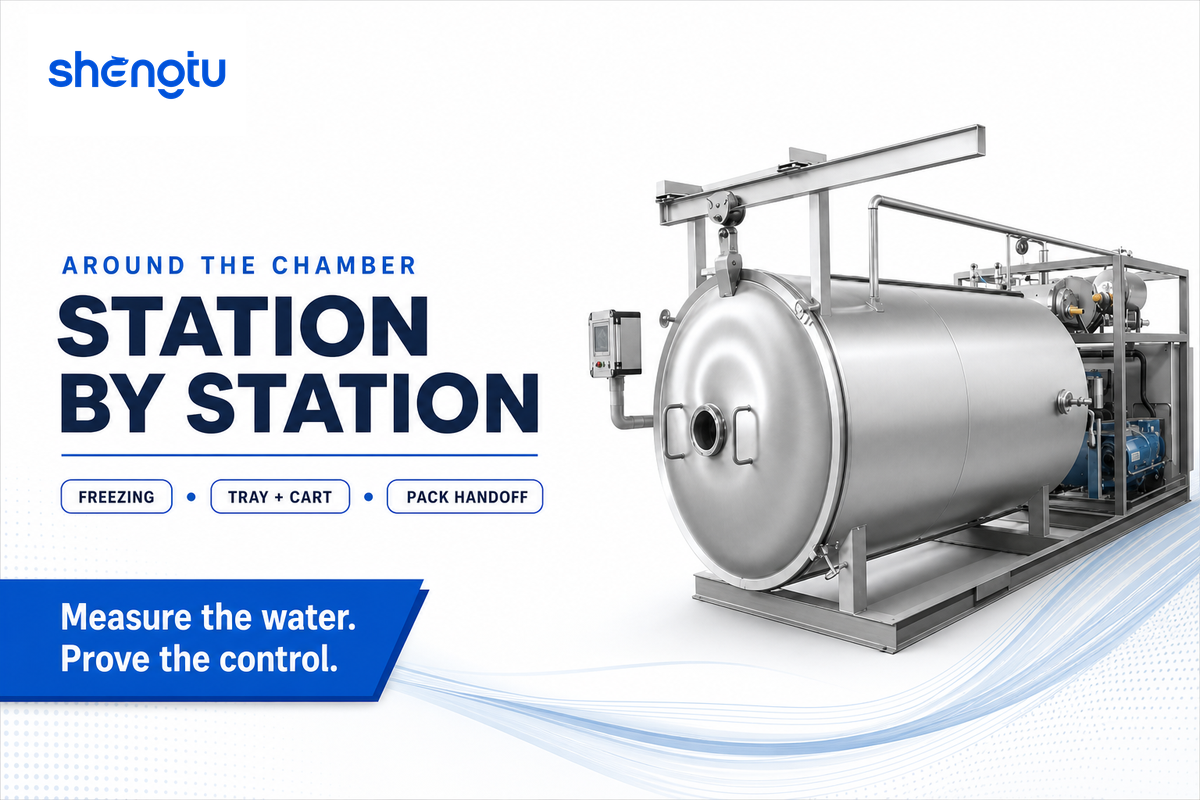
A working plant is more stations than most first-time buyers budget for. Petsource by Scoular’s freeze-dried facility is described by Pet Food Processing as six production lines: raw meat blending, ingredient blending, forming and dicing, freeze-drying, bulk packaging and packaging. Only one of those six is the dryer.
Stations nobody quotes are the ones that bite. Freezing capacity has to match the chamber, or product waits at ambient temperature. Tray and cart washing scales with throughput in a way that surprises people: one operator described preparing to wash thousands of pans a day and asked whether the building even had room for it. That same operator noted that within six months, every time, the operation had outgrown the floor area it had planned for.
📐 Engineering Note
One published reference configuration gives a sense of the utility envelope for a roughly 20 m² class module: effective shelf area at least 19.8 m², shelf range −45 °C to +80 °C, cold trap at or below −60 °C, at least 300 kg ice capture per batch, installed electrical load at or below 88 kW at 380 V / 50 Hz, and a module envelope no greater than 7,600 × 2,100 × 3,600 mm with service clearances additional. These are the numbers Shengtu publishes as its own proposal baseline on its freeze-dried pet treat line page; treat them as one worked example of what to ask about, not as a universal specification.
| Interface | Reference figure | What to confirm on site |
|---|---|---|
| Installed electrical load | at or below 88 kW | Spare breaker capacity and cable route to the panel |
| Supply | 380 V / 50 Hz | Whether a transformer is needed for your grid |
| Effective shelf area | at least 19.8 m² | Effective, not gross, area against your tray count |
| Shelf temperature range | −45 °C to +80 °C | That your recipe endpoints sit inside the range |
| Cold trap temperature | at or below −60 °C | Empty-load reference; ask for the loaded figure |
| Ice capture per batch | at least 300 kg | Against the water in your own batch load |
| Batch load basis | at least 150 kg | Product density and tray depth at that load |
| Module envelope | no greater than 7,600 × 2,100 × 3,600 mm | Service clearances are additional to this box |
| Door and access height | cart height plus handling clearance | Route from freezer to chamber without a lift |
| Unloading room condition | controlled humidity, below 40 % RH | Dried product regains moisture before sealing |
Figures in the middle column are the published reference configuration cited above and are one worked example, not a universal specification. The 40 % RH unloading condition is a planning guideline rather than a published figure, and belongs in the supplier discussion.
Quality and safety standards belong in the same conversation as the station list, because the party that manufactures and distributes the finished pack owns them regardless of who supplied the machine. Automation level is the other axis to settle early. A line can be manual at the tray, semi-automatic at the cart, or fully integrated from dicer to pouch, and the right answer depends on labour cost and SKU count rather than on what’s technically possible. Research and development capacity matters too: moving from a pilot recipe to full-scale production is where most scaling projects lose time. Give your plant engineer that list before quoting. Electrical supply, refrigeration and vacuum interfaces, water and drainage, floor loading, door and ceiling height for cart access, and ambient conditions in the unloading area all constrain what will physically fit.
From Shelf Area to Annual Output: Sizing the Line
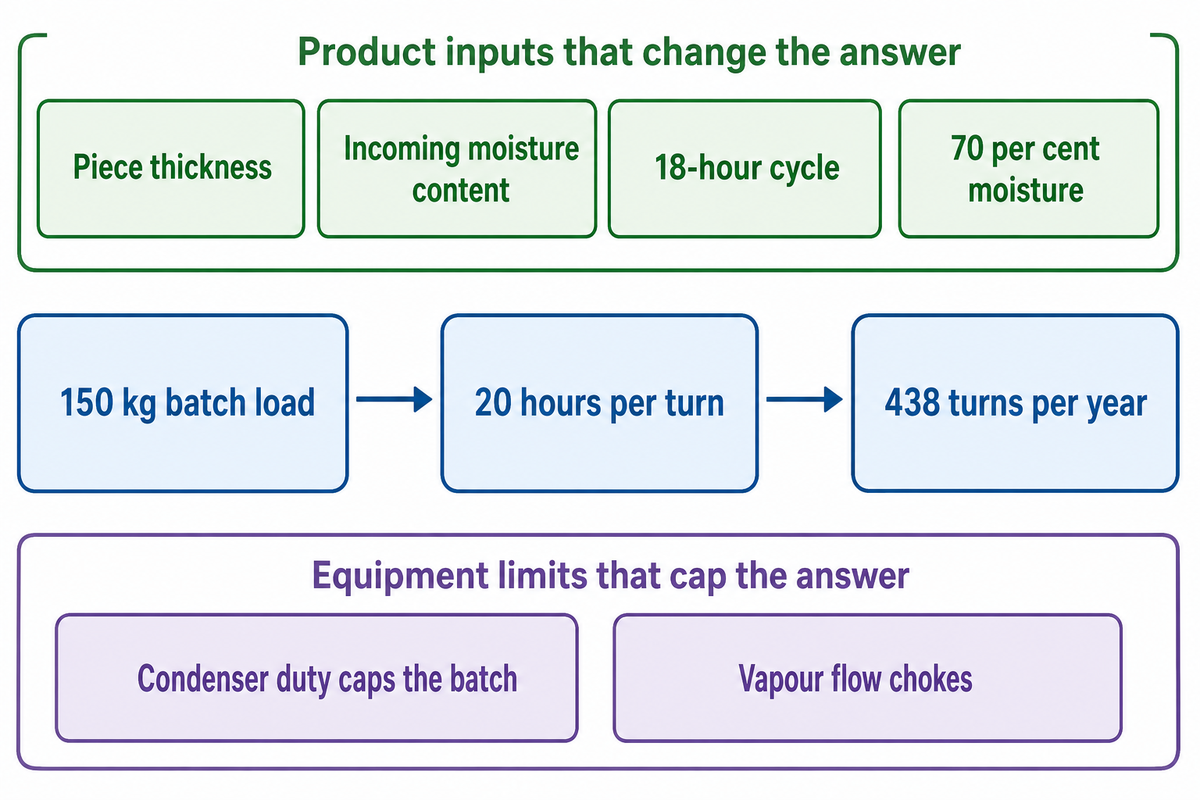
Shelf area is where every capacity conversation starts and where most of them go wrong. Arithmetic makes it look simple, and that’s precisely the problem.
Start with a batch load of 150 kg of prepared product. On an 18-hour cycle with 2 hours for unload, clean and reload, that’s 20 hours per turn, so a plant running continuously gets 8,760 ÷ 20 ≈ 438 turns a year. At 150 kg per turn that’s about 65,700 kg of wet infeed. Freeze-dried treats lose most of their mass as water, so at a 70 per cent moisture raw material the finished output is roughly 19,700 kg a year. Now apply your own availability assumption: at 80 per cent you’re near 15,800 kg, at 60 per cent nearer 11,800 kg.
That number is a planning placeholder, not a capacity, and here’s why. Published process-design guidance for freeze-drying treats load and pressure as the variables that set drying time, which is precisely what a shelf-area calculation holds constant.
✔ Four inputs that move the answer
- Piece thickness, the dominant term in drying time
- Incoming moisture content, sets the water you must sublime
- Tray loading depth and uniformity
- Formulation, including fat and sugar content
⚠ Two limits that cap it
- Condenser duty, once ice capture saturates, extra shelf area buys nothing
- Vapour flow between chamber and condenser, which chokes at high sublimation rates
None of that is theoretical. Operators running small equipment report that batch times aren’t consistent or predictable enough to plan around a single figure, which is exactly what you would expect when four product variables and two equipment limits all act on the same number. Ask a supplier for the cycle time with your product at your loading, and treat any figure quoted without those inputs as a sales estimate.
What Freeze-Drying Actually Costs You, and Why the Usual Figure Is Wrong
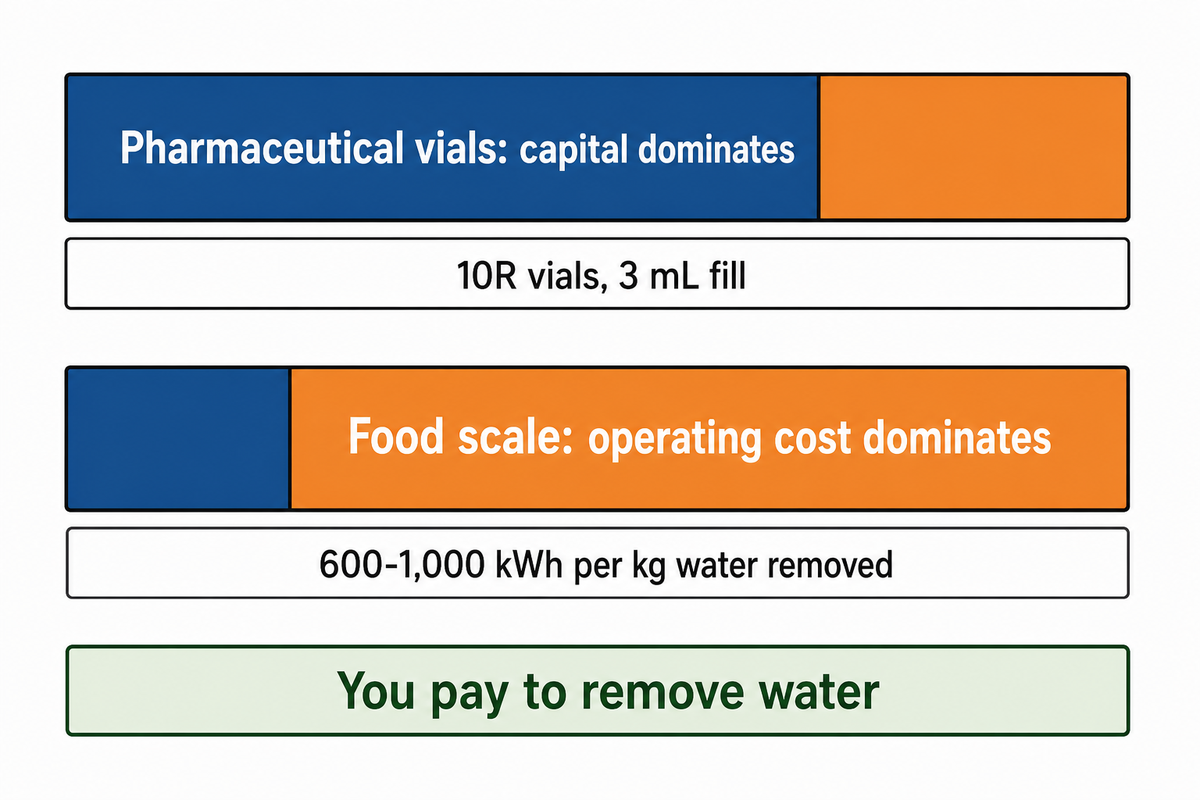
Search for the economics of this process and you’ll keep meeting one statistic: capital, not operating cost, dominates freeze-drying, at something like 91 to 95 per cent of the cost of a cycle. It is a real, published figure. It’s also measured on something that has nothing to do with your product.
Pharma’s Cost Curve Is Not Yours
Pharma’s Cost Curve Is Not Yours, because that capital-dominance figure comes from an economic model of pharmaceutical vial lyophilization 10R glass vials with rubber stoppers, filled with 3 mL of solution, 800 vials per laboratory cycle and around 100,000 vials in an 8 m³ industrial chamber. Water load per cycle is tiny and the equipment is enormous, so of course capital swamps everything else. Load the same class of chamber with trays of wet meat and the ratio inverts.
At food scale the split runs the other way. A 2026 review of freeze-drying in the food industry, drawing on the published literature it surveys, puts energy consumption at 600 to 1,000 kWh per kilogram of water removed, far above spray drying or conventional hot-air drying, and reports that reliance on batch processing pushes operating costs to 50 to 70 per cent of total production expenses. These are figures collected across the food sector rather than measured on a pet-treat line, so treat them as the shape of the cost structure rather than as your plant’s numbers. Two thirds of your cost is the running, not the buying.
That reframes the whole purchase. You aren’t buying drying time; you’re paying, by the kilogram, to remove water. Every decision that reduces the water entering the chamber, piece geometry, incoming moisture, whether a product should be there at all, moves your dominant cost line. Every decision that only shortens the calendar moves the smaller one. This is what Pharma’s Cost Curve Is Not Yours means in practice: the vial model tells you to chase machine utilisation, and the food data tells you to chase water.
Five-year cost picture: what to fill in before comparing two quotes
| Cost item | What drives it | Where the published evidence stops |
|---|---|---|
| Purchase price | Shelf area, cold-trap duty, controls | A single trade-press band exists; see below |
| Installation and commissioning | Utilities, floor works, integration | No public figure; site specific |
| Energy, five years | kg of water removed × tariff | 600–1,000 kWh per kg water is published |
| Labour, trays and sanitation | Load, unload, wash cycles per day | No public figure; scales with tray count |
| Downtime risk, five years | Batch length × availability | No published utilisation study for this equipment class |
Worked example for the energy line: at 150 kg of infeed per batch and 70 per cent moisture, each batch removes about 105 kg of water. At the midpoint of 800 kWh per kg that is roughly 84,000 kWh per batch-equivalent of water removed; at 438 turns a year and an industrial tariff of USD 0.10 per kWh, energy alone is the line item to model first. Substitute your own moisture, batch size and tariff — the point of the calculation is that it scales with water, not with hours.
Is a freeze-dried food business profitable?
Profitability turns on three numbers the published sources don’t contain: your energy tariff, the water load in your recipe and your chamber utilisation. What’s documented is the entry price, which tells you the size of the bet rather than its return. Anyone quoting a payback period without those three inputs is guessing.
Capital entry points are on the public record. Jerad Ducklow, executive vice president of sales and marketing at Parker Freeze Dry, told Petfood Industry in September 2025 that tabletop units typically cost 3,000 to 5,000 US dollars, while commercial freeze dryers range from 75,000 to over one million US dollars depending on capacity. That was published in September 2025 and is a single source, so treat it as a dated published band rather than a current market price; equipment pricing moves. It’s also worth noting that Google’s own AI summary for this topic currently quotes an upper bound of 1.3 million dollars sourced to a video recording of the same discussion; the trade-press record of that session says one million. Profitability then turns on your energy tariff, your water load and your utilisation, the three things the published band doesn’t contain.
Drying Is Not a Kill Step: The Food-Safety Boundary
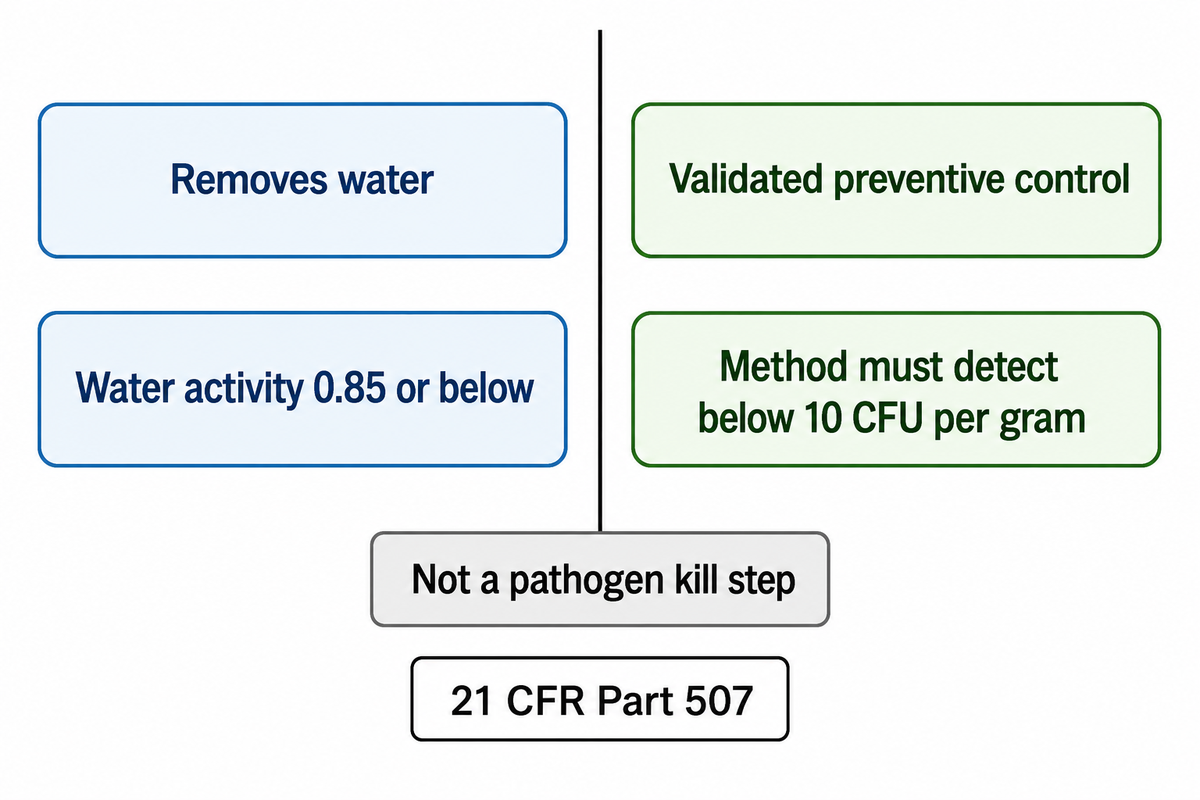
Freeze-drying is a preservation process, not a pathogen control. It stops microbial growth by removing water; it doesn’t reliably destroy the organisms already present. Clearest proof of that is commercial: the same process is used deliberately to keep probiotic bacteria alive through drying . A process chosen because bacteria survive it can’t be the reason a product is safe.
US regulators treat the category explicitly. FDA’s Center for Veterinary Medicine names frozen raw, freeze-dried raw and dehydrated raw foods for dogs and cats in its sampling assignment, and states that such product is adulterated under section 402(a)(1) of the Act if it bears Salmonella, Listeria monocytogenes or E. coli O157:H7. That standard is presence, not a count. Facilities work to 21 CFR Part 507, whose subpart C requires written preventive controls.
Recalls in this exact category are a matter of public record. In one FDA notice, a Wisconsin manufacturer voluntarily recalled specific lots of freeze-dried pet treats sold under several brands because of potential Salmonella contamination, and the notice states the recall was the result of FDA sampling that revealed the presence of Salmonella. FDA publishes such notices as company announcements and states that the investigation into the cause was continuing.
A declared control is not a control until the method can see the hazard
This is the part almost no buyer’s guide covers, and it is where a food-safety plan actually fails. In a 2023 warning letter, FDA examined a manufacturer of raw frozen and raw freeze-dried pet food that had declared probiotic inclusion as its preventive control for pathogens in freeze-dried product. FDA concluded the validation study did not support that claim, not because the control was obviously wrong, but because the method could not detect the hazard. In FDA’s words, probiotics present in treated freeze-dried raw beef samples contain high levels of background flora which can suppress the growth of Salmonella and decrease the sensitivity of detecting it. Non-selective enrichment had been used where selective enrichment was required, and the enumeration method could not resolve below 10 CFU per gram. That same letter records that finished-product testing over a twelve-month period had returned 49 products positive for Listeria monocytogenes or Salmonella.
This lesson generalises. Whatever you nominate as your preventive control, the validation has to be run in your actual matrix, with a method sensitive enough to find the organism in that matrix. Testing finished product is verification, not control.
Two measurements are also routinely confused. Moisture content and water activity are not interchangeable. FDA’s technical guidance notes that most foods sit above 0.95 water activity, which supports bacterial, yeast and mould growth, and that controlling finished product to 0.85 or below removes it from the scope of the US low-acid and acidified canned food regulations at 21 CFR Parts 108, 113 and 114. That threshold is a US regulatory boundary for those specific rules, not a global shelf-stability standard and not a pathogen limit. Water activity is the shelf-stability measurement. Neither figure demonstrates pathogen reduction.
When Freeze-Drying Is the Wrong Answer
Hot-air drying beats freeze-drying on the dimension that matters most to a plant manager: cost per kilogram of water removed. At 600 to 1,000 kWh per kg, freeze-drying runs an order of magnitude more expensive than conventional drying, so the premium has to buy something the customer can see.
That’s the test to apply before specifying anything.
If your product doesn’t need structure, colour or heat-sensitive nutrient retention preserved, you’re paying a large premium for an attribute your buyer won’t notice; the same food-industry review names high energy consumption and operating cost as the main constraints on wider industrial adoption. Your test is simple: name the attribute that only freeze-drying can deliver for this specific product, in one sentence, before you specify anything.
✔ Where the premium earns its place
- Whole-muscle and organ pieces sold on appearance
- Products positioned on minimal processing
- Heat-sensitive inclusions that hot air would destroy
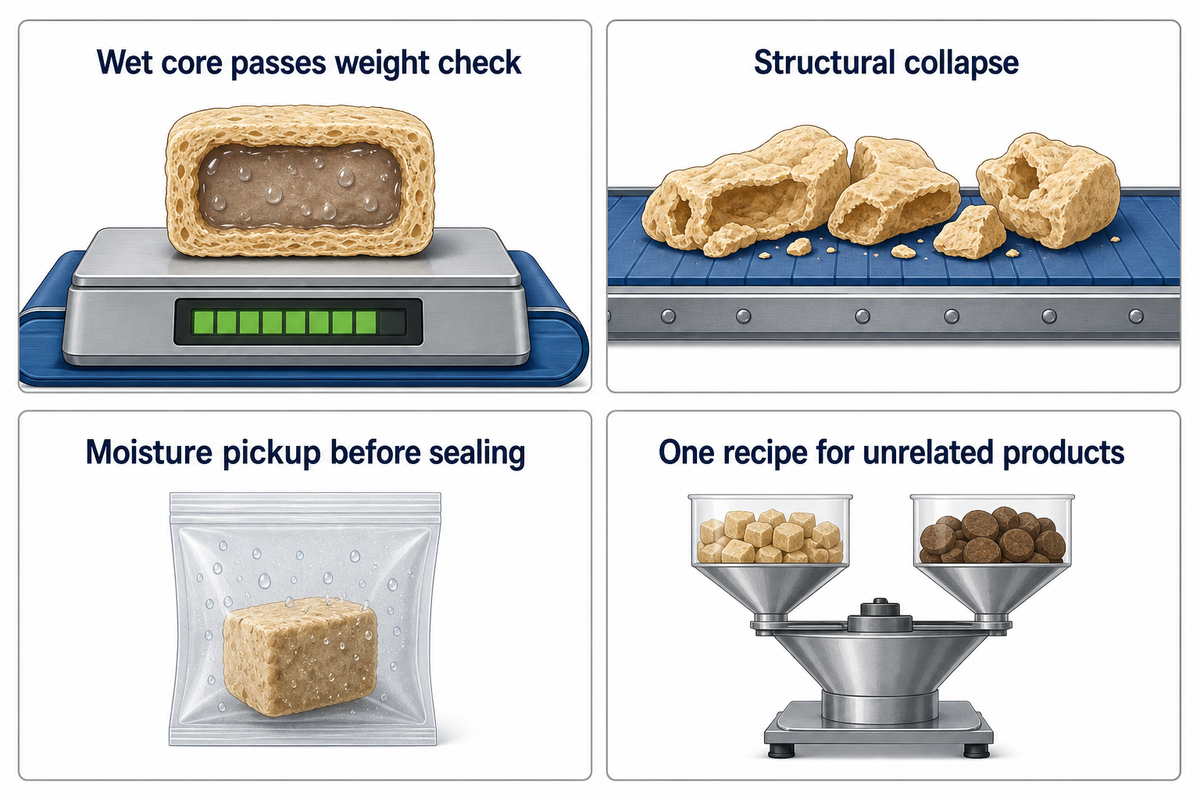
⚠ Common failure modes
- A wet core that passes a weight-loss check but fails water activity
- Structural collapse from driving primary drying too hard
- Moisture pickup between unloading and sealing
- One cycle recipe applied to unrelated products
What is the downside of freeze drying?
Three drawbacks dominate, in order of how often they cause trouble: it’s a batch process that can’t be sped up, it consumes energy in proportion to the water removed rather than to product value, and the finished piece is hygroscopic and will pick moisture back up before it’s sealed. Each has a different remedy.
First, it’s a batch process.
As one co-manufacturer put it, freeze drying is a batch process and you cannot accelerate it the way you can extrusion ; you add capacity by adding chambers, not by turning up a line. Second, it is energy-hungry in a way that scales with water rather than with product value. Third, the finished product is hygroscopic, it will pull moisture back out of the air between the chamber and the seal, which is why barrier packaging is part of the process rather than an afterthought. Oxygen and moisture barrier performance is measured to ASTM D3985 and ASTM F1249 respectively, and those figures belong in your packaging specification. Formats that require preservatives to hold up in distribution are a signal the drying endpoint was wrong. A low moisture product in a genuinely airtight container holds its freshness and is easy to store at ambient temperature; the same product in a marginal pack will regain moisture content until the texture and the water activity both drift.
In-House Line or Co-Manufacturer?

The In-House Stop/Go Matrix below exists because for most brands entering this category the first correct answer is a co-manufacturer, and the market says so plainly: the facilities that actually make freeze-dried pet treats are overwhelmingly contract and private-label operations, not brands running their own chambers. Capital is also a documented reason companies choose that route, one operator’s business was acquired partly because of the capital required to scale.
| Condition | Stop, use a co-manufacturer | Go, own the line |
|---|---|---|
| Annual finished volume | Below what one chamber fills at your own availability assumption | Consistently above one chamber and growing |
| Number of SKUs | Many geometries, each in small lots | Few geometries, repeat runs |
| Food-safety ownership | No qualified individual, no validated control | Named owner, written plan, validated method |
| Facility readiness | Utilities or floor area unsurveyed | Power, refrigeration, vacuum, drainage and access confirmed |
| Capital and cash cycle | Equipment purchase would consume working capital | Capital available without starving inventory |
The food-safety row is the one that most often decides it. Owning a line means owning a written food safety plan and validated preventive controls under 21 CFR Part 507, and a co-manufacturer that already holds those is selling you compliance as much as capacity.
Two or more rows on the Stop side of The In-House Stop/Go Matrix and the honest recommendation is to buy nothing yet. We build this equipment, so it’s worth saying directly: a chamber bought before the volume and the food-safety plan exist will sit part-loaded, and a part-loaded batch process is the most expensive way to make a treat. Run The In-House Stop/Go Matrix again once your volume has been stable for two or three quarters, not before.
What Makes Two Quotes Non-Comparable
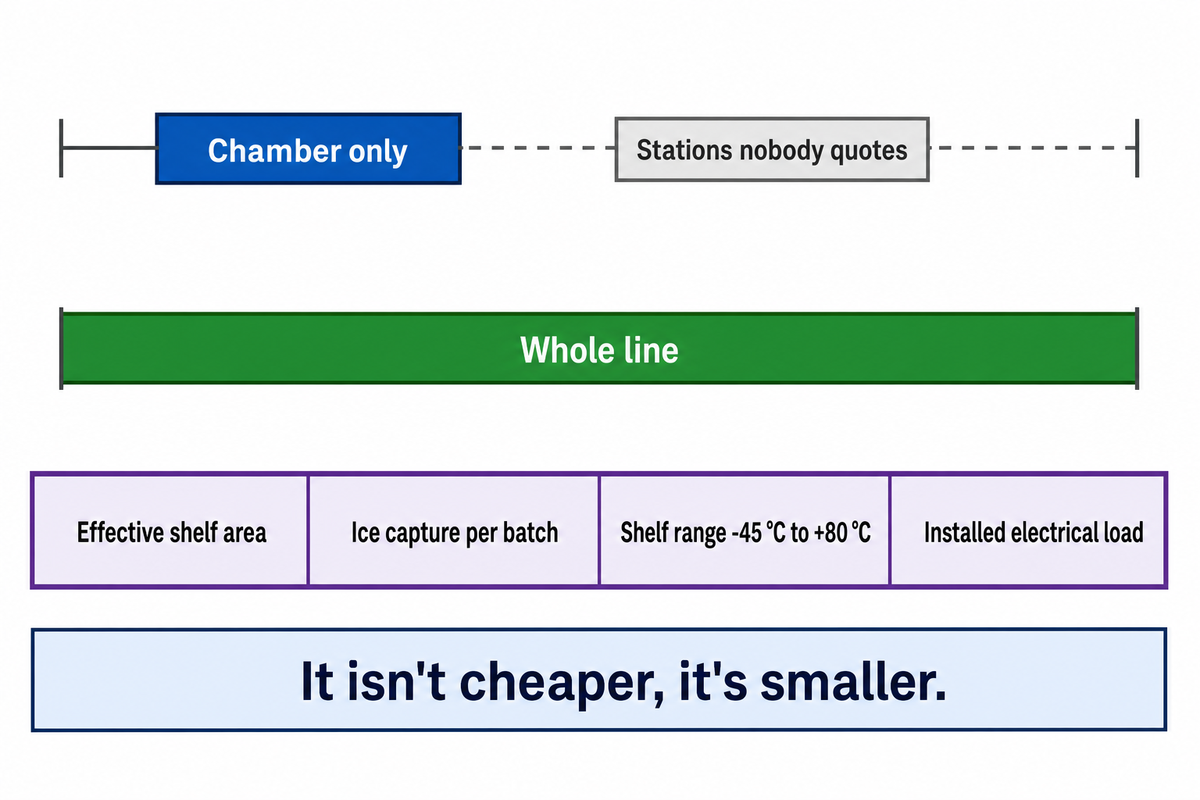
Most quote confusion in this category is scope confusion, not price disagreement. One supplier prices a chamber; another prices a chamber plus freezing, dicing, detection and packaging; a third assumes you provide utilities to the skid edge. Fix the boundary before you compare.
RFQ checklist — copy these into your quote request:
| Parameter | What to state | Why it matters | How to verify |
|---|---|---|---|
| Effective shelf area | m², effective not gross | Gross area includes surfaces you cannot load | Ask for tray count × tray area |
| Ice capture per batch | kg per cycle | Condenser duty caps the batch regardless of shelf area | Compare against your water load per batch |
| Cycle time basis | Hours, with the product and loading assumed | A cycle time without a product is not a number | Require a trial run on your material |
| Installed electrical load | kW at supply voltage and frequency | Determines whether your building can host it | Plant engineer sign-off before order |
| Shelf temperature range | °C minimum and maximum | Sets which recipes are achievable | Factory acceptance test record |
| Scope boundary | Which stations are included | The single biggest source of quote mismatch | Station-by-station inclusion list |
| Pack barrier spec | OTR and WVTR targets | Product regains moisture from air after unloading | ASTM D3985 and ASTM F1249 test reports |
Two further items belong in the same request and are routinely forgotten. Tray material and count, because tray design drives both cleaning labour and usable shelf area; and whether the pouch specified is recyclable in your target market, because that constraint can force a different barrier structure late in a project. If a quote omits a facility interface or leaves validation ownership unstated, it isn’t cheaper, it’s smaller. Shengtu publishes its own version of this boundary discussion on its freeze-dried pet treat line page, including which responsibilities sit with the buyer’s facility.
Where Freeze-Dried Pet Capacity Is Heading
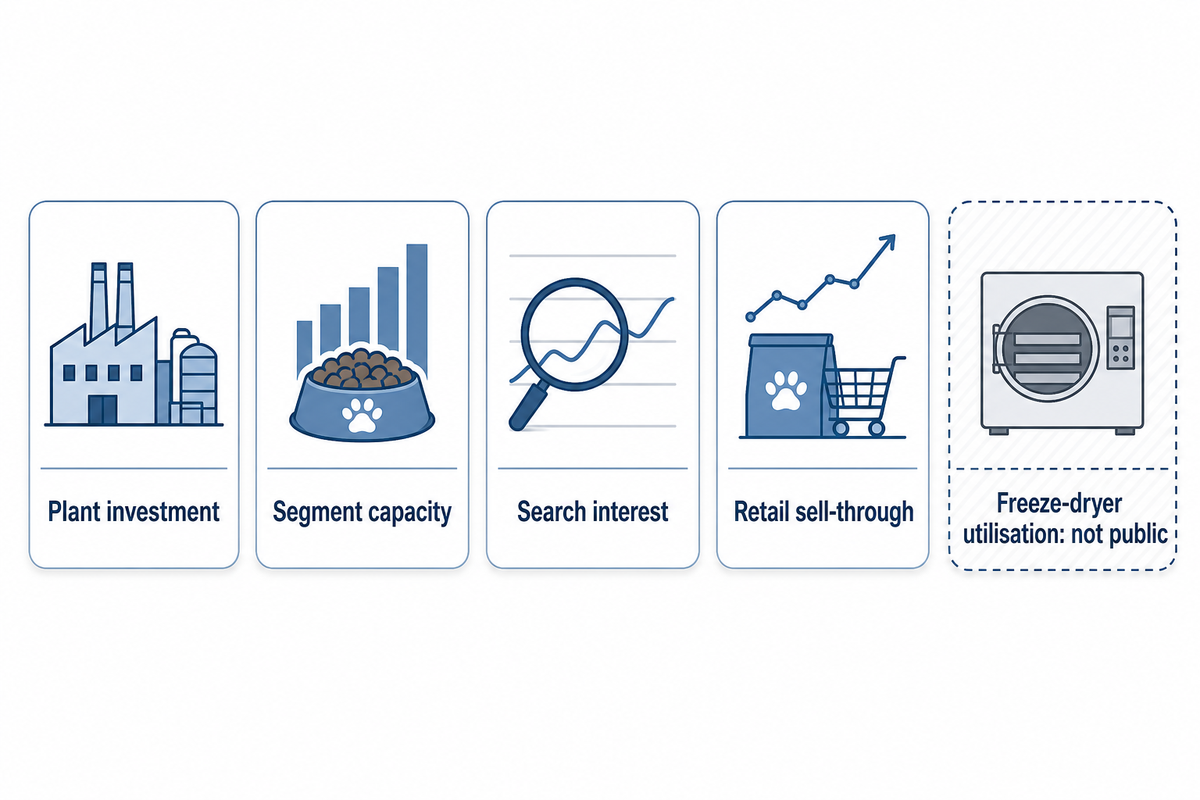
Honest answer first: the question buyers actually ask, is there room for my tonnes, can’t be settled with the data that exists publicly. Four different quantities get quoted as if they were one, and none of them measures how hard the installed chambers are already working. Knowing which number is missing is more useful than a confident forecast built on the wrong one.
Four different quantities get quoted interchangeably. Pet-food plant investment is well documented: writing in Petfood Industry in June 2026, Kormotech chairman Rostyslav Vovk records 40 major production projects completed between 2020 and 2022, double the number in the three pre-pandemic years, and over 1.5 billion US dollars invested in new plants and expansions from early 2023 through mid-2024. Freeze-dried segment capacity is documented separately: Petsource by Scoular completed a 75 million dollar expansion adding 70,000 square feet that tripled its freeze-drying capacity. Search interest is a third quantity, our own measurement shows business-side interest in pet treat manufacturing running about 174 per cent above its level three years earlier. Retail sell-through is a fourth.
None of those four measures the one thing that decides whether adding a chamber is sensible: how heavily the freeze-dryers already installed are being used. That figure isn’t public.
What that leaves is a discipline rather than a forecast. Vovk’s argument is that excess capacity pressures margins, strengthens the retailer’s hand in negotiation, and pushes private label ahead of branded product, and that the market shifts from rewarding scale to rewarding distinctiveness. A reader of that same article put the buyer’s version of the test more sharply still: a manufacturer investing in production capacity should care about volume growth rather than value growth, because volume is non-inflationary, and the real question is whether the market can absorb the additional tonnes. Before you commit capital, answer that question for your own channel, in kilograms. Market demand reaching a retail channel isn’t the same as tonnes leaving a plant, and freeze-dried treats sit in a different competitive position from bulk animal feed precisely because product quality rather than price carries them. Nothing in that argument depends on an additive, a formulation trend or a market forecast.
⚠️ Important
Search-volume figures in this article are measured in keyword tools, which report bucketed and rounded values. Search interest is not demand and does not forecast sales. It is used here to compare the direction of business-side and consumer-side attention, nothing more.
About This Analysis
We build equipment used to manufacture freeze-dried foods and treats alongside kibble and other formats, and we work with startup brands as well as established ones, so this guide names where our commercial interest sits: the section on in-house versus contract manufacturing recommends against buying a chamber when volume, SKU count or food-safety ownership are not yet settled. Process, cost and regulatory figures here are drawn from published research, FDA documents and named industry sources rather than from our own sales material.
Frequently Asked Questions
Q: How do you legally sell freeze-dried pet food in the US?
You need a facility operating under 21 CFR Part 507 with a written food safety plan, plus labelling that meets state feed and AAFCO requirements.
You need a facility operating under 21 CFR Part 507 with a written food safety plan, plus labelling that meets state feed and AAFCO requirements. Part 507 subpart C requires written preventive controls, and the control you nominate has to be validated for your product. Product bearing Salmonella, Listeria monocytogenes or E. coli O157:H7 is adulterated regardless of the level detected. Labels making a nutritional adequacy claim for dogs and cats are checked against AAFCO profiles, and veterinary or health claims carry their own substantiation burden. Registration and licensing requirements vary by state, so confirm both federal and state obligations before shipping.
Q: Which companies manufacture freeze-dried pet treats?
Freeze-dried pet treats are made mainly by contract and private-label co-manufacturers rather than by the brands whose names appear on the pouch, with facilities concentrated in the United States, Turkey, China, New Zealand and the United Kingdom.
The category is served mainly by contract and private-label facilities rather than by brands running their own chambers. Search results for this term are dominated by co-manufacturers in the US, Turkey, China, New Zealand and the UK. For a brand entering the category, that concentration is itself information: the normal route to market is a co-manufacturer first, with in-house capacity added once volume and food-safety ownership justify it.
Q: Is freeze-dried pet food raw or cooked?
Freeze-drying itself neither cooks nor sterilises anything, so a freeze-dried treat is whatever the raw material was before it entered the chamber: raw material in means a raw product that has simply had its water removed, and FDA treats it as a raw category.
Freeze-drying itself neither cooks nor sterilises, so the product is whatever it was before it entered the chamber. If raw material goes in raw, the finished treat is a raw product that has been dried, whether the input was poultry such as chicken and turkey or a novel protein such as venison. FDA’s sampling programme treats freeze-dried raw food for dogs and cats as a raw category alongside frozen and dehydrated raw. Any cooking, pasteurisation or pressure treatment has to happen as a separate, validated step.
Q: How is freeze-dried different from dehydrated pet food?
Freeze-drying removes ice by sublimation under vacuum with no heat drive, while dehydration evaporates water using warm air; the practical result is that freeze-dried pieces keep their shape, porosity and heat-sensitive nutrients, and dehydrated pieces shrink and can case-harden.
Freeze-drying removes ice by sublimation under vacuum with no heat drive; dehydration evaporates water using warm air. Practical consequences are structural and nutritional. Freeze-dried pieces keep their original shape and porosity, rehydrate quickly and retain heat-sensitive nutrient content. Hot-air drying shrinks the piece, can case-harden the surface so a wet core remains, and has been reported to cost up to 70 per cent of vitamin C, carotenoid and phenolic content in produce. Cost runs the other way: at 600 to 1,000 kWh per kilogram of water removed, freeze-drying is far more expensive to run.
Q: Why is freeze-dried pet food so expensive to produce?
Because you pay by the kilogram of water removed rather than by the kilogram of product, and because the process is a batch that cannot be accelerated: published figures put energy at 600 to 1,000 kWh per kilogram of water and operating cost at 50 to 70 per cent of total production expense.
Because you pay by the kilogram of water removed, and because the process is a batch that cannot be accelerated. Published figures put energy consumption at 600 to 1,000 kWh per kilogram of water removed and operating costs at 50 to 70 per cent of total production expense in food applications, with batch operation named as the reason. Raw material amplifies this: a treat that starts at 70 per cent moisture means most of the mass entering the chamber is water you are paying to sublime. Note that the widely quoted claim that capital dominates freeze-drying cost is drawn from pharmaceutical vial models with very small water loads, and does not describe a food line.
Q: Can pets get parasites from freeze-dried treats?
Drying is not a validated kill step for pathogens or parasites, so any control has to come from somewhere else in the process, whether that is ingredient sourcing, a validated upstream treatment, or both together with a written food safety plan that names who owns it.
Drying is not a validated kill step for pathogens or parasites, so the control has to come from elsewhere in the process, sourcing, an upstream validated treatment, or both.
Q: Are there preservatives in freeze-dried pet food?
Usually not, because removing water to a low water activity is what makes the product shelf stable, so there is nothing left for spoilage organisms to grow in; desiccants are still common in retail packs that are not vacuum sealed, as an extra guard against moisture ingress.
Usually not, because removing water to a low water activity is what makes the product shelf stable. Most operators see no reason to add a preservative to a product they freeze-dry, and desiccants remain common in packs that are not vacuum sealed.
Related Articles
- Dry Kibble Extrusion Line: A Process Control Guide, the continuous-process counterpart to this batch process
- Pet jerky drying line, the hot-air route for treats that do not need structure preserved
- Industrial freeze dryer sizing, machine-level water load and shelf area
- Mesh belt hot-air dryer, where continuous drying fits
- Fruit and vegetable freeze-drying line, produce carries its own pretreatment decisions
- Freeze-dried meat and seafood line, the human-food adjacent application
References & Sources
- Application of Freeze-Drying Technology in the Food Industry: A Review Foods, 2026
- Practical Advice on Scientific Design of Freeze-Drying Process Tchessalov et al., 2023
- Emerging Freeze-Drying Process Development and Scale-up Issues Patel et al., 2011
- Heat Flux Analysis and Assessment of Drying Kinetics during Lyophilization of Fruits Foods, 2023
- Economic Analysis of a Freeze-Drying Cycle Processes, 2020 (pharmaceutical vial scope)
- The efficacy and safety of high-pressure processing of food EFSA scientific opinion
- Impact of Freezing and Freeze Drying on Lactobacillus rhamnosus GG
- Review of drying meat products and the associated changes Frontiers in Nutrition, 2022
- CVM Assignment to Collect Official Samples of Raw Foods for Dogs or Cats US Food and Drug Administration
- Warning Letter 645467 US Food and Drug Administration, 2023
- Water Activity (aw) in Foods, Inspection Technical Guide US Food and Drug Administration
- 21 CFR Part 507, Preventive Controls for Food for Animals Electronic Code of Federal Regulations
- Five questions answered about freeze-dried pet food production Petfood Industry, 2 September 2025
- When pet food capacity outpaces demand, what’s a manufacturer to do? Petfood Industry, 22 June 2026
- Muenster Milling 2.0 Pet Food Processing
- Freeze-drying frontier: Latest advancements in freeze-drying equipment Pet Food Processing



![Beef/Lamb/Poultry Cutting Line Acceptance Guide [2026]](https://shengtumachinery.com/wp-content/uploads/2026/09/beef-lamb-poultry-cutting-line-guide-featured-150x150.png)
![Dry Kibble Extrusion Line: Process Control Guide [2026]](https://shengtumachinery.com/wp-content/uploads/2026/08/dry-kibble-extrusion-line-guide-featured-150x150.png)


