Get in touch with Shengtu Bufan Company

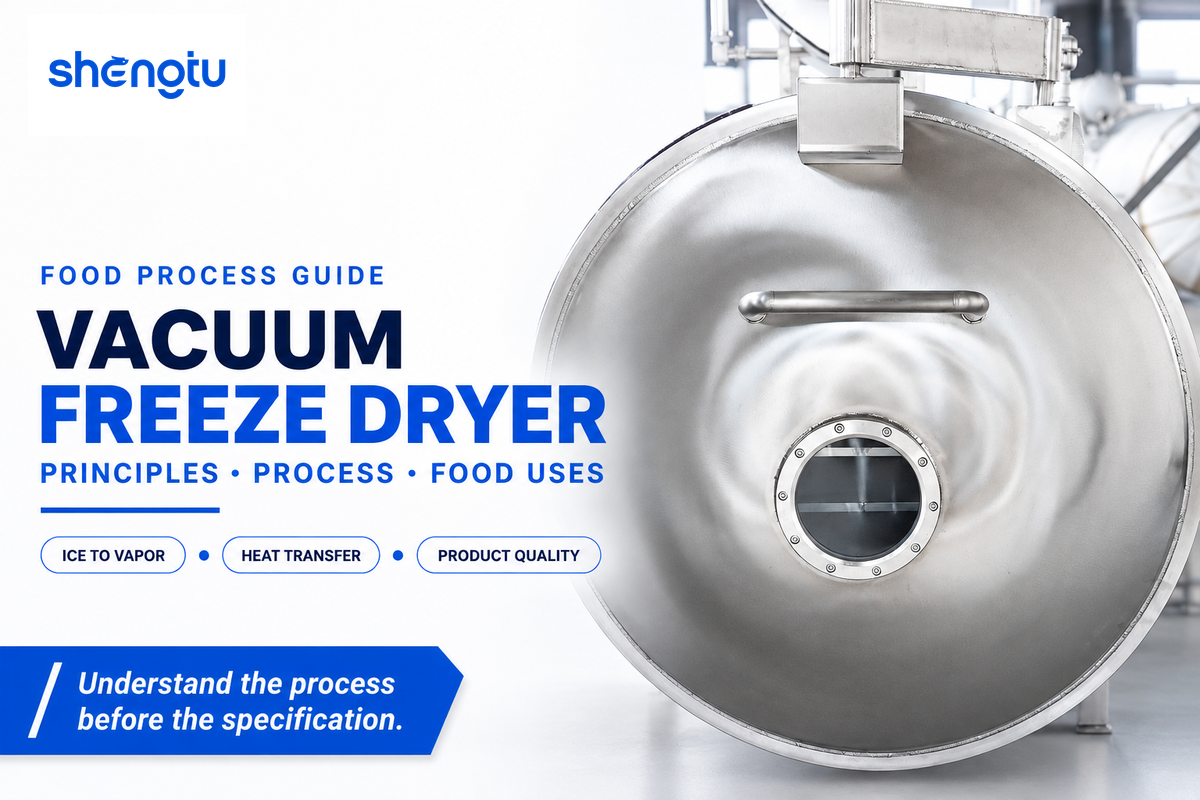
A Vacuum freeze dryer uses sublimation and a subsequent process known as secondary drying to remove water from frozen food. The resulting porous structure can give fruit a crisp bite and help dried ingredients rehydrate. Achieving this effect requires heat as well as cold. Making a chamber colder or performing a deeper vacuum won’t help address all drying issues.
Process at a glance
- Sequence: freezing, primary drying, secondary drying.
- Water route: ice in the food becomes water vapor, which collects as ice at the condenser.
- Useful product traits: porous structure, low weight and rapid rehydration where the recipe supports them.
- Release checks: dryness throughout the load, product quality and a protective package.
A vacuum freeze dryer combines freezing, low pressure and controlled heat to remove ice without first melting it. Primary drying removes ice; secondary drying removes residual moisture. Food composition and slice thickness change the cycle.
Key points
- A deeper vacuum doesn’t always make primary drying faster.
- Shelf, product and condenser temperatures describe different physical locations.
- Freeze drying removes water; it doesn’t remove fat or sterilize food.
- Dryness, storage quality and microbiological control need separate checks.
What Is a Vacuum Freeze Dryer?
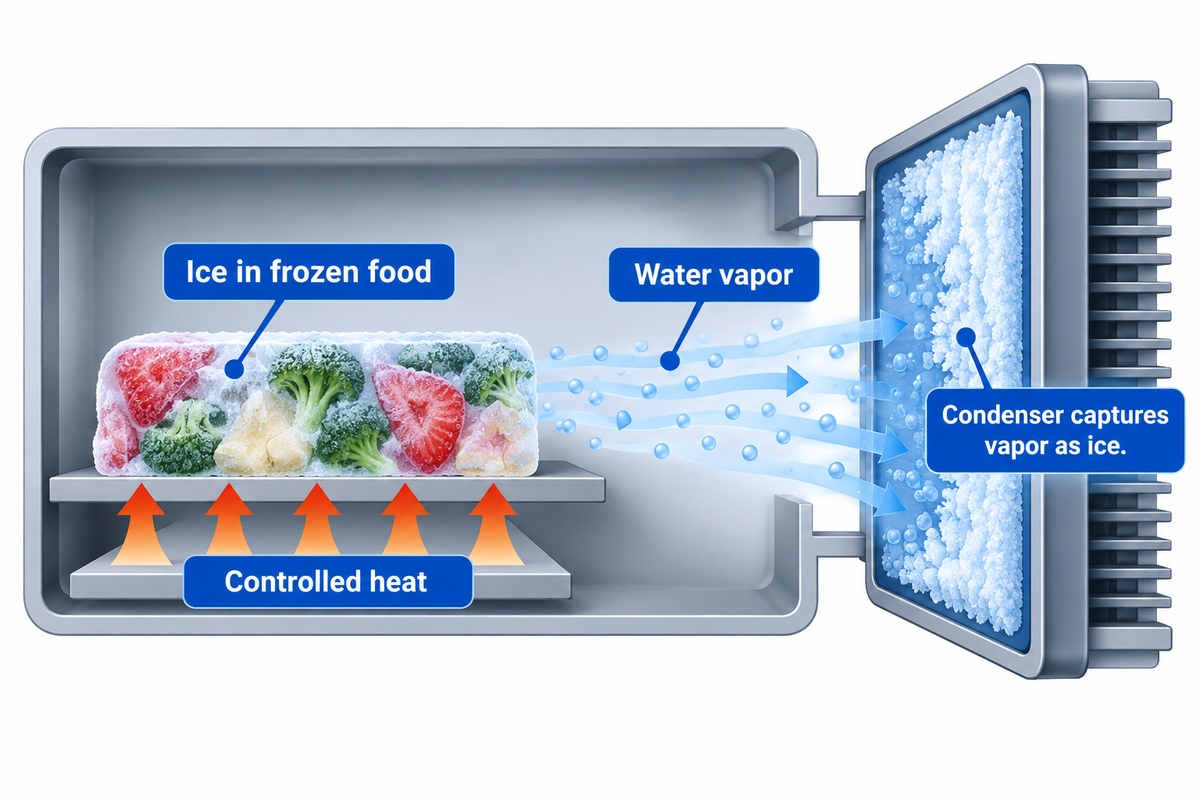
A vacuum freeze dryer employs a refrigerated drying process in which ice in a frozen product is removed as vapor at reduced pressure. It’s also known as a lyophilizer. This route leaves spaces where ice crystals once occupied the food, rather than drying only by evaporating liquid water.
Consider ice as a temporary framework. After it’s removed, pores remain. These pores create the lightness and brittleness of freeze-dried strawberries. A dried ingredient can rehydrate. Damage to cells, formulation and storage affect the final texture of the product.
The food-process review by Nowak and Jakubczyk talks about the interrelation of the freezing, heat transfer and vapor movement processes. A freeze dryer vacuum chamber alone is of no use; the product needs a way for heat to be transferred to the ice and a way for the vapor to move from the product.
The open structure of some veggie snacks can warrant freeze drying. A chewy dried fruit may suit another food dryer. The preferred texture should be defined prior to selecting a preservation method.
How the Freeze-Drying Cycle Works
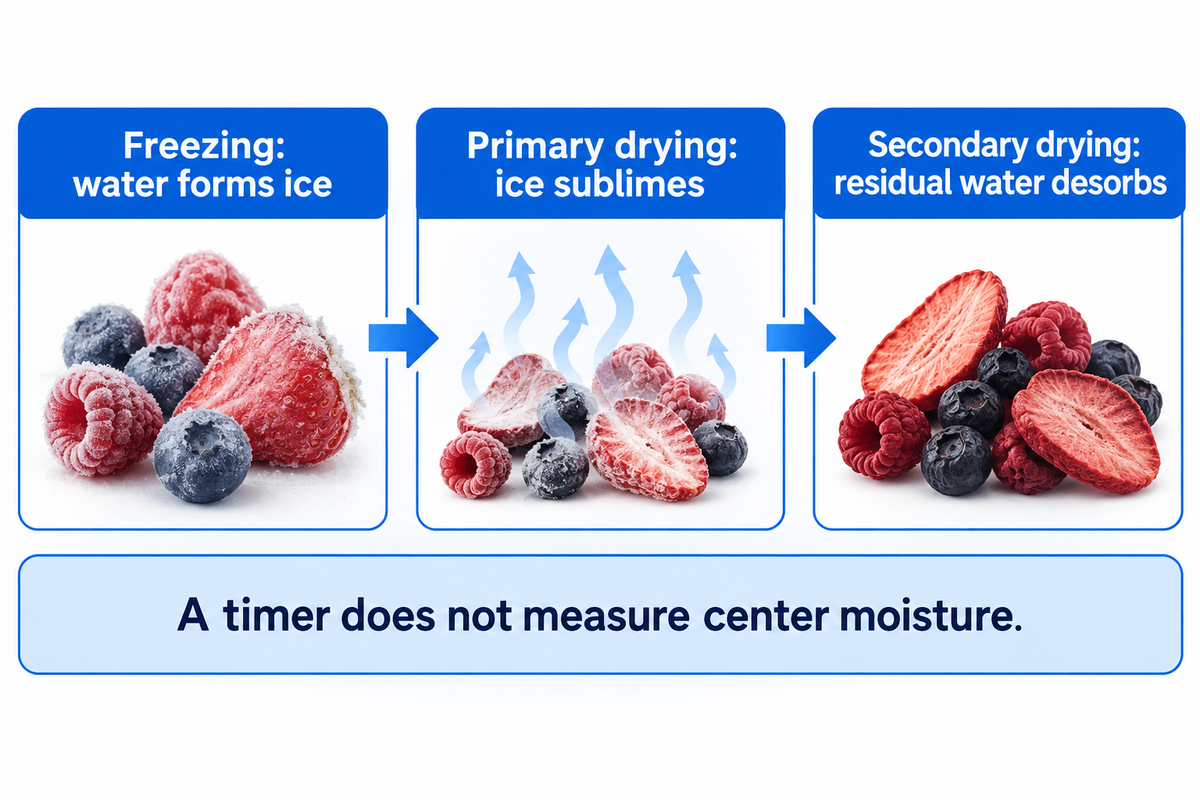
There are three stages in freeze-drying that perform different tasks. In freezing, ice forms and primary drying removes that ice through sublimation. The leftover water is removed through desorption. Heating continues during drying because sublimation consumes energy. The goal is to keep the food within its structural limitations, and allow water vapor to escape.
| Stage | What happens | What can limit the result |
|---|---|---|
| Freezing | A portion of the food’s water forms ice; solutes concentrate in the remaining phase. | Uneven freezing and ice-crystal structure affect later vapor pathways. |
| Primary drying | Ice sublimes while heat enters the product. | Heat supply, dried-layer resistance and vapor capture must work together. |
| Secondary drying | Residual water desorbs from the material. | Time and temperature must meet the product’s final moisture and quality targets. |
The morphology of ice can change with the speed of freezing, which can also damage tissue. Larger ice crystals can leave wider vapor passages, but they can also damage tissue. In some cases, fast freezing can protect certain structures while creating smaller pores that resist drying. Neither extreme is preferable for every recipe. The review of fruit and vegetable freeze-drying assistance methods discusses how pretreatment and physical energy inputs alter this balance.
Consider a product-development team evaluating the effects of freezing and heating on both sliced and pureed fruit. Cellular walls and uneven skin coverings are present on the sliced fruit, while the pureed fruit has an even, continuous layer. That record helps explain a rejected batch instead of reducing every failure to an adjustable timer. A useful trial records prepared geometry, the freezing history and the endpoint alongside the finished texture.
Primary drying ends when the relevant ice has been removed, not when the display reaches a chosen shelf temperature. A digital timer defines a programmed interval; it doesn’t measure the moisture at the center of the food. An adjustable timer and temperature control, therefore, need a validated recipe and product endpoint. Final moisture is a separate endpoint after secondary drying.
What Each Part of the System Does

The drying chamber holds the food, temperature-controlled shelves supply or remove heat, and refrigeration supports freezing and vapor capture. The vacuum system maintains a low pressure. A condenser or cold trap captures the water vapor as ice. The vacuum pump and condenser therefore have complementary functions; a larger pump alone can’t make up for all restrictions in the vapor route.
What are the main components of the vacuum freeze dryer?
The main components are the chamber, product trays or shelves, refrigeration equipment, condenser, vacuum pump, sensors and controls. Food-contact stainless steel surfaces must also be accessible for the required cleaning. Due to the differences in design and configuration of the other major elements (pump, shelves, and controls), equipment of the same name can perform very different functions on different machines.
A tray carries the food but also affects heat contact. Refrigeration can cool the shelves for freezing; during drying, a shelf sensor may monitor the heating fluid rather than the food. At the cold end the condensing coil builds up a layer of ice; defrosting and drainage are part of the turnaround between batches. A compressor rating, in itself, describes neither the temperature distribution of a loaded product nor the dry, accepted product.
For an actual pilot-scale example, Cornell’s equipment page lists the Magnum XL pilot freeze dryer, with a stated condensing rate of 20 L in 24 hours and a separate 30 L batch capacity. Condensate collection and product loading aren’t the same. Neither is in kilograms of dry food accepted.
A touchscreen can make a stored recipe easy to use, but the displayed program is only useful when the sensor locations and load conditions are understood. For a vacuum freeze dryer machine with digital controls, locate the sensors behind the displayed values. An adjustable temperature changes a set point, not all the temperatures in the chamber. A touch screen changes the recipe as entered by the operator, and heat and vapor pathways still determine the process.
Freeze Drying vs Vacuum Drying and Hot-Air Drying
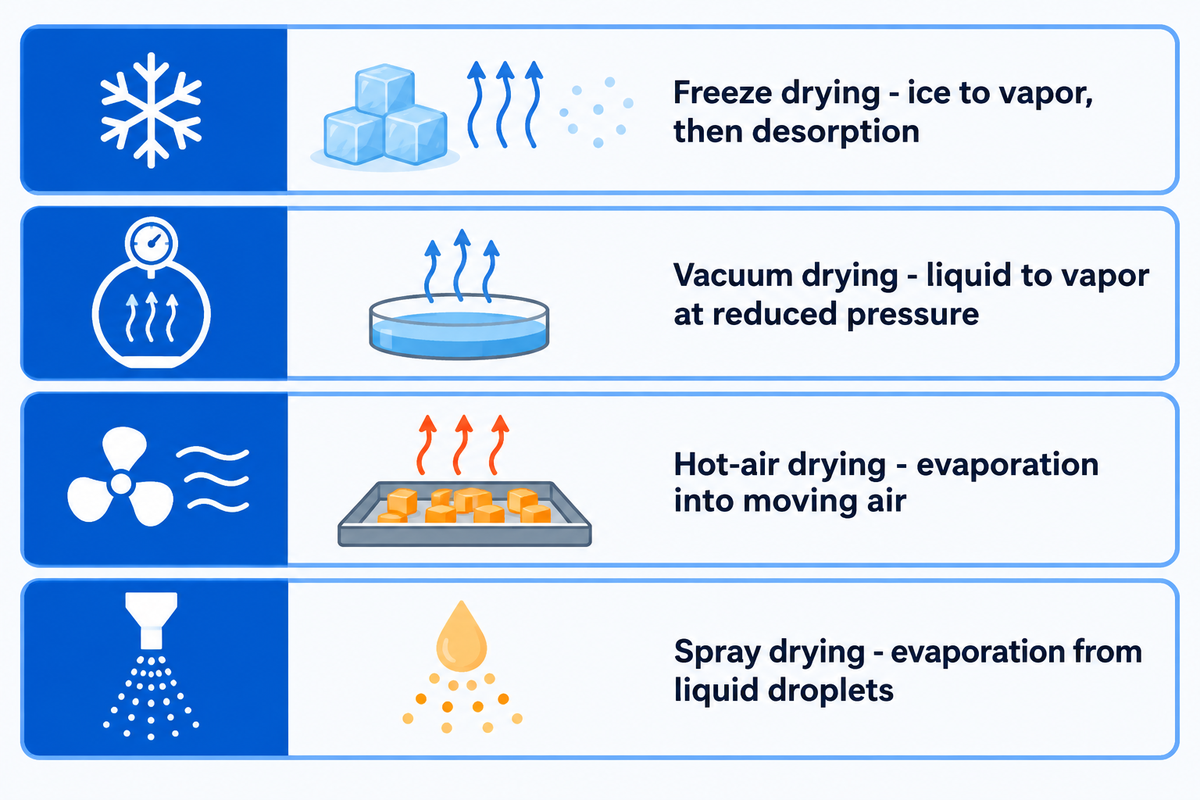
Freeze drying removes ice by sublimation, conventional vacuum drying generally evaporates liquid water under reduced pressure, and hot-air drying carries evaporated moisture away in an air stream. Hot-air drying can be an economic alternative to freeze drying, if the product has a texture that can tolerate shrinkage and a different heat history.
What’s the difference between freeze-dried and vacuum-dried?
The primary difference between the two methods is what state water is in during the main drying step. In freeze drying, the state of water is ice, which is then sublimated to its gaseous state. In vacuum drying, the state of water is liquid, which then evaporates. Both methods use a reduced pressure environment. The phase change of water, along with the history of heat, helps explain the difference in texture of the product; processes labeled vacuum don’t always imply similar processes.
| Method | Main moisture route | Useful product goal | Trade-off to evaluate |
|---|---|---|---|
| Freeze drying | Ice to vapor, then desorption | Open structure and rehydration | Long equipment occupation and refrigeration duty |
| Vacuum drying | Liquid to vapor at reduced pressure | Reduced boiling temperature relative to atmospheric drying | Liquid movement, shrinkage and formulation effects |
| Hot-air drying | Evaporation into moving air | Chewy or compact dried products where acceptable | Heat exposure, shrinkage and air distribution |
| Spray drying | Evaporation from atomized liquid droplets | Powders made from suitable liquid feeds | Feed properties and powder recovery rather than intact food pieces |
A food dehydrator is applicable when a firm or chewy texture is part of the product. Drying food for a crisp snack has a different texture target from making a chewy ingredient. The temperature of boiling water falls as pressure falls; freeze drying instead removes ice through sublimation. Choosing the right freeze-drying route starts with the required structure and rehydration behavior. There can’t be a universal nutrient retention percentage for differentiating various vitamins, recipes and storage conditions.
For coffee, extraction and concentration precede drying; our freeze dried coffee process guide follows the route of a liquid feed. A comparison of only the dryer neglects the operations that precede it.
Which Foods Are Suitable for Freeze-Drying?

Foods that contain a good deal of moisture and benefit from a more porous structure are good candidates for freeze-drying, but other factors like sugar and fat affect the outcome. A food freeze dryer removes water rather than fat. High sugar can make structure harder to retain, while an intact skin or thick center can slow moisture movement even when the outside appears dry.
Practical guidance from Utah State University helps understand barriers at a food’s composition and surface. These help conceptualize the limits of food trials. A successful food trial at home doesn’t mean the same result for an industrial production.
| Food type | Physical feature | Product goal | Trial observation |
|---|---|---|---|
| Sliced fruit | Water-rich tissue, natural sugars | Crisp pieces that hold shape | Center dryness and breakage after handling |
| Whole berries | Skin around a wet center | Intact shape | Skin resistance and the effect of permitted preparation |
| Vegetable pieces | Fibrous cellular structure | Rehydration or crisp texture | Piece-to-piece uniformity and cooked texture |
| Herb leaves | Thin surfaces, irregular tray contact | Aroma and easy crumbling | Wet patches among apparently dry leaves |
| Lean cooked meat | Protein fibers and residual fat | Acceptable rehydrated bite | Chewiness, drying uniformity and later flavor |
| Seafood pieces | Variable thickness and composition | Shape and rehydration quality | Thickest pieces and storage flavor |
| Prepared meals | Several ingredients in one portion | Balanced rehydration | Different components finishing at different rates |
| Coffee or tea extract | Dissolved solids in a liquid feed | Soluble porous product | Layer structure and dissolution |
| Sugary puree | Concentrated solutes, weak structure during drying | Stable porous sheet or powder feed | Collapse, stickiness and removal from the tray |
Which foods cannot be freeze-dried?
Pure oils make poor freeze-drying candidates as there’s little water to remove. Very fatty or very sugary foods can also perform poorly, especially on home equipment. Foods containing some fat or sugar can be processed to yield a dried product. Factors such as the recipe, how the food is processed, and what it’s processed to be can determine if a food can be dried.
A soup developer should evaluate the vegetables and fatty sauce together, rather than approving the meal because its vegetable pieces dry well. If a small piece dries while a large one retains a wet center, compare geometry before changing the whole recipe. Record each component’s texture after rehydration; extending the cycle cannot remove oil.
Why Pressure and Temperature Must Work Together
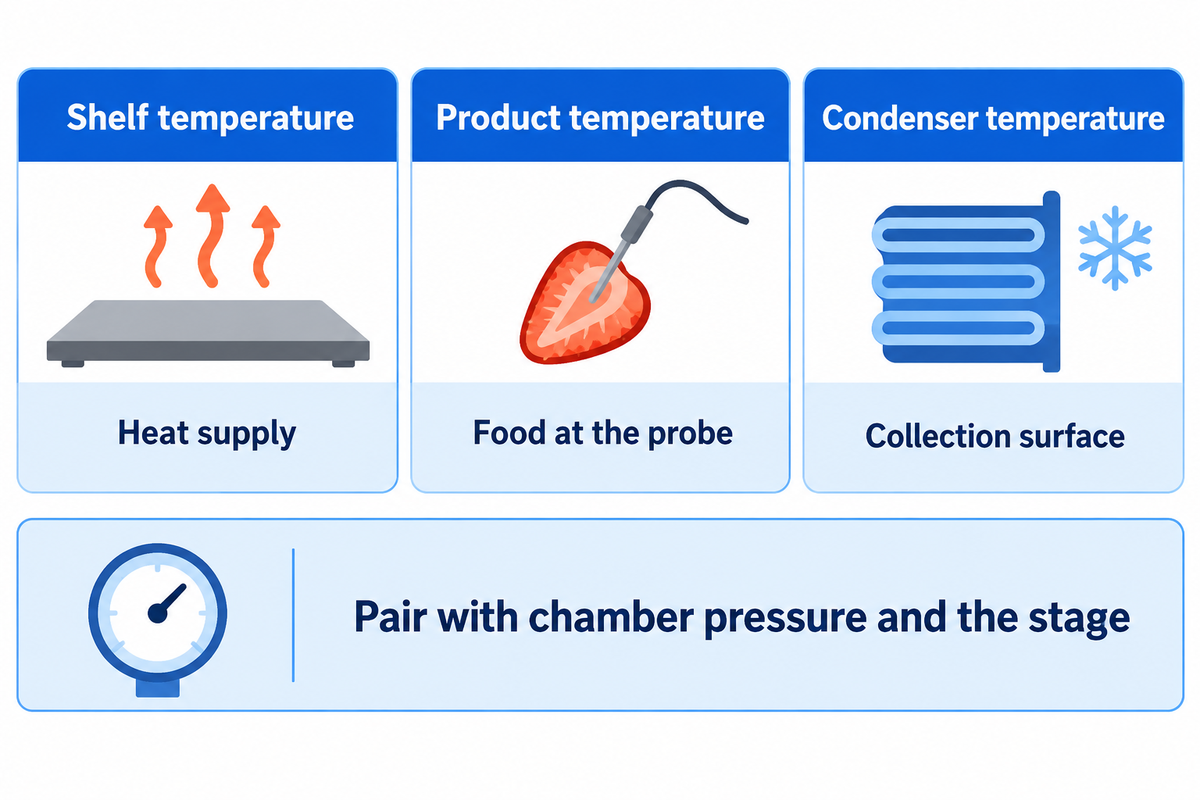
Pressure and temperature control the heat available for sublimation and the route by which vapor leaves the food. A low pressure can create a better driving force for vapor movement, but very low pressure can also reduce heat transfer by the gas. A cold product receiving too little heat may dry slowly even while the vacuum gauge shows a low reading.
Three Temperatures, Three Different Jobs
Use this reading card to locate each temperature sensor and take a reading before comparing with other values. Shelf temperature describes heat supply, product temperature describes the food at the probe, and condenser temperature describes the collection surface. Condenser temperature describes the surface that collects vapor. Reading all three, along with chamber pressure, can help identify an issue with heat input versus an issue with vapor removal.
| Reading | Physical job | How to interpret it |
|---|---|---|
| Shelf or heating-fluid temperature | Sets the heat-transfer boundary | Locate the sensor; an inlet-fluid value can differ from shelf surface and food. |
| Product temperature | Tracks a selected food location | Keep the probe location with the trace; one point does not describe the whole load. |
| Condenser temperature | Supports vapor capture as ice | Read under the relevant load, with accumulated ice and refrigeration duty. |
| Chamber pressure | Describes the low-pressure environment | Pair with temperatures and the stage; do not use minimum pressure as a speed rating. |
Labconco’s laboratory explanation distinguishes heating-fluid and sample readings and challenges the assumption that the deepest vacuum always dries fastest. The settings of Labconco’s equipment aren’t food processing recipe instructions.
In Chen and colleagues’ 2023 kiwifruit study, Figure 6 examines a 7 mm sample with a −20°C shelf plate. Those values describe one experiment, not a target for every fruit. The study follows the drying front as it moves through the sample and the dried region becomes thicker. This makes a changing transport path visible even without a change in machine label.
In a trial with mixed slice thicknesses, the thinner slices may progress to the shelf temperature earlier, while thicker center slices may retain ice. Raising the heating setting based on the warmest probe risks treating unlike pieces as one load. Standardizing the cut and recording where the probes sit gives the process engineer a better starting point than changing vacuum depth first. Thickest pieces can be compared to the end point by quality staff, while pressure trace comparisons may be done by maintenance staff.
Reading a Drying Problem Before Changing the Cycle
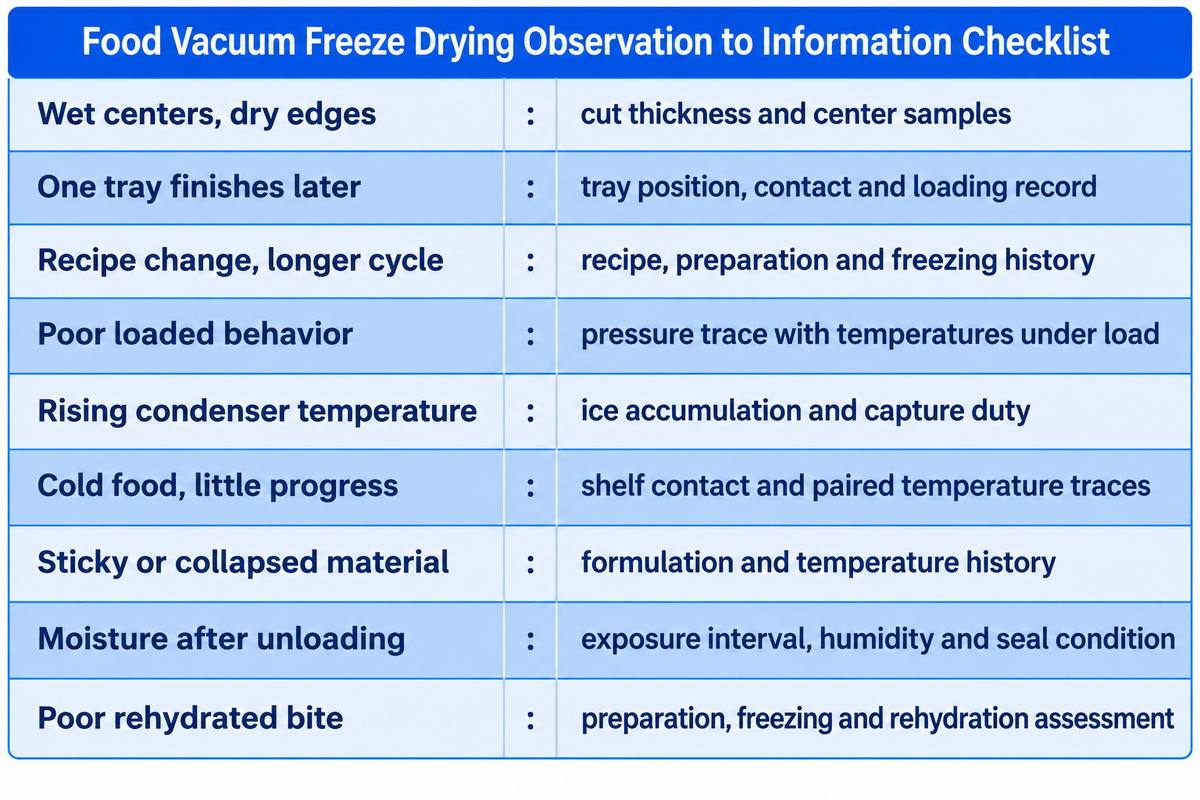
Wet centers and collapsed pieces can be due to many restrictions of heat and/or moisture removal. Start from the location of the defect and the timing of the defect in the cycle. Product geometry and shelf contact have to be determined prior to assigning the problem to the pump or extending the drying time.
An October 2026 home-user discussion about basil describes crisp leaves mixed with wet, limp leaves. That’s one reported observation, not a diagnosis. It illustrates why an average-looking load can conceal local differences.
| Observation | Possible restriction | Information to compare |
|---|---|---|
| Wet centers, dry edges | Long transport path through thick pieces | Cut thickness and center samples |
| One tray finishes later | Different heat contact or loading | Tray position, contact and loading record |
| Long cycle after a recipe change | Changed solids or structure | Recipe, preparation and freezing history |
| Good empty-chamber pressure, poor loaded behavior | Vapor load or a load-dependent system restriction | Pressure trace with temperatures under load |
| Rising condenser temperature | Refrigeration or capture-duty limitation | Ice accumulation, duty and approved service checks |
| Cold product and little drying progress | Insufficient heat reaching the food | Shelf contact and paired temperature traces |
| Sticky or collapsed material | Product structural limit exceeded | Formulation and temperature history |
| Moisture changes after unloading | Exposure during handling or packaging | Exposure interval, humidity and seal condition |
| Dry product with poor rehydrated bite | Structure or recipe limitation | Preparation, freezing and rehydration assessment |
Labconco’s common mistakes article mentions collector capacity and vapor reaching the pump oil as problems on the equipment side. Service actions belong to the manufacturer’s procedure; the observation table shows what’s known and names questions, not a way around interlocks or instructions for chamber opening.
Do
- Record the position of a wet sample.
- Keep temperature traces with the pressure trace.
- Separate drying defects from changes after unloading.
Don’t
- Diagnose the whole load from its driest piece.
- Treat minimum vacuum as a production-rate rating.
- Bypass equipment protections to shorten a cycle.
What Happens After the Dryer Opens?
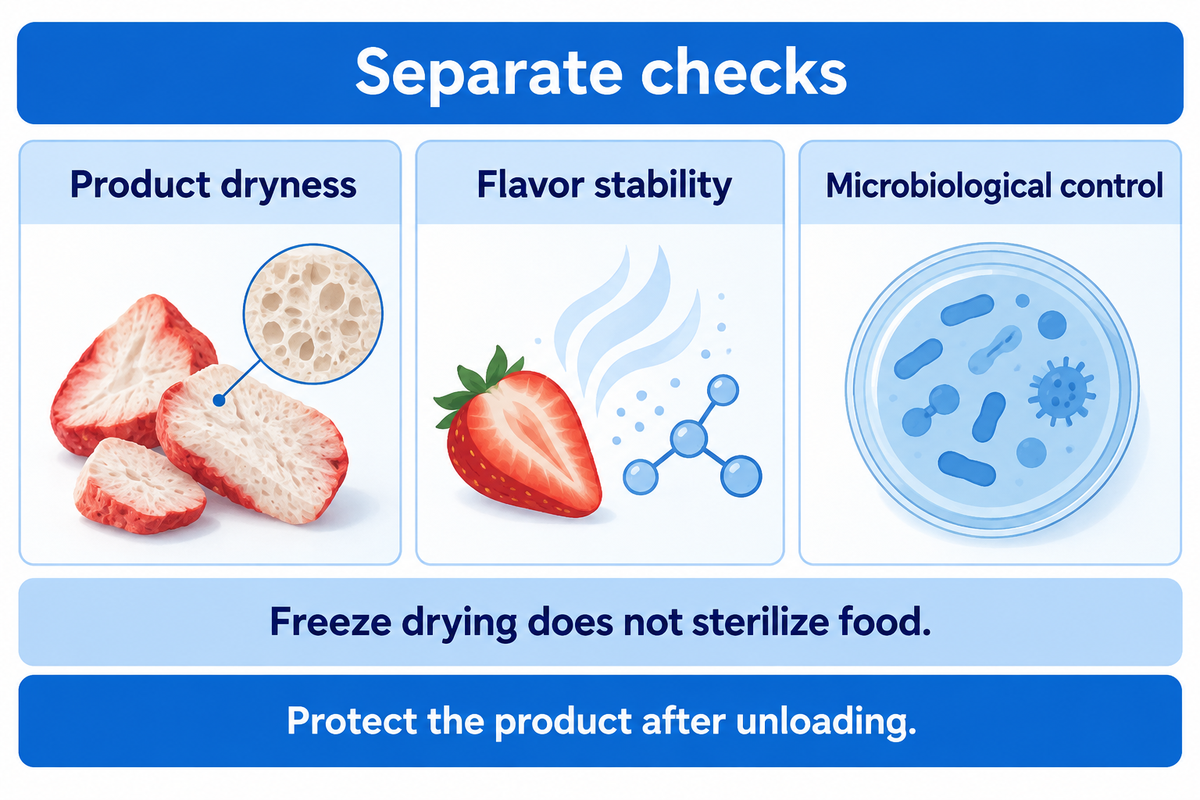
Dry food can reabsorb moisture after it’s unloaded. Therefore, handling and packaging are part of the food preservation process. A package should provide moisture and oxygen protection and seal integrity for storage. Product dryness, flavor stability and microbiological control remain different questions; a dry-looking piece cannot answer all three.
Food Storage and Moisture Pickup
The University of Minnesota Extension suggests immediately packaging foods in moisture-proof packages and sealing them. It suggests that the freeze drying process doesn’t kill microorganisms that cause illness.
“Freeze-dried foods absorb moisture easily.”
A 2025 study of cooked meat meals in PE/PA vacuum pouches followed storage for 12 months at 5°C, 25°C and 40°C. Sensory and texture quality deteriorated, particularly at the higher temperature, despite low water activity. The meals had received cooking before drying. The experiment tested those meals and that packaging; it didn’t directly compare aluminium-laminated pouches.
A flavor and texture evaluation should be performed in addition to a moisture analysis to assess the quality of the food. A seal can remain closed while the food becomes less palatable. Mylar bags describe a packaging option, but the full laminate and seal determine barrier performance; an oxygen absorber does not replace moisture protection or the product’s food-safety controls. The sealer should be suitable for the package and its contents.
What Makes Freeze-Drying Expensive?
The cost of the freeze-drying process, in addition to vacuum use, is occupancy of the plant and refrigeration, heat input and batch turnaround. Longer process time increases the cost per usable kilogram. Home-unit price, pilot service, and a capital cost quote are three very different transactions and shouldn’t be in the same price range.
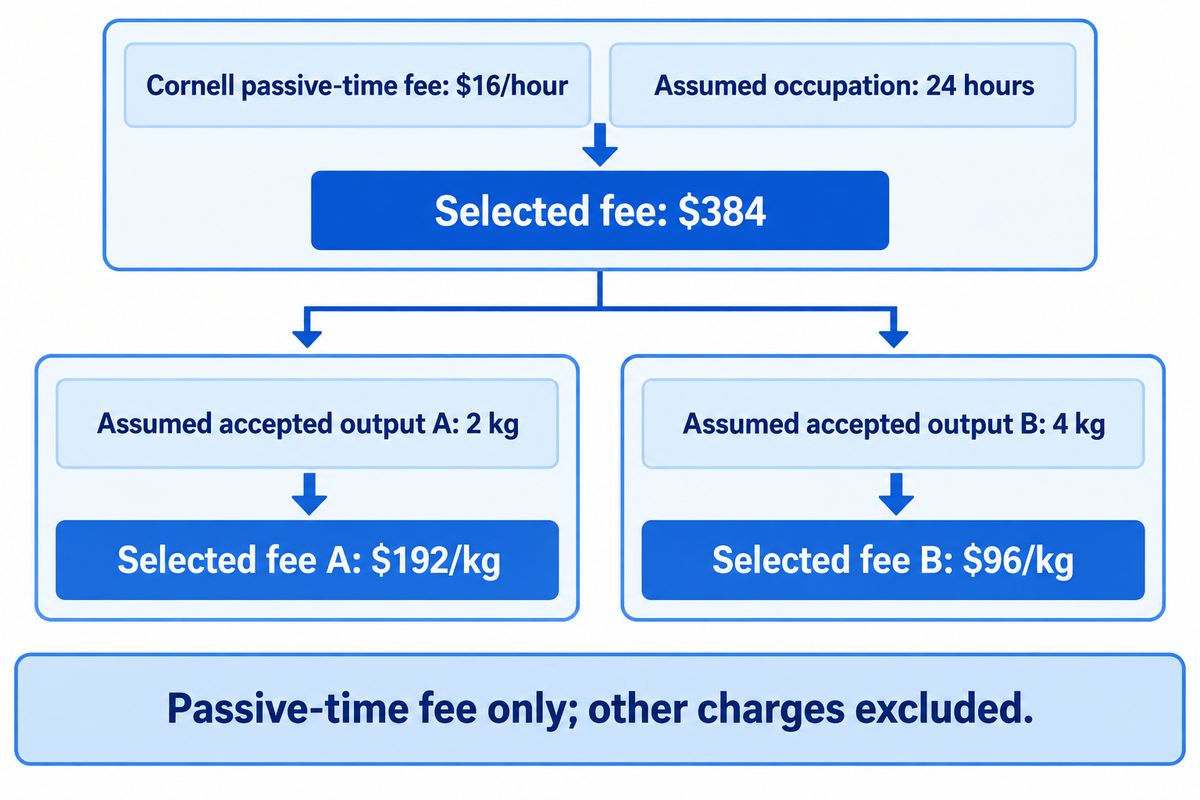
Cornell’s January 2026 external-client schedule lists $16/hour for Freeze/Nyle/Carbonation passive time. That’s a service-fee category. Full plant use and additional testing, materials and shipping have separate charges. It is neither a batch charge nor an electricity rate.
Worked example: use that published passive-time rate with assumed occupation of 24 hours and 2 kg of accepted dry output. The selected fee is 24 × $16 = $384; $384 ÷ 2 kg = $192/kg. With the same assumed occupation and 4 kg accepted, the selected fee becomes $96/kg. These are passive-time fees per accepted kilogram, excluding the other service charges, ingredients and equipment investment.
| Input or result | Example A | Example B |
|---|---|---|
| Published passive-time fee | $16/hour | $16/hour |
| Assumed occupation | 24 hours | 24 hours |
| Calculated selected fee | $384 | $384 |
| Assumed accepted dry output | 2 kg | 4 kg |
| Selected fee / accepted output | $192/kg | $96/kg |
Suppose a development team compares these trial outcomes. Finance sees the fee per accepted kilogram halve, while quality staff must establish why more product passed: better geometry, fewer damaged pieces or a different acceptance criterion. The plant manager needs the same occupation boundary for both records, including time charged for setting up and packing the equipment, if any, outside active drying. If the second outcome is for product that’s more wet, the arithmetic is better while the product deteriorates. Record the acceptance basis for each outcome before evaluating the total.
For an owned commercial freeze dryer, metered kWh per batch and the site’s tariff replace a service rate in the energy calculation. An energy efficient claim needs the same feed, final condition and system boundary on both sides of the comparison.
From a Food Trial to an Industrial Equipment Brief
A food trial should establish the prepared product, finished texture, drying endpoint and packaging needs prior to an industrial equipment brief fixing the system boundary. Home, laboratory and factory equipment serve different duties. The trial record should accompany the recipe to ensure that the same product is described by the production, quality assurance and equipment teams.
NIST’s July 2024 Meat & Complete Case provides a good example. The Nebraska meat bar business wanted to diminish their dependence on cold chain distribution. Dr. Grace Danao at the University of Nebraska-Lincoln’s Food Processing Center helped freeze-dry a small batch. The products were returned to the company for evaluation of texture, palatability, taste and room-temperature stability. It was a third party feasibility study and not a Shengtu study or a general shelf life study.
For equipment categories, Cornell operates a Millrock pilot unit, and Labconco describes laboratory lyophilization. Separate machines for home use from equipment intended for professional use by comparing their supported duties. A countertop home freeze dryer and a scientific freeze dryer shouldn’t be treated as interchangeable with a factory food system merely because their basic phase change is the same. Smaller models can support formulation work, but production handling and cleaning remain separate design duties.
- Describe the prepared food. Include ingredients, piece or layer geometry and the freezing history.
- Define accepted output. State dryness, appearance and rehydration or eating-quality criteria.
- Test the packaged product. Assess the intended storage conditions alongside the fresh dry result.
- Transfer the record. Give the equipment team the load and endpoint evidence for configuration.
Industrial food hygiene also extends beyond a drying result. In the FDA’s draft guidance for low-moisture ready-to-eat human foods for January 2025, sanitation and environmental monitoring and the limitations of relying on product testing after contamination are discussed. It is non-binding draft guidance and, as such, is not a new regulation. Process and food safety teams should address the applicable production controls separately from dryer performance.
A February 2026 food-industry review analyzes pretreatment, hybrid drying and intelligent control technologies, and cites research gaps on scaling up and economic analysis. Results from infrared- or software-assisted research need a product and system boundary to become an industrial performance claim.
At Shandong Shengtu Bufan Intelligent Technology Co., Ltd., equipment configuration and line integration are covered on our industrial vacuum freeze dryer solution page. That is the next step for a defined food project, with its utilities, loading arrangement and quotation scope.
Frequently Asked Questions
What is the downside of freeze drying?
Freeze drying requires costly equipment and long occupation times compared with simpler drying routes.
Refrigeration, controlled heating and vacuum operation contribute to the expense. The finished food is often fragile and needs protection against moisture pickup. A crisp structure or fast rehydration can justify those costs for some products. For a chewy snack or a low-value ingredient, hot-air drying may produce the intended result with a different cost structure.
Can I freeze dry without a machine?
Controlled freeze drying requires equipment that combines freezing, low pressure, heat input and vapor capture.
A household freezer freezes water but doesn’t provide the controlled drying environment of a lyophilizer. A vacuum sealer removes air from a package; it doesn’t run the food through primary and secondary drying. Uncontrolled improvisation also leaves the endpoint uncertain. Food intended for sale needs a defined process and appropriate product controls, rather than an assumed equivalent result.
Can freeze-dried food be vacuum sealed?
Freeze-dried food can be vacuum sealed in suitable packaging, although fragile pieces may break under compression.
Choose the package around moisture and oxygen protection, the product’s physical strength and the intended storage conditions. Removal of headspace air doesn’t establish a shelf life. Seal integrity and the full packaging structure still matter. For delicate pieces, packaging development should include an assessment of breakage during sealing, transport and ordinary handling as well as storage-quality testing.
Do freeze dryers need a special outlet?
Electrical requirements are specific to the freeze-dryer model and its installed auxiliaries.
A home appliance and an industrial installation can have different supply and protection requirements. Use the selected machine’s nameplate and electrical documentation. Include refrigeration and vacuum equipment in the installation scope rather than assuming the chamber connection describes the complete load.
Should I get an oil pump or an oil-free pump?
Choose a pump against vapor duty, maintenance capability and the manufacturer’s supported operating conditions.
A rotary vane vacuum pump commonly uses oil, so oil condition and the prescribed servicing schedule affect operation. An oil-free design changes maintenance tasks but doesn’t eliminate maintenance or the need for vapor protection. The condenser still has to perform its capture duty. Compare supported loaded performance, consumables, service access and the facility’s maintenance resources before comparing purchase prices. Pump choice alone can’t correct an unsuitable recipe, poor shelf contact or a restricted vapor path.
How long will freeze-dried vacuum sealed food last?
Freeze-dried food has no single shelf life that applies to every recipe and vacuum package.
Storage temperature, residual moisture, oxygen exposure and the package barrier affect the result. Fat-containing products can lose acceptable flavor even when dry. Establish a product-specific storage claim through suitable stability testing of the food in its intended package.
What size freeze dryer do I need?
Size the system from the prepared load, tray area, removable water and validated cycle, rather than chamber volume alone.
A larger loading space doesn’t automatically create more accepted dry output. Thick pieces can occupy less area but take longer to dry, while condenser duty limits the water that can be collected under the specified conditions. Keep wet feed, water removed and dry product as separate quantities in the equipment brief. For home and commercial uses alike, the load arrangement and endpoint belong with the capacity figure; an advertised tray count omits those conditions.
Discuss a food freeze-drying project
Bring the recipe, prepared piece or layer geometry, target texture and packaged-product requirements to the discussion. Shengtu can use that brief to address the equipment and line-integration scope. Include the intended loading and quality criteria so the proposal describes your product rather than a generic machine capacity.
This report draws on published food research, university-level resources, and named third-party references. The cost exercise uses a published service rate with stated assumptions. It reports no private Shengtu production trials, and company-level credentials are not presented as product certification.
References & Sources
- The Freeze-Drying of Foods, The Characteristic of the Process Course and the Effect of Its Parameters on the Physical Properties of Food Materials Nowak and Jakubczyk, Foods, 2020.
- Novel Efficient Physical Technologies for Enhancing Freeze Drying of Fruits and Vegetables: A Review Yao, Chen and Fan, Foods, 2023.
- Capabilities and Pricing Cornell AgriTech, Seneca Foods Foundation Pilot Plant; January 2026 pricing.
- Can I Freeze Dry That? A Practical Guide to Safe and Effective Freeze-Drying Utah State University Extension, 2026.
- Numerical and experimental study on the heat and mass transfer of kiwifruit during vacuum freeze-drying process Chen and colleagues, Alexandria Engineering Journal, 2023.
- Freeze drying Amy Johnston, University of Minnesota Extension, reviewed 2025.
- Effect of plastic packaging on lyophilized goulash and eggbarley with different types of meat Malisek and colleagues, Scientific Reports, 2025.
- Testing the Feasibility of Freeze-Drying Meat Bars National Institute of Standards and Technology, Manufacturing Extension Partnership, 2024.
- Draft Guidance for Industry: Establishing Sanitation Programs for Low-Moisture Ready-to-Eat Human Foods and Taking Corrective Actions Following a Pathogen Contamination Event US Food and Drug Administration, January 2025, non-binding draft.
- Application of Freeze-Drying Technology in the Food Industry: A Review Uwineza and Zhang, Foods, 2026.