
Get in touch with Shengtu Bufan Company

Updated September 2026
A Tomato / Chili / Compound Sauce Line is not a fixed equipment chain. The correct processing route hinges on the feed state, the desired texture, the formulation, the thermal route, the desired evidence for a changeover, and packaging. There are shared production stages for tomatoes, tomato concentrate, chilies, and chili powder. However, these stages do not place the same machine duty on fresh tomatoes, tomato concentrate, fresh chili peppers, dry chili and compound sauce.
A chili sauce production line reaches stable production only when the process and packaging states agree. The planning method below treats productivity as released product, not motion at one machine.
The aim of this document is to assist plant managers, QA teams, project principals and buying teams to block out decisions prior to benchmarking machinery. There are no generic statements of scope detailing a recipe, anticipated production volume or universal food-safety setpoint. Commercial model selection, project-specific utilities, lead time and quotation remain on Shengtu’s tomato, chili and compound sauce line configuration options.
The main idea is to describe the product continuously through measurable attributes, verify each operating state and determine which record will serve as proof of acceptance. Equipment comes later. This process allows suppliers to quote the same thing when the request is for “sauce production line.”
Key takeaway
Freeze feed state, finished texture, process classification, package and measured cycle before choosing a line. The fastest nameplate in kg/h does not prove the daily output of the complete production line.
One Label Hides Several Different Sauce Processes
A single sauce line combines multiple operations in one production process, and order and load change with the product. For example, making sauce from fresh tomatoes involves washing and sorting. Paste-based recipes start with controlled dilution and dispersion. An additional factor in decisions about impurity removal, grinding and hydration is the choice of fresh versus dry chili.
The line label should begin the technical discussion. A fresh-tomato route would involve a washing machine, sorting conveyor, a cutting machine, crusher, and probably a pulping machine, prior to concentration. Paste-based routes can bypass most of that front end but add powder induction, controlled water addition or oil-phase handling in mixing tanks. Specialized equipment should only be added where the processing duty dictates; extra processing machinery isn’t a substitute for a clear basis.
Compound sauce introduces even more complexity. Starch, gums, sugar, salt, oil, and other particulates can change the order of the mix, the level of shear, the need for a jacket, the type of pump, the holding behavior, and sauce filling. The same finished sauce name can hide different particle size specifications and target stability.
Common mistake: A buyer sends a request for “1,000 kg/h chili sauce line” without a clear specification of whether the feed is fresh chili, dry chili flakes, chili paste, or a chili concentrate. Four suppliers will most likely propose four variants of production lines, and quotes won’t be comparable. The missing element is the processing route, not the equipment list.
Procurement teams may argue that describing the product delays quoting. A one-page feed and finished-product basis reduces later clarification and lowers the chance that an omitted operation becomes a change order.
Decision capsule: Write the feed as a measurable state, such as fresh whole fruit, 28 °Brix concentrate or dry chili flakes, then write the finished texture and package. Product names alone do not tell suppliers which preparation stages belong in the processing line.
The Five-Route Sauce Switchboard
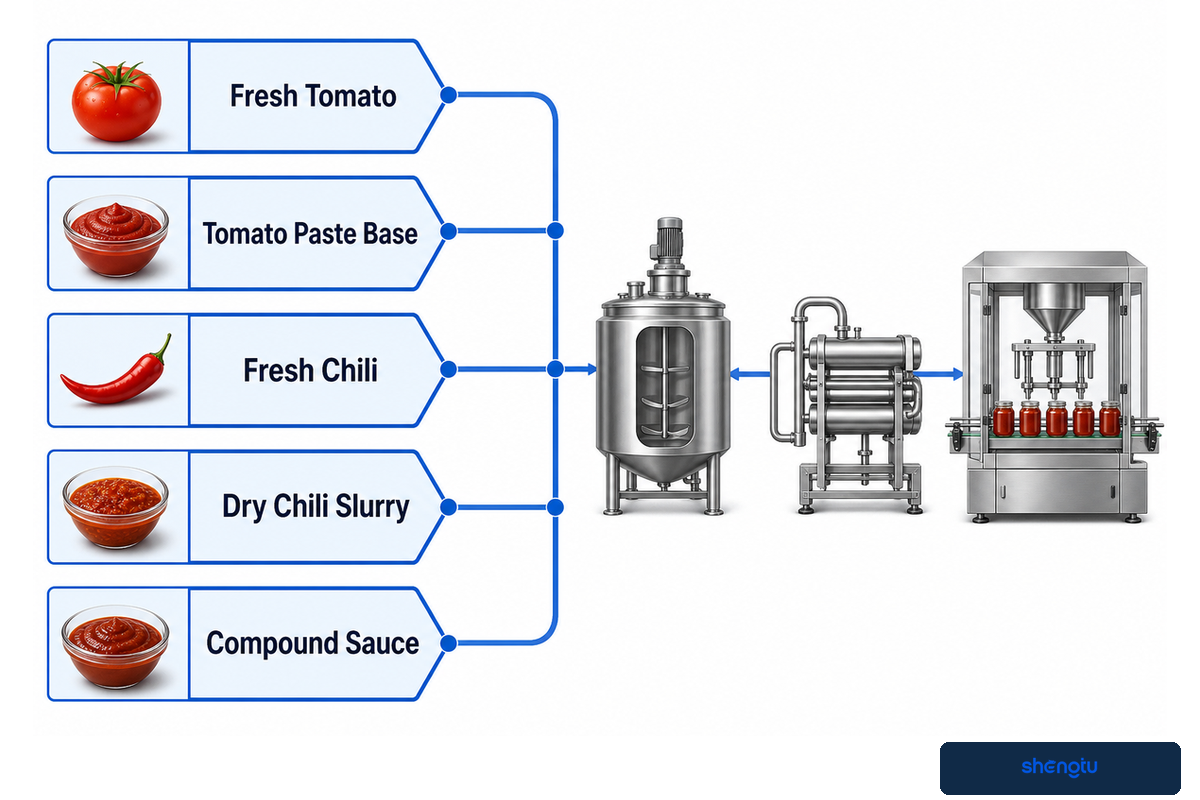
The Five-Route sauce Switchboard separates various projects based on what enters and what leaves the process. It’s a planning map rather than a catalog. Select the closest route, mark optional operations, and note every shared station where product family, texture, thermal history or cleaning risk may change.
| Route type | Incoming state | Likely decision point | Evidence to request |
|---|---|---|---|
| 1A Fresh tomato, smooth | Whole fruit | Sort, crush, break, pulp and refine before concentration or cooking. | Raw-fruit sampling and finished particle/viscosity target. |
| 1B Fresh tomato, textured | Whole fruit | Protect or add defined pieces after the smooth base is prepared. | Piece-size distribution and damage limit. |
| 2A Tomato paste base | Concentrate | Meter water and disperse paste without unmixed pockets. | Incoming °Brix, drum/bag condition and dilution basis. |
| 2B Paste plus powders | Concentrate + dry ingredients | Control powder induction, hydration order and foam. | Addition sequence and lump/air acceptance check. |
| 3A Fresh chili, smooth | Whole pods | Wash, sort, cut and grind to a measured particle endpoint. | Foreign-material plan and grind profile. |
| 3B Fresh chili, seeded | Whole pods | Define seed removal and the accepted residual level. | Seed count method and retained-sample result. |
| 4A Dry chili slurry | Flakes or powder | Hydrate, wet out and grind while managing dust and agglomerates. | Moisture, mesh/particle description and hydration trial. |
| 4B Chili oil system | Dry chili + oil phase | Control solids suspension, temperature exposure and transfer. | Oil/solid ratio and settling observation window. |
| 5A Smooth compound sauce | Multiple liquid/dry inputs | Sequence mixing, hydration, emulsification and deaeration. | Recipe order and measured final flow behavior. |
| 5B Particulate compound sauce | Liquid base + pieces | Protect pieces through pumps, valves and filling machine passages. | Maximum particle dimensions and package-opening check. |
Route-switch scenario: A plant is scheduled to make one week of smooth tomato ketchup, then garlic chili sauce with visible pieces. The first recipe suggests a path of refining and a smooth filling. The second recipe could involve a late addition of particles, gentler transfer and larger particles through the filling valve. The high-shear loop and narrow valve path remain the same in this case, so the garlic particles will likely disperse before the glass jars reach capping. For this reason, the useful drawing indicates which loop is active for each SKU, where particles enter, which valves change position and which sample confirms the desired texture. Buying a separate “chili sauce making machine” won’t answer this question.
Freeze route cases when customers require full automation from day one. Automation software is able to order states, but can’t determine whether the incorrect grinding, holding or packaging path was specified.
Different types of chili can affect moisture, the perception of heat, the type of particles required and the seed count. Record these variations, even in small production trials, before the same route is released for large scale production.
Decision capsule: A 10-row route matrix makes a quote testable: each row names the feed, process fork and required evidence. Suppliers can then state which production equipment is shared, bypassed or added, while the commercial configuration stays on the solution page.
Set Incoming-Material Acceptance Rules Before Equipment Selection
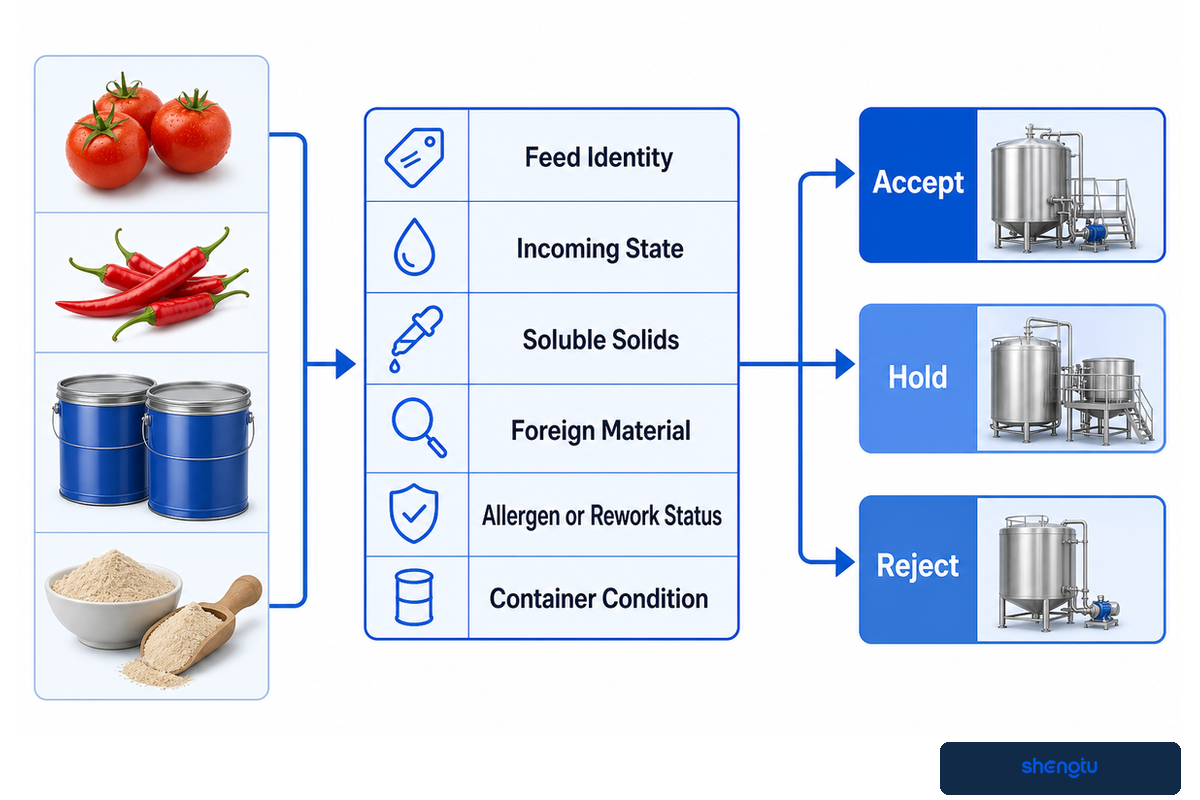
Incoming-material rules translate variability in agricultural and semi-finished products into process duty. Measure what is affected by washing, sorting, crushing, pulping, grinding, heating, evaporation or filling. Each specification should name the sample, method and decision owner. Single °Brix or pH results are useful only inside the defined sampling system.
Inspection may include the degree of ripeness, damage, presence of foreign materials, stones, stems, seeds and surface soil for fresh produce. Washing can remove dirt, but doesn’t guarantee that all impurities are removed. Define what can enter cleaning and crushing equipment and what must be rejected, trimmed or diverted.
The currant-tomato study evaluated moisture, pH, total solids content, density, and physical properties before break treatments were made. Its pulp was reported at 5.50 ± 0.70 °Brix at 24 ± 2 °C. Ripe tomatoes of commercial quality are not described by those study numbers, which are not a purchase grade for commercial tomato sauce.
Build the acceptance card around feed identity, lot, incoming state, total soluble solids, pH method, dry-chili moisture, foreign material, damage, particle distribution, allergen/rework status and container condition. Each field needs an accept, hold, re-sort, adjust or reject decision.
Incoming Brix can throw off material balance, but it isn’t a measure of quality for all factors. Quality or lack thereof is reflected by flavor, color, acidity, damage, and contamination. Procurement shouldn’t accept a single number grade unless QA has defined what that grade is and what it means for the approved sauce.
Decision capsule: The 5.50 ± 0.70 Brix value at 24 ± 2 °C in the study highlights how measures can lose context without material and temperature. Your acceptance card must capture the real sample method and route decision as opposed to replicating the study result as a buying limit.
The Texture Target-to-Unit-Operation Grid
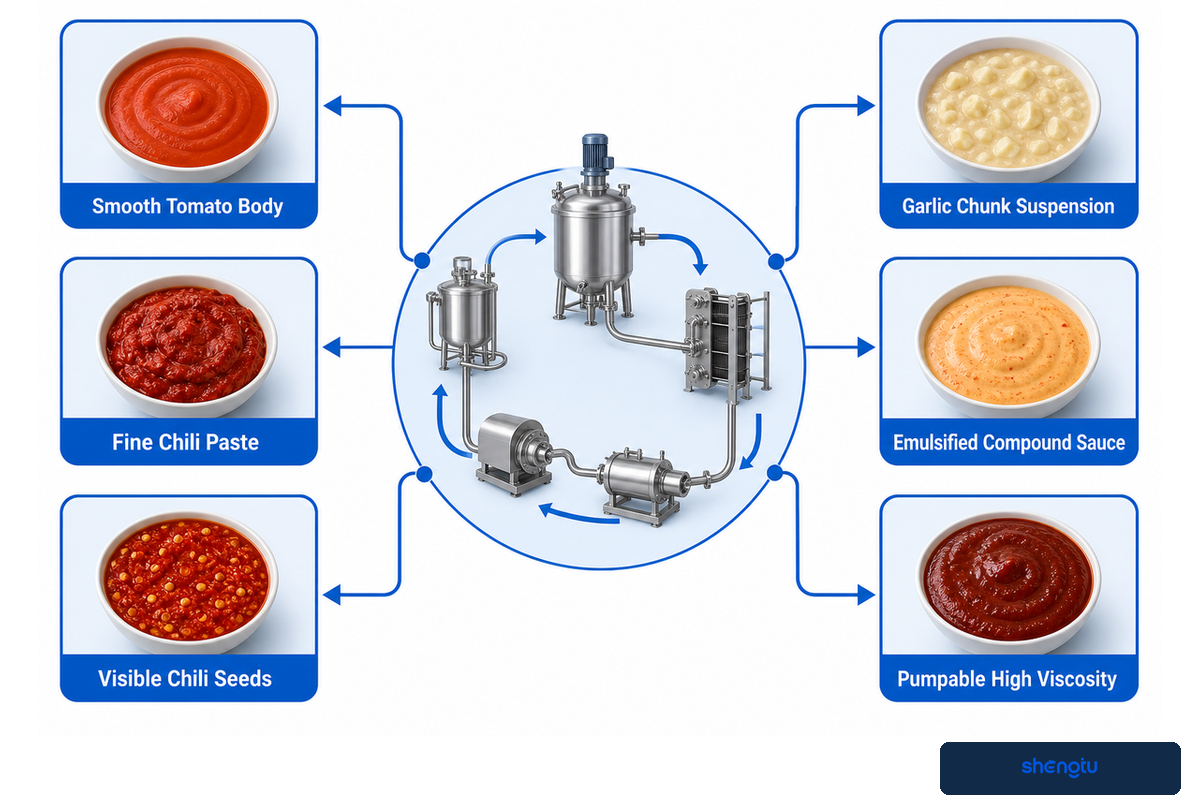
Prior to choosing a pulping, grinding, colloid-milling or homogenizer process, texture should be described as measurable product behavior. The sensory adjectives “smooth,” “thick” and “with pieces” are helpful, but they don’t provide a screen, valve passage, shear history, filling condition or stability test.
One tomato study used cold-break treatments at 55 °C and 65 °C and hot-break treatments at 75 °C, 85 °C and 95 °C, each over 2 min. It showed treatment-related viscosity differences. Treatment conditions are not recipe instructions. The cited high-pressure homogenization review reports that formulation, solids, valve geometry, energy, residence time and cooling change the result.
| Observed target | Measure before selection | Operation to test | Failure check |
|---|---|---|---|
| Smooth tomato body | Particle distribution + flow curve | Pulp/refine and controlled break | Seed/skin residue or lost body. |
| Bright tomato color | Color method + heat history | Compare bounded break routes | Color gain with unacceptable viscosity loss. |
| Fine chili paste | Largest particle and distribution | Pre-cut plus wet grinding | Heat rise, grit or blocked passages. |
| Visible chili seeds | Seed count and damage | Late addition or bypass | Unwanted seed breakage. |
| Garlic/chunk suspension | Piece size + settling window | Gentle blend and transfer | Floating, settling or piece damage. |
| Emulsified compound sauce | Droplet/phase stability test | Controlled high shear or homogenize | Separation after target storage. |
| Pumpable high viscosity | Viscosity at test temperature and shear | Pump and pipe trial | Starvation, heat or filler drift. |
| Low trapped air | Density/air observation | Mixing sequence or deaeration | Foam and unstable filling volume. |
| Pouch-ready sauce | Particle vs nozzle passage | Pump/filler product trial | Seal contamination or underfill. |
| Glass-jar particulate sauce | Piece delivery by container | Filling and capping trial | Uneven solids or closure contamination. |
This grid is for writing a trial, not for picking equipment from a word. Record temperature, sample age, and method when comparing viscosity. Readings in cP or Pa·s can vary with shear and temperature, so state the test conditions. Color and flavor are separate acceptance endpoints.
If a supplier requests only “thick sauce,” send a retained reference sample and measured endpoints. Even though that’s more specific than a simple adjective, it provides a fair acceptance target to the supplier.
Decision capsule: The cited study tested break conditions from 55 °C to 95 °C over 2 min and still found product-specific effects. Buyers should compare measured texture endpoints instead of assuming that a hotter break or more shear always improves product quality.
Coordinate Heating, Concentration and Formulation
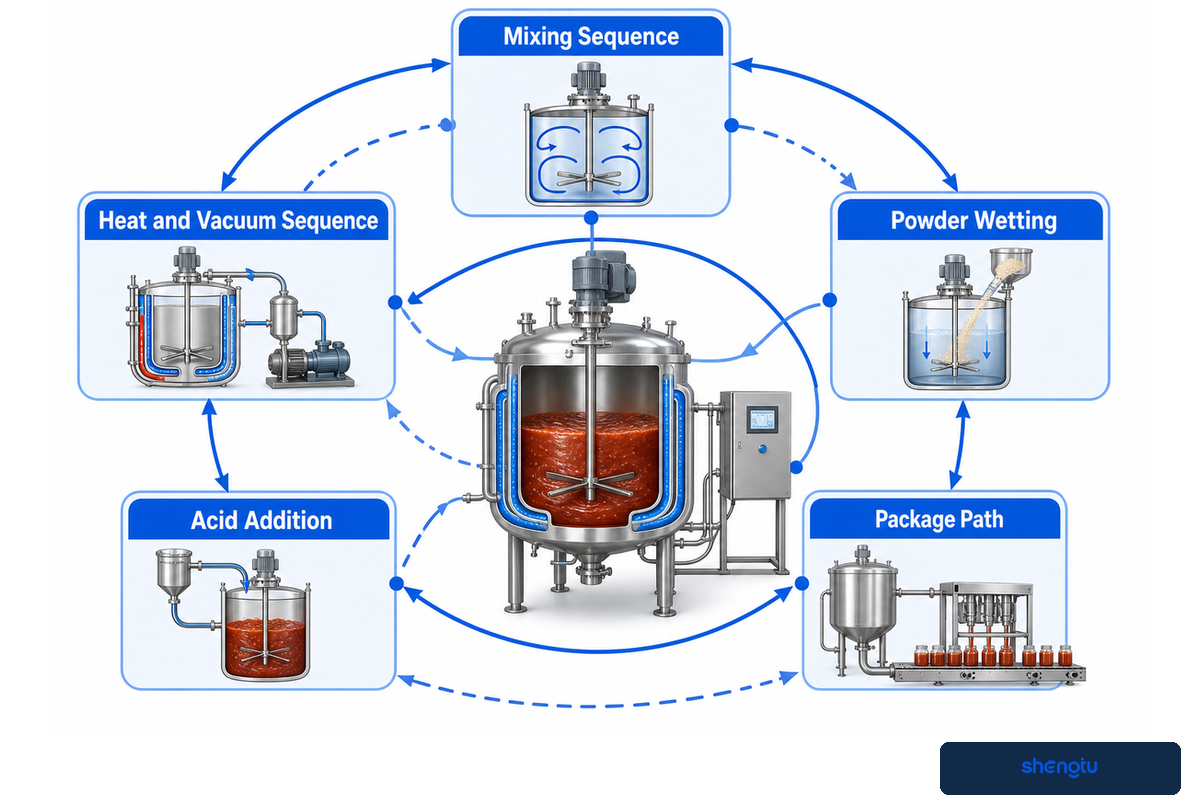
Heating, evaporation and additions affect one another. During water removal, rising solids can affect heat transfer, viscosity and pump load. The hydration of starch and gums depends on the order of addition and the thermal history. Acid, salt, sugar and oil can affect the final sauce and its response to further processing.
Choose the tomato hot-break or cold-break option from the desired pulp behavior and quality outcome. Concentration duty should be based on inlet and final solids, recovered product, operating losses and the approved recipe. For the sauce manufacturing paste case, the primary control can change from evaporation to dispersion, hydration and deaeration.
Do not copy a study setting into a production instruction. The cited currant-tomato work used a defined cultivar, preparation, a 2 min treatment and a specific laboratory measurement method. Your food processing facility requires the raw material, the mixing sequence, the shape of the processing vessel, the heat transfer system, the batch size and the path of the packages.
“Scheduled processes for acidified foods shall be established by a qualified person.”
The quotation applies only in relation to the U.S. acidified-food rule. It does not mean that every tomato sauce or commercial chili sauce necessarily falls into that category. The plant’s product and process owners must establish the applicable classification and authority path.
Practical review: place the recipe order next to the heat and vacuum sequence. Time the wetting of powders, the time of acid addition and the time of insertion of the pieces; control the peak-viscosity pump; and determine whether the filling machine receives the product in the same state as used in the trial. Finally, that single overlay often shows a missing mixing or transfer duty.
An owner may request one “safe” temperature and time to choose equipment. One reliable answer is an approved product-specific process basis; a range can be construed to be a process basis and can generate a false sense of confidence and result in undersizing or oversizing of heat transfer and holding equipment.
Decision capsule: Connect every 1 °C or 1 min process value to its product, test method, package, and authority. Jacketed vessels or pasteurizing units can hold an approved condition, but equipment suppliers should not create that condition.
The Batch-to-Pack Bottleneck Clock: Size Useful Output
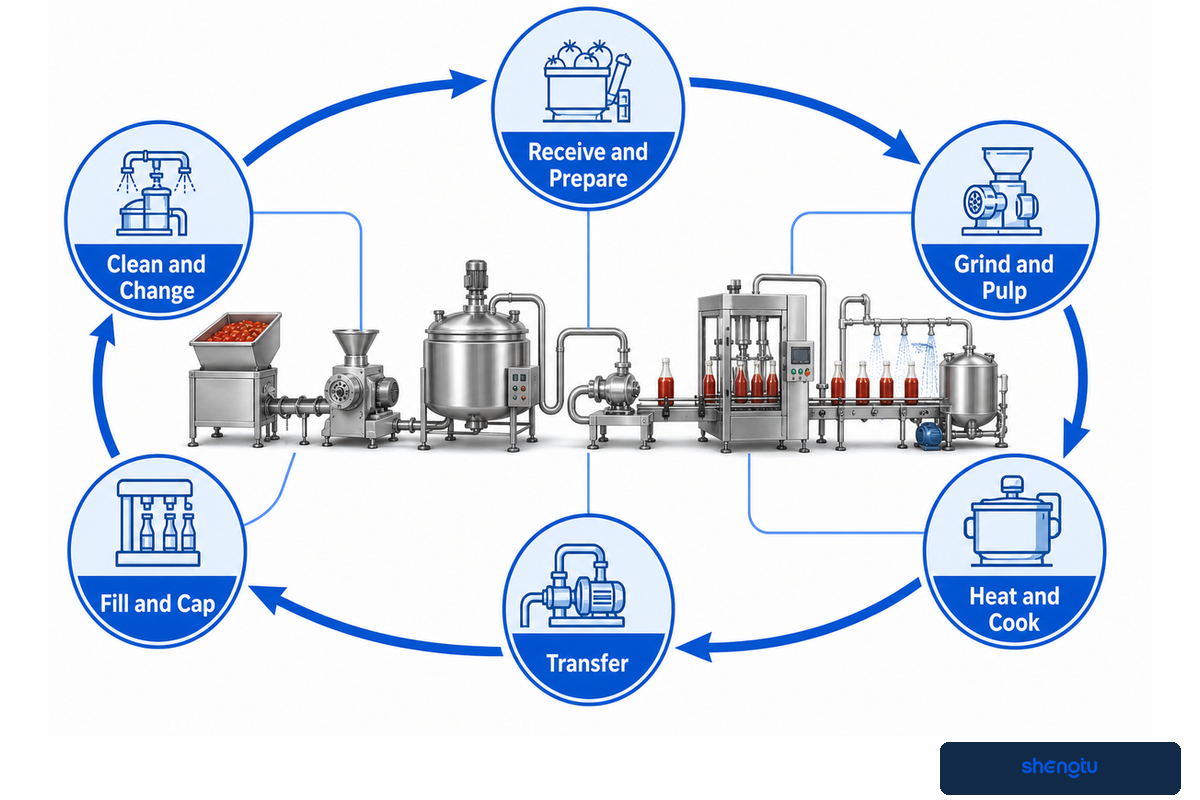
The time and loss states that define good packaged output are captured by the Batch-to-Pack Bottleneck Clock, but it doesn’t claim that a particular machine is the actual bottleneck prior to the availability of data. The preparation, batch, transfer, thermal, buffer, sauce filling, capping, labeling, cleaning, and changeover should be measured under each representative SKU.
Nameplate rates provide answers to narrowly focused queries. Fillers may run quickly with a smooth, warm product, but slow as viscosity rises or solid particles enter the product passage. Capping machines can wait for containers, while stable filling volume depends on the actual sauce condition. Packaging lines may also lose productivity to labels, labor costs or QA release.
| Clock state | Measure | Unit | Hidden constraint question | Owner |
|---|---|---|---|---|
| Receive/prepare | Good feed released per elapsed time | kg/h | Does sorting loss or washing hold the next stage? | Production + QA |
| Grind/pulp | Accepted pulp at target particle state | kg/h | Does screen load or recirculation cut the net rate? | Process |
| Ingredient induction | Addition plus hydration time | min/batch | Does powder wet-out extend vessel occupancy? | Production |
| Heat/cook | Load-to-approved endpoint | min/batch | Do utilities or high viscosity extend the cycle? | Process + utilities |
| Concentrate/cool | Endpoint-to-transfer-ready time | min/batch | Does evaporation or cooling hold the vessel? | Process |
| Transfer | Stable accepted flow | L/min | Do pipe losses, air or pump starvation interrupt flow? | Engineering |
| Buffer | Usable volume and high/low dwell | L and min | Does the buffer absorb normal variation or hide waiting? | Engineering |
| Fill/cap | Good sealed packages | packs/min | Do viscosity, particles, caps or checks reduce good output? | Packaging + QA |
| Label/case | Released cases after inspection | cases/h | Do label verification or labor create blockage? | Packaging |
| Clean/change | Last good pack to next good pack | min/change | Which circuit, part or release test sets the interval? | Sanitation + QA |
| Downtime | Event, duration and cause | min/event | Is lost time planned, blocked, starved or failed? | Area owner |
| Good output | Released product by shift and SKU | kg/shift | Which state changes when the SKU mix changes? | Plant manager |
Constraint-migration scenario: a tomato sauce production line fills smooth ketchup in glass bottles in the morning and a thicker, more particulate sauce in pouches after lunch. The capping and labeling machines may be the bottleneck for the bottle run. The pouch run may be constrained by product transfer, accurate filling, sealing or seal-area cleaning. If both products are averaged into one daily output, neither constraint is visible. Each SKU should be measured separately and the complete cycle from released feed to good packaged sauce should be measured. The “bottleneck” is a measured state, not a condition that’s affixed permanently to one machine.
The sauce line capacity selector is helpful for structuring capacity discussions after the measured basis is complete. Procurement should request the assumed product state, uptime boundary, and acceptance run behind every high output figure.
Worked example: a quoted 1,000 kg/h station running for 8 h appears to yield 8,000 kg/shift. If measured good production lasts 6 h, the observed output is 1,000 kg/h × 6 h = 6,000 kg/shift before rejects. A filler at 60 packs/min for 300 min would indicate 18,000 packs only if product supply, capping and QA release keep pace. On the same hypothetical basis, a 500 L batch transferred at 50 L/min needs 10 min; if batching takes 45 min and cleaning adds 40 min, the cycle is 95 min before other stops. Replace every input with plant data.
Decision capsule: Compare kg/h, min/batch, L/min, packs/min, cases/h and min/change for the same SKU. The observed bottleneck may move when recipe, temperature, package format, staffing or cleaning duty changes.
Validate Product, Thermal Process and Package as One System
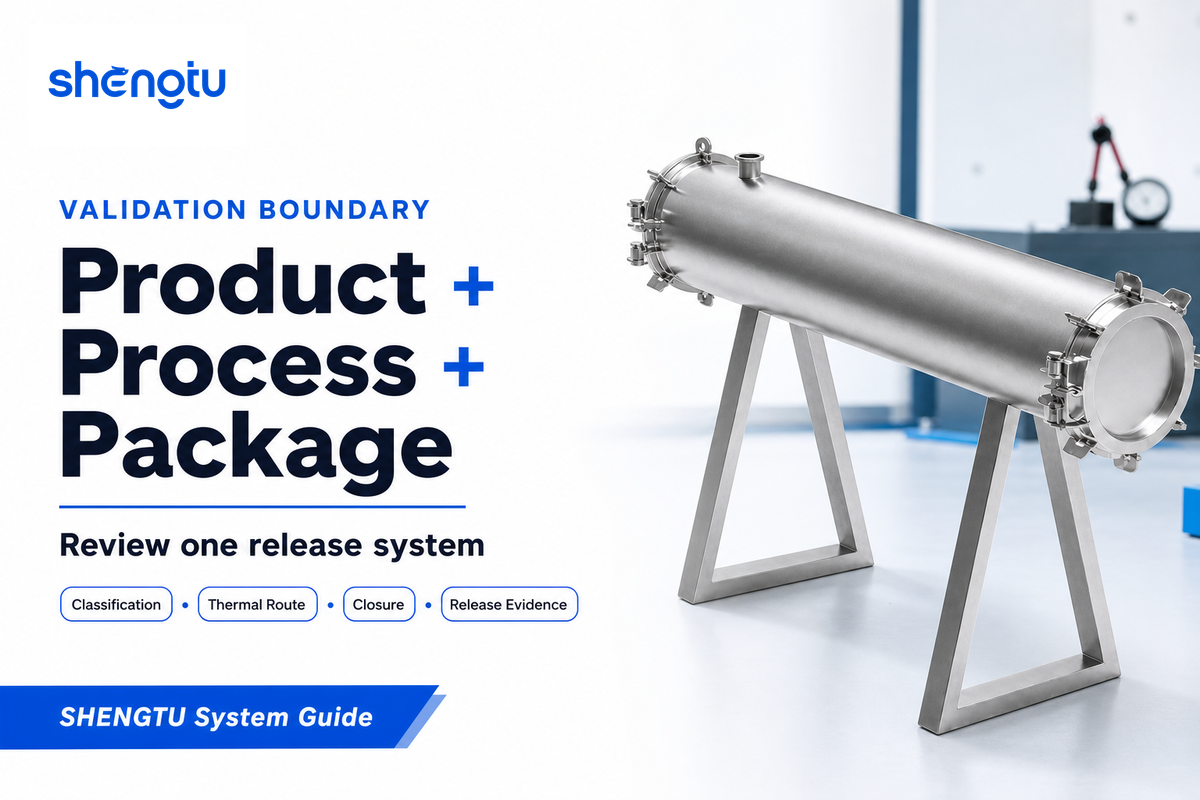
Product, process and package form one release system. A sauce may be hot-filled, pasteurized, retorted or aseptically processed; however, those labels do not provide a universal process schedule. Formulation and Equilibrium, Water Activity, Phase State, Particulates, Container, Closure, and Heat Transfer combined with the Rules of the Intended Market dictate the Validation Question.
Under Part 114, acidified food has a finished equilibrium pH of 4.6 or below and water activity above 0.85 when the definition applies. This rule also has exceptions. Some acid foods and acid condiment sauces, refrigerated products, and other cases take different routes. Classify the product first; do not use pH 4.6 as a generic sauce recipe target.
For U.S. products that fall within the definition of Part 114, the scheduled process and records are important. Section 114.100 addresses pH and other critical factors, while section 114.83 places scheduled-process establishment with a qualified person. Other products and markets may use different rules, authorities, or validation evidence.
Freeze ten linked groups: product classification, formulation, critical factors, particle/viscosity challenge, container, thermal route, fill/closure window, cooling, shelf-life evidence and deviation ownership. Change on any one of these can impact the process-to-package review.
In the instance of retort processing, review process and container together. For tunnel pasteurization and UHT with aseptic filling, the equipment train, control points and package expectation will change. Shengtu’s sterilization and aseptic filling routes give a commercial perspective depending on the base product approved.
A buyer may request that the machinery supplier confirms shelf life. The supplier can provide evidence of the equipment against an approved duty; however, the safety of the product, validation of the package and ownership of the shelf life require the plant’s approved technical and regulatory path.
Decision capsule: In the U.S. Part 114 definition, pH 4.6 and aw 0.85 are classification boundaries for covered products, not absolute sauce setpoints. Join actual recipe and critical factors, thermal route and container to substantiate a process claim.
The Changeover Carryover Risk Grid
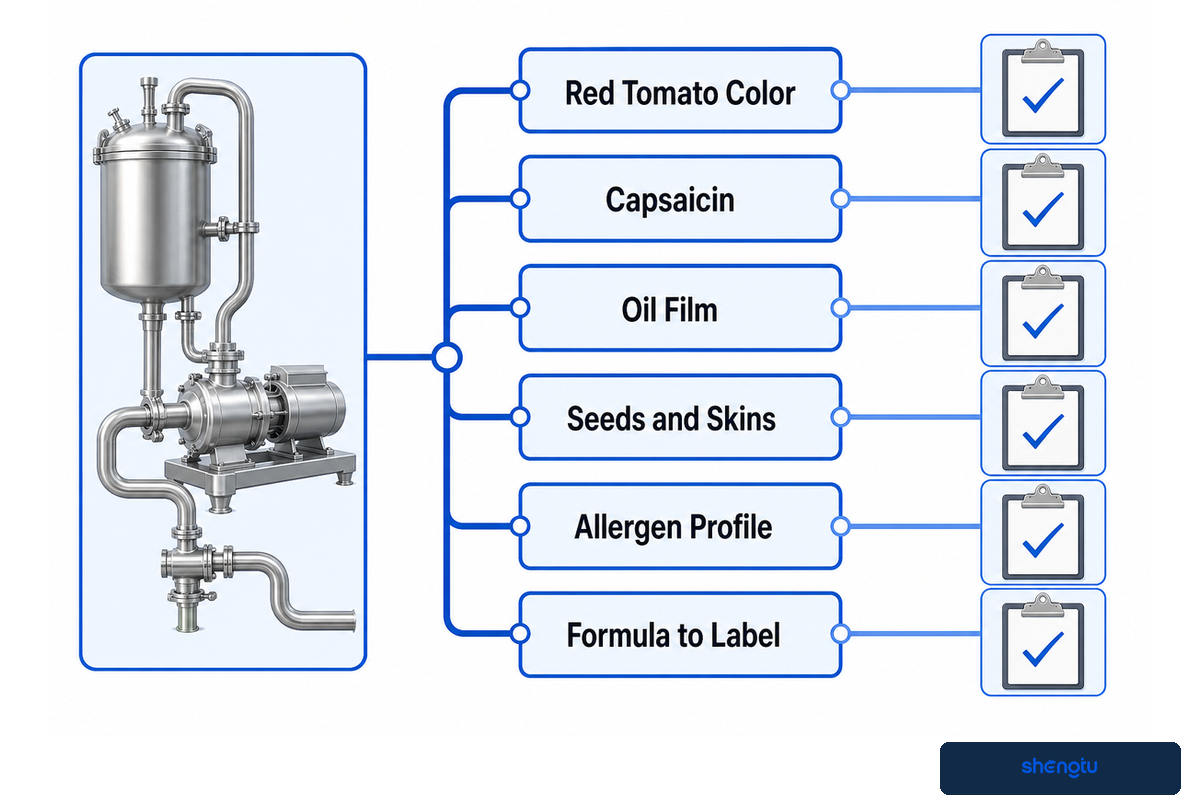
The Changeover Carryover Risk Grid describes what can move from one recipe to the next with shared surfaces, dead legs, seals, pumps, fillers and utensils, rework and labels. Cleaning time on its own isn’t sufficient. Each transition requires an approved residue mode, a named cleaning and hygiene procedure, and a release check matched to the risk.
Current U.S. 21 CFR 117.135 lists cleanliness of food-contact surfaces and prevention of allergen cross-contact as sanitation controls, as appropriate to the facility and food. This guide doesn’t establish a universal CIP chemical, concentration, temperature, or contact time. These criteria pertain to the concerned materials and actual soil.
| Carryover mode | Where to look | Release evidence | Owner |
|---|---|---|---|
| Red tomato color | Gaskets, sight glasses, filler bowl and returns | Defined visual/color endpoint | Sanitation + QA |
| Capsaicin | Grinding loop, seals, hoses and sampling tools | Approved product-specific verification | QA |
| Oil film | Tank walls, pump casing and low-flow returns | Rinse/inspection under approved method | Sanitation |
| Seeds and skins | Screens, valves, tees and filler passages | Disassembly or flush inspection record | Operator + QA |
| Starch/gum deposits | Hot surfaces, jacketed vessel and recirculation loop | Approved cycle completion + inspection | Sanitation |
| Allergen profile | Shared equipment, utensils, rework and storage | Allergen-clean release under plant program | QA |
| Rework identity | Rework vessels, hoses and batch issue | Lot/recipe reconciliation | Production + QA |
| Formula-to-label | Labeling machine, code, roll and finished case | Line-clearance and first-pack approval | Packaging + QA |
| Chemical residue | Final rinse, low points and retained liquid | Approved rinse endpoint | Sanitation + QA |
| Microbial condition | Product-contact circuit and open equipment | Site sanitation verification program | QA |
Changeover Scenario: A line finishes a sesame-containing compound sauce and moves to an allergen profile that does not declare sesame. One visually clean filler is not sufficient. The team must close the rework lot, remove the old labels, run the approved equipment-cleaning procedure, verify the defined allergen endpoint, inspect shared utensils and validate the first correctly coded package. Capsaicin or tomato color may be considered separate quality issues, but neither may be used to validate allergen release. Thus, a single changeover may impact many acceptance owners and many records.
The station-by-route changeover sheet can assist in a commercial discussion. Plants with common cleaning circuits can also review the CIP cleaning system scope. Neither of these substitutes for a plant’s validation.
A purchasing objection frequently notes that more separate circuits incur a greater cost. The grid enables the team to compare this cost to the actual measured cleaning time and the lost product and release risk for the SKU sequence, without creating a universal justification.
Decision capsule: Record min/change for each transition, then attach the correct visual, rinse, allergen, rework and label evidence. A 30 min clean on one SKU pair says nothing about another transition until the plant has tested the actual soil and circuit.
Build a Golden-Batch Evidence Pack
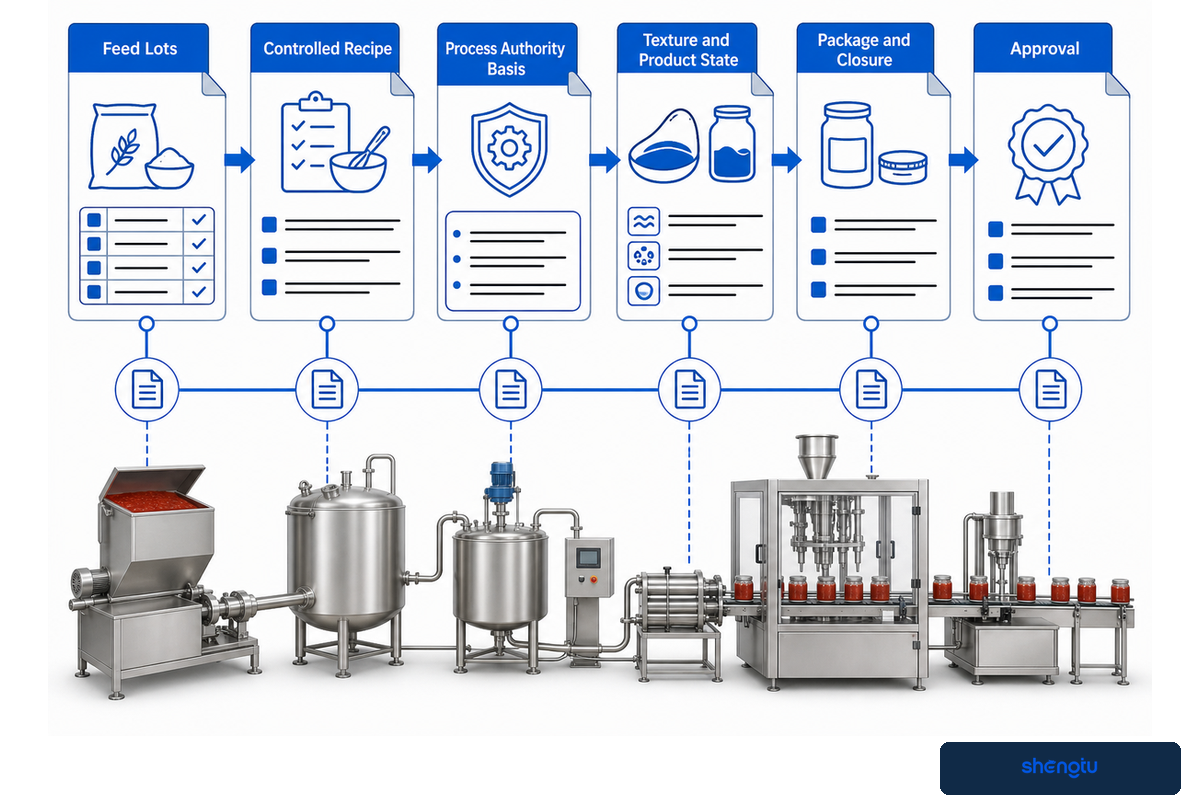
A Golden-Batch Evidence Pack connects the approved recipe to the product, operating record, package and release decision, while a water run can confirm flow direction, controls, utilities and mechanical readiness but cannot validate finished sauce texture, thermal behavior, filling accuracy, package integrity or a shelf-life claim.
The pack isn’t a selected batch subsequent to the event. It’s a controlled reference run with defined inputs, agreed upon challenge circumstances, and documented evidence. Deviations remain apparent. Therefore, it becomes fairly simple to analyze the effects on feed, recipe, equipment, software, packaging machines or the industrial production cycle.
| Evidence block | Minimum question | Example attachment | Owner |
|---|---|---|---|
| Feed lots | Were approved materials used? | Receiving and lot-release records | QA + warehouse |
| Controlled recipe | Was the correct version issued? | Formula/version and actual additions | Production |
| Incoming measurements | Was feed variability recorded? | °Brix, pH, moisture, particle and sample IDs | Lab/QA |
| Process authority basis | Who approved the safety process where required? | Scheduled/validated process reference | Technical owner |
| Critical-factor record | Did the run remain inside approved limits? | Instrument trends and checks | Operator + QA |
| Texture/product state | Did the finished sauce match the target? | Viscosity/particle/color method and result | QA |
| Package/closure | Was the correct package produced? | Fill, closure, seal and code checks | Packaging + QA |
| Cycle and good output | What did the complete line achieve? | kg/shift and clock-state record | Plant manager |
| Cleaning/changeover | Can the next SKU be released? | Approved cycle and release evidence | Sanitation + QA |
| Deviation | Were exceptions and affected product closed? | Investigation and disposition | QA |
| Training/handover | Can operators repeat the accepted state? | Signed training and operating documents | Production |
| Approval | Who accepted each evidence block? | Owner, date and open-item list | Project owner |
A client could prefer a short Factory Acceptance Test. The pack can differentiate what can be proved prior to shipment from what needs actual ingredients, utilities, operators and packages on-site. FAT, SAT and production release can share a duty basis without claiming that they provide the same result.
Decision capsule: A useful reference run links 12 evidence blocks to named owners. Record kg/shift, °Brix, pH and package checks with their methods, while safety limits and release authority stay with the approved plant program.
Turn the Process Basis into a Supplier Brief

A supplier brief should make each proposal respond to the same product and operating case. It defines feed, recipe families, finished product, package, measured output basis, cleaning boundary, utilities, interfaces and acceptance evidence. Processing equipment and a complete industrial scope are commercial answers to that frozen duty, not replacements for it.
| Brief section | Buyer supplies | Supplier returns | Acceptance owner |
|---|---|---|---|
| Product/route | Five-route cases and annual SKU list | Station-by-route process flow | Process owner |
| Raw materials | Feed states and acceptance fields | Preparation assumptions and exclusions | QA |
| Recipe/product state | Addition order and measured texture | Mixing, transfer and heat-duty basis | R&D/process |
| Capacity | kg/shift by SKU and clock inputs | Assumed rates, buffers and constraint case | Plant manager |
| Package | Pouch, glass bottles/jars or other approved pack | Filling and capping interface | Packaging + QA |
| Safety process | Approved product/process basis | Equipment capability and control mapping | Technical authority |
| Cleaning/changeover | Risk grid and release rules | Circuit, access and proposed verification points | Sanitation + QA |
| Utilities/site | Available kW, bar, water, drainage and space | Consumption basis and connection list | Facilities |
| Automation/data | Recipe, traceability and integration needs | I/O, alarm, report and interface list | Controls/IT |
| Testing | Golden-Batch acceptance plan | FAT/SAT evidence matrix | Project owner |
| Documentation | Language and format requirements | Drawings, manuals, parts and certificates list | Engineering |
| Commercial response | Delivery boundary and requested options | Scope, exclusions, price and lead time | Procurement |
The supplier brief can’t finish hygienic facility design on its own. Room layout, drainage, zoning of ingredients, utilities, cleaning management, access for employees, quality systems, and applicable regulations are all up to the owner. A modular design can help with the staging of the project, but each interface still requires an owner. A SUS304 label won’t define the finish, weld, gasket, or the chemical compatibility.
To prepare the supplier brief, you can use Shengtu’s line brief builder. Once you finish, review the background of Shengtu machinery’s project and company. A prospective buyer should only visit the solutions page after the technical basis is established and a final equipment proposal is desired.
A procurement team may ask for a price although not all fields are closed. A budgetary scope should be issued with a clear set of assumptions. The final offer should contain all open fields, exclusions and acceptance criteria. A preliminary offer shouldn’t be taken as a design specification.
Decision capsule: A 12-section brief puts utilities in kW and bar, capacity in kg/shift, changeover in min/change and package output in packs/min onto one review sheet. Similar inputs will generate comparable bids.
Tomato, Chili and Compound Sauce Line FAQs
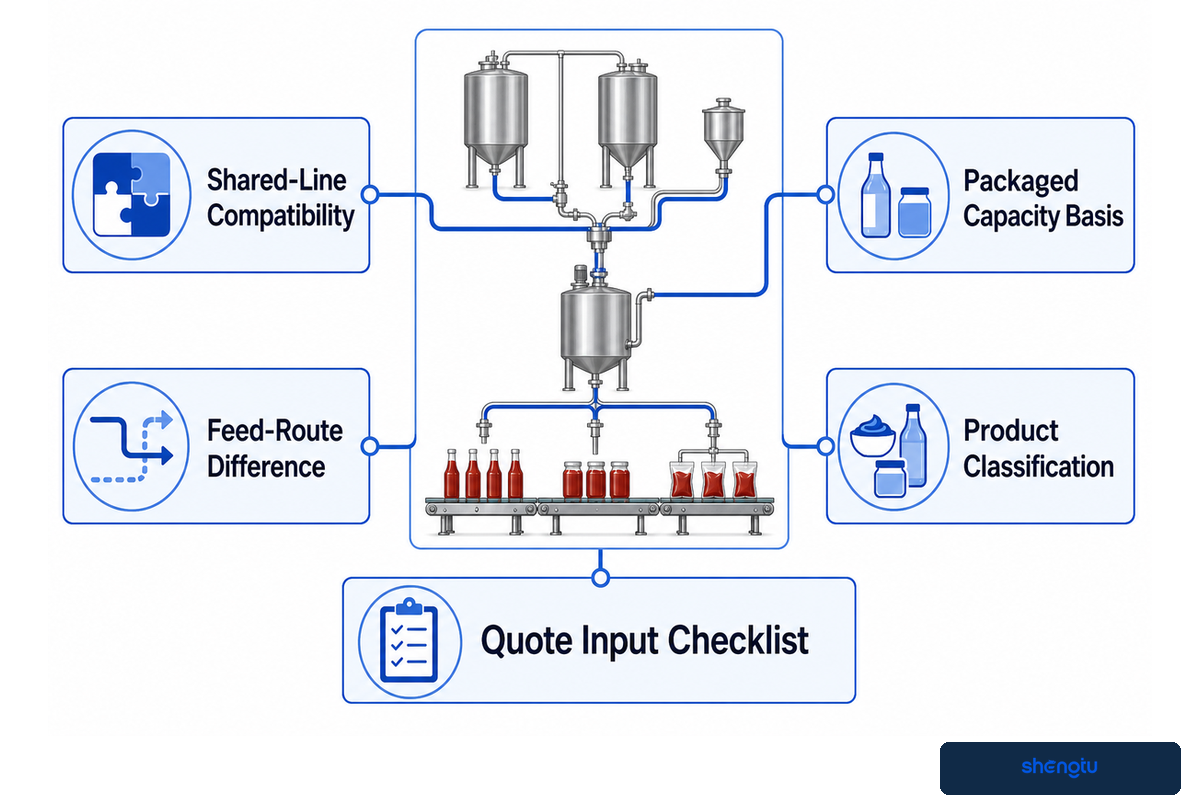
These answers don’t replace product trials, the food-safety program of the plant, or a project-specific quote. Each answer outlines a specific planning issue, but doesn’t replace a supplier’s final equipment configuration.
Can one production line handle tomato, chili and compound sauces?
Short answer
Yes, selected stations can be shared when feed routes, product passages, thermal duty, filling format and changeover evidence are compatible. Build a station-by-route map and test the worst texture, particle and cleaning cases. “Shared” should mean verified compatibility, not merely a common pipe connection. Record which pumps, valves, tanks, fillers and cleaning circuits change state for every SKU.
What is the difference between fresh-tomato and paste-based production lines?
Short answer
A fresh-tomato route normally adds receiving, washing and sorting, crushing, break treatment, pulping/refining and possibly concentration. A paste-based route begins with controlled paste handling, water and ingredient addition, dispersion and recipe cooking. Fresh-fruit variation can shift yield and front-end load; paste condition can shift dilution, drum handling and mixing duty. Compare both routes against the accepted feed, finished texture, utility basis and package rather than the page title.
How should production capacity be specified?
Short answer
State good packaged output by SKU and shift, then attach batch, transfer, thermal, filling, cleaning, changeover and downtime assumptions. Separate kg/h of accepted product from packs/min at the filler and kg/shift released by QA. A machine rate does not establish daily output unless the complete cycle and acceptance boundary are defined. Record blocked, starved, planned-stop and failure time separately so the constraint can be reviewed instead of guessed. Confirm whether the rate applies to the easiest product or the representative product mix, and identify buffer limits, operator coverage, QA hold time and the package size used for the calculation. The acceptance run should reproduce the agreed basis.
Is pH 4.6 the correct target for every sauce?
Short answer
No. In the U.S. Part 114 definition, a finished equilibrium pH of 4.6 or below appears with water activity above 0.85 and other classification conditions and exclusions. Product formulation, process, package, storage and destination-market requirements must be reviewed by the responsible technical authority.
What information is needed before requesting a quote?
Short answer
Provide feed states, recipe families, target texture, thermal/process basis, packaging format, good-output target, utilities, available space, cleaning and changeover requirements, automation interfaces and acceptance evidence. Unknown fields should be marked as open decisions rather than replaced with guessed specifications.
Prepare the Process Basis Before the Equipment List
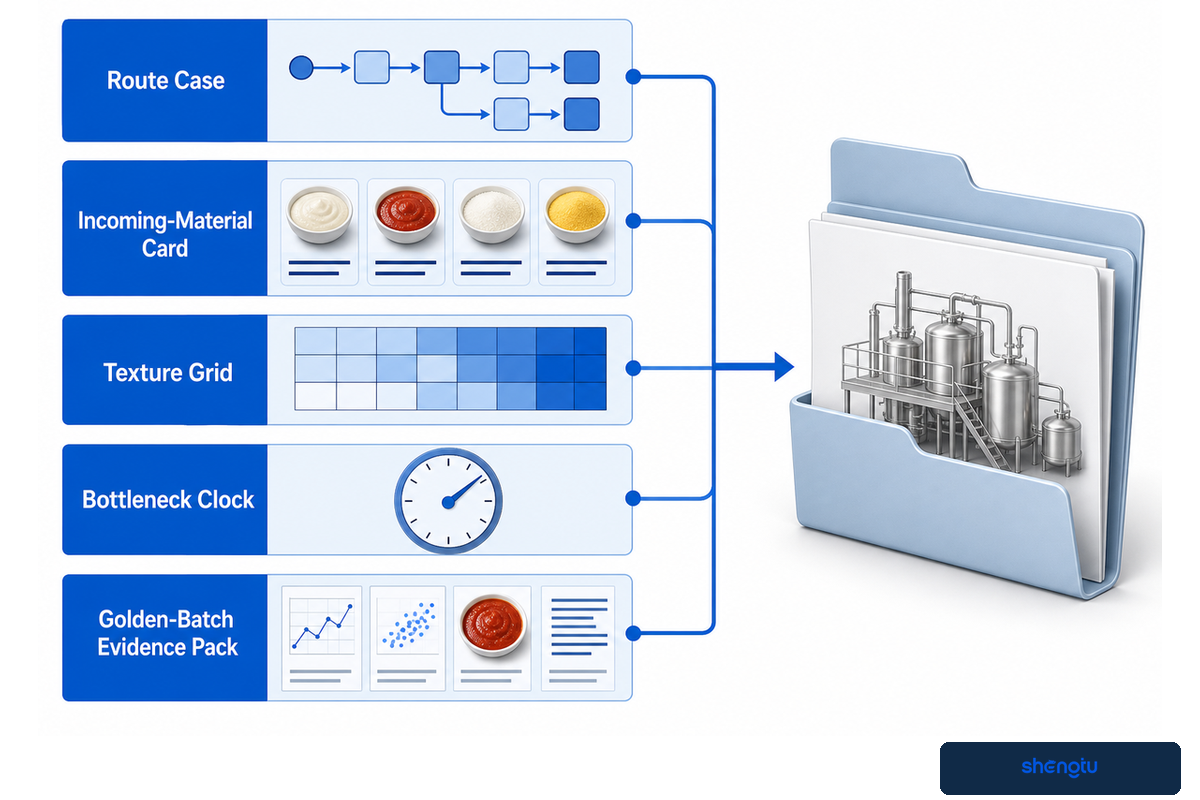
There are five linked records for the first step of industrial sauce production: a route case, an incoming-material card, a texture grid, a bottleneck clock and a Golden-Batch Evidence Pack; these records keep route assumptions visible when teams compare a tomato processing line, a tomato paste production line and a tomato sauce processing line. Taken together, these documents tell a supplier what manufacturing steps must be performed, what must be measured and which outcome the plant will accept.
For a project-specific review, prepare the brief, and then compare it to Shengtu’s sauce processing solution scope. Leave raw-material samples, product samples, and pack samples available for trials. Treat every number without a name as an assumption until a named owner closes it.
Turn your product basis into a reviewable line brief
Share the feed route, target texture, package, good-output basis, changeover cases and acceptance evidence with Shengtu’s project team.
References & Sources
The sources listed provide regulatory, rheology, and planning constraints. The boundary for the first-party scope is established by the commercial pages. Values are still related to the methods and materials used.
- Electronic Code of Federal Regulations, 21 CFR Part 114.
- Effect of Cold- and Hot-Break Heat Treatments on Currant Tomato Pulp and Paste.
- High-Pressure Homogenization in Plant-Based Foods: Review.
- Electronic Code of Federal Regulations, 21 CFR 117.135.
- Packaging Digest: product and container retort test-lab case.
- Shengtu Machinery tomato, chili and compound sauce line (first-party scope).
![F&V Freeze-Drying Line Process Guide [2026]](https://shengtumachinery.com/wp-content/uploads/2026/09/fv-freeze-drying-line-guide-featured-768x512.png)
![Beef/Lamb/Poultry Cutting Line Acceptance Guide [2026]](https://shengtumachinery.com/wp-content/uploads/2026/09/beef-lamb-poultry-cutting-line-guide-featured-768x512.png)
![F&V Freeze-Drying Line Process Guide [2026]](https://shengtumachinery.com/wp-content/uploads/2026/09/fv-freeze-drying-line-guide-featured-150x150.png)