Get in touch with Shengtu Bufan Company

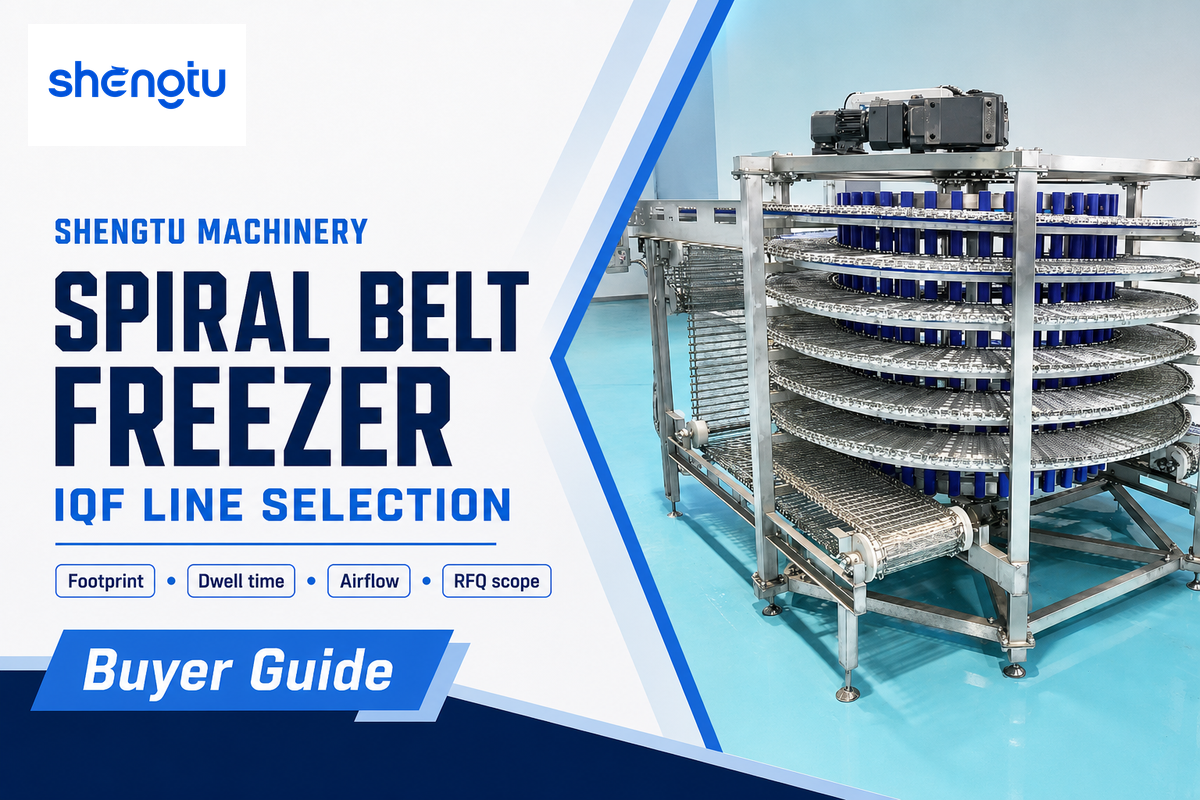
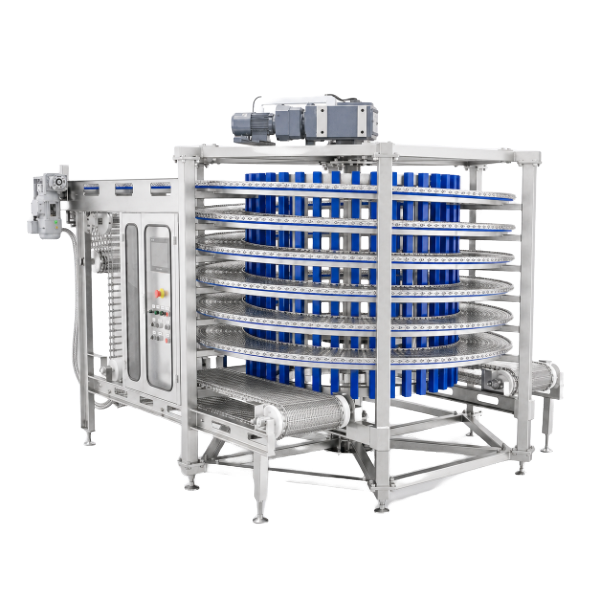
A spiral belt freezer is an IQF freezing machine that carries food on a continuous spiral conveyor belt through forced cold air. It isn’t selected by capacity alone; the useful buying question is whether your product, room, sanitation plan, refrigeration boundary, and acceptance evidence can all support the same freezing duty without creating a bottleneck after commissioning.
Fast answer for buyers
Shortlist a spiral freezer when you need continuous product travel, minutes of dwell time, and a small footprint that trades floor length for room height. Hold the purchase until the supplier can demonstrate product duty, belt loading, airflow, sanitation access, safety controls, refrigeration scope, and factory acceptance testing on your actual product conditions.
How This Selection Guide Was Built
The selection guide combines Shengtu’s public spiral belt freezer page, food-equipment rules, FAO freezer engineering references, a University of Wisconsin Industrial Refrigeration Consortium airflow study, OSHA and EPA refrigeration-safety material, and supplier-neutral quote logic. It’s written for plant, quality, procurement, maintenance, and finance teams preparing an RFQ.
| Evidence type | Number to keep qualified | How to use it in the RFQ |
|---|---|---|
| FAO format example | 700 kg/h, 260 m² in-line example, 100 m² spiral example, 5 m/s | Use as a format-to-footprint illustration, not a universal space-saving ratio. |
| University airflow study | 1690 sec, about 28 min, 156.4 products/min, 10.4% | Use as study-specific evidence that airflow profile affects freezing capacity. |
| University energy balance | 121.7 kW fan energy, 22.6% of modeled energy balance | Ask for fan, motor, pressure, and refrigeration load assumptions. |
| Shengtu first-party freezer range | -30 to -40 °C, 3 to 6 m/s, up to 10 °C, -18 °C | Treat as Shengtu-published scope language to match against your product test. |
| Shengtu first-party timing | 15 to 45 min dwell, 3 working days for quotation, 45 to 60 days after down payment | Tie timing to drawings, FAT window, shipping boundary, and commissioning plan. |
| FDA storage reference | 0 °F (-18 °C) | Separate storage temperature from product-specific food safety validation. |
| OSHA ammonia threshold | 10,000 lb ammonia coverage threshold | Ask whether the refrigeration system changes plant safety obligations. |
| EPA refrigerant trigger | Section 608 ODS: 50 lb; HFC rule from Jan. 1, 2026: 15 lb when the refrigerant contains an HFC, or a substitute for an HFC with GWP >53; final repair duties depend on refrigerant, appliance category, owner/operator role, and local jurisdiction | Define owner/operator repair responsibility in the refrigeration boundary. |
| Buyer category terms | Single spiral, double spiral, tunnel, blast, carton, and cryogenic common types | Name the common types so suppliers quote the right freezing products and process route. |
What a spiral belt freezer does, and when buyers should shortlist it
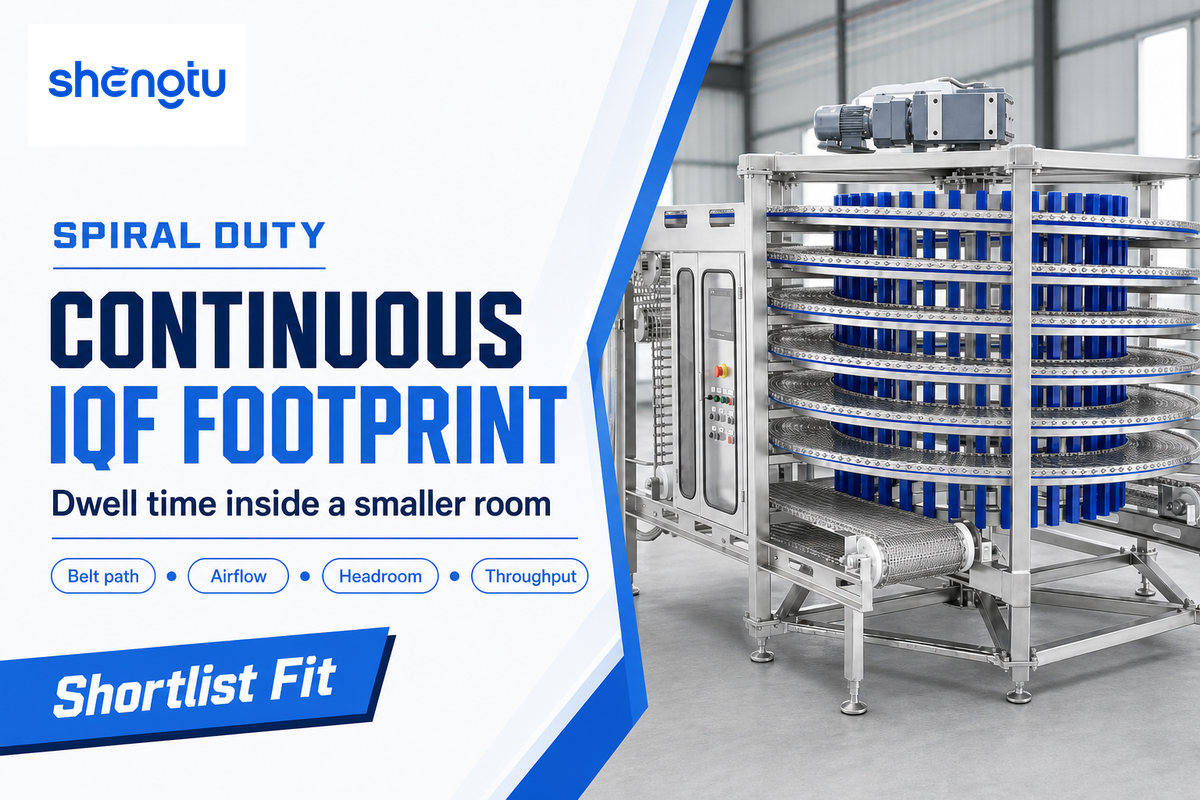
A spiral freezer transports food items on a continuous spiral conveyor through forced cold air, so the belt path can be long while the machine footprint remains small. That makes it different from a cold room, which stores frozen food, and different from a short hardening tunnel, which purchases residence time with building length. FAO’s freezer reference considers air movement, product loading, and freezer design as part of the freezing system rather than as separate afterthoughts.
Buyers usually put a spiral belt freezer on the shortlist when the line requires continuous output, individual pieces, controlled belt speed, and sufficient dwell time for product cores to reach the target exit condition. Poultry portions, seafood, ready meals, prepared foods, bakery goods, and some dairy products can all follow this pattern, but the product shape is more important than the category name. Flat fillets, sticky glazed items, tall trays, and delicate pastries don’t load the same belt in the same way.
In the food industry, the phrase spiral freezer can encompass a single spiral freezer, double spiral freezer, or another helical conveyor system. The underlying principle is mechanically simple: a continuous spiral conveyor belt moves quantities of food through a controlled cooling process so the line can freeze large quantities of products without lying the entire path flat. The freezer equipment choice still depends on product duty, not on the name alone.
For procurement language, freezing equipment for the wide range of products a plant wants to freeze should still be narrowed to a calculated duty before quotation, because belt loading, product temperature, and exit-core target can move the same model request into a different engineering discussion.
Shortlist signal
- The freezer will serve high-volume food production environments without needing a very long straight tunnel.
- The product can sit on a belt without clumping, tipping, marking, or blocking airflow.
- The plant has sufficient headroom, drainage, cleaning access, and service clearance around the tower.
- The refrigeration system and fan boundary can maintain the required air temperature and velocity without concealed utility load.
A good first review is simple: if the product must stay individually separated, the room is short on floor area, and the process needs continuous flow, a spiral freezer belongs in the first conversation. If the product is boxed, tall, sticky, fragile, or batch-run in small quantities, keep the alternative freezing method on the table. The next step isn’t asking “what model do you sell?” It’s building the duty brief.
Build the 9-Input Freezing Duty Brief before asking for a quote
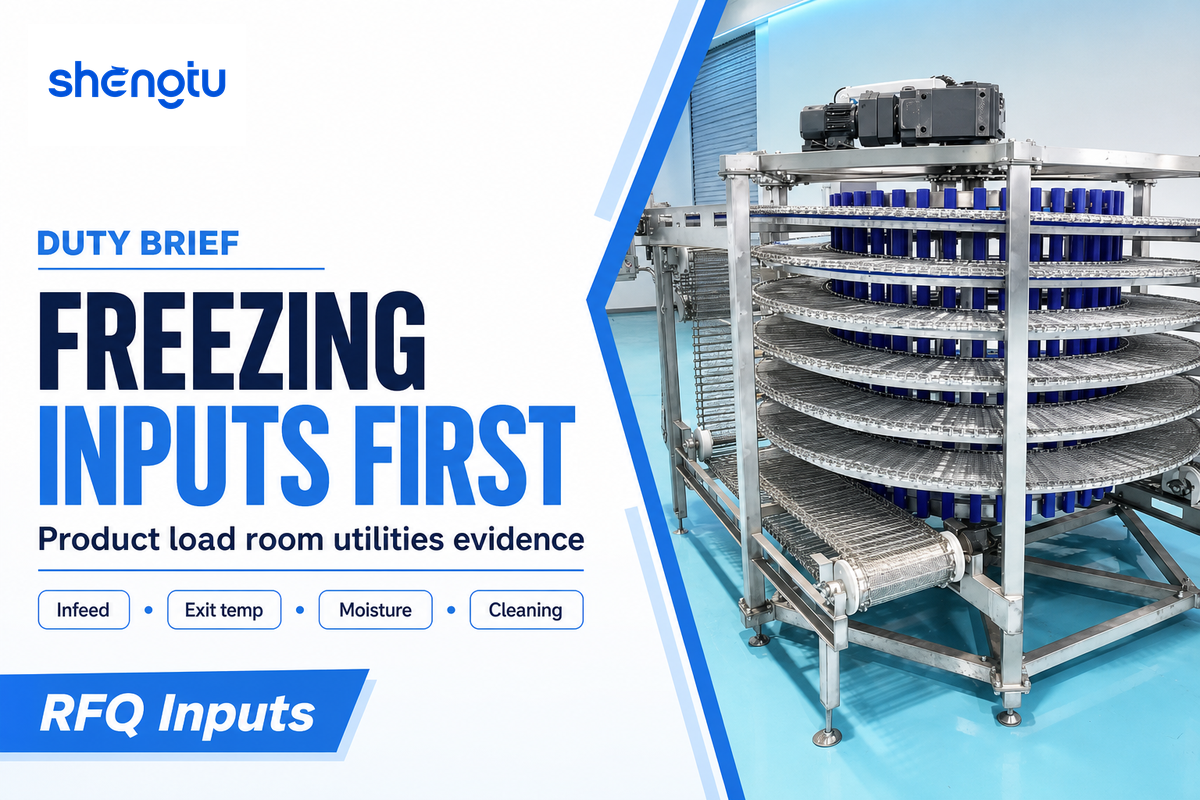
The 9-Input Freezing Duty Brief turns a vague capacity request into data a freezer manufacturer can size. FAO’s engineering data notes that accurate freezing time should be measured under intended conditions, because product size, shape, packing, temperature, and air speed all affect the result. In one University of Wisconsin IRC spiral-freezer study, the modeled product needed about 1690 seconds, or roughly 28 minutes, at a product rate of 141.7 products/min under the tested velocity profile. That’s a study condition, not a universal dwell rule.
| Input | What to send | Why it changes the machine |
|---|---|---|
| 1. Product and geometry | Name, length, width, height, piece weight, and surface shape | Sets belt width, loading density, airflow exposure, and transfer risk |
| 2. Package state | Naked, battered, glazed, marinated, wrapped, tray-packed, or cartonized | Changes whether the process is IQF spiral freezing, chilling, tunnel freezing, or carton freezer work |
| 3. Entry temperature | Measured temperature entering the freezer, not upstream room temperature | Drives heat load and freezing process duration |
| 4. Exit core target | Target final product’s temperature at the core and the measurement method | Defines the thermal target, but does not by itself validate food safety |
| 5. Hourly and shift capacity | kg/h or lb/h, shift hours, peak rate, and expected downtime | Separates short peak production capacity from sustained output |
| 6. Dwell target | Required residence time window, plus product test data if available | Sets belt speed, belt length, tier count, and tower diameter |
| 7. Belt loading and spacing | Items per row, gap, loading pattern, stacking risk, and belt contact limits | Controls whether products are evenly frozen and whether counting or transfer sensors work |
| 8. Room and utilities | Floor area, ceiling height, door path, power, water, drains, and refrigeration tie-in | Decides fit, installation cost, access, and whole-system heat exchange boundary |
| 9. Sanitation and service window | Washdown method, cleaning chemicals, defrost interval, inspection access, and maintenance shift | Changes enclosure, belt material, drainage, CIP expectations, and downtime plan |
Product safety boundary: freezing is preservation and temperature control, not an automatic microbial kill step. FDA consumer guidance uses 0 °F (-18 °C) as a freezer storage target and explains that freezing stops bacterial growth rather than killing most bacteria; its storage basics also put refrigerator control at or below 40 °F (4 °C) when chilled staging feeds the line. FDA also notes little change in nutritional value during freezing. For industrial food safety, the buyer still needs the product’s validated process, cooking instructions, hazard controls, and storage distribution plan.
The brief also keeps sales discussions honest. If one supplier assumes a 15-minute dwell and another assumes 35 minutes, their prices may look different because they’re quoting different machines. One continuous spiral conveyor belt can carry many products, but the right spiral freezer is the one sized against your measured duty, not a catalog phrase.
Spiral vs tunnel vs blast freezer: format-to-footprint decision
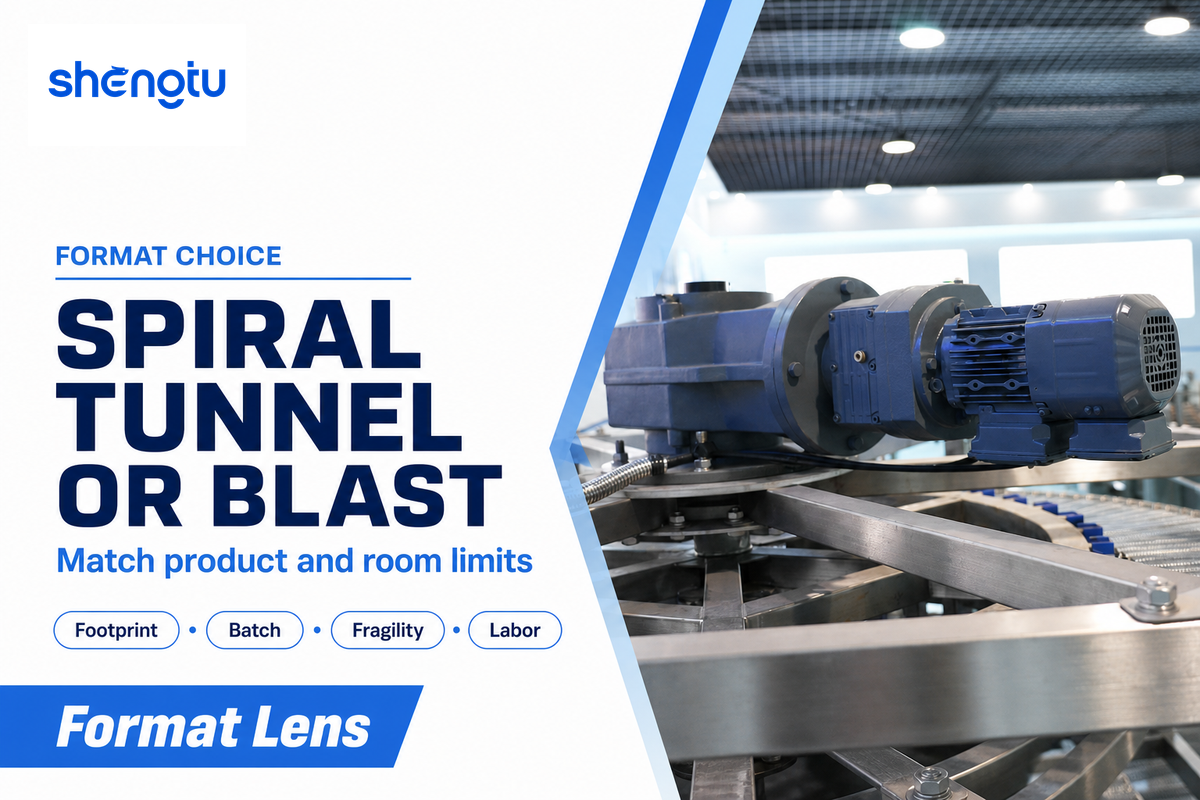
Spiral, tunnel, and blast freezing systems answer different constraints. In its 1984 planning manual, FAO gives one illustrative freezer-cabinet floor-area comparison for 700 kg/h IQF fillets at 5 m/s: a continuous in-line freezer example used 260 m2 and a continuous spiral example used 100 m2. That table does not include refrigeration machinery, loading, unloading, cleaning aisles, or maintenance access. The useful lesson isn’t “spirals always save this percentage.” The lesson is that conveyor path geometry can shift the space problem from floor length to headroom and access.
| Freezing route | Best fit | Buyer risk |
|---|---|---|
| Spiral belt freezer | Continuous IQF products needing minutes of dwell in a compact footprint | Headroom, cleaning access, belt loading, defrost timing, and safe maintenance access |
| Tunnel IQF freezer | Flatter layout, easier linear access, and products that suit straight conveyor travel | Longer floor run when dwell time grows |
| Blast freezer | Batch chilling or freezing where carts, racks, or trays fit the plant rhythm | Labor handling, batch variability, and lower integration with a continuous production line |
| Cryogenic system | Special crusting, very rapid freezing, or products needing low temperatures from liquid nitrogen or carbon dioxide | Consumable gas cost, ventilation, safety rules, and supply availability |
Use Shengtu’s format-to-footprint decision lens when the room constraint is still unsettled. The right format is the one that leaves room for people to clean, inspect, service, and remove components, not the one that looks smallest in a brochure.
Belt, airflow, transfer, and defrost risks that change quality
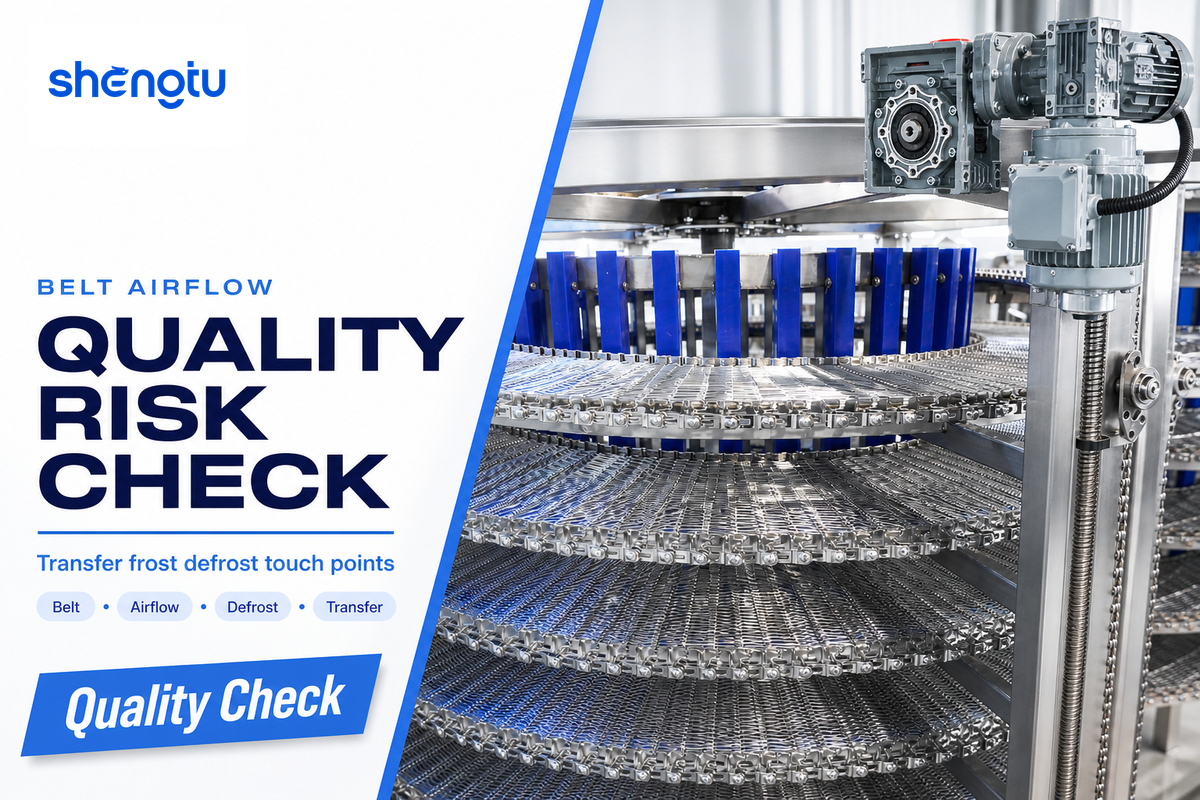
After the format choice, belt and airflow decisions decide whether the machine can repeat product quality after the first trial. One University of Wisconsin IRC study found that a high-performing velocity profile improved modeled throughput by 10.4% in one spiral-freezer case, while also noting 3.414 m/s as one average-velocity condition, 121.7 kW of modeled fan power, and airflow distribution as system issues. FAO also flags insufficient or non-uniform airflow as a freezer performance problem. Treat those as engineering signals, not as a universal gain promise.
Metal belt and modular plastic belt choices should be reviewed as metal and plastic conveyor belts, not as generic parts. Belt open area, transfer radius, rail wear, cleanability, and low temperatures change cleaning and maintenance work. If a supplier uses broad language such as 360-degree freezing or preserving the quality, ask where airflow is measured and how freshness and texture are verified on your product.
Spiral Fit Gate Matrix
| Gate | Pass evidence to request | Hidden bottleneck if missing |
|---|---|---|
| Belt support | Belt type, belt width, turn radius, loading density, transfer gap, and wear-strip access | Product marking, clumping, edge damage, or tracking stops |
| Airflow path | Air velocity basis, baffle layout, evaporator condition, fan motor data, and product test position | Uneven freezing, excess fan power, or weak early-stage heat removal |
| Transfer and counting | Infeed/outfeed layout, product gap, sensor logic, and stop/restart behavior | Unreliable counts, pileups, and residence-time drift during speed changes |
| Defrost and frost control | Defrost sequence, drainage, frost-prone areas, and production-window assumptions | Airflow loss, rising product exit temperature, and unplanned downtime |
| Guarding and lockout | Guard layout, emergency stops, safe cleaning mode, jam-clearing process, interlocks, and stored-energy control | Unsafe intervention around a moving spiral conveyor belt |
OSHA’s public accident database records a 2022 fatality involving a worker caught in a spiral conveyor belt. That evidence doesn’t define every freezer’s design, but it does make one buying point non-negotiable: safe cleaning, jam clearing, emergency stops, lockout points, interlocks, and startup checks belong in the acceptance plan beside product temperature and belt speed.
The practical test is whether a supplier can explain what happens on a bad hour: wet product enters, the upstream line stops, frost rises on the coil, the belt speed changes, and maintenance needs to inspect a transfer point. Demo-condition performance can still erode texture and flavor when the plant runs mixed SKUs.
Why spiral freezer prices vary and how to normalize quotes
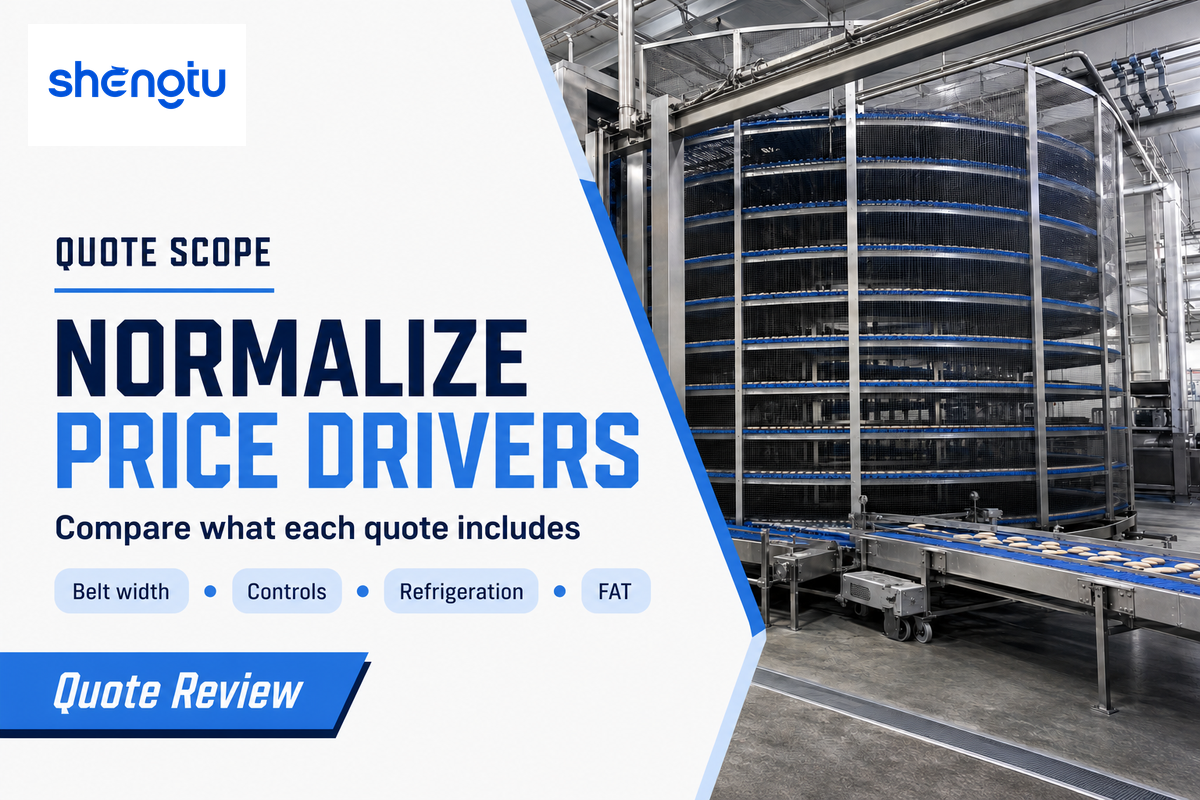
Spiral freezer prices vary because a quote can include very different boundaries. One supplier may quote only the insulated enclosure and spiral conveyor. The competing scope may include evaporators, fans, refrigeration connection, control cabinet, PLC logic, safety devices, field wiring, installation supervision, commissioning, spare parts, test product support, and FAT documents. Raw price ranges from marketplaces are weak evidence unless the scope is equal.
Quote Normalization Triangle
1. Freezing duty
Product geometry, entry temperature, exit core target, loading pattern, dwell time, hourly rate, and shift schedule.
2. Scope boundary
Belt, enclosure, refrigeration, controls, sensors, safety devices, CIP, shipping, installation, and service support.
3. Acceptance proof
Drawings, material data, belt run test, interlock test, alarm list, defrost sequence, FAT video, manuals, and spare parts.
Refrigeration scope also needs its own line. If ammonia is involved, OSHA notes that systems with 10,000 pounds or more of ammonia fall under process-safety-management coverage, while many control practices are still useful below that threshold. EPA leak-repair scope isn’t one universal number: Section 608 materials address certain ozone-depleting refrigerant appliances at 50 pounds or more, while EPA’s HFC FAQ says affected refrigerant-containing appliances with 15 pounds or more of a refrigerant that contains an HFC, or a substitute for an HFC with GWP greater than 53, are subject to 40 CFR 84.106 from January 1, 2026, with exclusions. For quote comparison, ask for refrigerant identity, total charge, machinery-room or outdoor-rack implications, leak detection, ventilation, emergency shutdown, and jurisdiction-specific documentation.
Use Shengtu’s freezer quote normalization scorecard when comparing suppliers. Lower numbers are only lower prices if the freezing duty, refrigerant boundary, control system, safety package, and acceptance documents are the same. Otherwise the offer may simply be a smaller scope.
Cost-effective buying also means asking what the quote does to optimize production efficiency, operational efficiency, technical support, and reducing energy consumption over real shifts. A custom design can reduce downtime, but only when the supplier names the utility loads, support window, spare parts, and carbon footprint assumptions behind the statement.
Manufacturer and FAT evidence to request before deposit

Factory acceptance testing isn’t a magic regulatory checkbox. It’s a buyer’s evidence request because food plants must operate equipment that can be cleaned, inspected, maintained, and controlled. 21 CFR 117.40 supports this direction for food-plant equipment and utensils, including cleanability, maintenance access, suitable materials, and temperature-measuring devices where relevant. 9 CFR 416.3 is a USDA sanitation anchor for official meat and poultry establishments, so don’t present it as a universal rule for every food category.
“adequately cleanable, and shall be adequately maintained”
21 CFR 117.40, equipment and utensils wording reviewed through Cornell Law
FAT Evidence Checklist
- General arrangement drawing with room footprint, ceiling height, service clearance, door path, and drainage.
- Belt specification covering material, belt width, loading assumptions, transfer points, tension range, and take-up access.
- Food-contact material statement, weld and joint approach, access panels, clean-in-place or washdown boundary, and sanitation procedure.
- Refrigeration boundary: evaporator, fan, refrigerant, controls, sensors, leak detection responsibilities, and utility loads.
- Control proof: PLC test, belt speed setting, alarm list, interlocks, emergency stops, safe cleaning mode, and restart logic.
- Thermal proof: air temperature basis, air velocity basis, dwell-time setting, product test method, and exit-core acceptance criterion.
- Defrost proof: sequence, drain path, restart condition, production-window assumption, and coil-access plan.
- Handover proof: O&M manual, spare parts list, belt tension guidance, direct-drive mechanism or gearbox notes, defrost schedule, and service contact process.
IFT’s food-equipment safety discussion and AFFI’s hygienic design material both point buyers toward cleanability, accessibility, suitable surfaces, and validated cleaning practice. Turn those principles into physical evidence before deposit. Brochure claims that a freezer meets hygiene standards aren’t the same as seeing the drain slope, belt access, spray boundary, test records, and maintenance instructions.
Match Shengtu’s product page specs to your RFQ scope

Shengtu’s product page should be used as the conversion and specification handoff after your team defines the duty brief. The public spiral belt freezer page states a freezing zone of -30 to -40 °C, 3 to 6 m/s air velocity, product entry up to 10 °C, exit core to -18 °C, dwell time from 15 to 45 minutes, MOQ of 1 set, engineer-reviewed quotation within 3 working days, and manufacturing scheduled at 45 to 60 days after down payment. Those are Shengtu-published values and process notes, not universal promises for every plant.
Because public commercial pages can change, carry those figures into the RFQ as a dated starting point, then ask Shengtu to confirm the final temperature basis, dwell assumption, quotation timing, production schedule, and exclusions in the signed offer.
| Shengtu page item | RFQ question to attach |
|---|---|
| -30 to -40 °C freezing zone | What air temperature basis is used for my product and evaporator condition? |
| 3 to 6 m/s air velocity | Where is velocity measured, and how is fan power reflected in the utility load? |
| Entry up to 10 °C, exit core -18 °C | What probe method, product sample, and storage plan define acceptance? |
| 15 to 45 minutes dwell | Which dwell setting is assumed for my product thickness and loading pattern? |
| 3 working day quote, 45 to 60 day manufacturing | What drawings, FAT date, shipping boundary, and commissioning plan are included? |
Shengtu Machinery is useful in this conversation because the company builds machinery and digital-control capability in-house: custom retorts, smart packaging gear, STUnit platform development, OTA upgrades, low-code control boxes, multi-protocol gateways, YOLO vision, and edge algorithms all point toward integrated food equipment rather than only metal fabrication. For a freezer RFQ, translate that capability into concrete questions: What data can be logged? Which alarms are captured? Which protocol connects to upstream or downstream equipment? What support is available after commissioning?
Ready to send a real freezer brief?
Attach your product dimensions, entry temperature, target exit core temperature, hourly rate, room footprint, ceiling height, sanitation window, and refrigeration boundary.
When a spiral belt freezer is the wrong choice
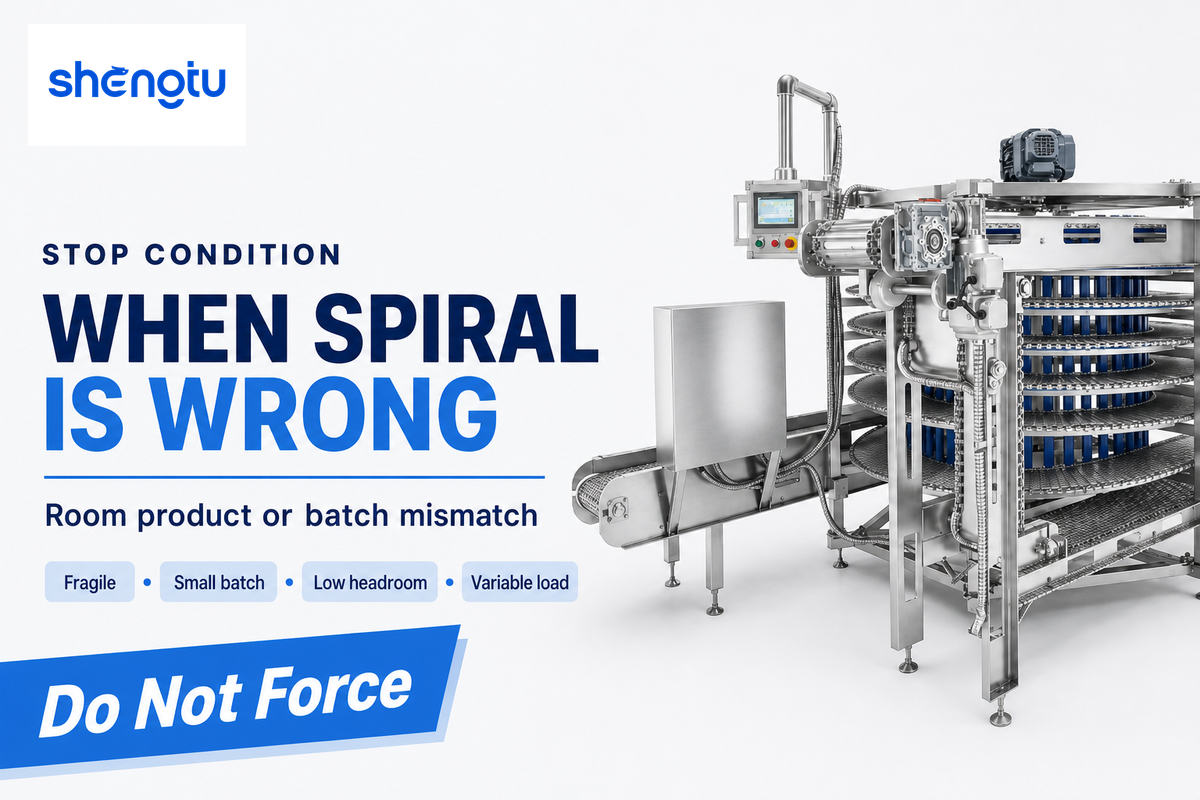
Spiral belt freezers are the wrong choice when their compact footprint hides a larger operating problem. FAO notes that underloading continuous freezers raises cost per kg, and its freezer engineering discussion points to airflow, frost, and product handling as performance factors. Plants that run short, irregular, low-volume batches may pay for a continuous tower that’s rarely loaded correctly.
- Product is too tall for tier spacing or too fragile for repeated belt transfers.
- Wet, sticky, or battered surfaces bridge and block clean belt loading.
- The room has floor area but not enough ceiling height, service clearance, or door path.
- The plant can’t support the required refrigeration, fan power, drainage, or defrost water handling.
- Cleaning access is limited enough that sanitation time would erase the space saving.
- Production changes SKUs so often that batch blast freezing or a tunnel IQF freezer alternative may be easier to schedule.
That isn’t a reason to reject spiral freezing. It’s a reason to keep the engineering review honest. If the fit gate fails, compare Shengtu’s tunnel IQF freezer alternative, a blast route, or a carton freezer path before locking the building layout. Suppliers who help you say no to the wrong machine are often safer long-term partners.
Some wrong-format confusion comes from similar-looking heat-transfer machines. A spiral oven moves on a helical conveyor too, but it heats rather than freezes. Cryogenic systems can advertise temperatures as low as -100 °C and may use liquid nitrogen or carbon dioxide; that doesn’t make their cost basis comparable with a mechanical quick freezing tower.
What is changing in IQF freezer buying: energy, automation, documentation
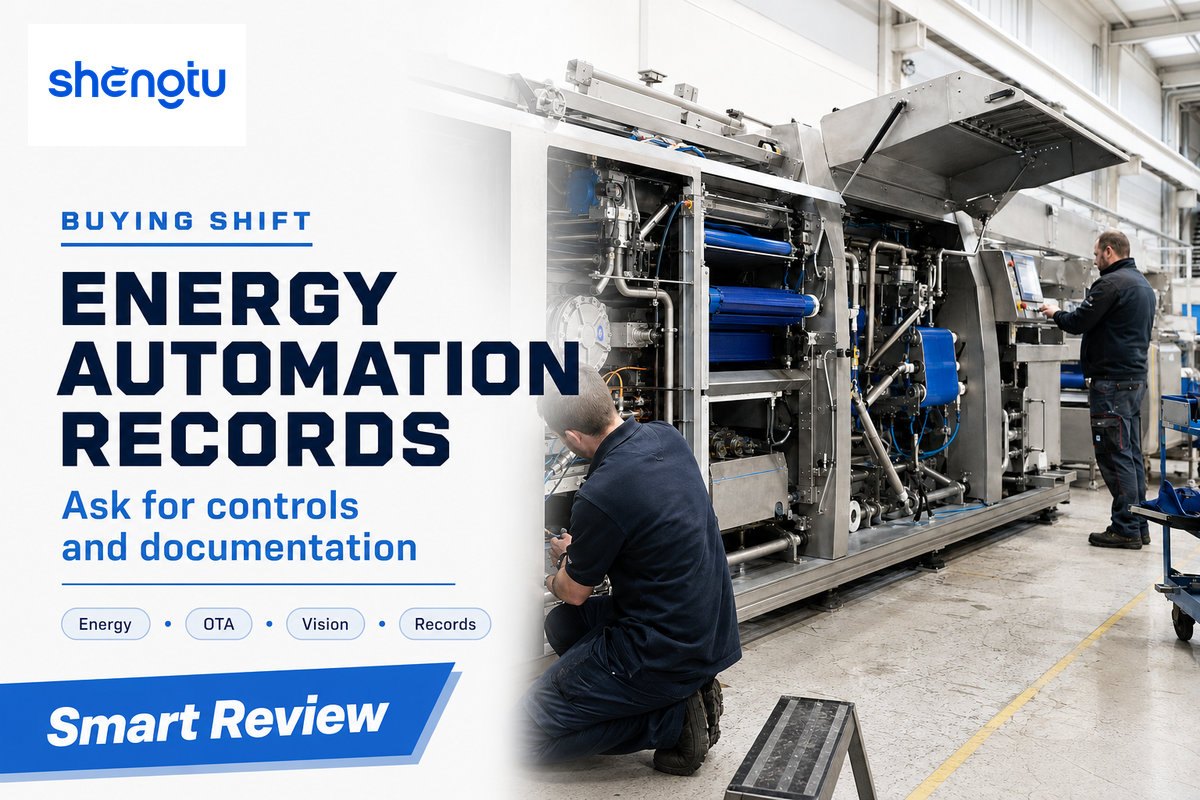
IQF freezer buying is moving from mechanical selection alone toward documented performance, control visibility, and energy basis. Fan-system guidance and the Wisconsin IRC study both support a simple caution: more airflow isn’t automatically better when fan power, pressure drop, motor size, load variability, and whole-system refrigeration load aren’t visible. Patent evidence around spiral freezer airflow also shows that warm-air infiltration, ice buildup, and convection losses remain active design problems.
Technology should appear in the quote as usable records, not decoration: belt speed trend, alarm timestamps, product count, temperature history, fan status, defrost status, and maintenance prompts. When those records are available, the production manager can compare the promised freezing capacity with what the line actually did during a wet product run, a stop/start event, or a sanitation shift.
| 2026 RFQ item | What to ask for | Why it matters |
|---|---|---|
| Energy basis | Fan motor power, refrigeration load, pressure boundary, defrost schedule, and product load assumption | Prevents energy savings language from hiding a larger utility bill |
| Automation | PLC architecture, alarm map, data logging, controlled belt speed, stop/restart logic, and remote support path | Protects dwell time and product traceability when the line changes rate |
| Documentation | FAT record, O&M manual, sanitation checklist, safety checks, refrigerant documents, and spare-parts plan | Turns a supplier promise into commissioning evidence |
Trade-press manufacturing coverage in 2024 frames automation and data projects through cost-benefit analysis, productivity, efficiency, and data quality. For a food processing freezer, that means the RFQ should ask for the information your team will use every shift: belt speed, dwell setting, alarms, product count, temperature trend, defrost status, and maintenance prompts. The future-facing freezer quote is less about naming artificial intelligence and more about proving usable operating data.
FAQ
What do you need before you can quote a spiral belt freezer?
Capacity alone is not enough for a spiral belt freezer quote; send product geometry, entry temperature, exit target, throughput rate, room space, sanitation window, utilities, and acceptance requirements.
Send the 9-Input Freezing Duty Brief: product geometry, package or surface state, entry temperature, target exit core temperature, hourly and shift capacity, dwell window, belt loading, room/utilities, and sanitation/service window. Add photos, a short product video, packaging status, known stickiness or breakage problems, available refrigeration details, and the time window allowed for sanitation and defrost. If the product has a validated safety process, include that boundary too. This keeps two suppliers from quoting different belt width, dwell time, refrigeration duty, and proof documents for the same project.
How does a spiral freezer work?
A spiral freezer carries food on a helical conveyor through forced cold air, using belt speed, product spacing, airflow, and dwell time to bring the product core toward the specified exit target.
The belt enters the enclosure, travels around a spiral cage, and exits after a set residence time. Fans move cold air over the product, while belt speed and product spacing control exposure. The machine works only when loading, airflow, defrost, transfer design, cleaning access, and exit-core checks match the product.
What are the key differences between a tunnel freezer and a spiral freezer?
A tunnel freezer buys dwell time with floor length and easier straight-line access, while a spiral freezer stacks belt travel vertically to save floor area when headroom, sanitation access, and transfer design allow it.
Tunnel layouts can be easier to inspect and can fit low ceilings or flatter process lines. Spiral layouts can reduce floor area when the product needs more belt travel, but they require headroom, safe access, good sanitation routes, and careful belt handling. The decision should be made from product duty and building limits, not only from a footprint sketch.
What are spiral freezers used for?
Spiral freezers are used for continuous freezing of separated food products that need controlled dwell time, compact belt travel, and repeatable airflow exposure through a production shift.
They serve poultry, seafood, ready meals, prepared foods, and bakery goods that can travel separated on a belt.
How should buyers compare spiral freezer prices?
Compare spiral freezer prices by equal duty, equal mechanical and refrigeration scope, equal controls and safety boundaries, and equal acceptance proof such as drawings, FAT records, manuals, and exclusions.
Use the Quote Normalization Triangle. First equalize product duty: entry temperature, exit core target, dwell time, hourly rate, shift schedule, and loading pattern. Second equalize scope: belt, enclosure, refrigeration, controls, sensors, safety devices, field wiring, shipping, installation, commissioning, and technical support. Third equalize proof: drawings, material records, FAT video, alarm list, interlock test, defrost sequence, O&M manual, spare-parts list, and warranty process. Then ask each supplier to mark exclusions in writing. This method prevents procurement from choosing a quote that looks cheaper only because refrigeration, controls, or acceptance evidence were left outside the number.
Does CE documentation satisfy US food-facility requirements?
CE documentation may support equipment review, but US food-facility compliance still needs local food-safety, sanitation, worker-safety, temperature-control, product-specific hazard-control, operator-training, maintenance, commissioning checks, and validation records.
Ask for CE-related documents if they matter to your purchasing file, but do not treat them as a substitute for US plant review. Food facilities still need cleanable equipment, suitable materials, temperature control where relevant, sanitation procedures, worker-safety controls, and any product-specific hazard-control documentation required by their own market.
Engineering Handoff
A quote-ready spiral freezer brief has nine inputs, one fit gate, one normalized scope comparison, and one FAT evidence list. That’s the shortest path from “we need an IQF spiral freezer” to a specification an engineer can check.
References & Sources
- 21 CFR 117.40, Equipment and utensils – Cornell Law School Legal Information Institute
- 9 CFR 416.3, Equipment and utensils – Electronic Code of Federal Regulations
- Current Good Manufacturing Practices for Food – U. S. Food and Drug Administration
- Are You Storing Food Safely? – U. S. Food and Drug Administration
- Processing Equipment for Food Safety – Institute of Food Technologists
- Hygienic Design – American Frozen Food Institute
- Airflow and Energy Optimization in Spiral Freezers – University of Wisconsin Industrial Refrigeration Consortium
- Freezers and Freezing – Food and Agriculture Organization of the United Nations
- Planning and Engineering Data – Food and Agriculture Organization of the United Nations
- Spiral conveyor belt accident record – Occupational Safety and Health Administration
- Ammonia Refrigeration eTool – Occupational Safety and Health Administration
- Ammonia refrigeration evaluation and control – Occupational Safety and Health Administration
- Stationary refrigeration leak repair requirements – U. S. Environmental Protection Agency
- HFC phasedown and leak repair questions – U. S. Environmental Protection Agency
- Improving Fan System Performance: A Sourcebook for Industry – U. S. Department of Energy
- Future-Proofing Operations on a Budget – IndustryWeek
- US20140000296A1 spiral freezer airflow patent publication – Google Patents
- Spiral Belt Freezer product page – Shengtu Machinery