Get in touch with Shengtu Bufan Company

Updated October 2026
A continuous frying machine is an industrial conveyor fryer that moves a defined product path through heated oil while controlling residence time, thermal recovery, oil condition, product loading and mechanical handling. A stable temperature display is helpful, but it can’t show product is overlapping, if the moisture load has changed, if oil is drifting, or if one position of the belt is cooking differently.
This guide provides timed evidence for control, drift diagnosis, and run verification. This guide gives production, QA, R&D, maintenance and project teams a timed evidence method: record what entered, what the oil system did, what the product experienced and how the result was verified.
Configuration, specifications, price, lead time and quotations remain with Shengtu’s continuous frying machine solution page. The broader frying and coating equipment guide reviews line architecture and batch duties. This article reviews evidence and control, and diagnoses oil system drifts.
Product duty comes first. Different frying potato chips, banana chips, and french fries; corn chips, snack foods; spring rolls; chicken nuggets; and a nugget and a meat pie require different frying schedules. Products fried in snack production, central kitchens, or other food processing production line also have different schedules. An industrial continuous fryer, automatic continuous fryer, deep fryer or fryer machine requires its own evidence; settings don’t transfer from batch fryers.
Equipment terms serve as inspection reminders to the processor. Examine a mesh belt, conveyor belt, conveyor system, belt width, oil tank, oil filters, oil filtration, deoiling, a heat exchanger, and how parts convey food. Scope food-contact materials, 304 stainless steel, 316 stainless steel, and corrosion resistance. Oil temperature, temperature control, automatic temperature control, speed control, the heating system and heating method may involve electric heating, electric fryers, electric models, oil heating, gas heating, a gas fryer or natural gas. Check catalogs that refer to fines as “slag” or describe an oil-water arrangement.
High efficiency, production capacity, service life, downtime, customization, “customize,” after-sales service, spare parts, running costs, operating costs, mid-range, Henan and TZ-D4000 are commercial or supplier-specific. Keep them in a verified quotation from the continuous frying machine solution page. The same boundary covers automatic continuous frying equipment and products made by an extrude step.
Key takeaway
Treat the fryer as a linked process, not a collection of independent setpoints. Align product state, belt movement, heat recovery, oil evidence and finished-product samples on one timeline before changing anything.
Read a Continuous Frying Machine Through the 3 Control Clocks Framework
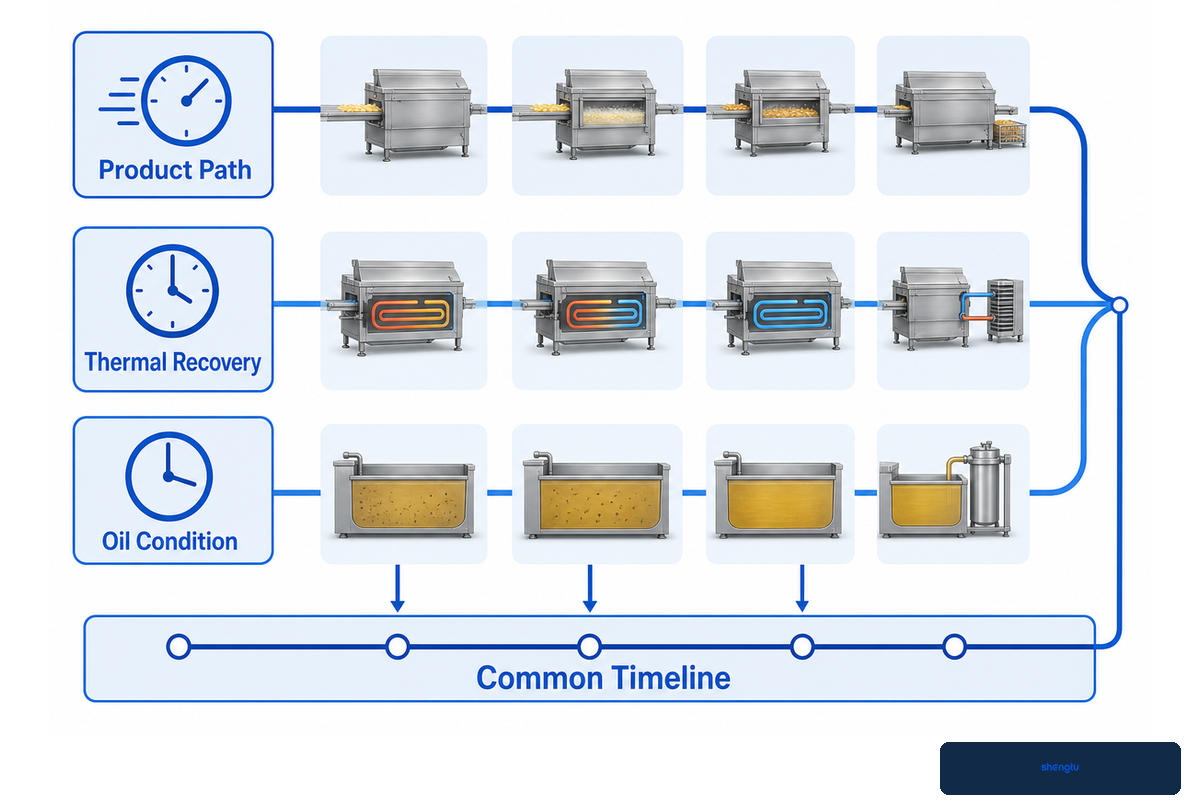
The Three Control Clocks describe the product’s trip through the oil, the oil system’s recovery after load enters and the slower change in oil condition. Operators need all three views because each clock moves at a different rate, and stability in one does not establish stability in the others.
The product clock starts when a defined product unit enters the effective cook zone and ends when it leaves. It includes the spread of actual transit times, not just a speed setting. Floating, submergence, overlap, slippage, belt loading and product geometry can change the path.
The thermal clock indicates what happens after the product and its moisture reach the oil. Helpful evidence includes temperature profile and actual load recovery. An average can cover up a slow zone, cross belt differences or repeated drops after feed surges.
The oil condition clock runs across campaigns and hours of continuous production. The condition of the oil can be impacted by fines, exposure to water and oxygen, turnover and replenishment and history of operation at various temperatures. Filtration can remove particles, but it cannot reverse oxidation, hydrolysis or polymerization.
| Clock | Primary question | Evidence | Common false comfort |
|---|---|---|---|
| Product | How long did real pieces stay in the effective cook zone? | Transit-time distribution, loading, position, product result | The belt-speed display is stable |
| Thermal | How did the oil respond to the actual mass and moisture load? | Zone trace, lowest point, recovery, feed event | The average temperature is on target |
| Oil condition | How is the frying medium changing across the run? | Fines, turnover, replenishment, named analytical checks | The oil looks clear after filtration |
“The dimensions of a fryer are determined by the production rate, frying time and product loading.” Oklahoma State University Extension
Evidence note:Oklahoma State University links production rate, frying time and loading in industrial fryer design. Peer-reviewed research shows that the geometry of the product and oil flow affect spatial uniformity. Use clocks as a measuring device, rather than adhering to a strict recipe. OSU extension; peer-reviewed study
Build a Continuous Fryer Control Window Before Changing a Setpoint
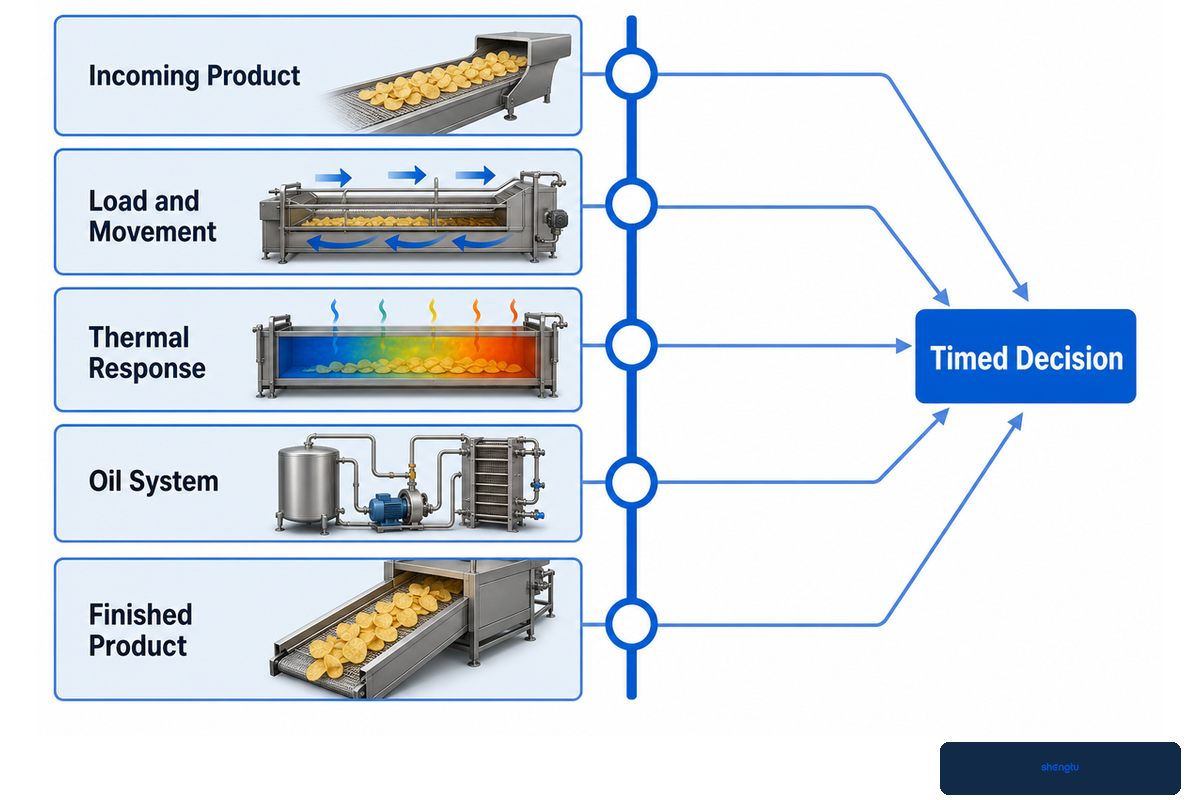
A control window is a synchronous record of product input, process inputs, the response of the fryer and finished product results. Its objective is to relate cause to timing. Without that shared timeline, a team can change belt speed to correct a problem that actually began with feed condition, loading or oil flow.
Start with a single approved product and define the range of conditions the product can come in. Record the identity of the product, lot, mass or geometry distribution, initial temperature, surface condition and coating. Document the feed rate, belt loading pattern, belt speed, effective cook length, level of oil, and agreed upon locations for the temperature control.
Next, line up the response data. Indicate feed starts, rate changes, pauses, alarms, oil additions, filter events and sample times. Record product moisture, color, texture, surface oil and visible defects with the method used. If a method hasn’t been specified, sample position or time hasn’t been given, a given number can’t be evaluated.
| Layer | Fields to freeze | Timed evidence | Decision |
|---|---|---|---|
| Incoming product | Lot, mass/size, temperature, moisture, coating state | Entry samples by time and belt position | Inside trial basis? |
| Load and movement | Feed rate, bed depth, spacing, belt speed, cook length | Actual transit samples and position check | Stable path? |
| Thermal response | Sensor locations, setpoint, oil flow, heater state | Profile, lowest point and recovery after load events | Recovery acceptable? |
| Oil system | Oil identity, turnover basis, filter setup, sampling method | Fines, additions and analytical results | Oil action needed? |
| Finished product | Methods and acceptance criteria | Moisture, color, texture, oil and defects | Release, adjust or investigate? |
Illustrative data-row format only: 6 m cook length; 0.05 m/s belt speed; 120 s estimate; marked pieces at 112 s, 118 s, 123 s, 127 s and 131 s; 100 kg/h and 120 kg/h loads; 175°C baseline; 168°C low; 172°C at 90 s; 175°C at 150 s; 500 g samples at 0 min, 10 min, 20 min and 30 min; 2 mm, 4 mm and 6 mm size bands; 5%, 10% and 15% moisture bands; 1 hr, 2 hr and 3 hr oil checks. Replace every value with approved project data.
Not every available sensor is required to provide a good window. It needs the smallest set that can distinguish product, time, thermal, oil and mechanical causes. Add a signal only when someone owns the measurement and knows what action follows. Decorative data that’s never evaluated should be deleted.
Verify Residence Time as a Distribution
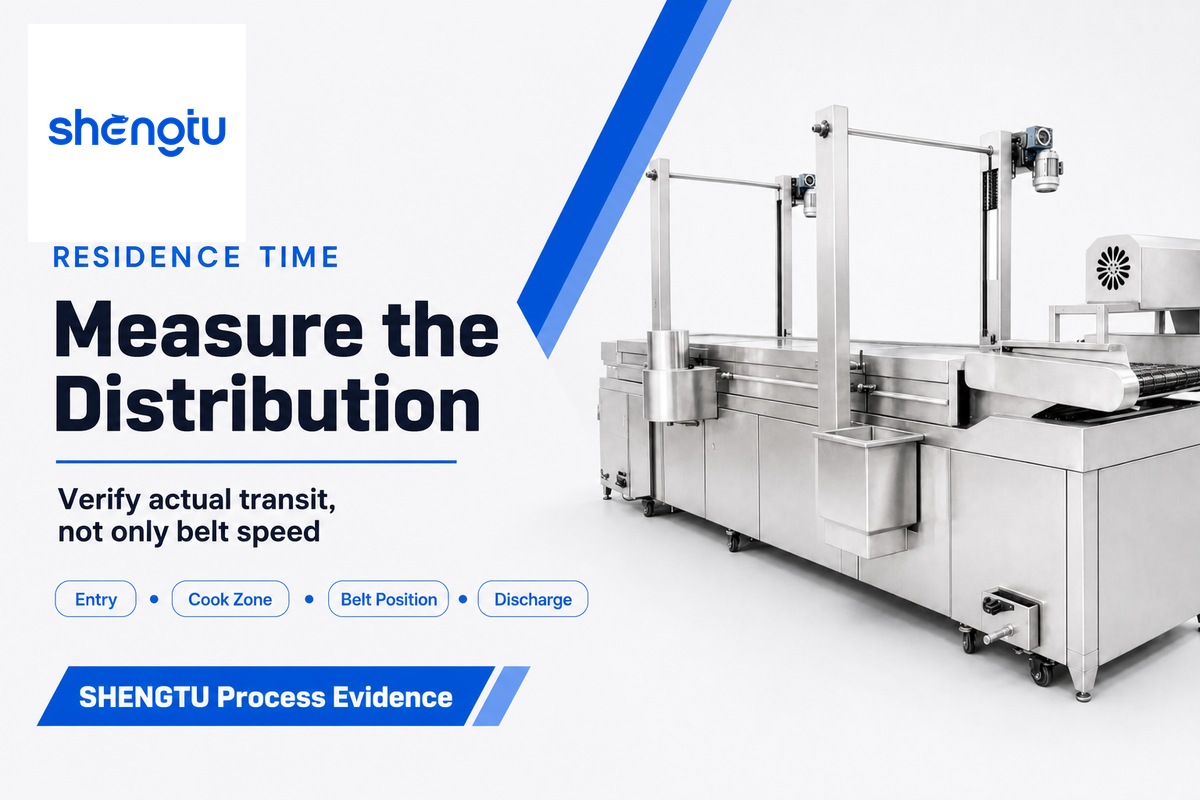
Residence time is the range of actual product transit times through the effective cook zone under a defined load. A single calculated time may miss early or late exits, overlaps, or variation near a sidewall. Verify the distribution with the product and operating case of interest.
The initial estimate is the effective cook length divided by belt speed. It can be used as a prediction. Verify where the cook zone begins and ends, because the physical tank length may include entry, discharge or transition areas that do not expose product to the same conditions.
Use marked pieces, a traceable surrogate or another safe site-approved method to sample transit across time and belt position. Check again at the planned loading pattern. Additionally, in the case of products that float, tumble or require a hold down belt, Path Evidence is required in addition to conveyor movement.
Report location and spread. If one edge repeatedly exits early, changing the average belt speed may shift the entire process while preserving the cross-belt difference. If one edge exits earlier, investigate the difference across the belt before moving the whole process with an average belt-speed change. Loading pattern, belt tracking, product overlap, submergence, oil flow, or obstruction may be the root cause before treating the symptom as a process control problem.
Evidence note: Industrial guidance makes frying time and product loading part of fryer design. Pilot studies demonstrate that product geometry and cross-flow affect distribution and homogeneity. The defensible operating value therefore comes from the actual product path and load, not a copied industry number. OSU Extension; spatial-variation study.
Match Product and Moisture Load to Thermal Recovery
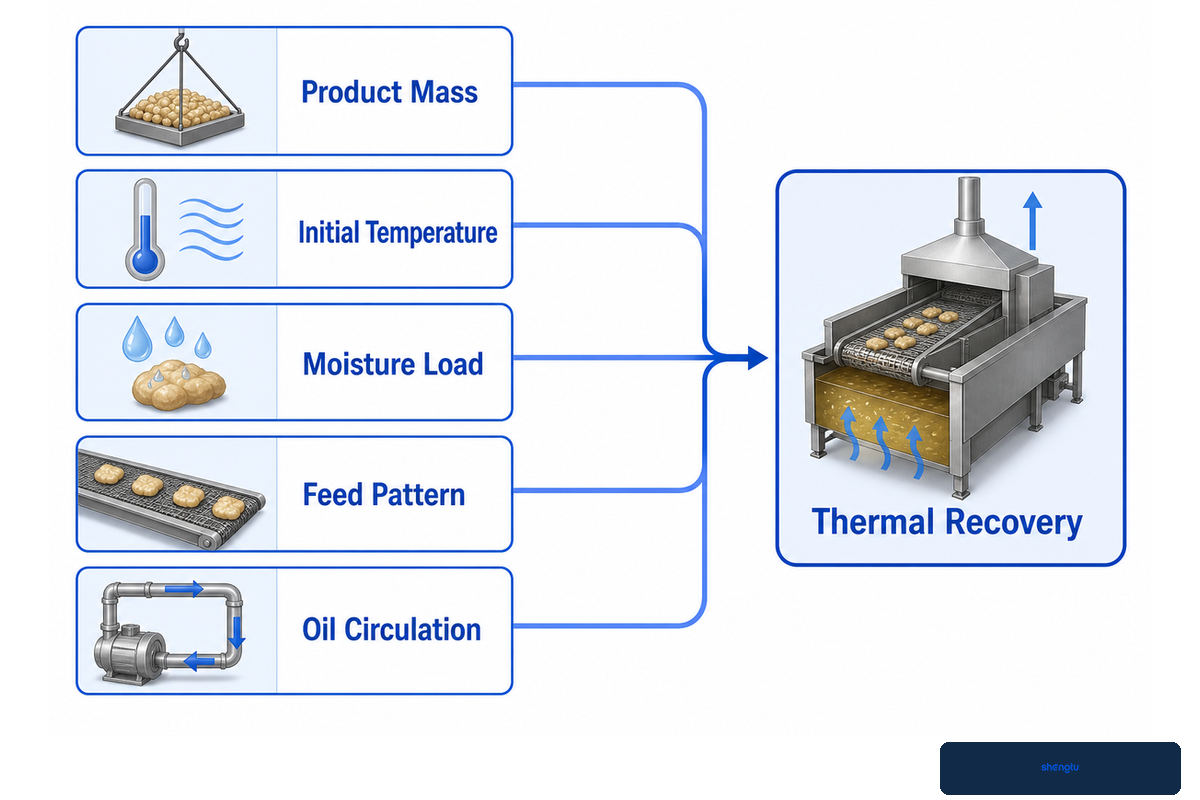
Product mass, initial temperature, water content, feed pattern, and oil circulation affect thermal-energy absorption and latent-heat release. The product zone may experience a deeper or longer disturbance than what’s indicated on the controller.
Trend the temperature at named locations and match the trace with product entry. Capture baseline, minimum, time to recovery and oscillation. If heater setting or control state is available, record that also. Compare runs only when sensor location, sampling interval and product basis are the same.
Loading should be described as a distribution, not just in kilograms per hour. Two runs with the same hourly mass can behave differently if one is evenly spaced and the other is in surges. Moisture adds another dimension because the product releases water as it fries and the evaporation pattern changes through the cook path.
Use finished product to interpret the curve. Factors like moisture, core condition, color and texture can be different and vary with respect to changes in temperature. A recovery trace is a process signal and can’t replace measurement of the product. Cross-belt samples are useful when average data looks stable but product variation persists.
Evidence note: OSU describes the rapid temperature drop after product loading and the need to account for recovery. Peer-reviewed work shows coupled heat and mass transfer, while controlled tests show that core temperature, water loss, oil uptake, color and texture need not move together. OSU Extension; multi-signal study.
Manage Oil State With Filtration, Fines Removal, and Analytical Evidence
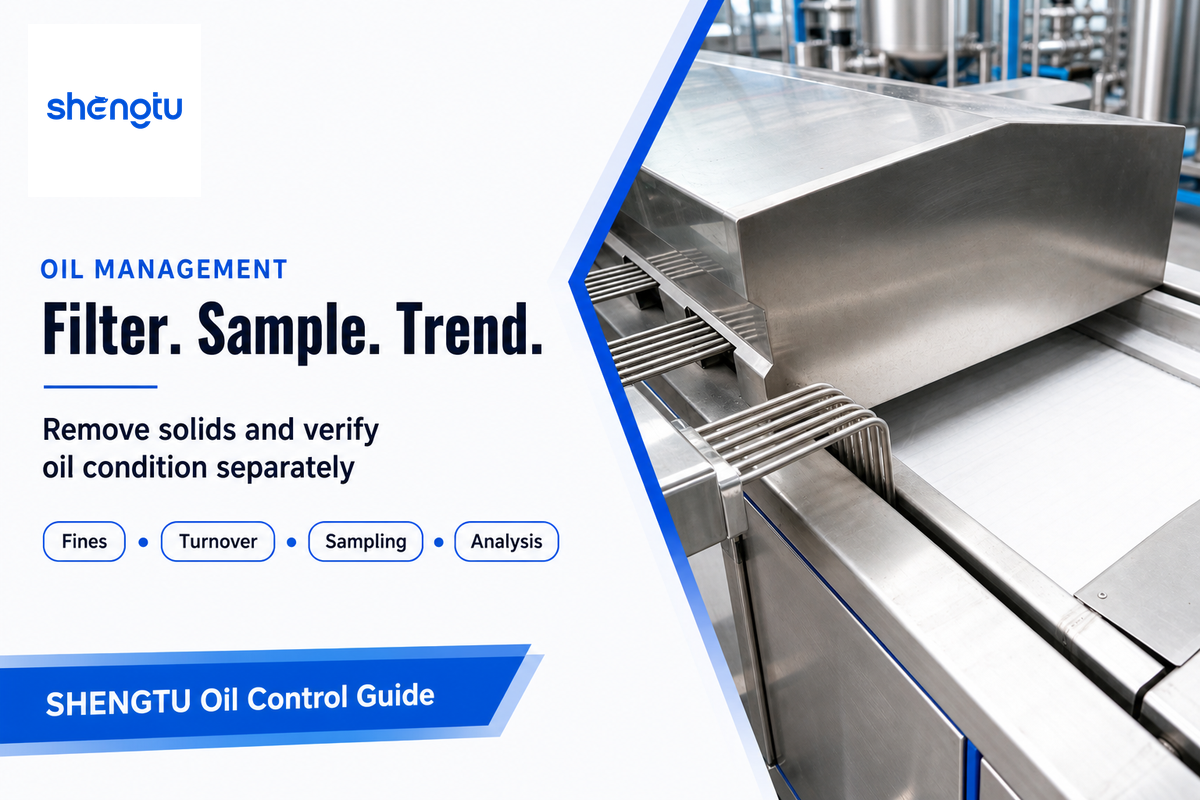
Oil-state control combines solids removal, oil turnover, and named analytical checks. Continuous filtration protects the process by removing crumbs and fines that can burn, darken and increase degradation. It does not restore chemically degraded oil, so visual clarity after a filter cycle is incomplete evidence.
Match the fines-removal method to particle size, amount, hardness and whether particles float or sink. Watch for dead zones, slow circulation, and deposits on the belts, heaters, and return lines. Record filter events and retained solids versus production, product type, and coating loss to see if there’s an increasing burden on the process.
Define oil sampling before setting action rules. Sampling rules must be defined for the conditions of temperature and/or cooling, point of sample, timing, the sample container, how the sample is handled, and the testing method. Free fatty acids, peroxide value, p-anisidine value, and total polar compounds provide information about the oil condition. One value can’t be interpreted as another.
Because primary oxidation products can decompose as oxidation advances, peroxide value deserves particular care and a low result can mislead without secondary-oxidation evidence. It’s best practice to validate site limits against the product, oil, validated plan, method, customer requirements, and applicable regulations.
Relying on rapid and/or remote sensing may increase the frequency of sampling. Treat it as an emerging screening layer until the device is calibrated for the oils and products in use, checked against a reference method and assigned a cleaning and action owner. A digital reading does not remove the sampling and method boundary.
Evidence note: OSU separates fines removal from oil chemistry and warns that peroxide value alone can mislead. AOCS lists several assays and method limitations. Peer-reviewed sensor work supports conditional rapid screening while retaining reference-method and calibration requirements. OSU oil guidance; AOCS; sensor study.
Control Startup, Shutdown, and Production Interruptions
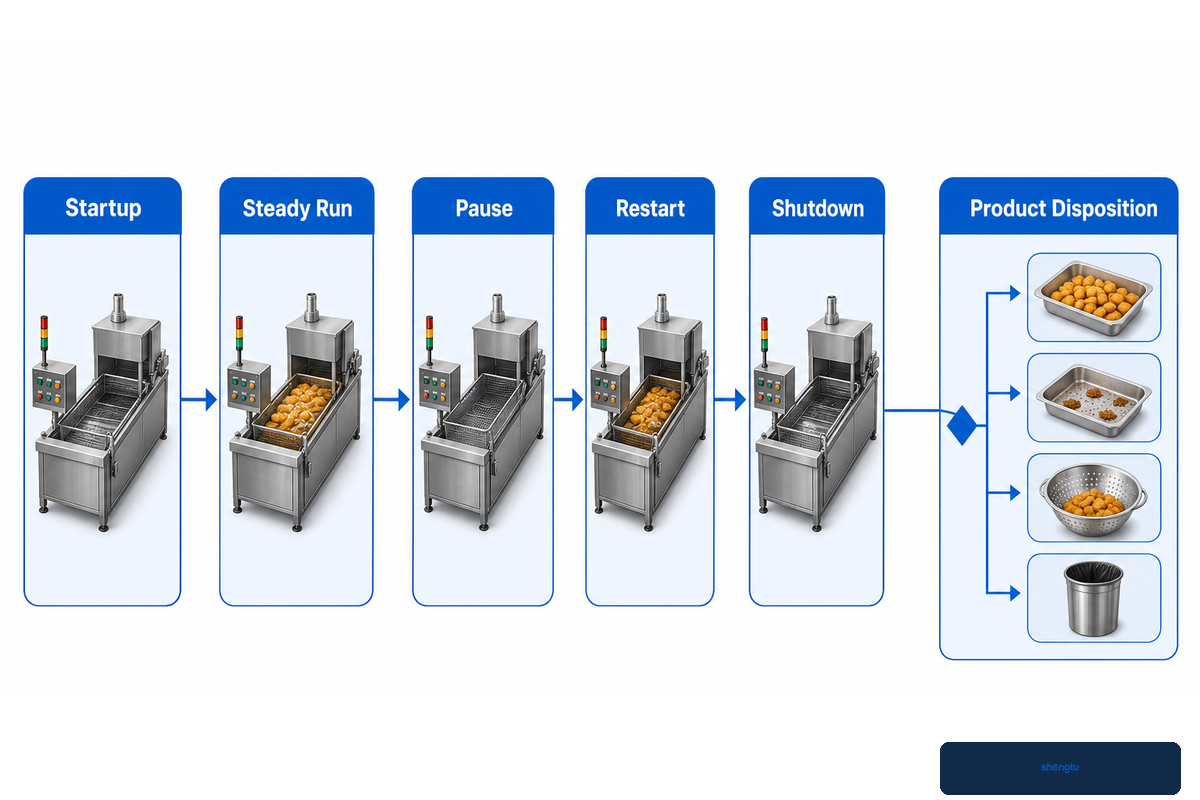
Transient-state control focuses on what occurs during startup, shutdown, and changeover of the unit while oil, circulation, heat, and product flow move toward or away from steady production. Each state has its own explicit site procedure, and the sequence often explains why the approved window is narrow.
At startup, confirm the correct oil, level, circulation path, filter readiness, guards, exhaust and agreed safety functions before product enters. Establish stable flow. Don’t mix startup product with run product; stop or divert incoming product according to the approved procedure. Discard startup product.
During an interruption or shutdown, separate the product being handled from the oil system being handled. Divert or stop incoming product in accordance with an approved procedure. Define who decides whether product already in the fryer is held, evaluated or rejected. Heating, circulation and addition or removal of oil, or cooldown, must be in accordance with the machine instruction manual, site hazard assessment, and trained person responsibilities.
At shutdown, remove product, manage heat input, circulate or transfer oil as specified, handle fines and prepare the system for cleaning or safe standby. At shutdown, record product removal, heat-input state, oil circulation or transfer, fines handling, and preparation for cleaning or safe standby. Don’t rely on a generic time or temperature. Maintain system guards, isolation, lock-out, exhaust, fire protection, and emergency functions under the site, OEM, and applicable-rule boundary.
Evidence note: OSU identifies startups, shutdowns and interruptions as potential sources of oil and product degradation and gives bounded interruptions tied to OEM instructions. The article preserves that boundary and does not replace the OEM manual, site safety program or food-safety plan. OSU Extension.
Diagnose Product Drift With a Defect-to-Signal Matrix
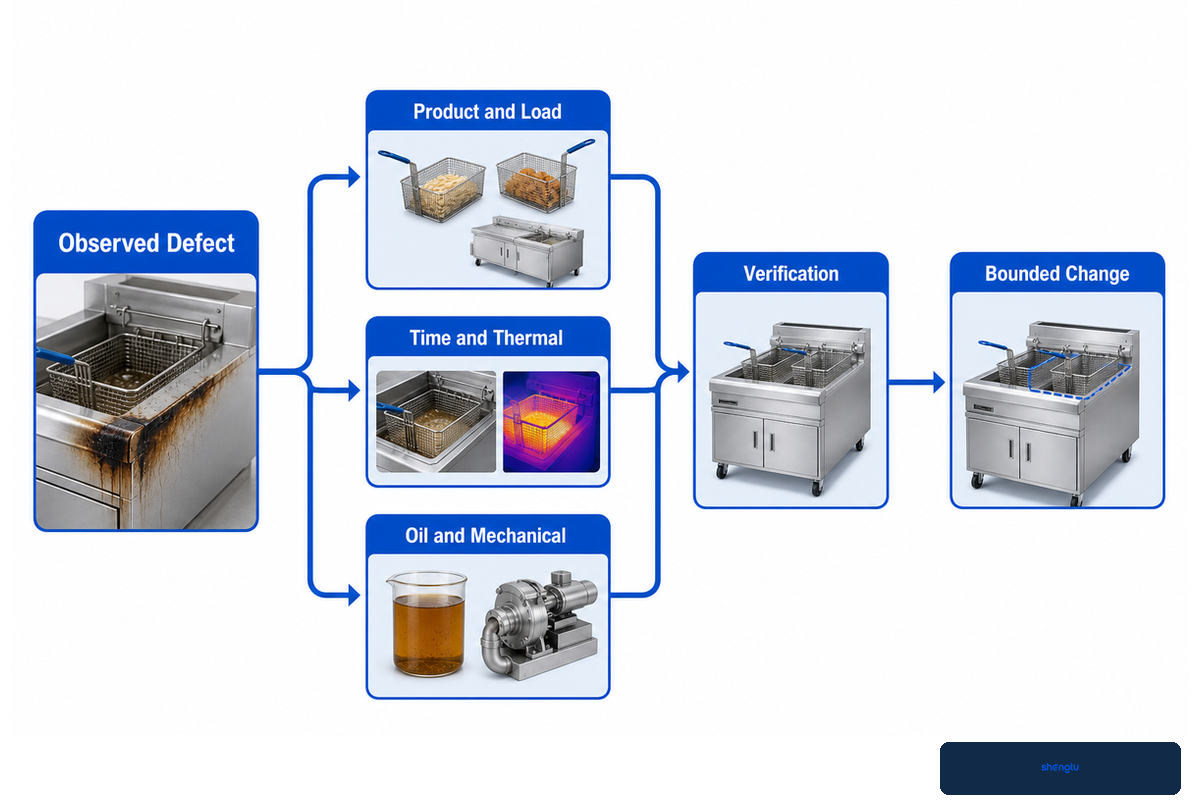
A Defect-to-Signal Matrix identifies an observable problem with a product and transforms it into an ordered investigation. It is a hypothesis and verification map, not a fault tree that proves one cause. Begin with the time and the position on the belt where the defect is observed, and look for product, residence, thermal, oil and mechanical signals within the same window.
| Defect type | Product/load checks | Time/thermal checks | Oil/mechanical checks | Verification |
|---|---|---|---|---|
| Pale or dark color drift | Input temperature, moisture, coating, load surge | Transit spread, zone profile, recovery | Oil sample, fines, position pattern | Repeat matched run and sample by position |
| Uneven moisture or texture | Piece distribution, bed depth, overlap | Actual product path and recovery | Flow distribution, hold-down contact | Cross-belt moisture/texture method |
| Excess surface oil or uptake | Crust/coating state, product moisture | Cook and drain/cool timing | Oil condition, discharge handling | Method-defined product oil result |
| Burnt notes or dark particles | Coating loss and feed debris | Particle residence and heat history | Filter load, dead zones, deposits | Retained-solids and sensory trend |
| Surface damage or contact marks | Geometry, spacing, fragile coating | Entry and transfer timing | Guides, belts, hold-down and discharge | Position-linked observation or video |
| Instability after a feed change | Rate step, lot condition, moisture | Response delay and recovery duration | Control action, flow and accumulation | Return to frozen baseline, one change at a time |
| Foaming or surface instability | Moisture event, product/coating change | Onset time and temperature history | Oil sample, turnover and contamination check | Qualified oil and process review |
| Repeated belt-position pattern | Entry distribution and geometry | Position-specific transit and temperature | Flow, guides, belt tracking and deposits | Mapped cross-belt samples |
Work with the oldest evidence and move to the latest. Check incoming product and load coming off the line before moving product downstream. Thermal response and residence must be proven and verified before a target is changed. Mechanical and oil signals must be verified next. Change one bounded factor, run long enough to observe its response and keep the original baseline available.
Signals must not be substituted for one another. Published frying research demonstrates that core temperature, moisture loss, oil absorption, color and texture may respond in an unpredictable manner; oil absorption may be non-monotonic. The matrix limits the investigation but doesn’t make the release decision for QA or the food-safety owner.
Separate Hygienic Design, Cleaning Execution, and Cleaning Verification
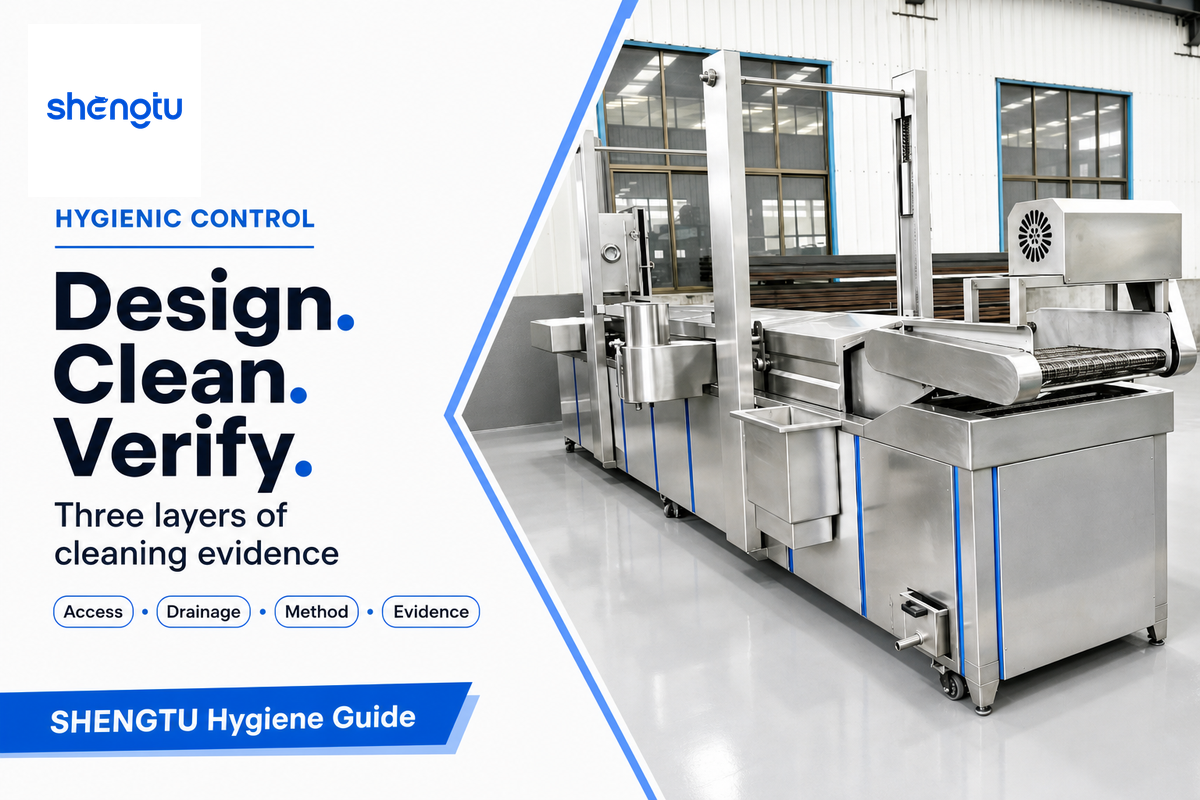
Cleaning evidence has three layers. The first layer is equipment design for the intended cleaning method. The second layer is site execution of the defined cleaning cycle. The final layer is verification of the cleaning result. Polished surfaces may address part of the issue, however a statement that a product is “easy to clean” doesn’t prove a changeover has occurred.
Review the access to fryer pans, belts, hold-downs, oil returns, filters, pumps, heat transfer surfaces, drains, covers, seals, and adjacent areas. Look for areas that retain water, oil or cleaning solution, crumbs and other contaminants. Confirm which components open, lift, remove or require tools, and how the site controls them safely.
The cleaning procedure should name the product boundary, disassembly state, chemistry, concentration, temperature, mechanical action, contact time, rinse, inspection, reassembly and release responsibility.
Verification may include visual inspection, residue or allergen methods, microbiological methods where relevant, and periodic validation by a qualified team.
Facility specific-hazards stay with the facility hazard analysis. Strategies for Acrylamide, raw material precursors, allergen carryover, shared oil, retained product and release criteria can’t be deduced from machine cleanliness alone. For covered U.S. facilities, design of equipment and process conditions should be part of the facility hazard analysis and preventive controls.
Evidence note: EHEDG’s catalogue treats cleaning validation, monitoring and verification as a defined discipline. Current U.S. manufacturing rules require adequately cleanable equipment and facility-specific hazard analysis for covered operations. These sources frame responsibilities; they don’t certify a particular fryer or cleaning cycle. EHEDG; 21 CFR part 117.
Prove Performance With a Fryer Run Evidence Register
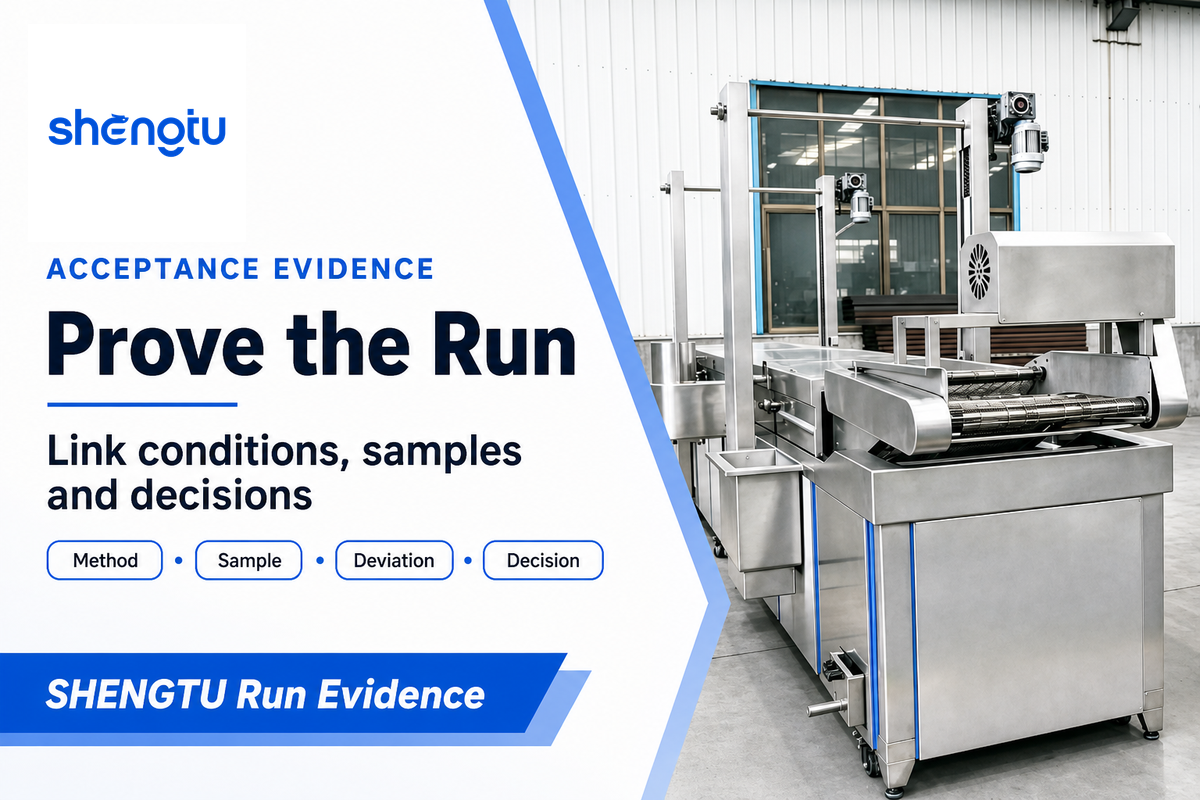
A Fryer Run Evidence Register keeps factory testing, site commissioning and production qualification from being combined into a single approval. Each test answers a distinct question. The register provides necessary structure, but it becomes evidence only when tests align with the actual food, process, method and acceptance criteria.
| Stage | Question | Minimum record | Does not prove |
|---|---|---|---|
| Supplier FAT | Was the agreed machine built and did its functions operate before shipment? | Components, controls, alarms/interlocks, conveyor, circulation, filtration, documents and deviations | Performance with final utilities and routine product |
| Site commissioning/SAT | Is the installed system integrated with actual utilities, interfaces and safety functions? | Installation, utilities, interfaces, safety checks, residence study, temperature map and punch list | Repeatable saleable product across normal variation |
| Production qualification | Can the defined process repeatedly make acceptable product and handle transitions? | Product/load basis, repeated runs, criteria, methods, variability, oil evidence, interruptions, cleaning and deviations | A different product, load, method or untested worst case |
Before testing, define the parameter, acceptance criterion, acceptable variability, measurement method, sampling plan, analysis and relevant worst-case conditions. Name a decision owner for each. During the test, document actual measurements made, name the operator or reviewer, state the product or lot ID (if applicable) and the date and time of measurement.
One good run isn’t enough to claim repeatability. No-load tests may help to validate motion, circulation, or control functions, but they don’t validate product quality. Site acceptance testing can help prove installed integration, but it doesn’t prove the production envelope. If a difference in condition exists from what’s supported in the evidence, qualify that difference or obtain new evidence.
Use deviations and failures as part of your record. Note what changed, whether product was affected, who decided the disposition and how the next run was modified. Don’t remove a failed trial by showing only the last and final settings. The sequence can sometimes provide an explanation for a narrowed accepted window.
Evidence note: CFIA asks whether validation evidence matches the actual food and process and covers parameters, criteria, variability, methods, analysis and worst-case conditions. Current 21 CFR 117.305 requires actual observations and contemporaneous traceability of covered records. Neither source sets universal fryer acceptance criteria. CFIA ; eCFR
Prepare a product-specific fryer trial
Provide product and incoming-state range, target output, utilities, oil plan, cleaning boundary, and acceptance basis. Shengtu can discuss the project configuration based on the information and your site retains responsibility for validated limits and release decisions.
Frequently Asked Questions
How does a continuous frying machine work?
An effective conveyor or controlled product path and oil circulation system with heating and filtering move food through heated oil. The measurement of the actual product path, load, thermal response, oil condition, and finished-product result must be integrated to provide useful product control.
How do you calculate residence time in a continuous fryer?
A good starting point is effective cook length divided by belt speed, which gives the theoretical transit time. Various factors can lead to actual product transit times having a wider distribution than the expected or planned estimate, so verify the result with real product under the planned load. Those factors include floating, product overlap, slippage, shear, hold-down contact, and differences in the product path, so record their measured spread across time and belt position as well as the average.
Does filtration extend frying-oil life?
Filtration can remove crumbs and other suspended solids that can burn and add degradation pressure, but it can’t reverse oil degradation. Oxidation, hydrolysis, and polymerization continue despite filtration. Decisions about oil and sample analysis still require defined sampling, named analytical methods, and site-specific action criteria.
What causes color variation in a continuous fryer?
Variability can be caused by differences in incoming product state and temperature, moisture, coating load surges, thermal recovery, oil condition, cross-belt flow, mechanical handling, and transit time. Compare aligned signals before changing a setpoint. One visible defect doesn’t prove one cause.
What should be checked during FAT and SAT?
FAT should confirm the agreed-upon build, function, controls, and document set prior to shipment. SAT should confirm installation, utilities, interfaces, and site functions. Production qualification then validates the repeatability of the product’s performance against defined criteria related to the food, load and process method.
Where can I compare models, specifications and project options?
Use Shengtu’s continuous fryer solution page for machine configurations and quotations. Provide the product, incoming-state range, required output, utilities, oil plan, and cleaning boundary, and proposed acceptance evidence, prior to the discussion. This separates configuration questions from process-development work and gives both sides a shared basis for trial evidence. See About Shengtu Machinery for the company and manufacturing context, and review the frying and coating equipment category for adjacent line context.
References and Source Boundaries
References & Sources: The following documentation supports process mechanisms, evidence types and regulatory scope. These sources don’t certify a Shengtu machine, approve a site process or set universal operating limits. Supplier and patent literature is used for background only unless otherwise noted.
- Oklahoma State University: Industrial Deep Fat Frying
- Oklahoma State University: Edible Oil Quality
- Peer-reviewed review of chemical changes in deep-fat frying
- Peer-reviewed spatial-variation study
- Peer-reviewed multi-signal frying study
- AOCS: Frying-oil chemistry and analytical assays
- EHEDG guideline catalogue
- CFIA: inspection of evidence that control measures are effective
- 21 CFR part 117
![F&V Freeze-Drying Line Process Guide [2026]](https://shengtumachinery.com/wp-content/uploads/2026/09/fv-freeze-drying-line-guide-featured-768x512.png)
![Beef/Lamb/Poultry Cutting Line Acceptance Guide [2026]](https://shengtumachinery.com/wp-content/uploads/2026/09/beef-lamb-poultry-cutting-line-guide-featured-768x512.png)