Get in touch with Shengtu Bufan Company

Project-Specific Quality Review
Extrusion Equipment
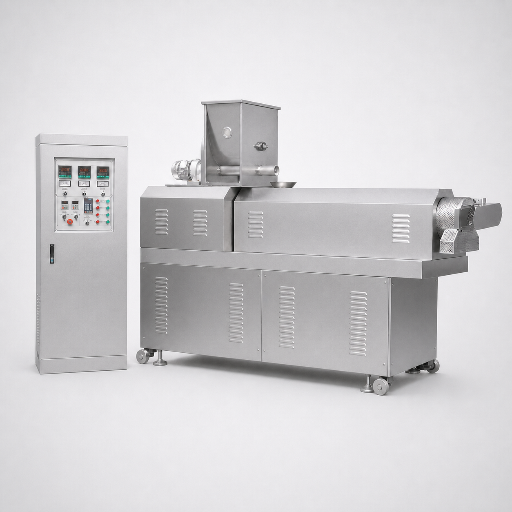
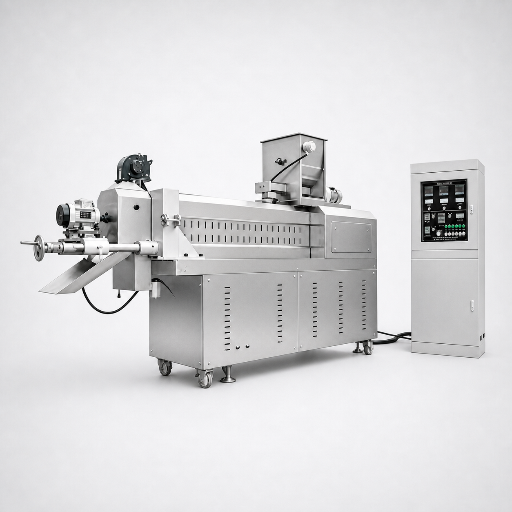
Food Extruder Machines, Twin-Screw Extrusion Equipment for Snack, Pet Food, Cereal and Aqua Feed Lines
Shengtu builds twin-screw food extruders and the stations around them, from the mixer at the front to the packer at the end. Tell us the product and the kilograms per hour, and an engineer sizes the machine against your recipe rather than against a catalogue.
- Four models, 100–500 kg/h
- Build in 30–40 working days
- 30% T/T deposit
- One set is the order minimum
Your recipe, product photographs and target output stay between you and our engineering team. We don’t publish or reuse customer formulations.
Click to Switch
100–500
Kg/h Output Range
30–40
Days Build Time
100%
Recipe Engineered
ISO
Equipment Documentation
Extrusion Capability at a Glance
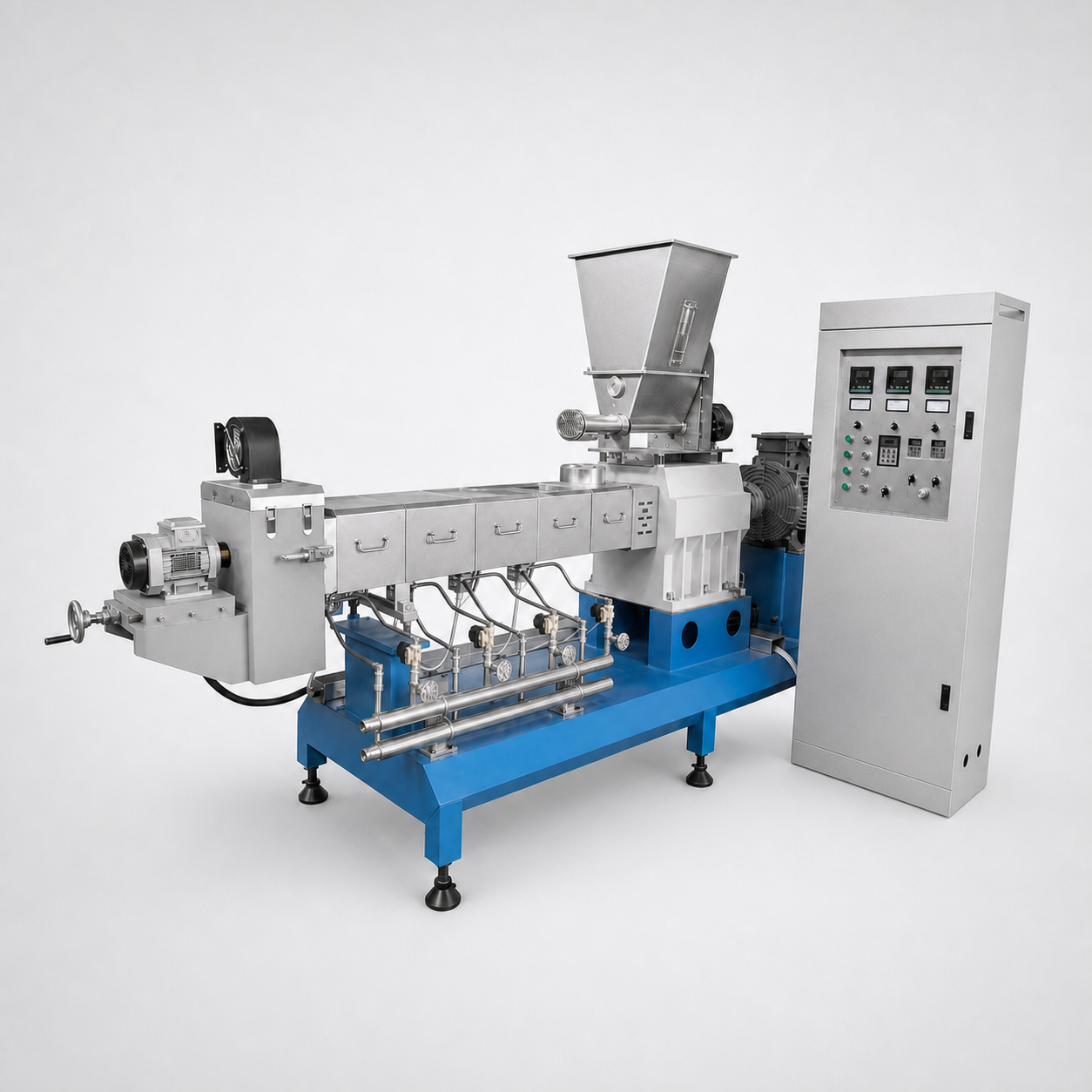
A food extruder is a twin-screw machine that mixes, cooks and shapes food or feed in one continuous pass, and Shengtu builds four of them, from 100 to 500 kg/h. Cooking happens in the screw through shear and pressure, shape comes from the die, and length comes from the cutter.
100–500 kg/h
Four twin-screw models. The LY65 covers pilot and small-plant volumes, the LY85 covers full production.
65 mm to 85 mm screws
Twin intermeshing screws in 65, 70, 75 and 85 mm, with screw lengths from 1,050 mm to 2,150 mm.
22–75 kW main drive
Inverter-controlled on the LY65, LY70 and LY85. Barrel heating is zoned, 10–26.4 kW depending on model.
food-grade 304 stainless steel
Machine construction throughout, the grade the food-contact metal regimes are written around, from FDA 21 CFR Part 177 to GB 4806.9.5
five pre-shipment tests
No-load run, loaded simulation, temperature-control stability, core-component inspection and full-line linkage, on every machine.
Warranty terms confirmed in the quotation and contract
Response times, remote support, on-site service and spare-parts arrangements are confirmed in the quotation and contract.
Nine stations
Mixing, feeding, preconditioning, extrusion, cutting, drying, seasoning, cooling and packing, supplied as one line or as single machines.
For related planning details, see the food extrusion equipment guide.
Recipes designed with you
We set the formula and extrusion parameters with you and tune them again during commissioning.
The Extrusion Line, Station by Station
An extruder on its own makes a shape. A line makes a product. These are the nine stations we build and integrate, in the order material moves through them.
Mixing and automatic feeding
Dry ingredients are blended and then metered into the extruder at a controlled rate. Feeding runs on its own inverter-controlled drive, 0.75 kW on the LY65 and LY70 and up to 2.2 kW on the LY75, so feed rate can be trimmed without touching screw speed.
Anti-bridging geometry in the hopper matters more than feeder power. A hopper that bridges starves the barrel, and a starved barrel reads on the panel as a screw speed problem when it’s a powder-flow problem.
Preconditioning, and when you can skip it
Preconditioning adds steam and water to the dry mix in a paddle chamber before the material reaches the screw. NC State Extension puts the mixing time at two to four minutes and describes the effect plainly: the raw material moves from a glassy state to a rubbery one, starch begins to gelatinise, and the extruder then needs less mechanical energy to finish the job.1
There’s a threshold worth knowing before you pay for the station. Below roughly 18% process moisture, preconditioning can be left out, and low-moisture highly expanded products such as corn puffs are the classic case.1 Above 18–20% moisture, leaving it out means raising barrel temperature, shear or the length-to-diameter ratio to reach the same cook, and that route brings dextrinisation and scorching with it.1
Two operating details from the same source save recurring trouble. Oil and other liquid additions go in near the discharge end, because oil added early coats the particles and blocks water uptake. Meat slurry has to be metered accurately, because clumps show up downstream as surging and out-of-spec pieces.1
Twin-screw extrusion
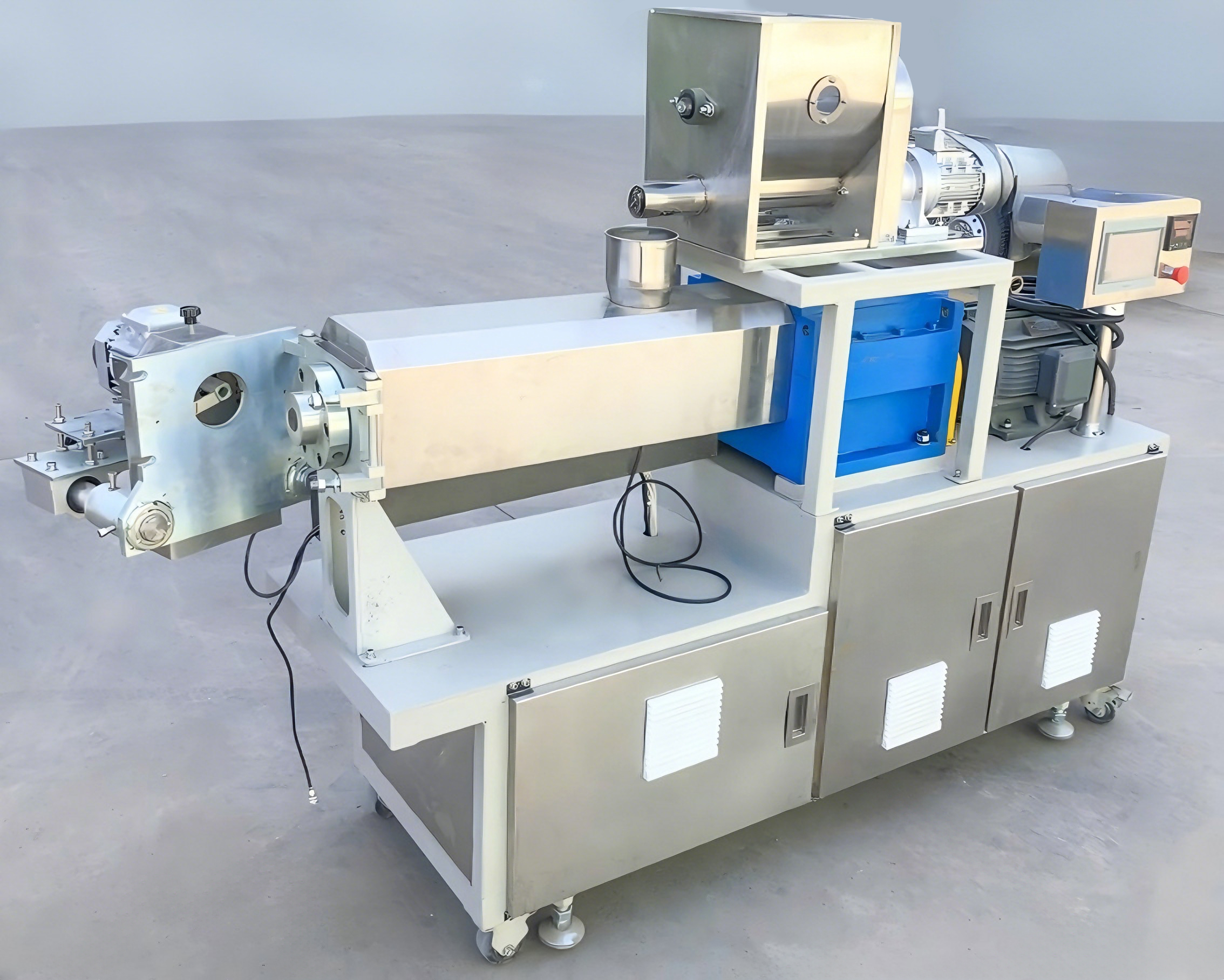
Two intermeshing, co-rotating screws convey, mix and cook in the same barrel. Cooking energy arrives two ways: mechanically, through shear from the screws, and thermally, through the zoned barrel heaters. Mechanical energy from the screws is what the industry calls specific mechanical energy.
In twin-screw practice the working length is made up of screw elements whose pitch and profile decide where the material is conveyed, where it’s mixed and where pressure builds. The Wenger patent describes exactly this, a disrupting and homogenising section built from alternating right-hand and left-hand pitch parts.2 Torque, not rated power alone, is what the gearbox has to deliver into that geometry.
Nothing about that concept is ours. A Wenger Manufacturing patent on mid-barrel restriction defines high specific mechanical energy extrusion as a single or twin extruder with an upstream preconditioner, and reports run values between 45 and 60 kW·h per tonne.2 That’s the mechanical component alone, and it’s the number a process engineer optimises through the whole extrusion process.
Cutting and forming
A variable-speed face cutter sets piece length at the die. Cutter drives are inverter-controlled at 0.75 kW on the smaller models and 1.5 kW on the LY85. Shape comes from the die plate, so a new product usually means new tooling rather than a new machine.
Hot-air drying
Multi-layer hot-air drying brings moisture down to a storable level after expansion. This station is the one most often undersized, and a dryer that can’t keep up caps the whole line no matter what the extruder nameplate says.
Seasoning, oil spraying and cooling
A rotating drum applies oil and seasoning powder; a cooling section brings the product to packing temperature so it doesn’t sweat inside the bag. Both stations are optional in the strict sense and decisive in the commercial sense, because they’re where flavour consistency is won or lost.
Automatic packing
Weighing and bagging closes the line. We supply it as part of a turnkey scope or leave the interface open if you already run a packer.
Raw Materials and Recipes This Line Runs
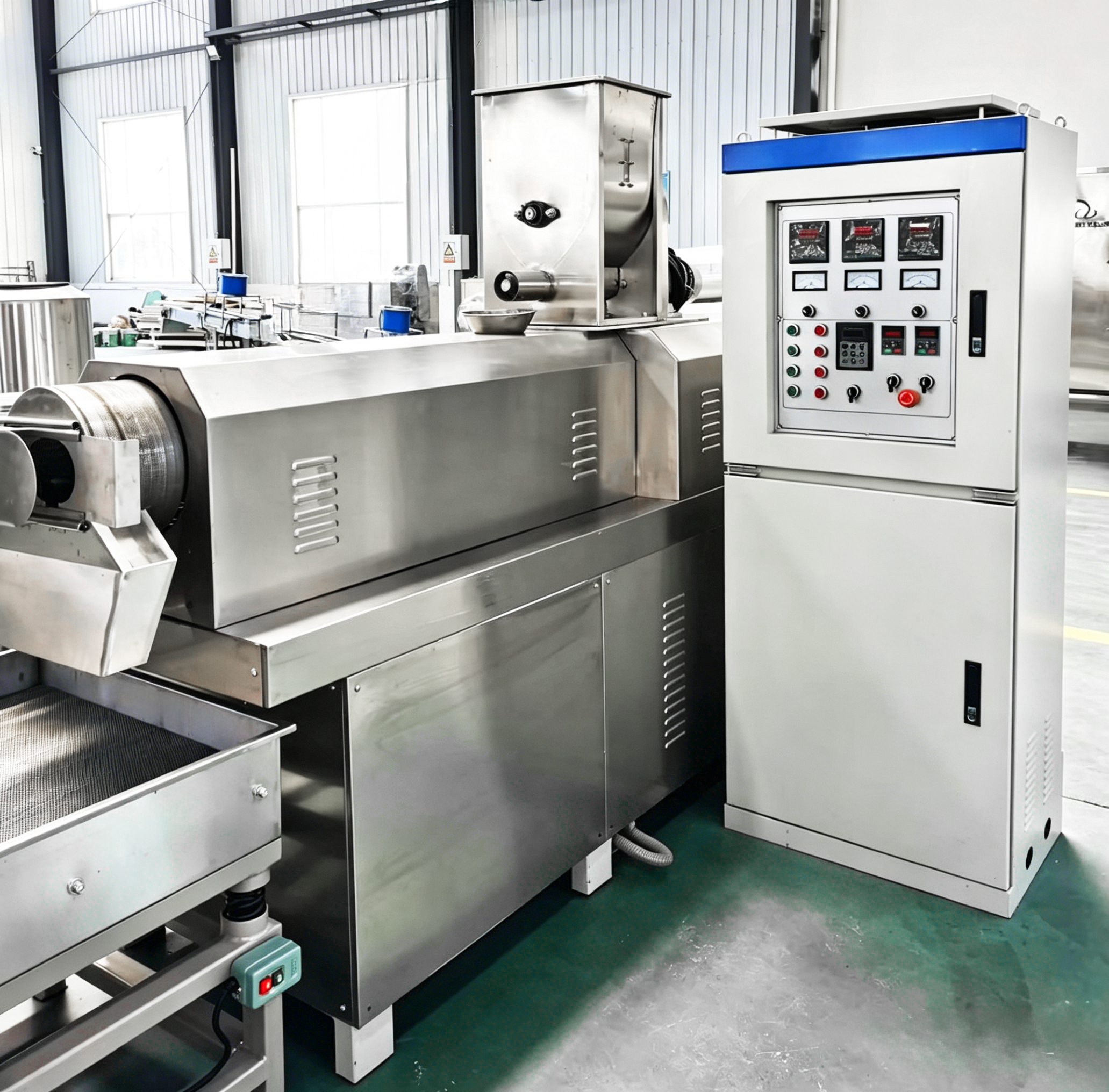
Extrusion is a formulation process before it’s a machine process. These are the material families the line is built to handle, with the property that governs how each behaves in the barrel.
| Material family | Behaviour in the barrel | Products it makes |
|---|---|---|
| Corn grits and corn flour | High starch, expands readily at low moisture | Corn puffs, curls, extruded snack sticks |
| Rice flour | Fine texture, clean colour, low fat | Rice-based crisps, gluten-free snacks |
| Wheat flour and semolina | Gluten network gives cohesion rather than expansion | Pasta pre-forms, snack pellets, bread crumb |
| Corn and wheat starch | Pure starch, gelatinises fast under shear | Modified starch, binder, pellet snacks |
| Oat and barley flour | Higher fibre, lower expansion, needs more moisture | Breakfast cereal, high-fibre extruded products |
| Bran and cereal fibre | Abrasive, raises wear on screws and dies | Fibre-enriched cereal and snacks |
| Material family | Behaviour in the barrel | Products it makes |
|---|---|---|
| Soya protein and defatted soy flour | Protein texturises under shear and moisture | Textured vegetable protein, soy chunks, meat extenders |
| Pea and blended plant protein | Fibre alignment depends on shear history | Plant-based meat pre-forms |
| Meat meal and poultry meal | Fat content raises lubricity and lowers shear | Dry pet food kibble, treats |
| Fish meal | Needs controlled temperature to protect nutrients | Floating and sinking aqua feed |
| Fresh meat slurry | Added at the preconditioner, must be metered accurately | High-meat-content pet food |
| Functional additives, vitamins and colours | Heat-sensitive, usually dosed after the die or in the coater | Fortified cereal, functional snacks, nutritional pet food |
Dies, Shapes and Downstream Finishing
Die and finishing train decide what the buyer sees. Repeatability is decided by the extruder.
Round and Hollow Dies
Sticks, tubes, rings and curls. The workhorse geometry for corn and rice snacks.
Shaped Dies
Stars, shells, animal shapes and letters, cut at the face to length.
Kibble Dies
Round, cross, bone and fish shapes for dry pet food and treats.
Aqua Feed Dies
Sized for floating or sinking pellets; density is set by moisture and die pressure, not by the die alone.
Texturised Protein Dies
Slot and cooling-die arrangements for soy chunks and fibrous plant protein.
Hot-Air Drying
Multi-layer circulation with independent temperature control, sized against the extruder’s output rather than against its model number.
Oil Spraying and Seasoning
Rotating drum with metered oil and powder dosing for even coverage at speed.
Cooling
Brings product to packing temperature so moisture does not condense inside the bag.
What the Die Actually Controls
Die geometry and the restriction ahead of it set the pressure the material sees at the exit, and pressure together with moisture is what decides whether an aqua feed pellet floats or sinks. It’s the same variable the Wenger patent manipulates deliberately with a mid-barrel restriction valve to raise specific mechanical energy without adding thermal energy.2
Contrary to the usual sales framing, a wider die isn’t a route to more output. Open more area and pressure falls, expansion falls with it, and the product changes rather than the tonnage. Output belongs to screw speed, feed rate and the drive; shape and density belong to the die.
Drying is the station that most often decides the finished moisture, and NC State Extension’s account of preconditioning is the reason why: material that arrives at the die already hydrated leaves with more water to remove.1 Size the dryer against the extruder’s output, not against its model number.
Tooling is the cheapest way to add a food product. A new die and a cutter setting will usually get you a new shape on the same extruder, which is why we quote dies separately from the machine.
Our line is modular in the same spirit. Take the extruder alone, take it with drying, or take the full train through to packing, and add a station later when a new food products range justifies it. What decides the final product is the combination of recipe, die and process parameters, not any single machine in the row.
Four Models from 100 to 500 kg/h
Every figure in this table comes from our own machine specifications. Where a value isn’t settled, the row is absent rather than estimated.
| Specification | LY65 | LY70 | LY75 | LY85 |
|---|---|---|---|---|
| Throughput | 100–150 kg/h | 200–260 kg/h | 250–350 kg/h | 400–500 kg/h |
| Screw diameter | 65 mm (2.56 in) | 70 mm (2.76 in) | 75 mm (2.95 in) | 85 mm (3.35 in) |
| Screw length | 1,050 mm (41.3 in) | 1,699 mm (66.9 in) | 2,150 mm (84.6 in) | 1,650 mm (65.0 in) |
| Screw configuration | Twin, intermeshing | Twin, intermeshing | Twin, intermeshing | Twin, intermeshing |
| Main drive | 22 kW, inverter | 45 kW, inverter | 75 kW, 4-pole | 75 kW, inverter |
| Feeder drive | 0.75 kW, inverter | 0.75 kW, inverter | 2.2 kW, 4-pole | 1.5 kW, inverter |
| Cutter drive | 0.75 kW, inverter | 0.75 kW, inverter | 2.2 kW, 4-pole | 1.5 kW, inverter |
| Specification | LY65 | LY70 | LY75 | LY85 |
|---|---|---|---|---|
| Oil-pump drive | 0.37 kW | 0.37 kW | 0.75 kW | 0.37 kW |
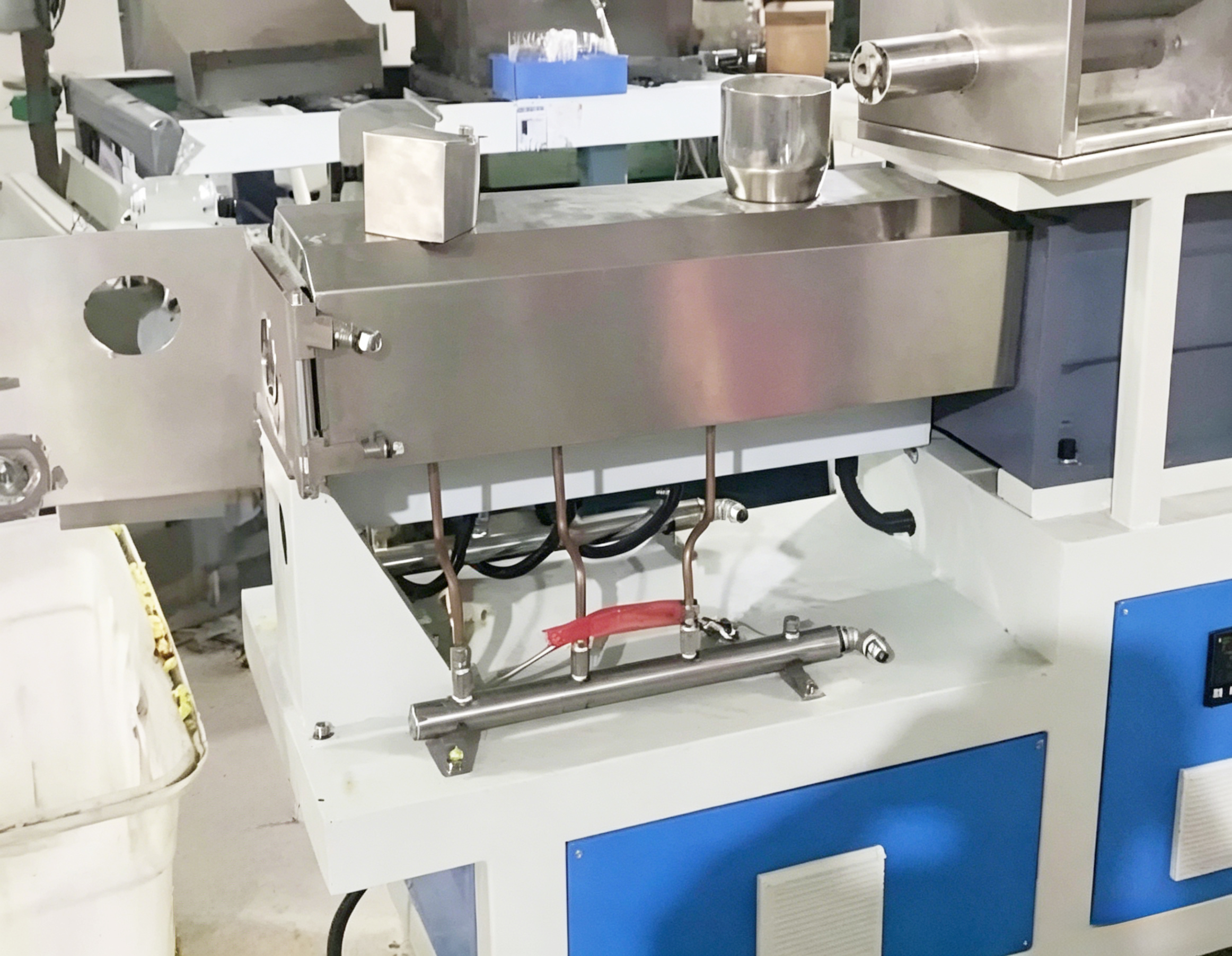
| Barrel heating | 10 kW (5 × 2 kW) | 14 kW (7 × 2 kW) | 26.4 kW (12 × 2.2 kW) | 21 kW (7 × 3 kW) |
| Installed power | 33.87 kW | 60.87 kW | 106.55 kW | 99.37 kW |
| Running power | 25–28 kW | 33 kW | 85–90 kW | 55–65 kW |
| Supply | 380 V / 50 Hz | 380 V / 50 Hz | 380 V / 50 Hz | 380 V / 50 Hz |
| Model | Running power | Throughput | Total running power per kg |
|---|---|---|---|
| LY65 | 25–28 kW | 100–150 kg/h | 0.17–0.28 kWh/kg |
| LY70 | 33 kW | 200–260 kg/h | 0.13–0.17 kWh/kg |
| LY75 | 85–90 kW | 250–350 kg/h | 0.24–0.36 kWh/kg |
| LY85 | 55–65 kW | 400–500 kg/h | 0.11–0.16 kWh/kg |
Reading the Two Energy Numbers in an Extruder Quote
Any extruder quotation can put an energy figure in front of you, and it will be one of two different quantities. One is total running power per kilogram, everything the machine draws at rated output. Other is specific mechanical energy, only the work the screws put into the material. A quote that doesn’t say which one it means has told you nothing.
Divide the running-power row by the throughput row and you get the first number, the one that turns up on an electricity bill. We publish it because a buyer can check it against our own specifications and against their own tariff.
This isn’t specific mechanical energy, and the two shouldn’t be compared. The figures above cover everything the machine draws at rated output: main drive, feeder, cutter, oil pump and barrel heaters. Specific mechanical energy counts only the mechanical work the screws put into the material, and the Wenger patent reports run values of 45 to 60 kW·h per tonne for that quantity.2 A vendor quoting one against the other is comparing different things.
Two things are visible in the table itself. Across the range the LY85 is the most economical per kilogram. The LY75 sits at the other end, and it also carries the most heating zones in the range at 26.4 kW across twelve bands, and the longest screw at 2,150 mm.
×
![Enlarged Equipment View]()
Build Quality and Pre-Shipment Testing
Every machine passes five pre-shipment tests before it leaves the works, and none of them is a paperwork exercise.
01
Running the machine empty confirms stable rotation and clean starts and stops across conveying, main drive and control system.
02
Under simulated production conditions, continuously, we watch how it behaves once material is in the barrel.
03
Heating system and control loop are checked for accuracy across the zones.
04
Motor, gearbox, screws and bearings get checked item by item.
05
Everything from infeed to finished product runs as one sequence, not station by station.
Works tests are run in that order because the failure modes stack: a control fault found under load is a different problem from a bearing fault found at rest, and finding them in the wrong sequence means stripping the machine twice. Shengtu runs the loaded simulation before the component inspection for that reason, not for form.
Company records: Request the current holder, scope and validity details.
Equipment conformity: Confirm the documents for the model, configuration and destination country.
Order documents: Agree inspection records, manuals, drawings and shipment paperwork in the contract.
Materials and the standards that govern them
Machines are built in food-grade 304 stainless steel. Rules defining what “food-grade” means for a metal are FDA 21 CFR Part 177 in the United States, Regulation (EC) 1935/2004 in the European Union, and GB 4806.9 in China, which replaced GB 9684-2011 for metallic materials in food application.5 We name the material grade and the regimes it is chosen against, and we leave certification claims to the documents that carry them.
Company certifications
Applicable certificates and documents are confirmed for the equipment model, configuration and destination country. Company management-system records are reviewed separately from product conformity documents.
Request current company management-system records and any applicable DCMM assessment for supplier review. A management-system certificate or data-management assessment does not establish machinery safety or conformity for an individual model.
Support after the machine is running
Buyers of Chinese equipment describe the same failure pattern in public: thin troubleshooting support, missing documentation, and a time difference that turns a one-hour problem into a three-day problem.6 The response process, responsibilities and timing need to be agreed in writing.
Two of those complaints are about paperwork rather than steel. Documentation that never arrives, and a language barrier that turns a one-hour problem into a three-day problem, are the failures buyers name most often, and neither is fixed by a better machine.
Response times, remote support, on-site service and spare-parts arrangements are confirmed in the quotation and contract. Warranty duration, coverage and exclusions are confirmed in the quotation and contract. Confirm the recommended screws, dies, bearings and control components in the spare-parts list.
Products This Line Makes
The application spread below is the one the trade press describes for twin-screw work: pasta, textured vegetable protein and oily foods on the twin-screw side, plain kibble work still going to single-screw machines.3
Snack and puffed food
Corn curls, sticks, rings and filled snack shapes from corn grits, rice flour and blends. This is the low-moisture, high-expansion end of the range, and it’s the case where preconditioning can often be left out.
Breakfast cereal and corn flakes
Extruded cereal shapes and flake pre-forms, with the drying and coating train that turns them into a finished cereal.
Pet food and aqua feed
Dry kibble and treats from meal-based recipes, and floating or sinking aqua feed where pellet density is set by moisture and die pressure. High-meat recipes take the meat slurry at the preconditioner.
High-moisture and plant-based protein
Textured vegetable protein, soy chunks and plant-based meat pre-forms, where the fibre structure created in the barrel is the product and must survive everything downstream.
Pasta, bread crumb and starch products
Pasta and macaroni pre-forms, extruded bread crumb, modified starch and fortified rice, all on the same machine family with different tooling.
Functional and fortified products
Vitamin-enriched cereal and nutritional pet food, where heat-sensitive additives are dosed after the die or in the coater rather than into the barrel.
Where this page sits among extruder types
Searches in this category split by application rather than by machine, which is why the same barrel turns up as a pet food extruder, a cereal extruder, a fish feed extruder machine and a puffed food extruder in four different catalogues. Contrary to how those catalogues read, they’re usually the same twin-screw platform with different tooling and a different downstream train.
Buyers comparing food extruder manufacturers often start from an extruder machine for pet food and end up specifying a cereal production line, or the reverse. The principle of extrusion cooking doesn’t change between them; the recipe, the moisture and the die do.
Turnkey scope
Single machines, a single-layer or multi-layer line, semi-automatic or fully automatic, or a whole-plant scope with layout planning. The line covers mixing, feeding, preconditioning, extrusion, cutting, drying, seasoning, cooling and packing.
Where Extrusion Is Not the Right Process
Four cases where we would tell you to buy something else, or to buy less. In practice the honest answer to an enquiry is sometimes a smaller quotation than the one you asked for.
01
One stable recipe, no changes
A twin-screw machine buys you recipe flexibility and costs you capital, and a single-screw machine is not a substitute for it when the recipe changes weekly. On one fixed product the reverse holds: the second screw buys you nothing, a single-screw machine does the job for less, and suppliers across this market say so. Alternative: a single-screw extruder sized to the same output.
02
Wet pet food and retort products
Extrusion cooks and shapes a plastic mass. Canned and pouched wet food is a filling, seaming and sterilising route. Alternative: a retort line, which is a different family of equipment.
03
Heat-sensitive actives in the barrel
Probiotics, some vitamins and delicate colours do not survive barrel conditions. Alternative: dose after the die, in the coater or in the spray step.
04
Buying capacity you cannot feed or dry
A larger extruder in front of an undersized dryer produces a bigger queue, not a bigger output. Alternative: size the constraint station first, then the extruder.
Frequently Asked Questions
What is a food extruder and what does it do?
A food extruder forces a mixed, moistened food or feed material through a heated barrel with one or two rotating screws and out through a shaped die. Mixing, cooking and shaping happen in one continuous pass, which is why one machine replaces several batch steps.
What counts as an extruded food?
Any product cooked and shaped in the barrel rather than assembled afterwards: puffed snacks, breakfast cereal, kibble, aqua feed pellets, textured protein and pasta pre-forms are all extruded food in that sense. Extrusion works the same way in each case; recipe, die and parameters are what differ.
What is the difference between a single-screw and a twin-screw food extruder?
A single-screw machine mainly conveys and melts. Twin intermeshing screws add real mixing capability, tolerate wider moisture and fat ranges, and handle recipe changes without retooling the process. The trade-off is capital cost.
How do I choose an extruder for 100 to 500 kg per hour?
Fix the product first, then the hourly output, then check the stations either side of the extruder. Within our range the LY65 starts at 100–150 kg/h and the LY85 covers 400–500 kg/h; the model matcher above walks the same path.
Does a bigger extruder mean a bigger line output?
Not on its own. If the preconditioner in front or the dryer behind can’t take the new flowrate, the extra extruder capacity doesn’t reach the packer.8
What raw materials can this line run?
Corn, rice, wheat and oat flours, starches, bran and cereal fibre, soya and pea protein, meat and fish meal, fresh meat slurry at the preconditioner, and functional additives dosed downstream. The materials table above lists how each behaves in the barrel.
Can one extruder make more than one product?
Yes. That’s the main argument for twin screws.
Can it process fresh meat or high-fat ingredients?
Fresh meat slurry goes in at the preconditioner and has to be metered accurately, because uneven mixing shows up downstream as surging and out-of-spec pieces.1 High fat lowers shear, so screw configuration and moisture are adjusted rather than assumed.
What is extrusion cooking and how is it different from cold forming?
Extrusion cooking gelatinises starch and denatures protein inside the barrel using shear and heat. Cold forming only shapes a mass that has already been cooked or blended upstream. Both need different screws, different temperatures and often different machines.
How much power does the machine actually draw per kilogram?
Between 0.11 and 0.36 kWh per kilogram at rated output across the four models, counting everything the machine draws. That isn’t the same measure as specific mechanical energy, which counts only the screws’ mechanical work and is reported in the range of 45 to 60 kW·h per tonne in the extrusion-patent literature.2
When is preconditioning worth paying for?
Below roughly 18% process moisture it can often be skipped, which is why corn puffs are usually made without it. Above 18–20% moisture it’s what lets the extruder cook properly without being pushed into scorching territory.1
What maintenance does an extrusion line need?
Screws, dies and bearings are the wear path, and barrel heaters and their controls need periodic checking. We keep screws, dies, bearings and control components available for the life of the machine.
What is the difference between a food extruder and a pellet mill?
A pellet mill compresses without cooking. An extruder cooks as it conveys.
What are the downsides of food extrusion?
Heat-sensitive nutrients can be lost in the barrel, the capital cost is higher than batch equipment, and some raw materials don’t suit the process at all. Industry sources note the same limitations, and the section above lists the four cases where we would point you elsewhere.
How long is the build time and what are the payment terms?
Machine build is scheduled at 30–40 working days from the deposit, confirmed with your quotation. Payment is a 30% T/T deposit with the balance before shipment, and an L/C at sight is also accepted.
What is the minimum order and how is the machine packed?
One set is the order minimum, and one machine can be extended into a full line later. Machines leave the works in fumigation-free wooden cases. Packing is sized for sea freight, and the crate travels with the machine documentation, the wear-part set supplied with the order and the layout drawing your installation team will need on the day the crate is opened. If your destination has its own phytosanitary or marking requirements, tell us at order stage and we build them into the crate specification rather than discovering them at the port.



![F&V Freeze-Drying Line Process Guide [2026]](https://shengtumachinery.com/wp-content/uploads/2026/09/fv-freeze-drying-line-guide-featured-150x150.png)