
Get in touch with Shengtu Bufan Company

Updated October 2026
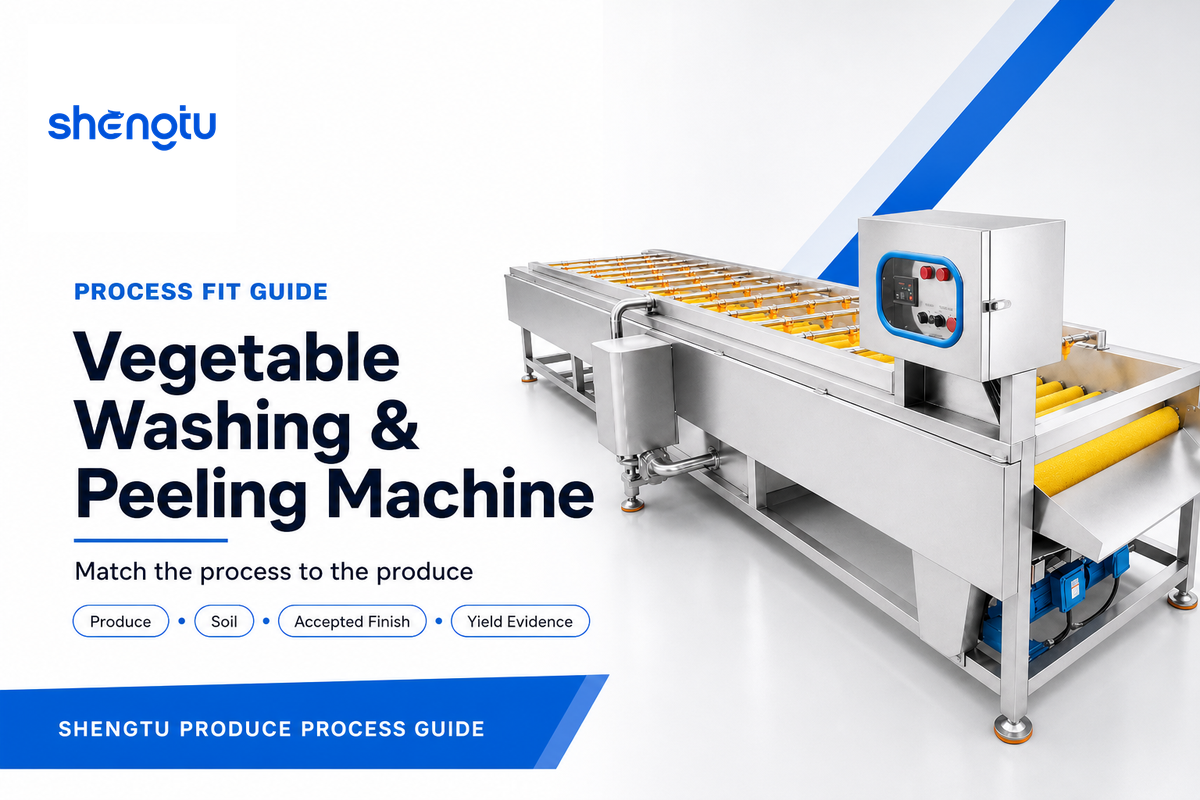
A vegetable washing & peeling machine is contact-processing equipment that removes soil and, when required, part or all of the skin from suitable produce. It is not the same treatment for every crop. The contact method must fit the crop surface, soil condition, desired finish, damage threshold and food-safety considerations. The preferred method is the least aggressive one that reaches the defined cleanliness and peel endpoint while preserving usable yield.
This guide is for processors, plant managers, QA personnel, engineers, and project teams considering an industrial vegetable washer, vegetable peeler, or combined washing-and-peeling system. It explains how to choose a technology, manage wash water, evaluate cleanability, and run a product trial.
Models, production capacity, utilities, specifications, price, lead time and quotation stay on Shengtu’s Vegetable Washing & peeling machine solution page. Whole-line integration for root vegetables belongs on the root vegetable washing and peeling line, while the fruit and vegetable processing equipment category provides broader application context. The article retains the selection and verification method.
Catalog language can blur the boundary. Fruit and vegetable washing machines, fruit and vegetable washers, fruit washing machines, potato washing machines, potato peelers, potato peeling machines and potato washing and peeling machines may use very different contact systems. “Automatic,” “fully automatic,” “high-quality,” “food grade,” “disinfection” and “sterilization” are not acceptance evidence. Downstream slicers, seasoning stages, conveyors, packaging machines and vegetable choppers also do not prove the function of a fruit and vegetable washer. Define the duty before comparing machinery.
Key takeaway
Choose based on evidence, not a crop list. Freeze the incoming product, soil, target finish and measurement method; then compare cleanliness, peel removal, damage and usable yield on representative lots.
What a Vegetable Washing and Peeling Machine Actually Does: the 4-Part Produce-Soil-Surface Fit Map Framework
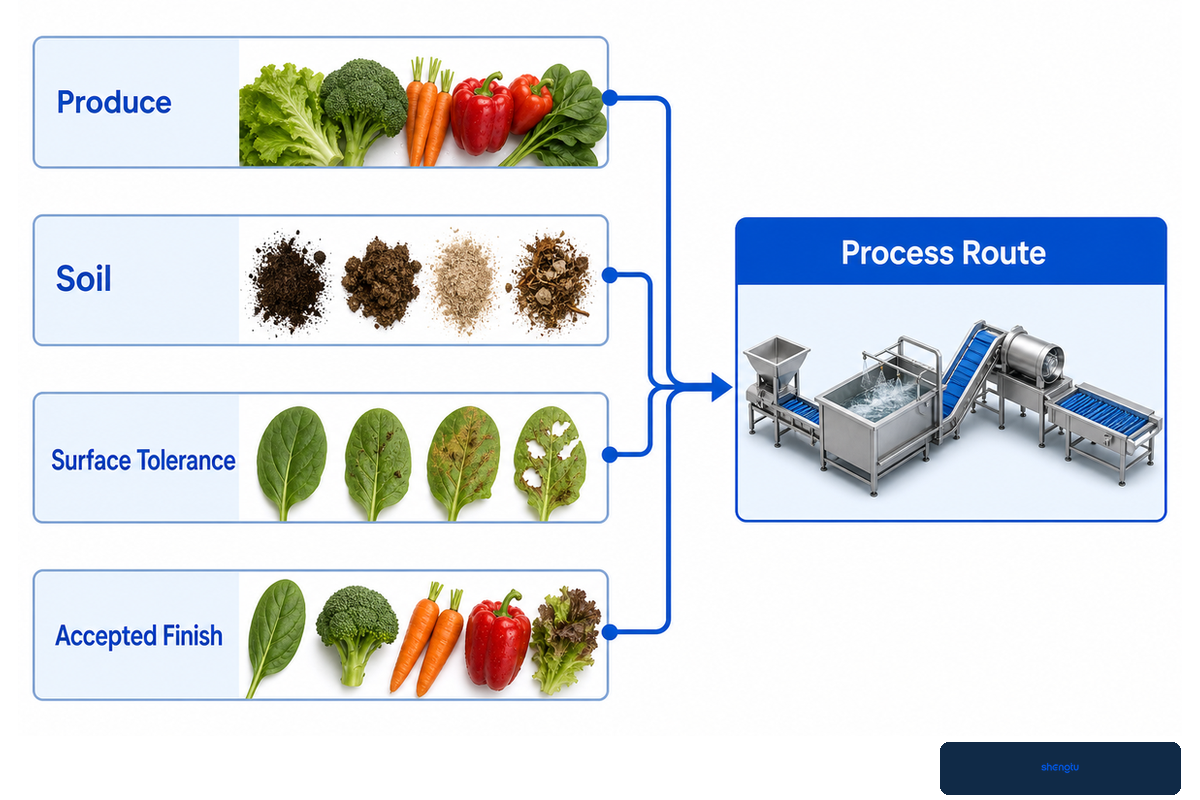
Washing, scrubbing and peeling are different actions. Washing removes loose soil and carries it away. Scrubbing or polishing adds direct surface contact to release adhered material. Peeling deliberately removes skin and may also remove edible flesh. Buyers should not accept one percentage as proof of all three.
Evidence boundary: A peer-reviewed fresh-cut processing review distinguishes washing from physical preparation steps such as peeling and cutting. It does not validate a particular machine configuration.
Combined machines commonly move product over rotating brush rollers while a spray manifold removes loosened soil and peel. Brush material, stiffness, speed, spacing, loading, water coverage and residence all affect the result. The same equipment can behave as a cleaner, polisher or aggressive peeler when those conditions change.
Combined brush contact is commonly marketed for relatively firm, round, oval, root or rhizome products such as potatoes, carrots, sweet potatoes, taro and ginger. That is a starting hypothesis, not a universal suitability rule. Maturity, variety, shape, surface defects and downstream use can change the answer within one crop family.
| Product type or question | Low-contact starting point | Escalation trigger | Evidence to retain |
|---|---|---|---|
| Firm, regular roots; loose soil | Rinse or gentle brush | Adhered soil or a defined peel target remains | Lot, soil class, finish, damage and yield |
| Irregular roots; crevice soil | Coverage trial with gentle contact | Crevices stay dirty while exposed areas abrade | Position photos, retained soil and scuffing |
| Smooth, firm fruit or vegetables | Spray or gentle agitation | Target requires polishing rather than rinsing | Bruising, skin loss and downstream quality |
| Leafy, soft or easily bruised produce | Non-brush route assessment | Only after a damage-controlled product trial | Tissue damage, breakage and shelf-life observations |
| Mixed size distribution | Grade or test distinct size bands | Small pieces shield or over-process | Size band, position and defect rate |
| Seasonal maturity change | Repeat the baseline trial | Skin adhesion or firmness changes | Maturity, firmness and storage response |
| Downstream slicing or cooking | Protect surface integrity first | Minor damage affects slice or cook quality | Downstream defect and reject evidence |
| New supplier or field condition | Treat as a new trial family | Soil or surface condition leaves the approved range | Supplier, field, lot and deviation record |
Use the map to screen a process route, not to size equipment. Once the route is credible, the commercial page can handle model and configuration questions. That separation keeps this guide informational instead of turning it into a second sales page.
Start With Produce, Soil, and the Accepted Finish
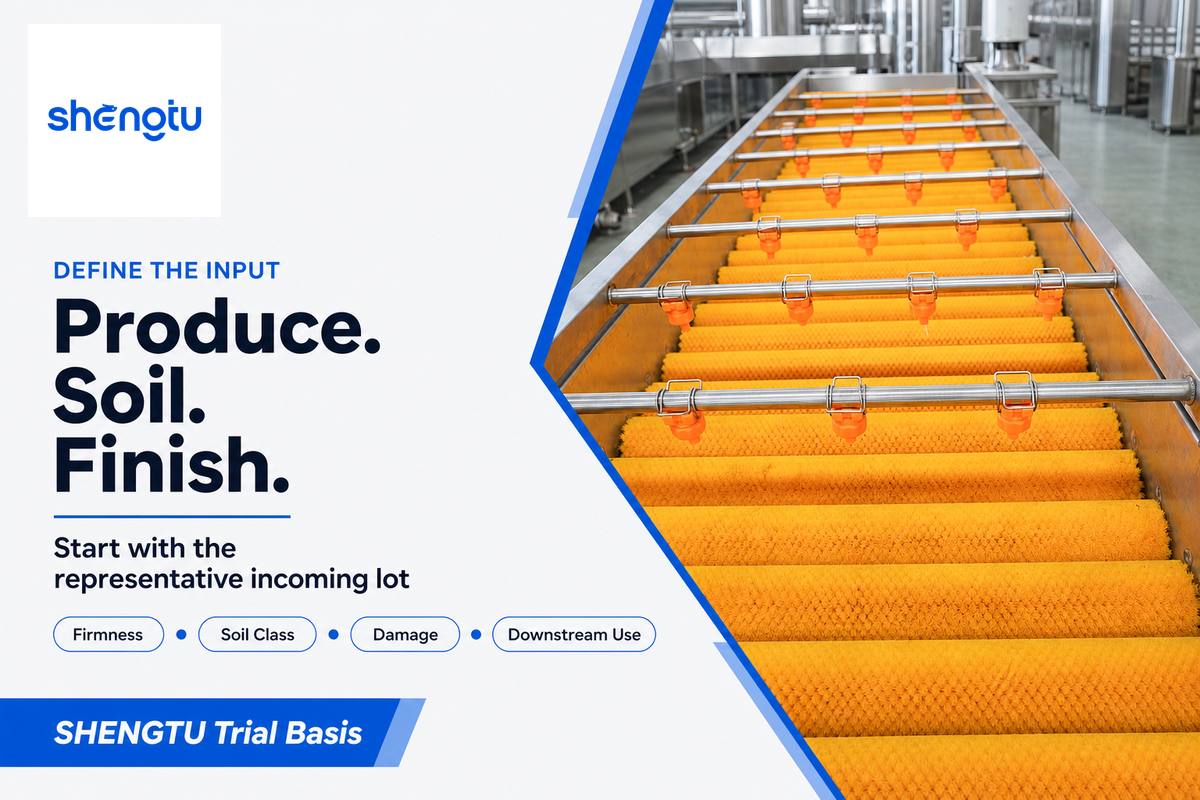
Useful specifications begin with the incoming lot. Record firmness, skin adhesion, geometry and size spread. Also capture maturity, temperature and existing damage. Then describe loose field dirt, adhered clay, crevice soil or organic debris. These details predict contact demand better than the phrase “various vegetables.”
Next define the finish in observable terms. “clean” may mean soil-free for the next processing step, and “polished” describes the cosmetic surface. “peeled” requires sampling for skin removal. Partial and full peeling are different tasks. A manufacturer can’t select a defensible route when the accepted finish is a photo of one ideal piece.
Consider downstream impacts. Acceptable surface marks differ among culinary herbs, carrot slices, potato chips, and prepared roots for central kitchens. Chinese herbs, produce prepared for central kitchens, and vegetables for industrial processing are not necessarily one processing task simply because a marketplace page groups them together. Temperature, storage time, coating, cooking and packaging can amplify the damage that looked minor at the time of discharge.
In a carrot study, commercial abrasive peeling caused more tissue damage and poorer quality outcomes than hand peeling. The lesson is to make damage and downstream impacts part of acceptance, rather than assessing peel removal alone. Review the study record.
Compare Washing and Peeling Mechanisms Without Overgeneralizing
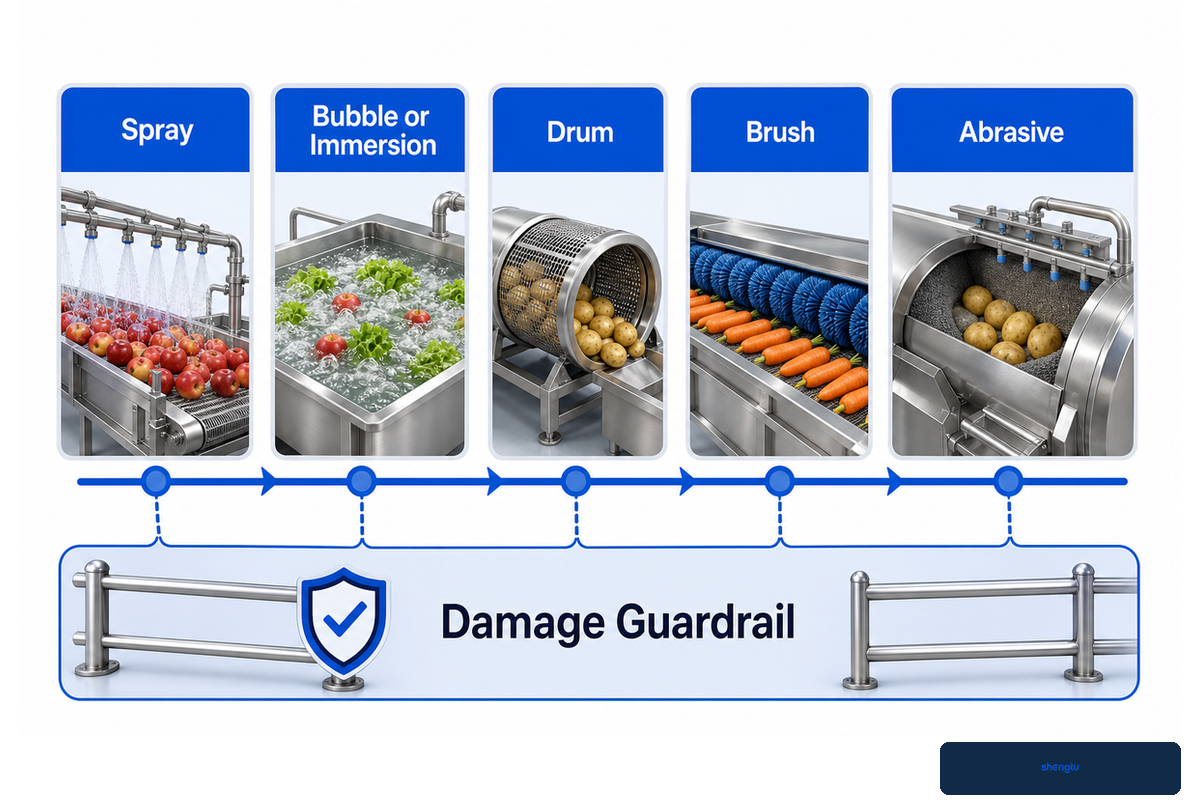
Spray washing uses water coverage and impingement. Nozzle placement, pressure, droplet size, soil-particle size, exposure time, and soil adhesion influence the result. A high-pressure label does not prove coverage or gentle handling.
Evidence boundary: The same peer-reviewed review describes multiple washer designs in fresh-cut processing. Its examples provide process context, not a universal ranking of spray, bubble, drum, brush or abrasive systems.
Bubble or immersion washing can provide gentler bulk agitation for some produce. Because water becomes part of the process, controls must cover product loading, organic matter, solids removal, overflow and cross-contamination; clear-looking water is not a release test.
Drum or barrel washing adds tumbling and product-to-product contact. Product fragility, dimensions, fill level and drop height are critical factors. FAO technical guidance warns against rotary washing for fragile vegetables; the relevant boundary is product response, not whether a catalog says the machine is suitable.
Brush washing or polishing adds direct surface contact. A soft brush may release soil or polish a resilient skin; a firmer brush, longer exposure, or heavier loading may make the same machine act more like a root-vegetable peeler. The marketplace phrase peeler machine does not establish the brush material, contact pattern, or accepted finish. Inspect the brush, drive transmission, water path and product conveyance rather than relying on “automatic electric” or “cleaner” labels.
Abrasive peeling deliberately increases removal and can be appropriate when a defined peel endpoint justifies extra contact, but flesh loss and surface injury must be measured. Steam and knife peeling belong in the comparison when a brush route cannot reach the target without unacceptable damage.
Peel Aggressiveness Ladder
- Rinse
- Gentle bulk agitation
- Soft brush contact
- Firmer brush or longer controlled contact
- Abrasive action
Move up only when the current step misses the defined finish and the next trial stays within the damage and yield guardrails.
Balance Cleanliness, Peel Removal, and Usable Yield
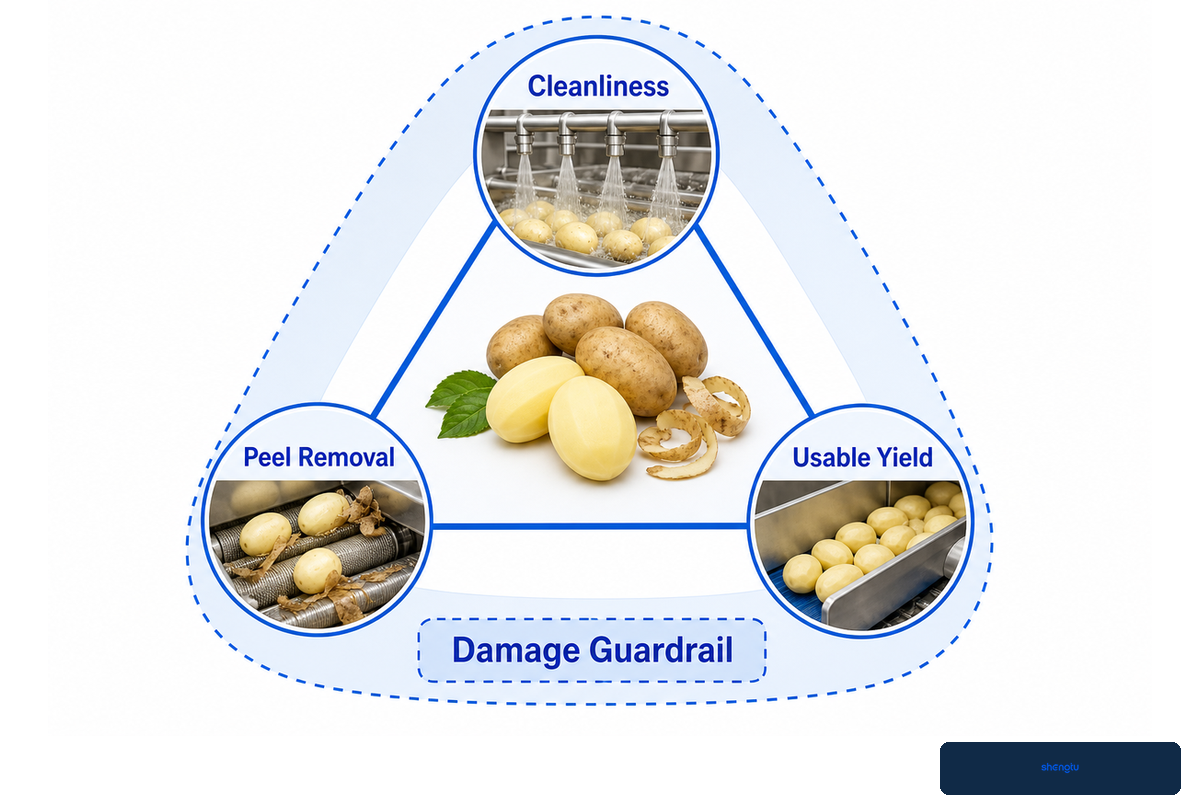
The Wash-Peel-Yield Evidence Triangle prevents an attractive output sample from hiding a poor process. Define the three corners before the run: a cleanliness endpoint (i.e. wash) and sampling method; a peel-removal endpoint (i.e. peel) and sampling method; and usable mass after rejects and trimming (i.e. yield).
Add product damage as a guardrail. Monitor and record scuffing, bruising, cuts, broken tips, and unneeded flesh removal. A center sample may be good; however, samples near the inlet, wall, and discharge may be over-processed. Sample by time and position, especially when product size or feed distribution changes.
| Evidence corner | Define before the run | Record during sampling | False comfort |
|---|---|---|---|
| Cleanliness | Soil classes, inspection method and sample positions | Remaining soil by type and location | “Looks clean” at one point |
| Peel removal | Partial/full endpoint and scoring method | Skin remaining, flesh removed and variation | A high average hides extremes |
| Usable yield | Accepted output, trimming and reject rules | Incoming mass, accepted mass, rejects and deviations | Nameplate throughput equals saleable output |
A 2024 chickpea peeling study found that speed and brush-row count changed throughput, peeling efficiency and broken-seed response in the tested prototype. A 2025 brush-roller tuber study likewise found that loading and run time changed material loss and surface response. Together, these studies justify multi-output trials. Their rpm, loads and percentages are not transferable settings for another crop or machine. Peer-reviewed chickpea study.
| Evidence | Tested or reported range | Observed result | Use in a buyer trial |
|---|---|---|---|
| 2025 brush-roller study design | 20 kg and 25 kg loads; 3 min and 4 min runs; 3 repetitions per condition | A controlled comparison, not a factory setting | Define matched loads, run times, and repeats for the actual crop |
| Lower-loss study condition | 20 kg at 3 min, repeated 3 times | 96.75% retained yield and 3.25% weight loss | Record yield and loss together |
| Higher-loss study condition | 25 kg at 4 min, repeated 3 times | 91.18% retained yield and 8.82% weight loss | Treat load and time as interacting trial factors |
| FAO method-level comparison | Mechanical-peeling losses of 18–28% for potatoes and 16–18% for carrots | Crop and method change loss response | Do not transfer the ranges as acceptance limits |
| Peer-reviewed wash-water literature | 50–200 ppm sanitizer concentrations reported in reviewed studies | Efficacy still depended on process conditions | Qualified owners must set lawful, site-specific controls |
Boundary: These figures belong to the cited studies, not to a Shengtu model or a recommended operating window. The comparison shows why a buyer must record load, time, yield, loss, repetitions, and water-control context together. The matrix displays the 20 kg at 3 min and 25 kg at 4 min boundary cases; the same study also tested 20 kg at 4 min and 25 kg at 3 min. Its four reported boundary outputs were 96.75%, 3.25%, 91.18%, and 8.82%; the FAO comparison reports 18% to 28% for potatoes and 16% to 18% for carrots. These values remain study evidence, not transferable settings.
Build an illustrative data row before testing. For form design, include fields for product size bands, incoming temperature, feed condition, contact time, sample mass, observation interval, brush setting, spray condition, and water use. Do not prefill them with universal values; replace each field with the approved product, machine, and site basis. Drive configuration and other equipment specifications belong in the project quotation.
The row should define how percentages are calculated. Peel remaining is not the same measure as mass loss. A defect rate requires the sample count, defect definition, and lot relationship. Each checkpoint also needs a stated start event. Use units, denominators and method names consistently so the supplier, QA team and plant engineer can compare runs without reinterpretation.
Control Wash Water, Soil, and Cross-Contamination Risk
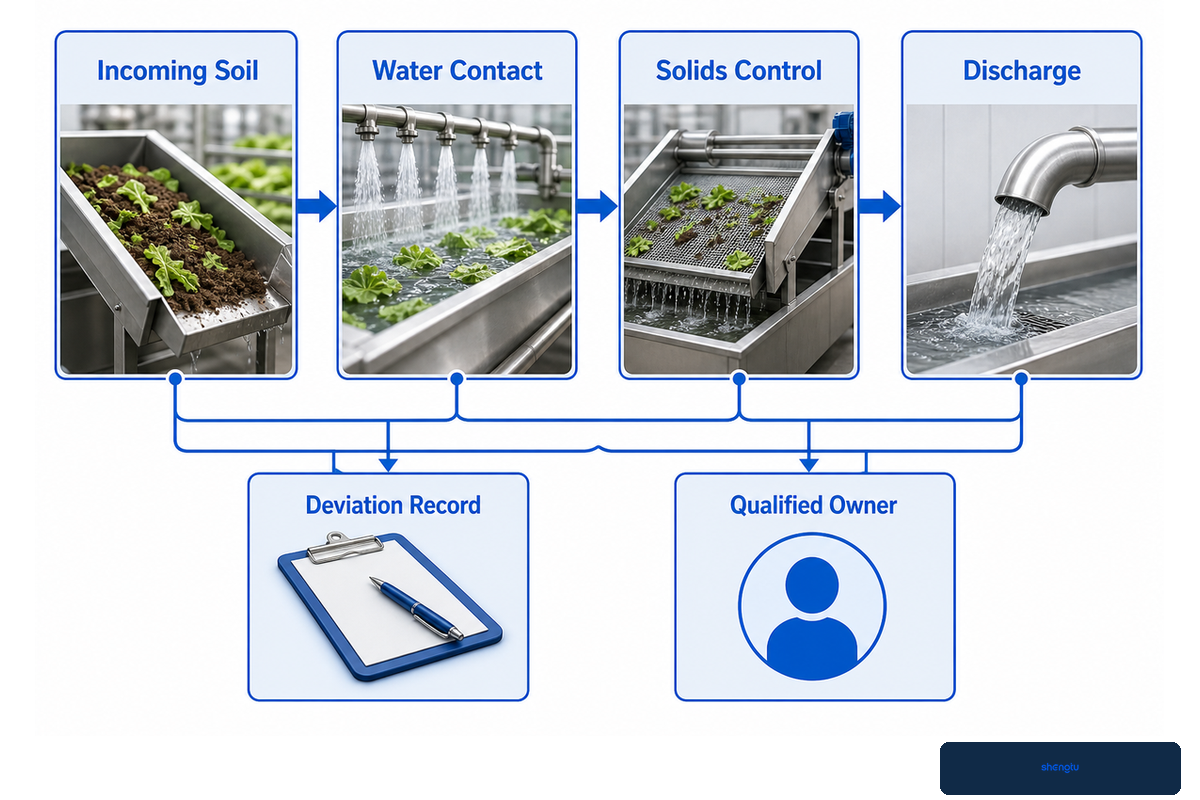
Washing can remove soil and support a facility’s food-safety system, but a washer does not make produce microbiologically safe by itself. A peer-reviewed review explains that process-water sanitizers are mainly used to limit cross-contamination in wash water; they do not guarantee product safety. FDA’s current fresh-cut guidance likewise places controls inside the processor’s broader preventive-control responsibilities.
Construct a Soil-to-Drain Control Sheet depicting the actual process. Record incoming soil load, fresh-water input, spray or bath observation, solids-removal condition, monitoring result, overflow or change decision, discharge observation, deviation and corrective action. Date and lot-code each observation so it stays linked to the product lot.
There is no universal sanitizer concentration, turbidity threshold or water-change interval for every vegetable washing machine. Efficacy can change with the chemical used, residual concentration, contact time, temperature, pH, product-to-water ratio, and organic-matter load. Any chemical must also be lawful for the intended food-contact use and conditions. The qualified food-safety owner should define the method, authorization, limits, monitoring and action plan.
| Stage | Observe or measure | Owner question | Record |
|---|---|---|---|
| Incoming | Lot, soil type, soil load and product temperature | Inside the approved basis? | Lot and intake sample |
| Water contact | Source, spray/bath condition, chemistry where used | Are authorized conditions maintained? | Method, value, time and action |
| Solids control | Screen, filter, tank and settled material | Is soil accumulating or recirculating? | Inspection and service event |
| Discharge | Water, soil, peel and cleaning waste | Do site permits and handling rules apply? | Route, deviation and responsible owner |
Wastewater is not only a cost question. Soil, suspended solids, peel, cleaning chemicals, oil, and grease may create site-specific utility and environmental obligations. These conditions vary by product and facility. Review applicable discharge and solids-handling requirements with the facility’s qualified owner. Do not copy a limit from another plant.
Evidence note: FDA finalized fresh-cut produce guidance in August 2026. Its scope is covered ready-to-eat fresh-cut produce operations under Part 117, not farms or every produce process. The guidance is nonbinding, and the article uses it to define control responsibilities rather than machine performance.
Use this guidance to assign control responsibilities, not to claim universal machine performance.
FDA guidance; wash-water review.
Separate Hygienic Design, Cleaning Work, and Verification
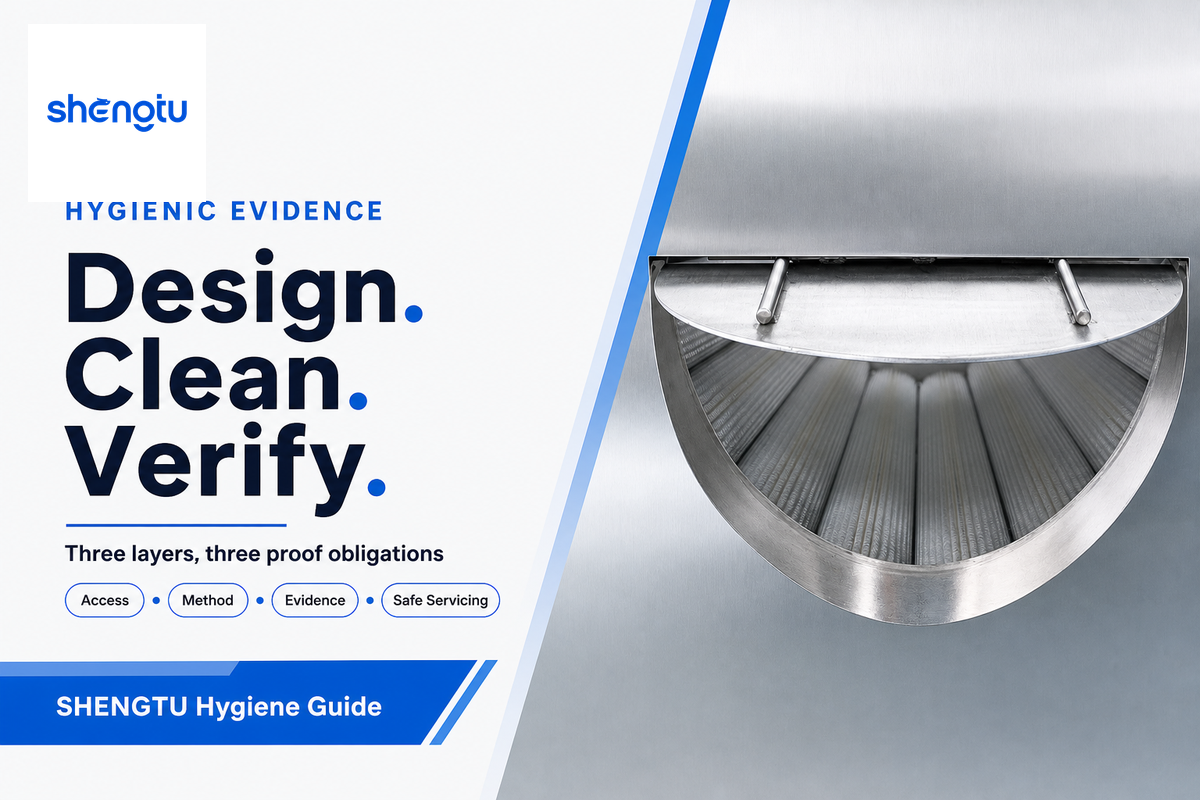
A cleanable design, a completed cleaning cycle and evidence that cleaning worked are separate layers. “Stainless steel,” “food grade,” “easy to clean” and “CIP” are incomplete statements until the boundary, method and result are defined.
Design evidence covers access, drainage, inspectability, product-contact materials, removable brushes or rollers, shields, bearings, seams, dead spaces and non-product-contact surfaces near the process. 3-A public material notes that surfaces outside direct food contact can still create contamination risk. A voluntary standard or symbol claim does not automatically certify a specific machine for the buyer’s duty.
Execution evidence defines disassembly, chemistry, time, temperature, mechanical action, rinse and reassembly. Verification evidence uses the facility’s selected visual, residue, rinse, swab or other method. The facility should also name the owner for each step, acceptance decision and corrective action.
Regulatory language needs precision. For covered U.S. operations, Part 117 requires sanitary operations and adequately cleanable equipment, but it does not require regulatory validation of every sanitation control. Keep engineering cleanability assessment, routine monitoring, validation where applicable and verification distinct.
Cleaning access also creates worker-safety boundaries. Opening guards or entering a hazard zone for washing, inspection, brush replacement, or jam clearing does not suspend machine-specific procedures for hazardous-energy control, including lockout/tagout, guarding, chemical exposure, and slip control. This article cannot replace the OEM manual or site safety program.
Evidence note: Current 21 CFR Part 117 provides the U.S. manufacturing scope. The 3-A primer supplies voluntary hygienic-design context. Neither source proves that a particular Shengtu or competitor model conforms.
Diagnose Uneven Cleaning, Over-Peeling, and Surface Damage
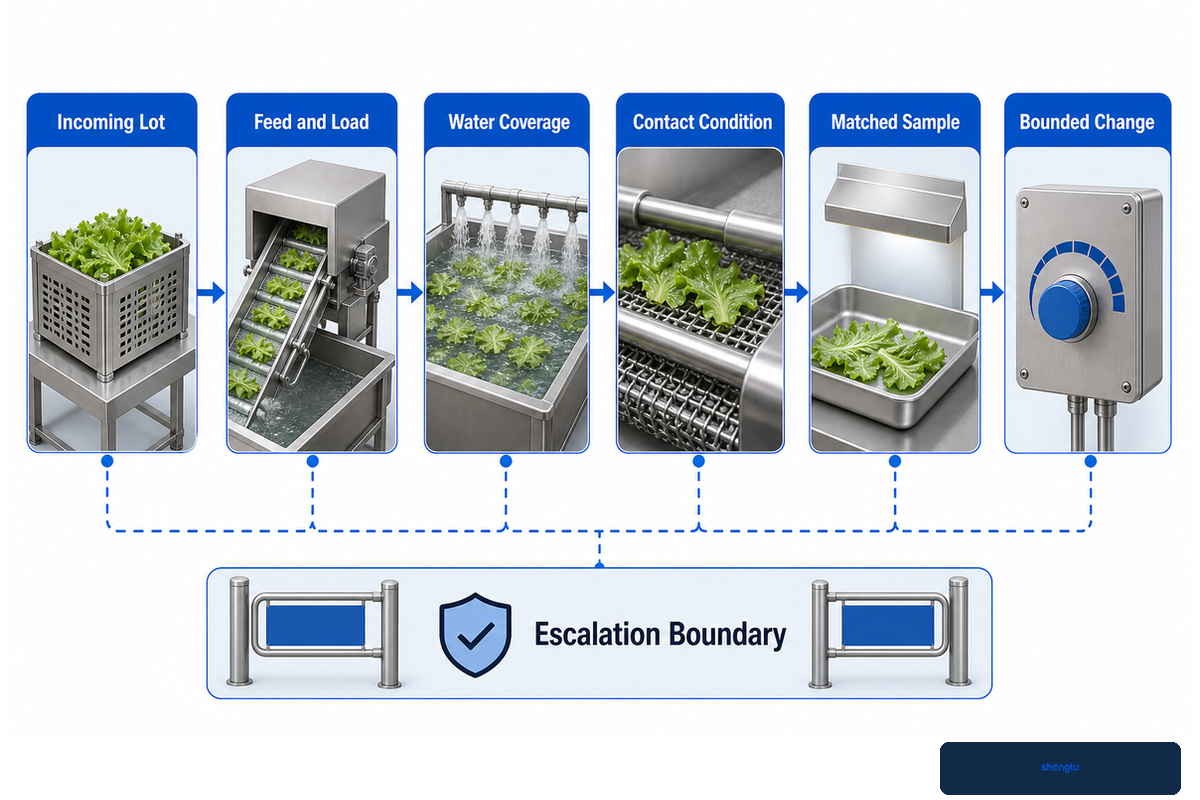
Troubleshoot in process order. Start with the incoming lot, size distribution, maturity and soil. Next check feed distribution, loading and sample position. Then examine water coverage, brush or abrasive condition, residence and discharge handling. Finish by confirming that the measurement method stayed the same.
Evidence boundary: A peer-reviewed processing review links fresh-cut process choices to safety and quality outcomes, but it does not prescribe this troubleshooting order. The sequence above is a controlled diagnostic method.
Uneven peeling can come from mixed geometry, shielding, uneven loading or position-specific contact. Excess flesh loss may coincide with longer exposure or more mechanical action, but that observation does not prove one cause. Brush wear is a useful inspection prompt. Unless the condition is measured and linked to output evidence, it is not a diagnosis.
| Observed defect | Check first | Compare next | Do not assume |
|---|---|---|---|
| Soil remains | Soil class, geometry and coverage | Position, load and contact | More pressure is always better |
| Peel remains | Skin adhesion and target definition | Exposure and contact condition | Longer time has no yield cost |
| Scuffing or bruising | Incoming damage and fragility | Brush, drop and discharge contact | The brush is the only cause |
| Drift during a shift | Lot, soil and loading change | Water, solids, contact and measurement | A stable display means a stable process |
Make one bounded change and repeat the matched samples. If the issue involves product release, chemical control, or intervention inside a guarded hazard zone, stop troubleshooting and escalate to QA, the qualified process owner, maintenance, or the OEM.
Run a Product Trial That Can Survive Handover
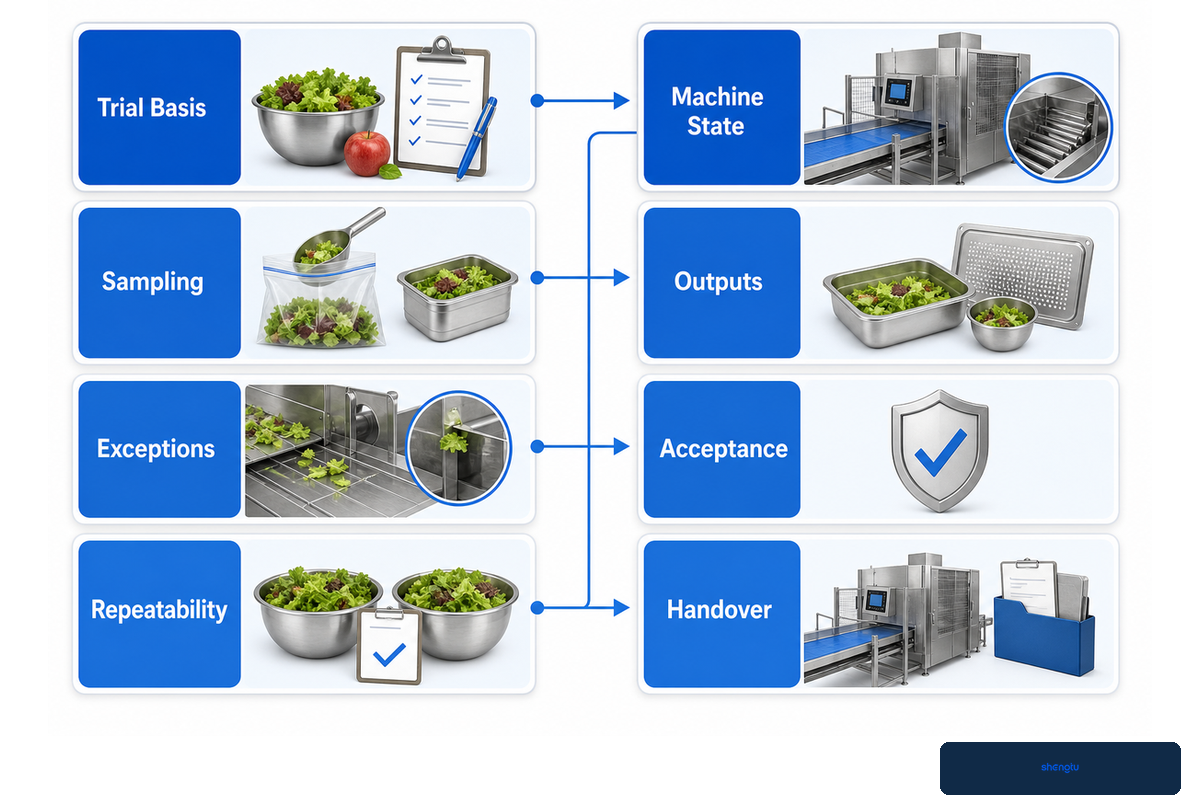
Trials are useful when another qualified person can reconstruct what happened. The Product-Family Trial Card binds one representative lot, its incoming condition, actual settings and sample positions. It also records methods, output evidence and deviations. One good batch is not repeatability.
Evidence boundary: For covered U.S. operations, 21 CFR Part 117 provides record and verification context, not a machine-trial template. The card below is an engineering acceptance framework, not a universal regulatory protocol.
| Block | Required fields | Evidence owner | Handover question |
|---|---|---|---|
| Trial basis | Product, lot, size, maturity, soil, temperature and target finish | Process/QA | Does the lot represent production? |
| Machine state | Configuration, loading, water, speed/contact, time and condition | Supplier/operations | Can the settings be reconstructed? |
| Sampling | Positions, times, counts/mass and methods | QA/process | Do samples cover variation? |
| Outputs | Cleanliness, peel removal, damage, usable yield and downstream quality | QA/operations | Are results comparable to criteria? |
| Exceptions | Adjustments, alarms, downtime, water events and corrective action | Named responsible role | What invalidates or limits the run? |
| Acceptance | Approved limits, decision rule and disposition for each output | QA/process owner | Did the run meet every agreed criterion? |
| Repeatability | Matched repeat runs, lot differences and result variation | Process/operations | Does the result survive a repeated run? |
| Handover | Approved settings, methods, records, responsibilities and open actions | Project owner | Can the receiving team operate the approved basis? |
Separate the evidence stages. Supplier FAT can check components, controls, drives, guards, interlocks and the water path. It can also check the contact system, discharge and agreed documents. Site commissioning or SAT checks utilities, installation, interfaces, safe access and operation with the specified product and load. Production qualification repeats product runs, water and sanitation records, output evidence, deviations and handover under the buyer’s approved plan.
Establish acceptance criteria before running. Operations documents actual procedures. QA owns methods and releases. Maintenance owns machine condition. Process engineering analyzes changes. The supplier may support a trial, but it shouldn’t become the owner of the processor’s food-safety decisions.
Decide Between a Combined Unit and Separate Stages

A combined washer-peeler can fit a stable family of firm products when washing and peeling need similar contact, residence and sanitation boundaries. Separate stages may be easier to control when fragile and damage-tolerant crops share the line, wash and peel times diverge, yield needs independent adjustment, or the hygiene boundary changes after peeling.
Layout is important. Review raw-to-clean zoning, congestion, backtracking, buffer needs, dewatering, inedible peel flow, and downstream handoff. A requirement to separate raw-material and cleaner-processing areas does not prohibit a combined machine; it means the facility flow and hygienic boundary require review.
Compare throughput achieved at the required quality, not just nominal capacity. Water supply, wastewater and peel handling, energy, labor, maintenance, brush replacement, changeover, and downtime can make a nominally simple combined unit expensive to operate—or make two separate stages unnecessarily complex. The right answer comes from the product family and site evidence.
For food processing projects, before teams equip a cleaning and peeling machine for root vegetable peeling, map every transfer in the vegetable and fruit washing route so each conveyor can convey product without compromising the defined hygiene boundary. Do not design a vegetable cleaning line around a generic catalog label; define the equipment interfaces and evidence required at each handoff.
When the route is clear, use the commercial solution page for questions about model, capacity, layout, utilities and quotes. For information on the company and the project-service offering, see About Shengtu machinery.
Prepare a trial-ready machine inquiry
Send the produce family, size range, incoming soil, target finish, damage and yield guardrails, sanitation basis, hourly profile and proposed acceptance method.
Frequently Asked Questions
Can one vegetable washing and peeling machine process every crop?
No. Combined brush or abrasive contact often suits firm roots and tubers, but geometry, maturity, skin adhesion, soil and damage tolerance still vary. Softer produce may require another washing route. Test representative lots against cleanliness, damage and usable-yield criteria together.
Does a vegetable washing machine make produce microbiologically safe?
No. A washer can remove visible soil and support a sanitation program, but appearance does not prove microbial control or product release. Water quality, process-water condition, lawful chemical use, contact conditions, monitoring, corrective action and verification belong to the processor’s food-safety plan and applicable requirements.
Where recirculated water is used, the plan should define how organic matter, solids, product loading and the selected monitoring method affect decisions during a run. The responsible food-safety team must set site-specific limits and release criteria rather than treating the machine, clear-looking water or one sanitizer reading as a standalone safety guarantee.
How do you measure whether peeling is too aggressive?
Record incoming mass and condition, the defined peel endpoint, accepted output, trimming and rejects, visible flesh removal and defects such as scuffing, cuts or broken tips. Compare samples across positions and repeat the trial under the intended load. Extra peel removal is not beneficial when it creates unacceptable loss or downstream quality risk. Include the sample rule and acceptance threshold, then confirm that a matched product lot and machine condition can reproduce the result before approving the setting for handover.
What data should be recorded during a washer-peeler trial?
Record product ID, lot, size distribution, maturity, incoming temperature and soil condition, target finish, loading, water condition, contact configuration, speed or residence time, sample position, cleanliness, peel removal, surface defects, usable yield, discharge observations, adjustments, and deviations. Time-aligned records allow outputs to be traced to the equipment conditions that produced them.
What should a buyer send a supplier before requesting a configuration?
Send representative photos or samples, product families, size range, incoming soil and temperature, required finish, damage and yield guardrails, hourly and batch profile, water and utility constraints, sanitation boundary, downstream interface and proposed acceptance method. That evidence is more useful than a capacity number alone.
References & Sources
- FDA: Guide to Minimize Biological Hazards in Ready-to-Eat Fresh-Cut Produce. Current guidance for its stated scope. It is not a machine certification or universal process limit.
- 21 CFR Part 117. Current U.S. regulatory text for covered human-food operations; applicability requires qualified review.
- Review of fresh produce wash-water cross contamination (peer-reviewed). Supports process dependencies, not a universal sanitizer setting.
- Peer-reviewed chickpea peeling-machine study. Product- and prototype-specific evidence, values not transferred to other crops or machines.
- 3-A Sanitary Design Primer. Voluntary design context, not proof of model conformity.
First-party Shengtu pages support company identity, product scope and internal navigation. Competitor and marketplace pages were reviewed for SERP and buyer-language context only. They do not support the technical, safety or regulatory claims above.


![Meat / Poultry / Prepared: Plant Planning Guide [2026]](https://shengtumachinery.com/wp-content/uploads/2026/10/meat-poultry-prepared-processing-guide-featured-768x512.png)