Get in touch with Shengtu Bufan Company

Vacuum Freeze Dryer
Industrial Freeze Dryer Systems | Vacuum Freeze Dryer
Sized from your product, not from a catalogue
Production in 60 to 120 working days
Commissioned and handed over by our own engineers
Warranty terms confirmed in the quotation and contract
Shengtu builds vacuum freeze dryers for food plants that have to hold shape, colour and nutrition while pulling moisture down to a shelf-stable level. We start from what you are drying and how much water has to leave it each day, then set shelf area, condenser duty, vacuum sizing and heating method around that answer.
Get a Quote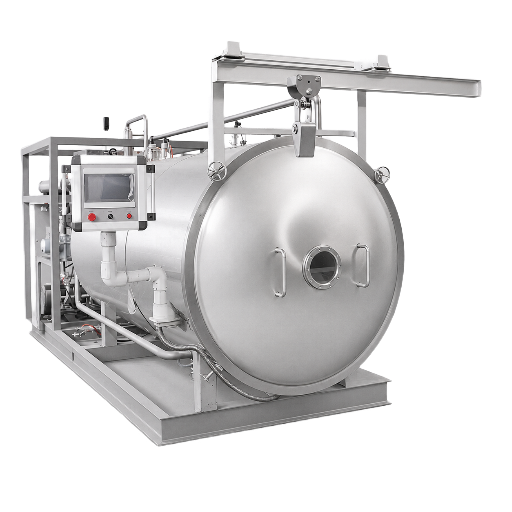
01
Production lead time
60 to 120 working days from the date the deposit clears
02
Payment
Telegraphic transfer against a deposit at order confirmation, or a letter of credit
03
Warranty
Warranty duration, coverage and exclusions are confirmed in the quotation and contract
04
Installation
Our engineers travel to your site to direct installation, complete commissioning and train your operators
Industrial Freeze Drying Capability
Buyers of industrial freeze drying equipment nearly always open with the wrong question. They ask how many kilograms a chamber holds. The number that decides whether the investment works is how many hours a load takes and therefore how many loads a year the machine will ever run.
A chamber gets sized on batch weight, the business case gets built on annual output, and nobody writes down the cycle time that connects the two. That gap is where the argument starts later. We put the number on the table before we quote, even when the answer is inconvenient.
The vacuum freeze drying process itself is not in dispute. The product is frozen solid, the chamber is pumped below the triple point of water, and heat is fed through the shelf so ice turns straight to vapour without passing through liquid; that vapour re-freezes on a cold condenser rather than passing through the vacuum pump.[1] Sublimation is the step in the drying process that consumes most of the energy, and peer-reviewed work puts the phase change at roughly 2,840 kJ for every kilogram of ice removed.[2]
The Four Stages We Build Around & Integration
Freezing
The product is brought down to a solid state, either in a separate blast room where airflow does the work or directly on the shelf. Ice crystal size is set here, and it governs how fast vapour can escape later. Everything the preservation result depends on is decided in this stage.
Vacuum draw-down
The chamber is evacuated below the triple point of water so sublimation can begin.
Primary drying
Shelf heat is supplied at a controlled rate to sublime the free ice. This is the longest stage and the one that consumes most of the energy.[1]
Secondary drying
The shelf is warmed further to desorb bound water and bring the product down to its target residual moisture.
Batch Freeze Drying
Trays are loaded on trolleys, the chamber door is closed and one recipe runs to completion. This is the right build when you run several products, change over often, or need each batch traceable as a unit.
Whole-Line Integration
The freeze dryer is one station, so we plan the blast freezer, trolleys, loading rail and the downstream packing step together and the dryer is not left waiting on the stations either side of it. Where the same plant also runs a coating section, we build that battering and breading line as well. High-volume producers running a single product without changeover should weigh a continuous plant against a batch one before committing.
Products This Freeze Dryer Machine Handles
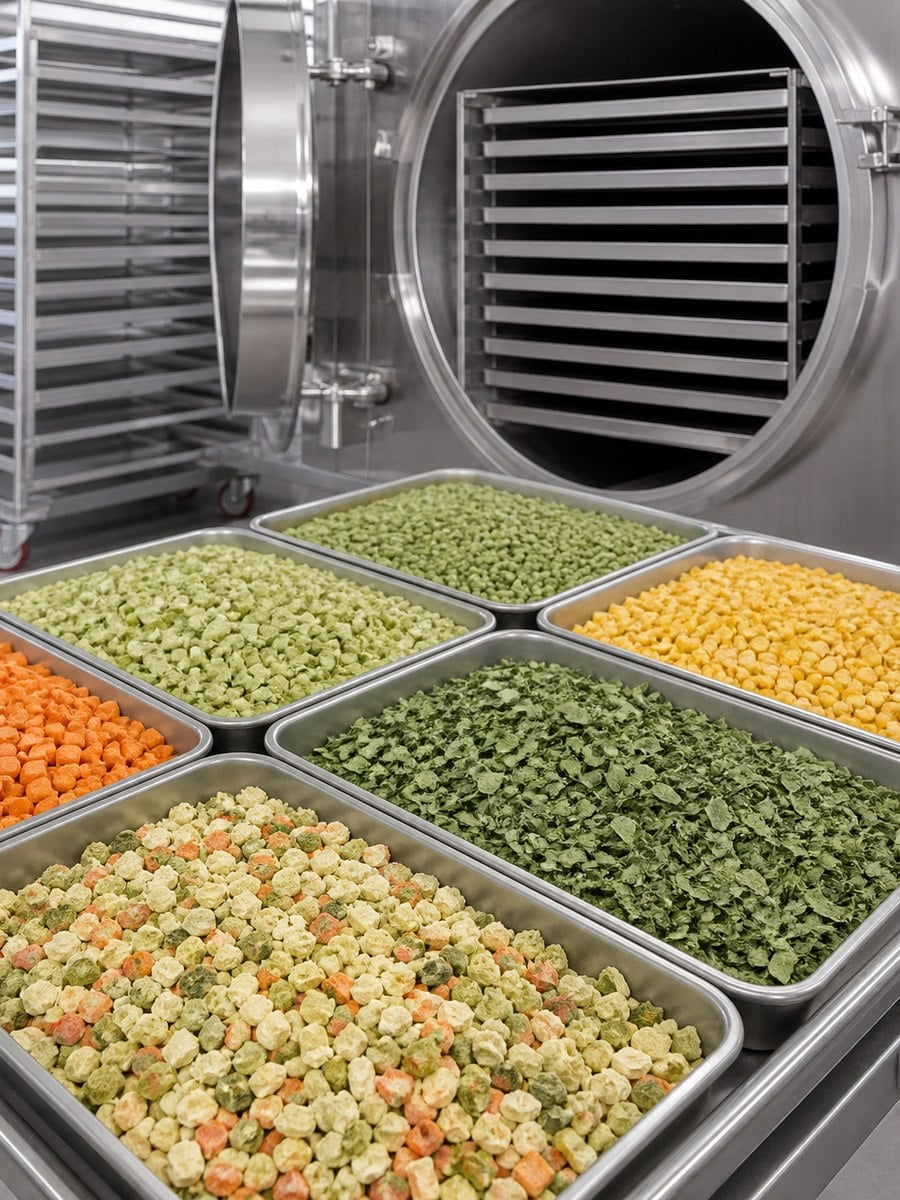
What changes between products is not the machine. It is the water. Sugar content, slice thickness and cell structure decide how long each kilogram of ice takes to leave, and that is why we ask for the product before quoting a configuration.[3]
SPEC // FRT-01
SPEC // VEG-02
SPEC // MET-03
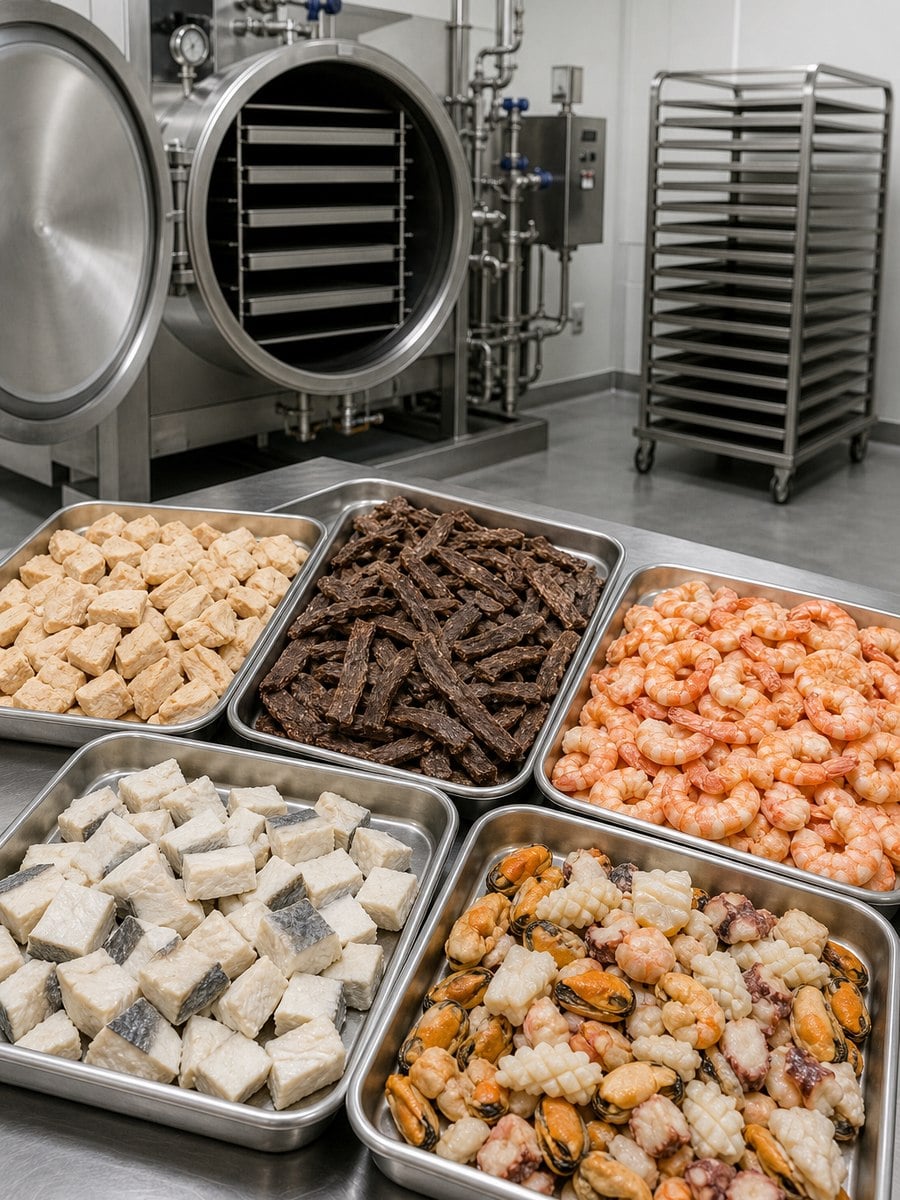
SPEC // BEV-04
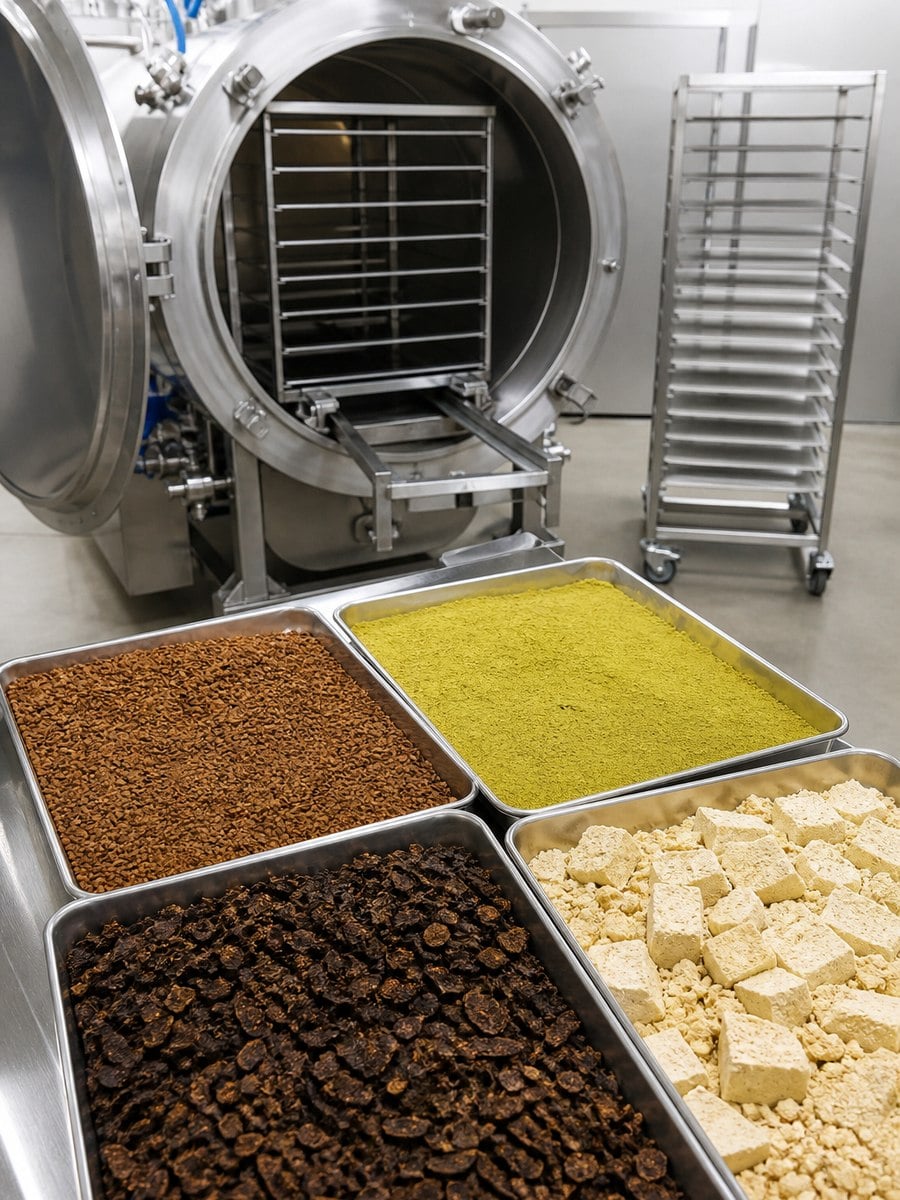
SPEC // PET-05
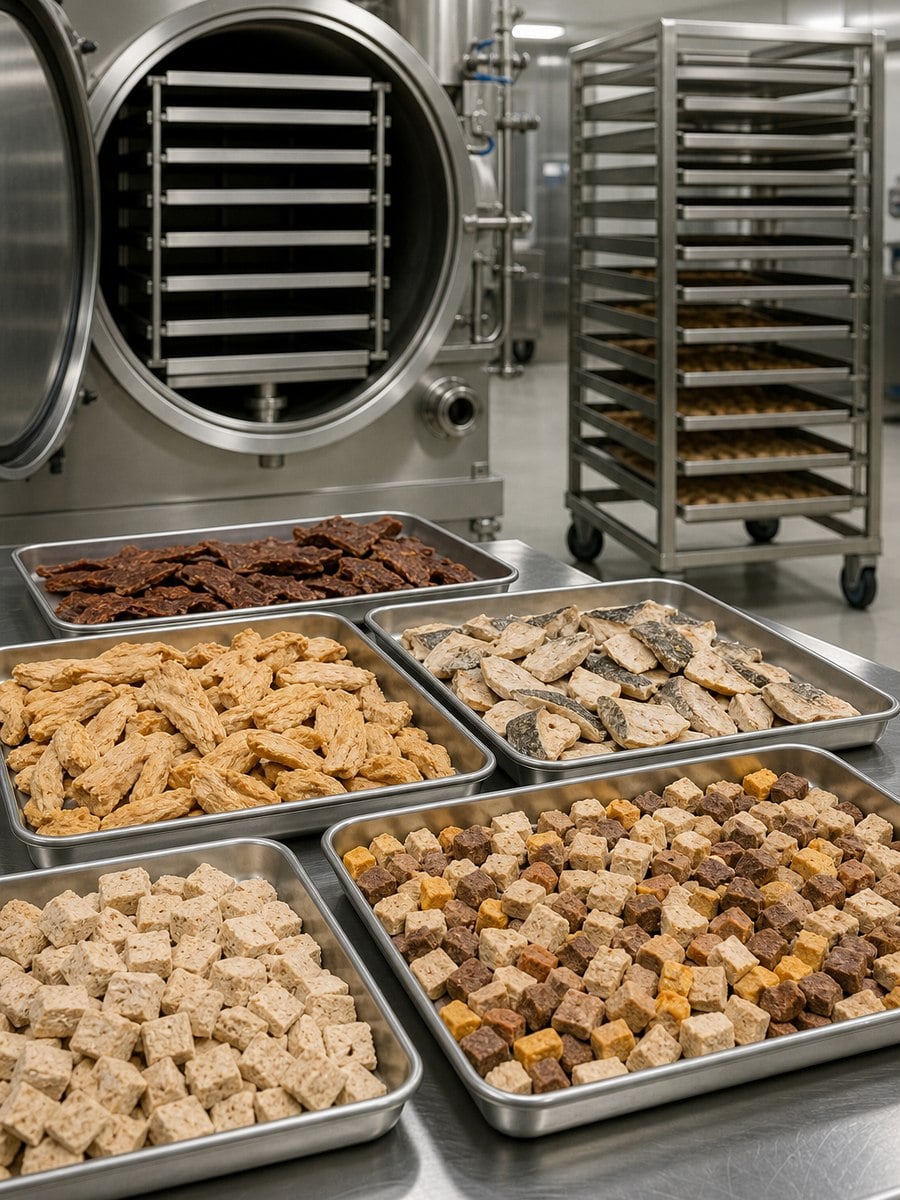
SPEC // PRO-06
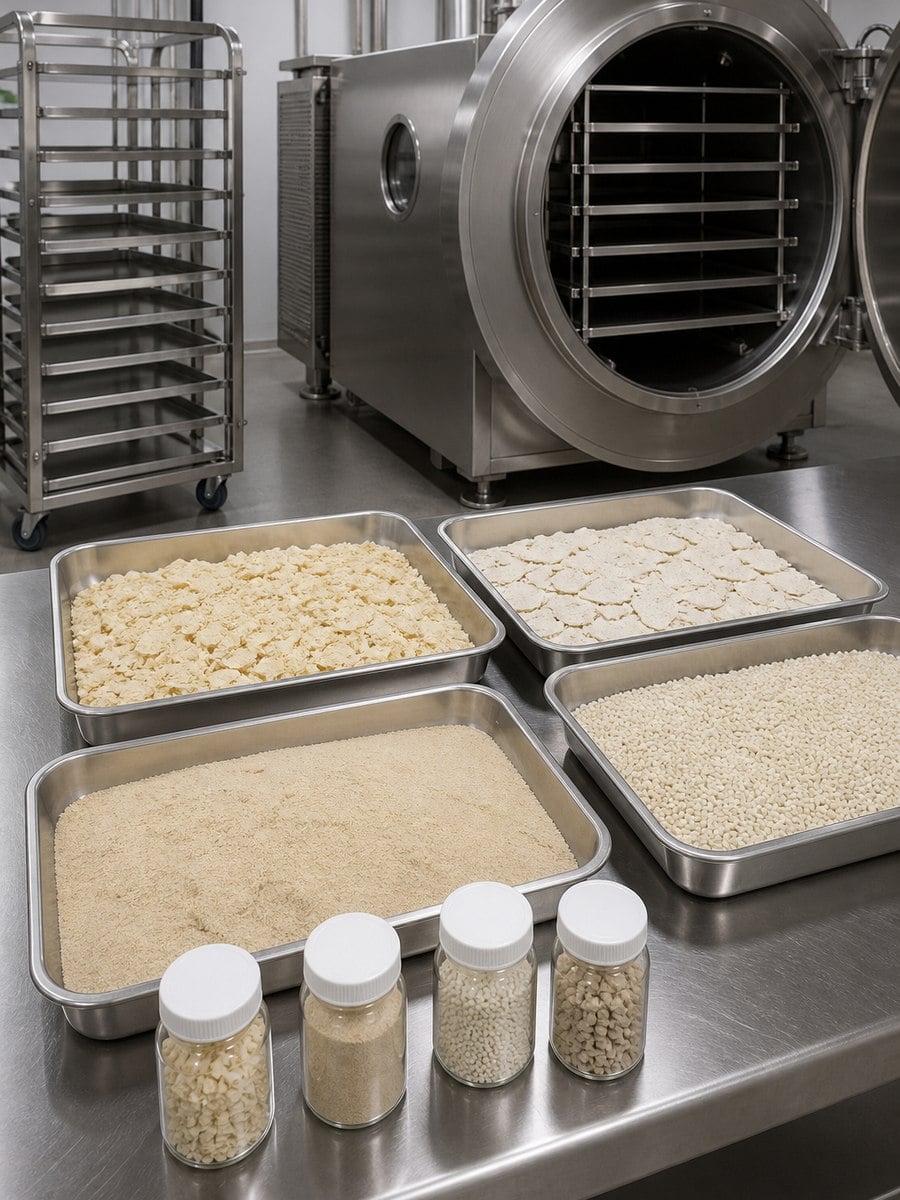
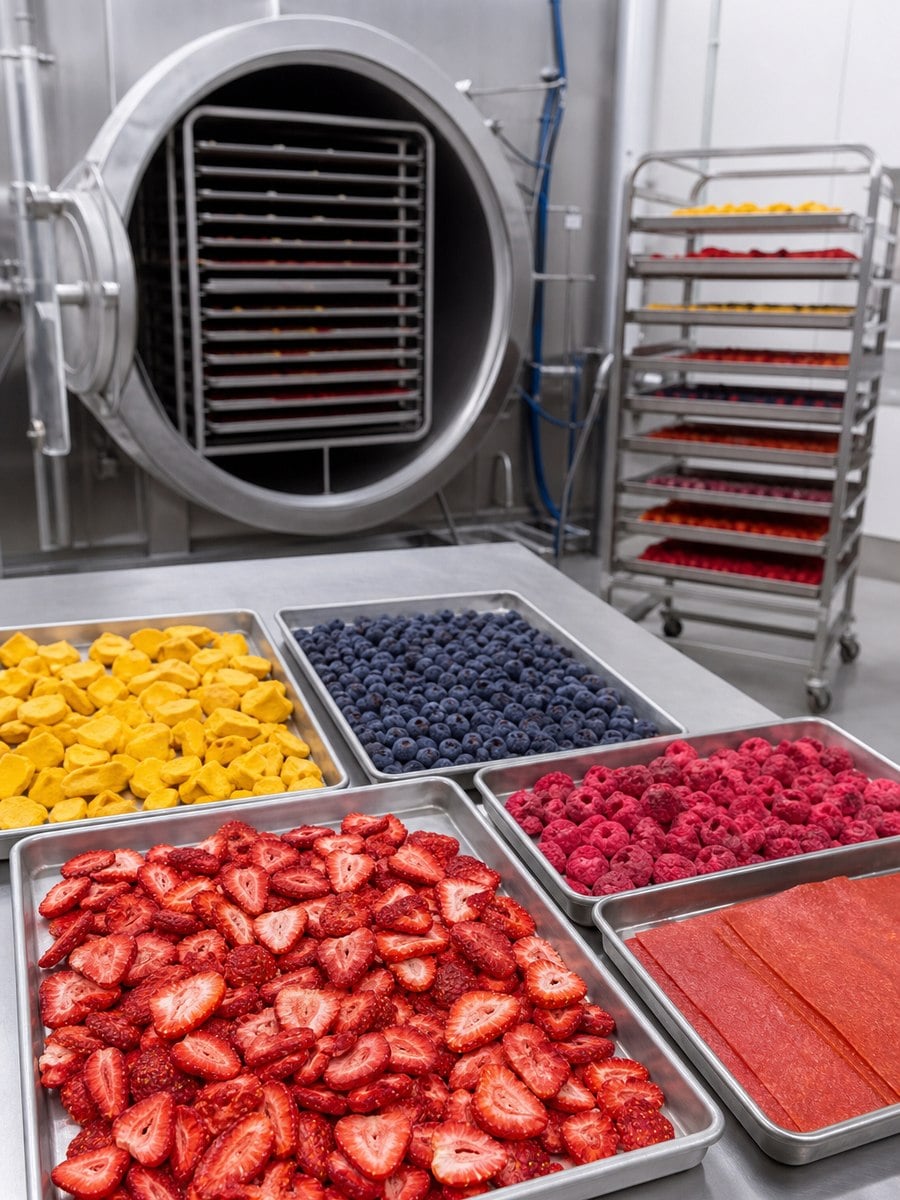
Fruit
Forms we run
Slices, dice, halves, purée, whole berry
Why it is freeze dried
Colour and cell structure survive, so the piece rehydrates to something close to fresh instead of a chewy fragment.
Cycle driver
High sugar lowers the collapse temperature, so shelf heat has to be fed more slowly.
Watch out for
Thick slices. Cutting from 10 mm (0.39 in) to 6 mm (0.24 in) shortens drying far more than raising shelf temperature does.
Configuration Variables
Heating and Defrost Options
Two choices set most of the running cost of an industrial freeze dryer. One is how heat reaches the shelf; the other is how the condenser is cleared between batches. Both get decided at configuration, not afterwards, and both serve the same mechanism: shelf-supplied heat under a controlled draw-down below the triple point.[7]
| Option | How it works | Where it fits | Effect on the cycle |
|---|---|---|---|
| Electric shelf heating | Resistive elements or a heated fluid loop raise the shelf directly. | Smaller and mid-size chambers, and plants with no steam supply. | Simplest to install and control. Electricity carries the whole heating load. |
| Steam or thermal-fluid heating | Plant steam or a heat-transfer fluid circulates through the shelf. | Large chambers in plants that already run a boiler. | Shifts heating off the electrical supply. Needs boiler capacity in your utility plan. |
| Single water defrost | The condenser is flooded once at the end of the batch to melt the ice off. | Single-shift operations with slack between batches. | Lowest cost. Adds the longest gap between one batch and the next. |
| Steam defrost | Steam clears the condenser coil faster than water alone. | Plants already committed to a steam supply. | Shortens the gap between batches, which is where extra annual output comes from. |
| Alternating automatic defrost | The condenser is split so one half sheds ice while the other stays in service. | Continuous or near-continuous running. | Highest capital cost. Removes defrost from the critical path almost entirely. |
Vendor Neutrality Guarantee
We do not lock the machine to a single component brand. Where you already standardise on a refrigeration or control supplier for the rest of the plant, say so with your brief and we will build to that requirement so your spares stay common.
Sizing an Industrial Freeze Dryer by Water Load
A freeze dryer’s nameplate is not its output. What you are actually buying is a rate of water removal, and the trade press already reports industrial plant capability that way, in kilograms of ice sublimated per hour rather than in tray area.[6] Below is the ladder we climb on every machine we quote, with the owner of each number named on its own rung.
Why This Is a Method and Not a Model Table
Rungs 1 to 3 are yours. Nobody can supply them for you, and a configuration quoted without them is a guess.
Rung 7 comes from running your product, not from a brochure. It is the single number that decides annual output.
Rungs 5, 6 and 11 are what we engineer. Your machine’s configuration sheet is issued with the quotation, once rungs 1 to 3 are on the table.
Two plants buying the same chamber can end up with very different annual output, purely because their cycle times differ.
Three Instincts That Cost Buyers Money
Contrary to the common assumption, faster sublimation happens when system pressure sits near half the vapour pressure above the product, not at the deepest attainable vacuum, because heat becomes harder to transfer into the piece as pressure falls.[4] Heated shelves exist precisely to widen that temperature difference and move moisture faster.[1]
The condenser has to run 15 to 20 °C (27 to 36 °F) below the product; for an aqueous product about −50 °C (−58 °F) is enough, and going colder buys you cost rather than speed.[4] What matters instead is whether the condenser can trap the vapour rate your load actually generates.
Published cost modelling of a freeze drying cycle reaches the opposite conclusion to the one most buyers expect: capital cost was 91 per cent of the total cost of a cycle on a seven-day week and 95 per cent on a five-day week, so the return comes from fitting more cycles into the machine’s life rather than from shaving kilowatts.[2]
Inspection, Testing and Warranty
A vacuum chamber either holds its pressure or it does not. That gets checked before the machine leaves us, not after it reaches you. Trust in this category is built on what is verified at the factory gate.
How Every Machine Is Checked
01
Chamber and condenser welds are inspected, then the assembly is pressure and leak tested.
02
The vacuum pump set is run and the empty chamber is held under vacuum to confirm the seal.
03
Refrigeration is charged, the compressor set is pulled down, and condenser temperature is confirmed against the recipe range.
04
Shelf heating is stepped through its range and temperature is logged shelf by shelf to ensure uniformity across the stack.
05
A simulated run exercises the control sequence end to end before packing begins.
Equipment Warranty
Warranty duration, coverage and exclusions are confirmed in the quotation and contract. Review the agreed start date, covered components, exclusions and support procedure before ordering.
What Happens When Something Breaks
The spare parts list is agreed at order, not after a stoppage. Buyers on public forums report vacuum pumps and control systems as the first things to give trouble, so those are the items to stock.
Wear items are named in the quotation with their replacement interval, so your maintenance plan can be written before the machine arrives.
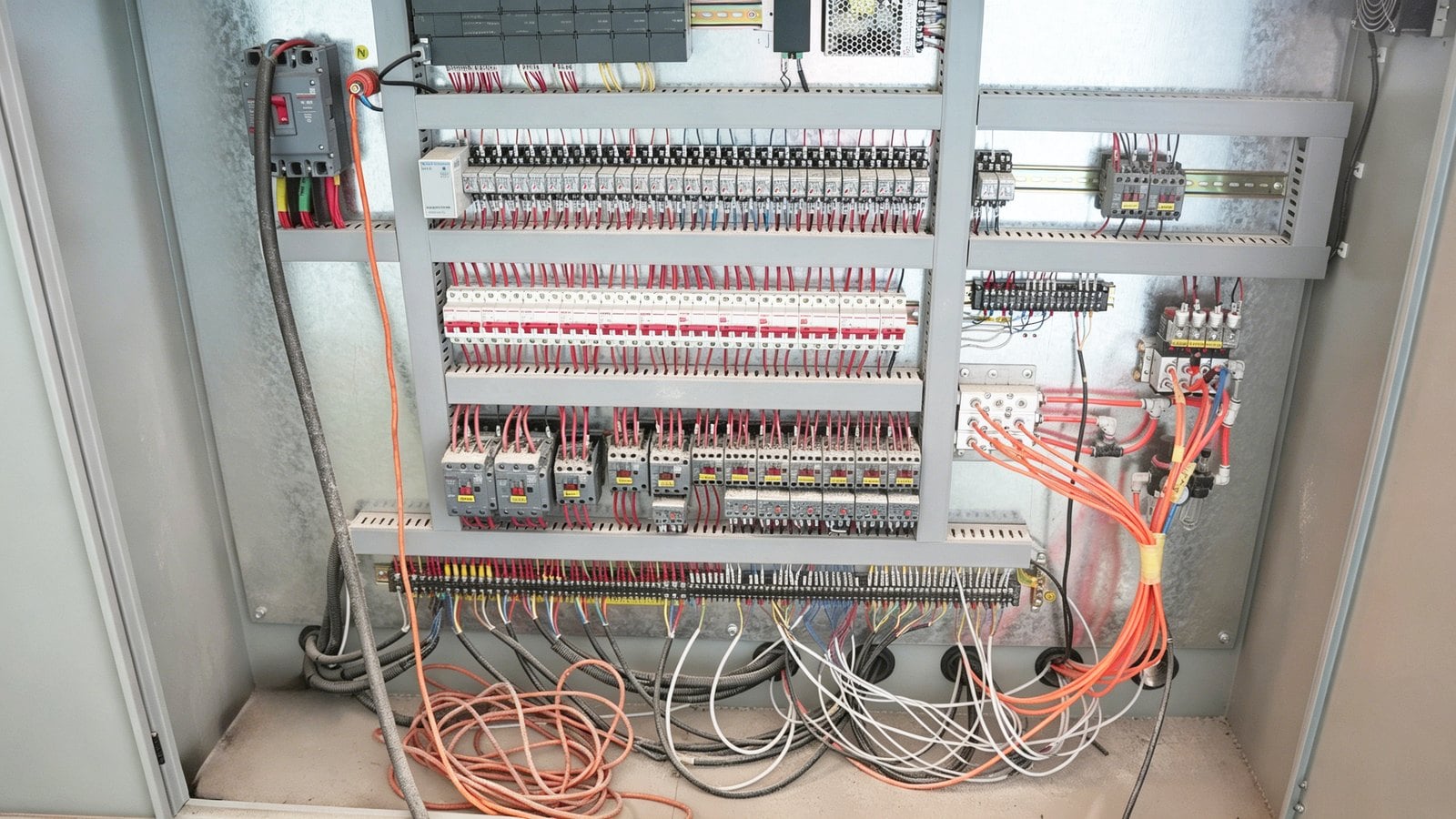
Remote access through the control platform lets our engineers read alarms and recipe logs with you rather than asking you to describe a fault over email.
Where a part is a standard industrial component rather than something proprietary to us, we say so, because that means you can source it locally as well as from us.
Company Qualifications
ISO9001 quality management system
ISO27001 information security management system
DCMM Level-2 data management capability maturity
SRDI enterprise status (specialized, refined, differentiated and novel small and medium enterprise)
Gazelle Enterprise status
7 patents and more than 100 software copyrights across our equipment platform
Company records: Request the current holder, scope and validity details.
Equipment conformity: Confirm the documents for the model, configuration and destination country.
Order documents: Agree inspection records, manuals, drawings and shipment paperwork in the contract.
×
![Enlarged View]()
How We Work: From Brief to Commissioning
01
Send your product brief
Product, cut, incoming moisture, target residual moisture, the output you need and your building constraints.
02
Sizing review
An engineer climbs the water-load ladder and tells you what is missing before anything is priced.
03
Itemised quotation
Scope, configuration sheet, delivery arrangement and acceptance terms in one document.
04
Build and factory testing
The inspection sequence above, completed and recorded before shipping.
05
Delivery and site assembly
Machines of this size ship in sections and are assembled at your plant.
06
Commissioning and handover
We do not consider the job done at delivery. Our engineers travel to your site to direct installation and train operators.
Who Does What on Site
| Item | Shengtu | Your plant |
|---|---|---|
| Sectional delivery and positioning plan | Supplied with the configuration sheet | Access route, floor loading confirmed |
| Lifting gear, tools and skilled trades | — | Forklift, crane, welding equipment, welder, fitter, electrician |
| Assembly supervision | Our engineer directs the sequence on site | Your crew executes under that direction |
| Utilities to the machine | Requirements issued in advance | Power, water and any steam supply terminated at the machine |
| Commissioning and operator training | Carried out by our engineer through to a completed batch | Operators released to attend |
| Travel and accommodation | Quoted as a separate line | Confirmed with the order |
VFD System Evaluation & Showcase
Freeze drying is the most expensive way to take water out of food. It earns that cost on premium product and loses badly everywhere else, so it is worth checking your case against the three below before you go further.
System Warnings
Commodity dried product sold on price
What to do instead: Hot air or belt drying for the commodity line, and keep freeze drying for a premium grade that carries the cost.
Very high sugar or high fat product
What to do instead: Reformulate, cut thinner, or accept the longer cycle and size the machine for it rather than being surprised by it.
Buying capacity to fix a line bottleneck
What to do instead: Time the whole sequence first. Shortening changeover and defrost often buys more annual output than a larger chamber.
Workshop Data
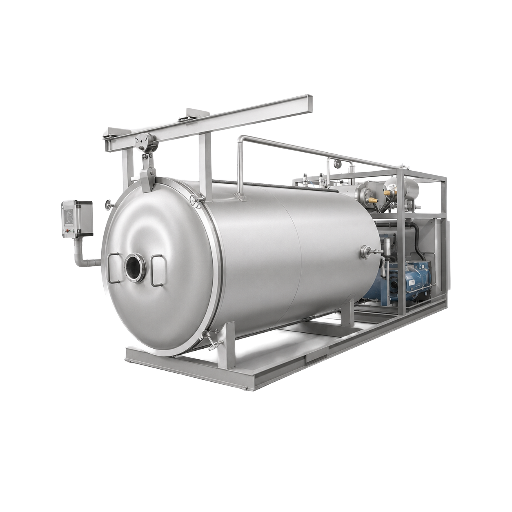
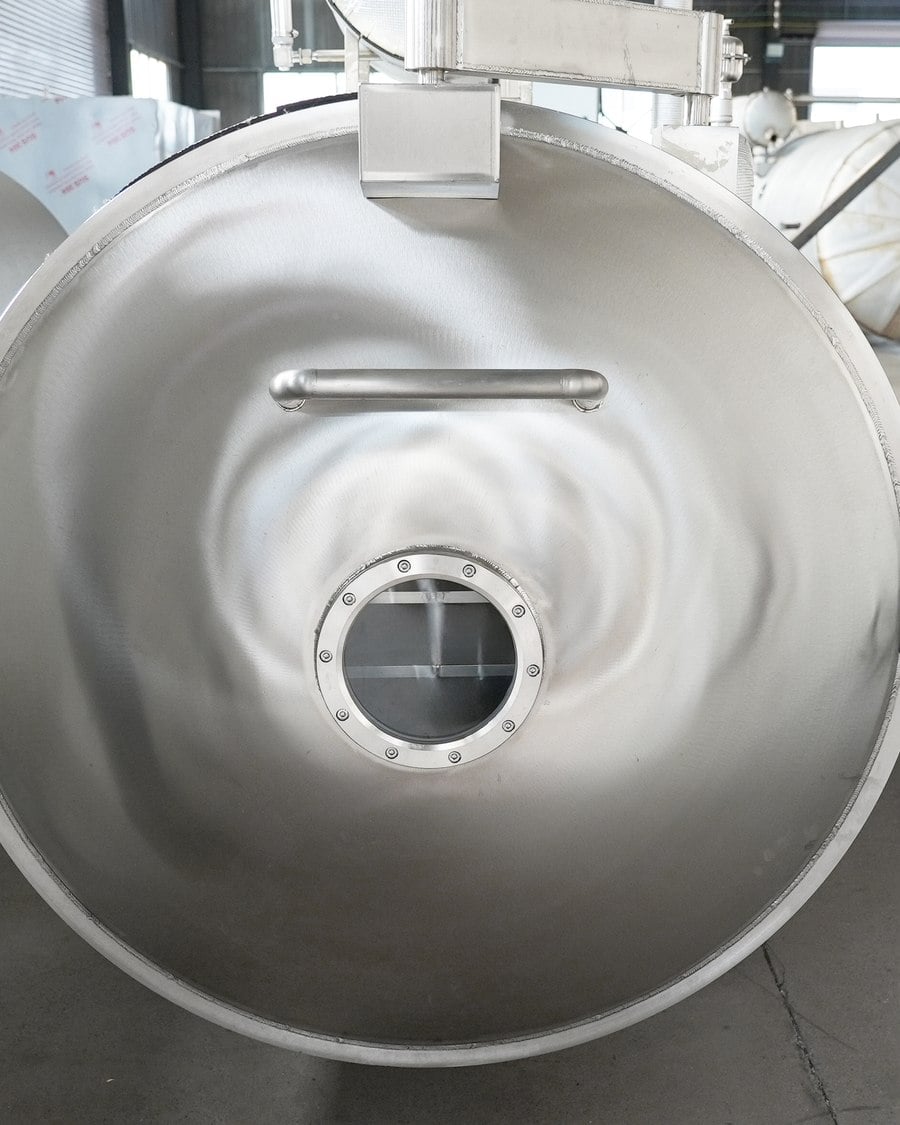
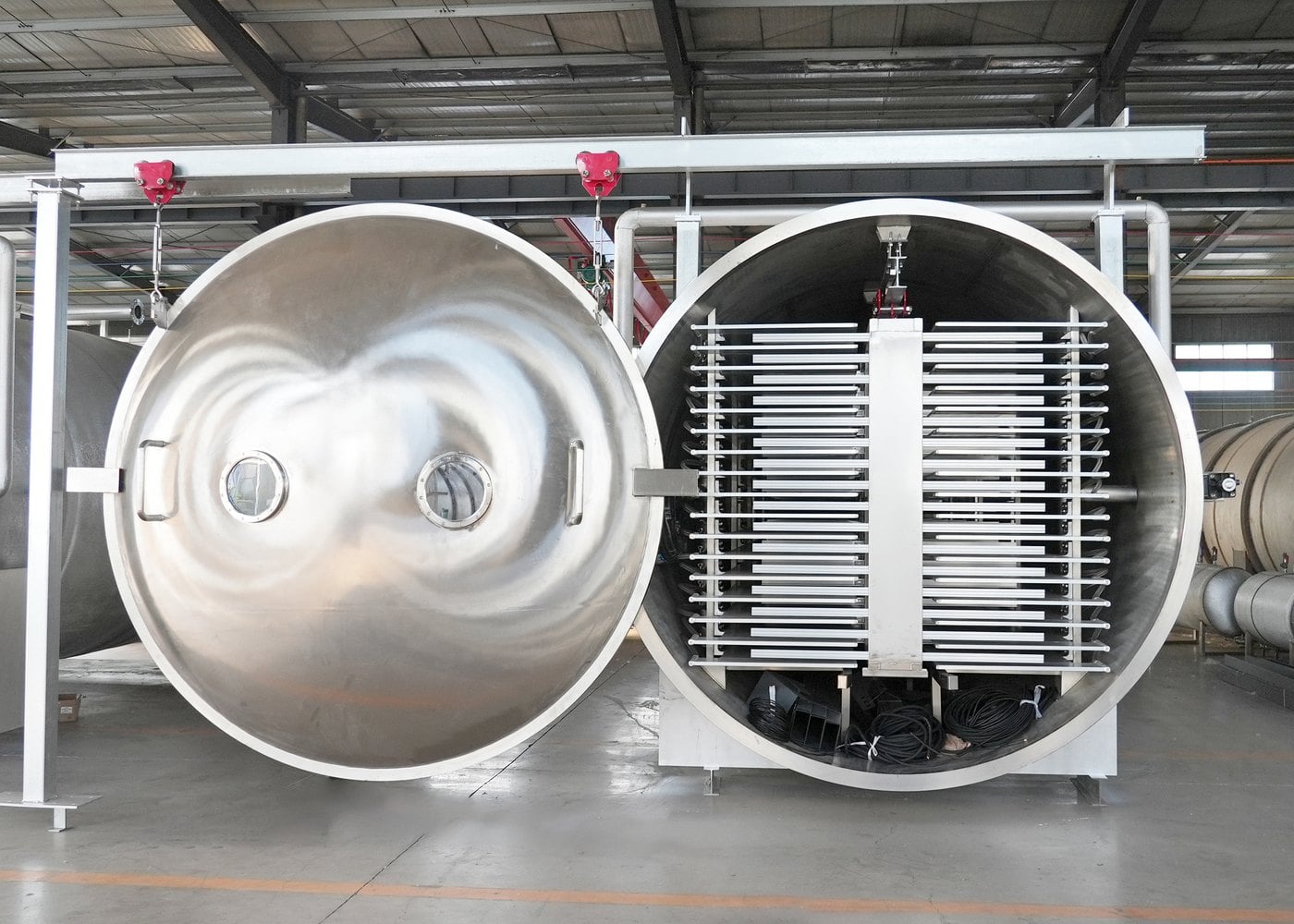
Chamber, skid frame and overhead loading rail during assembly in our workshop.
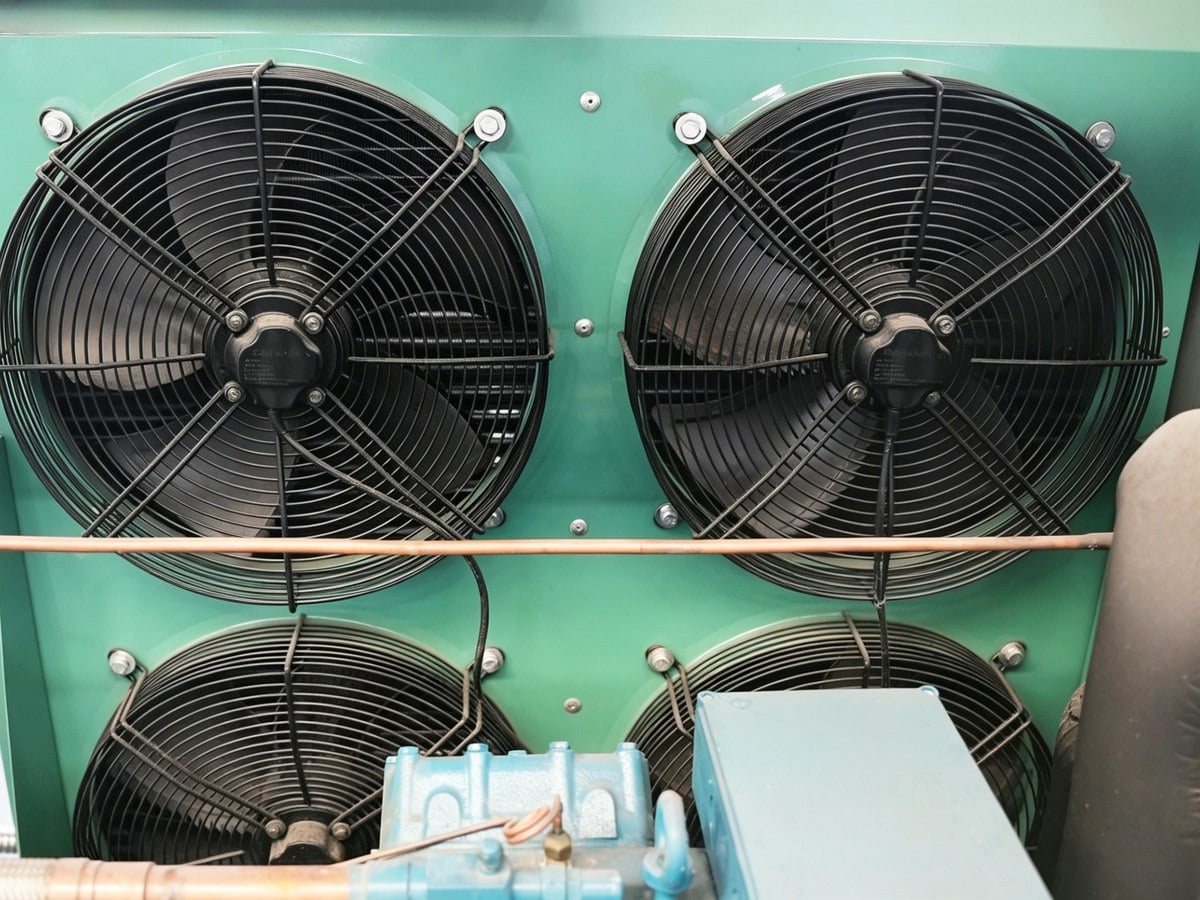
Refrigeration condensing unit with high and low pressure gauge panel, assembled and piped in house.
Product rendering showing the operator panel and vacuum pump skid layout. This image is a rendering, not a photograph.
A short walkthrough video of an assembled unit is available on request with your product brief.
Advanced Vacuum Freeze Dryer Production & Energy Calculators
Water-Load and Shelf Area Calculator
Rungs 1 to 6 of the Water-Load Ladder. Enter your product and this works out how much water actually has to leave the chamber, and how much shelf that batch needs.
Access Calculator ➔Batch to Annual Output Converter
Rungs 7 to 10 of the Water-Load Ladder. Cycle time is the number that turns a batch weight into an annual figure, and it is the number most quotations leave out.
Access Converter ➔Freeze Drying Energy Cost Estimator
This tool deliberately does not supply an energy figure. Published values for energy per kilogram of water removed differ by close to an order of magnitude depending on what the scope includes, so the only honest version of this calculation uses a figure you have measured or been quoted.
Access Estimator ➔Applicable certificates and documents are confirmed for the equipment model, configuration and destination country. Company management-system records are reviewed separately from product conformity documents.

![F&V Freeze-Drying Line Process Guide [2026]](https://shengtumachinery.com/wp-content/uploads/2026/09/fv-freeze-drying-line-guide-featured-150x150.png)