Get in touch with Shengtu Bufan Company


Yogurt, Cheese and Butter Production Line
We create a yogurt production line, a cheese line and a butter line that have one milk processing front end then fork off to three dedicated unit groups. Raw milk reception, chilling, separation and pasteurization go once through for all three; cheese making, fermentation and churning are done in dedicated units.
Our process hardware is self-produced in Weifang, Shandong, so the machinery and the control layer are specified together rather than integrated after the fact.
01 Quotation
Written quotation within 24 hours on business days
02 Delivery
120–180 days
03 Payment
30 % deposit, 70 % balance before shipment
04 Shipping
FOB or CIF
05 Acceptance
Trial production on your own product before acceptance
06 After Sales
Maintenance duration and technical-support scope confirmed in the contract
Yogurt, Cheese and Butter Line Configurations
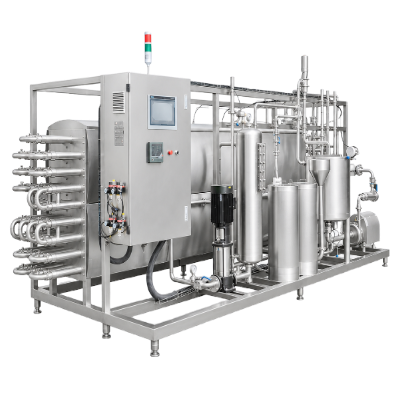
One front end feeds three routes. Milk comes in, gets chilled and stored, then homogenized and pasteurized before any product-specific equipment. This split occurs after pasteurization and its position determines what portion of the line is shared.
Six stations every configuration is built from
- Chilled milk tank
- Receives and holds raw milk at storage temperature until the batch starts
- Homogenizer
- Breaks the fat phase so the product does not separate in the pack
- Pasteurizing tank
- Heat treatment with temperature control and a timed holding section sized to the pasteurization time-and-temperature pair published in the US Pasteurized Milk Ordinance
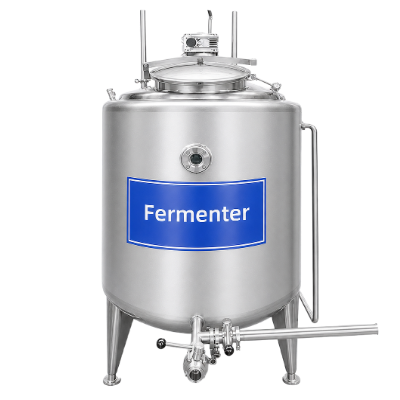
- Fermentation tank
- Jacketed and agitated, holding incubation temperature for the culture
- Cheese press
- Expels whey from the curd and forms the block
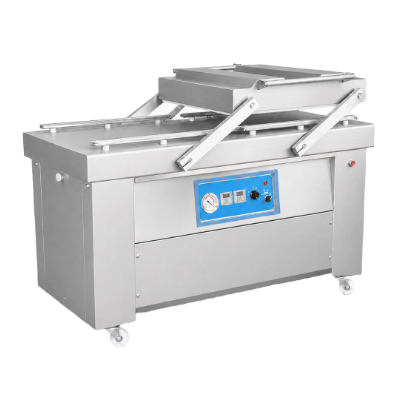
- Packaging machine
- Cup, pouch or bottle filling machine matched to your pack format
Dairy products these production lines make
- Set, stirred and drinking yogurts, including probiotic and Greek-style products.
- Fresh curd cheese, mozzarella, feta and semi-hard pressed cheese
- Sweet cream butter and cultured butter, with buttermilk as a by-product.
- Skim milk and cream separated on the shared front end can be sent to a separate fresh milk line rather than staying in these three routes.
- Cream, skim milk and whey are routed to separate storage tanks instead of being disposed of as waste.
- Milk powder, following the addition of downstream evaporation and drying components.
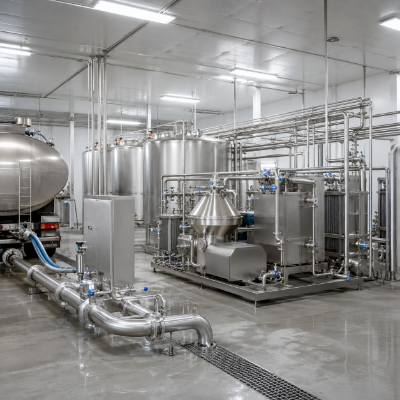 STAGE 01
Shared milk processing front end
Reception, chilling, storage, separation and pasteurization serve all three routes from one set of equipment. This group is where a combined line earns back the cost of being combined, and it is the first thing to check on any quotation.
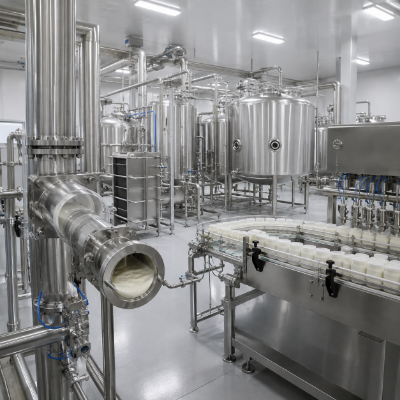 ROUTE A
Yogurt route
After the mix is homogenized and heat treated it is cooled to incubation temperature, inoculated and held in the fermentation tank until it reaches target acidity. Cooling stops the ferment, and the product goes to cup, bottle or pouch filling. Probiotic and Greek-style products change the culture and the cooling duty, not the station list.
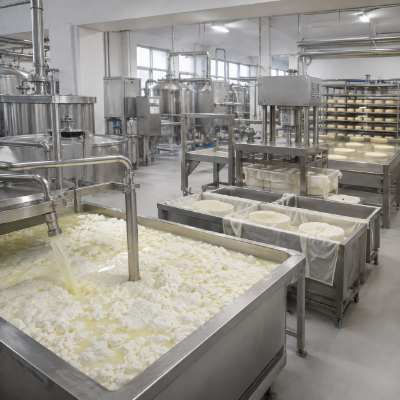 ROUTE B
Cheese route
Standardized milk is coagulated with rennet, then the curd is cut and stirred and the whey is drained. Curd is then pressed to form and consolidate the block before brining and ripening. Fresh curd cheese, mozzarella and semi-hard pressed cheese all run this sequence with different cut sizes and press cycles.
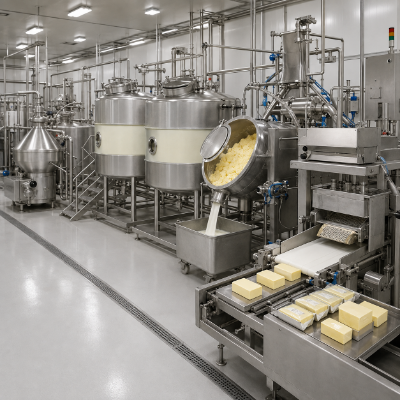 ROUTE C
Butter route
The separator splits milk into cream and skim milk, and the cream is held and ripened before churning. In the churn the fat phase inverts and buttermilk drains off, leaving butter to be worked to its target fat content. Skim milk returns to the front end for liquid milk, yogurt mix or a milk powder route.
Contact Materials and Line Construction
Product contact steel, gasket compound and weld condition are the three construction decisions that follow the line for its whole service life. All three are fixed in the quotation before fabrication starts.
| Material / Component | Grade / Compounds | Where it is used | Condition (Surface / Weld) | Notes |
|---|---|---|---|---|
| SUS304 stainless steel | SUS304 / AISI 304 / EN 1.4301 | Tank shells, fermentation tank jackets, frames, platforms and cladding | 2B mill finish, which reaches Ra 0.8 µm on product contact without further polishing | The standard contact material on our published dairy modules |
| SUS316L stainless steel | SUS316L / AISI 316L / EN 1.4404 | Acid and alkali dosing, brine circuits, whey lines and acidified product contact | Electropolishing available where a lower roughness is specified | The molybdenum addition resists pitting at low pH; it is not needed on the whole line |
| Gaskets, seals and welds | EPDM, silicone and PTFE, selected by temperature and product contact | Valve seats, pipe unions, manway doors, pump housings and heat exchanger stacks | Full-penetration welds ground back and passivated so the bore stays continuous | A cracked gasket holds residue no rinse removes, so seals belong on the spares list |
Another material or standard
If your project engineer or inspector has specific requirements regarding gasket compound, piping standards, or finish requirements, please send this information along with your enquiry. We confirm availability and the cost effect in the quotation rather than after the order.
Hygienic Design Specifications for a Wet Dairy Line
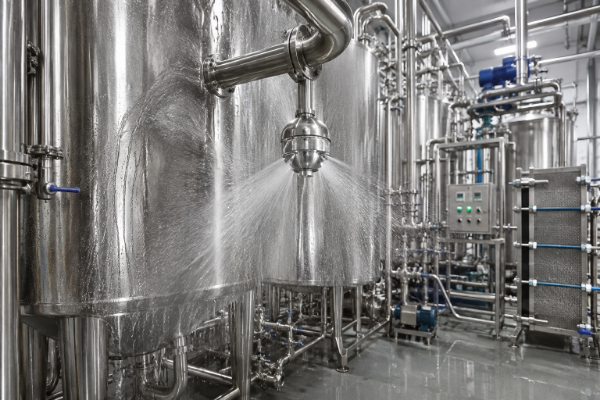
On a wet line, hygiene depends on geometric considerations more than on chemical solutions. Three conditions let residue survive a full clean: water that cannot leave a vessel, a corner a spray device cannot reach, and a horizontal run with no fall.
| Design item | Standard | What the standard sets | Why it decides the outcome |
|---|---|---|---|
Product contact roughness |
EHEDG Doc 8 · 3-A | Ra 0.8 µm or better; 3-A states the same limit as a nominal 32 µin | A 2B mill finish already meets it, so a rougher surface is a choice |
Internal corner radius |
EHEDG Doc 8 | Minimum 3 mm radius on every internal angle of 135° or less | Sharp corners are where a spray device leaves a shadow |
Drainage slope |
EHEDG Doc 8 · EN 1672-2 | Sufficient inclination to be self-draining, horizontal contact surfaces avoided | Standing water is how contamination survives between runs |
Roughness limit in food safety codes |
Codex CXC 1-1969 · ISO 22002 | No numerical roughness limit is set at all | Your figure has to come from the equipment standard instead |
Certification scopeApplicable certificates and documents are confirmed for the equipment model, configuration and destination country. Company management-system records are reviewed separately from product conformity documents. |
EHEDG · 3-A · NSF | All three assess design; EHEDG also requires closed equipment to pass at least three clean-in-place tests | A certificate covers the drawing, not the plant as installed on your floor |
Spray coverage verification |
3-A riboflavin procedure | Riboflavin at 0.015–0.025 % w/w, dissolved above 70 °C, read under ultraviolet light | Missed surfaces show as dark patches inside a closed vessel |
Riboflavin confirms that the spray device reached the surface. It does not measure cleaning performance, so the clean-in-place (CIP) sequence is run and logged separately, with its time, temperature and chemical concentration recorded for each circuit.
Process Set Points a Dairy Line Has to Hold
These are the values the production process demands, and the reference points the industry accepts a line against. Where a value is fixed by regulation rather than by preference, the table follows the pairs published in the US Pasteurized Milk Ordinance and the published composition minimums, not a house preference, and your local authority sets the pair that binds your plant. Where your recipe needs a different set point, it belongs in the enquiry so it is designed in rather than discovered at commissioning.
Stage & Process Requirement
Stage
Process requirement
Standard pasteurization
72 °C for 15 s, high temperature short time, with a timed holding section
Vat pasteurization for starter culture
63 °C for 30 min, on the separate vessel used to prepare cheese and yogurt cultures
Yogurt mix heat treatment
85 °C for 30 min or 95 °C for 10 min, deliberately above the legal pair
High fat and sweetened products
Held 3 °C above the standard pair at 10 % fat or more, sweetened or condensed
Homogenization pressure
2,000–2,500 psi (roughly 14–17 MPa) on yogurt mix
Incubation
Cool to 42 °C, inoculate, hold until pH 4.5
Culture optima
Streptococcus thermophilus 35–53 °C, Lactobacillus bulgaricus 40–44 °C
Post-fermentation cooling
Cool to 7 °C to arrest acidification before filling
[HOVER PANEL TO REVEAL 5 MORE SPECS]
Pasteurization time and temperature pairs under the US Pasteurized Milk Ordinance
Temperature
Hold time
Method
63 °C (145 °F)
30 minutes
Vat pasteurization
72 °C (161 °F)
15 seconds
High temperature short time
89 °C (191 °F)
1.0 second
Higher heat shorter time
94 °C (201 °F)
0.1 second
Higher heat shorter time
100 °C (212 °F)
0.01 second
Higher heat shorter time
138 °C (280 °F)
2.0 seconds
Ultra pasteurization, for extended shelf life and sterilization duty
Cost Drivers, Payment Terms and Lead Times
A dairy line is priced per layout, not per unit. Cost follows the number of separate routes, peak hourly flow, filling format, contact material grade and how much of the sequence runs without an operator. There is no price list for a combined line, and your figure comes back in a written quotation.
What moves your price
-
DriverEffect on costHow to reduce it
-
Number of separate routesEach dedicated route adds vessels, pumps, valves, a cleaning circuit and floor areaSplit only after pasteurization, where the process forces it
-
Peak hourly flowVessel volume and pump duty follow the busiest hour, not the daily averageRun two shifts on smaller vessels rather than one on oversized ones
-
Heat recovery configurationRegeneration recovers 90–94 % of the heating and cooling duty (published dairy engineering practice)Specify it at layout stage, while it is still a plate count
-
Filling formatCup, bottle, pouch and can machines are different machines, not settingsFreeze the pack format before the layout is drawn
-
Contact material gradeSUS316L costs more than SUS304 and is not needed on every surfaceApply 316L to acid, brine and whey contact and keep SUS304 elsewhere
-
Automation depthA manual cleaning sequence costs less to buy and more to run every dayAutomate the cleaning sequence and the temperature control loops first
Lead time and commercial terms
-
ItemTermWhat it covers
-
QuotationWithin 24 hoursProcess flow, station list, price and terms
-
Delivery120–180 daysFabrication, vessel polishing, panel build and factory assembly
-
Payment30 % deposit, 70 % before shipmentDeposit releases fabrication; the balance is due before the line ships
-
ShippingFOB or CIFThe term is fixed in your quotation
-
AcceptanceTrial production on your own productThe line runs your product before it is signed off, not a water test alone
-
After salesMaintenance duration and technical-support scope confirmed in the contractMaintenance and warranty scope are confirmed in the quotation and contract
Quality Control and Cleaning Verification
A dairy line is judged twice: once against water, and once against your own product. Trial production on your product is what closes acceptance, because a water run proves the circuit and only product proves the process.
How the line is checked
- Material grade is matched to the fabrication drawing before any plate is cut. Vessel internals are checked and passivated before insulation goes on.
- Build the line and it runs on water — pumps, valves, the temperature control loops, the timed hold and the full cleaning sequence.
- Every closed vessel is verified for spray device coverage with the 3-A riboflavin test and examined under ultraviolet light.
- Trial production runs your own recipe on the finished line, and the acceptance criteria on the sign-off sheet are read against those results.
Where spray coverage usually fails
- Baffles, and the undersides of mixer and agitator blades
- Access ports and manway shadows
- Tank nozzles with narrow annular spaces
- Any surface that was never fully wetted because a fabrication oil film survived the first rinse
Your own acceptance test can lie to you: riboflavin gives a false pass if a fabrication oil film is still present, so a water break test on the bare surface comes first. That sequence — water break, riboflavin, then the logged cleaning run — is what turns a hygienic drawing into a hygienic plant.
From Enquiry to First Saleable Batch
-
STAGE 01
Send your brief
daily intake, product mix, pack format, your floor plan and a list of the utilities you have on site.
-
STAGE 02
Layout and quotation
a process engineer returns a written price within 24 hours on business days, with the layout and station list.
-
STAGE 03
Deposit and drawing approval
we take 30 % on deposit by transfer. After sign-off of the drawings we then start the clock running for 120–180 days.
-
STAGE 04
Manufacturing and factory testing
vessels are built and polished, control panels are wired, and the whole sequence is run before anything is packed for despatch.
-
STAGE 05
Installation and trial production
at your site the line is built, plumbed and wired, and then the process starts with your products. We stay until that batch meets the signed acceptance sheet.
-
STAGE 06
Handover and support
maintenance and technical-support arrangements confirmed in the quotation and contract.
Layout decisions that lower your installed cost
| Layout decision | What to specify | Why it saves money |
|---|---|---|
| Shared front end | One reception, chilling and separation group serving all three routes | Reception and separation is the most duplicated cost when routes are quoted separately |
| Regeneration section | Ask for heat recovery to be configured from the start | A regeneration section recovers 90–94 % of the heating and cooling duty (published dairy engineering practice) |
| Pipe diameter | Size pipework so milk velocity sits near 3 m/s at peak flow | Undersized pipe raises pump duty and shear; oversized pipe raises cleaning cost |
| Room separation | Decide whether fermentation, filling and palletizing sit in separate rooms | A partition added after the line is piped means moving welded equipment |
| Cleaning circuit count | Fix how many circuits clean in parallel during production | Every added circuit is a tank, a pump, a return line and a set of valves |
The digital layer, specified with the machinery
The control layer is scoped separately from the process equipment. Our STUnit platform, low-code control boxes and multi-protocol gateways can be specified into this line at quotation stage, so the control layer is priced together with the machinery rather than retrofitted later, and where it is specified, standalone over-the-air upgrades mean a software change does not require a site visit. Line integration, smart factory planning and IT and OT digital work are quoted as their own scope items alongside the machinery.
Published Dairy Modules
Two modules from our dairy range are published with their full specification. They are the smallest units we list, which makes them the honest answer to what a first order can look like.
“Yogurt is less forgiving than cheese.”
Small moves in temperature or in culture show up as flavour and thickness, so a cheese plant adding a yogurt route takes on a second discipline rather than one more station. Sizing the fermentation tanks and the cooling duty for that discipline at layout stage is cheap, and discovering it after the pipework is welded is expensive. Treating a second route as a bolt-on is the most common mistake we are asked to correct.
Our published separator lists an annual output of 70 sets a year, and maintenance and technical support for the pasteurizing tank are confirmed in the quotation and contract. Larger vessels and a full dairy processing plant are built in-house to your layout rather than sold from a catalogue.
Get a Line Proposal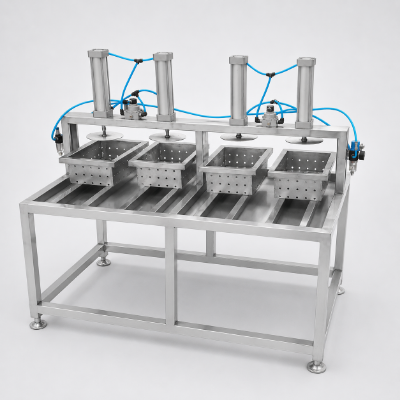
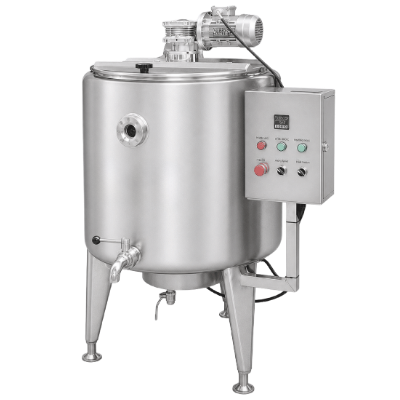
IP05-28 pasteurizing tank
- Model IP05-28
- Capacity 100 L
- Contact material SUS304
- Other listed sizes 150 L, 300 L and 500 L
- Warranty Confirmed in the quotation and contract
BR04-02 milk separator
- Model BR04-02
- Throughput 1,000 L/h
- Power supply 380 V, 1.5 kW
- Bowl speed 7,546 r/min
- Dimensions 680 × 400 × 680 mm
Where a Three-Route Line Is the Wrong Call
Combining routes pays only when the shared front end is genuinely shared. Each of these four situations is an expensive mistake to correct once the pipework is welded, and each has a cheaper answer that costs nothing to ask for in the 24 hours it takes us to return a layout.
| Situation | Why it works against you | What to do instead |
|---|---|---|
| One product at high volume | A shared front end adds valves, transfer lines and cleaning circuits that never carry product | Quote a dedicated single-product line; the piping is simpler and the circuit count drops |
| Greek yogurt made by whey straining | Acid whey is hard to place and the separation equipment for it is a capital line of its own | Reach the same solids with milk protein concentrate or membrane filtration, and no acid whey |
| Artisan batches below the smallest vessel | Equipment idles, and cleaning a large vessel for a small batch uses more water than the batch | Start with a batch pasteurizing tank and a manual cheese vat, then move to an industrial production line |
| Milk supply not yet contracted | Vessel sizing follows peak collection, so a line sized for milk that never arrives is dead capital | Fix the collection schedule and hold volume first, then size the storage tanks around them |
Dairy & Sauce Processing Tools
Standardized operational grids and batch input worksheets for yogurt, cheese, and butter processing lines.
Under the US Pasteurized Milk Ordinance the pairs run from 63 °C for 30 minutes and 72 °C for 15 seconds through the higher heat shorter time pairs to ultra pasteurization at 138 °C for 2 seconds, and products at 10 % fat or more, sweetened or condensed, are held 3 °C higher. These three routes are built around the first two pairs. Vat pasteurization is the pair that still earns its place in the dairy industry, mainly for preparing the starter cultures used in cheese production, yogurt and buttermilk.
Yogurt mix is heat treated at 85 °C for 30 minutes or 95 °C for 10 minutes, far above the 72 °C for 15 seconds legal pair, and deliberately so. That extra heat denatures whey proteins, so the gel sets firm and holds its water instead of weeping. A pasteurizer specified only to the legal minimum cannot make a stable set yogurt, which is the most common specification error on a shared line.
A cheese vat coagulates milk with rennet and then cuts and stirs the curd with tools built into the vessel, draining whey through a screened outlet. A fermentation tank has an agitator built for a liquid, not a cutting and healing programme for a curd. Both vessels look similar and are not interchangeable, which is why the cheese route separates from the yogurt route immediately after pasteurization.
Incoming milk is split into cream and skim milk by the separator, and the cream is held and ripened before it reaches the churn. In the churn the fat phase inverts, buttermilk drains off, and the butter is worked to its target fat content and moisture before forming and packaging. Skim milk returns to the front end, so a butter route does not throw away the volume it separates.
EHEDG Doc 8 and the 3-A standards set product contact roughness at Ra 0.8 µm or better, which 3-A states as a nominal 32 µin. Internal angles of 135° or less carry a minimum 3 mm radius, and surfaces are inclined enough to be self-draining. Codex CXC 1-1969 and ISO 22002 set no numerical roughness limit at all, so the figure on your specification has to be taken from the equipment standard.
A combined line is priced per layout. Cost drivers are route count, peak hourly flow, filling format, contact material grade and automation depth, and they are itemised above. Send your daily volume, product mix and floor plan and your figure comes back in a written quotation within 24 hours.
Delivery runs 120–180 days, and the clock starts at deposit and drawing approval rather than at enquiry. Buyers plan against the delivery date, but the dangerous gap is after delivery: erection, piping, wiring, the cleaning sequence and trial production on your own recipe all sit between shipment and first sale. Build both into your schedule from the start.
Orders run on a 30 % deposit with the 70 % balance before shipment, and we quote FOB or CIF with the term fixed in your quotation. Acceptance is trial production on your own product, not a water run alone. Warranty duration, coverage and exclusions are confirmed in the quotation and contract. Maintenance and technical support are scoped in the same written terms.
Yes — the front end is genuinely shared: reception, chilling, storage, separation and pasteurization serve all three routes. After that the routes are separate unit groups, because a fermentation tank, a cheese press and a churn each do something the other two cannot. Asking one vessel to do all three jobs is where combined lines fail, and it is the first thing to check on any quotation.
The control layer is optional scope, not a default inclusion. If you specify it, our STUnit platform with low-code control boxes and multi-protocol gateways lets the line report into plant systems you already run, and standalone over-the-air upgrades mean a software change does not need a site visit. Tell us which systems have to receive data and the interface is priced in the quotation.
![F&V Freeze-Drying Line Process Guide [2026]](https://shengtumachinery.com/wp-content/uploads/2026/09/fv-freeze-drying-line-guide-featured-150x150.png)