Get in touch with Shengtu Bufan Company

Vegetable Washing & Peeling Machine
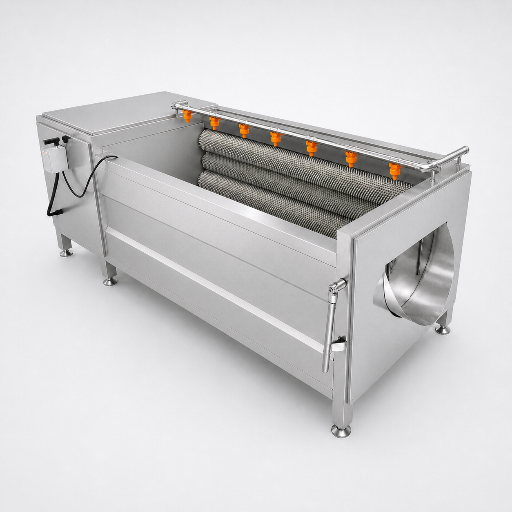
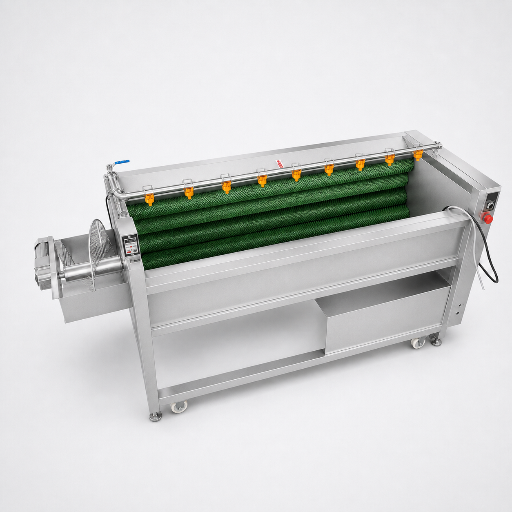
This vegetable washing and peeling machine uses counter-rotating brush rollers under a spray manifold to clean and peel root vegetables in one pass, with the rollers turning continuously as they rinse. Change the brush type to switch between polishing and peeling. It runs on its own at a single station, or connects into a longer processing line when your throughput grows.
Quotes reviewed and returned within 1 working day
304 stainless steel standard, 316L on request
Built to EN 1672-2 and ISO 14159 hygiene design requirements
Standalone unit today, line-integrated later
Quote response
Reviewed by an engineer, returned within 1 working day
Product-contact material
304 stainless steel standard, 316L on request
Hygiene design reference
Built to EN 1672-2 and ISO 14159 machinery hygiene requirements
Wash + peel in one pass
Brush rollers polish or peel; swap brush type to change function
The Challenge & The Solution
Washing and Peeling Capabilities
Soil clinging to root vegetables carries more than dirt — field soil is a known vector for pathogens and residue that manual rinsing under a tap struggles to remove consistently, especially at volume. Hand-washing also does not scale: it is slow, inconsistent between workers, and ties up labor that could run other stations. The brush-roller mechanism below is built to strict hygienic design principles, not just a tank and a hose.
Hygienic Standard Built to EN 1672-2 self-drainable, crevice-free surface principles.
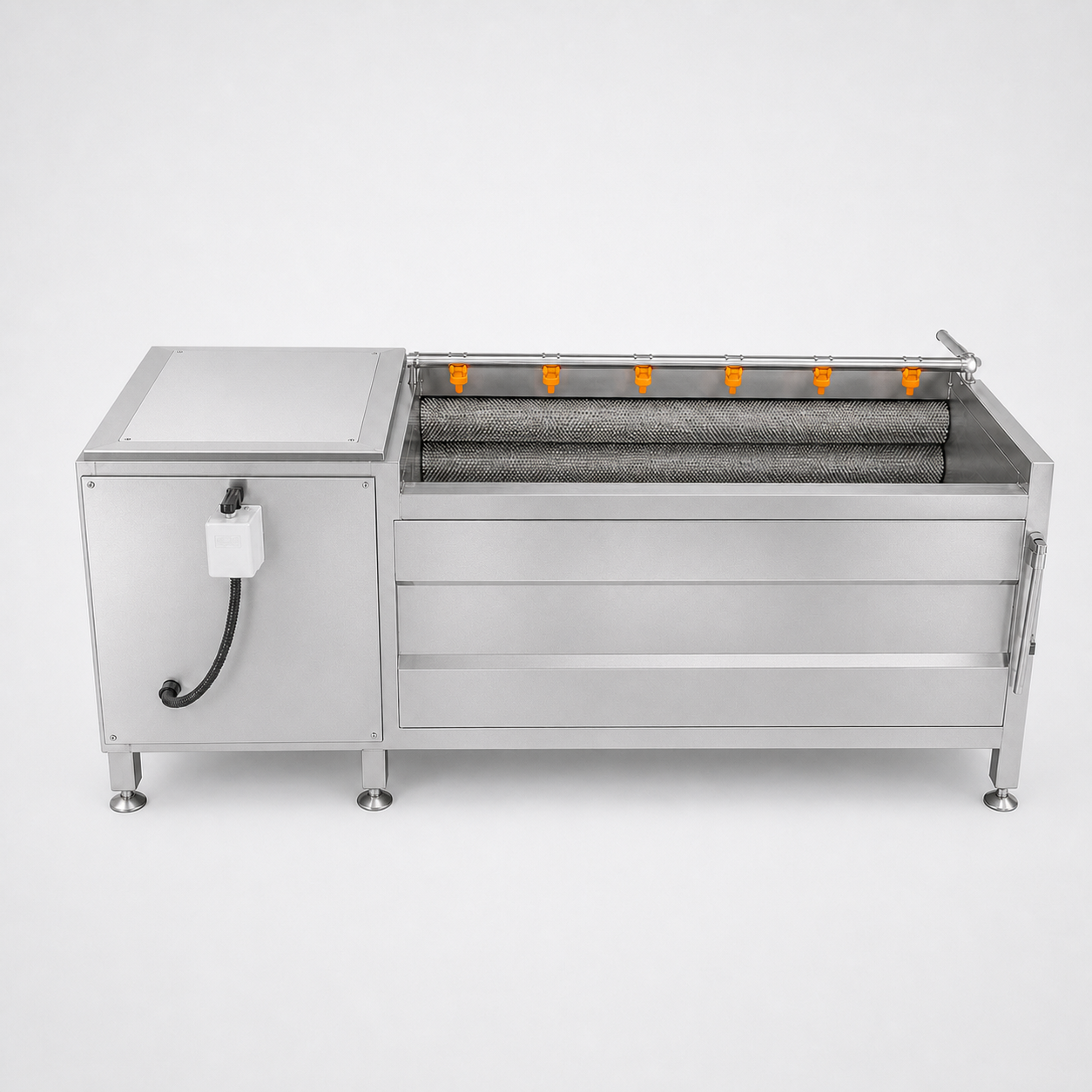
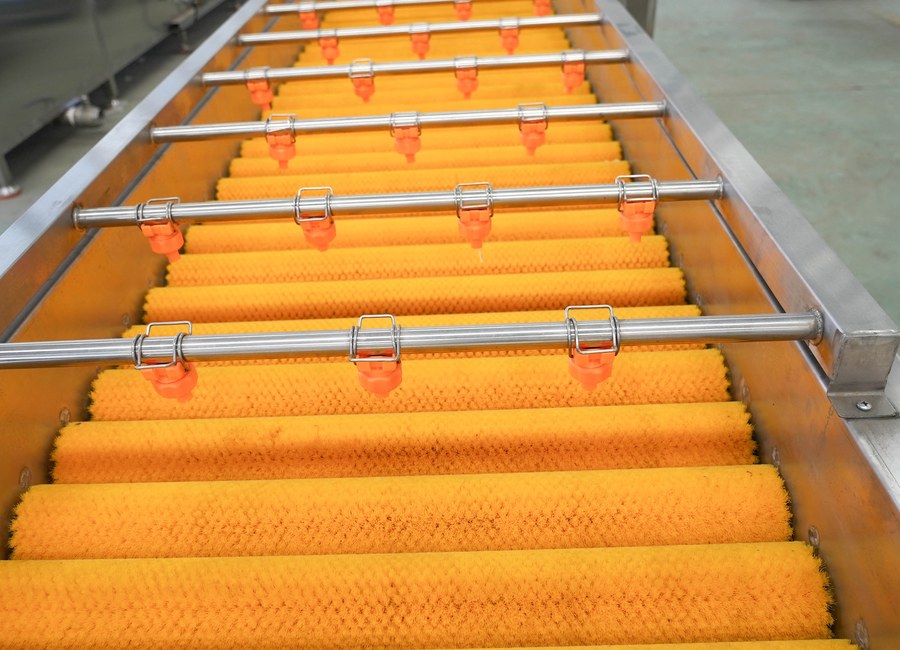
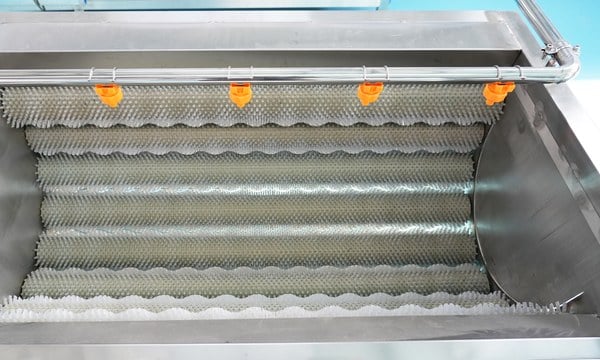
A spray manifold above two counter-rotating brush rollers showers dirt-encrusted root vegetables with water as the rollers brush it clean, continually washing the soil away.
Fit a bristle brush set for wash and polish, or an abrasive brush face to peel.
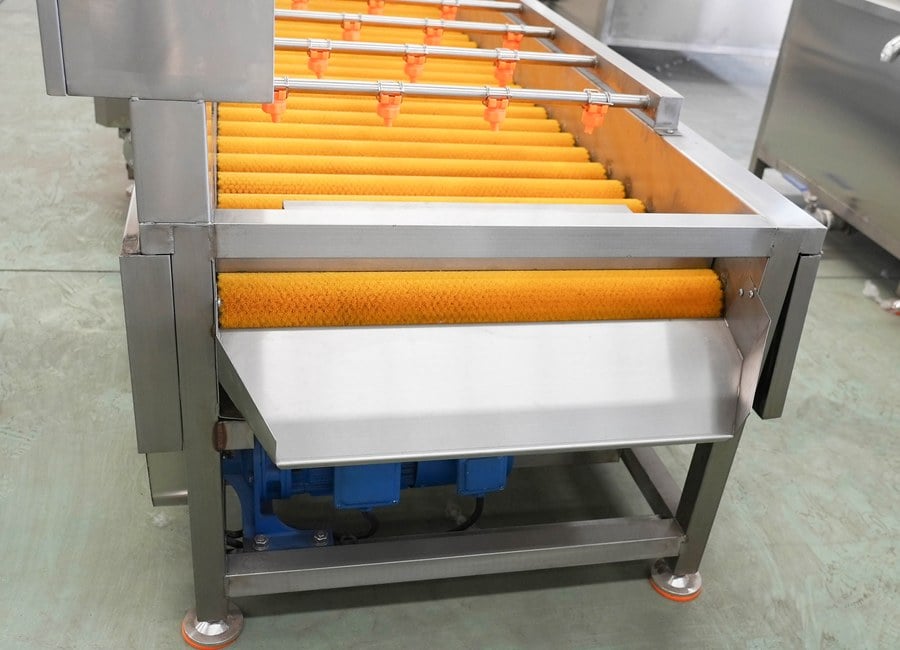
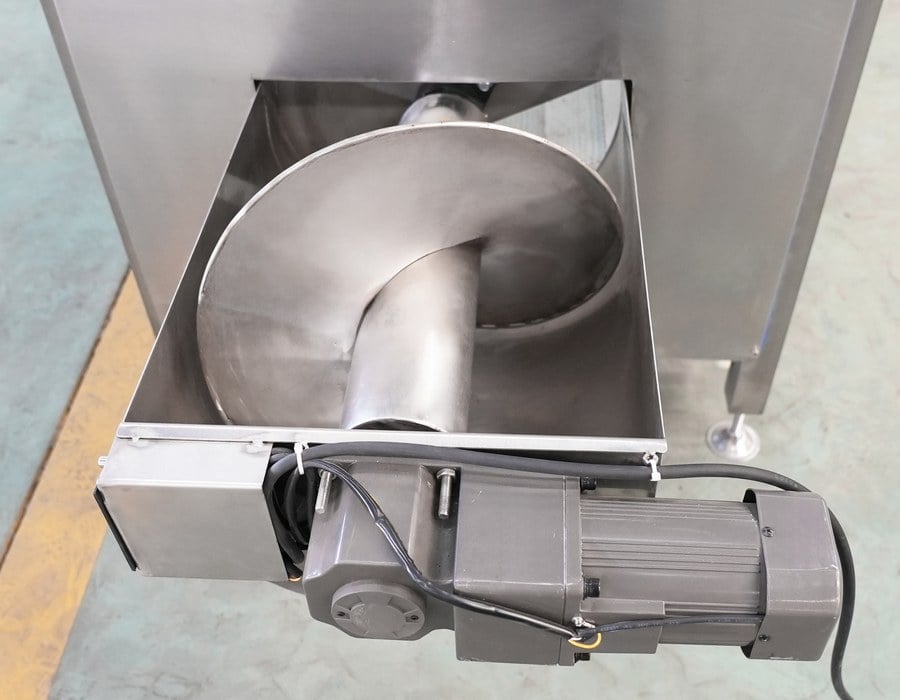
Cleaned or peeled product is discharged automatically through a hinged side door as the rollers turn, so you don’t have to stop the line.
Brush-Roller Washing
The product is washed and kept in motion between rollers that continue turning under an overhead water spray. Rotating brush contact lifts dirt and grit off the product’s surface, even in crevices, while the spray washes it away.
Brush-Roller Peeling
Swap to the abrasive brush face and the same frame becomes a peeler instead of a washer. The rollers remove the outer skin layer as the product rotates and continues to rinse.
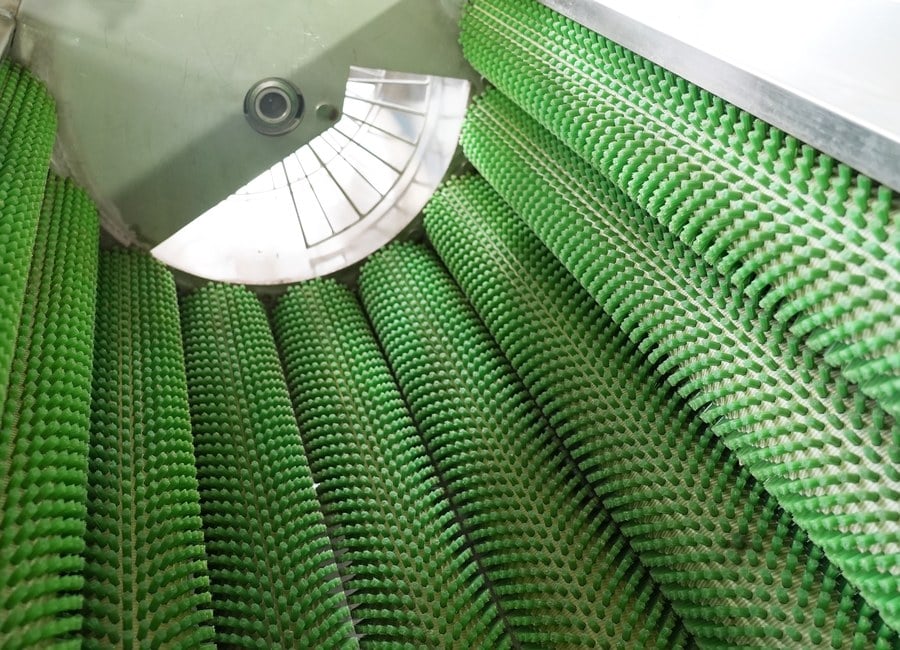
What You Can See on the Machine
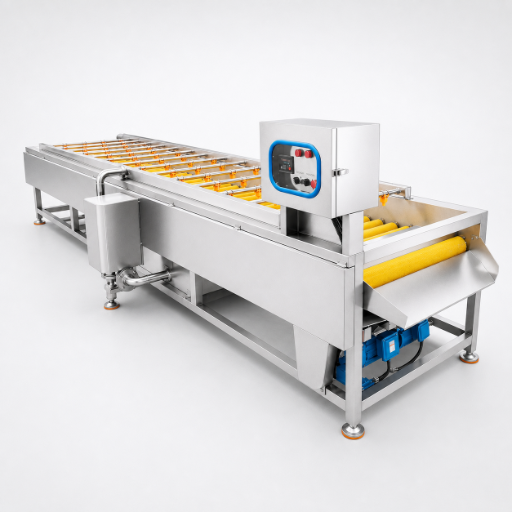
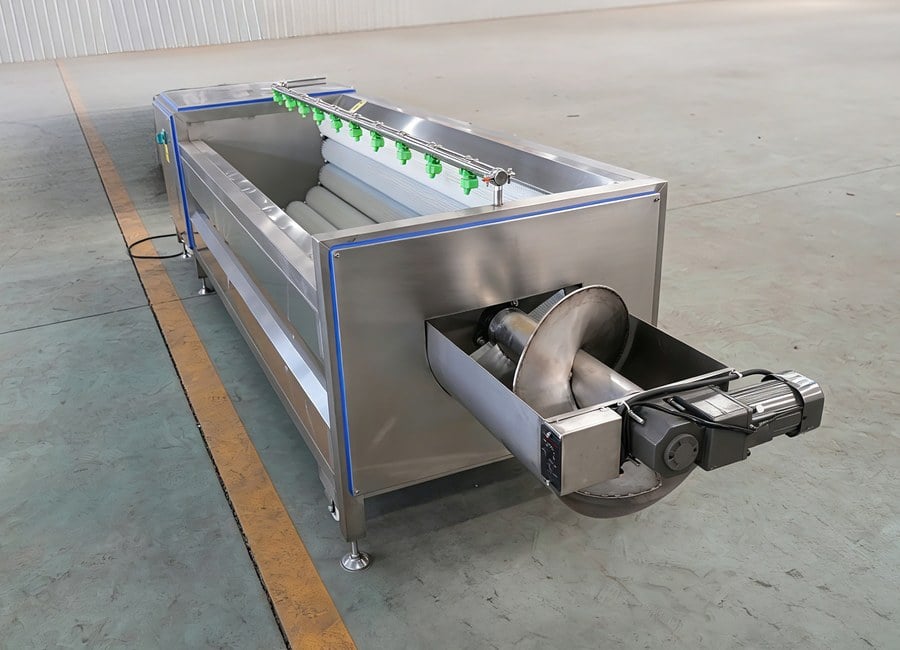
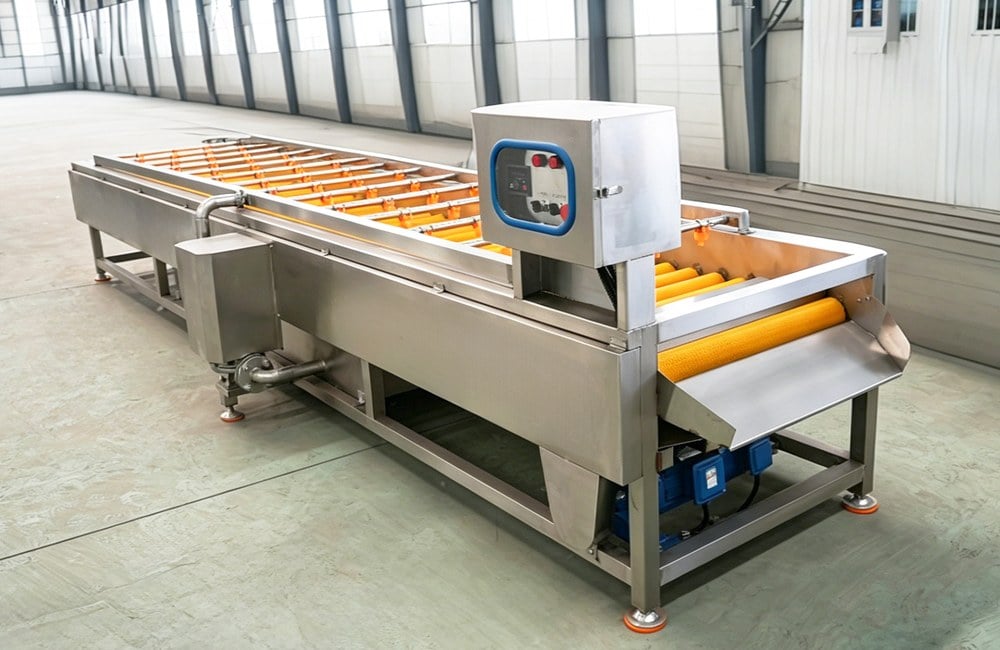
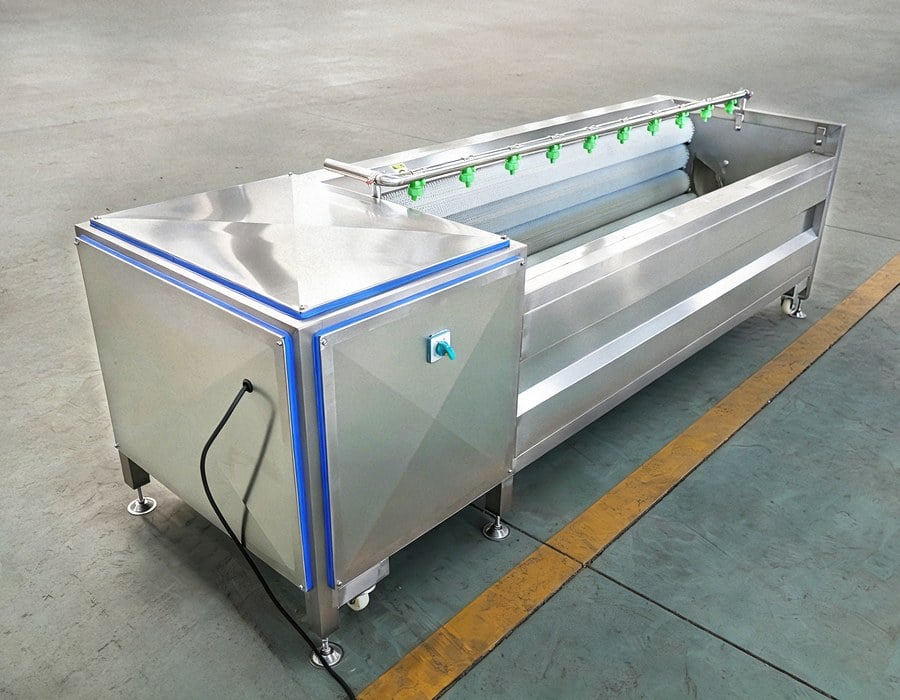
- Adjustable-speed motorized roller conveyor with control box attached to the machine frame.
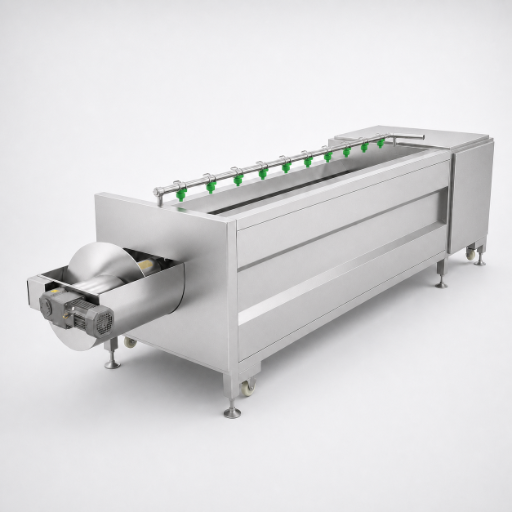
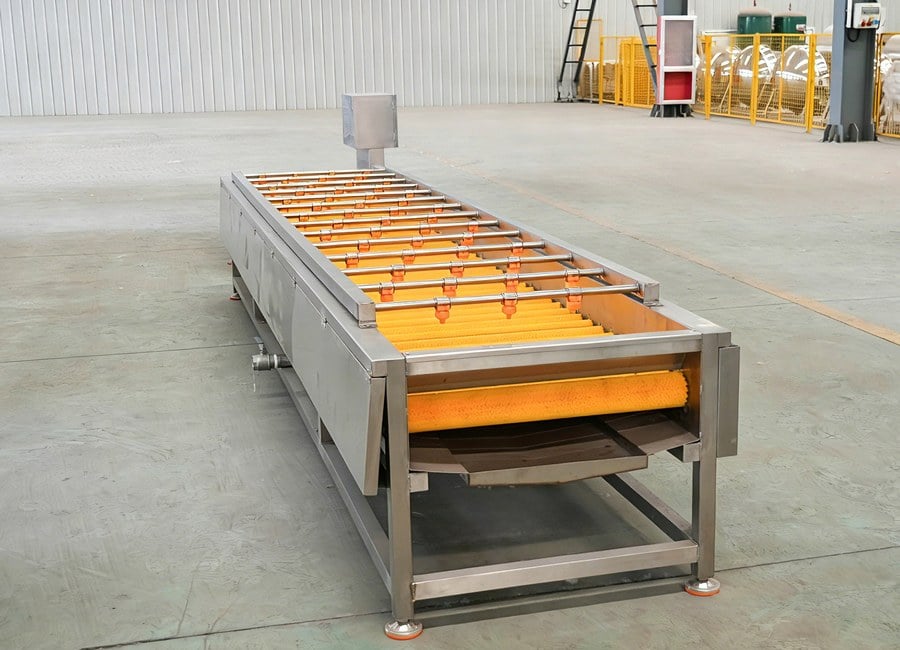
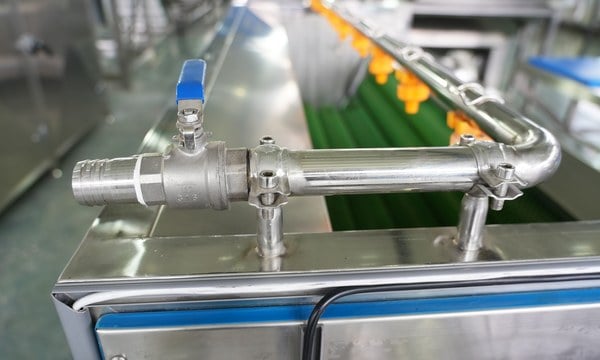
- Top spray manifold with multiple nozzles set at different patterns and angles, delivering constant clean water along the roller bed.
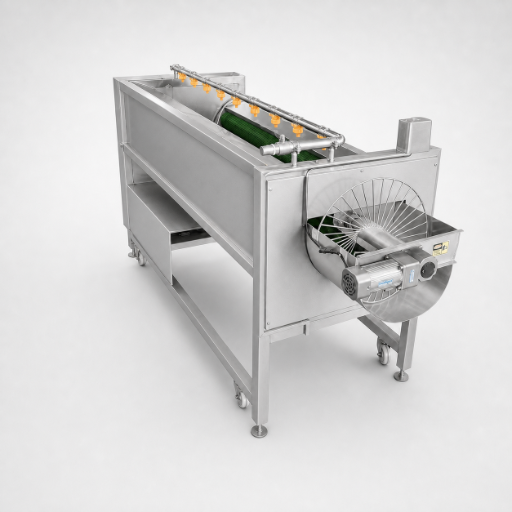
- Side-view, hinged semi-circular product discharge door equipped with a continuous bristle lining on inside edge which brushes product off rollers as they move past the exit, ensuring it is carried along a collection belt or chute.
- Stainless-steel machine constructed with heavy-duty stainless tank and support legs with integral drain opening.
As a potato peeling machine, this unit performs the same brush-roller mechanism used across our range of vegetable washing and cleaning machines — the same frame, switched between wash and peel duty by the brush type fitted.
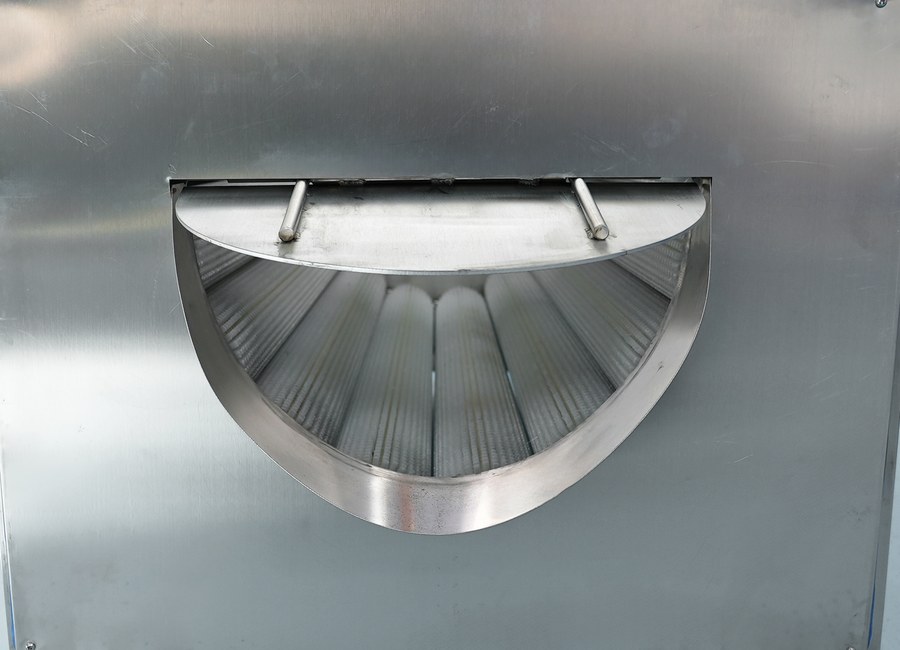
Vegetables This Machine Handles Well
A 2025 peer-reviewed study evaluating a similar brush-roller design for tuber washing measured a 96.75% yield recovery with only 3.25% weight loss at an input rate of 400 kg per hour, confirming that roller-based mechanical washing removes soil effectively without stripping usable product. That is the same mechanism this machine uses — rotating brush rollers under a spray manifold, not abrasive scraping.
“Most customers want the largest tank capacity possible. But the real question is what kind of soil your particular crop carries — washing potatoes needs different brush pressure and speed than washing beets, and sizing for the wrong one either underperforms or wastes capital on more machine and electrical capacity than you need.”— Shengtu Bufan Application Engineering Team
Specifications and Compliance
These figures represent standard configurations, not a generic industry table. We list exact figures here because unverified claims create real risk for a buyer comparing suppliers who should not have to guess which numbers are backed and which are filler.
01 // CUSTOMIZATION
Actual motor capacity, dimensions and overall system efficiency are customized to your specific crop and throughput when you submit your production details.
02 // VERIFICATION
The material and hygiene rows below cite EN 1672-2 and ISO 14159:2002 as design references. Any third-party test report must be confirmed for the actual model and configuration.
03 // VALIDATION
The brush-roller mechanism itself is validated by peer-reviewed measurement — a 2025 study measured 96.75% yield recovery and 3.25% weight loss at 400 kg/h — not just supplier claims.
Specification
What we confirm
Product-contact material
304 stainless steel standard; 316L available on request
Hygiene design reference
EN 1672-2 (food machinery hygiene requirements) and ISO 14159:2002 (hygiene requirements for machinery design)
Documents to Confirm for Your Project
CE, ISO 9001 (quality management), ISO 27001 (information security), SGS, DCMM Level-2
Manufacturing base
Four owned and self-built manufacturing bases; headquarters in Zhucheng and branches in Qingdao, Changzhou and Weifang, with 20,000+ m² of office and display space
Track record
10+ years building food processing equipment, 52 countries served, 2,000+ machines delivered
Quote response time
Within 1 working day, reviewed by an engineer
Configuration
Runs as a standalone unit or as one station in a longer washing-and-peeling line
Pricing Transparency
Pricing and Quote Process
There isn’t really a fixed price list.
Motor capacity, brush type and brush surface area, combined with standalone versus line-integrated use and your voltage and phase supply, ultimately set the machine’s price.
All five China-based industrial suppliers we reviewed for this page price the same way, so this is how the category works, not a gap in our transparency.
What Moves Your Price
Effect on cost
Target throughput (kg/h)
Larger tanks and longer roller beds raise cost.
How to reduce it
Optimize Capacity
Confirm your actual peak-hour rate, not your average day, so we do not oversize.
Effect on cost
Brush configuration
Combined wash-and-peel setups cost more than wash-only.
How to reduce it
Clarify Workflow
Specify whether peeling is required or handled elsewhere in your line.
Effect on cost
Material grade
316L raises material cost over 304 standard.
How to reduce it
Verify Chemistry
Confirm 304 is sufficient for your water chemistry before requesting 316L.
Effect on cost
Standalone vs. line-integrated
Conveyor interfaces and controls integration add scope.
How to reduce it
Map Existing Setup
Tell us up front if this connects to existing equipment.
Manufacturing Process
01
Requirement Confirmation
Requirements confirmed against your crop, throughput and hygiene needs before design starts
Base Fabrication
Fabrication takes place at one of our four self-built manufacturing bases
Quality Inspection
Stainless steel welds and food-contact surfaces are checked before the unit ships
Post-Installation
Documentation and support are available after installation
Certifications Overview
- CE
- ISO 9001
- ISO 27001
- SGS
- DCMM Level-2
Company records: Request the current holder, scope and validity details.
Equipment conformity: Confirm the documents for the model, configuration and destination country.
Order documents: Agree inspection records, manuals, drawings and shipment paperwork in the contract.
How We Work
Buyers who skip straight to a purchase order without confirming crop, throughput and integration details often end up reworking their line after the machine arrives — a delay measured in weeks, not days. Six steps, starting with your written quote within 1 working day, keep that from happening on your order.
STEP 01
Tell us your crop and throughput
Send crop type, target kg/h and whether you need washing, peeling or both.
STEP 02
Engineer review
A process engineer reviews your requirements against machine capability.
STEP 03
Written quotation
You receive a written quote within 1 working day.
STEP 04
Manufacturing
Your machine is built at one of our self-built manufacturing bases.
STEP 05
We stand behind the build
If the machine does not match what was confirmed in your quotation, we work with you to correct it.
STEP 06
Shipping
The unit is packed and shipped to your facility.
Manufacturing Base and Equipment
Inspection requirements and records are agreed for the equipment before shipment. Any management-system record must be checked against its holder, scope and current validity.
Vegetable washing and peeling machine — stainless steel roller conveyor with control panel and drive motor
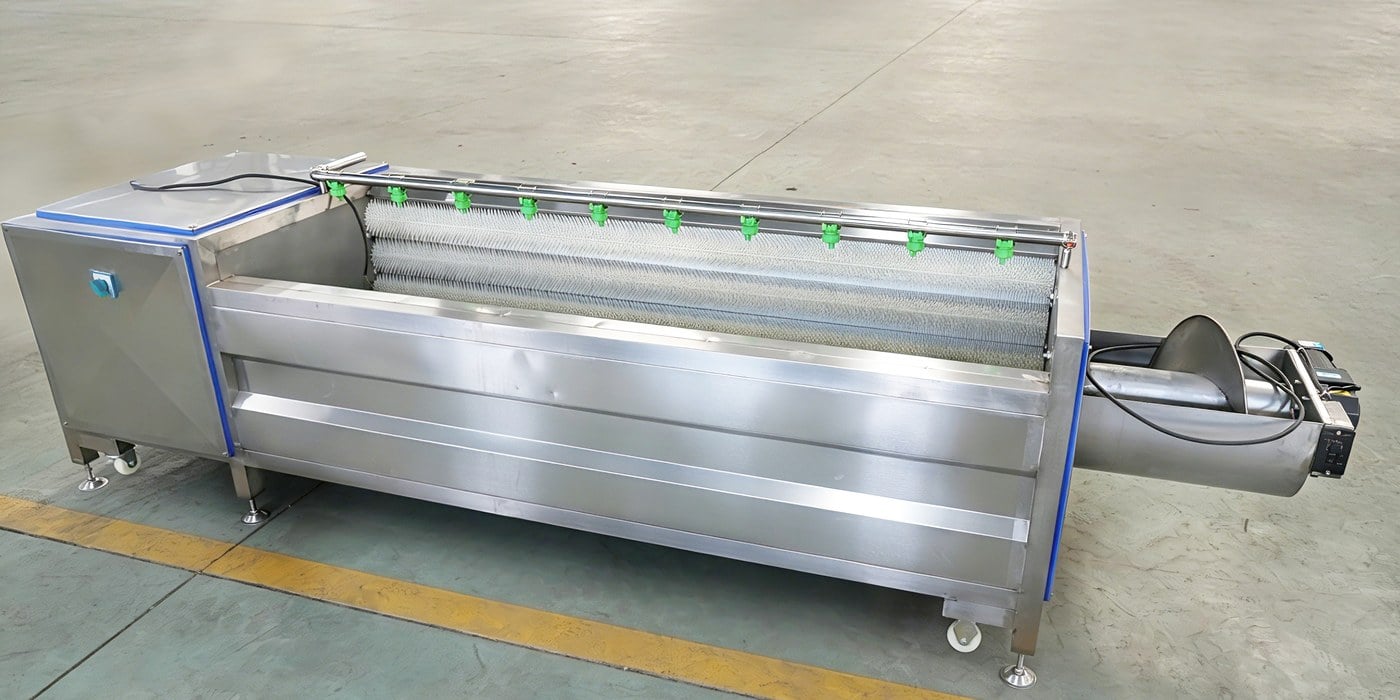
Unit on the factory floor at a Shengtu Bufan manufacturing base
Brush-roller assembly with top spray manifold, photographed on the shop floor
04
Four Self-Built Bases
Four owned and self-built manufacturing bases; 20,000+ m² of office and display space across our four-city company network.
~5K
m² Showroom
Working equipment on display for factory visits and video walkthroughs.
~80%
Self-Produced
Roughly 80% of core equipment leaves our own factory rather than a trading company’s supplier list.
10+
Years, 52 Countries
10+ years building food processing equipment, exported to 52 countries with 2,000+ machines delivered.
When a Single Machine Is the Right Call — and When It Isn’t
Industry Guidance
Not every buyer needs a full processing line, and not every buyer should stop at a single machine.
Industry guidance on fresh-cut processing is direct about this: the right response to a manual bottleneck is not always more machinery — it can be better work instructions, raw-material specification or workstation design. Hygienic design principles such as EN 1672-2 apply the same way whether you run one machine or ten, so scale is a throughput decision, not a compliance one.
Application Note
A single washing and peeling machine added to an existing manual line, with workers still handling feeding and final trimming, is a recognized semi-automation step — not a compromise, but also not a substitute for a full line if your real bottleneck is somewhere else.
Buying the wrong configuration for your situation costs you twice: once on the equipment, and again on the throughput problem it does not actually solve.
The trade-off table below is where to look instead of defaulting straight to a bigger machine.
What is a brush roller vegetable peeling washing machine?
It is a machine that uses rotating brush rollers under a spray manifold to clean root vegetables and, when fitted with an abrasive brush type, peel them in the same pass. Product is continuously rinsed while the rollers turn, then discharges automatically through a side door.
Can the brush roller machine be used only for washing without peeling?
Yes. Fit bristle rollers instead of an abrasive brush type and the same machine works as a wash-and-polish unit only.
Can I process different vegetables in the same washing peeling machine?
Yes, within the same category of root vegetables – potato, carrot, sweet potato, taro, ginger, radish, beetroot and cassava are all commonly run on this type of machine. Confirm your specific crop mix with us before ordering, since heavier-soil crops may call for a different configuration.
What is the difference between brush roller washing and air bubble washing?
Brush rollers clean through direct mechanical contact and are effective against baked-on field soil, at a somewhat higher bruising risk. Air bubble washing cleans through water turbulence with almost no contact, which suits delicate or leafy produce. This machine uses the brush-roller method.
Does the vegetable washing machine meet food safety standards?
The machine hygiene design references EN 1672-2 and ISO 14159:2002. Applicable certificates and documents are confirmed for the equipment model, configuration and destination country. Company management-system records are reviewed separately from product conformity documents.
Can this machine be integrated with other vegetable processing equipment?
Yes. It runs as a standalone unit or as one station in a longer line – for example ahead of a cutting or dewatering machine. Tell us what it needs to connect to and we confirm interface details in your quotation.
Will the peeling machine clog with peel waste?
A spray manifold above the rollers continuously rinses loosened soil and peel debris away from the product as the rollers turn. Confirm your crop’s soil load with us so we can recommend the right brush configuration.
What factors should be considered when buying a commercial vegetable washer machine?
Crop type and soil load, target throughput in kg/h, whether you need washing only or washing and peeling, the stainless steel grade you require, and whether the machine needs to integrate with existing line equipment. Confirming these details before you request a quote gets you an accurate price faster.
What types of produce can your industrial vegetable washing machine handle?
Potato, carrot, sweet potato, taro, ginger, radish, beetroot and cassava all run well on this machine. For leafy greens, ask about our leafy fresh-cut processing line instead — this brush-roller design is built for root vegetables.
How does your quote response time compare to the industry?
Industry response times for this category typically range from same-day to a few business days depending on the supplier, based on the suppliers we reviewed for this page; our quotation timing is confirmed after an engineer reviews the project inputs.
![F&V Freeze-Drying Line Process Guide [2026]](https://shengtumachinery.com/wp-content/uploads/2026/09/fv-freeze-drying-line-guide-featured-150x150.png)