Get in touch with Shengtu Bufan Company

Continuous Fryer and Batter & Breading Machine Systems
We build continuous fryer lines and batter and breading machines for plants that fry coated protein, vegetable and snack items in continuous production rather than in batches. A continuous fryer here means a mesh-belt machine with a hold-down belt, motor-driven immersion adjustment and an external skimming box, sized to the output you actually run rather than to a catalogue maximum. Send us the product you want to fry and your target output per hour, and an engineer returns a quotation within 24 hours.
- Engineer-reviewed quotation within 24 hours
- Standard machines in 20–35 working days
- Minimum order one set
- Your product run before shipment, trial video included
Not ready for a full enquiry? Send a photo of your product and we will tell you which conveyor configuration fits it. Reading product fit costs you nothing and takes one reply.
Continuous Fryer and Coating Line Configuration
Two machines carry this line, and each one is configured against a different property of your product. The fryer is configured against buoyancy, frying time and how much debris the product sheds; the coating machine is configured against how thick the batter is and how the crumb behaves. Everything below is adjustable at the drawing stage rather than fixed by a catalogue model.
Belt and immersion
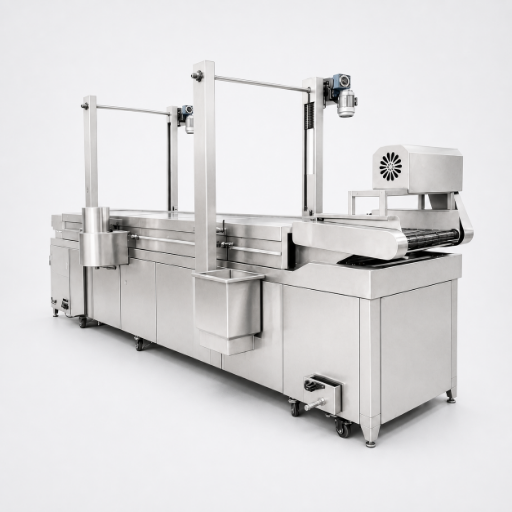
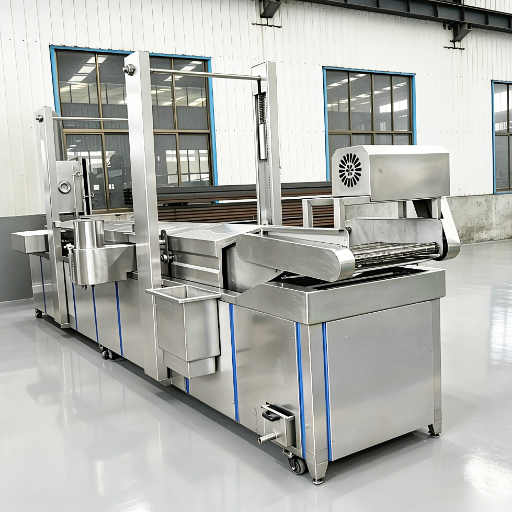
- Mesh belt conveyor running the full length of the oil tank, so the line runs continuously instead of in batches
- Hold-down submerger belt above the main belt, which keeps floating product under the oil
- Two motorised lift columns with worm-gear drives and lead screws, one per belt frame
- Immersion depth is motor-set from the control box, not levered by hand between products
Oil handling and discharge
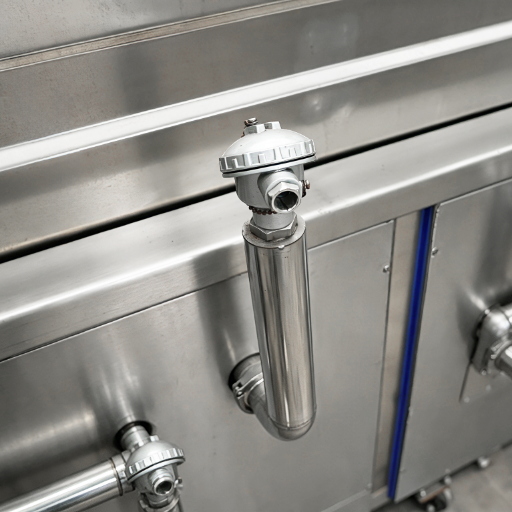
- Bottom drain valve and spout on the tank side wall for scheduled oil changes
- External residue and skimming box hung on the tank side, reachable without draining
- Discharge conveyor with a drum roller that lifts product clear of the oil at the outfeed
- Extraction hood with a circular vent fan over the outfeed section
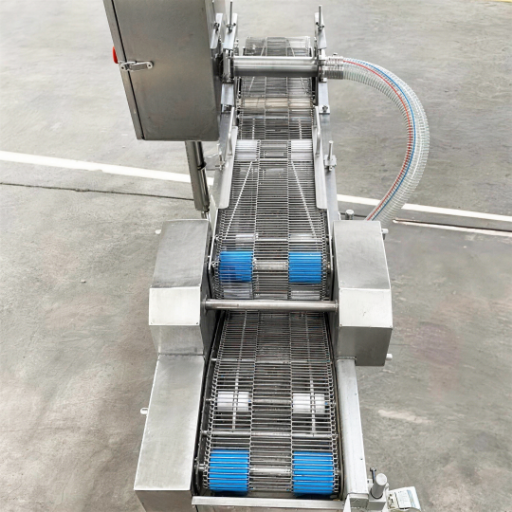
Batter side
- Batter recirculation pump with sanitary tri-clamp fittings and return piping to the tank
- Automatic batter pickup set by submerging or waterfall application, chosen by batter thickness
- Removable mesh belt section over the batter tank for washdown
- Hinged tank covers and bolted inspection panels on both side walls
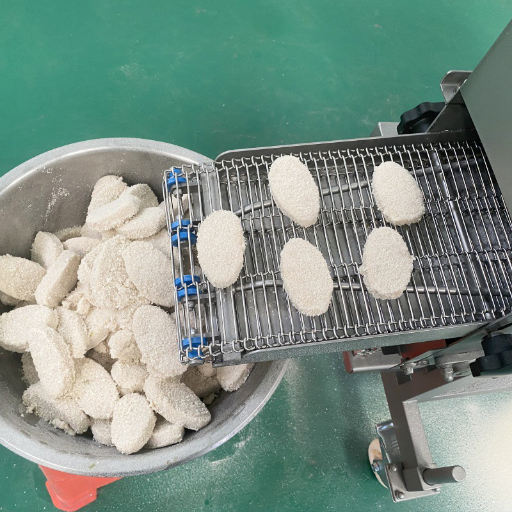
Breading side
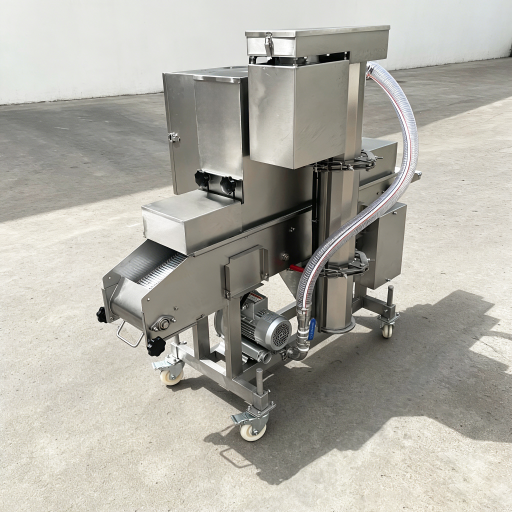
- Powder hopper with a sloped feed chute and a flour-return elevator that recovers crumb to the hopper
- Side-channel blower feeding an air knife over the conveyor belt, so excess flour is blown off rather than shaken off
- Sight window on the crumb applicator housing for in-run checks
- Hand-wheel belt tensioners at the outfeed drum
Belt support geometry is a real engineering variable rather than vendor decoration. A granted US patent for a continuous conveyor fryer places rectangular heat exchanger tubes directly beneath the food-carrying run so they support the belt against sag and shorten the span between heat source and heat sink. That same patent puts the entrant ramp on high and low positions, so the machine adapts to product buoyancy instead of the product adapting to the machine.
Products these lines are built for
- Coated poultry — chicken nugget, strip, patty and bone-in portions
- Breaded fish and seafood, including thicker egg-wash and tempura-style coatings
- Coated vegetable items — onion rings, mushrooms, cheese sticks and vegetable croquettes
- Snack food processing lines, including potato chip, extruded pellet and dough-based products
- Par-fried products destined for freezing rather than direct pack
- Meat and starch products that need a set crust before a second cook step
Sending a short clip of your product on its current line is usually faster than a specification.
Coating Systems and Product Types
Industrial coating splits three ways, and the split decides the machine rather than the recipe. Google's own generated answer for the head term still mixes commercial breading machines with domestic bread makers, so the taxonomy below is worth stating plainly.
Coating system
What it is
Products it suits
What the machine needs
-
Free-flowing breaderFine, dry, free-running crumb or flour blend that flows like sandNugget, strip, patty, coated vegetable itemsEven bed depth, gentle top duster, high crumb recovery — most of the powder never touches the product
-
Non-free-flowing flour breadingSticky flour or batter-flour blend that clumps and bridgesMarinated poultry, wet-surface protein, home-style coatingsAgitated hopper, positive feed, frequent belt cleaning; a free-flow duster will bridge and starve
-
Japanese-style crumbLong, flaky panko-type crumb that must stay unbroken to give the textureTonkatsu, fish portions, premium fried productsLow-shear handling, short recycle loops, gentle air knife — crushed crumb becomes flour and changes the product
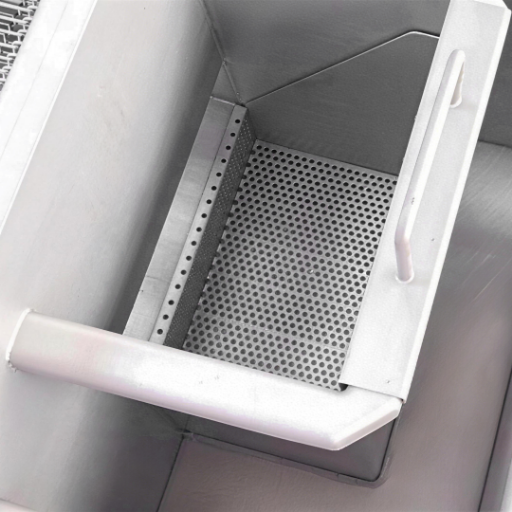
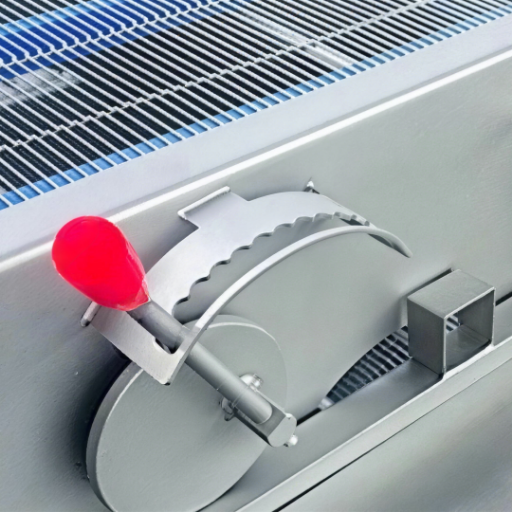
Batter application: submerging or waterfall
This is the one selection axis inside the coating machine that changes the finished item most, and it is the axis competitors show as two catalogue photographs without a rule. Thickness is that rule. A submerging batter breading machine suits thicker batter and egg wash; a waterfall arrangement suits a light, thin batter that must not be loaded up.
The product passes under the batter surface, so coverage reaches undercuts and irregular shapes. Pickup is higher and more consistent on thick-batter items, and the batter tank needs recirculation to stay homogeneous.
A curtain of batter falls onto the product from above. Pickup is lighter and easier to trim with the air knife, which is what a thin tempura-style coating needs.
Coating your line already runs
Send the crumb specification, the batter viscosity you run and a photo of the coated product before frying. We confirm the applicator arrangement, the recovery loop and the air-knife setting in the quotation rather than after the machine arrives.
Heating Methods and Oil Management
Oil is the largest running cost on a frying line, and "oil efficient" is the phrase every competitor uses without defining it. Degraded oil has measurable definitions, published limits and a formula that predicts how fast you will get there. This section gives all three, because the frying technology decisions you make at purchase set your oil cost for the life of the machine.
Oil turnover rate is how long the whole oil charge takes to be replaced by make-up oil, and it is the single best predictor of oil life. Oklahoma State University's Food and Agricultural Products Center defines it as the weight of oil in the fryer divided by the weight of oil carried out by the product each hour, with practical fryer use running at 80 to 90 percent of the theoretical figure.
Industrial fryers run turnover rates of 5 to 10. Low is better — degradation rises and shelf life falls as the turnover rate rises.
A worked example from the same source: 32 lb of oil in the tank, 50 lb/hr of product at 8 percent oil absorption, gives 4 lb/hr of make-up and an 8-hour turnover.
Batch ranges run 5 to 12 hours. Extending a turnover from 5 hours to 12 hours puts much more stress on the oil for the same product.
"We size the oil volume against the product's absorption rate, not against the tank that looks impressive in a photograph. A fryer with more oil than your throughput justifies is a fryer whose oil sits and oxidises between shifts."
— Shengtu Application Engineering Team
Fines are not cosmetic. Crumb that falls off and stays in the oil burns, carbonises and accelerates degradation, and the burnt note it leaves reads as a recipe fault when it is really a product quality defect the hardware caused. Screens ahead of the circulation pump therefore matter more than the brochure suggests.
There is no universal legal limit on frying oil degradation. Total polar materials ceilings are statutory in some markets, advisory in others and absent in the three largest English-speaking ones. If you export finished fried products, the destination market decides your oil change schedule.
| Total polar materials limit | Where it applies |
|---|---|
| 24 percent or less | Germany |
| 25 percent or less | Belgium, Brazil, Chile, Costa Rica, Czech Republic, Finland, France, India, Italy, Poland, Portugal, Thailand, Turkey |
| Below 25 percent | Panama, Spain |
| 27 percent or less | Austria, China, Switzerland, Netherlands |
| 30 percent or less | Hungary |
| Acid value of 3 or less, instead of a polar materials test | Japan, South Korea |
| No legal limit | United States, Australia, United Kingdom |
Two practical notes sit behind that table. In the United States and Australia the polar materials reading is an internal benchmark used by operators rather than a statute, and in the United Kingdom there is no legal maximum at all. A single polar materials reading also misses polymerised material, which is why the practical two-parameter version pairs polar materials below 24 percent with polymeric triglycerides below 12 percent.
Heat delivery decides how tightly you can hold oil temperature, and temperature stability is what the oil pays for. The bands below come from published fryer engineering guidance and are the numbers we design the frying system against.
| Heating route | Temperature fluctuation | Where it fits |
|---|---|---|
| Direct gas-fired | 10 to 15 °F | Lowest capital cost, widest swing; suited to hard-wearing products with a wide process window |
| Thermal fluid heated | 7 to 10 °F | Multi-product lines where the same fryer runs several recipes |
| Indirect, external heat exchanger | Within 2 °F | Tight-window products, delicate crumb, and any process where colour is the specification |
| Fryer heat load, all routes | 12 to 18 °F drop across the frying zone | The design figure the heat exchanger and oil circulation loop are sized to |
Materials matter here too, and not only for hygiene. Oil- and food-contact surfaces are T-304 stainless or better, and brass and copper stay out of the oil circuit entirely because they catalyse oil oxidation. Palm oil in general use should not exceed 363 °F, which is the point at which industry practitioners report the oil starts to crack.
Specification and Selection Table
Machine performance figures belong in a quotation against your product, not on a web page, because throughput on a continuous fryer is a function of your product's frying time and belt loading rather than a fixed model number. What can be stated here is what we specify, what the design targets are, and at which moment each figure gets locked.
Cost Drivers, Quotation Inputs and Lead Times
Price follows configuration, capacity and the amount of stainless in the machine rather than a published price list. There is a real class gap behind the numbers you find online: a countertop breader listed at a consumer price and a continuous production line are different classes of equipment, and comparing their prices tells you nothing useful. Here is what actually moves your figure.
| Requirement | What we specify | When it is fixed |
|---|---|---|
| Conveyor arrangement | Mesh belt with a hold-down submerger belt above it; immersion depth set by two motorised lift columns | At drawing approval |
| Cook area and fryer length | Cook area is your production rate multiplied by frying time, divided by belt loading; fryer length is cook area divided by belt width | From your stated target output per hour |
| Temperature control band | Within 2 °F on an indirect heat exchanger route, 7 to 10 °F on thermal fluid, 10 to 15 °F on direct gas-fired | With the heating route you choose |
| Fryer heat load | Sized to a 12 to 18 °F temperature drop across the frying zone | At design, from product and throughput |
| Oil turnover target | Oil volume selected for a 5 to 10 hour turnover at your stated output and absorption | At design |
| Oil-contact materials | T-304 stainless or better on oil and food contact; no brass or copper in the oil circuit | Fixed — not a quotation variable |
| Fines handling | Crumb screen ahead of the circulation pump, external skimming box for floating fines, bottom drain for settled material | At drawing approval |
| Standard machine lead time | 20–35 working days after drawing approval | Confirmed in your quotation |
| Custom line lead time | 45–60 working days | Confirmed in your quotation |
| Quotation turnaround | Within 24 hours on business days, reviewed by an engineer | On enquiry |
| Minimum order | One set — single machines are accepted | Fixed |
| Pre-shipment verification | Your product run through the machine at our works, with the trial video shipped with the equipment | Before the balance falls due |
| Driver | Effect on cost | How to reduce it |
|---|---|---|
| Target output per hour | Sets belt width and cook area, which sets the steel, the oil volume and the heat load together | Quote your realistic sustained rate, not your peak-season aspiration |
| Heating route | An indirect heat exchanger route costs more than direct gas-fired and buys you a tighter temperature band | Match the route to your product's process window instead of buying the tightest available |
| Number of product changeovers | Multi-product lines need adjustable immersion, faster washdown access and more control logic | Group products by coating family so one setup covers several items |
| Oil handling scope | Filtration, skimming, sludge removal and heat recovery each add hardware to the oil circulation loop | Start with the fines handling your product actually sheds and add filtration stages later |
| Line integration scope | A coating machine and a fryer under one control system costs more than two standalone machines and less than fixing the handoff afterwards | Decide the integration scope before fabrication, not after installation |
| Bought-in components | Specified drive and control brands carry their own price and their own lead time | Tell us any plant standard you must match at enquiry, not at final drawing |
| Order stage | Lead time | What it covers |
|---|---|---|
| Quotation | Within 24 hours | Configuration, scope and price against your stated product and output |
| Standard machine | 20–35 working days | Fabrication, assembly, control build and pre-shipment trial |
| Custom or integrated line | 45–60 working days | Layout engineering, multi-machine control integration, extended trial |
Quotations are returned within 24 hours on business days and are reviewed by an engineer before they leave. We work from the product you want to run, its size, a photo or short video of it, your target output per hour, and your factory layout drawing if you have one.
- Your product: what it is, its size and weight, and whether it floats or sinks in oil
- Coating detail: crumb type, batter thickness and whether it is applied wet, dry or both
- Throughput: your target output per hour, sustained rather than peak
- Utilities on site: gas, steam, thermal fluid or electricity, and what capacity is spare
- Space and access: factory layout drawing, ceiling height and the route the machine has to travel to get in
FRYER SIZING WORKSHEET
The two calculations above are the ones that decide whether a machine fits your plant, and they take four inputs you already know: production rate, frying time, belt loading and oil absorption. The worksheet runs both, then returns the turnover rate the resulting oil volume would give you.
DELIVERY & PAYMENT
Lead time starts at drawing approval, not at enquiry, and it excludes ocean transit and customs at destination. Payment is 50% deposit with the balance before shipment, or an irrevocable letter of credit at sight. We ship FOB or CIF from a Chinese port, or EXW from our works, and bought-in drives and control components are named in your quotation.
Line Integration and the Coating-to-Fryer Handoff
The handoff between coating and frying is where a two-supplier line usually fails, and it fails quietly. Product that leaves the breader with uneven pickup arrives at the fryer with an uneven crust set time, and the fryer gets blamed for a coating problem. Running both machines under one control system is the client-side reason this page exists as a single page rather than two.
- Belt speed ratio between the coating machine and the continuous frying machine, so pickup and residence time stay locked together
- Transfer height and product orientation at handover, so coated items do not tumble and shed crumb before entering the oil
- Crumb that falls in transfer, which either returns to the hopper or ends up burning in the oil
- Start, stop and emergency-stop logic shared across both machines rather than duplicated
The two machines on this line
Battering and breading machine
Batter tank with recirculation pump, powder hopper with flour-return elevator, and an air knife on a side-channel blower. Submerging or waterfall batter application, selected against your batter thickness.
Continuous frying machine
Mesh-belt tank with hold-down submerger belt, motorised immersion columns, external skimming box and an extraction hood over the outfeed. Built to the cook area your product and output require.
Two things on this page are verifiable by you rather than asserted by us. Your own product runs through the machine before it ships and the trial video travels with the equipment; and every bought-in drive and control component is named in your quotation, so you know in advance which parts have a third party behind them. Both are checkable inside the transaction rather than after it.
Planning a line rather than a single machine? Send your layout drawing and we will mark up the transfer points.
Ask for a layout fit check →From Enquiry to Commissioning
The pre-shipment trial is the part of this process most worth understanding before you order, because it is a recognised procurement instrument rather than a courtesy. Factory acceptance testing and site acceptance testing are defined by the International Society for Pharmaceutical Engineering as the inspection and static or dynamic testing of manufacturing systems performed to approve them for delivery and to support qualification, the first at the manufacturer's site and the second at the final site of installation.
-
01Send your product details: what you fry, how much of it per hour, and the coating you use.
-
02We return a configuration review covering the conveyor arrangement, heating route and oil handling scope, plus anything in your layout that constrains the machine.
-
03A written quotation follows with scope, price, lead time and the named bought-in components, within 24 hours of a complete enquiry.
-
04You approve drawings. Lead time starts at this point, and it is the last cheap moment to change anything.
-
05Fabrication runs, then we put your own product through the machine at our works and film it. If it does not run right here, it does not ship.
-
06Packing, shipping and commissioning support: crated with the manual, trial video and toolbox, with installation guidance on arrival.
| What to verify | What to ask for | Why it saves money later |
|---|---|---|
| Machine functions across the full adjustment range | Video of immersion depth, belt speed and air-knife settings at both extremes | Range limits found on site are a shipping problem, not a settings problem |
| Safe access and interlocks | Guard, interlock and emergency-stop demonstration in the trial footage | Retrofitting guarding after installation means downtime on a live line |
| Equipment dimensions and utility fittings | Dimensioned drawing against your layout, with connection sizes and positions | A machine that will not fit through the door is the most expensive avoidable error there is |
| Documentation package | Manual, drawings and component certificates listed before shipment, not after | Missing paperwork stalls customs and internal sign-off, and neither is quick to fix remotely |
The reason step five exists is documented rather than promotional. As the same source states, "It is common to find inconsistencies post fabrication" — user requirements and purchase-order commitments get missed on the way into design. And the cost curve runs one way only: "costs of addressing such issues, whether simple or complex, grow once shipped from the equipment manufacturing site."
Our wider equipment engineering and line integration services cover the layout and control work that sits around these machines when a full line is involved.
Quality Control and Documentation
Hygienic design on frying and coating equipment is judged against a published vocabulary, and knowing that vocabulary is how a buyer checks a machine rather than trusting it. The 3-A Sanitary Standards are the reference point most food processing buyers reach for first.
What the hygienic design vocabulary actually covers
3-A sets four fundamental criteria — that equipment be nontoxic, cleanable, inspectable, and able to withstand the conditions of its intended use. For product-contact surfaces it addresses materials permitted and their certification, maximum surface roughness, sanitary welding, minimum radii, and the absence of surface imperfections, crevices, threads, perforations and springs.
They are not regulations.
Many regulatory authorities nonetheless treat them as such when permitting equipment for food processing use, and the 3-A symbol signifies conformance verified by a Certified Conformance Evaluator in a third-party verification.
Where the definition bites.
Product-contact surfaces are not only the ones the product touches — they include any surface from which residues can drip, drain, drop or be drawn onto the product.
Where that bites on a fryer.
Extraction hoods, hold-down belt frames and crumb return chutes sit above the product line, which is precisely why we build them to come apart for washdown.
How every machine is checked
- Weld and surface inspection on oil- and food-contact assemblies before the machine goes together
- Control build tested against the function list, including interlocks and the emergency stop circuit
- Dry run of belt travel, immersion adjustment, air-knife and pump operation across the adjustment range
- Wet trial with your product, filmed end to end, before the balance falls due
An operation manual, the factory trial video, a toolbox, and the export paperwork — commercial invoice, packing list and bill of lading — ship with your order. If something on the machine does not match the approved drawing, we correct it against that same drawing rather than against a verbal account of what was intended.
Continuous Fryer and Breading Machine FAQs
What is a continuous fryer and how does it work?
A continuous fryer carries product through a heated oil tank on a mesh belt, so product enters at one end and leaves fried at the other without the oil being emptied between loads. Above it, a hold-down belt keeps floating items submerged for the whole frying time. Heat is supplied by a burner, a thermal fluid loop or an external heat exchanger, and the oil is circulated, screened and returned continuously.
What are the types of breading machines?
Industrial breading splits three ways: free-flowing breader for dry, sand-like crumb; non-free-flowing flour breading for sticky flour blends that bridge and clump; and Japanese-style crumb machines built to keep long panko flakes unbroken. Batter application then splits again into submerging and waterfall types. Consumer-facing search results mix these up with domestic bread makers, which is worth knowing before you compare listings.
What is the difference between a continuous fryer and a batch fryer?
A batch fryer cooks a load at a time in a fixed oil volume; a continuous fryer moves product through the oil on a conveyor at a set belt speed. The practical difference is oil turnover: a continuous line replaces oil steadily as product carries it out, while a batch fryer's oil ages through idle hot hours. Batch frying suits short runs and frequent recipe changes; continuous frying suits sustained output on a settled product.
What heating methods are used in industrial fryers?
Direct gas-fired, thermal fluid heated, and indirect heating through an external heat exchanger are the three routes in general use. They differ mainly in how tightly they hold oil temperature — roughly 10 to 15 °F on direct gas-fired, 7 to 10 °F on thermal fluid, and within 2 °F on indirect. Electric heating appears on smaller machines where gas or thermal fluid is not available.
How is frying oil quality measured?
Total polar materials is the standard measure, expressed as a percentage and read with a meter on the line. A practical two-parameter version pairs polar materials below 24 percent with polymeric triglycerides below 12 percent, because a polar reading alone misses polymerised material. Japan and South Korea use an acid value test of 3 or less instead.
Can battering, breading and frying run as one line?
Yes, and the reason to do it is control rather than floor space. Belt speed ratio, transfer height and stop logic have to agree between the coating machine and the fryer, and that agreement is much cheaper to engineer before fabrication than to retrofit afterwards. We build both machines, which is why the interface is a design decision here rather than a negotiation between two suppliers.
What products can run on a continuous fryer?
Coated poultry such as chicken nuggets, strips and patties; breaded fish and seafood; coated vegetable items; snack products including potato chip and extruded pellet lines; and par-fried products destined for freezing. The constraint is not the product category but its buoyancy, frying time and how much debris it sheds into the oil.
What do you need from me to quote?
The product you want to run, its size, a photo or short video of it, your target output per hour, and your factory layout drawing if you have one. With those five things an engineer returns a quotation within 24 hours on business days. Utilities available on site — gas, steam, thermal fluid or electricity — will save a round trip if you include them.
How much does a continuous fryer cost?
Price follows target output per hour, heating route, oil handling scope and integration scope, so a figure quoted without your product behind it is not a real number. Be careful comparing online listings: a countertop breader and a continuous production line are different equipment classes, and prices across the industry are quoted against configuration rather than against a model name. Send your product and output and we will quote the actual configuration.
What is the lead time?
Standard machines ship in 20–35 working days after drawing approval. Custom or integrated lines run 45–60 working days, confirmed with your quotation. The clock starts at drawing approval rather than at enquiry, and ocean transit and destination customs sit outside it.
Do you run a trial with my product before shipment?
Yes. We run your product through the machine at our works before it ships, and the trial video travels with the equipment. Factory acceptance testing exists precisely because inconsistencies after fabrication are common, and the cost of fixing them grows once the machine has left the factory.
What documents ship with the machine?
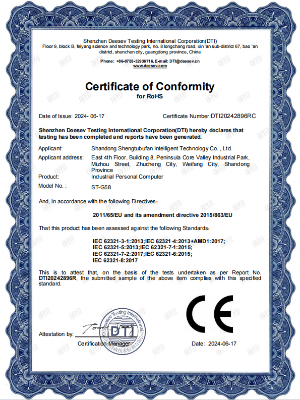
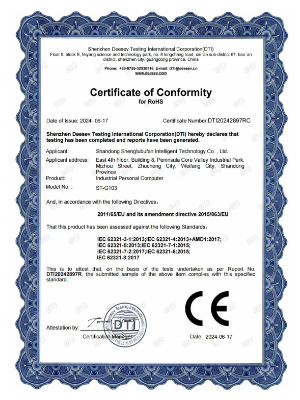
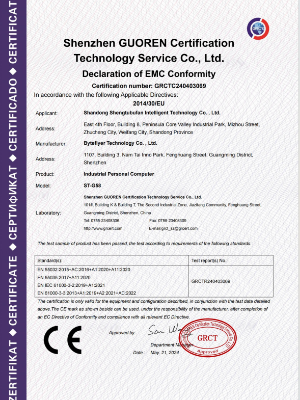
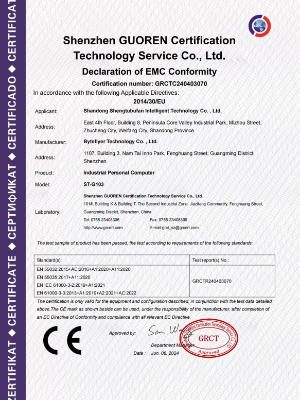
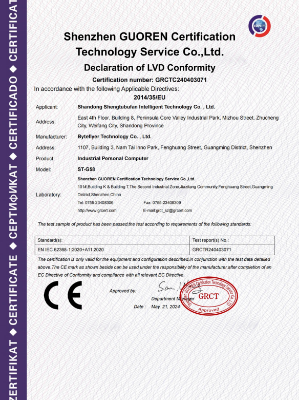
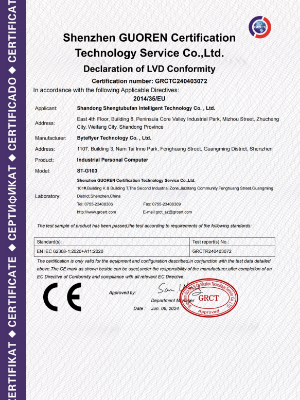
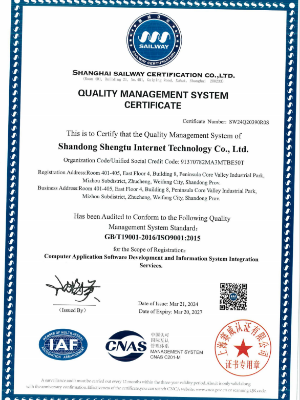
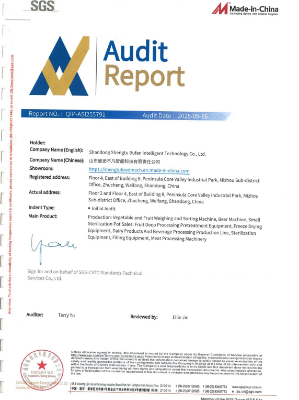
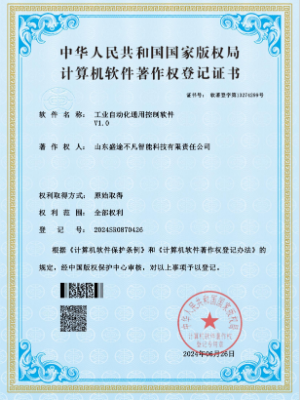
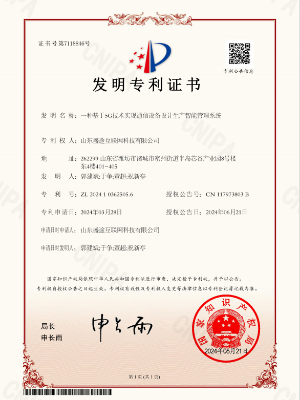
Applicable certificates and documents are confirmed for the equipment model, configuration and destination country. Company management-system records are reviewed separately from product conformity documents.
An operation manual, the factory trial video, a toolbox, and the export paperwork — commercial invoice, packing list and bill of lading. Bought-in drive and control components are named in your quotation, so their own documentation can be requested by brand before shipment. Payment is 50% deposit with the balance before shipment, or an irrevocable letter of credit at sight.
What should I check before buying a used fryer?
Start with what the machine was used for previously, because prior non-food use is a real risk on direct food-contact surfaces. Then check sanitary weld condition, cleanability, calibration records, spare parts availability and whether the safety features meet current rules in your jurisdiction. Finally, check the equipment against the line around it — a machine that is too big for the adjacent equipment moves your bottleneck without raising output.
How long does a continuous fryer last?
Service life on a stainless frying system is governed by the oil circuit and the belt rather than by the tank, which is why oil-contact material grade and fines handling matter more than they look. T-304 stainless or better on oil contact, with brass and copper kept out of the circuit, removes the metal catalysis route for oil oxidation. Belts, drive components and heat transfer surfaces are the wear items, and they are the ones worth specifying to a brand you can source locally.
![F&V Freeze-Drying Line Process Guide [2026]](https://shengtumachinery.com/wp-content/uploads/2026/09/fv-freeze-drying-line-guide-featured-150x150.png)