Get in touch with Shengtu Bufan Company

Food Extruder and Potato Snack Processing Lines, Delivered as One Scope
Shengtu builds two kinds of snack food production line: a food extruder route for puffed and extruded shapes, and a potato route for chips and fries. Both arrive as one delivery scope, with the machinery, the control layer and the line integration inside it. This page sets out which route your product belongs to, what we can state as fact, and what only your own recipe can decide.
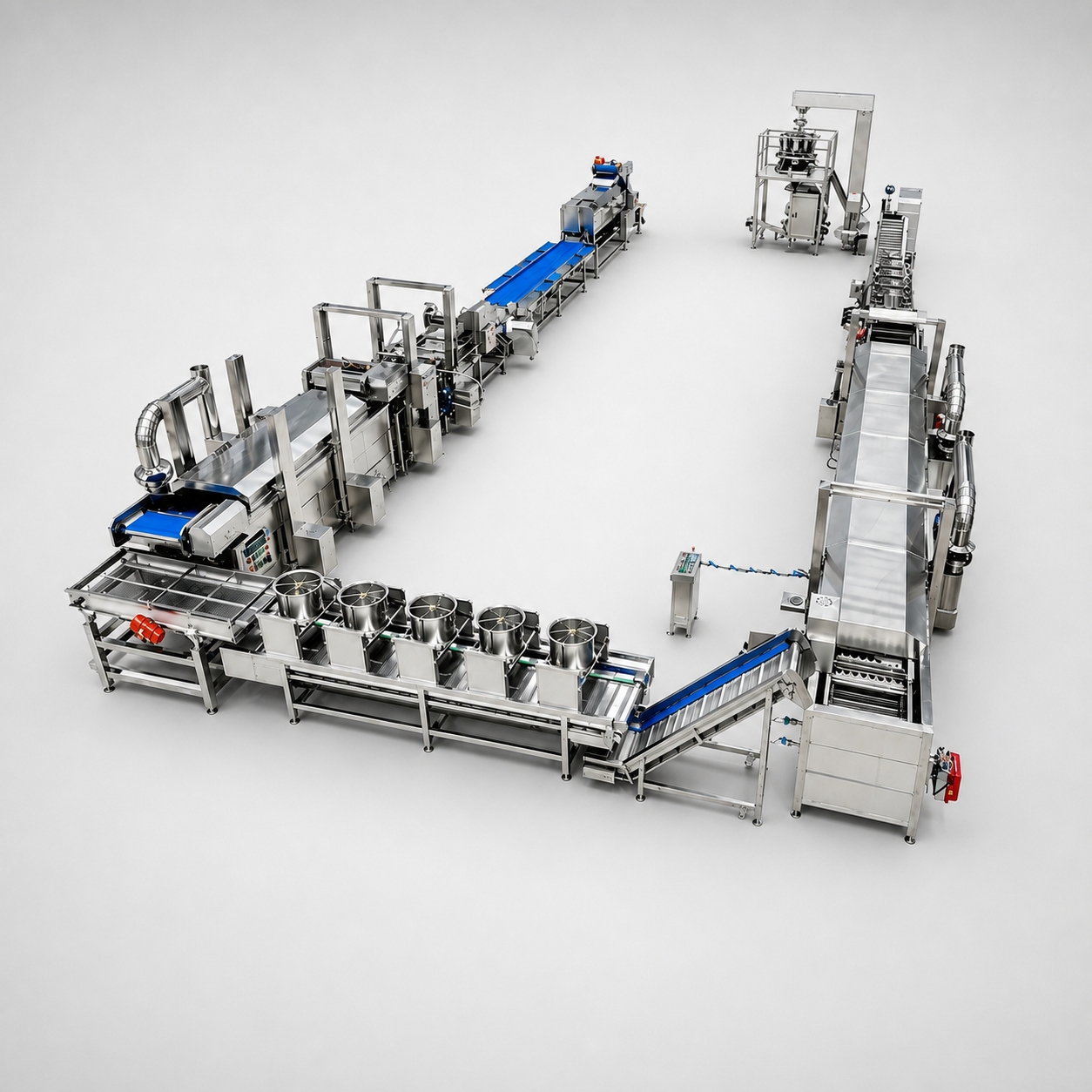
01
Two routes, one delivery scope
02
Every station in our delivery scope named
03
Controls and line integration in scope
04
Your recipe keeps the setpoints
Two Process Routes, One Delivery Scope
A snack is a product description, not a process route, and the two are settled by different questions. The route is decided by three things: whether your raw material arrives dry or fresh, whether the product is cooked by extrusion or by frying a slice, and what texture the finished piece has to hold. Continuous extrusion cooking for snack production is long-established engineering art, described in patents such as US4985269A for tortilla chip production.
Route 1: The Food Extruder Route
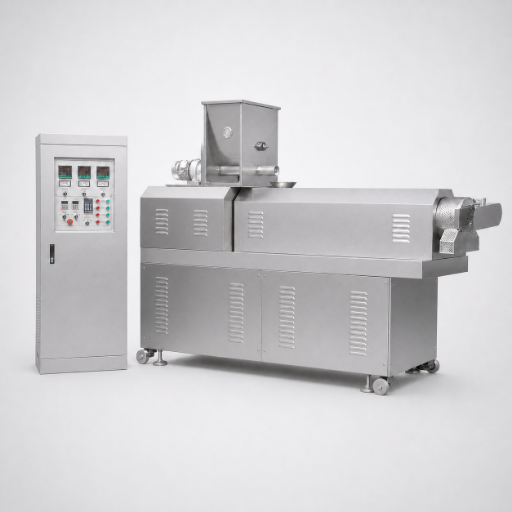
A twin-screw extruder cooks a dry blend under heat, pressure and shear, then the die and the cutter set the shape. The versatility of the extrusion process is why one machine platform can run curls, rings, balls, pellets and breakfast cereal shapes. These are the stations we deliver on this route, in running order:
- Twin-screw extruder
- Conveyor
- Bucket elevator
- Continuous fryer
- Vibrating de-oiling machine
- Octagonal seasoning drum
- Packaging machine
- Metal detector
Route 2: The Potato Route
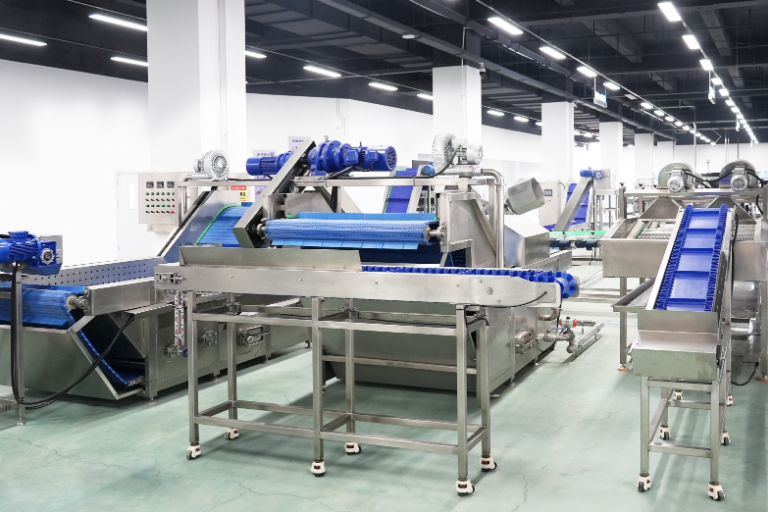
The potato route starts with a raw potato rather than a flour blend, so the front end is a washing, peeling and slicing train instead of an extruder. Frying then does the cooking that extrusion does on route 1. These are the stations we deliver, in running order:
- Bubble washer
- Brush-roller peeler
- Tornado slicer
- Blanching machine
- Fryer
- Packaging machine
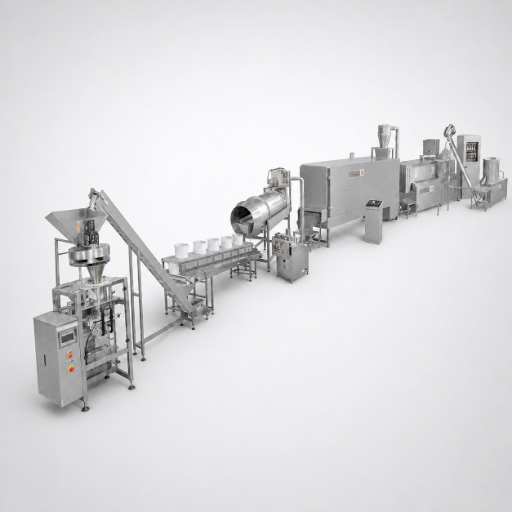
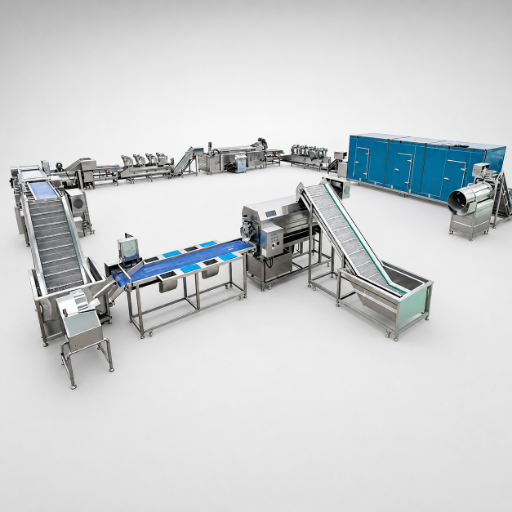
What the two sequences are, and what they are not
Both lists are the stations confirmed inside our delivery scope. A complete plant may carry further stations added to meet your finished-product requirement, and those are fixed with the configuration at quotation stage.
| Finished product | Raw material state | Cooking step that decides the texture | Lead machine | Route |
|---|---|---|---|---|
| Puffed corn curls | Dry maize grits | Extrusion cooking, then frying | Twin-screw extruder | Extrusion route |
| Rings, balls and stick shapes | Dry cereal flour blend | Extrusion cooking, then frying or hot air | Twin-screw extruder | Extrusion route |
| Pellet snacks, sold as a half-product | Dry starch and flour blend | Extrusion, then drying; the pellet is fried later | Twin-screw extruder | Extrusion route |
| Extruded breakfast cereal shapes | Dry cereal flour | Extrusion cooking alone | Twin-screw extruder | Extrusion route |
| Filled or co-extruded pieces | Dry blend plus a filling | Extrusion with co-injection | Twin-screw extruder | Extrusion route |
| Seasoned fried pellets | Dry pellets from an earlier run | Frying, then dry seasoning in a drum | Octagonal seasoning drum | Extrusion route |
| Sliced potato chips | Fresh whole potato | Blanching, then frying | Tornado slicer and fryer | Potato route |
| French fries | Fresh whole potato | Blanching, then frying or freezing | Cutting and frying stations | Potato route |
| Potato crisps with dry seasoning | Fresh whole potato | Frying, then seasoning | Fryer and seasoning applicator | Potato route |
| Compound chips from rehydrated flake | Dehydrated potato flake made into a dough | Sheeting and forming, then frying | Dough sheeting and forming train | Neither of the two above — a third route; raise it before you compare quotations |
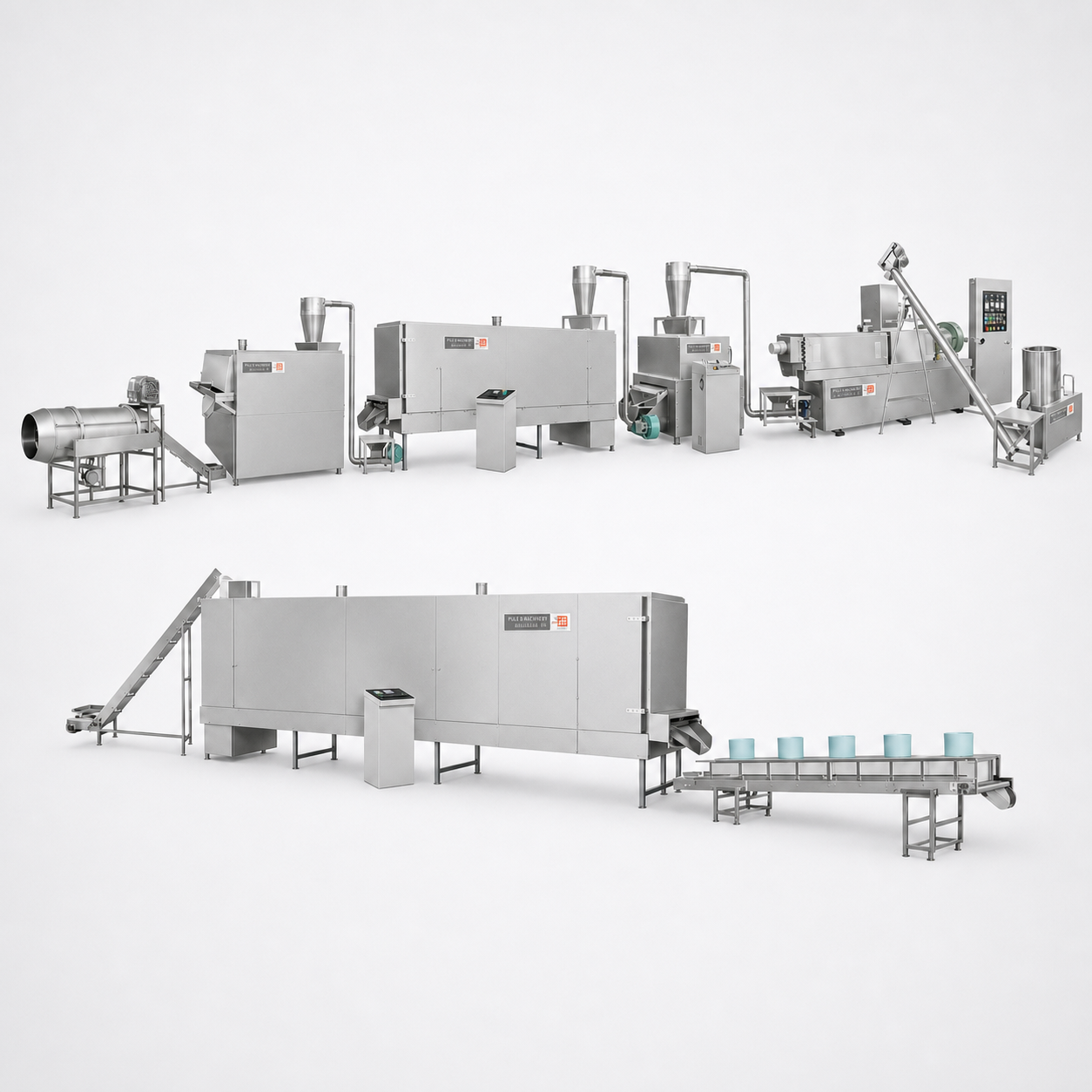
Extruded and Puffed Snack Line
Dry raw ingredients in, shaped and cooked pieces out, with the die and cutter deciding the form. Specification detail for this route sits on the extruded and puffed snack line page.
View Route 1 Detail
Potato Chips / Fries Line
Fresh potato in, washed, peeled, sliced, blanched and fried out, with the slicer setting the finished format. Specification detail sits on the potato chips and fries line page.
View Route 2 DetailRoute Decision Guide
Three answers about your raw material, the way the piece is cooked and your finished format decide which of these routes your enquiry belongs on. Where they disagree, the guide names the clash rather than picking a line for you.
DOCUMENTATION STRUCTURE
What You Will Find on This Page
| Section | What it settles | Where it stops |
|---|---|---|
| Route split | Which finished snack belongs to the food extruder route and which belongs to the potato route | It does not choose your recipe |
| Station sequence | The stations we deliver on each route, named in running order | Extra stations for your finished product are fixed at quotation |
| Setpoint ownership | Which process variables your recipe fixes and which ones we build the window for | No setpoint values are published here |
| Quotation variables | The eleven things that have to be settled before any snack line can be priced | No price and no output figure |
| Certificate boundaries | What ISO 9001, ISO 27001 and DCMM Level 2 prove | They prove nothing about your finished product |
| Disclosure record | What five competing snack line pages published on 6 August 2026, this page included | One page per supplier, not their whole site |
Twin-screw installations are documented in the trade press: Food Engineering reported a twin-screw extruder installed in a development centre, Foodwest, running a Coperion ZSK 27 to develop and test snacks and cereals. What that coverage never contains is the procurement structure below it.
| Raw material | Arrives as | Route it feeds | What it decides downstream |
|---|---|---|---|
| Maize grits and corn meal | Dry, milled | Extrusion | Expansion and the crispness of the extrudate |
| Wheat, rice and other cereal flours | Dry, milled | Extrusion | Texture, colour and how hard the piece bites |
| Native and modified starch | Dry powder | Extrusion | Whether a pellet holds its shape before the second fry |
| Protein and fibre additions | Dry powder blend | Extrusion | Screw configuration and the specific mechanical energy needed |
| Fresh whole potatoes | Field-fresh, unwashed | Potato | Washing and peeling load, and the yield you get per tonne |
| Dehydrated potato flake | Dry powder or flake | Neither, as delivered | A dough-based compound line, which is a separate scope |
| Frying oil | Bulk liquid | Both | Fryer type, oil filtering and how fast the oil turns over |
| Seasoning powders and slurries | Dry or liquid | Both | Applicator type and the dosing gear on the drum |
Cost Trap Warning
Getting this first call wrong is expensive in one specific way: the two front ends aren't interchangeable, so a route corrected after contract means buying either the washing and peeling train or the cooker extruder a second time. Dehydrated flake is the usual trap, because it reads as a potato input and behaves as a dry blend. Raw material state is therefore the first thing to settle on a snack line enquiry.
Raw material state is the single fastest way to settle the route, and every food processing decision downstream inherits from it. Dry cereal and starch blends belong to the extruder; whole fresh tubers belong to the potato train. Patent literature on extruded starch snack foods, such as EP0296039B1, describes the dry blend being fed continuously into a co-rotating twin-screw cooker extruder with water and oil injected downstream.
Scope 01
Dry milled cereal is what an extruded snack production line is built around, and it fixes the front end as a cooker extruder rather than a mechanical handling train.
Scope 02
Whole fresh tubers put the potato chips manufacturing process on your floor instead: washing, peeling, slicing and blanching all exist because the input is wet, alive and variable.
Scope 03
Flake and dough compounds sit in a third scope that gets quoted separately, so folding them into an extrusion enquiry buys you a line that can't run them.
Finished Snack Formats and What Sets Them Apart
Buyers describe a finished snack food by how it eats, and equipment has to translate that into geometry, density and moisture. Trade coverage of the extrusion route's product positioning shows the same pull toward lighter, better-for-you formats. Format is the reason the same twin-screw extrusion route can serve very different shelves.
low density, high expansion, seasoned after frying or hot air; an extruded food of this type is defined at the die exit as much as by the recipe that went in.
dense, dried and shelf-stable, fried by you or by your customer; this snack food format lets one plant supply many finishing sites.
cooked by extrusion alone, dried rather than fried, with texture held by moisture control.
the slice thickness on the tornado slicer is the format decision, and the frying machine after it exists to protect that decision.
strip geometry and blanching decide colour and interior texture, and the finished product may be fried or frozen.
a sheeted dough rather than a cut slice, which is why its output figures aren't comparable with a fresh-slice line.
Process Setpoints Belong to Your Recipe, Not to Our Machine
We build the operating window. Your recipe, your finished food product specification and your own food safety plan fix the numbers inside it. Published research makes the reason concrete: in a pilot-scale study of potato chip frying, Tarmizi and Ismail set production at 50 kg/h so that oil turnover time was fixed at 10 h, with fresh oil compensated at 20 kg/h throughout, figures that follow from that study's protocol and not from any machine's rating plate.
| # | Station | Variable it controls | Who fixes the setpoint |
|---|---|---|---|
| 1 | Twin-screw extruder | Barrel temperature profile, screw speed, shear and moisture | Your recipe and target texture; we build the window and the control logic |
| 2 | Conveyor | Transfer rate between stations | Shengtu, set against your target output so the line stays balanced |
| 3 | Bucket elevator | Lift rate and buffer | Shengtu, from the same line balance |
| 4 | Continuous fryer | Oil temperature and dwell time | Your product specification and your food safety plan |
| 5 | Vibrating de-oiling machine | Vibration intensity and residence time | Your target oil content in the finished piece |
| 6 | Octagonal seasoning drum | Drum speed and dosing rate | Your seasoning recipe and coverage target |
| 7 | Packaging machine | Bag format, film and cycle speed | Your packaging specification and your retail requirement |
| 8 | Metal detector | Detection sensitivity and the reject rule | Your food safety plan and your customer's audit requirement |
| 9 | Bubble washer | Water flow, agitation and residence time | The condition your raw potato arrives in |
| 10 | Brush-roller peeler | Brush pressure and peel time | Your potato variety and how much peel you accept losing |
| 11 | Tornado slicer | Slice thickness and cut profile | Your finished-product specification |
| 12 | Blanching machine | Water temperature and dwell time | Your recipe and the colour you are targeting |
| 13 | Fryer | Oil temperature, dwell time and oil turnover | Your product specification and your food safety plan |
| 14 | Packaging machine | Bag format and cycle speed | Your packaging specification |
Where we stop, deliberately
No single thermal step on either route is delivered as a validated kill step for your product. Extrusion cooking and continuous frying are process steps; whether either one achieves the lethality your product needs is established by your own process validation, against your own hazard analysis.
What Determines Your Quotation on a Snack Line
There's no price on this page, and no output figure for our line either. A snack production line is configured against a finished product, so a number quoted without your product attached would be a number for somebody else's line. What follows is the structure that produces your figure instead.
Energy demand in food manufacturing is dominated by thermal steps, and fried potato products sit among the most energy-intensive foods in the mapping study by Ladha-Sabur and colleagues. Change the recipe or the moisture target and the energy, the machine sizes and the price all move with it. Two lines quoted against one identical output figure can still carry very different equipment schedules.
Quotation Blocker Map
| Variable | Who fixes it | What happens while it stays open | Where it lands in the quotation |
|---|---|---|---|
| Finished product format | You | The route cannot be chosen, so nothing below it can be priced | Scope heading |
| Target output | You | Every machine size on the line stays open | Equipment schedule |
| Raw material state on arrival | You | The front-end stations change entirely between routes | Equipment schedule |
| Recipe and moisture target | You, with your food technologist | Screw configuration and die selection stay unfixed | Equipment schedule |
| Frying medium and oil handling | You | Fryer type, oil filtering and oil turnover stay open | Equipment schedule |
| Seasoning method and dosing | You | Drum, applicator and dosing gear cannot be selected | Equipment schedule |
| Packaging format and film | You | Packaging machine and metal detection specification stay open | Equipment schedule |
| Level of automation | You, against your own labour plan | Conveying, control boxes and interlocks all change | Controls schedule |
| Utilities available on site | Your site | Power, steam and water connections cannot be sized | Installation scope |
| Local compliance route | Us as manufacturer, with you and your authority... | The documentation package stays undefined | Documentation annex |
| Existing equipment to integrate | You | Gateway and protocol work cannot be scoped | Controls schedule |
Settle the eleven rows above and a written scope becomes possible. Leave them open and every supplier you contact will answer with a different set of assumptions, which is why quotations for "a snack line" so often turn out to be incomparable.
Payment structure
Payment terms are confirmed in the written quotation for your configuration. We don't print a structure here, because it's settled against the scope rather than in advance on a web page. Ask for it in writing, from every supplier you shortlist.
Send your variable list for a written scopeQuotation Readiness Checklist
Work through the eleven rows above and the checklist scores how much of your line can actually be specified. It also writes the enquiry brief for the rows still open, so every supplier you contact answers the same question.
Open the quotation readiness checklistFrom Enquiry to Commissioning: Where Our Scope Starts and Stops
Our scope starts at the equipment schedule and ends where the written quotation says it ends. It doesn't extend to your recipe development or your process validation, and a supplier who offers to take those over is offering something they can't deliver.
01
You describe
the finished product, a photo, a sample or a specification, plus a target output...
the finished product, a photo, a sample or a specification, plus a target output. This alone settles the route.
02
We map
the route and the stations: sequence, automation level and integration points come back...
the route and the stations: sequence, automation level and integration points come back in writing.
03
You settle
the open variables: eleven rows in the ledger above become fixed values...
the open variables: eleven rows in the ledger above become fixed values.
04
We issue
the written quotation: equipment schedule, controls schedule, installation scope and...
the written quotation: equipment schedule, controls schedule, installation scope and documentation annex, each priced against your configuration.
05
We manufacture and pre-assemble
self-produced control hardware lets us integrate the control layer during build rather...
self-produced control hardware lets us integrate the control layer during build rather than patching it on site. Which stations are built in our own works and which are sourced to specification is listed in the equipment schedule.
06
We install and commission
where that sits inside the agreed scope: the line is handed over running your own...
where that sits inside the agreed scope: the line is handed over running your own product, with the control logic set up for your operators. Installation and commissioning scope is defined in the quotation, not assumed.
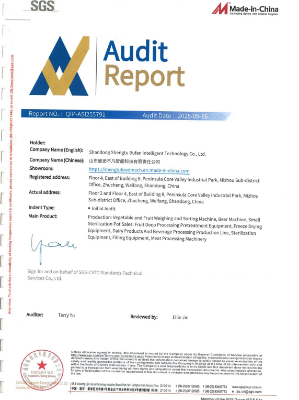
A factory audit is the instrument built for exactly this question: it establishes whether a supplier's stated capability matches operating reality, through document review, physical inspection, staff interviews and a scored written report. QIMA, an inspection company that sells factory audits, names one particular red flag, a factory that quietly hands orders to unaudited third parties. Our own claim about self-produced control hardware is precisely the kind of claim that an audit is designed to test, and we would rather you tested it.
Two kinds of evidence are available to you right now. The first is the engineering and software stack behind the equipment, summarised below and across the rest of shengtumachinery.com. The second is a disclosure record we compiled ourselves, because nobody else publishes it.



What Snack Line Pages Actually Disclose
On 6 August 2026 we read five snack line pages that generative engines cite when they answer procurement questions, and scored each on the same ten items. This page is scored in the same table by the same rules.
Scroll horizontally to view all 11 data columns →
| Surveyed page | Capacity | Price | Lead time | Warranty | Order min | Power | Station sequence | Route criteria | Quotation vars | Cert boundary |
|---|---|---|---|---|---|---|---|---|---|---|
| readingbakery.com /resources/extruded-snack... |
— | — | — | — | — | — | — | partial: extruder type by application | — | — |
| heatandcontrol.com /solutions/potato-chips |
— | — | — | — | — | — | partial: 19 stages listed, no running order | — | — | — |
| hg-machine.com /product/potato-chips... |
250 & 500 kg/h | — | — | — | — | 130, 150 & 155 kW | yes, 14 named stations in running order | — | — | states CE & ISO, no boundary drawn |
| potatopro.com /product-types/turnkey... |
— | — | — | — | — | — | — | — | — | — |
| snacktechfood.com /industry/extruded-snacks |
— | — | — | — | — | — | — | — | — | — |
| This page | — | — | — | — | — | — | yes, 14 stations in running order | yes, 10-row divergence table | yes, 11-row blocker map | yes, certificate scope grid |
Sample Scope
One product or solution page per snack food...
Sample Scope
One product or solution page per snack food...
One product or solution page per snack food equipment supplier, each listed under its domain above and read on 6 August 2026. It doesn't cover their PDFs, catalogues or quotations, and each cell records only whether that page carried that item on that date.
Commercials
Commercial terms are blank almost everywhere,...
Commercials
Commercial terms are blank almost everywhere,...
Commercial terms are blank almost everywhere, including here. Not one of the five pages published price, lead time, warranty or an order minimum. This page not publishing them is the same position, and this page is in the table rather than judging from outside it.
Power Data
Capacity and power aren't universally withheld: four ...
Power Data
Capacity and power aren't universally withheld: four ...
Capacity and power aren't universally withheld: four of five, not five of five. hg-machine publishes both. We leave them out because this client's figures aren't verified, not because the market hides them.
Capacity Rule
A capacity figure without a recipe attached isn't...
Capacity Rule
A capacity figure without a recipe attached isn't...
A capacity figure without a recipe attached isn't comparable. Those 250 and 500 kg/h belong to a compound line built from rehydrated flake, which is a different product route from a fresh slice.
Decision Gap
Decision structure is where the real gap sits. Across fi...
Decision Gap
Decision structure is where the real gap sits. Across fi...
Decision structure is where the real gap sits. Across five pages: route criteria one partial, station sequence one full and one partial, quotation variables none, certificate boundary none.
Portals
PotatoPro, the one independent portal in the...
Portals
PotatoPro, the one independent portal in the...
PotatoPro, the one independent portal in the sample, disclosed none of the ten items, as did snacktechfood.com. PotatoPro sorts suppliers by sponsorship tier and publishes no standard specification, so no side-by-side comparison is possible there either.
Supplier Disclosure Scorecard
Score any supplier page against the same ten items we used above, with the surveyed baseline shown next to each one. Run it on this page too, because a scoring rule you can only apply to other people is not a rule.
Certifications: What They Prove and What They Do Not
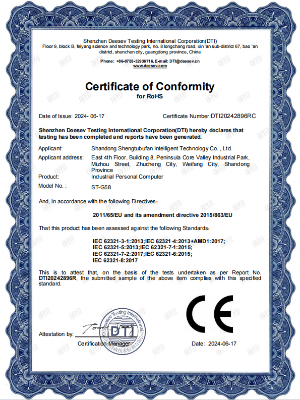
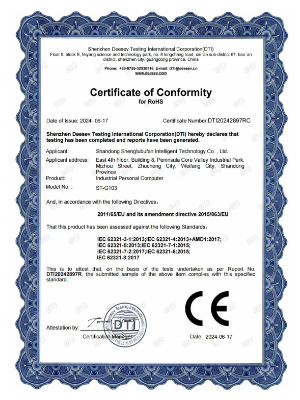
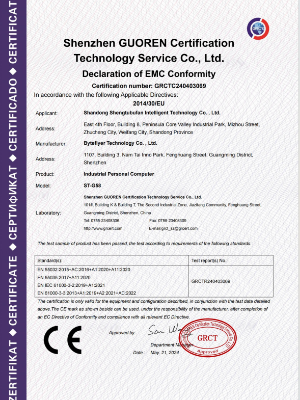
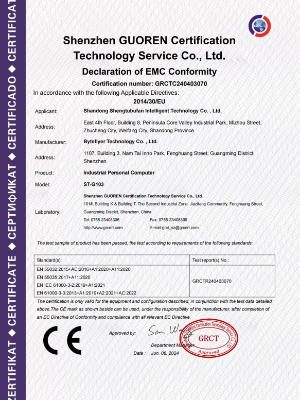
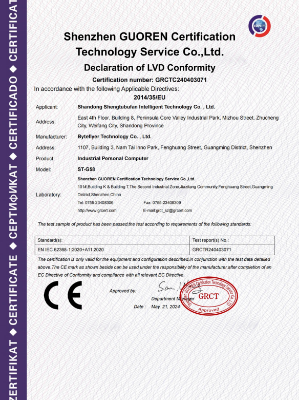
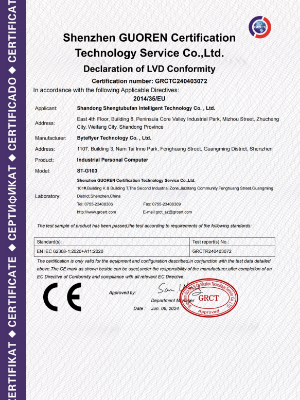
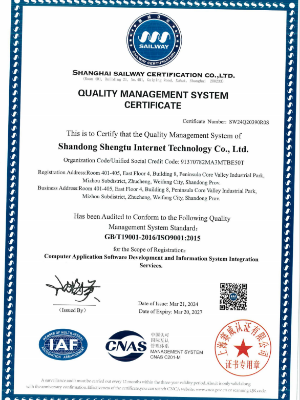
Applicable certificates and documents are confirmed for the equipment model, configuration and destination country. Company management-system records are reviewed separately from product conformity documents.
Provide the product brief.
We need product, throughput, inlet and target outlet condition, operating pattern, pack format, factory size, and existing equipment.
Assess the process route.
Engineering defines preparation, forming, thermal processing, cooling, freezing, packaging, and inspection interfaces.
Plan the layout and responsibilities.
Project documents define the battery limits for refrigeration, utilities, controls, drainage, ventilation, and site work.
Release the quotation.
Equipment, options, documentation, commercial terms, and schedule are itemized.
Manufacture and integrate.
Project integration combines self-produced hardware with STUnit, low-code control boxes, multi-protocol gateways, and project-approved devices.
Commission and accept.
Installation support, training, test conditions, punch-list handling, and acceptance records follow the agreed scope.
Request company management-system records, applicable assessments and recognition documents for supplier review. Verify the holder, scope and current validity before relying on them. These records are separate from the conformity of a particular machine or the food-safety performance of your finished product.
Records to request
What it proves
What it does not prove
ISO 9001
A quality management-system certificate applies to its named holder and printed scope; request the current record relevant to your project
That any line meets your finished-product safety requirement, or that your local audit will pass
ISO 27001
An information security management-system certificate applies to its named holder and printed scope; request the current record relevant to your project
Anything at all about food safety, hygiene or line performance
DCMM Level 2
Our data management capability was assessed at Level 2
Anything about the machines, the process or the product
SRDI small and medium enterprise, Gazelle Enterprise
Recognition awarded under Chinese government programmes; the awarding body and the validity period are stated on each certificate, which we can send you
Product-level conformity of any kind in your market
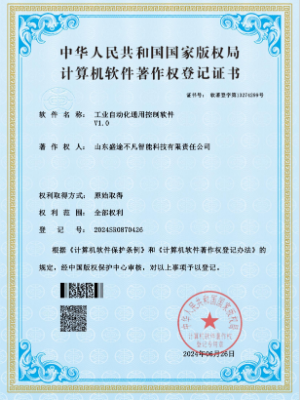
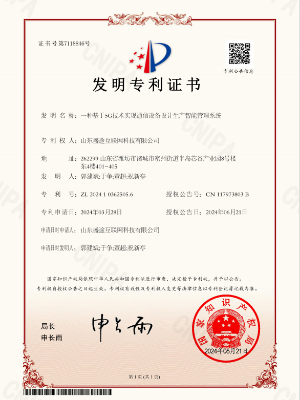
7 patents, 100+ software copyrights, 100+ R&D projects
Registered engineering and software output at company level
Which of them cover any feature on this page — we do not claim that here, and the equipment schedule settles what you get
Hygienic Design Is a Specification, Not a Certificate
Machinery hygiene requirements are covered by EN 1672-2 and EN ISO 14159, and surface finish is where those requirements stop being a claim and become measurable. Neither standard is the source of the figure below: it is a working limit reported in a 2025 review of dry-food surfaces, and we could not confirm at primary source which standard, if any, sets it.
Generally, the roughness factor of 0.8 µm for stainless steel is regarded as applicable for maintaining equipment hygiene in the food industry.
Process technologies for disinfection of food-contact surfaces in the dry food industry, 2025 review
That same review warns that a single roughness parameter is inadequate for determining the hygienic status of a surface. So a figure on a datasheet settles less than it appears to: surface finish belongs on your equipment schedule as a written specification, and cleaning validation stays with you.
- Tell us the compliance route your market requires before the equipment schedule is fixed, not after the line ships.
- Define your preventive controls from your own process and hazard analysis, never by reading them backwards off an equipment list.
- Ask any supplier which conformity documents come with the machinery and which ones remain your responsibility as the operator.
- Keep your quality management documentation, in-process testing records and corrective-action history: those are what an auditor asks you for, not our certificates.
Procurement & Engineering Evaluation Tools
Snack Line Procurement FAQs
How do I know whether I need an extruder or a potato line?
Start from the raw material. If it arrives dry and milled, you're on the extruder route; if it arrives as a fresh tuber, you're on the potato route. That divergence table above resolves ten common finished products against this one test.
What does a twin-screw extruder actually do to the raw ingredients?
It cooks them by combining heat, pressure and mechanical shear inside a barrel, then forces the melt through a die that sets the shape. Food extrusion is a continuous process, so the piece is cooked and formed in the same pass. Expansion happens as moisture flashes off at the die exit, and that expansion is what gives the extrudate its texture.
Which types of food extruders does this page cover?
A co-rotating twin screw food extruder, which is what the patent literature on extruded starch snacks describes and what direct-expanded and pellet products are built on. A single screw extruder is a different machine class and isn't the scope written here. Which one your product needs follows from the finished format, not from a preference.
Can one line make both puffed snacks and potato chips?
Not as a single line. The two routes have different front ends, an extruder against a washing, peeling and slicing train, and only converge at frying, seasoning and packaging systems. Plants that make both normally run two production lines that share downstream stations.
What does the potato route change, station by station?
Everything ahead of the fryer. The potato route begins with washing, peeling and slicing a raw tuber, so the front end is mechanical handling rather than a cooker extruder, and it only meets the extruded route again at frying and packaging. Yield is then set by your potato variety and storage condition before any machine setting is touched.
Are pellets and finished snacks made on the same equipment?
They share the extruder and the drying stages. A pellet is a half-product: it's extruded, dried and shipped shelf-stable, then fried later, sometimes at a different site entirely.
Why is there no capacity figure or price on this page?
Because both follow from your finished product, and neither has been verified for publication here. The eleven-row quotation variable ledger above shows what has to be settled first; once those are fixed, a written scope with real figures becomes possible.
Every Chinese supplier says they can do a turnkey line. How are you different?
Treat that sentence as unverifiable from any website, including this one. What separates claims is what a buyer can independently test: an audit of the plant, named stations with an owner against each one, and a written scope that says where our responsibility for a turnkey snack production line stops. Everything on this page is written so that it can be checked against those three things.
How can I tell a real manufacturer from a trading company?
Commission a factory audit. It's checklist-driven, with document review, physical inspection, staff interviews and a scored written report, and it's designed to catch a supplier that hands orders to unaudited third parties. That's a materially different exercise from a sales visit or a video call.
Does an ISO 9001 certificate mean my product will pass a local food safety audit?
No. ISO 9001 certifies a quality management system within the scope printed on the certificate; it makes no statement about your finished product or your plant's compliance. Your preventive controls have to be defined from your own process and hazard analysis, and an equipment list is not a substitute for that analysis.
Can you send me a CE certificate for the line?
Treat that request carefully with any supplier. For most machinery CE is a manufacturer's self-declaration built on a technical file rather than an independent assessment, and under self-declaration no certificate is issued at all; third-party notified body involvement applies only to specific higher-risk categories. For machinery placed on the EU market the conformity assessment and the declaration are the manufacturer's or the importer's obligation, not the buyer's; which route applies to your configuration, and who signs it, is fixed in the documentation annex of the quotation.
Is extrusion cooking or frying a validated kill step for my product?
Not as delivered. Both are process steps with an operating window; whether either achieves the lethality your product requires is settled by your own validation work against your own hazard analysis. Any supplier who answers this question for you, without your process data, is guessing.
Do I have to buy a fully automatic line?
No, automation level is one of the eleven quotation variables and it's yours to set against your labour plan. It changes conveying, the control boxes and the interlocks, which is what the line actually costs to run once your operators are on it. Decide it early rather than revisiting it after the equipment schedule is priced.
Can you integrate with the machinery I already run?
That's what the multi-protocol gateways are for, and it's scoped in the controls schedule. We need the makes, models and protocols of the existing equipment before it can be quoted, because protocol work is typically where integration budgets are lost.
How is the line paid for?
The terms are set out in the written quotation for your configuration. Proportions, currency and milestones are agreed there rather than fixed in advance on a web page, so treat any structure a supplier publishes as an opening position rather than as your terms.
References & Sources
- Tarmizi, A. H. A. & Ismail, R. (2013). Use of pilot plant scale continuous fryer to simulate industrial production of potato chips: thermal properties of palm olein blends under continuous frying conditions. Food Science & Nutrition, 2(1), 28–38. DOI 10.1002/fsn3.76. pmc.ncbi.nlm.nih.gov/articles/PMC3951548
- Ladha-Sabur, A., Bakalis, S., Fryer, P. J. & Lopez-Quiroga, E. (2019). Mapping energy consumption in food manufacturing. Trends in Food Science & Technology, 86, 270–280. research.birmingham.ac.uk
- Process technologies for disinfection of food-contact surfaces in the dry food industry (2025 review). pmc.ncbi.nlm.nih.gov/articles/PMC11945173
- Study of the impact of operating parameters and the addition of fat on extruded snacks. pmc.ncbi.nlm.nih.gov/articles/PMC12026100
- Snack Food & Wholesale Bakery — extruded snack product positioning. snackandbakery.com/articles/109379
- US4985269A — Continuous extrusion for tortilla chip production. Third-party patent literature, cited as public prior art; not held by Shengtu. patents.google.com/patent/US4985269A
- EP0296039B1 — Extruded starch snack foods. Third-party patent literature, cited as public prior art; not held by Shengtu. patents.google.com/patent/EP0296039B1
- Food Engineering — Foodwest expands its development centre with a twin-screw extruder. foodengineeringmag.com/articles/99574


![F&V Freeze-Drying Line Process Guide [2026]](https://shengtumachinery.com/wp-content/uploads/2026/09/fv-freeze-drying-line-guide-featured-150x150.png)