Get in touch with Shengtu Bufan Company

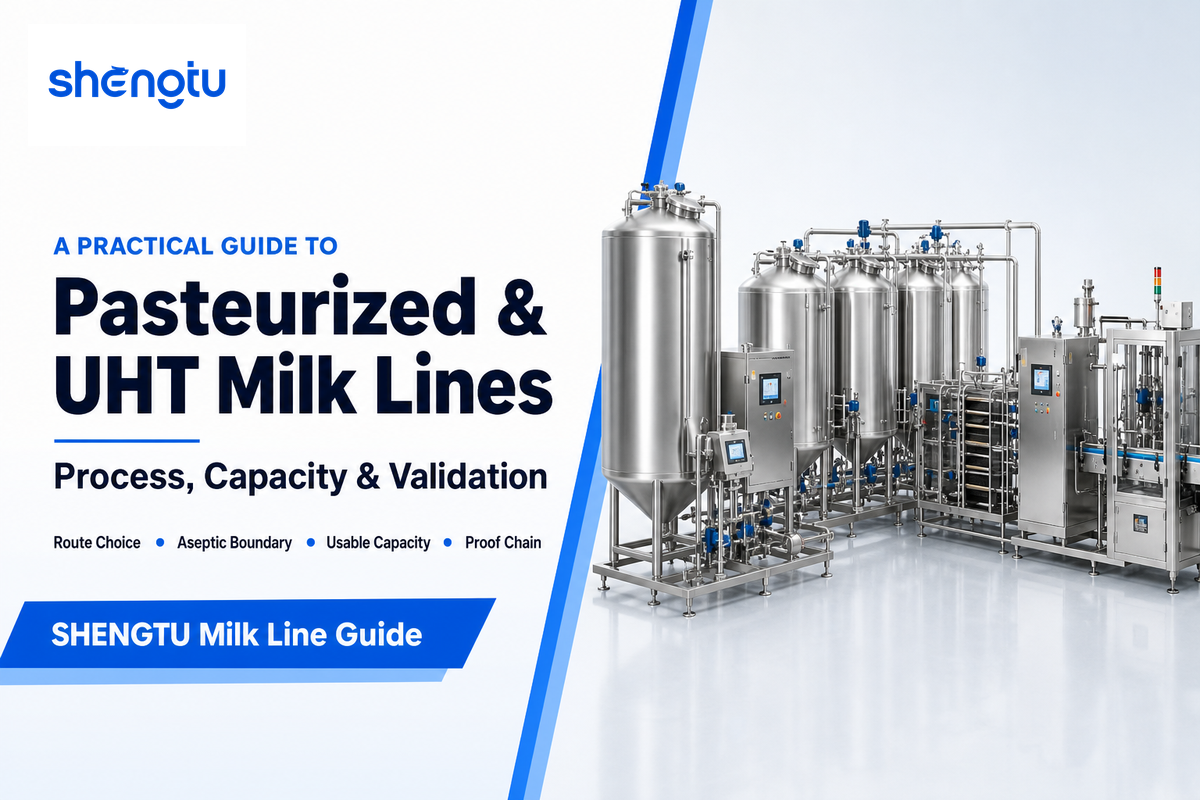
Dairy process planning guide · Updated September 2026
The milk line decision order is: route first, all interfaces connected, nameplate flow to delivered packaged quantity, and then required evidence prior to production.
The Pasteurized & UHT Milk Line is a connected dairy production system for refrigerated pasteurized milk or ambient UHT milk. The decision begins with the promised condition of the unopened product. Pasteurized milk normally depends on refrigeration, while ambient UHT milk depends on a qualified heat treatment joined to downstream aseptic processing and packaging.
This guide has a separate job from Shengtu’s milk pasteurization and UHT line solution. The solution page owns configuration, equipment fit, model discussion, quotation and project inquiry. This article explains the decisions and evidence a buyer should prepare before requesting those commercial details.
Direct answer: a milk line is selected by storage route, product duty, package, acceptable output and validation plan. Refrigerated pasteurized, refrigerated ESL and ambient UHT routes have different downstream boundaries. Freeze those inputs before comparing equipment.
Key takeaway
An ambient UHT outcome crosses two proof boundaries: the scheduled thermal process and the aseptic package system. Passing a heater trial does not release the package.
Route
Cold-chain pasteurized, refrigerated ESL, or ambient aseptic UHT
Cold-chain pasteurized, refrigerated ESL, or ambient aseptic UHT
Product
Raw milk history, fat, protein, solids, particles, sugar, flavouring
Raw milk history, fat, protein, solids, particles, sugar, flavouring
Output
Acceptable packaged L/h, not isolated skid nameplate flow
Acceptable packaged L/h, not isolated skid nameplate flow
Release
Product, thermal, package, instrument and record evidence
Product, thermal, package, instrument and record evidence
1. Should You Choose a Pasteurized or UHT Milk Line?
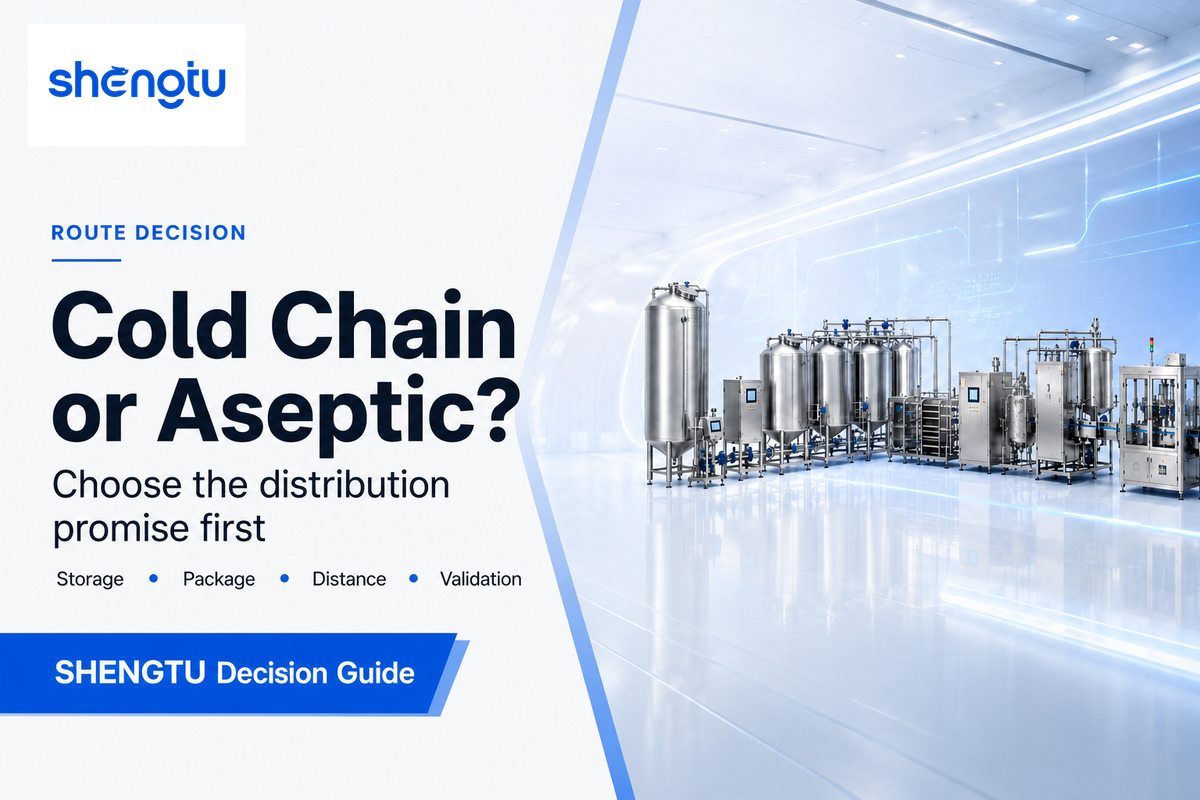
Choose pasteurization when the defined product will remain refrigerated through filling, storage, transport and sale. Choose UHT only when the project also includes a compatible aseptic filler, sterilized packaging and a controlled sterile zone. ESL is a valid refrigerated middle route and should be screened separately rather than forced into either label.
Each type of milk brings a different product and market boundary into dairy processing. Route selection therefore joins the distribution promise to the real formula, rather than treating all milk production as one heating problem.
In the dairy aisle, “pasteurized vs UHT milk” often sounds like a consumer label choice. For a plant, milk consumption patterns, delivery distance and the need for refrigeration define different production duties. Milk processed for a short chilled route should not inherit an ambient package cost without a market reason.
Cold-Chain-or-Aseptic Commitment Test
Cold-Chain-or-Aseptic Commitment Test – A 3-minute risk screen: Given your desired final packaged condition, can your available storage, distribution, sales & return network support the intended shelf life without aseptic conditions?
Refrigerated commitment
- Cold storage and transport remain controlled
- Pasteurization or an ESL route is validated for the product
- Filling and hygiene plans match refrigerated distribution
Ambient commitment
- Thermal process targets commercial sterility
- Package and closure are sterilized and protected
- Aseptic filler, sterile zone and deviation plan share one release decision
| Scenario | First route to screen | Evidence to freeze | Limitation |
|---|---|---|---|
| Local chilled white milk | Pasteurized | Cold-chain range and peak delivery time | The market rule still governs the process |
| Longer refrigerated reach | ESL | Microfiltration or heat route, package and chill plan | ESL is not ambient UHT |
| Ambient retail carton | UHT plus aseptic filling | Product, package and sterile-zone basis | A heater alone is incomplete |
| Chilled flavoured dairy drink | Pasteurized or ESL | Sugar, stabilizer, flavour and package sequence | Formulation changes heat behaviour |
| Ambient flavoured milk | UHT plus aseptic filling | Ingredient addition and sterile-side boundary | Particles may change equipment fit |
| Skim milk | Route follows distribution | Protein and mineral profile | Low fat does not remove fouling risk |
| Fortified milk | Trial both applicable routes | Addition point and nutrient stability | Nutritional value requires product evidence |
| Whey-based beverage | Product trial before route lock | pH, protein, solids and sediment risk | Milk settings may not transfer |
| Institutional bulk pack | Route follows package and distribution | Closure, handling and open-life plan | Pack size changes the downstream duty |
| Export through warm warehouses | UHT feasibility review | Temperature exposure and destination rules | Ambient does not mean temperature-indifferent |
Buyer objection: “UHT has a longer shelf life, so it must be the better route.” That conclusion ignores aseptic package cost, process complexity, product response, market preference and the full supply chain. The better route is the one whose unopened-package promise the plant can repeatedly prove.
Evidence capsule: Codex describes UHT treatment in the 135–150 °C range under qualified conditions and pairs it with further aseptic processing. The number defines neither a universal milk recipe nor final shelf life; product, package, process authority and destination requirements still set the approved operating window.
2. What Equipment and Interfaces Make Up the Line?
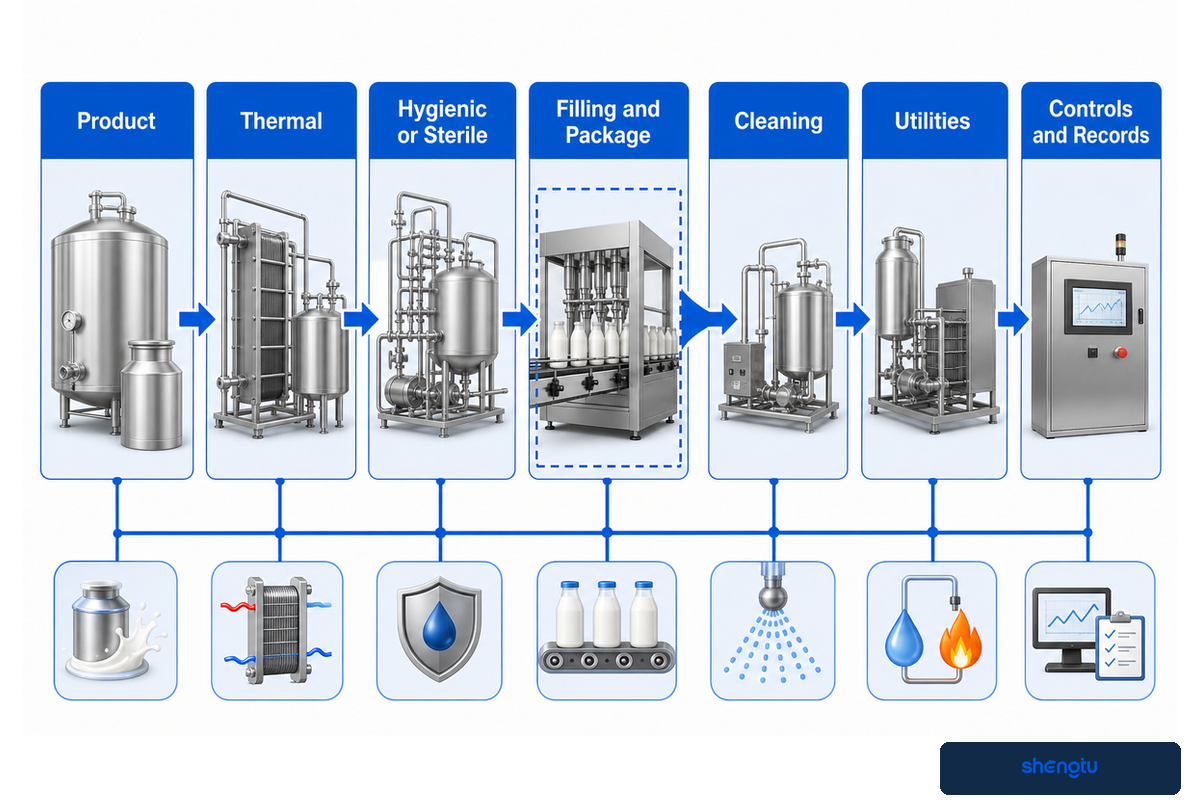
A complete line connects reception and storage, separation or standardization, heat treatment, homogenization, cooling or sterile transfer, filling, CIP, utilities and records. The exact equipment list changes with the product and package, but every interface must declare flow, pressure, temperature, hygiene state, control ownership and response to a stop.
Seven-Interface Milk Line Map: 7-Handoff Framework
Seven-Interface Milk Line Map is a 7-Handoff Framework that groups equipment by the handoffs that can limit output or break the release chain.
- Product: raw milk receipt, clarification, standardization, ingredient addition and balance tanks.
- Thermal: regeneration, heating, holding, cooling and any vacuum stage.
- Flow and control: pumps, valves, flow diversion, pressure relationships, sensors and PLC sequences.
- Homogenization: location, pressure duty and whether the homogenizer sits on the clean or aseptic side.
- Packaging: cold filler or aseptic filler, package treatment, closure and barrier.
- Cleaning and utilities: CIP circuits, steam, water, cooling, compressed air and electricity.
- Evidence: recipes, calibrations, alarms, deviations, samples and release records.
Hidden bottlenecks often sit between named machines. If a balance tank cannot hold a filler interruption, the line may require recirculation or product diversion. When a homogenizer is placed downstream of direct UHT, it may need an aseptic design. Carton sterilization faults can stop saleable output while the UHT unit continues to show normal thermal readings.
Buyer objection: “The quotation already lists every machine.” A machine list shows scope nouns; it rarely proves interface verbs. Ask who starts, stops, drains, sterilizes, diverts, records and accepts each handoff, including the state reached when the downstream packer stops.
3. How Does an HTST Pasteurized Milk Line Work?
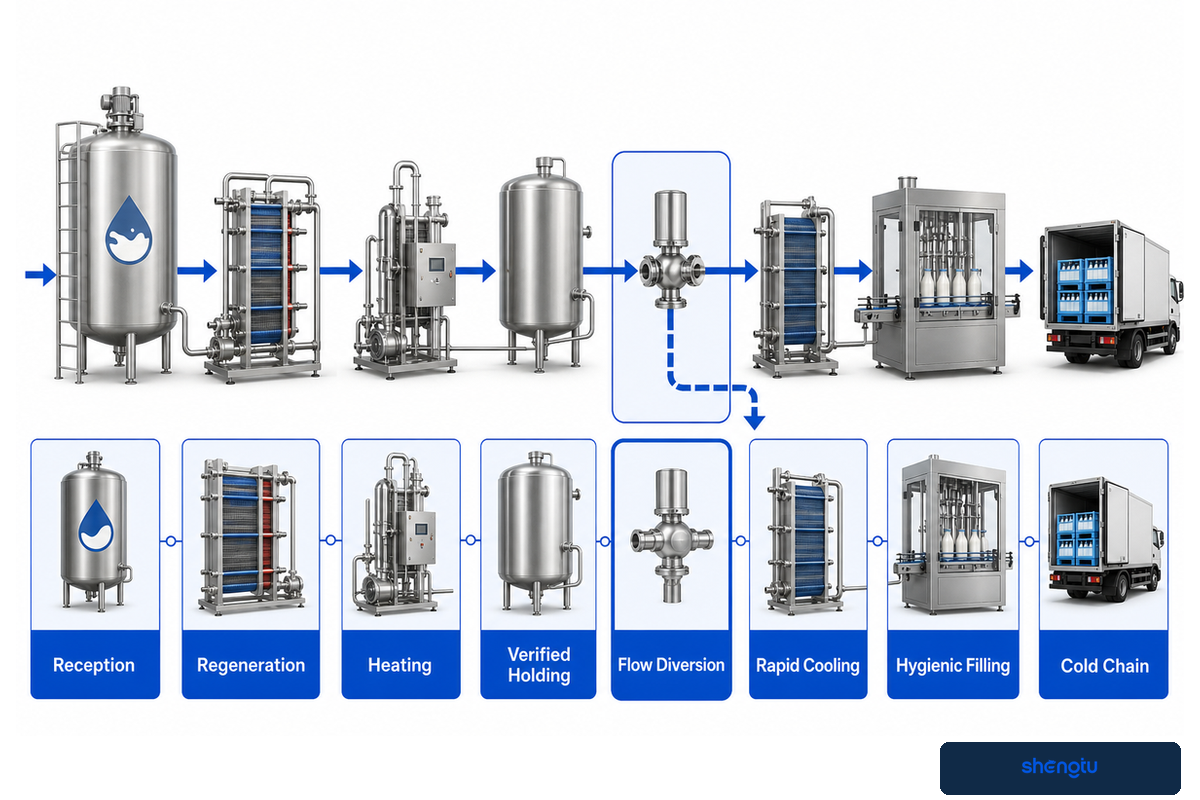
In an HTST pasteurization process, milk is heated under controlled flow, held for the validated time, checked against diversion conditions, cooled and transferred to hygienic refrigerated filling. Holding time, flow rate, temperature, pressure relationships, equipment integrity and records work as a linked safeguard chain rather than independent readings.
“The minimum holding time shall be obtained in both forward and diverted flow positions.”
The line receives and filters raw milk, standardizes it as required, preheats it through regeneration, applies homogenization at the selected location, completes the holding step, checks legal diversion logic, then cools and transfers the milk under the product-specific control basis.
The holding tube needs a known geometry and hygienic drainability. The timing basis must use the maximum permitted forward flow, not a comfortable average. Pressure relationships protect the pasteurized side from a leak across regeneration sections. Instrument checks and heat-exchanger integrity tests turn the flow diagram into auditable evidence.
Shengtu’s plate pasteurizer page covers commercial equipment scope. For a project brief, record the milk family, maximum flow, inlet condition, heat source, cooling condition, filler rate, cold-storage window and the authority that will approve the process.
Buyer objection: “Can we specify 15 seconds and finish the design?” A familiar time cannot stand alone. Product composition, validated temperature, flow measurement, holding volume, diversion response, pressure control and destination rules must describe the same operating state.
Evidence capsule: Current CFIA guidance calls for the holding tube to maintain a continuous upward slope of at least 2% and ties time verification to both forward and diverted flow. That geometry is a cited Canadian control example, not permission to copy one HTST design into another market.
4. How Does UHT Milk Processing Reach an Ambient Package?
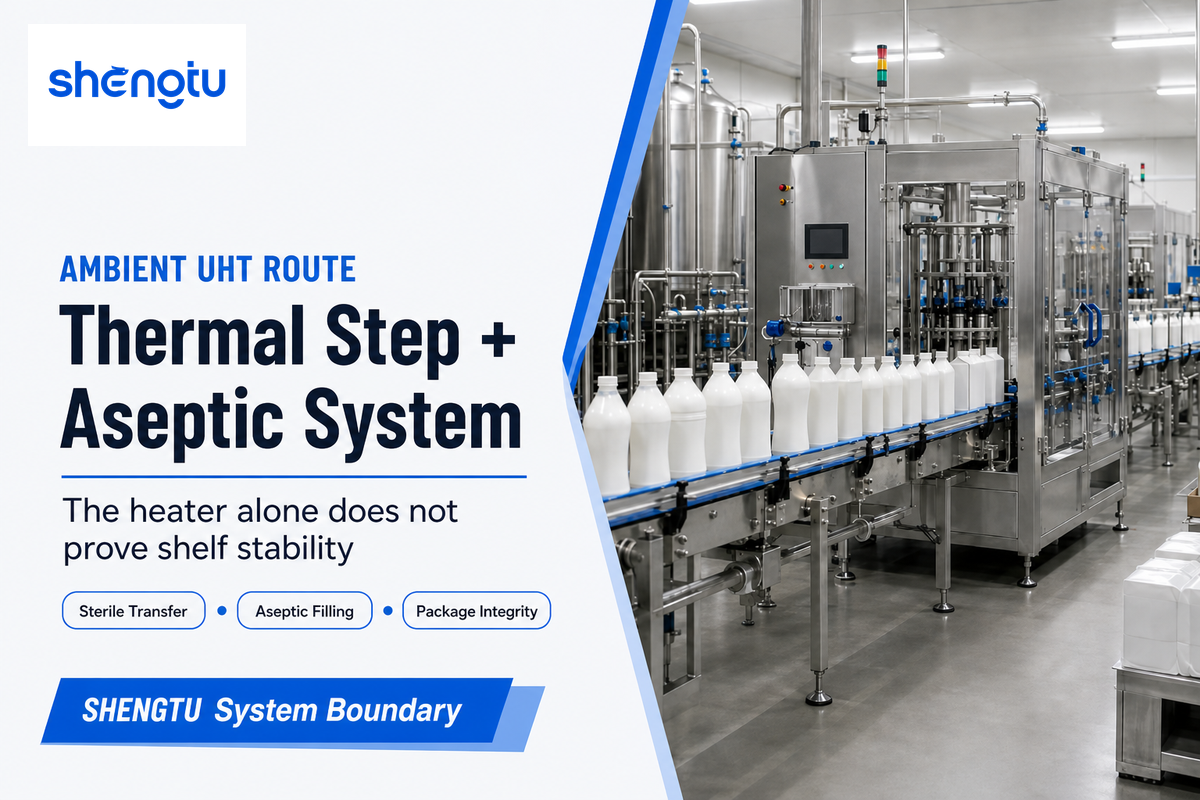
UHT milk processing heats a prepared product through a qualified ultra-high-temperature cycle, cools it without exposing it to contamination, and transfers it into sterilized packages inside a controlled aseptic environment. Commercial sterility belongs to the complete process and package system, including filler atmosphere, closure integrity, barrier performance and deviation handling.
Production of UHT milk begins before the high heat treatment. Raw milk age, psychrotrophic growth and heat-stable protease or lipase activity may influence later flavour, sediment or age gelation even after microorganisms are controlled. Standardization, deaeration, preheating and homogenization must therefore be tied to the actual white milk, skim milk, fortified milk or flavoured dairy formula.
Ultra-high temperature milk is sometimes described as milk heated to a higher temperature for a shorter period. That shorthand omits what follows. The product is heated, cooled under controlled conditions, and the milk is packaged inside the qualified sterile boundary. The UHT-treated label cannot establish how milk treated in one trial will behave in another carton or warehouse.
Direct UHT can use culinary steam injection or infusion and then remove added water through flash cooling under vacuum. Indirect UHT transfers heat through a plate or tubular exchanger wall. After uht treatment, the product might pass through an aseptic homogeniser, aseptic buffer tank and filler. The aseptic packaging boundary has to be reliable enough to survive normal production, startup, planned stops and recovery from a fault.
The UHT aseptic filling line is the relevant commercial handoff when the requirement is milk stored at room temperature before opening. Final shelf life should derive from the validated product-package-process combination and storage study, not a generic claim that milk can be stored for months without refrigeration.
Marketing glosses such as “room temperature for months,” “shelf life without refrigeration,” or “controls bacteria and extend shelf life” aren’t a process basis. Those phrases also cannot declare a product safe to consume. The validated study must relate milk produced using the actual formula, package and temperature exposure to the proposed shelf life.
Buyer objection: “The carton states UHT, so aseptic validation is the filler’s problem.” Product and packaging teams can each own separate work packages, but a release decision must relate sterilized product, package treatment, sterile atmosphere, closure and barrier without a missing gap.
Evidence capsule: The Codex milk-hygiene code places UHT processing around 135–150 °C under qualified conditions, while CFIA guidance defines package treatment, sterile filling and hermetic closure inside the aseptic system. One temperature profile can support one boundary; it can’t prove the unopened package on its own.
5. Direct or Indirect UHT: Which Route Fits the Product?
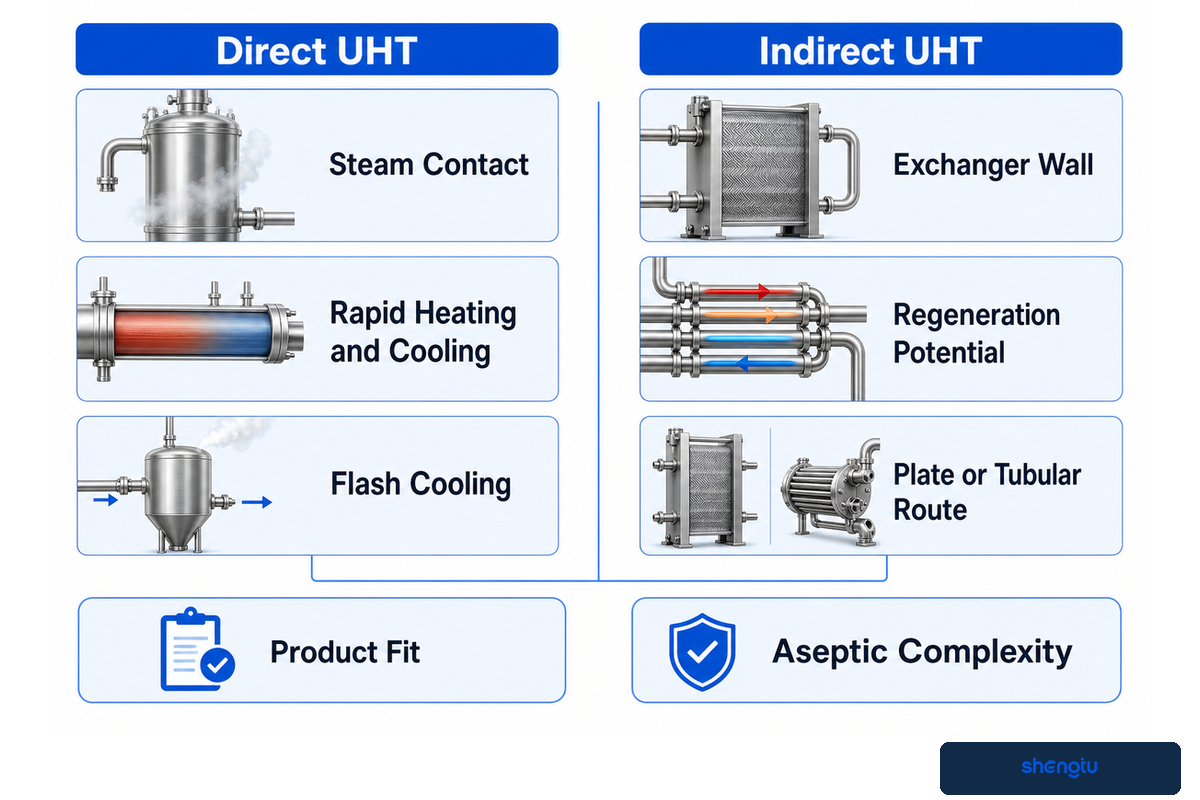
Direct UHT heats and cools product rapidly through steam injection or infusion followed by flash cooling. Indirect UHT transfers heat through a plate or tubular exchanger wall. Neither route is always better; product characteristics, sensory target, run length, utility costs and cleaning evidence are deciding factors.
Choice of heat-exchanger is core to this route choice. Plate design can offer high heat-transfer area in a small chassis for suitable low-viscosity products. Tubular pathways may match duties where product character, pressure or fouling require a different path. Scraped-surface equipment only belongs where the product and thermal duty justify moving-surface control. Product trials should precede any blanket declaration.
The homogenisation location can also vary. The homogeniser may be placed by a pasteurized milk line or indirect UHT milk production line upstream of final heating. In direct UHT systems, aseptic homogenisation may be placed downstream when product response supports that position. The choice affects sterile-side equipment, controls and cleaning boundaries. A commercial tetra pak dairy handbook depicts both placements, but doesn’t rank the two routes for another supplier’s project.
UHT milk processing lines have production needs of their own that a route label conceals. A flavored dairy beverage may add sugar, cocoa or stabiliser before or after a chosen step. The extreme heat treatment and storage can influence the nutritional or tasting result in varying ways across formulas. The 2026 Journal of Dairy Science fouling review also demonstrates that sensor methods still require product and geometry context.
| Product or duty type | First technical screen | Evidence requested | Limitation |
|---|---|---|---|
| Low-viscosity white milk | Plate or tubular indirect; direct if sensory case supports it | Trial flavour, heat load and run length | No universal winner |
| High-protein milk | Deposit and stability screen | Protein, mineral balance and ageing study | Protein source changes behaviour |
| Skim milk | Protein-led thermal trial | Deposit map and sensory result | Low fat is not low fouling |
| Fortified milk | Addition-point and stability trial | Vitamin or mineral recovery and sediment | Nutrition claims need separate substantiation |
| Flavoured milk | Sugar, cocoa or flavour interaction | Viscosity, particles, colour and flavour | One flavour trial cannot cover all recipes |
| Whey beverage | pH and protein stability | Precipitation and sediment trend | Milk assumptions may fail |
| Particle-bearing drink | Particle passage and residence distribution | Maximum particle size and distribution | Liquid temperature alone is incomplete |
| Long campaign | Fouling and pressure-drop trend | Run endpoint and CIP recovery | A clean-water trial is weak evidence |
| Frequent recipe changes | Changeover and sterile recovery | Sequence time, loss and release method | Peak output may hide changeover loss |
For commercial sterilizer scope, see Shengtu’s UHT sterilizer page. Keep any published equipment temperature range attached to that named module; it isn’t a complete process schedule across every dairy product.
Buyer objection: “Direct UHT protects product quality because exposure is shorter.” Rapid heating and cooling may matter, but raw milk history, formulation, steam quality, vacuum control, homogenisation and storage temperature may alter a simple ranking. Compare tested product outcomes, not route adjectives.
Evidence capsule: A commercial dairy handbook exhibits UHT system examples between perhaps 2,000-45,000 L/h and selected variable-flow instances at 50-100% of rated flow. Those numbers show how broad the design space is; they’re supplier examples, not Shengtu ratings or a customer guaranteed operating window.
6. How Do You Size Acceptable Packaged Capacity?
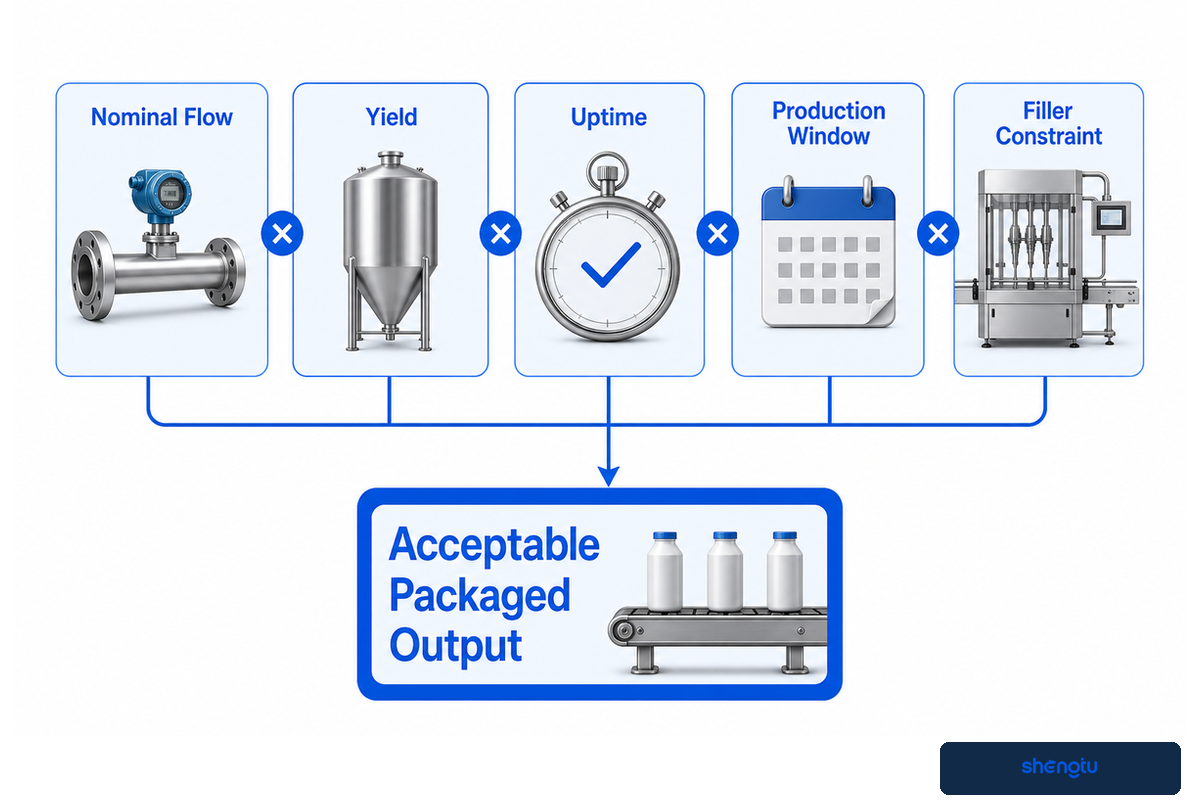
Size capacity in saleable product, then work backwards through filler capability, thermal line uptime, product yield and changeover. The smallest feasible interface sets the production rate. Nameplate litres per hour are helpful, but only once the project defines what counts as an acceptable product and what operating window it applies to.
Acceptable-Litres Capacity Equation
Acceptable-Litres Capacity Equation transforms rated flow into a planning forecast for saleable product while revealing each assumption.
Acceptable packaged L/h = min(thermal L/h, filler L/h, utility-supported L/h) × uptime × product yield × package acceptance.
Hypothetical example, not a machine claim: a thermal unit rated at 10,000 L/h feeds a filler that sustains 9,200 L/h. Utilities support 9,500 L/h. Planned uptime is 85%, product yield is 97%, and package acceptance is 99%. The result is 9,200 × 0.85 × 0.97 × 0.99 = 7,510 acceptable L/h after rounding. In an 8 h window, the unrounded planning output is 60,076 L before any additional SKU change or planned hold.
The equation is useful because it makes disagreement visible. Engineering may challenge the 85% uptime. Packaging may show that 9,200 L/h applies only to one carton. Production may add a 35 min sterile recovery after a stop. Finance can then compare energy and water use on acceptable litres rather than gross flow.
Utilities need state-based checks. Steam demand at startup can differ from steady production. Chilled water, cooling tower capacity, compressed air quality, electricity, CIP return flow and drain capacity may peak at different times. Record each state: sterilization, water circulation, product production, downstream stop, CIP and recovery.
Buyer objection: “We only want 10,000 L/h, so price a 10,000 L/h line.” That request masks the filler, package, product, uptime, utility states. Request the accepted product-output equation and substantiating data for each factor before comparing line costs.
Evidence capsule: The worked case begins at 10,000 L/h but falls to 7,510 acceptable L/h after rounding the downstream cap and four declared factors. Every figure is hypothetical. The method is portable because it preserves the minimum-interface rule and shows exactly which assumption a supplier or plant team must replace with measured data.
7. How Do Fouling and CIP Change the Production Window?
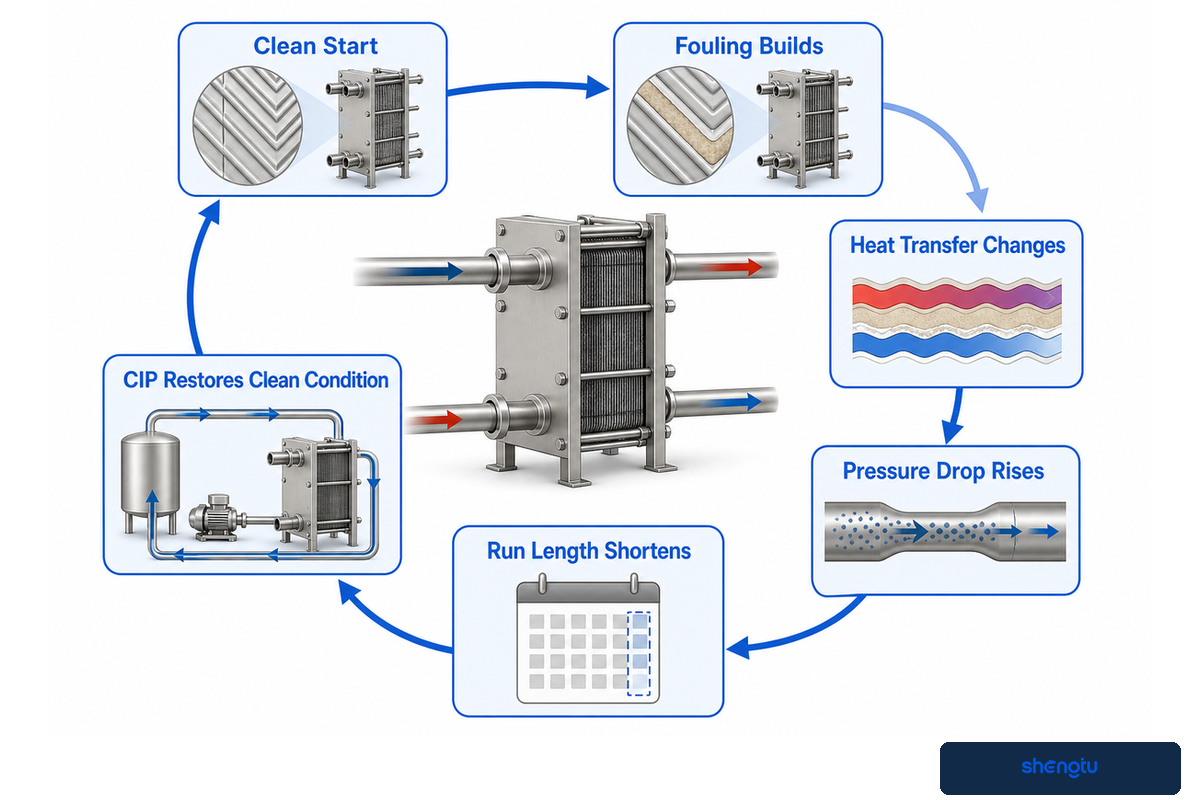
Dairy fouling reduces heat transfer and can increase pressure drop as a run proceeds, so it changes both capacity and the time available before cleaning. A CIP recipe restores a defined hygienic state only when concentration, temperature, flow, time, return condition and inspection or verification evidence meet the approved acceptance basis.
Protein and mineral deposits do not appear uniformly across every exchanger or recipe. Raw milk quality, preheating, surface temperature, geometry, velocity and product solids influence where deposits form. One temperature trace cannot diagnose the whole condition. Trend heat-transfer approach, differential pressure, flow, valve state and product quality together.
Do
- Define a measured production endpoint
- Trend pressure drop and thermal approach
- Verify chemical return and final rinse condition
- Inspect the hard-to-clean circuit after trials
Do not
- Promise one run length for every formula
- Use elapsed time as the only fouling signal
- Treat completed pump steps as release proof
- Assume a water trial represents milk deposits
CIP circuit architecture must specify which tanks, dead ends, filler interfaces, aseptic-component groups mix or don’t share flow. A validated sequence proves the requested steps occurred. Release requires the selected evidence: return conductivity, temperature, flow, time, final rinse results, visual access, swab or other site-approved documentation.
Buyer objection: “The line has automated CIP, so cleaning performance is settled.” Automation repeats commands. It doesn’t guarantee that cleaning reached every target surface, removed deposits, preserved drain function or met the plant acceptance basis.
Evidence capsule: A peer-reviewed 2025 fouling review connects deposits with reduced heat transfer, higher pressure drop, shorter production cycles and cleaning demand. If a project targets a 6 h campaign, that duration is a validation hypothesis; product trials must show whether the measured endpoint occurs before, at or after it.
8. What Must Be Validated Before Release?
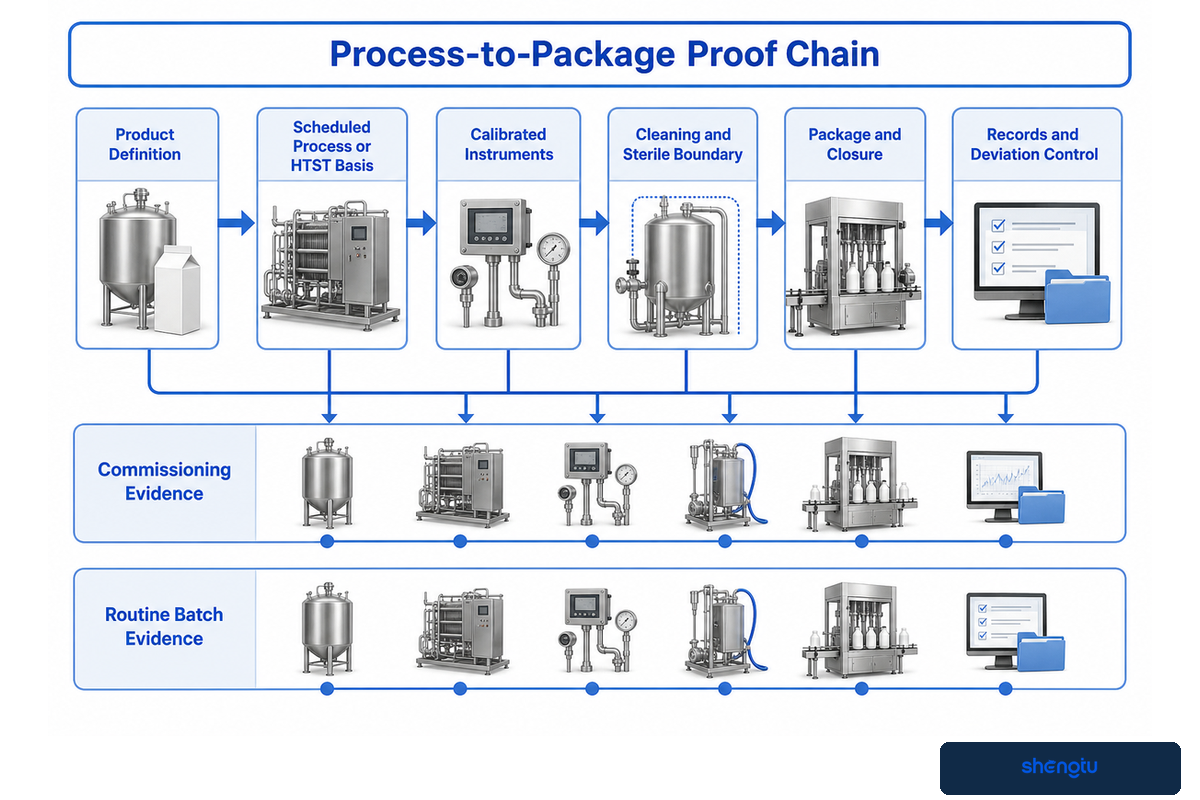
Release demands a linked set of evidence: package and product acceptance, qualified thermal standard, verified flow and dwell conditions, calibrated instruments, tested diversion or sterile controls, package and closure acceptance, cleaning documentation, deviation documentation, traceable data. FAT can verify functions; SAT must validate the installed line under site conditions.
Process-to-Package Proof Chain
Process-to-Package Proof Chain is a release verification instrument that ensures one validated subsystem doesn’t substitute for the entire batch.
- Freeze the duty: approve product family, worst case, package, route and destination.
- Qualify the process: bind flow, time, temperature, pressure and product state to the approved basis.
- Challenge the interfaces: test diversion, downstream stops, sterile recovery, buffer and utilities.
- Verify the package: confirm treatment, filling environment, closure, barrier and inspection method.
- Close the record: reconcile calibrations, deviations, samples, acceptance signatures and change control.
Build a traceability table before FAT. Every requirement should point to its owner, instrument, test method, acceptance criterion and retained record. During SAT, use site steam, water, cooling, air, electricity and packaging. Include a planned 2 min stop and a separate 10 min stop scenario so the team can observe recovery logic rather than inferring it from a normal run. Those durations are test examples, not acceptance limits. The plant’s food safety plan and destination rules control the final basis.
Change control continues after release. A new fat or protein range, fortified formula, package material, closure, filler, heat exchanger, holding tube, valve sequence, homogenizer position or CIP recipe may require a documented review. The responsible process authority and destination rules decide whether revalidation is necessary.
Buyer objection: “A supplier FAT certificate is enough to start production.” FAT can prove build and function against an agreed test. It can’t represent site utilities, final piping, local operators, actual package supply, warehouse exposure or every approved recipe.
Evidence capsule: A traceability plan may log control events at 1 s resolution, but timestamp precision is only a recording choice. The meaningful test is whether each instrument, alarm, diversion, filler state and deviation record resolves the approved acceptance criterion under the installed product and package duty.
9. What Should a Buyer Put in the Project Brief?
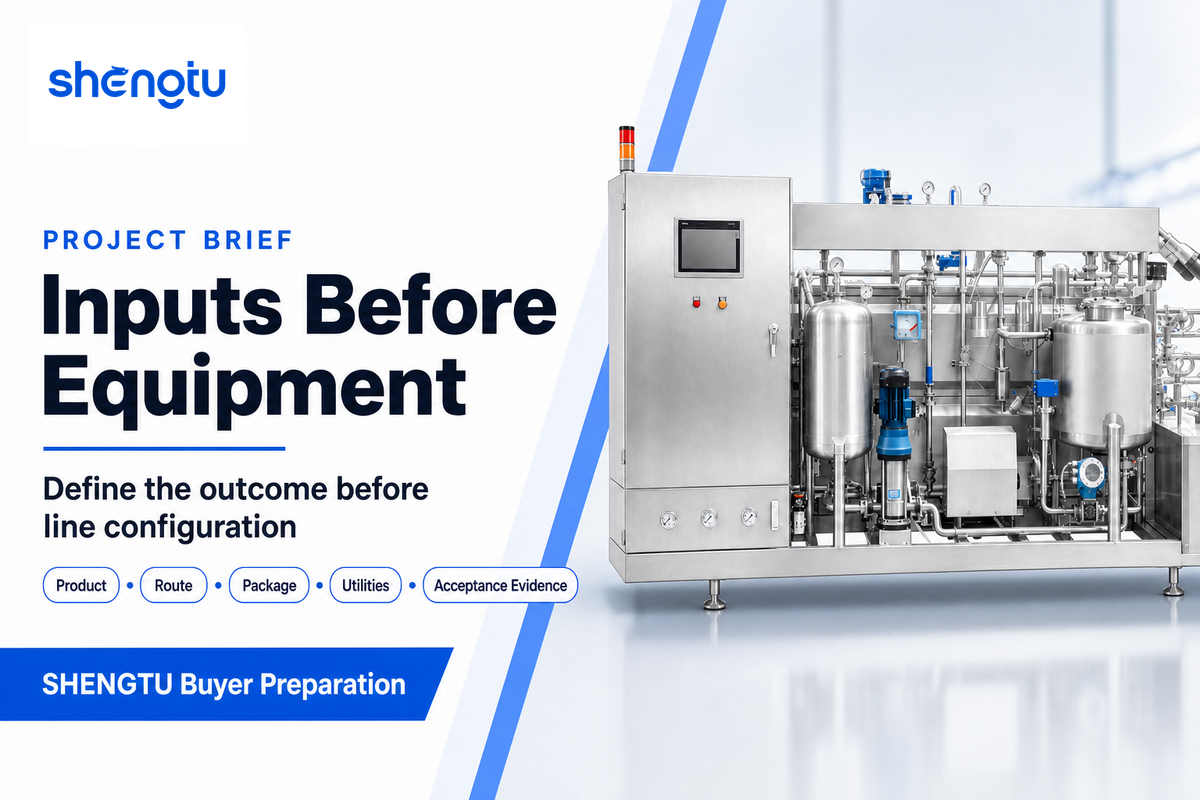
A useful milk-line brief states the product families, raw milk condition, route, package, destination, acceptable output, operating calendar, utilities, cleaning basis, validation owner and retained evidence. Suppliers can then expose exclusions and interface risks. A request that contains only litres per hour and “pasteurized or UHT” leaves the largest cost drivers undefined.
Start with a frozen product table. Include fat, protein, total solids, sugar, stabilizers, fortification, flavouring, particles, inlet temperature and expected raw milk age. Mark the worst case for heat transfer, fouling, homogenization, sediment, flavour and cleaning. State whether the project covers fresh milk, ESL milk, UHT milk or more than one route.
Next, identify packaging and distribution. Log package material, size range, closure, filler company or interface, refrigeration condition, warehouse temperature exposure, transport time and destination country. Ambient storage requires an aseptic packaging boundary. Refrigerated milk should move through a controlled cold chain. Neither statement sets a universal shelf life.
Each route has its own cost factors: utilities, consumables, lost product, setup and changeover, cleaning time, downtime, warranty and evidence work. Ask each vendor to itemize supplied scope, buyer-supplied scope, exclusions, battery limits, data handoff, evidence and acceptance testing. This makes quotations comparable without being misled by the lowest equipment number.
Input-field precision examples, not acceptance limits: record product temperature to 0.1 °C; cooling water to 0.1 °C; CIP return temperature to 0.1 °C; warehouse exposure to 0.1 °C; steam pressure to 0.01 bar; inlet pressure to 0.01 bar; outlet pressure to 0.01 bar; filter differential pressure to 0.01 bar; vacuum pressure to 0.01 bar; compressed air to 0.01 bar; homogenizer pressure to 0.1 MPa; pump speed to 1 rpm; ingredient mass to 0.1 kg; voltage to 1 V; current to 1 A; frequency to 1 Hz; motor load to 1 kW; peak utility demand to 1 kW; batch energy to 1 kWh; water use to 0.1 m³; CIP water volume to 0.1 m³; tank volume to 0.1 m³; drain capacity to 0.1 m³; pipe dimensions to 1 mm; service clearance to 1 mm; floor area to 0.1 m²; control events to 1 s; valve response to 1 sec; holds to 1 min; changeovers to 1 min; campaigns to 0.1 hr; CIP concentration to 0.01%; and yield, uptime, package acceptance, fat, protein and solids to 0.1% each. Use finer or coarser resolution when the measurement method requires it.
Shengtu’s Pasteurized & UHT Milk Line solution page is the next step for configuration and quotation. Company background is available on the About Shengtu page; those first-party details describe the supplier and do not replace project validation evidence.
Buyer objection: “Providing this much detail will slow the quotation.” A short generic RFQ returns assumptions that are discovered later as change orders. A structured brief usually moves uncertainty earlier, where the buyer can compare it before fabrication begins.
Turn the process boundary into a quote-ready scope
Bring your product table, package plan, target acceptable output, utilities and validation needs. Shengtu can review the connected line scope rather than guessing from one nameplate rate.
Frequently Asked Questions
Can a pasteurized milk plant add UHT production later?
Yes, but the upgrade requires a new system-boundary review covering thermal treatment, sterile transfer, aseptic filling, packages, utilities and records, rather than simply installing a hotter heater.
Existing tanks, utilities or homogenization equipment may remain useful, yet ambient UHT production adds qualified thermal processing, sterile transfer, package sterilization, aseptic filling, closure control and new deviation records. Layout, steam, cooling, air quality and CIP circuits need a fresh interface check before reuse is assumed. A site survey should confirm every reused connection.
Can pasteurized and UHT routes share tanks or a homogenizer?
Sometimes, but each shared asset must preserve the required hygiene state, available capacity, valve segregation, cleaning coverage and validated operating sequence for both installed routes.
Sharing depends on product compatibility, clean-side or sterile-side location, valve segregation, CIP coverage, changeover evidence and the consequence of a downstream stop. A homogenizer may sit upstream in one route and downstream on the aseptic side in another, so the piping diagram and operating state matter more than the equipment name.
What determines the final shelf life of milk?
The approved product, thermal process, package treatment, closure, handling history and storage temperature determine milk’s shelf life together; no equipment name can set it alone.
Raw milk quality, heat-stable enzymes, formulation, thermal history, post-process contamination control, package barrier, closure, warehouse temperature and transport all influence the result. A peer-reviewed storage study found major quality differences across temperature conditions, which is why a supplier shouldn’t promise one universal duration for every product or distribution route individually.
Is ultra pasteurized milk the same as shelf-stable UHT milk?
No. A high-temperature treatment name does not by itself define an ambient aseptic package, storage claim or freedom from refrigeration before the package is opened.
Check the market definition, required refrigeration statement, package system and approved process rather than relying on similar words.
Does UHT processing reduce the nutritional value of milk?
Heat can affect selected nutrients and sensory properties, but any comparison must use the real formula, thermal history, package and storage period rather than a route label.
Avoid turning a general route comparison into a nutrition claim. Fortified milk also needs recovery evidence for the added nutrient system.
What information is needed for a reliable milk-line quotation?
Provide product ranges, route, package, acceptable output, operating calendar, utilities, cleaning basis, site constraints, destination market and the evidence expected at FAT and SAT together.
Add site voltage, steam and cooling conditions, filler interface, recipe count, changeover pattern, layout constraints and destination market.
Research and Scope Statement
The guide was prepared in September 2026 from current public regulator guidance, the Codex milk-hygiene code, peer-reviewed dairy research and live Shengtu site pages. Commercial handbook examples were used only to frame equipment choices. No universal process schedule, shelf-life promise or supplier performance figure is inferred. Final design and release remain subject to the product, package, destination rules and responsible process authority.
References & Sources
- Code of Hygienic Practice for Milk and Milk Products, Codex Alimentarius, hosted by the Food and Agriculture Organization
- Extended Shelf Life Milk: Processing and Quality, peer-reviewed review indexed by PubMed
- HTST Pasteurization Systems, Canadian Food Inspection Agency
- Aseptic Processing and Packaging Systems, Canadian Food Inspection Agency
- Protein Changes in UHT Milk During Storage, peer-reviewed open-access review
- Review of Dairy Fouling and Detection Methods, 2025 peer-reviewed open-access review
- Effects of Raw Milk Quality, Processing and Storage Conditions on UHT Milk, peer-reviewed study indexed by PubMed