Get in touch with Shengtu Bufan Company

Updated August 2026
A plate pasteurizer moves a pumpable liquid through separate channels in a plate heat exchanger, using regeneration, final heating, validated holding, flow diversion and cooling as one continuous process. Although central, the plate pack is not the whole safety system. Product condition, flow, holding time, temperature, pressure relationships, equipment integrity, valve position and records have to agree before product can move forward.
This guide explains that operating logic for plant managers, production teams, quality assurance, maintenance and project engineers. It does not provide universal setpoints. Milk, juice and other liquid foods have different hazards, physical behavior, process-authority requirements and market rules. If you are already defining capacity, utilities or equipment configuration, use SHENGTU’s page to configure a plate pasteurizer for your product and utilities. This article stays on the operating and evidence side of the decision.
The operating rule in one sentence
Do not ask only, “Did the product reach temperature?” Ask whether the right product moved at the validated flow through the verified holding path, while the required pressure and diversion conditions were maintained, and whether the record proves what happened to every affected lot.
What a Plate Pasteurizer Controls Beyond Heat
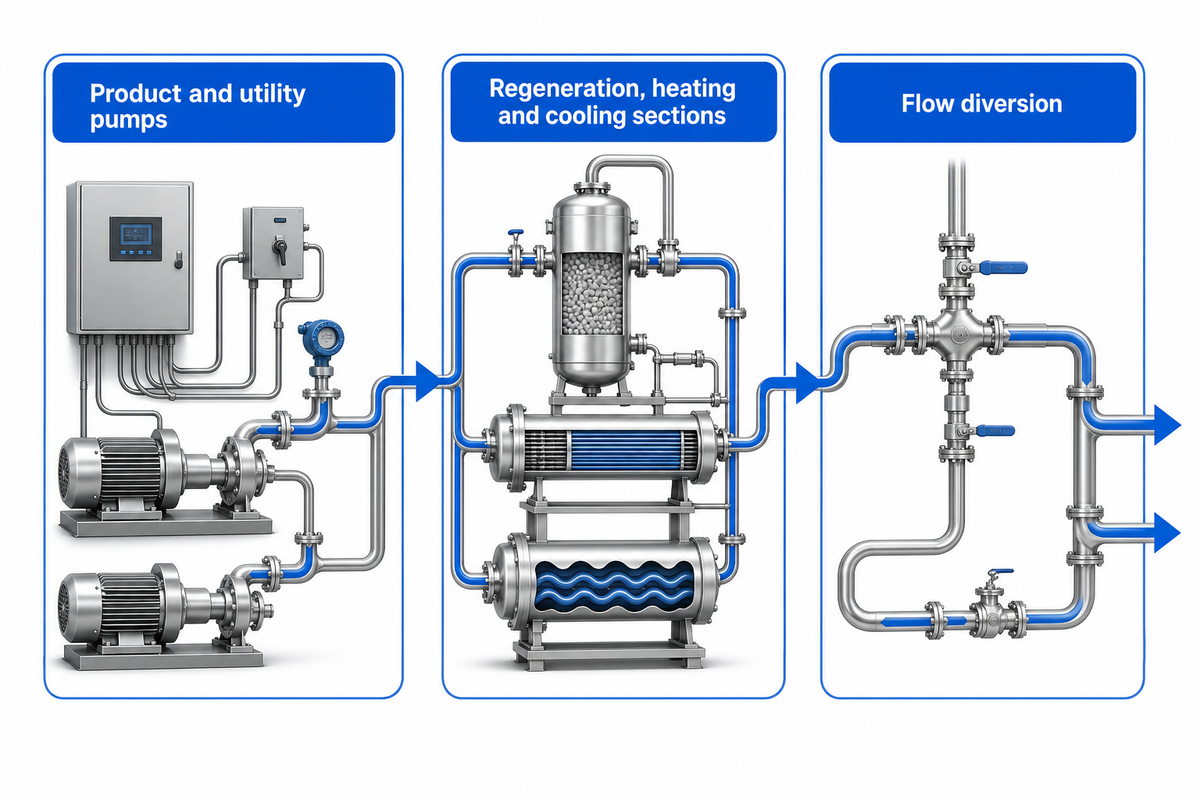
A plate pasteurization system normally combines several functions. Incoming product is pumped into the plate heat exchanger. In a regeneration section, hotter outgoing product transfers heat to colder incoming product across stainless-steel plates, while separate channels keep the streams apart. External heating then raises the product to its validated condition. From there, product travels through a holding path, reaches the forward-flow or diversion decision, gives heat back in regeneration and is cooled for the next protected step.
Regeneration can reduce the external heating and cooling load, but a fixed energy-saving percentage cannot be assumed. Actual recovery depends on temperatures, flows, plate arrangement, fouling, utilities and process design. The useful operating question is whether recovery behavior remains consistent under comparable conditions—not whether the nameplate contains an impressive percentage.
Several components make the plate heat exchanger a pasteurizer:
- Product and utility pumps establish the intended flow through the correct path.
- Regeneration, heating and cooling sections manage heat exchange while keeping streams separated.
- A verified holding path supports the required residence time at the controlled flow.
- Temperature, flow and pressure instruments provide the measurements used by the control and verification program.
- Flow diversion prevents forward flow when the approved condition is not met.
- Recorders, alarms and batch records preserve the product story for release or disposition.
This is why changing one item can affect several others. Increasing flow may change holding time and pressure drop. Different viscosity or solids can alter hydraulic behavior and heat transfer. Valve repair can affect line-up and interlock verification. Freshly cleaned plates may establish a different baseline from a unit near the end of its run.
Follow the Product—and the Evidence—Through One Pass
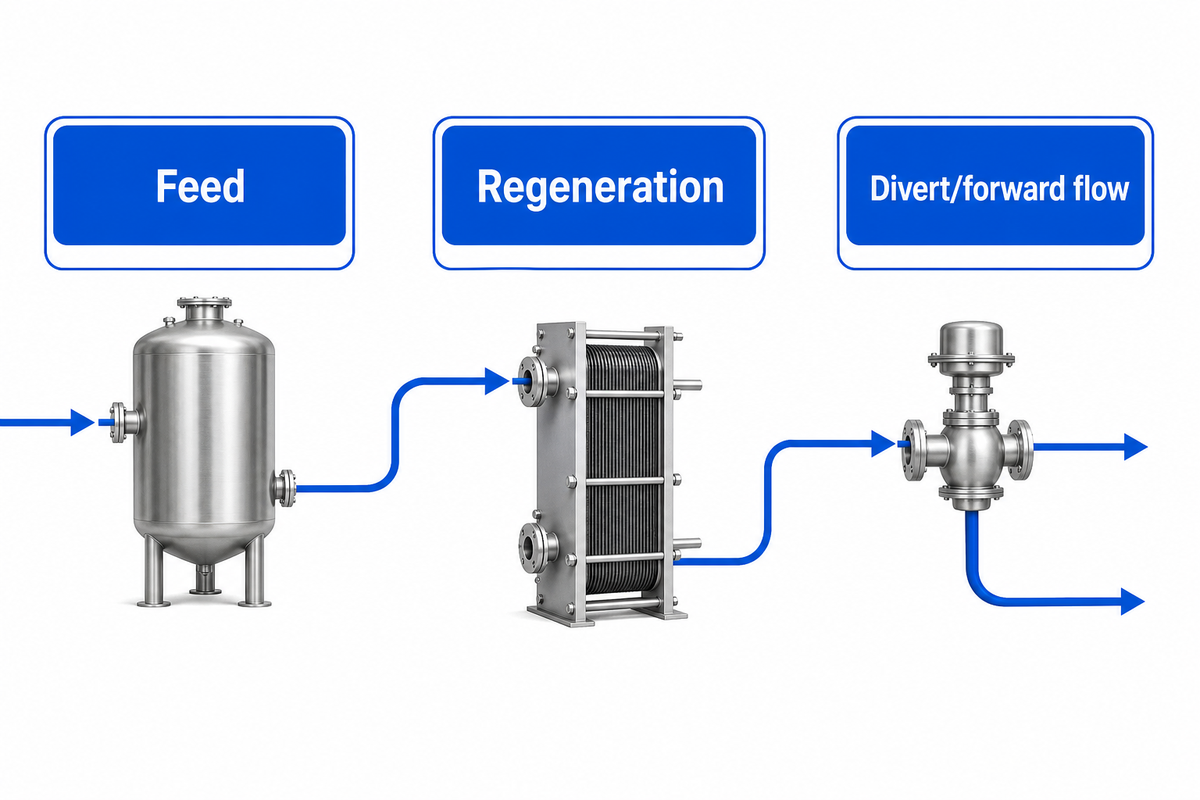
Follow both the liquid and its evidence to understand how a plate pasteurizer works.
| Stage | What happens | What the team must know |
|---|---|---|
| Feed | The approved product enters the correct circuit. | Identity, lot, physical condition, line clearance and upstream status. |
| Regeneration | Outgoing hot product preheats incoming cold product across separated plate channels. | Flow path, pressure relationship, integrity and expected recovery temperatures. |
| Final heating | A utility circuit supplies the remaining heat. | Validated measurement point, sensor status and control response. |
| Holding | Product remains in the verified path for the required residence time. | Flow limit, holding-path configuration and factors that could shorten residence time. |
| Divert/forward flow | The system routes product according to the monitored approved condition. | Valve state, interlock status, alarm time and affected-product boundary. |
| Recovery and cooling | Forward-flow product gives up heat and reaches the downstream target. | Protected downstream path, cooling performance and records through the complete transition. |
Official dairy HTST guidance from the Canadian Food Inspection Agency treats the flow schematic, cross-connections, time-temperature-pressure relationships, diversion logic, equipment tests and records as connected review items.[1] That does not make the Canadian requirements universal. It does show why a process review that starts and ends with one temperature chart is incomplete.
The Operating Evidence Chain
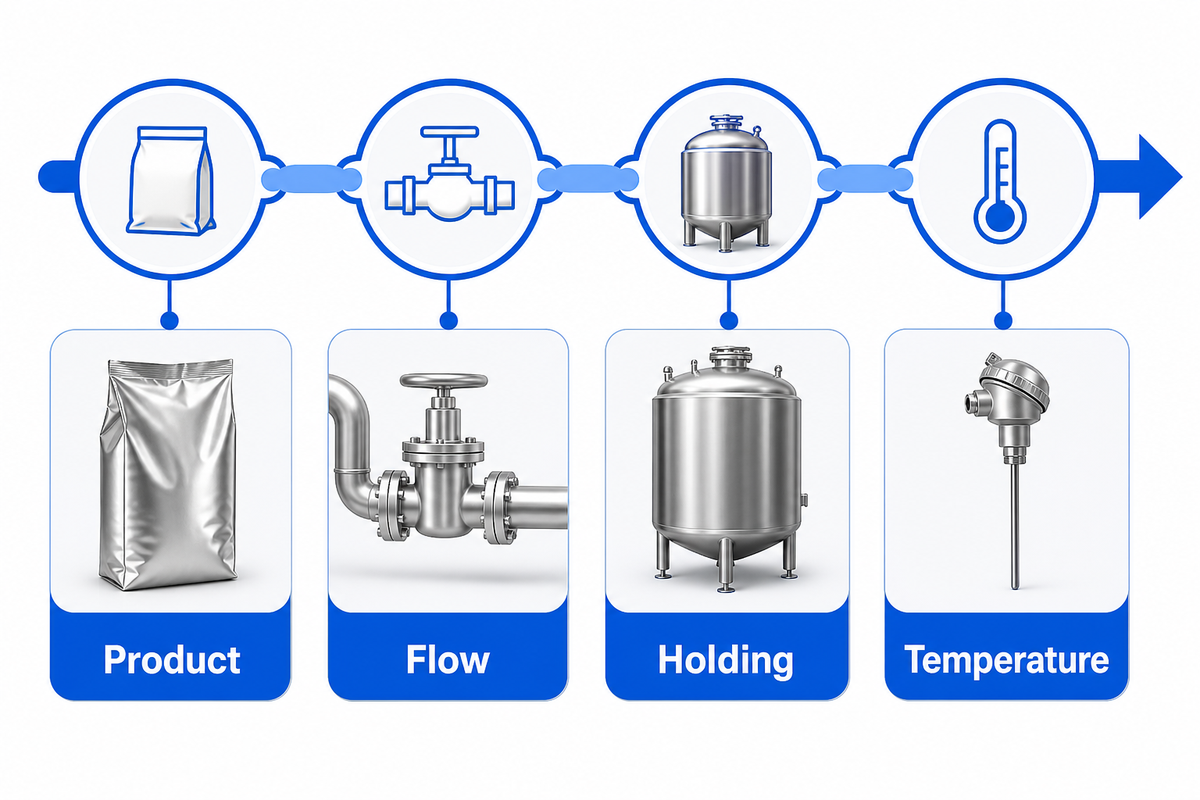
Use this worksheet as a planning aid for commissioning, daily verification and deviation review. It is not a substitute for a validated food-safety plan, a process authority or the applicable regulator.
| Evidence category | Question to close | Example evidence | Primary owner |
|---|---|---|---|
| Product | Is this the approved product in the approved condition? | Lot, recipe, feed temperature, screening/filtration status, physical check. | Production + QA |
| Flow | Was the validated maximum flow respected? | Flow record, pump state, timing check or approved flow-control evidence. | Operator + engineering |
| Holding | Was the verified holding path available and unchanged? | Holding-tube configuration, seal/connection status, commissioning test reference. | Engineering + maintenance |
| Temperature | Did the legal/validated measurement remain acceptable? | Recorder trend, indicating thermometer check, calibration/verification status. | Operator + QA |
| Pressure & integrity | Were separated streams protected as required? | Differential trend, valve/pump state, plate-integrity test, maintenance record. | Maintenance + QA |
| Diversion | Did the system divert whenever forward-flow conditions were not met? | Valve position, cut-in/cut-out test, interlock status, alarm log. | Operator + controls |
| Utilities | Were heating, cooling and control utilities stable through the run? | Supply and return trends, pressure or flow status, utility alarms and interruption log. | Engineering + operator |
| Verification status | Were required instrument, valve and interlock checks current? | Calibration status, scheduled test records, overdue-item review and approved exception. | QA + maintenance |
| Disposition | Can QA identify and decide the status of all affected product? | Time window, lot boundary, isolation, investigation, corrective action and release/rework/disposal decision. | QA |
Designed-in redundancy makes the chain useful. Flow evidence supports the holding-time conclusion. Pressure and integrity records support product-path protection, while diversion records establish the affected-product boundary. A missing link does not automatically mean unsafe product, but it can leave the team without enough evidence for routine release.
Fouling Does Not Announce Itself with One Number
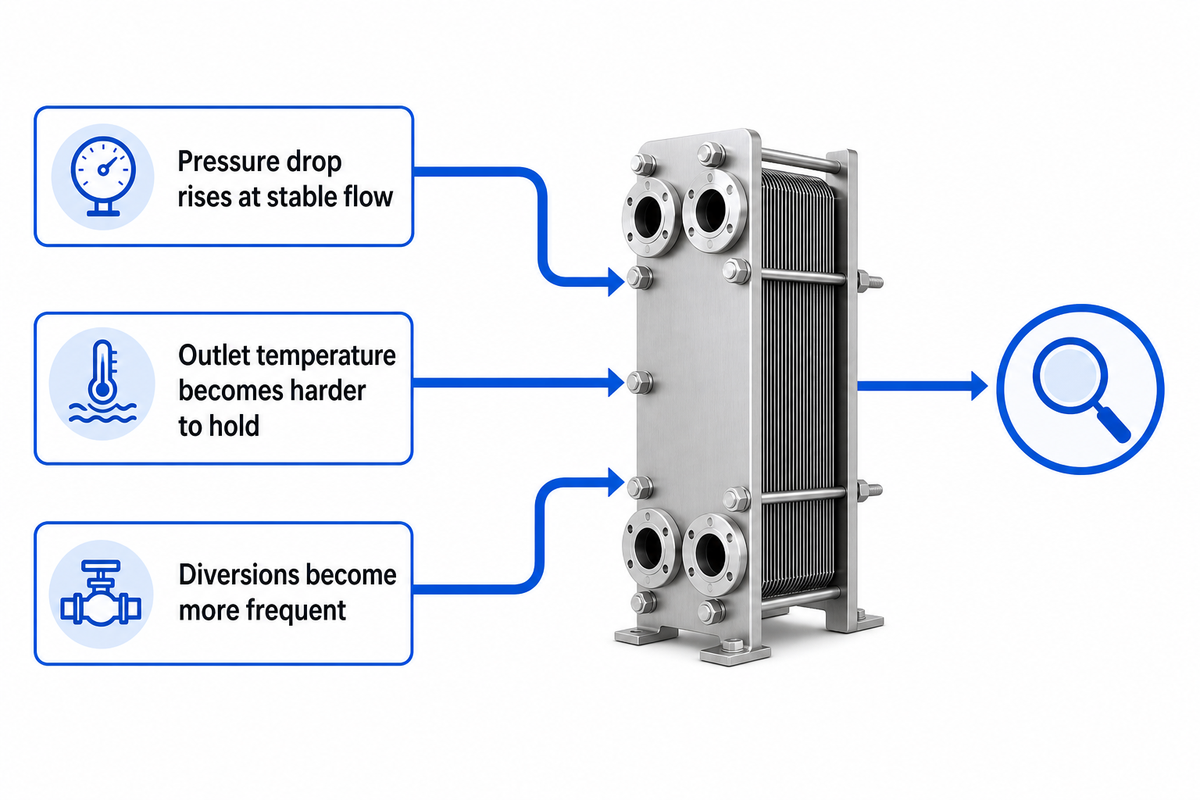
Food soils develop according to product composition, surface temperature, residence time, flow conditions and equipment geometry. Dairy fouling can include protein and mineral deposits; juice soils can be driven by different combinations of pulp, pectin, sugars, minerals and heat history. Trends learned on one product may not carry to the next recipe.
A peer-reviewed review of fouling measurement in dairy thermal processing describes two useful effects: deposits add resistance to heat transfer, and narrowing flow passages can raise pressure drop.[2] These effects give the team signals, not a diagnosis. A rising pressure differential can also reflect a flow change, a valve restriction, an instrument problem or a product change. Temperature instability can come from utilities, control tuning, sensor response or pump behavior.
Therefore, compare several signals at similar product, flow and utility conditions. Establish a clean-system baseline after verified cleaning and maintenance. Then trend the run rather than waiting for one alarm.
| Observed trend | Possible contributors | Corroborating checks | Decision owner |
|---|---|---|---|
| Pressure drop rises at stable flow | Deposit growth, channel restriction, valve position, product viscosity change. | Confirm flow and instruments; compare product/recipe; check section-level pressures if available. | Operator + maintenance |
| Outlet temperature becomes harder to hold | Reduced heat transfer, utility drift, sensor/control issue, changed feed condition. | Utility supply/return, feed temperature, valve output, sensor comparison, recovery temperatures. | Engineering + operator |
| Recovery temperatures drift | Fouling, flow imbalance, changed product properties, bypass/leakage concern. | Mass-flow balance, pressure relationship, plate-integrity evidence and section temperatures. | Engineering + QA |
| Flow or control output becomes unstable | Restriction, pump/cavitation issue, air, valve hunting, supply variability. | Pump suction, tank level, valve trace, air source, flowmeter health. | Maintenance + operator |
| Diversions become more frequent | Thermal margin loss, process variability, control or utility issue. | Overlay temperature, flow, utility and valve records; identify common lead signal. | Production + QA |
| Trend changes after a recipe switch | Different viscosity, solids, acidity, feed temperature or soil behavior. | Separate product baselines; review validated process and cleaning changeover assumptions. | Process engineering + QA |
How to use the matrix: define the baseline conditions, sampling interval, responsible reviewer and escalation path before the run. Plant-specific warning and stop limits should come from validated operating history, equipment capability, process authority input and the food-safety program. No universal pressure-drop or run-hour trigger appears in the table.
CIP Must Remove the Actual Soil—and Leave Evidence
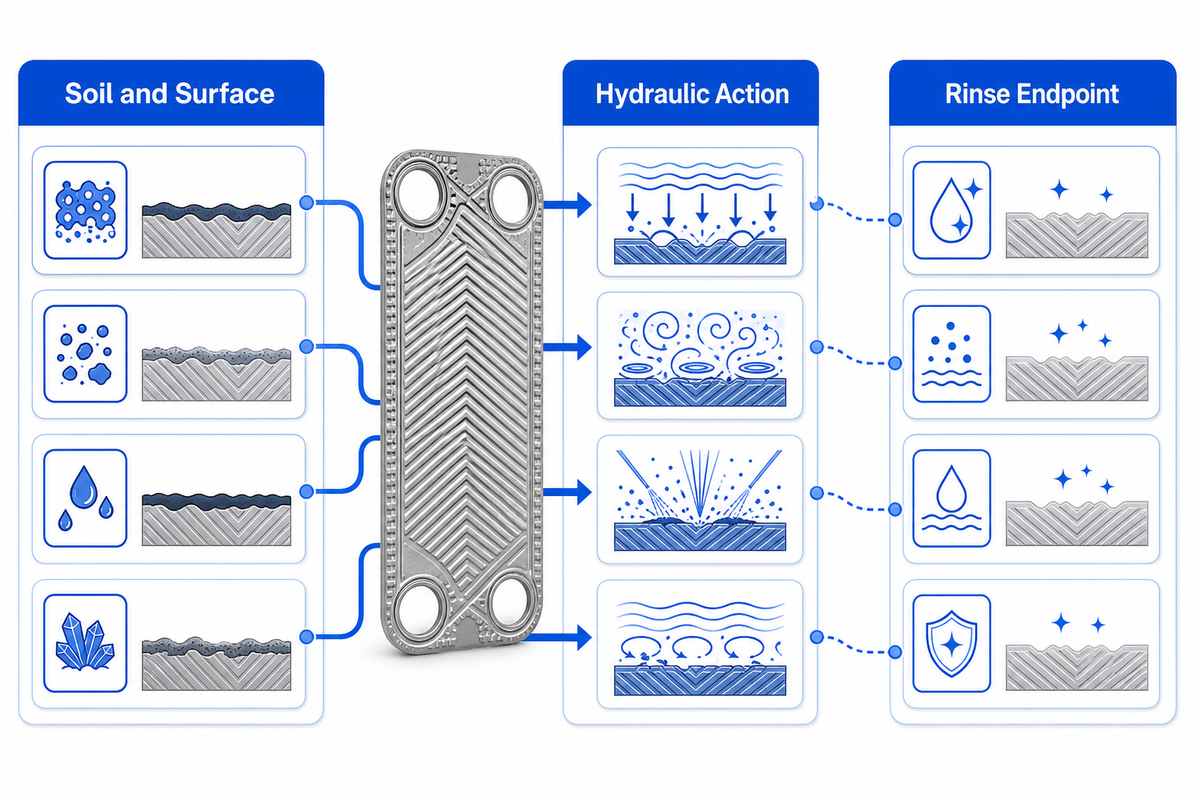
Cleaning in place is a controlled process, not a button label. Its effectiveness depends on the soil, surface, hydraulic action, chemistry, temperature, time, sequence, drainability and rinse endpoint. One product’s validated recipe and run length may not suit another. Chemical suppliers, equipment manufacturers, sanitation specialists and the plant’s food-safety team should define the actual program.
Records should show whether the approved cycle ran as intended. Depending on the plant and risk, verification may also use inspection, conductivity or concentration records, return temperature, flow/turbulence evidence, rinse criteria, plate-integrity tests, ATP, microbiological methods or scheduled disassembly. No single method proves everything. ATP can indicate residual organic material under an established method; it does not replace microbiological verification or validate the pasteurization process.
A controlled 17-hour milk pasteurization study sampled different plate-heat-exchanger sections and used microbial and ATP methods to compare biofouling and cleaning outcomes on two surfaces.[3] The study is useful because it looked at section-specific long-run evidence. It does not create a universal 17-hour run limit, an ATP pass value or a surface choice for every plant.
Cleaning also changes the operating baseline. If the next startup shows an unexpectedly high pressure drop or different recovery temperatures, the team should not simply assume “the plates are clean.” It should check valve line-up, flow, air removal, gasket/plate condition, instrument status and whether the CIP sequence actually reached the intended circuit.
The CIP Restart Evidence Pack
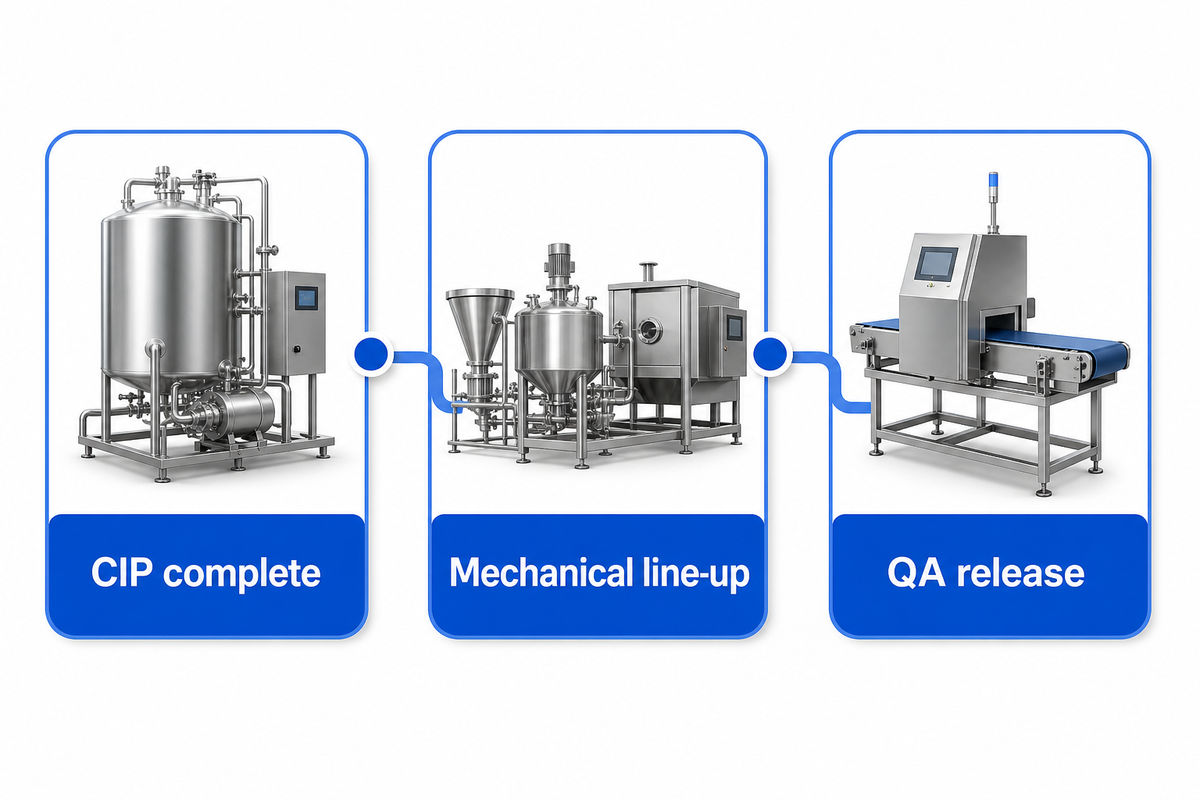
Finishing CIP and releasing product to forward flow are two different decisions. Cycle completion closes the sanitation step; restart approval confirms that the complete pasteurization system is ready to operate under the approved process.
| Release block | Evidence to attach | Verified by | Open exception / decision |
|---|---|---|---|
| 1. CIP complete | Cycle ID; time/action; chemical condition; temperature; rinse/endpoint; deviation status. | Sanitation / operator | Accept, investigate or repeat according to program. |
| 2. Mechanical line-up | Plate pack, gaskets, drains, connections, valves and correct process path ready. | Maintenance + operator | Identify leak, wrong line-up or incomplete circuit. |
| 3. Control readiness | Instrument status; recorder; alarms; diversion function; interlocks; required verification current. | Controls / QA | No forward release while a required protective function is unresolved. |
| 4. Stable startup | Approved startup sequence; flow, pressure, temperature and recovery trends stable; product transition controlled. | Production | Define diverted/rework product and the exact forward-flow start time. |
| 5. QA release | Lot boundary, open deviations, verification evidence IDs and record continuity. | QA | Release, hold, reprocess or reject under the approved disposition process. |
Make the evidence pack part of the real startup record, not a poster beside the machine. Each field needs an identifier, timestamp and owner. If an exception is permitted by the validated program, record who accepted it, why and what additional control applies.
Milk and Juice Need Different Validation Questions
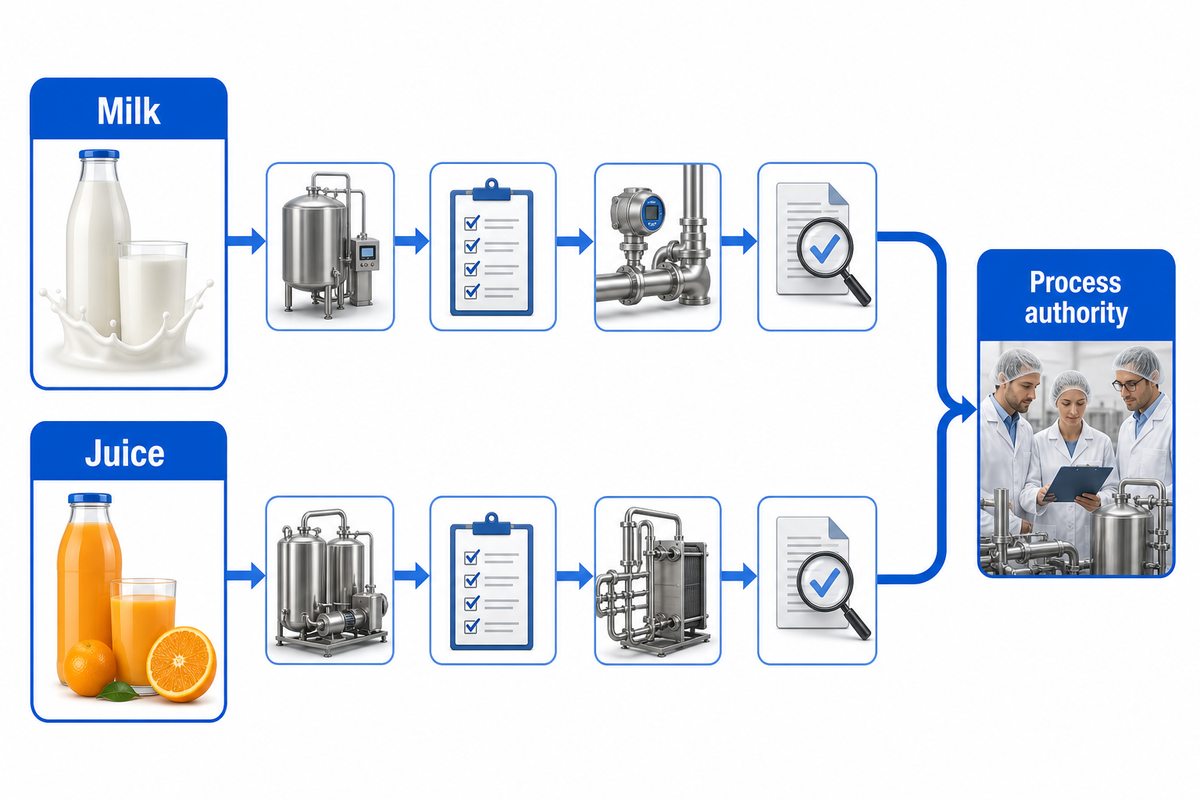
Pasteurization is a controlled heat treatment, with validated conditions set by the product, target hazard or quality objective, equipment and governing requirements. Copying a familiar dairy HTST number into juice—or assuming a juice process suits milk—skips those product-specific questions.
Milk rules illustrate the importance of the complete system. The U.S. Grade “A” Pasteurized Milk Ordinance and CFIA dairy guidance contain detailed provisions for temperature-time relationships, holding, flow diversion, pressure relationships, tests and records.[1][4] Those documents apply within named dairy programs. Plants must use the requirements and approvals that govern their product and location.
For covered U.S. juice processors, 21 CFR 120.24 requires control measures that consistently achieve at least a 5-log reduction of the pertinent microorganism for the relevant juice, within the rule’s scope.[5] Notice the phrase pertinent microorganism for the relevant juice: validation applies to the actual product and hazard. Acidity, soluble solids, pulp or particles, viscosity, heat sensitivity and flow behavior can change the technical question.
A process authority can determine the appropriate scientific basis and critical factors. The equipment supplier can then work from that approved basis to define heat-transfer area, holding arrangement, controls, recording and cleanability. Keeping those responsibilities clear protects both the process and the project schedule.
When the Process Diverts, Build a Product Story
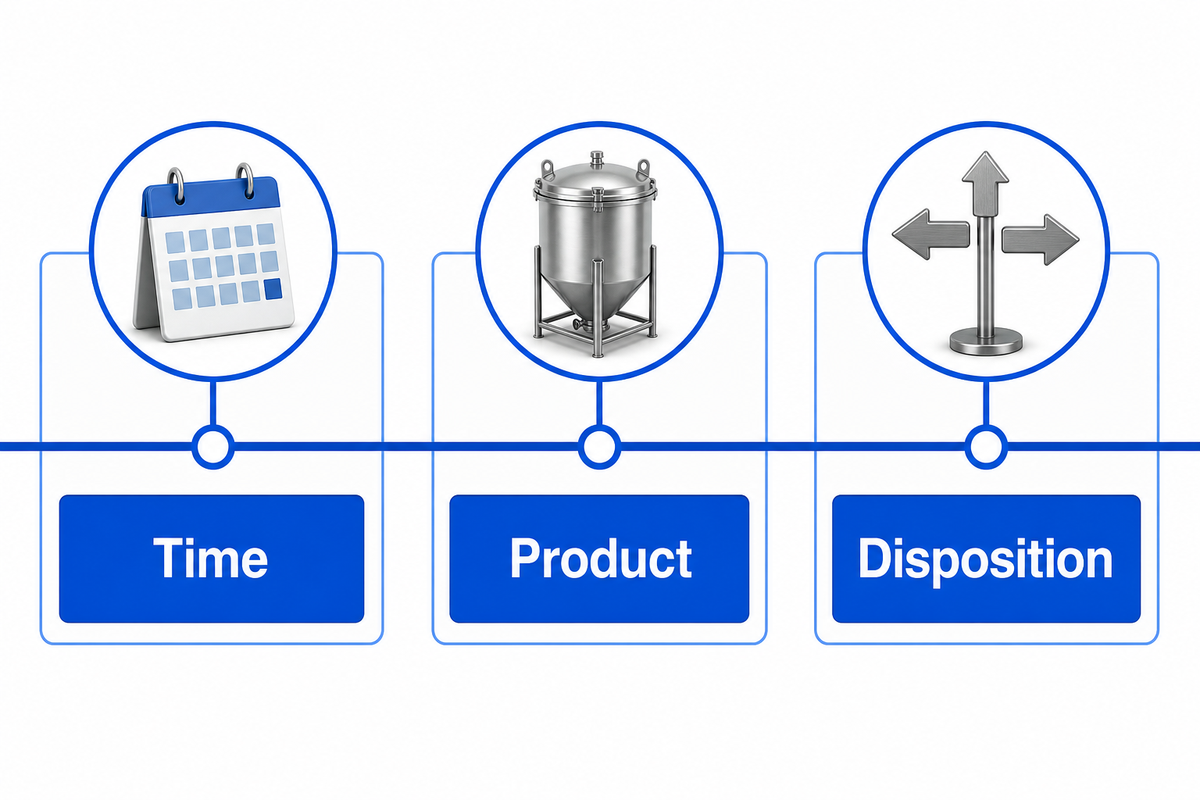
A diversion is a protective action, not a complete investigation. The team still needs to identify what happened, which product could be affected, why the condition occurred and what evidence supports restart.
Deviation Evidence Card
- Time: first abnormal signal, diversion time, last known acceptable point and recovery time.
- Product: recipe, lot, source tank, destination, quantity window and physical condition.
- Path: actual valve route, forward/divert status and how affected product was isolated.
- Evidence: temperature, flow, pressure, utility, instrument, alarm and maintenance records.
- Cause and action: confirmed cause versus hypothesis, immediate correction and preventive follow-up.
- Restart: tests/verification completed, stable condition demonstrated and person authorizing forward flow.
- Disposition: QA decision for every affected lot or time window, with traceable record IDs.
Start the card before troubleshooting changes the system. If a technician resets an alarm, swaps a sensor or changes a valve position before the timeline and product boundary are captured, valuable evidence can disappear. Besides preserving the timeline, the card keeps an engineering fix separate from the QA disposition decision.
How to Read Plate Pasteurizer Specification Language
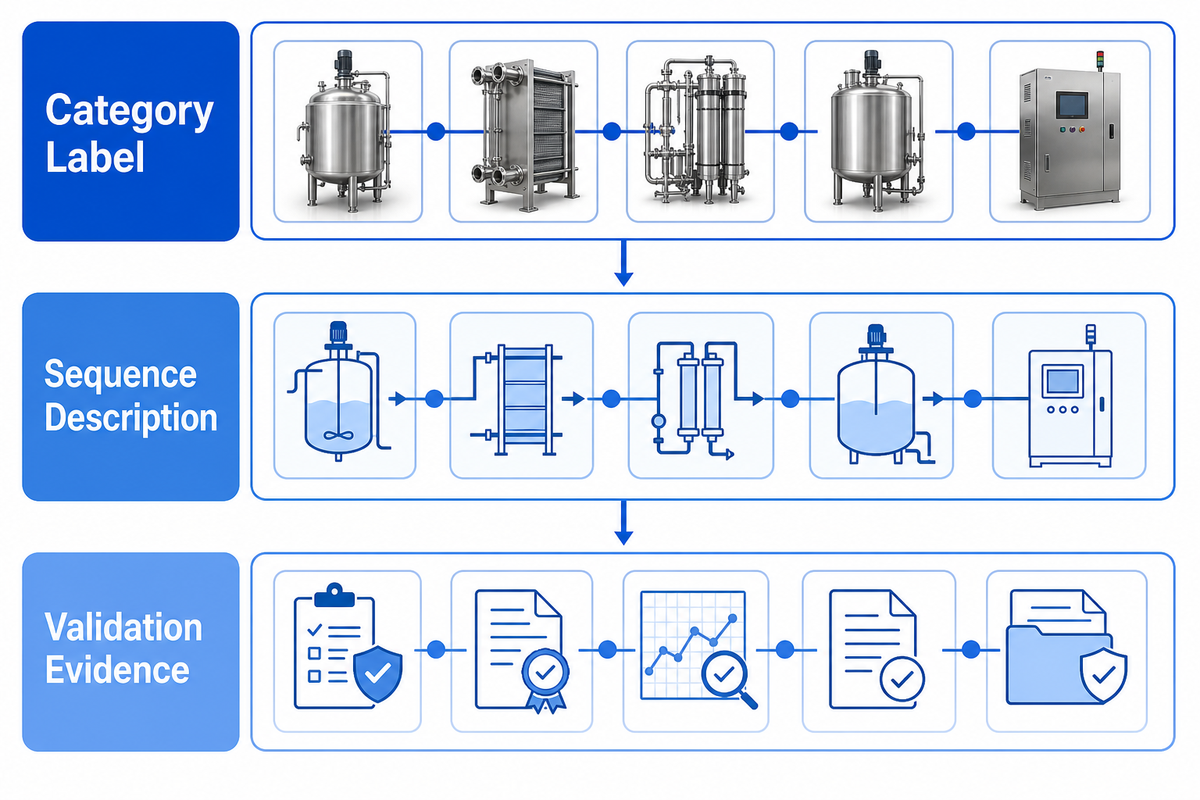
Supplier documents often mix process terms, equipment labels and outcome claims. Read each phrase according to what it can actually prove. A plate pasteurizer for milk, a plate-type pasteurizer, a sterilizer and generic pasteurization equipment are category labels, not validation evidence. In the dairy industry, a system used for raw milk, fresh milk or other dairy products may be part of producing pasteurized milk, yet the model name alone says nothing about the approved process for milk and other dairy products.
Fruit juice creates a different specification problem. Juice processing can involve a low-viscosity clarified liquid, suspended fruit pulp or a product that changes with soluble solids and acidity. Terms such as fruit juice pasteurizer or food and beverage production line should therefore lead to questions about the type of liquid, product type and real flow behavior. They should not be treated as proof that one heat exchange system fits every liquid food.
Continuous pasteurization usually describes a connected pipeline with a preheating section, heating section, heating plates or another heat-transfer surface, a verified holding path and a cooling section. Product may be rapidly heated toward the desired temperature, target temperature or specific temperature, then rapidly cooled toward a lower temperature. Those phrases describe sequence. They do not establish the right temperature, pasteurization temperature, sterilization temperature or validated temperature and time for a particular product.
Safety wording needs equal care. Marketing phrases such as “kill bacteria,” “kill harmful bacteria,” “kill the microorganisms” or “sterilization effect” can collapse several different scientific and legal questions into one promise. Pasteurizing a product under a validated process can support product safety and may help extend shelf life, but neither the sterilization process nor a claimed sterilization time should be inferred from a brochure. Shelf life and nutritional value still depend on the complete product, process, package and storage chain.
Controls also need evidence. Automatic control, temperature control and precise temperature control are useful only when the sensors, logic, diversion response, records and verification program are defined. Likewise, heat recovery, high heat recovery and energy efficiency must be measured at relevant production scale and operating conditions. Vague phrases such as “advanced heat exchange technology” or “significantly reducing energy consumption” do not establish operational costs or a guaranteed saving.
Finally, confirm the interfaces around the pasteurization system. A homogenizer, balance tank, product pump, CIP cleaning circuit, downstream filler and the wider production line can all change pressure, flow, cleanability or record boundaries. Whether the project is small-batch or high-volume, the control system should be reviewed as part of the validated process rather than as an isolated automation feature.
Move from Operating Questions to a Plate Pasteurizer Project
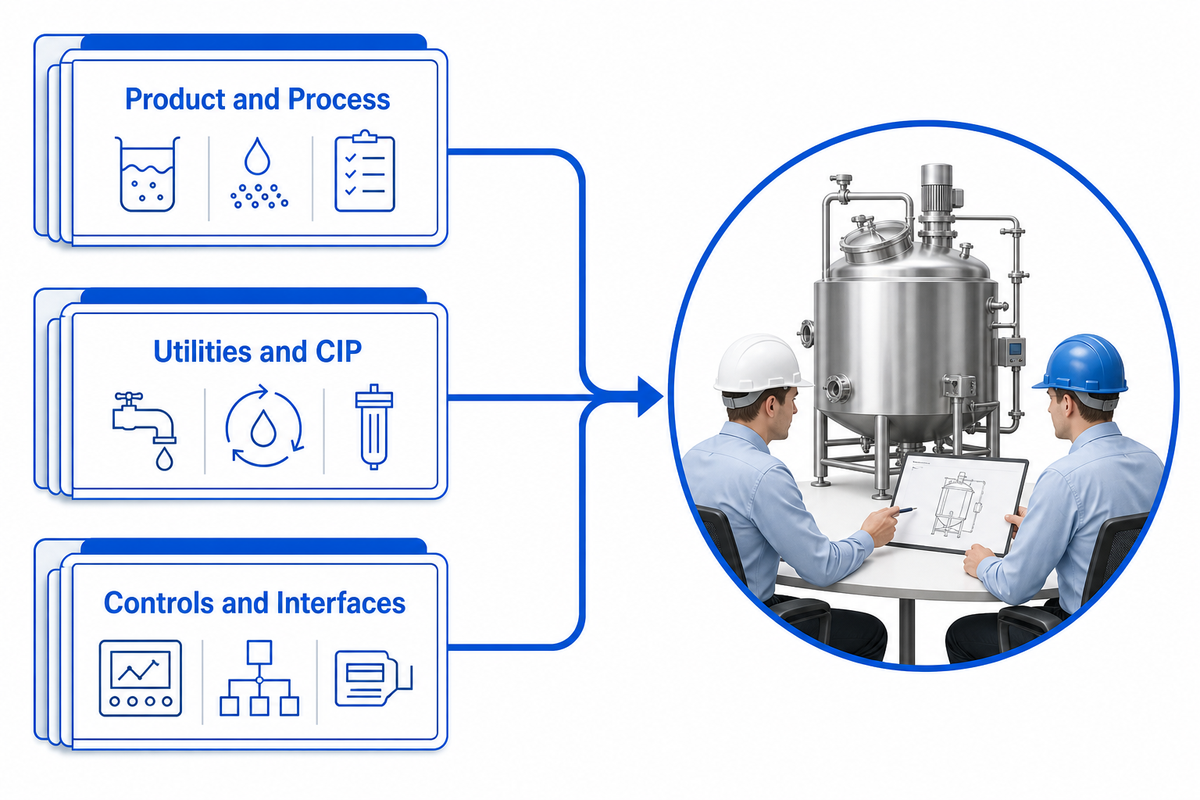
Once the team understands the operating evidence it needs, equipment discussions become more precise. Prepare these inputs before requesting a proposal:
- product families, recipes and physical behavior, including viscosity, pulp/particles, acidity and heat sensitivity;
- the validated process basis, critical factors, governing market and process-authority requirements;
- required production flow and capacity scenarios, including changeovers and planned run length;
- available heating, cooling, electrical, water and compressed-air utilities;
- CIP philosophy, soil differences, cleaning circuit limits and restart verification;
- automation, alarm, data-recording, diversion and traceability expectations; and
- factory layout, upstream/downstream interfaces and responsibility boundaries.
That package belongs in a commercial equipment discussion, not in a generic blog sizing table. SHENGTU describes its work as taking food producers from requirements through engineered, export-ready production-line solutions from its base in Zhucheng, Shandong. See the company’s About SHENGTU page for its first-party background and service footprint.
Have a validated process target and real plant inputs?
Bring the product, flow, utility, cleaning and control requirements together before discussing hardware. SHENGTU can then review the plate path as a complete production system.
Frequently Asked Questions
How does a plate pasteurizer work?
It passes liquid food through separated channels in a plate heat exchanger. Regeneration preheats incoming product, final heating brings it to the validated condition, a verified path provides holding time, a diversion function protects forward flow, and regeneration/cooling lower the temperature. Flow, pressure, instruments, valves and records are part of the process.
What is heat regeneration?
Regeneration transfers heat from outgoing pasteurized product to colder incoming product across separated plates. Measure the actual recovery under defined operating conditions rather than assuming a fixed percentage.
Why can pressure drop increase during a run?
Fouling can restrict passages and increase pressure drop, but it is not the only cause. Flow, viscosity, valve position, pump condition and instrument health also matter. Compare the trend with product, flow, temperature and utility data before deciding on the cause.
When should a plate pasteurizer be cleaned?
Use validated, product-specific limits based on food-safety requirements, operating history, heat-transfer and hydraulic trends, production schedule and sanitation verification. Generic run-hour or pressure-drop numbers do not transfer reliably across products and machines.
Does completing CIP mean the line is ready to restart?
Not by itself. The restart decision may also require correct mechanical line-up, current instrument and protective-function status, stable startup conditions, a defined product transition and QA confirmation that records and deviations are closed.
Can milk and juice use the same pasteurization settings?
Do not assume so. Milk and juice can differ in target hazards, acidity, soluble solids, pulp or particles, viscosity, heat sensitivity and flow behavior. Those differences affect the scientific basis, critical factors, cleanability and equipment fit. A process authority should establish the product-specific validated process, while the plant applies the requirements of its actual market and regulator.
What should happen if the required condition is not met?
Under the validated design, the protective system should prevent unacceptable forward flow. Operators and QA must then identify the affected product, preserve the records, investigate and correct the cause, verify restart conditions and document the disposition decision.
How is pasteurization different from UHT sterilization?
Pasteurization and UHT use different process objectives, time-temperature combinations, downstream protection and packaging assumptions. “Sterilization” should not be used casually as a synonym for every pasteurization process. Product shelf life depends on the validated process and the complete hygienic chain, not only the heater.
References & Sources
- Canadian Food Inspection Agency. HTST pasteurization systems.
- Kuruppu et al. Approaches for Measuring and Predicting Fouling During Thermal Processing of Dairy Solutions.
- Jindal et al. Comparison of biofilm development on plate heat exchangers during a 17-hour milk pasteurization run.
- U.S. Food and Drug Administration / National Conference on Interstate Milk Shipments. 2023 Grade “A” Pasteurized Milk Ordinance.
- Electronic Code of Federal Regulations. 21 CFR 120.24 — Process controls for juice.
- U.S. Food and Drug Administration. Juice HACCP Hazards and Controls Guidance, First Edition (March 2004).
Scope: This article is an educational planning guide. Applicable limits, validation, sanitation release and product disposition must be defined by the processor’s qualified team, process authority and regulator for the actual product and plant.
![Beef/Lamb/Poultry Cutting Line Acceptance Guide [2026]](https://shengtumachinery.com/wp-content/uploads/2026/09/beef-lamb-poultry-cutting-line-guide-featured-150x150.png)
![Dry Kibble Extrusion Line: Process Control Guide [2026]](https://shengtumachinery.com/wp-content/uploads/2026/08/dry-kibble-extrusion-line-guide-featured-150x150.png)