Get in touch with Shengtu Bufan Company

How to Evaluate a Leafy Fresh-Cut Process Before You Request a Solution

Technical education guide · Leafy fresh-cut processing
A Leafy Fresh-Cut Line is not one fixed machine configuration in this guide; it is the connected material-and-record path a team needs to examine before seeking a project-specific solution.
For a leafy fresh-cut project, clarity almost never comes from a capacity figure or a list of stations. Teams get further when they can describe the leaves coming in, each handoff they pass through, the evidence held by each party, and the questions that are still unanswered. This guide helps operations, quality, procurement, and technical teams prepare that shared record. It isn’t a line specification, a site food-safety plan, legal advice, or a quotation.
Shandong Shengtu Bufan Intelligent Technology prepared this as an educational resource for teams getting ready for a solution conversation. The focus stays deliberately on process evidence. It doesn’t recommend a configuration, state a throughput, quote a price, or promise a shelf-life.
1. What This Leafy Fresh-Cut Guide Covers, and What It Does Not
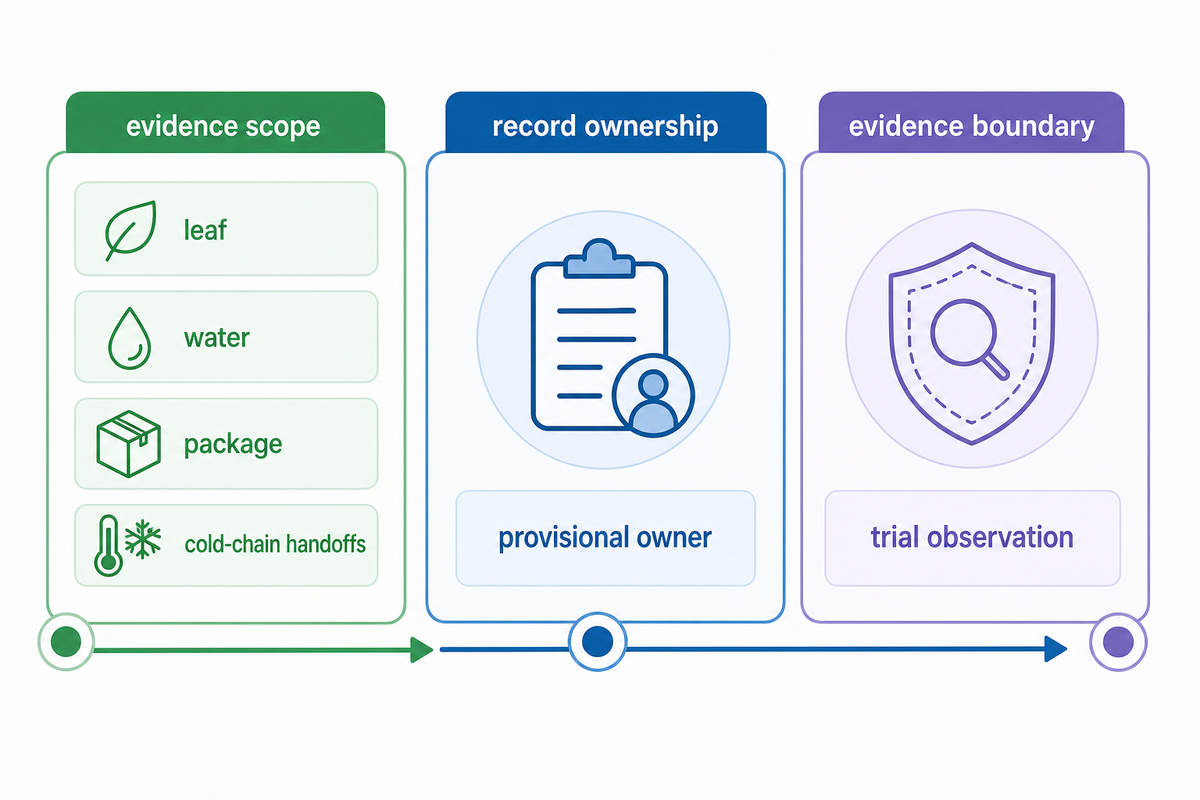
This guide and the commercial solution page have separate roles. A solution discussion responds to a defined project brief; this article helps a team build that brief by bringing assumptions into the open before anyone is asked to solve them. That distinction matters when the topic already has a commercial page. Its educational role is to support the next conversation, not compete with the page by repeating product details. For a scope reference, use the FDA official page on fresh-cut guidance because its stated scope does not validate a particular equipment configuration or site decision.
| This guide helps the team do | A project-specific solution discussion may address | This guide does not conclude |
|---|---|---|
| Identify leaf, water, package, and cold-chain handoffs that need evidence | Review the project brief, physical interfaces, and functions requested | Which equipment configuration is suitable |
| Assign a provisional owner to each record or unanswered question | Clarify the information needed for engineering or commercial review | Who is legally responsible in a particular jurisdiction |
| Separate a trial observation from an assumed production result | Discuss project-specific acceptance questions | Capacity, yield, cost, safety, or shelf-life performance |
Keep that boundary practical. For a supplier demonstration used as evidence, write down the product basis, the observation window, and the person who decides whether it is enough for the site. Where an upstream fact is missing, say so. A processor’s copy of a record should not quietly become a claim of complete supply-chain traceability.
Teams may use “leafy fresh cut line” or “leafy fresh-cut line” as shorthand. At a factory review, the buyer should keep each risk and evidence gap in the project record because a supplier’s answer is not, by itself, a complete site decision.
2. Start With the Leaves: Document Incoming Variability
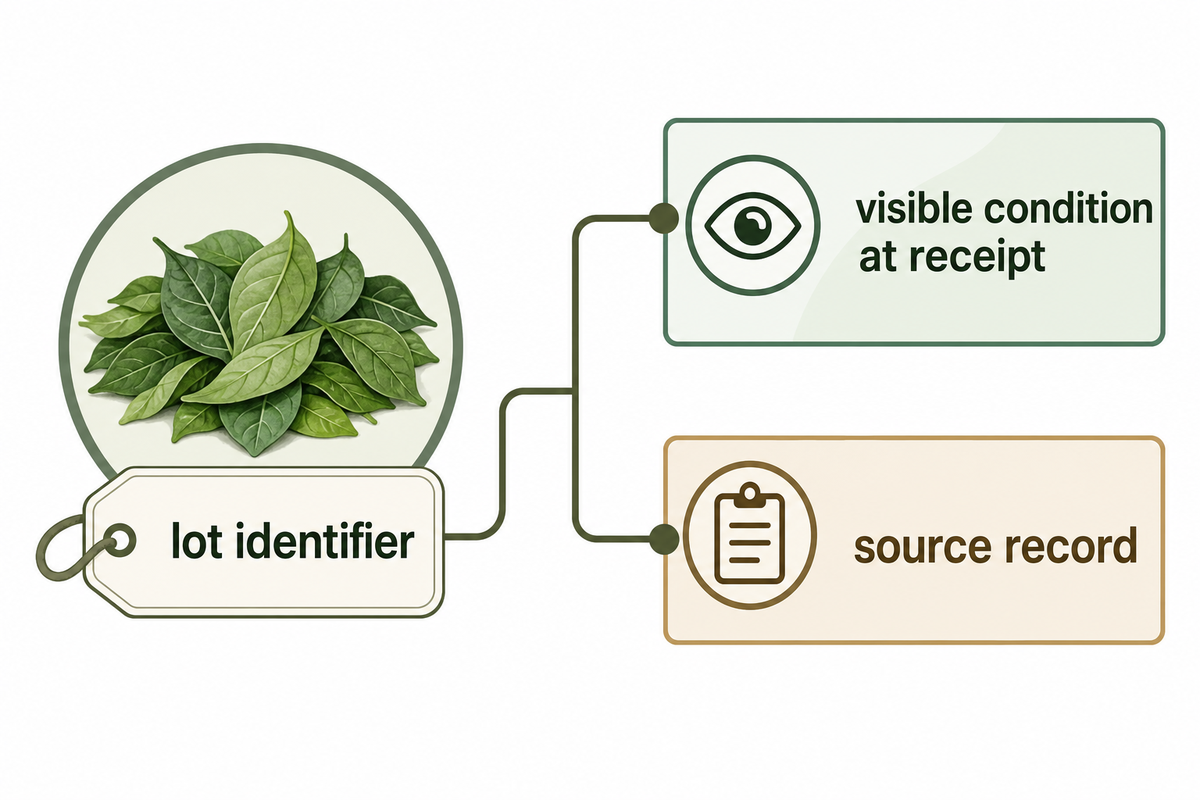
Fresh-cut leafy material does not arrive as one perfectly standardized input. Gil’s review identifies genotype, growing conditions, maturity, and harvest time as factors associated with fresh-cut leafy quality. That is useful because it does not produce a transferable machine setting. It tells the buyer to retain the incoming context that may explain a difference later.
Start the intake record with a lot identifier and receiving window. Include the site’s material description, the visible condition at receipt, any handling or temperature history supplied with the lot, and the person who owns the source record. If material from several farms, fields, suppliers, or receiving lots has been mixed before the observation, document the commingling rather than giving the mixture a false single origin.
| Field | Why it belongs in the record | What not to turn it into |
|---|---|---|
| Lot and available origin linkage | Connects the observation to the material actually handled | A claim that all upstream traceability is complete |
| Visible condition and damage observation | Gives the next handoff a common starting description | A release decision, microbial result, or universal acceptance limit |
| Receiving and handling context | Shows what the receiving team knew at the time | A substitute for a supplier, farm, or cold-chain record not in hand |
| Record owner and file reference | Makes a later review possible | Proof that another party owns the same conclusion |
Plain language is enough. “Two labelled lots received in one staging window; origin linkage retained separately; visibly bruised leaves isolated for observation” says far more than “normal material.” The same discipline works for fresh-cut lettuce and for a salad mix. The aim is not to grade the leaves; it is to make the starting condition findable when a quality, moisture, or transfer question appears later.
At the factory receiving point, a buyer or quality lead can treat a missing origin record as a traceability risk rather than fill the gap with an assumption. Because the FDA guidance has stated boundaries, the receiving record should preserve what the site actually knows.
3. Map the Connected Handoffs Before You Change Anything
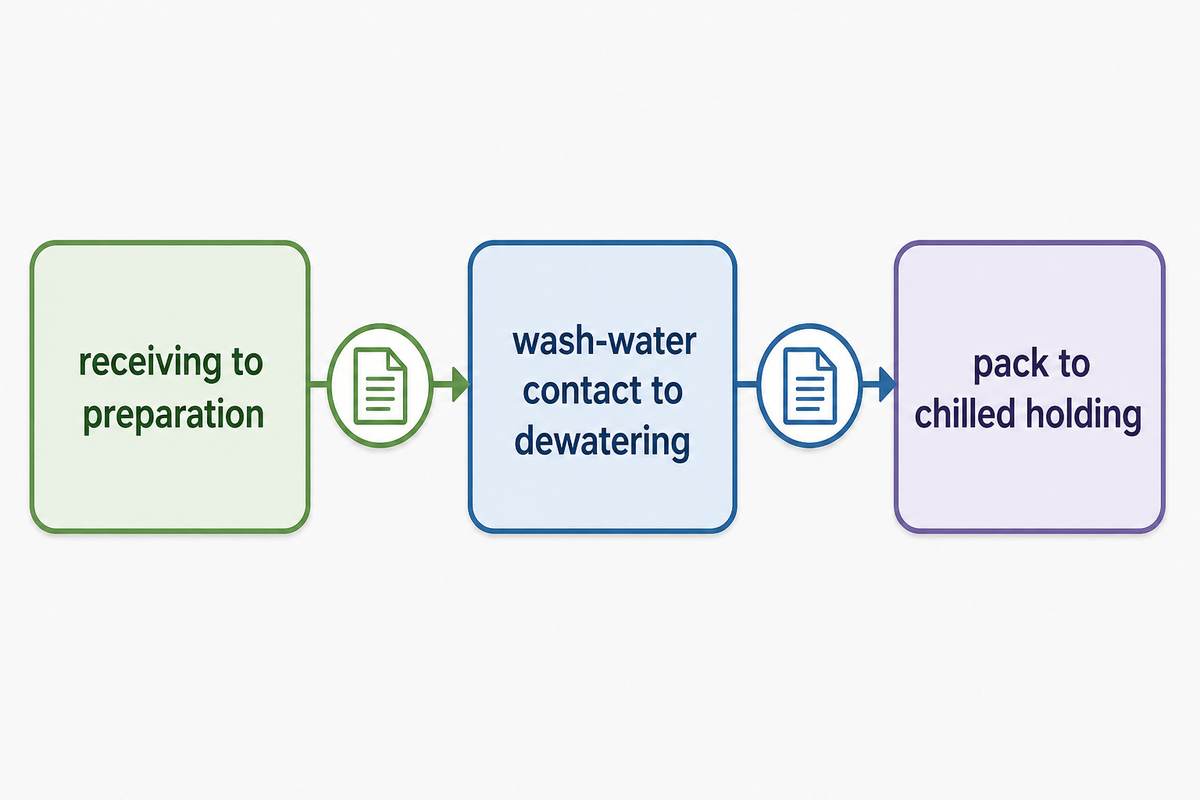
When an unwanted observation appears at one point, the natural reaction is to adjust the closest station. That can miss the interface that need attention. Start with a handoff map: receiving to preparation, preparation to wash, wash-water contact to dewatering, dewatering to a conveyor transfer or pack, pack to chilled holding, and chilled holding to the next owner. This isn’t a quotation flow diagram. It records where material and information change hands in a vegetable processing line.
Give wash water its own row. The wash stage is both a product handoff and a water-control interface. Record the water-related evidence the site expects, who’s responsible for validation or operational monitoring under its own system, the verification record retained, and the event that would trigger review. “The product was washed” can’t answer those questions.
| Interface | Evidence question | Named owner or follow-up |
|---|---|---|
| Incoming leaves → preparation | Can the observed material be tied to a lot and receiving condition? | Receiving/quality lead |
| Preparation → wash-water contact | Which site record defines the intended water-control evidence? | Site food-safety or quality lead |
| Wash → dewatering | What observation separates water carryover from a general visual impression? | Operations and quality observers |
| Dewatering → pack | Which package condition and observation time are recorded? | Packaging/quality lead |
| Pack → chilled handoff | What time-temperature record follows the pack to the next owner? | Cold-chain or distribution contact |
Leave unresolved items in view. “Farm record requested,” “package trial design pending,” and “distribution time-temperature data owner not yet named” are useful findings, not failures. They stop a local adjustment from being mistaken for evidence about the entire chain.
On a factory floor, the procurement contact and supplier can use the map to expose a handoff risk before a change is requested. Because an unnamed record owner leaves an evidence gap, the next production discussion should assign the follow-up rather than assume the interface is covered.
4. Food Safety Is a Control System, Not a Wash-Step Promise
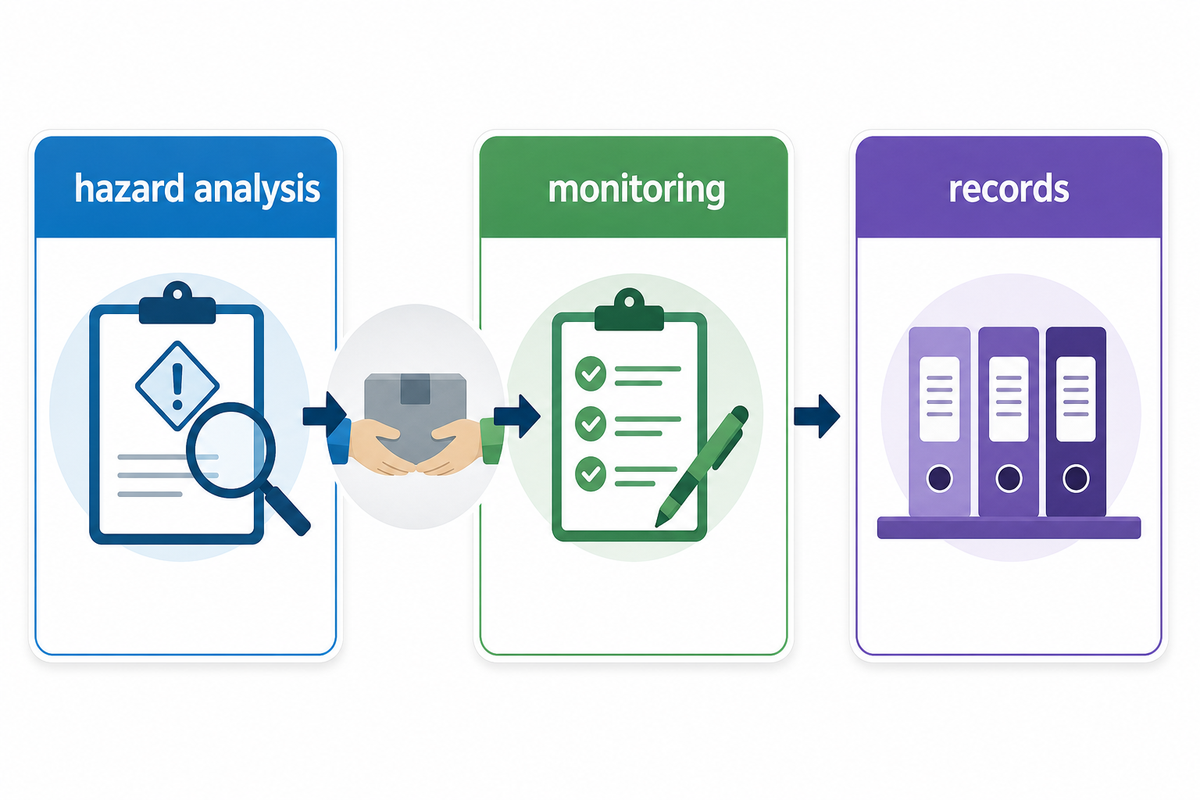
Can washing completely eliminate microorganisms from leafy vegetables? No responsible process brief should promise that. The connected-handoff map shows why this question requires more than a local answer. Within its stated U.S. scope, FDA’s fresh-cut produce guidance discusses hazard analysis, controls, validation, monitoring, corrective action, verification, and records. FDA also says the guidance is nonbinding and is not intended for farms. The practical takeaway is narrow but important: a wash step sits inside a documented control system, and the project team must identify the system that applies and the people who own its records.
Binding requirements may be relevant for a covered U.S. facility, while the answer may differ for another party, activity, or jurisdiction. Ask the responsible regulatory and food-safety team what applies; do not turn a general guidance statement into a universal legal duty. A supplier may describe agreed functions and share relevant technical information, but it cannot make the site’s validation, verification, implementation, or regulatory determination on the site’s behalf.
At a factory review, a buyer and site owner should make the control-record gap visible as a risk. Because FDA’s official guidance page is nonbinding, an independent validation or verification step remains the responsibility of the applicable party.
3-Layer Control Check: keep the intended control, its evidence, its stated limit, and its escalation owner together at each handoff.
Working rule: name the observation, keep the source record with its owner, and label an evidence gap before it turns into an operating assumption.
1. Control question
What is the intended product, water, sanitation, package, or temperature control at this interface?
What is the intended product, water, sanitation, package, or temperature control at this interface?
2. Evidence record
Which site-controlled document, observation, or data source is meant to show that the control was applied?
Which site-controlled document, observation, or data source is meant to show that the control was applied?
3. Verification limit
Who reviews the evidence, and what limitation prevents it from proving more than it shows?
Who reviews the evidence, and what limitation prevents it from proving more than it shows?
4. Escalation owner
Who decides whether an exception needs investigation, corrective action, re-validation, or another handoff?
Who decides whether an exception needs investigation, corrective action, re-validation, or another handoff?
Does washing completely eliminate microorganisms from leafy vegetables, and who owns each control record?
Use the question to build a record rather than to seek a yes-or-no assurance. Ask the site to identify its water-control evidence, the conditions under which it was established, its monitoring and verification records, and the people authorized to assess an exception. Separately identify what comes from a farm, supplier, receiver, packer, or distribution partner. That avoids presenting a processor’s downstream record as evidence for upstream activity it did not control.
5. Where Delicate Leaves Can Lose Quality
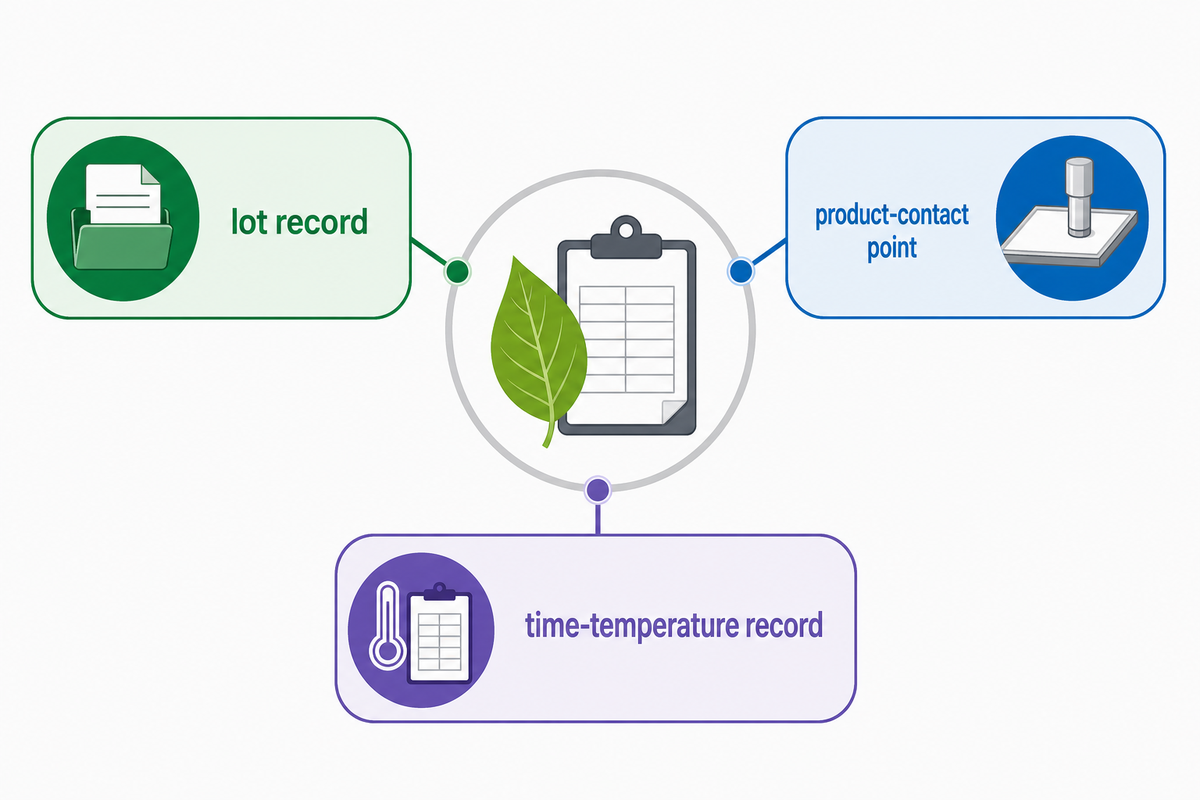
Treat leaf damage as an investigation signal, not merely a cosmetic note. Published work on fresh-cut baby leaves considers product damage alongside crop and processing conditions, giving good reason to avoid a one-size-fits-all conclusion. When bruising, cutting, tearing, or accumulating moisture is observed, connect that note to the lot record, product-contact point, wash-water context, sanitation evidence, package state, and time-temperature record.
Appearance alone cannot establish a microbiological outcome. Equally, a visible mark should not be dismissed simply because output continues to move. Ask, “What changed at this interface, and which records could help us investigate it?” A photograph can help if its lot and time are clear, but it remains a prompt for review, not proof of cause, a safety result, or a performance comparison.
Make each observation repeatable. Define an inspection window, name the person recording it, and keep the original wording. If the lot, handling condition, product form, or observation basis changes, start a new entry instead of comparing descriptions that do not match.
For a factory quality review, a buyer and supplier should preserve the observation without converting a visible mark into a claim. That reduces the risk that a missing record, or a gap between lots, becomes a misleading production conclusion.
6. Make Residual Moisture a Measured Handoff Condition
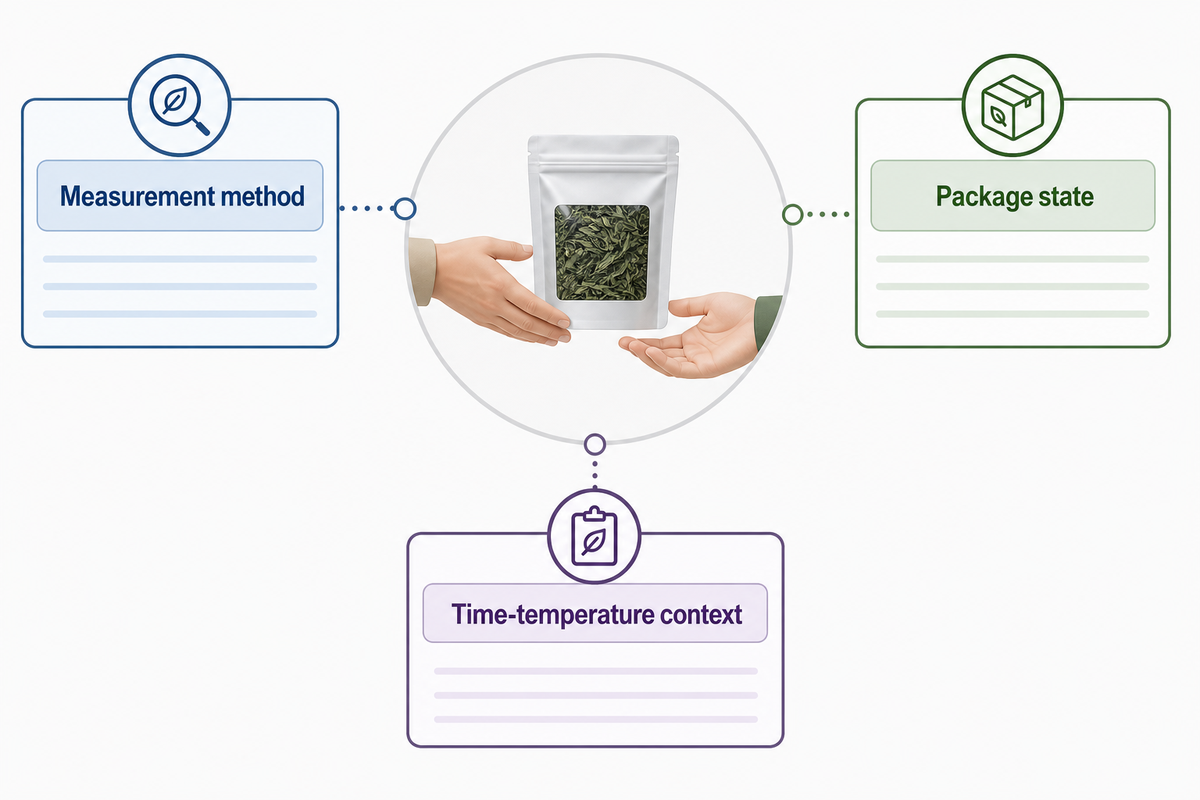
“Looks dry” isn’t a record. Residual moisture and excess surface water belong to the handoff from dewatering to packaging and chilled handling, where an appearance at one moment may not explain a later result. One packaging study is useful when it makes its material, pack geometry, perforation treatments, storage conditions, and observation schedule explicit. Those details are a model for documenting a trial, not a universal package setting or a shelf-life prediction.
Record moisture alongside package condition and the relevant time-temperature exposure. The three signals interact in a real operation, but this guide doesn’t claim a universal interaction, oxygen level, temperature, or storage period. It asks the team to retain enough context to examine its own result without pretending that one moisture target resolves the matter.
| Record field | Question to define before a trial or review |
|---|---|
| Measurement method | How will the site describe or measure the condition, and who owns the method? |
| Package state | Which material, geometry, seal/perforation context, and visual observations are retained? |
| Time-temperature context | Which handoff window and available cold-chain record accompany the package observation? |
| Review rule | What variation triggers review, and who decides whether a new trial is needed? |
How do I measure the residual moisture content of leafy greens?
First define the site method and its record owner. Use that stated method for the labelled observation window, retain package and time-temperature context, and write the escalation rule before interpreting the result. The guide sets no universal target or benchmark.
At a factory handoff, the buyer and packaging owner can compare like with like only when the method and record travel together. A missing method creates an evidence gap and a risk of mismatch; third-party verification, where the site requires it, belongs in the stated review process.
7. Turn Changeovers Into a Documented Operating Test
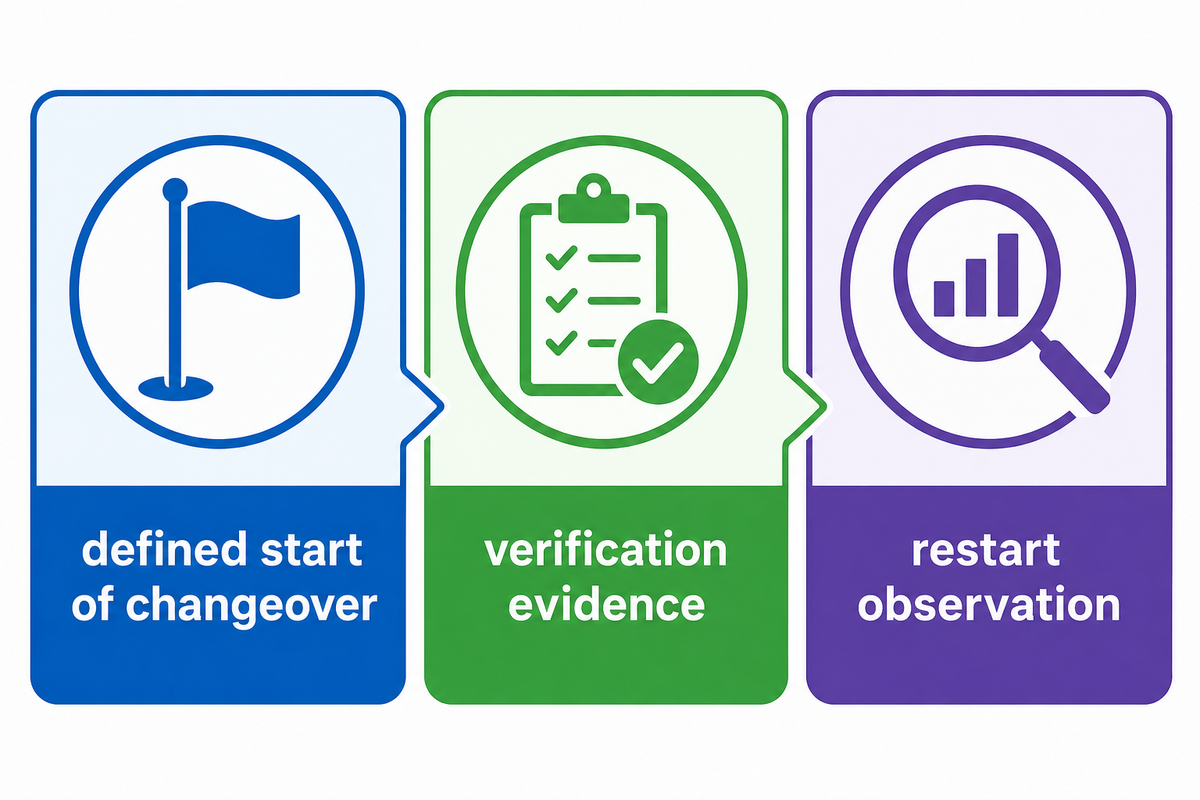
“Changeover time” doesn’t explain itself. To understand lost time or a shift in observations, separate four events: the defined start of changeover, the cleaning or sanitation activity carried out under the site’s own process, the verification evidence required by that process, and the restart observation. Putting all four inside one unqualified time figure removes the detail a team need to improve.
Before the event, identify the outgoing and incoming product or lot basis, each record owner, and the point at which the operating clock start and stops. Afterward, retain the exception or follow-up item as well as the elapsed time. Supplier demonstrations can show an agreed function or access point; they don’t approve the customer’s sanitation procedure or establish a universal schedule.
How much production time is lost during product changeovers?
There’s no responsible universal allowance. Record the four events above, interruptions, the material basis, and the reason an observation may not be comparable to the previous run. A defensible entry should also show the defined start and stop, the outgoing and incoming lot basis, the verification record checked before restart, and the person who owns any exception. Keep the record with the operating conditions and named reviewers so later comparisons do not imply a transferable time allowance.
Set the entry beside the prior record without comparing it to an imported benchmark; it says only what happened under the stated conditions. If an exception cannot be explained, label it for investigation rather than burying it in an average.
In a factory production review, the buyer and operations owner should call out the risk of an unexplained interruption. The evidence record matters because a changeover gap can otherwise be mistaken for a supplier, sanitation, or restart conclusion.
8. Use a Balanced Scorecard Beyond Hourly Throughput
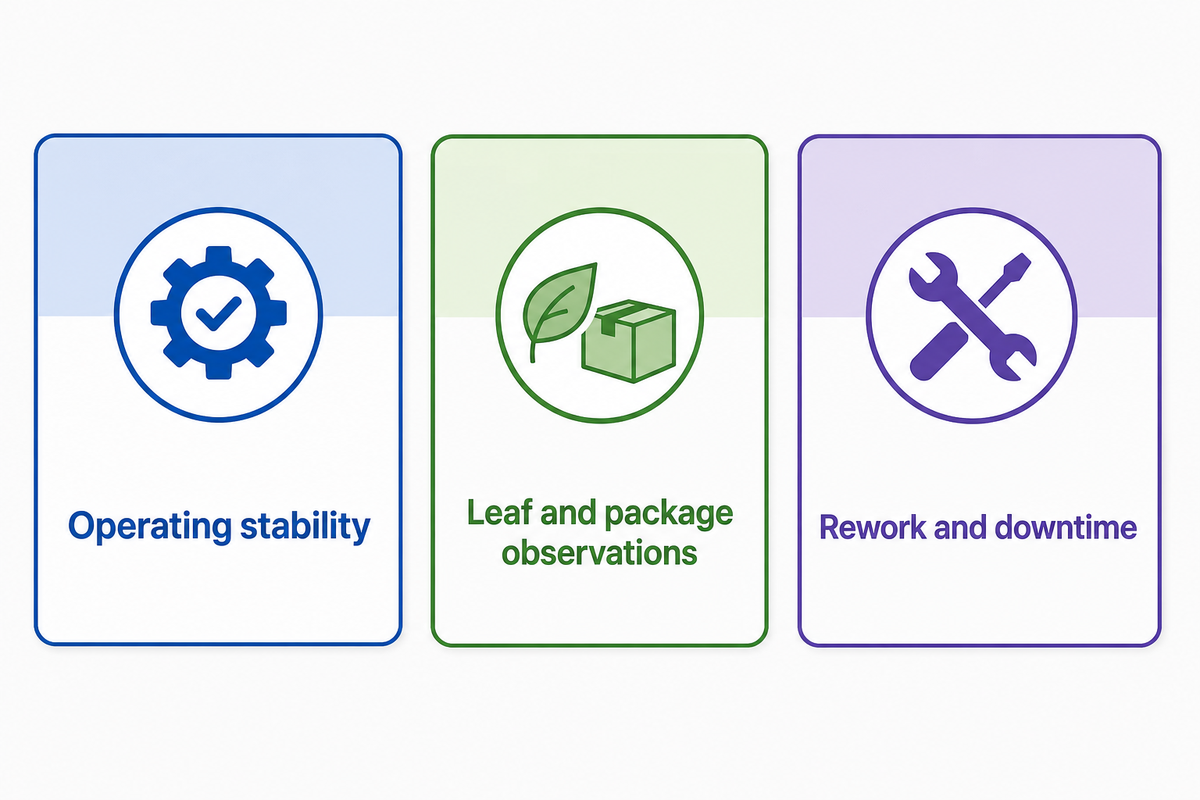
Hourly throughput can be a useful observation, but it should not stand alone as the scorecard. The documented changeover record is one input to that scorecard, alongside package condition and lot linkage. A process may look stable at one station while variation is being pushed into rework, a downstream queue, or an untraceable lot merge. Use a small scorecard that keeps those signals together.
| Signal | What to review | Limit to state explicitly |
|---|---|---|
| Operating stability | Observed interruptions, queues, and handoff conditions over the stated window | Not a capacity guarantee |
| Leaf and package observations | Damage notes, moisture method, and package context | Not a safety or shelf-life conclusion |
| Rework and downtime | Defined event categories and elapsed-time record | Not a universal loss rate |
| Lot-linkage completeness | Whether farm, field, supplier, receiving lot, and pack code can be connected where relevant | Missing linkage must be disclosed, not assumed complete |
The final row becomes especially important when lots are commingled. It does not accuse a process of failing traceability; it asks the project team to show the exact boundary of information it holds. A scorecard that honestly says “not available” is safer than one that silently turns several lots into one story.
For a factory scorecard, procurement and operations can use an explicit “not available” entry to show a risk rather than conceal it. That evidence boundary helps prevent a record gap from being misread as a stable production result.
9. Build a Process Brief Before You Discuss a Solution
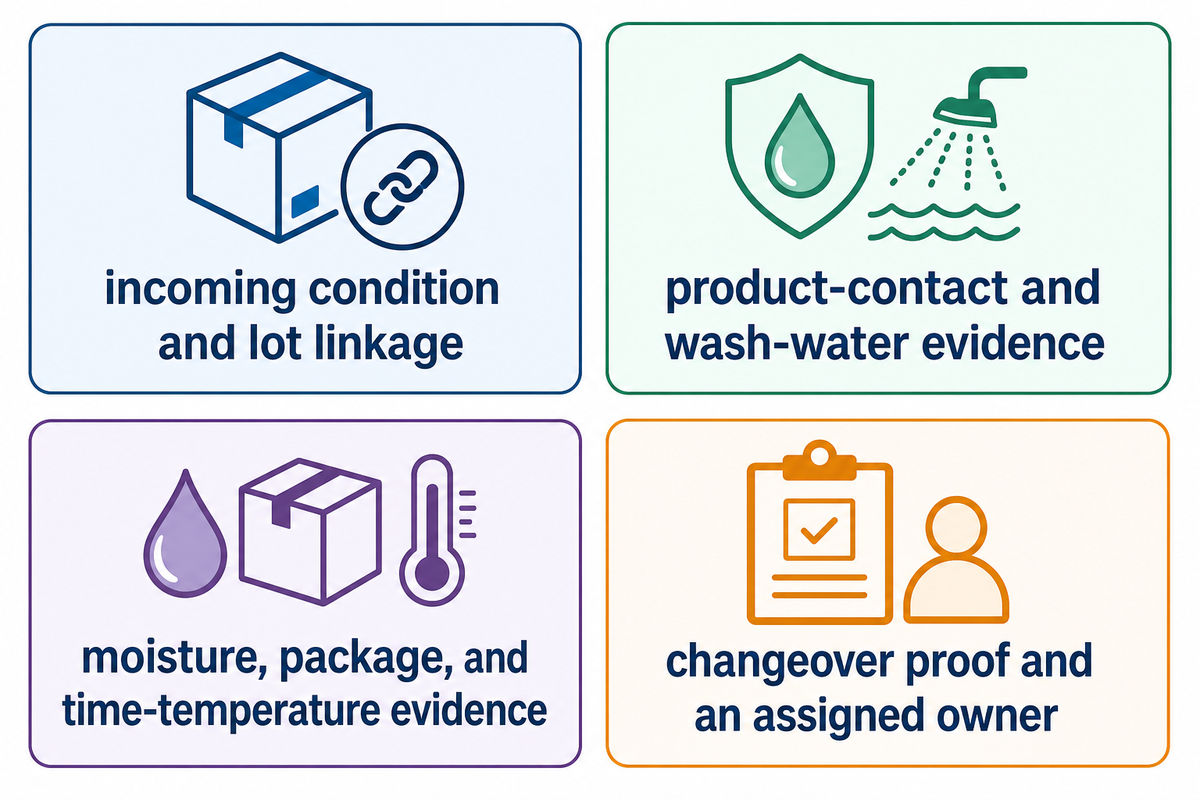
The 4-Signal Leaf-to-Handoff Map carries the scorecard’s explicit “not available” entries and its observations into a one-page technical brief without choosing a machine. It brings together four questions: what arrived and how well it is linked; what product-contact and wash-water evidence exists; what moisture-package-time-temperature context is retained; and what changeover proof and evidence owner have been named. The map turns a broad request into evidence the next conversation can actually use.
4-Signal Leaf-to-Handoff Map
- For the starting material, retain incoming condition and lot linkage: labelled material, receiving window, visible observations, commingling note, source-record owner.
- At the product and water interface, retain product-contact and wash-water evidence: the interface map, site-controlled water-control questions, monitoring/verification record owner, and unresolved control questions.
- At the pack handoff, retain moisture, package, and time-temperature evidence: the stated measurement method, package context, handoff window, available cold-chain data, and escalation rule.
- For a product switch, retain changeover proof and an assigned owner: start/stop definition, cleaning or sanitation boundary, verification record, restart observation, and follow-up owner.
| Evidence type | Example form to retain | Question the form keeps open |
|---|---|---|
| Receiving mass | 0.0 kg plus lot identifier |
Was the observed material the material received? |
| Receiving time | 00:00 and receiving date |
Which handoff window is being discussed? |
| Available product temperature | 0.0 °C or 0.0 °F with source-record owner |
What does this reading cover, and what does it not cover? |
| Wash-water record | Site method and record reference | Which validation, monitoring, and verification evidence is applicable? |
| Dewatering observation | Method plus 0.0% only if the site method uses a percentage |
Is this an observation, a site target, or an exception? |
| Package observation | Pack code, material description, 0.0 mm only if material thickness is a recorded project field, and 0.0 h observation window |
Which package state was actually reviewed? |
| Cold-chain interval | 0 min, 0.0 hr, or site-controlled time record |
Which time-temperature handoff accompanies the package? |
| Changeover event | 0 min start/stop record with exception note |
Which portion is cleaning, verification, restart, or interruption? |
| Product-contact observation | Point name, timestamp, and image/log reference if used | What changed at the interface? |
| Lot-linkage review | Farm/field/supplier/pack-code linkage or “not available” | Where does commingling limit the record? |
Keep the brief honest. Leave a field blank until the responsible party supplies the information. An answer from a supplier belongs in the supplier-evidence column; a site decision belongs with the site owner. This simple discipline make a later technical review clearer and helps prevent a procurement request becoming a bundle of untested assumptions.
At a factory project review, the buyer can use this brief to name the risk and the unanswered evidence gap. Because the record is still a preparation tool, any required third-party verification and site decision must remain with the responsible owner.
10. Integration Questions to Resolve Before a Solution Review
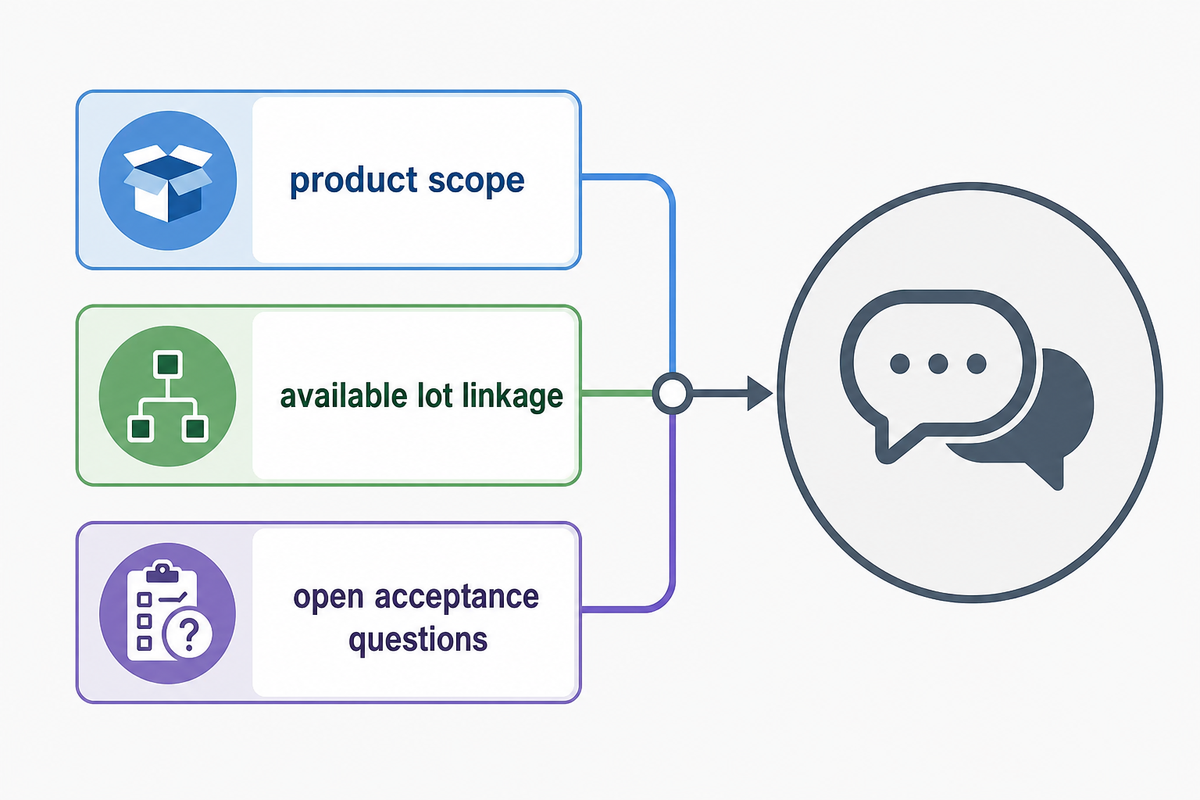
Before a commercial discussion, the project team should be able to state the product scope, available lot linkage, interfaces under review, package and chilled-handoff context, named evidence owners, and open acceptance questions. It should also identify facts that still belong with a farm, supplier, receiver, packer, distributor, or site specialist. A solution provider can use that brief to understand the project, but it can’t replace owner-side decisions outside an equipment discussion.
Once those questions are organized, readers who need the commercial next step can review a leafy fresh-cut production solution. That page is where a project-specific conversation belongs. This guide stays as the preparation layer: it helps the buyer bring evidence, uncertainties, and accountable owners into that conversation.
For broader context before that conversation, readers can also use the fruit and vegetable processing overview to place this evidence brief within the relevant process category.
At a factory integration review, the buyer, supplier, and site owner should identify any risk created by an unassigned interface. Because a missing record leaves an evidence gap, the production discussion should document the responsible follow-up instead of treating uncertainty as a settled requirement.
Frequently asked questions
What is the difference between this guide and a production solution page?
This guide organizes process evidence, handoffs, ownership questions, and uncertainties that need a named follow-up. A production solution page is the commercial destination for a defined project brief, after the reader can state what material, interfaces, records, and acceptance questions are in scope. This article doesn’t recommend a configuration, capacity, price, package, or product-specific acceptance criterion. Its job is to stop a broad request becoming an untestable assumption.
Does washing completely eliminate microorganisms from leafy vegetables?
No. Treat washing as one element of the site’s documented control system, not as a declaration that every microbiological risk has been eliminated. FDA guidance is nonbinding and not intended for farms; a responsible regulatory and food-safety team must determine which requirements apply to the facility and activity in question. The project record should separately identify water-control evidence, its stated conditions, operational monitoring, verification, exceptions, and who owns each record. A generic article cannot validate that programme or assign responsibility across the supply chain.
Why is residual moisture important after dewatering?
It’s a measurable handoff condition, not just an appearance. Record the stated measurement method together with package condition and available time-temperature context, then name the person who reviews variation and the explicit rule that triggers follow-up. Visual dryness or one trial can’t establish a universal shelf-life, package, or quality result. It also cannot supply a universal moisture target: the site must interpret its stated method, material context, and evidence before drawing a conclusion.
Which conditions should be recorded at incoming-product intake?
Record the labelled lot, available origin linkage, receiving window, visible condition, handling context available to the receiver, and record owner. If lots are commingled, disclose the limitation rather than invent a complete upstream history.
What should be included in a changeover validation record?
Separate the defined start and stop, cleaning or sanitation activity under the site process, verification evidence, restart observation, exception, and follow-up owner. Don’t assign a universal time allowance or imply that an equipment observation approves a site programme.
What should a processor prepare before discussing a leafy fresh-cut solution?
Prepare the four signals in the Leaf-to-Handoff Map, identify record owners, and keep unknowns visible. That creates a useful technical brief without pretending that the team has already settled facility scope, food-safety validation, acceptance limits, or supply-chain evidence.
Sources and evidence boundaries
References & Sources: the sources below support the limited statements made in this guide. For a production buyer at a factory, they help identify a risk and an evidence gap, not close one. Because FDA’s official guidance page has a stated scope, its record does not establish a Shengtu product capability, a site’s compliance status, a universal operating setting, or a shelf-life, yield, throughput, or food-safety result.
- U.S. FDA, Guide to Minimize Microbial Food Safety Hazards of Fresh-cut Fruits and Vegetables U.S.-specific, nonbinding guidance; food-safety-control and farm-boundary context.
- Gil (2016), Fresh-cut leafy vegetables raw-material variability context; no universal equipment setting adopted.
- Food Control, fresh-cut baby-leaf processing-damage research handling-context source; no vendor benchmark adopted.
- Peer-reviewed red-leaf-lettuce packaging study documentation-method context; no universal packaging or shelf-life result adopted.
- U.S. FDA Leafy Greens STEC Action Plan U.S.-specific traceability and buyer-specification context; no global rule inferred.
ENGINEERING CONTENT DISCLOSURE
Why Shengtu Publishes Technical Guides
These guides turn common production-line questions into a clearer decision path for food manufacturers, project engineers and procurement teams.
We focus on the inputs that change equipment selection: product characteristics, package format, target capacity, process stages, utilities, plant constraints and destination requirements.
01Define the applicationStart with the product, pack and operating target.
02Map the process routeConnect stages, interfaces and utility needs.
03Surface trade-offsExplain the choices that affect line scope.
04Prepare better questionsTurn reading into a reviewable project brief.
MANUFACTURER PROFILE
SHENGTU
- Focus
- Food processing equipment and turnkey line solutions
- Base
- Zhucheng, Shandong, China
- Project path
- Requirement → layout → equipment scope → delivery coordination
SOLUTION COVERAGE
VALIDATION BOUNDARY Final equipment configuration should be confirmed against your product, package, throughput, utilities, plant constraints and destination requirements.



![Meat / Poultry / Prepared: Plant Planning Guide [2026]](https://shengtumachinery.com/wp-content/uploads/2026/10/meat-poultry-prepared-processing-guide-featured-150x150.png)