
Get in touch with Shengtu Bufan Company

Updated August 2026
A UHT Sterilizer deviation is not resolved by finding one acceptable display value. It is resolved when the site can define the affected production window, trace the critical records through the relevant equipment and downstream boundaries, and show why the line may return to service. That distinction matters when a heater trace looks normal but a pressure trend, sterile-transfer concern, filling event, cleaning change, or package result does not.
This validation and troubleshooting guide is for plant operations, quality assurance, maintenance, and qualified process support. It does not provide a universal process setting, restart authorization, or legal interpretation. Applicable process requirements must be established for the actual product, package, equipment, site, and jurisdiction by the people authorized to make that decision.
For a commercial equipment discussion, use the SHENGTU UHT sterilizer solution page. That page owns equipment scope and commercial inquiry intent; this article stays with evidence-led deviation review and validation handoffs.
The practical starting point
- Freeze the time window before debating the cause.
- Read linked records before changing a setpoint or restarting a sequence.
- Follow the fault chain through heating, flow, holding, cooling, sterile transfer, filling, and package boundaries as applicable.
- Treat the checklists and matrices in this guide as illustrative planning tools, not a substitute for local procedures or qualified decisions.
Define the Evidence Window Before Troubleshooting
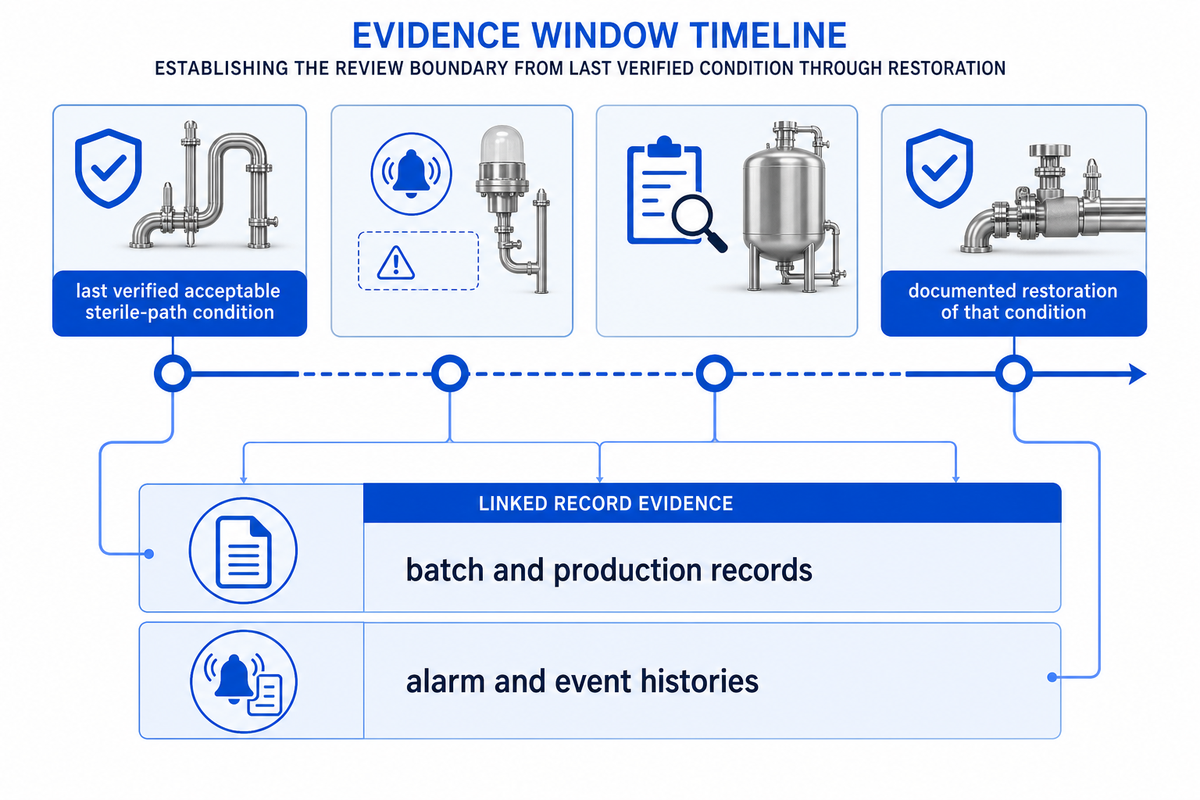
Name the event, the product state, and the earliest and latest times that could reasonably be affected. In the UHT process, that window may span heat treatment, sterile transfer, and aseptic filling records. Often, the answer is wider than the alarm timestamp. It can begin with the last known acceptable verification, a product or cleaning change, a control intervention, or the start of an uncertain condition. It ends only when the relevant condition is demonstrably restored and the site’s release logic says the evidence window has closed.
Build the window from contemporaneous evidence, not memory: batch and production records, alarm and event histories, instrument status, diversion status, maintenance work, cleaning records, samples or package observations, and downstream line events. Preserve originals and record who reviewed each source. Later explanations can be useful, but they should not replace the first record of what the line did.
Downstream boundaries matter. Canadian Food Inspection Agency aseptic-processing guidance describes control considerations that extend beyond the heater to downstream equipment, fillers, packaging equipment, and packaging material. Operationally, a good thermal record alone does not demonstrate the state of every downstream aseptic barrier.
Write the evidence window in one plain-language sentence before assigning actions. For example: “Review product produced from the last verified acceptable sterile-path condition through the documented restoration of that condition.” The sentence is not a release decision. It is an investigation boundary that prevents teams from quietly narrowing a deviation to the most convenient record.
Make the window falsifiable. Reviewers should be able to point to a record that would move its start earlier or its end later. This is especially important when an operator noticed an unusual condition before an automatic alarm appeared, or when a downstream observation was reported after production had already moved on. The evidence window is allowed to grow when the records justify it. It should not grow simply because the team is unsure what to do next.
Illustrative planning tool: A local procedure can require a different window, sampling plan, hold action, or release authority. Use this article’s sequence to organize questions, then apply the approved site process.
Isolate the Affected Production Window First
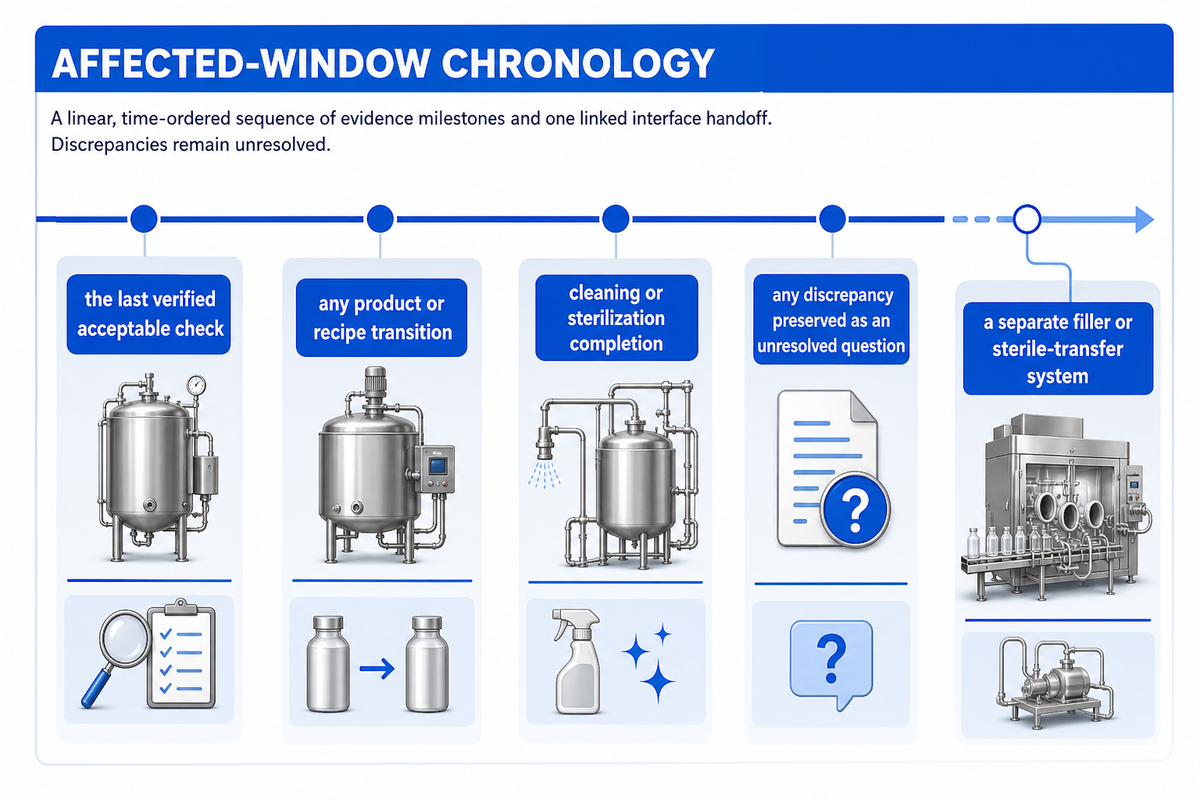
Once the initial window is in place, make it reviewable. Separate product that is obviously outside the window from product that requires a decision. Determine what changed while the window was open, who acted on the equipment, which records were generated automatically, and which records were entered later. This simple isolation step prevents an investigation from evolving into a broad equipment-history review with no specific decision point.
Use a chronology rather than a symptom inventory. Place the last verified acceptable check, any product or recipe transition, cleaning or sterilization completion, start-up, alarms, manual interventions, diversions, pressure or flow changes, downstream events, and restoration checks on the same timeline. If two sources of information conflict, keep the discrepancy as an unresolved question. Do not harmonize the times solely to make the story read smoothly.
When the line incorporates a separate filler or sterile-transfer system, examine the interface as an interface. In this context, the UHT aseptic filling line scope is relevant because heater evidence, sterile-transfer evidence, and package evidence may be controlled by different equipment and teams. Record an explicit handoff point in the investigation.
Isolation also protects the people conducting the review. Operations can preserve the sequence and equipment state. Maintenance can identify the work performed and the evidence that the repair restored its intended function. Quality assurance can control the event record and disposition path. None of those roles needs to answer every technical question before the facts are assembled. Clearer handoffs name the question, evidence source, and decision owner instead of issuing a vague request to “confirm the line is okay.”
Route-Specific Evidence Checks
Direct and indirect UHT routes do not need a generic selection comparison during a deviation. They may, however, change the evidence worth checking. Cornell’s UHT technology overview distinguishes direct steam-injection or infusion routes from indirect heat-exchanger routes. One peer-reviewed review of direct steam heating also identifies process interfaces specific to direct contact; it is cited here only to frame which records may matter, not to prescribe a route. For a direct UHT treatment, the local evidence set may need to account for the approved steam-contact and flash-cooling interfaces. For indirect heating, a tubular or other heat exchanger can shift attention toward heat-exchange surface condition, pressure relationships, and exchanger-integrity evidence. If the installed line is documented as a tubular UHT sterilizer or plate UHT sterilizer, use that approved configuration name only to locate the correct drawing and records; the label does not decide the cause. Applicable UHT system records and acceptance criteria still come from the approved local process basis.
UHT Sterilizer Troubleshooting: Follow the Fault Chain
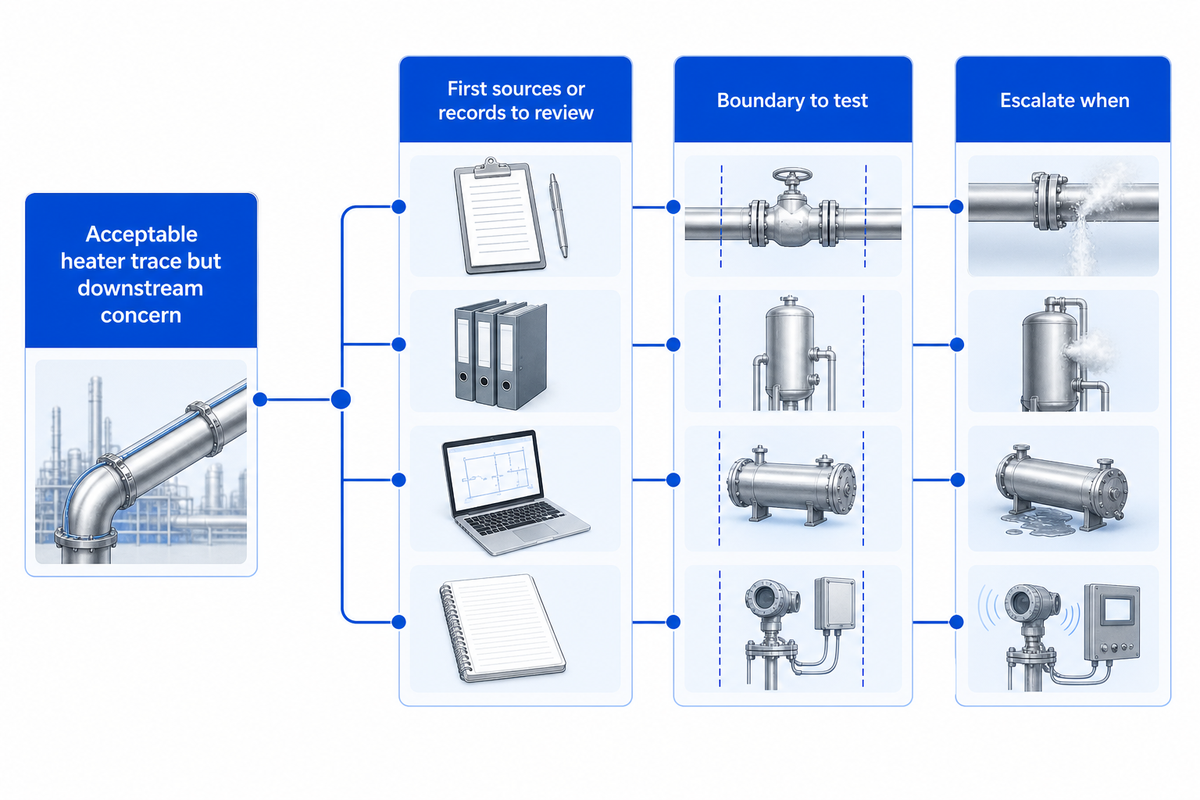
A useful troubleshooting question is not “What setting should we change?” It is “Which link in the evidence chain first stopped supporting the approved operating basis?” Start at the reported symptom, then move outward only as the records require. For an ultra-high temperature sterilization process, the chain can include the thermal process, flow and holding evidence, cooling, sterility controls, a separate filling machine, and the protected path between them. This approach reduces the temptation to correct a visible signal before learning whether the fault is upstream, downstream, or only apparent.
Illustrative matrix — adapt to the approved site procedure.
| Observed concern | First sources or records to review | Boundary to test | Escalate when |
|---|---|---|---|
| Unexpected diversion or unstable flow | Flow trend, pump/control state, event history, and approved configuration. | Whether the required residence condition can still be shown. | The relationship between flow, holding, and the approved basis is uncertain. |
| Temperature drift or repeated control response | Reference-instrument status, heating-medium condition, control events, and calibration status. | Whether the record represents the required point and period. | A critical limit or its evidence may not have been maintained. |
| Rising pressure drop or shorter stable run | Trend against clean baseline, product change, cleaning record, and inspection evidence. | Fouling, flow behavior, heat transfer, or cleaning effectiveness. | The approved run boundary or cleaning basis may be affected. |
| Acceptable heater trace but downstream concern | Sterile-transfer state, downstream sterilization cycle, filler events, and package/closure evidence. | The protected path after thermal processing. | The downstream boundary cannot be demonstrated for the affected window. |
| Product, recipe, or configuration change | Approved change record, product basis, line configuration, and authorization history. | Whether prior validation evidence remains applicable. | A changed factor could alter the scheduled process or validated scope. |
| Time-base or record disagreement | Alarm and event history, batch record, and source timestamps. | Whether the records establish one coherent affected-window chronology. | The source ordering cannot be reconciled under the local review process. |
| Instrument or calibration concern | Instrument status, calibration record, reference indication, and control events. | Whether the indication supports the relevant point and period. | Calibration status or its possible effect on the evidence is uncertain. |
| Maintenance or manual intervention | Maintenance work record, intervention log, equipment state, and event history. | The affected window and the evidence before and after the intervention. | The intervention’s effect on the approved configuration or evidence is uncertain. |
When package observations or test results trigger the investigation, write down the observed condition before labeling it microbial spoilage. Any microorganism or heat-resistant spore identification belongs to approved sampling, laboratory methods, and qualified interpretation. Keep the same evidence window across sterilization equipment, heating and cooling records, aseptic packaging, and filling events so a later result is not disconnected from the production chronology.
Fouling deserves a disciplined review because it can develop gradually. One peer-reviewed review of dairy thermal fouling describes its links to heat-transfer performance, energy demand, and cleaning decisions. That supports trend-based investigation; it does not create a universal pressure-drop limit or cleaning interval. Where cleaning evidence is part of the question, the CIP cleaning system context belongs in the boundary review, not as a generic corrective action.
Keep each proposed action tied to a specific uncertainty. “Inspect exchanger integrity because the pressure relationship changed” is stronger than “check everything.” “Hold the affected window while QA reviews downstream sterilization records” is stronger than “watch the next run.” The first phrasing identifies evidence and ownership; the second only postpones the decision.
Do not let a corrected indication erase the event history. Stability after an intervention may show that the immediate signal has changed; it does not by itself explain what product experienced before the correction or whether a related downstream boundary remained protected. Record the intervention, its time, the person who made it, the reason given at the time, and the first evidence that supports restored control. If that first evidence is not available, keep the limitation visible for the authorized reviewer.
Build a Deviation Evidence Package Before Restart
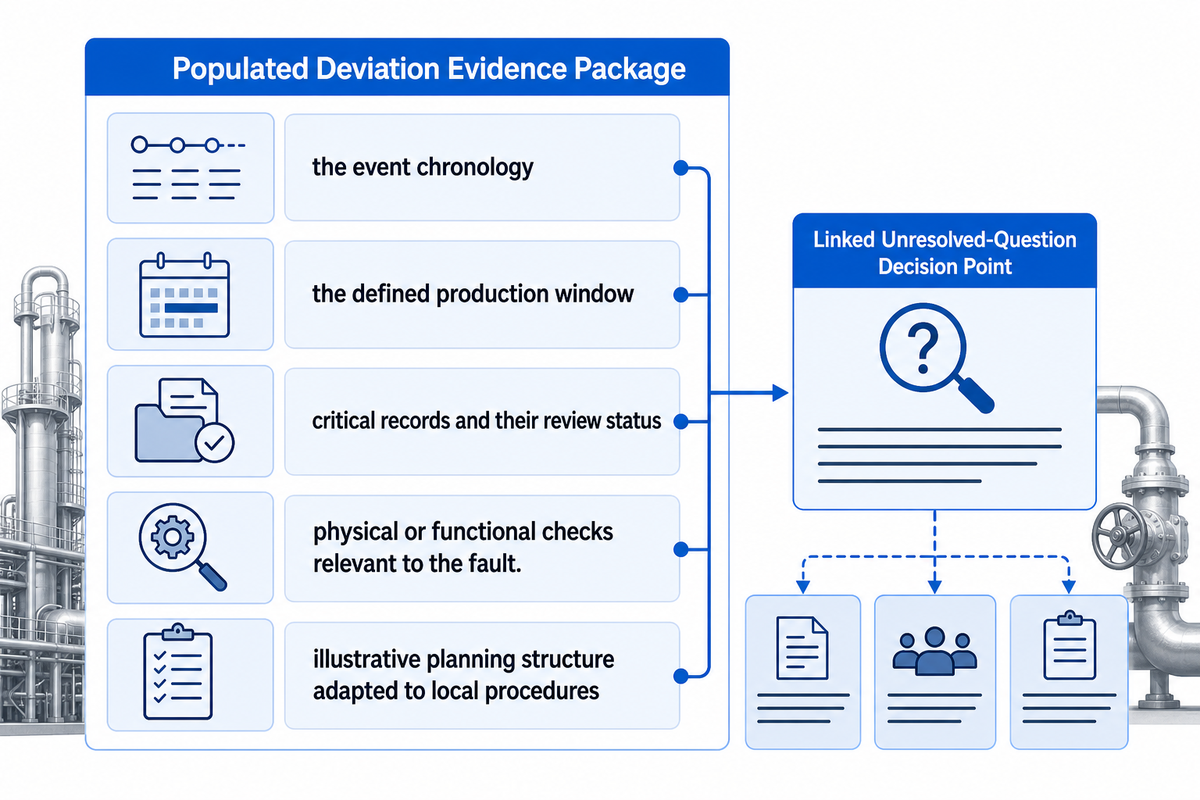
A restart should follow a coherent evidence package, not a verbal assurance that the alarm has cleared. Reviewers should be able to reconstruct the affected window, see what was checked, understand what changed, and identify the authority that accepted the return-to-service decision. Where aseptic processing is intended to produce a commercially sterile outcome, the evidence package must still be scoped to the actual product, package, production line, process conditions, event, local procedure, and regulatory context.
An illustrative package has five parts: the event chronology; the defined production window; critical records and their review status; physical or functional checks relevant to the fault; and a deviation conclusion with open items, product disposition, and sign-off. If the investigation found no impact, record why the evidence supports that conclusion. If the evidence is incomplete, record that limitation rather than converting it into a pass.
Evidence should be readable at the decision point. Link or identify the original record, its relevant time range, the reviewer’s observation, and any calculation or comparison used to interpret it. Avoid turning an investigation into a folder of screenshots with no stated relevance. One concise evidence index can be enough: each row names the question, the record, the time span, the finding, the limitation, and the reviewer. It gives the next reviewer a route through the package without implying that the index itself is the technical conclusion.
Where several systems contribute to the event, the package should make their order and interfaces explicit: it should show what the upstream record establishes, what the sterile-transfer or filler record establishes, what the package or closure record establishes, and which gap remains if one system’s evidence is unavailable, ambiguous, or outside the reviewer’s authority to interpret.
For United States facilities within the relevant scope, 21 CFR 113.83 requires scheduled processes within Part 113 scope to be established by qualified persons with expert knowledge of thermal processing. Use the actual applicable section and jurisdiction with qualified advice; this article does not determine applicability. For troubleshooting, a deviation package must connect the observed event to the approved process and the records that show whether it remained in control.
Before-restart review prompts
- What is the last verified acceptable point, and what is the first verified restored point?
- Which records support the thermal, flow, and downstream boundaries?
- Which instrument, equipment, cleaning, product, or control changes occurred inside the window?
- What remains unknown, and who has authority to accept or escalate that uncertainty?
Assign Validation Evidence and Sign-Off Responsibilities
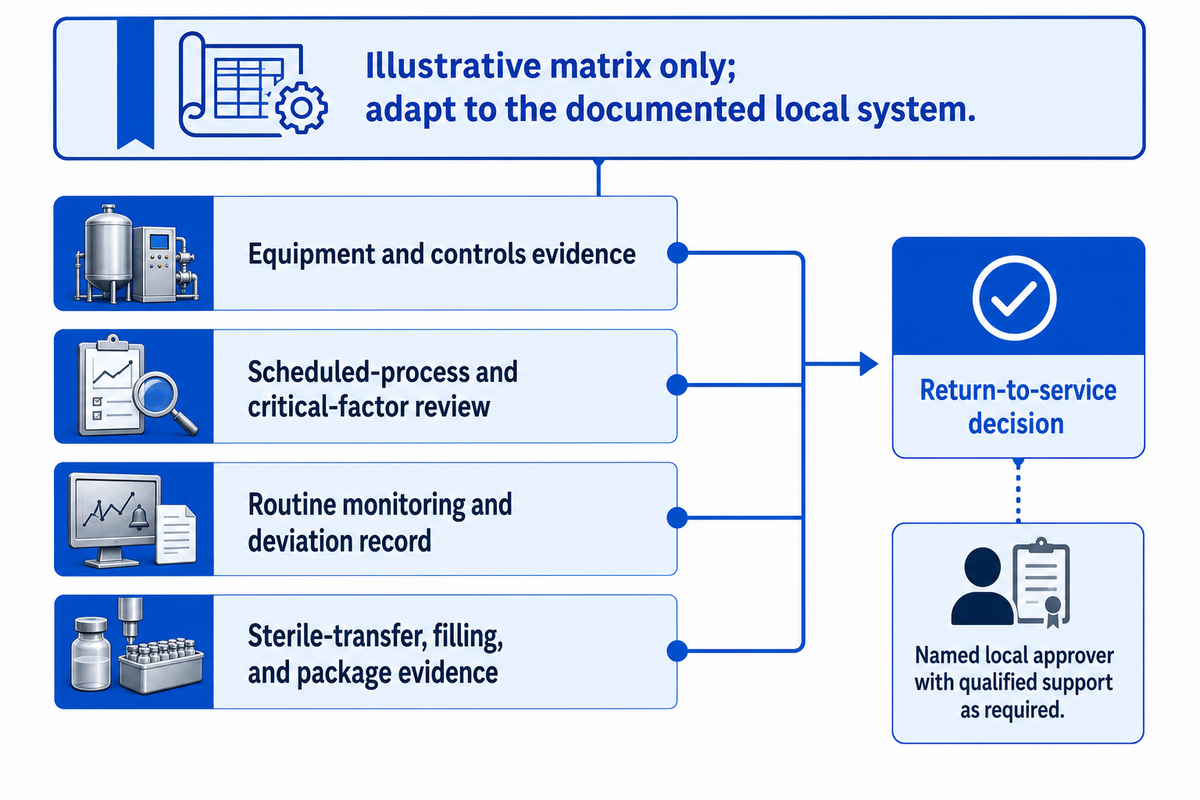
Equipment supply, plant operation, quality assurance, process validation, and filler/package integration are related responsibilities, but they are not interchangeable. Suppliers can provide defined equipment documentation and commissioning evidence. The processor controls its site operations and records. Quality assurance manages the local disposition and food-safety documentation pathway. Qualified process authorities or equivalent qualified roles may be needed to establish or review UHT sterilization process decisions within the applicable scope. Filler and package teams own evidence at their boundary.
Use the following matrix only as an illustrative meeting tool. It is not a standard, contract allocation, legal duty, or universal release procedure. Each site must adapt the names, decisions, deliverables, acceptance methods, and escalation routes to its documented local system.
Illustrative matrix only; adapt to the documented local system.
| Evidence type or job | Typical contributors | Question for local sign-off |
|---|---|---|
| Equipment and controls evidence | Supplier, site engineering, maintenance. | Does the documented equipment state match the approved application and configuration? |
| Scheduled-process and critical-factor review | Qualified process authority or local equivalent, QA, processor. | Who is qualified to determine whether the event affects the process basis? |
| Routine monitoring and deviation record | Operations, QA, maintenance. | Are the records complete, attributable, and linked to the affected window? |
| Sterile-transfer, filling, and package evidence | QA, filler/package integrator, operations. | Can the downstream boundary be demonstrated or does it need escalation? |
| Return-to-service decision | Named local approver with qualified support as required. | Is the decision authority explicitly identified in the site procedure? |
| Cleaning and sterilization evidence | Operations, maintenance, QA. | Which local records show the relevant cleaning or sterilization evidence for review? |
| Change-control applicability review | Process authority or local equivalent, QA, engineering. | Does the documented change require local review of prior evidence applicability? |
| Product hold, disposition, and release record | QA and the named local decision owner. | Does the record identify applicable local disposition status and the named decision authority? |
Both the CFIA guidance cited above and the relevant eCFR material emphasize qualified, documented process control within their respective contexts. Neither source makes this generic matrix a mandatory allocation for every plant. Its value is practical: it reveals an unowned evidence job before a deviation turns into an argument about who should decide.
Control Changes That Can Reopen Validation Questions
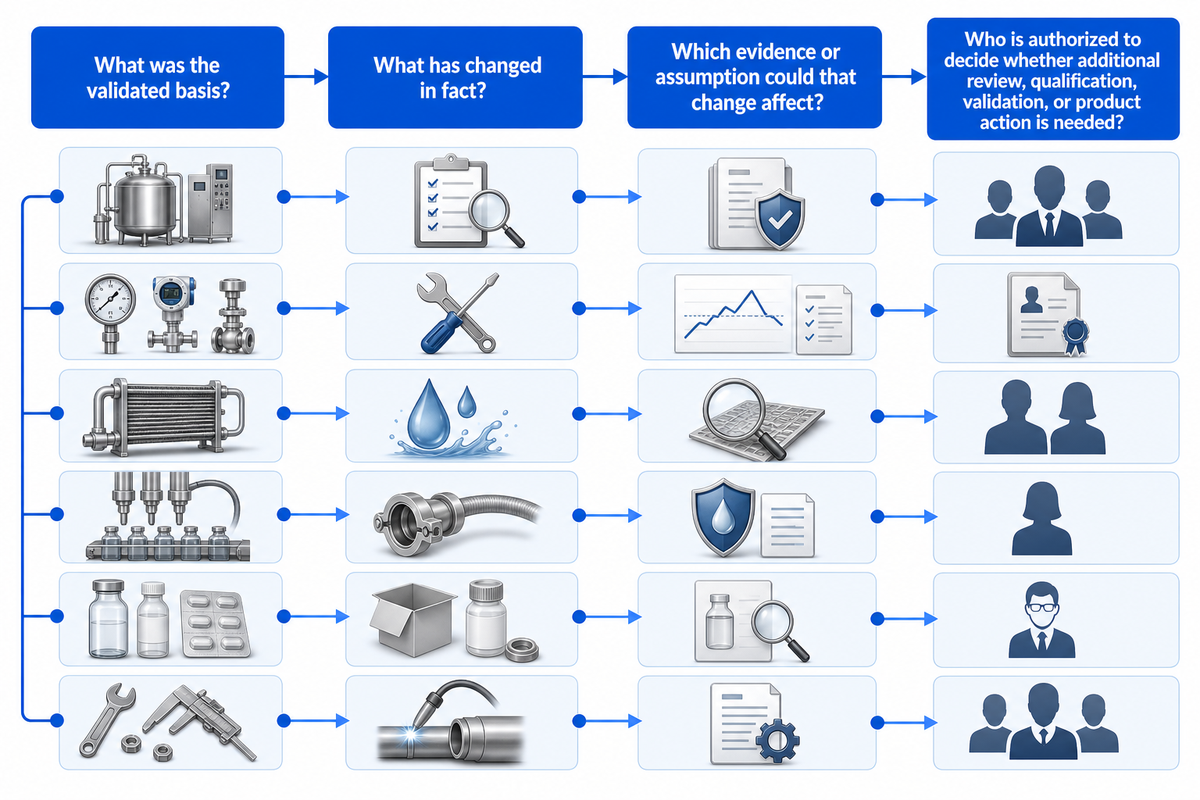
Not every adjustment invalidates prior work, and not every change is minor. Ask whether the change can alter a factor, boundary, record, or assumption that the approved evidence relied on. Product formulation, viscosity, particulate characteristics, route interfaces, holding geometry, controls logic, instruments, heat-transfer condition, cleaning program, sterile-transfer arrangement, filler interface, package material, and repair work can all justify a documented impact assessment depending on the local process.
Ask four questions before treating a change as routine: What was the validated basis? What has changed in fact? Which evidence or assumption could that change affect? Who is authorized to decide whether additional review, qualification, validation, or product action is needed? This is change control as a troubleshooting discipline, not a paperwork exercise.
Document the comparison at the level that allows a later reviewer to understand it. “Same product” may not be enough if a relevant formulation, inlet condition, or packaging attribute changed. “Same equipment” may not be enough after controls work, an instrument replacement, a heat-transfer concern, or a sterile-path repair. Its purpose is not to label every change high risk. It is to prevent an unexamined change from inheriting evidence that no longer fits.
For commercial equipment follow-up after the site has completed its evidence review, return to the UHT sterilizer solution page. For company background, see About SHENGTU. Neither link replaces the site’s validation or release authority.
Bring the evidence boundary to the technical conversation
Share the product state, affected window, observed deviation, linked records, and local decision owner. A focused technical conversation begins with the evidence already available.
Discuss Your UHT ProjectValidation and Troubleshooting FAQ
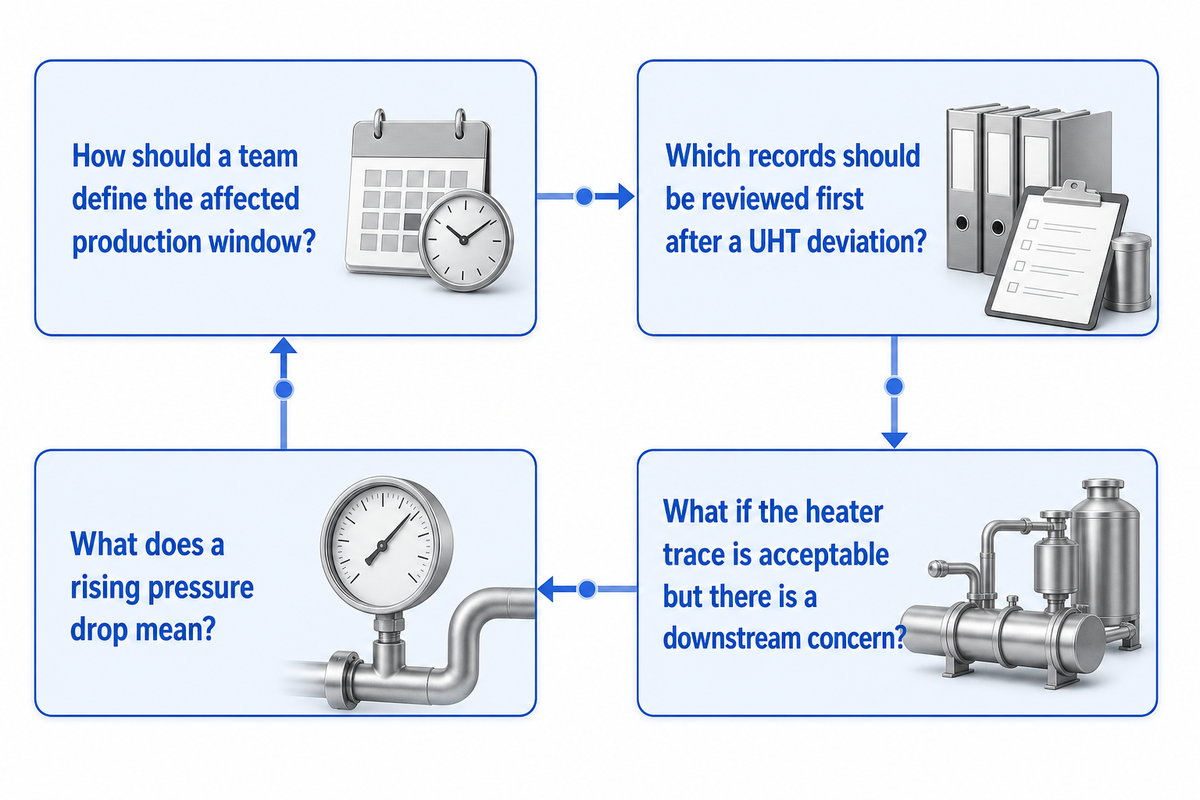
How should a team define the affected production window?
Start with the last verified acceptable condition, then extend the window through documented restoration while allowing earlier or later records to move either boundary materially.
Include product or recipe changes, start-up, cleaning or sterilization completion, alarms, diversions, manual interventions, maintenance, and downstream events. Record which evidence establishes each boundary. Identify which record supports each boundary and which one remains uncertain. Final hold, disposition, and release decisions still follow the approved local procedure and its named authority.
Which records should be reviewed first after a UHT deviation?
Review the event chronology first, then open the records tied most directly to the reported condition, the affected window, and any upstream or downstream boundary that could change the decision.
Start with the alarm and event history, production or batch record, relevant instrument and calibration status, flow and diversion record, intervention log, change history, and downstream aseptic evidence where applicable. Align their time bases without rewriting disagreements. Preserve the original source, note any gap, and assign unresolved conflicts to the authorized reviewer before the investigation expands into unrelated equipment history.
What does a rising pressure drop mean?
Rising pressure drop should prompt comparison with a clean baseline and related operating evidence; it is not a universal diagnosis by itself, and local criteria and related records govern action.
Compare the trend with the clean baseline, product state, cleaning record, and exchanger evidence. Local process criteria govern the diagnosis and action. Identify which record supports each boundary and which one remains uncertain. The final hold, disposition, and release decision still follows the approved local procedure and its named authority. Escalate if a validated boundary, exchanger integrity, or cleaning basis may be affected.
What if the heater trace is acceptable but there is a downstream concern?
Treat the heater trace as evidence for the point and period it actually represents, then review the protected path after heating instead of using one acceptable trace as proof for the whole aseptic system.
Check the sterile-transfer state, downstream sterilization evidence, filler and filling-machine events, package-treatment and closure records, and the interface history for the same production window. Identify which record supports each boundary and which one remains uncertain. An authorized reviewer then decides whether the assembled evidence supports continued control, additional review, or product action.
When should the team escalate to a qualified process authority?
Escalate when the event may affect the approved process basis, a critical factor, the applicability of prior validation evidence, a scheduled-process decision, or the authority for product disposition and restart—and whenever the site procedure requires qualified review.
Involve the qualified process authority or locally designated equivalent according to the actual product, package, jurisdiction, and site procedure. Provide the chronology, affected window, original records, interventions, conflicting evidence, current equipment state, and unanswered questions. Reviewers should be able to see which evidence establishes each boundary, which assumption has changed, and which decision remains outside the investigation team’s authority. Do not ask for a yes-or-no restart opinion built on a verbal summary. This guide organizes the handoff; it does not replace qualified analysis, the local release route, legal assessment, or documented decision authority.
References & Sources
- Electronic Code of Federal Regulations — 21 CFR 113.83.
- Canadian Food Inspection Agency — Aseptic Processing and Packaging Systems.
- Cornell University CALS — UHT Technology and Aseptic Processing.
- Peer-reviewed review indexed by NCBI — Dairy Thermal Fouling and Cleaning.
- Food Chemistry review indexed by PubMed — Direct Steam Heating and Its Processing Interfaces.


![How Is Freeze Dried Coffee Made? [Process Guide]](https://shengtumachinery.com/wp-content/uploads/2026/08/fd-coffee-tea-beverage-line-guide-featured-150x150.png)


