
Get in touch with Shengtu Bufan Company

Updated August 2026
Sterilization Equipment refers to controlled systems that apply a physical or chemical route to a defined load and endpoint. Select it from the required endpoint backward, not from a machine catalogue forward. Define the product or device, contamination risk, package, throughput basis, applicable authority, and proof needed to release each run. Only then can a buyer compare steam, dry heat, low-temperature, radiation, retort, UHT, or pasteurization systems without mixing incompatible sectors.
This guide is a supplier-neutral decision aid. It doesn’t provide a universal cycle, replace a food process authority, transfer healthcare instructions into food processing, or prove that a listed route suits a specific load. When your inputs are controlled, the Shengtu sterilization solution page is the commercial next step for configuration, capacity, utilities, and quotation.
Quick Specs: freeze these before comparing machines
- Sector, product or device, target endpoint, and governing requirement
- Load composition, package geometry, worst-case orientation, and incoming bioburden basis
- Compatible route, utility envelope, downstream boundary, and facility constraints
- Process-development owner, validation plan, routine monitors, deviation rules, and record retention
- Acceptance protocol, representative samples, exclusions, change control, and sign-off owners
What Sterilization Equipment Means Across Sectors
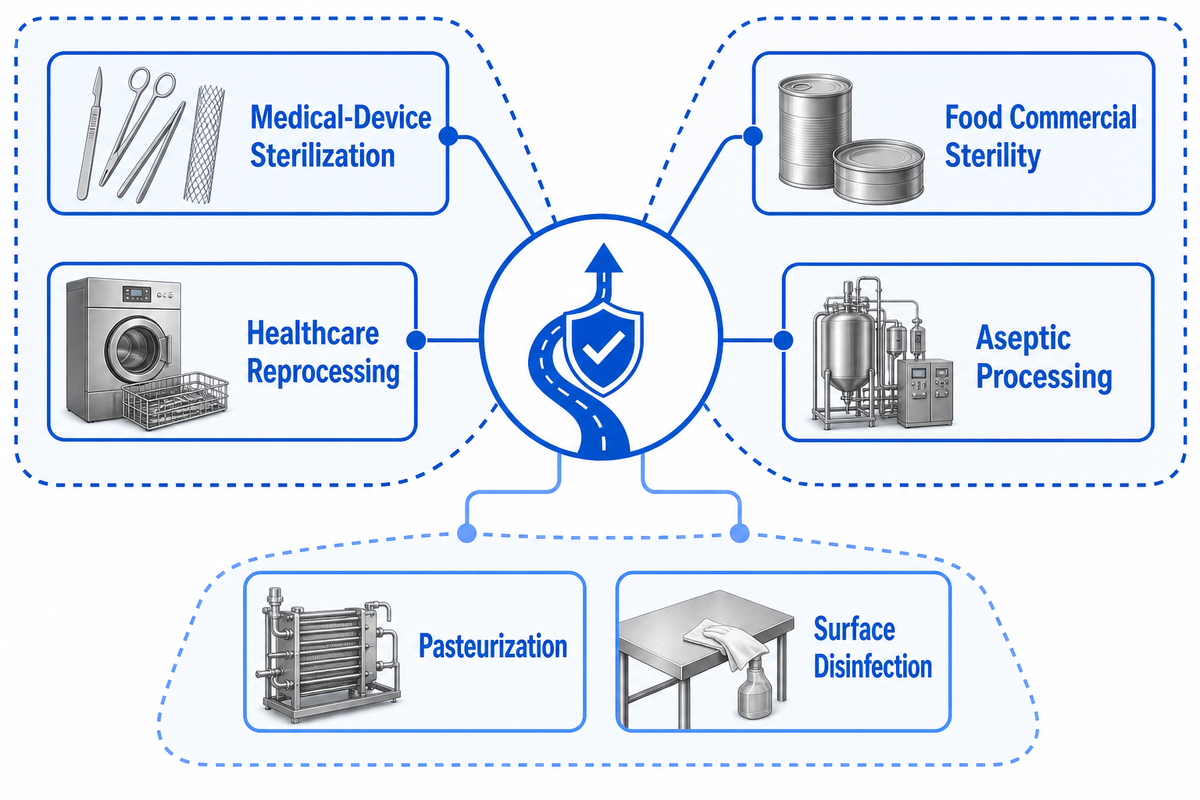
Sterilization equipment applies a controlled physical or chemical route to a defined load, but the required endpoint changes by sector. Those frozen project inputs set the acceptance protocol, change control, and sign-off boundary. Medical-device sterilization, healthcare reprocessing, food commercial sterility, aseptic processing, pasteurization, and surface disinfection use different authorities, load definitions, release evidence, and operating responsibilities. Sharing the word “sterilization” doesn’t make their procedures interchangeable.
Start with the endpoint. CDC healthcare guidance separates sterilization from disinfection and ties route choice to item compatibility. A USDA-hosted NACMCF definition says food pasteurization does not necessarily produce commercial sterility. FDA food guidance then places the product, package, process, and qualified authority inside a different control system.
Use four nouns in every project brief: load, endpoint, route, and evidence. “We need an autoclave” names a possible machine family. “We need a qualified process for this product-package system, with defined monitoring and release records” names a solvable project. If the endpoint is still disputed, pause equipment comparison.
Compare Sterilization Route Families Before Equipment Types
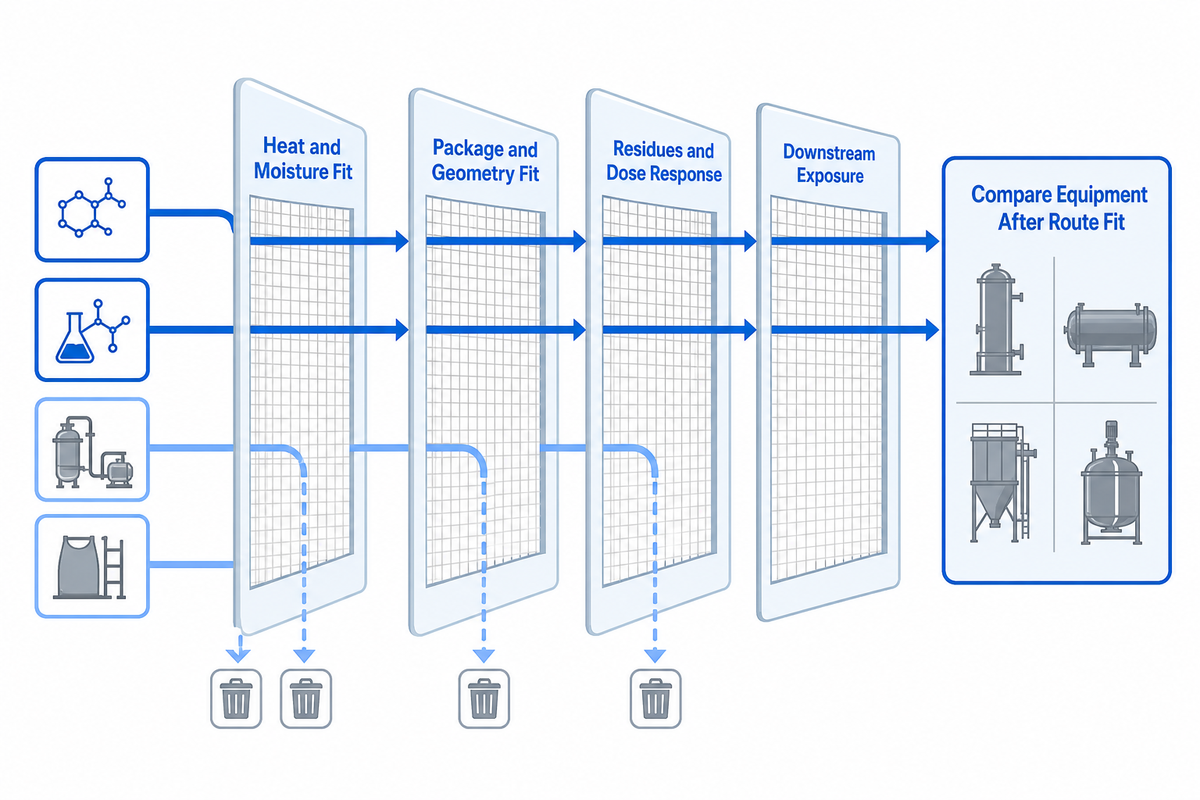
Route selection should eliminate incompatible agents before procurement compares chambers, conveyors, controls, or capacities. Heat tolerance, moisture tolerance, package permeability, product movement, geometry, residues, dose response, and downstream exposure can each disqualify a route. Use this table as a screening map, not operating instructions or a claim that every route delivers the same endpoint.
| Route family | Load or sector fit to investigate | Decision-bearing constraint | Evidence question | Boundary |
|---|---|---|---|---|
| Moist heat / steam | Heat- and moisture-compatible loads | Air removal, steam contact, condensate, package and load geometry | How will the worst-case location be defined and monitored? | Route-specific validation still required |
| Dry heat | Moisture-sensitive, heat-tolerant materials | Heat transfer, exposure uniformity and material tolerance | Which load location is hardest to bring into the qualified state? | Not a substitute for steam by label alone |
| Ethylene oxide | Selected heat-sensitive medical-device loads | Material compatibility, packaging, residuals, aeration and facility emissions | Who owns residual, aeration, emission and current-rule verification? | Medical and facility scope must be explicit |
| Vaporized hydrogen peroxide | Compatible low-temperature device applications | Material, lumen, packaging and system-specific limits | Do the device instructions and route claims cover the actual configuration? | Never infer compatibility from low temperature alone |
| Liquid chemical | Specific immersible or fluid-path applications | Contact, rinsing, residues, material and post-process handling | What prevents recontamination after the process? | Claims depend on the exact system and use |
| Gamma radiation | Radiation-compatible packaged products | Dose mapping, density, orientation and material response | How are minimum and maximum dose locations established? | Dose is product- and configuration-dependent |
| Electron beam | Compatible products with suitable penetration geometry | Penetration, density, conveyor presentation and dose distribution | Can the qualified presentation be maintained in production? | Do not transfer a gamma dose map |
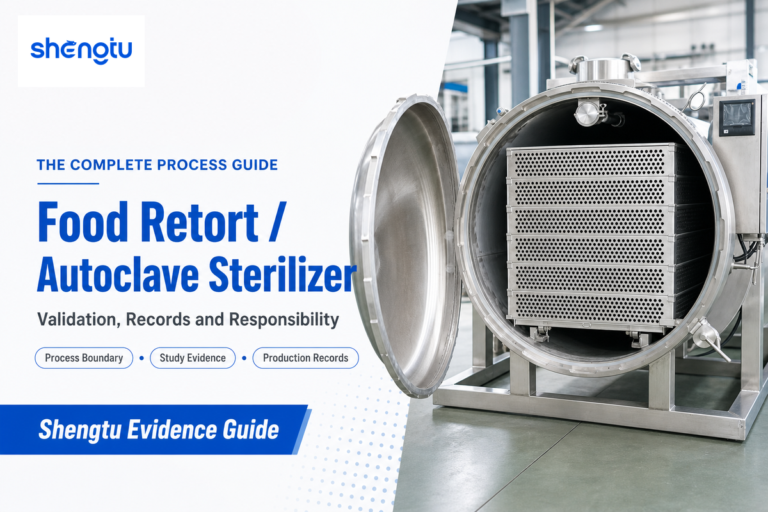
| Food retort | Applicable packaged-food commercial-sterility processes | Product, container, formulation, loading, heat distribution and cooling | Who establishes the scheduled process for this product-package system? | Equipment supplier settings are not a scheduled process |
| UHT plus aseptic filling | Pumpable products with an aseptic system boundary | Product flow, hold system, downstream equipment, filler and package sterilization | Where does the commercially sterile boundary begin and end? | A heater alone is not an aseptic line |
| Food pasteurization | Products whose safety and shelf-life plan uses a pasteurization endpoint | Target organism, product properties, distribution and storage conditions | What endpoint and post-process controls are required? | Does not necessarily create commercial sterility |
The FDA medical-device overview and CDC guidance show several medical routes, while the peer-reviewed cross-sector review explains why one terminal route is not universal. For a food-only screen, use the sterilization route fork before asking for a model.
How Steam Sterilization Equipment Works
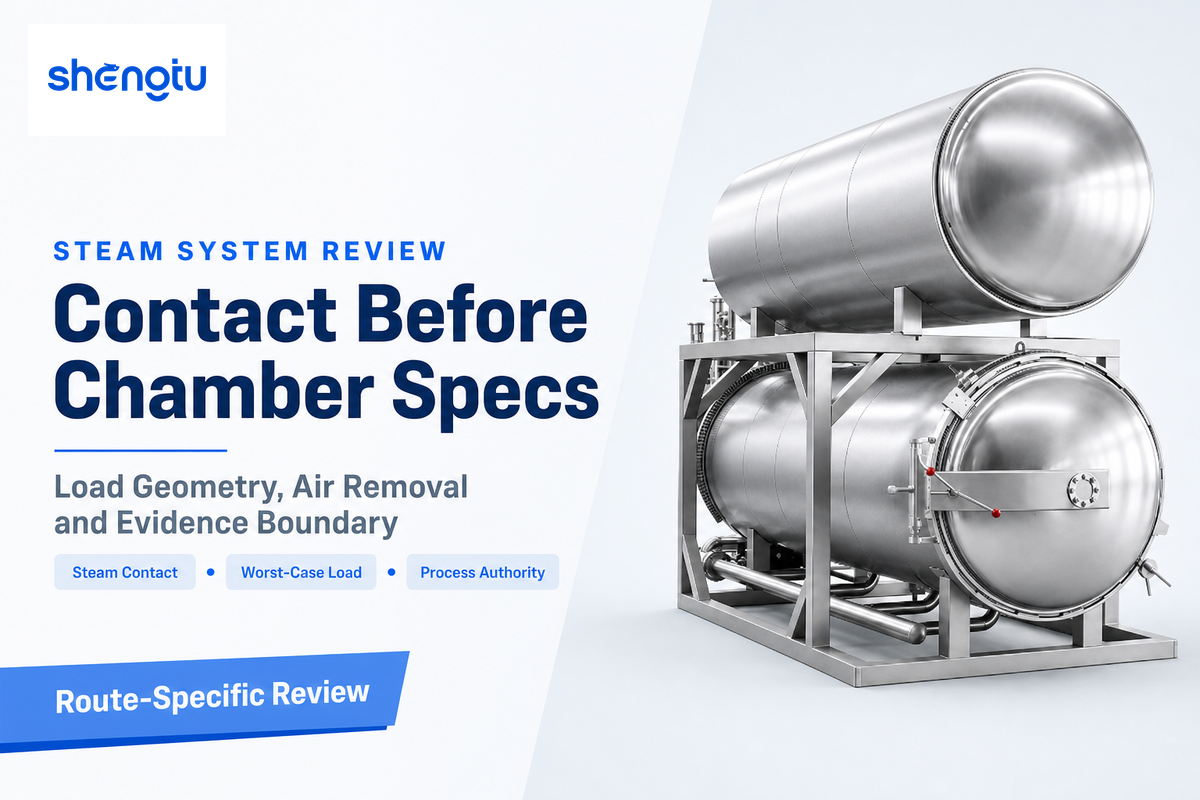
Steam equipment succeeds when saturated steam reaches the defined load locations after air is removed, and the validated process stays within its stated limits. After the route screen, steam demands a closer look at contact throughout the load. Chamber temperature alone can’t prove contact throughout a porous, packaged, lumened, stacked, or densely loaded configuration. Loading pattern, drainage, package, condensate, steam quality, and sensor placement remain part of the process.
Public information for ISO 17665:2024 covers development, validation, and routine control of moist-heat sterilization processes for medical devices. That scope is useful precisely because it is narrow: it does not authorize a food retort schedule or reveal requirements hidden in the paid standard. In food processing, current 21 CFR Part 113 assigns covered scheduled processes to qualified persons with thermal-processing expertise.
Synthesized public-source scenario: a plant receives two proposals for a steam vessel. Proposal A lists chamber volume and a controller. Proposal B also asks for the container, fill, load pattern, cold-location study, venting basis, utilities, cooling, sensors, and process-authority interface. Proposal B isn’t automatically compliant, but it exposes the evidence boundary needed for a meaningful review.
Use the retort and autoclave equipment page only after separating healthcare moist heat from food retort processing. For batch food projects, the retort batch-capacity worksheet helps define the loading basis without pretending capacity establishes a valid process.
Low-Temperature Routes Trade Heat for Other Constraints
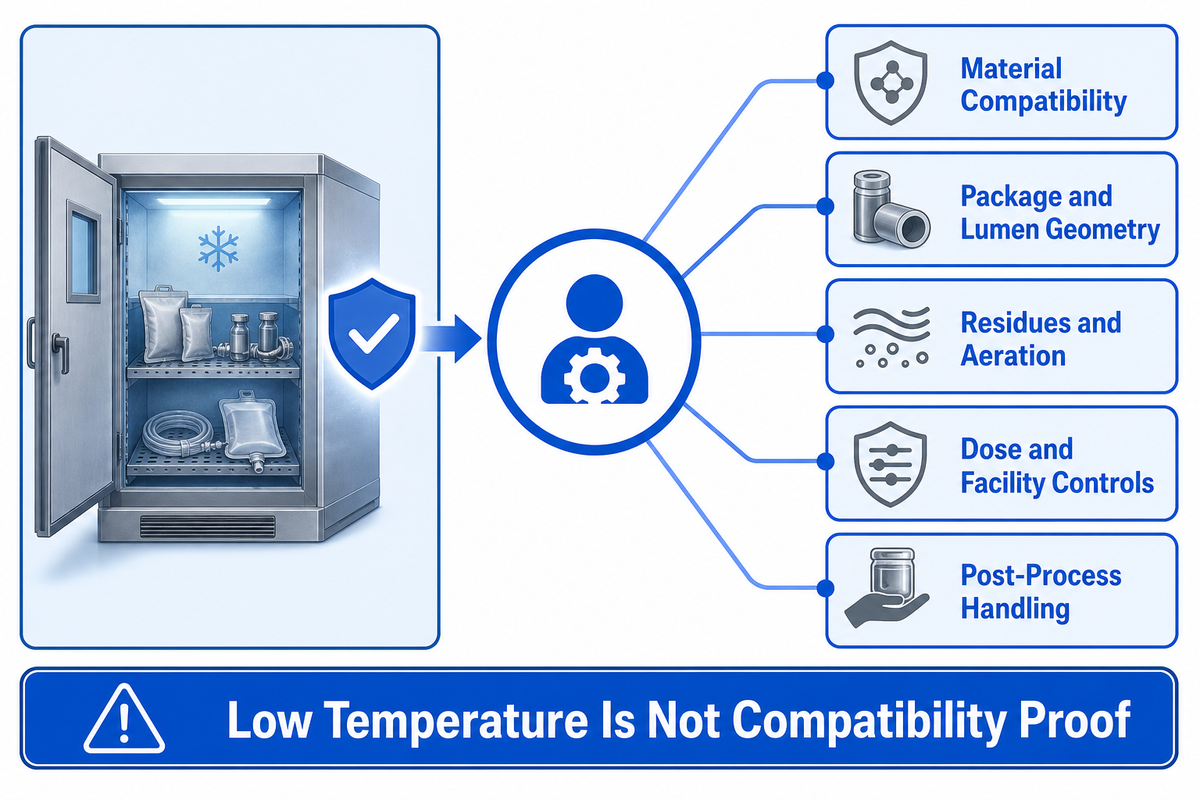
Low-temperature sterilization protects selected heat-sensitive loads by changing the agent, but it introduces a new constraint set rather than removing process risk. That process logic persists with other agents. Material compatibility, package permeability, lumen geometry, residues, aeration, dose distribution, occupational controls, facility emissions, and post-process handling vary by route. Low chamber temperature is therefore not a compatibility certificate.
For medical devices, the device instructions, sterilizer claims, package system, and applicable standards must align with the actual configuration. AAMI’s risk discussion connects variation in material, mass, shape, volume, packaging, instructions, human factors, and validation to reprocessing risk. As Atila Nozari put it in the AAMI account:
“Variability is associated with more risk.” Atila Nozari, quoted by AAMI
Ethylene oxide adds a facility boundary. EPA’s rule-history page lists an April 2024 final air-toxics rule and a March 2026 proposed reconsideration for commercial sterilization facilities. Procurement should therefore assign an owner to confirm current rule status, facility scope, emissions controls, residual and aeration evidence, and any device-submission consequences instead of treating EtO as a chamber-only purchase.
Medical and laboratory labels still need a route boundary
Medical equipment listings use overlapping terms that can conceal different claims. An instrument sterilizer, automatic sterilizer, hot air oven, laboratory chamber, and low-temperature sterilization technology don’t share one validated use merely because each appears under “sterilization products.” A lab, dental clinic, hospital sterile processing department, and device manufacturer may also work under different procedures. Proper sterilization of medical instruments begins with device instructions, the applicable health care policy, infection control requirements, and the exact devices used.
For surgical instruments and other medical devices, distinguish the sterilization process from cleaning, disinfection, inspection, packaging, storage, and distribution. Medical professionals may use an automatic cycle or a manual loading step, but automation doesn’t establish effective sterilization. Each selected method must sterilize medical devices within its cleared or approved scope, and the evidence must address the actual accessory, chamber configuration, pre-vacuum cycles where applicable, and routine checks. Filters, pressurize commands, and cycle-complete flags are only system elements.
Method names need the same discipline. Ethylene oxide gas, hydrogen peroxide, peracetic acid, hot air, UV, and ozone aren’t interchangeable sterilization routes. Some technologies may be used for surface, room, water, device, or process applications under product-specific claims; others may address microorganisms on the surface under a sanitizing or disinfection claim. Steam systems may need to remove air from the defined load path, but that function alone isn’t proof. Don’t say a method “destroys all microorganisms” without a defined test, load, endpoint, and scope. Required lethality, residual limits, and effectiveness must be demonstrated for the project rather than inferred from a broad label.
This vocabulary also affects business decisions. Dual-route proposals may improve contingency or create two validation burdens. Supply-chain claims may concern consumables, packaging, service, or contract capacity rather than machine output. Productivity should therefore be measured against loading, changeover, monitoring, review, release, and rework assumptions, not just an automatic cycle time. That distinction protects patient and operator decisions while keeping pathogen transmission claims inside the evidence actually reviewed.
Food Endpoints: Retort, UHT or Pasteurization?
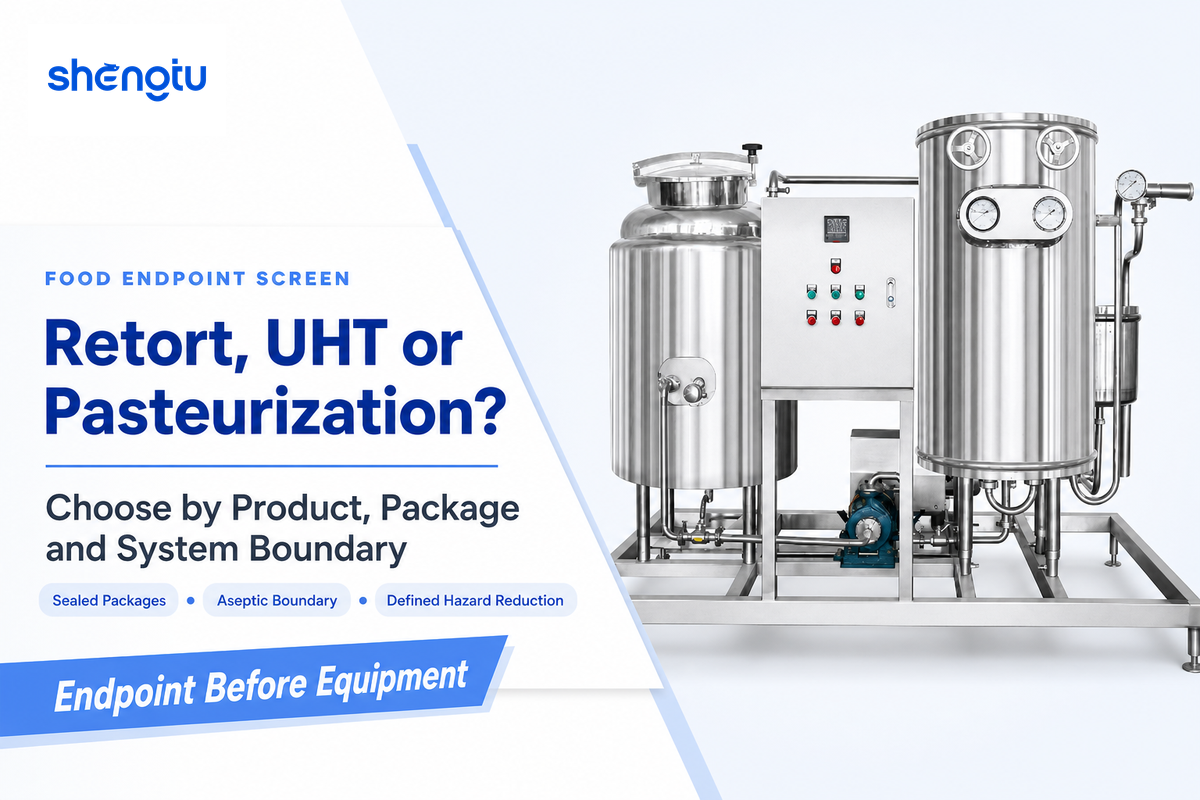
Food equipment must match the intended endpoint and complete product-package system. That route-boundary lesson carries into food loading, monitoring, and release. Retort processing treats applicable sealed packages; UHT processing belongs to a flow system that may extend through aseptic filling and packaging; pasteurization targets a defined hazard reduction under stated distribution and storage conditions. These routes cannot share a universal schedule merely because all apply heat.
For covered U.S. low-acid canned foods, 21 CFR 113.83 places the scheduled process with qualified persons having expert thermal-processing knowledge and adequate facilities. FDA’s LACF inspection guide shows why: critical factors can differ with formulation, viscosity, particle size, fill, headspace, container orientation, cooling, retort come-up, and the processing system. A supplier cannot replace that authority with a default recipe.
In an aseptic project, FDA’s 2005 investigator reference says the process authority must establish a process that ensures commercial sterility not only of the product but also of the product sterilization system and all downstream equipment including the filler, the packaging equipment, and the packaging material. It also says the reference does not bind FDA. Treat it as system-design context and verify current obligations against 21 CFR Part 113 and the qualified project authority. Buyers comparing a UHT sterilizer should therefore also define the UHT and aseptic-filling line boundary.
Synthesized public-source scenario: a beverage team asks whether a pasteurizer, retort, or UHT line is “best.” The first review finds that shelf-life target, package state during treatment, product flow behavior, storage condition, and regulatory category are unsettled. Close those endpoint questions before comparing heat exchangers, baskets, conveyors, or fillers. One plate pasteurizer may fit a defined route; it is not the default answer to every beverage project.
The 3-Axis Load-Route-Evidence Triangle
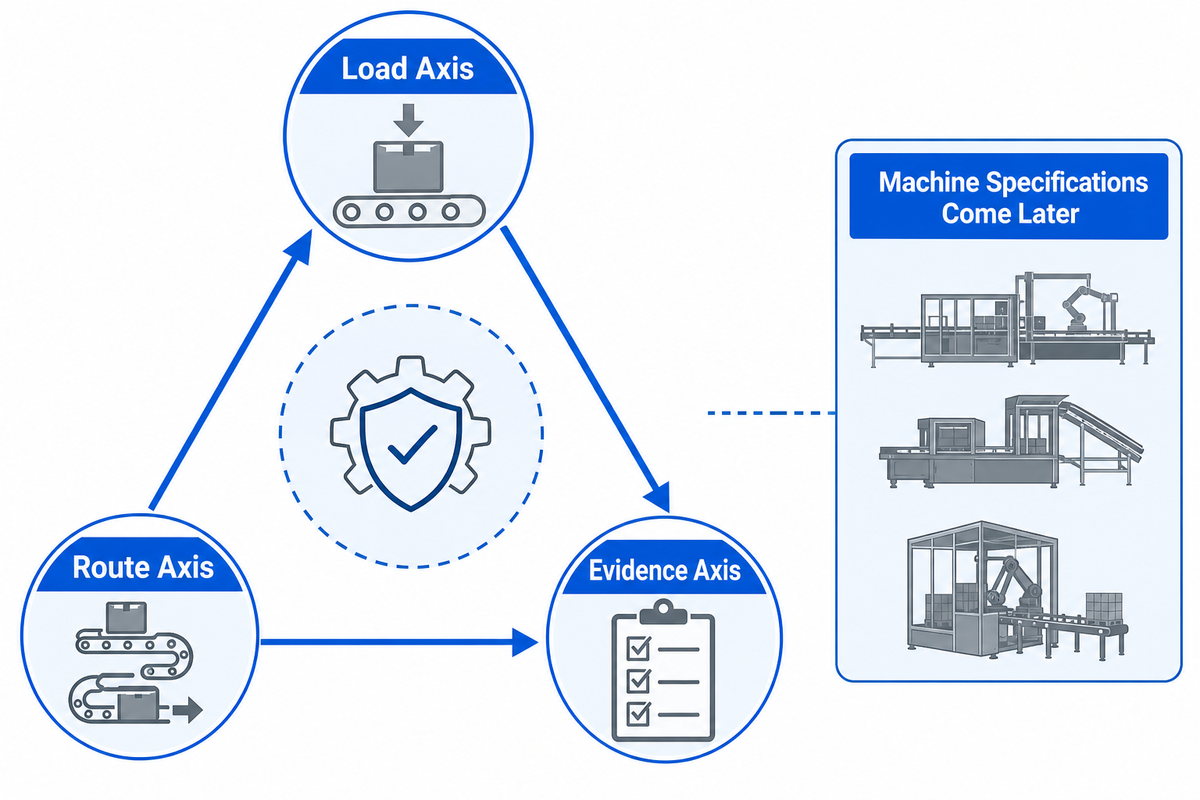
Definition: The 3-Axis Load-Route-Evidence Triangle screens the load, then the compatible route, then the proof required to release production. Select in the order load, compatible route, then evidence plan before comparing machine specifications. It prevents machine specifications from becoming the starting assumption and gives engineering, quality, operations, and procurement one order for closing unknowns before commercial comparison begins.
- Load axis — define product or device identity, materials, formulation, geometry, mass, package, orientation, incoming condition, worst case, and variants. For foods, add factors such as viscosity, particle size, fill, headspace, initial state, and cooling where relevant.
- Route axis — eliminate agents the load or package cannot tolerate. Then define the system boundary: chamber only, upstream preparation, downstream filler, utilities, emission controls, post-process handling, or storage.
- Evidence axis — name the authority, development owner, validation method, routine monitors, acceptance criteria, release record, deviation response, requalification trigger, and change-control owner.
Sequence matters. If buyers start with route, they may force a product into a familiar method. If they start with evidence but can’t describe the load, the protocol has no worst case. If they start with machine output, bidders may quote different load patterns and acceptance boundaries. Completing the triangle gives each bidder the same problem.
Synthesized public-source scenario: a pouch project appears to need a retort. The load axis reveals several pouch sizes and orientations; the route axis reveals cooling and package-pressure concerns; the evidence axis reveals that no process authority or representative worst-case pack has been assigned. Procurement can still request budget information, but a firm performance promise would be premature. The package-format compatibility check and utility-readiness checklist help expose those inputs without replacing validation.
The Hidden Bottleneck Map
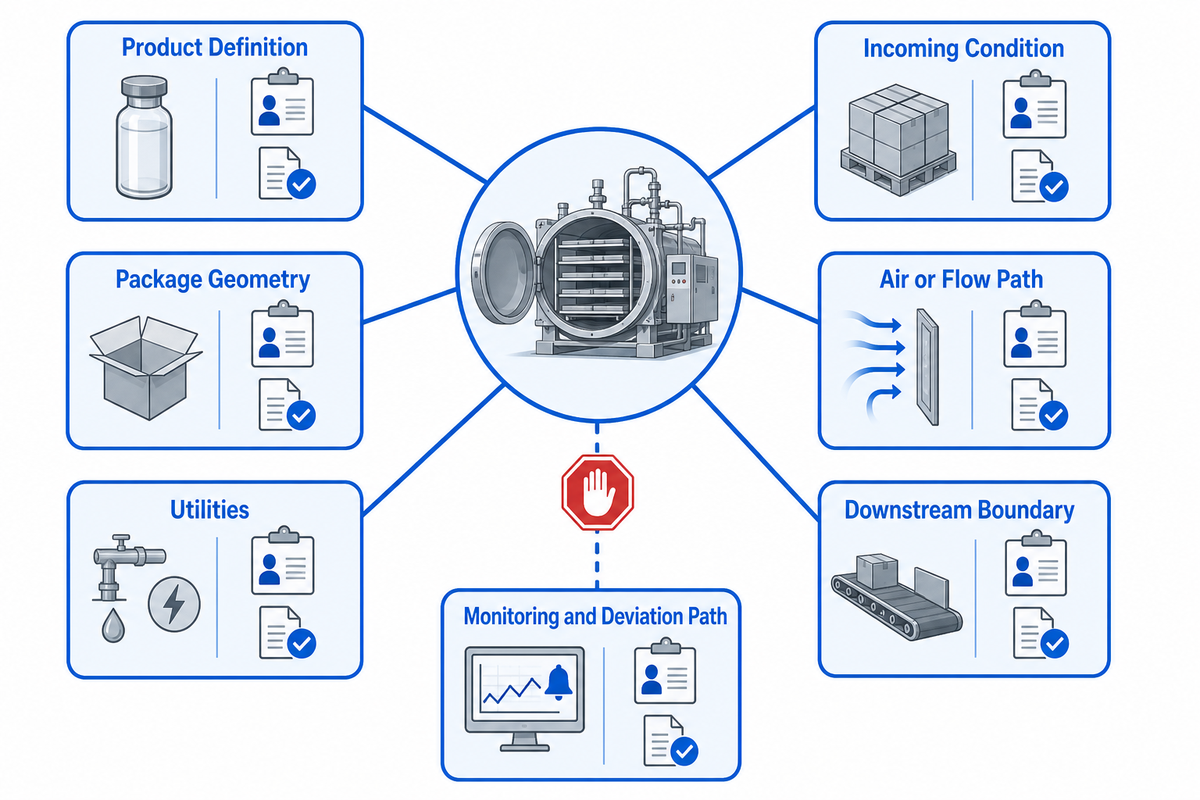
Sterilization projects often fail outside the vessel or heating section. The hidden bottleneck is the first uncontrolled condition that prevents the intended agent, load presentation, downstream boundary, or evidence chain from staying valid. Mapping it before quotation reveals work that headline chamber volume, temperature capability, or nominal throughput cannot show.
| Bottleneck type | Failure entering the process | Owner to name | Evidence to close it | Stop condition |
|---|---|---|---|---|
| Product definition | Formula, material, geometry or variant is changing | Product engineering or food technologist | Controlled specification and variant matrix | No worst-case load can be named |
| Incoming condition | Unknown contamination, cleanliness or initial state | Quality and upstream operations | Sampling basis and incoming limits | Development assumptions cannot be maintained |
| Package geometry | Agent contact or heat transfer changes with pack and orientation | Packaging and process authority | Approved pack, orientation and load drawing | Supplier is asked to guess presentation |
| Air or flow path | Trapped air, blocked flow or unstable residence path | Process engineering | Distribution study and defined load pattern | Chamber reading is treated as load evidence |
| Utilities | Supply quality or capacity changes process behavior | Facilities and supplier | Measured utility envelope and interface test | Site basis exists only as a nominal value |
| Downstream boundary | Filler, package or handling can reintroduce risk | Line integrator and quality | Boundary diagram and interface protocol | Aseptic claim ends at the heater |
| Monitoring chain | Sensor, recorder, time base or identity link is incomplete | Controls and quality | Traceable test, data map and record review | Release relies on an unverified display |
| Deviation path | An abnormal run has no hold, review or disposition rule | Quality and process authority | Approved deviation workflow and test case | Alarm acknowledgment substitutes for disposition |
| Change control | Load, software, utility, package or recipe changes silently | System owner and quality | Change matrix with re-review triggers | Qualified state cannot be defended |
The map separates equipment supply from process responsibility without creating gaps between them. In practice, a bidder should mark each item “supplier supplied,” “buyer supplied,” “process-authority supplied,” “requires joint validation,” or “unknown.” An unknown is not automatically a reason to reject a project; it is a reason to avoid a firm acceptance promise until the owner and evidence are named across design, commissioning, validation, routine operation, and change control.
Validation, Routine Monitoring and Records Are Different Jobs
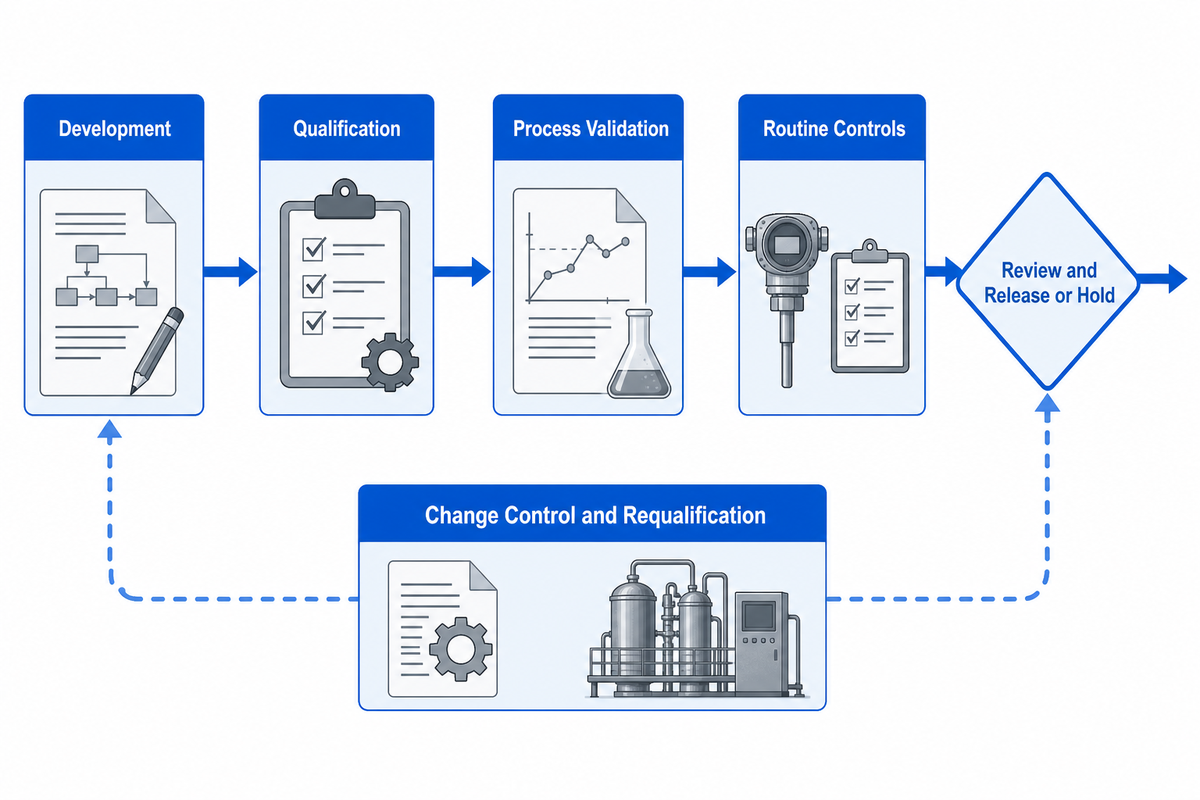
Validation establishes that a defined process can achieve its intended result for a defined load and system; routine monitoring shows whether each production run stayed within its approved conditions. Records connect product identity, equipment state, measured variables, alarms, operator actions, deviations, review, and release. None of those jobs is replaced by a cycle-complete signal.
Practical evidence plans have layers. Development defines the route and critical variables. Qualification establishes equipment and system capability. Process validation uses the approved product, package, load, and challenge. Routine controls capture the run. Review rules decide release or hold. Change control asks whether a modification affects the qualified state. Requalification is triggered by the approved risk and change logic, not by an improvised calendar copied from another sector.
Current eCFR text illustrates why direct source checks matter. For covered Part 113 equipment, a temperature-indicating device is tested for accuracy on installation and at least annually against a traceable reference device. For most records under 21 CFR 113.100, retention is at least one year at the plant plus two additional years at the plant or another reasonably accessible location. Those details are food-scope examples, not universal retention rules.
A 2016 PubMed-indexed review of failed healthcare loads attributes failures to more than sterilizer malfunction: steam quality, wrong cycle selection, and packaging or loading errors also appear. A 2026 peer-reviewed steam-sterilization review corroborates that broader failure frame with improper packing or loading, equipment malfunction, steam-quality problems, and cycle errors in ophthalmic surgical processing. That failure taxonomy is valuable across procurement discussions, but its healthcare context must remain visible. It supports investigating system causes; it doesn’t create a food schedule.
Review practice: ask a bidder to demonstrate how one representative run moves from recipe selection to recorded identity, sensor data, alarm handling, hold status, review, and authorized release. Then inject a controlled deviation during acceptance. A system that records only successful cycles hides the evidence needed on the day a run doesn’t behave as planned.
6 Selection Failures and Responsibility Gaps
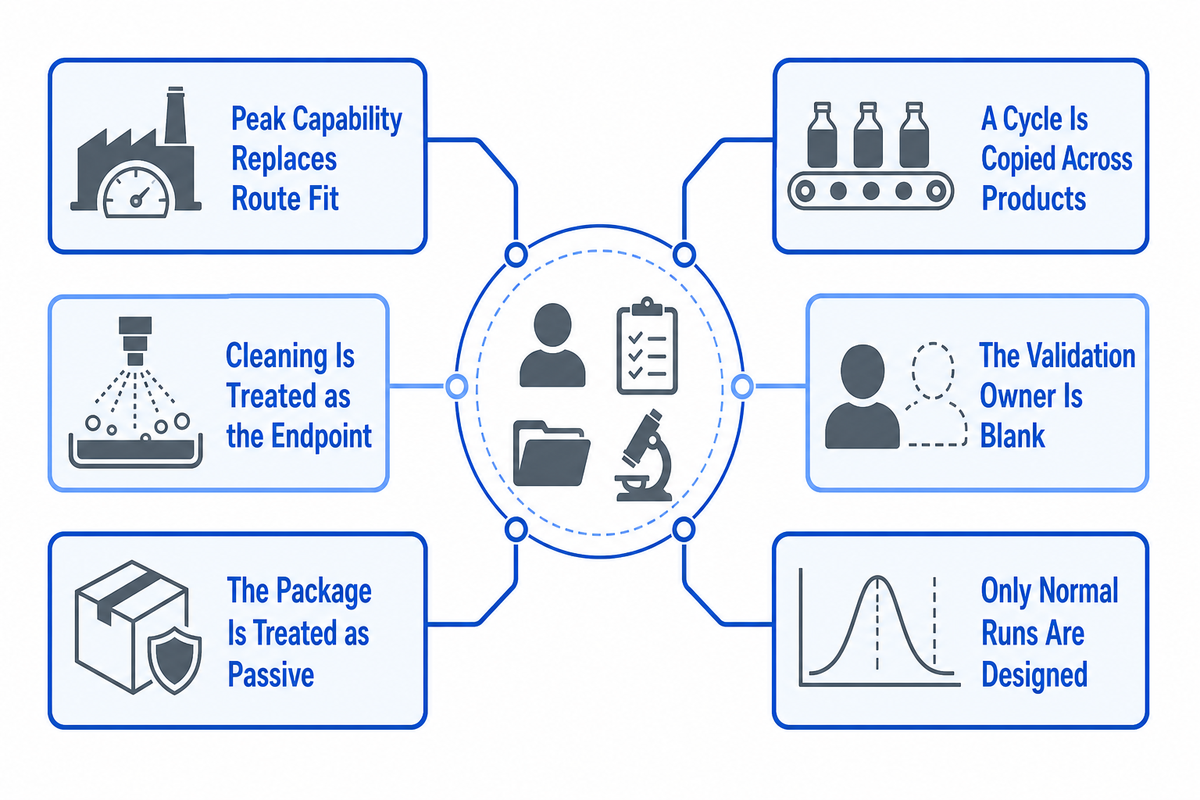
Equipment selection fails when a polished specification leaves the process boundary ownerless. The recurring errors are choosing by peak temperature, treating cleaning as sterilization, ignoring package and load geometry, copying a cycle across sectors, leaving validation ownership undefined, and omitting deviation or change-control records. Each error survives until an owner and evidence requirement are written beside it.
- Peak capability replaces route fit. A maximum value says little about agent contact, load compatibility, distribution, or proof.
- Cleaning is treated as the endpoint. Cleaning, disinfection, pasteurization, sterilization, and commercial sterility solve different problems. The CIP system boundary belongs upstream of many processes but isn’t automatically the sterilization claim.
- The package is treated as a passive container. Package permeability, seal, orientation, fill, headspace, density, and post-process handling can change the process.
- A cycle is copied from another product or sector. Familiar numbers become dangerous when the load, authority, route, or release endpoint changes.
- The validation owner is left blank. Supplier commissioning, process-authority work, validation, and buyer acceptance must be separated and connected.
- Only normal runs are designed. Alarm, hold, deviation, disposition, data retention, recipe revision, and change control need an agreed path.
Proceed to firm comparison when
- Endpoint and scope are agreed
- Representative loads and worst cases exist
- Route constraints and utilities are documented
- Validation, release and change owners are named
Keep the quote conditional when
- Product or package is still moving
- The authority or required endpoint is unsettled
- A bidder must invent the load pattern
- Acceptance is reduced to “machine runs”
2026 Regulatory Signals: Scope Before Market Hype
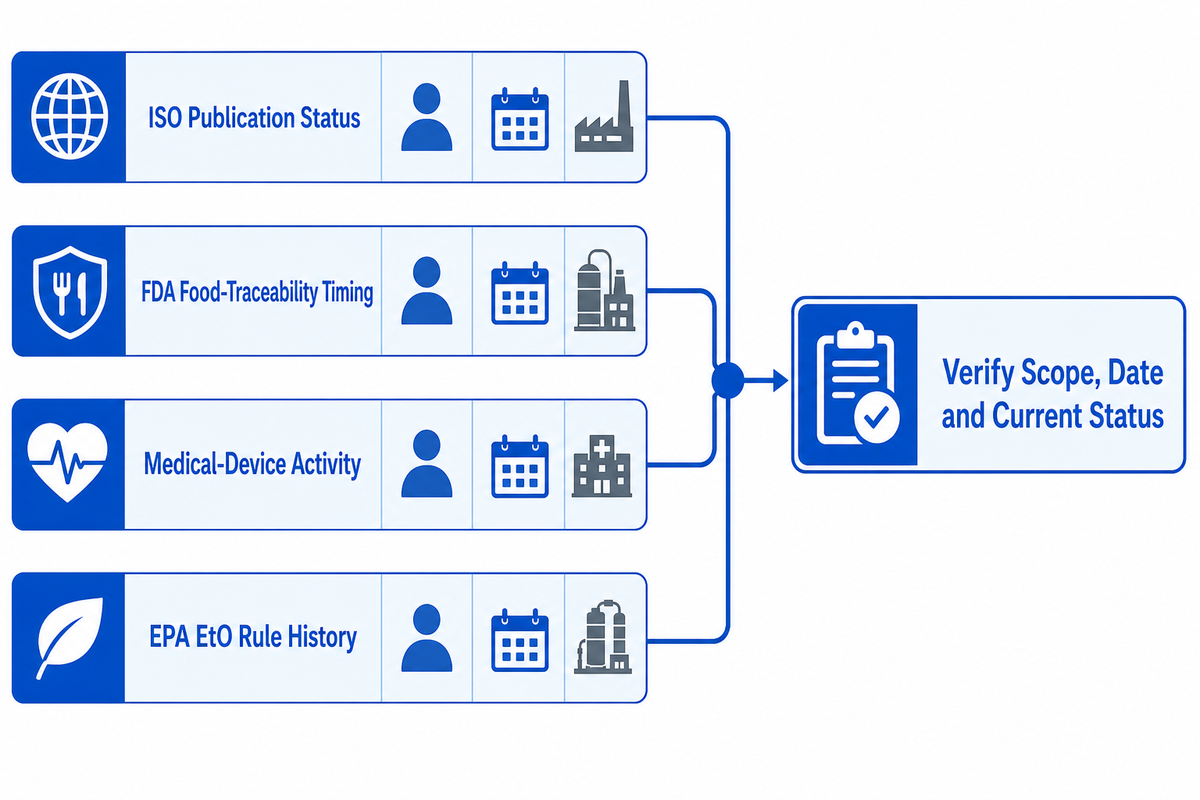
The useful 2026 signal is not a universal growth forecast. That acceptance failure matters when regulatory signals are reduced to a machine-purchase story. It is the need to track sector-specific changes without turning them into a cross-sector buying trend. ISO publication status, FDA food-traceability timing, medical-device activity, and EPA EtO rule history affect different owners and decisions. Their shared lesson is to verify scope, date, and current status.
ISO lists ISO 17665:2024 as the current moist-heat process standard for medical devices and shows earlier split documents as withdrawn. FDA’s food-traceability page applies additional records to persons handling foods on the Food Traceability List; it also says Congress directed FDA not to enforce the rule before July 20, 2028. That does not mean every sterilization buyer needs the same records or equipment.
The EPA EtO page is even more visibly dynamic, showing a 2024 final rule and a 2026 proposed reconsideration. Treat the page as a current-status checkpoint, not a frozen legal conclusion. A procurement file should record which source was checked, on what date, for which facility and product scope, and who must recheck it before design freeze or operation.
Because independent sources did not support one defensible sterilization-equipment CAGR, this guide does not publish one. Decision quality improves more from current rule ownership and traceable project evidence than from an unsupported market-size number.
Build an Evidence-Ready Sterilization Equipment RFQ
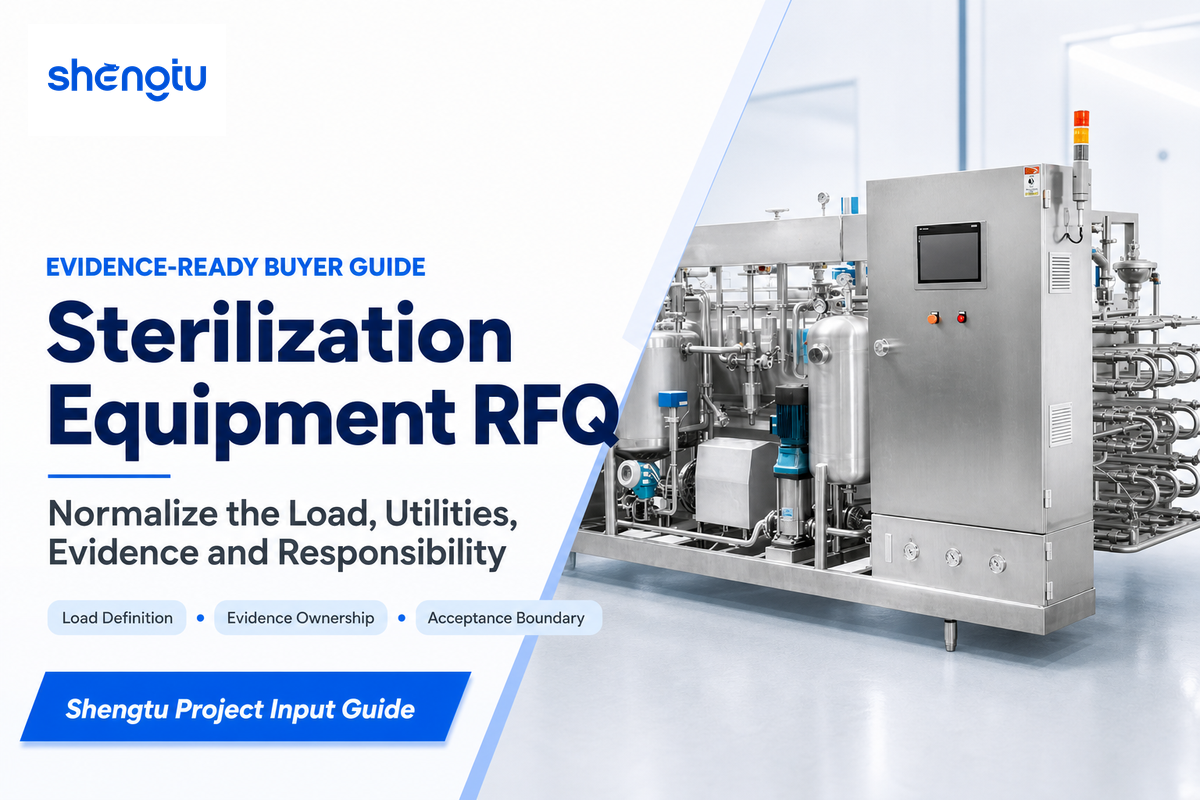
An evidence-ready RFQ gives every bidder the same product, package, load, route boundary, utilities, monitoring, acceptance, and responsibility assumptions. That rule ownership and traceable project evidence belong in the RFQ, not in a detached market forecast. It distinguishes confirmed values from unknowns and asks suppliers to declare inclusions, exclusions, dependencies, and proof. This makes capacity and price comparisons meaningful while keeping process-authority and validation duties visible.
Evidence-Ready RFQ — copy these fields into the quote request:
| Parameter | Project-specific value | Why it matters | Owner / how to verify | Limitation status |
|---|---|---|---|---|
| Sector and endpoint | Applicable product category, authority and intended endpoint | Prevents cross-sector cycle transfer | Buyer quality and process authority | Confirmed / unknown |
| Product and package | Controlled specifications, variants, fill, geometry and materials | Defines compatibility and worst case | Approved documents and samples | Buyer supplied |
| Load presentation | Pattern, orientation, density, containers and change parts | Controls agent contact and distribution | Joint load drawing and trial | Requires validation |
| Throughput basis | Mix, shifts, batch basis, changeover, loading and release time | Makes capacity claims comparable | Witnessed run with stated exclusions | Supplier and buyer inputs |
| Utilities and facility | Supply quality, drains, ventilation, emissions, access and interfaces | Site conditions can change performance | Measured site data and interface test | Buyer supplied / supplier checked |
| Monitoring and records | Sensors, identity, time base, data fields, alarms, audit and retention | Supports routine review and release | Data map and challenged demonstration | Supplier supplied / quality approved |
| Validation boundary | Development, equipment qualification, process validation and requalification | Prevents ownerless proof work | Responsibility matrix and protocol | Process-authority / joint scope |
| Acceptance and change control | Samples, tests, pass rules, deviation cases, revisions and sign-offs | Connects purchase acceptance to evidence | Witnessed protocol and change matrix | Confirmed before final acceptance |
Mark every cell “confirmed,” “buyer supplied,” “supplier supplied,” “process-authority supplied,” “requires validation,” or “unknown.” Normalize proposals against those labels before comparing price. If an output promise assumes a different package, load pattern, utility condition, or release time, it isn’t the same offer.
For projects ready to discuss a food-processing system, review Shengtu’s sterilization and aseptic-filling scope or the retort canned and pouch line. Bring the completed checklist, representative product and package information, and the planned evidence boundary. Machine configuration, commercial specifications, and quotation remain on the solution pages.
Discuss your sterilization project inputs
Frequently Asked Questions
The answers below clarify the sterilization project inputs buyers most often need before that discussion.
What equipment is used for sterilization?
Equipment families include steam sterilizers and autoclaves, dry-heat systems, ethylene-oxide systems, vaporized-hydrogen-peroxide systems, liquid-chemical systems, gamma and electron-beam systems, food retorts, UHT systems with an aseptic boundary, and pasteurizers for a different endpoint. The right family depends on the load, package, sector, compatible agent, facility, and evidence plan. A list can’t establish route compatibility, a valid cycle, or responsibility for release.
What are the three main types of sterilization?
There’s no single three-type classification that serves every sector. A high-level teaching model may group methods as thermal, chemical, and radiation routes, but procurement needs a finer split because steam, dry heat, EtO, hydrogen peroxide, liquid chemicals, gamma, electron beam, retort, and aseptic-food systems impose different load and proof constraints. State the sector and endpoint before using any simplified grouping.
How does an autoclave work?
An autoclave uses controlled moist heat in a pressure vessel, with air removal and steam contact designed for defined load locations. Pressure supports the steam condition; pressure alone is not proof. Load geometry, packaging, condensate, drainage, steam quality, sensors, validation, monitoring, and release rules determine process suitability for that load.
Is a sterilizer the same as an autoclave?
No. “Sterilizer” covers several routes. “Autoclave” usually describes a pressure vessel using steam or another defined thermal process. Confirm the agent, load, boundary, and endpoint rather than relying on the name.
Can a supplier provide the sterilization cycle?
A supplier can provide equipment capability, control functions, operating documentation, development support, and agreed tests. Authority to establish the process depends on the sector, qualifications, contract, product-package system, and governing rules. For covered U.S. low-acid canned foods, the scheduled process belongs to a qualified person with expert thermal-processing knowledge and adequate facilities. Commissioning confirms agreed equipment functions; it doesn’t automatically validate every product, package, load, or release claim. Write separate owners for process development, equipment qualification, process validation, routine review, deviations, and change control. Ask which deliverables are supplier supplied, buyer supplied, process-authority supplied, or joint. If the supplier offers process work, record the exact scope, source data, qualifications, assumptions, exclusions, representative samples, acceptance method, and final approval route.
What should be verified before requesting a quotation?
Verify the endpoint, product and package, worst-case load, route, utilities, evidence owners, acceptance samples, deviations, change triggers, and unknowns. Ask every bidder to price the same assumptions and declare exclusions.
References & Sources
- Electronic Code of Federal Regulations, 21 CFR Part 113
- FDA, Aseptic Processing and Packaging for the Food Industry
- FDA, Additional traceability records for certain foods
- FDA, Sterilization for Medical Devices
- CDC, Sterilization guidance for healthcare facilities
- USDA ARS, NACMCF food-pasteurization definition summary
- PubMed, 2016 review of failed sterilization loads
- PubMed Central, 2026 review of steam-sterilization failures
- PubMed Central, Multidisciplinary review of sterility assurance
- ISO, ISO 17665:2024 public scope and status
- AAMI, Risk management in medical-device reprocessing
- EPA, Ethylene oxide emissions standards for sterilization facilities
Review note: Reviewed for technical scope, source boundaries, and procurement usefulness by the Shengtu Machinery technical team. Final route, process, equipment configuration, validation, and release criteria remain project- and authority-dependent.


![How Is Freeze Dried Coffee Made? [Process Guide]](https://shengtumachinery.com/wp-content/uploads/2026/08/fd-coffee-tea-beverage-line-guide-featured-150x150.png)


