
Get in touch with Shengtu Bufan Company

Breading Machine and Batter Applicator Lines for Food Factories
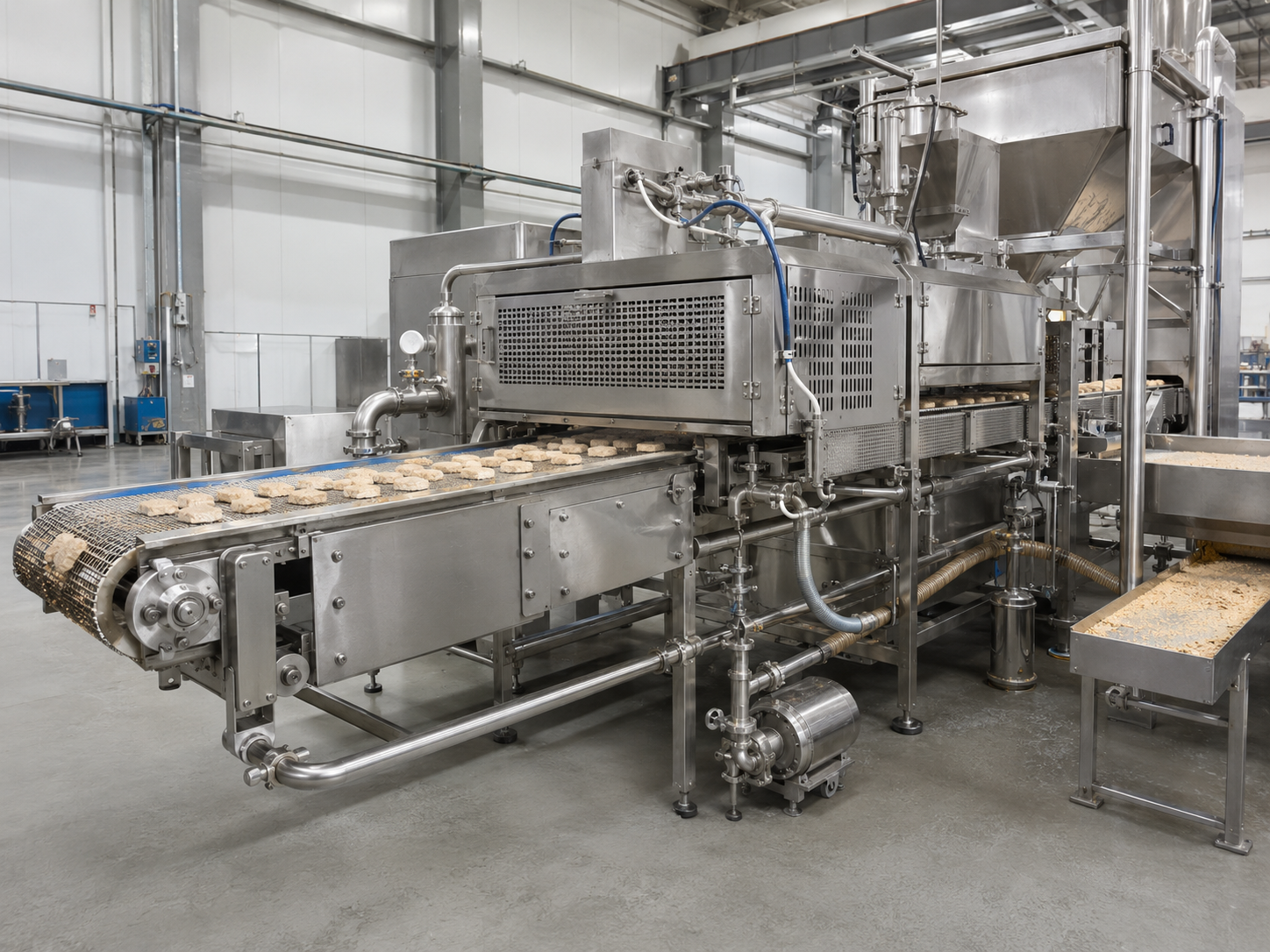
A breading machine applies predust, batter and crumb to a food product on a moving belt, in place of hand coating. On a further-processing line it sits between forming or portioning upstream and the fryer downstream, and its real job is holding coating pick-up inside the band your product label allows. This page is written for food factories buying a line component, not for a kitchen buying a countertop unit.
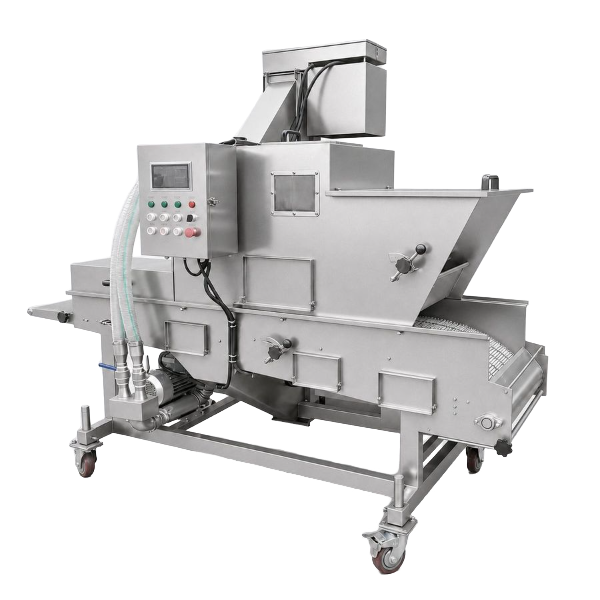
Shengtu Bufan designs, manufactures and commissions the coating section of a further-processing line: predust applicator, batter applicator, crumb applicator and drum breader, sized to your product and your existing conveyor pitch. Tell us the product, the target output and the crumb you use, and we return a station layout and a written quotation. Around 80 percent of the core food equipment we supply is built in our own factory rather than bought in and relabelled.
We are a food machinery manufacturer in Zhucheng, Shandong, inside the Zhucheng Food Machinery Industrial Cluster, with branch offices in Qingdao, Changzhou and Weifang. One named project engineer owns your enquiry from first drawing through commissioning, and technical questions come back within one working day.
- Written quotation within one working day
- A standard machine ships 30 working days after deposit and drawing approval
- Five coating routes in one section
- We accept a single machine
Product photographs, recipes and crumb specifications you send stay inside the project team.
Line Capability, Lead Time and Minimum Order at a Glance
Five facts a buyer usually has to email three times to obtain. Each one is a commitment we hold, not a range borrowed from the market.
One working day
From your product, target output and voltage to a written quotation
5 coating routes
Predust, submerging batter, waterfall batter, crumb applicator, drum breader
A single machine
Minimum order. One unit is a real order, not a favour
30 working days
Standard machine, after the deposit clears and drawings are approved
30 to 45 days
Customised or multi-machine coating sections
12 months
Warranty from commissioning, wear parts in the shipment
Five Machine Families in One Coating Section
An industrial breading machine is rarely bought alone. What buyers call an automatic batter breading machine is in practice three or four consecutive stations, and the station order in a batter-breading section is not a matter of taste. Manual breading collapses the whole chain into one pair of hands, which is why it drifts.
US patent US20100047411A1 describes the breading machine as fed by conveyor from prior equipment such as a batter applicator, which is the same order every plant runs.7
Predust applicator
Lays a thin dry layer directly on the product surface so the wet batter has something to grip. Predust is the cheapest insurance against coating loss, and it is the station buyers most often try to delete.
ApplicationsSuits: formed patties, whole-muscle fillet, wet-surfaced product straight out of a marinator.
Submerging batter applicator
Carries product under the batter surface on a submerger belt, so every face is wetted at once. This is the route for thick coatings and for egg-wash style systems.
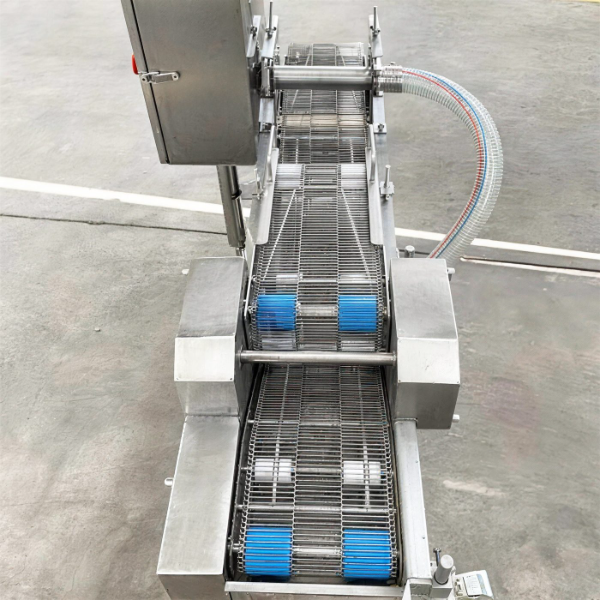
Open mesh wire conveyor and hold-down rollers, which keep product spaced and oriented.
ApplicationsSuits: tonkatsu-style cutlets, thick-coated seafood, vegetables that need full enclosure.
Waterfall batter applicator
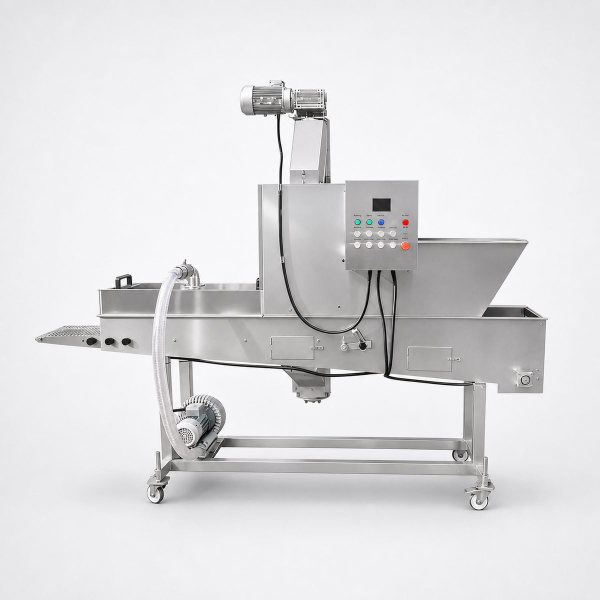
An automatic batter applicator of the waterfall type runs a falling curtain over product on an open mesh belt, with the excess recirculated. US patent US4058083A describes exactly this arrangement, an open mesh wire conveyor receiving spaced and oriented product with rear batter flow.
ApplicationsSuits: thin adhesion batters, tempura, high-speed lines where dwell time is short.
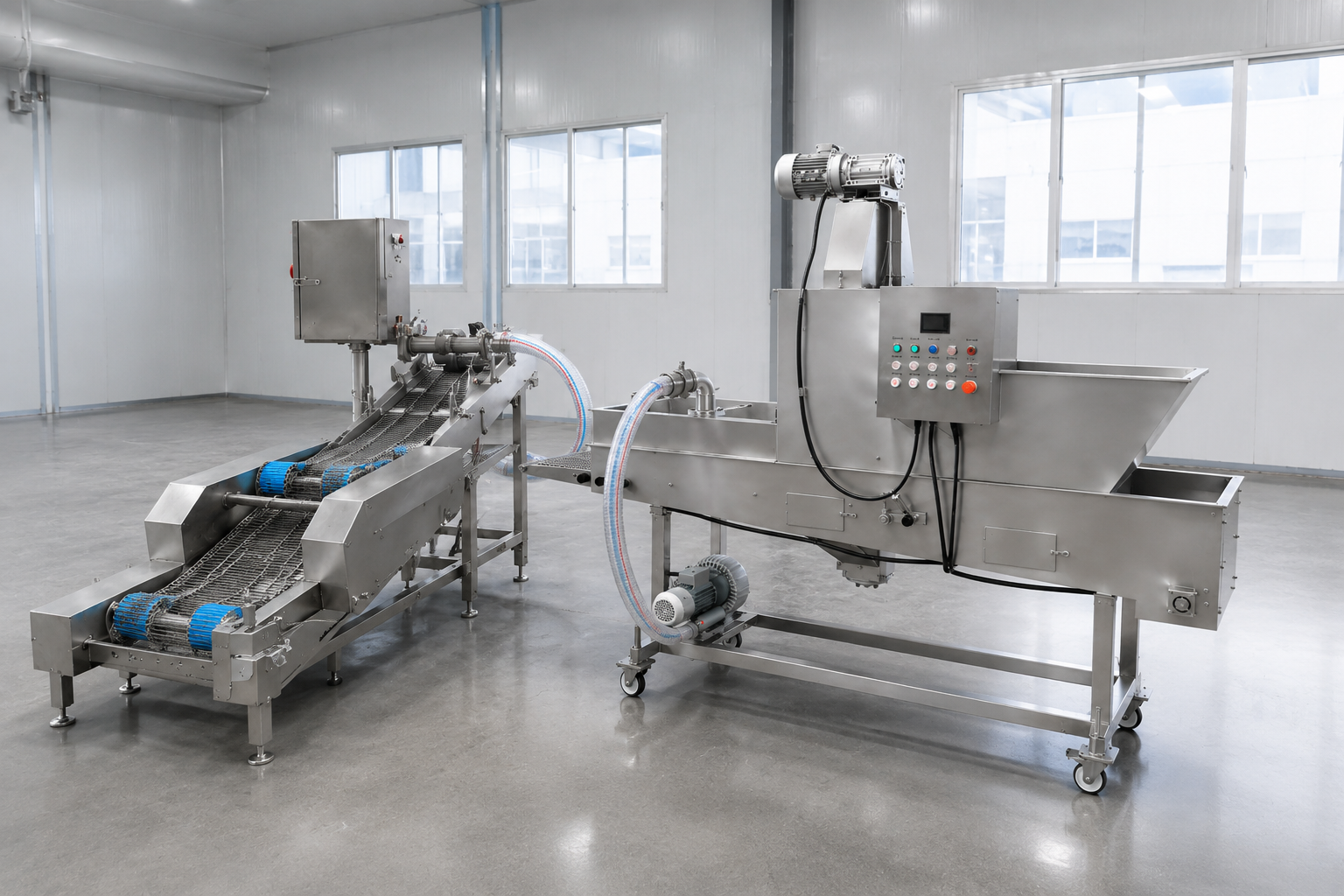
Crumb applicator
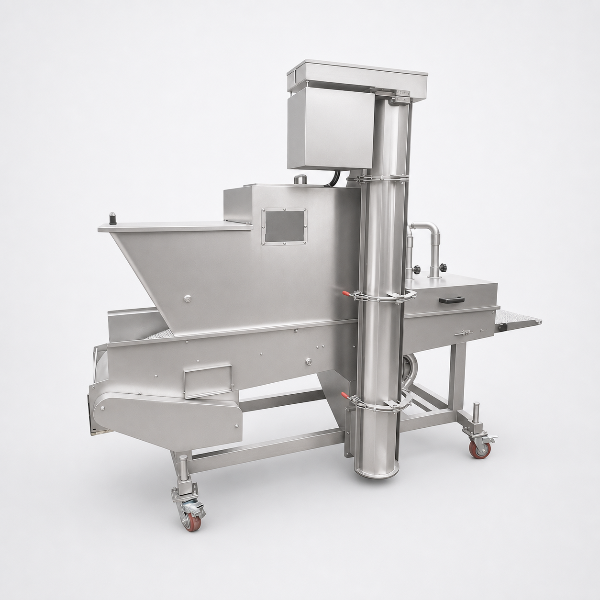
Vertical crumb-return elevator
A vertical crumb-return elevator sends excess crumb back to the hopper rather than to waste.
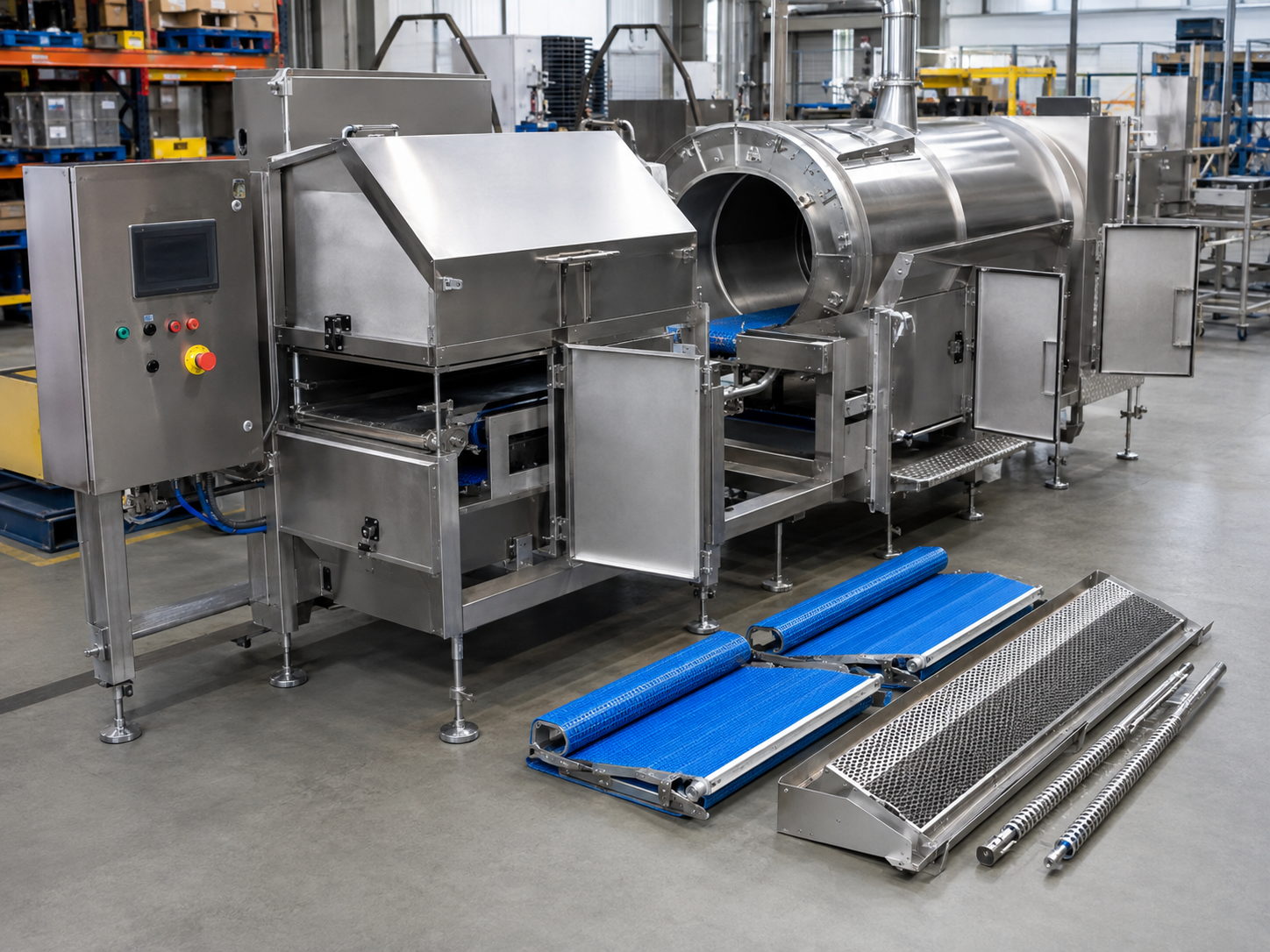
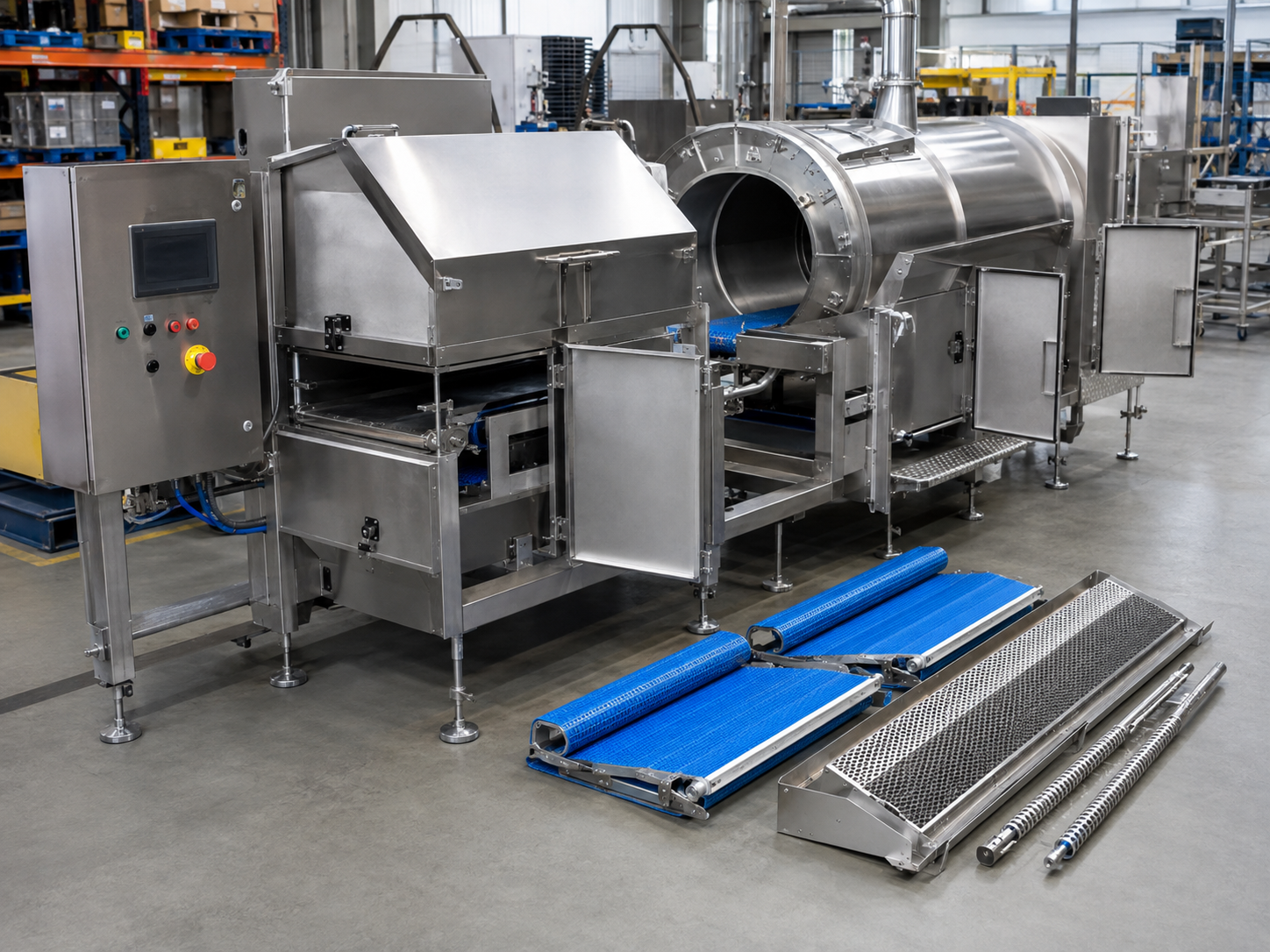
Beds product on a lower crumb layer, showers an upper layer, then removes the excess and returns it to the hopper. Bed depth and shower rate are set together so the crumb lands evenly across the belt rather than heavier at the centre. Belt lift-out is designed in because the crumb circuit is the part your cleaning crew fights with.
ApplicationsSuits: breadcrumb, cracker meal, panko and tempura flake on flat or lightly contoured product.
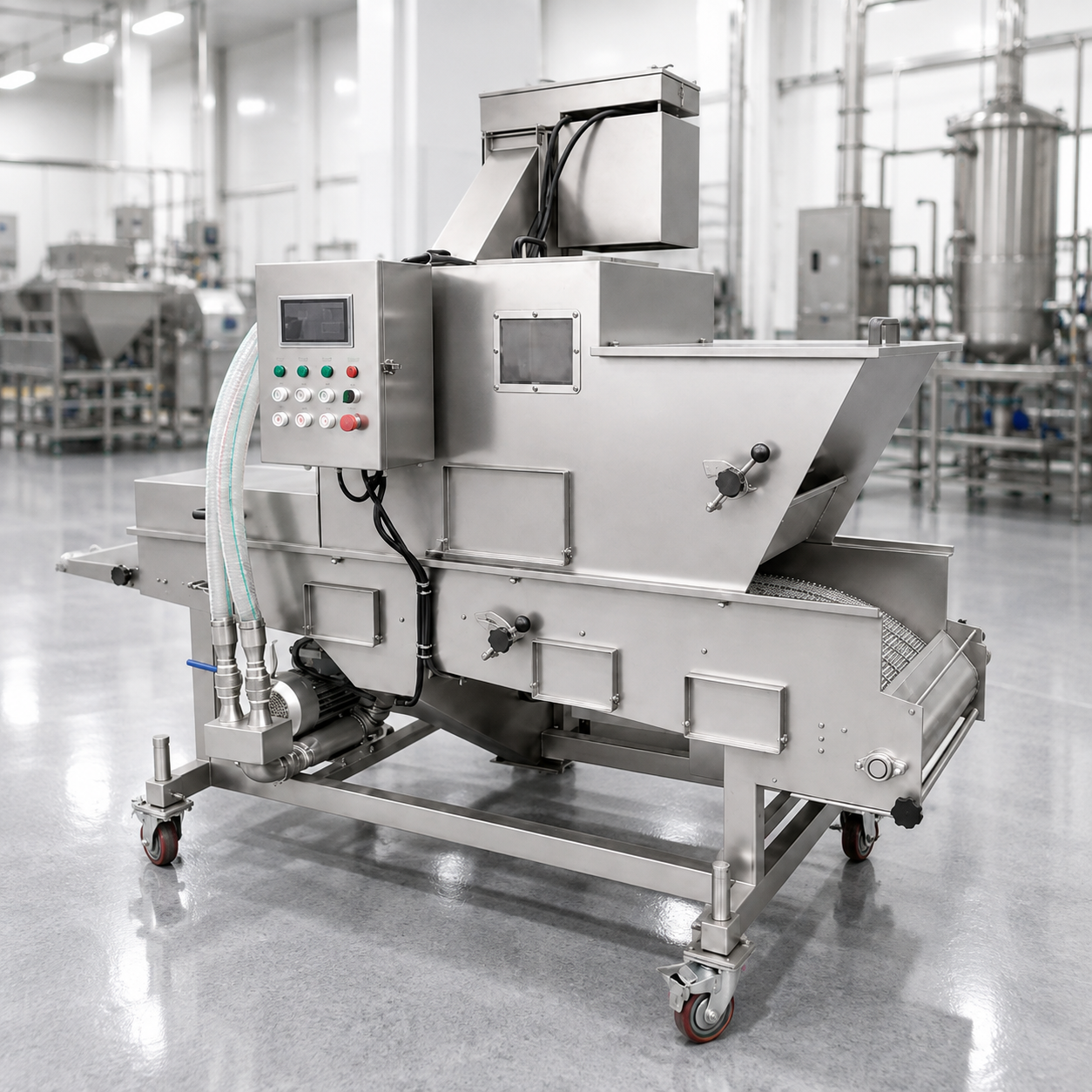
Drum breader
Tumbles product through a rotating drum of crumb instead of passing it under a shower. Tumbling reaches surfaces a flat bed cannot, which is why irregular geometry ends up here.
ApplicationsSuits: bone-in parts, irregular nuggets, homestyle flour coatings, anything a flat bed leaves bare on one side.
Section integration
- We supply the stations as one section with matched belt speeds and a common frame height, and we set the interface points to the forming machine upstream and the fryer downstream before mechanical design starts.
- Toothed quadrant levers set the submerger gap by hand, without tools.
- Belt speed, submerger gap and crumb bed depth are adjustable on the machine rather than fixed at build, so the section can follow a product change instead of blocking one. Where your existing conveyor pitch is fixed, we build to it rather than asking you to rebuild around us.
Products and Coating Media This Line Handles
The substrate decides the machine more than the recipe does. Formed patties and whole-muscle breast behave differently under the same crumb shower, and coating adhesion is measurably harder on vegetables than on red meat and poultry. Coated products are one of the largest volume categories in the food industry, and the range below is what we build food production equipment for. Where the finished item carries a label, the share of that weight allowed to be batter and breading is fixed by the label itself rather than by the machine.1
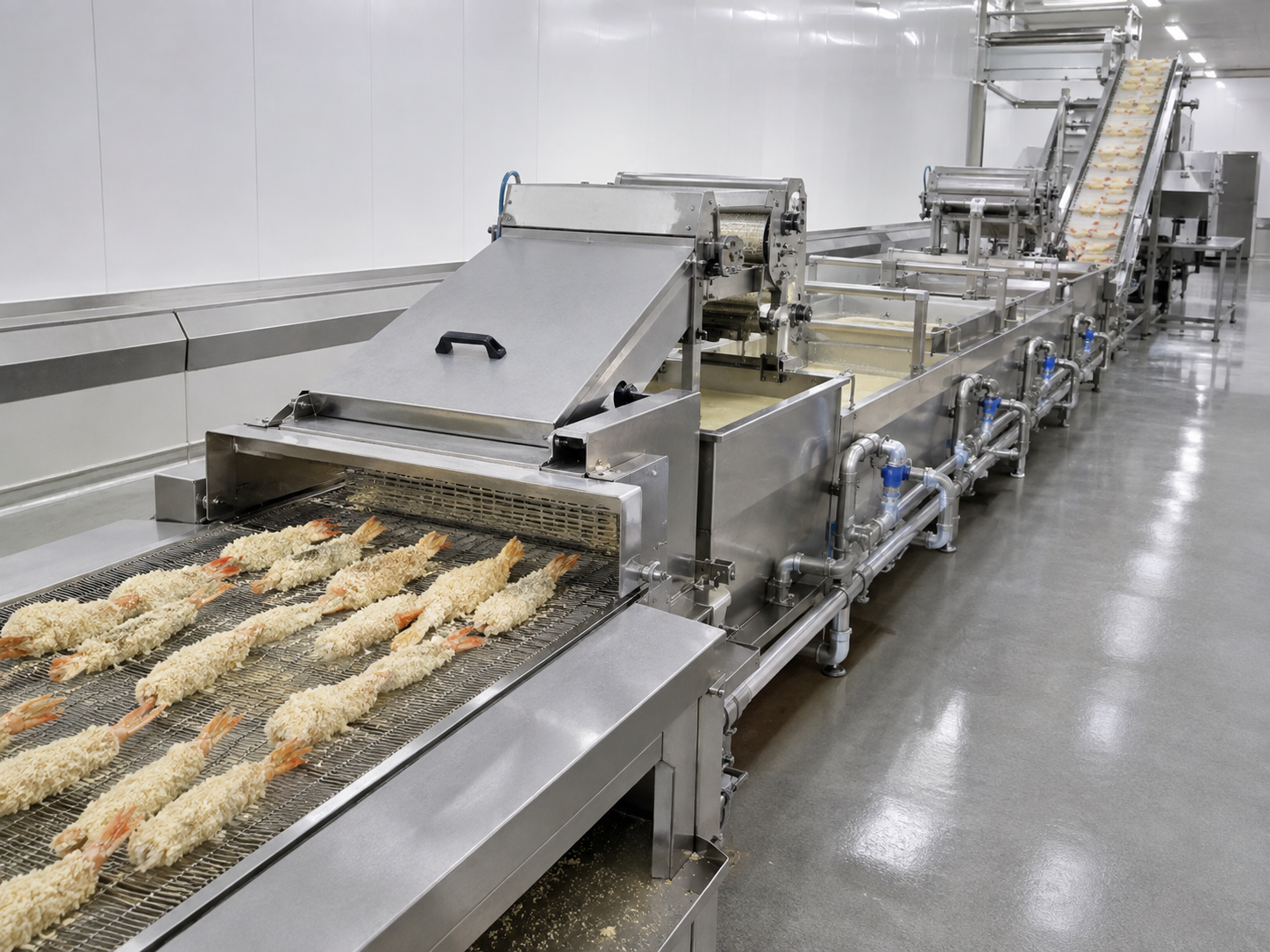
Products we coat
| Product group | Examples | What it changes in the machine |
|---|---|---|
| Formed poultry | Nuggets, patties, popcorn chicken, tenders | Uniform height suits a flat crumb bed; predust matters because formed surfaces are wet |
| Whole-muscle poultry | Breast fillet, karaage cuts, wings | Shape variation pushes towards a drum breader or a taller submerger gap |
| Bone-in poultry | Drumstick, thigh, half-cut parts | Tumbling reaches the underside; flat beds leave bare faces |
| Fish and seafood | Fillet, fish fingers, calamari, shrimp | Shrimp coating pick-up is regulated separately and runs far higher than meat |
| Red meat | Pork cutlets, schnitzel, meatballs, chicken-fried steak | Thick coatings favour the submerging route |
| Plant-based analogues | Soy and pea protein patties, vegetarian nuggets, mozzarella sticks | Lower surface protein reduces adhesion; predust and batter viscosity carry more of the load |
| Vegetables | Onion rings, mushroom, cauliflower, potato items | Adhesion is hardest here and coating can make up the majority of finished weight |
| Cheese and dairy | Mozzarella sticks, cheese bites | Full enclosure is mandatory; a single void becomes a fryer leak |
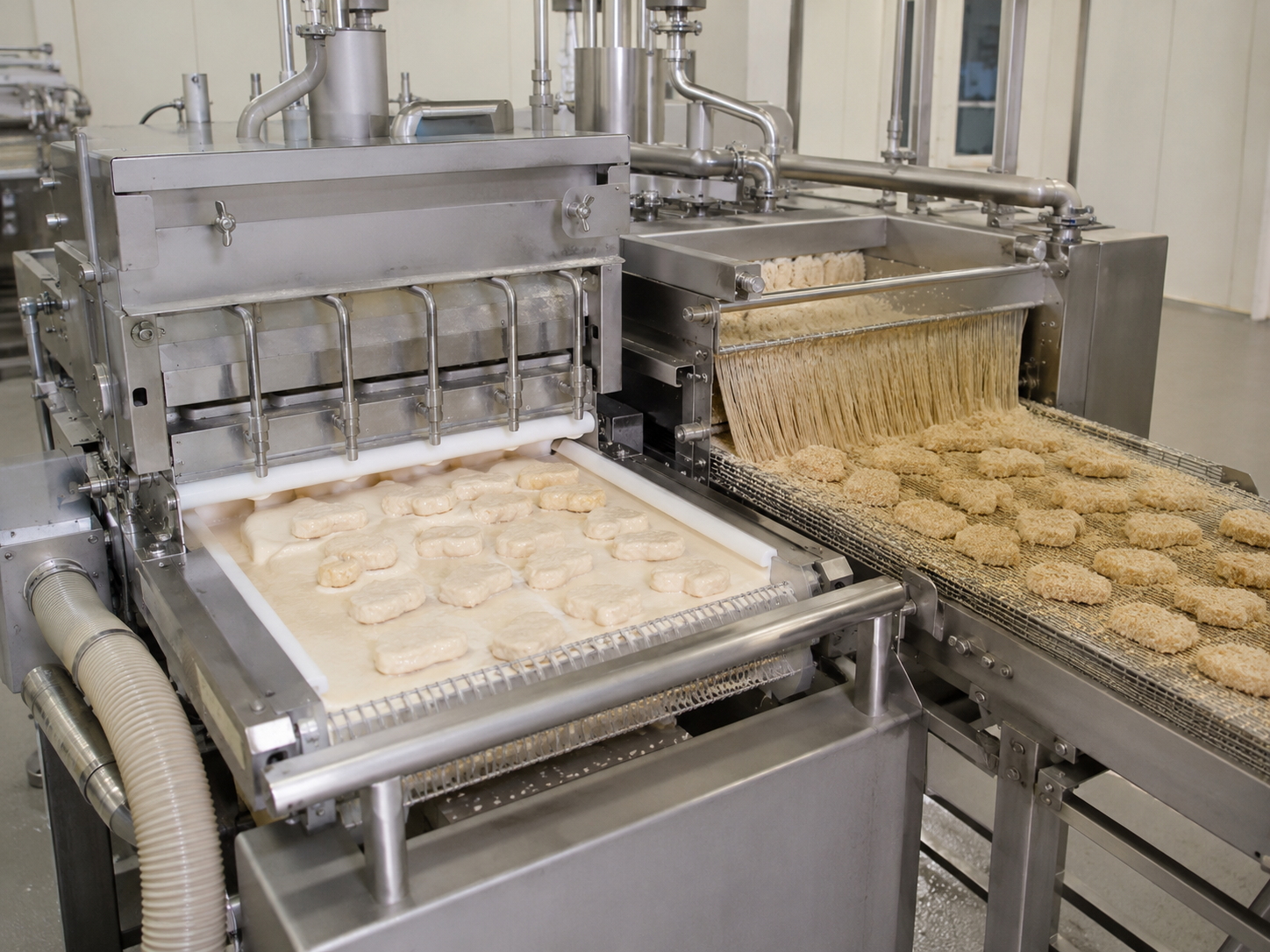
Predust
A dry coating applied directly to the substrate surface. Flour-based predusts compact and are less free flowing than crumb, so they need a flour applicator with flat-flex belts that move the powder mechanically rather than relying on gravity.
Batter
Adhesion batters are thinner and act as the glue layer. Cohesion and tempura batters carry more solids, run more viscous and build texture in their own right. Both can be applied by bath, waterfall or spray.
Crumb, cracker meal and panko
Cracker meal and standard breaders are hard, granular and durable in an applicator. Japanese style bread crumb is larger, more porous and more fragile, and needs its own applicator.
Fried chicken remains the volume anchor of the category, and chicken breading is where most buyers start, but the same breading process runs across the fried food range above without a change of machine family. Coated food products differ more by shape and surface than by recipe.
If your product is not on this list, send a photograph and the piece weight. We would rather tell you a different machine family fits than sell you the wrong station.
Send Details for Evaluation
Process Engineering
Coating Routes and What Each One Delivers
Coating pick-up is not a free yield gain. For red meat and poultry the allowable pick-up is 30 percent, and a product carrying more than that stops being a breaded product on the label and becomes a fritter. Trying to solve a coverage problem at 40 percent pick-up is not a realistic route when the ceiling is 30.1
That single boundary decides more machine selections than any brochure feature. Below is the decision grid our application engineers work through before a station list exists.
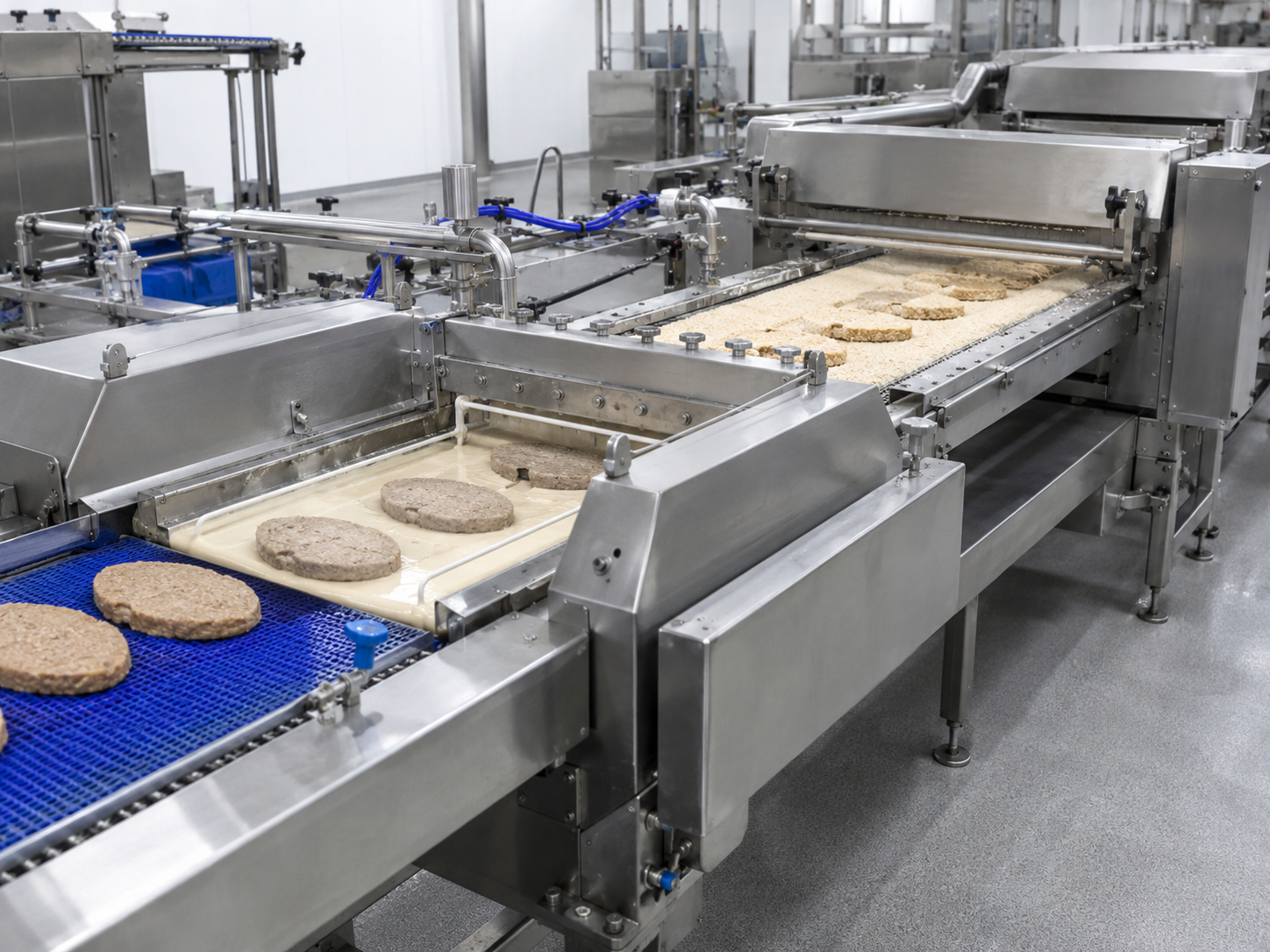
Coating Route Decision Grid
| Route | Batter viscosity | Product shape | Coating thickness | Product fragility | Powder/Batter recovery | Cleaning load |
|---|---|---|---|---|---|---|
| Predust | Not applicable, dry | Any, especially wet surfaces | Thinnest layer in the chain | Gentle | Dry recovery, simple | Low, dry circuit |
| Submerging batter | Medium to high | Regular height, needs a set gap | Thick, full enclosure | Moderate, product is held down | Batter recirculated from the tank | High, wet circuit |
| Waterfall batter | Low to medium | Spaced and oriented product | Thin to medium | Gentle, no submersion | Batter recirculated by pump, excess blown off | High, wet circuit |
| Crumb applicator | Not applicable, dry | Flat or lightly contoured | Medium to thick | Moderate, crumb is showered | Excess crumb returned to hopper | Medium, dry circuit |
| Drum breader | Not applicable, dry | Irregular, bone-in, rounded | Medium, homestyle appearance | Higher, product tumbles | Crumb recycled inside the drum | Medium, dry circuit |
Three route mistakes that cost real money
Japanese style bread crumb is porous and fragile. Push it through the extra mechanical conveying a flour applicator needs and it comes out ground fine, which is the opposite of what panko was bought for. A dedicated crumb applicator exists precisely to avoid that degradation.
Pick-up rises with viscosity, so viscosity is the primary lever on coating weight. It also drifts during a run, because water and crumb carried in on the product dilute the tank. Lab grab-samples are a poor guide since viscosity depends on temperature and shear rate, and the conditions in the beaker are not the conditions in the applicator.
A coating batter has to be set in a fryer before freezing. Skip the set and the batter keeps flowing on the freezer belt, and you get product sticking to the belt and voids where the coating was pulled off.
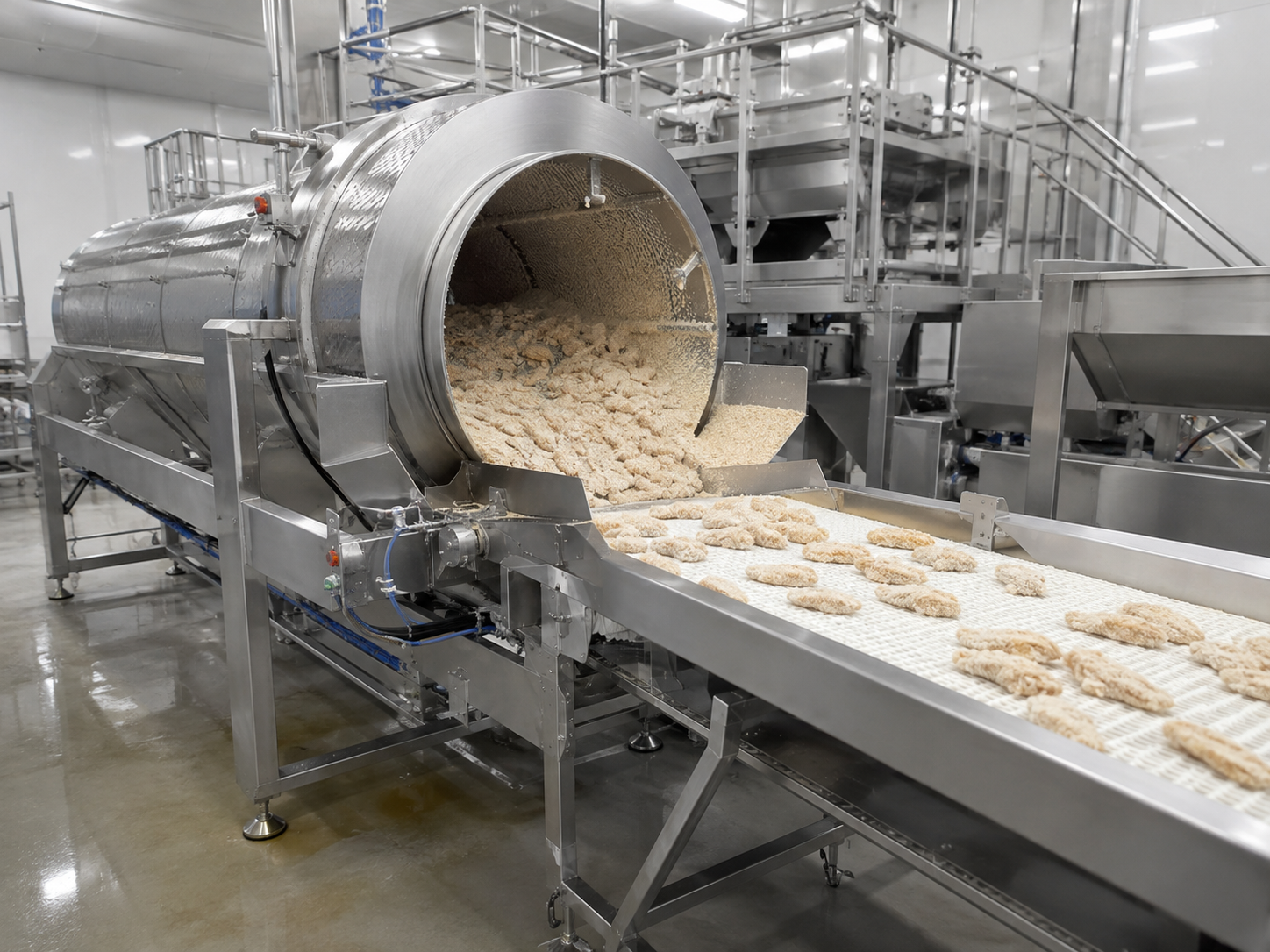
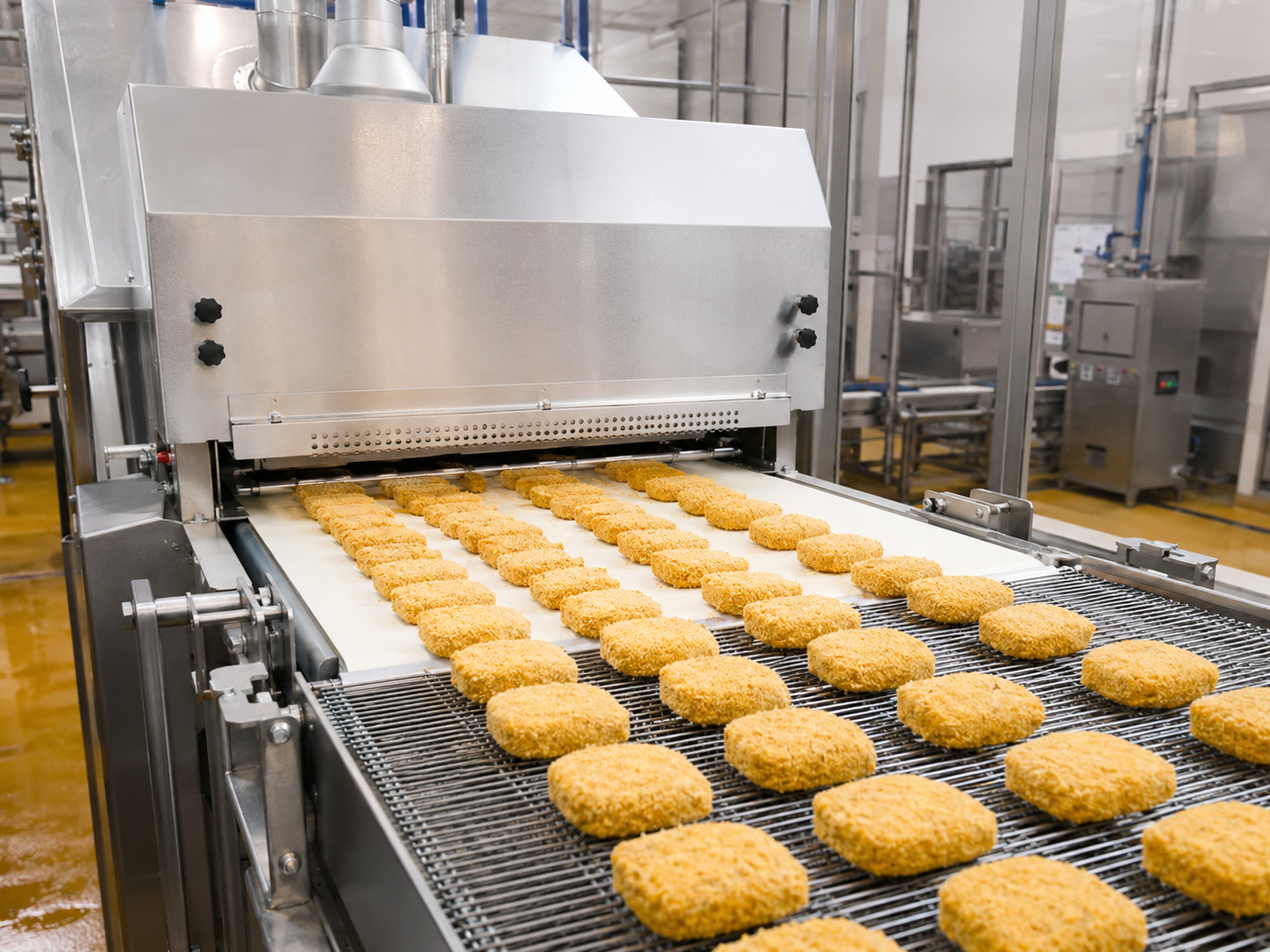
Coating consistency is what a buyer is really purchasing. A uniform coating gives even coverage on every face, and consistent coating weight is what keeps texture and appearance the same from the first case to the last.
Poor viscosity control shows up as a recognisable defect set: voids in the coating, poor adhesion, discolouration, underweight or overweight product, skirting at the product edge, and a soft doughy underlayer. If you are seeing three of those together, the problem is usually the batter circuit rather than the crumb station.
Batter and Breading Equipment Specifications and Capacity Bands
What we hold, in the terms a specification document uses. A batter breading machine is built to your product rather than picked as a catalogue model, so this table records the commitments and the standards, and the tables after it record what we need from you to fix the rest.
| Specification | What we hold |
|---|---|
| Coating stations supplied in one section | Up to 5: predust, submerging batter, waterfall batter, crumb applicator, drum breader |
| Coating pick-up target | Set to your product. Products labelled breaded under FSIS Directive 7620.3 stay at or below 30 percent batter and breading; above that the label becomes fritter, which carries up to 65 percent |
| Product contact material | Food-grade stainless steel, 304 as standard and 316L on request |
| Hygienic design reference | Built to EN 1672-2 and ISO 14159, the published hygiene and cleanability requirements for food processing machinery |
| Standard machine lead time | 30 working days after the deposit clears and the drawings are approved |
| Customised or multi-machine lead time | 30 to 45 days |
| Minimum order | 1 machine |
| Quotation turnaround | 1 working day from receiving your product, target output and voltage |
| Warranty | 12 months from commissioning, with wear parts included in the shipment and in-warranty failed parts replaced free of charge |
| Export documents | Certificate of origin, commercial invoice and bill of lading, with installation and operating manuals |
Send your product photo for a coating route opinion
Get a QuotationCoating Line Pricing Mechanism and Lead Times
Search for an industrial breading machine price and you will find nothing published anywhere in this category, because a number printed against a machine that has not been specified would be a fiction. What can be published is the mechanism, so you can see which of your own decisions move the figure before you ask for it. The same is true second-hand: used batter and breading equipment is priced on condition and configuration, not on a list.
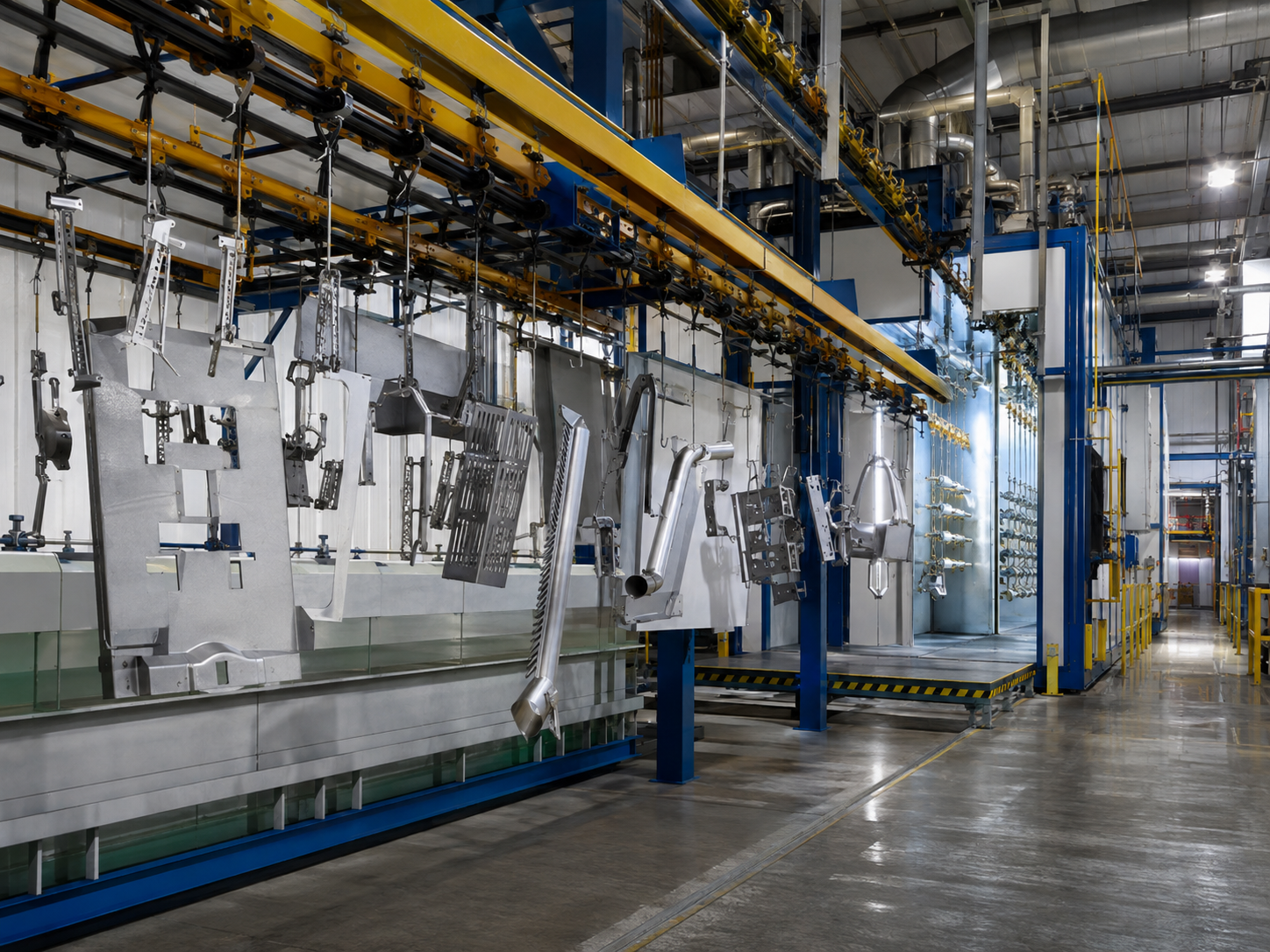
Eight variables that set the price
-
Set by your widest product and by the conveyor you are joining. Width scales frame, drive and every powder circuit around it.
-
A single crumb applicator and a four-station section are different machines commercially, not different options on one machine.
-
Tank volume, pump, recirculation and blow-off. Between them they make the wet circuit the most expensive part of a coating section, and the one buyers forget to specify.
-
Sieving and return of excess crumb. It pays for itself in ingredient cost and it is the difference between a clean room and a dusty one.
-
Motor sizing, belt speed range and frame rigidity all step up together rather than continuously.
-
Manual set points, a stored recipe menu on the panel, or integration with an existing plant control system through our STUnit platform.
-
304 as standard. 316L where your own food safety plan or a chloride exposure requires it.
-
Whether supervision, full installation and operator training sit inside or outside the quoted scope.
How the quotation is produced
-
You send the product, the target output and your supply voltage. A photograph is enough to start.
-
Your project engineer, not a form, reviews it and comes back with questions if the brief has gaps.
-
We return a written quotation within one working day, with the station list and the scope split visible.
-
You approve the drawings and pay the deposit, and the lead time clock starts from that point.
Commercial terms
A standard machine ships 30 working days after the deposit clears and the drawings are approved. Customised or multi-machine coating sections ship in 30 to 45 days. We accept a single machine as an order.
Powder recovery is the one line item that pays back in ingredient savings rather than in labour, and on a high-volume line it is usually the clearest single contributor to profitability.
Total cost is not the quotation. Oklahoma State University Extension puts the mechanism plainly: a complete specification minimises confusion between purchaser and supplier, and allows firm bids that eliminate hidden costs. The surprise invoice comes from a vague brief, not from a dishonest supplier.
Payment is a deposit against the signed contract, with the balance settled before shipment. T/T and L/C are both accepted. Your order ships in a plywood export crate that needs no fumigation treatment, so it clears customs without a heat-treatment stamp.
×
![Zoomed industrial machine]()
Hygienic Design, Factory Acceptance and the Document Pack
Coating equipment lives in a wet, floury, protein-carrying environment, and it gets swabbed. Hygienic design for food processing machinery is governed by published standards rather than supplier assurances: EN 1672-2 sets the hygiene and cleanability requirements for food processing machinery, and ISO 14159 sets the hygiene requirements for machinery design in general.
A coating section that is easy to clean is not a convenience feature. Cleanability is where efficiency and food safety stop competing with each other, because the wash-down window is production time either way.
We build to EN 1672-2 and ISO 14159. Product contact surfaces are food-grade stainless steel, 304 as standard and 316L on request, which is the grade range published equipment design guidance treats as appropriate for food contact.
What we check before a machine leaves
- Belt tracking and speed range run through the full band, loaded and unloaded, because belt speed is the setting every coating weight depends on and it has to hold its precision across the whole range.
- Batter pump, recirculation and blow-off run wet, not dry-tested.
- Crumb return circuit run to confirm the sieve and hopper feed keep up at top belt speed.
- Every product contact weld inspected for smoothness and crack-free finish.
- Control panel, emergency stops and guarding function-tested against the build drawing.
- Belt lift-out and tool-free strip-down demonstrated, timed, and recorded.
Factory acceptance, and why it matters
The objection buyers actually raise about an overseas supplier is not brand age. It is sequencing: do I pay before I see it work.
Factory Acceptance Testing is the contract-defined acceptance event held at the manufacturer’s premises before you accept shipment. It checks the technical specification, the drawings, the performance requirements and the documentation pack against what was contracted. We hold it on site or remotely by live video walkthrough, and it produces a dated report with a non-conformity log.
The commercial logic is asymmetric and it favours you. A non-conformity found in our workshop costs supplier hours. The same fault found after shipping, customs clearance and installation costs materially more, and drags a schedule penalty behind it.
What ships with the machine
Your order ships with the certificate of origin, the commercial invoice and the bill of lading, together with the installation and operating manuals. Wear parts travel in the shipment, and the warranty runs 12 months from commissioning, with parts that fail inside it replaced free of charge.
Certifications we hold
CE
ISO 9001 quality management
ISO 27001 information security
SGS
DCMM Level-2
Patents, software copyrights and registered trademarks
From Your Product Spec to a Commissioned Line
Product, target output, crumb type, supply voltage, and the equipment either side of the coating section. If you do not have all of it, send what you have and we will tell you which gap actually blocks the quotation.
A station list, a layout drawing and a written quotation come back within one working day. We own the layout, including the interface points to your existing conveyors.
Nothing is cut until you have signed off the general arrangement. The lead time clock starts here, not at enquiry.
Built in our own works, with in-process inspection points rather than a single check at the end.
Witnessed on site or remotely, producing a dated report with the non-conformity log. Anything found here is ours to fix before shipping.
Our technicians supervise erection, start-up and operator training at your plant. Travel and accommodation for overseas dispatch are borne by the buyer, and we say so before you ask.
Line Balance Gate
Raising one machine’s nominal capacity does not raise line output. Food Safety Magazine states the mechanism directly: if equipment upstream or downstream cannot accommodate the new flowrate, the goals may not be met. The same source warns that bigger is not always better, because equipment that is too large can challenge the processing system and the increase will not be fully utilised.
Coating sits inside a workflow that starts at portioning and ends at the freezer, and it cannot be specified as though it were the whole line. That is why we ask about the forming machine and the fryer before we size the coating section. Six checks decide whether new coating capacity will actually appear as finished product.
| Check | What to measure | What a failure looks like |
|---|---|---|
| Upstream feed rate | Forming or portioning output in pieces per hour at your run speed, not its nameplate | Coating belt runs part-loaded and the new capacity never materialises |
| Product spacing | Whether product arrives spaced and oriented or bunched | Touching product leaves bare faces that no coating setting fixes |
| Downstream fryer capacity | Fryer throughput and dwell time at the coating weight you are targeting | Coated product backs up, or coating is reduced to fit the fryer |
| Batter setting before freezing | Whether a prefry stage exists between coating and the freezer | Liquid batter flows on the freezer belt, causing sticking and coating voids |
| Belt pitch and transfer height | Pitch and discharge height of the stations either side | Product drops, flips or damages the coating at every transfer |
| Utilities at the line terminal | Voltage, phase, frequency, and available load at the connection point | The machine arrives and cannot be energised on schedule |
“Every buyer asks what capacity the machine runs. The question that actually predicts their output is what the forming machine and the fryer run, at the coating weight they are targeting. Those are two different conversations, and the honest one belongs at the drawing stage rather than at commissioning.”
If any check fails, the honest answer is often a smaller machine plus a change elsewhere, and we would rather say that during process design than discover it during commissioning. The same line-integration logic runs through our fruit and vegetable processing lines, where station order and utility matching decide the outcome in exactly the same way.
Where an Automatic Coating Line Is the Wrong Answer
Four situations where we will tell you not to buy this, and what to do instead.
View Solutions
You are a commercial kitchen, not a factory
If you are coating to order behind a counter, a continuous coating section is the wrong shape of machine and the wrong shape of cost. What you want is a breading table or a commercial breading machine sold with a published price, and that is a different supply chain to ours.
Your product changes every week
Coating sections reward a stable product family. If your run mix changes constantly, the changeover cost can eat the automation gain, and the honest first step is to fix the product mix and then automate the settled part of it.
Your bottleneck is upstream or downstream
If forming or frying is the constraint, a faster coating section adds nothing except a part-loaded belt. Run the line balance checks first. That answer costs you nothing and it is the answer more often than suppliers admit.
You are chasing yield through coating weight
Reducing breading pick-up towards the low end of your specification is usually worth more than raising it. More coating is not free margin. Cross 30 percent on red meat or poultry and the label changes.1 Over-coating also produces dark exteriors, a mushy coating texture, and an insulating layer thick enough to leave centres undercooked.
Battering & Breading Machine Engineering Tools
Configure the optimal batter, breading, and predust equipment sequence tailored to your specific product formulation.
Evaluate production line capacity, identify potential bottlenecks, and ensure synchronized operation across your coating processes.
Compile all critical technical parameters and utility requirements needed to generate an accurate, custom equipment proposal.
Frequently Asked Questions
What is a breading machine?
A breading machine applies a dry coating, usually breadcrumb, cracker meal or panko, to a food product carried on a belt. In a factory it is one station in a coating section that also includes a predust applicator and a batter applicator, and it replaces hand coating at a rate a hand line cannot hold.
What are the different types of breading machines?
Two families cover almost everything. Flat-bed crumb applicators bed product on a lower crumb layer and shower an upper layer, which suits flat and lightly contoured product. Drum breaders tumble product through a rotating crumb drum, reaching the surfaces a flat bed leaves bare, which suits irregular or bone-in product.
Are batter and breading the same thing?
No. Batter is the liquid layer; breading is the dry particulate layer applied on top of it. Each needs its own station.
What is the difference between a submerging and a waterfall batter applicator?
A submerging applicator carries product under the batter surface so every face is wetted at once, which suits thicker batters and egg-wash systems. A waterfall applicator runs a falling curtain over product on an open mesh belt, which suits thinner adhesion batters and higher belt speeds. The choice follows your batter viscosity and your target coating thickness.
How is throughput measured, in kilograms per hour or pieces per hour?
Both, and they only convert through your own numbers. A capacity in kilograms per hour is a mass rate; pieces per hour is a count rate; the bridge between them is the coated piece weight and how densely the belt can be loaded without product touching. Ask every supplier for both figures, stated per machine.
Which products can this machine coat?
Formed and whole-muscle poultry, bone-in parts, fish and seafood, red meat cutlets, plant-based analogues, vegetables and cheese items. The substrate matters more than the recipe, because adhesion behaves differently on vegetables than on red meat and poultry, and shape decides whether a flat bed or a drum is right.
How does an automatic coating line help with rising labour costs?
It moves coating from a manned station to a belt, which changes both headcount and consistency. We do not publish a payback figure, because a credible one depends on your loaded hourly rate, your current headcount on the coating station and your ingredient loss, and any number we printed would be marketing rather than engineering. The variables are listed in the ordering section so you can run them on your own figures.
How do I choose which automatic breading machine is right for my line?
Work through the coating route grid first, because product shape, batter viscosity and crumb type eliminate most of the field before capacity is even discussed. Shape decides whether a flat bed or a drum is right, crumb type decides whether the applicator has to be gentle, and batter viscosity decides whether you are submerging or running a curtain. Only then are you comparing comparable machines. Next run the line balance checks against your forming machine and fryer, because a coating section faster than either of them buys you a part-loaded belt and nothing else. Capacity is the last question you settle, not the first one you ask, and any supplier who leads with a capacity figure has skipped the two decisions that actually determine whether the machine suits your product.
Will an automatic coating machine improve consistency?
Consistency is a machine and a process question together. A belt applies coating more repeatably than a hand station, but pick-up still moves with batter viscosity, and viscosity drifts during a run as water and crumb from the product dilute the tank. Controlling the batter circuit is what holds the result, and that is why the wet circuit is specified as carefully as the belt.
How does machine design affect hygiene?
Through cleanability rather than through claims. EN 1672-2 and ISO 14159 set the requirements; our factory acceptance test demonstrates them.
Why is the initial investment in a coating section significant?
Because a coating section is typically three or four machines, and the wet circuit inside it carries pumps, tanks, recirculation and blow-off. Industry-typical thinking treats the crumb applicator as the whole purchase, which is where budgets go wrong. Ask for the station list, not the machine name.
Can the coating section be integrated with an existing forming machine and fryer?
Yes, and the interface points are set before mechanical design starts rather than discovered on site. We need the make and rated output of the equipment either side, the belt pitch and discharge height, and the utilities available at the line terminal. Where your existing pitch is fixed, we build to it.
![Dry Kibble Extrusion Line: Process Control Guide [2026]](https://shengtumachinery.com/wp-content/uploads/2026/08/dry-kibble-extrusion-line-guide-featured-150x150.png)